Morrison govt approved Yeelirrie uranium mine just the day before calling the election
|
Government approved controversial uranium mine one day before calling the election ABC News, 25 Apr 19, by national environment, science and technology reporter Michael Slezak, The Morrison Government signed off on a controversial uranium mine one day before calling the federal election, and did not publicly announce the move until the environment department uploaded the approval document the day before Anzac Day.
Key points:
The Yeelirrie Uranium mine, located 500 kilometres north of Kalgoorlie in Western Australia, requires both federal and state approval. The state approval of the proposed mine is still being fought in the state’s Supreme Court by members of the Tjiwarl traditional owners. In 2016, the West Australian Environment Protection Agency advised the mine not be approved, concluding it posed too great a risk of extinction to some native animals. The former Liberal Barnett government controversially approved the mine in 2017, just weeks before it lost the West Australian election. Canadian company Cameco, the world’s largest uranium producer, is seeking to develop the uranium mine, which would cover an area 9km long and 1.5km wide. It would involve the clearing of up to 2,422 hectares of native vegetation. It is also approved to cause groundwater levels to drop by 50cm, and they would not completely recover for 200 years, according to Cameco’s environmental reports. A spokesperson for Environment Minister Melissa Price said the approval was subject to 32 strict conditions to avoid and mitigate potential environmental impacts. Traditional owner of the area, Tjiwarl woman Vicky Abdullah, said she was surprised by the announcement, and was hoping for the project to be rejected. “It’s a very precious place for all of us. For me and my two aunties, who have been walking on country,” she said……. Ms Price has declined an interview with the ABC. …… Dave Sweeney, an anti-nuclear campaigner at the Australian Conservation Foundation, said the timing suggested the decision was political. “We need decisions that are based on evidence and the national interest, not a company’s interest or not a particular senator’s or a particular government’s interest,” he said. “This reeks of political interference, rather than a legal consideration or due process.” The approval is one of several controversial moves the Government made before entering caretaker mode, where such decisions would be impossible, including approving Adani’s two groundwater management plans for its proposed Carmichael coal mine. At a federal level, both Labor and the Coalition support the development of uranium mining in Australia…….. The company said the mine was expected to produce up to 7,500 tonnes of yellow cake concentrate over a 15-year period. Over its life, the mine would produce around 36 million tonnes of radioactive waste, which would be stored at the site. The West Australian EPA’s recommendation to block the mine was based primarily on the impacts the mine would have on animals that live in groundwater, called stygofauna. Dr Tom Hatton, chairman of the West Australian EPA, said there was more stygofauna in the area near the mine “than anywhere else in the northern Goldfields”. “The stygofauna habitat at Yeelirrie is particularly rich, with 73 species recorded,” Dr Hatton said in 2017. The federal approval is conditional on Cameco producing a groundwater management plan, which manages the risks to those animals. It also has a number of other conditions, including surveys to confirm reports of night parrots in the area, and if they are found, a night parrot management plan would be required. Ms Abdullah told the ABC she and her family have used the area for years to hunt and camp. “Where are all the next generation of our kids going to go,” Ms Abdullah asked……. Ongoing court challengesIn October, it was reported that Ms Price would not approve the mine before the court case in Western Australia was resolved. “My department advised that it was prudent to wait for the result of the WA Supreme Court proceedings before finalising the Federal assessment,” she reportedly told the Kalgoorlie Miner. “This ensures that we know the state decision is valid and we can avoid overlapping with any state approval conditions.”…….https://www.abc.net.au/news/2019-04-26/government-approved-uranium-mine-day-before-election/11047252 |
|
Yeelirrie has a low grade of uranium, and Cameco has closed McArthur River mine with a much higher grade
 It’s not worth wiping out a species for the Yeelirrie uranium mine, SBS, BY GAVIN MUDD “……. So are the economic benefits worth wiping out a species?
Short answer: no. But let’s, for a moment, ignore these subterranean animals and look at whether the mine would be beneficial.
Yeelirrie is one of Australia’s largest uranium deposits – and yet it has a low grade of 0.15 per cent (as uranium oxide). This refers to the amount of uranium found in rock. For comparison, the average grade of uranium mines globally is normally 0.1 to 0.4 per cent of uranium oxide (with some higher and others lower).
And Cameco’s Cigar Lake and McArthur River mines in Canada have typically been 15-20 per cent of uranium oxide. Despite such rich ore, McArthur River was uneconomic and closed indefinitely in early 2018.
What’s more, the future of nuclear power is not bright. According to the World Nuclear Industry Status Report, the number of nuclear reactors under construction around the world is at its lowest point in a decade, as renewable energy increases. The amount of nuclear electricity produced each year is flat. And nuclear’s share of global electricity is constantly falling behind renewables……..https://www.sbs.com.au/news/it-s-not-worth-wiping-out-a-species-for-the-yeelirrie-uranium-mine
It’s not worth wiping out a species for the Yeelirrie uranium mine
 SBS, BY GAVIN MUDD 26 Apr 19, Like the rest of the Western Australian outback, there’s a wonderful paradox where the land appears barren, but is, in fact, rich with biodiversity – and animals are under threat of extinction if the mine goes ahead. The Western Australian outback may look bare at first glance, but it’s teeming with wildlife, often beneath the surface.
The Tjiwarl Traditional Owners have fought any uranium mining on their land for the last 40 years, and the decision by the government wasn’t made public until the day before Anzac Day……..
This region is home to several of Australia’s deposits of uranium and not only holds cultural significance as part of the Seven Sisters Dreaming Songline, but also environmental significance. If the mine goes ahead, groundwater levels would drop by 50cm and wouldn’t fully recover for 200 years. And 2,422 hectares of native vegetation would be cleared.
I visited the site 16 years ago and, like the rest of the Western Australian outback, there’s a wonderful paradox where the land appears barren, but is, in fact, rich with biodiversity.
Native animals living in underground water, called stygofauna, are one such example of remarkable Australian fauna that aren’t obvious at first glance. These animals are under threat of extinction if the Yeelirrie uranium mine goes ahead.
Stygofauna are ecologically fragile
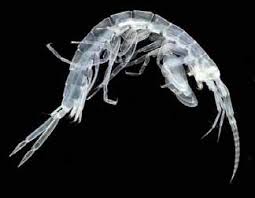
Most stygofauna are very tiny invertebrates, making up species of crustaceans, worms, snails and diving beetles. Some species are well adapted to underground life – they are typically blind, pale white and with long appendages to help them find their way in total darkness.
n 2016, the Western Australian Environmental Protection Agency (EPA) advised against building the Yeelirrie uranium mine because it would threaten the stygofauna species there, despite the proposed management strategies of Cameco Australia, the mine owner.
Stygofauna are extremely local, having evolved in the site they’re found in. This means individual species aren’t found anywhere else in the world. EPA chairman Tom Hatton said:
Despite the proponent’s well-considered management strategies, based on current scientific understanding, the EPA concluded that there was too great a chance of a loss of species that are restricted to the impact area.
And to get to the uranium deposit, the miners need to dig through the groundwater, a little like pulling the plug in the middle of the bathtub. Stygofauna have adapted to living at different levels of the water, so pulling out the plug could dry out important parts of their habitat.
Stygofauna are also susceptible to any changes in the chemistry of the groundwater. We simply do not know with confidence what mining will do to the groundwater chemistry at Yeelirrie in the long term. Various wastes will be backfilled into former pits, causing uncertainty for the welfare of surrounding stygofauna.
The approval conditions suggest that the mine should not be allowed to cause extinction – but if this does happen, nothing can be done to reverse it. And there would be no penalty to Cameco either – which has said it can’t guarantee such a condition can be met………..https://www.sbs.com.au/news/it-s-not-worth-wiping-out-a-species-for-the-yeelirrie-uranium-mine
Australian Mining touts Honeymoon uranium mine, but only IF URANIUM PRICE IMPROVES
They headed the article “Boss discovers ‘major breakthrough‘ for Honeymoon uranium expansion ” and went on to detail how the Honeymoon uranium mine project restart in South Australia will ramp up production. But even in its enthusiasm, , Australian mining gave a hint about the low prospects for the uranium industry. It will all happen – “ assuming a favourable global uranium price for shareholders is achieved” https://www.australianmining.com.au/news/boss-resources-discovers-major-breakthrough-for-honeymoon-expansion/
Uranium tailings at Olympic Dam – radioactive for at least 10,000 years- must be SAFELY managed!
Initial Scoping – Olympic Dam Expansion Issues 22 Feb 2019 David Noonan B.Sc., M.Env.St., Independent Environment Campaigner“……….Radioactive Tailings Management
The 1982 Indenture places an onus on the SA Gov. to grant approvals on terms to facilitate mining.
Roxby Tailings Storage Facilities are to be covered and ‘disposed’ above-ground as final landforms.
Civil society must not accept continued downgrade of standards in Roxby uranium mine expansions.
A full comprehensive safety assessment to determine long term risks from radioactive tailings must be a core required part of this assessment AND apply the 1999 standards set at Ranger mine.
The most recent assessment of Radioactive Tailings Management at Roxby granted Federal and SA Gov. Approvals (Nov 2011) to vastly increase tailings production (from the now lapsed open pit mine proposal) prior to actually carrying out this type of safety study on the long term risks from tailings.
The 2011 Roxby Approvals downgraded the key 1999 standards applied to Ranger uranium mine.
Instead of Federal Gov. required final disposal of tailings (in to a pit) “in such a way to ensure that:
- i)The tailings are physically isolated from the environment for at least 10,000 years;
- ii) ii) Any contaminants arising from the tailings will not result in any detrimental environmental impact for at least 10,000 years;” Olympic Dam Condition 32 Mine Closure (Nov 2011) defers a Mine Closure Plan and only applies unstated environmental outcomes: “that will be achieved indefinitely post mine closure”, and:
“c. contain a comprehensive safety assessment to determine long term (from closure to in the order of 10,000) risk to the public and the environment from the Tailings Storage Facility and Rock Storage Facility.”
Requiring outcomes to “be achieved indefinitely” does recognise that tailings risks are perpetual.
However, rather than specific high standards of outcome set at Ranger for at least 10,000 years, this 2011 approval has unstated outcomes and only references 10,000 yrs as a period of modelling study.
In April 2013 Condition 32 was amended to further defer the safety risk assessment, from “within two years of the date of the approval”, to: “prior to the construction of the Tailings Storage Facility”.
A “No Uranium Recovery” alternative leaves all uranium & associated radioactive decay products in the tails. Roxby mine extracts approx. 2/3 of the uranium from the ore, with 1/3 left in the tailings.
In current mining practice, tailings retain some 90 per cent of the radioactivity in the ore (given the decay product radionuclides remain, thorium & radium ect). Deporting all uranium to the tails doesn’t affect the public interest requirement, in any case, to isolate tailings for over 10,000 years.
Note: BHP “Tailings Facility Update” (19 Feb 2019) claims a review shows “no significant deficiencies” at Olympic Dam Tailings Storage Facilities and says: “BHP supports calls for greater transparency in tailings management disclosure”. The BHP “Dams and Tailings Management” page cites “establishment of independent Tailings Stewardship Boards to undertake reviews”, and says: “A trial of the stewardship program has been completed at our Olympic Dam asset in SA”. https://nuclear.foe.org.au/wp-content/uploads/Noonan-Olympic-Dam-Expansion-2019.pdf
BHP wants the South Australian government to further weaken standards at Olympic Dam uranium mine
Initial Scoping – Olympic Dam Expansion Issues 22 Feb 2019 David Noonan B.Sc., M.Env.St., Independent Environment Campaigner “……… Mine Expansion Assessment – to drive down Standards?
BHP will shortly release a formal Application to the SA Gov., the SA State Planning Commission & Mines Minister will decide the level of assessment and reporting requirements, and the SA Gov. release “Guidelines” to the EIS. Public consultation & NGO input should occur on draft Guidelines.
These Guidelines to the EIS are crucial to the credibility of the mine expansion assessment and this process is likely to be conducted before the Federal election and to be near binding thereafter.
There are a range of reasons for concern over this Roxby mine expansion project and assessment:
- Public interest appraisal of this 2019 project needs to draw on analysis of BHP Roxby operations from 2005-06 and expansion proposals, process, decisions & conditions to 2013;
- The outdated 1982 Indenture imposes extraordinary legal privileges and vested interests of the proponent, including over Aboriginal Heritage, that are intended to continue to apply;
- A new SA Mining Act currently before Parliament to apply updated standards to all other mining projects in SA is not proposed to apply to SA’s largest mine: BHP Olympic Dam;
- Roxby is also governed by the Mine Works and Inspection Act 1920 which solely provides the powers for Mine Inspectors to enter & inspect and to make Orders, however the Depart has sought to repeal this Act and roll these powers over Roxby into the proponents Indenture;
- The SA Gov.’s Major Project Declaration has sought to impose serious limitations on this assessment, contrary to the standards, coverage, analysis and transparency that are required to inform good public interest decisions and conditions in this case
; · Successive SA Gov.’s have failed to secure a Rehabilitation Bond over the Olympic Dam mine. This process must now do so, requiring a new appraisal of liabilities over all mine operations: existing, enabling 200 000 tpa, and proposed expansion works and impacts; ;
- Olympic Dam should be subject to a statutory mandated 100 per cent Bond applying the ‘most stringent conditions’ over estimated Rehabilitation Liabilities to ensure full costs in radioactive ore mining are secured in advance. See D Noonan submission (April 2017) to the Federal Inquiry on Rehabilitation of Mining (due to report 20 March
- 2019): https://www.aph.gov.au/DocumentStore.ashx?id=3ecf8af6-a640-47d9-96c0-22c03df14728&subId=510447
- Radioactive Tailings Storages at Roxby are designed and operated to leak liquid wastes, with inadequate lining to cut costs. The BHP open pit expansion proposal was also designed to leak. This 2019 expansion project is highly likely to be designed to leak and to cut costs by failing to require physical isolation of tailings from the environment for at least 10 000 years;
- This assessment should include a range of alternatives to the proponent’s vested interest preferences, including that the ‘No Uranium Recovery’ option to only trade in copper and other non-radioactive products should be assessed across all Roxby operations;
- The SA Gov. has a significant conflict of interest in this case and the ‘one stop shop’ Bilateral Assessment Agreement Clause 8.1, c (ii) seeks to constrain the coverage of Conditions applied by the Federal Minister. In practice, this Federal Liberal Gov. failed to impose Conditions on Radioactive Tailings Management in granting uranium mine Approvals in WA;
- The next Federal Gov. must apply the ‘most stringent conditions’ on all uranium mining operations & reject ‘clearly unacceptable impacts’ on MNES under EPBC including on the fragile Mound Springs, as the State of South Australia can-not be relied upon to do so……. https://nuclear.foe.org.au/wp-content/uploads/Noonan-Olympic-Dam-Expansion-2019.pdf
Olympic Dam: Uranium responsibilities and alternative ‘No Uranium Recovery’
“Olympic Dam Mega-Expansion Without Uranium” Report Launch
Initial Scoping – Olympic Dam Expansion Issues 22 Feb 2019 David Noonan B.Sc., M.Env.St., Independent Environment Campaigner “………..Uranium responsibilities and alternative ‘No Uranium Recovery’
Since opening in 1988, Roxby mine has produced toward 80 000 tonnes of uranium oxide and left toward approx. 200 million tonnes of radioactive tailings to remain above ground on-site for-ever.
While this Roxby project is assessed in 2019-20 to a cited BHP Board decision in late 2020, the RioTinto Ranger open pit mine will close and go onto rehabilitation, leaving BHP’s Roxby mine and General Atomics Beverley 4 Mile mine in SA as the only operating uranium mines in Australia.
The Nuclear Free Movement & allies have a responsibility to contest this BHP Roxby mine expansion:
- Australian uranium (from both Roxby & Ranger mines) fueled the Fukushima nuclear disaster in 2011, always produces intractable nuclear waste, and present’s ongoing dual-use nuclear weapons risks and untenable nuclear accident risks. Australia’s uranium sales deals are also marked by secrecy;
- Australian uranium is routinely sold to nuclear weapon states failing to honor their NPT nuclear disarmament obligations, to non-transparent regimes in China (and previously Russia), and is intended to go on to unstable regions: to the UAE in the Middle East, to Ukraine, and to India – outside of the NPT and in a nuclear arms race with Pakistan.
This BHP Roxby expansion is intended to increase and to ‘lock in’ Australia’s complicity in untenable nuclear risks & impacts, rather than the needed phase out of uranium mining and export sales deals.
In response to the prior BHP Olympic Dam open pit mine plan, the Australian Greens released a report by academic Dr Gavin Mudd “The Olympic Dam Mega-Expansion Without Uranium Recovery” (Dec 2010), with no uranium and only non-radioactive products to leave the Roxby mine.
In the public interest, this technically viable alternative mine configuration – with significant reduced water usage, should be re-appraised in light of this 2019 Roxby mine expansion plan, see the 2010 Report at: http://users.monash.edu.au/~gmudd/files/Odam-Cu-only.pdf
As Senator Scott Ludlam & SA Greens MLC Mark Parnell have said, this is a challenge to BHP and to the SA & Federal gov’s to assess credible alternatives with better environmental outcomes – both here & overseas, see the Report Launch at: https://www.youtube.com/watch?v=8qAVtPYcNmU
Note: Uranium has declined over time as a share of Olympic Dam revenue to less than 20 per cent.
ACF/ D Noonan have campaigned for ‘No Uranium Recovery’ at existing & any expanded Roxby mine…….”. https://nuclear.foe.org.au/wp-content/uploads/Noonan-Olympic-Dam-Expansion-2019.pdf
BHP’s grand plans for Olympic Dam uranium mine, using old legislation for open slather on water, Aboriginal rights, environment
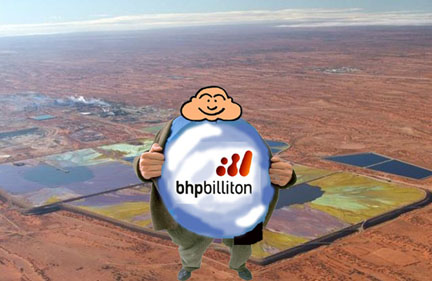
Initial Scoping – Olympic Dam Expansion Issues 22 Feb 2019 David Noonan B.Sc., M.Env.St., Independent Environment Campaigner The BHP Roxby ‘Major Project’ Copper & Uranium Mining Proposal: ‘Olympic Dreams: Major step for $3 billion, 1800-job North mine expansion’ (15 Feb, p.1 promo The Advertiser) as SA Gov. grant’s “Major Project” status to assess BHP’s latest expansion plan, to:
- Increase copper production from 200,000 tonnes per annum to 350 000 tpa, with an increase in ‘associated products’ – uranium oxide: from 4 000 to approx. 6 000 tpa;
- Use the outdated 1982 Roxby Downs Indenture Ratification Act to control this EIS assessment under the Mining Minister, with the Indenture over-riding other SA legislation and subjecting Aboriginal Heritage to a constrained version of a 1979 Act across BHP Olympic Dam operations in the Stuart Shelf Area (covering 1 per cent of SA) – rather than the contemporary standards, process and protections in the Aboriginal Heritage Act 1988;
- Use a since replaced 1993 Development Act and “Major Project” status Sec. 46 (1) that excludes Appeals regarding the Environment Impact Statement (EIS) process and outcomes;
- Use a ‘one stop shop’ Bilateral Assessment Agreement leaving the SA Gov. to conduct the assessment, including on Matters of National Environmental Significance (MNES)under the Commonwealth Environment Protection legislation (EPBC Act 1999), on nuclear actions and on the fragile Mound Springs Endangered Ecological Community – reliant on GAB waters;
- Use the SA Gov. Declaration to “Exclude” existing mining and “enabling activities” up to 200 000 tpa Cu & associated products and resultant impacts from this EIS assessment, “such as: waste treatment, storage and disposal, including but not limited to, Tailings Storage Facility 6, Evaporation Pond 6, additional cells for the contaminated waste disposal facility, and development of a low-level radioactive waste storage facility”;
- And to increase extraction of Great Artesian Basin fossil water “up to total maximum 50 million litres a day annual average” (above the volumes last assessed in 1997 and set at a max of 42 Ml/day) and give BHP rights to take GAB water – potentially up to 2070, with “any augmented or new water supply pipeline from the GAB along with any other wellfield”;…… ……. . https://nuclear.foe.org.au/wp-content/uploads/Noonan-Olympic-Dam-Expansion-2019.pdf
Traditional owners and Western Australia’s Conservation Council continue legal action, to uphold environmental law
 WA are continuing their fight against a proposed uranium mine, fearing unique subterranean fauna in the project area will be made extinct if it proceeds.
“Stygofauna might be a relatively obscure species. In fact, these particular species of stygofauna were not known to science until the proponent started exploring for uranium in that area,” Mr Verstegen said on Tuesday.
“But the legal precedent here has much broader implications.
“We’re certainly very keen to be upholding environmental laws … which were never intended to be used by a minister or a government to approve the extinction of species.”
The matter was heard on Tuesday and a decision will be handed down at a later date.
Conservation Council of Western Australia (CCWA) and three Tjiwarl Traditional Owners in court battle against uranium mining
WILDLIFE AND TRADITIONAL OWNERS REPRESENTED IN LANDMARK LEGAL CHALLENGE http://www.ccwa.org.au/landmark_legal_challenge?utm_campaign=nuclear_news68&utm_medium=email&utm_source=ccwa
The Conservation Council of Western Australia (CCWA) and three Tjiwarl Traditional Owners have continued their landmark legal bid to prevent the extinction of multiple species and protect Aboriginal lands from uranium mining at Yeelirrie, with a hearing in the WA Court of Appeal today.
The Yeelirrie mine proposal by uranium miner Cameco in the Northern Goldfields on Tjiwarl Native Title land was approved by the Minister for the Environment in the final days of the Barnett Government, against the advice of the Environmental Protection Authority (EPA), and against the outcome of an appeals process.
The EPA found that the proposal would cause the extinction of multiple species of subterranean fauna.
Bret Walker SC, Dr Hannes Schoombee, and the Environmental Defenders Office WA (EDOWA) represented Traditional Owners and CCWA in the legal challenge to the environmental approval for the Yeelirrie uranium mine.
CCWA Director Piers Verstegen said, “This important case is seeking to prevent the extinction of multiple species at Yeelirrie, and uphold the rights of Traditional Owners to protect sacred country from uranium mining.
“Mr Walker is one of Australia’s most eminent legal minds and his involvement with this case is an indication of its national legal significance.
“The approval of extinction at Yeelirrie at the stroke of a Minister’s pen cannot go unchallenged because it sets a dangerous precedent for all wildlife across Western Australia.
“We are proud to stand with three members of the Tjiwarl Native Title Group, Shirley and Elizabeth Wonyabong and Vicky Abdullah, who have been fighting to protect their country from uranium mining for many years.
“As well as the threat of extinction, Cameco’s uranium project would have a major impact on the landscape and ecosystems at Yeelirrie. It would involve a 9km open mine pit and processing plant, clearing 2421 hectares of native vegetation, and generating 36 million tonnes of radioactive mine waste to be stored in open pits.”
EDOWA Principal Solicitor Declan Doherty said, “This is a landmark case to test how Western Australia’s primary environmental law should be applied.
We argued that in approving the Yeelirrie uranium mine, Minister Albert Jacob failed to correctly follow the process set out in the relevant legislation.
“It will be an important test for how the legislation should be applied, which could have significant implications for future decisions of this kind.”
Olympic Dam Major Development Declaration
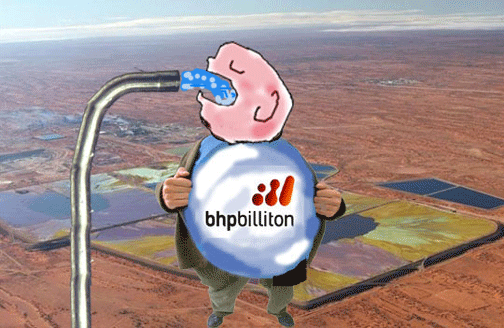 Olympic Dam Major Development Declaration, Friends of the Earth 28 Feb 19. The South Australian Minister for Planning has declared that a proposal by BHP Ltd to expand the operations of the Olympic Dam copper and uranium mine, located 550 km NNW of Adelaide, shall constitute a Major Development under section 46 of the Development Act 1993.
The proposal covers the expansion of mining and processing activities at Olympic Dam, including an additional take of water from the Great Artesian Basin. It allows for an increase in copper production from 200,000 tpa Cu and associated products to up to 350,000 tpa Cu and associated products, as well as new and/or expanded facilities to support the development.
The declaration of a Major Development takes the project outside the bounds of the usual development assessment process. The type of assessment and reporting required for this project has yet to be decided by the State Planning Commission and Minister for Energy and Mining. That decision will determine the degree of public consultation on offer, which this eBulletin will endeavor to report as soon as possible.
In this time of critical drought, water shortage, South Australia’s govt lets BHP expand its water-guzzling Olympic Dam uranium mine
Why does BHP get this water for free?
SA boost for Olympic Dam expansion https://www.sbs.com.au/news/sa-boost-for-olympic-dam-expansion 15 Feb 19, The South Australian government has granted the expansion of the Olympic Dam project major development status. BHP’s plans for a $3 billion expansion of its Olympic Dam project in South Australia’s north have been granted major development status by the state government.
The government’s move, gazetted on Thursday, clears the way for the company to increase annual copper production from 200,000 to 350,000 tonnes.
It also allows it to boost gold, silver and uranium production and to lift water extraction from the Great Artesian Basin to a maximum of 50 megalitres a day.
Declaring BHP’s proposed expansion of Olympic Dam a major development is a key milestone in this important project,” Mining Minister Dan van Holst Pellekaan said.
“Olympic Dam is already the state’s largest mining operation, providing jobs, investment and royalties for South Australia.
“(This is) a very important project that, if it goes ahead, would contribute 1800 additional jobs in South Australia during construction, and another permanent 600 jobs on site at Olympic Dam.”
But the minister said the project was still subject to thorough assessment, particularly the plan to extract more water.
“All potential environmental impacts, potential social impacts, potential economic impacts will be considered incredibly thoroughly,” Mr van Holst Pellekaan said.
Local communities will also be consulted on the company’s plans.
Mr van Holst Pellekaan said it would be several years before an expanded mine could begin operation.
The state government’s declaration also covers BHP’s development plans outside the mining lease, including proposals for extra accommodation. The proposed expansion of Olympic Dam has had a chequered history after first being mooted by the previous owners, Western Mining, back in 2002.
BHP initially proposed a $30 billion expansion, including development of one of the world’s largest open cut mines, but put the plans on hold in 2012.
The company has since been looking at lower-cost, smaller scale, alternatives to its original proposals.
In New South Wales, government lets mining companies dodge costs for site rehabilitation.
Lock the Gate accuses state government of placing interests of mining sector over those of taxpayers New South Wales taxpayers could be shortchanged up to $500m by a state government “accounting trick” that allows mining companies to dodge paying appropriate contingency costs for site rehabilitation.A 2017 report by the NSW auditor general found that security deposits paid by miners for future rehabilitation were inadequate and made several recommendations, including that the “contingency” costs be increased.
Though not part of the formal recommendation, the report said contingency costs should range from 25% to 50% (of the estimated total rehabilitation cost).
The environmental group Lock the Gate has obtained a letter, through Freedom of Information, that shows the NSW Department of Planning and the Environment told a parliamentary committee last year it had accepted all of the auditor general’s recommendations, and that it had already increased contingency costs.
The department told Guardian Australia this week it had increased “contingencies” to 30%. But it later clarified that figure included “contingency” and two other metrics – project management costs and post-project environmental monitoring – which were dealt with separately by the audit.
The amount for “contingency” remains at the previous level of 10%.
Rick Humphries, the mine rehabilitation coordinator at Lock the Gate, said the new arrangements were “an accounting sleight of hand” that had the effect of not forcing mining companies to meet the standards outlined by the audit….. https://www.theguardian.com/australia-news/2019/feb/14/nsw-accounting-trick-lets-miners-dodge-appropriate-rehabilitation-costs
 |
ReplyForward
|
Australian mining companies dominate in human rights abuses in African countries
 Dirty deeds: how to stop Australian miners abroad being linked to death and destruction, The Conversation, Lecturer, La Trobe UniversityJanuary 23, 2019 Australian companies dominate African mining. The Department of Foreign Affairs and Trade counts 175 ASX-listed companies operating in 35 African countries. Professional services company PwC reckons there are more than 200, and that “a golden age of Australia-Africa relations has begun”.
But Australian miners also arguably stand implicated in both human rights and environmental abuses in pursuit of Africa’s mineral wealth.
We can do better
Other countries are doing more.
France has introduced a “duty of vigilance” law requiring companies ensure their supply chains respect labour and other human rights.
In Switzerland there is a push for a constitutional amendment obliging Swiss companies to incorporate respect for human rights and the environment in all their activities.
Canada is soon to appoint an independent Canadian Ombudsperson for Responsible Enterprise to investigate allegations of human rights abuses linked to Canadian corporate activity overseas.
Ranger mine closure costs to hit more than $800m
Ranger mine closure costs to hit more than $800m NT News, 18 Jan 19, The Northern Territory’s Ranger mine is counting the millions — more than $800 million to be exact — to move the mine, which is surrounded by Kakadu National Park, towards full closure…. (subscribers only)
1 This month

of the week – Australians for War Powers Reform (AWPR)
To see nuclear-related stories in greater depth and intensity
 Antinuclear