Despite Tony Abbott, renewable energy investment has been promoted by Labor and the crossbench
Senate crossbench gave renewables $23bn boost by thwarting Abbott’s plan https://www.theguardian.com/environment/2019/jan/06/senate-crossbench-gave-renewables-23bn-boost-by-thwarting-abbotts-plan, Paul Karp@Paul_Karp Sun 6 Jan 2019
Decisions by Labor and crossbench to save clean energy agencies encouraged investment, report says The Senate’s decisions to stop Tony Abbott abolishing clean energy agencies helped create renewable energy projects worth $23.4bn, a new report says.
 The Australia Institute says decisions taken by Labor and the crossbench between 2013 and 2015 to
 save the Clean Energy Finance Corporation and Australian Renewable Energy Agency (Arena) have now secured $7.8bn in public funding and investment for clean energy.
Together with the renewable energy target – which was retained but reduced to 33,000GWh by 2020 – these measures will cut greenhouse gases by 334m tonnes over their lifetime, compared with 192m tonnes through the Coalition’s emissions reduction fund.
The Australia Institute released the Saved by the Bench report alongside polling that showed Australians supported the Senate’s role as a check on government power but were split on whether it blocked government legislation too often. Continue reading
Dave Sweeney reflects on the achievements of Australia’s nuclear-free movement in 2018
 The days roll on and 2018 is about to be in the past tense.
As ever the year saw highs, lows and flatlines. It also saw sustained and successful resistance to the nuclear industry in Australia.
This note is a snapshot, not a definitive list, but I wanted to capture some of our collective efforts and achievements so in a quiet moment we can reflect and recharge – and know that we are making a real difference.
Thanks and solidarity to all – and best wishes for a good break and time with people and in places that freshen the spirit. I look forward to working with you all in season 2019.
Uranium: Less is being ripped and shipped
- Kakadu: the clean-up of the Ranger site is underway – Mirarr native title of the region was formally recognised – Rio Tinto have accepted their responsibility to clean up – there was a calendar and a series of events around the country to mark twenty years since the Jabiluka blockade
- uranium remains stalled and actively contested in WA: 2018 saw a decade since then Premier Barnett announced a fast tracked uranium sector that would be “iron ore on steroids” – there are no mines but there is a major legal challenge to the Yeelirrie project, procedural challenge to Mulga Rock and community resistance to the four proposed projects with actions at AgMs, project critiques, Walkatjurra Walkabout and more
- Qld Labor reaffirmed its opposition to uranium mining at its state conference
Radioactive waste: Under pressure and delayed
the federal plan for a national waste facility in regional SA is highly contested, behind schedule and increasingly uncertain
- the issue was pushed ahead of the state election and SA Labor has subsequently adopted a good policy position
- there is growing civil society awareness and engagement with the issue – especially through our trade union partners
- the Barngarla people were formally awarded native title over the Kimba sites in June and have taken legal action over deficiencies in the Feds consultation processes
- Adnyamathanha resistance to the proposed Flinders Ranges site is strong and they have lodged a complaint on the plan with the Australian Human Rights Commission
- community resistance at both sites is sustained and strong with high levels of engagement and regular actions, events and media profile
- Federal Labor policy has a long way to go but at its national conference in December Labor moved from a policy position dominated by sites and place to one of standards and process
- Standing Strong – the story of the successful community fight against the earlier plan for an international radioactive waste dump in SA was launched and learned from
- there was early and strong opposition to chatter around other potential radioactive waste sites – especially at Brewarrina (NSW) and Leonora (WA)
Nuclear weapons: the cold war is reheating and support for a weapons ban grows
ICAN – the International Campaign to Abolish Nuclear Weapons – has continued to build on its 2017 Nobel Peace Prize profile
- there was sustained outreach and awareness initiatives, including a bike ride from Melbourne to Canberra
- there is growing international support for the Treaty on the Prohibition of Nuclear Weapons with more nations signing and ratifying the ban
- federal Labor committed to sign and ratify the ban treaty at its national conference in Adelaide in December – a major step forward
- the Peace Boat visited Australian waters and cities in January/February and the Black Mist, Burnt Country Maralinga exhibition continued touring
Broader nuclear free efforts
ANFA – the Australian Nuclear Free Alliance – had a good gathering in the Adelaide Hills in October and there was clear recognition of the role of First Nation people in the atomic resistance with awards to crew in WA, Aunty Sue in SA and Jeffrey Lee gaining the German based Nuclear Free Future award in the global Resistance category
- anniversaries were marked with actions, events and reflection – including Fukushima, Chernobyl, Hiroshima and Maralinga
- people engaged in state and federal processes including Senate Estimates, Senate Inquiries into radioactive waste siting and mine rehabilitation, ARPANSA Codes of Practice and more
- folks engaged with ALP state and federal conferences, the ACTU Congress, many union forums, SoS, the Sustainable Living Festival and more
- we remained connected and updated via the efforts of Christina Macpherson, Maelor at ACF, Jim Green at WISE, KA at CCWA and Walkatjurra, WGAR news, 3CR’s Radioactive Show, Understory and more
Looking ahead to 2019 – Another big year ahead folks – and one where we consolidate, defend and grow
- Challenges include:
- the forever struggle of resourcing and capacity
- pro-nuke voices pushing small modular reactors (SMRs) and seeking to overturn the ban on domestic nuclear power
- Mineral Council of Australia and others seeking the removal of uranium mining as a ‘trigger’ action in the federal EPBC Act
- We need to:
- better braid the uranium story and struggle into the wider dirty energy-fracking- fossil fuel narrative
- keep Rio Tinto and the regulators focussed and genuine re the best possible rehab outcomes at Ranger and keep the door shut to the uranium sector in WA
- support affected communities facing radioactive waste dump plans and push federal Labor to adopt a different approach
- pressure and support federal Labor to follow through on its commitment to sign and ratify the nuclear weapons ban
- make Australian uranium companies operating overseas – often in jurisdictions with low governance – accountable for their impacts
Cost of rehabilitating Ranger uranium mine
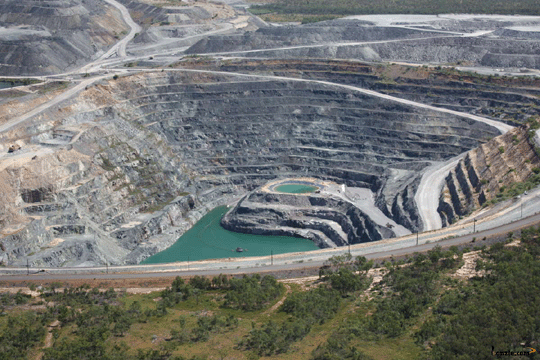 World Nuclear News 7th Dec 2018 The estimated rehabilitation costs for the Ranger Project Area inAustralia’s Northern Territory have increased from AUD512 million (USD370
million) to AUD808 million, Energy Resources of Australia (ERA) has
announced. The estimate is based on preliminary findings from a feasibility
study which will be finalised in early 2019.
http://www.world-nuclear-news.org/Articles/ERA-updates-Ranger-rehabilitation-costs
REPORT CASTS DOUBT OVER THE VIABILITY OF THE MULGA ROCK URANIUM PROJECT
|
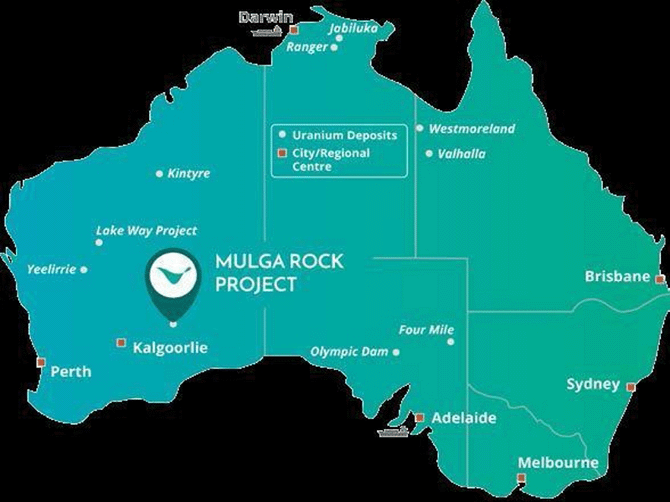
Vimy Resources has relied on heroic assumptions about prices, unfounded optimism about a booming nuclear industry, and has ignored regulatory risks and mine closure costs in its Definitive Feasibility Study (DFS) for the proposed Mulga Rock uranium mine to the east of Kalgoorlie, a new report by the Australia Institute has found. The report, commissioned by the Australian Conservation Foundation (ACF) and the Conservation Council of WA (CCWA), will be released tomorrow as shareholders gather at Vimy Resources AGM in Perth. Dr Cameron Murray of The Australia Institute said, “The report clearly shows that, based on plausible assumptions about exchange rates and uranium prices, the proposed Mulga Rock uranium mine is unprofitable. “The Mulga Rock DFS is ambitious to the point of heroic. The projections for the future role of nuclear power are extremely optimistic, and the economic assessment of the project’s position in the global uranium marketplace fails to accurately reflect the international situation,” Dr Murray said. CCWA Nuclear Free Campaigner Mia Pepper said, “This report is a reality check for shareholders making investment decisions that would not only adversely affect their back pocket, but also impact a unique part of WA’s backyard.” “Vimy Resources is putting a brave face on a speculative roll of the dice,” said ACF Nuclear Free Campaigner Dave Sweeney. “The company lacks finance, full approvals, social licence, and a market. Having a gamble is hardly news in the mining sector, but gambling with the product that fuelled Fukushima and always generates long lived radioactive waste is not acceptable, and will be actively contested.” For the full report go to http://www.ccwa.org.au/nuclearfreewa scroll down to Reports. |
|
Western Australia’s uranium promise: 10 years later it’s a complete flop
|
10 years ago this week the Barnett government lifted thpr The reality has been far more like morose miners on methadone. After a decade that has seen sustained Aboriginal and wider community resistance to mining plans, the uranium price plummet in the wake of Fukushima and a surge in renewable energy production, there is not a single operating uranium mine in WA. Uranium exploration companies were a dime a dozen but just four projects surfaced as having potential in WA. Three of them raced through the environmental assessment process under the Barnett government and emerged with environmental, but not final, approvals just weeks before the state election in a clear move to wedge the incoming Labor government. The McGowan government felt the wedge and let the four mines with partial approvals continue ‒a clear breach of Labor’s pre-election promise not to allow mines to proceed unless they had full approvals. But the sustained low uranium price and community opposition has thwarted plans to develop any of the four mines. Cameco has written off the entire value of the Kintyre project, Toro Energy has shelved its uranium plans and is now trying to strike lucky with gold, Cameco’s Yeelirrie project is the subject of a legal challenge by the Conservation Council of WA and three traditional owners and then there is Vimy’s Mulga Rock project. Vimy released its Definitive Feasibility Study for Mulga Rock earlier this year and the company is reportedto be “confident of securing contract prices of about $US60/lb this year or next for delivery in 2021 when it hopes to be in production with Mulga Rock.” There was supposed to be an investment decision by July but instead Vimy was handing out pay cuts and scaling back or bunkering down for the sustained lull in the uranium price (currently around $US30/lb). And while Toro is looking for gold ‒and other uranium companies have diversifiedinto medicinal marijuana production or property development ‒Vimy is hedging its bets by setting up a subsidiary to explore for base metals. Globally there are 115 nuclear reactors undergoing decommissioning‒double the number under construction. The International Energy Agency is warning about the lack of preparation and funding for a “wave of retirements of ageing nuclear reactors” and an “unprecedented rate of decommissioning”. A growing number of countries are phasing out nuclear power, including Germany, South Korea, Switzerland, Belgium and Taiwan. The world’s most experienced reactor builder, Westinghouse, went bankrupt last year and the debts it incurred on reactor projects almost bankrupted its parent company, Toshiba. After the expenditure of at least $A12.4 billion, construction of two partially-built reactors in the US was abandoned last year, and the only other reactor construction project in the US was almost abandoned this year after cost overruns of $A14 billion. No wonder that nuclear lobbyists are themselves acknowledging a “crisis that threatens the death of nuclear energy in the West” and are already writing eulogies about the “ashes of today’s dying industry”. Globally there are 115 nuclear reactors undergoing decommissioning‒double the number under construction. The International Energy Agency is warning about the lack of preparation and funding for a “wave of retirements of ageing nuclear reactors” and an “unprecedented rate of decommissioning”. A growing number of countries are phasing out nuclear power, including Germany, South Korea, Switzerland, Belgium and Taiwan. The world’s most experienced reactor builder, Westinghouse, went bankrupt last year and the debts it incurred on reactor projects almost bankrupted its parent company, Toshiba. After the expenditure of at least $A12.4 billion, construction of two partially-built reactors in the US was abandoned last year, and the only other reactor construction project in the US was almost abandoned this year after cost overruns of $A14 billion. No wonder that nuclear lobbyists are themselves acknowledging a “crisis that threatens the death of nuclear energy in the West” and are already writing eulogies about the “ashes of today’s dying industry”. |
|
Western Australia’s “uranium bonanza” just not happening
 WA’s uranium promises fail to appear, Midwest Times, Dave Sweeney, 21 Nov 18 Ten years ago this week then premier Colin Barnett ended Western Australia’s long-standing ban on uranium mining.
Industry promoters boasted of a new mining sector that would be “iron ore on steroids” and the speculation and exploration began in earnest.
In the intervening decade widespread community concern and resistance, combined with a depressed commodity price and a growing appetite for renewable energy, has seen the uranium dream fade.
Today there is not one commercial or fully approved uranium mine despite years of promotion and preferential treatment, and the few projects that continue to seek approval are strongly contested.
This is good news for WA and beyond as uranium is a mineral with unique properties and risks that cause local damage and fuel global risk.
Thanks to those who have helped keep the brakes on this contaminating trade and who have a perspective that lasts longer than a politician’s promise.
NATIONAL GROUP CONGRATULATES WESTERN AUSTRALIA NUCLEAR FREE CAMPAIGN
 https://nuclearfree.wordpress.com/2018/11/28/national-group-congratulates-western-australia-nuclear-free-campaign/ https://nuclearfree.wordpress.com/2018/11/28/national-group-congratulates-western-australia-nuclear-free-campaign/
This week marks 10 years since the ban on uranium mining was overturned by the former State Government in Western Australia. The Australian Nuclear Free Alliance (ANFA) sends a strong message of support and congratulations to the communities who have been so strong in their opposition to uranium mining in Western Australia. 10 years after the ban was overturned Western Australia remains free of any operating uranium mines.“We are happy to say there are no operating uranium mines in WA today and no immediate likelihood of any mines being constructed. This is a is a great time to acknowledge and pay tribute to the staunch communities who have stood strong, to the supporters the campaign and the stunning country that remains nuclear free.” West Australian ANFA co-chair Vicky Abdullah said today.
The Australian Nuclear Free Alliance (ANFA) formed in 1997 and is a committed national network of aboriginal and non-aboriginal groups working together to halt the threat of the nuclear industry. ANFA continues to make very real and positive differences and deliver significant results and has played a pivotal role for communities in Western Australia working to protect country and culture from nuclear developments. Over the last 10 years, ANFA has worked hard to support WA communities challenging unwanted uranium exploration, mines and waste dump proposals. Today, there are four proposed uranium mines being contested, Mulga Rock, Yeelirrie, Wiluna and Kintyre. Each community has been very public in opposition to uranium mining and all have been well represented at the annual ANFA meetings. ANFA Co-chair, Vicky Abdhullah continued: “This week, 10 years since the WA government overturned the ban on uranium mining with still no mines built is a strong example for Aboriginal communities that if you hold out and stand strong for country – you can win. We will continue to support the campaign in Western Australia to make sure uranium is left in the ground“ ANFA co-chair Vicky Abdullah concluded. |
|
Concern over New South Wales zurconium mine – also mining uranium and thorium
Kazzi Jai Kazzi Jai Fight To Stop Nuclear Waste Dump In Flinders Ranges SA, 11 Nov 18,
when you can’t legally “produce” uranium and thorium BUT inadvertently “mine” it to get the rare earth elements zirconium, hafnium, niobium and yttrium?
That’s what’s happening at the Toongi mine, 25km south of Dubbo in NSW. Called the “Alkane Resource’s Dubbo Zirconia Project” its lease was granted in December 2015. Much closer to Sydney at 380km…. compared to Roxby Downs which is 565 km from Adelaide! And it turns out that the mine has between 10,000 and 100,000 tonnes of uranium according to Geoscience Australia!
And there’s more! Turns out that over the 20-year life of the project around 80,000 tonnes of “radioactive substance” – uranium and thorium – would need to be “diluted”, according to Alkane’s Environmental Impact Statement.
This “dilution” would require up to 50 million tonnes of other, non-radioactive, materials. Around 7 million tonnes of salt, 2.5 billion litres of ‘liquid residue’ and 2 million tonnes of ‘solid waste’ would remain at the mine site forever, alongside a 40-hectare “final void”.
Now, why isn’t this in our local papers do you think? https://www.facebook.com/groups/344452605899556/
Rio Tinto offloads Northern Territory uranium resources to Canadian company
Rio Tinto offloads NT uranium asset to Laramide, Australian Mining Ewen Hosie
The Murphy uranium tenements, located near the Queensland-NT border, were responsible for the production of high-grade uranium in the 1950s but have not seen much exploration since the 1970s. The tenements are contiguous to Laramide’s Westmoreland project in northwest Queensland.
The acquisition comprises the EL 9319 and EL 9414 exploration licences and several other applications across 683 square kilometres.
Laramide has paid Rio the first of three $150,000 cash payments to Rio Tinto as laid out in the terms of the agreement announced in July this year…….https://www.australianmining.com.au/news/laramide-completes-acquisition-rio-tinto-uranium-tenements-nt/
Legal action in Western Australia means delay, uncertainty, for Cameco’s Yeelirrie uranium mine
  Federal nod for Cameco’s Yeelirrie uranium mine hinges on WA court challenge https://www.kalminer.com.au/?business/mining/federal-nod-for-camecos-yeelirrie-uranium-mine-hinges-on-wa-court-challenge-ng-b881003720z Federal nod for Cameco’s Yeelirrie uranium mine hinges on WA court challenge https://www.kalminer.com.au/?business/mining/federal-nod-for-camecos-yeelirrie-uranium-mine-hinges-on-wa-court-challenge-ng-b881003720z
It means the environmental status of Australia’s largest undeveloped uranium deposit, Canadian major Cameco’s Yeelirrie project near Wiluna, will likely remain uncertain until at least the second half of 2019, almost three years after its approval by former WA environment minister Albert Jacob. Yeelirrie is particularly sensitive because WA’s Environmental Protection Authority initially recommended it be refused on the basis it would make 11 species of rare subterranean invertebrates, known as stygofauna, extinct. WA-based Federal Environment Minister Melissa Price, whose sprawling Durack electorate includes Yeelirrie, told the Kalgoorlie Miner a legal challenge led by anti-nuclear campaigners and a handful of traditional owners was one reason for the delay, with Cameco previously stating it believed the process would be complete early this year. “My department advised that it was prudent to wait for the result of the WA Supreme Court proceedings before finalising the Federal assessment,” she said. “This ensures that we know the State decision is valid and we can avoid overlapping with any State approval conditions.” A Cameco spokesman said the company was working with Ms Price to achieve an outcome as soon as possible. The Conservation Council of WA is hopeful of winning a second appeal against Mr Jacob’s decision in WA’s Supreme Court, after an initial challenge was thrown out in February. Even if the action is unsuccessful the delay could buy opponents of the mine time to see out the conservative Morrison Government and leave the final decision in the hands of a Labor minister, with a hearing not expected to take place until next year. The group’s director Piers Verstegen said it would be “irresponsible” for Ms Price to make a decision on the project while the legal action was afoot. Yeelirrie was discovered by Western Mining Corporation in 1972 and prepared for development in the early 1980s before Labor leader Bob Hawke’s defeat of Malcolm Fraser in 1983 brought in the “three mine policy”, halting new uranium developments. It was sold for $430 million to Cameco by BHP in 2012, but the 128 million-pound yellowcake deposit has remained on ice since then in the face of a subdued uranium market and tricky approvals process. Federal Labor does not currently oppose the development of uranium mines, unlike their WA counterparts who agreed to let Yeelirrie and three other mines in WA, approved under the watch of the Barnett government, be mined in the future on ‘sovereign risk’ grounds. Mr Verstegen claimed Mr Jacob’s Yeelirrie decision set a bad precedent for future decisions on developments that posed a threat to wildlife. “The legal precedent is the same, it could be applied to any species that could be signed off for extinction by the minister,” he argued. “We’re taking that very seriously and that’s why we’re taking these steps to challenge it in the courts.” |
WA Indigenous community tries to rid water supply of unsafe level of uranium
Western Australian government refused to install water treatment plant due to size of Buttah Windee, Guardian, Calla Wahlquist, 3 Oct 18, An Aboriginal community in Western Australia is trying to raise money to fix its water supply, which contains unsafe levels of uranium.
Buttah Windee is a community of four houses about 3km from Meekatharra, a mining town that’s name means “place of little water” in the local Yamatji language.
It has 12 permanent residents and is supplied with bore water that is contaminated with uranium at more than twice the maximum safe level.
The WA government was notified of the uranium contamination in 2012 but refused to install a water treatment plant, saying the cost of doing so was “excessive given the small size of the community”.
Instead it put up signs warning residents not to drink or cook with the water and offered alternative public housing in Meekatharra itself.
Yamatji man Andrew Binsiar has been fighting to stay put. He has raised more than $10,000 through crowdfunding and an art auction and hopes to install a water filtration system to supply both the community and a new fish farm, which is part of a remote Indigenous employment program.
Binsiar discovered the uranium contamination nine years ago when all of the fish in his backyard koi pond died. He sent the water away to be tested and found that it had uranium levels of 0.04mg/L.
Health guidelines state that the maximum safe level is 0.017mg/L.
“I had it tested again this year, it’s still exactly the same,” Binsiar told Guardian Australia.
He installed a 9,000-litre tank on each house, which he fills with tap water from the town supply, to be used for drinking and cooking.
Uranium is a naturally occurring contaminant throughout parts of outback Australia.
A 2015 report by the state auditor general’s office found that the water in one in five remote Aboriginal communities in WA exceeded safe levels for nitrates or uranium.
The Department of Communities currently tests the water supply in 82 remote Aboriginal communities, and said it had seen a significant improvement in water quality since installing chlorine treatment units and reverse osmosis filtration systems in some communities.
“The community elected to continue to reside at Buttah Windee and accept responsibility for the provision of housing and associated services to residents,” assistant director Greg Cash said. “The department ceased providing management services in 2013 and has had no formal relationship with the community since then.”
Binsiar said: “They came and sat on the veranda over here and said they were going to put a bulldozer through my house and put be back into [public housing provider] Homeswest.”
In 2014, then premier Colin Barnett said up to 150 remote Aboriginal communities faced “closure” because they were “not viable” after the federal government withdrew municipal services funding.
The current government opposed that policy but has adopted the remote community reform process started under Barnett which focuses investment on larger communities. It has also cited funding woes linked to the end of the remote housing agreement.
Binsiar said many remaining residents – Wadjarri people and his wife’s extended family – had lived there since it was established on Wadjarri land in 1993.
He said the community was a safer place to raise children, away from the drug and alcohol issues of Meekatharra.
Unless the community’s water supply can be fixed, the new aquaculture enterprise, which is part of the federal community development program, will have to close.
“If we get this thing to a stage and we can’t fix the water, all the young fellas are going to say, ‘Oh, we have to get this far and then stop again’,” Binsiar said. “I want to show people that Australia is truly a generous, generous mob of people. If you are willing to work, people will help.”
Walkatjurra anti-uranium Walkabout completed
The Walkatjurra Walkabout has finished with a storm (literally)! An awesome walk into Leonora with lots of support to keep WA nuclear free. A successful public meeting the following day having CCWA Director Piers Verstegen come into Leonora to support the community and in particular the three Tjiwarl native title holders, Shirley, Lizzy and Vicky on the court challenge that included a visit to the proposed radioactive waste dump. You can see photos and read about their adventures here.
Traditional owners steadfast in 40-years opposition to uranium mining
Fighting for life in the “place of death”https://beyondnuclearinternational.org/2018/08/27/fighting-for-life-in-the-place-of-death/ August 27, 2018
Traditional owners won’t give up 40-year opposition to Yeelirrie uranium mine, By Linda Pentz Gunter
In the local Aboriginal language, the name Yeelirrie means to weep or mourn. It is referred to as a “place of death.” Yeelirrie is on Tjiwarl Native Title lands in Western Australia, where it has long been faithfully protected by Aboriginal traditional owners. The Seven Sisters Dreaming songline is there. It is home to many important cultural sites. And for 40 years, due to resolute indigenous opposition, and thousands of community submissions of protest, it had been spared plans by the Canadian mining company, Cameco, to plunder it for uranium.
The earth guardians know that such a desecration would cause the extinction of multiple species of subterranean fauna. It would release death. It would destroy Yeelirrie.
Now the fate of those tiny creatures hangs in the balance, their future in the hands of three brave women, backed by environmental organizations, after the outgoing Western Australian government decided to allow the Yeelirrie uranium mine project to go forward.
That decision was made in January 2017, despite the fact that, in August 2016, the Western Australia Environmental Protection Agency (WAEPA) had recommended that the Yeelirrie project be rejected.
The Conservation Council of Western Australia (CCWA), which is engaged in contesting the uranium mining permit for Yeelirrie, said the WAEPA had rejected the Yeelirrie mine plan “on the grounds that the project is inconsistent with three of the objectives of the Environmental Protection Act — the Precautionary Principle, the Principle of conservation of biological diversity, and the Principle of intergenerational equity. The EPA decision was based on the overwhelming evidence that the project would make several species of subterranean fauna extinct.”
But former Minister for Environment, Albert Jacob, threw all that aside to approve the Yeelirrie mine in the waning days of Western Australia’s Liberal government, now replaced by Labor, which came in on a mandate to end uranium mining that it now may not be able to enforce.
In February 2018, CCWA and three members of the Tjiwarl community initiated proceedings in the Western Australia Supreme Court in an attempt to invalidate the approval decision made by Jacob. The case was dismissed by the court, a decision said CCWA executive director, Piers Verstegen, that shows that “our environmental laws are deeply inadequate,” and “confines species to extinction with the stroke of a pen.”
However, while the decision was a set-back, Verstegen said, “it’s absolutely not the end of the road for Yeelirrie or the other uranium mines that are being strongly contested here in Western Australia.”
Accordingly, CCWA and the three Tjiwarl women — Shirley Wonyabong, Elizabeth Wonyabong, and Vicky Abdullah (pictured left to right above the headline) vow to fight on, and have begun proceedings in the WA Court of Appeal to review the Supreme Court decision.
“I grew up here, my ancestors were Traditional Owners of country, and I don’t want a toxic legacy here for my grandchildren,” Abdullah told Western Australia Today in an August 2017 article.
“We have no choice but to defend our country, our culture, and the environment from the threat of uranium mining — not just for us but for everyone.”
Yeelirrie is one of four uranium mines proposed for Western Australia. The other three are Vimy’s Mulga Rock project, Toro Energy’s Wiluna project, and Cameco’s and Mitsubishi’s Kintyre project. Each of them is home to precious species, but Yeelirrie got special attention from the WAEPA because the proposed mine there would cause actual extinctions of 11 species, mostly tiny underground creatures that few people ever see.
According to a new animated short film, produced by the Western Australia Nuclear-Free Alliance, all four of these proposed mines could irreparably damage wildlife, habitat and the health of the landscape and the people and animals who depend on it. The film highlights Yeelirrie, but also describes the other three proposed uranium mines and the threats they pose.
At Mulga Rock, in the Queen Victoria Desert, the site is home to the Sandhill Dunnart, the Marsupial Mole, the Mulgara and the Rainbow Bee Eater, according to the film.
Wiluna, a unique desert lake system, could see uranium mining across two salt lakes that would leave 50 million tonnes of radioactive mine waste on the shores of Lake Way, which is prone to flooding.
The Kintyre uranium deposit was excluded from the protection of the Karlamilyi National Park within which it sits so that uranium could be mined there. It is a fragile desert ecosystem where 28 threatened species would be put at risk, including the Northern Quoll, Greater Bilby, Crest Tailed Mulgara, Marsupial Mole and Rock Wallaby.
At Yeelirrie, says the CCWA, “Cameco plans to construct a 9km open mine pit and uranium processing plant. The project would destroy 2,421 hectares of native vegetation and generate 36 million tonnes of radioactive mine waste to be stored in open pits.”
The mine would likely operate for 22 years and use 8.7 million litres of water a day.
Under Australian laws, ‘nuclear actions’ like the Yeelirrie proposal also require approval by the Federal Environment Minister. CCWA and Nuclear-Free Western Australia, have launched a campaign directed at Federal Environment Minister, Josh Frydenberg, calling for a halt to the Yeelirrie mine, given the immense risk it poses to “unique subterranean fauna that have been found nowhere else on the planet.” They point out that the Minister has the opportunity to “protect these unique species from becoming extinct.
“Species have a right to life no matter how great or small,” they wrote. “One extinction can massively disrupt an entire ecosystem. No one should have the right to knowingly eliminate an entire species from our planet forever.”
Western Australia: Aboriginal Elders take action against uranium mining
 Aboriginal Elders Face Off with Uranium Mining Co. in the Australian Outback, Earth Island Journal , BY ELIZABETH MURRAY – AUGUST 27, 2018
With four new mines approved in the Western Desert, the Tjiwarl turn to courts for help
Members of one of Australia’s most remote Aboriginal nations, the Tjiwarl, who live in the red heart of the Western Desert lands, are embroiled in a long running battle to protect their ancestral home from mining interests.
Last year, the government of Western Australia approved four new uranium projects in the state, despite warnings issued by the Western Australian Environmental Protection Authority, and a global slump in the price of uranium.
Two of the projects, in Yeelirrie and Kintyre, belong to the Canadian mining giant Cameco. The other two are by Australia-based companies, Vimy Resources and Toro Energy.
While uranium use is banned in Australia it holds 33 percent of the world’s uranium deposits, and, it is the world’s third-largest producer of the mineral after Kazakhstan and Canada. Seen as controversial among Australian politicians and unpopular with electorates, uranium operations have drawn both federal and state government bans at various times.
In February this year, the Supreme Court of Western Australia backed the expedited approval of the Yeelirrie uranium project granted by the previous state government in January 2017, but recognized the duty of the Tjiwarl applicants as cultural custodians of Yeelirrie, to preserve those lands. Tjiwarl Elders, Elizabeth and Shirley Wonyabong, and Tjiwarl Traditional Owner Vicky Abdullah, are now appealing that Supreme Court decision, with the support of the Conservation Council of WA.
Western Desert Aboriginal nations have battled against uranium mining on their lands for forty years. It is just one of the many struggles they have faced to preserve their 40,000 year-old culture and spiritual connections to the land in the face of contemporary society’s competing priorities…….
Conservation Council of Western Australia Director, Piers Verstegen, said that the Yeelirrie approval had undermined the existing environmental protection framework. He said the approval “knowingly allows the extinction of multiple species” in Yeelirrie and “treats the EPA and its environmental assessment as something to be casually dismissed.”…….
If the Tjiwarl appeal was successful, it would restore the normal approval process and protect it from political influence, he said. Conversely, if it fails, governments in Western Australia will forever be able to use ministerial oversight to override the independent authority of the Environmental Protection Agency.
The council has previously expressed alarm over the Yeelirrie project’s proposal to clear 2421 hectares of native vegetation for a 9 km-open-pit mine, which they estimate could generate 36 million tons of radioactive waste.
Dr. Euan Ritchie, Associate Professor in Wildlife Ecology and Conservation at Deakin University, independent of the proceedings, said some remote regions are under-surveyed and Yeelirrie may fit that category. In such a circumstance, “where the fauna is unique…species that are not found in other areas, and/or it is in an area that is under-surveyed…there’s a risk of inadvertently having a negative effect on species because of our lack of understanding of what species are there.”
He said important research is developing in relation to cryptic species (species that are morphologically similar but genetically different, and unable to interbreed).
Thorough surveys of plant, animal and other organisms in the area of potential developments were vital, above and below ground, he stressed. The impact of uranium on water resources can be critical for many species in the food chain over a wide expanse, he added, and could extend well beyond the boundaries of a project.
Apart from the delicate, unique ecology of Yeelirrie, the area also includes multiple ancient Aboriginal spiritual sites there are so sacred that they cannot even be discussed or explained in open court or media……..
Cameco Australia has decided not to proceed with the Yeelirrie project until there’s renewed market demand for uranium. Additionally, in Cameco’s 2017 third-quarter report, the company’s global chief Tim Gitzel said “difficult conditions” were continuing and there had been “little change in the market.” In fact, earlier this year, just a week before the Tjiwarl filed their appeal against the project, Cameco suspended two more of its key mines in Canada, citing the global glut and the company’s own large inventory. ……
Financial pundits have also questioned if uranium prices can ever make a comeback with the growing strength of renewables on the market. http://www.earthisland.org/journal/index.php/elist/eListRead/aboriginal_elders_face_off_with_uranium_mining_co._in_the_australian_outbac/
Last week of the Walkatjurra Walkabout
Nuclear Free WA, K-A Garlick, 29 Aug 18 It’s the last week of the Walkatjurra Walkabout! Over 60 people have walked through awesome country in support and solidarity with Traditional Owners to stop uranium mine projects on their country. From Lake Way in Wiluna to the gates of Yeelirrie and finally finishing in Leonora this week they have walked over 250kms to raise awareness about this toxic industry that would destroy beautiful land, water and communities. The walk will finish with a public meeting in Leonora to share messages from the Walkatjurra Walkabout and to give updates on the Yeelirrie court challenge and the proposed national radioactive waste dump. You can see photos and read about their adventures here.
We welcome the new Federal Environment Minister, Melissa Price, Member for Durak, WA that includes Wiluna and Yeelirrie in her electorate not to Federally approve the Yeelirrrie uranium project and look forward to working with her on this issue.
Looking forward to seeing you all at the Projections at Parliament event on the 11th September to send a clear and important message to the WA Government to ban uranium mining permanently. See below for further details.
If you haven’t seen it … please watch and share the short 2 min video Uranium: West Australia under threat to make uranium mining extinct – not WAs unique species.
1 This month

of the week – Australians for War Powers Reform (AWPR)
To see nuclear-related stories in greater depth and intensity
 Antinuclear