Australian uranium mining company arousing concern in Greenland
 The prospect of a relatively unknown Australian company exploiting massive untapped resources in Greenland deserves a robust public and political debate. It has thus far received nothing in Australia, and little in Denmark and Greenland. In an age of worsening climate change, mining uranium is an arguably unsafe and potentially explosive answer to the problem.
Australian uranium mining in Greenland is tearing the country in half http://www.theguardian.com/commentisfree/2014/may/15/australian-uranium-mining-in-greenland-is-tearing-the-country-in-half After Greenland’s prime minister repealed a law on uranium mining, Australian firms are staking out the country for exploitation. Local political opposition is heating up
Antony Loewenstein This is a story about an Australian company you’ve never heard of, operating in a nation that rarely enters the global media: Greenland. It’s a story about the intense search for energy sources in a world that’smoving away from the dirtiest fossil fuels.
>Aleqa Hammond, the prime minister of Greenland, is the first woman to lead this autonomous country within the Kingdom of Denmark. She also welcomes the financial opportunities from climate change and a melting Arctic Circle.
“I simply refuse to be the victimised people of climate change”, she toldBusiness Week this month. “This time we have other options than just hunting. We have the right now to our own underground.”
In October last year, Hammond pushed legislation through Greenland’s parliament to overturn a 25 year old ban on the extraction of radioactive materials, including uranium, despite countless leading environmental NGOs urging otherwise. It attracted global interest from the rare earth and uranium industries, including from China. Concerns were also raised about Greenland’s ability to manage a toxic substance in the wake of Fukushima and Chernobyl.
The company Greenland Minerals and Energy Limited (GMEL) is based in Perth, Western Australia. This year GMEL announced a major step forward in their plan to open one of the world’s largest uranium mines in southern Greenland, at Kvanefjeld. The mine will also produce fluoride, thorium and other rare earths.There is still significant opposition to the Kvanefjeld project. The Ecological Council, a Danish NGO, organised a conference to discussthe potential contamination risks in March, noting that the mine poses serious risks for the inhabitants of the nearby village, Narsaq. Many locals told the BBC that they worried about pollution and challenges to traditional ways of life if GMEL moved ahead with its plans. Unsurprisingly, Danish green groups have pushed for a continued ban on uranium mining. They claim that rare earth elements can be extracted without uranium mining in Greenland.
This would have been an important but fairly typical contest over resources, but after issues surrounding the ownership and status of Perth-based GMEL were raised in the Greenlandic parliament, the prospects of the Australian firm may be in jeopardy.Late last year, Greenland MP Sara Olsvig (tipped by some as a future prime minister) wrote to the country’s minister of industry and minerals, Jens-Erik Kirkegaard. She demanded details about any and all of GMEL’s shareholders, after Australian media outlets had raised allegations about both the company back in 2009 (here and here) and mining prospector Mihran Shemesian, also known as “Mick Many Names“.
In 2009, Fairfax media claimed that Shemesian controlled more than 20% of GMEL stock. Range Resources, another company tied to Shemesian, had earlier been accused of paying the disputed government of the Puntland State of Somalia, linked to Somali rebels, more than $US6m ($A9.3m) for resource rights to the region. Since then, there have been very few stories about him.
Kirkegaard responded that the government dismissed any concerns about GMEL – “the alleged events all occurred outside Greenland’s jurisdiction” – and claimed that the company didn’t own an exploration license anyway, so there was nothing to worry about. This isn’t quite the case: Greenland Minerals and Energy A/S (GME), the firm granted the licence, is the wholly-owned Greenlandic subsidiary of GMEL.So is “Mick Many Names” Shemesian involved with GMEL? John Mair, the company’s executive director, told me he isn’t “registered as a shareholder”. But he would not guarantee that Shemesian has no involvement with GMEL.
Mair is proud of the Kvanefjed project, where “risks can be appropriately mitigated”. GMEL was “working with Greenland to help establish a secure and viable economy that will help sustain their increasing political independence,” he told me, adding that he was “optimistic” GMEL would be granted a mining license in the foreseeable future because “we have much local community support in Greenland”.A key shareholder in GMEL is Perth-based geologist Greg Barnes, founder and CEO of Tanbreez. He told me by phone from Singapore that he has personally invested $40m towards mining possibilities in Greenland. He says he has known Shemesian for 30 years and “has heard that he has a 50% share in GMEL and I’ve heard that he has 0%. I have no relationship with him.”
But in December last year he told Grønlandsposten, a Greenlandic newspaper that, “he and Shemesian could probably fire GMEL’s board if they wanted to”. He told me that this referred to the make-up of GMEL many years ago – not today.
“[Greenland] is the size of Western Australia but it has no mines”, he said. “In Western Australia an application for mining would take three months but in Greenland it takes years.” A vast part of Greenland has been “staked out by a number of Perth companies.” Barnes isn’t concerned about climate change “because it didn’t really show up in places like Greenland apart from some ice sheets reducing”.
There is another view. Niels Henrik Hooge is a Danish consultant who works with green NGOs. He’s been at the forefront of the campaign against uranium mining in Greenland. He says to me that the people of Greenland are “split down the middle regarding the repeal of the [uranium] ban.”
Hooge explains that the “mineral authorities” have fed the public disinformation over the last years but the tide may be turning, with growing concerns over environmental effects and the leftist party Inuit Ataqatigiit pledging to roll back the repeal if it wins back power.
The prospect of a relatively unknown Australian company exploiting massive untapped resources in Greenland deserves a robust public and political debate. It has thus far received nothing in Australia, and little in Denmark and Greenland. In an age of worsening climate change, mining uranium is an arguably unsafe and potentially explosive answer to the problem.
Uranium stock prices at last come to the reality of the market decline
CHART: Uranium stocks vs spot price – something’s gotta give #auspolhttp://tinyurl.com/n25brbj Frik Els | May 15, 2014
The prospect of a Japanese nuclear reactor restart. The end of the Russia-US megatons to megawatts program last August, eliminating a huge source of supply. China’s accelerated plan to approve six to eight plants a year through 2020; part of its war on pollution. The possibility of a rethink in Germany about phasing out nuclear (coal is the only viable alternative and Putin’s gas is becoming dearer).As the stars aligned for a pickup in global uranium demand so did investors for uranium stocks.
But the rapid run-up in uranium shares – especially developers – didn’t turn out to be a leading indicator.
The spot price continued to slide going below $30 a pound to levels last seen in 2005. That dragged the long term price, where most uranium business is conducted, down to $45, a six year low.
Uranium stocks have now come down to earth as this chart from Haywood Securities shows.

The independent investment dealer with $5 billion under management says now that the spot price appears to have found something of a floor, the sell-off may begin to slow down.
But the Vancouver-based firm cautions that the shares of producers and developers “remain at or above their indexed price point of 12 months ago, when spot uranium was $40.70 U3O8, a 40% premium to current spot”.
There may be more pain ahead
More trouble for ERA as shaft collapses ar Ranger uranium mine
 Shaft collapse brings new setbacks to Ranger 3 Deeps uranium operation Australian Mining 12 May, 2014 The Ranger 3 Deeps exploration decline project has suffered another setback after a collapse during works on a new ventilation shaft last week. Energy Resources Australian reported that soft ground had “gradually subsided” beneath the top of the vent opening, and that crumbling of material has created a cavity in the shaft wall, about 20 metres below the surface running to the top, which was observed after the completion of drilling by a raise bore.
ERA said this type of crumbling is common, and that ground movement was identified in the development of the raise bore design.The crumbling, which began midway through last week, created a cavity in the ventilation shaft wall which led to the gradual subsidence of material to the top of the shaft…….
The Australian Conservation Foundation, outraged at the “litany of management and material failures at Ranger”, has called upon ERA to suspend development of the Ranger 3 Deeps project altogether. “All mine development operations at Ranger should be immediately halted,” said ACF nuclear free campaigner Dave Sweeney. “The Ranger mine is a dog’s breakfast with eroding shafts, collapsing tanks and the company routinely losing contaminants and credibility,” he said.
“There have been enough warnings, now there needs to be a stop to works and a comprehensive and public assessment of the full impacts of this aging and failing facility.”
In 2021 ERA are legally obliged to end all mining and mineral processing and start the comprehensive clean-up of the existing Ranger site, however in their 2013 report ERA has stated they will not be able to fund the clean-up unless the Ranger 3 Deeps project goes ahead.
Rio Tinto again refused to commit to underwrite the cost of Ranger’s rehabilitation.
This has called into question the issue of regulatory approval for the Ranger 3 Deeps expansion. “The ultimate cost of rehabilitation is uncertain and whilst ERA has used its best estimate, costs may vary in response to factors such as legal requirements, technological change and market conditions,” the 2013 report reads. “In addition, if the Ranger 3 Deeps mine is not developed, in the absence of any other successful development, ERA may require an additional source of funding to fully fund the rehabilitation of the Ranger Project Area.
“Any inability to obtain additional capital or to monetise assets would have a financial impact on ERA’s business and financial performance.”Under the Ranger permit, rehab works must be completed by 2026, which a strategy review has found will cost $603 million……..http://www.miningaustralia.com.au/news/shaft-collapse-brings-new-setbacks-to-ranger-3-dee
Rio Tinto dodging its responsibilities for radioactive pollution of Kakadu National Park
 Rio Tinto dismisses Ranger rehab funding concerns as “hypothetical” Mining Australia, 8 May, 2014 Rio Tinto has stated that concerns about the funding for rehabilitation of the Northern Territory Ranger mine site are hypothetical, and remain the concerns of the ERA board of directors.
CEO Sam Walsh once again shrugged off suggestions that Rio Tinto, as 68 per cent shareholder in ERA, is responsible as the parent company for any of ERAs financial shortcomings in regard to rehabilitation and clean-up at the Ranger uranium mine…….David Sweeney of the Australian Conservation Federation, in his question to Sam Walsh and the Rio Tinto board of executives, suggested that because ERA reports to RioTinto’s energy division, it will be “closely watched and long judged on its actions regarding ERA”……..
“I thought his response was very partial and legalistic,” Sweeney said.
“Clearly Energy Resources Australia is a separate legal entity to Rio Tinto, but Rio provides the mining instructions, they provide the management, the CEO of ERA is appointed by Rio and is always a Rio person, Rio’s energy division manages ERA.
“It is absolutely a Rio Tinto subsidiary, it is a Rio Tinto child, and it concerns us greatly now that, when it’s coming to the pointy end of what will be a costly and complex rehabilitation exercise, ERA is saying they don’t have the funding capacity and Rio Tinto is saying they don’t have the responsibility.
“Just this week, Rio bailed ERA out of a problem caused by the suspension of mineral processing, by saying that they will pool Australian and Namibian uranium through the Rio Tinto marketing authority.”……http://www.miningaustralia.com.au/news/breaking-rio-tinto-dismisses-ranger-rehab-funding
Queensland uranium mining not to happen any time soon (perhaps never?)
 Uranium mining to face delays North West Star By CHRIS BURNS May 5, 2014,
QUEENSLAND Resources Council chief executive Michael Roche says he does not expect a rush of uranium mine development in the North West when Queensland regulations are approved later this year.
Radiation exposure to workers at Ranger uranium mine – sloppy controls
 Running amok at Ranger Mining Australia, 5 May, 2014 Ben Hagemann“…….The job was to clean out one of the CCD (Counter-Current Decantation) tanks, ready for inspecting and repairing the rubber lining, and to change pump impellers underneath the tank.
A CCD tank is like an enormous, open-topped butter churn, but rather than mastitus-ridden, bovine squeezings, the tank is filled with a mixture of milled ore, water, some kind of flocculant (guar gum, maybe) and of course, sulphuric acid.
If I remember correctly, the acid comes from the leach tanks where the ore sits for a while so that the uranium can dissolve into solution, then that solution is decanted in the CCD tank where the flocculant is frothed up so that it can bond with the uranium and float to the surface, turning the whole lot into one big, bubbly, radioactive milkshake.
Of all the tanks only one of them was shut down so that we could do maintenance, and judging by the look of them, we were the first guys to take on this job in a very long time.
Once drained, the tank was one or two feet deep in the extremely heavy ore slurry and the arms were piled with sulphur sediment, hard as sandstone. We needed to disconnect the pumps below and hose all the sludge down the drainhole in the middle, a task that we were instructed to do with process water.
Now, process water… little did I know that’s the water that was used to “process” the ore… duh.
This means the water contained traces of the uranium in solution, fully dissolved and ready to soak into porous, human skin. Although we wore gumboots, long gloves and faceshields, naturally we wound up completely soaked after a few minutes of waving a two inch fire hose on high pressure, trying in vain to get the dense rock sediment to lift up and go down the drain.
It took four weeks to clean one tank, and that included digging out the gutter around the top of the tank from a scissor lift, as well as smashing all the piled up sulphur residue off the enormous arms of the churn (crawling around the lattice structure with a gympie hammer, bashing our way through and getting covered in the yellow muck).
If this sounds like a horrifying degree of physical contact with some very noxious material, you’d be right. It was about two weeks into the job that management finally got around to giving us our radiation inductions.
There I learned that the water with which I’d been soaking myself was actually radioactive, and you shouldn’t let it get on your skin!
We couldn’t know the degree of radiation we faced, as we weren’t issued with personal radiation monitors (not necessary for shutdown crews, we were told) but workers would reassure us that it wasn’t much.
The next week I took myself to the radiation lab during lunch, where the radiation officers expressed bemusement, then horror when I told them that the grey material all over my shirt was ore.
A quick sweep with the scintillometer revealed slow ticking over my body, which was reassuring, but my leather boots crackled like static on a black and white TV.
They were, as they say in the uranium game, “hot”, and were promptly discarded and replaced with a fresh pair from the stores, along with a full complement of new socks……..
Leaving alone the forgetfulness of management when it came to educating a shutdown crew about the full extent of radioactive hazards, Ranger’s production plant was in pretty bad shape, even to my uneducated eye – It was like the mine that time forgot. There was gridmesh rusted out, full of holes in some spots, so you really had to watch your step on the stairs and catwalks, not to mention the rotted-out, RSJ beams, steel nearly two inches thick you could push a screwdriver through.
I guess that’s what happens when you have sulphuric acid fumes mixing with the sultry, jungle atmosphere- It rots the steel away from under you.
I don’t know whether the site was under-maintained or not, but the fact that a leach tank actually busted open and spilled a full load of radioactive acid slurry last year is a pretty bad sign.
It’s good that ERA is replacing the baffle supports in all the leach tanks, but that kind of corrosion incident points to the prospect that the Ranger plant will be up for a lot more maintenance than that.
It makes me wonder what could happen if ERA were allowed to start a new mine expansion?
Would they look after it? Or would it simply rot away over the years, mismanaged and scraping by on the barest minimum of maintenance?
What do I know? I’m just a simple rigger.
South Australian State govt aiming for uranium enrichment !
 South Australia digs deep on future of uranium http://www.heraldsun.com.au/news/national/south-australia-digs-deep-on-future-of-uranium/story-fnii5yv7-1226905247217 SHERADYN HOLDERHEAD MILES KEMP THE ADVERTISER MAY 04, 2014
THE State Government’s mining department has continued to explore uranium enrichment, despite the minister saying there is no business case for it. Documents released under Freedom of Information also show the State Government wants to ship the uranium ore already mined in SA through eastern ports to make it more cost effective.
Emails between Manufacturing, Innovation, Trade, Resources and Energy Department executives shows they planned a meeting in December with a University College London Master’s graduate whose thesis showed the State Government should invest in uranium enrichment.

The emails suggested the graduate give a talk to the Olympic Dam Task Force and attached a summary of the paper, which stated that the SA Government should invest in uranium enrichment company URENCO.
The summary states a strategic investment would provide access to profits without the risk of developing a new technology and leaving options open for Australia to construct a future uranium enrichment facility.
Another report prepared for the State Government into how to make the state’s uranium industry more profitable and allow new mines to open suggests eastern states be lobbied to allow shipment from higher-traffic ports such as Sydney, Brisbane and Melbourne. Its report says found government should take a leadership role in lobbying for improvement which included a “discussion document around options for addressing access to east coast shipping ports”. Adelaide and Darwin are the only ports from which uranium shipping is now permitted.
A spokeswoman for Queensland Premier Campbell Newman said there were no plans to export uranium from Queensland ports. A Victorian Government spokesman said that “the proposal is not something that has been considered … Any proposal would need to be assessed to consider environmental implications, port handling and also transport arrangements’’.
In 2011, Mining Minister Tom Koutsantonis, publicly backed by then treasurer Kevin Foley, called for change from the traditional approach of simply mining uranium and sending it offshore.
“We’ve got to value add here in SA. Down the track, I would like to see some form of enrichment, some sort of value add. We have to go out and passionately support the uranium industry,’’ he said at the time.
But in April last year, he said there was no case for it “any time in the near future” because it was not commercially viable.
Mr Koutsantonis said the department was not “investigating” uranium enrichment but that it was “keen to foster relationships between universities” and was often approached to discuss a range of policy issues.
He said that SA Government has not been presented with a viable business case for enrichment, and had not approached the eastern states to use their ports.
Family First MLC Robert Brokenshire said the government needed to “come clean” with their plans for uranium. “They’ve tricked their way back into office and it’s no longer acceptable for them to sidestep important issues on alternative energy sources,” he said.
“Why are they doing secret work, what are their intentions? And if they’re not considering it, then why allow the department to look at options?”
Uranium industry not economic for Mt Isa, and fraught with environmental problems for Queensland
 Uranium debate heats up in Mount Isa Queensland labour senator Jan McLucas says the state’s uranium deposits are too small to warrant developing the industry. ABC Rural By Virginia Tapp, 1 May 14
“These mines at Valhalla and Westmoreland are not huge deposits, they will not employ large numbers of people like Mount Isa, Cloncurry and Century have done.
“These are small mines and I don’t think they are the answer to the question of employment in the Mount Isa region.”…….Senator McLucas also claims there is not enough information about managing uranium mines in areas that experience intermittent periods of very high rain fall and flooding.
She says parts of the abandoned Mary Kathleen uranium mine, situation between Mount Isa and Cloncurry, are still radioactive.
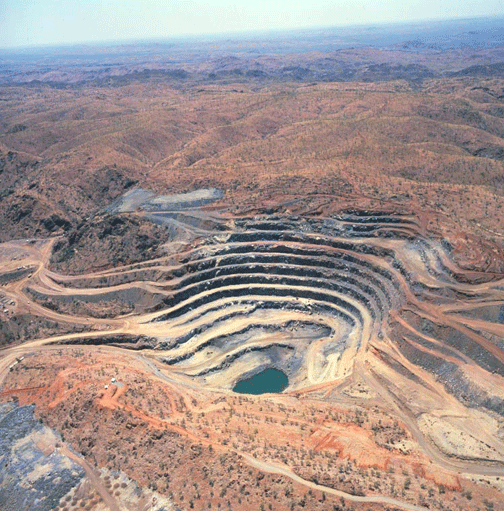
“The residents of Mount Isa are still living with the results of that mine and the inadequate capping of the spoil and the contamination of the land that even graziers today won’t go near.”…….
[Queensland Department of Natural Resources and Mines and the Department of Environment and Heritage Protection joint statement] ……”We are still assessing the condition of the Mary Kathleen site and looking at whether it could be mined again in the future.
“Contamination issues at the site may not have been properly addressed in the past.”…..http://www.abc.net.au/news/2014-05-01/uranium-debate-queensland/5423232
Australian government’s unseemly haste in selling uranium to volatile Middle East region
Robb Fast-Tracks UAE Uranium Deal https://newmatilda.com/2014/04/23/robb-fast-tracks-uae-uranium-dea By Dave Sweeney, 23 April 14 The Federal Government has signed another uranium export deal with a dubious overseas partner – and without inspecting the country’s facilities. We need an independent inquiry, writes Dave Sweeney
In a move that marks the first time Australia uranium would be sold to the Middle East, Trade Minister Andrew Robb is fast-tracking a nuclear cooperation agreement with the United Arab Emirates (UAE). Last week hesigned a new treaty in Dubai worth 800 tonnes of Uranium a year from 2020. But in doing so, the Minister is treating our Parliament as little more than a radioactive rubber stamp.
The foundation for these sales was laid by former foreign minister and airline food critic Bob Carr, who signed the initial agreement with the UAE — a country with a secretive, unelected government situated in one of the world’s most insecure regions.
Consequently, the Joint Standing Committee on Treaties recently recommended that prior to any ratification of the sales plan, the International Atomic Energy Agency undertake physical inspections of UAE facilities.
But the Federal Government’s failure to take this or any other prudent step, in favour of providing “certainty” to the ailing uranium sector shows it has confused the commercial interest of Australia’s small, high-risk low-return uranium sector with our national interest. Uranium is a small contributor to Australian export revenue and employment, but when it comes to global impact and risk Australian uranium is playing in the major league. The Australian Conservation Foundation has used industry data to examine the sustained gap between the sector’s promise and performance.
The report, Yellowcake Fever: Exposing the Uranium Industry’s Economic Myths, highlights the urgent need for an independent cost-benefit analysis and a comprehensive and transparent assessment of Australia’s uranium trade. The sector’s employment contribution is tiny: the World Nuclear Association estimates there are less than 1800 jobs in Australia’s entire uranium industry, representing just 0.015 per cent of Australian jobs. From 2002 to 2011, uranium sales averaged $627 million annually and accounted for only 0.29 per cent of all national export revenue: small beer, but with a big hangover.
Why sell to the UAE? The seven emirates, including Abu Dhabi and Dubai, have one of the least participatory political systems in the world. In 2012, more than 50 human rights activists in the UAE were rounded up and detained without charge following calls for political reform. The Human Rights Watch 2013 world Report describes a worsening human rights situation in the country, with labour rights a particular issue.
The planned uranium sale treaty doesn’t take into account local human rights issues, political changes or broader social upheavals in one of the world’s most volatile regions. It states that the agreement “shall remain in force for an initial period of thirty years and upon expiry of this initial period shall be renewed automatically for successive thirty year periods”. If this is advanced Australia would be locked in. As Greens Senator Scott Ludlam said, the Federal Government should “take a deep breath” and ask “do they really want to be selling uranium into the Middle East at the moment?”
Despite the Federal Government’s repeated insistence that the uranium must and will only be used for peaceful purposes, there is clear evidence that international nuclear safeguards are stressed, under-resourced and effectively impossible to police. To simply state that Australian uranium will not be misused is dangerously naïve.
In the shadow of Fukushima — a continuing nuclear crisis directly fuelled by Australian uranium — we need policy based on evidence. Instead of fast-tracking irresponsible uranium sales to the UAE and India — or continuing to provide nuclear fuel to nuclear weapon states — we urgently need an independent assessment of the full impacts of Australia’s radioactive and risky uranium trade.
Australian uranium miner Paladin continues its revenue fall
 Paladin’s revenue continues to slide Revenue for uranium miner Paladin Energy fell in the three months to the end of March.
The company’s sales revenue of $US88.56 million in the three months to March 31 was down from $US106 million in the same period a year earlier.
Its average sales price in the March quarter was $US36.82 per pound, down from $US38.40 in the first six months of the 2013/14 financial year, and $US55.22 in same quarter a year earlier…….http://www.sbs.com.au/news/article/2014/04/22/paladins-revenue-continues-slide
Australian uranium miner Paladin’s production declines
During the quarter under review, Paladin reported a combined production of just over two-million pounds from its Kayelekera and Langer Heinrich mines. This compared with the 2.2-million pounds of uranium oxide (U3O8) in the previous quarter.
The Kayelekera operation produced 696 710 lb during the quarter, compared with the 777 015 lb produced in the previous three months.
Paladin suspended operations at Kayelekera in February this year, citing the depressed price of U3O8, and the unsustainable cash demand to maintain the loss-making operation.
Production at the Langer Heinrich operation, in Namibia, declined to 1.39-million pounds during the three months to March, compared with the 1.43-million pounds produced over the three months to December……..http://www.miningweekly.com/article/paladin-production-declines-on-kayelekera-close-2014-04-22
Australia to co-operate with United Arab Emirates in nuclear-related activities
Australia hopes to lure Emirati students to its institutions while selling uranium to the UAE The National, Caline Malek
April 17, 2014 ABU DHABI Higher education and nuclear power are areas in which the UAE and Australia will start collaborating.
During a visit to the UAE this week by Andrew Robb, Australia’s trade and investment minister, an agreement was signed with Sheikh Hamdan bin Mubarak, the Minister for Higher Education. The countries will collaborate on vocational education, training and research cooperation in higher education……..
Mr Robb said the UAE was investing in infrastructure and restructuring its economy, creating opportunities in sectors where Australia had a proven track record.
He also met senior ministers to advocate for a resumption of negotiations for a free trade agreement with the GCC.
“I [used] my visit to set out the Australian government’s trade and investment agenda, to emphasise that Australia is open for business and that we are committed to deepening our economic engagement with the region,” he said.
Australia will also begin to export uranium to the UAE for its nuclear power plants.
The Nuclear Cooperation Agreement was signed in July 2012 but was ratified and came into force only on Monday. It could lead to the export to the UAE of up to 800 tonnes of uranium a year by the end of the decade. “The agreement should now pave the way for separate commercial agreements between potential Australian uranium suppliers and the Emirates Nuclear Energy Corporation,” said Mr Kang. “The [first exports] are subject to the timeline for the construction of the UAE’s nuclear power plants, but I understand the first of these plants is scheduled for completion in 2017.”
Under the agreement, Australia will supply uranium for use in the UAE’s developing civil nuclear power programme and cooperate in nuclear-related activities, such as safeguards, security, safety and science.
“The agreement has been secured because Australia is a reliable supplier of uranium and the UAE is a responsible user of nuclear energy for civilian purposes,” said Mr Robb, who met Sheikh Abdullah bin Zayed, the Foreign Minister, this week in Abu Dhabi.
“This will open up a new long-term market for Australian uranium producers.”……….Sheikh Abdullah said the ratification of the agreement would offer more opportunities for collaboration between the Government and private sectors of both countries. He said this falls in line with the UAE’s policy of developing its peaceful nuclear energy programme in collaboration with other countries that shared the same commitment.
Hamad Alkaabi, the UAE’s permanent representative to the International Atomic Energy Agency, said the agreement constituted a governmental framework for cooperation in nuclear activities between both countries……..http://www.thenational.ae/uae/australia-hopes-to-lure-emirati-students-to-its-institutions-while-selling-uranium-to-the-uae
In lead up to Rio Tinto’s Australian AGM (May 8) signs that Rio will not pay up for fixing up Ranger uranium mine
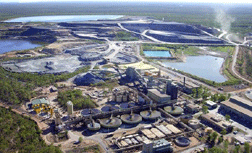 Rio chief tight-lipped on Ranger mine, SMH April 16, 2014 – Peter Ker Rio Tinto chief executive Sam Walsh has refused to guarantee that his company will cover the cost of rehabilitating the Ranger uranium mine near Kakadu, building on uncertainty that was created last month by the Rio subsidiary in charge of the mine.
Energy Resources of Australia – which is 68 per cent owned by Rio – raised eyebrows when it revealed it may need to find new sources of money to meet its rehabilitation commitments for Ranger, which is entirely surrounded by Kakadu National Park.
Under the Ranger permit, ERA must have rehabilitated the site by 2026, and a review of the rehabilitation strategy in 2013 found the cost would be $603 million on a net present cost basis. ERA has $357 million on hand and has ceased mining at Ranger, with the company now exploring for more uranium underground in a bid to find future revenue streams.
In an unusual move, ERA appeared to link the success of that exploration project – known as Ranger 3 Deeps – to its ability to pay for the rehabilitation of the site. “If the Ranger 3 Deeps mine is not developed, in the absence of any other successful development, ERA may require an additional source of funding to fully fund the rehabilitation of the Ranger Project Area,” the company said in its annual report.Such an outcome would be unusual, as miners are typically compelled to pay for the rehabilitation at the end of a mine’s life through provisions that are made each year.
In ERA’s case, some rehabilitation is already underway and it maintains a trust with the Australian Government which was holding $63.9 million at December 31.
When asked at Tuesday night’s annual meeting of Rio shareholders in London, Mr Walsh indicated he was in no mood to pick up the tab for ERA, particularly after Rio took part in a $500 million equity raising for the company in 2011. “There was a rights issue at ERA to fund the rehabilitation work and those funds are still sitting within that business,” said Mr Walsh.
”(ERA) is a public Australian company and clearly that is an issue for them.
“We are clearly shareholders, but it’s a matter for all shareholders and a matter for the ERA board.”
Environmental sensitivities of another kind were also raised at the AGM, with Rio executives forced to defend the company’s continued involvement in coal mining.
Mr Walsh said Rio did accept that “man made emissions” were responsible for changes in the climate, but the company believed the challenge could be resolved through technological developments rather than by ceasing coal production………
Rio’s Australian AGM will take place on May 8. http://www.smh.com.au/business/mining-and-resources/rio-chief-tightlipped-on-ranger-mine-20140416-36qfi.htmlSMH
No real recovery in sight for dismal uranium prices
FN Arena reports (15 April 14) “……The recovery will not, however, be long lasting under CIMB’s modelling. Despite recent voluntary cuts to supply, including Paladin Energy’s Kayelekeera mine in Malawi being placed into care & maintenance, and despite the end of the Russian HEU supply agreement, CIMB sees the global uranium market drifting back in to surplus by 2016. …
In the meantime, UBS is the most recent of brokers to mark uranium prices to market for the purpose of producer valuations. The broker has cut its 2014 average price forecast to US$39/lb from US$43/lb previously. …”
Uranium mining plans by Toro Energy – expensive, polluting, and under investigation
Toro uranium expansion plan: premature and polluting http://www.ecovoice.com.au/toro-uranium-expansion-plan-premature-and-polluting/
Western Australia’s peak environmental group has condemned a move by uranium mining hopeful Toro Energy to expand their unrealised Wiluna mine plan into a much larger uranium mining precinct spanning 100km and two ecologically sensitive lake systems in the East Murchison region.
The state EPA has released details of the expansion plan while the company is under investigation by the Australian Securities Exchange for a second time over claims they have released misleading information to shareholders and the market. (See background below).
“Toro have never successfully mined anything before and have a long way to go to get their original single-mine project approved – let alone any new expansion,” said CCWA Nuclear Free campaigner, Mia Pepper.
“Contrary to their statements to shareholders, the company needs to complete additional environmental management , mine closure, tailings management and transport plans for assessment before any mining can commence at the Wiluna site.”
The company has struggled to find investors and currently needs $300 million in start-up costs and a further $300 million in upfront bonds.
“This new plan to attract investors is likely to draw further scrutiny from both regulators and the wider community who will be looking at the cumulative impacts of a regional uranium precinct covering 100km and two arid zone Lake Systems.”
“Toro plans to double its water consumption and store radioactive mine waste from several mine sites in a Lake bed. This idea lacks credibility and the company lacks capacity, experience and financial backing.”
Toro’s new plan involves four deposits over one hundred kilometres – Lake Way, Centipede, Millipede and Lake Maitland, with the company’s long term plans including mining an additional three deposits Nowthanna, Dawson Hinkler and Firestrike – covering a hundred kilometres in the other direction.
Also in the region is WA’s largest uranium deposit – Yeelirrie, which is now owned by Cameco. Traditional Owners have consistently opposed this project for forty years.
CCWA is partnering with a range of public health, union and faith groups to call for a public inquiry into the Toro mine plan.
ASX investigation
The Mineral Policy Institute and the Conservation Council of WA received formal notification that the Australian Securities Exchange is investigating Toro Energy for the second time over the release of potentially misleading information. Continue reading
1 This month

of the week – Australians for War Powers Reform (AWPR)
To see nuclear-related stories in greater depth and intensity
 Antinuclear