Uranium supply will outlast the uneconomic nuclear industry
reality appears to be relegating nuclear power to the uneconomic category of history
 Enough Uranium, but Nuclear Power Is Still Shrinking http://www.truthdig.com/report/item/enough_uranium_but_nuclear_power_is_still_shrinking_20140412 By Paul Brown, Climate News Network This piece first appeared at Climate News Network.
LONDON—There is enough uranium available on the planet to keep the world’s nuclear industry going for as long as it is needed. But it will grow steadily more expensive to extract, because the quality of the ore is getting poorer, according to new research.
Years of work in compiling information from around the world has led Gavin M. Mudd from Monash University in Clayton, Australia to believe that it is economic and political restraints that will kill off nuclear power and not any shortage of uranium, as some have claimed.
Writing in the journal Environmental Science & Technology that renewables do not have the disadvantages of nuclear power, which needs large uranium mines that are hard to rehabilitate and which generates waste that remains dangerous for more than 100,000 years.
In addition, research shows that renewable technologies are expanding very fast and could produce all the energy needs of advanced economies, phasing out both fossil fuels and nuclear.
Mudd, who is a lecturer in the department of civil engineering at Monash, has compiled decades of data on the availability and quality of uranium ore. He concludes that, while uranium is plentiful, mining the ore is very damaging to the environment and the landscape. Continue reading
ERA desperately trying to restore confidence in uranium investors for Ranger mine
ERA digs deep in search of a future BARRY FITZGERALD THE AUSTRALIAN APRIL 10, 2014
“…..Chief executive Andrea Sutton told ERA’s annual meeting in Darwin yesterday that the environmental impact statement would be submitted in the second half of this year. The company is targeting first production late next year and has a $120 million exploration decline and a $57m prefeasibility study into the development running concurrently. Uranium production at Ranger from stockpiled ore is suspended following the collapse of a leach tank in the processing plant in December.
The collapse released a slurry of ore and acid which was captured by the site’s containment system, with ERA saying that no material escaped into Kakadu.
The AGM was told that ERA’s board had approved a work plan to bring the processing plant to readiness for a restart. But a final clearance is required from the NT and federal governments.
Ms Sutton was not able to put a timeline on when that might happen, raising the prospect that ERA will have to secure uranium from other sources. The meeting was told that the quantities involved would depend on the timing of operations being restarted.
The company said it understood the “importance of restoring confidence in the safety and environmental performance of the Ranger mine”. http://www.theaustralian.com.au/business/era-digs-deep-in-search-of-a-future/story-e6frg8zx-1226879305475#
Plan for underground mine at Ranger is high risk and low return
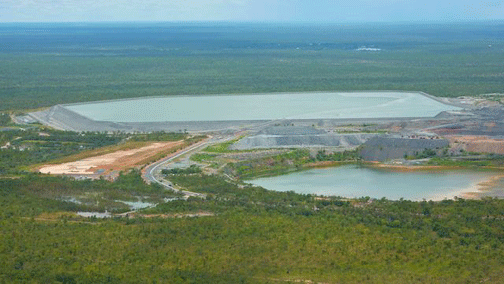 ERA told: Clean up Ranger uranium mine site and clear out rather than shifting underground, 9 April 14
http://www.abc.net.au/news/2014-04-09/era-urged-to-clean-up-ranger-uranium-mine-site-and-clear-out/5377698?section=ntPublic health experts have joined traditional owners and environmentalists in calling for Energy Resources of Australia (ERA) to focus on land rehabilitation rather than expansion of its Ranger uranium mine in the Northern Territory.
The company’s latest report shows that despite operations being suspended at the site since a toxic leak last year, plans to mine uranium underground continue.
ERA is holding its annual general meeting in Darwin today.
NT branch secretary of the Public Health Association of Australia, Dr Michael Fonda, says underground uranium mining poses serious health risks. One of the main things that is concerning us is that they [miners] are going to be exposed to dangerous levels of radon gas,” he said. Dr Fonda says ERA has a troubling safety record and it cannot be trusted to ensure safe work practices for the underground uranium mining.
“What is being planned for the R3 Deep’s expansion is for very large extraction fans to take much of that radon [gas] out of the mine,” he said.”I am concerned, and the Public Health Association is concerned, that will not be enough.”
Australian Conservation Foundation (ACF) national nuclear campaigner Dave Sweeney says ERA should focus on land rehabilitation in the final years of its mining lease. “Realise this is high risk and low return,” he said.
“Instead of accepting the inevitable and cleaning up and exiting, and having a staged and a costed and managed rehabilitation of the Ranger site, ERA is increasingly desperate and is chasing the illusion of dollars by going underground with the Ranger 3-Deep project.”Mr Sweeney says ERA and its parent company Rio Tinto should realise the planned underground mine is high risk and low return.
Indigenous traditional owners have expressed concerns that ERA will not have enough money to follow through on rehabilitation plans for the mine, which is near Jabiru and inside the boundaries of Kakadu National Park.
The end of an era for Energy Resources of Australia’s uranium mining in Kakadu
 The ERA of uranium mining is over http://www.onlineopinion.com.au/view.asp?article=16200, Dave Sweeney 9 April 14, In the early hours of Saturday December 7th 2013 the evacuation order was given in the processing area of Energy Resources of Australia’s troubled Ranger uranium mine in Kakadu.
Minutes later came the unforgiving sound of peeling metal followed by a surge of over one million litres of highly acidic uranium slurry from the buckled and broken number one leach tank. The toxic tide swept over the concrete bunds meant to contain any spills and moved uncontrolled through the night and the site.
Four months later and ERA remains under pressure, under performing and under scrutiny. Mineral processing remains suspended at Ranger pending the findings of a federal government review of the tank collapse and this week the ERA board and management will face sceptical shareholders and no doubt plenty of critical questions at the company’s annual meeting in Darwin. Continue reading
How safe are the nuclear facilities of Australia’ uranium customers? Jim Green Reports
 Nuclear security and Australia’s uranium exports Jim Green, 8 April 2014, http://onlineopinion.com.au/view.asp?article=16197“………Australia’s uranium customers Nuclear security standards are demonstrably inadequate in a number of Australia’s uranium customer countries. Nuclear security risk factors in Russia include political instability, ineffective governance, pervasive corruption, and the presence of groups determined to obtain nuclear materials. A March 2014report by Harvard University’s Belfer Center for Science and International Affairs notes that Russia has the world’s largest nuclear stockpiles stored in the world’s largest number of buildings and bunkers, and that underfunding raises serious questions about whether effective nuclear security and accounting systems can be sustained.”
In a 2011 report, the US Director of National Intelligence discussed nuclear smuggling in Russia: “We assess that undetected smuggling of weapons-usable nuclear material has occurred, but we do not know the total amount of material that has been diverted or stolen since the dissolution of the Soviet Union. We judge it highly unlikely that Russian authorities have been able to recover all of the stolen material.”
Nuclear security lapses have repeatedly made headlines in the USA over the past two years. Example include:
- the Air Force removed 17 officers assigned to guard nuclear-armed missiles after finding safety violations, potential violations in protecting codes and attitude problems;
- Air Force officers with nuclear launch authority were twice caught napping with the blast door open;
- an inspection by the Department of Energy’s Inspector General found that Los Alamos National Laboratory failed to meet its goal of 99% accuracy in accounting for the lab’s inventory of weapons-grade nuclear materials, including plutonium;
- a report by LBJ School of Public Affairs at Texas University detailed inadequate protection of US commercial and research nuclear facilities;
- at least 82 missile launch officers from an Air Force base in Montana face disciplinary action forcheating on monthly proficiency tests or for being aware of cheating and failing to report it. Former missile-launch control officer Bruce Blair said cheating “has been extensive and pervasive at all the missile bases going back for decades”;
- missile launch officers in two different incidents were found to have violated security regulationsdesigned to prevent intruders from seizing their ICBM-firing keys;
- nineteen officers at Minot Air Force Base, North Dakota, were forced to surrender their launch authority because of performance and attitude problems;
- the Navy has opened an investigation into accusations of widespread cheating by sailors at an atomic-reactor training school in South Carolina;
- the congressionally mandated Advisory Panel on the Governance of the Nuclear Security Enterprise says that drastic reforms are crucial to address “systemic” management shortcomings at the National Nuclear Security Administration; and
- former military contractor Benjamin Bishop will plead guilty to providing nuclear-arms secrets and other classified information to his Chinese girlfriend.
Time magazine describes the most embarrassing lapse: “In the U.S. in 2012, an 82-year old nun and two other peace protestors broke into Y-12, a facility in Tennessee that contains the world’s largest repository of highly enriched uranium (HEU) in metal form and until the incident was colloquially known as “the Fort Knox of HEU” for its state-of-the-art security equipment. The nun bypassed multiple intrusion-detection systems because faulty cameras had not been replaced and guards at the central alarm station had grown weary of manually validating sensors that produced frequent false alarms. When the protestors started hammering on the side of a building that contains enough HEU for hundreds of weapons, the guards inside assumed the noise was coming from construction workers that they had not been told were coming. She and her fellow protestors were eventually challenged by a single guard.”
The United States’ credibility is also undermined by its failure to ratify the 2005 amendment to the Convention on the Physical Protection of Nuclear Materials and the International Convention on the Suppression of Acts of Nuclear Terrorism. Moreover US federal government budget requests and allocations for nuclear security have been reduced repeatedly since 2011, with programs such as the Global Threat Reduction Initiative, the International Material Protection and Cooperation program, Securing the Cities, and a program to replace HEU research reactor fuel with low-enriched uranium, suffering………
The March 2014 report by Harvard University’s Belfer Center for Science and International Affairs details significant nuclear security gaps in a number of countries that import uranium − or want to import uranium − from Australia. For example it states that India’s approach to nuclear security is “highly secretive”; the threats India’s nuclear security systems must confront “appear to be significant”; India faces challenges “both from domestic terrorist organizations and from attacks by terrorist organizations based in Pakistan”; India also confronts “significant insider corruption”; and the risk of theft or sabotage in India “may be uncomfortably high”……….
So what is Australia doing? So what is the Australian government doing about the vital problem of inadequate nuclear security standards in uranium customer countries? And what are the uranium mining companies operating in Australia doing about the problem? The short answer is: nothing. They adopt a head in the sand approach, just as they ignored the disgraceful nuclear safety standards in Japan that led to the Fukushima disaster.
There are simple steps that could be taken − for example uranium exports could be made contingent on customer countries ratifying the amendment to the Convention on the Physical Protection of Nuclear Materials, and the International Convention on the Suppression of Acts of Nuclear Terrorism. http://onlineopinion.com.au/view.asp?article=16197
European company sell off its uranium asset to Australian company (unprofitable?)
 European Uranium to sell Slovakia uranium projects to Forte Energy Proactive Investors, by Deborah Bacal 4 April 14 European Uranium Resources (CVE:EUU) said it has agreed to sell its Kuriskova and Novoveska Huta uranium projects in Slovakia to Australia’s Forte Energy NL (ASX:FTE) (LON:FTE) for approximately $8.5 million plus a production royalty. The deal represents the sale of the company’s only remaining mineral projects. It told investors in a statement Friday that it now plans to investigate mineral projects to option or acquire in “multiple commodities” in Europe, with the deal today giving the company the initial funding to implement its business strategy.
The binding heads of agreement with Forte, a dual-listed exploration and development company with a portfolio of uranium assets in the Republics of Mauritania and Guinea, is subject to regulatory and shareholder approvals of both companies…..
….French nuclear energy giant Areva currently holds a 4.5% stake in Forte. http://www.proactiveinvestors.com/companies/news/53229/european-uranium-to-sell-slovakia-uranium-projects-to-forte-energy-53229.html
Confusion over BHP’s plans about its uranium projects
 Which of these reports is true?
BHP getting out of uranium mining
BHP weighs divestment options Mining Weekly By: Esmarie Swanepoel 1st April 2014 PERTH – Mining giant BHP Billiton on Tuesday said it was “reviewing” and “assessing” its divestment options, after media outlets in Australia reported that the company was considering a $20-billion demerger plan……..As we have said previously, the simplification of our portfolio is a priority and is something we have pursued for several years,” BHP said in response to the market speculation, adding that in the last two years, the company had completed a number of divestments in Australia, the US, Canada, South Africa and the UK.
Divestments included petroleum, copper, coal, mineral sands, uranium and diamond assets……….
BHP told shareholders that the company would actively continue to study the next phase of simplification, including its structural options, but noted that it would only pursue those avenues that maximised value for the company’s shareholders.
BHP CEO Andrew Mackenzie has previously said that Australia would remain a focal point for the company, pointing out that the country accounted for about 70% of its profits……..http://www.miningweekly.com/article/bhp-weighs-divestment-options-2014-04-01
Queensland’s Premier Newman breaks promise to keep ban on uranium mining
 No apology for dumping Uranium mining ban on 2nd anniversary of election of the Newman Government Mark Bailey Keep Queensland Nuclear Free 24 March 2014 http://www.mysunshinecoast.com.au/articles/article-display/no-apology-for-dumping-uranium-mining-ban-on-2nd-anniversary-of-election-of-the-newman-government,33604?utm_source=rss&utm_medium=rss&utm_campaign=MSC_Feed#.UzNVFahdV9U With the second anniversary of the Newman government this week, it is timely to note there has been no apology from Premier Newman for dumping his promise to Queenslanders before the last election to keep the ban on uranium mining in Queensland.
Premier Newman was explicit when he said;
“We have no plans and that’s as clear as I can be. The parliamentary team are very, very clear that we have no plans to develop any sort of uranium mines in Queensland.” ABC 16 Nov 2011
Yet, two years on there is less than 100 days left until dirty and dangerous uranium mines are made legal by the Newman government with approval power likely to be handed to them by the Abbott Federal Government.The safety record of uranium mining in Australia has been appalling with over 200 recorded safety incidents at Ranger mine, which is still shut down after a toxic spill last year of a million litres of radioactive slurry.
Not a single closed uranium mine in Australia has been successfully rehabilitated to this day with the last mine at Mary Kathleen a toxic mess to this day.
Queenslanders do not want the risk of radioactive contamination of their waterways, from truck accidents near their homes and schools and they certainly don’t want uranium being exported across the Great Barrier Reef.The Newman state government should suspend their dumping of the twenty-three year ban on uranium mining forthwith and conduct an independent enquiry into all implications of allowing uranium mining in our state so that communities, schools and existing industries can have their say in this far reaching decision.
Things just got even worse for Australian uranium miner Paladin
Uranium miner Paladin falls as Newmont sells 5.4% stake Mining.com,Cecilia Jamasmie | March 12, 2014 Shares in Paladin Energy Limited (ASX, TSX:PDN) fell over 5% in Australia after news broke one of the world’s largest gold producers Newmont Mining Corporation (NYSE:NEM) is selling its 5.4% stake in the uranium miner……At the time of acquisition the stake was valued at about $278 million, but Paladin’s share price was struck shortly after by the Fukushima nuclear disaster and has had a rocky time since then.http://www.mining.com/uranium-miner-paladin-falls-as-newmont-sells-5-4-stake-14330/
Thorium mining illegal in Victoria – but watch this space, and watch Dr John White
 The Liberal Party’s nuclear dreams: The strange case of Dr John White and Ignite, Independent Australia Sandi Keane 12 March 2014,
Why were Ignite Energy so desparate to dissociate their director Dr John White from both the nuclear industry and the Liberal Party? Deputy editor Sandi Keaneinvestigates.
IS THE nuclear fantasy that has taken hold in South Australia poised to slip under Victoria’s ‘no nukes‘ radar?
More to the point, is the iconic Ninety Mile Beach region of Gippsland being eyed off as a future source of thorium – uranium’s young sister – the substance hailed by nuclear proponents as the green energy source of the future?………
Enquiries to both the Sydney and Melbourne offices of Ignite confirmed that, yes, Dr White was still one of its key people — manager, government and community liaison. Less than five months ago, he was introduced as Ignite’s “executive director” in an interview with the ABC’s The World Today on 17 October 2013. Indeed, the receptionist at Ignite thought that the ‘executive director’ title was still listed on Dr White’s CV.
So, why delete it from the website and have conniptions over us publishing his connections to the Uranium Industry Framework? Also, what did Megan Davison mean by ‘casting aspersions’? Was it the reference to his being ‘a key Liberal Party adviser in the Howard-era’?
As chair of Howard’s Uranium Industry Framework and mastermind of the business plan for the Global Nuclear Energy Partnership (now renamed the International Framework for Nuclear Energy Co-operation), ‘key adviser’ hardly seems to do him justice.
Is this a reaction to the claims by members of the Gippsland community that Ignite is getting favourable treatment because of John White’s special relationship with the Liberal Party?
ELA4968’s thorium prospects Continue reading
NUCLEAR WEAPONS PROLIFERATION IN SOUTH AUSTRALIA 1945 – 1965
 Nuclear Information Centre, Conservation Council of South Australia INTRODUCTION The ways in which a country or state can contribute to the proliferation of nuclear weapons are many and varied. They include direct and indirect, overt and covert, subtle and not so subtle; the line between contributing and not contributing is fuzzy and elusive. What may be ignored at one time may later be seen to be highly significant.
We will concentrate on the obvious and widely acknowledged contributions.
A successful nuclear weapons program requires:
- A pool of knowledge
- A supply of highly trained specialists
- Research and development
- A source of fissionable material
- The facilities for converting the fissionable material into weapons grade
- Testing of guidance and delivery systems, firing mechanisms, various materials, and complete weapons.
We will limit this article to contributions made in the post-war period 1945 to 1965, which constitutes the first phase of South Australia’s contribution to nuclear weapons proliferation.
History will probably record that the second phase started with the discovery of uranium at Beverly east of Mt. Painter (1969), at Honeymoon about 75 km north-west of Broken Hill (1972), and at Olympic Dam on the Roxby Downs station (1975).
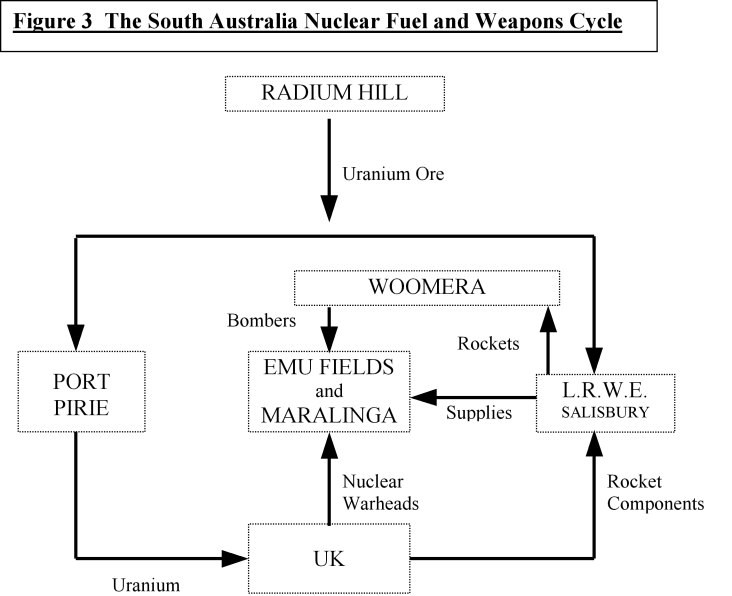
The Olympic Dam mine at Roxby Downs has been exporting to nuclear weapons states since it began production in 1988. Continue reading
Another radioactive spill at an Australian owned uranium mine
 Paladin Energy spills radioactive material at African mine, The Age, Peter Ker 17 Feb Another Australian uranium miner has been forced to clean up a spill of radioactive material.
ASX-listed Paladin Energy has reported a spill near one of its African mines, saying a truck carrying a container of uranium oxide from its Kayelekera mine in Malawi overturned while negotiating a curve in the road…….
The incident comes less than three months after ASX-listed Energy Resources of Australia (ERA) suffered a spill at its Ranger precinct in the Northern Territory. That spill is still under federal investigation and processing at the site has not resumed since.
ERA is majority owned by Rio Tinto, and the incident at Ranger occurred in the same week as a similar spill at a Rio Tinto mine in Nambia…..
The incident occurred just three days after Paladin announced it would cease mining at the loss-making Kayelekera until uranium prices improved significantly…..
Australian Conservation Foundation spokesman Dave Sweeney said the Paladin incident highlighted the risks that were inherent in mining uranium.
“We have seen costs rising and corners being cut right across Africa,” he said.
“Paladin have announced they are closing Kayelekera and this is a toxic and tragic way to say goodbye.”http://www.smh.com.au/business/mining-and-resources/paladin-energy-spills-radioactive-material-at-african-mine-20140217-32v7v.html#ixzz2td54yjQ1
Our National Parks are no place for uranium mines
By Dave Sweeney and Mia Pepper, 17 Feb 14 When we think of National Parks in Australia we generally think of places of renewal and natural beauty where we can take the whole family to recharge and reconnect with nature – places that draw international visitors to our shores looking for a taste of the wild places that have made our state famous.
Yet Western Australia’s largest National Park is current in the cross hairs of a Canadian company for a large scale uranium mining project. Right now the Canadian mining company Cameco is proposing to mine uranium in the Pilbara at Kintyre, in an area that has been excised from WA’s biggest National Park – Karlamilyi (Rudall River).
The area that contains the Kintyre uranium deposit is one of the most unique and diverse ecosystems in the country, including the fate 28 endangered, vulnerable and priority species. The proposed mine site is nestled between two branches of the Yandagoodge creek, which feeds springs and lake systems throughout Karlamilyi National Park and provides water for the communities of Punmu and Parnngurr.
On top of the question of the appropriateness of placing a uranium mine in an area well recognised for its unique and fragile environmental assets, the equation becomes even more fraught when the track record of the proponent – Cameco Resources – is given closer inspection.
Cameco’s track record overseas raises disturbing questions about the risks and potential impacts on this fragile desert ecosystem and the adequacy of the state systems that are meant to protect the people and the place. Cameco’s operating uranium mines in Canada have been dogged by leaks, floods, contamination and unsafe work environments.
Cameco has been through court over license breaches in the US, has been investigated for tax avoidance in Switzerland and has had Chinese companies turn back their leaking uranium shipments. Community division, lowering house values,community court actions and secret deals with the US military are all things that feature in reports about Cameco.
The company is also currently embroiled in a court action with the Canada Revenue Agency, which is seeking millions in unpaid tax between 2007 and 2013. Which all begs the question – is this the kind of corporate track record to which we should be willing to open up our National Parks?
Karlamilyi National Park should not be the testing ground to see if this company can operate safely or treat communities with respect without creating division.
Despite industry assurances and government promises the Australian uranium sector has a sorry track record of failed uranium mines, with leaks, spills and license breaches from exploration projects at Wiluna and Yeelirrie in WA to operating mines at Ranger in the NT and Olympic Dam in SA.
In fact there has never been single uranium mine rehabilitated successfully in Australia – Rum Jungle, Nabarlek, Mary Kathleen and more are all names associated with unresolved radioactive or acid mine drainage legacies.
Giving a blank cheque to a foreign company to operate a dirty mine in one of WA’s most special places is not smart politics or policy. It is a short term trade that would see a long term loss and an uncapped liability on the State and its tax-payers.
We all know from past experience both here and overseas that mining uranium is a risky business. Between the processing acids, heavy metals, radon gas, dust and radioactive mine waste there is a lot that can go wrong. This is sector facing strong opposition internationally with nuclear shut downs in Germany and Japan after the Fukushima disaster – a catastrophic natural and nuclear disaster fuelled by Australian uranium.
When you put this contaminated cocktail next to a National Park that is home to a network of ephemeral rivers and numerous endangered, vulnerable and priorityspecies then the stakes get even higher. WA can – and must – do better than this.
Dave Sweeney is the Nuclear Free Campaigner at the Australian Conservation Foundation. Mia Pepper is the Nuclear Free Campaigner at the Conservation Council of WA.
Nuclear waste dump plan for South Australia -uneconomic and uinrealistic
This reality is not linked to any red or green tape, but rather to the clear absence of economic returns. While the sector’s risks are significant, its economic contribution is not: in total it provides only around 650 jobs and $700 million in earnings – nationwide.
 Dave Sweeney: Nuclear pain outweighs economic gain for South Australia THE ADVERTISER FEBRUARY 10, 2014 IF South Australia moved further down the nuclear road by processing enriched uranium or storing nuclear waste, it would threaten the natural environment and put the state in direct conflict with federal policy, global markets and community expectations.
The call by Business SA to process enriched uranium and store nuclear waste stems from misplaced enthusiasm rather than measured assessment.
Any such call can only be made by ignoring the reality that the nuclear industry is, here and internationally, under intense political, regulatory and community pressure since the Fukushima meltdown in Japan.
A market analysis by economic forecaster Morgan Stanley shows the price of uranium has slumped by nearly 50 per cent since the Fukushima nuclear crisis, where Australian uranium became and remains global radioactive fallout. Continue reading
1 This month

of the week – Australians for War Powers Reform (AWPR)
To see nuclear-related stories in greater depth and intensity
 Antinuclear