ERA’S GROWING LIST OF URANIUM FAILURES IS NO BARREL OF LAUGHS
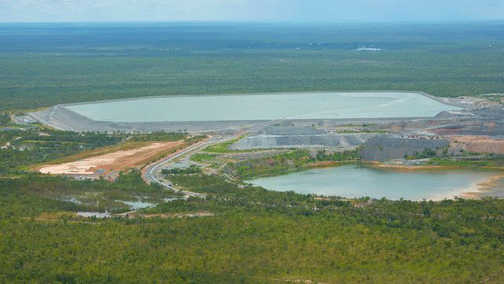 The Environment Centre NT and the Australian Conservation Foundation have condemned the latest in a conga line of failures at Ranger uranium mine amid revelations that four uranium barrels were discovered abandoned in Darwin’s rural area today.
Energy Resources of Australia (ERA) is currently under investigation for a serious operational breach following the recent unauthorised removal of a mine vehicle used in the controlled and contaminated area of the Ranger mine. This latest incident is further evidence of systemic failure at Ranger and highlights the need for an urgent review into the mine’s operations.
“ERA has not only lost control of a vehicle and uranium barrels, they’ve also clearly lost the capacity for responsible management and effective operations”, said Lauren Mellor from the Environment Centre NT. “Uranium mining, with its risks to public health and safety and long-term environmental contamination must be subject of greater Federal government scrutiny – not less as Northern Territory Mines Minister Willem Westra Van Holthe suggested today”.
Environmentalists are calling for a full, public and independent review of the operations and impacts of Ranger. “These drums are literally warning drums about the serious regulatory problems at Ranger and their description matches ERA’s assurances – empty, weathered and fire damaged”, said ACF nuclear campaigner Dave Sweeney. “ERA is currently undergoing an environmental assessment process for their proposed Ranger 3 Deeps underground mine and these systemic breaches should be a red light to Federal and Northern Territory Government assessors that ERA does not have either the capability or credibility to mine and export uranium safely and securely.”
“While there is still uncertainty as to the outcome of the investigation into ERA’s security breach, some things are crystal clear. It is clear that ERA has failed to control its operations on or off the Ranger mine, clear that the regulatory regime is deficient and clear that there is an urgent need for an open and independent review of Ranger.”
In 2011 it was confirmed that Australian uranium was inside the failed Fukushima nuclear reactor and the UN Secretary-General called on Australia to conduct an in-depth assessment of the net cost impact of the impacts of uranium mining on local communities and ecosystems. Environmentalists are calling for this assessment to now be urgently implemented.
“ERA is losing vehicles, barrels and credibility and the Northern Territory community is losing confidence and patience. It is time for the regulators and those who are meant to protect the community and country of Kakadu to get serious and get to work on closing the door to this toxic industry for good,” concluded Ms Mellor.
Lost uranium drums show regulatory failure at Rio’s Ranger mine
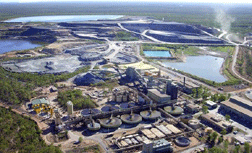 20 Nov 13, The Gundjeihmi Aboriginal Corporation (GAC) is outraged by revelations that four uranium barrels from Ranger uranium mine have been located at Noonamah south of Darwin. It is understood that the NT Department of Health yesterday notified Energy Resources of Australia (ERA) of the drums and asked that they be removed. The drums have been returned to the Ranger mine within the bounds of Kakadu National Park for safe storage. This incident comes within weeks of another serious breach of radiation management at Ranger when a potentially contaminated vehicle left the Ranger site without authorisation
GAC’s Chief Executive Officer Justin O’Brien said: “It is clear that the radiation control measures at the Ranger mine site have failed on multiple occasions. While we welcome the timely reporting of this issue by the company, ERA’s management of radiation is plainly inadequate.
“The Commonwealth Government must step in and ensure that this matter is taken seriously. To date the response by the Office of the Supervising Scientist (OSS) has been dismissive and woefully inadequate. Both the NT and Federal Governments must broaden their current investigations into the vehicle incident and examine the entire management of radiation at the Ranger mine.
“This is not a only a matter between the Mirarr and the mining company, there are significant questions of public health to be considered here. We expect these issues to be considered in a comprehensive investigation of these incidents.
“This revelation raises very serious concerns for the Mirarr Traditional Owners regarding the suggestion of further mining at Ranger,” Mr O’Brien concluded.
No price relief in sight for Australia’s troubles uranum miners
 Tough times ahead for uranium miners ABC Rural By Tara de Landgrafft 19 Nov 13, “……With a number of Japanese reactors still offline after the 2011 earthquake, there is an oversupply of uranium in the marketplace…..it will be a tough two years ahead for current producers, with one Australian miner already going into care and maintenance.
“You could have up to 40 to 50 per cent of producers who are actually operating at a loss at present,” he said.
“We’ve got a shorter term surplus in the market where you’ve got reactors offline and material that would have been entering into term contracts, those have been deferred, and that’s finding its way probably more into the short, medium-term market.” http://www.abc.net.au/news/2013-11-19/nrn-uranium/5101704
Queensland uranium sales would bring radioactive waste importing to Australia
 Uranium Mines More Dangerous Than Nuclear Power Confirms Japanese Atomic Expert At Brisbane Forum http://www.mysunshinecoast.com.au/articles/article-display/uranium-mines-more-dangerous-than-nuclear-power-confirms-japanese-atomic-expert-at-brisbane-forum,32305#.UofD39Jwo7o 16 Nov 13, Fears for worker safety at future uranium mines in Queensland were confirmed by a top Japanese atomic expert at this week’s Australia-Japan Dialogue Forum in Brisbane.
Japan Atomic Energy Commission vice chairman Dr Tatsujiro Suzuki said at the forum “Mining actually poses larger risks than reactors, even when there are not accidents. Uranium miners are regularly exposed, there’s high exposure in areas around mines and the potential for atmospheric contamination.”
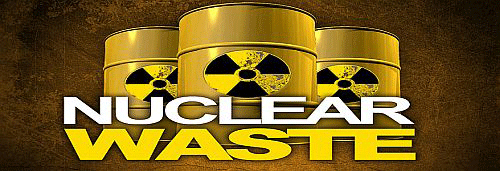 Anti-Nuclear Campaign Coordinator, Mark Bailey said Mr Suzuki’s comments showed why uranium mines were not worth the risk in Queensland. “The Ranger mine in the Northern Territory, in a similar wet season climate as North Queensland, has an appalling safety record with more than 150 documented mishaps including workers drinking and bathing in radioactive water.”
“The latest reported mishap occurred only last week. The safety of workers and nearby communities cannot be guaranteed by the uranium industry given their very poor record.” Dr Suzuki also confirmed that Japan is set to run out of nuclear waste storage capacity within six years and is looking to sign deals with uranium suppliers who are prepared to help it dispose of radioactive waste. Mr Bailey warned “Once we allow uranium mines in Queensland it is inevitable that nuclear waste storage and nuclear power will soon be on the agenda. Uranium mines are the thin edge of the nuclear wedge in Queensland.” “Once the nuclear industry has their radioactive foot in Queensland’s door, they will want to move in and take over the whole house.”
“Queensland doesn’t need uranium mining, nuclear waste dumps or nuclear power and we should re-instate the ban on uranium mining promised before the last election before it’s too late,” said Mr Bailey. “The Newman government has no mandate from the people of Queensland to allow uranium mining as they explicitly ruled it out before the election.”
Australian uranium miner Paladin: last ditch battle for survival?
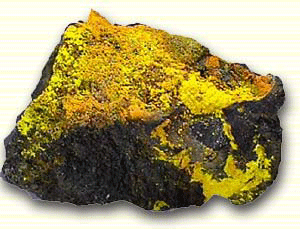 Weak uranium price hurts Paladin http://au.news.yahoo.com/thewest/business/a/-/national/19838677/weak-uranium-price-hurts-paladin/ Nick Sas, The West AustralianNovember 15, 2013, Paladin Energy has underscored the enormity of its battle for survival, admitting its African uranium mines lost $US14.9 million ($15.9 million) in the September quarter despite record production.
As shareholders prepare to quiz long-standing managing director John Borshoff at the company’s annual meeting in Perth next week, Paladin last night released its financial and operating report for the three months to September 30 detailing the pain caused by the depressed uranium price.
The gross loss on operations was the result of a 17 per cent slump in quarter-on-quarter uranium price and a resulting impairment of uranium inventory at the Kayelekera mine in Namibia, more than offsetting a 37 per cent jump in sales volumes.
It was the first time in more than five years that Paladin has not reported a gross profit for the September quarter, despite a period that included bringing the company’s second mine, Kayelekera, into production to add to output from Langer Heinrich in Namibia.
The weak September quarter came despite record production at Langer Heinrich – leading to a record group output – and continued cash cost reductions.
Production at Kayelekera fell by 9 per cent. Although Paladin receives a premium over the market-traded spot price courtesy of long-standing contracts with suppliers, a yellowcake price sitting at historical lows has now pushed it over the brink of profitability.
Over the quarter Paladin received an average of $US41.38 a pound U _{-3} _
O{-8} – down from $46.22/lb in the June quarter. The average spot price over the quarter was $US36/lb – a historical low.
The gross loss for the quarter including impairments was $US40 million. It adds to the $US420.9 million loss reported during the 2012-13 financial year, largely because of big writedowns on the value of its assets.
Paladin celebrated its 20-year anniversary earlier this year but the pressures surrounding the uranium price, mounting debt and a free-falling share price have been no cause for celebration. Paladin’s shares, at 40¢, are worth less than half of the 91.5¢ they commanded on the eve of last year’s annual meeting.
Paladin has $US276 million in unsecured convertible bonds maturing in late 2015, and a further $US236.6 million falling due 18 months later, fanning fears about its ability to generate cash to repay its debt.
Shareholders are likely to vent their disappointment at Thursday’s meeting. The Australian Shareholders’ Association wants chairman Rick Crabb to retire.
Uranium miner Paladin loses US $40 million in last three months
Uranium miner Paladin makes $US40m loss Yahoo 7 Finance AAP , 15 Nov 13 Uranium miner Paladin Energy made a $US40 million loss in the three months to September as uranium prices remain low…….Its average realised uranium sales price for the September quarter was US$41.38 per pound, as the spot price trades around eight year lows. Paladin is looking to sell a stake in the Langer Heinrich mine. It is also cutting jobs and costs in response to falls in the price of uranium.
Japanese nuclear expert gives Queensland a warning on uranium exporting, and nuclear waste
Top Japan nuke expert warns Qld on uranium http://au.news.yahoo.com/a/19813899/top-japan-nuke-expert-warns-qld-on-uranium/ 7 News, MARTY SILK -November 13, 2013 Mining uranium is far more dangerous to human health than nuclear power, a top Japanese expert warns. Japan Atomic Energy Commission vice chairman Dr Tatsujiro Suzuki says Queensland’s government must be extremely careful if it allows mining to go ahead.
The state wants to begin assessing uranium mining applications from next year after lifting a longstanding ban.
But Dr Suzuki warns that countries must plan every aspect of uranium mining meticulously. “Mining actually poses larger risks than reactors, even when there are not accidents,” he told AAP at the Australia-Japan Dialogue in Brisbane on Wednesday.
“Uranium miners are regularly exposed, there’s high exposure in areas around mines and the potential for atmospheric contamination.
“You have to be very, very careful.”
 Dr Suzuki says the key issue is how to safely store more than 1300 spent nuclear fuel rods. Japan is set to run out of nuclear waste storage capacity within six years and is looking to sign deals with uranium suppliers who are prepared to help it dispose of radioactive waste.
He added that an independent regulator should also ensure that Queensland uranium exports were only used for peaceful purposes.
Australia signed a deal to export uranium to India last year and Dr Suzuki said it couldn’t be certain that the uranium was only being used for civilian purposes.
India hasn’t signed the nuclear non-proliferation treaty and access to Australian uranium could help free up its domestic reserves for use in nuclear weapons.
The Honeymoon is over: post Fukushima reality check for Australia’s uranium industry
13 Nov 13 ACF has described reports of the imminent closure of the Honeymoon uranium mine in South Australia as further proof of the marginal and embattled nature of the uranium sector that highlights the need for an evidence based assessment of Australia’s uranium trade.
The Honeymoon mine in north east South Australia is set to close following a write down in the mine’s value of over seventy million dollars due to a combination of high costs, technical difficulties and a collapsing uranium price as the market fallout from the Fukushima nuclear crisis in Japan continues.
The Honeymoon closure is the latest in a run of bad news for Australia’s uranium industry that includes:
- Sustained losses and operational failures at Energy Resources of Australia’s Ranger mine in Kakadu
- The scrapping of plans for a massive expansion of BHP Billiton’s Olympic Dam mine in SA because of the ‘uncertain’ uranium market
- A fall of around fifty per cent in the uranium commodity price and larger falls in the share value of uranium mining companies since the Fukushima crisis began
- Attempts by Queensland uranium promoters to receive ‘royalty relief’ and public concessions even before making any formal applications to mine
- Projects stalled, scrapped or deferred across WA, SA and the NT and uranium hopefuls like Toro Energy effectively stranded without the necessary approvals or financing
- Increased shareholder anger over the poor performance of uranium companies like the Perth based Paladin Energy
- Sustained global scepticism over the role of nuclear energy following Fukushima – a continuing crisis directly fuelled by Australian uranium Continue reading
As USA’s nuclear plants bite the dust, so do Australian uranium mines?
 South Australian uranium Honeymoon mine to stop production, jobs in doubt NEWS.COM.AU NOVEMBER 11, 2013 THE Honeymoon uranium mine in South Australia’s far northeast is expected to be mothballed. Low uranium prices and production difficulties at the plant have put pressure on the mine. The future of about 70 employees was not immediately known but far fewer employees would be needed when the mine is put under “care and maintenance”.
Honeymoon, which began producing uranium in 2011 , became wholly owned by Russian state company JSC Atomredmetzoloto in mid-October.
Previously it had been 49 per cent owned-and-operated by Canada’s Uranium One……..
Honeymoon is about 500km north by road from Adelaide, 80kms northwest of Broken Hill.It uses an in-situ leach method – where liquids are pumped underground to dissolve the uranium with the mineral extracted from the pregnant solution at the surface. SA is Australia’s leading uranium producer with Olympic Dam and Beverley in operation. Ranger in the NT is the only other mine. The Four Mile mine – near Beverley – has been approved but is yet to be built….. http://www.news.com.au/national/south-australia/south-australian-uranium-honeymoon-mine-to-stop-production-jobs-in-doubt/story-fnii5yv4-1226757697638
Exploration company Thundelarra reduces costs, sell uranium assets
 Thundelarra sells non-core Hayes Creek uranium asset November 11, 2013 byProactive Investors Thundelarra (ASX:THX) will sell its Hayes Creek uranium assets for a total value of $1.5 million, while neatly retaining an exposure to any future exploration success from the Northern Territory project…….The sale is part of a new “look” Thundelarra that has rationalised non core projects, taken costs from the system and is focusing on core copper, base metal and gold exploration..
…the deal removes the rent, rates and exploration commitment overheads that accompany the Hayes Creek interests…..Today’s deal further illustrates the new broom through Thundelarra, disposing of non-core assets, while focusing on core projects. http://www.proactiveinvestors.com.au/companies/news/50073/thundelarra-sells-non-core-hayes-creek-uranium-asset-50073.html
Western Australia’s biggest national park faces uranium threat
WA’s biggest national park faces uranium threat National and state environment groups have vowed to fight plans for a uranium mine that would directly threaten Western Australia’s largest national park. The Australian Conservation Foundation and the Conservation Council of WA will join groups across the nation to challenge plans by the Canadian multinational Cameco, which today lodged an Environmental Review Management Plan for the Kintyre uranium mine at Karlamilyi National Park (Rudall River) with the WA Environment Protection Agency.
“Kintyre is in one of the most unique and diverse ecosystems in the country and is directly connected to WA’s largest national park,” said ACF campaigner Dave Sweeney. “The proposal to mine at Kintyre has been actively contested since the 1980s and will continue to be a priority issue for the environment movement given the high conservation values of the area and the unique risks of uranium mining.
“Many things have changed since the first proposal to mine Kintyre, including a severe and sustained slump in the uranium price and increased pressure on nuclear power from the growth in renewable energy and concerns fuelled by the continuing Fukushima crisis.“This is not the time – and certainly not the place – to give a green light to yellowcake.”
The Kintyre uranium deposit is nestled between two branches of Yanadagodge Creek which feeds springs and lake systems throughout the Karlamilyi National Park and the communities of Punmu and Parngurr. Radioactive contamination of water sources is already an issue in the area with elevated uranium levels found in Parngurr’s (Cotton Creek) drinking water.
“We will use every available avenue to challenge this dangerous proposal,” said CCWA campaigner Mia Pepper. “Cameco’s plan for a 1km wide, 1.5km long open pit only 500 metres from the Yanadagodge Creek could have devastating impacts on this fragile desert ecosystem.”
“Uranium poses unacceptable and unnecessary risks to the environment and public health. Cameco’s plan is a long way from being economically viable or environmentally approved.”
Cameco’s plan will be open for public comment for fourteen weeks.
Contact: Dave Sweeney 0408 317 812 or Mia Pepper 0415 380 808
Defeatism emerging in the Australian uranium industry
 Uranium plunge clouds outlook ROBIN BROMBY THE AUSTRALIAN NOVEMBER 04, 2013 JUST as one quarterly report hit the screen proclaiming uranium was at a new eight-year low, the spot price promptly shed another US50c — and thus was born an even newer eight-year low.Spot uranium sank to $US34.75 a pound during the week, a long way from the record $US136/lb it hit in 2007 during the yellowcake frenzy.
Then we had about 260 listed companies that each boasted at least one uranium project. Now we are left with the brave few.
In this space exactly a year ago, we took a relatively upbeat view of the sector. Australia had finally begun uranium sale talks with India (the new federal government may sign the deal by year’s end) and the new Queensland government had lifted its uranium mining ban.
Wisely, this column said it was too early to make the call that the uranium market had bottomed, but that at least the remaining players in the sector were upbeat.
Ditto for this month: still too early, and the brave are still battling on.
And, if the price falls close to $US30/lb, defeatism could emerge. The quarterly report mentioned above came from Manhattan Corp (MHC), which has an inferred 7800 tonnes of uranium at its Ponton deposit in Western Australia. It’s run by Alan Eggers, who seems never to tire of arguing uranium’s story. –
……..Toro Energy (TOE) is positioning itself to be Western Australia’s first producer. But not at current prices. http://www.theaustralian.com.au/business/opinion/uranium-plunge-clouds-outlook/story-e6frg9if-1226752388347#sthash.Wv1Mhsta.dpuf
Australian uranium company Paladin – huge losses and never a dividend
Paladin chief calls for investor calm The Age, November 4, 2013 Peter Ker Resources reporter Paladin Energy chairman Rick Crabb has urged shareholders to cool their lust for executive scalps at the troubled uranium miner, saying that succession planning was in train and that board changes would be counterproductive while an asset sell-down was under way.
 Mr Crabb and his managing director, John Borshoff, have been under extra pressure in recent times on the back of shareholder anger at the company’s direction.
An Asian hedge fund has been leading a group of Paladin shareholders that are trying to remove Mr Crabb and Mr Borshoff, and their rebel cause has been helped by proxy adviser ISS, which last week called for shareholders to reject a dilutive share placement that Paladin made in August.
The pressure is likely to continue before this month’s annual meeting, with the Australian Shareholders Association set to agree with ISS, plus name Mr Crabb at the top of its list of ASX chairmen who should stand down……..
Paladin failed to sell a stake in its Langer Heinrich mine in the September quarter, and Mr Crabb said sale negotiations were still under way, making it a bad time to overhaul the board…..
The ASA disagreed, with chairman Ian Curry saying that Paladin had not once delivered a dividend to shareholders since it started trading in 1994, yet had imposed billions of dollars worth of losses. : http://www.smh.com.au/business/paladin-chief-calls-for-investor-calm-20131103-2wusp.html#ixzz2jiZEkGKl
Australia’s Foreign Minister Julie Bishop pushes ahead on uranium sales to India
 India, Australia inching towards civil nuclear agreement THE HINDU, 2 NOV 13 India moved a step closer to sourcing uranium from Australia, the world’s biggest exporter of the radioactive mineral, with the Foreign Ministers of both countries agreeing to hold the third round of talks on a bilateral civil nuclear agreement towards the end of this month.
External Affairs Minister Salman Khurshid and his Australian counterpart Julie Bishop reaffirmed the commitment of both countries to finalise a Civil Nuclear Cooperation Agreement to enable the sale of Australian uranium to India, and announced that the third round of negotiations would be held here in the last week of November. They met in Perth on the margins of a multilateral conference.
The two Ministers also discussed energy security and the possibility of a Comprehensive Economic Cooperation Agreement (CECA) to strengthen ties. Both sides have laid stress on the security of sea lanes as India and Australia have supplemented their coal-based energy ties with a multibillion dollar contract for sourcing Australian gas…… http://www.thehindu.com/news/national/india-australia-inching-towards-civil-nuclear-agreement/article5306545.ece
No sign of hope for uranium mining in Queensland
Uranium mining start faces hurdles, ABC News 2 Oct 2013, The Australian Uranium Association says it will be some time before uranium mining begins in Queensland……Mr Angwin says low uranium prices are a big deterrent.
“We’ve got low-cost competitors around the world who are doing much better than Australia is at the moment and we’ve got a relatively cumbersome assessment and approval process for environmental issues,” he said.
“So if you put those three issues together and particularly the low price of uranium then it’ll be some time before companies decide the time is right to mine uranium.” http://www.abc.net.au/news/2013-10-02/uranium-mining-start-faces-hurdles/4993738
1 This month

of the week – Australians for War Powers Reform (AWPR)
To see nuclear-related stories in greater depth and intensity
 Antinuclear