Nuclear Free Queensland protest in Brisbane, against uranium mining policy
 Activists protest return to uranium mining in Queensland http://www.centraltelegraph.com.au/news/activists-protest-return-uranium-mining-queensland/2065510/ 28th Oct 2013 ABOUT 20 people staged a colourful protest in Brisbane today to mark the first anniversary of the Queensland Government’s decision to allow a return to uranium mining in the state. The protesters gathered outside the Executive Building in the hope of catching State Government ministers as they entered the building for the weekly Cabinet meeting.
Members of anti-uranium group, Keep Queensland Nuclear Free, spent about 10 minutes chanting “No Mandate for Uranium” before dispersing. Anti-Nuclear campaign co-ordinator Mark Bailey said regional centres like Townsville, Mt Isa, Emerald and St George along with a number of smaller towns will be at risk from nuclear accidents.
“Rather than arrogantly place many Queenslanders at risk the government should at least facilitate an informed debate about the dangers and risks of uranium mining through an independent inquiry,” he said.
“It is highly unlikely a majority of Queenslanders would support the resumption of mining when presented with all the facts. “Uranium mining is a dangerous, risky, small industry with big impacts on the environment, on workers, surrounding regions and potentially along transport routes.”
Call for inquiry into proposed uranium mining in Queensland
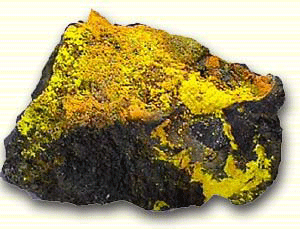 The Newman government must hold a fully independent and open inquiry into the real risks of uranium mining before Queensland starts down a risky pathway for existing industries, workers and our environment.
If it’s as safe as they claim, then they have nothing to fear from any inquiry.
Independent inquiry needed into uranium mining Brisbane Times, Mark Bailey, October 23, 2013 This week marks one year since the Newman government breaking its pre-election promise by overturning Queensland’s ban on uranium mining – without any mandate to do so.
Queenslanders across the state should be deeply worried about the dangers of mining and transporting uranium yellow cake due to the many radioactive risks involved. It was no surprise to hear Premier Campbell Newman admitting no research or modelling had been done before overturning the ban.
Given the extensive history of over 150 recorded mishaps at the Ranger uranium mine in the Northern Territory, why would our state allow a uranium mine located in our tropical climate prone to heavy summer rainfall and cyclones from the Coral Sea and the Gulf?
Given the vast amounts of radioactive sludge (or ‘tailings’) involved in uranium mining, the impact of inevitable extreme weather events slamming into mine sites with many hectares of tailings risks radioactive sludge spreading over vast distances in our state. That’s not a risk worth taking for existing industries in north and north-west Queensland let alone residents.
Uranium mines use vast amounts of water that are likely to come from the Great Artesian Basin for most of the year. While rainfall is often torrential in the wet season in north Queensland, much of the north west is dry most of the time.
The cumulative impact on the Great Artesian Basin of anywhere between one to five uranium mines may have a significant impact on water resources for other existing agricultural and cattle industries. Once one uranium mine is approved then other mines will likely be approved……
Shamefully, the Newman government has not ruled out exporting uranium across the Great Barrier Reef which should be a source of great national and international concern. Continue reading
ASX investigation casts shadow over Toro uranium company’sAGM
 18 Oct 13 At today’s AGM Toro Energy is expected to face strong criticism from shareholders over an investigation by the ASX into claims that the company has released misleading information.
The investigation follows complaints to the ASX and ASIC by the Conservation Council and a shareholder, claiming that Toro has misled shareholders and investors by inferring that a newly discovered uranium deposit is included in their existing uranium mine proposal at Wiluna.
Toro Energy has an existing application to mine uranium at Wiluna which is limited to its Lake Way and Centipede deposits. This mining proposal has received a conditional environmental approval but requires a number of other approvals from both State and Federal regulators.
Nuclear Free Campaigner, Mia Pepper explained “The new deposit mentioned in Toro’s latest release to the ASX is not part of the current Wiluna mining proposal as suggested, and will require new and separate environmental and mining approvals which will add further delays and costs to Toro’s mining plans at Wiluna.
“This is not only misleading for shareholders, but we are concerned Toro Energy is attempting to avoid proper environmental assessment for their long-term plans for a uranium precinct at Wiluna.
“Toro want the ‘best of both worlds’ by promoting an expanded project to their shareholders and investors, while withholding the details of this expansion from the community and government regulators.
“We have also written to State and Commonwealth regulators calling on them to halt further approvals for Toro’s Wiluna proposal until they are able to undertake a full cumulative impact assessment of the company’s long-term plans.”
In addition to the lack of approvals, there are a range of serious environmental and other constraints to the expansion of the already problematic Wiluna proposal.
Ms Pepper continued “The Wiluna uranium proposal as it is, is an environmental catastrophe waiting to happen with plans to dump 9.1 million tonnes of radioactive mine waste in a Lake bed, and with only enough water for a third of the life of the mine.
“If Toro were to incorporate additional deposits, the proposal would be drastically different. A 100km network of small shallow uranium mines and waste dumps across two Lake Systems is very different to a single mine. The cumulative impact of these operations must be fully assessed.
People will be handing out economic reports to shareholders entering the AGM from 8.30am – 9am at the Celtic Club – 48 Ord St West Perth.
Media Comment – before and after the shareholders meeting:
Uranium miner Paladin has to sell assets to stay afloat?
Hurt by Low Uranium Prices, Paladin Targets Asset Sale WSJ, By Ross Kelly 16 Oct 13 SYDNEY–Paladin Energy Ltd. (PDN.AU) was once among the boldest predators in the uranium industry, buying up deposits of the nuclear fuel in countries as diverse as Niger and Canada to feed a boom in global demand for non-fossil fuels.
Now, the Australian company has turned seller to ease investor concerns over its debt pile, as it racks up losses due largely to the sharp fall in uranium prices since an earthquake triggered an atomic crisis in Japan in early 2011……
It has already cut its exploration budget in half and slashed executive pay by 10% to ease pressure on its balance sheet, but this hasn’t arrested a fall in its share price to near-decade lows.
In August, Paladin said it needed the spot uranium price to average US$42.50 a pound over the coming year or it would run out of cash by the end of September next year without additional cost cuts. That price goal is well below current levels of US$35.25 a pound, near an eight-year low hit last month……
analysts think the sale process could stumble again, given the uncertain outlook for nuclear power.
“Barring a miraculous recovery in the uranium price, the only realistic way to generate enough cash to meet the US$300m convertible maturity in November 2015 is a sale of a stake in Langer Heinrich, which didn’t generate acceptable bids earlier this year,” said Clarke Wilkins, an analyst at Citigroup, who rates Paladin’s stock a sell…..http://online.wsj.com/article/DN-CO-20131016-001298.html
Poor forecast for uranium miners ERA and Paladin
 Little optimism in uranium market http://finance.ninemsn.com.au/newscolumnists/greg/8739108/little-optimism-in-uranium-market 15 Oct 13 Olympic Dam is Australia’s largest uranium source but outside of the diversified resource conglomerate that is owner BHP Billiton, Australia’s two “big” pure-play uranium producers are Energy Resources of Australia, operating in the Northern Territory and Paladin Energy operating in Namibia. Continue reading
Poor results from uranium producer ERA
Expected slump in ERA results, THE AUSTRALIAN 13 Oct 13
RIO Tinto’s listed uranium subsidiary Energy Resources of Australia has kicked off the September quarter reporting period for the group on the sour note widely expected by investors.
Output from ERA’s Ranger operation in the Northern Territory fell sharply in the quarter because of the exhaustion of open-cut reserves, restricting operations to the processing of lower-grade stockpiles.
Uranium production plunged 51 per cent to 610 tonnes (1.34 million pounds) from the previous corresponding period…..
Australian rare earths company Lynas still on the nose in Malaysia
Residents though remain highly sceptical and opposition candidates running on an anti-Lynas platform won a raft of seats around the plant, in the May general election.
Lynas lost more than $107 million last financial year, and has informed the market that it’s set to report another quarter of reduced output, as it continues to work on the plant’s operational issues.
Deutsche Bank’s Chris Terry says the company’s share price is now around 40 cents, compared with its peak value of $2.30 in early 2011
Australian rare earths miner Lynas Corporation sparks fresh anger in Malaysia ABC News, Kate Arnott for Newsline 9 Oct 13Australian rare earths miner Lynas Corporation is refusing to publicly disclose the location of a permanent waste storage facility for its processing plant in Malaysia.
Earlier this year, Lynas started commercial production of rare earths, which are used in a wide range of high tech equipment, but the plant on the east coast of peninsular Malaysia has been plagued by operational problems. Continue reading
Influential Aboriginal leaders have doubts about Warren Mundine and the new Indigenous Advisory Council (IAC)
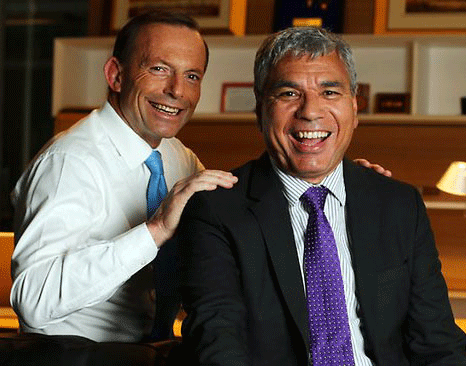
The establishment of the IAC, two thirds of which is directly aligned with the uranium industry, does not bode well for advancing a mature conversation around and action on the problems of Aboriginal disadvantage. At the very least there should be a diversity of communities and a diversity of views represented.
A lode of real action http://www.onlineopinion.com.au/view.asp?article=15551 By Kado Muir, Mitch . and Peter Watts – 7 October 2013 This article was first published in the Koori Mail As the dust starts to settle and Australia reflects on the outcomes of the recent federal election, many Aboriginal people have growing concerns over Tony Abbott’s new Indigenous Advisory Council (IAC) and the agenda behind its plans for real action for Indigenous Australians. Continue reading
Abbott govt accelerates sale of uranium to India, as India fires another nuclear-capable missile
 India, Australia to hold third round of nuclear talks IANS | http://ibnlive.in.com/news/india-australia-to-hold-third-round-of-nuclear-talks/427039-3.html?utm_source=ref_article Oct 07, 2013 New Delhi: India and Australia, under the new dispensation of Prime Minister Tony Abbott, are hoping to hold a third round of talks on nuclear cooperation in December this year, said a top official on Monday. Secretary (East) in the external affairs ministry Ashok K Kantha said Abbott has “made positive comments about the need for expediting, accelerating negotiations between India and Australia on nuclear cooperation”.

“We already have held two rounds of negotiations, and we are hoping to hold a third round of negotiations if possible in December this year.  We have not yet firmed up the dates. But I believe there is a strong desire on both sides to try and bring these negotiations to a successful conclusion at an early date,” said Kantha at a briefing in New Delhi.
India test fires nuclear capable missile from Odisha Tribune, By Web Desk October 7, 2013 ODISHA: India test-fired a nuclear-capable Prithvi-II missile from a test range at Chandipur, Odisha on Monday, Express News reported……The Prithvi II missile was inducted into India’s Strategic Forces Command in 2003 and is the first missile developed by DRDO under India’s IGMDP (Integrated Guided Missile Development Program.
The missile is capable of carrying 500 to 1000 kilograms of warheads according to The Hindu.
On September 14, India successfully test-fired for a nuclear-capable missile that can reach Beijing and much of Europe. http://tribune.com.pk/story/614650/india-test-fires-nuclear-capable-missile-from-odisha/
Investors warned about the fading glow of the uranium market (The Australian!)
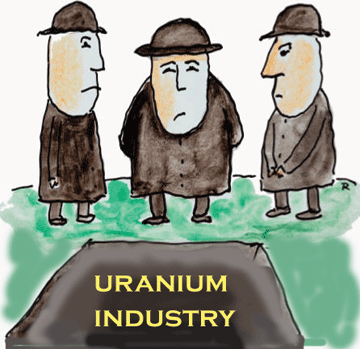 The price fall that started six years ago could continue, especially with major new reserves being readily discovered in Australia and Africa. And it seems nuclear incidents are never too far away.
Those holding shares in uranium companies, or considering them, should handle them with great care.
Uranium best handled with care TONY KAYE THE AUSTRALIAN OCTOBER 05 IT isn’t all about Japan, Iran, the “China syndrome”, or even the swarm of moon jellyfish that forced a shutdown this week of all three reactors at Sweden’s Oskarshamn nuclear plant.
But the cold reality of the meltdown afflicting the uranium sector globally was best demonstrated on Wednesday when Australian group Paladin Energy announced it was slashing its operating costs across the board in the face of a further weakening in the spot price of the nuclear fuel it mines in southern Africa.
Paladin, based in Perth, has watched its share price dive more than 90 per cent since 2007 at the hands of a uranium price that has plunged about 75 per cent over the same period. Compelled to address the issue, the company has taken the knife to its cost structure, cutting head-office jobs, exploration expenses, executive pay by 10 per cent, and cash costs by $23 million.
Paladin is also attempting to sell its stake in its flagship Namibian mine to pay down $US750m ($794m) in debt. “Optimisation strategies have now become even more pertinent with the further incremental weakening of the uranium spot price,” the company said.
So what are the factors behind uranium’s fading glow? The answer is not rocket science. Continue reading
Business analysts downgrade Paladin Energy’s uranium operations
Translating business language – “outperform” – means good to invest. “Sector Perform” mean s not so good
Outperform. The stock’s total return is projected to exceed the average return of the industry (or its sector or its peers). This means the stock will perform better than the competition and is likely rated a “Buy”.
Sector Perform). The stock is expected to perform in line with the average return of the market or sector or its peers. Similar to a “Hold” or a “Neutral” rating.
 Paladin Energy Limited Downgraded to Sector Perform at RBC Capital (PDN) North fork vue.com October 2nd, 2013 Paladin Energy Limited (ASX:PDN) was downgraded by investment analysts at RBC Capital from an “outperform” rating to a “sector perform” rating in a note issued to investors on Wednesday, American Banking News reports. They currently have a A$0.80 ($0.75) price target on the stock……..
A number of other analysts have also recently weighed in on PDN. Analysts at TD Securities cut their price target on shares of Paladin Energy Limited (ASX:PDN) from A$0.90 ($0.84) to A$0.65 ($0.61) in a research note to investors on Friday, August 30th. They now have a “hold” rating on the stock. Separately, analysts at BMO Capital Markets cut their price target on shares of Paladin Energy Limited (ASX:PDN) from A$0.80 ($0.75) to A$0.60 ($0.56) in a research note to investors on Friday, August 30th. Finally, analysts at Raymond James downgraded shares of Paladin Energy Limited (ASX:PDN) from an “outperform” rating to a “market perform” rating in a research note to investors on Monday, August 5th. Three equities research analysts have rated the stock with a hold rating and one has issued a buy rating to the stock. The stock presently has an average rating of “Hold” and a consensus price target of A$0.96 ($0.90).
Paladin Energy Ltd (ASX:PDN) is a uranium production company with projects in Australia and two operating mines in Africa. http://www.northforkvue.com/finance/10712/paladin-energy-limited-downgraded-to-sector-perform-at-rbc-capital-pdn/
Paladin Energy cuts costs as uranium prices remain down the drain
Paladin cuts top-echelon base salaries, overall spending amid low uranium price TIMES COLONIST OCTOBER 2, 2013 PERTH, Australia – Paladin Energy Ltd (TSX:PDN) is cutting the base salaries of its board and management by 10 per cent as part of cost-saving measures due to low spot prices for uranium — its main commodity.
In total, the miner — which lists its shares on the Toronto and Australian stock markets — is aiming to reduce cash costs for its 2014 financial year by US$23 million.
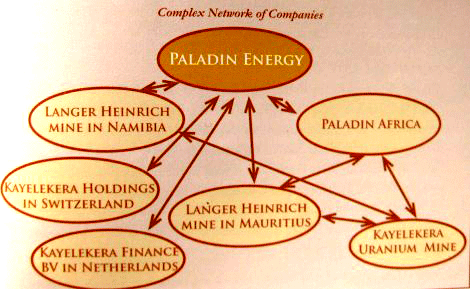
The cuts include a $10.8-million reduction in spending on overhead and exploration and a US$12.4-million reduction in discretionary capital spending at two mines in southern Africa….The Langer Heinrich mine in central Namibia will see its capital spending cut by US$10 million compared with the 2013 financial year while a further $2 million will be cut from the capital budget for the Kayelekera mine in Malawi. http://www.timescolonist.com/business/paladin-cuts-top-echelon-base-salaries-overall-spending-amid-low-uranium-price-1.645930
Don’t let the Australian government lose oversight of the NATIONALLY important (and financially failing) uranium industry
 Uranium mining and export not a piece of yellow cake http://www.couriermail.com.au/news/opinion/opinion-uranium-mining-and-export-not-a-piece-of-yellow-cake/story-fnihsr9v-1226729513911 DAVE SWEENEY THE COURIER-MAIL SEPTEMBER 30, 2013
THIS week the Australian Uranium Association and other nuclear industry hopefuls will head to western Queensland for the Mining the Isa conference. Mt Isa is no stranger to mining but the region – and Queensland – would be well advised to treat the claims of the uranium sector with caution.
Globally the nuclear industry is under intense political, regulatory and community pressure since the Fukushima meltdown, a continuing nuclear crisis directly linked to Australia’s contested and contaminating uranium industry.
Recently the Newman Government released an “action plan” that seeks to open the door to uranium mining in Queensland but the LNP’s uranium road map is deeply flawed and in conflict with federal policy, global markets and community expectations. A key plank of the LNP’s plan is to have “all uranium mining proposals in Queensland assessed and approved by the state government”. Currently uranium mining and wider nuclear issues remain the clear responsibility of the federal government and this is as it should be.
Uranium mining is an issue of national interest and importance with extensive risks and long term impacts and is rightly a matter for the active consideration of the national government.
State governments, mining companies and the Australian Uranium Association, have long dreamt of the power to tick off on a new uranium mine being transferred to state governments in the hope that this would removing key checks and balances and speed up approvals. Continue reading
The end of the line for Australian uranium company Paladin Energy?
the fact remains that it has not had a profitable annual result since commencing operations. Our modelling forecasts continued negative cash flow and the company running out of cash in early 2014 and consequently [being] unable to service its substantial debt position.
Uranium price slumps, Paladin Energy in trouble Jim Green WISE/NIRS Nuclear Monitor #768, 27 Sept 2013 ” Paladin Energy ……….Australian-based Paladin Energy operates two uranium mines in Africa − Langer Heinrich in Namibia and Kayelekera in Malawi. CEO John Borshoff told a mining conference in Western Australia in July that the uranium industry faces a number of “major problems” such as the lack of greenfields development, dwindling investment capital and the sickly uranium price.[12]
Borshoff said: “[T]he uranium industry is definitely in crisis, I believe, and is showing all the symptoms of a mid-term paralysis if this situation does not demonstrably change. How can there not be a problem when you have an effective moratorium with nearly all major companies making no commitment to greenfields development until the price gets about US$70 and it is believed it can stay above that level. And how can there not be a problem when you have a strong chance that some of the more expensive, smaller operations will be mothballed − putting more pressure on current production. … Only at this price level [US$70/ lb] − and above − can sufficient capital for new products be raised and returns on investment be justified to finally give some risk reward to the shareholder. And this appears to be a long way away.” Continue reading
The uranium industry in deep trouble
The industry hopes that reactor restarts in Japan will improve the situation − but restarts will be slow and in many cases strongly contested. The industry hopes that new build in China will improve the situation − but pre-Fukushima nuclear growth projections have been sharply reduced and China now plans to approve a “small number” of new reactors projects each year.
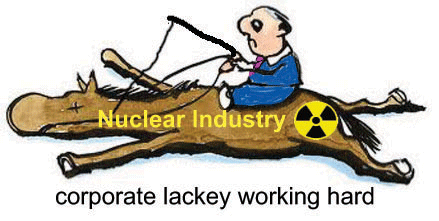
Uranium price slumps, Paladin Energy in trouble Jim Green WISE/NIRS Nuclear Monitor #768, 27 Sept 2013 The spot uranium price fell to US$34.50 / lb U3O8 in late July, a price not seen since December 2005 during the upswing of a spectacular price bubble which peaked in June 2007 at US$138 / lb. The 12% price slump in July was the biggest monthly loss since March 2011. Since September 2, the spot price has been still lower, at US$34.00. Those prices are just over half the spot price of US$66.50 / lb on 11 March 2011, the first day of the triple-disaster in north-east Japan.[1]
The long-term contract price has been reasonably stable in recent months at US$57 / lb. At that price, the value of annual global uranium requirements for power reactors is around US$10 billion.
FNArena wrote on September 17: “The issue of low uranium prices discouraging new supply is not just one of the spot price itself but one of the marginal cost of new supply. Producers suggested to Ux that the average marginal cost of production of operating mines is around where the spot price is now, but the marginal cost of developing a new mine is more like US$65-70/lb. From the nuclear energy prospective, respondents rated the most significant demand-side influences as, in descending order of influence, Japanese reactor restarts, Chinese reactor build, the premature shutdown of older US reactors and the emergence of newcomer countries to nuclear energy (about equal), and the upcoming French nuclear licence renewals.”[19]
Raymond James analyst David Sadowski expects an average spot price of $40 per pound this year, $52 in 2014, and $70 in both 2015 and 2016.[2] Michael Angwin from the Australian Uranium Association expects low prices until about 2017/18, and a nasdaq.com article states that “the road to recovery for this battered commodity will be a long haul”.[3,4] Rob Atkinson, outgoing CEO of Energy Resources of Australia, says the uranium spot price is woeful, making it extremely difficult to make the case for developing a new mine, and the market will remain difficult for at least another two years.[21] Continue reading
1 This month

of the week – Australians for War Powers Reform (AWPR)
To see nuclear-related stories in greater depth and intensity
 Antinuclear