ERA flounders with uranium losses, cost-cutting and the prospect of financial collapse
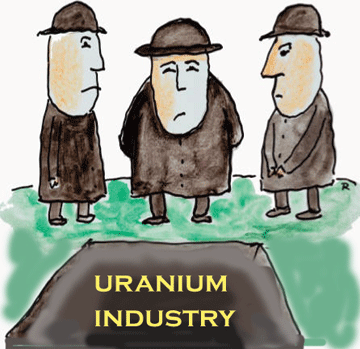 ERA’s cost-cutting continues while uranium prices flounder The Motley Fool By Darryl Daté-Shappard – September 23, 2013 “…..The company, which is 68% owned by Rio Tinto (ASX: RIO), just recently reported a $53.55 million loss for its half-year result, with its expenses approximately the same as its $144.3 million revenue. A larger than average $129 million depreciation charge added to the net loss, its third in three years since 2010.
Its Ranger 3 Deeps mine project was discussed, and the company said that the pre-feasibility study was on schedule and on budget. Assuming all necessary approvals are granted, the commencement of production should take place in late 2015. This underground project is adjacent to its open pit mine site, located in the Kakadu National Park. The open pit mine is nearing its end, and so are mining approvals for it, so the underground project is of great importance to continue the company’s activities in this area.
This month the newly installed Brine Concentrator began operation to clean up water used in production. It will be able to process up to 1.8 billion litres per year, rehabilitating the site’s water to be safe near the heritage-listed national park. The water facilities cost $20 million annually to operate.
A total cumulative $102 million out of $150 million in projected savings has been achieved since 2011. However, will this lead to a profit in the near-term if the company in the end is producing less than before, and uranium prices are still around $30-$40/lb?
The overseas uranium market still has not recovered since the Japanese nuclear disaster in Fukushima, and downward price pressure is coming from the development of cheap natural gas within the US, seen as an alternative power generation fuel with less pollutants than coal, and no need for specialised containment and storage that nuclear energy requires……..http://www.fool.com.au/2013/09/23/eras-cost-cutting-continues-while-uranium-prices-flounder/
Yeah – let’s Australia become the world’s radioactive trash toilet!
Call to store nuclear waste to sustain uranium industry http://www.afr.com/p/business/sunday/call_to_store_nuclear_waste_to_sustain_bQJnppe7viMuI9dlCLPbmJ CLAIRE STEWART, 22 Sept 13 Australia will need to start enriching uranium and storing the nuclear waste if it is going to sustain a competitive uranium industry in the future, says senior finance and resources figure Mark Johnson.
Mr Johnson, a former deputy chair of Macquarie Bank and former chairman of AGL, said Australia had a “great opportunity” to become a participant in a “free world nuclear fuel cycle”, if it produces uranium. “But the consequence of that is we would also have to store spent uranium,” he told Financial Review Sunday.
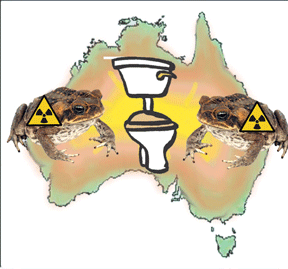
Federal government laws explicitly prohibit the building of nuclear fabrication, enrichment or power plants and the return of nuclear waste to Australia for storage. “Nobody wants spent nuclear fuel in their backyard, even if it would be right in the centre of the outback of Australia, [with] very stable geological conditions,” Mr Johnson said.
The price of uranium has halved since governments around the world promised to cut their reliance on nuclear power following the Fukushima nuclear disaster. Energy Resources Australia chief executive Rob Atkinson said the market will turn, particularly given expected demand from China.
For other democracies, nuclear power is “off the table for generations”, Mr Johnson said, prompting suggestions that enrichment and storage of waste will be a key part of expanding the industry. Australia currently processes uranium to the “yellow cake” stage, which is then exported for further processing and concentration, and in some cases turned into fuel rods.
Uranium as a fuel source can only be used for about three years before it becomes too unstable, said Australian Conservation Foundation nuclear campaigner Dave Sweeny. He said making Australia part of the global fuel cycle was about opening the country up for return of that spent material. “Industry returns are meagre and the risks are significant and continuing,” he said. “Storage is the Achilles heel . . . it highlights the political, social and technical difficulty of doing this.”
Traditional land owners want troubled ERA uranium mining to shut down by 2021 (or earlier)
 traditional owners of the land want ERA to stick to the 2021 deadline.
“It’s never crossed our mind that they would mine beyond 2021,”
Rio Tinto may decide to walk away from the project at its mandated deadline. “They will be acutely aware that they will be judged long into the future on how they exit Kakadu,” Sweeney says.
Debate warming up over Ranger mine future, The West Neda Vanovac, AAPSeptember 19, 2013, The operators of the Ranger uranium mine in the Northern Territory have unveiled a new water processing machine they say will give it a future beyond 2021.
But not everyone’s happy……. Traditional owners and environmental groups want to see ERA exit in 2021. Continue reading
Uranium mining might commence again at Ranger, Northern Territory
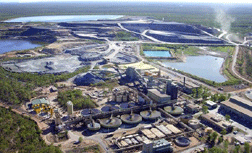 NT uranium mine gets future beyond 2021, Yahoo 7 Finance, 19 Sept 13 The Northern Territory’s Ranger uranium mine has unveiled a new water processing machine it says will prolong its future beyond a planned 2021 closure. Mining has been completed at the site, which is located within but is not a part of the world heritage-listed Kakadu National Park. It’s operated by Energy Resources Australia (ERA), which is owned by Rio Tinto.
The $220 million brine concentrator unveiled on Thursday will improve the mine’s ability to treat water and progressively rehabilitate the site, which must be completed by 2026, when it must be of a standard to be reintegrated into Kakadu.
Previous attempts to treat water properly were either too small for requirements or unsuccessful, CEO Rob Atkinson said………
Although the Ranger mine is now only processing stockpiled ore as its open pits are slowly being backfilled, exploration for a possible underground mine is underway at a neighbouring site called Ranger 3 Deeps.
If feasible, mining could begin in 2015 but would only be able to operate for five years under the current lease agreement.
Mr Atkinson said it was too early to be talking about future negotiations with stakeholders such as the Jabiru community and the Mirarr people, the transitional owners of the land….. http://au.finance.yahoo.com/news/nt-uranium-mine-gets-future-052217361.html
ERA, Rio Tinto, Paladin desperately hope that Fukushima is just a “bump in the road”
Japan goes nuclear-free The Motley Fool, By Justin Loiseau – September 16, 2013 Japan is closing down its last operating nuclear reactor for scheduled maintenance, putting the country in “nuclear-free” territory for the first time since the Fukushima crisis necessitated nationwide inspections two years ago. Japan has 50 commercial reactors nationwide, and the March 2011 Fukushima disaster marked the first time in over 40 years that the country pulled power exclusively from non-nuclear sources.
Japan is split on the future of this fuel. While Prime Minister Shinzo Abe and utilities point to the need for nuclear to meet Japan’s growing energy demands, the general public and environmental activist groups remain apprehensive about the safety of local reactors.
Japan and Australia may be oceans apart, but the two countries are closely linked. Energy Resources of Australia (ASX: ERA) is one of the largest uranium producers in the world, the secret sauce of nuclear reactors. Rio Tinto (ASX: RIO) has a 64% stake in the company as well, and Japan’s exit from nuclear could push prices down drastically if it bids adieu indefinitely. Paladin Energy (ASX: PDN) and its 82%-owned Summit Resources(ASX: SMM) subsidiary tell a similar story. Spot prices have already dropped from $65 highs in 2011 and are currently hovering around $35, similar to 2006 markets.
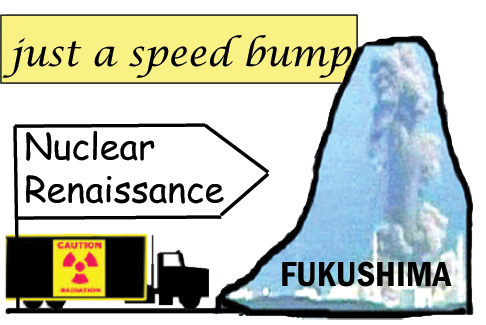
Japan’s nuclear notions are unclear, and proponents of the energy have warned of blackouts if the country doesn’t jump back on the nuclear track. Opponents, including Greenpeace Japan, are instead pushing Japan to seize the opportunity to become a leader in renewable energy.
Regardless of the ultimate outcome, this latest nuclear shutdown is another bump in the road (read “increased risk”) for nuclear energy and its uranium producers……http://www.fool.com.au/2013/09/16/japan-goes-nuclear-free/
New equipment: old problems – ERA’s Kakadu uranium plans in focus
Environment Centre NT, 17 Sept 13, Uranium miner Energy Resources of Australia will unveil its new brine concentrator – a long overdue piece of infrastructure that seeks to address both chronic water management problems and contaminated process water – at its aging Ranger uranium mine in Kakadu on Thursday.
The Ranger mine has been plagued with water and waste management problems that have caused extended shutdowns and deep concerns about impact on the World Heritage Kakadu National Park. “The new infrastructure is a long overdue and welcome initiative,” said Lauren Mellor, Nuclear Free NT Campaigner with the Environment Centre NT.
“The delay in commissioning this key piece of equipment is a poor reflection on ERA’s commitment to rehabilitation, given the company’s long history of water mismanagement. That ERA has been allowed to continue mining and expanding its waste water inventory, now estimated at eleven gigalitres, without having an effective waste water management plan or the ability to treat process water shows a disturbing lack of regulatory rigour.” Continue reading
Queensland govt says no exporting of uranium over great Barrier Reef
 Government rules out uranium exports over Great Barrier Reef The Satellite, APN Newsdesk 12th Sep 2013 APN NEWSDESK EXPORTING Queensland’s uranium is a priority for the state government, but the radioactive material is unlikely to leave Australian shores via the Great Barrier Reef.
In an “action plan” released on Thursday, the State Government has ruled that any uranium pulled from Queensland provinces can only be exported from Adelaide or Darwin……… The government has again ruled out allowing nuclear power plants or the disposal of radioactive waste in Queensland.
And like all major resources projects, the state is pushing to gain control over approvals – but environmental activists are concerned.
Australian Conservation Foundation Dave Sweeney said such state powers conflicted with comments by the incoming Federal Government that it would retain its hold over uranium projects. “Uranium mining is an issue of national interest and importance and is rightly a matter for the active consideration of the national government,” Mr Sweeney said.
Mines Minister Andrew Cripps said the government would begin considering projects by mid-2014. From there, demand from industry would determine when mining began.http://www.thesatellite.com.au/news/exporting-queenslands-uranium-barrier-reef/2018482/
Queensland government pro uranium mining, but cautions on poor market for uranium
Qld Government moves closer to re-establish uranium mining ABC News, By Kim Lyell, 13 Sept 13 The Queensland Government has released a plan to re-establish uranium mining in the state as early as next year…….. Mines Minister Andrew Cripps says the Government has accepted the findings of an independent committee that, with some adaptations, uranium mining could resume under existing industry regulation and radiation safety systems.
“An action plan has been released and an oversight committee established,” he said. Mr Cripps says the action plan covers all aspects of the approvals process, environmental and health and safety standards, Indigenous opportunities and native title.
The Government says although it could assess applications from next year, the market for uranium will ultimately determine when mining begins……http://www.abc.net.au/news/2013-09-12/qld-government-moves-to-re-establish-uranium-mining/4953742
Abbott govt likely to speed up uranium sales deal with India
 Australian Election Seen Likely to Speed Talks with India on Uranium Deal National Journal, By Rachel Oswald, Global Security Newswire September 11, 2013 WASHINGTON — Newly elected leaders in Australia likely will push to conclude a trade agreement aimed at allowing uranium exports to India, issue experts told Global Security Newswire.
While it was earlier predicted to take two years to conclude the export negotiations, a new Liberal-National government led by conservative leader Tony Abbott likely will push to have trade discussions finished “within the year,” according to Amitabh Mattoo, director of the Australia India Institute at the University of Melbourne. Continue reading
South Australian uranium mine to be 100% Russian owned
Honeymoon Well uranium mine to go into Russian hands ABC Rural By Babs McHugh 7 Sept 13, The Honeymoon Well uranium mine in South Australia is set to be 100 per cent Russian owned by the September quarter.
Shareholders of Canadian company Uranium One have approved a buyout offer from the Russian State Corporation for Nuclear Energy, Rosatom.
A Rosatom subsidiary already owns 49 per cent of Uranium One and, once the deal is completed, the new entity will be private.
Honeymoon Well is is the smallest of Australia’s operating uranium mines. The others are Olympic Dam in South Australia, Ranger Mine in the Northern Territory and Beverley Mine in South Australia…… http://www.abc.net.au/news/2013-09-06/russia-to-own-honeymoon-well-uranium-mine/4941128
Glut of uranium to continue – market forecast is dire, especially for Paladin
Japan’s nuclear energy intentions are the swing factor at present. … if Japan does not start turning back on more reactors, Japanese uranium stockpiles will continue to hit the market to pay for increased fossil fuel imports. Nor is it helping at present that the US is also talking about turning off reactors.
Meanwhile, traders and speculators stuck with material and producers suffering cash flow problems are ever more desperate to offload material.
No rush to buy uranium, 9 News Finance by FN Arena 2 Sept 13, The spot market for uranium was never of much interest until the big surge took prices up well over US$100/lb in 2006. In that era, legacy contract obligations at much lower prices impacted on the earnings potential of the large and long-established players, such as Energy Resources of Australia in Australian terms, while new kids on the block, such as Paladin Energy relished the opportunity to secure contracts at more spot-aligned pricing.
Fast forward to the post-Fukushima era of 2013 and the tables have turned. Those noughties contract obligations have largely run off and the uranium price is wallowing in the depths. Lower cost, long-established producers such as BHP Billiton can at least bungle along (ERA has had its own specific production issues) while the high-cost later entrants are struggling to stay afloat. Paladin is the classic example. Continue reading
Paladin’s boss John Borschoff rails against ”diabolical” state of uranium market
 Paladin managing director John Borshoff could do little on Friday but launch yet another speech about how unreasonably low the uranium price has been, labelling it ”diabolical”, ”extremely depressed” and ”of great concern
Paladin still paying price of uranium freeze August 31, 2013 SMH, Peter Ker Resources reporter Two years after Fukushima, nuclear energy companies remain troubled. The first year after the Fukushima disaster was always going to be tough for the uranium sector, but few would have thought the second year would be even worse.
The spot price for uranium hit eight-year lows this week, and now stands 30 per cent lower than a year ago, when the industry was supposedly at its nadir.
Most of the Japanese nuclear power stations that were turned off after the deadly tsunami of March 2011 remain idle, and the prospect of new demand emerging in developing countries such as China has yet to eventuate.
While all uranium stocks have suffered over the past 30 months, few companies epitomise the struggles of the sector more than Paladin Energy, which has almost been decimated since it was fetching $5 a share on the day before the Fukushima tragedy. Continue reading
Paladin Energy’s John Borschoff puts a brave face on uranium market’s disaster
‘Price hikes will be severe’ And uranium’s rise will come sooner, not later, says Paladin’s John Borshoff Resource Clips, by Greg Klein, 31 Aug 13,
With uranium selling well under $40, “no one will or can move forward with growth, never mind maintaining current production,” said Paladin Energy TSX:PDN managing director/CEO John Borshoff. While summarizing his company’s fiscal 2013 he expressed incredulity about the uranium market’s “absolute absurdity” of low prices despite looming shortages.
He also predicted a dramatic change, emphasizing “the price can only go up sooner than some think.
”…… Addressing a conference call from his Western Australia office on August 30 (August 29 in the Western Hemisphere), Borshoff acknowledged “an extremely challenging year, what with the uranium price falling from about $50 in July 2012 to $35 this month and currently sitting on an eight-year low.”
He attributed this month’s fall in share value to the uranium price, a general weakness in world markets “still waiting by and large for Japanese nuclear re-starts post-Fukushima” and uncertainty about the sale of a minority interest in Paladin’s Langer Heinrich mine in Namibia…….
There’s absolutely no incentive for miners or juniors to develop anything today in anticipation of this shortage. This time around, prices will have to rise and stay there on a sustained basis before the time of the shortfall for the developers to commit, and the end user needs to realize this fact.”
Borshoff said new development will remain stalled “until a price of at least $70 or higher is reached to galvanize some action. It’s only at this price level, and above, that sufficient capital for new development can be raised.”…… http://resourceclips.com/2013/08/29/%E2%80%98price-hikes-will-be-severe%E2%80%99/
Uranium miner Paladin’s financial loss twice as bad this year as last year
 Struggling Paladin records $471m loss Canberra Times, August 30, 2013 Peter Ker Uranium miner Paladin has more than doubled last year’s losses with a $US420.9 million ($471.2 million) net loss for the 2013 financial year.
Despite increasing production and improving revenue, low uranium prices continue to take a toll on the company, prompting $US335.9 million worth of asset write downs.
Shares in Paladin last traded at 53 cents, meaning the stock has almost been decimated – in the literal sense of the word – since the Fukushima nuclear crisis destroyed confidence in the sector…… The Singaporean Government’s investment corporation is now the company’s biggest shareholder.
Paladin boss John Borshoff acknowledged that the recent failure to sell a stake in the company’s flagship mine was the major disappointment of the year, http://www.canberratimes.com.au/business/earnings-season/struggling-paladin-records-471m-loss-20130830-2sulp.html#ixzz2dZwCtmc0
Radio: Adelaide the hub of military industrial intelligence nuclear complex
The issue isn’t nuclear power. The issue is processing uranium for nuclear power that then can be used for defence
You have to understand this in terms of in terms of Adelaide, -it’s a military industrial intelligence complex
Simons is connected to the University College of London but basically he’s a front man for business interests, We can clearly question what he is doing given the fact that he’s getting funding from indirect corporate sources.

 AUDIO: https://radio.adelaide.edu.au/nuclear-power-in-south-australia-a-golden-age/ Nuclear Power in South Australia – a golden age? Radio Adelaide 23 Aug 13 Chris Komorek spoke with Dr David Palmer from Flinders University to explore the changing landscape. Produced by Ian Newton. TRANSCRIPT by Christina Macpherson
Chris Komorek As the uranium debate heats up, so does the destroyed reactor in Fukushima, Japan.The International Energy Policy Institute at the University College London’s Adelaide campus is advocating a ramped up nuclear industry here in South Australia. We’re joined by Dr David Palmer from Flinders University.
1 This month

of the week – Australians for War Powers Reform (AWPR)
To see nuclear-related stories in greater depth and intensity
 Antinuclear