Australia’s low return high-risk uranium industry a part of global nuclear weaponry

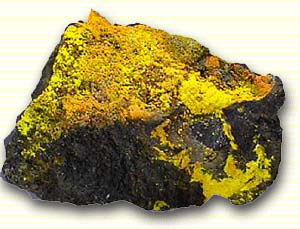 Time to stop the (uranium) boats, SMH, Dave Sweeney, 28 Aug 13, “…….. Time after time the uranium industry promises big but delivers little. It contributes less than 0.3 per cent of export revenue and account for 0.015 per cent of Australian jobs.
The most recent independent assessment Australia’s uranium industry – a 2003 Senate inquiry – found the sector characterised by underperformance and non-compliance and urged changes to protect the environment and its inhabitants from “serious or irreversible damage”.
Sadly, in the decade since then little has changed, even though the need to manage radioactive materials over extremely long periods with specific security and proliferation issues make uranium mining fundamentally different from other types of mining.
Uranium mining remains a contested and contaminating industrial activity that poses serious and continuing problems – now and long into the future – and continues to lack community consent and a social licence.
But Australia can – and must – do better than this.
We are a rich nation blessed with a skilled workforce and abundant renewable energy resources. Instead of literally fuelling disaster we should be leading the world in clear and sustainable energy technology and generation.
Two decades ago nuclear power provided around 17 per cent of the world’s electricity, today it is close to 10 per cent. In China, Germany and Japan – three of the world’s four largest economies – renewable energy sources generate more power than nuclear reactors.
In France, a favourite of the atomic lobby, the share value of state utility EDF, the world’s largest nuclear operator, has fallen 85 per cent over the past five years.
Talk of domestic nuclear power is fanciful but Australia is a major global nuclear player by virtue of the uranium we sell to other countries and we now need a genuine debate about our role in fuelling this trade.
As home to around 35 per cent of the world’s uranium, the decisions we make here count and – like the waste – they count for a very long time. That is why Hawke’s call for Australia to become the world’s nuclear waste dump is way off the mark. http://www.smh.com.au/comment/time-to-stop-the-uranium-boats-20130827-2snau.html#ixzz2dIOX2ZZw
Crippling losses for US nuclear weapons company’s uranium mine in Australia
 Fukushima fallout for uranium stings Heathgate Resources Financial Review, SIMON EVANS, 26 Aug 13 Heathgate Resources, the owner of the Beverley uranium mine in northern South Australia, has suffered losses totalling a whopping $60 million over the past two years.
Heathgate has operated Beverley since 2000, but has been hit hard in its past two financial years by a plunge in global uranium prices.Beverley is one of four uranium mines in Australia, and Heathgate is also involved in the nearby Four Mile uranium project, set to become the nation’s fifth uranium mine as regulatory approvals move a step closer.
Uranium prices fell by more than 50 per cent after the meltdown at the Fukushima nuclear plant in Japan in March 2011, and have failed to recover . Heathgate Resources made a loss of $34.5 million in calendar 2012 according to its latest financial statements lodged with the Australian Securities and Investments Commission.
This followed a loss of $25.6 million in 2011.
Heathgate’s total revenue in calendar 2012 was $59 million, according to its financial statements, a substantial slump from the 2011 when total revenue was $84.6 million.
Heathgate president Craig Bartels declined to comment on the results and the operating performance.
Heathgate is owned by the US-based global nuclear giant General Atomics, as is one of Heathgate’s stablemates, Quasar Resources, which holds a 75 per cent stake in the Four Mile project. The other 25 per cent of Four Mile is owned by ASX-listed Alliance Resources, but the two groups are still involved in court action over past disagreements about how best to develop the resource…… http://www.afr.com/p/australia2-0/fukushima_fallout_for_uranium_stings_7q6Q2t7EXWB2IaLsOu5w0L
BHP’s Olympic Dam uranium mine expansion again rears its ugly head
BHP ‘determined’ to push ahead with Olympic Dam but only after new mining techniques are thought through, CHRISTOPHER RUSSELL THE ADVERTISER AUGUST 22, 2013 BHP Billiton is “absolutely determined” to find a way to go ahead with expanding Olympic Dam, the company’s top executive in South Australia says.
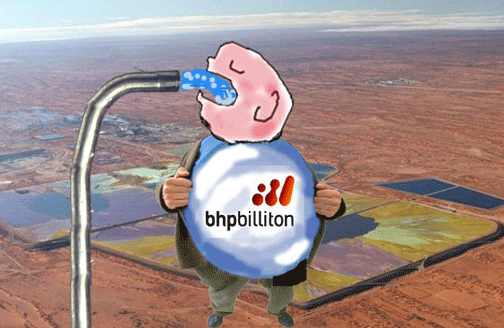
There were two key objectives for BHP in South Australia, asset president of Olympic Dam Darryl Cuzzubbo told a mining conference in Port Pirie.In his first public speech since taking command in SA, Mr Cuzzubbo said the priority was to make sure the existing Olympic Dam copper/uranium/gold operation was running at world-leading efficiency standards.
If not, he would have no credibility when asking the BHP Billiton board to fund the expansion. Secondly, the key was to make the economics of the expansion work. “We are absolutely determined to find the best way to expand Olympic Dam that competes against other investment opportunities,” he said…….
Since being granted a four-year extension by the State Government on the indenture covering the mine expansion, BHP has been working hard at rescoping the project……. There were three areas to be resolved he said – to work out a more effective mining method to get down 350m to reach the ore, to process the minerals at less cost and to split the project into “bite-size” pieces so it could generate revenue along the way.
The original expansion method envisaged spending about $30 billion but not reaching the top of the ore body for four or five years.
Toro’s Vanessa Guthrie optimistic in the face of uranium’s financial disaster
 INTERVIEW -Uranium miners face new hurdles as Fukushima disaster worsens Reuters, Aug 21, 2013 By James Regan
* Uranium miners face uncertainty as new Fukushima nuclear disaster unfolds
* Australia’s Toro says need for new uranium mines still stands
SYDNEY, Aug 21 (Reuters) – Revelations of more toxic leaks from Japan’s Fukushima Daiichi nuclear power plant will raise second-thoughts about Japan’s nuclear future, but won’t halt the long-term global expansion of the industry, the head of a uranium mining company said.
“It reinvigorates the heightened state of nervousness, it surely will make the Japanese government and nuclear regulatory authorities more cautious and conservative in the decisions about the restart,” said Vanessa Guthrie, managing director of Australia’s Toro Energy Ltd, which expects to start mining uranium in Australia in 2016.
Japan is set to raise the severity rating of the leak to level 3, or “serious incident”, on an international scale for radiological releases, underlining a deepening sense of crisis at the site.
The price of uranium, used mainly as fuel for nuclear reactors, plunged after the March 2011 meltdown at the Fukushima plant 240 km (150 miles) from Tokyo and has struggled to recover ever since. August uranium futures stood at $35.15 per pound on Wednesday compared with $68 per pound before the earthquake and tsunami that triggered the disaster.
However, Guthrie said contract prices between uranium miners and buyers standing at around $58-$59 a pound more accurately reflect the supply and demand balance than the spot price.
Operating costs in the industry range between $22-$25 per pound up to the high $40s, Guthrie said……
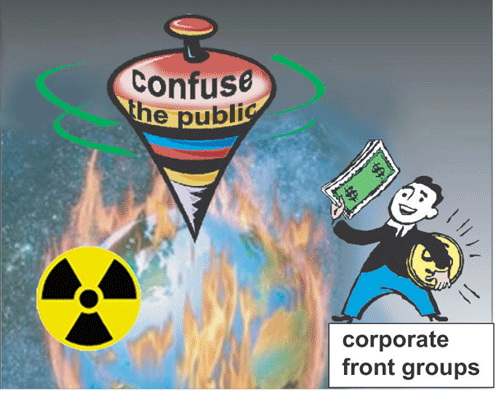
Uranium spin from David Paterson – “emotion” is good, when it’s pro nuclear
 I have often been accused by nuclear lobbyists of beong – that awful thing “emotional”. An anti-nuclear person speaking out is “emotional” (obviously not sensible). Indeed, an anti nuclear woman is “hysterical”.
So I find it almost hysterical that Australia’s uranium propagandists are now being advised to be emotional – C.M .
 Coal seam gas industry has to work harder to win over critics August 21, 2013 Business Day David Paterson
- “……..Australia’s CSG industry could learn a few lessons from the way the uranium industry worked on its image during the past three to four decades…….
in 2006, the uranium sector sought to bring a more sophisticated approach to its advocacy on public policy and in the following years there were some substantial successes…… the Australian uranium industry made a number of fundamental changes to the way it approached policy debates that helped improve its public reputation.
For today’s CSG industry, there are five important lessons that could be learned from the uranium sector’s experience.
Firstly, hearts and minds will not be won by facts alone. Good advocacy requires reliable factual information, but emotions will play a surprisingly important role in even the most technical debate. Understanding this is the first step to developing a communications strategy that will resonate with audiences.
Secondly, the CSG industry must learn that the battle is all about trust. Building trust takes many things, from showing technical ability to emotional intelligence, and company representatives will need to have both. Continue reading
Nuclear Weapons company gets go-ahead for South Australian uranium mine
 Final environmental OK for Four Mile World Nuclear news, 16 August 2013 The start of operation of the Four Mile uranium mine in South Australia has moved a step closer with final environmental approval. However, the project partners have yet to agree on a development plan.
| r) |
The state Environmental Protection Authority (EPA) has now granted a mining and mineral processing licence for Four Mile. The licence also covers radiation and radioactive waste management plans for the in-situ leach (ISL) mine…..
The Four Mile project is a joint venture between Alliance Resources (25%) and Quasar Resources (75%). The project is managed by Heathgate Resources affiliate Quasar. Both Quasar and Heathgate are subsidiaries of US-based General Atomic Technologies Corp.….
Disputes delay start-up
The start of production from the project has been stymied by legal disputes between Alliance, Quasar and Heathgate. There are on-going Federal Court proceedings by Alliance seeking restitution of its full ownership of the Four Mile deposit due to delays and disagreements.
In May 2012, Alliance said it had agreed to form a strategic alliance with Japanese trading house Itochu Corporation. Under the terms of this, Itochu will have the right to acquire a 14.9% shareholding in Alliance within six months of all litigation being finally determined. Furthermore, within 12 months of that final determination, Itochu will have an option to acquire a further 25.1% shareholding in Alliance.
Four Mile uranium project – Australia’s dirtiest and most dangerous uranium connection
 (Christina Macpherson, originally posted on 4 Nov 2012) Leaving aside its nasty little internal squabbles, Australia’s fifth uranium mine Four Mile uranium project in South Australia is without doubt the most striking example of all that is wrong about Australia’s uranium industry. Well, next door, is Beverley mine – equally bad. But they’re practically the same, in that they are both practically owned by USA’s General Atomics. Neal Blue is the chairman of Quasar Resources, which is affiliated with General Atomics, a major United States weapons and nuclear energy corporation. He is CEO of Heathgate Resources. a 100 per cent-owned subsidiary of General Atomics (GA) which owns Beverley uranium mine. He is Chairman of the Board of Directors for General Atomics
General Atomics has a murky history It develops nuclear technologies including arms manufacture. Especially those Predator drones which kill anybody that the Pentagon thinks is “suspicious” in Iraq and Afghanistan. Neal Blue was one of the designers of Predator. At its uranium processing plant on an Indian reservation in Oklahoma, General Atomics for years covered up radioactive water and gas leaks.
General Atomic has spent $thousands’ lobbying and ferrying of USA politicians to Australia, , and Australian federal and state politicians to USA . In 2000 Heathgate applauded police brutality against environmentalists and local Aboriginal people. An online video clip details this brutality. the police action (in a 2000 media release which is no longer available online). After a 10-year legal case, 10 people were awarded a total of $700,000 damages.
General Atomics flew a group from the US Congress to Australia, accompanied by company executives, to persuade the Federal Government to buy the company’s Predator unmanned aircraft
As well as its interest in unmanned spy planes, General Atomics has employed human spies. In 2008 it was caught hiring a former undercover police officer turned private investigator to infiltrate Australian environment groups and report on their actions.
In 2008 General Atomics and Neal Blue were sued for fraudulently hiking uranium prices and manipulating costs. In the settlement One of General Atomics’s customers, Exelon, received $US41 million from the company. It is estimated Mr Blue made $US200 million by breaking the contracts and selling uranium on the spot market
Heathgate Resources have been promoting the view that low-level radiation is beneficial, and funding the Australian visits of people like Dr Doug Dr Boreham prepared to promote those views.
Heathgate is not required to clean up Four Mile uranium mine. and there is no requirement it decontaminate the Beverley site when mining ceases. Christina Macpherson 25 Oct 12,
Go-ahead for disputed uranium joint venture BY: BARRY FITZGERALD From: The Australian October 25, 2012 THE much-delayed Four Mile uranium project in South Australia – a joint venture between ASX-listed Alliance Resources (25 per cent) and US group Heathgate (75 per cent) – is finally being developed.
Deluded optimism in uranium industry, with price in free fall
Since the Fukushima disaster — a continuing nuclear crisis fuelled by Australian uranium — the price has been in free fall.
Industry advocates remain adamant or delusional that there will be a commodity price recovery but, looking at the sector’s vital signs, we find a weak pulse….. people outside of the uranium industry do not share the optimism about a uranium price recovery.
For new comers like WA uranium hopeful Toro Energy this does not bode well.
When a small inexperienced company like Toro are competing with existing operating mines for scant finance and market access, the $260 million needed to start the proposed Wiluna mine and the further $150-$260 million in upfront bonds looks more and more like “the dream that failed” a term coined by The Economist.
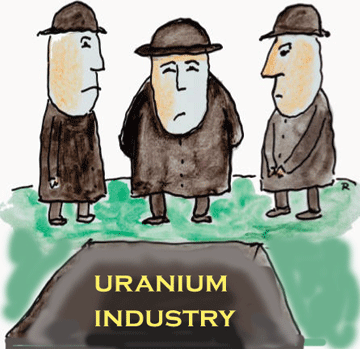 Uranium industry in crisis of confidence http://www.greenleft.org.au/node/54727#sthash.TOxcBrLT.dpuf August 11, 2013 By Mia Pepper, Perth While Australia’s mining sector shows signs of resilience, there is one mineral whose outlook may be terminal.
There are five significant events that have occurred recently that send a clear message about the future of the uranium sector and the wider nuclear industry.
The uranium price dropped to US$34.50 a pound Energy Resources of Australia, the operator of the Ranger uranium mine in Kakadu, announced a $54 million loss.
Perth-based uranium miner Paladin Energy failed to sell a stake in its Langer Heinrich mine in Namibia. French nuclear giant EDF announced its exit from nuclear power in the US and Duke Energy cancelled two proposed reactors in Florida.
These incidents are neither isolated nor unrelated — they are significant indicators about the health of nuclear industry. The uranium price was around US$20 through much of the 1980s and 1990s. It increased dramatically around 2005 with the promise of a “nuclear renaissance” but began a steady drop in 2007 through to the end of 2010.
Since the Fukushima disaster — a continuing nuclear crisis fuelled by Australian uranium — the price has been in free fall. Continue reading
Toro Energy and Mega Uranium making a big mistake in acquiring Lake Maitland
Toro’s mega mistake Mia Pepper – Conservation Council of WA 12 August 2013 WA uranium hopeful Toro Energy’s acquisition of Lake Maitland, another small calcrete uranium deposit in a sensitive Lake system, is based more on optimism and need rather than any measured assessment of the deeply depressed uranium price and nuclear sector said the CCWA today.
The acquisition between Toro and Mega Uranium does little to change the fundamental constraints facing each company and may well be Toro’s mega mistake.
It is a further sign of the difficulties facing junior uranium companies in a time of falling commodity prices and rising costs. Toro and Mega may share big dreams but they do not have big capacity, experience or dollars.
Toro cannot begin construction at Wiluna and do not have final and formal approval to mine at Wiluna. Instead the company has a conditional Federal approval that involving 35 conditions and requires further assessment from the Federal Minister.
The conditional nature of the approval prohibits Toro Energy from clearing vegetation or using heavy machinery for breaking ground for mining or infrastructure. Toro must also complete a mine closure plan for both State and Federal level assessment.
A recent independent economic analysis of the Wiluna project (attached) found that:
The Wiluna project’s lack of scale and high sensitivity to changes in operating or capital costs means our estimate of its position on the mine production cost curve is perilously high. The project would be highly vulnerable under our model, in the event of sustained lower long-term contract prices in the next decade. On both a cash and total economic cost basis our model suggests Wiluna is a high cost project that will struggle to compete against either existing mines or most greenfield and brownfield projects. For the full report: http://www.ecolarge.com/work/osos-sobre
For Western Australia’s Toro Energy uranium project, the outlook may be terminal
Nuclear not worth digging or dealing http://ccwa.org.au/blogs/nuclear-not-worth-digging-or-dealing#.UgWPQ9Jwo6I August 9th 2013 by Mia.Pepper Article published in the Kalgoorlie Miner 9th August 2013
At this week’s Diggers and Dealers, low commodity price and high production costs have been a focus of attention for the entire minerals sector. While, overall, Australia’s mining sector shows signs of resilience, there is one mineral whose outlook may be terminal.
There are five significant recent events that have occurred recently that send a clear message about the future of the uranium sector and the wider nuclear industry. The uranium price dropped to US$34.50lb. Energy Resources of Australia, the operator of the Ranger uranium mine in Kakadu, announced a $54 million loss. Perth –based uranium miner Paladin Energy failed to sell a stake in its Langer Heinrich mine in Namibia. French nuclear giant EDF announced its exit from nuclear power in the US and Duke Energy cancelled two proposed reactors in Florida.
These incidents are neither isolated nor unrelated – they are significant indicators about the health of nuclear industry. Continue reading
Paladin uranium miner’s troubles in Africa – near to going down the gurgler?
 Paladin shares plummet after mine sale cancelled Proactive Investors, by Fiona MacDonald 2 August 13, Paladin Energy’ s (TSE:PDN) (ASX:PDN) stock lost 15 cents on the Toronto Stock Exchange Friday from prior close of 92 cents to fall more than 16 per cent on the back of the news that the uranium miner had terminated negotiations with all parties for the sale of a minority interest in the Langer Heinrich Mine.
The announcement, released after the close of North American trading Thursday night, sparked intraday trading that saw share prices dip as low as 65 cents, marking a new bottom for the Subiaco, Australia-headquartered miner’s 52 week range.
The mine, located in Malawi in southern Africa, is owned 100 per cent by Paladin and was taken off the table as a result of low uranium prices – a legacy of the disaster at Japan’s Fukushima-Daiichi atomic power plant after the 2011 earthquake and tsunami — undercutting the company’s chances of collecting the pay day it had in mind….. It is a long fall for the miner, which was trading at $1.00 per share as recently as a week ago. http://www.proactiveinvestors.com/companies/news/46789/paladin-shares-plummet-after-mine-sale-cancelled-46789.html
Trading of Paladin uranium stock halted as its share price nosedives
 Shares of uranium miner Paladin dive after cancelled sale Reuters, Aug. 02 2013, Shares of Australian uranium miner Paladin Energy Ltd. fell as much as 29 per cent in Toronto on Friday after the company cancelled plans for now to sell a minority interest in an African mine, and instead raised funds through a private placement of shares. Paladin said it ended negotiations with a potential investor on Thursday and all other parties for a stake in its Langer Heinrich mine in Namibia. The company said it was unlikely to get the price it wanted because of low uranium prices….. Trading of Paladin stock was halted in both Canada and Australia on Thursday, pending news.
Paladin’s stock was down 28 per cent, or 26 Canadian cents to 66 Canadian cents in early trading on the Toronto Stock Exchange. http://www.theglobeandmail.com/report-on-business/industry-news/energy-and-resources/shares-of-uranium-miner-paladin-dive-after-cancelled-sale/article13572589/
Bad news for Paladin Energy in drastically low uranium price
Paladin cancels uranium mine sale Yahoo 7 Finance, 2 Aug 13 Paladin Energy has scrapped the sale of a stake in its flagship African uranium mine after it failed to attract a high enough bid.
The Australian listed company instead will use a shareholder diluting $88 million capital raising to reduce about $US670 million ($A753.95 million) of debt.Paladin had been negotiating with two nuclear power companies to sell a 15 to 20 per cent stake in its Langer Heinrich mine in Namibia.
In late June, managing director John Borshoff maintained a sale would go ahead.
But the global uranium market is still depressed more than two years since Japan’s Fukushima nuclear disaster, and the spot price is at seven-and-a-half-year lows of about $US35 a pound……….
It said it would wait until prices lifted before going to the market to sell again. A uranium price of at least $US70 a pound was needed, it said.
In other bad news for Paladin, the company said it expected to have to write down the value of assets including its other producing mine, Kayelekera in Malawi, by $US180 million ($A202.55 million).
The capital raising involves the equivalent of 15 per cent of its stock being issued to private institutions.
The company’s shares went into a trading halt on Thursday at $1. http://au.finance.yahoo.com/news/paladin-cancels-uranium-mine-sale-023213073.html
Australian company Paladin’s uranium contract with Malawi -the “worst possible swindle”

 Malawi gov’t and Paladin: Act on Kayelekera uranium raw deal now! By Veronica Maele-Magombe Nyasa Times, By Veronica Maele-Magombe July 30, 2013 Since last week’s stinging observation by UnitedNations (UN) Special Raportuer on the Right to Food Olivier De Schutter regarding Malawi’s Kayelekera Uranium Mine deal, two elusive culprits remain pretty much intact in their hard shells. It is as if the country’s most guarded contract between government and Australiancompany, Paladin Africa Ltd has not been unravelled as the worst possible swindle. Continue reading
UN says Malawi is getting a poor deal from Australian uranium mining company Paladin
 UN rubbishes Malawi’s Paladin uranium deal, fertilizer subsidyBy Hudson Mphande, Nyasa Times July 23, 2013 United Nations Special Raportuer on the Right to Food Olivier De Schutter who was in Malawi for an assessment of the food situation in the country has rubbished Kayerekera uranium mine deal between Malawi and Australian Paladin Mining Company saying the Southern African country has had a raw deal that is robbing the poor.
The UN Raportuer said the uranium mining deal was one of the investments in Malawi through which the country is losing resources that could otherwise make a difference in food security and other pro-poor initiatives. He said in the life span of the mine Malawi is expected to lose almost US$281 million…
“Mining companies are exempt from customs duty, excise duty, value added taxes on mining machinery, plant and equipment. They can also sign special deals on the rate of royalty owed to the government. I believe that there are more reasons that investors would come to Malawi without such incentives,” he said.
De Schutter was addressing journalists in the capital Lilongwe at the end of his 11-day tour of the country.
He bemoaned that due to illicit financial flows, tax envasion as well as tax incentives that the country offer to both domestic and foreign companies currently Malawi was failing to get maximum use of its resources.
De Schutter said that revenue losses from special tax incentives to Paladin Africa Mining alone are estimated at almost K67 billion (US$205 milion) since the mine started its operations and could reach almost K92 billion (US$281 million) over its13-year lifespan.
“Paladin alone is costing the budget more than US$20 million (almost K8 billion) a year in taxes,” he said.
He added: “I am convinced that unless combined with a comprehensive enhancement and optimisation of tax revenue, current macro-economic reforms may not have substantive positive impacts. There is need for
Malawi to examine its national tax laws and policies towards preventing illicit capital flight. As mining develops, Malawi can simply not afford business-as-usual.”
The UN Special Raportuer said it is estimated that the country has lost over 10 percent of its growth domestic product (GDP) to illicit outflows and tax evasion over the period 1980 to 2009……..
De Schutter also specifically expressed concerns on the country’s current minimum wage currently at K371 ($1.12) per day, describing it as the lowest in the world…… The UN special rapporteur said he will give a report and his recommendations to both the UN Human Rights Commission and the Malawi Government. http://www.nyasatimes.com/2013/07/23/un-rubbishes-malawis-paladin-uranium-deal-fertilizer-subsidy/
1 This month

of the week – Australians for War Powers Reform (AWPR)
To see nuclear-related stories in greater depth and intensity
 Antinuclear