Paladin Energy – the Ugly Australian uranium mining company in Malawi
the British silently stole our uranium and left when their projections did not add up to their whims, and now we have the Aussies who are refusing to deal fairly.
Honestly I loved Crocodile Dundee the movie but this Aussie corporation turning Malawi land into some ‘plunder outback’ is making me sick
Killing Malawians through the rotten extractives deals: The case of Paladin’s uranium mining Nyasa Times, by Patrica Masinga, 24 April 13, Malawi has in the few weeks been engaged by a plethora of stakeholders discussing strategies to revive, or more on the ground, reclaim the benefits that Malawians are been milked of by the so-called extractive industry multi-national corporations.
They call themselves investors, and government believes that the Malawi Development Goals (MDGs – who cares if it’s the second phase) will be boosted, particularly that mining alone through Kayerekera of Paladin Energy Limited group of companies (trading as Paladin (Africa) Ltd in Malawi?) could provide a large economic base.
But that is all a fat lie. Paladin and many other foreign multinational mining countries are least interested to contributing to the Malawi economic growth. They are here to milk the country – exploiting all that it has rich in minerals and dump us when the time is right even poorer.
Imagine, to screw Malawians of their rightful economic gains, the company, incorporated in Australia first listed on the Australian Stock Exchange (ASX) on March 29, 1994 under code ‘PDN’, and quickly changed its name from Paladin Resources NL to Paladin Resources Ltd in 2000 and listed under the Toronto Stock Exchnage (TSX) in Canada April 29, 2005, and again changed its name to Paladin Energy Ltd in November 2007 and listed on the Namibian Stock Exchnage on February 2008.
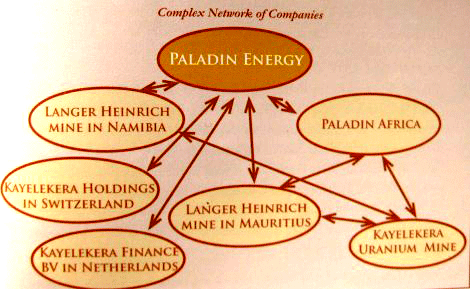
By such trends, one is compelled to question the motive, considering also that in Namibia itself the company owns the Langer Heinrich Uranium Mine where it started production in 2008 and has Kayerekera Uranium Mine as its second largest mining venture in this part of Africa acting also as a good supllment to the Langer Heinrich Uranium Mine. Continue reading
Doom and gloom in Australia’s uranium investment sector
 Uranium, rare earths miners in doldrums BY:ROBIN BROMBY The Australian July 15, 2013 A FEW years ago, talking up a well-balanced portfolio of uranium and rare earth elements assets would have been a mouth-watering come-on for investors. Not now, of course.
You’ve got Toro Energy (TOE) with most of its ducks in a row including finance and government approvals to develop Western Australia’s first uranium mine.
All except the rather important duck of a spot uranium price somewhere in the vicinity of $US70 a pound that would make the mine viable; it’s stuck with $US39.50/lb.
A few years ago, the average resources punter would have sold their children to raise money for buying such a share, but Toro languishes at just 9c.
And there was disappointment on Friday for Aura Energy (AEE), French nuclear giant Areva pulling the plug on plans to partner up with the Australian junior in its Haggan uranium project in Sweden, one of the largest undeveloped uranium projects in the world (389,000 tonnes)…..
Uranium miner Paladin among many suspected Australian tax cheats
Advocacy group ActionAid claims poor countries are losing more than $130 billion in tax revenues a year by giving generous tax breaks to big companies, including Australian miners. There are about 240 Australian mining companies with operations in Africa.
Perth-based uranium miner Paladin Energy, came under scrutiny for its tax arrangements in Malawi where it runs a mine in Karonga. A report by the group Norwegian Church Aid alleges there are discrepancies between Paladin’s reported tax and its tax paid. It also alleges other payments by Paladin in Malawi are lower than the company reports.
Paladin has subsidiaries registered in Mauritius and the British Virgin Islands, both tax havens. Last year’s annual report showed the company accumulated losses that mean it will need to make profits totalling $208 million in Australia before paying any tax.
Tax man takes scalpel to energy and resources firms http://www.theage.com.au/national/tax-man-takes-scalpel-to-energy-and-resources-firms-20130705-2phat.html July 6, 2013 Georgia Wilkins The Tax Office will open 60 cases of suspected tax dodging by Australian and international companies amid global pressure to crack down on profit shifting.
The investigations will add to the 26 cases of offshore restructuring already under review by the government body.
Under scrutiny are companies that deliberately restructure their business to route profits through low-tax jurisdictions or tax havens to avoid paying higher taxes in Australia, often through the use of post box companies or marketing hubs that have little real substance. Continue reading
Uranium company cuts back its NT and Queensland operations as uranium price plummets
 Deep Yellow slashes jobs, cuts pay, Minng.com, 5 July, 2013 Vicky Validakis Uranium exploration company Deep Yellow has cut jobs and reduced salaries by five per cent as it ramps up steps to reduce overhead costs, blaming the move on the weakness in the uranium sector.
The company announced board fees and executive salaries would be reduced by five per cent for at least six months, with salary scales to remain fixed at 2013 rates.
The company also said its Perth office had reduced staff to just three, comprising the managing director, financial controller and office manager.
Deep Yellow is said it is also planning to move to a smaller office by the end of the year.
The latest pay cuts follow a ten per cent reduction in base salary and fees and group-wide salary freezes in July 2012…… Deep Yellow’s chairman Mervyn Greene said the steps to reduce overheads costs was due to ongoing volatility in financial markets and a weakness in the uranium market…… In Australia the company owns the Napperby Uranium project in the Northern Territory as well as exploration tenements in Queensland. http://www.miningaustralia.com.au/news/deep-yellow-slashes-jobs-cuts-pay
A warning to Tanzania, (where an Australian company is to start mining uranium)
 Health hazards posed by uranium mining IPP MEDIA 5th July 2013“…….. the developing countries in the process of starting mining uranium, must learn a lesson from the USA, the most powerful rich and technically advanced nation in the world, who for the sake of protecting its environmental pollution from the known post uranium mining hazardous health effects, to its citizen of today, tomorrow and future generation, admitted that enough was enough, and shut down most of uranium mining in their country.
The big lesson here for Tanzania with its Uranium deposit soon to be exploited is that; until now there is no proper way of destroying completely remains of uranium mining, and therefore it is difficult to control the effects of the mineral that will end thousands of years. Above all the cost of cleaning up the environment and avoidance of effects caused by remains of big uranium mines and management of radioactive waste will put a big strain on the already ailing country’s economy. Continue reading
Australia’s “Northern Territory Intervention” trashed the reputation of Aboriginals on behalf of mining industries
 Government had made it clear that it wished to re-engage itself more directly in the control of community land through leasing options as well as to open up Aboriginal land for development and mining purposes.
The plan was to empty the homelands, and this has not changed. However, it was recognised that achieving this would be politically fraught – it would need to be accomplished in a manner that would not off-side mainstream Australia. Removing Aboriginal people from their land and taking control over their communities would need to be presented in a way that Australians would believe it to be to Aboriginal advantage, whatever the tactics.
So began the campaign to discredit the people and to publicly stigmatise Aboriginal men of the Northern Territory
And even in 2009 when the CEO of the Australian Crime Commission, John Lawler, reported that his investigation had shown there were no organised paedophile rings operating in the NT, no formal apology was ever made to the Aboriginal men and their families who were brutally shamed by the false claims.
 Sixth Anniversary of the Northern Territory Intervention – Striking the Wrong Note Lateral Love Australia‘concerned Australians’ Michele Harris, 21 June 13 Aboriginal advocate Olga Havnen, in her Lowitja O’Donoghue oration has asked a critical question. She asks what has been the psychological impact of the Intervention on Aboriginal people of the Northern Territory. It is surprising that so little attention has been given to this critical, yet in some ways tenuous, link before now.
Even before the Intervention began in June 2007, government had long planned a new approach to the ‘management’ of Aboriginal people in the Northern Territory. It was no longer part of government thinking that self-determination and Aboriginal control over land could be allowed to continue. These were the Whitlam notions of 1975 and they were no longer acceptable.
Early inklings of change occurred in 2004 with the management of grants being transferred from communities to Government’s newly established Indigenous Co-ordination Centres. More ominous were the Amendments of 2006 to the Aboriginal Land Rights Act and the memoranda of agreements that followed. Government had made it clear that it wished to re-engage itself more directly in the control of community land through leasing options as well as to open up Aboriginal land for development and mining purposes. Continue reading
Confusion about New South Wales Government’s attitude to nuclear power and uranium mining
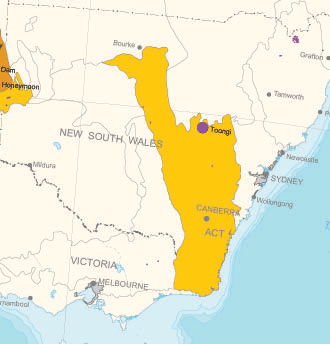 In May, the minister’s office said evaluation of the expressions of interest were due to begin, with an announcement of the successful applicants due “mid-year”.
It’s far from clear, but presumably the announcement – which must be imminent – will not only tell us which companies have applied to explore uranium, but also where they want to do so. (at left, areas recommended for uranium exploration)
[NSW Premier -] “The Uranium Mining and Nuclear Facilities (Prohibitions) Act 1986 continues to prohibit the construction of nuclear generation facilities in this state,” a spokesman told Fairfax Media when approached about the response.
“There has been and will be no change in the NSW government’s position on that.”
Nuclear act is still a minefield http://www.brisbanetimes.com.au/comment/nuclear-act-is-still-a-minefield-20130628-2p2cm.html#ixzz2XfneLben June 29, 2013 Sean Nicholls Sydney Morning Herald State Political Editor More than a year after the heat generated by last year’s announcement that the NSW government would overturn a 25-year ban on uranium exploration, things have gone a little quiet – publicly at least.
Premier Barry O’Farrell declared the move would help boost the state economy, particularly in light of the federal government decision to allow export of uranium to India. As expected, it was met with furious opposition from environment groups. Greenpeace labelled it “obscene”.
But while O’Farrell talked up the decision as a potential economic boost, he insisted his government was “not about to rush into mining uranium until we have carried out the necessary environmental and exploration checks and have had a mature and sensible discussion about utilising this resource”. Continue reading
Australian uranium company Paladin having more troubles, as share price falls
Uranium producer Paladin’s shares slide after stake sale delay BY:BARRY FITZGERALD The Australian June 27, 2013 SHARES in African uranium producer Paladin have been pulled back to near 52-week lows because of a delay in a planned debt-reducing sale of a minority equity position in the group’s flagship Langer Heinrich operation in Namibia.
It had been hoped that Paladin would make inroads into its $US740 million debt pile by making the sale the news of which pushed the shares from an April low of 70c to more than $1 a share in late May. But recent concerns that the previously advised June 30 target date would not be met have sent the shares lower.
The concerns were well placed, with Paladin saying yesterday that the planned sale had been delayed until mid-to-late August. Paladin shares closed 6c, or 6.8 per cent, lower at 82c.
The fall came despite Paladin managing director John Borshoff remaining confident a sale will be achieved. The planned deal is with two unnamed nuclear groups……http://www.theaustralian.com.au/business/mining-energy/uranium-producer-paladins-shares-slide-after-stake-sale-delay/story-e6frg9df-1226670445221
Democratic process stops the uranium mining rush into Woomera area
Senate slows deal to give mineral explorers access to Defence’s Woomera testing grounds Adelaide Now, CHRISTOPHER RUSSELL Business Editor June 21, 2013 “…..Laws to keep Defence as the prime user and controller of access to Woomera Prohibited Area but giving certainty to mineral explorers were this week shunted into a Senate committee inquiry after earlier clearing the Lower House with bipartisan support.
The Foreign Affairs, Defence and Trade committee now will seek new public submissions on the pact, which had been negotiated over several years between industry, government and Defence following an inquiry by former public servant Allan Hawke.
The committee is only due to report back on August 20, just weeks before the federal election. That means the reform Bill will lapse and have to await being reintroduced by the next Federal Government……..
Greens MP Adam Bandt said his party was “absolutely opposed to mining uranium” and also had concerns about Aboriginal issues.SA Senator David Fawcett said it was quite appropriate for the Bill to go to a committee inquiry and it should not be rushed.”If it’s not dealt with this week – and clearly it won’t be – it’ll be an issue for whoever forms government after September,” he said.
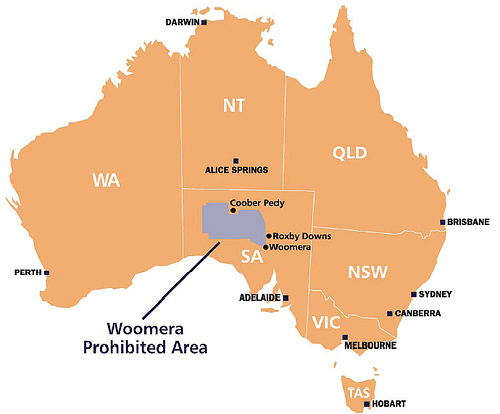
Senator Fawcett, who came to politics from a military career which included working in Woomera, said the area was crucial to Defence testing.
“Just because we have a State Government and mining lobby who are saying let’s go on with it, I don’t see that – short of a national emergency – we should be circumventing the democratic process,” he said…… http://www.adelaidenow.com.au/business/sa-business-journal/senate-slows-deal-to-give-mineral-explorers-access-to-defence8217s-woomera-testing-grounds/story-e6fredel-1226667870070
AUDIO: Obstacles in the way for Toro Energy’s Wiluna uranium project
Wiluna uranium mine not officially protested http://www.abc.net.au/local/stories/2013/06/19/3785317.htm By Glenn  Barndon, Sarah Taillier, Chloe Papas
ABC’s Sarah Taillier spoke to Mia Pepper from the Conservation Council of WA. Have a listen to the interview
Toro Energy’s potential uranium mine at Wiluna has been the subject of much controversy – but was not officially appealed during the required period. So, what happens next?
Toro Energy’s plans to build a uranium mine in Wiluna have been the subject of considerable controversy since the $269 million project was proposed last year. Recently, the company announced that no appeals were launched during the four-week protest period allowed by the Federal government.
Though this takes the company one step closer to putting plans into action, Mia Pepper from the Conservation Council of WA told ABC’s Sarah Taillier that a formal appeal was not the only avenue of protest.
“The fight against the Wiluna uranium mine is definitely not over just because of not lodging one out of many possible appeals.” Pepper told the ABC that not only are there other ways to attempt to stop the mine, but the company may have bigger issues than a formal protest. “They’ve been trying to take it to market for a long time and haven’t been successful, and I think they’re using this event or non-event as a platform to try and fundraise for the project – which is and has been their main problem for a long time.”
Strong police presence at Paladin’s Malawi uranium mine; five arrests
the development has stunned most workers who think management’s move is aimed at eliminating workers deemed to be fighting for the employees’ welfare.Management already eliminated other employees through “unfair dismissals and retrenchment” of 25th January 2013.
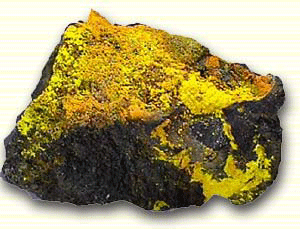 Five held for ‘bomb’ threats at Paladin’s Malawi uranium mine, Nyasa Times By Nyasa Times Reporter, June 19, 2013 Malawi Police in the northern border district of Karonga are keeping in custody five Kayelekera Uranium Mine workers on allegations they threatened management to blow up the mine.
The five, arrested last Friday, are also suspected of being linked to the theft of explosives worth US$5780.76 (about K2, 150, 600) belonging to China Road and Bridge Construction Company in Chitipa.
There was no immediate comment from Karonga Police as officers said they are “still investigating”. But Nyasa Times sources said the five were arrested on orders from Paladin Energy Limited (owners of Kayelekera). The five, who are production plant operators, are reported to have threatened Kayelekera management that they would blow up the process plant if their salaries were not increased and foreign workers laid off…….. Continue reading
Danger in Australia selling uranium to undemocratic Middle Eastern regime
Australia’s plan to sell uranium to the UAE is ill-considered. It essentially requires us to turn a blind eye to the UAE’s poor democratic form and strikes a blow to the goal of a nuclear-free Middle East. It also fails to apply adequate scrutiny and attention to Australia’s corner cutting uranium trade – an industry described by a Senate report as needing urgent changes in order to protect the environment and people from ‘serious or irreversible damage’
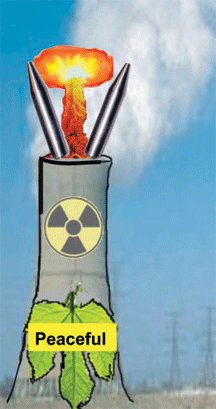 Why Australia shouldn’t sell uranium to the UAE Online opinion, By Dave Sweeney , 17 June 2013 For most Australians nuclear issues are the concern of other nations, largely because we don’t, and are most unlikely to ever have, domestic nuclear reactors. But as home to one third of the world’s uranium Australia is a significant player in the global nuclear game and we are playing an increasingly irresponsible hand.
Today in Canberra representatives from the Australian Conservation Foundation, Friends of the Earth, the Medical Association for the Prevention of War and the International Campaign to Abolish Nuclear Weapons will have a rare window of opportunity to put their case to a Parliamentary committee as to why Australia should not sell uranium to the United Arab Emirates (UAE).
The UAE is country with an illiberal government situated in one of the world’s most insecure regions. The commercial interests of multi-national uranium producers have been prioritised over the wider national interest. Instead of industry assurances it is now time to test the claims – and examine the costs – of Australia’s uranium industry.
The value of the employment and economic contribution made by the Australian uranium sector is consistently exaggerated while its risks and liabilities are routinely played down. When it comes to jobs and dollars uranium is a small contributor to Australian export revenue and employment, but when it comes to global impact and risk Australian uranium is in the major league.
From 2002 to 2011, uranium sales averaged $627 million annually and accounted for only 0.29 per cent of all national export revenue: small beer, but with a big hangover…… Continue reading
Mary Kathleen uranium mine – still toxic decades after closure
Remediation efforts continue at abandoned uranium mine Australian Mining, 11 June, 2013 Vicky Validakis Queensland officials inspected the abandoned uranium mine at Mary Kathleen last week, as part of an ongoing assessment of the site’s remediation status.
Minister for Natural Resources and Mines Andrew Cripps announced last year, the government would assess opportunities for mining at the site, which contains millions of tonnes of ore tailings.……. A spokesperson for the minister said the inspection was not connected to an assessment of opportunities for future mining at the site.
The Mary Kathleen mine is under a Restricted Area 232 status, meaning exploration and production are both prohibited.
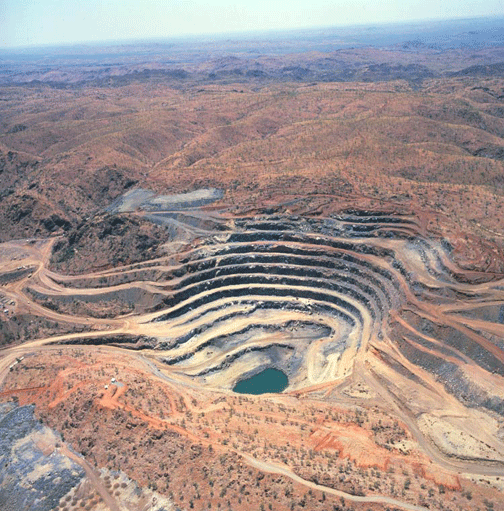
“Remediation and environmental management issues are critical factors for the Queensland Government to address prior to any future consideration about whether or not to release land from Restricted Area 232,” Cripps said.
Cripps said Abandoned Mine Lands program officers from the Department and the Geological Survey of Queensland would undertake field assessments later this month, including drilling at the tailings dam.
“This work will enable the Department to gain a better understanding of the current condition of the abandoned mine,” he said.
The Greens North Queensland spokesperson Jenny Stirling, said “toxic” tailings at the mine meant that uranium mining had made the site useless for other purposes.
“They are looking to mine rare earth and, if they had the good sense that God gave them, they would know that they would have to deal with the toxic tailings of uranium mining at Mount Kathleen,” Sterling said.
“It’s just a highly problematic situation.” http://www.miningaustralia.com.au/news/remediation-efforts-continue-at-uranium-mine
Australian uranium industry should be aghast at ever lower uranium prices
Sluggish uranium prices put pressure on industry http://www.miningaustralia.com.au/news/sluggish-uranium-prices-put-pressure-on-industry 11 June, 2013 Vicky Validakis With uranium prices hitting a four-year low last week, analysts predict a resurgence of the rare earth is not expected for 12 months.
The price of uranium fell below $40 a pound for the first time since 2009, to $39.87 a pound. Despite industry claims the demand for uranium would increase, prices have not pushed through the $45/lb mark since December last year. The West Australian reported low uranium prices is causing concern on local uranium juniors such as Toro Energy who are in the bid for partners to help fund the $269 million Wiluna project.
Toro have previously said if financing arrangements went to plan the mine would be in production by the end of 2015.
The $269 million Wiluna mine, is set to become Western Australia’s first uranium mine. With world energy demands increasing, last week Resource Minister Gary said the uranium industry in Australia needs to ramp up. Speaking to the Australian Uranium Association(AUA),Gray said with the demand for uranium set to rise, Australia was in the perfect position to supply them more of the precious metal.
However, some analysts now predict a turn-around in price is still twelve months away, leaving many asking if new projects will get off the ground.
A report commissioned by Greens senator Scott Ludlam into the economic viability of Toro Energy’s proposed Wiluna project, claimed the company may struggle to make the project viable. “The Wiluna project sits very high on the cost curve of global uranium projects,” the report’s author said.
“It’s difficult to see why any of the major uranium players would invest in this project when there’s a lot of cheaper projects out there.”
In 2012, production from Australian mines rose more than 17 per cent to top 8000 tonnes. However, the level is well below the period between 2003 and 2009 when it was 9000 to 11,000 tonnes. http://www.miningaustralia.com.au/news/sluggish-uranium-prices-put-pressure-on-industry
Australian uranium industry’s new propaganda – rubbishing fear of radiation
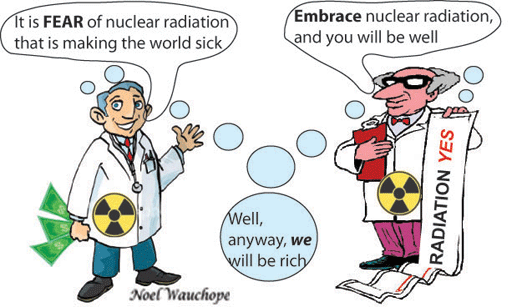 Industry leaders claim uranium mining held back by fear, Mining Australia 6 June, 2013 Vicky Validakis Addressing the fear of the uranium industry was the central theme of a uranium conference held in Adelaide last month, with industry leaders speaking out against campaigns that they say have choked the development of industry…… AUA chief executive Michael Angwin said the local industry has been politically choked by fear…… we should use that impetus to also reform the overweight regulation of and the approvals process for new uranium mines in Australia.”…..
“In short, we have entered the political end-game for uranium and any remnant political fears about the industry cannot be justified against the sector’s 40 year track record.”….
Greens nuclear policy spokesman Scott Ludlam said selling uranium to India would be ‘mistake’.
“I’m extremely concerned that Australian uranium will find itself one way or another fuelling a sub-continental arms race,” he said at the time……..http://www.miningaustralia.com.au/features/industry-leaders-claim-uranium-mining-held-back-by
1 This month

of the week – Australians for War Powers Reform (AWPR)
To see nuclear-related stories in greater depth and intensity
 Antinuclear