Fear and loathing about prices hits the Western Australian uranium market
 Uranium price hits four-year low Nick Sas, The West Australian June 7, 2013, A new wave of nervousness swept through WA’s already under-pressure uranium explorers yesterday after the uranium spot price hit a four-year low.
The price fell below the $40 a pound threshold for the first time since April 2009, closing at $39.87 a pound.Despite industry assurances of a price rebound over the past 12 months, uranium has failed to get any traction.
The price has not pushed through the $45/lb mark since December 14.
The lethargic price places further pressure on local uranium explorers such as Toro Energy, which is looking for a strategic partner to help fund its $269 million Wiluna project.
If funding is found, Wiluna will become WA’s first uranium mine. A hearty increase in the spot price is needed to force WA’s fledgling uranium sector into first gear, with Canadian giant Cameco indicating a price of more than $70/lb is needed before it can give the green light to its massive Yeelirrie or Kintyre deposits……http://au.news.yahoo.com/thewest/business/a/-/wa/17512668/uranium-price-hits-four-year-low/
Toro Energy’s Wiluna uranium unlikely to make a profit
So how do the economics of the Wiluna project stack up? According to our modelling – based on Toro Energy’s own cost figures ?– not well……
Why Wiluna is worth watching, Business Spectator, Rod Campbell, 28 May 13 What could be Western Australia’s first uranium mine is unlikely to turn a profit unless costs to clean up the mine can be made to disappear.
Our modelling of the economics of Toro Energy’s Wiluna uranium project found that the mine is unviable if Toro Energy has to pay even optimistic estimates for the decommissioning and rehabilitation of the site.
 The public and the environment have quite a stake in most mining projects and uranium projects in particular. Not only is it the public’s own mineral resources that are being sold – it’s often forgotten that all mineral resources are held by the Crown in the name of the public – but the environmental impacts of mine closure can be serious if not carried out properly.
Properly cleaning up a uranium mine can be an expensive business, so here’s why the public should be interested in the finances of mining projects – if in 2030 Toro Energy cannot foot the bill, Western Australians will face the unpleasant choice of paying the bill or accepting a degraded, potentially radioactive landscape. Continue reading
Australia’s SILEX uranium enrichment technology – a nuclear weapons danger
a SILEX facility could make it much easier for a rogue state to clandestinely enrich weapons grade uranium to create nuclear bombs
SILEX could become America’s proliferation Fukushima,
Controversial nuclear technology alarms watchdogs http://www.smartplanet.com/blog/intelligent-energy/controversial-nuclear-technology-alarms-watchdogs/18138 By David Worthington | July 30, 2012 A controversial nuclear technology is raising alarms bells among critics who claim it may be better suited for making nuclear weapons than lowering the cost of nuclear power and could lead to a nonproliferation “Fukushima” for the United States.
SILEX (separation of isotopes by laser excitation) is a method for enriching uranium with lasers. It was developed by Australian scientists during the mid 1990’s as a way to reduce the cost of nuclear fuel, because uranium must be processed before it can be used to generate power.
The scientists formed Silex Systems to license the technology for commercialization, and that process is still ongoing. In 2000, the governments of Australia and the United States signed a treaty, giving the U.S. authority to review whether SILEX should be deployed. That’s because there could be a major proliferation problem. SILEX reduces the steps necessary to transform fuel grade uranium into to weapons-grade uranium, and the process doesn’t create telltale chemical or thermal emissions, according to an article published by the Bulletin of the Atomic Scientists. R. Scott Kemp, an assistant professor of nuclear science and engineering at MIT, has the byline. Continue reading
Report shows that Malawi gets a raw deal from Paladin’s KAYELEKERA URANIUM MINE
THE CASE OF PALADIN’S KAYELEKERA URANIUM MINE: REPORT RELEASED ON THE REVENUE COSTS AND BENEFITS TO MALAWI, Mining in Malawi, 23 May 13 The Australian mining company Paladin Energy and its subsidiaries along with the Malawi-based Kayelekera Uranium Project, in which it has an 85% stake, were the subject of much discussion this evening in Lilongwe at the launch of the report The Revenue Costs and Benefits of Foreign Direct Investment in the Extractive Industry in Malawi: The Case of Kayelekera Uranium Mine. The report explores what it describes as Malawi’s largest Foreign Direct Investment* and the extent to which Malawi is benefiting. It concludes that ”Malawi is getting a raw deal from the mining and exploitation of uranium by Kayelekera Mine”…….
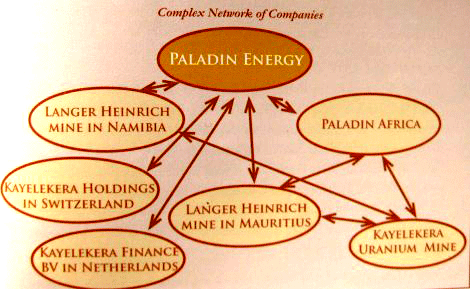
At the launch of the report, Dalitso Kubalasa and Collins Magalasi, the executive directors of MEJN and AFRODAD respectively, spoke briefly before AFRODAD’s Tafadzwa Chikumbu presented the research findings. This paved the way for a lively question and answer session with questions raised about whether or not parliament is ready to renegotiate the terms of the agreement with Paladin, what has happened to the man who lost his sight due to “kayelekera radiation” and if mining revenue in Malawi therefore “dirty money”.
This discussion was followed by the official launch of the report by the Second Deputy Speaker of Parliament Juliana Mphande who exclaimed that she was “appalled to note that incentives offered to Paladin have severe implication to Government revenue and require attention of parliament”. She outlined the areas requiring parliamentary investigation and debate…..
Below is a summary of the main findings: Continue reading
Mining companies secretive about how they gain consent of Aboriginal communities
 Oxfam report mocks Native Title, Lateral Love Australia, by Gerry Georgatos May 20th, 2013 Oxfam Australia has added its weight to the controversy that domestically and internationally embarrasses Australia over how the resources sector and the various prescribed government bodies cheat Aboriginal land owners out of due benefits for access to land for mining projects. Oxfam has completed a study that has found that only one of the 53 biggest miners on the Australian Securities Exchange had a public commitment to the United Nation’s principles of informed consent for Aboriginal peoples.
OXFAM CEO, Helen Szoke said that Australian companies are circumventing the intentions of the Native Title Act and that informed consent is not being secured.
“We looked at the policies of companies specifically within the context of how they dealt with the issue of consent of Indigenous peoples to use their land,” said Ms Szoke.
“Disturbingly what we found is that the majority of companies do not have any transparent policies about how they gain that consent and how they go about negotiating with local Indigenous communities.” Continue reading
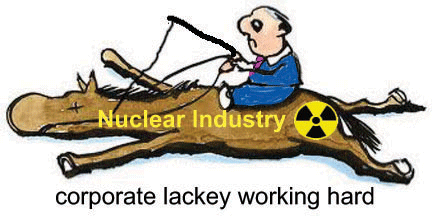
Toro Energy flogging a nearly dead uranium horse?
Claims Toro’s uranium project may struggle May 20, 2013 http://www.abc.net.au/news/2013-05-20/claims-toro27s-uranium-project-not-financially-viable/4700982 An economist is warning that the first proposed uranium mine in Western Australia may struggle to get off the ground.
The comments are made in a report, commissioned by Greens Senator Scott Ludlam and environmental groups, into the viability of Toro Energy’s proposed Wiluna project.
The study by ‘Economics at Large’ indicates the project’s profitability relies on a number of sensitive factors. The paper’s author, Roderick Campbell, says Toro may struggle to make the project viable.
“The Wiluna project sits very high on the cost curve of global uranium projects,” he said. “It’s difficult to see why any of the major uranium players would invest in this project when there’s a lot of cheaper projects out there.”
 Toro has released a statement saying the Wiluna project has won WA and Federal Government environmental approval to proceed after a rigorous three and a half year assessment process. It says, as a result, there is significant market interest from international energy utilities and global resource investors in the Wiluna project.
Senator Ludlam claims the project will just manage to be financially viable if Toro can avoid clean-up and decommissioning costs.He says Toro has not submitted a costed mine closure plan and the numbers are against the company when the cost of the clean-up is factored in.
Toro is yet to respond to that particular claim.
Yvonne Margarula’s continued fight against uranium mining on her people’s land
Fifteen years on and still no mine at Jabiluka
Sunday May 19th marks fifteen years since Yvonne Margarula – Senior Traditional Owner of the Mirarr clan – was arrested for ‘trespassing’ on her traditional land at Jabiluka.
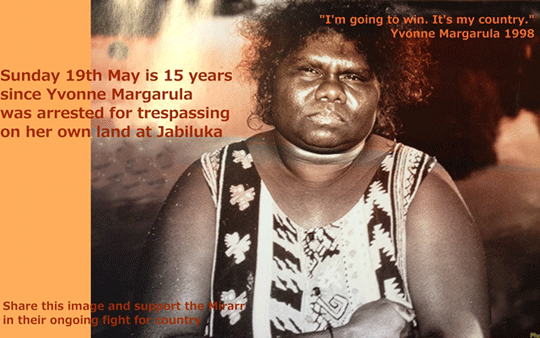
In the early hours of May 19th 1998 Yvonne Margarula was arrested along three other Aboriginal people – Jacqui Katona, Christine Christophersen and Reuben Nango – on the Jabiluka mineral lease. The highly controversial proposed Jabiluka uranium mine was under construction at the time of the arrests but development of the mine was eventually halted as a result of the campaign lead by Ms Margarula.
Ms Margarula argued that her protest against the Jabiluka uranium mine was “traditional action taking a modern form” and that her long standing opposition to the mine was fulfilling her duties as a Traditional Owner. However, in an extraordinary court ruling Ms Margarula was found guilty of trespassing on her own land and after appeal was fined $500.
Yvonne’s arrest took place on a shipping container which was the property of the mining company and she was aware of the fact that she may be arrested. This combination of factors was enough to see tens of thousands of years of living culture and connection with land overruled by the imposition of an unwanted mining project. Amidst significant publicity surrounding this ludicrous legal situation, Yvonne’s fine was anonymously paid and legal history was made.
Fifteen years ago Yvonne Margarula stood on her country and said no to unwanted mining just as her father said no to unwanted mining on Mirarr country at Ranger fifteen years before that. The efforts of the Mirarr to protect their country and culture continue. Please support the Mirarr in their continued fight to ensure responsibility at Ranger and to permanently protect Jabiluka.
Toro economic report – uncovering the uranium industry bull
20 May 13, West Australia’s first planned uranium mine has been put under the spotlight and found lacking in a detailed new economic  analysis.
The viability of Toro Energy’s Wiluna uranium proposal has been examined by the independent economic consultancy Economists at Large in a report jointly commissioned by the Anti-Nuclear Alliance of WA and the office of WA Senator Scott Ludlam.
“It is time for Toro to come clean on the full costs of the Wiluna project”, said ANAWA member Mia Pepper. “Toro’s mine closure plans and costs require particular attention as the project’s viability rests on these.”
“In 2013 ERA – the operator of the Ranger uranium mine in Kakadu – estimated closure costs at $640 million. Even if you half that and half that again for this small low grade project, mine closure estimates are still around $150 million – we are yet to hear full details from Toro about this cost.”
The report outlines that for Toro to achieve a positive Net Present Value would require the convergence of a range of external scenarios including low mine closure costs, structural changes in the long term uranium contract price, a drop in Australian exchange rates, cost easing in the mining sector and better efficiency in mining, milling and recovery rates so the project proceeds on time, within budget and without technical snags. The chance of all these factors occurring is very low.
“The Toro project represents risk at every stage”, said Mia Pepper. “It is a risk to the environment at Lake Way, a risk to shareholders and investors and a risk to WA tax payers. This report confirms that the economics of the project are volatile and uncertain – however it is certain that the project will remain strongly contested”.
“From people taking action on country – like the seventy committed people walking through the region in opposition to uranium mining right now – to sounding the alarm in the board room, this flawed mine plan will be contested. The Toro Energy plan has never made sense and this report shows that it also won’t make dollars”.
The author of the report, Roderick Campbell, economist with Economist at Large, is available for comment on 0438503249.
Lack of health regulation for workers in Australia’s overseas uranium mines?
 Comment on article Man loses sight due to Kayelekera radiation rshaba , 20 May 13, Does this mean that Paladin does not offer protective clothing including protective glasses to its employees? This is a no-brainer for someone dealing with radioactive substance business. I am shocked! It seems Paladin is taking advantage in people’s ignorance by not investing in appropriate protection especially for its front-line employees doing the “dirty” work. I could understand if it were a Chinese or Indian based company,
BUT Australian & Canadian based, my foot! Where are the government regulators? This should be a basic issue on their “checklist”: no protection and insurance cover for front-line staff, no business, simple and straight forward. The problem is that once someone has been exposed to radioactivity then whoever or whatever they come into contact with, will indirectly be exposed to radioactivity. Does the Government run regular radioactive on water, foods etc around the area? http://www.bnltimes.com/index.php/sunday-times/headlines/national/15108-man-loses-sight-due-to-kayelekera-radiation

Paladin Energy blames sub-contractor for poor working conditions at Kayelekera uranium mine
 Man loses sight due to Kayelekera radiation, SUNDAY TIMES, 19 MAY 2013 KAREN MSISKA It is all doom and gloom for a Kayelekera Uranium Mine ex-employee who has lost his sight, his job and any means of eking out a leaving to fend for his extended family.
On July 7, 2010, Abraham Siliwonde started working as a labourer at [Australian] Paladin Africa’s Kayelekera Mine in Karonga bubbling with hope that he would use the remuneration to improve living standards in his household.
But less than three years later, the 31-year-old, along with his six children and five wards from his deceased relatives, is a mere dependent on a small banana business his wife conducts at Karonga town market.
He lost sight in July 2012 and medical examinations have linked his condition, uveitis or inflammation of the uvea – the part of the eye that contains the iris and ciliary body and choroid – to exposure to radioactive chemicals.
Uranium ore is known to be highly radioactive.”In February 2012, I was moved to spotting. This is where one stands and guides the dumpers on where to drop the uranium ore from the pit as it is set to get into the crusher, the first point in uranium processing,” said Siliwonde on Friday.
“I was guiding dumpers carrying high grade uranium ore; the other grades are low and medium. I could feel intense heat from lumps of uranium ore and the next day I would be passing yellowish urine and feeling malarial symptoms.” He said regardless of the gear one puts on while at spotting, they feel the heat being emitted by the uranium ore, stressing “the situation is worsened by supervisors who keep people there longer than more productive.”
He said he was drafted into driving dumpers in January 2012 but by July, he had lost his vision and instead of working, he was a continuous visitor to health facilities seeking to restore his vision. “After a series of visits to the mine clinic at Kayelekera, I was referred to Karonga district hospital where I was further referred to Mzuzu central hospital on 30 November 2012,” he added.
“At Mzuzu Central Hospital, they asked whether I had an eye operation before because they said my eyes had cracks. I underwent strenuous tests but after telling them the environment I was working in, they identified exposure to radiation as the possible cause and referred me to Kamuzu Central Hospital.”
According to medical documents The Sunday Times has seen, Siliwonde’s reference to Kamuzu Central Hospital’s Lions Sight First Eye Hospital was “to determine if patient’s condition may indeed be due to uranium dust exposure.” His situation was not improving even with spectacles. A reference report dated April 15, 2013 indicates that Siliwonde’s acuity (sharpness of vision) for both eyes had slightly improved to 6/36 from 6/60.
A report signed by Dr J Msosa, Chief Ophthalmologist at Lions Sight First Eye hospital, confirms exposure to radiation as the possible cause.
Part of the report reads: “The vitritis (posterior uveitis) may indeed be due to exposure to radiation. It is well known that all radioactive substances can cause radiation retinopathy which appears like posterior uveitis………
“The only source of income is a small banana business my wife conducts. It’s a pity that the situation at Kayelekera is not closely monitored. A lot of people are suffering because they are exposed to radioactive dust blowing from the pit area since the surface is not kept wet as per agreement.”
However, Paladin officials pushed the bucket to one of their contractors. In response to an emailed questionnaire, Paladin Energy Limited’s General Manager – International Affairs, Greg Walker, said Siliwonde was employed by one of their contractors at the mine. He added that the issue has not been brought to Paladin’s attention……http://www.bnltimes.com/index.php/sunday-times/headlines/national/15108-man-loses-sight-due-to-kayelekera-radiation
Huge write-down in value of Paladin’s Kayelekera uranium mine
Kayelekera value cut over weak spot prices THE DAILY TIMES , 17 MAY 2013 THOM KHANJE Australian-uranium miner, Paladin Energy, has slashed a further US$45 million from the value of its Kayelekera Mine in Karonga as poor spot prices of uranium continue to negatively affect its earnings from the mine.
Following the write-down, the mine is now valued at only USid=”mce_marker”40.8 million, down from over US$200 million nine months ago.
 In its financial report for nine months to March 31 released this week, Paladin blamed continued poor uranium prices for the losses.
The spot uranium price, which has been in the doldrums since the 2011 Fukishima nuclear disaster, went down to a three-year low of US$40.75 a pound by the beginning of this week.
Paladin has since reported an overall net loss of US$247.7 million for the nine months, a sharp drop from the USid=”mce_marker”37.7 million net loss for the similar previous period…….
The falling uranium price and reduced production levels at both the Kayelekera and Langer Heinrich Mine in Namibia during the first quarter of 2013 compared to the previous three months, have also led to a fall in Paladin’s stock market value….. http://www.bnltimes.com/index.php/daily-times/headlines/business/15096-kayelekera-value-cut-over-weak-spot-prices
90% decline in share price for uranium producers ERA, Paladin Energy , and Bannerman Resources
Coal, uranium and gold stocks among the hardest hit as good times end BY:ROBIN BROMBY The Australian May 20, 2013 “…… Among those hardest hit are coal, uranium and gold. The base metal stocks don’t seem to have suffered to quite the same degree, although few stocks have come off less than about 60 per cent.
Among those with declines of more than 90 per cent since their peak are leading uranium stocks. In their case, their peak was back in 2007. Producer Energy Resources of Australia (ERA) has come down from $18.92 then to $1.04 now. Paladin Energy (PDN) hit $10.80 back in 2007 and now sits at 94c. Bannerman Resources (BMN) with its Namibia project was a star back then at a high of $4.14, now at 5.8c…..”
Uranium price could stagnate at low levels, for years
Now here’s an unusual item from the Australian business pages. Instead of the usual big talking up of the future for Australia’s uranium companies, – darned if one investment writer hasn’t told it like IT IS!
 Uranium on the nose, The Motley Fool By Mike King – May 16, 2013 More than 26 months after the nuclear accident at Fukushima, Japan, the nuclear industry is still feeling the effects with depressed uranium prices and cost pressures that are squeezing margins……
The price for uranium has fallen 40% since Fukushima to US$40 a pound, as Japan suspended its fleet of nuclear plants, while Germany…
….. the uranium price could stagnate at current levels for many years, much like it did after previous nuclear incidents. Japan may not restart its reactors, preferring instead to seek other energy alternatives, and reactors currently under construction could still be cancelled or postponed.
That is not good news for ASX listed uranium miners Paladin, Energy Resources of Australia (ASX: ERA), Toro Energy (ASX: TOE) or Deep Yellow Limited (ASX: DYL). http://www.fool.com.au/2013/05/16/uranium-on-the-nose/
Uranium mining: Budget slightly dents the government handouts to this industry
 The mining industry has had a royal run from the Australian government. Up until this latest Federal Budget uranium mining companies could deduct the full cost of exploration immediately, or even 150 per cent of the cost of exploration in some cases. Tax breaks on exploration and equipment cost taxpayers more than $1 billion per year.
Now – mining companies will cry poor, as the new budget contains measures to tighten the rules on exploration deductions for miners. Companies will now only be able to deduct genuine exploration spending, rather than writing off the acquisition of a company that acquired mining rights and spent money on exploration. But hey, the Government is sacking more than 100 staff from the federal environment department, staff who help assess mining proposals
 But don’t let’s feel too sorry for the uranium, or indeed, any mining corporations. For example BHP Billiton and Rio Tinto pay tax on their fuel, but the government gives nearly all of it back through the Fuel Tax Credits program. Fears the diesel fuel rebates could be targeted again proved unfounded, with no direct changes to the 32 cent rebate.
As Charles Berge wrote (in Sydney Morning Herald May 11, 2010) “And then there are direct government services. Geoscience Australia’s annual budget is $130 million, much of which goes to providing free data and services to the mining industry. The CSIRO and various government research centres chip in another $130 million per year in benefits to the industry. And for the research the miners have to do themselves, they get $160 million back per year in the form of research and development tax concessions.
A billion or two for fuel, … a billion for free pollution and a couple of hundred million for subsidised science . . . pretty soon we’re talking real money.
And that’s before we’ve even begun to talk about government-provided roads, rail, ports, electricity networks and other infrastructure.
Mining is different from most other industries because it directly accesses publicly owned, non-renewable resources. It is appropriate that it pay for this privileged access, over and above its fair share of company tax. In light of the $4 billion to $5 billion in benefits the mining industry receives each year from the Australian taxpayer, the government’s proposed resource rent tax starts to look modest (and anyway, uranium mining was exempt from that tax)…..
So don’t be snowed by the big miners’ shrieks about sovereign risk driving them out of Australia. The biggest risk is that we continue to subsidise mining operations that aren’t paying a fair return for their use of public resources and taxpayer dollars.”
Australia should not lock in to selling uranium in the highly unstable Middle East region
 The UAE is a collection of seven emirates including Abu Dhabi and Dubai and has one of the least participatory political systems in the world. In the most recent national election in 2006, only 6889 people – less than 1 per cent of the population were entitled to vote, and they were hand-picked by the national rulers.
The uranium sale treaty currently before the Federal Parliament’s joint standing committee on treaties, states that the agreement “shall remain in force for an initial period of thirty years
The treaty would lock us in to supply uranium to the UAE irrespective of political changes or upheavals in the region
Think again, minister, on uranium deal with Emirates http://www.smh.com.au/comment/think-again-minister-on-uranium-deal-with-emirates-20130513-2jh5d.html#ixzz2TDVaKzxm May 13, 2013 Dave Sweeney
It might surprise many Australians to know that Foreign Minister Bob Carr is moving forward with a deal to sell Australian uranium to the United Arab Emirates – a country with an illiberal government situated in one of the most volatile and insecure regions in the world. Continue reading
1 This month

of the week – Australians for War Powers Reform (AWPR)
To see nuclear-related stories in greater depth and intensity
 Antinuclear