Wiluna uranium mine by no means a goer, and Aboriginal resistance strong
We must note that approval for this project does not mean that the deal is done and dusted. Activists should take inspiration from the recent campaign at James Price Point which saw Woodside forced to shelve its plans for a gas hub there. In that case an organised community campaign pushed the big business interests back.
 Labor approves WA’s first uranium mine, Socialist Party, 10 May 13, Federal Environment Minister Tony Burke gave the go ahead to Toro’s $270 million uranium mining project in the Wiluna region of Western Australia last month. This decision has angered many people across the state especially the local aboriginal community – the Wiluna and Tarpla people.
Wiluna elder, Glen Cooke, said “Uranium should stay in the ground. It can hurt our Country, the environment, our people, our children, our children’s children”. Continue reading
9 May: antidote to uranium lobby’s lies about its high taxes and royalties
 AUSTRALIA’S URANIUM EXPORT REVENUE IN PERSPECTIVE YELLOWCAKE FEVER Exposing the Uranium Industry’s Economic Myths , Australian Conservation Foundation “……BHP Billiton enjoys extensive subsidies in the form of fuel-tax credits (formerly known as diesel fuel rebates). Under the mine expansion plan, the company would have enjoyed $350 million in diesel fuel rebates over five years – more than was to be paid to the State in royalties from the existing underground mine over the same period – and an effective subsidy of $85 million annually to 2050.
A 2012 Australia Institute report found that at a time when the mining industry is earning record profits, it received subsidies and concessions worth more than $4 billion per year from the Federal Government alone. The biggest single subsidy comes in the form
of fuel-tax credits, valued at $1.9 billion in 2009/10
Uranium mining companies – and the Australian Uranium Association – fought the proposed Resources Super Profits Tax in 2010. Ross Gittins wrote in The Age in February 2013: “Last year the mining industry accounted for more than a fifth of all the profit made in Australia, even though it had a much smaller share of the economy. This was mainly because the royalties charged by the state governments failed to capture enough of the market value of the minerals the largely foreign-owned miners were being permitted to extract.
When the Rudd government tried to correct this with a resource super profits tax, the industry set out to bring about its electoral defeat.”
Uranium was to be included in the proposed Resource Super Profit Tax, but it was subsequently excluded from the Minerals Resource Rent Tax. A 2011 report by the Australia Institute notes that the average rate of corporate tax paid by the mining industry in 2008/09 was 13.9% – substantially below the theoretical 30%…..”http://www.acfonline.org.au/sites/default/files/resources/ACF_Yellowcake_Fever.pdf
Australian media silent on the dire state of the uranium industry. Media repeats the industry’s hype.
 the media hasn’t responded at all. In March 2013, Bureau of Resources and Energy Economics reduced its mid-term forecast for uranium revenue by nearly half, and the media was silent. The Australian Conservation Foundation released a detailed, factual report on April 26 exposing the uranium industry’s economic misinformation, and the media was silent.
In the mid-2000s, uranium was the ‘new black’ as The Bulletin put it and investors could take their pick in this “radioactive heaven”. The number of listed uranium juniors doubled, and doubled again … and again and again.
A company sent radioactive drill samples for assay and quickly became the most traded stock on the ASX (leading to a suspension of share trading). Residents of the small Pacific Island Niue were surprised to learn from an Australian company that they might be sitting on 10 per cent of the world’s uranium, and surprised again when the project was abandoned two months later − easy come, easy go. The uranium spot price increased ten-fold and more, peaking at $US138/lb in June 2007.
Michael Angwin, the Australian Uranium Association’s Executive Director, said in 2008 that Australia “has enough reserves to be to uranium what Saudi Arabia is to oil.” Only a pedant would note that Saudi oil generates 466 times as much revenue as Australian uranium (and that most of ‘our’ uranium revenue never comes anywhere near Australia because of the high level of foreign ownership).
Politicians from the major parties have been only too happy to regurgitate uranium industry propaganda – for example former SA politicians Mike Rann and Kevin Foley have made the comparison with Saudi oil.
The Australian Securities and Investments Commission could hold uranium miners and wannabes to account for peddling misinformation – but it doesn’t. Business journalists could hold the uranium industry to account − but they usually don’t.Claims that nuclear power growth in China, India and Russia will drive huge increases in uranium exports are routinely and uncritically regurgitated yet they don’t withstand the simplest calculations. For example it is routinely claimed that uranium sales to Russia will generate $1 billion annually − but Australia would need to supply entire Russian demand twice over to generate that amount of export revenue.
Milk and cream generate almost twice as much revenue as uranium − so where are the newspaper column-inches with pithy headlines about corporate ‘moovers and shakers’; where the ponderous weekend think-pieces about how the nation that once rode on a sheep’s back is now attached to a cow’s udder? Why isn’t milk the ‘new black’? Continue reading
Northern Territory govt sets levy on miners to clean up old mines, such as Rum Jungle
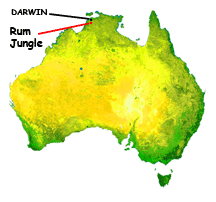 Miners to pay for mess, NT News, ALISON BEVEGE | May 8th, 2013 A MINING levy will raise funds to fix polluted legacy mine sites, the NT Government has announced.
The fee will be 1 per cent of the upfront environmental bond that all miners must pay, as set by the Department of Mines’ Security Assessment Board.
The Government has said the bond would be 100 per cent of clean-up costs but there is no way for the public to tell as the amount is secret. The new levy comes into effect in October. Mines Minister Willem Westra van Holthe said the impost would raise $6.5 million in its first year………. “We’re simply asking mining companies to chip in to a program that will be used to remediate legacy environmental problems caused by the industry.”
The move comes after the NT News exposed environmental disasters that festered for decades at defunct mines including Rum Jungle, Redbank and Mt Todd.
Camping is banned at the recreational lake near abandoned uranium mine Rum Jungle, 100km south of Darwin, as radiation levels are too high for long-term use…… Environment Centre NT co-ordinator Stuart Blanch said he supported the levy, but it would not be enough to clean up the polluted mine sites which could cost up to a billion dollars….. http://www.ntnews.com.au/article/2013/05/08/320647_ntnews.html
May 6: antidote to uranium lobby’s lies about benefits to Aborigines
AUSTRALIA’S URANIUM EXPORT REVENUE IN PERSPECTIVE YELLOWCAKE FEVER Exposing the Uranium Industry’s Economic Myths , Australian Conservation Foundation“……..The Australian Uranium Association supports a profits-based, rather than production-linked, royalty system in the NT although such a system fails to provide a certain, secure and assured revenue platform for Indigenous communities. During the first 5 -10 years of a uranium mining operation, there is a high likelihood that little or no income would be generated under a profit-based royalty scheme, even though there would be direct environmental and social impacts from any such operations.. ” http://www.acfonline.org.au/sites/default/files/resources/ACF_Yellowcake_Fever.pdf
Uranium Paydirt Conference Only 35 turned up to hear the gloomy news
Uranium sales to India fuel nuclear arms fears 6 MAY 2013 KAREN ASHFORD, SBS Negotiations to launch Australian uranium exports to India have begun, a move welcomed by the industry at its annual conference in Adelaide…..
……The Gillard government is going down the same route as the US and Canada, circumventing the nuclear non-proliferation treaty y instead striking a bilateral agreement containing safeguards guaranteeing how Australian uranium will be used.
Delegates were scarce too – just 35 peppered the venue, the empty chairs reflective of the post-Fukushima doldrums that have gripped the sector.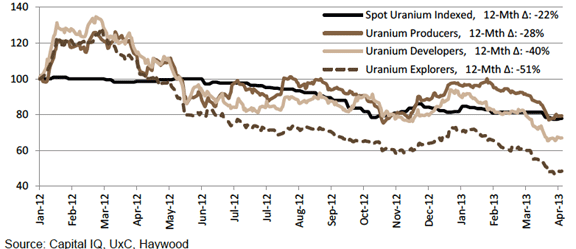
A significant number of existing and planned reactors worldwide have been shut down or delayed in response to the disaster as nations reconsider their use of atomic energy, leading to depressed uranium prices and a general industry slowdown……http://www.sbs.com.au/news/article/1763258/Uranium-sales-to-India-fuel-nuclear-arms-fears
May 3rd: antidote to uranium lobby’s lies about EMPLOYMENT
AUSTRALIA’S URANIUM EXPORT REVENUE IN PERSPECTIVE YELLOWCAKE FEVER Exposing the Uranium Industry’s Economic Myths , Australian Conservation Foundation “…..IBISWorld’s market report (March 2013) states there are just 650 jobs across Australia in uranium mining. In May 2006, the federal Department of Industry, Tourism and Resources estimated “over 700 jobs” in uranium mining and in October 2007 the Department’sInvestors have been burned, as governments and “analysts” hype Australia’s failing uranium industry

Last year the Olympic Dam expansion was cancelled, BHP disbanded its uranium division and sold the Yeelirrie uranium lease in Western Australia for about 11 per cent of the nominal value of the resource.
Also indicative of the state of the industry was Cameco’s announcement in February of a $162.5 million write-down on the Kintyre project in Western Australia. Just months after first production at the Honeymoon mine in north-east SA in September 2011, project partner Mitsui announced its decision to withdraw as it “could not foresee sufficient economic return from the project”.
In addition to industry propaganda, governments routinely inflate the significance and potential of the uranium industry, as do industry “analysts” (some of them market traders), some business journalists and some academics. There are real-world consequences to uranium mania — many “mum and dad” retail investors have been burned, especially during the speculative price bubble in the mid-2000s.
Uranium Industry Dreams Of Paydirt http://newmatilda.com/2013/05/02/uranium-industry-dreams-paydirt By Jim Green, 2 May 13, A new report released by the Australian Conservation Foundation: Yellowcake Fever: Exposing the Uranium Industry’s Economic Myths, shows that uranium accounted for just 0.29 per cent of Australia’s export revenue in the 10 years from 2002−2011. In the last financial year, uranium revenue of $607 million was 103 times lower than the biggest earner, iron ore. Milk and cream generate twice as much export revenue as uranium — and can’t be turned into Weapons of Mass Destruction.
Uranium export revenue is still more underwhelming given that the four companies mining uranium in Australia are all either majority foreign owned or 100 per cent foreign owned; in other words, a sizeable proportion of that export revenue never leaves the Northern Hemisphere and never comes anywhere near Australia. Continue reading
May 1st’s antidote to Australia’s uranium lobby lies about: The Uranium Market
 AUSTRALIA’S URANIUM EXPORT REVENUE IN PERSPECTIVE YELLOWCAKE FEVER Exposing the Uranium Industry’s Economic Myths , Australian Conservation Foundation A serious constraint is the modest size of the global market for uranium. Even if all secondary supply is bundled into the primary market, and lower spot prices are ignored, the figure still falls short of $10 billion p.a:
 (Beverley) 100%, and Uranium One (Honeymoon)
AUDIO The harsh economic facts contradict the Uranium Paydirt Conference’s hype
 AUDIO Australia’s uranium industry is high risk, low return, says campaigner http://www.radioaustralia.net.au/international/radio/program/connect-asia/australias-uranium-industry-is-high-risk-low-return-says-campaigner/1123008?autoplay=1122972 29 April 2013 Australia’s uranium industry is high risk, low return: that’s the assessment of a report designed to expose the uranium industry’s promise of great economic reward. Its findings suggest uranium accounted for just 0.29 per cent of Australia’s export revenue between 2002 and 2011.
The report by the Australian Conservation Foundation calls for a national independent inquiry into the industry’s contribution to Australia’s economy and employment.The report comes as uranium advocates meet in Adelaide today for the annual Paydirt Uranium Conference.
Presenter: Richard Ewart
Speaker: Dr Jim Green, national anti-nuclear campaigner for Friends of the Earth in Melbourne and co-author of the report, ‘Yellowcake Fever: Exposing the Uranium Industry’s Economic Myths’
Excerpts from this audio discussion

Australian Uranium Association’s Paydirt Conference shortened to one day, in gloomy economic prospects
 PAYDIRT URANIUM CONFERENCE IN ADELAIDE THIS MONDAY Uranium industry boosters will gather this Monday April 29 at the Adelaide Hilton for the annual Paydirt Uranium Conference. This year’s conference has been downgraded to a one-day event, reflecting industry stagnation in the wake of the Fukushima disaster.
Friends of the Earth national nuclear campaigner Dr Jim Green, co-author of a new report exposing the economic myths of the uranium industry, said: “The Australian Uranium Association’s Executive Director Michael Angwin claims that Australia “has enough reserves to be to uranium what Saudi Arabia is to oil”. However Australia’s uranium export revenue in 2011 was 466 times lower than Saudi oil revenue in the same year. Others to draw asinine comparisons between Australian uranium and Saudi oil include former SA politicians Mike Rann and Kevin Foley, and Adelaide-based academics Ian Plimer and Haydon Manning.”
“For decades the uranium industry has promised great economic benefits but it never delivers. Uranium accounted for just 0.29 per cent of Australia’s export revenue in the 10 years from 2002−2011. In the last financial year, uranium revenue was four times lower than Australia’s 20th biggest export earner, eight times lower than Australia’s 10th biggest export earner and 103 times lower than the biggest earner, iron ore. Even milk and cream generate nearly twice as much export revenue as uranium − and can’t be turned into Weapons of Mass Destruction. Uranium mining and exploration accounts for just 0.015% of all jobs in Australia.”
“Last year, BHP Billiton cancelled its planned expansion of Olympic Dam, disbanded its Uranium Division, and sold the Yeelirrie uranium lease in Western Australia for about 11% of the nominal value of the resource. Just months after first production at the Honeymoon mine in north-east SA in September 2011, project partner Mitsui announced its decision to withdraw as it ‘could not foresee sufficient economic return from the project.'”
“An independent inquiry is long overdue to objectively weigh the uranium industry’s economic benefits against its effects on environmental and public health, safety and security, particularly in the shadow of the unfolding Fukushima tragedy − a tragedy directly fuelled by Australian uranium,” Dr Green concluded.
‘Yellowcake Fever: Exposing the Uranium Industry’s Economic Myths’, a report released by the Australian Conservation Foundation last Friday, is posted at:
The dirt on Australia’s uranium industry, as it holds its “Paydirt” conference
Yellowcake Fever. Exposing the Uranium Industry’s Economic Myths Report in full at: http://www.acfonline.org.au/sites/default/files/resources/ACF_uranium_economics_Yellowcake_Fever.pdf by Dr Jim Green (FoEA) & Dave Sweeney (ACF), Australian Conservation Foundation, April 2013 (33 page PDF) Executive Summary: The Australian uranium industry involves serious and unresolved domestic and international security, environmental and inter-generational concerns and remains a contested and controversial sector that lacks a secure social license. This report examines the sectors small economic and employment contribution in relation to its significant risks and legacies and seeks to build the case for an independent cost-benefit analysis and a comprehensive and transparent assessment of the impacts and implications of Australia’s uranium trade.
Uranium is a small contributor to Australian export revenue and employment. From 2002 to 2011, uranium sales averaged $627 million annually and accounted for only 0.29% of all national export revenue. In the 2011/12 financial year, uranium revenue of $607 million was 4.4 times lower than Australia’s 20th biggest export earner, 8.7 times lower than Australia’s 10th biggest export earner and 103 times lower than the biggest earner, iron ore. Small industrial sectors can play an important economic role but the unique properties and risks of uranium mining relative to any benefits means its role requires particular scrutiny.
The industry’s contribution to employment is also underwhelming. The World Nuclear Association estimates 1,760 jobs in Australia’s uranium industry. That is the highest of all estimates yet it represents just 0.015% of all jobs in Australia. The industry’s primary promotional body, the Australian Uranium Association (AUA), claims its members are “significant employers of First Australians”
however the sector only provides around one job for every three thousand Indigenous Australians.
In the mid-2000s, there was a speculative uranium price bubble. Since this bubble burst the uranium industry has been battered by a falling commodity price, rising production costs, the Global Financial Crisis (and associated credit crisis), the failure of the global nuclear power ‘renaissance’ to materialise, the failure to develop new mines and serious production shortfalls……. Continue reading
High risk, low return: Australia’s uranium industry’s poor record demands inquiry
 Dave Sweeney, 26 April 13 Australia’s uranium industry is a minor contributor to employment and the economy, a major source of domestic and international risks and is overdue for an independent inquiry into its effects on the environment, health, safety and security, according to a report released today on the anniversary of the 1986 Chernobyl nuclear disaster.
The report, Yellowcake Fever: exposing the uranium industry’s economic myths, released by the Australian Conservation Foundation, shows uranium accounted for only 0.29 per cent of national export revenue and less than 0.015 per cent of Australian jobs in the decade to 2011.
In the last financial year, revenue from uranium was four times lower than Australia’s 20th biggest export earner, eight times lower than Australia’s 10th biggest export earner and 103 times lower than the biggest earner, iron ore. “While Australia’s uranium sector remains an economic minnow, it is a leviathan when it comes to the damage it does to communities and the environment and the risks it spreads,” said the Australian Conservation Foundation’s Dave Sweeney.
“It is time for an independent and credible cost-benefit analysis of this sector and for decisions to be based on evidence, not self-interested industry enthusiasm.”
The most recent independent assessment of the Australian uranium industry – a Senate Inquiry in October 2003 – found the sector characterised by underperformance and non-compliance, an absence of reliable data to measure contamination or its impact on the environment and an operational culture focussed on short term considerations.
“In the decade since that Senate Inquiry, leaks, incidents and accidents have continued to dog uranium mines, Australia has sold uranium to more nuclear weapon states and Australian uranium has fuelled the continuing Fukushima tragedy,” said Dave Sweeney.
“The Australian Uranium Association’s push to reduce independent scrutiny of uranium projects shows why this sector does not enjoy community confidence or a social license.
“We call on the federal government to establish an evidence-based inquiry into the operations and impacts of this industry, particularly in the shadow of Fukushima.” Contact: Dave Sweeney, 0408 317 812
Don’t let Australia’s uranium lobby remove safeguards – say doctors
It is essential that appropriate environmental and human safeguards remain, and that uranium mining and milling remains within the definition of “nuclear actions” for the purposes of the EPBC Act. There is a clear need for federal oversight to ensure clear and consistent implementation of these measures
Medical Assocation for the Prevention of War (MAPW) SUBMISSION ON FEDERAL REGULATION OF URANIUM MINING, by Dr Margaret Beavis April 2013 The uranium mining industry is attempting to remove federal overview of uranium mining. MAPW Vice-President Dr Margaret Beavis has prepared this submission to the Productivity Commission arguing that federal oversight should remain, and noting that as risks to health and the environment become more apparent, radiation regulation is increasing internationally.:
 It is concerning that the uranium industry has used the expression “mild radiation” to describe its radiological environmental impacts, when there is no regulatory basis or definition to use this term, potentially giving the impression that the levels of radiation in the uranium mining industry are without risk to the environment. The evidence is clear and unassailable that this is not correct. Furthermore, it is appropriate that uranium mining continue to be considered a ‘nuclear action’ as specified by the EPBC Act as the radioactivity derives specifically from nuclear decay processes. Tailings from uranium mining are radioactive for millennia, resulting in unique environmental considerations for every uranium mine.
The International Commission on Radiological Protection has determined that the dose coefficient for radon gas, one of the sources of radioactivity from uranium mining, needs to be doubled, indicating that it is actually thought to be double the previously estimated carcinogenic hazard.1. ARPANSA is currently in the process of revising dose estimates to workers. It follows that risks to others is doubled and makes it even more essential appropriate mitigation strategies are introduced. It also follows that the environmental risk is also increased. Continue reading
Doctors make powerful statement on protection of animals from uranium mining radiation
 Medical Assocation for the Prevention of War (MAPW) SUBMISSION ON FEDERAL REGULATION OF URANIUM MINING, by Dr Margaret Beavis April 2013 “…..With regard to non-human species, the 2010 ARPANSA Technical Report No. 154 entitled
1 This month

of the week – Australians for War Powers Reform (AWPR)
To see nuclear-related stories in greater depth and intensity
 Antinuclear