King Uranium is losing not only its Big Mine, but also its Adelaide Castle!
 BHP dumps Adelaide tower plans BY: SARAH DANCKERT The Australian August 25, 2012 BHP Billiton has scrapped plans to take a long-term lease on a purpose-built $250 million office tower in central Adelaide following its decision to shelve the expansion of its Olympic Dam mine.
The miner is also understood to be considering reducing the amount of existing office space it leases, said to be about 10,000sqm, in what will be a blow for the Adelaide office market…. Adelaide property professionals are maintaining a stiff upper lip despite the miner’s devastating decision to put on ice the $US30 billion ($28.6bn) expansion of the uranium and copper mine, 560km north of the city.
Earlier this year the miner began sounding out developers for a purpose-built office tower in the city’s central business district to house the new employees. BHP Billiton established its uranium headquarters in Adelaide in 2009 when the company created the Uranium Customer Sector Group.
Up until recently BHP Billiton was seeking a long-term lease on a state-of-the-art office that would be built for the resources group in the heart of the city. The lease was to include naming rights over the building. Continue reading
South Australia better off without the Great Big New Uranium Mine?
The union movement sees an upside to the delay at Olympic Dam, urging the state government to use it to fight for a better deal for SA.
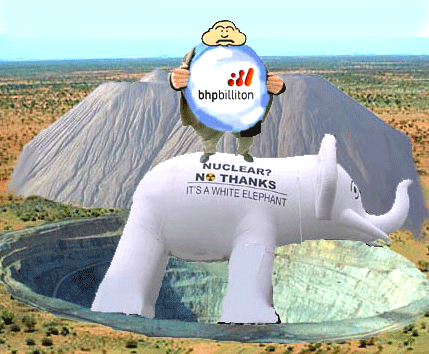 SA Unions state secretary Janet Giles said benefits from the mining industry should flow to the whole community, and the state government would be wise to show caution when dealing with BHP Billiton in the future.
Olympic delay no mining death knell Sky News, August 24, 2012 South Australia’s peak mining group says BHP Billiton’s decision to delay the expansion at Olympic Dam is not all doom and gloom.
Chief executive Jason Kuchel said SA’s mining industry had diversified dramatically over the past decade and the state currently had 20 major mines in production with many more projects in the pipeline…..
‘South Australia has a lot on the go with several new mining regions, exciting oil and gas developments, and a multitude of small and mid-tier miners who collectively could bring just as much, if not more, benefit to the state than the expansion of Olympic Dam.’ Continue reading
South Australia just escaped a very poor deal of Olympic Dam as “China’s quarry”
 SA government now wary of BHP: premier, Yahoo Finance, AAP – Wed, Aug 22, 2012 “…He [Premier Jay Weatherill ] said South Australia was now entitled to be wary when dealing with the company in future and warned the government would take a tougher approach to negotiations if asked to approve expansion a third time.
“We’ve been given to understand that BHP were proceeding with an expansion once. We’ve been given to believe that BHP will proceed with an expansion twice,” Mr Weatherill said. “If they come to us and seek permissions and approvals on a third
occasion, we will be taking a different approach to the negotiations….
the Greens said the delay was a “get-out-of-jail card” giving the government the chance to negotiate a much better deal.
“The 2011 deal was economically irresponsible, environmentally reckless and would have left South Australia as little more than China’s quarry,” Greens MP Mark Parnell said. “Despite giving the company nearly everything it wanted, it still
didn’t stack up economically.”… Continue reading
Decision to stop new Olympic Dam uranium mine was unavoidable
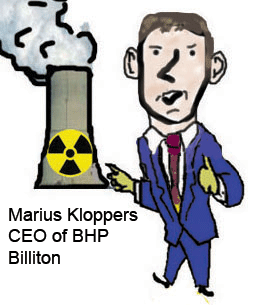 New era for BHP shareholders Financial Review 24 AUG 2012 TONY BOYD Marius Kloppers secured his job by delaying $30 billion in capital projects in Australia but he needs to do much more to get the BHP Billiton machine humming at optimum speed….
There was an inevitability to the project delays….. Olympic Dam might have been justified several years ago when its cost was estimated at $15 billion. But at a cost double that amount and with Australia’s high construction and infrastructure cost base, it was untenable.
Kloppers said the project never actually jumped the hurdle called “economic concept”, which meant BHP was never able to talk seriously with a potential Chinese partner to develop the world’s largest uranium deposit and fourth largest copper and gold deposit….
His outlook statement issued with the full-year results was seen by several analysts as bullish. But coverage will be dominated by the Olympic Dam decision because of its widespread implications.
Analysts think it is unlikely that a large-scale development project will proceed at the site in South Australia…. Given the company’s desire to operate within a credit rating envelope that delivers it low-costing debt, the Olympic Dam decision was unavoidable. Continue reading
Scrappimg of Olympic Dam new uranium mine does not help the present plight of the uranium industry
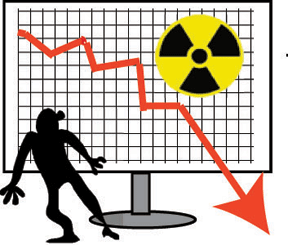 ... the effects of the project delay are longer term and do little to address near-term challenges facing the uranium industry…
Implications Of The Olympic Dam Expansion Delay For The Uranium Industry Seeking Alpha, August 24, 2012 Earlier this week, BHP Billiton (BHP) announced that it will investigate an alternative, less capital-intensive design of the Olympic Dam open-pit expansion, effectively shelving this massive, over $20 billion project. Though not unexpected, the decision is undoubtedly an important development for the world’s largest mining company.
But it has even larger long-term implications for the small and highly concentrated uranium mining industry. Continue reading
Can Olympic Dam copper mine be developed without uranium recovery?
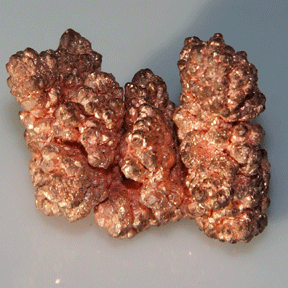
Dr Gavin M. Mudd Environmental Engineering, Monash University December 2010
“…… – it is eminently reasonable to propose a process flow sheet for Olympic Dam which does not include recovery of the uranium but still allows for copper, gold and silver to be produced.
http://users.monash.edu.au/~gmudd/files/ODam-Cu-only.pdf
Of course, a more modern idea is in design. Designing technologies so that it is practical and relatively easy to RECYCLE copper – C.M.
Open cut mine at Olympic Dam dead in the water? perhaps just copper extraction now?
Writing on the wall now gospel The Age, August 23, 2012 Malcolm Maiden “…..The decision to defer the Olympic Dam open-cut project was forced by a tightening cost-benefit equation as capital costs rose and commodity prices eased.
BHP said at its announcement that it would investigate ”an alternative, less capital-intensive” open-pit design, and is expected to focus on copper extraction technologies, among other things.
The biggest cost in the project is digging the open-cut quarry. There is no way to significantly downsize project costs without reducing the size of the hole, and the amount of overburden that needs to be removed before the ore body is exposed.
The final outcome is in the hands of the markets and the copper price, but the full-blown open-cut idea may be dead.
http://www.theage.com.au/business/writing-on-the-wall-now-gospel-20120822-24mqf.html#ixzz24PobKbbu
The Olympic Dam uranium project – uneconomic, unnecessary for South Australia
At its peak, the mine was expected to consume more electricity than the city of Adelaide, and 100 Olympic swimming pools worth of fresh water every day.
Olympic Dam was too expensive.
South Australia will be fine. Mining accounts for a relatively small share of South Australia’s overall economy, and only 1 per cent of its employment.
the carbon emissions from Olympic Dam would have dwarfed all the gains in emissions reductions that South Australia has made in renewable energy in recent years
The Olympic Dam Delay Has A Silver Lining New Matilda, By Ben Eltham 23 Aug 12, Why did BHP Billiton halt the Olympic Dam mine? The project was just too expensive. The decision is good news for the South Australian environment, writes Ben Eltham
Picture a hole in the ground four kilometres long and one kilometre deep. Picture a manmade mountain of dirt next to it nearly as high — a mountain of dirt dug from the ground and heaped next to that hole, a new landmark on the South Australian horizon.
Picture a mega-project so large and so thirsty that it would have required a new baseload electricity generator to meet its power needs, and a new desalination plant hundreds of kilometres away on the coast to make the water it required.
Picture a mine so vast, it would have increased the world supply of Uranium by a third.
This was the vast edifice that was to be Olympic Dam — when finished, the largest mine in the world. Continue reading
OLympic Dam uranium mine expansion a financial white elephant despite government help
BHP cans Olympic Dam expansion Financial Review 22 AUG 2012 JAMIE FREED, MATHEW DUNCKLEY AND GEMMA DALEY BHP Billiton has confirmed it is not proceeding with a planned $US20 billion expansion of its Olympic Dam copper-uranium mine in South Australia as it reported its first annual profit fall in three years. As foreshadowed by The Australian Financial Review, the world’s largest miner said sluggish market conditions including subdued commodity prices and higher capital costs had triggered the decision and it would hold talks with the South Australian government in the coming months over the project.
BHP will take a $US346 million writedown on the project in the 2012 financial year……
Before BHP’s announcment, Prime Minister Julia Gillard was asked during question time in Parliament to guarantee the outlook of the project.
“We have legislated carbon pricing so BHP when they are making those decisions can do it against a backdrop of certainty,” she said.
“But in fact, the uncertainty for BHP and Olympic Dam, the uncertainty for every business in this country comes from the destructive negativity of the Leader of the Opposition and his reckless attempt to roll back every economic reform that makes sense for this country and will build our prosperity.”
BHP has been working on plans to expand Olympic Dam as an open pit since the $9.2 billion acquisition of WMC Resources in 2005, which was championed internally by its now chief executive Marius Kloppers……BHP has environmental approvals in place for a much smaller expansion of the existing underground operation to 350,000 tonnes of copper production a year but Mr Mackenzie indicated it had done very little work on that option relative to the open pit.
Expanding the underground mine, at a potential cost of $US2 billion to $US3 billion, could make building an open pit more difficult in the future.
Mr Kloppers is likely to come under pressure from investors over the large amount of spending to date on the open pit concept.
BHP last year approved $US1.2 billion of pre-commitment capital for the project and likely spent hundreds of millions of dollars prior to that on studies of the expansion over the last seven years.
However, one analyst noted that spending on drilling and metallurgical studies along with some surface infrastructure could still be applied to an underground expansion…..Credit Suisse analyst Paul McTaggart has calculated the project has only a 10 per cent internal rate of return based on long-term prices, which is lower than the 15 per cent typically targeted by BHP. He does not expect it would be free cash-flow positive until 2021 if approved this year.
The project has suffered from rising capital costs amid a stronger Australian dollar and higher input and labour costs and a weaker outlook for the key byproduct, uranium….. http://afr.com/p/markets/market_wrap/bhp_confirms_olympic_dam_expansion_ePeUWL4Wd1ZVrTW75RWleO
BHP scraps plans for Olympic Dam gigantic new uranium mine
BHP cancels $30 billion Olympic Dam expansion near Roxby Downs in South Australia Outback Business Writer Meredith Booth AdelaideNow August 22, 2012 BHP Billiton has shelved its $30 billion Olympic Dam expansion and will go back to the drawing board to find a cheaper alternative….
.. However, BHP chief executive Marius Kloppers today insisted market conditions, subdued commodity prices and higher capital costs led to the decision, which has been the subject of speculation within several months.
“As we finalised the details of the project … it became clear that the right decision for the company and its shareholders was to continue studies to develop a less capital-intensive option to replace the underground mine at Olympic Dam,” Mr Kloppers said…….
The mine would have become the world’s biggest open cut copper and uranium mine at six kilometres long and one kilometre deep.
The news came as BHP Billiton announced a 21 per cent fall in annual profit of $US17.1 billion…… Mineral Resources and Energy Minister Tom Koutsantonis said BHP had made a decision based on international factors.
“South Australia unfortunately, even though we did everything right … forces outside of our control took over,” he said.“These resources aren’t going anywhere .
New South Wales Uranium Free Charter gathers political strength
 The waste from any uranium mining in NSW would remain dangerous long after the O’Farrell government is gone from Macquarie Street.
Rather than promoting the unsafe uranium sector the government should building an energy future that is renewable, not radioactive
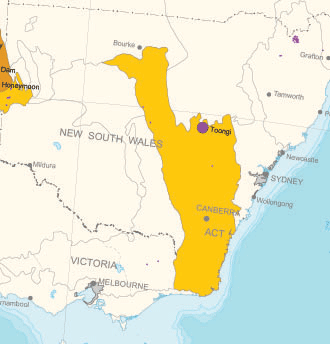
(Map: yellow shows area where uranium exploration could occur)
Nuke South Wales? http://www.onlineopinion.com. au/view.asp?article=14007 By Natalie Wasley and Pepe Clarke -, 20 August 2012 Earlier this year, in a sharp break with a long standing and bi-partisan ban, the NSW Government announced it would allow uranium exploration across the state. This abrupt reversal of a 26-year prohibition came without warning or consultation and against the backdrop of the global nuclear industry reeling from the continuing
Fukushima disaster.
At the time, Premier O’Farrell cited the narrowly won ALP national conference vote allowing uranium sales to India as rationale for the policy change, but outside of cabinet responses ranged from wariness to outright hostility.
The decision to allow uranium exploration was – and is – fiercely opposed by NSW Labor and the Greens. Speaking against the move in both state parliament and a recent public meeting, Shadow Environment Minister Luke Foley captured the strength of this resistance: “As long as I am in public life I will argue against this dangerous industry
Civil society and community groups are increasing both the light and the heat on the Premier’s atomic ambitions including through this week’s launch of a NSW Uranium Free Charter in Sydney. The Charter highlights the dangers of the nuclear industry,calls on government to rule out uranium mining in New South Wales and has already gathered strong support state and national trade unions, environment groups, public health and student organisations. (see attached and
www.nccnsw.org.au/uranium ).
The Charter signals the start of a new campaign to keep NSW free from uranium mining and promises to increasingly locate this controversial mineral on the state political radar . Continue reading
Uranium exploring companies in Australia deserting an economically sinking ship
 Marketing mavericks turn heads at Diggers & Dealers meet THE AUSTRALIAN BY: ROBIN BROMBY The Australian August 13, 2012 “….. Uranium? Head for the hills. Forget about it. The spot price is down to $US49.25 a pound.
Joe Gutnick’s Top End Uranium (TEU) is flicking the switch to precious gems exploration, just the latest of many uranium explorers heading for the doors.
In this case, it cites constant delays in getting access to its ground as the reason, but you would have to be a uranium true believer to put another dollar into the ground right now.
As Warwick Grigor at Canaccord Genuity points out in his Friday note, prices of uranium companies are being reduced to shell levels.
He cites companies with advanced projects such as Uranium SA (USA) with $3 million in the bank and a market cap of $8m, while Bannerman Resources (BMN) has cash of $9m and market cap of $27m…..”
http://www.theaustralian.com.au/business/opinion/marketing-mavericks-turn-heads-at-diggers-dealers-meet/story-fnciihm9-1226448709580
Australian company Mantra Resources has to pay tax bill, for Tanzania uranium mine to go ahead
Tanzania: Uranium Project Licence Shelved Till Tax Bill Paid, Beyond Nuclear 12 Aug 12, Dodoma – A SPECIAL mining licence to allow Russian firm, Uranium One start mining at Mkuju River in the Selous Game Reserve buffer zone, will not be issued until Australian Mantra Resources pay over 180 million US dollars (approx. 292.12bn/-) in taxes, the Parliament was told.
Australian uranium miner Paladin lost $39 billion in 9 months
Uranium mine lost K39 billion in 2011 , The Maravi Post, 10 Aug 12 BLANTYRE–The Kayekelera uranium mine in Karonga, which is operated by Paladin Energy Limited of Australia, lost K39 billion in nine months of operation ending March 2012 due to fluctuating prices of the commodity on the international market, the company’s top official has said.
Greg Walker, general manager for international affairs, told the Daily Times Business that the loss was a result of the historic earthquake in Japan that produced a Tsunami in March last year. Spot price for uranium oxide dropped from $75 (some K21, 000) to $47.50 (K13, 000) after the closure of Fukushima nuclear plant in Japan.
Walker said now the price is at $49.50 -K14,000 – saying this was below the direct cost of production at Kayelekera, the country’s biggest investment. Walket told the daily that Paladin have bankrolled $145 million–K41 billion- to keep the mine afloat… http://www.maravipost.com/malawi-news/society/1486-uranium-mine-lost-k39-billion-in-2011.html#.UCbaJ6FlT4Y
Rare Earths Reprocessing in Australia
Note – I am not opposed to the mining and reprocessing of rare earths. I recognise that they are a necessary “lesser evil” in the development of modern and renewable technologies. BUT – rare earths reprocessing does produce toxic radioactive wastes, and the disposal of these wastes is an important issue that must be adressed, and clearly shown [ rather than spun] to the public. – Christina Macpherson
 Whilst working with Alkane on a pilot rare earths processing plant, ANSTO has previously partnered with BHP Billiton at the Olympic Dam mine, Energy Resources Australia at the Ranger uranium mine, and a number of other Australian-based miners.
Chalmers marked final government approvals as other major hurdles beyond the research with ANSTO.
And while so far steering clear of local opposition, the company remains mindful of the importance of keeping those outside the industry on side.
All eyes on ANSTO, Australian Mining, 10 August, 2012 Andrew Duffy “….. On a tour of its ANSTO pilot plant Alkane managing director Ian Chalmers told Australian Mining the company [ Alkane Resources ] was aiming to be producing rare earths by 2015…..
The company also runs tours for schools and interested community members to ensure everyone’s well informed.
Chalmers told Australian Mining Alkane’s close relationship with the community had been part of the reason why the company had avoided the difficulties faced by Lynas. Lynas has faced significant community opposition to its rare earth
processing plant in Malaysia, and protestors have been the source of ongoing delays, cost blowouts, and multiple court battles. ….
while the company’s community and environmental relations are a focus, the research at its ANSTO plant is all about the science behind rare earths processing. Continue reading
1 This month

of the week – Australians for War Powers Reform (AWPR)
To see nuclear-related stories in greater depth and intensity
 Antinuclear