Energy Resources of Australia (ERA) – big losses but hopeful that Japan will “embrace nuclear energy”!
 ERA looks to Japan re-embracing nuclear THE AUSTRALIAN, BY: BY KIM CHRISTIAN From: AAP July 26, URANIUM miner Energy Resources of Australia (ERA) says Japan will re-embrace nuclear power and that China will become increasingly reliant on the same technology.
The comments by ERA chief executive Rob Atkinson come as the miner’s year of reckoning approaches with its flagship mine Ranger in the Northern Territory rapidly depleting.,,,,,, Mr Atkinson said the uranium market remained challenging,… Mr Atkinson was speaking after ERA said it net losses shrank by more than 50 per cent to $59.86 million in the first half compared to the previous corresponding period. Continue reading
Australian Uranium Association resigned to inevitable fall in uranium sales
 Simon Clarke, communications director for the Australian Uranium Association, said the Fukushima incident had hurt demand for Australian uranium, and the new policy would see an overall reduction in exports
“We would very much prefer to have the whole Japanese nuclear fleet back in the game, but obviously that’s not going to happen,” he said……would mean a fall in sales for Australian producers ERA and BHP Billiton.
Tetsunari Iida, who heads Japan’s Institute for Sustainable Energy Policies, hopes Japan can become a leader in renewable technology and come to depend solely on renewable sources.
Gas the winner as Japan crafts its post-tsunami energy plan BY: RICK WALLACE The Australian July 26, 2012 “…the nation looks to reduce its dependence on nuclear energy after the Fukushima disaster. The policy will not be released for at least another month, but three scenarios have emerged from the sometimes fractious deliberations.
The impact on Australia — which provides 20 per cent of Japan’s natural gas, 66 per cent of its thermal coal and more than one quarter of its uranium — will be slightly different in each case. Continue reading
South Australian government not affected if BHP’s Olympic Dam expansion doesn’t go ahead
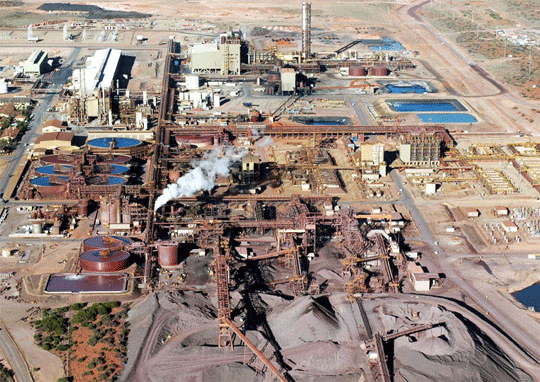
 “Olympic Dam doesn’t have any significant revenue for the state government,” “Olympic Dam is never going to be some sort of cash cow for the state government
Olympic Dam no cash cow for state, says Jack Snelling THE AUSTRALIAN, BY: SARAH MARTIN July 25, 2012 BHP Billiton’s $30 billion Olympic Dam mine expansion will have no revenue implications for the South Australian government, Treasurer Jack Snelling says.
In comments far removed from earlier claims that the mega-project would transform the state, Mr Snelling said the budget would not be affected if the project did not go ahead. Continue reading
Contractor lays off Olympic Dam workers, in view of doubts on its future
BHP reviews contractors, staff amid project uncertainty Business Spectator, 24 Jul 2012 In the latest sign that BHP Billiton Ltd may not approve the expansion of its Olympic Dam copper-uranium mine in South Australia later this year, the miner is conducting a review of contractors and staff across its mining mega-projects, looking for potential cost-saving cuts, according to The Australian Financial Review.
In the wake of BHP’s indication recently that it may not approve its three mining mega-projects before December, the company in charge of conducting a feasibility study on the $US20 billion-plus Olympic Dam project laid off several workers last week after its contract expired, according to the AFR.
The company, Jacobs Engineering, made the layoffs on the basis that it could not justify the staffing levels unless BHP’s board approved the project….. If the BHP board fails to approve the Olympic Dam project by December 15 the South Australian government will have the right to allow an indenture agreement setting royalty rates for 45 years to lapse. … http://www.businessspectator.com.au/bs.nsf/Article/BHP-reviews-contractors-staff-amid-project-uncerta-pd20120723-WGLXZ?OpenDocument&src=hp10&WELCOME=AUTHENTICATED%20REMEMBER
Protesting BHP’s Olympic Dam – its special privileges, water guzzling, uranium to Fukushima
Mythical lizard haunts Australian uranium extractors Infoshop News, July 22 2012 Anti-nuclear protesters camping at what they describe as “the gates of hell” — that is, on the edge of BHP Billiton’s Olympic Dam uranium mine in the desert of South Australia — decided to play a game of cricket on Tuesday, July 17, in order to publicize their message: Uranium isn’t Australian.
“It’s just not cricket,” they chanted, “and that’s why we picket.”
by Peter Rugh Waging Nonviolence “…….There’s no room for nature’s business in the uranium business. That’s why BHP is digging into the belly of Kalta, the sleeping lizard who, according to aboriginal legend, lives under the rocks at Olympic Dam. BHP is sucking yellow uranium poison out of Kalta’s belly and feeding it to nuclear reactors around the world.
It already takes about 9 million gallons of water a day to wash all that poison down the throats of global markets — water sucked out at no cost to BHP from the region’s only reliable freshwater source, the Great Artesian Basin. But the Melbourne-based multinational plans to expand its mining operations at Olympic from an area of about 1,700 square miles to a terrain roughly eight times that size. The $30 billion expansion would make Olympic Dam at Roxby Downs the world’s largest open-pit mine.
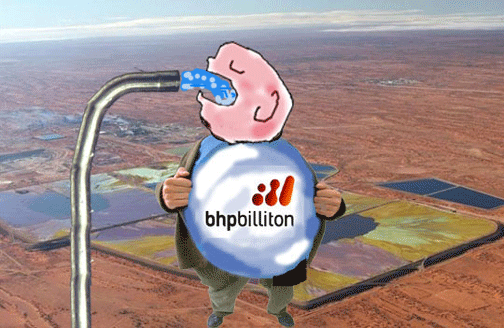
An additional 53 gallons of water a day will be used up should mining at Olympic expand. The amount of diesel required to extract and transport BHP’s uranium would cause South Australia’s greenhouse gas emissions to skyrocket by 12 percent.
Olympic currently operates under the Roxby Downs Indenture Act of 1982, which granted BHP exemptions from laws covering native sovereignty, public disclosure, environmental impact and water preservation. The Indenture Act was amended in 2011 , when BHP began scouting out more land. Critics say the law is essentially a contract between BHP and the South Australian government for the corporation to do what it likes.
Meanwhile, the effects of BHP’s mining are felt far beyond the Outback. Approximately 4,400 tons of Australian uranium per year are used to feed aging reactors in the United States, which jeopardize the civilian population centers that they surround . A major portion of the stuff comes from BHP. The company is to Australia’s uranium industry what Nirvana was to grunge; they’ve cornered the market…..
Prior to the Fukushima disaster , Japan — after the United States and the European Union — was Australia’s third best uranium customer, importing nearly 2,700 tons a year. The uranium fuel pellets that melted down three reactor cores at Fukushima on March 11 of last year were from Olympic Dam.
Dr. Jim Green, an anti-nuclear campaigner with Friends of the Earth Australia, accuses BHP of turning a blind eye to fraud and safety problems in Japan’s nuclear industry in the run-up to the meltdowns. Despite widespread documentation of data falsification and safety breaches, he says BHP continued to peddle its toxic product to the quake-prone nation in the run up to the Fukushima meltdowns…. http://news.infoshop.org/article.php?story=20120722092133582
BHP will have a hard time depicting anti uranium protestors as useless bludgers
many of the group.. had taken leave without pay to travel to Roxby Downs to spread their message.
“There are other alternatives (to uranium for power) and I think an event like this can bring that more into discussion.”

We’re no bludgers, say mine protesters, Ben Hyde, The Advertiser July 20, 2012 THEY came from interstate and even overseas to protest against uranium mining, and some could be camped on the doorstep of BHP Billiton’s Olympic Dam mine for another two weeks. The group of Lizard’s Revenge protesters, which peaked at about 400 activists last weekend, were an eclectic bunch, united in their anti-nuclear stance. Continue reading
Protest continues at Olympic Dam uranium mine: 5 more arrests
 Protests flare again at Olympic Dam news.com.au 19 July 12, FIVE people have been arrested after renewed protest action at the Olympic Dam uranium and copper mine in South Australia’s north.
The arrests on Thursday brought to 18 the number of people taken into police custody since about 350 anti-nuclear activists converged on the area on Saturday.
The official protest was scheduled to conclude on Wednesday but up to 100 people remained in the area. Police said about 40 people blocked Olympic Way, just south of the declared protected area, on Thursday morning. They pushed a car onto the road, let down its tyres and locked the steering.
The action forced a truck to stop on the road and two men then chained themselves to the underside. They were arrested and charged with illegal interference. Three other people were charged with refusing to follow police direction.
Warning on over optimism about Australia’s uranium industry
 Toro boss says analysts overestimate uranium industry Australian Mining 19 July, 2012 Andrew Duffy Toro Energy managing director Greg Hall, who is leading the development of WA’s first export uranium mine, says analysts have overestimated future uranium production….
new projects must pass technical, regulatory and finance hurdles, often uniquely specific to the uranium sector, before construction and ultimately production can come online,” he said.
“In this regard Toro believes the market and a number of uranium analysts are being overly optimistic on supply timelines for new uranium projects and that as a result future production is overestimated.”
Toro Energy now postponing decision on whether to go ahead with Wiluna uranium mine
WA’s first uranium mine delayed Business Spectator, 19 Jul 2012 The timeline for Western Australia’s first uranium mine has slipped after a rigorous environmental assessment. Toro Energy Ltd announced a revised target date for a final board decision on whether to proceed with its Wiluna project in central WA, moving it back to the first half of 2013.
The company had previously expected to make a final decision by the end of 2012.
The project was approved by the state’s Environmental Protection Authority (EPA) in May and appeals are being reviewed before a final decision by WA environment minister Bill Marmion. Managing director Greg Hall said yesterday the company hoped Mr Marmion would make a decision by the end of September….
…. In 2008, the Liberal state government lifted a six-year ban on uranium mining that was imposed by the previous Labor government. WA’s Labor opposition remains has not changed its stance on uranium mining, but says it will not stand in the way of any planned uranium mine that has received approvals if the party wins state elections in March.
There are no other uranium projects in WA that would be fullyenvironmentally approved by the time of the election.
ww.businessspectator.com.au/bs.nsf/Article/Timeline-for-WAs-first-uranium-mine-slips-WC4P8?OpenDocument
BHP tightlipped about whether or not the big new Olympic Dam uranium mine will actually go ahead
 For all the hype about its planned “biggest uranium mine in the world” at Olympic Dam, BHP is experiencing some jitters, as shareholders are not so keen on seeing the company blow $30 billion on this behemoth, before there’s a sign of any profit from this geewhiz dream of CEO Marius Kloppers.
BHP Seeks Friends in Volatile Times, Wall Street Journal, 19 July 12“…..fuel for volatility in BHP’s shares is the question of BHP’s spending discipline. Commonwealth Bank has said it remains concerned by the company’s capital allocation policy, and believes the market would rather see windfall cashflow returned to shareholders via dividends or share buybacks…
BHP has declined to comment on the progress of the multibillion dollar projects, including the expansion of the OlympicDam copper-uranium mine in South Australia …“Cuts to capex [capital expenditure] and growth profile are…likely if commodity prices weaken further than expected,” Citi analysts said.
Renowned film-maker David Bradbury will document anti-uranium protest at Olympic Dam
 David Bradbury is traveling to Roxby with a small camera crew to document the actions at Olympic Dam as part of Lizard’s Revenge. He is driving down (ie. heading south) and is aware of the roadblocks the state is putting in place, but is hoping to make it down by today or tomorrow. His trip and the festival can be followed on Facebook: http://www.facebook.com/pages/David-Bradbury/349981725057349
BHP Billiton who own the mine and run it ‘like Nazi Germany’; so one of the workers told me three years ago when I was there filming after he told me not so politely to put my camera away and ‘f- off’. The miners and the huge multi national mining giant don’t like their right to earn big money and profits ripping out the Heart of Australia and polluting the precious water supply of future generations. Continue reading
Police agree on ‘right to protest’ – but block off road 4Km from Olympic Dam uranium mine
 Police block mine road to protesters, BY: MARK SCHLIEBS The Australian July 12, 2012 POLICE will set up roadblocks around BHP Billiton’s Olympic Dam mine in outback South Australia, creating further anger and warnings of confrontations with anti-uranium activists who plan to “shut down” mining operations during a five-day protest at the site.
Two roads leading to the Roxby Downs mine, in the state’s remote centre, have been blocked ahead of the first day of the protest on Saturday. The road protesters planned to use has been blocked 4km from the mine’s southern gates.
Only mine workers, emergency services workers and people individually approved by police can use the roads.
Protest organisers had hoped between 200 and 2000 activists would attend the demonstration and a music festival. One organiser, Nectaria Calan, said yesterday the police were being deliberately antagonistic.
“They’re blocking a public road,” she said. “On the one hand, they’re saying we’ve got the right to protest but on the other hand they’ve already made moves to prevent us from doing so.” She said the activists would decide how the protest would proceed once they reached Roxby Downs, but would not rule out blockading the roads.
Hundreds of police reinforcements, including special operations officers, have reportedly been sent to the town….. A company spokeswoman would not confirm whether hundreds of private security contractors had been flown to Roxby Downs but said preparations had been made. http://www.theaustralian.com.au/national-affairs/state-politics/police-block-mine-road-to-protesters/story-e6frgczx-1226423874130
Australia cannot ignore the problems of rare earths, and should develop recycling, as one answer
 Recycling Rare Earths Stop Lynas, 11 July 12, “…….We know that human induced climate change is a fact. Solutions to cut carbon emissions include energy efficiency, hybrid cars and renewable technologies like wind power which all need rare earths. But it is a dangerous path we are on when we continue with the ‘business as usual’ moto – instead we must continue to challenge the influence of governments and corporations that do not take people’s needs into account by protecting human rights and the environment for future generations.
One partial solution to the negative impacts of rare earth mining and processing would be to reduce consumption and increase the reuse and recycling rates of rare earth elements. Currently the recycling rate for most rare earth metals is around 1% or less . Japan is exploring increased recycling of rare earths fromelectronic waste . If the price of the final materials included the true social and environmental costs of rare earth mining, the incentive to recycle and dig up less would increase.
We must be concerned not only with how our use of rare earths contributes to their depletion, but also how pollution from the production, processing and use of rare earths should be considered in the context of our use – particularly because rare earths are recyclable. http://stoplynas.org/recycle-rare-earths/
The anti uranium rally at Olympic Dam – an issue for all Australians, not just a fringe issue
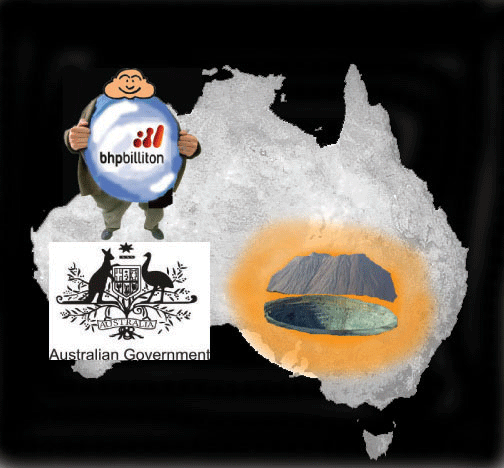 BHP’s URANIUM FIEFDOM , 11 July 2012, New Matilda Olympic Dam has been plagued with faults – but is exempt from public scrutiny. The failure of government and business to ensure the mine’s safety is not a fringe issue, writes Jim Green
BHP Billiton’s Olympic Dam uranium and copper mine is a state within a state. It operates under a unique set of laws enshrined in the amended Roxby Downs Indenture Act. That would be unobjectionable except that the Indenture Act allows Olympic Dam wide-ranging exemptions from environmental laws, water management laws and Aboriginal Heritage laws — and for good measure it curtails the application of the Freedom of Information Act.
Hundreds of Australians are protesting the mine this weekend. Their overarching concern might be expressed as what sociologists call “political blockage” — official avenues of grievance resolution are closed so people take matters into their own hands….
 I’ll be at the Olympic Dam convergence for two main reasons. Firstly, out of solidarity with Traditional Owners who are ignored by BHP, ignored by the state and federal governments, and sometimes ignored even by their own people. BHP generously supports Reconcilitation Australia yet holds on tenaciously to its exemptions from the SA Aboriginal Heritage Act — that sort of hypocrisy and cant needs to be exposed.
And secondly, I’ll be there because the domestic problems with Australia’s uranium industry are compounded by serious international problems. Australia has uranium export agreements with nuclear weapons states that have no intention of meeting their Nuclear Non-Proliferation Treaty disarmament obligations; countries with a history of secret nuclear weapons research; countries that refuse to sign and ratify the Comprehensive Test Ban Treaty; countries blocking progress on the proposed Fissile Material Cut-Off Treaty; undemocratic, and secretive states with appalling human rights records.
Both major parties now support the abandonment of previous policies banning uranium exports to countries that have not signed the Non-Proliferation Treaty. The federal government is planning to allow uranium sales to a Middle Eastern dictatorship — the United Arab Emirates. The last time Australia went down that path was in late 1978 when the Fraser government was negotiating with the Shah of Iran — a few short months before his overthrow during the Iranian Revolution.
All of these uranium export agreements are accompanied by safeguards inspection regimes that are at best modest, sometimes tokenistic (e.g. China) and sometimes all but non-existent (e.g. Russia).
Those converging on the mine later this week reflect broader public concerns about uranium mining. Opinion polls are roughly divided on the topic; typically, polls find that a majority of Australians want existing uranium mines to be allowed to run their course but a majority want a ban on new uranium mines. A 2006 Newspoll found even a majority of Coalition voters wanted a ban on new uranium mines, as did more than three-quarters of Labor voters.
Recent polls indicate that two-thirds of Australians oppose uranium sales to nuclear weapons states and two-thirds oppose the plan to sell uranium to India — a country which has not signed the Non-Proliferation Treaty and is engaged in a nuclear arms race with Pakistan and China.
These are not fringe concerns. http://newmatilda.com/2012/07/11/bhps-uranium-mining-fiefdom
Olympic Dam copper/uranium mine’s future more doubtful, with rise of RECYCLING of metals
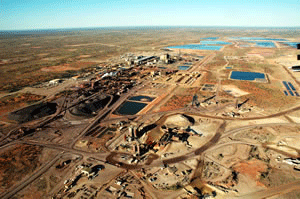 Olympic Dam is surely under review,” said UBS mining analyst Glyn Lawcock. “It’s not an issue of finding the cash,” he
said, but rather ensuring a good return on the investment……
Further curbing the appetite for refined copper, BHP now sees recycled scrap meeting up to 50 percent of China’s overall demand in the coming year for the metal, up from 35 percent now.
there is a much bigger question mark over it [Olympic Dam new mine] now
BHP Olympic Dam delay would tighten copper supply Reuters, By James Regan SYDNEY | Fri Jul 6, 2012 “….. A 25 percent drop in benchmark international copper prices since early 2011 has eroded potential returns from the project, and the economic slowdown in top base metal consumer China has dampened the demand outlook.
BHP’s scheme to quadruple output from Olympic Dam – the fourth-largest known copper deposit and largest uranium source in the world – is one a growing number analysts believe likely to be shelved until markets stabilize…. London copper prices have fallen to around $7,650 a metric ton (1.1023 tons) from a peak over $10,000 in early 2011 as big copper buyers such as car and computer manufacturers slow consumption… Continue reading
1 This month

of the week – Australians for War Powers Reform (AWPR)
To see nuclear-related stories in greater depth and intensity
 Antinuclear