Peaceful anti-nuclear protest in South Australia might be met with police violence, as in the past
Still fresh for many campaigners are the memories and scars of an anti-nuclear protest at the Beverley Uranium Mine in  May 2000…. a nasty example of police violence
we should also try to engage genuinely with the important moral issues that the protestors are highlighting.
Their agenda is quite public , which is more than could be said for the private sector interests they are protesting. We might also question why the police are deploying over 200 personnel to “manage” a peaceful protest and what violence police have instigated during similar events in the recent past.
Peaceful dissent and a lizard’s revenge http://www.abc.net.au/environment/articles/2012/07/10/3541989.htm PETER D. BURDON ABC 10 JUL 2012 Protesters at the Beverley uranium mine were treated in a “degrading, humiliating and frightening” manner in 2000, according to a later judgement.
THE ANTI-NUCLEAR MOVEMENT in Australia can be characterised by several key themes – colour, lentils, solidarity and a commitment to nonviolent acts of resistance. Another pervasive theme that characterises the past forty years of activism is power imbalance. On one side of the struggle you have poor and sometimes dislocated indigenous people, students and concerned community members (greenies). On the other side there are billion dollar companies, the Government, State police and the media.
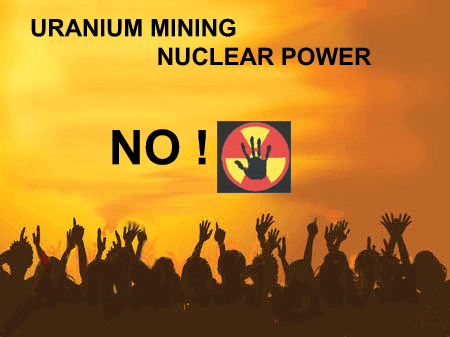
Such is this power imbalance that many campaigners will spend decades resisting without reward. Those who are fortunate to be involved in a campaign victory (or even a slight concession) have also seen promises betrayed and decisions reversed.
Yet, despite many crushing defeats, antinuclear activists continue to resist. They do so, not because they have nothing better to do, or because they are violent delinquents (the images commonly portrayed in the media), but because they are acting in accordance with their conscience. Continue reading
Above Australia’s State and Federal laws – BHP and Olympic Damn uranium mine
Jim Green: Project a rule unto itself Adelaide Now, Jim Green July 10, 2012 OLYMPIC Dam is like a state with no environment, water, Aboriginal and FoI laws, says Jim Green. HUNDREDS of Australians will converge on BHP Billiton’s Olympic Dam uranium/copper mine – and a camp up the Oodnadatta Track – from Saturday for five days of protest, education and entertainment.
The concerns leading people to participate are many and varied. The overarching concern might be expressed as a failure of governance – corporate and political.
Olympic Dam is a state within a state. It operates under a unique set of laws enshrined in the amended Roxby Downs Indenture Act.
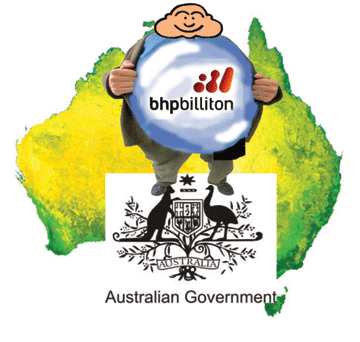
That would be unobjectionable except that the Indenture Act allows Olympic Dam wide-ranging exemptions from environmental, water management and Aboriginal Heritage laws and, for good measure, it curtails the application of the Freedom of Information Act.
SA Liberal Party industry spokesman Martin Hamilton-Smith said “every word of the (Indenture) agreement favours BHP, not South Australians”. It beggars belief the SA Labor Government would agree to such one-sided terms and that Mr Hamilton-Smith and his Liberal colleagues waved it through Parliament with no amendments. Continue reading
BHP Billiton’s open cut Olympic Dam copper/uranium project to be shelved indefinitely?
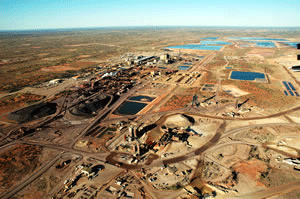 BHP (NYSE:BHP) Reports It Will Make Tighter Worldwide Copper Supply- USA Election News, 9 July 12 By: Jessica Honsinger BHP Billiton Limited (NYSE:BHP) reported on Friday that it will make tighter worldwide copper supply from late 2013 onward if it delays work on its single-biggest project, the $30 billion growth of the Olympic Dam mine in Australia.
A 25% decrease in benchmark international copper prices since early on 2011 has eroded possible returns from the project, and the economic delay in top base metal consumer China has dampened the demand
viewpoint. BHP’s system to quadruple output from Olympic Dam the fourth-biggest known copper deposit and biggest uranium source in the world is one a growing number experts consider probable to be shelved until markets
stabilize….. http://uselectionnews.org/bhp-nysebhp-reports-it-will-make-tighter-worldwide-copper-supply-bhp-pcx-vale-anr-aci/
Olympic Damn Uranium Mine: BHP’s disgraceful record, and contempt for Australian Aboriginal rights
BHP has shown similar contempt for taking responsibility for the impacts of its actions in Australia. The recently amended Indenture Act which will apply to the new mine continues to exempt BHP from the Aboriginal Heritage Act 1988, which applies elsewhere in the state.
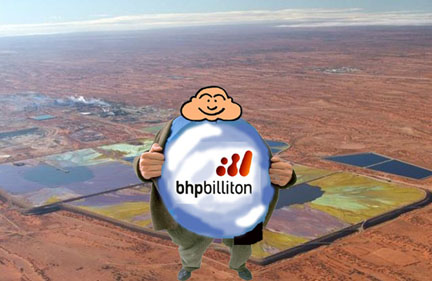
It is clearly a conflict of interest to have a corporation with a commercial interest in a piece of land also making decisions as to whether this same piece of land has competing non-commercial values.
Uncle Kevin Buzzacott is an Arabunna elder. Arabunna land lies North of the mine site. The borefields which extract water for the mine from the Great Artesian Basin are located on Arabunna land. The recent recognition of the Arabunna peoples long standing Native Title claim does not give the Arabunna people any rights to contest the location of the borefields. The GAB feeds the mound springs scattered throughout the Lake Eyre region. The springs are integral to the desert ecosystem and sacred to the Arabunna people. They have already been impacted by the water usage of the current mine.
by Nectaria Calan, 9 July 12, The Lizards Revenge was first announced on the 10th October 2011, coinciding with the State and Federal approvals of the Olympic Dam expansion. Since then, Rio + 20 in June this year has highlighted the failure of the concept of sustainable development and the failure of individual governments and the international community to genuinely address the ongoing environmental destruction that has become a feature of our age. Continue reading
Sydney hospitals’ dangerous dumping of radioactive materials
Toxic health dumping scandal, SMH, July 8, 2012 Natalie O’Brien The dangerous disposal of hazardous substances including liquid uranium and contaminated objects, the dumping of the confidential records of patients and the mishandling of asbestos have exposed a culture of mismanagement in Sydney hospitals. : http://www.smh.com.au/national/health/toxic-health-dumping-scandal-20120707-21nqp.html#ixzz204LVGURR
Another Ugly Australian Uranium Mine in a World Heritage Park
Tanzania gets U.N. nod for uranium mine in game park DAR ES SALAAM, July 5 (Reuters) – Tanzania has received U.N. approval for Australia-based miner Mantra Resources to build a $400 million uranium mine in a world heritage game reserve despite pressure from environmental groups opposed to the project, it said on Thursday.
Green groups have warned that toxic mining activities at the plant would harm the ecologically sensitive Selous Game Reserve in the east African country… http://af.reuters.com/article/tanzaniaNews/idAFL6E8I57YN20120705
Globe company mining rare earths, but sending them to China for processing
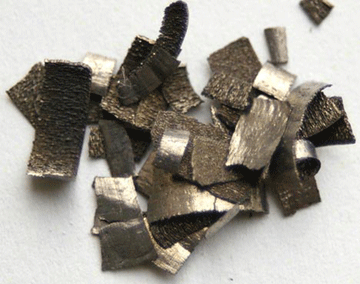 Globe tests waters with new rare earth spinoff Kate Emery | View Archive, The West, June 11, 2012, “……..Uranium had its pre-GFC day in the sun and, more recently, it was rare earths’ time to shine, with prices for the not-actually-so-rare metals soaring on the back of moves by China to restrict supply. Prices for the handful of Australian-listed rare earths players rocketed in response and investors were suddenly talking about the likes of scandium and yttrium.
Fast forward to mid-2012 and the heat has decidedly come out of rare earths stocks.
There’s no one reason for the fall, most likely a combination of the dramas encountered by Australia’s sole rare earths miner, Lynas Corp, at its Malaysian processing plant, global macroeconomic conditions and a realisation that the surge in prices is unsustainable.
Globe Metals and Mining knows something about how quickly investor sentiment can turn when it comes to commodity bubbles, having lived a past life as Globe Uranium….. Arafura has encountered its share of obstacles and, as with Lynas, they have been largely associated with the processing side of the business.
Globe hopes to sidestep that potential pitfall by establishing Mount Muambe as a mining-only operation, shipping the product to China for processing….. http://au.news.yahoo.com/thewest/opinion/post/-/blog/13920051/globe-tests-waters-with-new-rare-earth-spinoff/
 BHP buys more Olympic Dam licences Jun 27 2012 http://news.ninemsn.com.au/article.aspx?id=8490254 BHP Billiton has bought four exploration licences for areas in the Olympic Dam region in South Australia for $3 million.
BHP bought the licences, and five exploration licence applications, from mineral exploration company Copper Range, which had been reviewing its presence in the Olympic Dam region since the departure of a joint venture partner.
BHP is currently considering a massive expansion of its copper, gold and uranium mining operations at Olympic Dam.
Lynas rare earths plant in Malaysia to go ahead without plan for long term disposal of radioactive wastes?
 why are we talking about a storage facility in Malaysia when it was made clear that one of the prerequisite to the Temporary Operating License or TOL is that the waste be shipped back to Western Australia?
The Australian government reiterated that it will not accept responsibility for any waste material produced by Lynas, although one of the five conditions attached to the recent approval of its temporary operating license is that it must take full responsibility for waste management from its plant including returning the waste to the source, if necessary.
But in a media briefing, AELB director-general, Raja Abdul Aziz Raja Adnan, gave his assurance that the board would insist on a letter of undertaking from Lynas Australia that it would adhere to this condition.
TOL sell-out by PSC: The final smirk from Lynas Malaysia Chronicle, by Charles Santiago, 19 June 12, We welcome the report of the Parliamentary Select Committee which has produced its recommendations, including the upgrading of the standards used by the AELB. But while we appreciate the effort, this is clearly a document which has only looked at ways to keep the Lynas Advance Material Plant (LAMP) in operation.
The key area – returning the radioactive waste to Western Australia – has not been looked at although it was one of the earliest pre-conditions to the government granting Lynas a Temporary Operating License.
Violating pre-requisite to the Temporary Operating License (TOL) Over a ten-year period of the plant’s operation, the total volume of wastes will amount to 2,766,600 cubic metro. Over a 20-year period, as Lynas continues to enjoy its tax break, the waste would presumably have doubled. And it is highly inconceivable that there will be enough soil and technology available to “dilute” the wastes and remove its radiation level to natural ground level radiation.
This is especially crucial as Lynas plans to store the wastes onside in the Residue Storage Facility (RSF). Continue reading
No sign of a future for Jabiluka uranium mining
 No start on horizon for Jabiluka development, SMH, Peter Ker, June 21, 2012 Development of Australia’s most prospective and controversial uranium deposit, Jabiluka, is unlikely to happen in the next decade despite its leaseholder improving relations with local indigenous groups.
That’s the view of analysts visiting the Northern Territory operations of uranium miner Energy Resources of Australia this week.
ERA is currently hosting major investors on a tour of its mines and leases near Kakadu National Park, in a bid to promote its recent decision to spend $57 million on a ‘pre-feasibility’ study into turning its Ranger open cut mine into an underground operation.
But discussion of ERA’s future inevitably turns to Jabiluka, which has remained untapped for years out of respect for the wishes of the local indigenous Mirrar people…… ERA, which is majority owned by Rio Tinto, has been targeted by environmental groups who believe its proximity to Kakadu is inappropriate. http://www.smh.com.au/business/no-start-on-horizon-for-jabiluka-development-20120621-20pju.html#ixzz1yYEL25eI
Lynas’s rare earths stockpile near Fremantle – call for transparency in its radiation monitoring
 Rare earth stockpile radiation levels questioned ABC News, June 20, 2012 An MP is calling on the State Government to make radiation monitoring results public after revelations the Lynas Corporation has been stockpiling rare earth concentrate in Bibra Lake. The Member for Fremantle, Adele Carles, says the Government is yet to confirm whether
monitoring is being conducted.
The Environment Minister Bill Marmion has confirmed the containers have been held at Lynas’ holding yard since March…… Ms Carles says the Government is basically saying the material is perfectly safe. “I say to them, well, if it’s so safe, then release to us the radiation monitoring so that we can see that for ourselves,” she said.
Ms Carles says monitoring is required under a Radiation Management Plan. “That requires that if this material is stored anywhere for more than 24 hours, there must be radiation monitoring,” she said. “I’ve asked to get copies of this monitoring and the Minister has basically denied that information.” http://www.abc.net.au/news/2012-06-20/questions-over-rare-earth-stockpile/4081280?section=wa
ERA’s Ranger uranium mine continues to be a money pit
Ranger uranium miner ERA predicts loss of up to $60m, BY: BARRY FITZGERALD The Australian June 20, 2012 RANGER uranium miner Energy Resources of Australia has flagged a $50 million to $60m loss for the first half.
The forecast loss by the listed Rio Tinto subsidiary was made by the company in presentation notes filed with the ASX ahead of a two-day tour by analysts of the Northern Territory mine….
.. Earlier this month, ERA approved $57m for expenditure on a study into the potential of the Ranger 3 Deeps mine. A decision on its viability is due in late
2014.
recommendations for BHP Billiton’s planned new copper/uranium mine at Olympic Dam

 Olympic Dam / Roxby mine Recommendations 2012, by David Noonan, 18 June 2012:
Prevent South Australia becoming the Radioactive State by requiring BHP Billiton’s Olympic Dam / Roxby mine to:
- only trade in copper and other non-radioactive products;
- not export uranium or to sell proposed radioactive copper-uranium concentrates; and
- leave the uranium and all other radioactive waste at the mine site.
Repeal the Roxby Downs (Indenture Ratification) Act 1982 and the 2011 amendments to the Indenture to: remove the extraordinary legal privileges granted to BHP Billiton including the override of state legislation that would apply to any other mining venture or commercial activity.
Require BHP Billiton to commit to environmental protection measures to:
- dispose of radioactive tailings into the proposed new Roxby open pit and to rehabilitate the pit should it be constructed;
- prevent liquid radioactive waste leakage from tailings piles – including by required lining of the tailings piles;
- use renewable energy for the full electricity supply to the proposed new open pit mine, rather than the BHP Roxby mine plan for a jump of 12 percent in SA’s total greenhouse gas emissions, and to phase out use of fossil fuels for the electricity supply to the existing mine;
- stop extraction of Great Artesian Basin waters from Borefield A as soon as possible and to phase out rather than expand extraction of GAB waters from Borefield B;
- and commit to biodiversity projects that genuinely compensate for the loss of flora and fauna caused by the mine project, proposed new open pit and associated operations.
Protect the unique ecology of the Upper Spencer Gulf and the breeding ground of the Giant Australian Cuttlefish by: prohibiting the construction of a major desalination plant in this fragile region by BHP Billiton.
These Recommendations are based on my recent update of the relevant sections of the “2010 State Election Agenda for SA” (authored by CCSA, ACF, TWS and NCSSA) that I had a lead role in as then ACF national nuclear free campaigner.
All is not well with Australia’s uranium industry
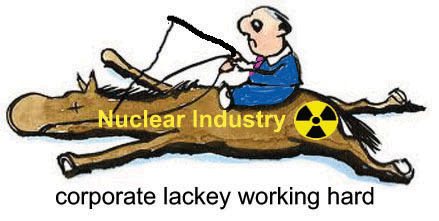 for all the hype, uranium accounts for a lousy 0.3% of Australian export revenue and a negligible 0.02% of Australian jobs. The industry’s future depends on the nuclear power “renaissance”, but global nuclear power capacity has been stagnant for the past 20 years.
The uranium price tanked after the Fukushima disaster and so far there is no sign of a bounce.
Australian uranium industry in trouble after Fukushima, June 2, 2012,Green Left, By Jim Green A protest walk from Wiluna to Perth took place last year against the proposed Wiluna uranium mine.
These are interesting times in the uranium sector. The mining companies have had a few wins in the 14 months since the Fukushima disaster, but they’ve had more losses.
Bill Repard, organiser of the Paydirt Uranium Conference held in Adelaide in February, put on a brave face with this claim: The sector’s hiccups in the wake of Fukushima are now over with, the global development of new nuclear power stations continues unabated, and the Australian sector has literally commenced a U-turn in every sense. Continue reading
Australian rare earths company Lynas backing out of its processing project in Africa
Lynas Likely To Give Up Rare Earths Project in Africa International Business Times, By Esther Tanquintic-Misa | June 14, 2012 With its highly-controversial Malaysian rare earths processing plant an already ample source of headache, Lynas Corp. has been reported to be likely backing out from another rare earths project, this time in Africa.
Citing unidentified industry sources, The West Australian reported that Lynas Corp. is thinking of shunning the Kangankunde rare earths project in Malawi after a Malawi High Court questioned the authenticity of the Australian miner’s ownership over the project…..
With the recent development, the Australian rare earths miner deemed it might be better to give up the African project altogether, than suffer again the same fate as with its highly controversial rare earths processing plant in Malaysia, The West Australian reported…. Lynas Corp. “is reassessing the project’s risks in the context of Malawi’s present governance and institutional frameworks,” sources told The West Australian. … http://au.ibtimes.com/articles/351984/20120614/lynas-corp-rare-earths-malawi-africa-malaysia.htm
1 This month

of the week – Australians for War Powers Reform (AWPR)
To see nuclear-related stories in greater depth and intensity
 Antinuclear