Warren Mundine – the nuclear industry’s Aboriginal puppet
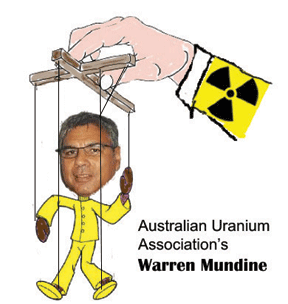 Mundine’s claim to support Aboriginal empowerment is contradicted by his consistent failure to speak out when mining and nuclear interests and governments that support those interests disempower Aboriginal people.
Warren Mundine’s nuclear allegiances. Online opinion, By Jim Green , 11 April 2012 Warren Mundine, a member and former National President of the ALP, and co-convener of the Australian Uranium Association’s Indigenous Dialogue Group, has been promoting the nuclear industry recently. Unfortunately he turns a blind eye to the industry’s crude racism, a problem that ought to be core business for the Indigenous Dialogue Group.
Mundine could have mentioned the legacy of uranium mining in the Wiluna region of WA; to pick one of many examples. Uranium exploration in the region in the 1980s left a legacy of pollution and contamination. Greatly elevated radiation levels have been recorded despite the area being ‘cleaned’ a decade ago. Even after the ‘clean up’, the site was left with rusting drums containing uranium ore. A sign reading “Danger − low level radiation ore exposed” was found lying face down in bushes. Continue reading
Australia’s uranium promoters working hard against the reality of falling profits
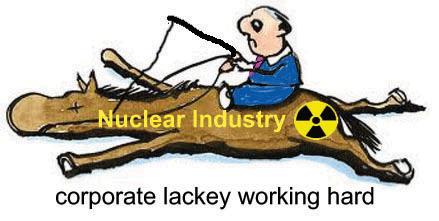 Uranium bulls have spent much of the past 12 months arguing there is a serious disconnect between the way the sharemarket and short-term investors view the outlook for uranium and the way long-term industry players (the CGNPCs and Rios of the world, for example) see it.
No sweeteners for yellowcake players, The West, Kate Emery April 11, 2012, A little over a year after the Fukushima nuclear disaster and despite endlessly positive outlook statements from the uranium industry, the fact remains it’s a still a tough time to be in the yellowcake business. Continue reading
Decline in Ranger uranium mine’s production, profit and morale – time to close it down
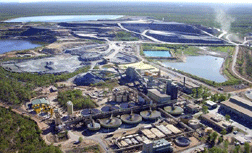 ERA tightens 2012 guidance, Colin Jacoby , 10 April 2012 …The uranium miner Energy Resources of Australia reported production of 612 tonnes of uranium oxide for the March quarter, down 41% from its December 2011 quarter production of 1030t.. The company was dogged by high rainfall at Ranger and access to high-grade ore was restricted due to the water level in the pit.
With ERA unable to access the high-grade ore located at the bottom of the pit, the ore milled during the quarter was sourced from stockpiled material. … the company said 2012 production remained highly dependent on the level of rainfall for the remainder of the year.
Kakadu uranium miner faces growing criticism. ACF, 11 April 12, Mining at the troubled Ranger uranium operation in Kakadu has been described as dirty, dangerous and desperate by the Environment Centre NT and the Australian Conservation Foundation. The groups have used Energy Resources of Australia annual meeting today in Darwin to re-affirm their concerns about uranium mining inside the World Heritage listed Kakadu National Park.
 ”ERA’s open cut mine has seen over 150 leaks, spills and breaches; radioactive exposure to workers; mismanagement of water and a mine shutdown that resulted in a $150 million dollar loss last year. The mine continues to pose ongoing environmental risk to Kakadu and the creation of more unwanted and poorly managed radioactive waste,” said Environment Centre NT campaigner Cat Beaton.
“Much of that waste is stored in an overloaded tailings dam that continues to leak over 100,000 litres of contaminated water a day.” Continued Ms Beaton.
In recent years ERA’s controversial Ranger mine has been plagued by declining production, morale and profit, with operations severely impacted by severe weather events. The company is attempting to reverse this decline by moving away from open cut mining in favour of underground mining.
“ERA’s fortunes are in systemic decline and will not be turned around by a tunnel to nowhere,” said ACF nuclear campaigner Dave Sweeney. “In the shadow of Fukushima – which we know was fuelled by Australian uranium – we need an open assessment of the costs and consequences of the uranium trade, not piecemeal approvals of short term projects that generate long term risks and problems”. “Uranium mining is unclean and unsafe, and this industry remains contaminating and contested”. Concluded Mr. Sweeney.
Malaysia insisting that Australia agrees to accept Lynas radioactive wastes
 ‘Onus is on Lynas to get nod for waste shipment’, The Malaysian Star Reports by MARTIN CARVALHO, YUEN MEIKENG, RAHIMY RAHIM and TASHNY SUKUMARAN , 29 March 12, THE onus of obtaining permission from the authorities to ship waste from the proposed rare earth plant in Gebeng, Pahang, to Australia lies with operators Lynas Corporation, said Science, Technology and Innovations Minister Datuk Seri Dr Maximux Ongkili.
“There has been no official word from the authorities in Australia over the shipment (of the waste) and I have not received any formal communication,” he said at Parliament lobby.
Though helping facilitate Lynas’ investment in setting up the plant here, he noted there were conditions that the company must fulfil with the onus on them to obtain approval for waste shipment to Australia if the need arose. “We are not here for the purpose of just helping Lynas. We have set conditions and they must follow,” he said.
The Atomic Energy Licensing Board’s (AELB) imposed five conditions for the issuance of a temporary operating licence for the Lynas plant which includes locating a suitable site for a permanent disposal facility. “If Lynas cannot process the wastes here according to our standard or cannot find a permanent disposal site, then they have to seek a site outside this country…..
“Otherwise, I am not giving the licence as they have signed for that,” Ongkili repeatedly said….. Ongkili said Lynas Corporation chose to have its rare earth plant in Malaysia because the cost to operate the facility here was 30% of that in Australia….. http://thestar.com.my/news/story.asp?file=/2012/3/28/parliament/11002216&sec=parliament
New South Wales Upper House passes uranium exploration legislation by 20 votes to 18
the Government had no mandate for uranium exploration……..Mr O’Farrell had declared to Parliament in August 2011 that the Government had no plans to allow uranium mining or exploration.
Uranium ban lifted by NSW Parliament, Herald Sun AAP March 28, 2012 LEGISLATION to repeal a ban on uranium exploration has passed through the NSW Parliament, with MPs in the state’s Upper House supporting it by 20 votes to 18. The legislation passed through the Legislative Council unamended today, despite opposition from Greens and Labor
MPs…
.. Separate legislation would be required to lift the NSW ban on uranium mining. Continue reading
Uranium exploration in New South Wales? – call for inquiry into govt OK to this
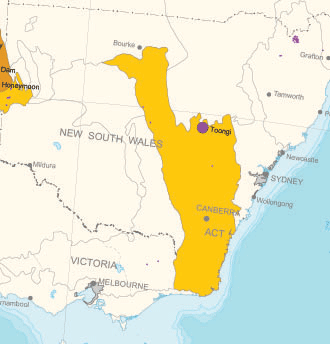 Since Premier O’Farrell announced his intention to open up uranium exploration in this state, thousands of people have signed a petition calling on the government to maintain the uranium ban.
Inquiry should probe O’Farrell’s okay to uranium search – ecology groups, Cowra Community News,
http://cowracommunitynews.com/viewnews.php?newsid=142&id=4 28 March 12, STATE and national environment groups have called for an independent public review into uranium mining in New South Wales as legislation to allow exploration is due to be debated in parliament today (Wednesday).
Premier Barry O’Farrell has no mandate to change a long-standing and popular policy banning uranium projects in the state, the Nature Conservation Council of NSW, the Australian Conservation Foundation and the Beyond Nuclear Initiative say in a joint statement. The groups have criticised the lifting of the ban on uranium exploration, urging the State Government to set up a public inquiry into the uranium industry. Continue reading
Australia has been warned of the earthquake danger to Olympic Dam uranium mine
 SEISMIC EXPERT: “MAGNITUDE 7 EARTHQUAKE RISK OBSCURED AT OLYMPIC DAM URANIUM MINE”, Coober Pedy Regional Times, 31 May 2010 “Was the Clark Shaft accident at the Olympic Dam mine preceded by a seismic event?”
A geophysicist who investigated earthquakes for the US Geological Survey for 22 years, says that the connection between mining and seismicity [earthquakes] is obscured in Australia, particularly the seismic hazard of the Olympic Dam mine.
In a communication [Memo] sent to various federal and state government ministers [and others] on Tuesday 22 May 2010, Seismologist Edward Cranswick discusses the 35-km-long, steeply dipping Mashers Fault which passes through the middle of the Olympic Dam ore body. A fault length which implies an earthquake of maximum about 7.
The same memo is available as a PDF
http://cranswick.net/Kalgoorlie/KalgoorlieEarthquakeOlympicDamMine.pdf
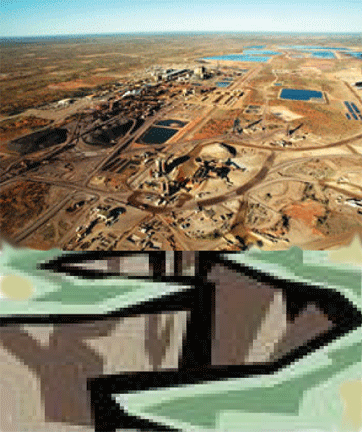
BHP Billiton has proposed to dig the largest open-pit mine on the Earth at Olympic Dam, 4.1 km long, 3.5 km wide, 1 km deep. As a geophysicist who investigated earthquakes for the US Geological Survey for 22 years [1], I strongly criticised BHP’s Olympic Dam Expansion Draft Environmental Impact Statement 2009 (ODXdEIS) [2] because it omitted consideration of seismicity, i.e., rockbursts or earthquakes, caused by open-pit mining, despite the fact that seismic hazard is well-known in the Australian mining industry …..
Traditionally, underground mines are deeper, and therefore, more seismically hazardous than shallow open pits, but the proposed pit at Olympic Dam will be as deep as the underground mine it replaces. Based on the dimensions of the open-pit, the results of McGarr et al. (2002) [19] suggest an earthquake of maximum magnitude 4-6 could occur.
The 35-km-long, steeply dipping Mashers Fault passes through the middle of the Olympic Dam ore body that is to be mined – that fault length implies an earthquake of maximum magnitude about 7…….
It is absurd – irrational, unscrupulously & tragically dishonest and unprofessional – that the ODXdEIS for the proposed largest open-pit mine on Earth does not address the principal hazard to digging that mine, triggered/induced seismicity and rockbursts…… http://cooberpedyregionaltimes.wordpress.com/2010/05/31/seismic-expert-magnitude-7-earthquake-risk-obscured-at-olympic-dam-uranium-mine/
Toro Energy’s uranium project in Western Australia may or may not be a goer
Toro uranium project faces feasibility study http://www.abc.net.au/news/2012-03-22/toro-uranium-project-faces-feasibility-study/3906292 ABC News, March 22, 2012 Toro Energy has contracted an Australian engineering company to conduct a feasibility study into its uranium project near Wiluna in northern Western Australia.
The study by Bateman Australia will determine the operating costs and capital needed to mine uranium to sell to overseas customers. Toro Energy is still seeking federal and State Government approval to begin operations at the site where it hopes to mine up to 800 tonnes of uranium oxide concentrate per year. The feasibility study is expected to be completed by September, while Toro Energy hopes to begin selling uranium in 2014.
Comparing conditions for Lynas’ radioactive waste: Australia or Malaysia
 Let’s de-politicise the Lynas issue — Stop Lynas Coalition, The Malaysian Insider March 21, 2012 “…….Lynas loves to boast that their project is approved in Australia also. Given Australia’s high environmental standard, if it is approved in Australia, why would Malaysians reject it? However, Lynas hid from the public that the Australian proposal was approved under extremely stringent conditions.
The table shows the conditions under the Australian proposal [6] compared to LAMP.
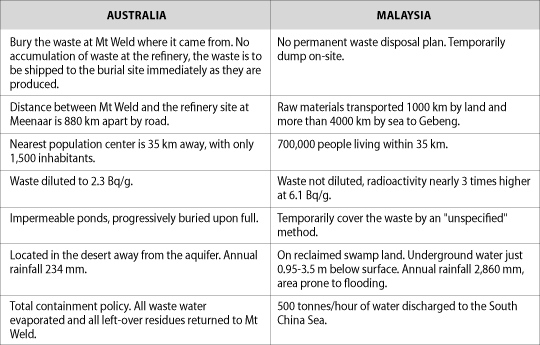
Regardless of what justification the government gives, any person of general intellect can deduce that LAMP is shifted to our shores because Lynas wants to dump its waste here. How can our government inflict such indignity on the very people it is elected to protect?…
[6] “Proposed rare earths mining and beneficiation at Mt Weld, Laverton and secondary processing at Meenaar, near Northm”, Ashton Rare Earths Ltd, August 1992. http://www.themalaysianinsider.com/sideviews/article/lets-de-politicise-the-lynas-issue-stop-lynas-coalition
BHP won’t pay a cent of Mineral Resources Rent Tax from Olympic Dam uranium mine profits
 March 16, 2012 With copper, uranium, gold and silver not covered by the Mineral Resources Rent Tax, profits from biggest hole in the ground ever dug on the face of this planet, the Olympic Dam mine, will be excluded the Greens said.Greens Senator forSouth Australia, Senator Penny Wright, told the Senate last night, that while the tax was a first step towards more efficient taxation of the benefits of the mining boom, not a single cent derived from the Minerals Resources Rent Tax (MRRT) would come from the Olympic Dam mine.
“Olympic Dam is one of our largest mines and is expected to raise billions of dollars of profits from the copper, uranium, gold and silver mined there – yet not one of these minerals will be included in the MRRT,” Senator Wright said.
“The owners of this massive hole, BHP Billiton, are smiling all the way to the bank. Their deal with the South Australian Government locks in pitifully low royalty rates for 45 years, with no guarantees of one extra job in the state, and the government footing the bill for infrastructure. And Australians will not receive a cent from the mine under the MRRT.
“The net economic return toSouth Australiain years 10-20 of the project could be as low as $10m per year and that is even before millions are given back to BHP Billiton through federal subsidies like the diesel fuel rebate.
“But the real losers of this deal are our children and grandchildren – we are giving their resources away for a pittance while at the same time leaving them to deal with the enormous toxic legacy of managing the world’s largest radioactive waste dump.
“The Greens will ultimately support this tax, because in this case, something is better than nothing. But there is no doubt that this taxation regime needs to be strengthened so we can all get a fair return for our shared mineral wealth and invest it in things that will benefit all Australians like Denticare, the NDIS and quality public education.”
Is rare earths company Lynas planning to return radioactive wastes to Australia?
“Where exactly is ‘abroad’? Identify and prove to us which country outside of Malaysia is willing to accept this massive [volume of] toxic waste.
 AELB says will close Lynas plant if waste agreement broken http://www.themalaysianinsider.com/malaysia/article/aelb-says-will-close-lynas-plant-if-waste-agreement-broken The Malaysian Insider, March 15, 2012 KUALA LUMPUR, The Atomic Energy Licensing Board (AELB) assured Malaysians today it will shutter Lynas Corporation’s rare earth plant in Kuantan if the Australian mining firm violates conditions on the disposal of radioactive material.
According to Star Online, the regulator reminded at its weekly media briefing today that that firm had already struck an agreement with local authorities here for it to return any radioactive waste to Australia if it fails to set up a permanent disposal facility here. Continue reading
Anti nuclear rallies across Australia on 11th March
 Australian Rallies Remember Fukushima Disaster, Voice of America, Phil Mercer 11 March, Sydney Hundreds of anti-nuclear demonstrators have converged on the Australian headquarters of global mining giants BHP Billiton and Rio Tinto to
mark one year since Japan’s nuclear crisis. The 500-strong march Sunday through southern Melbourne called for an end to uranium mining in Australia.
Rallies have been held across Australia to mark the first anniversary of the Fukushima nuclear disaster. The rallies are also part of a national day of action to end uranium mining in Australia. There were events in Sydney, and in Melbourne a protest included
speeches and performances by representatives of the expatriate Japanese community as well as Australia’s Indigenous communities, who are worried about the effects of mining near tribal lands.
There was a minute’s silence for the victims of Japan’s devastating earthquake, tsunami and nuclear catastrophe. The rally was followed by a march past the headquarters of Australia’s largest uranium miners, BHP Billiton and Rio Tinto.
The Australian Conservation Foundation is demanding an independent review of the costs and consequences of Australia’s uranium trade and insists that the nuclear power industry has lost public confidence and credibility following the Fukushima disaster. Foundation spokesman Dave Sweeney says Australia must abandon its exports of uranium.
“We have 40 per cent of the world’s uranium in Australia. We supply 20 per cent of the global market and this is the basic fuel for nuclear power, it is the basic fuel for nuclear weapons,” he said. “On a good day it becomes high-level radioactive waste and on a bad day it become Fukushima fallout and I think the question for Australia is do we want to continue to do that?”…….
http://www.voanews.com/english/news/asia/east-pacific/Australian-Rallies-Remember-Fukushima-Disaster-142242575.html
Grandiose tower for grandiose BHP and its biggest uranium mine in the world
 discussions between major developers and BHP about a new $250m office tower in Currie Street, for which the company would have naming rights….
BHP plans office tower linked to Olympic Dam expansion, BY:MICHAEL OWEN:The Australian March 09, 2012 BHP Billiton is looking at teaming with a major developer to build a new office tower in Adelaide ahead of the planned expansion of its Olympic Dam mine in the far north of South Australia.
It is understood BHP is in talks with several developers and construction companies about a new office tower that could be worth up to $250 million.
The high-rise development, potentially slated for Currie Street, in Adelaide’s CBD, would provide the company with a significant visible presence as it launches a mammoth project with an estimated mine life of more than 100 years. Continue reading
Doubts over whether or not BHP’s new big Olympic Dam uranium mine will go ahead

 Reuters report on mining conference in Canada Mar 6, 2012 By Euan Rocha TORONTO, March 6 – The Anglo-Australia mining giant, which already operates an underground mine at the site, has yet to sign off on the budget for
the open pit…. but BHP may opt to delay taking on the heavy financial burden that could easily be in the $10 billion to $20 billion range…..
…. PDAC, the mining industry’s largest annual gathering. The convention, organized by the Prospectors and Developers Association of Canada, opened in Toronto on Sunday.
Even though Olympic Dam, located 550 km (345 miles) north of Adelaide, is one of BHP’s biggest growth prospects, the cost of
digging the massive pit may prove prohibitive.
Last month the company reported a profit decline, and it struck a cautious tone on its expectations for growth in China, one of its
biggest markets. That has led some to speculate that the miner may delay spending on capital-intensive projects such as Olympic Dam and the Jansen potash project in the Canadian province of Saskatchewan.
In late 2011, BHP finalized state approvals to begin construction work on the open-pit phase of the Olympic Dam project, but the agreement would lapse around December if BHP delays its decision on proceeding.
“We want to see a board decision before the end of the year about substantial works beginning. If not, the approvals run out and BHP know this,” said Tom Koutsantonis, minister for mineral resources and energy for the state of South Australia.” I’m not in the business, and no government should be in the business, of allowing anyone to have massive tenements that they don’t develop …”-
A spokesman for BHP declined to comment on the remarks.
MASSIVE SCALE The sheer scale of the open-pit project is formidable. BHP will have to shovel rock for five to seven years before it reaches the Olympic Dam ore body, discovered in the mid-1970s…..
http://www.reuters.com/article/2012/03/06/canada-mining-pdac-olympicdam-idUSL2E8E60E220120306
Lynas moved its rare earths processing to Malaysia because of Malaysia’s less stringent laws
 ANAWA and EDO strongly believed that Lynas had chosen to move its operations to Malaysia because of the heavy metals and radioactive waste involved in the processing. “We believe Lynas picked Malaysia to save money and enable it to operate under less stringent laws,”
“The biggest concerns about the processing are the storage and waste management issues which are made more difficult in Gebeng which we understand to be wetlands.”
“There is no way it could operate the way it is in Malaysia over here,” he said. “Australia’s laws are much more stringent.”
 Aussie NGO: Gebeng not part of Lynas’ blueprint, Free Malaysia Today News, Stephanie Sta Maria | March 6, 2012 Anti Nuclear Alliance of Western Australia (ANAWA) claims that Lynas’ massive changes to its plan has resulted in its plant being built in Gebeng where laws are looser and labour is cheaper. PETALING JAYA: The Anti-Nuclear Alliance of Western Australia (ANAWA) has revealed that Lynas Corporation Ltd was supposed to build its plant in Western Australia and not Malaysia.
According to ANAWA, Lynas’ 14-year-old blueprint indicated that the Australian mining giant had orginally planned to build its processing plant in Meenar a decade ago. But until today there had been no signs of any development on the intended site.
ANAWA spokesperson Marcus Atkinson told FMT that the orginal approvals were given by the Environmental Protection Authority (EPA) for Lynas to ship rare earth to buyers and confirmed that he had viewed these relevant documents firsthand.
However, he said that Lynas had since made numerous alterations to its operations to the point that its rare earth refinery had now landed in Malaysia. “Instead of transporting processed rare earth, it is now shipping a concentrate which contains thorium and other radioactive material with more heavy metals,” he told FMT. Continue reading
1 This month

of the week – Australians for War Powers Reform (AWPR)
To see nuclear-related stories in greater depth and intensity
 Antinuclear