Malaysia considering sending Lynas’ radioactive waste back to Western Australia

 No decision yet on sending Lynas waste to Western Australia The Star, Malaysia, KUALA LUMPUR, 7 March 12, : The Cabinet has not decided on a proposal asking Lynas Corp rare earth waste material to be sent back to Western Australia, said Green Technology, Energy and Water Minister Datuk Seri Peter Chin.
He said Western Australian Minister for Mines and Petroleum Norman Moore was entitled to his view that Australia would not accept responsibility for any waste produced by Lynas Malaysia Sdn Bhd. “Our Cabinet has not made a decision on the matter. Wait for it to be announced,” he said after the launch of the National Energy Security Conference 2012 yesterday.
Moore told the Australian parliament that the Western Australian government does not support the import and storage of other countries’ radioactive waste.
PKR MP Fuziah Salleh had proposed that the rare earth waste material for Lynas be returned to Australia. ….
http://thestar.com.my/news/story.asp?file=/2012/2/29/nation/10825847&sec=nation
Olympic Dam uranium mine at risk from earthquakes
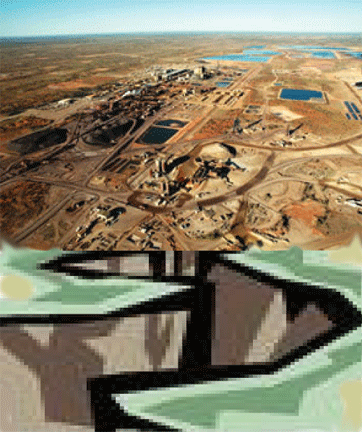 from our Seismology Watcher, 28 feb 12, Australian Yet another timely warning for Quarry Australia following seismologist, Edward Cranswick’s peer-reviewed paper on the 35-km-long, steeply dipping Mashers Fault which passes through the middle of the Olympic Dam ore body. The fault length implies an earthquake of maximum about 7.
An observation by Cranswick is that censoring of Australian lists of earthquakes and their corresponding source parameters, (i.e., time, location, depth, magnitude) has taken place.
Cranswick, who investigated earthquakes for the US Geological Survey for 22 years, suggests that the connection between mining and sesmicity (earthquakes) is obscured in Australia particularly the seismic hazard of the OD project in SA. Seemingly, BHP’s proposed expansion and potential radioactive fall-out at the Olympic Dam project in the event of a “natural” catastrophe reveals scant regard for public health and safety. However, there is nothing like an outraged Momma Nature (whose **se is being chewed by the mining industry) to make an ecocidal event, a grim reality.
Cranswick also makes reference to the Barrick/Newmont super pit and its connection to the unprecedented 5.2 magnitude earthquake that occurred in the stable continental region of Kalgoorlie/Boulder in April 2010. And what a pitiful mess that made of the historic buildings in the main street of Boulder which is about a kilometre from the super pit.
En garde my fellow Australians, asleep at the wheel.
Australian Greens call for uranium to be included in the Mineral Resources Rent Tax (MRRT)
 Renewed calls for MRRT to include gold, uranium Mining Weekly, By: Esmarie Swanepoel 23rd February 2012 PERTH – The Australian Green Party has renewed calls to the federal government to include gold and uranium in the mineral resources rent tax (MRRT), in an effort to garner more revenue.
Greens leader Bob Brown said on Thursday that the Treasury needed to reconsider extending the mining tax across gold and uranium, as well as other minerals, while the nexus with royalties should be dropped.
“Australia has the means to adequately fund education, health, transport. It should not have a watered-down mining tax pass into law that fails to collect potential funding sourced from resources that
belong to the nation,” Brown said….
Anti-Nuclear Alliance of Western Australia appealing to EPA about Lynas rare earths and radiation
 ANAWA is currently working with the Environmental Defenders Office (EDO) to lodge a referral to the EPA regarding the Lynas operations at Mt Weld and their mining of rare earths. Lynas has made a number of changes to their procedures, which have not gone through the appropriate approvals and they are currently operating under approvals given to them 14 years ago.
There are major concerns about the amounts of this radioactive substance being transported from Mt Weld to the ports of Fremantle and health & safety issues for those involved in handling the material that will be exported to their controversial processing plant in Malaysia. ANAWA will be going to the EPA with the EDO lawyer Josie Walker on Tuesday the 28th of February at 10.30 am.
Malaysians asking questions about Lynas’ rare earths and radioactive wastes
 The Lynas Advanced Material project will produce 20,000 tones of radioactive waste, which is 10 times more than the Asian Rare Earth factory in Bukit Merah.
1. Why didn’t Lynas set-up the rare earth plant near its source of extraction in Western Australia as it would have saved a huge amount of money in shipping costs?
2. Why didn’t Lynas obtain an approval from the authorities in Western Australia to set-up the plant?
3. Could the authorities in Western Australia be concerned about the possible radiation leaks, health hazards, birth defects, lead poisoning and other complications?
4. Shouldn’t this in itself raise a red flag with the Malaysian authorities?
Gov’t fails to learn from Bkt Merah tragedy http://www.freemalaysiatoday.com/2012/02/22/govt-fails-to-learn-from-bkt-merah-tragedy/ Free Malaysia Today February 22, 2012 Is the RM700 million in Lynas investment more important to the government than the lives of its citizens? By Charles Santiago Severe birth defects, eight leukemia cases over five years in a community of 11,000, tears and anguish of the poor people from a largely shoe-making community – these are not news headlines. Neither is it the plot of a movie.
These are the consequences of carelessly allowing the Asian Rare Earth factory to be built in Bukit Merah, Perak in 1982. When Mitsubishi Chemical started operating its rare earth factory, the villagers complained of choking sensation, pungent smell, coughs and colds. The community also saw a sharp rise in the cases of infant deaths, congenital disease, leukemia and lead poisoning. While US$100 million is estimated to be the clean-up cost of the factory and dump site, the
largest in the rare earth industry, it has not wiped out the memories and heartache of the villagers who lost their children and loved ones.
But 30 years later, the government has again allowed a rare earth factory to be set-up by Lynas Corporation Ltd in Gebeng, Kuantan. This means the government has waved the green flag with full knowledge of
the possible consequences and deadly effects. Continue reading
Melting permafrost leads Australian uranium company to exploit Greenland
 Asian, European Firms Circle Greenland Mining Project, WSJ, By Robb M. Stewart, FEBRUARY 22, 2012, In one of the world’s coldest climates, competition to develop a future source of uranium and rare earths is heating up…. The impact of climate change has made mining in Greenland easier by melting permafrost, while the island’s growing autonomy from Denmark has enabled officials to award more exploration licenses….
The government of Greenland late last year amended the Perth-based Greenland Minerals & Energy company’s exploration license to include uranium, the first such permit for the nuclear fuel on the island. According to John Mair, the company’s executive director of business development, an attractive option as a strategic partner would be a consortium interested in rare earths as well as uranium…. http://blogs.wsj.com/dealjournalaustralia/2012/02/21/asian-european-firms-circle-greenland-mining-project/
Aboriginal elder takes legal action against new Olympic Dam uranium mine
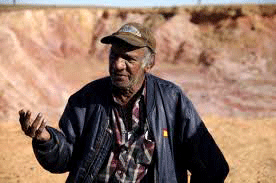 ‘Tiny voice’ of elder takes on Olympic Dam BY: SARAH MARTIN, SA POLITICAL REPORTER The Australian February 22, 2012 BHP Billiton’s proposed $20 billion Olympic Dam mine expansion, to create the world’s largest open-cut mine, will be challenged in the Federal Court after an application was lodged by Aboriginal elder Kevin Buzzacott.
Mr Buzzacott, who is known as Uncle Kevin, is being represented by the Adelaide-based Environmental Defenders Office. The office claims the mine expansion has been approved unlawfully under the Environment Protection and Biodiversity Conservation Act by federal Environment Minister Tony  Burke.
Among the claims are that much of the environmental assessment and decision-making was based on plans and studies that have not yet been prepared and that the minister did not properly consider impacts from the above-ground storage of radioactive tailings waste, the export of uranium and on groundwater resources, including the Great Artesian Basin.
Mr Buzzacott, an elder from Arabunna land in South Australia’s remote north, is known for his anti-uranium campaigning, and in 2007 was awarded an Australian Conservation Foundation award recognising his protest work. The EDO filed an application on his behalf in the Federal Court yesterday, saying his “tiny voice” was prepared to take on the giant……
http://www.theaustralian.com.au/national-affairs/state-politics/tiny-voice-of-elder-takes-on-olympic-dam/story-e6frgczx-1226277611443
South Australian government framed laws for BHP Billiton’s uranium mining, not for the people
 Commercial vested interests of uranium mining companies are writing the script for Australia’s uranium sales deals under both Liberal and now ALP federal governments…….
South Australia should come to its senses and recognise our society’s responsibilities to get out of the uranium trade and not be made complicit in nuclear risks for BHP Billiton’s vested interests.
Our uranium fuelled Fukushima, David Noonan, The Guardian, 22 Feb 12 “……..How did the SA government perform in exercising their responsibilities after Fukushima? Indigenous people bear a disproportionate burden of impacts from uranium mining and this will certainly continue to be the case in SA
under the Roxby Indenture deal “negotiated” by the state with BHP Billiton that is being pushed through Parliament with bi-partisan support.
BHP Billiton is not bound by the Aboriginal Heritage Act 1988 in the “Stuart Shelf Area” of some 1.5 percent of the area of SA around the Olympic Dam mine.
Aboriginal heritage obligations that apply to every other miner or developer do not apply to the Big Australian for the 70-year extended period of the Roxby Indenture, and the state further agreed that this can only be changed in future with the agreement of the company. Continue reading
Australian uranium mining companies ripping off African countries?
IGF’s views follow remarks by Reserve Bank of Malawi Governor Perks Ligoya last December during which he protested the generous allowances the Malawi government provided to Australia’s Paladin Energy in the Kayelekera uranium mining deal in Karonga.
 Mining deals worry industry grouping The Daily Times, 21 February 2012 Isaac Masingati An international mining industry grouping, Intergovernmental Forum on Mining, Minerals, Metals and Sustainable Development (IGF), says it is concerned with contracts between investors and governments especially in developing countries, saying they tend to be skewed in favour the investor.
IGF President Leonard Kalindekafe told the Business Times in Zomba on Friday that there was a concern among members of the grouping that some investors were taking advantage of governments’ lack of expertise to strike deals that bring little profits. “This is a big concern to the Forum because some bona fide countries are not able to realise full benefits from their minerals,” he said. Continue reading
Look out, New South Wales, the uranium economic downward plunge beckons!
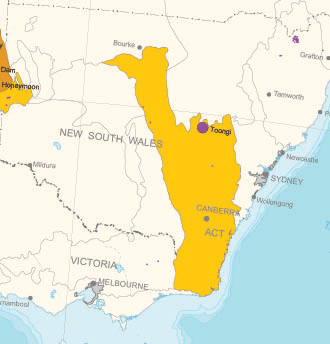
Look out – New South Wales residents! You thought coal seam gas exploration was a threat? And it probably is.
But now, your government, in its unwisdom, is going to allow uranium exploration.
The yellow area shows the area of uranium mineralisation in New South Wales.
Very handy, I suppose, to where some of Ziggy Switkowski’s 50 nuclear reactors will supposedly be positioned.
South Australia is going to go down the economic drain, for its drive for all things nuclear. Meanwhile, what with Paladin Uranium looking like going broke, and the nuclear industry winding down, – Does New South Wales want to join this plunge? – Christina Macpherson
GOVERNMENT TAKES STEP TOWARDS URANIUM MINING Lee Jeloscek, 7 News Sydney February 14, A map drawn up by the government and reported on by 7News shows a large swath of land from north western town of Bourke stretching down past Canberra to the Victorian border could be explored for the resource. http://au.news.yahoo.com/nsw/latest/a/-/newshome/12905605/government-takes-step-towards-uranium-mining/

Australian uranium mining company makes dramatic loss, and share price fall
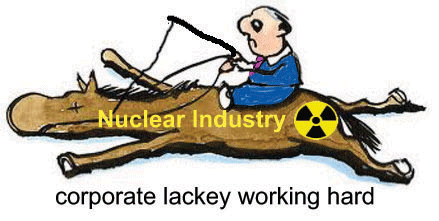 Paladin’s annus horribilis worsens, The Age, Peter Ker February 15, 2012 URANIUM miner Paladin Energy has managed to underwhelm the market yet again, despite the worst aspects of yesterday’s $US120.2 million loss being known for several months.
Investors wiped more than 5 per cent off the value of the stock … The loss was largely due to a $US133 million write-down on the value of Paladin’s Kayelekera mine in Malawi. Paladin revealed the write-down to the market late last year. …
the market was not impressed. Analysts at Goldman Sachs said the result was worse than expected, and by the close of trading 10¢ had been shaved off Paladin’s share price, taking it to $1.70 – dramatically lower than the $5.40 it was fetching less than a year
ago.
Some of the negativity appeared to be linked to ballooning expenses, despite chief executive John Borshoff cutting his own pay by 25 per cent and reducing exploration in an effort to rein in costs.
From $US31 a pound in the first half of 2010, Paladin’s costs rose to $US34 a pound in the six months to December 31, and costs at the Kayelekera mine were as high as $US46 a pound in the final quarter of last year. http://www.theage.com.au/business/paladins-annus-horribilis-worsens-20120214-1t45b.html#ixzz1mVWU3qJN
Responses to New South Wales government new policy on uranium mining
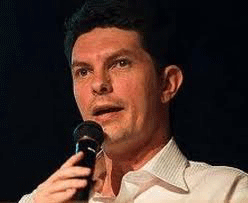 O’Farrell’s 180 degrees on uranium a toxic turn,Senator Scott Ludlam, February 14th, 2012. The New South Wales Government appears poised to commit a random act of colossal stupidity, following reports that the NSW Cabinet will move to overturn the state’s 26-year uranium ban. Greens spokesperson on nuclear affairs Senator Scott Ludlam said Premier Barry O’Farrell should stick to the position he held before being lobbied by the uranium industry and Federal ALP minister Martin Ferguson.
“In August 2011 it was revealed that resources minister and nuclear fanatic Martin Ferguson had urged Premier O’Farrell to lift the ban and the Australian Uranium Association had lobbied state resources and energy minister Chris Hartcher to do their dirty work. Asked in parliament if the government was considering lifting the ban, the Premier said no.”
“Uranium mining in the Northern Territory has a long and sorry history. More than forty years after Rum Jungle’s closure, the Federal Government recently committed eight million dollars over four years just for an attempt to figure out how to clean up the mess.
“Australian uranium was used in every reactor at Fukushima. Why would the O’Farrell Government want New South Wales to be complicit in the next disaster?”
Nuke South Wales? Uranium plan is unsafe and unwelcome, Dave Sweeney, AUSTRALIAN CONSERVATION FOUNDATION 15 February 2012 State government plans to open the door to the uranium mining in NSW are ill-considered and out of step with community opinion, the Australian Conservation Foundation said today.
“Premier Barry O’Farrell has not taken his uranium u-turn to the NSW community, because he knows it would be deeply unpopular,” said ACF nuclear free campaigner Dave Sweeney. “The uranium industry is unsafe, unclean and unwelcome in NSW. “For the NSW government to open the door to uranium mining now is like taking up smoking at thirty: it would bring high risk, little joy and it’s completely unnecessary.”
The last independent assessment of the Australian uranium industry – a 2003 Senate Inquiry – found the sector is characterised by underperformance and non-compliance, an absence of reliable data to measure the extent of contamination or its impact on the environment and an operational culture that gives greater weight to short term considerations than long term environmental protection.
The Senate report concluded that the uranium industry in Australia had to change to protect the environment and its inhabitants from ‘serious or irreversible damage’. “In the shadow of the first anniversary of the continuing Fukushima nuclear crisis – which was fuelled by Australian uranium – we need to move away from this controversial and contaminating industry, not open the door to more environmental and community threat,” Dave Sweeney said. “The Premier lacks a mandate to mine. This poorly considered policy reversal will be actively contested.”
NSW’s peak environment group condemns Government green light for toxic impacts of uranium mining February 15th 2012 The state’s peak environment group, the Nature Conservation Council of NSW, has strongly condemned Premier O’Farrell’s decision to overturn a 26‐year ban on uranium exploration in NSW.
“The O’Farrell government’s uranium exploration proposal leaves our local communities and our environment exposed to serious pollution risks and a persistent legacy of toxic waste,” Chief Executive Officer Pepe Clarke said today.
“Uranium mining consumes enormous volumes of water, contaminates groundwater and leaves behind a
legacy of radioactive mine waste, placing workers, local communities and the environment at risk.
“Less than one year after the tragic nuclear accident at Fukushima in Japan, it is incomprehensible that the O’Farrell government is planning to overturn a 26‐year ban on this dangerous, polluting industry…. http://www.nccnsw.org.au/media/nsw%E2%80%99s-peak-environment-group-condemns-government-green-light-toxic-impacts-uranium-industry
NSW people don’t want the uranium industry
Opposition lashes O’Farrell’s plan to overturn NSW ban on uranium exploration, THE AUSTRALIAN, AAP, February 15, 2012 THE NSW opposition has criticised a plan to overturn the state’s decades-old ban on uranium exploration….. Opposition Leader John Robertson said voters don’t support the industry. “The people of NSW didn’t vote for it and they don’t want it,” he said in a statement. “Only months ago the Premier categorically ruled out uranium mining and exploration in NSW – now it is on for young and old.”
Greenpeace campaigner Julien Vincent called the expected announcement an “insult”….. “Next month we are marking the first anniversary of nuclear disaster in Fukushima, which is one of the best reasons for not going nuclear,” he added.
Australian Greens nuclear affairs spokesperson Senator Scott Ludlam added: “Australian uranium was used in every reactor at Fukushima. “Why would the O’Farrell government want New South Wales to be complicit in the next disaster?”
 Uranium mining is banned in Queensland but allowed in Western Australia and South Australia.
… Just days before that vote Australian Workers’ Union secretary Paul Howes called on states that don’t allow uranium mining to overturn their bans. http://www.theaustralian.com.au/national-affairs/opposition-lashes-ofarrells-plan-to-overturn-nsw-ban-on-uranium-exploration/story-fn59niix-122
‘Shonky fast-tracked approval’ for Australian company’s rare earths plant in Malaysia
Ire over Lynas ‘sham’ plant consultation, SMH, Vince Chadwick February 13, 2012 Groups opposed to a rare-earths refinement plant in Malaysia plan to appeal against the atomic regulator’s decision to grant Australian miner Lynas a temporary operating licence…
.. Ms Tansaid two separate appeals would be launched this week, one by locals in Kuantan and another in Kuala Lumpur. She said objections would centre on the ”shonky, fast-tracked approval process” in which the licensing board temporarily approved the plant less than a week after public consultations closed.
The president of the Malaysian Bar association, Lim Chee Wee, said last week, ”it beggars belief that [the licensing board] could have adequately and properly considered the 1123 public comments within merely two working days.
”The only natural conclusion is that the whole public consultation process is a sham and charade, ” he said…..
Lynas expects to begin refining rare earths shipped from its $100 million mine in Mount Weld, Western Australia, by the second quarter of this year. It hopes to recycle some waste to make building materials or fertiliser. In the case of iron phosphate gypsum, for which there are no commercial applications, the company said it can store waste safely
for up to 17 years.
Mr Lim said ”the granting of a 10-month period for Lynas to provide the plan and location of the [permanent disposal facility] borders on recklessness: by then, even if the terms of the licence remain unfulfilled and the licence is suspended or cancelled, substantial amounts of radioactive wastes would have been produced”…..
Ms Tan said the ecologically sensitive area near mangroves meant toxic runoff into the South China Sea could affect local fisherman. http://www.smh.com.au/business/ire-over-lynas-sham-plant-consultation-20120212-1sznp.html#ixzz1mIqXT47j
Toro Energy sells out of uneconomic Mt Woods uranium project
Toro Energy: shareholders accept termination terms for Mt Woods uranium project Proactive Investors, , February 14, 2012 by John Phillips Toro Energy (ASX: TOE) has updated the market on the Mt Woods uranium project.
Toro said that shareholders have voted to accept the terms of a termination agreement for the company’s involvement in the Mount Woods uranium project in South Australia….. OZ Minerals has conducted major exploration programs at Mt Woods and, despite extensive drilling campaigns, no potentially economic uranium results have been reported
from the project.
1 This month

of the week – Australians for War Powers Reform (AWPR)
To see nuclear-related stories in greater depth and intensity
 Antinuclear