Still no radiation registering of Northern Territory’s uranium workers
 NT URANIUM WORKERS STILL NOT ON NATIONAL REGISTER, GREENS SAY, Safe To Work, By Cole Latimer 20 October 2011 Uranium miners in the Northern Territory are still not on the National Radiation Dose Register, Greens senator Scott Ludlam says. It comes five months after Ludlam originally brought the issue to bear in May, with Ludlam today again quizzing representatives from the Australian Radiation Protection and Nuclear Safety Agency on this issue.
“In July 2010 the register began collecting data on the radiation doses to which workers had been exposed. There are now over 18,000 workers on the database – covering about five years – but there is no information at all on the radiation workers have been exposed to at the Ranger Mine in the Northern Territory. We revealed this in May, and urged the Territory and Federal authorities to address it. ARPANSA told us today that nothing has changed, and to raise the issue with the office of energy and resources minister Martin Ferguson,” Ludlam said in a recent statement.
“We will write to Northern Territory Chief Minister Paul Henderson to encourage urgent action to fix this problem.” The national register was created as a central database to track radiation dose histories of miners….. Under this new development, information on radiation doses will be sent to a central register, where miners can then access their personal records.
“Excluding work in the Northern Territory is a huge crack in the system, and it was revealed five months ago and NT uranium mine workers are still off the radiation dose radar. The system will only have integrity if all radiation doses are included,” Ludlam says….. http://www.safetowork.com.au/news/nt-uranium-workers-still-not-on-national-register
Hindrances in South Australian Parliament to BHP BIlliton’s plan for monster uranium mine
 Greens call for inquiry into Olympic Dam expansion, SMH Peter KerOctober 18, 2011 APPROVAL for BHP Billiton’s massive Olympic Dam expansion may not proceed as quickly as the global miner would like, with minor parties in the South Australian parliament seeking to slow the process by attempting to force the company to front a parliamentary inquiry.
The indenture agreement struck by BHP and the SA Government for Olympic Dam will be introduced to the state’s parliament today or tomorrow, and must be approved by both chambers to have any legal power.
The Premier Mike Rann – who will retire on Friday – wants Parliament to approve the bill as soon as possible, and BHP has promised to start spending up to $US1.2 billion as soon as the bill secures passage through the Parliament.
But Mr Rann’s Labor Party does not control the upper house of Parliament, where a group of seven minor party MP’s have the balance of power. Two of those MPs represent the Greens Party, and Greens leader Mark Parnell said the agreement was so important to South Australia’s future it must be fully analysed by a select committee with powers to call and question BHP executives.
Mr Parnell said the delay should pose no problem given BHP does not expect to take a final investment decision until mid 2012. ”What is the point of the SA Parliament cutting corners and rushing this through when the company isn’t going to decide until the middle of next year anyway,” he said.
Mr Parnell wants to quiz BHP over why more processing of Olympic Dam’s copper, uranium and gold could not take place in Australia, as well as the environmental impacts. Despite the approvals process running over many years and through hundreds of pages of environmental impact statements, Mr Parnell said the public had never had a chance to publicly question BHP officials.
“It is time, as Parliament sets to sign off on the biggest deal in South Australia’s history, to finally get some straight answers on this enormous project,” he said. : http://www.smh.com.au/business/greens-call-for-inquiry-into-olympic-dam-expansion-20111017-1ltda.html#ixzz1b9u265hy
South Australian Premier Mike Rann having a bet each way on his uranium “legacy”
 Two faced Premier Mike Rann, previously elected as S.A. Labor Party’s spokesman AGAINST uranium mining, went on to be a fervent servant of BHP Billiton. Now he wants to have his “legacy” as having approved. the monster Olympic Dam open cut uranium mine.
BUT – that mightn’t work out. Olympic Damn has a good chance of becoming an environmental and economic nightmare for South Australia. So, just in case, Mr Rann is now piously giving himself the credit for saving Arkaroola Wildreness from uranium mining. (Bad luck, Marathon Resources, your Premier dumped you for BHP.) – Christina Macpherson
Arkaroola protection bill going to SA Parliament ABC News, October 17, 2011 Premier Mike Rann has visited Arkaroola Wilderness Sanctuary to promote this week’s introduction of legislation to permanently protect the area from mining.
The South Australian Premier sees Arkaroola’s protection as some of his last business before he steps out of the limelight…
His Government signed the Olympic Dam indenture with BHP Billiton last week, another key project Mr Rann leaves as his legacy….. New laws will ban all types of mining at Arkaroola and come four years after exploration waste was dumped at Mount Gee in the area by explorer Marathon Resources. Arkaroola also has been provisionally listed on the state heritage register and will be nominated for national and world heritage listing…
Marathon Resources had spent millions of dollars exploring at Arkaroola and its share price has fallen since the mining ban was flagged.It is negotiating with the SA Government for compensation. http://www.abc.net.au/news/2011-10-17/arkaroola-wilderness-legislation-mining-ban/3574300
Sydney’s Hunter’s Hill uranium radioactive wastes might be dumped in western suburb
 Sydney’s uranium waste could still go west, Josephine Tovey, October 18, 2011 The Premier, Barry O’Farrell, will not rule out sending waste from a former uranium plant in Hunters Hill to western Sydney, despite the Coalition campaigning against the move when it was in opposition.
The Keneally government had signed a contract with SITA Environmental Solutions at Kemps Creek to dispose of the waste but withdrew from it last year after an outcry from the community.
Liberal candidate for Mulgoa Tanya Davies, who won the seat, had accused the former government of using her electorate as “dumping ground for Sydney”…. http://www.smh.com.au/environment/sydneys-uranium-waste-could-still-go-west-20111017-1ltfb.html
Grandiose uranium mine depicted as a tourist attraction!
As well as a giant open pit, the company will leave behind a small mountain of unused rocks and a large tailings storage facility, which will need to be fenced off with warnings of the potential for radiation exposure.
Once mining stops, the pit is expected to fill with rising groundwater, creating a vast outback lake that would be up to 350m deep.
BHP Billiton says backfilling is not a feasible option and has suggested the South Australian Government resume control of the pit and turn it into a managed tourist attraction. It says the government would be responsible for building and maintaining viewing platforms and controlling access by tourists, students and scientists.
It suggests the rock storage, where it will dump the ”overburden” of surface rock and soil which will take about five years to remove, should be returned as crown land and could also be used for tourism….
The expanded mine is planned to be productive for 40 years……
Anti-nuclear groups and the Greens have criticised the conditions for not going far enough, but are equally concerned about what will be left behind.
The Australian Nuclear Free Alliance said almost nine billion tonnes of radioactive waste would remain in northern SA. A spokeswoman said if that was acceptable to the SA Government, then it was setting the bar ”extremely low”.
”The radioactive waste will remain on Kokatha and Arabunna country long after BHP Billiton packs up its business and moves on,” she said, referring to traditional indigenous landowners of the region…. http://www.canberratimes.com.au/news/national/national/general/mine-could-one-day-be-a-tourist-attraction/2320845.aspx
Obscenity of BHP Billiton’s Control of Huge Water Resources in Olympic Damn Uranium Mine Deal
 VIDEO Mine expansion draws more water from basin ABC News, Paul Klaric, October 14, 2011 Scientists are concerned that the the proposed Olympic Dam mine expansion will put a strain on Australia’s greatest underground water supply. http://www.abc.net.au/news/2011-10-14/mine-expansion-draws-more-water-from-basin/3572500
 GREEN LIGHT FOR OLYMPIC DAM EXPANSION THE BLOGGER IS A BHP BILLITON SHAREHOLDER. On 13 May 2011 the company announced a proposal for six-fold expansion of Olympic Dam Mine in South Australia – to extract the most valuable single mineral deposit in the world. The mine will consume up to 42 million litres of water a day from the Great Artesian Basin for plus 40 years.
USE OF THE GREAT ARTESIAN BASIN BY THAT MINE IS THE ISSUE WHICH THIS BLOG ADDRESSES
On 10 October 2011 the South Australian (SA) Government granted approval for the BHP Billiton (BHP) Olympic Dam expansion. The Indenture Bill, signed on 12 October by representatives of BHP and the State Government, will now be submitted to vote in the SA Parliament. The SA government will not terminate or suspend the current licence which entitles BHP to take 42 million litres of water each day for Olympic Dam from the Great Artesian Basin (GAB) – but BHP will in the future pay for GAB water. This failure of the SA Government to protect the best interests of the GAB represents an enormously significant strategic win for BHP.
One small concession to Australia’s environment – BHP to pay a bit for future water grab

(once again – so much news about BHP Billiton and Olympic Dam uranium mine – more items at http://nuclearnewsaustralia.wordpress.com/ )
BHP forced to pay for Great Artesian Basin water, ABC Rural By Annabelle Homer , 13/10/2011 The South Australian Government and BHP Billiton have signed an Indenture Agreement to enable the Olympic Dam mine expansion to go ahead. The Indenture Bill will be introduced to State Parliament next week to enable this agreement to be backed by the full force of South Australian law.
As part of the agreement, the company will now be charged for the water it extracts from the Great Artesian Basin and $350 million a year in royalties will be generated once the project is at full capacity….. BHP has accepted reluctantly they will now come under Environment Protection Agency, they are paying for the first time ever for the Great Artesian Basin water.”
BHP will be charged on the current NRM Board levy rate (currently $0.0318/KL) for the region (capped at $0.10/KL), for a period of 30 years from the commencement of the project.The charge will then revert to the current NRM Levy rate.
BHP will not be required to pay for water being taken on the Special Mineral Lease.
Independent environmental consultant David Noonan says the BHP is not paying enough. “He says the company will be paying $1.3 million to $1.5 million a year for essentially a precious water resource.”
The Bill also includes a 12-month sunset clause, which means the company has one year from when Parliament passes the Bill to get the approval from its Board of Directors to formally begin the expansion. http://www.abc.net.au/rural/news/content/201110/s3338957.htm
How Australian governments gave BHP special treatment, and free groundwater
Public resources for private profit: free water for the largest open-pit mine in the world Coober Pedy Regional Times, by: Nectaria Calan, 13 Oct 11 In August mining giant BHP Billiton announced record financial results for the 2011 financial year, recording a total net profit of US$23.95 billion, nearly double its 2010 figure of US$13.01 billion.Friends of the Earth call for transparency on proposed Whyalla In Situ Leach uranium trial
14 oct 11, Public submissions for Samphire Uranium’s application for an In Situ Leach trial mine closed yesterday. Better known as the Mullaquana project, the proposed trial site is located 20km from Whyalla, 3.6km from the Upper Spencer Gulf. Samphire Uranium is wholly owned by UraniumSA, a new entrant in the uranium mining industry.
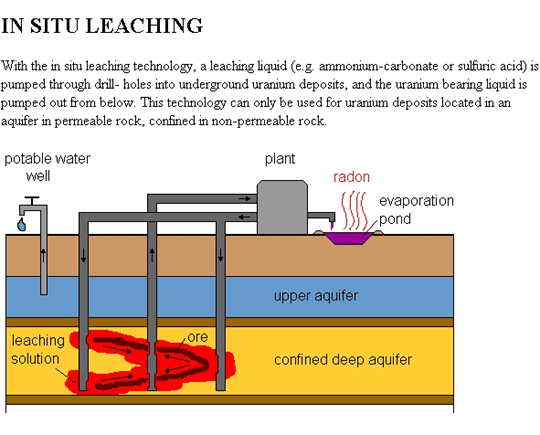
In Situ Leach mines pump highly acidic substances into an aquifer to mobilise uranium. The liquid is then pumped out of the aquifer and processed to remove the uranium. The waste liquid is then pumped back into the aquifer.
Two grassroots environmental groups, Friends of the Earth Adelaide and West Mallee Protection, stated in their joint submission that:
“Given the number of risks involved with the proposed Mullaquana trial, particularly the routine contamination of groundwater by heavy metals and radioactive materials associated with In Situ Leach mining…we strongly recommend that this proposal is rejected.”
“Using…questionable, fuzzy logic, attempts are made to argue that low soil productivity and the low quality of groundwater negate potential risks and minimise the impact of contamination…this is essentially saying that it’s okay to pollute soil and groundwater with radioactive materials and heavy metals simply because it is of a lower quality.”
Friends of the Earth Adelaide and West Mallee Protection are calling on PIRSA to reject the application.
“The In Situ Leach method of mining has left numerous sites in Eastern Europe heavily contaminated. In South Australia, there have been over 20 spills at the Beverley In Situ Leach mine. In January 2002 a pipe burst, releasing 62, 000 litres of contaminated water. UraniumSA claim that they have recruited heavily from within this sector,” said Nectaria Calan, of Friends of the Earth Adelaide.
No commercial acid leach mine in the USA has ever been given environmental approval because of the high risk of contamination.
“Given UraniumSA’s public commitment to transparency, we are calling on the company to commit to making publically available the In Situ data that will be obtained during the trial, and the models they use to obtain it,” stated Ms Calan.
Australia’s Environment Minister lying about safety of BHP’s Olympic Dam uranium mine


( Once again – so much news on Olympic Damn that we have put a selection of other items on http://nuclearnewsaustralia.wordpress.com/)
A headache of Olympic proportions The Drum, Scott Ludlam, 13 Oct 11 The concept of ‘environmental protection’ has taken on new meaning with the announcement of Commonwealth environmental approvals for BHP Billiton’s Olympic Dam copper/gold/uranium mine in South Australia.
“We have the toughest environmental conditions that you’ll ever find imposed on a uranium mine,” Commonwealth Environment Minister Tony Burke stated proudly.
This is known in the technical literature as a ‘bald-faced lie’. We know that, because the toughest environmental conditions found at a uranium mine are 2,000 kilometres northward, at the Ranger Uranium mine on a lease chopped out of Kakadu National Park in the NT. There, the company is required to backfill the mine voids with their radioactive wastes, removing somewhat more than a hundred million tonnes of the stuff from the surface and dumping it back in the pit to be capped and revegetated as best as possible. In Kakadu, the company is required to isolate these wastes from the wider environment for a period not less than 10,000 years. This is clearly an impossible task, but a worthy ambition at least.
No such duty of care will be applied for the benefit of South Australians. Mr Burke has earnestly reassured us that conditions will apply for 10 years after the life of the mine. He has granted approval for the mine tailings waste to be dumped and left out on the surface in apparent ignorance of the fact that the residual inventory of Uranium 238 has a half-life of 4.5 billion years, and that the mine wastes will contain a cocktail of unwanted daughter isotopes including radium, protactinium, radon gas and radioactive lead. Continue reading
Uranium is not much of an export earner for Australia. Do we really need this dirty industry?
 Do we need the money from uranium? How does uranium compare to our other exports? According to the Australian Bureau of Agricultural and Resource Economics and Sciences (ABARES) export data, in the decade from 2000/01 to 2009/10, uranium exports averaged $596 million/year. Lamb, cheese, cotton, barley, sugar, wool, wine, other crops, wheat, and beef-veal, each averaged $664, $806, $955, $1,170, $1,286, $1,825, $2,309, $3,463, $3,665, and $4,002 million/year, respectively…..
Expanding Olympic Dam: with great power comes great responsibility, Gavin Mudd, The Conversation, 12 October 2011, “……..In a post-Fukushima world, the hard questions need to be asked: what is Australia’s role in fuelling nuclear disaster, creating high-level nuclear waste and feeding nuclear weapons risks around the world? Continue reading
Energy Resources of Australia begging shareholders for $500 million
 ERA begging for $500m boost, The Age Barry FitzGerald October 13, 2011 THE fall from grace of Rio Tinto-controlled Energy Resources of Australia has become absolute, with the Ranger uranium miner going cap in hand to shareholders for $500 million in equity funding in a heavily discounted rights issue.
The 12-for-7 underwritten issue of new shares at $1.53 a share represents a near 30 per cent discount on ERA’s share price before the stock went into a trading halt. The funds will go a long way to overcoming ERA’s water-handling issues, as well as funding potential mine life-extending activities….. Rio is also to act as sub-underwriter to the equity raising. Should that role be fully utilised, its holding in ERA could increase to 82 per cent, reducing liquidity in what is an already thinly traded stock.
ERA has been producing uranium at Ranger for 30 years and is only the second mine in the world to have produced more than 100,000 tonnes of uranium. But its shares have been in free fall for the past 12 months on the realisation that despite the long production history, it has not been on top of the environmental threat that a record big wet in Kakadu poses.
The build-up of water around the mine and in its pits forced the decision in January to suspend processing operations as a ”precautionary measure” to ensure levels in the operation’s tailings storage dam remained below the authorised limit. More rain forced a further suspension to late July…..
Rio’s decision to back ERA’s equity raising suggests Rio is confident that ERA’s Jabiluka deposit near Ranger might one day be developed.
Jabiluka is one of the biggest undeveloped uranium deposits in the world but its development is being vetoed by traditional owners. http://www.theage.com.au/business/era-begging-for-500m-boost-20111012-1ll13.html#ixzz1ahltBWq2
Not all smooth sailing for BHP’s plan to expand Olympic Dam uranium mine
agreement is conditional on the Indenture Act passing through South Australia’s Parliament. And with the Greens and Opposition poring over the details, that progression is far from assured.The company has signed a preliminary agreement with the state’s Premier Mike Rann. BHP Billiton now has a year to reach a final investment decision. Mr Rann says today will go down in history.
But the Opposition says he has compromised important negotiations. Nance Haxton reports. Continue reading
Never mind Australia’s nuclear non-proliferation policy – Ferguson, Minister For The Uranium Industry is out to sabotage it
 ‘‘Opening up uranium sales to India would fuel the nuclear arms race under way between India
 and Pakistan, which has potentially catastrophic consequences,” ICAN’s Australian director, Tim Wright, said yesterday. ”The threat of a regional nuclear war between India and Pakistan is real. Selling uranium to India runs counter to Australia’s own security interests, and makes a mockery of its stated commitment to a world free of nuclear weapons.”
The briefing note was written after Mr Ferguson met Indian Foreign Minister S. M. Krishna in January…
The note was dated February 7, three days before The Age revealed a cable leaked to WikiLeaks that asserted Mr Ferguson had told the United States embassy in Canberra that a deal to supply India with nuclear fuel could be reached within three to five years.
Australia, India in talks over uranium sale, The Age, Michael Gordon, October 13, 2011 AUSTRALIA and India have already begun a ”dialogue” that is likely to canvass the sale of uranium to the nuclear-armed nation if Labor dumps its opposition to the trade at the party’s national conference in December.
A confidential briefing note to Resources Minister Martin Ferguson in February says the dialogue ”may prove a useful avenue to communicate any policy shifts on the issue” of uranium exports, which are banned to India under existing government and ALP policy. Continue reading
With Diesel rebates, BHP’s Olympic Dam Royalties likely to return poorly to South Australian Government
Mike Rann has claimed that the new open-pit mine will be his “economic legacy to the state.” However, a consideration of the financial return to BHP through diesel rebates alone indicates that this legacy may be somewhat overstated…
 BHP stands to gain $128 million per year in diesel rebates in the initial development period of the mine, $144 million per year in the intermediate stage, and $178 million per year at full production.
Public resources for private profit: free water for the largest open-pit mine in the world Coober Pedy Regional Times, by: Nectaria Calan, 13 Oct 11, “………With approval of the new mine announced on Monday, the next stage of the approval process is the negotiation of a new Indenture Act which will apply to the new mine. It is expected that the revised Act will be introduced into the South Australian parliament next week, given Mike Rann’s commitment to finalising the indenture agreement before his retirement on October 20.
It is within the power of the South Australian government to negotiate a substantially different indenture agreement, or to repeal the Indenture Act completely. Continue reading
1 This month

of the week – Australians for War Powers Reform (AWPR)
To see nuclear-related stories in greater depth and intensity
 Antinuclear