South Australian government secrecy on expansion of BHP’s Olympic Damn
 Release ‘secret’ Roxby report, 22 Sept 11, The Greens have called for the immediate release of a hidden report that captures the views of State Government agencies on the Olympic Dam
Mega-expansion.
Called the ‘Assessment Report’, it is a compulsory step in the approval process for a major development. It summarises the responses by various government agencies to the proponent’s Supplementary Environmental Impact Statement (EIS) and is supposed to be released before the Government announces its approval of a project. However, for recent controversial projects the Rann Government has chosen to only release the Report after they have announced their decision. “The only reason the Government is choosing not to release the Assessment Report now is to avoid scrutiny,” said SA Greens Parliamentary leader Mark
Parnell.
“The Government is holding back the Report’s release for political reasons – keeping the SA community in the dark. This means that the public doesn’t get a chance to respond. It also allows the Government to dodge tricky questions as the media and others tend to focus on the approval decision, rather than what Government agencies actually think.
“The Rann Government has form in releasing the Assessment Report only after they announce their decision on a project. They did it for Buckland Park and they did it for the Port Stanvac desal plant. “For a project as important as the Olympic Dam expansion, the Government should be giving the SA community more opportunities to be involved in the
final decision, not less. “For example, the Assessment Report will be able to tell us what
Government agencies like SARDI really think about the proposed desalination plant at Pt Lowly.
“The Greens call on the State Government to immediately release the Assessment Report, well before they announce their decision on the OlympicDam Expansion.
Information about rare earths, but not much about their dangerous wastes
ABC radio conducted this informative interview on rare earths – but rather light-pedalled their radioactive waste problem – C.M.
The role of rare earths in your day to day life, ABC Radio 17 Sept 11, Philip Clark“……..the nature of some of these deposits is that they are quite complex. In essence they… as you mentioned, there’s lots of elements, particularly they’re present in small quantities. They’re in quite complex minerals, often in phosphate minerals; often they have uranium and thorium and other elements associated with them. That leads to complications in processing to some extent, but it also leads to regulatory issues, because around the world—in this country as well—there are jurisdictions that do not want or don’t allow at this stage, mining of uranium, even though that uranium might be a very, very small amount, as it generally is with these deposits.
I guess the other part of the processing—and it’s what’s really occurred I think in Malaysia recently—it is a complex… with so many elements and very complicated but manageable process route to get each of these elements out, and they’re very valuable, you do need to use sophisticated chemical processes and they need to be strictly and adequately policed……
Philip Clark: My guest is Peter Arden. He’s a scientist and resources analyst at Ord Minnett. We’re talking about rare earths. These are unusual minerals, but with big uses in electronics—television sets, mobile phones, batteries, powerful magnets, all use these materials and most of the world’s supply at the moment is controlled by China. Is there an opportunity for Australia here?
The processing of these minerals, though, is the key, isn’t it? That’s not straightforward, you need a processing plant, and extracting the actual rare earth from the mineral can be complex, can’t it?… in addition to the rare earths you generally find, as we’ve talked about, other elements—uranium and so on.
Malaysian MP disputes radiation opinion of Lynas’ Australian employee on rare earths
 Fuziah belittles radiation expert’s analysis, Free Malaysia Today, K Pragalath, September 14, 2011 The Kuantan MP replies to criticisms by Lynas-hired Nick Tsurikov. PETALING JAYA: Kuantan MP Fuziah Salleh today shot back at radiation expert Nick Tsurikov, who has disputed statements she made recently regarding the dangers posed by the rare earth project in Gebeng, near Kuantan.
She criticised his analysis as “shallow” and questioned his standing as an independent expert, noting that he was hired by Lynas Corp, the Australian mining company that is setting up the Gebeng operations……
She also said Tsurikov, who is based in Australia, was unable to understand the seriousness of the situation….
Fuziah quoted reports alleging that Lynas was using China Standards GB9133-88 as a benchmark.“I mentioned that there are no rare earth refineries in operation outside China at the moment. Thus we do not have a benchmark. Neither do we have a best practice in rare earth refining.”
Australian analysts show that uranium price is STILL going down
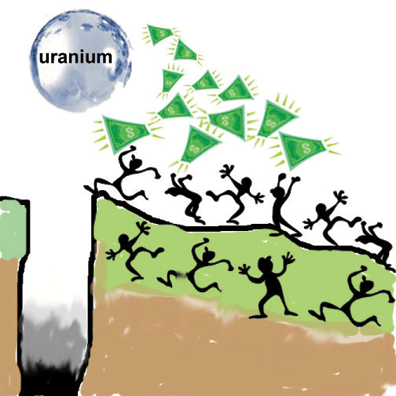 Uranium spot price could fall more, Star-Tribune, Tom Mast, September 11, 2011 The spot price of uranium, which tumbled following a Japanese nuclear disaster last spring, could fall even further in the short term.
That’s the assessment of Sydney, Australia-based Resource Capital Research. In its September quarter review, the firm noted a current spot price of $48.85. It is now back to the level seen after a March 11 earthquake and tsunami crippled a nuclear power complex at Fukushima, Japan…..
The firm said the fund-implied price, which is an indicator of market price expectations looking out three to six months, points to a spot price of $45.95. This reflects expectations of possible new supplies entering the market later this year…..
Why Toro’s uranium mining plan at Wiluna should be stopped
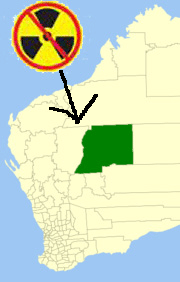 Key concerns with Toro’s plan to mine uranium at Wiluna,
by Mia Pepper and Jim Green, 9 sept 11,
* Traditional Owners are opposed to the construction of a uranium mine at
the significant sacred site of Lake Way. Toro has not completed
Archeological and Ethnographic studies and does not already have a
comprehensive Aboriginal Heritage Management Plan.
* Uranium exported from Wiluna will at best end up as high-level nuclear
waste. At worst it will end up as fissile (explosive) material in nuclear
weapons, or in a nuclear disaster such as that unfolding in Fukushima,
Japan.
* Toro does not accept responsibility for its own application, stating
that it has “not fully verified the accuracy or completeness” of its
application.
* Lake Way is home to a unique population of Stygofauna − a
newly-discovered species of subterranean crustaceans.
* Toro has not factored in recent advice from the International Commission
on Radiological Protection that radon is twice as carcinogenic as
previously thought.
* Transport plans are presented as a “preliminary draft” and the company
plans to transport its toxic, radioactive product over many thousands of
kilometres, from Wiluna to Adelaide and Darwin.
* Uranium mining and tailings disposal in this region will occur below the
water-table and will be connected to aquatic ecosystems. There is a
significant risk of contaminating the aquatic ecosystems with changes in
water chemistry, including the mobilisation of radioactive compounds.
* The legal requirement for tailings management at the Ranger uranium mine
in the NT is effective isolation for at least 10,000 years. The minimum
standard should be the same for Wiluna.
* There has not been a calcrete uranium deposit mined in Australia and
there is only one calcrete deposit presently being mined worldwide. There
is a lack of expertise and experience in engineering and mine design for
these deposits.
* Wiluna has a number of operating mines close to town and in the region.
Despite current mining activity, Wiluna still suffers from extreme
poverty, homelessness, unemployment, violence and other social problems.
Investor support ‘has evaporated’ from Australian uranium mining companies
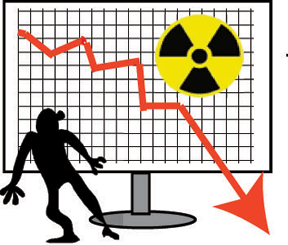 Investor support has evaporated and the share prices of most ASX-listed uranium plays have fallen more heavily than the wider market. The share price falls have eroded any chance of capital raisings to fund drilling programs or project development while continued production problems experienced by market leader Paladin Energy have added to the negative sentiment hanging over the sector.
The Merrill Lynch uranium equity index, which tracks global listed stocks, is down 19 per cent over the past month and 23 per cent in the past year.
More pain for uranium sector as price dips, PETER KLINGER, The West AustralianSeptember 7, 2011 Already battered by headwinds, including strong opposition from environmentalists, WA’s fledgling uranium sector is set for more grief amid expectation the nuclear fuel’s low price will fall another 6 per cent within the next few months. Continue reading
Oh dear! Uranium price and shares’ inexorable downward slide
Uranium prices plunge causing issues for Australian producers, Herald Sun, Greg Roberts ,September 07, 2011 URANIUM prices have fallen back to levels last seen after Japan’s nuclear accident in March, causing further grief to struggling Australian producers.
The uranium spot price is $US48.85 ($A46.04) a pound, having plummeted from $US67.75 to $US49 immediately after the earthquake and tsunami on March 11.
The spot price had recovered to about $US56.50 after the Fukushima accident. Analyst group Resource Capital Research says the dynamics driving the sector have changed in the aftermath of the meltdown, with Germany planning to close all 17 of its nuclear power reactors by 2022.
The “fund implied price” – an indicator of market price expectations – is signalling a further fall in the spot price to $US45.95. The Merrill Lynch Uranium Equity Index, which measures the performance of uranium equities, has fallen 19 per cent over the past month.
It is down 27 per cent over the past three months and 23 per cent over the past year, according to the latest quarterly report by Resource Capital Research. Shares in Australia’s largest uranium producer, the Rio Tinto-backed Energy Resources of Australia, have fallen 13 per cent in the past month and 73 per cent in the past year.
A year ago, ERA shares were $13.49, compared with $3.65 now, with the company posting a $122 million half-year net loss. http://www.heraldsun.com.au/business/uranium-prices-plunge-causing-issues-for-australian-producers/story-fn7j19iv-1226130940686
Latest promotion from Australian Uranium Industry – lacking in confidence
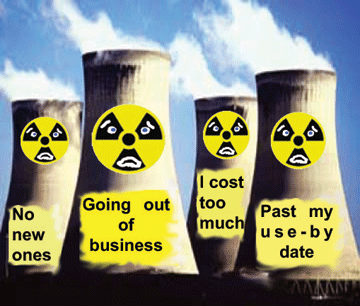 “…an extended period of uncertainty…..A mistake by one operator or explorer or project developer in our industry affects all of us.”
Fukushima puts Australia’s uranium industry on the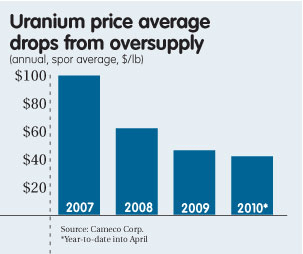 defensive Independent Australia, 2 Sept 11, The Australian nuclear industry feels the heat after the Fukushima calamity, but spins on gamely. Noel Wauchope reports.
With plummeting uranium prices, and increasinglybad news about Fukushima radiation, Australia’s uranium industry is well and truly on the back foot. But the industry battles on with religious fervour in its belief in the future uranium boom. Continue reading
Flooding in Paladin and Rio Tinto uranium mines in Namibia
 Namibia Q2 uranium production down | Industrial Fuels and Power August 30th, 2011 Uranium production in Namibia decreased from 2.35mlb to 2.09mlb in the second quarter of 2011 when compared with the previous quarter.“This was largely due to adverse weather conditions, with some of the mines becoming flooded with the abnormally heavy rains seen this year,” financial group Capricorn Investment Holdings said.Namibia’s uranium is produced by Rio Tinto and Australia’s Paladin Energy.
Namibia Q2 uranium production down | Industrial Fuels and Power
Big loss for uranium miner Paladin miner , and fall in share price
Paladin Energy Q4 loss widens to US$47.7M, The Canadian Press08/31/2011 PERTH, Australia – Paladin Energy Ltd (TSX:PDN), an Australia-based miner that lists on the TSX, cited higher financing costs Wednesday among reasons for a widening of its fourth-quarter and full-year loss.
Paladin Energy, which reports in U.S. dollars, said its after-tax loss for the three months ended June 30 was US$47.7 million or 6.3 cents per share, compared with a loss of US$25.2 million or 3.5 cents in the same year-earlier period….profits were affected an impairment of inventory expense of US$26.4 million at the company’s Kayelekera mine due to higher operating costs during ramp-up and the lower prevailing uranium spot price since last March’s earthquake-induce nuclear disaster in Japan.
The company also faced an earlier, US$6.3-million early buyback of convertible bonds. On the Toronto Stock Exchange, Paladin Energy shares were down nine cents at $2.16 at midday Wednesday.
Uranium miner Paladin calling for more money to be invested
More uranium investment needed, says Paladin CEO, Mining Weekly, 31st August 2011 PERTH − Uranium miner Paladin Energy CEO John Borshoff said that more investment was needed the uranium sector, as supply and demand dynamics would become more strained.
“Discoveries of new deposits have to be made, exploration and high-risk capital needs to be sunk into these programmes, because these programmes determine the long-term future of the mining industry,” Borshoff told delegates at the Africa Downunder conference in Perth on Wednesday…..
“Uranium is still suffering from the impact of the Japanese earthquake and tsunami, and the parallel damage to the Fukushima nuclear reactors. The supply sector and the nuclear industry have suffered a bruising effect from this event…
A truly valuable legacy for Premier Mike Rann, to repeal South Australia’s unjust Indenture Act
the Indenture Act trumps all other SA legislation…..Over to you, Mr Rann − repealing the indefensible legal privileges in the current Indenture Act would be a good way to end your tenure as SA Premier.
 Above the law: Olympic Dam’s legal privileges, Jim Green and Gavin Mudd, 27 Aug 11 Premier Mike Rann has done us a favour by insisting on concluding negotiations with BHP Billiton over the SA Roxby Downs Indenture Act before leaving office. It is by no means clear that the outcome will be
improved with Mr Rann’s involvement, but he has at least drawn attention to this remarkable legislation.
The Indenture Act governs the operations of the Olympic Dam copper/uranium mine. The legislation was controversial when it was enacted in 1982 and it is all the more inappropriate as the basis for the planned expansion of
the mine.
The Act provides BHP Billiton with the legal authority to override important state legislation including the Aboriginal Heritage Act 1988,
the Environmental Protection Act 1993, the Freedom of Information Act
1991, the Natural Resources Act 2004 (including water management issues),
the Development Act 1993 and the Mining Act 1971. Continue reading
As Australia’s groundwater declines, BHP BIlliton should not extract GAB water for free
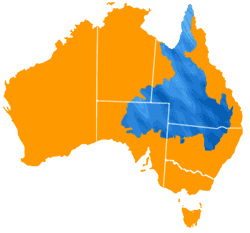 It is within the power of the Federal and South Australian governments to require, as a condition of consent to the BHP Billiton proposal, that at the time the desalination plant is commissioned, the company will surrender any and whatever licence it has to extract water from the Great Artesian Basin ….
It is our submission that, as the largest single extractor of water from the GAB in South Australia, BHP Billiton has created its own ethical obligation to the future of the GAB …
It is our further submission that this is not an economic issue, it is not even an environmental issue, it is about the ethics of any company continuing to assert its current right to a public resource when that company has the financial capacity to secure the same resource from its own private reserves. ….
Re:- BHP Billiton – Olympic Dam Expansion Proposal, 22 August, 2011 Letter to Senate Standing Committees on Rural Affairs and Transport from Richard Quilty BHP Billiton Shareholder Willem Vervoort,Associate Professor, Hydrology & Catchment Management The University of Sydney
Preamble
On the dry Australian continent groundwater is the only consistently reliable source of water; it is thus an extremely valuable resource. The Great Artesian Basin (GAB) is the largest of those groundwater resources.
The total value of production supported by GAB water is estimated at $3.5 billion per annum. Without that groundwater there would be little to no economic activity and in fact little opportunity for life in much of regional Australia.
Currently, many groundwater resources are over-allocated leading to declining water tables and water quality. Federal and State governments as well as private business are investing large amounts of money to rectify this problem. An example is the $140 million GABSI program to save GAB water. Continue reading
Friends of the Earth write to South Australian politicians about Roxby Downs Indenture Act
exemptions from the Environmental Protection Act (1993) are of particular concern. The exclusion of this Act means that the Olympic Dam mine is not subject to the same environmental regulatory framework as other industrial projects in South Australia, and the Environmental Protection Authority (EPA), which administers the Act, is excluded from its monitoring role. BHP’s environmental performance is instead the responsibility of the Minister for Mineral Resources Development, who, based on BHP’s own reports, has full discretion to approve or reject programmes for the management and rehabilitation of the environment, without any obligation to consult with other agencies. Given the Ministers role in promoting mining in SA, this arguably amounts to a conflict of interest.
Re: ROXBY DOWNS INDENTURE ACT
Dear
The Roxby Downs Indenture Act is currently the subject of negotiations between the SA Government and BHB Billiton, owner of the Olympic Dam copper/uranium mine. We expect that in the near future amendments will beintroduced into parliament extending the operation of the Act to the proposed Olympic Dam expansion.
Friends of the Earth is concerned that indefensible legal privileges in the Indenture Act will be retained in the context of the proposed mine expansion, including exemptions and overrides from the SA Aboriginal Heritage Act1988, the Environmental Protection Act 1993, the Freedom of Information Act 1991, and the Natural Resources Act 2004. Continue reading
BHP Billiton above the law, exporting megalitres of Australia’s water – for free!

 BHP Billiton: Billions in profits and not paying a cent for water in SA, Friends of the Earth Adelaide, 24th AUGUST 2011 Today mining giant BHP Billiton announced record financial results for the 2011 financial year, recording a total net profit of US$23. 95 billion, nearly double its 2010 figure of US$13.01 billion.
Despite its profits more than tripling in the last three years, BHP has never paid a cent for the vast amounts of water used by the Olympic Dam copper and uranium mine near Roxby Downs. The mine currently uses approximately 35 million litres of water a day from the Great Artesian Basin. Under the Roxby Downs Indenture Act BHP is not required to pay for this water usage.
The Indenture Act applies specifically to the Olympic Dam mine, and provides for wide-ranging legal exemptions and overrides from environmental and Aboriginal heritage protection laws that apply elsewhere in the state, including the Environmental Protection Act and the Natural Resources Act (which incorporates water management issues).
“The Indenture Act means that the Olympic Dam mine is not subject to the same environmental regulatory framework as other industrial projects in the state,’ explained Nectaria Calan of Friends of the Earth Adelaide. “Additionally, by allowing BHP to take water from the Great Artesian Basin for free, the South Australian government is essentially providing BHP with a massive subsidy,” she continued.
The water intake from the Great Artesian Basin has already had adverse impacts on the unique Mound Springs found near Lake Eyre, which are fed by the underlying Artesian Basin, and are sacred to the Arabunna people, the traditional owners of the area.
As part of the proposed expansion of the Olympic Dam mine, BHP Billiton proposes to increase its water consumption by an additional 200 million litres per day. Water intake from the Great Artesian Basin will increase to up to 42 million litres per day, with the remainder to come from a proposed desalination plant at Point Lowly. This amounts to over 100,000 litres of water per minute.
“The vast water usage of uranium mines is often forgotten in the debate about uranium and nuclear energy. Here we are, in the driest state on the driest continent on earth, host to a mine which needs millions of litres of water each day. Due to the Indenture Act, we are essentially exporting our water overseas for free,” said Ms. Calan.
The Indenture Act is currently the subject of negotiations between BHP Billiton and the South Australian government. In the near future amendments will be introduced into parliament to extend the Indenture Act to the proposed expansion.
“The South Australian government is planning to allow the largest uranium mine in the world to go ahead with legal privileges that will allow BHP an impunity characteristic of some third world states,” said Ms. Calan. “The Indenture Act should be repealed completely, allowing BHP to be subject to the same laws as other corporations operating in the state.”
1 This month

of the week – Australians for War Powers Reform (AWPR)
To see nuclear-related stories in greater depth and intensity
 Antinuclear