Spinbusting the extraordinarily inept nuclear waste media release from 3 Australian MPs.
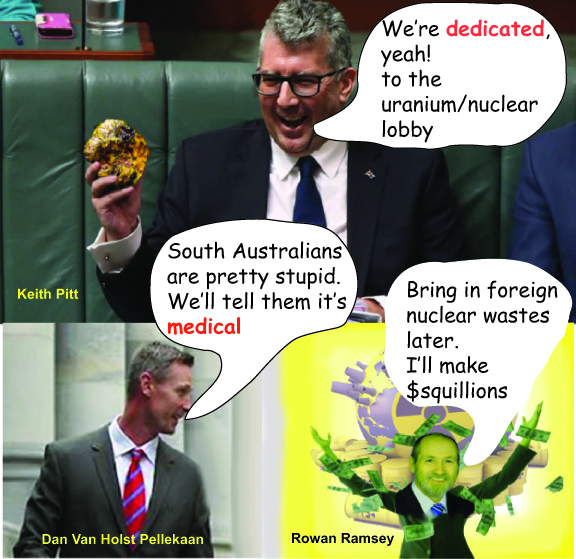
27 July 20, On 20th July, MPs Keith Pitt, Rowan Ramsey and Dan van Holst Pellekaan issued a joint media release, which announced the establishment of a new agency in Adelaide to manage Australia’s nuclear waste. The agency was to start that same day (even though they would be advertising for staff and a CEO) . It was obviously written in a hurry, and raised amazement among those who follow the ongoing drama of the Australian government’s attempt to impose a nuclear waste dump on a rural region. Amazement at the questions that remain unanswered.
Peter Remta critiques the statement, and raises some of those embarrassing questions:
The joint media release is inconsistent within itself and with other previous reports and is surely an embarrassment to the two ministers while confirming the long-held partiality of the local member , Rowan Ramsey.
It is badly composed with meaningless statements and lacks any precise reasons and explanations for what should be the creation of a major and nationally important organisation
The establishment by other countries of entities with similar objectives (even though it is hard to ascertain what they are in the case of this new Australian agency) has invariably involved lengthy and detailed planning including the views and suggestions of various members of the community together with commercial interests and other government agencies.
A most pertinent example is the Reset Initiative of the United States of America as to the management of its nuclear waste which was undertaken by the well known Stanford and George Washington Universities which are regarded as world leaders in that field.
The recommendations under the Initiative should have been followed in Australia as they are imperative for the proper and safe management of nuclear waste and it is surprising that none of the submissions or evidence by ANSTO and ARPANSA and also by the Department of Industry Science Energy and Resources made any mentioned of this well-known and internationally recognised study.
It is hoped that ANSTO will not be relying on this rather meaningless and inconsistent release as part of its submission requirements for ARPANSA which in turn should immediately as the regulatory and licensing authority require a full explanation of the reasons behind the release.
ARPANSA must not on this occasion hide behind its licensing independence in refraining from strong comment as the release could be viewed to be an attempt to usurp its status and functions which are recognised internationally,
Announcing this agency before the government has final parliamentary approval smacks of arrogantly taking both
the Senate and ARPANSA for granted
It also shows a cavalier attitude to proper governing to be committing taxpayers’ money before all approvals are in
place.
Even with the vagueness of the release the government should be seriously considering and examining the Azark
Project facility at Leonora which besides being considered as one of the best in the world would overcome or avoid
many of the problems inherent with the Napandee proposal It would also be a major financial saving for the government
Why has there not been any previous mention of this new agency?
How will it manage Australia’s radioactive waste?
How will it bring together this responsibility and expertise since it seems currently to be lacking the expertise and from past experience the responsibility?
“The Australian Radioactive Waste Agency (ARWA) will be based in Adelaide and be responsible for all functions of the
National Radioactive Waste Management Facility (the Facility), including engagement with the Kimba community.”
Why will it be located in Adelaide which has no history of competence or knowledge in this area despite the Scarce
Royal Commission and uranium mining in South Australia ?
How will it engage with the Kimba community and in what respect since it seems that the battle lines are well and truly
drawn in a seriously divided community.
Will it be replacing ANSTO as the operator of the facility at Napandee?
How will the new agency develop Australia’s radioactive waste management solutions and capabilities as neither the
government nor ANSTO has any realistic knowledge in this area?
Is not this another instance of rushed planning without a proper understanding and consideration of the factors
including the regulatory regime?
Will it not be an unnecessary duplication of the existing functions of ANSTO?
Is the agency going to assume or usurp some of the functions of ARPANSA in the regulatory context?
How will the agency’s location in Adelaide enhance the operations at Napandee as it was understood that this had
already been established through prior planning?
Hasty new nuclear dump agency will have some overseas staff, – and law for waste dump is not yet passed!
Nuclear dump to be managed from SA, https://www.cessnockadvertiser.com.au/story/6842627/nuclear-dump-to-be-managed-from-sa/?cs=7, Tim Dornin, 22 July 20
Staff from around Australia and possibly overseas will be recruited for a new government agency to manage a nuclear waste dump in South Australia.
Legislation to establish the dump has already passed federal parliament’s lower house and is before a Senate committee after the location was selected earlier this year.
Resources Minister Keith Pitt said the establishment of the new agency was another step forward in what had been a very long-running process to develop a vitally important facility.
“Two in every three Australians will use nuclear medicine and that means two of every three Australians will produce some low-level radioactive waste that needs to be stored and managed,” he said.
“This is a national piece of infrastructure that is critical for all of those individuals.”
Mr Pitt said ARWA would operate as an independent agency with staff to be drawn from around Australia and possibly around the world to secure those with the right skill set.
But the Australian Conservation Foundation said the government had jumped the gun, establishing the new agency when legislation for the dump was still before the parliament.
“It is absurd to establish a new federal agency for a proposal that is still under active Senate review and has no current legislative basis,” campaigner Dave Sweeney said.
“This initiative has all the hallmarks of a tailor-made political fix for a federal plan that has no broad social licence.”
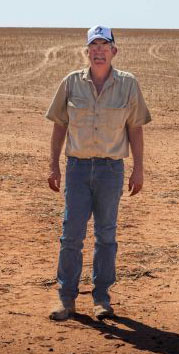 When the Napandee site was chosen, owner Jeff Baldock welcomed the plan and urged the government to move forward.
He said it was a “once-in-a-lifetime opportunity to secure Kimba’s future” and the waste facility would potentially provide jobs and much-needed revenue for the region.
“It’s very rare that a small country community gets the chance to guarantee that it’s still going to be here in 300 years’ time,” he said.
Hasty and crummy pro nuclear media release from Messrs Pitt, Ramsey and Van Holst Pellekaan
Peter Remta, 22 July 2020. Here we go again.
This is a very poorly and hastily planned and quite ill-conceived attempt to deflect from the true situation with the proposed facility at Napandee which only shows up the incompetence and lack of knowledge within the federal government as to the management of nuclear waste
The joint media release is inconsistent within itself and with other previous reports and is surely an embarrassment to the two ministers while confirming the long-held partiality of the local member It is hoped that ANSTO will not be relying on this quite meaningless release as part of its licensing submission requirements for ARPANSA which in turn should immediately as the regulatory and licensing authority require a full explanation of the reasons behind the release
ARPANSA must not on this occasion hide behind its licensing independence in refraining from strong comment as the release could be viewed to be an attempt to usurp its status and functions
I will separately comment on the different parts of the release
South Australian Government must oppose the Federal government’s nuclear waste dump
 Friends of the Earth, 21 July 20, Today’s announcement by federal resources minister Keith Pitt that a new ‘Australian Radioactive Waste Agency’ will be established and located in Adelaide is the latest move by the federal government to impose a national nuclear waste dump in SA. The Agency will be responsible for all functions of the proposed nuclear ‘facility’
including engagement with the Kimba community.
Dr. Jim Green, national nuclear campaigner with Friends of the Earth Australia, said: “‘Locating the Australian Radioactive Waste Agency in Adelaide is a cynical attempt to present the strongly contested nuclear waste dump as a done deal.
“The imposition of a nuclear waste dump is a clear breach of the SA Nuclear Waste Facility (Prohibitions) Act, legislation introduced by Liberal Premier John Olsen and strengthened by Premier Mike Rann. Yet current SA Premier Steven Marshall and energy and mining minister Dan van Holst Pellekaan support the proposed nuclear dump. That support should be reversed.”
“van Holst Pellekaan falsely claims that Kimba has ‘clearly’ expressed its willingness to be the host community. In fact, a narrow majority supported the facility, and that narrow support was won with a multi-year, multi-million-dollar federal government PR campaign including the fictitious claim that 45 local jobs will be created.
“A majority of South Australians oppose the proposed nuclear dump and there has been no consultation let alone consent along transport corridors. Barngarla Traditional Owners were excluded from the Kimba ballot and their separate ballot found unanimous opposition.
“If the results of the Barngarla ballot are included with the ballot of local Kimba residents (and out-of-town ratepayers), the overall level of support falls to just 43.8% of eligible voters (452/824 for the Kimba ballot, and 0/209 for the Barngarla ballot). That is well short of a majority and a long way short of the government’s 65% benchmark for ‘broad community support’,” Dr. Green said.
Prof. Graeme Samuel’s EPBC Interim Report released yesterday noted that the federal government’s framework environment legislation “reflects an overall culture of tokenism and symbolism, rather than one of genuine inclusion of Indigenous Australians”.
An April 2020 report by Federal Parliament’s Joint Committee on Human Rights noted that planned changes to the National Radioactive Waste Management Act, currently the subject of a Senate inquiry, do not sufficiently protect the Barngarla’s rights and interests. The Committee found “there is a significant risk that the specification of this site will not fully protect the right to culture and self-determination”. Importantly, the Human Rights Committee’s report was unanimous and was endorsed by Liberal and National Party members.
Dr. Green said: “Shamefully, the Federal Government has acknowledged that its proposed changes to the National Radioactive Waste Management Act will deny Barngarla Traditional Owners, farmers and other interested parties a right to a judicial review of the proposed nuclear waste facility; indeed, it appears that the purpose of the legislation is to do just that.
“Prof. Samuel’s EPBC Review and the Coalition and Labor members of the federal parliament’s Human Rights Committee have found that the rights of Traditional Owners need to be strengthened, yet Premier Marshall and Minister van Holst Pellekaan are supporting the imposition of a nuclear waste dump unanimously opposed by Barngarla Traditional Owners. Their crude racism diminishes all South Australians and must be resisted,” Dr. Green concluded.
The SA Labor Party argues that Traditional Owners should have a right of veto over nuclear projects given the tragic history of the nuclear industry in South Australia. Deputy Leader of the Opposition Susan Close said that SA Labor is “utterly opposed” to the “appalling” process which led to the announcement regarding the Kimba site. The SA ALP State Conference in Oct. 2018 endorsed a resolution supporting Traditional Owners “in their current struggle to prevent a nuclear waste facility being constructed in their region.”
Federal radioactive waste agency flawed from day one
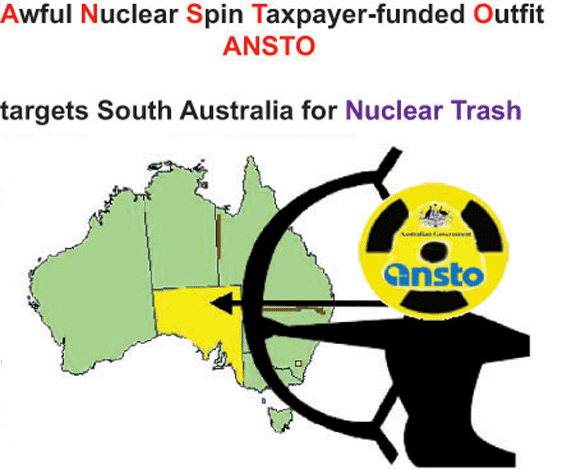 Australian Conservation Foundation, 21 July 20, In response to Resources Minister Keith Pitt’s announcement of a new Australian Radioactive Waste Agency, to be based in Adelaide, the Australian Conservation Foundation’s Nuclear Free Campaigner Dave Sweeney said:
“With his announcement of the Australian Radioactive Waste Agency, Minister Pitt is playing short-term politics with the management of long-term waste.
“This new agency appears to have been set up to rubber stamp and maintain momentum for the Federal Government’s deeply flawed and contested radioactive waste facility planned for Kimba in regional South Australia.
“From day one the perception of this new agency has been tainted – rather than being expert and independent, it has been created primarily to advance the Government’s Kimba plan.
“It is absurd to establish a new federal agency for a proposal that is still under active Senate review and has no current legislative basis.
“Instead of what is needed – an expert and independent authority to oversee radioactive waste management in Australia – this initiative has all the hallmarks of a tailor-made political fix for a federal plan that has no broad social licence.
“It is extraordinary that this announcement to advance a national radioactive waste facility in Kimba against the specific objections of the Barngarla Traditional Owners comes a day after a major review of federal environmental laws highlighted a tokenistic approach to Indigenous concerns.
“Minister Pitt continues to re-state the tired myths that have dominated the Federal Government’s approach to this issue.
“To be clear, nuclear medicine in Australia is not dependent on the Kimba plan. Universities and hospitals that produce radioactive waste will still need to manage waste at these places.
“This is a disappointing, half-baked and deeply compromised response to the growing uncertainty and contest surrounding the Federal Government’s approach to radioactive waste management.”
South Australian government (ignoring its own nuclear prohibition laws) joins Federal govt’s haste for nuclear waste dump
|
New agency to safely and securely manage Australia’s radioactive waste, The Hon Keith Pitt MP, Minister for Resources, Water and Northern Australia, 21 July 2020
Joint media release with the Member for Grey, Rowan Ramsey MP, and the South Australian Minister for Energy and Mining, Dan van Holst Pellekaan……. The Australian Radioactive Waste Agency (ARWA) will be based in Adelaide and be responsible for all functions of the National Radioactive Waste Management Facility (the Facility), including engagement with the Kimba community. Minister for Resources, Water and Northern Australia, Keith Pitt, said the creation of the new agency is the next important step in developing Australia’s radioactive waste management storage solution and capabilities……. Member for Grey Rowan Ramsey said this was another step in establishing the NRWMF at the Napandee site at Kimba. …… For SA, this is yet another win building on the expansion of our technological know-how.” South Australian Minister for Energy and Mining Dan van Holst Pellekaan welcomed the establishment of the agency. “The South Australian Government has consistently said one best practice national facility is appropriate for the storage of this medical and research waste and Kimba has clearly expressed its willingness to be the host community,” Mr van Holst Pellekaan said. The new agency will also progress long-term work to site a separate, permanent location for disposal of intermediate level waste, as well as other waste management functions outlined in the Australian Radioactive Waste Management Framework……. A domestic and international search for a CEO will be undertaken to ensure that the agency is led with the appropriate skills and expertise. The agency will be operational from 21 July 2020, initially established as a separately branded function of the Department of Industry, Science, Energy and Resources before transitioning to a non-corporate Commonwealth entity. ……. https://www.minister.industry.gov.au/ministers/pitt/media-releases/new-agency-safely-and-securely-manage-australias-radioactive-waste |
|
George Gear submits on Radioactive Waste Bill – that Kimba site is totally unsuitable
George Gear to Senate Economics Committee on NATIONAL RADIOACTIVE WASTE MANAGEMENT AMENDMENT (SITE SPECIFICATION, COMMUNITY FUND AND OTHER MEASURES) BILL 2020 [PROVISIONS] Addition to my submission. I have attached [on original] two short articles on radioactive storage which will be of assistance to the committee. As you will see the proposal by the government will not be licensed for storage in Australia. It fails to reach the International Atomic Energy Agency (IAEA) standards for the storage of Intermediate Level Waste (ILW).
Accordingly your committee must inform the senate that the Kimba proposal in the bill does not meet IAEA standards and should be withdrawn.
The first is written by Aurora who are the only company operating a (low level ) radioactive storage facility in Australia.
In it they draw attention to the following factors which are relevant to Kimba:
1. The buffer zone is inadequate, it is measured in hectares instead of kilometres. Leonora has a buffer zone of 15 kms.
2. The site should be at a location where there are “few active land uses” on surrounding land. As you know the Kimba site is in the middle of a prime wheat growing area. The site at Leonora is remote, nothing grows there and nobody goes there.
3. When the governments proposed site is finished with in 30 years and a new underground site has been established the redundant Kimba site will have to be managed (at taxpayer expense ) for 300 years.
4. Based on their experience none of the sites in SA would have been considered if it were not for the expression of interest model chosen by the government.
5. The Kimba site is unsuitable.
6. The decision to site the facility at Kimba is a political one and not based on technical or scientific considerations.The second article is by the AINS Group who are a specialist group in storing radioactive waste. They are based in Helsinki and this article is specific to the decision to establish the facility at Kimba. The main points of the article are:
1. Intermediate Level Waste (ILW) should be stored at intermediate level geological disposal. The Department already knows this. The quote below is taken straight from the “ National Radioactive Waste Management Facility Project” (NRWMFP) Facebook home page (attached). The statement that it will take several decades to site and build is wrong and they know it. The Leonora site can store the ILW at depth within a year and the NRWMFP have known this for 3.5 years.
Kimba “interim” nuclear waste site – bad news, uncannily like the misguided New Mexico waste plan
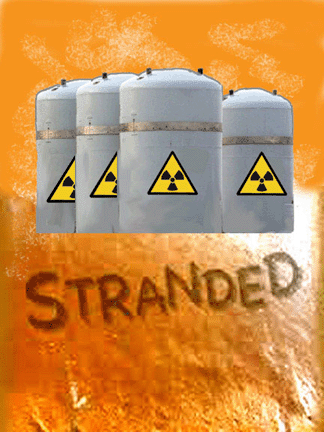
KIMBA GOVERNMENT PROPOSALS, by Peter Remta, 11 July 20 Is not the newspaper article below describing practically the same situation as with the Kimba proposals?
Should not the Australian government learn from this and the other unsatisfactory experiences overseas of which France is a main one despite being used as a successful example by the government for Kimba of community consent.
The author of this article and the former chair of the Nuclear Regulatory Commission of the USA (who incidentally has been to Kimba) would both be prepared to give evidence and their opinions to the Senate committee inquiry by video link.
However this article shows the effects of inept and incomplete planning as is the case with Kimba.
New Mexico nuclear facility is bad news, Las Vegas Sun, By Judy Treichel Monday, July 6, 2020, It may seem like good news in Nevada that an effort is underway in New Mexico to build a private storage facility for nuclear waste there.
But don’t be mistaken: This facility wouldn’t be an alternative to the disastrous Yucca Mountain nuclear waste repository. In fact, its existence depends on Yucca Mountain becoming an operating repository. That’s unacceptable, because the Nevada facility poses far too many risks for our state.
The license application for the New Mexico facility calls for it to operate over 40 years, after which the waste stored in it would go to Yucca Mountain….. today those Yucca Mountain deliberations are on an indefinite hold.
Now comes the New Mexico license application to the Nuclear Regulatory Commission, which in the opinion of the Nevada Nuclear Waste Task Force the commission should not have accepted with the assumption that Yucca Mountain would be an operating repository.
During all of the time that Nevada has been fighting the Yucca Mountain proposal, we were repeatedly assured that we could place our trust in the commission because before any license was granted for construction or operation, a thorough and unbiased process would fully play out. We were told there was no reason for questioning the fairness of the commission’s licensing process…….
Any siting of a facility that creates risk for the community should require informed consent, and the people of New Mexico do not consent.
What we see happening with this so-called interim site is that it does not solve the nuclear waste problem. In fact it increases the risks by putting the waste on the roads and rails, and requiring it to be loaded and unloaded multiple times and transported more than once. Additionally, the only way a site can be considered “interim” is to know that the waste will leave, and the assumption here is that it will leave New Mexico and come to Nevada.
The incentive for the company proposing to build the facility is purely financial — specifically, it’s to gain access to the $42 billion in the federal nuclear waste fund. An interim site does not increase or improve public safety, but rather does just the opposite. It creates one more nuclear waste site and provides more room at reactor sites for more waste. And it moves the waste closer to Nevada.
A national high-level nuclear waste repository at Yucca Mountain is an overwhelmingly unsafe idea. Nevada residents, elected officials and people across the country living near transport routes know it. For 20 years, the Department of Energy studied the site and discovered — or were forced to admit — that there were conditions present that, according to their own guidelines, disqualified the site.
If the licensing process ever restarts, how could we trust the Nuclear Regulatory Commission to fairly judge the science when it has previously assumed a licensed and operating repository at Yucca Mountain? Congress needs to reverse the action it took naming Yucca Mountain as the only site to be considered for a national repository, and take a fresh and fair look at nuclear waste disposal.
Initiatives like the interim storage site in New Mexico are simply misguided and misleading diversions.
Judy Treichel is executive director of the Nevada Nuclear Waste Task Force
Foreign nuclear waste headed to Australia
 Yes, this article is nearly 2 years old, but, sadly it is so relevant today!
Fears for indigenous lands as foreign nuclear waste headed our way, Weekend Australian, JACQUELIN  MAGNAY, LONDON
The Australian can confirm that the waste will be temporarily stored at Lucas Heights in Sydney, until the contentious new nuclear waste management centre is built, possibly at the South Australian sites of Hawker or Kimba.
But the waste will not be material from Australian spent fuel rods from the decommissioned High-Flux Australian Reactor at Lucas Heights (which was originally generated from British-sourced uranium) and reprocessed at Dounreay, Scotland, in 1996.
Instead it is considered too expensive to move that low-level waste from Dounreay, and so the nuclear waste to be transported to Australia will be “substitution waste’’ from Sellafield in England, but of a higher radioactive level.
Glasgow environmental activist Gary Cushway, who helped stop a nuclear storage plant near Coober Pedy, said there was increased awareness in Scotland that Australia didn’t have adequate storage for intermediate-level waste. He said there were fears that the new nuclear waste management facility, said to be for low-level waste, would be recategorised retrospectively to handle the intermediate-level waste.
“Once the storage facility is built for the low-level, where will they put the intermediate-level waste? It has to go somewhere and many Aboriginal owners think it will be temporarily stored with the low-level waste until that temporary status becomes permanent,’’ he said. While the Australian radioactive waste in Dounreay is believed to total about 76 tonnes and is rated low level, the grading of the waste that will be shipped to Australia is of intermediate level, but there will be less of it. It is slated to be transported by 2022 at the latest.
Britain’s parliamentary undersecretary for business, energy and industrial strategy, Richard Harrington told Parliament – “……The radioactive waste, which arose from the processing (of the Australian fuel), comprises several tens of drums of cemented waste. The substituted radioactive waste will be in the form of four vitrified residue containers holding waste that falls within the activity levels of intermediate-level waste.’’
He said the waste would be stored at Lucas Heights and then temporarily “co-located’’ at the new nuclear storage centre.
Australia accepted a 130-tonne “TN81 cask’’ of reprocessed intermediate-level waste from France in December 2015, which required extensive road closures for its transport from Port Kembla to Lucas Heights. It also required special government dispensation for the Lucas Heights centre to temporarily store the intermediate-level waste…….
ANSTO anticipates that four to five casks of intermediate-level waste will need storing in Australia in the next 40 years, much of which will be the return waste from France of reprocessed spent fuel rods of the current OPAL reactor at Lucas Heights. About 7500 200-litre drums of low-level waste is also currently stored at Lucas Heights. ….. https://www.theaustralian.com.au/nation/foreign-affairs/fears-for-indigenous-lands-as-foreign-nuclear-waste-headed-our-way/news-story/21a1027bafda79992897b676db2e71ed?fbclid=IwAR24ceIPdDhe0KCFKC_HKZwxHPkKjoAvB1yq53BCcK7v3DTVKd8qHeRQjxo
Independent advice essential for Kimba community: they have received only pro nuclear dump propaganda
 Having read the Hansard transcript of Tuesday’s Senate committee hearing it becomes even more imperative that the community at Kimba opposing the facility and others who are not completely convinced must get their own independent advice and assessment on the government’s proposals
The most concerning of the evidence was that on behalf of ARPANSA which contrary to expectations suggested that any community involvement or engagement in the licensing process would be rather perfunctory
The way I understand that evidence by Dr Larsson is that the extent of the consultations with the community will really be what and how the community decides – this would suggest that they will be in a far stronger position if they have proper technical information and knowledge to argue against the government’s proposals in the course of the consultations
In view of this evidence the chairman and members of the inquiry committee should be formally requested to provide the necessary funding for the independent advice and assessment and the right to bring the results into the evidence for the inquiry
The community at Kimba opposing the facility, and others must stress the disadvantage and unfairness in their being deprived of that advice and assessment, and that is it is also equitable for the Government to pay for the independent assessment having regard to the money already given to the community to bolster approval for the government’s choice of the facility location
After all how can ARPANSA expect them to be fully and properly involved in the community consultation process if they do not have the necessary information?
AustralianGovtWatcher comments on Senate Committee enquiry hearing on Tuesday 30 June 2020
In general both the committee members and the witnesses appeared to be ill prepared and lacked knowledge of some of the pertinent issues involved
Several important factors were neither raised by questions nor otherwise dealt with by the witnesses – these included:
- details of expenditure of the whole exercise particularly the cost of the reports by AECOM
- more specific description of how the Kimba proposals and present arrangements for storage of nuclear waste comply with international standards and best practice
- no information on the radionuclides inventories and mobility
- information on examination of techniques and methods for permanent disposal of intermediate level waste – merely mentioned directional drilling which no doubt refers to the borehole technology
- no specific mention of geological burial requirements and applicable codes
- complete silence on immediate availability of the highly suitable Leonora site of the Azark Project
- no questions regarding the previous nominations
- no questioning of the ballot results yet seemed to agree with the Department’s proposition that the Barngarla peoples’ own ballot was of not much help since so many had not voted
Senator Sarah Hanson-Young pursued a couple of worthwhile points regarding consultations with the Barngarla and their lack of informed consent and the issue of double handling of the intermediate level waste by initial storage at Kimba followed by permanent disposal at some other location
The other member who pursued a number of issues with some success was Senator Jenny McAllister but again she appeared to lack the required knowledge to be really effective
However she was a butt to Senator Chris Carr who is obviously very much in favour of the Kimba proposal particularly with his references to his discussions with Dr Adi Paterson from ANSTO
Senator Rex Patrick asked some good questions but regrettably this was obviously slanted towards his present campaign to get the waste disposed of at Woomera
Perhaps the most badly prepared witness was Ms Sam Chard from the Department who simply could not answer some fairly basic questions and kept asking for them to be put on notice for subsequent provision of the necessary information – she was actually castigated by Senator McAllister
Asking for requests to be put on notice is invariably good tactics to avoid having to answer immediately an uncomfortable question and I suspect there is more use of this than necessary
However this can be reduced to some extent if the inquiry committee made greater use of its powers of production and discovery before and even during the hearings
The witness with whose answers I was disappointed – and I did see a bit of him on video – was Dr Carl-Magnus Larsson from ARPANSA who was very noncommittal and not extremely helpful by continuously claiming that ARPANSA would only become involved once it received the applications for the necessary licences for the Kimba facility
The very disappointing aspect of his evidence is that he would not provide any significant technical information and seemed too interested in shoring up the position of ANSTO
It is of course very difficult in these hearings since the members of the enquiring committee are mostly not trained in the art of forensic questioning as well as having insufficient knowledge to make the inquiry process very effective
It also seems that the research team for the enquiry did not delve sufficiently into various issues that should be investigated which only makes it more difficult for the committee considering the limited time given to each member for questions
From the submissions by the government and its agencies it is now quite clear that the community members opposing the Kimba facility must get proper independent assessment and advice to be able to be involved in the consultations with ARPANSA during the licensing process in a meaningful manner
They should ask the committee to ensure sufficient funds are available for that purpose as otherwise it will be practically impossible for the community members to deal with the technical and rather scientific aspects of the licensing applications particularly as Dr Larsson was not overly encouraging in his evidence about assisting them
The best self serving evidence was from AEMCO who simply relied on their report and very stated that quite a few of the issues raised by questions ere outside of its commission
Busting Australian govt media spin about Napandee nuclear waste plan, – by AustralianGovtWatcher

Cut through this spin from the Department of Industry, Science, Energy and Resources – glossing over the licensing problem about waste classification. It is duplicitous about “medical” wastes. It ignores the plan’s failure to comply with all regulatory requirements, failure to properly inform local community. It makes dubious claims on economics and employment, and dubious claims about the selective community ballot, and duplicitous claims about Aboriginal involvement (AustralianGovtWatcher’s comments in red italics)
Department of Industry, Science, Energy and Resources National Radioactive Waste Management Facility: Hearings last Tuesday of the Senate Standing Committee on Economics
Media release
2 July 2020
The following can be attributed to a spokesperson from the Department of Industry, Science, Energy and Resources:
“The department was pleased to attend the committee hearings on Tuesday to discuss the proposed legislation to support the National Radioactive Waste Management Facility,” the spokesperson said.
“Specifically it was also an opportunity to address some questions about the process and proposed facility, including some those which have since been raised in the media, as outlined below.
Is there are need for a facility?
“The legislation delivers on the Australian Government’s commitment to site the facility at Napandee in Kimba, South Australia.
“The facility will be for the disposal of low-level waste and temporary storage of intermediate level waste, which will be stored at the facility only if it meets strict Waste Acceptance Criteria.”
The facility will fail to meet the safety codes and prescriptions of IAEA as adopted in Australia by ARPANSA
What is proposed to overcome this problem as otherwise ANSTO or whoever else will be the operator of the facility will not get the necessary licences
“About 80 per cent of Australia’s radioactive waste stream is associated with the production of nuclear medicine which, on average, two in three Australians will need during their lifetime.”
This is a dubious claim and depends entirely on the level of classification and the source of the waste – it should be specifically broken down into those categories.
“This medical waste, along with Australia’s historical radioactive waste holdings, is currently spread over more than 100 locations across the country, like science facilities, universities and hospitals.”
True but only a portion of that waste is held or controlled by the federal government.
“It is international best practice to consolidate this waste at a purpose-built facility.”
Agreed but the facility at Napandee will not achieve this.
Can’t the waste be permanently stored at ANSTO?
“Australia cannot indefinitely produce the vital nuclear medicine
that it needs, without responsibly and safely managing the radioactive waste by product.
“The national facility will not fit at ANSTO – it requires at least 40 hectares plus a buffer zone and enabling infrastructure.
“On the other hand, the whole ANSTO Lucas Heights campus, designed for nuclear medicine and research, is only 70 hectares in size, and already has more than 80 buildings on it.”
Although unavoidable due to simply adding new buildings when needed it still shows a dismissal lack of planning over many years which is acknowledged by former senior personnel at ANSTO
Do we need more scrutiny around the process to identify a site?
“The process to site the facility was developed with the assistance of an Independent Advisory Panel which included members with a range of academic, industry and environmental backgrounds, and people who are both generally supportive and against the proposal to establish the facility.”
Absolute nonsense since the choice of the site and subsequent development proposals fail to comply with all regulatory requirements.
Moreover the community members against the proposals were never given full and proper information despite their specific requests.
A good example of this was the issue of fire risks which is of prime importance with the proposed above ground structure in the heart of prime agricultural land.
The so-called Independent Advisory Panel proved to be ineffective and was not constituted as initially planned – it certainly did nothing of consequence to identify the location and provide any real scrutiny.
“And the process has already been independently scrutinised
on two occasions.
“In 2018, the Senate Economics References Committee ran an inquiry into the process for the selection of a site for the facility, and this found that that the process was sound.
“Four years of community engagement and three years of technical studies support the identification of Napandee as a site, which is suitable technically to safely and securely manage Australia’s waste, and broadly supported by the community.”
The Senate Committee inquiring into the selection process in 2018 could not possibly be regarded as being an independent scrutiny as seen from its conclusions and recommendations.
What was the second occasion of scrutiny?
Most importantly the community at Kimba has requested funding and governmental assistance in getting their own proper and independent expert scrutiny and assessment but the government has refused the requests.
The District Council of Kimba also refused a similar request despite claiming to represent the whole community.
What economic benefits would the facility deliver for regional Australia?
“Independent economic analysis conservatively estimated the facility would bring over $8 million in economic benefits to Kimba each year.”
How?
“The facility will also be the area’s largest employer, bringing 45 local jobs.”
Much larger facilities overseas employ a fraction of that number – it is more likely to be less than 10 employees in total and will no doubt depend on the infrequent deliveries of waste to the facility.
Hard to see where the yearly economic benefits of $8 million will come – it will do nothing to replace an agricultural industry at Kimba worth between $55 million to $85 million a year which based on recent overseas situations will suffer dramatically due to the presence of the facility.
“And some 62% of the local Kimba community supported the facility in a Council-run ballot undertaken last year.”
This is based on a very selective ballot the results of which have not been correctly interpreted.
Most importantly the ballot failed on the principle of informed consent as there was a lack of proper information given to the voters prior to the ballot.
What are the ways of protecting cultural heritage?
“While there is no native title or registered heritage at Napandee, which is cleared farming land, the department recognises the Traditional Custodians in the region, who have strong views about a radioactive waste facility being situated in the area.
“If the Barngarla People are willing to consider the opportunity, the department is seeking to engage with the objective of a funded agreement between BDAC and the Government, which could include:
• a Barngarla economic plan – including $3 million allocated
by the Australian Government,
• training, employment and business opportunities,
• a cultural heritage assessment and management program,
• the opportunity to ensure Barngarla heritage and cultural values are enhanced by the Facility and its design,
That is not what the Barngarla people say particularly as the proposed funding outlined by the government will in any case come from other existing financial assistance already available to them.
In any case the government should have been consulting the Barngarla for that type of agreement several years ago and certainly well before their legal actions were taken and which were strongly opposed by the government.
It seems that it will be hard to mend the bridges!
CONCLUSION
These comments are based on various expert advice from overseas which is far more credible in the areas of nuclear science and engineering then exists in Australia mainly due to there being no local nuclear generation industry .
This expert advice can be made available to the Senate committee if necessary
However the whole process of selection of a previously nominated site and the subsequent development proposals lack any community consideration of such inherent issues as the radionuclides inventories of the waste and the risk of fires
Napandee nuclear waste plan futile and unnecessary, as it lacks adequate knowledge of radionuclides involved

From the AINS Group (a multi-discipline engineering consultancy specialised in nuclear waste management services, Finland)
“… it is quite unlikely that Napandee could ever be commissioned by the regulatory body
Nonetheless the selection of a site would need a thorough safety assessment that includes climatic and groundwater conditions, rock stability, host rock composition, and the amounts and nature of the hazards of the waste (i.e. the radionuclide inventory). AS said before the AECOM report is not enough to demonstrate or ensure the safety of the site and the post closure monitoring for 300 years may also be an issue.
Final remarks. Knowledge of the inventory and mobility of the radionuclides in the wastes must be the first step in determining how and where the wastes should be stored and disposed of permanently.
Without this, it is not possible to even consider or decide the conditions or attributes of the waste management location and the manner of storage and disposal, and this will, or should be, the prime consideration in the licensing process.
This does not seem to have been done with the Kimba location and the nature of its facility and hence its selection and subsequent plans may prove to be futile and unnecessary….”
References. ARPANSA 2010 Safety guide. Classification of radioactive waste – Radiation protection series No.20. Eurajoki T 2006 Lovisa Low and Intermediate Level Waste Repositary Safety case LOKIT – 2543 Fortum Nuclear Services Ltd, Espaa Finland. IAEA 2006 Geological disposal of radioactive waste, IAEA Safety Standard Series No. WSR4
ANSTO has been completely disingenuous in communicating to Kimba community about radioactive waste levels

RADIONUCLIDES
Three internationally renowned nuclear science academic and research institutions from overseas have tried to find out the inventory of the radionuclides of the re-processed nuclear waste at Lucas Heights which is to be placed in aboveground storage at Napandee near Kimba
The reason is that this would help – but not definitively – to determine the true level of that waste which ANSTO claims is intermediate level but France as the re-processing country classifies it as high-level waste.
All attempts to get this information have proved unsuccessful and the three institutions quite independently of each other believe that the information was deliberately withheld from them as it was probably realised that it could be used in some form to reclassify the intermediate level waste held at Lucas Heights.
However the radionuclides for the low level waste are readily available on ANSTO’s website.
Is this believable?
Should this be correct then it means that ANSTO has been completely
deceptive and disingenuous in its public disclosures particularly with regard to the Kimba community and all further attempts or actions to establish the national facility at Napandee should cease immediately
EXTRACT FROM WIKIPEDIA:
A radionuclide (radioactive nuclide, radioisotope or radioactive
isotope) is an atom that has excess nuclear energy, making it unstable.
This excess energy can be used in one of three ways: emitted from the
nucleus as gamma radiation; transferred to one of its electrons to
release it as a conversion electron; or used to create and emit a new
particle (alpha particle or beta particle) from the nucleus. During those
processes, the radionuclide is said to undergo radioactive decay.
Australia must plan for permanent disposal of Lucas Heights nuclear waste, not hurriedly transfer it to Kimba “temporarily”
 Senator Sarah Hanson-Young, No Nuclear Waste Dump Anywhere in South Australia, 1 July 20,
ARPANSA has out on the record that there is NO urgency or safety concerns with the current storage at Lucas Heigts — then my questions is —- why move this intermediate-level waste before establishing long term plan for the disposal? Wouldn’t it make more sense? Otherwise we will be just double handling and risking the ILW to become potentially stranded at Kimba. https://www.facebook.com/groups/1314655315214929/
1 This month
To see nuclear-related stories in greater depth and intensity
– go to https://nuclearinformation.wordpress.com/


 Antinuclear