National Radioactive Waste Management Amendment Bill aims to prevent Bangarla people from legal action against the nuclear dump
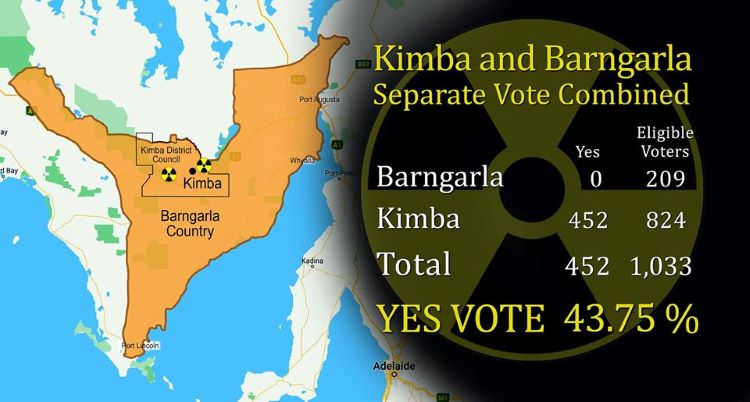
Schedule 1 of the Bill is a blatant and indisputable attempt to prevent any judicial review proceedings which would have been initiated by the Barngarla people (and potentially other members of the Kimba Community)
There is clearly no broad community support and such material suggesting there is, was manufactured by gerrymandering the ballot to exclude the Barngarla.
The Barngarla Determination Aboriginal Corporation to Senate Committee on National Radioactive Waste Management Amendment (Site Specification, Community Fund and Other Measures) Bill 2020 [Provisions]
Submission 25 The Barngarla Determination Aboriginal Corporation RNTBC ICN 8603 (BDAC) is the
registered native title body corporate for the Barngarla native title holders.1 As the determined native title holders for the Kimba area, which includes the site of Napandee, the Barngarla people seek to make a submission to the Senate Standing Committees on Economics (the Committee) as part of the Committee’s inquiry…….
………….., once the pandemic is resolved, BDAC consider it important that the Committee should attend on Country and hear from the Barngarla people directly. BDAC would welcome this opportunity and may seek to provide supplementary submissions at this time.
4. The Committee would be aware that members of BDAC were excluded from participating in a community ballot, facilitated by the District Council of Kimba between 3 October 2019 and 7 November 2019, to gauge support for the nominated sites of Napandee and Lyndhurst at Kimba.2 As the First Peoples for the Kimba area, this exclusion was alarming to our community given the permanent impact that the National Radioactive Waste Management Facility (NRWMF) would have on Country.
The Barngarla people also hold many parcels of native title land very close to the NRWMF location, and have the right to live on and use this land. That native title land was, and is in many cases, closer to the proposed site than the town of Kimba to the site. To be excluded from the ballot on the technicality that the land was not rateable,
was terrible for the Barngarla community. The ballot returned a yes vote whilst excluding over 200 Barngarla persons who would likely have voted no. Clearly the entire legitimacy of the site selection process is, at best, highly questionable in these circumstances. It is Barngarla’s position that the site selection process has entirely miscarried. There is clearly no broad community support and such material suggesting there is, was manufactured by gerrymandering the ballot to exclude the Barngarla. We are also aware that community consultation was not consistent with processes used for the Wallerberdina site and, as a result, also excluded members of the farming
community living and working in the Kimba area from the community ballot.
However, we respectfully submit to the Committee that the introduction of this Bill (in particular Schedule 1 of the Bill) presents a significantly more disturbing issue which goes beyond the exclusion of voters, seeking to have a voice on the NRWMF, from a community ballot.
6. We respectfully state that the issues raised in our submission, outline such a significant matter of principle that it will become evident to the Committee that Schedule 1 of the Bill should not be passed. We understand that Schedule 1 of the Bill seeks to directly legislate Napandee, as the specified site for the NRWMF, following
the policy decision (which was mischaracterised as a declaration) of the former Minister for Resources and Northern Australia on 1 February 2020. BDAC make clear that the Bill is in no way supported by the Barngarla people and is of the greatest concern to us, not only as the First Peoples for the Kimba area but as Australians in general, given that it effectively removes our right to seek judicial review .
Summary of Submission Continue reading
Sebastian Tops: National Radioactive Waste Management Amendment Bill uses vague unspecified term “controlled material” FOR SECRET REASONS? “

Sebastian Tops to Senate Committee on National Radioactive Waste Management Amendment (Site Specification, Community Fund and Other Measures) Bill 2020 [Provisions] Submission 22
Argument: This Bill involves possible Mutiny or even Treason. My argument here is that this Bill proposal is most disrespectful in several ways. To me this (amendment) Bill does involve democratic mutiny, Federal but also
State.
The Bill has ignored fundamental recommendations and Verdicts from S.A.’s Citizen’s Jury (2016) entirely. Great disloyalty to Australian lands and citizens is also still optionally hidden inside this Bill, for ‘non-Commonwealth’ entities can also be ‘doing their thing’. That disrespectful proposal possibility presents the idea of treason. If (only) a military land zone is required – please say and do so – but that should follow a different process.
This Bill does state to rely on “The principle of voluntarism” (Explanatory Memo, p.1). This Bill therefore fails because it cannot be found reasonable or legal for only one, or even a few South Australian land owner(s) to decide to sell land for purposes that will impact an entire region’s State future outlook negatively in several ways. Could anyone find it democratically respectful and reasonable for one single landowner’s (temporary life) choice and this Bill, to impact an entire State, here possibly South Australia, to become the proposed nuclear victim, again?
There is no ‘voluntary principle’ apart from the one, or two apparent S.A. landowner(s). There might be an NSW heritage or family history link? It would then involve fraud (false declaration), and or treason, at least against S.A.. These are matters relating directly to ethics which have failed fundamental (Australian) morals.
The Bill here proposes to introduce possibly new payment categories for NAW, in Item 33 par. 34B(1)(b) and (c) (Expl. Memo, p.19) “payable to the Commonwealth”. England is part of the ‘Commonwealth’. Further, only a fee is payable “by non-Commonwealth and non-host State users”. Does this mean England can store their (nuclear active) waste in Australia at no cost? This Bill continues to be unspecific on proposals related directly to nuclear most hazardous topics.
With anything nuclear; any relevant information should have been part of, and timely provided to each of the applicable eligible voter prior a vote on the matter. That officially presented voter information determines what could only possibly be stored in an appropriately ‘selected’ region. Not what is possibly proposed in the Bill here, after the actual vote. Otherwise, again, no proper political processes have been applied in this matter (2015 – 2019).
Neither the AEC, nor the District Council of Kimba seem to be willing or able to inform the public what printed information was provided to each of those limited few local voters, prior considering their vote. It could explain why ballots were
not returned. Likely due to a lack of trust in the applied political processes.
Vague unspecified term uses regarding anything nuclear. Who considers that ethical? The term use of “controlled material” is extremely vague, and can involve “all types of waste” (Expl. Memo, Schedule 3, Other Amendments, point 132, p.25). It has unspecified additional unknown liabilities and outcomes, and involves other unspecified responsibilities. Within the JCV (1997). The term use of “controlled material” amends the Object of Act (Expl. Memo, p.12). Controlled
material remains secretive for dubious reasons, and did admittedly under Schedule 3, point 132 not form part at all of the applied vote processes. Were voters made timely aware of any “controlled material” involving “primarily” from “State and Territory Governments, industry, hospitals and universities” (Expl. Memo, part 6A, p.3) to which even “laws cannot apply to regulate, hinder or prevent the doing of a thing” (Expl. Memo, point 94, p.20)?
This Bill fails to specify a clear set of criteria, full accountabilities, appropriate specifications of various necessary kinds, or responsibilities for all parts of this proposal. The proposed long-distance transport of highly hazardous (nuclear active) waste products produced in another State is entirely unnecessary
The Bill proposes for the EPA to not be able to report on environmental matters regarding the proposals inside the Bill put. What is generally known is the necessity to protect life against any poison’s hazard life duration. NAW is supposed to be safely ‘managed’ to protect vital sources like water, esp. in drought affected regions. The lifetime involvement of the EPA would be an absolute minimum requirement as such for any Australian NAW proposal. By not explicitly stating any poison responsible needs for its still unknown hazard life duration, and all its necessary more costly safety requirements, seems rather unprofessional. This Bill presents its disregard for another’s (State or Territory) land, by meaning to apply intentional disrespect to another by not demanding compliance with fundamental NAW safety requirements.
Any hazardous material is to be maintained closest to its source (for safe containment reducing wider risk exposures), minimize handling, introduce future monitoring and re-packing facilities in NSW etc.. Otherwise, if this Bill was to pass then more fully operational regional hospitals would be needed prior commencement of introducing the spread of any hazardous substances etc.. No new strategically located regional fully operational hospitals are proposed in this Bill.
Democratic Human Rights – Self-Determination (not to ever have to endure another State’s own produced (nuclear active) wastes to at least prevent image impairment and future economic opportunity losses.)……
To claim that “The specification of the site … is supported by a comprehensive consultation process” (Explanatory Memo, p.4), is incorrect, as a similar (also foreign) NAW proposal was considered earlier in the process. That process did receive an official S.A. Citizens Verdict, stating: “Under no circumstances do we pursue the disposal of nuclear waste because the potential brand damage is too great a risk to the state”. “It is a threat to a $17.5billion/year (1) income to the state generated from tourism, international students, agriculture, food, wine, seafood, livestock, and this is just the beginning. This is a risk we are not willing to take”. One can suggest that related to foreign (nuclear active) wastes only but, RCNCJ reasons go much deeper into their debated, wider considered, and broader researched nuclear related findings than this Bill seemingly has.
The RCNCJ expressed the need to prevent a lasting State or Territory ‘image impairment’. Storing another’s (nuclear) wastes would have ramifications to South Australia’s economy and negatively impact future opportunities like trade. That particular finding received 82% support. That economic Verdict finding alone relates directly to this Bill amendment proposal. Like “The jury felt it was it was important for environmental impact studies to include impacts beyond radiation”. The reasons state that overall, no economic benefits are sufficient to lose or damage one’s clean and safe image which South Australia still has. The Gawler Ranges are still brilliant. Several other “No” reasons are expressed within that RCNCJ verdict. Another such example: “The project will have significant social costs. Particularly, through the divisiveness of the issue”. How true is that finding alone, and who did dictatorially decide to allow politicians to totally ignore those Citizens Verdict findings?
The (Two-third or three-quarter) majority requirement has not been achieved………
At least two non-compliant issues are present within this Bill as it fails:
1. The JCV (66.6% majority), respecting dubious vote result (under 55%).
2. The Consultation paragraph of the explanatory memo (K. Pitt), as well the Bill ignore South Australian RCNCJ (2016) Verdict. Misrepresentations regarding NAW, “controlled material”, or “doing a thing” do involve inappropriately controlled voting processes, contrary to a controlled RCNCJ (2016) “No” Verdict(s). Non-compliant issues described are to have immediate political ramifications for this (Amendment) Bill and should be denied any further considerations in its
entirety. I elaborate on (also other) reasons in the Appendix “No Because”.
References………..
Appendix “No Because”
Other additional reasons to stop this (Amendment) Bill entirely:
As this amendment Bill relates directly to (anything) nuclear,
1. it would be logical to be very specific, clear, and state exactly what will be included and excluded.
2. full professional and personal accountabilities are to apply at all times, under any of the applicable Laws (State or Federal), otherwise nuclear should finally admit that (anything) nuclear is actually the least regulated industry………
Megan Johnson: National Radioactive Waste Act – not democratic, not transparent, a hasty inadequate plan
I urge you to reject the bill until the community is presented with a transparent, democratic, comprehensive, long-term plan.
Megan Johnson to Senate Inquiry on National Radioactive Waste Management Amendment (Site Specification, Community Fund and Other Measures) Bill 2020 [Provisions]Submission 41
- Democratic Process
The Community Consultation process has not been adequate. This is a matter that affects all South Australians,
and all South Australians should have the democratic right to vote on it.
It is particularly concerning that the Barngarla were excluded from the vote – traditional landowners should be
entitled to a vote, just as residents of Kimba District were entitled to a vote.
The proposed facility is for permanent disposal of low-level waste and temporary storage of intermediate-level
waste. These are two very different concerns, but there has been a down-playing of the role of intermediate-level
waste at the facility. The term ’gloves-and-gowns’ waste has become common parlance in the discussion. This is
not an accurate description of intermediate-level waste, which will not decay to an acceptable level
“during the time for which institutional controls can be relied upon”.
waste. Therefore, intermediate level-waste should be given at least equal discussion.
into service only 5 years ago at Lucas Heights. No-one has been able to adequately explain what purpose is
served by moving intermediate-level waste from the Lucas Heights location to temporary storage at Napandee.
facility. However, the Aube facility is for permanent disposal of low-level waste only. It is not at all comparable
to the proposed facility at Napandee, and is therefore misleading. In the interest of balance, DIIS should have
brought representatives from a community that lives near a temporary storage facility for intermediate-level
waste.
be removed from Napandee between 50-100 years after it is installed. At this stage, the waste will be nowhere
near its half-life. There is no plan and no funding allocated for this re-location.
unintentionally. The community has not been given enough information to make an informed decision.
There are circumstances under which a nuclear waste facility could be the right deal for a community and a
permanent solution to our national waste management. However, the current offering is very poor – I urge you to
reject the bill until the community is presented with a transparent, democratic, comprehensive, long-term plan.
Friends of the Earth condemns shameful Radioactive Waste Management Bill, offers positive alternatives
Friends of the Earth,. to Senate Committee on National Radioactive Waste Management Amendment (Site Specification, Community Fund and Other Measures) Bill 2020 [Provisions] Submission 54
The National Radioactive Waste Management (NRWM) Amendment Bill is deeply flawed and should be rejected. Further, the existing Act is deeply flawed and should be repealed.
The proposal to proceed with the nuclear waste facility despite the unanimous opposition of the Barngarla Traditional Owners is unconscionable and must not be allowed to stand. Shamefully, the federal government excluded Barngarla Traditional Owners from a ‘community ballot’ held in 2019. Therefore the Barngarla Determination Aboriginal Corporation initiated a separate, confidential postal survey of Traditional Owners, conducted by Australian Election Company. This resulted in 100% of respondents voting ‘no’ to the proposed nuclear facility. If the results of the two ballots are combined, the overall level of support falls to just 43.8% of eligible voters (452/824 for the government-initiated
ballot, and 0/209 for the Barngarla ballot) ‒ well short of the government’s benchmark of 65% for ‘broad community support’.
committed the SA Labor Party to “support communities opposing the nomination of their lands or region for a dump site, and any workers who refuse to facilitate the construction and operation or transport and handling of radioactive waste material destined for any contested facility or sites including South Australian Port communities.”
committed the SA Labor Party to “support communities opposing the nomination of their lands or region for a dump site, and any workers who refuse to facilitate the construction and operation or transport and handling of radioactive waste material destined for any contested facility or sites including South Australian Port communities.”
Illegal under SA law: The proposed nuclear waste facility is illegal under South Australia’s
Nuclear Waste Facility (Prohibition) Act, introduced by the SA Liberal Government in the
year 2000 and strengthened by the SA Labor Government in 2002. The federal government is expected to take the draconian and unacceptable step of using regulations to specifically override the SA Nuclear Waste Facility (Prohibition) Act. South Australians are opposed to the proposed nuclear waste facility: a 2015 survey found just 15.7% support for a nuclear waste dump, and a 2018 survey found that those who strongly agreed with stopping the dump outnumbered those who strongly disagreed by a factor of three (41:14).
1 https://www.transcontinental.com.au/story/6454080/state-labor-party-weighs-in-on-nucleardebate/?
cs=1538
2 https://phys.org/news/2020-02-tribal-vote-nixes-radioactive-storage.html
in a region which has no known significant natural resources, including potentially valuable mineral deposits, and which has little or no potential for agriculture or outdoor recreational use”.
waste currently stored at ANSTO’s Lucas Heights site in NSW accounts for an overwhelming majority (>90%) of the waste destined for the nuclear waste facility in SA. There is no logic behind the proposal to move intermediate-level waste from interim abovegroundstorage at Lucas Heights to interim above-ground storage at the Kimba site. The proposed double-handling is illogical, it exposes communities to unnecessary risk, and ARPANSA’s Nuclear Safety Committee has indicated that it is not consistent with international best practice.
from Industry, Innovation and Science to another minister and department (e.g. health) who might do a better job.
Friends of the Earth Australia wishes to emphasise that not only is the NRWM Amendment Bill deploy flawed, the existing National Radioactive Waste Management Act 2012 (NRWMA) is undemocratic in many respects. The Act should either be repealed or radically amended to remove clauses which disempower Australians and in particular First Nations.The current Bill does the exact opposite..
The NRWMA gives the federal government the power to extinguish rights and interests in land targeted for a radioactive waste facility. In so doing the relevant Minister must “take into account any relevant comments by persons with a right or interest in the land” but there is no requirement to secure consent from Traditional Owners.
Muckaty in the Northern Territory.
Previous, failed attempts to establish a Commonwealth radioactive waste facility (repository and store) assumed the need for off-site, centralised facilities. This assumption continues with the current project configuration. However, a closer examination indicates both that this assumption may not be warranted and that there are major information gaps that need to be addressed before informed decisions can be made.
the adequacy/inadequacy of existing storage sites. The failure to actively address these basic issues has worked against progression to the resolution of this contentious public issue in recent decades.
that ANSTO is likely to be operating at its current site for many decades to come.
they significantly raise public-acceptance obstacles. The current co-location proposal would mean double handling i.e. transport to the interim national store then future transport to a currently non-determined disposal site. Such an approach would be likely fail the net benefit test that ARPANSA would need to apply in response to any license application
• Dr Clarence Hardy, Australian Nuclear Association: “It would be entirely feasible to keep storing it [radioactive waste] at Lucas Heights …”7
• Then ARPANSA CEO John Loy: “Should it come about that the national approach to a waste repository not proceed, it will be necessary for the Commonwealth to devise an approach to final disposal of LLW from Lucas Heights, including LLW generated by operation of the RRR [Replacement Research Reactor]. In the meantime, this waste will
have to be continued to be handled properly on the Lucas Heights site. I am satisfied, on the basis of my assessment of the present waste management plan, including the license and conditions applying to the waste operations on site, that it can be.”8
• Department of Education, Science and Tourism: “A significant factor is that ANSTO has the capacity to safety store considerable volumes of waste at Lucas Heights and is unlikely to seek the holding of frequent campaigns to disposal of waste holdings generated after the initial campaign.”9
“ANSTO is capable of handling and storing wastes for long periods of time. There is no difficulty with that. I think we’ve been doing it for many years. We have the capability and technology to do so.”5
3 Friends of the Earth, Beyond Nuclear Initiative, Australian Conservation Foundation, November
Commission Of Inquiry’, https://nuclear.foe.org.au/wp-content/uploads/Responsible-Radioactive-
http://web.archive.org/web/20040610143043/http://www.arpansa.gov.au/reposit/nrwr.htm#for
um
6 September 2008, www.abc.net.au/news/2008-09-22/new-nuclear-waste-site-for-sydney/517372
7 ARPANSA forum, Adelaide, 26 February 2004,
http://web.archive.org/web/20040610143043/http://www.arpansa.gov.au/reposit/nrwr.htm#for
6 September 2008,
7 ARPANSA forum, Adelaide, 26 February 2004,
Reactor at Lucas Heights. Reasons for Decision”, p.30.
9 Application to ARPANSA, 2003, Vol.iii Ch.9 Waste – Transfer and Documentation p.5.
Maurice Blackburn: nuclear waste Bill Amendment is against natural justice, excludes Aboriginal community and concerns
the proposed bill removes the right of judicial review and greatly narrows the review rights of an administrative decision, after the site selection process is underway.
The removal of a fundamental right should only be considered in extreme circumstances,
such as in the case of an emergency. It is clear that the expansion of land for the site is not an emergency, and such, the removal of further review mechanisms is at odds with the principles of natural justice and procedural fairness.
Maurice Blackburn and Co. Submission to the Economics Legislation Committee, National Radioactive Waste Management Amendment (Site Specification, Community Fund and Other Measures) Bill 2020 [Provisions] Submission 76
include any protection or consideration for cultural heritage or the protection for Aboriginal culture as part of this section.
community) and reinforces a perception that the Commonwealth does not take Aboriginal culture and concerns seriously.
Further, while sections 34GA and 34GB are also transitional and replicate current provisions in the Act, we are concerned that the Bill simply replicates these provisions and does not include any explicit protection of consideration of Aboriginal culture or heritage. This is concerning to our clients and other Aboriginal communities (particularly the Barngarla
community) and reinforces a perception that the Commonwealth does not take Aboriginal culture and concerns seriously.
The addition of section 19C in its proposed form purports to provide for procedural fairness, but it is limited in scope and does not prescribe any real requirements to the Minister to meaningfully consider community views or submissions.
The requirement that the Minister must invite any person who has a right or interest to the land to comment and to take into account those comments is a broad concept. It is not clear who will have a right or interest in the land. In our experience Native Title Holders and Traditional Owners are often excluded from consultation and community is often given a narrow interpretation. As we have seen from the community ballots conducted by the Flinders Ranges Council and the Kimba Council, many Native Title holders were precluded from voting in the ballot. This provision, and whether members of the Aboriginal community may comment is left ambiguous.
The requirement that the Minister must ‘take into account any relevant comments’ under subsection 19C(1)(b) is vague and does not prescribe any requirements for the Minister. It does not require the Minister to do anything with the comments or take any action, and minimises the community engagement and consultation paramount to any additional
acquisition or expansion of land.
We submit that the proposed provision places a proactive requirement on the Minister to:
1. Publish any relevant comments on a public forum; and
2. The Minister publish a response showing the consideration given to these comments.
Further, section 19C(4) provides that:
“This section is taken to be an exhaustive statement of the requirements of the
natural justice hearing rule in relation to the following:
(a) a decision about the making of regulations under subsection 19A(1);
(b) the Minister’s decision whether to make an instrument under subsection 19B(1)”.
Maurice Blackburn considers such an exhaustive provision to be draconian in nature, as it limits the ability for community members to challenge and appeal the decisions of the Minister, and submit that this be reconsidered.
In its current form, the proposed bill removes the right of judicial review and greatly narrows the review rights of an administrative decision, after the site selection process is underway.
The removal of a fundamental right should only be considered in extreme circumstances,
such as in the case of an emergency. It is clear that the expansion of land for the site is not an emergency, and such, the removal of further review mechanisms is at odds with the principles of natural justice and procedural fairness.
We submit that section 19C be amended to include meaningful community engagement and mechanisms to challenge and appeal the regulations and decisions by the Minister that accordance with Natural Justice. We propose that this take the form of a mandatory request for submissions from the relevant community and a public response by the Minister within a specified timeframe.
Finally, in recognition of the special connection Aboriginal people have with the land, this provision should make it clear that members of the Aboriginal community are included in this process irrespective of whether they are local residents or title holders.
Brett Pike: The overwhelming majority of South Australians do not want a nuclear waste dump in their State
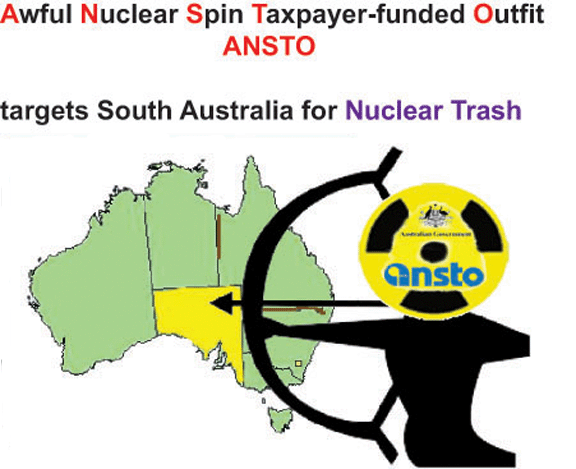 Brett Pike to Senate Committee on National Radioactive Waste Management Amendment (Site Specification, Community Fund and Other Measures) Bill 2020 [Provisions] Submission 67
I am writing today to register my concern and frustration at the continued reoccurring proposals of a Nuclear Waste Dump here in my home state of South Australia.
From the devastating environmental impacts with being so close to National Parks, the long term prolonged economic impact of the local Kimba region due to the stigma associated with hosting a Nuclear Waste Dump, the already vocal disapproval from the local indigenous authority and the cherry picking of voters in the local ballot all suggest that the shadiness of the operation to clout the public’s best interest and render the land useless for the rest of time.
To put it plainly, we don’t want any Nuclear Waste Dumps here in South Australia. We never have and we never will. The overwhelming majority of South Australian’s do not want it here. This bill has to go.
Nancy Lennon:: ensure that key environmental laws are applied to National National Radioactive Waste Management Act
 Nancy Lennon National Radioactive Waste Management Amendment (Site Specification, Community Fund and Other Measures) Bill 202 [Provisions] Submission 66
I respectfully request your rejection of the federal governments proposed changes to the National Radioactive
Waste Management Act.
The government has not made a clear case about the need for the planned national facility at Kimba. Moving
radioactive waste across long distances is extremely hazardous and completely unnecessary. This waste is
presently managed near the site it is generated at Lucas Heights, and it should remain stored in that area.
In particular, I am requesting you to remove options for judicial review of the government’s site selection
under current laws. Rather, please ensure that the key environmental and cultural heritage protection laws are
applied to any future changes in the NRWM Act.
David Myer : nuclear lobby bullying their way by their effort to change the National Radioactive Waste Management Act

David Myer to Senate Committee on National Radioactive Waste Management Amendment (Site Specification, Community Fund and Other Measures) Bill 2020 [Provisions] Submission 68
The proposed waste facility at Kimba is a bad idea.
1. Handling and transport of nuclear waste is seriously hazardous.
2. The native people of the Kimba regoin have not been consulted. This is deeply troubling after years of being
ignored, we finally apologise for our historical appalling treatment of our aborigines, and now here we are
again, pretending they don’t exist, don’t have an opinion and don’t matter. Talk about third class citizens.
3. Removal of common law rights, as proposed in the draft legislation, through the denial of access to judicial
review and exempting environmental and heritage legislation, is tantamount to admitting that “this proposal
won’t stack up so we are bullying our way through.” How dare they exempt the law of the land!
Please do not support the proposed changes to the Act.
A WASTE OF TIME – submissions re radioactive waste dump Inquiry- ONLY TECHNICAL MATTERS will be considered
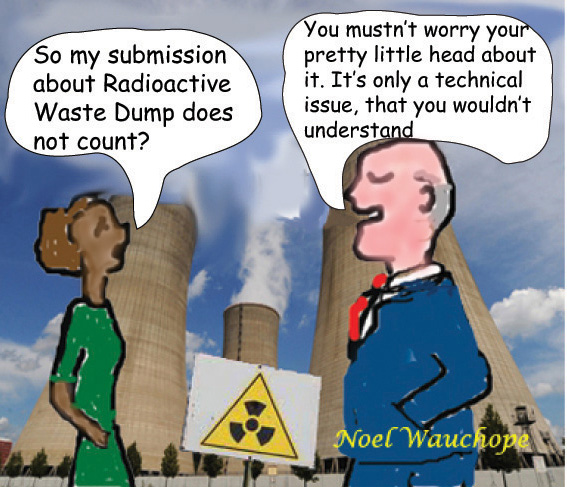
Noel Wauchope 27 May 20 It looks like the Senate Committee inquiring into the Bill to amend the National Radioactive Waste Management Act 2012 will limit the scope of their inquiries to mainly technical and scientific information. This will be done for two reasons.
The first reason is to bolster ANSTO’s position for getting all the licences for the facility at Napandee as described in ARPANSA’s submission since there are strong and real doubts that ANSTO will not succeed in getting them.
This would make the whole selection process a futile and unnecessary exercise without a result. We all know that this cost millions of dollars.
The second reason is that by concentrating on the technical factors the Committee will be able to avoid dealing with the more emotive questions based on the differences within the community, the outcome of the Parliament’s Joint Committee on Human Rights and the destroying of Native Title and other matters. The result is that many of fine submissions to the Committee will now be simply ignored as they do not include technical data.
What hope does the general community have?
Bob and Sue Tulloch: scrutiny needed on Radioactive Waste Management Amendment- paves the way to import foreign nuclear wastes
 Bob and Sue Tulloch ( Flinders Local Action Group ) to Senate Inquiry on National Radioactive Waste Management Amendment (Site Specification, Community Fund and Other Measures) Bill 2020 [Provisions] Submission 72
There is a lot of misinformation about the Federal Government’s proposed National
Nuclear Waste Management Facility at Kimba. Information has been with held from most Australians via a deliberate, discriminatory voting process, with only two South Australian communities ( Hawker / Quorn and
Kimba ) allowed to vote, (1300 citizens) a process that has so far failed them.
Do our law makers understand WHAT they are voting for?
This is NOT, just mainly a low level nuclear waste dump for hospital gloves and gowns. Two dumps co-located are planned. The second, a temporary storage facility, for far more dangerous intermediate level waste. This will include reprocessed spent fuel rods, used in the nuclear reactors at Lucas Heights, being returned to Australia from
France and the UK. Waste needing serious isolation from humans and the environment for 10,000 years. It is the temporary storage of this ILW, that worry people.
Case for keeping ILW at Lucas Heights
World’s best practice for dealing with Intermediate Level Waste, or High Level waste as classified in France and the UK, is permanent, deep underground burial. There are currently no plans for this to happen in Australia. There is also no time limit set for the storage of this waste, to be placed ‘temporarily’ in an above ground shed at Kimba, if moved from its current modern safe, secure storage facility at ANSTO’s Lucas Heights complex.
It is well documented that the cost of establishing a permanent, deep underground disposal facility for Australia’s relatively low volumes of ILW, is prohibitive. Unless the Australian Government is planning to subsidise the cost of establishing a nuclear waste storage and disposal facility at Kimba, by importing nuclear waste from overseas,
one must question the economical rational to relocate ILW to a second, temporary storage facility at, huge expense to the Australian tax payer.
Australian Nuclear Waste Law
Ref. Protecting Authority, Burying Dissent: An Analysis of Australian Nuclear Waste Law – Angela
Morsley. 2016
This paper considers the Australian legal framework for a national nuclear waste repository. The paper argues that the current law protects the Commonwealth’s decision- making in relation to a repository site, at the expense of ‘the place for
public participation in the development of the land’, conservation of Aboriginal heritage and environmental impacts, legitimate protections that under the proposed changes to the Act will be even more eroded.
In 2010 the Senate Legal and Constitutional Affairs Legislation Committee recommended that the NRWMA not be enacted unless mandatory provision was made for a Regional Consultative Committee. Closer analysis reveals that the RCC
has no power or influence over a Ministerial declaration, it’s function being merely to ‘facilitate communication’ between the host community and the Commonwealth’.
….. ‘Consultation may be provided for under the NRWMA, but there is no evidence to suggest that it has anything other that a tokenistic place within a legal framework that positions site selection as an almost inevitable outcome of nomination, supported by Ministerial fiat, rather than broadly sought public consent.’
The South Australian Parliament has legislation in place under the Nuclear Waste Storage Facility (Prohibition) Act 2000 to prevent the construction of such a facility and the transportation of radioactive waste through the state. The proposed
amendment to the NRWNA to nominate the Napandee site near Kimba as the‘relevant land’, will exclude all state legislation from regulation of all activities associated with the NRWMF. ARPANSA’s Code of Practice for the Safe Transport
of Radioactive Materials, is merely a code of practice and not a statute, is unenforceable in regards to the transportation of radioactive waste through South Australia.
Australia’s Future Nuclear Industry Involvement
Questions about nuclear power generation in Australia, future lucrative ‘fuel leasing’ plans involving an Australian Nuclear Fuel Industry as detailed in the following government reports, and the role a ILW storage facility at Kimba will play, need
clarification and public disclosure.
Australia’s Uranium – Greenhouse friendly fuel for an energy hungry world
A case study into the strategic importance of Australia’s uranium resources for the Inquiry into
developing Australia’s non-fossil fuel energy industry. November 2006
Final Report and recommendations of the SA Nuclear Fuel Cycle Royal Commission.
May 2016
Not without your approval: a way forward for nuclear technology in Australia;
Report of the inquiry into the prerequisites for nuclear energy in Australia; Dec 2019
A report by the House of Representatives Standing Committee on the Environment & Energy.
The proposed amendments to NRWM Act, 4A, specifically, refers to ‘radioactive waste’ to be replaced with ‘controlled materials’ (ref ARPANSA Act 1998 ‘controlled material means any natural or artificial material, whether in solid or liquid form, or in the form of a gas or vapour, which emits ionizing radiation spontaneously’), and removal of the words ‘domestic origin’, can allow future operations of the storage facility to encompass nuclear power and nuclear fuel leasing industries as detailed in the Dec 2019 ‘Not without your approval’ report.
For these reasons, more scrutiny on this proposal should be obligatory, and a genuine national discussion implemented. Information supplied to the communities of Hawker/Quorn, Kimba did not include these possibilities, and ballot results obtained from 1207 votes does NOT therefore represent an honest national conversation.
To pass the proposed amendments to the NRWM Act now, would be irresponsible and premature to say the least.
Legal action to follow the shonky National Radioactive Waste Management’s processes?
 This is an extract from Peter Remta – submission to Senate Committee on National Radioactive Waste Management Amendment (Site Specification, Community Fund and Other Measures) Bill 2020 [Provisions] Submission 65
“…………..PROVIDED INFORMATION
All of the information on which the government has based its proposals for the facility has been completely one-sided and self-serving and without any opposing or contrary research and opinions being presented to the Kimba community.
At no stage has the government provided or suggested any review or assessment of its information by the general community of Kimba especially when its members have asked some awkward questions which were mostly responded to by deflecting information or simply left unanswered.
When it was requested to do so the government neither responded nor provided any financial assistance for an independent assessment and scrutiny of its proposals and the information provided by the government and the District Council to the Kimba community.
This is a most unfair and unsatisfactory situation considering the quantum of substantial grants made by the government to the Kimba and previously Hawker communities in order to obtain their approval for hosting the government’s facility.
To that extent the members of the Kimba community opposing the government’s proposals have been deprived of properly and fully testing the validity of the information given by the government as in many instances it lacked credibility and caused grave concern within the Kimba community.
All of this flies completely in the face of the facts and the implications of human rights described in the explanatory memorandum especially as the members of the Kimba community were deprived of the full benefits of those rights and their consequences.
BALLOTS
The Kimba District Council has held two ballots to gauge the community support for
proposed facility with the later being in October 2019.
The results of that ballot were:
Voting papers issued 824
Formal votes accepted 735
Yes vote 452
No vote 283
Informal (no vote) 89
The government decided that the result is the percentage of yes votes of the total formal votes accepted and this is 61.5% in favour. However if the informal 89 votes were rightly included then the result is 54.8% in favour.
The voting base for this ballot was relatively limited as explained in the Federal Court decision dismissing the Barngarla appeal and even excluding the Barngarla many people within the Kimba region who should have been given a vote were not included The irony is that there were residents of the Kimba area who were denied a right to
vote yet they lived closer to the town than some of the eligible voters.
A previous community ballot was held at Kimba in June 2017 with people in the District being encouraged to participate in voting. While it was claimed that this ballot achieved voting of 57.4% in favour and 42.6% against on a total of 691 votes accepted the result in favour dropped to slightly less as they were not resident ratepayers which was the necessary qualification prescribed for the voting.than 50% based on the total of 793 voting papers issued.
INFORMED CONSENT
For a proper and fair ballot vote the Kimba District Council which arranged the ballot should have provided the voters with full written explanations accompanying the voting papers as to both sides of the question to be decided by the ballot so as to enable the intending voters to make a fully considered and informed decision. This has not been done and therefore makes the result highly suspect and unreliable.
Most importantly all the information regarding every aspect of the facility has been provided solely by the government and has been completely one-sided without any information to the contrary or at least a proper scrutiny of the government’s proposals.
Still on the issue of informed consent the government has never enabled or offered the members of the Kimba community who oppose the facility to obtain their own independent advice and assessment of the government’s proposals or to provide funds to meet the costs involved.
This has become extremely important as some of the information given by or on behalf of the government or the District Council of Kimba as proponents of the facility has been misleading or plainly wrong.
It is a well established legal principle that the Kimba District Council owes a duty of care to its community in providing proper and full information on any important issue such as the proposal to establish the facility but the Council has quite clearly failed tosatisfy that duty at law.
Leaving aside any legal rights and remedies available to the Kimba community in that regard the most pragmatic and practical solution would be for the government to pay for a full and proper independent assessment and critical analysis of the whole situation for or on behalf of the members of the community opposing or questioning
the government’s proposals.
This could then be followed by a much wider based ballot which would include explanations of the for and against cases in full so that a properly informed decision can be made by the intending voters. In the overall situation this is probably the most important factor having regard to the mainly disingenuous or at least misleading information from the government over the past four years.
This becomes even more relevant having regard to the numerous requests for information which have never been satisfied by the government in any of its guises and to that extent the community of Kimba were deprived of their full rights described in the explanatory memorandum.
LEGAL ACTIONS
It would seem that in all the circumstances the members of the Kimba community opposing the facility (should they feel so inclined) would have a right of action against the District Council and probably the federal government on the issues of failing to provide full and proper information and holding a fair and more extended ballot based on that information.
It could readily be argued by the Kimba community members who feel aggrieved by the actions of the District Council and the government that the voting rights should be extended to a much broader area and include persons who are not necessarily on the ratepayers’ roll but still have a close affinity to Kimba. For example there are apparently instances of community members who are not on the roll but are much closer to the Kimba township than some of the persons entered on the roll.
Australian nuclear dump decision trashes indigenous peoples’ rights
|
Australian nuclear dump decision trashes indigenous peoples’ rights, https://www.foe.org.au/australian_nuclear_dump_decision_trashes_indigenous_peoples_rights Jim Green and Michele Madigan, 26 May 20, Earlier this year, the Saugeen Ojibway Nation voted against plans for a deep geological repository near Lake Huron. The Canadian government will respect the decision and will no longer target the site. Sadly, the situation in Australia is the exact opposite: Traditional Owners were denied a right to vote in a ‘community ballot’ concerning a national nuclear waste dump, and the federal government is proceeding with the dump despite their unanimous opposition.
The federal government announced in February that it plans to establish a national nuclear waste ‘facility’ near Kimba on South Australia’s Eyre Peninsula. It will comprise a permanent dump for low-level nuclear waste, and an ‘interim’ store for long-lived intermediate-level waste. Shamefully, the federal government has decided to move ahead despite the unanimous opposition of the Barngarla Traditional Owners, native title holders over the area. The federal government refused a request from the Barngarla Determination Aboriginal Corporation (BDAC) to include traditional owners in a ‘community ballot’ held last year. So BDAC engaged the Australian Election Company to conduct a confidential postal ballot open to all Barngarla Traditional Owners. None of the respondents voted in favour of the dump. Jim Green and Michele Madigan Earlier this year, the Saugeen Ojibway Nation voted against plans for a deep geological repository near Lake Huron. The Canadian government will respect the decision and will no longer target the site. Sadly, the situation in Australia is the exact opposite: Traditional Owners were denied a right to vote in a ‘community ballot’ concerning a national nuclear waste dump, and the federal government is proceeding with the dump despite their unanimous opposition. The federal government announced in February that it plans to establish a national nuclear waste ‘facility’ near Kimba on South Australia’s Eyre Peninsula. It will comprise a permanent dump for low-level nuclear waste, and an ‘interim’ store for long-lived intermediate-level waste. Shamefully, the federal government has decided to move ahead despite the unanimous opposition of the Barngarla Traditional Owners, native title holders over the area. The federal government refused a request from the Barngarla Determination Aboriginal Corporation (BDAC) to include traditional owners in a ‘community ballot’ held last year. So BDAC engaged the Australian Election Company to conduct a confidential postal ballot open to all Barngarla Traditional Owners. None of the respondents voted in favour of the dump. Racist legislation The National Radioactive Waste Management Act systematically discriminates against Australia’s First Nations. For example, the nomination of a site for a nuclear dump is valid even if Aboriginal traditional owners were not consulted and did not give consent. And the Act has sections which nullify or curtail the application of laws such as the Aboriginal and Torres Strait Islander Heritage Protection Act 1984, and the Native Title Act 1993. The federal government recently announced that it plans to amend the Waste Management Act. While the Act is sorely in need of an overhaul, the planned amendments aren’t those that are needed. Clauses in the Act that dispossess and disempower traditional owners will remain untouched. Indeed, the planned amendments will, if passed, further disempower traditional owners. Barngarla Traditional Owners are lobbying opposition and cross-bench federal parliamentarians regarding the flawed amendments. A recent report by the federal parliament’s Joint Committee on Human Rights found that the amendments could breach international law by failing to protect the human rights of Barngarla Traditional Owners and that the amendments pose a significant risk to their right to culture and self-determination. Appalling process The South Australian Labor Party argues that traditional owners ought to have a right of veto over nuclear projects given the sad and sorry history of the nuclear industry in South Australia, stretching back to the British atomic bomb tests at Maralinga and Emu Field. Deputy Leader of the Opposition Susan Close says that South Australian Labor is “utterly opposed” to the “appalling” process which led to the announcement regarding the Kimba site. Compare that to the federal government, whose mind-set seems not to have advanced from the ‘Aboriginal natives shall not be counted’ clause in the Constitution Act 1900. As Barngarla Traditional Owner Jeanne Miller says, Aboriginal people with no voting power are put back 50 years, “again classed as flora and fauna.” The current debate follows a history of similar proposals ‒ all of them defeated, with traditional owners repeatedly leading successful campaigns. In 2004, after a six-year battle, the Howard government abandoned plans for a national nuclear waste dump in SA. The Kupa Piti Kungka Tjuta ‒ a senior Aboriginal women’s council ‒ congratulated the government for belatedly getting their ‘ears out of their pockets’. In 2016, the plan to import high-level nuclear waste from around the world was abandoned after a Citizens’ Jury noted the lack of Aboriginal consent and concluded that “the government should accept that the Elders have said NO and stop ignoring their opinions.” And last year, the federal government abandoned plans for a national nuclear dump in South Australia’s Flinders Ranges, a plan that was fiercely contested by Adnyamathanha Traditional Owners. South Australian Premier Steven Marshall is rightly proud of his record promoting the growth of renewable energy in the state. And he’s proud of his significant role in putting an end to the plan to import high-level nuclear waste from around the world. But the Premier ‒ whose portfolio includes Aboriginal Affairs and Reconciliation ‒ supports the federal government’s nuclear dump plan. He needs, as the Kungkas put it, to get his ears out of his pockets and to respect the unanimous opposition of the Barngarla Traditional Owners. The fight goes on! More information: www.nuclear.foe.org.au/waste Jim Green is the national nuclear campaigner with Friends of the Earth Australia. Michele Madigan is a Sister of St Joseph who has spent the past 40 years working with Aboriginal people across South Australia. |
|
The false economics promised by the government’s National Radioactive Waste Management plan
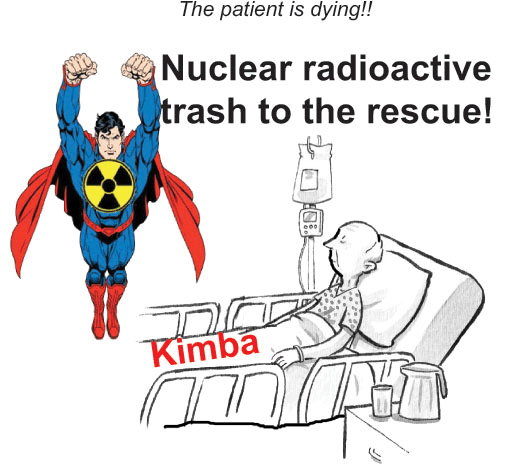
on all proper assessments and studies it is quite clear that the suggested benefits will not become a reality and in fact may lead to a deterioration in the value of the farming lands and residential properties at Kimba due the presence of the nuclear waste facility.
the government is doing no more than attempting to create a false economy which regrettably is being seized on by some members of the Kimba community as the misconceived salvation of its present depressed rural conditions which are actually common to the rest of Australia.
This is an extract from Peter Remta – submission to Senate Committee on National Radioactive Waste Management Amendment (Site Specification, Community Fund and Other Measures) Bill 2020 [Provisions] Submission 65
“………FINANCIAL GRANTS
The government has made significant financial grants to Kimba and also previously Hawker to gain community approval for its proposals. While it is a little difficult to ascertain the exact amounts of the grants the list of
recipients indicates that many of them were for rather nebulous and unnecessary purposes with little support or justification. In December 2018 the government first mentioned a so called community purposes
grant of $31million but failed to provide full details of the grant and its application.
Eventually it was explained that this grant would be a community development package to build economic capacity skills and resilience within those communities and to help realise the economic benefits of hosting the facility.
The three components of the package were:
(a) $8 million for community skills and development
(b) $3 million from the government’s Indigenous Advancement Strategy to support economic opportunities for the local Aboriginal community
(c) $20 million as a community fund to contribute towards a range of community focused projects including sustainable health services agricultural research and development and enhancements to local infrastructure such as roads and telecommunications
Even if component (a) were excluded the remaining applications of money should be part of the normal expenditure by the federal and state governments and be completely unrelated to and independent of the community’s acceptance of the facility.
In fact the local Aboriginal community considers that the moneys from the Advancement Strategy would be available to it in any event under previous arrangements.
Yet at the Senate estimates hearing on 21 February 2019 Manager Chard of the so called national radioactive waste management taskforce stated on behalf of the Department that the community development package of $31 million (she referred to it as $30 million) was being “enshrined” in legislation because this was requested by the community.
She also said that fund – being presumably the component of $20 million of the total package – was “not dependent on the legislation change” since it was envisaged that a fund would be established to support the community when the existing legislation was “conceived” in 2012 even though there had never been any public release or mention of the package and its value until December 2018.
ECONOMIC BENEFITS
The government has constantly promoted the notion and claimed that the establishment of the facility will lead to significant economic benefits for the Kimba region and its community.
The argument espoused and promoted by the government is that Kimba is a dying agricultural area with no future prospects of revival and consequently the establishment of the facility will provide significant increased employment and other infrastructure benefits ensuring its future for an even quoted figure of 300 years. The economic prospects for Kimba would also be augmented and improved by the intended grants from the government already described as the community development package.
However on all proper assessments and studies it is quite clear that the suggested benefits will not become a reality and in fact may lead to a deterioration in the value of the farming lands and residential properties at Kimba due the presence of the nuclear waste facility.
Based on proper and considered financial advice it seems that the government is doing no more than attempting to create a false economy which regrettably is being seized on by some members of the Kimba community as the misconceived salvation of its present depressed rural conditions which are actually common to the rest of Australia.
This is a completely wishful but unrealistic perception since it has already been shown by other examples that the facility would in a normal commercial sense need less than 10 workers unlike the government’s constantly quoted figure of 45 workers. Moreover the construction of the facility at Kimba will probably be carried out by already qualified and well experienced contractors from outside of Kimba and their presence during the building stage will add little to the local community……….”
Napandee is geologically and geophysically unsuitable for Australia’s nuclear waste dump

This is an extract from Peter Remta – submission to Senate Committee on National Radioactive Waste Management Amendment (Site Specification, Community Fund and Other Measures) Bill 2020 [Provisions] Submission 65
“……….NAPANDEE
Napandee near Kimba in South Australia is the site chosen by the government for its national radioactive waste management facility which would be given legislative effect by the enactment of the Bill.
Unlike what was stated by the responsible minister Napandee is not a locality or community but simply the name of the farm part of which will be acquired by the government by purchase to host the facility. Again contrary to what the minister has said there is no community at Napandee supporting the government’s proposals other than the resident owners of the farm whose opinion must be discounted because of their financial interest.
SUITABILITY
The Napandee site is both geologically and geophysically unsuitable for hosting the facility.
This is confirmed by many experts locally and overseas who are surprised at thechoice of Napandee since it is a most inappropriate ground and soil mineral structure for the construction and the operations of the waste facility.
Because of the soil and ground conditions it would be extremely difficult to properly clean up the area in the event of any escape of waste and would probably leave the ground contaminated for many decades.
The main reasons for its unsuitability are that the Napandee site is on sands of unconsolidated sediments to a depth of some 30 metres in an area of known seismic volatility with several significant earthquakes having been recorded in the past fifty years.
LOCATION
Kimba (and this includes the Napandee farm which is located some 25 kms by road west of the Kimba township) is a prime agricultural area renowned for its cereal crop growing and livestock pastures and is a totally inappropriate and unsuitable location for the facility.
Again based on well regarded and authoritative expert opinion the establishment of the facility at Kimba will be greatly detrimental to its agricultural and farming industry from which the region may never recover.
The financial and economic loss within the agricultural industry for the Kimba region will be incapable of being replaced by any economic benefits claimed by the government to be gained from the waste facility.
The government has attempted to show that agriculture and nuclear waste management can coexist in a satisfactory manner as is the case with the Champagne district of France.
However that situation together with many others throughout Europe has completely changed with significant opposition – and even violent demonstrations – against the storage of nuclear material in their regional localities.
NATURE OF FACILITY
The facility to be constructed at Napandee is based on the model of the El Cabril waste repository in the Córdoba province of Spain.
However the first major difference between the two is that Napandee is in prime agricultural land with many neighbouring and well established farms while El Cabril is in relatively isolated foothills country and until some years ago was a uranium mine which immediately provided a remote and generally uninhabited environment and barrier for that waste facility.
The second is that El Cabril is a very large and highly technical installation with its attendant complexities and costs and consequently is not really an ideal reference example for a very scaled down version for Napandee.
In any case El Cabril despite being regarded as one of the best above ground repositories in the world has recently experienced some water problems which has led the Australian government to look for other possible models for the Napandee facility but no details of this have been publicly released.
In reality El Cabril was probably a bad model to choose for the government’s facility in the first place………..”
Peter Remta: Misleading and inaccurate information provided by authorities on National Radioactive Waste Management
 Peter Remta – submission to Senate Committee on National Radioactive Waste Management Amendment (Site Specification, Community Fund and Other Measures) Bill 2020 [Provisions] Submission 65
“………. EXPLANATORY MEMORANDUM The explanatory memorandum accompanying the Bill simply repeats many of the
inaccurate and misleading comments and information provided by the Department of Industry Innovation and Science and ANSTO to the communities of the initially accepted sites in South Australia since the beginning of the nomination process under the existing legislation.
………I must stress that the serious and unacceptable manner in which quite inaccurate information has been disseminated on behalf of the government on such an important issue both now and during the nomination and selection process has only caused more concern and community dissension and I suggest will lead to a greater general apprehension of starting a nuclear industry in Australia
Explanatory memorandum assertions :
1. While the concept of a single and purpose-built nuclear waste facility is a desired objective as outlined at the start of the explanatory memorandum it will be difficult to achieve as is now proposed.
To begin with it is wrong to say that this facility will support nuclear science and technology since it fails to meet the safety prescriptions for a facility of that nature.
It is also wrong to link the provision of nuclear medicine to the proposed storage and disposal of waste at the facility as the various entities generating waste from medical and research activities will continue relying on their own disposal methods and will not necessarily use a government run business for that purpose.
2. Most importantly it is a totally false and misleading proposition to suggest that the failure to establish the facility as proposed by the government will somehow lead to a reduction in nuclear medical services and treatment and the government should quickly correct that serious misconception since this has been a rather distressing concern for the community at Kimba and generally. It is therefore disingenuous to give that impression that this will be a central
facility for all nuclear waste in Australia.
3. While existing waste is held in numerous locations around the country there is no legal or other requirement that this waste would be disposed of at the facility and it is therefore disingenuous to give the impression that this will
be a central facility for all waste in Australia.
4. The reference to meeting with the international obligations under the Joint Convention4 ignores the safety code requirements promulgated some 12 years later under which it would be very difficult to establish the proposed
facility.
5. The suggestion of acquiring additional land for such things as all weather road access is only another example of the intrinsically unsuitable nature of the chosen site and the lack of planning and the necessary technical knowledge for construction of the facility.
6. The process of identifying a suitable location being a 40 year effort again shows the inability of the government or simply ignores that the current process in a proper manner only began after 2012 under the existing legislation.
7. To suggest proper and successful consultations with community members is a test of normal intelligence having regard to the strong and spirited opposition to the facility from the outset by the community generally and the fact that a concerned Aboriginal group has litigated its opposition to an appeal to the Federal Court5 and may now resort to a referral to the United Nations Human Rights Council.
8. The financial aspects of the government’s proposals lack frankness and justification when it has been claimed variously that the amount so far spent in selecting the site is $55 million or $85 million over the past five years but with a constant refusal to provide any details as to how that money has been spent or applied.
Surely there should be proper public disclosure of this quantum of expenditure when compared to the usual outcry where there is only a fraction of that amount involved if there is no reasonable explanation given. Moreover this should be gauged against the persistent refusal of the government to pay for an independent assessment and scrutiny of its
proposals by the members of the Kimba community who oppose the facility.
9. The statement as to compatibility with human rights is again with respect rather nonsensical when the government was incapable of holding a proper and valid ballot (albeit through the District Council of Kimba) which totally ignored the inclusion of an opposing argument contrary to the recognised and applicable principles of human rights. That ballot and the previous one as well as some claimed community surveys failed to meet the principles of informed consent which places a high standard of compliance on both the government and the District Council.
This becomes even worse by excluding the Aboriginal peoples from the ballotIf the government were genuine then it should hold another ballot with a more appropriate and wider base for voting and with the prior provision of all pertinent
information including the arguments or case against the facility. This goes back to providing a proper assessment and scrutiny of the government’s proposals by the opposing members of the Kimba community which has never been
the case.
Regrettably the compatibility statement is more prescriptive in its content instead of actually dealing with the facts of the situation and circumstances that occurred and which have been presented in the statement in a most favourable light for the government. when under the most basic of constitutional and democratic rights they
should have been included in that process…………
Sections on NAPANDEE FINANCIAL ASPECTS INFORMATION, BALLOTS, and INFORMED CONSENT LEGAL ACTIONS MANAGEMENT of FACILITY INTERNATIONAL OBLIGATIONS TECHNICAL ASSESSMENT [these will be published here separately, later]
…. CONCLUDING COMMENTS aand RECOMMENDATIONS Continue reading
1 This month
15 April – Zoom –Nuclear Power is Not the Solution
Apr 15, 2026 01:00 AM in Canberra, Melbourne, Sydney

Join the International Physicians for the Prevention of Nuclear War (IPPNW) on Tuesday, April 14th for a timely webinar exploring the risks associated with nuclear power and challenging the myth that it offers a simple, safe, carbon-free solution to the climate crisis

of the week – Australians for War Powers Reform (AWPR)
To see nuclear-related stories in greater depth and intensity
 Antinuclear