Centre Alliance Senator Rex Patrick exposes wider flaws in the Australian govt’s targeting of South Australia as nuclear waste dump

 Senator Rex Patrick has shown up the hypocrisy of the Federal Government in its expensive frenzy to foist a nuclear waste dump on rural South Australia. And in instigating the Senate Inquiry into this process, has set in motion the discrediting of the whole National Radioactive Waste Management Facility sham.
However, the propaganda by Western Australian private company Azark is not reliable, either. There is indigenous opposition to nuclear waste dumping in the Leonora region,Western Australia. Western Australia’s Labor government may not support Azark’s low level waste dump plan, may have its own plan for WA.s radioactive waste. This WA private offer is for low level waste disposal and is not for the Fed govt proposed above ground 100 year Store for 10,000 yr nuclear fuel wastes and long lived intermediate level wastes.
This exposes Federal govt’s plan to have two dumps in one, to “co-locate” a long lived waste Store’ along side a low level disposal site. It exposes their priority to dump Federal govt owned long lived nuclear wastes at an above ground “stranded wastes” dump in regional South Australia.
South Australian site selection for a national radioactive waste facility is a “sham”, as Western Australian private project is revealed

 South Australia nuclear waste site a “done deal: claims Senator Rex Patrick https://www.adelaidenow.com.au/business/sa-business-journal/sa-nuclear-waste-site-a-done-deal-senator-rex-patrick/news-story/08524bb4dc5004f467462b1591a55b1f, The Advertiser, Erin Jones, Regional Reporter, June 13, 2018
Centre Alliance senator Rex Patrick told The Advertiser the decision to establish a low-level facility at one of two sites in South Australia appeared to be a “done deal” following the revelation.
In August, Azark Project made a nomination to include the commercial operation of an underground storage facility, near the remote central mining town of Leonora, north of Kalgoorlie.
The South Australian senator, who visited Leonora, said the proposal appeared to have “considerable support” and unlike the two SA sites near Kimba and Hawker, did not need taxpayer funds to proceed.
“Resources Minister Matt Canavan needs to properly engage the proponents of the proposed site near Leonora or risk the whole selection process being confirmed as an absolute sham,” he said.
“It appears as though the new site is a ‘faster runner’ in the race, but won’t be allowed to participate because the Minister is determined to rush to select one of the South Australian sites despite there being a divided community.”
Azark Project chairman George Gear said the WA site had no environmental, land rights or water issues, and the proposal had support of the 2900 people in Leonora Shire.
Mr Gear said he had no confidence in the specially-formed government taskforce considering sites for the waste facility, given Leonora was not on the table.
“Apart from this being a superior site located in a mining area and in solid rock, this wouldn’t cost the taxpayer any money as it’s a private company that will build this,” Mr Gear, a former minister in the Keating government, said.
“The taskforce to date has either spent or committed $40 million and they haven’t finalised the project.
“Azark has completed all of its due diligence at its own cost and has offered to make it available to the taskforce — this invitation was not accepted.”
Mr Gear said Azark Project had decided to pursue the plan on its own, but was expected to meet Mr Canavan in Perth, today.
The Government is expected to decide in coming months whether to build the waste facility in SA, after a final ballot of Kimba and Hawker districts, on August 20.
Mr Canavan has previously said “broad community support” would be needed for the waste facility to go ahead — although no arbitrary figure has been provided.
The two-year site selection process has divided both communities — those in favour believe it would create economic opportunities, while those opposed say it will jeopardise industries.
The district where the waste facility is located would be rewarded by the government with a $10 million community fund to spend on local projects.
Both districts were already benefiting from a $4 million grants fund as a reward for being involved in the site selection process.
Senator Patrick this year successfully pushed for a Senate inquiry into the site selection process used for the national waste facility and an outcome is expected only days before the ballot, on August 14.
In a submission to the inquiry, Kimba’s mayor said more information on financial rewards and jobs was needed before the community voted in the ballot.
Mr Canavan did not respond to questions before deadline.

Medical Association for Prevention of War – an urgent need for an independent inquiry into the production and management of Australia’s nuclear waste.
The Medical Association for Prevention of War (Australia) Sue Wareham OAM MBBS Dr Margaret Beavis MBBS FRACGP MPH President Secretary Submission to Inquiry into the Selection Process for a national radioactive waste management facility in South Australia
The appropriateness and thoroughness of the site selection process for a national radioactive waste management facility at Kimba and Hawker in South Australia, noting the Government has stated that it will not impose such a facility on an unwilling community.
We will address the key issue of “Broad community support”, as we believe the information provided to communities has been misleading. It is not possible to have genuine community consent and a truly “willing community” based on inaccurate and incomplete information.
We will also raise concerns regarding “related matters”, addressing plans to massively increasing the future production of nuclear waste in Australia. There has been very poor process, information and community consultation about this issue also, and it will significantly impact on the community selected for the NRWMF due to markedly increased levels of long lived intermediate level waste being produced for the next 40 years.
The Medical Association for Prevention of War (Australia) works for the elimination of all weapons of mass destruction and the prevention of armed conflict. We promote peace through research, advocacy, peace education and partnerships. Our professional not-forprofit organisation has branches across Australia, and works globally through the International Physicians for the Prevention of Nuclear War.
Nuclear waste is toxic material that can last for millennia, and despite billions of dollars of research over many decades there are still no safe long term solutions. As an organisation we support the creation of a Federal facility, but the current process is unacceptably flawed.
In summary our concerns are:
REGARDING COMMUNITY SUPPORT
1) The NRWMF process as it stands is very divisive. Repeated, highly damaging processes imposed on previously cohesive communities are causing significant harms.
- Considerable amounts of persistently misleading information have been and continue to be presented to communities. Incorrect and incomplete information does not result in genuine consent or community support.
- In particular, despite many statements to the contrary, there is clear failure to observe international best practice standards for long lived intermediate level waste (ILW) management. There is no disposal plan whatsoever for ILW, which needs to be isolated from the ground water and the environment for 10,000-100,000 years, leaving the problem with many future generations of the affected community.
- RELATED MATTER: THE EXPANSION OF NUCLEAR MEDICINE PRODUCTION FOR EXPORT
- The expansion will create 40 years of significantly increased production of ILW.
- There is a lack of demonstrable “Net benefit” for the Australian community. The proposed expansion of medical isotope production needs genuine cost/benefit analysis to make sure this is not a heavily subsidised product being sold into the global market at the expense of the Australian community both now and in the future. Independent NEA/OECD economic modelling finds only 10-15% cost recovery of isotope manufacture when there is genuine inclusion of all costs.
- ANSTO has a narrative of global shortages, yet given falling demand and increasing global supply there is no shortage of Mo99 . The NEA/OECD predict a significant oversupply.
- 4) Again, there is no plan whatsoever for disposal of the additional long lived ILW generated. The current NRWMF process is just “kicking a highly radioactive can down the road”.
Both processes are unacceptably flawed.
MAPW urges
Recognition that currently the information provided to communities is riddled with so much misinformation it calls into question the underlying validity of any community consent process.
A halt to the current NRWMF process until such time as world’s best practice is followed. There is sufficient capacity at the Lucas Heights facility, once regulatory approvals are met, to store LLW and ILW well into the next decade.
Cessation of expansion of nuclear medicine for export, and a phase out of exports, until there is demonstrated, publicly available, clear analysis of cost/benefit and plans for appropriate disposal of the substantial amount of ILW this process will generate.
Transparent evaluation of “net benefit” to the Australian community. This as a whole must underpin the process, and be based on cradle to grave impacts of production.
In closing, it is clear there is an urgent need for an independent inquiry into the production and management of Australia’s nuclear waste.
Dr Beavis would be happy to appear before the committee if that would assist the inquiry. She is a GP with strong interest in public health issues, and teaches at the University of Melbourne in the areas of medicine, global health and nuclear waste.
Government assessment of proposed Kimba nuclear waste dump area is a farce
 Regina McKenzie Fight To Stop Nuclear Waste Dump In Flinders Ranges SA 12 June 18 The cultural assessment is a sham, just another token gesture by the Federal Government to tick a box, RPS failed to do a full cultural walk through and find the cultural significance of the area, they did not survey all Adnyamathanha people, to find the ones with the cultural knowledge of the area, they only did small pockets of area, also for the holes that were dug, no tests pits were done, only just standing watching a front end loader dig, no sieving whatsoever,
I suggested this but no, also hole for the water from drills was dug without a archaeologist present and a grader over a sandhill, no walk through no archaeologist in sight, they ran over marked heritage , a grindstone and dumped waste outside of work area , this assessment is a farce, no one listened , its just all tokenism, and all the underarm dealings behind closed door with the fanatical yes blacks , sounding a lot like insider trading to me. https://www.facebook.com/groups/344452605899556/
Flinders Local Action Group’s detailed submission: Nuclear Waste Dump decision is a National matter – not just a local one
CONCLUSION: The current model to establish a NRWMF is wrong. This initiative has not come from any community. This is a National problem and it needs a National solution.
What is really wrong about this process is that radioactive waste, including the legacy material, is the Nation’s inheritance from an industry which, for its entire lifetime, has not included waste disposal as part of its production process. Filling and stacking drums was never going to be a solution. This is a National issue and a National problem. Small, remote communities, whether at Kimba, the Flinders Ranges or anywhere else, should never be expected to make the decision alone to accept the toxic by-products of one industry’s lifetime production.
The Flinders Ranges are promoted throughout the world as one of the last untouched landscapes that can be easily accessed. Tens of thousands visit the Flinders Ranges each year from all over the world.
A major point has been made of the need to clear our hospitals of low level waste comprised of used gloves, gowns, syringes and other items. This was contradicted, in October 2017, by a DIIS sponsored spokesman in Hawker who “advised that nuclear waste from nuclear medicine procedures in hospitals is virtually zero……the use of nuclear medicine will not contribute to radioactive waste in hospitals……this short lived product is stored for 10 half-lives……and disposed of as hospital waste.
Flinders Local Action Group , Greg Bannon, Roybn Wood, Leon Ashton, Bob Tulloch Submission toTo The Senate Economics References Committee. Inquiry into the process surrounding the Federal Government’s National Radioactive Waste Management Project (NRWMP).(Submission No. 73)
INTRODUCTION The Flinders Local Action Group is a regional group of volunteers based in the Flinders Ranges that have strong concerns about the project proceeding in our community.
The three sites currently under consideration for the facility are all in South Australia – one at Barndioota in the Flinders Ranges and two in Kimba on the Eyre Peninsula. Some of this nuclear waste is a hazard for hundreds of years and some for thousands of years.
The Flinders Local Action Group (FLAG) was formed to challenge the waste facility being built in our area and is made up of indigenous and non-indigenous members of the community. The site at Barndioota is of high cultural and archaeological significance to the Adnyamathanha Traditional Owners, is located in a flood zone, is subject to seismic activity and is located in the iconic Flinders Ranges. We do not believe this site is appropriate for the federal radioactive waste facility. The process of site selection is fundamentally flawed and has caused deep division and stress in our community.
Addressing the Terms of Reference Continue reading
Kay Fels’ strong submission against nuclear waste dump siting, – from a farmer’s point of view
 Kaye Fels Submission to Senate Inquiry re the Nuclear Waste Repository Proposal at Barndioota South Australia (submission No. 63)
I am a life time resident of the Flinders Ranges region of South Australia. For the past 44 years I have lived and worked and now part own a sheep and cattle station within a 25 kilometre radius of the proposed waste repository.
I am deeply concerned at the way the land was volunteered for this purpose. The owner, who is an absentee landlord, saw an opportunity to capitalise on his sale. The irony is that he is an ex politician who was heavily involved in the nuclear debate in the 1990’s. The argument has been raised that you do not have to contact your neighbours if you wish to make changes but this is not a town block, nor is it something which does not come without stigma and or risks. I’m sure the equity of the neighbouring properties will be strongly affected by having a nuclear waste facility in the vicinity.
Another concern is that our stock (sheep and cattle) may also be stigmatised by the proximity of the waste dump and our organic status compromised. That is one source of income. We have been involved with tourism for over 50 years having established station stays, in purpose built cabins, and have continued to optimise this form of income with bush camping, 4WD tracks and providing services to the tourism industry since 1967. This will all now be jeopardised as the clean, green image of the Flinders Ranges is tarnished and why this area is even being considered is beyond me. The promises of a greater attraction, money for the community, jobs and security fade into insignificance when this highly productive region is being compromised by the effects of a nuclear waste facility.
Now for the risks, of which we are told will be minimal. The sites are located in an area where the underground water table is almost at surface level. This could lead to contamination of the underground water source, so vital to the region. The location is also on a piedmont plain and prone to flooding at intervals and intensities that most people would have no knowledge of. The floodwaters end up in Lake Torrens where the residues come to the surface and are blown to the four winds. There is also evidence where the flood systems have combined and resulted in flows into Spencer Gulf. Both scenarios are a recipe for environmental disaster.
Furthermore the site is located in a severe fault line as is the region of the Flinders. The land is constantly moving. We have evidence of huge cracks running for many kilometres on very similar soil types. This location is within 15km from the proposed site on very similar strata. Please see attached photos. If this disturbance was to occur where there is an above ground repository or even a sump, the results would be disastrous. Given that the proposal is to store low level waste in an above ground facility, and temporarily store intermediate waste in that same facility, it seems ludicrous that this is even considered given the geological and environmental features and risks involved. Why all the money has been spent on trying to convince the community what a great thing it would be when it clearly is unsuitable, beggars belief.
I am also very alarmed at how the original “66% of the people of the region were in favour” of the proposal going ahead was arrived at. When I questioned ANSTO regarding this I was told that it was an independent outsourced survey. People were supposedly telephoned and asked their opinion. When I inquired as to the survey base there was complete dismissal by ANSTO with them saying that they had every confidence in how the survey was conducted. I stated that I was not surveyed nor any of my family who also live and work here they tried to tell me that I was. Clearly this process is deeply flawed and there was a plot to choose a site and they chose here.
Apart from the physical disadvantages there is also the psychological damage caused by this proposal. The community has been split and in a small community such as ours which is renowned for its community spirit this is of huge concern. Family who have been friends for generations have been affected and it is ripping the heart out of the soul of the town. There is a lot of anguish and angst which you can’t walk away from although some have chosen to leave. One of the ANSTO representatives came out to speak to us in 2016 – which was the third or fourth visit in the “consultation”. My husband who had recently been through major heart operations was a little confrontational and asked why there was no continuity with the persons involved in the consultations. This person then proceeded to turn on his heel and leave. My son then informed him that he was here to hear our points of view, and was being employed to do so, and as such he was shirking his role. He then proceeded to accept an apology and contritely heard us out.
This is the problem. ANSTO will walk away from the conflict, problems and influences. We are left to deal with the trauma, the disadvantage, the psychological effects on family and relationships and the very real risks involved.
Whilst ANSTO have had representatives in Hawker and Quorn for the past 18 months their primary role has been to inform the public as to the benefits of the nuclear waste facility and sway the dissidents into coming in line with their way of thinking. All the hard questions are answered with “could”, “may”, “possibly won’t” or “shouldn’t” and there is a wealth of grey area to which there are no definite answers. E.g. will the waste repository have an effect on the organic status of our meat?” Answer: “No it shouldn’t impact on your organic status” Shouldn’t but it probably will! Even though there may be no physical impact again there is the stigma – and if there is any leakage into the water table or any contamination we will be left to bear the fallout literally!
Our family has been producing on the land for six generations and it is hoped this will continue into the future. My grandchildren are very concerned for their future here and do not want their future jeopardised by this intrusion. They have as much connection to the land as the aborigines and feel as protective.
The proposal has also caused a huge rift in the aboriginal community with some of the more vocal men in favour. However the women and the men who have lived here continuously are greatly opposed but are not given a voice and have become afraid of those who have assumed power.
We understand that the repository has to be sited somewhere but here is not the place. There are many more years where it could be housed at Lucas Heights so why make the move until necessary and why in an area which is so not suited for very many reasons. The intermediate waste will be temporarily housed in a facility not but for that purpose. Is this because they will build storage for this waste here too eventually? I am sure if the right reasons were quoted ANSTO were honest with us and the money was taken out of the equation there would be very few who would be in favour.
The $2m incentives to the community has already caused much angst as in their wisdom the Aus. Industry department decided to transfer some of their business grant applications into the $2m funding pool leaving community members aghast at the temerity of the businesses. One business owner has moved away because of the level of bitterness and the grant had “fallen through”. While this was happening Aus. Industry did not set the record straight. Not only has this now set a precedent which was advised against by members of the Barndioota Consultative Committee, it has also caused another deep divide in the community.
Many of the older residents of Hawker and district are confused, frightened and tormented by the proposal. One lady in her nineties whose family used to own the Wallerberdina Station blames herself for having sold the land to someone who would “put it up” for consideration as a nuclear waste facility. She has since developed dementia which I am sure has been hastened by the added stress.
Also of extreme concern is the amount of time, money and resources which has already been expended in convincing the community that this is a good idea. Why all this expenditure has occurred before feasibility studies have been conducted, clearance given by the aboriginals and other land holders and the state government (which I believe is bound by a nuclear waste management act) I cannot comprehend. As a taxpayer I am astounded at the waste of money over the past two plus years on this proposal which may not and I hope not come to fruition. I would like to know how much has already been spent on resources and all costs involved in this project. Independent studies should have been carried out. No, – more resources have been extended gagging people who are exponents of the negative. Some working for government departments have been told their jobs are on the line if they speak out further. Is this an honest and transparent process? – I think not!
The consultation phase was a tokenism with ANSTO telling us what will be happening, how safe it is and pushing the affirmative – not a true reflection of the community’s views and concerns. The consultative committee is a rubber stamp only with member’s views either “put down” or not taken seriously and an unworkable number with little effect. Even the meetings do not have minutes but are conveyed as courses of action with no recourse.
I hope the project will be abandoned and speak for many other persons in the community many of whom are afraid to speak out for fear of reprisal. There are no frank and open discussions and I fear that as already quoted, “the heart of the community has been ripped out”.
Let the Federal Government acquire land which is suitable and not in a pristine area which is free from atomic pollutants. Leave our small communities alone and don’t let one person make the decision that his land is available to the detriment of a whole region and community.
Thank you for taking the time to read my submission. For any further clarification or information I can be contacted at or Kaye Fels Please see photos below [on original] for indication of surface movement during 1990’s taken 3/8/2018
Ellenor Day is concerned about conflict of interest in nuclear waste site volunteered by Grant Chapman

Ellenor Day SUBMISSION TO AUSTRALIAN SENATE REGARDING THE: Selection process for a national radioactive waste management facility in South Australia (Submission No. 67)
I am writing as a resident of Quorn, South Australia, in regards to the proposed national radioactive waste management facility in South Australia. I have lived in the region for 8 years and have recently built a home with my husband in Quorn. While I disagree with having a radioactive waste management facility in South Australia altogether, my submission is only regarding the selection of Barndioota as a possible site, as I have not been part of the consultation process for Kimba.
The government has stated that it will not impose such a facility on an unwilling community. However, the methods of consultation upon which their statements about a broad level of community support are based, are flawed. Below are my thoughts and opinions in the context of the Terms of Reference provided:
a) the financial compensation offered to applicants for the acquisition of land under the Nominations of Land Guidelines;
My concerns are not about the compensation offered to land-owners, however in the case of the Barndioota site, the site is co-owned by an ex-Federal Senator Grant Chapman, who served on various Committees relating to this industry. This does call into question whether Mr Chapman had prior knowledge of plans to build a facility of this nature. There was no consultation with neighbours at that time which I find quite astounding.
b) how the need for ‘broad community support’ has played and will continue to play a part in the process, including:
i) the definition of ‘broad community support’, and
Broad community support is a somewhat ambiguous term, and the basis for which the government is stating they have broad community support for Barndioota is flawed. Please see below for details.
- how ‘broad community support’ has been or will be determined for each process advancement stage; In this section, I refer to this report: http://www.radioactivewaste.gov.au/sites/prod.radioactivewaste/files/files/NRWMF%20 Community%20Sentiment%20Surveys%20Report.pdf
My concerns begin with the Australian government’s sample size used to make the statement that “The nomination at Barndioota in South Australia demonstrated strong overall support (65 per cent of those surveyed) for moving ahead to Phase 2”.
They phoned 228 people, 59 refused to be surveyed and contact couldn’t be made with a further 56. So 113 households were surveyed, and in total 146 responses were received. That is just 146 people out of an estimated 1671 population for the Flinders Ranges Council area at that time (Refer to ABS Statistics for detail). On that basis, the “strong support” is based on just 95 people (or 5.7% expressed as a percentage of the total Flinders Ranges Council population).
The total responses included 38 people from Hawker and 106 from Quorn (as well as 2 from other areas around Barndioota). Neighbours, Indigenous people and Businesses were apparently surveyed separately, so these are not included in the 65% statistic I’m talking about.
In their own document, the government said there is a high margin of error for consultations around the Barndioota site. Even they got confused, because on one page they say it was +/-10% and on another page they said it was +/-9%.
In the initial survey report, just 3% of Indigenous people surveyed supported the Nuclear Waste Facility. 65% of Neighbours either Strongly Opposed or Opposed.
- how any need for Indigenous support has played and will continue to play a part in the process, including how Indigenous support has been or will be determined for each process advancement stage;
In the initial survey report, just 3% of Indigenous people surveyed supported the Nuclear Waste Facility (from a sample of 77 people). The consultation process should have stopped then and there and an alternative site should have been explored for the Nuclear Waste Facility.
After many years working with Aboriginal communities, I would also suggest that while clearly some Aboriginal people support the proposal, they are not representative of all Aboriginal people in the region. In the same way that my opinion is not representative of all non-Aboriginal people in the region, it’s important to recognise there are many voices and they are all important.
- whether and/or how the Government’s ‘community benefit program’ payments affect broad community and Indigenous community sentiment;
I do not have strong opinions about the Community Benefit program, however, it is clearly a ‘sweetener’ to encourage the community to get on board and support the Nuclear Waste Facility. Additionally, the job advertisement for the local Community Liaison Officer was very marketing and promotion focused rather than being targeted towards real, meaningful community engagement
e) whether wider (Eyre Peninsular or state-wide) community views should be taken into consideration and, if so, how this is occurring or should be occurring; and
For info, there is no ‘r’ in Peninsula.
I don’t believe in state-wide views being taken into consideration, because I fear that city-based South Australians, as well as populations south of Adelaide, will not care what happens in our region. It is so far away from their homes, their families and their lives. People living in our region, however, are living this issue and it has divided communities. This facility has the potential to impact on our lives, our businesses, and the prosperity of our region, given the Flinders Ranges is one of SA’s greatest tourism destinations.
Community views should be sought from people located in and around the proposed sites. I strongly believe this includes, for the Barndioota site – Hawker, Quorn, Cradock and Port Augusta. Some consideration also needs to be given to landowners and businesses located north of Hawker. I think Port Augusta opinions are important, as if such a facility is built in the region, tourism businesses in Port Augusta may also suffer as a result and
I think Port Augusta people have a right to have a say in that too. Notably, many people in the Port Augusta community have connections to Hawker and Quorn and regularly visit the area for tourism, recreation and to visit family.
The marketing of information sessions for the community has been extremely poor and, as a result, I believe there have been some low attendance numbers. I attended a session for business owners in late 2017 in Quorn and there was only a handful of business representatives there because of a lack of advertising. In fact, I only found out about the session by accident as I saw something on Facebook the day before and sought out further information. At this session, I asked if any economic analysis/data modelling had been completed to provide evidence of the proposed benefits and was told that this had not yet been done. How, after two years, is this possible this had not yet been done? A whole department is dedicated to this process – yet meaningful data has still not been gathered (nor has meaningful consultation been undertaken to obtain statistically significant data on community opinions).
I provided my contact details and business card at that session I attended to ensure I didn’t miss out on any further information. Yet I have not ever heard from anyone from the department since. As a result, I missed the last meeting they held in Quorn recently because I was out of town.
I would like to see meaningful community engagement in any further efforts to gather community views. You can’t just put a poster on the community noticeboard and tell the committee to tell their friends – that is not adequate community consultation.
f) any other related matters. I have noted some submissions published on the website so far are from members of the Barndioota Consultative Committee (BCC) who are paid allowances to sit on that committee. In considering all submissions, I think it’s important that the Standing Committee are advised who are currently being paid by the government for this purpose and who are independent community members. I appreciate that the BCC committee members deserve to have their say as part of this process – the same as all of us – but I think transparency in this case is very important.
Ruth Tulloch: “community consultation” by National Radioactive Waste Management – ” a huge, expensive marketing exercise “
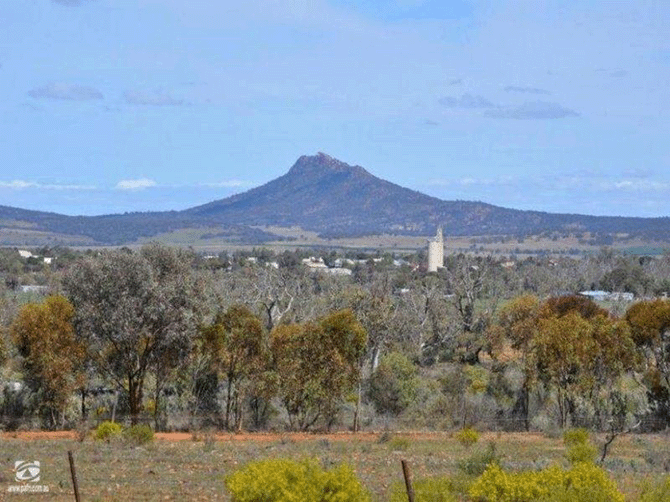
I have found this whole process to be not much more than a huge, expensive marketing exercise by a government department desperate to force this facility on to a small outback community
The information that was being given out was also changing. It started as being a low level waste facility and maybe a small amount of temporary low-intermediate waste, to what we now know to be more about intermediate level waste to possibly higher grade waste.
If this facility is so safe and as low impact as claimed then why not place it nearer to Lucas Heights which would cause less cost in transportation, less chance of accidents en-route and easier access for workers etc.
Ruth Tulloch Submission to the Senate Inquiry into the selection process for a national radioactive waste management facility in South Australia (Submission No. 62)
I have been a resident of Quorn for around 23 years and moved to this beautiful part of the state to get away from the congestion, smog and the increasingly impersonal city. I have been involved in the tourism and hospitality industry during my time in Quorn and believe I have a fairly good idea of what people expect to find when visiting The Flinders Ranges. Generally that is natural, un-spoilt and healthy environs to enjoy outdoor pursuits.
I am writing this submission as I am concerned about the lack of real consultation and information with-in the Quorn community.
I have tried to keep informed as best as I can regarding the siting of the Radioactive Waste Management Facility (Dump) in the Flinders Ranges area and am totally opposed to it as I believe it is the most inappropriate area to place such a facility on several grounds including; –
The way the process has been conducted and is being conducted
– (expenditure and marketing) – Not a suitable area – geologically etc – Aboriginal cultural sensitivities
– How it would affect the image of the area i.e.; tourism and the clean, green agricultural image of South Australia and the local area.
I went to the original meeting at the Quorn Town Hall back in early 2016 and was also included in the phone survey.
I was against the dump in that survey which was very confusing, as they would ask a question and then expect an answer on a variant scale for or against without my having any or very little background information as to what was being asked of me or the facility being proposed. I then went to the information meeting where they had glossy brochures and a power point presentation about how wonderful it would be to have a facility nearby. It seemed to be a purely PR and marketing exercise. I was not convinced and unfortunately (or fortunately for the Dept of Innovation, Industry and Science – DIIS) the SA government was also embarking on their own, now apparently defunct, investigation into a nuclear waste depository which made for quite a bit of confusion for many people, which by the way, still exists in the community.
The DIIS people then started having so called meetings in the Quorn Council chambers on a weekly basis whereby 3 or 4 representatives would come over from Canberra and sit in the office in case some-one wanted or happened to walk in and have a chat to them. I did venture in on a couple of occasions and found it at times quite intimidating with these experts ready to throw all their knowledge at me and assure me that all my questions or fears were basically unfounded and unnecessary with no basis to my doubts. I found this attitude extremely dismissive and often derogatory. They were also holding these ‘information sessions’ during office hours when most younger people are working and unable to get there even if they wanted to. A large percentage also work in Port Augusta (approx 40km away) so couldn’t even drop in during a lunch break etc.
This went on for many months at what enormous cost to the taxpayer? Also if they were compiling visitor stats then I would suggest that they may not be accurate, as many of the people who visited them went multiple times, like myself.
The information that was being given out was also changing. It started as being a low level waste facility and maybe a small amount of temporary low-intermediate waste, to what we now know to be more about intermediate level waste to possibly higher grade waste. This depends on who is saying what and what there grading perceptions are…… who should we believe????
DIIS then arranged for a French delegation to come out to assure us of how safe these types of facilities were and how the equivalent in France was operating.
I duly went to the meeting to find out more. Again it was during the day so the majority of the few people that were able to get there were of the older age bracket. During that meeting the head of the facility run by ANDRA (the French equivalent of ANSTO) made a presentation of their process. ANDRA specified that during their selection process there were four essential criteria for their site selection. They were:
Clay base as a natural barrier,
Low risk related to natural environment,
Low seismic activity,
Low risk of flooding
After his presentation I queried these points and asked if the site had a sand base, constant seismic activity, a sensitive natural and native cultural environment, prone to severe flooding events plus a natural and vital underground aquifer, – all the opposites to what he had stated as essential and which are present at the Barndioota site – would he place a facility there? His simple answer was NO!!! I asked a further couple of questions along this line of thought and also directed them to ( ) the DIIS rep and the discussion was immediately dismissed and firmly shut down as “we are not here to discuss that but to listen to the French delegation’s presentation.” In other words… shut up and don’t ask questions that we can’t or don’t want to answer!!!!!!
DIIS then set up the Barndioota Consultative Committee (BCC) as a liaison link to both Quorn and Hawker communities. I am of the belief that this is not the case as I have asked questions of members and on occasion either not had an answer or no answer or explanation has been forthcoming or they were not allowed to discuss issues.
On one occasion, a couple of people I know who visited one of the BCC meeting as observers – which I believe is normal public meeting procedure – were forced to leave the meeting with no plausible explanation as to why they could not stay.
Another concern of mine is the amount of taxpayer’s money that has been spent – in my view wasted – on this process. The cost of sending people from Canberra every week for months/year, the cost of various committees with paid members that have been formed for spurious reasons, the $2 million community grants, the cost of sending anyone who wants to go to Sydney to visit the Lucas Heights Facility to be assured “how safe it is” – which of course it is safe otherwise people wouldn’t be able to work there, plus NO-ONE would be given access to unsafe and or controlled areas any way!!!! I also believe there was an initial offer for expense paid trips to France to view their facility.
A perfect example of my comments is the forming of an Industry Working Committee (whose members are paid), who are in the process of organising ‘The Hawker Industrial Expo’ for May and in their promotion blurb state –
“This will assist the local community and businesses to better prepare for the potential arrival of the NRWM facility”.
A particularly biased statement!
The only contacts for this event are an events management company in Adelaide (who “specialise in Special Events, Conferences and Incentives for corporate, government and non-profit clients”) and the DIIS. More wasted money????
Considering a vote of the communities involved has yet to be undertaken to determine if this will go ahead or not, I find this arrogant and contemptible that it is even being planned this far out from a decision and it appears to already presume that the building of this dump will go ahead. Selection process for a national radioactive waste management facility in South Australia Submission 62 This, to me, smacks of bribery and a vast marketing campaign to ‘win over the locals’.
There has also been quite a bit of discussion around the facility providing new jobs for the area. Again this appears to be misleading as there is no information or guarantees as to how many jobs, who would be skilled for those jobs, would they be given to locals or just advertised to the general population, whether they would be full time part time etc etc etc…… Many questions to be answered and yet many loose or false promises provided.
We have also been constantly told that the facility would be run on ‘World’s Best Practice Principals’. Whilst this is somewhat reassuring in the short term, there are no guarantees that can be given re natural disasters happening or human error factors which are both more likely than not to happen in the long term. Plus DIIS are talking about long term as this waste has a very long half life (ILW) and even though it is supposed to be a temporary facility there are, at this stage, no plans for a permanent waste disposal facility. I understand this to be a critical requirement of having a license issued by ARPANSA.
Wouldn’t it be a more practicable and sensible idea to find a place for a permanent repository for all waste rather than shift it again some time in the future? As we now know, some of the radioactive waste that was dumped at Woomera (SA) some 20 years ago is now leaking and will need analysis and restoring which will take time and a great expense to re-secure and possibly transport again.
Lastly I would like to address the fact that DIIS has a belief that a majority of people in the area are for this ‘dump’ to progress. Again I believe this to be incorrect as nearly 100% of people I have talked to about this are against having it in the Flinders. They may not be going to meetings or jumping up and down in the streets for many, varied and legitimate reasons but they still care and are not in favour of it going ahead. I also Selection process for a national radioactive waste management facility in South Australia Submission 62 feel it divides the community making people less likely to discuss this issue in case they get into arguments with friends and or family.
In summary…I have found this whole process to be not much more than a huge, expensive marketing exercise by a government department desperate to force this facility on to a small outback community with no consideration for what is here and the likely loss of income that would surely follow from having a radioactive waste facility in what is a relatively pristine, clean, green, beautiful environment which is also on the verge of being placed on the World Heritage List. This would have an enormous impact on agriculture and tourism which are the main income streams for this area.
If this facility is so safe and as low impact as claimed then why not place it nearer to Lucas Heights which would cause less cost in transportation, less chance of accidents en-route and easier access for workers etc. Also why were all the other offered sites so quickly dismissed as being unsuitable without the same processes that we are enduring???
SA also has a law prohibiting any nuclear/radioactive waste facility and transportation of such waste through and in the state. Will this mean that the Federal Government will over-ride the wishes of the people of SA who very recently overturned any and all suggestions of a nuclear waste facility?
This should be a decision for all South Australians, and maybe all Australians, to decide not just a few hundred people in 2 small towns. After all it will affect the whole state and country for hundreds of years to come.
I have one last concern and that is regard to the proposed vote for consent to be put to the community sometime (this also varies) this year. Will it be a simple transparent question or like many surveys contain an ambiguous question that is written to get an outcome favourable for the departments Selection process for a national radioactive waste management facility in South Australia Submission own purposes and will it be able to present an unbiased case that all residents can understand.
This submission is not so much about not wanting this facility in our/my backyard so to speak but rather the lack of suitability of the proposed site and the lack of respect, discussion and research by the people conducting the process (DIIS). I hope you have read this submission and take my concerns seriously. I appreciate the opportunity to make my feelings known.
Chloe Hannan: community mental health is a serious issue that is ignored in the nuclear waste dump site selection process

Chloe Hanan, Kimba : Submission to Senate Inquiry: National Radioactive Waste Management Facility (Submission No. 61)
I have grown up in Kimba on our 3rd generation farm and have lived here for the majority of my 28 years. I choose to live, volunteer and raise my own family here in Kimba and I felt it extremely important to put a personal submission into the Senate Inquiry due to the negative impact the National Radioactive Waste Management Facility process has had not only on my family but the Kimba community. I am also open to provide more information to the senate inquiry surrounding the process in Kimba if required.
I would like to make comment on the following Terms of Reference:
b) how the need for ‘broad community support’ has played and will continue to play a part in the process, including: i) the definition of ‘broad community support’, and ii) how ‘broad community support’ has been or will be determined for each process advancement stage;
Right from the very beginning of the process the Minister and the Department of Industry, Innovation & Science have all consistently stated that siting this facility needs ‘broad community support’ and that it will not be imposed on an unwilling community. However, there has never been a clear definition provided to the community apart from the Minister Canavan stating he would need 65% support which was quickly retracted and ignored once the vote in Kimba did not meet that target. Because there has been no definition or set target provided within this process guidelines it means that there is no accountability of the Minister and the Department. This makes a community feel powerless, especially when throughout the 210 days of community consultation that Kimba has endured, what is deemed as broad community support to progress through different stages of the site selection process keeps changing. I believe strongly that at a minimum 2/3rd majority of a community is needed for the siting of the National Radioactive Waste Management Facility to be considered. Especially due the longevity of such a facility – it cannot be just over half, as this is damaging to a community when people are put against people in such a heated debate.
d)whether and/or how the Government’s ‘community benefit program’ payments affect broad community and Indigenous community sentiment;
I strongly believe these payments are deliberately used to influence community consent with the promise of jobs and money even though there is very little detail of the economic impacts of the facility. This should be upfront factual information, not provided later as you progress through the stages.
e) whether wider (Eyre Peninsular or state-wide) community views should be taken into consideration and, if so, how this is occurring or should be occurring The electoral vote in Kimba didn’t capture people that had properties just outside the boundary lines; however, these families have sent or do send their children to Kimba Area School, play sport for Kimba and shop locally; however they would not be eligible to vote even though they are active community members. These people were encouraged to write letters which would be considered by the Minister; however, these have never been mentioned by the Minister when making his decision when progressing Kimba to the next stage. I strongly believe that wider community support should be assessed especially concerning the two sites Lyndhurst and Napandee where it is clear that people in the neighbouring district council area are closer to the Napandee site than many living in the Kimba District Council area
f) any other related matters. The mental health and well-being of communities is completely ignored in this process and this is a serious issue that needs to be addressed in future frameworks and guidelines. This process makes communities feel powerless – no support is given to those with opposing views, it is a process that is heavily favoured towards those pro-nuclear and when the rules keep changing to suit those in favour it really gives people a sense of hopelessness.
Katrina Bohr is dissatisfied with the National Radioactive Waste Management Facility’s process for “Community Consultation”
Katrina Bohr Submission to Senate Inquiry Selection process for a national radioactive waste management facility in South Australia Submission 59
My name is Katrina Bohr. I have been a resident of South Australia for 32 years, having lived in regional South Australia for the last 22 years. Nuclear waste and the historical outcomes of radioactive damage has been an ongoing concern of mine for almost 50 years.
In the initial stages of the announcement for site selection at Barndioota, when Josh Frydenberg was Minister for Resources and Energy, a statement was issued from the Government.
‘The Australian Government will also take into account the views of others (outside community zones) as part of the commitment to broad consultation.’ The proposal for low and intermediate waste to be stored in South Australia affects not only myself, but also future generations. Unlike some respondents, I do not live in the Hawker region. Therefore, my views are not driven by benefits, but rather genuine concerns for peoples’ health, our environment, and our local Indigenous communities.
B) How the need for ‘broad community support’ has played and will continue to play a part in the process, including:
i) The definition of ‘broad community support’ I believe the definition of ‘broad community support’ is defined as support given by the majority. Broad support should be determined when the consultation process has been conducted thoroughly and with all persons of interest. The consultation process should offer full disclosure for the proposed site selection process.
ii) How ‘broad community support’ has been or will be determined for each process advancement stage Determining Broad Community support at this stage has involved a number of methods. Surveys, Public Meetings, face to face meetings, a continual presence of Australian Nuclear and Science and Technology Organisation (ANSTO) employees, members of the Australian Radiation Protection and Nuclear Science Agency (APRANSA) and a Heritage Assessment process.
Rowan Ramsey’s June/July 2016 Grey Newsletter states that all all the feedback, including district surveys were considered by the Minister to evaluate whether there was a realistic chance of ‘developing’ broad support. The word ‘developing’ almost implies an action to develop rather than consult.
My understanding of on-going broad community support is for updated and collated material to be honest and transparent, and that all perspectives be
C) How any need for Indigenous support has played and will continue to play a part in the process, including how Indigenous support has been or will be determined for each process advantage stage;
There are local indigenous people who believe that they should have been consulted from the outset. This is due to Yappala Station (next door to the proposed site) having already been classed as a protected area. Yappala Station is heritage listed as an Indigenous protected area due to its cultural and environmental significance. A South Australian Department of State Development spokesperson confirmed that there are three Aboriginal sites that fall within the Barndioota-nominated area. Two of the sites are cultural and the third is archaeological (NITV Posted 2016). The local indigenous people needed to be involved in all aspects of the site selection process. From heritage assessment to cultural importance. Dreamtime stories and Songlines.
Traditional land owner and Elder Eunice Marsh speaks of their love for the land as love for family. Hookina Springs and the surrounding area is significant to the Adnyamathanha women. When the Adnyamthanha Traditional Lands Association met at the end of March 2018, the vote for the NRWMF was overwhelmingly against.
E) Whether wider (Eyre-Peninsula or State-wide) community views should be taken into consideration and, if so, how this is occurring or should be occurring; I believe that wider community views should be considered as the nuclear waste, and in particular, the intermediate waste from Lucas Heights in NSW will be transported through a number of corridors. Therefore, wider community consultation should be considered. Matt Canavan makes reference to a ‘wide’ consultation process to determine whether the site is suitable’-Transcontinental newspaper 22/11/2016.
As far as I am aware, there has been no wider community consultation to date. Wider community consultation could be conducted through relevant forums, surveys and information mail outs.
F) Any other related matters
In the fairness of disclosure, I have referred to the Australian Government Department of Business Initial Business Case (revised) 2014 Page 29 ‘The Capital cost estimates for the project options are based on delivery of given designs at a site in Central Australia’-Page 60 The Business Case also refers to a Timeline where ANSTO is due to run out of space for low and intermediate storage. This is by 2018.
When in Parliament, Grant Chapman chaired the select committee that recommended the country’s low level nuclear waste be stored in a single facility-The Guardian 29/4/16. Grant Chapman is part owner of the proposed site at Barndioota, and has made it quite public that he believed his land would be an ideal site for a NRWMF. He served on three committees including Uranium mining and milling to Radioactive Waste from March 1995 to May 1997. The other from August 2000 to May 2001. Acting as Chair in the first two committees, where in !996 a decision was made to pursue a NRWMF. There is evidence that there may have been a determination over the years by the Australian Government to establish the site at Barndioota.
Images: I am sending three images displaying the ferociousness of historical flooding near the rail lines in the proposed area for the site. ( these are added in an attachment on the original at https://www.aph.gov.au/Parliamentary_Business/Committees/Senate/Economics/Wastemanagementfacility/Submissions)
Conservation Council South Australia: No adequate case has been made for the establishment of a National Radioactive Waste Management Facility.

In the case of the site nomination of Wallerberdina Station, the pastoral lease is held by an absentee landlord. It is of deep concern that this person can receive financial gain for the siting of a radioactive waste facility which will impact the local community that he is not part of.
To date, there is no definition of the boundaries of “community”, what proportion of a community must support the proposal to be regarded as “broad” or how it will be gauged.
It is a fundamental flaw of the guidelines and the process that these critical parameters have not been defined. They should have been clear before Phase 1 began.
Justification The current proposal for which site selection is already underway has not been justified. No adequate case has been made for the establishment of a National Radioactive Waste Management Facility. The failure of the proponent to consider and review other management options means that justification of the proposal and the site selection process cannot be proven.
It is of deep concern that a site selection process has commenced prior to an investigation of the need for a site.
Conservation SA believes that there is a strong case for extended interim storage at ANSTO’s Lucas Heights reactor, particularly for the intermediate level waste created and already stored there.
The three sites currently under consideration are all in South Australia. South Australia has legislation11 that explicitly bans the establishment of radioactive waste management facilities. There is a lack of clarity and disclosure about how this legislation will be considered in the site selection process.
The nomination process is still open. No nominations should be accepted until the report from this Senate Inquiry has been released so as to minimise any negative impacts on communities and ensure the best possible management of Australia’s most hazardous waste
Conservation SA Craig Wilkins Chief Executive RE: Submission to Senate Inquiry into the selection process for a National Radioactive Waste Management Facility in South Australia (Submission No 55. Contains excellent references)
Conservation SA is an independent, non-profit and strictly non-party political organisation representing around 60 of South Australia’s environment and conservation organisations and their 90,000 members. Conservation SA is grateful for the opportunity to provide comment to the Senate Inquiry into the selection process for a national radioactive waste management facility in South Australia.
We welcome the inquiry into “The appropriateness and thoroughness of the site selection process for a national radioactive waste management facility at Kimba and Hawker in South Australia, noting the Government has stated that it will not impose such a facility on an unwilling community”. Each of the Terms of Reference are addressed in turn below. Continue reading
Nuclear Waste Dump Site Selection: Leszek Gaweda points out the Conflict of Interest, and other negative factors
Leszek Gaweda Submission to Senate Inquiry on Selection process for a national radioactive waste management facility in South Australia (Submission No 54)
I am opposed to the current process on the following grounds:
1. Site Selection: Site nominated by ex Liberal politician Mr Grant Chapman. His nomination should never have been accepted on the grounds of conflict of interest.
Mr Chapman was a strong supporter of storing nuclear waste in Australia during his time as a senator, chairing a Senate committee into the subject and recommending a single national facility, a clear conflict of interest.
Best practice in the world for storage nuclear waste is to store it as close as possible to the production site (Lucas Heights in this case) not thousands of kilometres away.
- Broad Community Support:Communities involved: Transport to the site about 2000km, it’s not just the immediate area that would be effected. In case of accident a large part of the country could become uninhabitable. People from the towns, communities along the route should be consulted.Does the community understand that majority of the waste to be stored there is intermediate to high level? Example Lucas Heights reactor and vitrified nuclear waste brought back from France is intermediate and high level waste as classified in France. This requires isolation from the biosphere for hundreds of thousands of years.
Majority of Low level is only dangerous for hours to days (max few weeks) and doesn’t require a specialised facility.
- Aboriginal Communities‘It’s like getting news of a death’ Adnyamathanha woman Regina McKenzie said the local Indigenous community has been shattered by the announcement.Why haven’t the local Aboriginal community been consulted prior to the announcement? These people lived on these lands for 50,000 years in harmony with the environment and they deserve better.
The nuclear strategists know that Maralinga wounded the Aboriginal people. It is still an open sore and just like vultures, they are still picking on the wounded. Politicians should be protecting the disadvantaged and instead they are supporting and encouraging this assault.
Adnyamathanha Native Title Representative Body (NTRB) known as ATLA.’
They go on to oppose nuclear activities on several counts, including the advisability of renewable energy development instead, and roundly condemn the waste dump proposal:
‘The push for a waste dump in SA keeps coming up repeatedly; we didn’t want it then and we don’t want it now…….Pressuring poverty stricken and isolated communities is unethical, and the public of SA have faced this issue several times in the last decade or more. Enough is enough.’ No means No
4. Water
Much of the region relies heavely upon aquifers to supply settlements, stations, fauna and top up dams.
Polluted water means no business, no food production, no communities just a toxic wasteland to be passed to the future generations.
5. Floods
This region is prone to heavy flooding. Nuclear waste should never be located where flooding occurs. Containment leaks can’t be guaranteed.
On the 14th of February 1955 a huge flood flowed down the Hookina creek only a stone throw away from the proposed Wallerberdina site and washed away a bridge. In the images below you can see the large concrete bridge pylons laying on their sides. The weight of these would be at least 80 tons.
Hookina Spring
“Australia’s first registered Adnya¬mathanha storyline runs 70km from Hawker to Hookina Spring through pastoral and indigenous lands between Lake Torrens and South Australia’s picturesque northern Flinders Ranges, where it is emerging as a battleline ¬between anti-nuclear activists and the federal government ”
She said the Adnyamathanha didn’t want the risk of contamination of groundwaters that fed mound springs on the floodplain where Ms McKenzie brought groups to camp, drink from the spring, and hunt and cook kangaroo in trad¬itional ground ovens and share stories. “We want to share the culture so we can promote this region to the world,’’ she said. “Nobody takes the Aboriginal belief systems seriously — it’s our belief system. I just wish that non-Aboriginal people will look and see the richness in our culture.’’ (Source: The Australian May 23, 2016)
Hopkins Spring is only a stone throw away from the proposed site
- Seismic ActivityFlinders Ranges is the oldest mountain range in the world, the area selected is not seismically stable. In fact it is probably the most seismic area in the whole of Australia 7.7.Food production – Kimba
About 4% of Australia’s land is suitable for agriculture and Kimba is in the 4%, this land must be given highest protection as our future food supply is paramount. If a nuclear waste dump was to be located in Kimba, its reputation as a clean and green supplier of food would be adversely effected.
The perception that SA would be a nuclear waste dump would surely effect our clean and green image and price our agricultural products would attract.
8.Summary
Many locals don’t want industries such as tourism and farming threatened. Many traditional owners do not want cultural heritage sites and their spiritual connection to country put at risk.
South Australians do not want their state turned into nuclear dump.
This issue continues to cause deep division and stress in the affected communities where friends even families are divided and turn against each other.
SA parliament passed the Nuclear Waste Facility Prohibition Act 2000. The object of this Act are “to protect the health, safety and welfare of the people of South Australia and to protect the environment in which they live by prohibiting the establishment of certain nuclear waste storage facilities in this state.
It’s a real travesty of justice that such a proposal is being seriously considered in our beautiful tourist mecca Flinders Ranges and food bowl of our state Kimba.
A cry from a brave indigenous heart
Heather Mckenzie Stuart Fight To Stop Nuclear Waste Dump In Flinders Ranges SA, 4 June 18 Hmm, Regina McKenzie Vivianne C McKenzie I feel that our intelligence has been insulted by DIIS especially how we have been disrespected and ignored in our stand against the proposed nuclear waste dump Barndioota on Adnyamathanha yarta.
Honestly people, we might be Aboriginal and are still part of the flora and fauna and not in the Australian Constitution, but we have a mind of our own and can go between the non Aboriginal world and our culture.
We started our campaign against the dump talking to media etc, attending protest marches, visiting politicians. Vivianne and Regina went to Melbourne to see the then minister Frydenburg. Regina and my grand daughter went to Canberra campaigning with others. Regina’s daughter attended functions in Sydney.
I dropped out attending functions interstate, due to the loss of my only son. The grief of a loss of a child, no matter how old is horrendous, I wouldn’t wish it on anyone, but at the time, the DIIS lot didn’t care about me my feelings, my hurt, my sorrow as a human being, a mother who was in mourning, they still persisted liaisoning with my family organisation and visited family homes in Port Augusta causing unrest among our once close family. During this time, culturally at different times, I should have had my loved ones around me, but due to the unrest among everyone that those lot caused, me and my family were left on our own. Everyones world was turned upside down as we had already lost a dear family member 4 months before my son’s passing, we were already grieving for a nephew.
I love all my family no matter what, but I with my sisters and my family will trudge on against what we believe in and that’s standing up and say NO to a nuclear waste dump on Adnyamathanha yarta. We will never forget the hurt that has been caused through this dump by DIIS dividing and conquering. We have had enough of our family been destroyed bad enough our mum was stolen from her family. #WeWillKeepSayingNoToNuclearWaste#EnoughIsEnough #WeWillNeverGiveUp https://www.facebook.com/groups/344452605899556/
MNEMOSYNE GILES’ powerful submission exposes the deceit in the National Radioactive Waste Management Facility plan
 MNEMOSYNE GILES (citizen of South Australia) to Senate Inquiry on Selection process for a national radioactive waste management facility in South Australia (Submission 51)
I submit that the process of selecting a site for a NRWMF has been fundamentally flawed by the fact that it has not been properly or publicly debated whether a NRWM F is an appropriate response to the problem of Australia,s radioactive waste. It is therefore premature to be selecting a site. The inappropriate campaigns of ANSTO and ARPANSA to find a site as soon as possible,(within one year it is suggested) , are part of the misguided nature of their task
I therefore recommend that this Senate Inquiry lead on to a full independent Judicial inquiry into Australia,s radioactive nuclear waste and whether we should keep producing it. I recommend a moratorium on uranium mining should be held while a decision on what to do with the waste is made.
World wide there is no solution to the long lived ILW (Intermediate Level Waste), and this must be acknowledged and emphasised at all levels of discussion and public consultation. Instead of this the NRWMF site selection process has given the illusion that a National site would be a “safe”solution allowing the industry to continue.
- CORRUPTION The Act 2012 that allows nominated private land to become nuclear radioactive dump sites, allowing State prohibition laws to be over-ridden, needs to be examined in connection with the possible corrupt volunteering of land, ………. I recommend an independent inquiry into how and why the National Dump process was initiated,and what interests,(including defence,may have been involved).
An inquiry should ask :why is nuclear radioactive waste at present not better secured at sites such as Woomera where it currently is held? :how”safe” is any storage of ILW? :would one National site be “safer” than more smaller sites,considering that a National site provides a more definite military target and involves the hazards of transport.
2) COLLUSION It needs to be explained how it came to be that the two campaigns for an International dump in S.A. And a National dump were run in parallel during the year of the NFCRC (Nuclear Fuel Cycle Royal Commission).
I submit that there was communication and co-operation between State and Federal Govts.or other bodies to keep the two separate. The effect of the concurrent campaigns was to confuse the public : if it was designed to confuse , it succeeded :after the S.A. “Citizen,sJury” rejection of the International dump, most South Australians believed the threat of a “Dump” for S.A. was over.
Now many South , Australians believe that this proposed National dump must be quite different, a smaller proposal,necessary for low level medical waste only. I perceive because I have talked to hundreds of people, handing out information leaflets to passers by on the streets of Adelaide, over the last two years. I submit that the separating of the National and International dump proposals has been and is a deceitful strategy. Well known and influential Richard Yeeles submitted to the NFCRC that a National dump was a good strategy to lead eventually to an International dump. So this strategy is well known to government and industry leaders. But the distinct possibility of a National dump leading to an International dump is never admitted to the public, (especially not to people at Kimba or the Flinders Ranges). This is collusion at a high level to deceive the public. If it is the blind leading the blind it is not good enough when so much is at stake.
3) DECEIT
I also submit that the presentation of medical waste as the main purpose of a National dump is deceitful. Other submissions I am sure will give details of the small proportion of waste which is medical, and the fact that nuclear reactors are not necessary for producing isotopes for medical treatment Nuclear contamination has caused innumerable cancers and will continue to do so. People in contaminated districts can not forget this, but further away people wonder where their cancer comes from.
4) CONFUSION OVER LEVELS OF WASTE In the early stages of the ARPANSA National dump campaign people were led to believe that it was for LLW only. Even politicians seemed to need to have it explained repeatedly that ILW was to be “co-located”.An inquiry should look at bringing Australian definitions of HLW and ILW into conformity with international definitions.
5) BROAD COMMUNITY SUPPORT
Why is the definition of this only now being questioned? For an honest straight forward process it should have been defined at the outset. Leaving it vague has caused uncertainty, confusion, and ultimately angst and division in previously harmonious districts..Whoever decided that small remote townships should be targeted to become willing hosts for the most toxic waste ever produced, and to make a decision which would affect all of us and future generations for thousands of years? South Australian land and people have already suffered contempt and abuse from nuclear /military actions and we will not accept disenfranchisement now. Both State and Federal Govts. (lab and Lib), ape the Finnish with a mantra of “not imposing” on any unwilling community. But this is disingenuous. Finland is a nuclear nation reliant upon nuclear power, so a small local community can have some sense that it is acting in the public interest in hosting a dump. Most Australians do not want Australia to be further implicated in the nuclear fuel cycle:this is probably why we are not being asked about this dump, or given the relevant information. This is not democracy. Finland also has very different geology, with plenty of water and has an absolute veto on the transport of nuclear material across its borders (which we do not have).
This is not a local issue but a National and a State one.
6) FINANCIAL BENEFITS
Small communities are easier targets for bribery and this has been shameless, and benefit to the local community is the most often cited reason for local acceptance. Public money has also been used to fund paid staff to have a constant pro- dump presence in town,and a “local project office” in Kimba. This use of funds means that the pro-dump people in town are supported and can be seen as pillars of the community, positive in attitude, while those against lack funds and support except from volunteers. The current ICAN tour of remote nuclear sites and the target dump sites of Kimba and the Flinders Ranges , is in response to this isolation. ARPANSA has not and does not intend to appear in Adelaide to explain what they are presenting to Kimba and the Flinders communities. I recommend that they should complete an inventory of what is intended before people can be expected to consider the proposal
7) INSUFFICIENT INFORMATION
This is the most serious defect of the ARPANSA campaign. Target communities of Kimba and the Flinders Ranges are being asked to make a decision on a project that is not described or defined. Attached is an appendix of questions asked of ARPANSA . After a year most of these questions are still not answered satisfactorily .They are basic questions about the waste and the need for an
8) PERCEPTION OF “SAFETY”
All the local people who accept the dump proposal think that it is “safe”,although they do not know what it actually would or could be.(none of us do , it is an open ended process it seems). This is a result of ARPANSAs campaign to create a “perception “of “safety”, an example of which was their hosting of a French pro-nuclear delegation from the Aube. The mayor and others told locals at Kimba and the Flinders ranges how they felt comfortable living and producing near a nuclear waste store, and how tourists flocked to see it. No mention was made of France,s terrible problem with ist waste. When asked about the tritium that leaked(irreversibly) into the water system it was explained that this was only because the facility originally did not have a roof. So contamination and accidents belong to the past, and are not expected in the thousands of years of future storage.
9) MANIPULATION
“In its pursuit of a “willing community”within a year, ARPANSA is manufacturing consent in the same way as the S.A. NFCRC tried to do with its accompanying Road Show”, and the Citizens Jury. The techniques are quite usual nowdays but I submit they are inappropriate for major decision making. They include: -No genuine public meetings ie. No independent chair -Casual style consultation instead, with individuals usually addressed in ones or twos – -low attendance at ARPANSA consultations is normal, similar to roadshow”attendances -questions from the floor usually relegated to private discussion after the meeting.
In conclusion I submit that the site selection process shows pro-nuclear bias and avoids democratic scrutiny. Therefore an inquiry by the Senate into the process should not only condemn the process,but ask for a judicial inquiry into its inception and the basic assumptions it makes about Australia,s further nuclear involvement
. Mnemosyne Giles 2/4/2018
APPENDIX:
Further questions to ANSTO, ARPANSA & the DEPARTMENT OF INDUSTRY, INNOVATION and SCIENCE (DIIS) from ENuFF (Everybody for a Nuclear Free Future SA) Continue reading
Sydney’s Opal nuclear reactor’s High Level Wastes off to France, later to return to planned Federal Nuclear waste Dump
Guarded nuclear shipment to secretly depart Sydney SBS News, 1 June 18 Any day now a decade’s worth of heavily guarded nuclear cargo will be secretly transported through Sydney’s  streets and sent to France for reprocessing. ….. Any day now a decade’s worth of spent nuclear fuel assemblies weighing 24 tonnes will be moved out of Sydney’s Lucas Heights facility in a highly sensitive transport mission months in the making.
 specific timing of the operation remain classified with the Australian Nuclear Science and Technology Organisation (ANSTO) only disclosing it will happen mid-year.
An ANSTO spokesman has assured the public of the operation’s safety, saying the radioactive materials will be enclosed in specially-designed transport casks reinforced with lead and made to withstand almost anything, including a jet fighter crash.
“There is no credible chance of any accident or incident that could result in the cask being compromised,” an ANSTO spokesman said.
It will be the 10th transport mission of spent nuclear fuel assemblies, with the last shipment sent to the United States in 2009.
The spent fuel has come from Australia’s multi-purpose OPAL reactor…..The reprocessing project will cost $45 million, including the contract with France, equipment, staff and other costs.
Once the uranium and plutonium are extracted, they will be recycled into overseas civil power and research programs, with the remaining materials vitrified into a safer form for waste storage and sent back to Australia…..
The spent fuel assemblies, which would have been considered high-level waste, become transformed into an intermediate level waste, Hef Griffiths, ANSTO’s Chief Nuclear Officer told AAP.
But the question of where it will be stored remains.
The waste from this year’s transport mission will be returned from France in many years’ time and sent to the yet-to-be-built National Radioactive Waste Management Facility where it will be kept in storage for several decades.
Eventually, the waste will need to be moved again to a permanent disposal facility. https://www.sbs.com.au/news/guarded-nuclear-shipment-to-secretly-depart-sydney
1 This month
7 April – WEBINAR – Australia and the Doomsday Clock – Preventing nuclear war through NoFirstUse and other policies
Online | Tuesday April 7, 4:00-5:30pm, Australian Eastern Time / 8:00-9:30am Central Europe Time
– Access the registration link
15 April – Zoom –Nuclear Power is Not the Solution
Apr 15, 2026 01:00 AM in Canberra, Melbourne, Sydney

Join the International Physicians for the Prevention of Nuclear War (IPPNW) on Tuesday, April 14th for a timely webinar exploring the risks associated with nuclear power and challenging the myth that it offers a simple, safe, carbon-free solution to the climate crisis

21 April Webinar: No Nuclear Weapons in Australia
Start: 2026-04-21 18:00:00 UTC Canberra, Melbourne, Sydney (GMT+10:00)
End: 2026-04-21 19:30:00 UTC Canberra, Melbourne, Sydney (GMT+10:00)
Event Type: Virtual
A virtual link will be communicated before the event.
Host Contact Info: australia@icanw.org

of the week – Australians for War Powers Reform (AWPR)
To see nuclear-related stories in greater depth and intensity
 Antinuclear