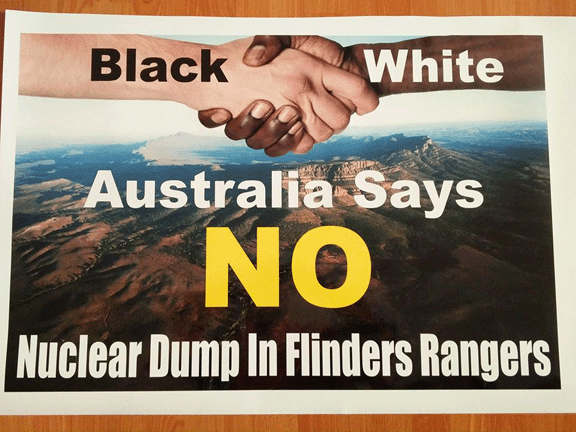
 Sunday 29th April 2018 marked two years since then Minister Frydenberg selected Barndioota in the Flinders Ranges as a possible site to dump and store Australia’s radioactive waste.
Members of the Flinders Local Action Group, No Dump Alliance and Don’t Dump on SA spent the weekend at the Adnyamathanha-run Wilpena Pound and in Hawker to raise awareness of the issue with locals and tourists alike.
Overseas visitors were surprised and horrified to learn about the federal government’s proposal to put a radioactive waste facility in the area and were happy to sign postcards being collected to send to Minister Matt Canavan to show their opposition to a nuclear waste dump in SA.
The cited employment and economic opportunities are modest: some short-term fencing and construction work and just 12 to 15 longer term security and maintenance jobs. In contrast, the South Australian Tourism Commission states that visitor expenditure in the Flinders Ranges is $415 million p.a. with 1,400 jobs directly in the tourism industry and 1,300 indirect jobs – a total employment impact of 2,700 people.
Current federal Minister Matt Canavan recently announced that an AEC community vote for a planned waste dump and store would begin on August 20th. This is despite the fact that there is currently a Senate Inquiry examining the flawed and divisive site selection process and exhibits no regard for recommendations which may arise from the inquiry that will not report to parliament until mid-August. The Minister has not clarified what constitutes ‘broad community support’ despite repeated community requests.
Minister Canavan recently visited the area but failed to consult with the Adnyamathanha people. In response, the Adnyamathanha Traditional Lands Association (ATLA) released a short video message to the Minister.
Regina McKenzie, Adnyamathanha woman who lives next door to the proposed site, said “it’s been two years of the government not listening, they turn deaf ears towards the whole Adnyamathanha Nation who say no to the waste dump. We say no waste dump in our country”.
Greg Bannon, chair of the Flinders Local Action Group, said “this fight has been going since the site was shortlisted. For two years, the government has had a continual presence in district. The process has dragged on, but the government needs to know that we are committed to stopping this proposal. They have using a site selection model that has been tried and failed for years: forcing a radioactive waste dump on a remote community.”
Leading civil society organisations including environment, public health, Indigenous, trade union and faith groups all support an expert, open and independent inquiry into the full range of radioactive waste management options.
April 30, 2018
Posted by Christina Macpherson |
Federal nuclear waste dump, Opposition to nuclear |
1 Comment
 I hereby call onto the Minister to dismiss the Hawker and Kimba site nominations and reconsider all options available, including co-hosting the radioactive waste management facility at an already existing nuclear site.
Submission : Anica Niepraschk Selection process for a national radioactive waste management facility in South Australia Submission 29 In this submission, I wish to point out the inappropriateness of the site selection process for a national radioactive waste management facility at Kimba and Hawker in South Australia.
In 2015, when the current voluntarist approach to the National Radioactive Waste Management Project (NRWMP) was in its early phase calling for land nominations to site Australia’s low and intermediate level radioactive waste management facility, I conducted a study on international best practices for such siting processes. Please thoroughly consider my research findings in the attached report. In my research, I found that a number of characteristics have internationally proven to be crucial for the success and integrity of a voluntarist approach. The NRWMP is lacking in most of these. Interestingly, in the cases I looked into, siting has only been successful in communities where a repository can be co-hosted with other nuclear facilities. These are communities with a nuclear history of some sort, such as hosting a nuclear reactor or intermediate storage facilities for radioactive waste.
Even when other communities had shown initial interest in hosting a radioactive waste facility, they ended their engagement in the siting process quite early on. This shows that it is much more likely for a repository to be hosted by a ‘nuclear community’, which partly roots in it already being familiar with the risks and benefits involved and thereby being much more comfortable to make an informed decision. An already existing positive relationship with the respective nuclear operator can furthermore contribute to a community showing interest.
Australia currently has a limited number of nuclear activities and stores its radioactive waste materials in numerous intermediate storage places, most of them very small. Only the site of the Australian Nuclear Science and Technology Organisation’s nuclear reactor and larger radioactive waste storage facility at Lucas Heights would reflect this experience. This is also where the majority of Australia’s radioactive waste is already stored. It would therefore provide the opportunity of simply improving on the current facilities and not having to transport the existing waste to a remote facility, thereby reducing risky and unnecessary transport of dangerous materials.
To be a truly voluntary process, community and public opinion has to be effectively taken into account by the respective decision making institutions and reflected in decisions. This means thatcommitments to not impose a repository on any community have to be observed. Showing respect towards informed decision-making necessitates providing local communities and the wider public with the necessary time and information. This is an essential factor to build trust towards the implementing agency.
Furthermore, a truly voluntary process acknowledges the role of the communities by engaging with them throughout the whole duration of the repository project. This should not be limited to the siting process but extend to the construction, operation and closure phases of the project. As the case of Belgium shows, communities can engage on issues such as the facility design and wider community implications e.g. facility monitoring and socio-economic projects. The early provision of information is essential, providing the community and wider public with the possibility to commission studies, reports and expert opinions. This encompasses an extensive assessment of environmental impacts and of alternative methods and siting options as major references to base a meaningful siting decision on for both the implementing agency and the community. These provisions enhance transparency and accountability and help build a more trusting relationship with the community. They raise the chance of a successful siting process as it is based on an informed decision and allows communities to feel more confident. Indigenous communities and Traditional Landowners play a central role in the siting process in some countries. Their consent and close engagement is critical in Australia where Traditional Owners are directly affected by the sites currently progressed. Furthermore, community engagement should also encompass neighbouring communities, which might be affected by the project.
A non-restrictive timeframe should be applied in siting processes, providing all stakeholders with sufficient time to make informed decisions. In the international case studies this has shown to require years. When the community feels comfortable to make a decision on the matter, a test of community support should be taken to establish its position. Similarly, the right-to-veto the government’s or operator’s siting decision should also provide the community with the final say on hosting a facility or not. In general, a community should be able to leave the siting process at any time if wished. As the UK example shows, this was one of the main factors communities wanted ensured when consulted on how to improve the siting process and has further proven to be a key feature of all the siting processes, making engagement really voluntary.
All the international examples enabled community engagement through providing funding to use according to their own needs to engage effectively on the issue. Additionally, some countries provide benefit packages for communities participating in the process and/or hosting the planned facility as a way to compensate for the efforts and risks associated and further drive local development, apart from the economic benefits already associated with the project such as employment, improved infrastructure and know-how. In case of any provisions in this respect, it is important that communication on funding or contributions is very clear from the beginning and that it does not compromise the position of the community on the issue and can be handled independently from nuclear operators or facility proponents.
In the case of Australia community engagement is completely carried out and funded by the National Radioactive Waste Management Project (NRWMP) and aimed at supporting the understanding of the project, instead of providing room for engaging on the issue. This transactional approach does not allow for the community to engage in ways it finds meaningful.
The main concern regarding the continuation of the site selection process, however, is the community opposition, which has been apparent for both the Barndioota site near Hawker as well as Kimba.
In the case of Barndioota, the local Adnyamathanha community at Yappala station, just kilometres away from the site, has been very vocal in its opposition to the siting from the beginning. With this site, the government chose, after pursuing Coober Pedy from 1998 to 2004 and Muckaty in the NT from 2005 to 2014, to not only once again target an Aboriginal community but also a culturally highly significant site. The proposed property is part of a songline and hosts many cultural sites, including the beautiful Hookina springs, a sacred women’s site for the Adnyamathanha. The local community remains actively connected to the maintenance and preservation of the land and is documenting and preserving their culture and history through recording traditional heritage sites and artefacts and mapping storylines in the area. The proposal is seen as an attack on their cultural beliefs, history and heritage.
The terms of reference of this inquiry clearly note the Government’s statement that it will not impose such a radioactive waste facility on an unwilling community. If the government is serious about its voluntary intentions and wants to be successful in the siting of the facility, it is paramount not to proceed with the shortlisted sites at Hawker and Kimba as they very clearly do not fulfill the essential criteria of community support. Attempts to ‘convince’ the local community of potential benefits of hosting the facility should be avoided under all circumstances, and the informed decision, which communities have taken, respected.
I hereby call onto the Minister to dismiss the Hawker and Kimba site nominations and reconsider all options available, including co-hosting the radioactive waste management facility at an already existing nuclear site. https://www.aph.gov.au/Parliamentary_Business/Committees/Senate/Economics/Wastemanagementfacility/Submissions
April 30, 2018
Posted by Christina Macpherson |
AUSTRALIA - NATIONAL, Federal nuclear waste dump |
Leave a comment
Submission Appendix Anna Niepraschk Wasting Time? International lessons for managing Australia’s radioactive waste, Anica Niepraschk Discussion Paper July 2015 from https://www.aph.gov.au/Parliamentary_Business/Committees/Senate/Economics/Wastemanagementfacility/Submissions

In her paper Wasting time? International lessons for managing Australia’s radioactive waste, researcher Anica Niepraschk looks at how other countries have approached this challenge and what lessons might help Australia move away from a search for an ‘out of sight –out of mind’ dump site in favour of a responsible and effective management regime
Overview: For over two decades successive Australian governments have floundered when faced with how best to handle Australia’s radioactive waste. They consistently tried – and consistently failed to impose a!national dump site on unwilling communities in South Australia and the Northern Territory.
Now the federal government has a revised approached based on a foundation principle of volunteerism. Industry Minister Ian Macfarlane has called for nominations from around the country and is soon to release a short=list of possible sites where Australia’s low level waste can be buried and longer=lived material stored above ground.
1 Introduction
Finding technically, geologically and socially accepted sites for the storage or disposal of all forms of radioactive wastes has proven an international challenge for decades. Many countries have chosen to engage in various voluntary siting processes after having failed to site facilities on solely technical and/or political grounds due to community opposition and public contest. Australia is the most recent country to develop a voluntary approach after the failure of earlier approaches to realise a site.
For two decades Australia has been trying to find a solution to the disposal and storage of its low and intermediate-level radioactive waste (LILW). Attempts to impose a national repository on communities in South Australia (from 1998 to 2004) and subsequently the Northern Territory (2005 to 2014) have failed amid Federal Court trials, leaving the Australian government needing to engage in a different approach to the challenge of siting a repository. Continue reading →
April 30, 2018
Posted by Christina Macpherson |
AUSTRALIA - NATIONAL, Federal nuclear waste dump |
Leave a comment
Selection process for a national radioactive waste management facility in South Australia, Submission 29 – Extract from Attachment 1 Anica Niepraschk
Arising challenges
Even though the current process is still in its early stages, it already either faces new challenges or has not yet dealt with older ones. Despite repeated calls by civil society organisations for an independent Inquiry into the full range of radioactive waste management options available, the government has instead continued its preferred option of a centralised radioactive waste facility. This leaves the current process vulnerable to criticism that the waste should remain at the sites where it is produced rather than being transported long distances through Australia, posing the risks of accidents on the way and the risk of an out of sight – out of mind approach in a remote area far away from expert oversight.
A continuing concern remains the federal government’s perception of urgency to solve the siting challenge, which is used as a justification for avoiding a more time consuming approach based on extensive consultation and consensus. Other countries have recognised that the provision of realistic timeframes is an essential condition in successful siting processes. The Australian government, despite the last 20 years of unsuccessful, rushed and pressured approaches, has again chosen to be bound by a rigid and self-imposed timeframe, trying to resolve the siting in around 18 months.
The current National Radioactive Waste Management Act (2012) is democratically compromised, as it provides for key legislation to safeguard cultural heritage and the environment as well as state legislation to be overridden in order to declare a site. SA, WA, Victoria and the NT all have state legislation in place prohibiting the storage or even transportation of radioactive waste from outside the state or territory. The federal government’s call for all Australian landowners to consider making a site nomination has failed to address this conflict of undermining existing laws and a ‘voluntary’ process. https://www.aph.gov.au/Parliamentary_Business/Committees/Senate/Economics/Wastemanagementfacility/Submissions
April 29, 2018
Posted by Christina Macpherson |
AUSTRALIA - NATIONAL, Federal nuclear waste dump |
Leave a comment
Colin Mitchell Submission to the Senate Standing Committee on Economics re the selection process for a national radioactive waste management facility from Colin Mitchell (independent campaigner)
I believe that the site selection process for a national radioactive waste management facility (NRWMF) is flawed because:
- The notion of ‘broad community support’ is considered far too narrowly as applying only to the local community.The NRWMF is a National project which could have environmental consequences extending far beyond the local community to encompass large areas of SA and beyond into other States of Australia, potentially effecting the whole nation. For example, leakage of radioactive material into the water table could spread over time causing disastrous effects on human and animal health, as well as agricultural crops. Also escape of radioactive material into the atmosphere could have similar negative consequences across wide areas of Australia and beyond. This is a decision which involves far more than the welfare of the immediate local community, rather the welfare of all the people of SA and all the people of Australia should be considered.
Recommendations: ‘Broad community support’ should extend to include the people of SA as a whole. Community opinion in other States of Australia should also be considered
Community support should be gauged by multiple methods including wide-ranging telephone and internet polling, acceptance of petitions and public meetings in Adelaide and all other major cities and towns in SA.
This process should be carried out by an independent body, not controlled by the government organisations involved in the establishment of a NRWMF. (ie not controlled by ANSTO or ARPANSA)
The consultation process should be thorough, be conducted over a long period (suggest a year) and incorporate the provision of full and open information about the project, including plans for both the low-level waste disposal facility and the above-ground store for intermediate level waste to be co-located at the same site.
The establishment of a NRWMF should not proceed without overwhelming support from the population of SA – at least 90% – (as well as 100% support from the local community), because the consequences of an unwise decision, flaws in the design of the facility, accidental releases of radioactive material, or an inability to properly maintain the facility over hundreds or even thousands of years, could be extremely serious to present or future generations.
- The site-selection process is also also flawed because insufficient information about the proposed NRWMF has been provided to the communities consulted. There has been a lack of transparency and bias in the presentation of information.1. Emphasis has been placed on medical isotope waste and there is insufficient information about the proposed co-location of intermediate level nuclear waste from Lucas Heights at the same site. The consultation process is deceitful because of the bias towards discussion of only the low-level waste and failure to properly inform the community about the colocation of Intermediate – level waste.
Recommendation: The co-location of Intermediate level nuclear waste should be mentioned every time the NRWMF is mentioned to avoid the false impression that this is only a low-level waste facility.
2. the communities have not been informed that the Intermediate-level waste to be colocated at the site is much more highly radioactive and has to be isolated for thousands of years compared with hundreds of years for low-level waste.
3. There are no plans presented for the “temporary” above-ground store to hold the intermediate-level waste.
4. The communities are not informed how the intermediate level waste is to be dealt with after “temporary” storage. There are no plans presented for long-term storage or final disposal of this waste.
5.The communities are not informed that the intermediate-level waste may be later disposed of in a deep geological disposal facility which may be built at the site of the NRWMF.
6. The communities are not informed that the construction of a deep geological disposal facility may lead to the importation of intermediate and high level nuclear waste from overseas in the future ie an international nuclear waste dump on the site (as advocated by government advisor Richard Yeeles in his submission to the recent Nuclear Fuel Cycle Royal Commission in SA “……it is open to your Royal Commission to recommend that the South Australian Government actively pursue the State’s further involvement in the nuclear industry with an initial focus on national and international radioactive waste management…….That as a demonstration of its strong interest in, and commitment to the further development of a safe and sustainable Australian nuclear industry, and as a first step in such further development, the South Australian Government offers to host a national facility for the storage and disposal of Australia’s own low and intermediate-level radioactive waste with the ultimate aim of securing Federal Government support for hosting an international radioactive waste management facility in South Australia.”
R.Yeeles, submission to Nuclear Fuel Cycle Royal Commission.)
- By failing to properly inform the communities about the co-location of the intermediate level waste the consultation process leaves itself open to the charge of deceit and thus undermines trust in the process and the agencies conducting the process as well as the government.
- Hazards of transporting nuclear waste over land/water are not being considered.
- Communities are not informed that intermediate-level waste can be securely stored at Lucas Heights itself. There is no advantage to moving this waste to another location and in fact moving the waste increases the risk of hazardous spills.
- Communities are not informed that there is not general agreement that a NRWMF is needed at all in Australia. They are not informed that there is a significant body of opinion that Australia’s nuclear waste should stay where it is and that, in particular, the intermediate-level waste at Lucas Heights is best stored at Lucas Heights where there are the resources and expertise to store this waste securely as it has been for many years. They are not informed that there is a significant body of opinion that there is nothing to be gained from moving this waste across country to another location because it is not presently known how to safely dispose of intermediate or high-level radioactive waste for the thousands of years it remains dangerously radioactive.Recommendation: the deficiencies in the information provided to communities mentioned above should be remedied. An independent community consultation body should be created which can provide full information on the proposed NRWMF in an open transparent manner including plans for the low-level facility and the intermediate-level above-ground store. This body should be independent from ANSTO or ARPANSA.
April 28, 2018
Posted by Christina Macpherson |
Federal nuclear waste dump, South Australia |
Leave a comment
I do not think that one of two small rural communities should feel that if they do not accept the radioactive waste, these [medical] applications will be forced to stop, as they have been told by Departmental Officials.
Christine Mary Wakelin- Submission to Senate Inquiry on selection process for nuclear waste dump siting
My name is Christine Wakelin and together with my husband, I am a longstanding landowner in the Kimba District. I was a Registered Nurse for over fifty years, much of which I was employed at our local hospital. I had, in this position supervised the administration of IV Chemotherapy and taken simple XRays. A close family member had treatment with Nuclear Medicine for the control of Neuro Endocrine Tumours.
The matters I would like to submit to the Senate Economics References Committee on the appropriateness and thoroughness of the site selection process for a National Radioactive Waste Management Facility at Kimba and Hawker are as follows:
- The compensation to landowners for “volunteering”one hundred acres of land at four times the normal value makes the more remote rural areas of Australia more likely to be selected as the amount of land required, without significant buildings and improvements, is more easily found there than in more closely settled areas and prices at the selected rural sites will be significantly less.
- Cropping land such as offered at Kimba, is, in total, only approximately 4% of Australia’s land mass. Eyre Peninsula, which Kimba is part of, is an important grain, meat and wool exporter.
- To Volunteer, as defined by the Cambridge English Dictionary is doing something willingly without being paid for it. Being paid four times the value of the land does not meet this definition!
- The definition of “Broad community support” has been a very vexatious matter, varying from a two thirds district support to the majority of immediate neighbours supporting the sites. This has caused much anxiety within our community. It has been said that those against the selection of sites in the are only a “small vocal minority” but even with the incentive of the community benefit $2 million, 43% of people voted not to go onto stage two of the selection process.
- It is unclear how “broad community community support” will be defined when the selection process moves to the next stage, with Minister Canavan saying that there is no defined level of voter support from a further ballot. This has given further cause for concern from those apposed to the selection of a site in the Kimba Area.
- The selection of the two original sites in Kimba, following a suggestion by the local Federal member of a site on his farm, which was then withdrawn, caused significant apprehension and distress. There was immense relief when these two sites were rejected by the Federal Government, just prior to the 2016 Federal Election. The nomination of a further two sites soon after this time, has seen distress renewed and added scepticism of the whole process!
- Since the beginning of the two selection process, there have been many visits from Departmental Officers, several glossy information sheets and visits to ANSTO at Lucas Heights by many local residents, with all but two paid for by the Australian taxpayers. In addition are the ongoing costs of a Community Liaison Office and staff member. These are all to promote the siting of the NRWMF at either Kimba or Hawker. Those apposed to the sites in their area have received no financial support. This contrasts to the recent same sex marriage debate which saw funding allocated to both sides.
- The incentive of community benefits program and the $2 million /year that is offered, did, I believe, influence people to vote to go onto stage two of the selection process. Remarks such as “we may as well go onto stage two and get the money” were heard as a justification for voting to go further in the process. “We have to do something” was another reason for voting yes. It was ironical that Kimba had just been recognised as South Australia’s “most sustainable town”!
- The Community Benefits Program is designed, we are told, to overcome any community inconvenience. However no amount of money can compensate for the mental health wellbeing of the community which has been the affect on some community members, both those for and against the NRWMF proposals. I am closely linked only with the Kimba community but I understand the Hawker community has also had these concerns.
- The selection of the members of the Consultative Group must also come under scrutiny, with an apparent imbalance between those known to be for and against the site proposals. Who made the decision on the membership of the group and on what criteria?
- The Kimba District is part of Eyre Peninsula, a rich Grain, meat and fibre producing area. Much of our produce is exported, with benefits being passed on to the wider Australian community. Anything which has potential to affect our valuable industries must be given due consideration. Many on Eyre Peninsula say that their opinions should be considered also.
- We are told that the siting of a NRWMF Facility in our region “should not” affect our markets. This is very different from “will not” and remains a pivotal concern for many people.
- I am supportive and somewhat familiar with the use of Nuclear Medicine for the treatment and diagnosis of a variety of conditions. However I do not think that one of two small rural communities should feel that if they do not accept the radioactive waste, these applications will be forced to stop, as they have been told by Departmental Officials. Surely there is a wider community responsibility.
- Does the 2012 Legislation for the Disposal of Radioactive Waste have the power to overrule South Australian Legislation which currently does not allow the building of the NRWMF in South Australia or the transport of other than our own waste, in the state?
- Does this above legislation have the power to overrule the wishes of Aboriginal peoples of an area?
April 27, 2018
Posted by Christina Macpherson |
AUSTRALIA - NATIONAL, Federal nuclear waste dump |
Leave a comment
THE construction of a radioactive waste dump in South Australia could be stalled by court challenges unless local indigenous people are consulted properly, the Australian Human Rights Commission has warned, Peter Jean, The AdvertiserAPRIL 25, 2018
THE construction of a radioactive waste dump in South Australia could be stalled by court challenges unless local indigenous people are consulted properly, the Australian Human Rights Commission has warned.
The commission has intervened in the debate over potential locations for the dump after some Aboriginal groups complained they were not being fully consulted.
The Federal Government said it was working closely with indigenous people as it considers two sites near Kimba and one at Hawker as possible homes for low and intermediate-level radioactive waste.
But in a submission to a Senate inquiry, the Human Rights Commission said it was concerned that Adnyamathanha indigenous people near Hawker were unhappy with the consultation process.
“This situation requires immediate attention if the consideration of the site at Wallerberdina Station is to continue,’’ the commission said.
The “overwhelming and clearly expressed support of the affected indigenous group” would be required for the facility to go ahead, according to the commission.
The federal Department of Industry, Innovation and Science told the inquiry that it was consulting indigenous people, and an Aboriginal cultural heritage assessment had been conducted at the Wallerberdina Station site near Hawker.
The department said it would continue to work closely with traditional land owners to “preserve, protect and minimise the impact on indigenous heritage”
Legal challenges resulted in earlier plans for a waste dump in the Northern Territory being abandoned in 2014.
April 27, 2018
Posted by Christina Macpherson |
AUSTRALIA - NATIONAL, Federal nuclear waste dump |
Leave a comment
 No nuclear waste groups stand together, https://www.eyretribune.com.au/story/5362658/no-nuclear-waste-groups-stand-together/ 24 Apr 18
No nuclear waste dump groups from Kimba and the Flinders Ranges came together in Port Augusta last week in response to the recent announcement by federal Resources Minister Matt Canavan that a community vote for a planned national radioactive waste management facility would begin on August 20.
The groups discussed shared concerns and committed to increase their efforts against the plan including through an open debate featuring the federal department, the Australian Nuclear Science and Technology Organisation (ANSTO), Traditional Owners and public policy and health professionals.
People at the meeting included Adnyamathanha community members, representatives from Kimba, Hawker, Whyalla and Quorn along with members of the Flinders Local Action Group and No Radioactive Waste on Agricultural Land in Kimba or SA.
Peter Woolford from Kimba said the “flawed federal process” was failing the communities.
“Minister Canavan is fast-tracking a plan that does not have broad community support”.
The groups committed to highlight community concern and opposition to the federal plan ahead of the August vote and urged residents in the wider region to stand up and speak out.
Former federal member for Grey Barry Wakelin said it was a national issue, “not something that a regional community should be left to deal with”.
“The current federal plan lacks evidence and poses a threat to our existing industries – we need a better way,” Mr Wakelin said.
“This has been a productive meeting and it is heartening to see regional South Australians stepping up to the challenge, taking action and working together.”
April 25, 2018
Posted by Christina Macpherson |
aboriginal issues, Federal nuclear waste dump, opposition to nuclear, South Australia |
Leave a comment
 Selection Process for a National Radioactive Waste Management Facility in South Australia – Submission From: Barngarla Determination Aboriginal Corporation ICN 8603 : 3 April 2018
The Barngarla Determination Aboriginal Corporation (BDAC) is the prescribed body corporate for the Barngarla native title holders as defined in the Barngarla Determination of Native Title made by the Federal Court in Croft’ on behalf of the Bamgar/a Native Title Claim Group v State of South Australia (N0 2) [2016] FCA 724 (SAD 60/11/998) on 23 June 2016.
We attach a map [on original]of the Barngarla Determination Area, as Schedule I. It clearly shows that the Barngarla are the native title holders for the two nominated sites near Kiinba, namely the Lyndhurst and Napandee nominated sites.
BDAC believes that community consultation in relation to the site selection rocess for a National Radioactive Waste Management Facility (NRWMF) has been patently inadequate, bordering on non-existent.
We hold this view given the lack of contact by the Federal Government and the Department of Industry, Innovation and Science (the Department) from the outset. The chronology of consultation is contained in our letter to the Department of 21 February 2018 (which is attached [on original] along with all other correspondence as Schedule 2), for the sake of ease of reading we reproduce a version of it below:
On 7 April2017, three months after the Lyndhurst and Napandee sites were nominated, Barngarla made contact with the Department. Prior to this letter, the Department had made no contact with the Aboriginal traditional owners or native title holders of the area.
Notwithstanding this complete lack of contact, the Department was asserting that there were no Aboriginal heritage issues in the area. Therefore, the Barngarla letter of 7 April2017 sought to correct the Department and indicated that Barn aria needed to be engaged with. Barngarla further indicated that the failure to consult to date was unacceptable.
On 4 May 2017, Barngarla received a pro forma letter from Mr. Bruce Wilson (the date April2017 had been crossed out with May inserted). The letter contained three general paragraphs and did not in any way address the Barngarla’s concerns.
On 10 July 2017, Barngarla sent a response to Mr. Wilson, requesting s ecific information on the following:
ll proposed activities, which the Department seeks to undertake for the purposes of the proj’ect, ‘what protocols, if any, the Department intends to apply in respect of Aboriginal Heritage; and Selection process for a national radioactive waste management facility in South Australia Submission any assessment that the Department has undertaken in respect of the impact of the proposal on Aboriginal Heritage in the Bamgar/a Determination Area.
On 14 August 2017 (originally dated 11 August, with the 11 crossed out and replaced with a hand written 14), Barngarla received a particularly uriconstructive letter from Mr. Bruce MCCleary. We do not repeat it here, but a longer description of this letter i contained in our letter of 21 contained in our letter of 21 February 2018.
Barngarla responded to the 14 August 20171etter, on 13 October 2017, providing the Department with all of the information (that the Commonwealth already had) indicating the status of BDAC, and Norman Waterhouse’s role as the Solicitors for Barngarla.
Barngarla did not receive a response to their letter of 13 October 2017. The next item of correspondence we received was a further pro forma letter from Mr. Bruce MCCleary, dated 31 October 2017, confirming the Solicitor for Barn arla’s a arent “nomination” for the Kiinba Consultative Committee (although Mr Llewellyn-Jones himself did not nominate for this Committee). It is obvious from reviewing the correspondence, that this letter was not a response to any of the letters sent by Bamgarla and was just a misaddressed pro forma letter of no substance.
Bamgarla received no further correspondence from the Department in 2017
Barngarla finally received a letter on 20 February 2018, congratulating BDAC for its status as a PBC (somewhat out of date, given that this had occurred approximately one year earlier) and advising that the Department would like to present to the BDAC Board. However, this letter.
Did not address any of the substantive matters raised by Barngarla on 7 A in 2017 or, O July 2017; in particularit does not answer how the Department could assert a lack of any Barngarla Aboriginal heritage given that there had been no discussions or engagement with Barngarla;
Did not answer the express questions put to the Department on 10 July 2017; and ,
Suggested that the first consultation with Barngarla should occur some 14 months after the Lyndhurst and Napandee sites were nominated, even though the Department had been making representations about the Barn aria and Aboriginal heritage during this time.
It is Barngarla’s position that the entire consultation process has been completelyl inappropriate and, in most cases, has involved being copied into pro forma correspondence, which is not relevant to any of the issues raised by Barngarla.
As can be seen above, BDAC has repeatedly contacted the Department to address Barngarla heritage concerns as the traditional owners in the Kiinba area. Correspondence was instigated by BDAC, not by the Department. Again, as indicated above, Barngarla’s most recent letter to the Department on 21 February 2018 provides a chronological outline of BDAC’s communication with the Department. All relevant correspondence is enclosed with this submission.
The correspondence largely speaks for itself, and so forms part of this submission. Most concerning, apart from the Department not having made contact with the Aboriginal traditional owners or native title holders for the area, was the Department’s assertion that there were no Aboriginal heritage issues in the area surrounding Lyndhurst and Napandee. ‘ This assertion was made without any consultation with these traditional owners. Further, Barngarla have repeatedly asked, on three separate occasions, for the Department to provide the basis of this assertion, which the Department has failed to do. It is not the case that there is no Aboriginal heritage in the area. Given the complete inactivity of the Department to engage with Barngarla, BDAC retained out of its own funds, the services of Dr Dee Gorring to conduct a heritage assessment of the area. This took place on 27 February 2018 to 3 March 2018. Preliminary conclusions from Dr Gorring indicated that there are a number of sites that have been identified surrounding the site of Lyndhurst and spanning across to the site of Napandee.
Accordingly, as per terms of reference:
The Department has not even engaged with Barngarla to establish whether there is any relevant Indigenous support for the NRWMF. Therefore, in respect of the Committee’s terms of reference paragraph (c), the need for Indigenous support has so far not played a part in the Department’s site selection process at all in respect of the sites near Kiinba.
The Barngarla are not aware of the Government ‘community benefit program payments referred to in the Committee’s terms of reference paragraph (d). These have therefore had no impact upon the sentiment of the Barngarla Community.
However, irrespective of any community benefit package, Barngarla would not support the NRWMF in the area. This indicates that the Committee’s terms of reference paragraph (b) have not been met; there is no ‘broad community support’ in respect of the NRWMF from Barngarla.
The proposed NRWMF does not have the support of BDAC nor does the NRWMF have the support of the broader Barngarla Community.
As seen above, there has been no appropriate consultation process. The approaches made by BDAC have been rebuffed by a combination of meaningless pro forma correspondence, bureaucratic tangents, and obfuscation, which has resulted in a contrived consultation process completely lacking in transparency.
April 25, 2018
Posted by Christina Macpherson |
Federal nuclear waste dump, South Australia |
Leave a comment
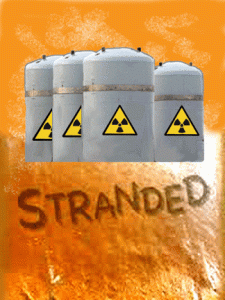 Effectively it is about relocating Australia’s worst radioactive waste from above ground interim storage at a purpose built and heavily secured and resourced facility in Sydney to above ground interim storage at a far less resourced facility in regional SA. There is no compelling public health or radiation management rationale for this approach.
It is definitely not something that should be foisted on a community area/state/through transport route communities at the behest of a local land/leaseholder.
The national radioactive waste facility is in two parts
(i) a dump for LLW – placed there and never recovered or removed (most of this material will decay to background equivalent in 300 years) and
(ii) a store for ILW to be kept above ground prior to being removed at a undefined future point by an undefined process to an unchosen site for promised deep burial (this material needs to be isolated from the wider environment for 10, 000 – 10K – years).
Submission by Michele Madigan To The Economic References Senate Committee Inquiry – Selection process for a national radioactive waste management facility in South Australia
The appropriateness and thoroughness of the site selection process for a national radioactive waste management facility at Kimba and Hawker in South Australia, noting the Government has stated that it will not impose such a facility on an unwilling community, with particular reference(s).
I submit that the present method/process of selection for the site for Australia’s long term intermediate radioactive waste and to a lesser extent for the nation’s low level radioactive waste is not only inappropriate but has grave implications for present and future generations:
*of local communities *for all South Australians *and indeed all Australians – in particular those national communities along any proposed transport route.
I note, as does the Senate Committee, that the Federal Government has stated that it will not impose such a facility on an unwilling community. This condition of willingness is indeed world’s best practice. Whether or not its present process and reported results accurately reflects the reality of such unwillingness in the South Australian proposed sites is discussed below. Continue reading →
April 23, 2018
Posted by Christina Macpherson |
AUSTRALIA - NATIONAL, Federal nuclear waste dump |
Leave a comment
 Paul Waldon –No Nuclear Waste Dump Anywhere in South Australia https://www.facebook.com/groups/344452605899556/
If government can’t show that it can cleanup, or even finance a $30 million cleanup of 9,8000 leaking rusty barrels of radioactive waste abandoned at Woomera, what reason would any adroit person have to believe that the government’s $10 million incentive package to manage a radioactive dump in Hawker or Kimba is nothing more than a 79 cents a week contract to abandon high grade waste under the guise of being called intermediate waste, for the next 244,000 years of its hazard.
April 22, 2018
Posted by Christina Macpherson |
Federal nuclear waste dump, South Australia |
Leave a comment
Submission by Barbara Walker Senate Economics References Inquiry – National Radioactive Waste Management Facility
Introduction:
My name is Barbara Walker. My husband and I bought a home in Quorn fifteen years ago, retiring to the peace and tranquility of the magnificent Flinders Ranges. We are both active volunteers within our community. I served as a volunteer lifeguard/supervisor at the Quorn swimming pool for nine years and am also a volunteer at
the Platform Gallery in Port Augusta. I am a member of the Flinders Local Action Group – a group of concerned citizens protecting the Flinders Ranges and against a pending nuclear
waste repository.
My husband is a regular volunteer for several local clubs and community fundraising events.
He is also an organiser for an annual military veterans retreat and a volunteer radio operator
for the VKS-737/RFDS Radio Network.
Through our network of friends and radio contacts we have always encouraged people to
visit the iconic Flinders Ranges. Many travellers visit us while travelling through Quorn and
most are horrified after discovering a nuclear waste repository is pending for the Flinders
Ranges.
A nuclear waste facility will adversely affect tourism within the Flinders and outer regions.
Many travellers from Australia and abroad have said they will not return if a waste dump is
located in the Flinders Ranges.
The prospect of a nuclear waste repository has also caused much division and ill health
within our local communities.
The Flinders Ranges is the home of the Adnyamathanha people who coincide with tourism
operators and local pastoralists in showcasing the marvels of the Flinders Ranges.
The question of broad community support:
I believe the Orima survey was flawed and inconsistent with broad community views and
opinions. Orima survey phone calls were made but only to some fixed home phones. These days most
people use mobile phones. Mobile phone users were not surveyed.
Orima offered small incentives in the form of supermarket vouchers to some indigenous
respondents. Proof of this is written in the Orima survey, headed “Interview Method”. Why
was this necessary? Would this be classed as a bribe?
In my opinion a better way to survey people would be through the postal system, canvassing
the whole community by using a simple democratic process. Perhaps using the AEC would
have been a better and fairer solution, and in doing so, every community member would
have a voice.
South Australia’s Nuclear Waste Storage Facility (Prohibition) Act 2000 states it is illegal to
have a nuclear waste storage facility in South Australia, in which case, the whole of South
Australia has already said a clear NO to the storage of nuclear waste, and if that were to be
changed by Government, all South Australians should be asked for consent.
At our own expense, Flinders Local Action Group also conducted a survey. It was posted to
the people living in Hawker, Quorn and Cradock. People were simply asked for a YES, NO
or UNDECIDED vote regarding storage of nuclear waste in the Flinders Ranges. Flinders
Local Action Group then asked if the results could be opened and scrutinized by the CEO of
the Flinders Ranges Council. FRC kindly obliged and final results showed 79% of the
respondents were against having a nuclear waste repository in the Flinders Ranges.
The consideration of Indigenous support:
The consideration of indigenous support is an important factor within the Flinders Ranges
and the wider community. Any support for a nuclear waste repository would firstly have to be
given from the Adnyamathanha community because, in the case of
Wallerberdina/Barndioota, a nuclear waste repository on that site would be invasive to their
culture. Intrusion would cross cultural songlines and disturb artifacts, sacred sites and the
Hookina – The Hookina is a culturally important place for Adnyamathanha women.
Adnyamathanha families from Hawker and surrounding areas have been severely affected
by this controversial process. It has caused great heartache, division and ill health for many
people. Families and friends are feeling torn apart by the long and ongoing processes from
ANSTO and the Department of Industry, Innovation and Science.
Community Benefits Program:
Another example of division. Many think the Community Benefits Program is divisive and
creates an impression of bribery. Some businesses needing monetary assistance,
regardless of their ‘for’ or ‘against’ opinions, are happy the money has been offered and
therefore feel it is up for the taking. Others refuse to apply as they regard it as bribe money.
Some people in the community were selected for paid positions, and part of their role is to
reassure people that a nuclear waste repository would be a positive enhancement to the
Flinders Ranges – jobs, tourism and Federal money. A few of these people have used their
positions as a license to bully community members who are not in favour of a nuclear waste
dump. I suggest in future jobs like these need to be screened and monitored regularly if
people are to receive Federal funding for this kind of employment.
Small vulnerable communities would be best served if community benefits were given in
constructive growth projects, like tourism and small business, not a nuclear waste repository
that offers minimal employment and destroys tourism and cultural heritage.
Wider Community Views and conclusion:
Wider community views should always be considered regarding the storage of nuclear
waste. Most people would agree there needs to be a single repository for a low level nuclear
waste facility somewhere in Australia but it is fundamentally important to find the right place.
The Flinders Ranges is not the right place.
The intermediate nuclear waste stored at Lucas Heights should stay where it is. The Lucas
Heights storage facility is purpose built for safety and has ‘state of the art’ security with plenty
of storage availability for years to come. Why move it to a place that has massive floods, frequent earthquakes and sometimes 50+ degree days in summer?
April 21, 2018
Posted by Christina Macpherson |
Federal nuclear waste dump, politics |
Leave a comment
This is the best of several submissions to the Senate Inquiry, that I have read so far. It can be heavy going for the reader, because it is densely informative. For a start, I have summarised some of the major arguments,
ENUFF argues that “the Taskforce has not properly nor fully informed either the wider public; nor their arbitrary ‘local community’ cohort; nor the State Government; &, it would appear, not even their own Federal Minister – about the whole radioactive waste regimen. Instead they almost only & exclusively accentuate & promote Australian usage of medical radioisotopes. ”
The community consultation methods have been inadequate and unfair. There is no scientific need for Lucas Heights nuclear wastes to be transported to rural South Australia, and medical wastes amount to only a tiny fraction of the radioactive wastes planned for the S.A. Dump.
Stirling North and Leigh Creek residents would be affected, but were excluded from the consultation. Adnyamathanha Traditional Lands Association were NOT consulted prior to the Wallerberdina preferred site announcement , contrary to UN endorsed Indigenous Rights.
In surveys run by Flinders Local Action Group a clear majority voted “no” to the establishment of a National Radioactive Waste Management Facility in the area .
Scrutiny of the Barndioota Consultative Committee NRMWT survey reveals questionable and biased methodology and results.
National Radioactive Waste Management Facility’s communications and publicity have been deceptive with its pretense that the waste is predominantly medical Low Level Wastes, ignoring Intermediate Level Waste volumes intended for ‘temporary’ storage
Given the prime-facie maladministration ans deficiencies described above, ENuFF calls for a judicial inquiry into the NRWMF ‘s processes.
ENuFF-SA Submission 1 to the Senate ERC NRWMF Inquiry (not yet published on the Senate website)
CONTENTS Page 2 Acronyms 3 Introduction 5 Executive Summary 6 History 8 Contemporary Action 9 Wallerberdina 16 Indigenous appraisal 19 Correspondence with the Taskforce 22 Afterword 25 Bibliography
In order to determine whether or not maladministration &/or negligence has any bearing upon the community consultation process, ENuFF asks the committee to recommend a judicial inquiry into the performance of the NRWMF Taskforce…..
EXECUTIVE SUMMARY Continue reading →
April 20, 2018
Posted by Christina Macpherson |
AUSTRALIA - NATIONAL, Federal nuclear waste dump, politics |
Leave a comment
 Looks like the bribery has been successful. $2M approved for 33 Kimba projects, Eyre Tribune 16 Apr 18
More than 30 projects in the Kimba district will share in $4 million from the National Radioactive Waste Management Facility Community Benefit Program.
Resources Minister Matt Canavan announced the successful projects near Kimba and Wallerberdina Station near Hawker on Wednesday, with 33 out of the successful 45 projects located in Kimba.
The successful projects include big projects such as a new palliative care wing at the Kimba Hospital, and smaller projects like air-conditioning in the Kelly Pioneer Memorial Hall.
The projects vary from new infrastructure and upgrades to existing infrastructure, community projects, feasibility studies and trials.
Mr Canavan said the two communities, which were being consulted about hosting the facility, were invited to submit projects that “deliver social and economic benefits to their area”.
“Two million dollars for each community is a significant investment, designed to help offset the time and resources they are devoting to the detailed consultation program underway,” Mr Canavan said……..
- “Beneficiaries include local sporting clubs, community organisations, and projects focussed on everything from tourism to health, agriculture and mobile phone coverage. ……
-
“Two sites in Kimba and one at Wallerberdina Station volunteered to host the facility, and are currently in a detailed community and technical assessment process.
“The Community Benefit Program is a key part of the process.”…….
https://www.eyretribune.com.au/story/5336162/2m-approved-for-33-kimba-projects/?cs=5806
April 18, 2018
Posted by Christina Macpherson |
Federal nuclear waste dump, South Australia |
Leave a comment
ATLA opposes UCG in Leigh Creek, The Transcontinental, , 16 Apr 18
The Adnyamathanha Traditional Lands Association (ATLA) has declared that “enough is enough”, voting unanimously against underground coal gasification (UCG) in Leigh Creek and the proposed radioactive waste management facility near Hawker.
ATLA CEO Vince Coulthard said it is time to “heal this area, not fill it with poison”.
“We don’t want the dangerous gasification project at Leigh Creek and we don’t want the toxic nuclear waste dump either,” he said.
“Our country has had enough, it is time for healing, we don’t want any further destruction at Leigh Creek.
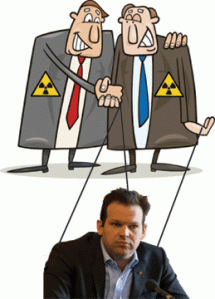 “This is a very important Muda (spirituality) and the desecration of this site has to stop.”……….ATLA’s vote against a nuclear waste dump at Barndioota comes after a recent visit to the site by Minister for Resources and Northern Australia Matt Canavan.
The Minister declared that a postal vote would commence on August 20 to measure the community support for the proposed national radioactive waste management facility.
April 18, 2018
Posted by Christina Macpherson |
Federal nuclear waste dump, South Australia |
Leave a comment






 Antinuclear