Tiny outback town divided over plan for federal nuclear waste dump
 One misapprehension in this otherwise excellent article.
Residents of Hawker say it has been incredibly confusing that the proposed intermediate-level facility in their community is being discussed at the same time as plans for future high-level nuclear storage elsewhere.
Despite the government saying that many of the jobs and development opportunities near Hawker will benefit the indigenous people at Yappala, McKenzie says they will continue fighting the proposal to the end.
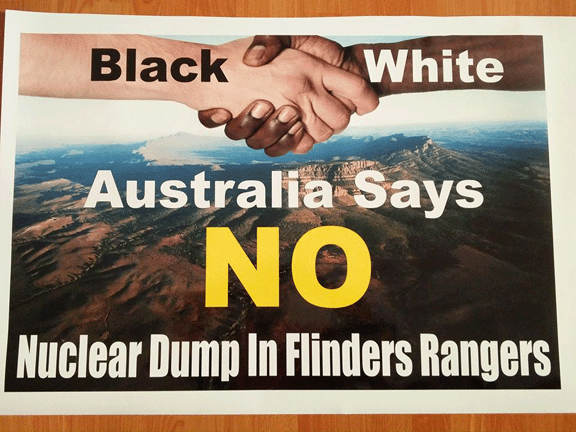 Australian nuclear waste dump divides tiny outback town
“This land is our past, present and future and we don’t want a nuclear waste dump on it.”, Aljazeera, by Jarni Blakkarly, 29 Nov 16
While the mountains are named after the British explorer who trekked them in the early 19th century, the indigenous Adnyamathanha people have lived in the region for tens of thousands of years.
This arid and remote part of South Australia has become the unlikely centre of a heated public debate after it was named the preferred site for the country’s first nuclear waste dump. Continue reading
“Medical” uses do not justify Lucas Heights nuclear reactor, nor a Flinders Ranges nuclear dump
Solid forms of low-level waste include materials that have been contaminated – at Lucas Heights or in hospitals using isotopes, or in industrial firms using isotopes, and so on. Waste of this kind has accumulated at scores of places throughout Australia, but it amounts to only a tenth of all radioactive waste, the rest coming from Lucas Heights
A NEW REACTOR? It’s the worst possible option! Nuclear Study Group Sutherland Shire Environment Centre 1998 By R.D. (Bob) Walshe, OAM
Chairman, Sutherland Shire Environment Centre
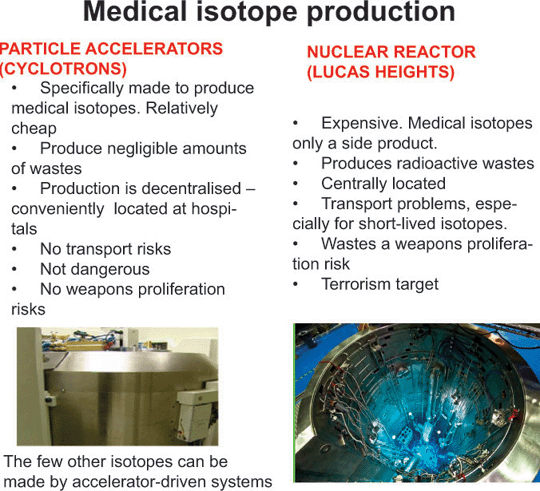
- Medical isotopes can be produced by non- reactor technology, such as cyclotrons, which are much cheaper and safer and are powered by electricity.
- Claims that a reactor serves Australia’s ‘national interest’ do not withstand scrutiny……
‘Medical uses’ don’t justify a new Reactor
Life-saving? In fact reactor-produced medicine won’t save many lives, if only because over 98% of it is used in diagnosis, not in life-saving therapy.
The Minister should have spoken more moderately. Reactor-based nuclear medicine is only one among many medical technologies used in diagnosis. The Minister didn’t explain why he was favouring it over all other diagnostic technologies by heavily subsidisingit through a new hugely expensive reactor. Nor, indeed, why a new reactor is needed when the bulk of nuclear medicine consists in the supplying of medical isotopes that can be obtained much less expensively from sources other than a Lucas
Heights reactor? Consider…
- Most importantly, cyclotrons increasingly produce isotopes and so render a reactor unnecessary (see cyclotrons, p.13); they are cheaper and safer and produce only small quantities of low-level radioactive waste.
- Nearly all countries in the world import the isotopes they need.
- ANSTO, the Australian Nuclear Science and Technology Organisation, itself imports them when it shuts the reactor for maintenance.
- ANSTO’s isotope operations are indeed heavily subsidised, and thus are not really competing economically with those of large overseas suppliers.
- While ANSTO argues that its most-used isotope technetium-99m can’t be
imported because it has a currency (technically, a ‘half-life’) of only six
hours, ANSTO neglects to say that an equally effective, longer-lived
isotope, molybdenum-99, is widely transported all around the world.
So, by using two cheaper alternatives – importation of some isotopes and production of others in cyclotrons – Australia would save itself the huge expense of this new reactor. It’s as simple as that. And safer too……
ANSTO has been stockpiling such waste for 40 years, and there it sits at Lucas Heights….
Not that ANSTO and the Federal Government haven’t tried to get rid of all this embarrassing waste. They have continually invited any and every state government to set up a dump-site (a ‘repository’) for it. But until 1998, no government would have it.
Only in February of 1998 did one government, that of economically troubled South Australia, hesitantly indicate it might accept it, at a site it considers to be ‘remote’ – but Aboriginal communities have expressed opposition. If established, such a dump would soon become ANSTO’s dump for all levels of its waste.
The long failure of the Federal Government to find a remote dump-site for radioactive waste is conclusive proof – though proof is surely not needed – of the dangerous nature of nuclear waste. So why go on creating such waste? No community wants to be saddled with the burden Sutherland Shire has carried for 40 years.
Three ‘levels’ of waste – and all dangerous
There are three general categories of radioactive waste. First, the high-level kind, chiefly the highly radioactive spent fuel rods; second, intermediate-level waste, such as results from reprocessing of spent fuel rods; third, low-level waste, such as the continual gaseous and liquid discharges from nuclear plants, and contaminated materials like gloves and instruments.
But ANSTO chooses not to follow this high-intermediate-low classification, arguing that high-level waste comes only from nuclear power-generating reactors, and since Australia’s reactor is the ‘research’ kind, its operation results only in intermediate-level and low-level waste. This is a semantic quibble which puts ANSTO at odds with US and Canadian terminology.
More than 1600 of the spent fuel rods, high – level waste, have accumulated at Lucas Heights in the past 40 years. ….. the resulting waste will be returned to Australia as ‘intermediate-level waste’, which will again constitute a problem here. Such shipments are never trouble-free: they involve safety, health and environment risks; they spark anti-nuclear protest along the route, resistance from residents around the destinations, and charges of unethical behaviour for dumping what should be one’s own responsibility onto others…. Continue reading
Why dump nuclear reactor waste in Flinders Ranges? Lucas Heights is the best place.
Regina McKenzie to Fight To Stop Nuclear Waste Dump In Flinders Ranges SA November 26
How radioactive is the nuclear waste we got back from France?
 Steve Dale to Fight To Stop Nuclear Waste Dump In Flinders Ranges SA, 26 Nov 16
44,000 times more radioactive than the Uranium Yellowcake we export
13,750,000 times more radioactive than typical Olympic Dam ore
(Yellowcake = 25,000 Bq/g, Olympic Dam ore = 80 Bq/g)
Sources:
Greenpeace report_BBC Shanghai and its nuclear waste cargo report.pdf,
odxEisAppendixSUraniumAndRadiation.pdf,
Guide-to-Safe-Transport-of-UOC.pdf
1 This month
7 April – WEBINAR – Australia and the Doomsday Clock – Preventing nuclear war through NoFirstUse and other policies
Online | Tuesday April 7, 4:00-5:30pm, Australian Eastern Time / 8:00-9:30am Central Europe Time
– Access the registration link
15 April – Zoom –Nuclear Power is Not the Solution
Apr 15, 2026 01:00 AM in Canberra, Melbourne, Sydney

Join the International Physicians for the Prevention of Nuclear War (IPPNW) on Tuesday, April 14th for a timely webinar exploring the risks associated with nuclear power and challenging the myth that it offers a simple, safe, carbon-free solution to the climate crisis

21 April Webinar: No Nuclear Weapons in Australia
Start: 2026-04-21 18:00:00 UTC Canberra, Melbourne, Sydney (GMT+10:00)
End: 2026-04-21 19:30:00 UTC Canberra, Melbourne, Sydney (GMT+10:00)
Event Type: Virtual
A virtual link will be communicated before the event.
Host Contact Info: australia@icanw.org

of the week – Australians for War Powers Reform (AWPR)
To see nuclear-related stories in greater depth and intensity
 Antinuclear