AUDIO: Commentary on Energy Minister’s visit to planned nuclear waste dump area
 AUDIO Federal minister visits Muckaty Station http://caama.com.au/wp-content/uploads/2013/08/Lauren-Mellor-Penny-Phillips.mp3 http://caama.com.au/federal-minister-visits-muckaty-station
Yesterday, Federal Minister for Resources and Energy, Gary Gray met with Traditional Owners at the proposed nuclear waste facility at Muckaty Station, near Tennant Creek.
This is the first time a federal minister has visited the site and met with Traditional Owners at Muckaty.
Traditional Owner Penny Phillips welcomed the minister’s visit, but says the people were not invited to the meeting between the minister and Northern Land Council.
“I was happy for him to come, I went to Canberra and invited him to come but the Northern Land Council mob didn’t tell us he was coming to Muckaty, so we ended up going.”
Also in Muckaty was anti-nuclear campaigner Lauren Mellor, from the Environment Centre NT, who on behalf of the Traditional Owners put forth a new approach.
“There is a new approach, which is a national commission into radio active waste management options, that looks at all options, not just a remote dump site and investigates the best and safest way to actually manage Australia’s stock piles of waste.”
Listen below to the extended comments from Penny Phillips and Lauren Mellor.
Australia needs a public and independent national commission on nuclear waste management
-
 Plan to use Aboriginal land as a nuclear waste dump is flawed and misguided Dave Sweeney theguardian.com, Wednesday 31 July 2013

“……..Radioactive waste management is difficult. Only time can take the heat out of the waste – but transparent and robust processes and policy development can take the heat out of the waste debate.
Australia has never had an independent assessment of what is the best (or least worst) way to manage our radioactive waste. Decades ago unelected bureaucrats decided a centralised remote dump was the best model and ever since a chain reaction of politicians have tried – and failed – to find a compliant postcode.
Australia is better placed than some countries to do things differently – and better. We have much less radioactive waste than nations with domestic nuclear power and ours is mostly stored at two secure federal sites – the Woomera prohibited area in South Australia and the Australian Nuclear Science and Technology Organisation’s Lucas Heights nuclear facility in southern Sydney.
ANSTO, which produces and houses most of Australia’s radioactive waste, is upgrading its storage facilities. It and the federal nuclear regulator agree ANSTO has the ability and capacity to securely manage all radioactive waste on site, including material due for return from overseas.
This reality provides Australia with some much needed breathing space. For more than two decades, politicians have talked big and listened little – and they have spectacularly failed come up with an agreed, credible and mature approach to radioactive waste management.
It is time to move away from the obsession with finding a place to dump and instead build a space to discuss. We need to get the policy architecture right so future generations of Australians will not have a radioactive legacy that is badly wrong.
A public and independent national commission would advance the discourse on what constitutes responsible radioactive waste management and to move all stakeholders out of the trenches and to the table.
In a long overdue and most welcome change of style, if not yet of substance, the latest federal minister with responsibility for this issue has acknowledged that there are deep Aboriginal and wider concerns over the Muckaty plan.
A minister named Gray should be well-placed to show leadership on an issue of inter-generational national importance that is not – and should never be – just black and white.
 Reply Reply |
Forward |
Retransfer of Australian obligated plutonium to Australia’s major uranium market, Japan

 Australia-Euratom Nuclear Safeguards: Plutonium Retransfers …..The Agreement will enter into force when Australia notifies the Delegation to the European Commission that all domestic requirements necessary to give effect to the Agreement have been satisfied…. Department of Foreign Affairs and Trade – Australian Government 01/06/2013 | Press release distributed by noodls http://www.noodls.com/view/2FBAFE516E5E78B9F15B62CBEB136F9A32994CC7
Australia and the European Atomic Energy Community (Euratom) exchanged diplomatic notes in Canberra on 28 May 1998 as the first step towards bringing into force an Agreement under which Australia will – subject to certain conditions – broaden its consent for the return from the European Union to Japan of Australian obligated plutonium following the reprocessing of Japanese spent fuel in Europe. The European Union is an important provider of nuclear fuel cycle services for countries purchasing Australian uranium and Japan is a major market for Australian uranium exports. Continue reading
Australian Financial Review joins the spruikers for Australia as the world’s nuclear waste dump
 Christina Macpherson 15 June 13, Today the Financial Review published a very worthy(?) article entitled “Energy sources to be a diverse mix by 2100” I should have been warned, when I saw it quoting Australian Renewable Energy Agency chairman Greg Bourne sayng that 100 per cent renewable energy power supply is not realistic.
But no – I read on this lengthy article, and then comes the real message – at the end:
 AUSTRALIA COULD BE ‘THE WORLD’S REPOSITORY OF NUCLEAR WASTE’
“In any discussion of Australia’s future energy needs and mix of sources, there is always a very big elephant in the room: nuclear energy. Australia is the Saudi Arabia of uranium, with almost 1.4 million tonnes of known recoverable resources. That is 1.4 times the resources of the number two supplier, Kazakhstan, and 2.6 times the resources of number three, Canada.
But Australia does not use the metal – exporting all it produces – and has no plans to do so. “Nuclear energy is quite simply the purest, cleanest and lowest-emission form of energy there is, and Australia has enormous reserves of that form of energy,” says Professor Stephen Martin,chief executive of the Committee for Economic Development of Australia (CEDA).
“If Australia is serious about mitigating the effects of climate change, then nuclear must be on the table. It has the potential to provide low-cost, clean, baseload energy and will be an important back-up if other renewable or clean energy options do not come to fruition. If we want to improve environmental outcomes, if we want to lower emissions, nuclear energy is a no-brainer,” Martin says…….
From the mini-reactors being developed, which are buried in the ground, to the ‘Generation IV’ reactors, and the potential of small-scale thorium reactors, it’s a pretty exciting outlook for nuclear energy. In fact, through technological changes, Australia could be the world’s repository of nuclear waste – which we could then refine and re-use,” Martin says.
Michael Angwin, chief executive of the Australian Uranium Association, agrees there needs to be a “reconfiguration of the Australian political dynamic” for our uranium to be used domestically for power, but says the case is compelling.
“Nuclear power is one technology that can supply electricity reliably for large population centres, with no emissions. It does this all over the world. If Australia had a nuclear industry we would be very keen to supply it,” Angwin says. http://www.afr.com/p/2100/energy_sources_to_be_diverse_mix_A2laV1flAoEMOCg5XYHneL
The radioactive poisoning of Maralinga
 Historic records of Radiation Monitoring at Australian Nuclear Test Sites, Paul Langley’s Nuclear History Blog 3 June 13“……..RETURN TO MARALINGA, Australia Bomb Test Site On 24 May 1984 a special VIP flight to the RAAF left Adelaide for Maralinga. On board were the Minister of Resources and Energy, Senator Walsh, and the south Australian Premier, John Bannon, accompanied by scientists of the Australian Radiation Laboratory. The tour of the bomb sites took no more than four hours and the politicians learned little more than they already knew from their briefings in Canberra and Adelaide. But the importance of the trip was symbolic. The representatives of the Federal and South Australian Government were there jointly to express their regret that the atomic test series had ever been allowed to take place in Australia and to pledge their support for all investigations into the possible harm done to servicemen, Aborigines and the environment…….
Traditional owners, Central Land Council, unions marched in Tennant Creek, against nuclear waste dump
Waste dump opponents ‘not going to back down’ http://www.abc.net.au/news/2013-05-27/waste-dump-opponents-not-going-to-back-down/4715238 By Gail Liston May 27, 2013 More than 200 people have marched in Tennant Creek to protest against a nuclear waste dump planned for Muckaty Station north of the town.
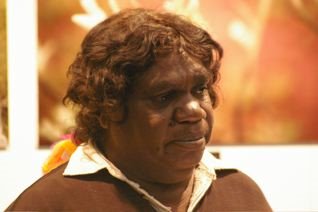 Traditional owner Diane Stokes says the chairman of the Central Land Council (CLC), Maurie Ryan, addressed the rally, declaring the CLC will support the protesters. Mr Ryan told the crowd, the CLC is on a collision course with the Northern Land Council over how they have handled the Muckaty nomination. Ms Stokes says it is time the CLC takes control of the country as far north as Elliott to support traditional owners in their bid to stop the dump going ahead.
“We were saying before about the boundaries to be put back now because Central Land Council is very strong on helping us out, supporting us in getting the boundary back to Elliott,” she said.
She says representatives from Unions NT and the CLC travelled to Tennant Creek to join the rally. “I’m very happy that we’ve marched and I know I want these people out there to know that we’re still standing strong and I want to let the supporters know that I want to thank them for supporting us,” she said.
Natalie Wasley from the Beyond Nuclear Initiative says the protesters recognise that the proposed nuclear waste dump is not just an NT issue. “This is shaping up to be a very important issue in the Northern Territory for the federal election and so that was expressed very strongly at the rally, that people are going to be knocking [on] the doors of all the candidates and asking where they stand and are they going to stand up for the Territory on this issue,” she said.
She says it has been six years since the site was nominated and no-one is planning to give up the fight. “It was noted that this Muckaty campaign has outlasted many federal ministers, chief ministers and chairpeople and CEOs of the Northern Land Council,” she said.
“The community is absolutely resolute and they’re not going to back down. “They’re going to build up and radioactive waste is going to last even longer than all of those politicians.”
NT trade unions join Traditional Owners to protest Muckaty radioactive waste dump.
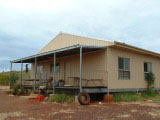 24 May 13, Six years and still standing strong: NT Union members will join Traditional Owners and supporters from across the Territory in Tennant Creek this weekend for a rally against the proposed national radioactive waste dump at Muckaty in the Northern Territory. The rally and concert will mark exactly six years since the Northern Land Council voted to nominate the site.
In May 2012 the Australian Council of Trades Unions National Congress unanimously voted to support the Muckaty campaign. Bryan Wilkins, NT Organiser for the Australian Manufacturing Workers Union said, “NT Unions  are standing in solidarity with Traditional Owners and communities to resist the federal government plan for a radioactive waste dump. We will continue to campaign against any legislation that targets the Muckaty Land Trust, or any site in Australia for a nuclear waste dump that is not based on recognised scientific and international best practice.”
Muckaty Traditional Owners and the community in Tennant Creek remain resolutely opposed to the national radioactive dump being built. Muckaty Traditional Owner Dianne Stokes said, “It’s been six years of big struggle for Warlmanpa and Warumungu people. We are still standing strong. We are saying that we still don’t want the waste to come to Muckaty Land Trust.”
“Tomorrow will be a big day for us mob, the Traditional Owners of the Muckaty. We are happy that we have people traveling to Tennant to join us for the rally against the nuclear waste. We also have unions coming along and we are looking forward to meet these people. We will march together to stand up strong and tell the NLC and the government to back down and leave us alone.”
Beyond Nuclear Initiative coordinator Natalie Wasley added, “The nomination of Muckaty by the NLC and the dogged pursuit of the site by successive Federal Ministers are being challenged on the ground as well as in the federal court. It is highly disappointing that while the court is scrutinising the original nomination process, the NLC is preparing to nominate a new site on Muckaty for assessment. The process of managing radioactive waste must be transparent and include all stakeholders. We urge Federal Resources Minister Gary Gray to step away from the highly contested Muckaty plan and initiate an Independent Commission into radioactive waste management.”
Australia’s old dead reactor and radioactive trash to make way for more nuclear development?

Australia should shut down Lucas Heights and stop making radioactive trash
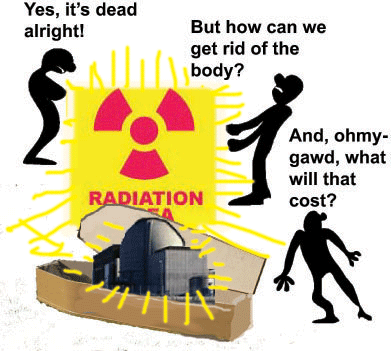 Nuclear waste on the move in clean-up http://www.smh.com.au/nsw/nuclear-waste-on-the-move-in-cleanup-20130515-2jmu5.html#ixzz2TV9sbj00 May 16, 2013 Heath Aston Radioactive waste and parts of Australia’s oldest nuclear reactor will be trucked out of Sydney under plans to clean up the Lucas Heights nuclear facility and develop a national hazardous-waste dump in the outback.
But residents in Sydney’s south are concerned at the prospect of having radioactive  material transported past their homes.
They believe the dismantling and removal of the 1960s-era ”high-flux Australian reactor” and spent fuel rods is a bid to clear the way for further development at Lucas Heights and the production of more dangerous waste.
The plan to move the retired reactor, switched on by former prime minister Robert Menzies in 1958 and taken out of service in 2007, emerged in the budget papers.
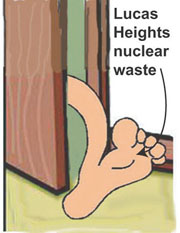 The Australian Nuclear Science and Technology Organisation, which manages Lucas Heights, has been given $28.7 million to prepare for the move. The four-year funding package will pay for ”pre-disposal conditioning of existing radioactive waste in preparation for long-term storage and disposal, and for the clean-up of buildings and infrastructure containing hazardous materials” at Lucas Heights.
Separately, the government has put $35.7 million into securing a site to become the nation’s repository for radioactive material. It will host waste from Lucas Heights and may provide the state government with a destination for contaminated soil from the former uranium smelter site at Hunters Hill.
An area at Muckaty, 800 kilometres south of Darwin, is the government’s preferred site after it struck an agreement with the Northern Land Council. But development of the semi-arid claypan site is bogged down in a legal challenge by some traditional owners. The budget papers do not identify Muckaty specifically, but a spokesman for Resources and Energy Minister Gary Gray said Muckaty, 100 kilometres north of Tennant Creek, remained the only location under consideration.
Within four years a facility that could centralise waste from Lucas Heights, and 100 or so other industrial and medical waste facilities, would be ready for construction. An ANSTO spokesman confirmed the plan to move the reactor and waste. The load will include fuel rods due to arrive in Botany Bay for transportation back to Lucas Heights after they were reprocessed at a nuclear facility in France.
Local resident groups who supported a previous plan to encase the reactor in concrete will meet ANSTO management in Engadine in the next few days.
Sutherland Council doesn’t want Lucas Heights nuclear wastes – “The local community would not support that”
the only sensible thing to do is to shut down the Lucas Heights nuclear reactor. Nuclear medicine is just a sideshow there anyway. All nuclear medicine’s pharmacueticals can be made in other ways, by non nuclera cyclotrons.
Lucas Heights real purpose is to keep a foot in the door for the nuclear fuel cycle in Australia
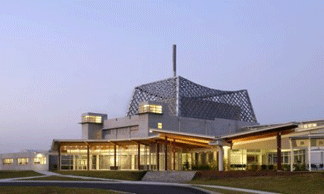 A Sydney council’s nuclear waste warning, BYVIKKI CAMPION The Daily Telegraph April 29, 2013 A SYDNEY council has warned it does not want to be the dumping ground for Australia’s nuclear waste.
It comes as a massive expansion of the nuclear medicine operations at Lucas Heights triples the amount of nuclear waste generated.
The Australian Nuclear Science and Technology Organisation plans to build a state of the art nuclear waste treatment facility – to safely store it – but could end up keeping it there for up to 10 years.
Sutherland mayor Kent Johns said the council’s biggest concern was making sure Lucas Heights did not become the permanent home of nuclear waste storage……..
A spokesman for ANSTO said it supported setting up a long term storage facility for nuclear waste, but not at Lucas Heights……. “By law ANSTO cannot be used as a national waste repository. The local community would not support that….. ( just like the Muckaty Aboriginal community C.M)
Nuclear waste dump: other sites more suitable than Muckaty
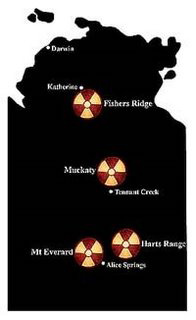 Proposed new nuclear waste dump site nomination, Natalie Wasley 19 April 13
 How Australia should responsibly manage its nuclear waste
A RESPONSIBLE APPROACH TO RADIOACTIVE WASTE MANAGEMENT, Jim Green, Feb 2011, – 1. Waste minimisation – 2. All options for radioactive waste management should be considered -3. Site selection processes must be fair and transparent.
 1. Waste minimisation
Nuclear waste dump: where do New NT Chief Minister Giles and Federal Resources Minister Gray, stand?
New NT Chief Minister and Federal Resources Minister , by Natalie Wasley, 19 April 13 approached to meet with Traditional Owners opposed to the waste dump and we hope this meeting will be advanced soon to allow grassroots voices of opposition to be heard and represented.
Greens MP Kate Faehrmann invited, but sidelined at Kemps Creek radioactive waste meeting, while ALP dominated
 Despite being invited to address the meeting, NSW Greens MLC Cate Faehrmann was told at the last minute that she would not be seated on the stage and would only get to speak at the start of discussion time.
She raised the proposal of shifting the waste to the Lucas Heights nuclear reactor site, and said that if the federal Labor government wanted to, they could step in now to make this a reality through an amendment to national laws.Despite a number of people in the crowd pressing the speakers to address this idea, all preferred to side step it.
Labor MPs hijack local outrage over uranium dump plan http://www.greenleft.org.au/node/53403, February 22, 2013 By Fred Fuentes Angry residents from Kemps Creek and surrounding neighbourhoods packed the local sports and bowling club auditorium on February 18 to protest against the state government’s plan to dump radioactive waste in the area.
The NSW Liberal government is proposing to shift 5800 tonnes of soil from an area in Hunters Hill, where a uranium ore processing plant once stood, to the Kemps Creek SITA dump site.
Cancer clusters have been detected in Hunters Hill, which have been linked to the contamination left behind at the former plant site.
The amount of community concern against the project was shown by the more than 3000 submissions against the proposal over the past two months.
The meeting was addressed by three federal politicians and a councillor from Penrith, all from the ALP. Continue reading
Radioactive waste in Arkaroola Wilderness now tax-payers’ problem, not Marathon’s
In February of this year, Marathon was paid $5 million in compensation by the State Government over the decision to stop it exploring in the Flinders Ranges.
it is ironic the Arkaroola Wilderness Sanctuary is home to a radioactive waste facility.
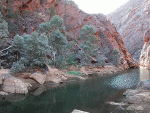 Radioactive waste being stored in shed in Arkaroola, THE AUSTRALIAN BRYAN LITTLELY with Giuseppe Tauriello From: adelaidenow December 25, 2012 IT’S the nuclear-waste facility that few people know about – 21 barrels of medium- to high-level radioactive material stored in a tin shed in South Australia’s Outback paradise.
The waste is in the heart of Arkaroola, the Outback wilderness sanctuary the State Government hopes will one day be included on the World Heritage list.
The facility, known as Painter Camp, is not registered under the Radiation Protection Act and a management plan for its safe and secure operation is still being developed.
In a revelation likely to outrage environmental groups and anti-nuclear campaigners, responsibility for Painter Camp now lies with the State Government, Continue reading
Marathon resources chairman suggests South Australia for global nuclear waste dump
- Repository for nuclear waste … The inevitability of all global stakeholders agreeing that a safe haven must be found somewhere in a stable geological and political environment is an opportunity this State should consider.. Peter Williams, Chairmans Address 2012AGM_
1 This month

of the week – Australians for War Powers Reform (AWPR)
To see nuclear-related stories in greater depth and intensity
 Antinuclear