Flooding the planned nuclear waste dump area
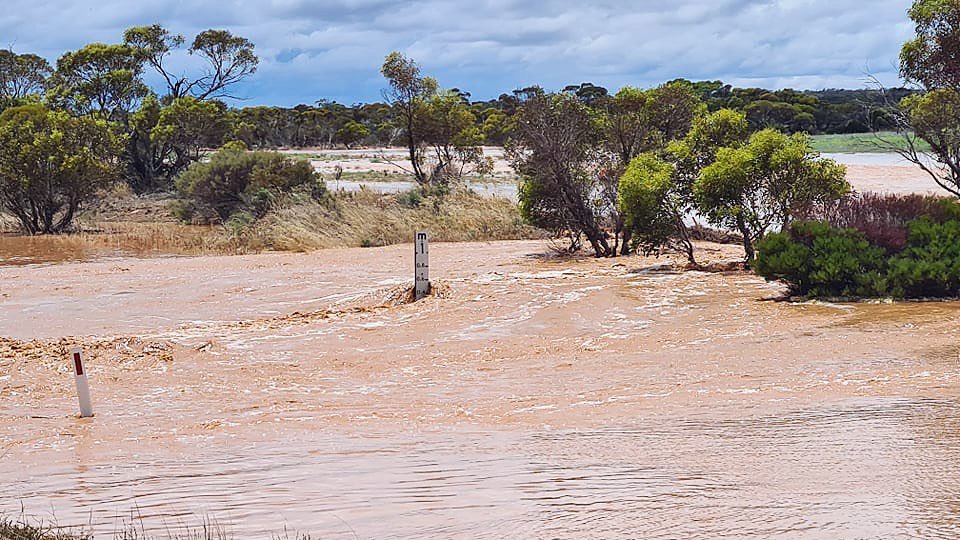
Flooding the Dump Michele Madigan, Sunday Mail, 6 Feb 22,
Well surely that has settled the matter- the Kimba region is a totally unsuitable site for where the federal government is proposing to dumping the nation’s highest-level radioactive waste.
Just out of Kimba, at Buckleboo where the proposed Napandee site actually is, neighbours recorded 185 mm in just the first recent downpour. Some areas received up to 300mm in two days. The Kimba mayor reported ‘massive damage to our roads and general infrastructure.’
The federal government is planning to transport this dangerous radioactive waste half way across the country to simply store it above ground for at least 100 years. The storage sheds will be designed with water outlets to leak.
Despite government assurances, 90% of the waste, measured by radioactivity, is intermediate level waste – toxic for an unimaginable 10,000 years.
In these times of galloping climate change it is certainly optimistic to be talking about ‘once in 100 years’ downpours. How much safer to keep it where it is manufactured in ANSTO’s solid buildings in Lucas Heights outer Sydney, with its on-site nuclear experts and highest-level security.(added ? )
Ranger uranium mine rehabilitation costs could blow out to $2.2 billion, Energy Resources tells ASX
Ranger uranium mine rehabilitation costs could blow out to $2.2 billion, Energy Resources tells ASX, https://www.abc.net.au/news/rural/2022-02-02/ranger-uranium-mine-cleanup-cost-blowout-to-2-2-billion/100798666ABC Rural / By Daniel Fitzgerald The rehabilitation of a decommissioned uranium mine in Kakadu National Park could cost up to $1.2 billion more than expected and take two years longer than initially planned.
Key points:
- Rehabilitation of Ranger uranium mine to cost between $1.6 billion and $2.2 billion
- Timeline of clean-up pushed out by two years
- Gundjeihmi Aboriginal Corporation concerned ERA won’t be able to fund extra costs
Energy Resources of Australia (ERA) — a subsidiary of mining giant Rio Tinto — shut down production at its Ranger uranium mine, 250 kilometres east of Darwin, in January last year and has since been working to return the mine site to its original state.
The rehabilitation was originally estimated at $973 million, but in a statement to the ASX on Wednesday, ERA revised costs to be approximately between $1.6 and $2.2 billion.
The company also said clean-up works could continue until the end of 2028, more than two years longer than planned.
The Gundjeihmi Aboriginal Corporation, which represents Mirarr traditional owners, had been seeking clarity on the expected cost blowouts from ERA.
“We knew it would cost more, but a doubling — to probably the biggest rehabilitation exercise in the history of Australian mining — took us by surprise,” chief executive Justin O’Brien said.
“It’s not good news, but at least we now have a much greater picture of the true cost.”
ERA’s statement outlined a number of reasons for the revised cost, including engineering issues, emerging technical risks and additional water treatment costs.
“It is a complex operation and it is in a very sensitive, world-heritage-listed national park, upstream of Aboriginal communities and the Arafura Sea,” Mr O’Brien said.
Federal changes needed to extend time frame
ERA’s current lease stipulates the company must complete the rehabilitation and be off the mine site by 2026, a condition legislated by the Atomic Energy Act 1953.
With the rehabilitation time frame now stretching into 2028, ERA said it “has been engaging with government and key stakeholders to amend the Atomic Energy Act 1953 and extend the expiry date of ERA’s tenure on the Ranger Project Area”.
Mr O’Brien said a two-year extension to the rehabilitation was “pretty ambitious”.
“If you’re going to amend the legislation in Canberra you don’t just do it for two years, you give them lots of space to do this,” he said.
“If they [ERA] relinquish within another 26 years, then fine.”
Can ERA afford the cost blowout?
In light of the cost revision, ERA said it was “currently reviewing all available funding options to ensure that the increased forecast cost of the rehabilitation of the Ranger Project Area will be adequately funded”.
As of December 31, 2021 the company had $699 million in cash funding and $535 million held by the Commonwealth government as part of the Ranger Rehabilitation Trust Fund.
ERA’s parent company, Rio Tinto said in a statement to the ASX, “it is committed to working with [ERA] to ensure the rehabilitation of the Ranger Project Area is successfully achieved to a standard that will establish an environment similar to the adjacent Kakadu National Park”.
Channel 10’s ”The Project” did have the guts to show Australia the Kimba nuclear waste dump story
How happy was the nuclear lobby, to keep this under wraps from the Australian public.!
In typical form, the nuclear lobby chooses a rather remote small rural community, and then blankets thenm with propaganda from ANSTO and any other pro nuclear institution they can find. Only the pro nuclear spin got to that community.along with lovely financial ”incentives”.
In the current floods, no media mention is made of the clear threats to a Napandee nuclear waste dump, from flooding – to add to the other threats, such as the ruination of the local agricultural reputation.
Only Channel 10 has had the guts. And I write as a person who is biased against the commercial TV channels. Always a fan of the ABC – I now see it as a rather timourouis organisation, always in dread of having their funding cut – as the Scott Morrison government continues in the good old Liberal tradition of death to the ABC by a thousand cuts.
Does Channel 10’s ”The Project” have the guts to tell the truth about the government’s planned Kimba nuclear waste dump?

You would have thought, with the present flooding of the Kimba area, and indeed, of much of Northern South Australia, that concern about planning a nuclear waste dump there would be an ‘‘urgent item of news”
Indeed, Channel 10’s ”The Project” had 2 hours of interview s about the dump sll ready.
In a rare media event, they had interviewed No Dump advocates Kimba farmers Peter & Sue Woodford & Barngarla Traditional Owner Jason Bilney
Of course they’d also interviewed pro-dumpers.
But anyway, Channel 10 decided that this matter is not ”urgent” – and it’s gone on the back burner.
But instead, they’ve managed to put a reassuring spiel from The Australian Radioactive Waste Agency, (just in case the wider world in Australia might get a bit worried about the situation)
- Roni Skipworth, No nuclear waste dump anywhere in South Australia , 31 Jan 22, Was told today the Interviews Peter and Sue were involved with was 2 hours long and was suppose to be shown tonight on the Project though they got a message saying they will view it later in the week as an urgent report needed to go first.
- Let’s see how long they take to telecast it and also they just didn’t interview the Woolfords from No Nuclear Waste Dump on Agriculture Land. They interviewed the Yes Group also where Ramsay visited Kimba as well to put his bit in. Be interested to see what replaced the time slot tonight. This interview should had happened 6 years ago not just now!
- https://www.facebook.com/groups/1314655315214929—
Floods at Kimba: serious doubts that the Australian government has a plan for nuclear waste dump vulnerable to flooding

NUCLEAR WASTE AND FLOODS
Nuclear waste and floods
1. Preventing problems at a nuclear waste dump/store from flooding should be manageable, if and only if project management oversight and regulation is up to the task.
There are serious questions about whether management and regulation of the Australian government’s proposed national nuclear waste dump/store at Kimba in SA would be adequate. The most relevant case study in Australia is the flawed ‘clean up’ of the Maralinga nuclear test site in the late 1990s, overseen by the federal government. Everything that could go wrong, did go wrong. There has been no honesty or transparency about the failures at Maralinga, no attempt to learn from mistakes. Successive governments have simply lied about the problems and tried to cover them up. Expect the same at Kimba. https://nuclear.foe.org.au/flawed-clean-up-of-maralinga/
2. The proposed Kimba dump will be designed to leak. Either barriers prevent leakage, in which case there is a risk of accumulation of infiltrated water resulting in corrosion of waste drums and other such problems. Or, as is the case with the Kimba proposal, there will be water outlets, i.e. it is designed to leak.
3. Even with the expertise and resources available to ANSTO, and the importance of safely managing irradiated/spent nuclear fuel, water infiltration has been a problem at Lucas Heights. In early 1998, it was revealed that “airtight” spent fuel storage canisters had been infiltrated by water – 90 litres in one case – and corrosion had resulted. When canisters were retrieved for closer inspection, three accidents took place (2/3/98, 13/8/98, 1/2/99), all of them involving the dropping of canisters containing spent fuel while trying to transport them from the ‘dry storage’ site to another part of the Lucas Heights site. The public may never have learnt about those accidents if not for the fact that an ANSTO whistleblower told the local press. One of those accidents (1/2/99) subjected four ANSTO staff members to small radiation doses (up to 0.5 mSv).
4. One example of flooding compromising nuclear waste: Flooding at Nine Mile Point. In July 1981, water flooded the Radwaste Processing Building containing highly radioactive waste for Unit 1 at the Nine Mile Point nuclear plant in upstate New York. The flood tipped over 55-gallon metal drums filled with highly radioactive material. The spilled contents contaminated the building’s basement such that workers would receive a lethal radiation dose in about an hour. The Unit 1 reactor had been shut down for over two years and was receiving heightened oversight attention when the Nuclear Regulatory Commission (NRC) investigated the matter. But the NRC was reacting to a television news report about the hazardous condition rather than acting upon its own oversight efforts. The media spotlight resulted in this long over-looked hazard finally being remedied. https://allthingsnuclear.org/dlochbaum/flooding-at-nine-mile-point
5. Another example: Federal health officials agree radioactive waste in St. Louis area may be linked to cancer. The US government confirms some people in the St. Louis area may have a higher risk of getting cancer. A recent health report found some residents who grew up in areas contaminated by radioactive waste decades ago may have increased risk for bone and lung cancers, among other types of the disease. The assessment was conducted by the Agency for Toxic Substances and Disease Registry, a branch of the U.S. Centers for Disease Control and Prevention. Tens of thousands of radioactive waste barrels, many stacked and left open to the elements, contaminated the soil and nearby Coldwater Creek which sometimes flooded the park next to people’s homes. https://www.cbsnews.com/news/radioactive-waste-cancer-federal-health-officials-acknowledge-possible-link/
Kimba and the South Australian government must protect this precious agricutural region from nuclear waste dump’s danger of ground contamination.
Peter Remta, 29 Jan 22, Someone from Kimba should formally request the deputy premier what his government will do to ensure that the nuclear waste management facility at Napandee or anywhere else within the Eyre Peninsula will not lead to any radioactive ground contamination
This is an issue entirely within the constitutional competence and responsibility of the state government and it cannot rely on the federal government to provide a solution
The radioactive contamination of prime rural land within the Kimba district and further afield would be a disastrous outcome for the state’s economy and population with the likelihood of the destruction of its agricultural industry
The satisfaction of the resulting and incalculable claims for compensation due to the contamination would no doubt be completely beyond the state’s financial resources
There is now a strong possibility of radioactive ground contamination due to the significant flooding and the use of an above the ground facility of escape or leakage of the nuclear waste if the facility were established
The risks involved and the safety measures to overcome them are far too uncertain making it completely unacceptable to have the government’s proposed facility at Napandee
The risk will be incapable of elimination by the existing methods of containing the waste without using effective and proper geological burial in a suitable location
This request should be by way of addressing what the deputy premier raised in his letter posted by Karen Gray on Facebook on 13 January 2022
WASHED AWAY – Minister Keith Pitt’s grand dream of a Kimba nuclear waste dump
there is now no earthly hope of it ever being established at Kimba.
It is all over for Pitt so he should pick up his marbles and go home.
Peter Remta, 27 Jan 22, The recent events at Kimba resulting from the severe flooding have exposed a number of aspects included in the planning of the waste management facility that had been either inadequately covered or
completely ignored in the planning and accompanying studies.
While there are several instances of these insufficiencies it becomes most concerning that the federal government has spent huge amountsof money on developing its South Australian proposals and more
importantly has failed to inform the communities of the true situation
There will no doubt be attempts to downplay any forewarning of the flooding possibility at Kimba but the fact remains that none of the government studies gave much credence to the Pirie – Torrens corridor
which has always been a risk as to flooding and rising water tables for a large part of the Eyre Peninsula
MINISTER’S COMMENTS
Minister Pitt tweeted on 24 January 2022:
” It’s been a challenging couple of days for communities around Kimba inmSA after a big rain event. Thanks to those who took time out to joinmdiscussions for the new radioactive waste facility. It’s a critically important piece of national infrastructure #auspol”
The mention of “a big rain event” sounds more like some ancient tribalnwar dance than the devastating flooding in the Kimba region while thenrest of his tweet is hard to follow.
Surely he must be extending his thanks to those who previously joined in the past discussions for the waste facility as there is now no earthly hope of it ever being established at Kimba.
It also undoes the years of disingenuous exaltations of the facility by the government which in many instances were an insult to the community.
It is all over for Pitt so he should pick up his marbles and go home.
His biggest fault besides his numerous and unfounded statements was that he never gave the community the opportunity to get is ownnindependent assessment of his government’s proposals as is required by
all international prescriptions in these situations
OPINIONS
In closing here are a couple of comments by leading international experts whose anonymity I have preserved for commercial confidentiality:
A. Kimba – What a perfect site with floods – has groundwater at 20 mnand within 20-30 km of towns and wheatfields.
B. ……if the plan is to store waste fractions from spent fuel reprocessinginto what qualifies as intermediate level near-surface facility, and thennplace this facility in an area of obvious flooding risk … …it seems to
reach internationally competitive levels of stupidity. And …… it doesn’t help if it’s only interim storage, since we are not looking long term but a risk that would be well plausible during our generation
Kimba flooding: Australian government must immediately abort nuclear waste dump project.
Peter Remta 25 Jan 22, Is this where the federal government should be placing its proposed above ground nuclear waste management facility?
There is no doubt that the sever flooding caused by the heavy rains in South Australia which included the Kimba district is a serious and essential reason for immediately aborting the proposed nuclear
waste management facility at Napandee farm.
From expert advice it is quite clear that Kimba as a whole – and not just Napandee – is far too dangerous to be an installation for theholding of nuclear waste particularly as the results of the present flooding may take up to ten years to overcome without any further flooding
This is especially the case as nuclear isotopes are dispersed and travel freely in water which can affect and contaminate all the surrounding land for many centuries making it completely unusable.
The federal government as the proponent of the Kimba nuclear waste facility cannot deny knowledge of floods and fires as risks for the purposes of the safety requirements for nuclear waste in Australia
As a result of advice by overseas experts that these two major risks are far more pertinent to Australia than other countries with nuclear waste the regulatory bodies should or must include these risks
within the Australian Radioactive Waste Management Framework and other applicable prescriptions and and standards for the longterm management of Australia’s radioactive waste including the storage or disposal of this waste at suitably sited facilities
I informed the officer at ARPANSA in charge of the Kimba facility development about formal inclusion of these risk and the requirement for the long overdue start of the safety case and her response was:
‘‘I think that it is not necessary at this stage however will take you up on the offer when we feel is the right time’‘
In view of the drastic situation that has now developed it is it is imperative that the federal government provides immediate funding to the Kimba community for an independent assessment and review of the government’s proposals
Massive flooding in Kimba district, – the Agricultural (no it’s now the Nuclear Waste) Town of the Year.
Flooding in Kimba district causes a decade’s worth of damage and communities are ‘completely shut off’
ABC North and West SA / By Declan Gooch, Brooke Neindorf, and Marcus Wilson, 23 Jan 22, V
Flooding on South Australia’s Eyre Peninsula has caused “massive, massive damage” to roads and infrastructure and left communities completely isolated.
Key points:
- Some parts of the Kimba district received 300mm of rain over the weekend
- The mayor says there has been “massive” damage to infrastructure
- A local farmer says his property looks like “channel country”
The Kimba district was among the hardest hit by the weekend’s destructive rain, which battered most of regional South Australia.
Mayor Dean Johnson said some areas received up to 300mm throughout Friday and Saturday.
The Bureau of Meteorology said the 160mm officially recorded in the 24 hours to 9am on Saturday was the most rain in a day ever documented there.
“It’s done massive, massive damage to our roads and general infrastructure,” Cr Johnson said.
“It will be some years and perhaps even a decade before we get to repair all of this, I think.”
“There are entire roads and sections of roads that have just been swept away by rivers of water. I can’t paint a much better picture than that. Just cliff edges where there used to be a road.”
He said many of the roads that had been damaged or destroyed were major roads, and the Kimba district was cut off from most directions.
“We’re completely shut off from the rest of the world at the moment. The road to the airport has completely washed away,” Cr Johnson said.
It is one of several regions that have been isolated by floodwater, with authorities scrambling to repair the Olympic Dam Highway that has cut off access to Roxby Downs.
‘You can mistake us for being in channel country at the moment’
Buckleboo, about 30 kilometres from Kimba, was another of the hardest-hit areas and also received its most rain ever recorded in a day.
Local farmer Tristan Baldock said his property had been transformed.
“You can mistake us for being in channel country at the moment, so we’ve got a historic watercourse that’s probably extending 20 kilometres through our property with a series of lagoons,” Mr Baldock said. ……
Will get through’
Cr Johnson said he was confident the region would recover. “The Agricultural Town of the Year is set up for a pretty good growing season next year, I think.”
more https://www.abc.net.au/news/2022-01-24/kimba-floods-eyre-peninsula-damage-isolated-roads-closed/100777084#:~:text=%22It’s%20done%20massive%2C%20massive%20damage,infrastructure%2C%22%20Cr%20Johnson%20said.&text=He%20said%20many%20of%20the,the%20world%20at%20the%20moment.
The Australian government’s Kimba nuclear waste decision rides roughshod over Australia’s obligations under international law

United Nations Declaration on the Rights of Indigenous Peoples
The Australian Human Rights Commission advised that Article 29(2) of the United Nations Declaration on the Rights of Indigenous Peoples states that ‘no storage of hazardous materials shall take place on Indigenous lands without their free, prior and informed consent.’ 265
1.255 The Commission submitted that in order for Indigenous people to make informed consent, adequate resourcing to representative groups needs to be provided to ensure appropriate and informed consultation. 267
EXTRACT FROM REPORT BY FORMER SPECIAL RAPPORTEUR VICTORIA TAULI-CORPUZ IN SEPTEMBER 2017 FOLLOWING HER VISIT TO AUSTRALIA IN MARCH 2017
Self-determination and participation
When Australia officially endorsed the United Nations Declaration on the Rights of Indigenous Peoples in 2009, the Government stated its intent was to reset relations between Indigenous and non-Indigenous Australians and to build trust in order to work together to overcome the legacy of the past and shape the future together. Furthermore, in Australia’s pledge as a candidate to the United Nations Human Rights Council 2018-2010, it committed to give practical effect to the United Nations Declaration on the Rights of Indigenous Peoples and the World Conference on Indigenous Peoples’ Outcome Document.
Self-determination is a fundamental element of the Declaration whereby indigenous peoples have the right to freely determine their political status and freely pursue their economic, social and cultural development (Art. 3 of UNDRIP) and have the right to autonomy or self-government in matters relating to their internal and local affairs, as well as ways and means for financing their autonomous functions (Art. 4). The Declaration also sets out that indigenous peoples have the right to participate in decision-making in matters which affect their rights (Art. 18).
While Australia has adopted numerous policies aiming to address Aboriginal and Torres Strait socio-economic disadvantage, the failure to respect the right to selfdetermination and the right to full and effective participation in these is alarming. The compounded effect of these policies has contributed to the failure to deliver on the targets in the areas of health, education and employment in the Closing the Gap strategy and has contributed to aggravating the escalating incarceration and child removal rates of Aboriginal and Torres Strait Islanders
LETTERS PATENT
The Letters Patent, long title “Letters Patent under the Great Seal of the United Kingdom erecting and establishing the Province of South Australia and fixing the boundaries thereof”, defined the boundaries
of the Province of South Australia:
Provided Always that nothing in those our Letters Patent contained shall affect or be construed to affect the rights of any Aboriginal Natives of the said Province to the actual occupation or enjoyment in their own Persons or in the Persons of their Descendants of any Lands therein now actually occupied or enjoyed by such Natives
Nuclear waste returning from UK to Australia

Dealing safely with nuclear waste, THE AUSTRALIAN, DECEMBER 30, 2021,Australia’s lack of a long-term storage plan for nuclear waste is a serious gap the Morrison government needs to address. The issue has been highlighted by the return from Britain in coming months of a two-tonne shipment of nuclear waste generated in Australia. The nation is committed to receiving the waste after 114 spent fuel rods from the Australian Nuclear Science and Technology Organisation were sent to Scotland to be reprocessed in 1996. It will be the second shipment of intermediate-level nuclear waste returned to the country in recent years under tight security. In the absence of a permanent secure storage facility, the waste will be stored temporarily at ANSTO facilities at Lucas Heights in Sydney’s south.
Preparations for the shipment have been in train for years, with all safeguards to be implemented. The waste is being returned in a more condensed form than what was originally sent to Scotland. It has been vitrified in four glass containers, then encased in an outer container made of specialised steel. Details of its movement, and the timing, will be kept secret. ANSTO previously received intermediate-level nuclear waste in 2015 when 25 tonnes of similar-level nuclear waste were returned from France. Australia can expect to have to receive further shipments of returned waste every six or seven years……..
As an alternative to Lucas Heights, a temporary storage facility for intermediate waste is being considered for a site near the town of Kimba in South Australia. But the proposal is being contested, with a judicial review requested by the traditional landowners. https://www.theaustralian.com.au/commentary/editorials/dealing-safely-with-nuclear-waste/news-story/5bbe6898c49206c64fe987e9949d88b4
Nuclear waste from Britain heading to Lucas Heights – first load of many.

Nuclear waste from Britain heading to Lucas Heights, THE AUSTRALIAN, JACQUELIN MAGNAY 30 DECEMBER 21, LONDON@jacquelinmagnay,
Australia is to receive a two-tonne shipment of nuclear waste from Britain that will arrive under tight security and amid high secrecy in the coming months.
The shipment of intermediate-level nuclear waste has been prepared for delivery to the Australian Nuclear Science and Technology Organisation facilities at Lucas Heights, in Sydney’s south.
It will be just the second tranche of intermediate-level nuclear waste returned to the country, and its arrival shines a spotlight on Australia’s lack of a long-term storage plan for nuclear waste classified above low-level material.
The radioactive uranium and plutonium waste has been vitrified in four glass containers and then encased in an outer container made of specialised steel, known as a TN81 cask.
ANSTO says its previous experience in receiving intermediate-level nuclear waste – which occurred in 2015 when a larger shipment was returned from France – will mitigate any risks.
In that shipment, all local roads along the route were shut for more than five hours, and the operation involved the NSW Riot Squad and other police units to contain antinuclear protesters.
In the coming weeks, the nuclear waste will be moved by rail from the decommissioned nuclear plant at Sellafield in Cumbria to the British coast before being loaded onto a ship operated by Nuclear Transport Solutions.
It is expected to travel through Australian waters, including some maritime parks, before berthing.
The cargo is likely to be unloaded at Port Kembla in Wollongong under heavy guard, arriving sometime before the middle of next year.
Wherever the ship berths, the container will be loaded onto a truck for transport through residential and industrial areas, as well as along the Princes Highway through the Royal National Park south of Sydney and on to the Lucas Heights facility.
ANSTO says the final route will be a closely guarded secret and will be decided in consultation with NSW authorities.
NTS confirmed that the return of the intermediate-level waste in the form of vitrified residue to Australia had first been expected to take place last year.
Preparations for the shipment have been carried out since 2014……..
The Australian Radiation Protection and Nuclear Safety Agency has recently certified “the transport package”, and it will allow ANSTO to “temporarily” store the nuclear waste in the Interim Waste Store at Lucas Heights before another temporary storage facility for intermediate waste – currently being considered for Napandee, near the town of Kimba in South Australia – is ready to receive it.
This planned alternative storage solution, which is known as the National Radioactive Waste Management Facility, would bring together all the low-level radioactive waste from 100 different sites around the country and allow temporary storage of intermediate-level waste.
However, the proposed site in Kimba is being contested, with a judicial review requested earlier this month by traditional landowners the Barngarla Determination Aboriginal Corporation.
Longer-term storage plans for the intermediate waste are yet to be considered.
Despite this uncertainty, Australia is committed to receiving the waste after 114 ANSTO spent fuel rods were sent to Dounreay, Scotland, to be reprocessed of plutonium and uranium in 1996.
The processed waste being returned is of an equivalent radioactive level, but in a more condensed form than was originally exported to Scotland, and it has now been transported to the old Sellafield power station.
This means that instead of 52 500-litre drums of cemented waste, the British shipment will comprise four canisters of glass waste of an equivalent level.
It is classified by British authorities as having radioactivity levels greater than four GBq/tonne for alpha emitters and Beta/gamma emitters greater than 12 GBq/tonne – which puts it in the intermediate category.
ANSTO says it has experience in handling and storing such waste, citing the 2015 arrival of 25 tonnes of similar-level nuclear waste from France.
The new shipment will be stored next to that waste……………..
It is unclear if local councils positioned along the expected transport route will be notified when the shipment lands.
Previously, some export transportation of spent nuclear fuel rods from ANSTO to France for reprocessing has been carried out in the middle of the night with tight secrecy and no prior notice. Several councils, including Wollongong through which the nuclear waste will be carried, have called for Australia to sign and ratify the Treaty on the Prohibition of Nuclear Weapons.
Australia can expect to have to receive further shipments of returned waste every six or seven years, including spent fuel elements from the Opal reactor sent to La Hague in France for reprocessing before being returned. https://www.theaustralian.com.au/world/nuclear-waste-from-britain-heading-to-lucas-heights/news-story/e5e8511403cd24de66c79be3d1d96fe6
Dave Sweeney – Australia needs a genuine discussion about nuclear waste

(This is an extract from a basically pro-nuclear article on AAP , 28 Dec 21, )”………..Australian Conservation Foundation campaigner Dave Sweeney accepts there is a need for final solution for all the radioactive waste the nation produces, but he has grave concerns about the current approach.
He says the federal government recently handed ANSTO tens of millions of dollars to expand storage options at Lucas Heights and there’s no imperative to relocate waste from there any time soon.
He particularly objects to what he calls the unnecessary double handling of the worst nuclear waste Australia has.
“The plan is that a future federal government, sometime in the next 100 years, would relocate this material for deep burial at another currently undecided location via an undisclosed and unfunded process,” he says.
He points to evidence given to a parliamentary committee last year by Carl-Magnus Larsson, CEO of Australia’s nuclear regulator.
When asked why the majority of Australia’s waste stored at Lucas Heights could not simply stay there, Dr Larsson replied: “There is no such thing as indefinite storage. That equals disposal.”
“Waste can be safely stored at Lucas Heights for decades to come, but we need to talk long-term and even beyond the existence of ANSTO and the current facilities at ANSTO.”
Mr Sweeney says there’s never been a discussion in Australia that starts by asking “what’s the best way to manage this material, or what is the full scope of ways that we could mange this material and which do we think is the least worst”.
“We’ve heard that it can stay at Lucas Heights for decades to come. How about we use one of those decades to do what we’ve never done.”
Earlier this week, traditional owners of the Napandee site launched Federal Court action to try to stop the waste facility from proceeding.
The Barngarla Determination Aboriginal Corporation has accused the government of excluding traditional owners from a community ballot that ultimately supported the facility.
The Australian government has breached the rights of both black and white people of Kimba in depriving them of access to independent information on nuclear wastes.

Nuclear waste is considered a highly toxic and dangerous material which it is acknowledged requires geological burial for long term storage and disposal which is not the case at Kimba
I wonder how our government so highly regarded overseas as a beacon for justice and democratic principles has not just allowed but actively participated in depriving the Barngarla as well as the general community of their rights to properly ventilate their concerns
It is quite clear from the settled overseas requirements that the federal government as the proponent of the nuclear waste facility at Kimba must enable the Kimba community including the Barngarla to seek their own independent assessment and advice as to the government’s proposals with the government providing all the necessary funding and access to all information for that purpose
It should be relatively straightforward for the community generally which includes the Barngarla to establish that the government has failed to assist them in getting the independent assessment and refusing the funds for that purpose when requested on several previous occasions
In addition to obviously being a major ground for the judicial review the government’s conduct is tantamount to a seemingly serious deprivation of the human rights of the Barngarla and the Kimba community .
While this breach of human rights applies to the whole community the Barngarla can additionally claim that their human rights were breached and that the mandate created to overcome the discriminatory conduct towards them covering
- implementing international standards concerning the rights of indigenous peoples;
- making recommendations and proposals on appropriate measures to prevent and remedy violations of the rights of indigenous peoples;
- reporting on the human rights situations of indigenous peoples around the world; and
- addressing specific cases of alleged violations of indigenous peoples’ rights.
Francisco Cali Tzay is the current mandate holder as Special Rapporteur on the rights of indigenous peoples
The mandate on hazardous substances and wastes
relates to the exposure of people to a myriad of harmful substances without their prior informed consent which is a human right that can be satisfactorily solved if identified in its early stages
Dr Marcos A. Orellana is the current mandate holder as Special Rapporteur on toxics and wastes as human rights
Nuclear waste is considered a highly toxic and dangerous material which it is acknowledged requires geological burial for long term storage and disposal which is not the case at Kimba
Traditional owners lodge legal challenge to planned Kimba nuclear waste dump
Traditional owners lodge legal challenge to planned Kimba nuclear waste dump, https://www.abc.net.au/news/2021-12-21/barngarla-challenge-kimba-radioactive-waste-facility-napandee/100717404?fbclid=IwAR3QiztQ5454cuTfmjLaBaCb_nK4usDM43TObZV5R
ABC North and West SA / By Declan Gooch, Patrick Martin, and Gillian Aeria Tue 21 Dec 2021 raditional owners on South Australia’s Eyre Peninsula have formally lodged a legal challenge to the federal government’s plan to build a nuclear waste dump in the region.
Key points:
- The Barngarla people have begun legal action against a planned radioactive waste dump
- The federal government wants to build the facility near Kimba
- Traditional owners have complained they were not consulted properly
The government wants to store low and intermediate-level waste at a property called Napandee, near the town of Kimba.
The Barngarla people say they were not included in the consultation process, which included a ballot of ratepayers.
“We don’t want it to be at Kimba because we were excluded from the vote under white man’s law,” Barngarla Determination Aboriginal Corporation chairman Jason Bilney said.
The group filed for a judicial review of the site selection process in the Federal Court on Tuesday.
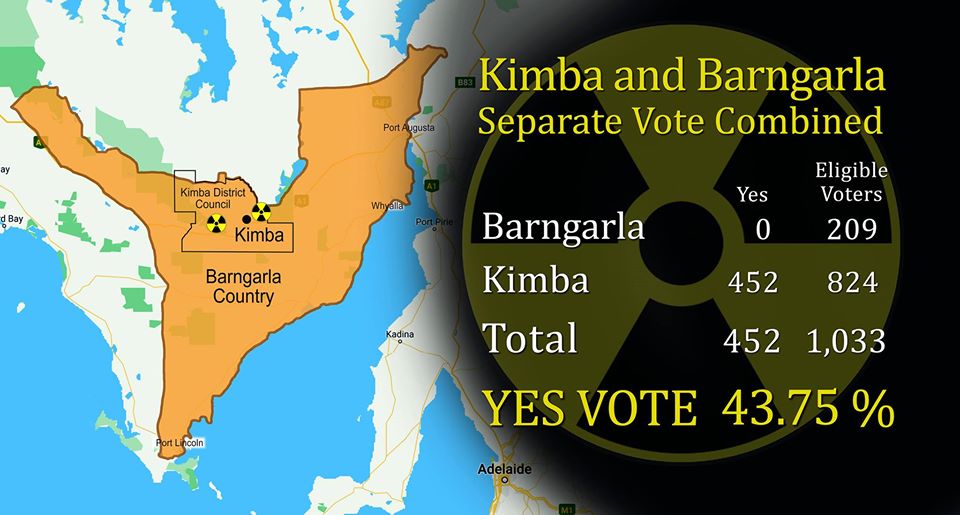
The ballot of Kimba ratepayers, which the government has repeatedly cited as evidence of community support, showed about 60 per cent of voters were in favour of the plan.
“The government says broad community support — well what broad community support did you have, let alone with the native title holders of Kimba or on the Eyre Peninsula?” Mr Bilney said.
The ballot of Kimba ratepayers, which the government has repeatedly cited as evidence of community support, showed about 60 per cent of voters were in favour of the plan.
“The government says broad community support — well what broad community support did you have, let alone with the native title holders of Kimba or on the Eyre Peninsula?” Mr Bilney said.
He said South Australian law required a parliamentary inquiry if nuclear waste was to be brought in and stored.
“We are going to see continual opposition emerge over the next five to 10 years, and this has got a long way to run.”
He expected the court to decide in the Barngarla group’s favour.
“They have a clear and strong case. They were excluded from the community ballot, and they do have native title rights, and it’s essential the Federal Court stands up and protects those rights.”
The government had initially tried to legislate the location of the facility in a way that would have eliminated the possibility of a judicial review.
It later amended the legislation in response to pressure from Labor so it received the support needed to pass both houses of parliament.
In a statement, resources minister Keith Pitt said the declaration of Kimba as the site for the facility was a “significant step”.
He said his facility was a crucial piece of national infrastructure for Australia’s nuclear medicine industry and nuclear research capabilities.
1 This month

of the week – Australians for War Powers Reform (AWPR)
To see nuclear-related stories in greater depth and intensity
 Antinuclear