Australia’s House of Representatives passed the National Radioactive Waste Management Amendment Bill
 11 June 2020, Federal govt just passed the National Radioactive Waste Management Amendment Bill through the lower house of federal parliament, which sounds like bad news but could be good news, an own goal by the government and minister Keith Pitt
Labor voted against the Bill and spoke strongly against it (including the shadow minister Brendan O’Connor, SA MP Tony Zappia and others) … raising issues of Traditional Owner opposition, double-handling of intermediate-level waste, etc etc. I’m guessing Labor also pointed out that voting on the Bill before the Senate Inquiry is complete is poor form.
Zalia Steggall spoke strongly, linking the dump to BLM and raising numerous other issues.
Andrew Wilkie voted against.
Some recent lobbying by Maritime Union of Australia might have been useful in getting the ALP to show some decency, as well as lobbying by Dave Sweeney and David Noonan
The Senate Committee is meeting tomorrow to discuss the inquiry into the Bill.
The Maritime Union of Australia (SA branch) rejects Nuclear Waste Bill, discusses transport dangers
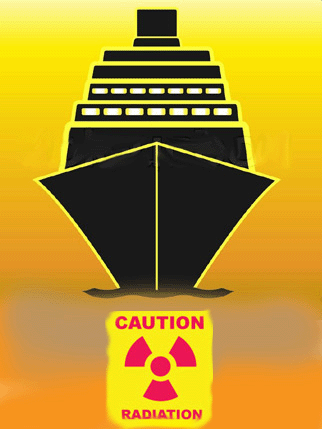
the proposal to move long-lived intermediate-level waste (ILW) from interim above-ground storage at Lucas Heights to interim above-ground storage at the Kimba site….exposes communities to unnecessary risks, and it exposes workers (including MUA members) to unnecessary risks. .. and raises “implications for security”… the considerable distances involved create a whole additional level of risk.
MUA policy is that our members will not be involved in moving nuclear waste. The toxicity
of the waste is severe.
The Maritime Union of Australia (SA branch) to Senate Committee on National Radioactive Waste Management Amendment (Site Specification, Community Fund and Other Measures) Bill 2020 [Provisions] Submission 19 The Maritime Union of Australia (SA branch) recommends that the Senate Committee rejects the National Radioactive Waste Management Amendment (Site Specification, Community Fund and Other Measures) Bill 2020 (hereafter the NRWM Amendment Bill).
The Bill is designed to advance a fundamentally flawed radioactive waste management process which should be put on hold until such time as a comprehensive independent inquiry is held to investigate all options for managing radioactive waste
powers to override Commonwealth and state laws.
in SA. The proposed nuclear waste facility is illegal under South Australia’s Nuclear Waste Facility (Prohibition) Act. Instead of respecting that state legislation, the Federal Government intends to override it and the NRWM Amendment Bill outlines a regulatory mechanism to override SA law and thus to undermine democratic rights.
Desmond Menz – Constitutional problems in Nuclear Waste Bill – could lead to High Court case?

why ultimately was South Australia the only state to contain the final three sites?
A tiny community poll seems to have informed the final decision, and contradicts the Minister’s stated position of “broad community support”. Just 0.037% of the voting public in SA have had a say.
why did South Australia become the only state to be chosen for the nuclear waste site, knowing that a Citizens Jury in 2016 had rejected a major nuclear waste storage industry in South Australia following the outcomes of the Nuclear Fuel Cycle Royal Commission? The Citizens Jury was substantially more representative of the views of the people of SA, in comparison with the very small poll of the eligible residents of the District Council of Kimba..
former Minister Canavan’s snap decision? The decision on site selection was announced on Saturday morning 1 February 2020, and by the afternoon Senator Canavan had resigned
Desmond Menz SUBMISSION TO ECONOMICS LEGISLATION COMMITTEE OF THE
AUSTRALIAN PARLIAMENT ON THE National Radioactive Waste Management Amendment (Site Specification, Community Fund and Other Measures) Bill 2020 Submission 13
In September 2019 ….I raised critical concerns about the validity of the National Radioactive Waste Management Act 2012 (NRWM Act) in relation to the Australian Constitution, and also the lawfulness of the process about site selection. I also raised concerns about breaches of South Australian law. It seems that my concerns were either ignored or dismissed. I again raise these critical matters for the attention of the Economics Legislation Committee. If they are not responded to, then it would not be too much a stretch of the imagination to have them resolved in a higher court of law, quite possibly the High Court of Australia. In my view, the Economics Legislation Committee should not make any decision on the Amendment Bill until all issues I have countenanced have been resolved.
Main Concerns
1.It is contended that inconsistency between the federal National Radioactive Waste Management Act 2012 (NRWM Act) and the South Australian Nuclear Waste Storage (Prohibition) Act 2000 (NWSP Act) (and other similar state/territory laws), has been manufactured by the Australian Parliament. This is a serious issue, and one that not even the Senate Standing Committee for the Scrutiny of Bills has acknowledged. It is incomprehensible why this matter was not addressed way back in 2010 during the establishment of the NRWM Act.
It is also contended that there are Constitutional matters that need to be resolved to affirm the safety of the federal law, including the Amendment Bill, because at the moment there are sufficient concerns relating to inconsistency between federal and state laws to inhibit the lawful and constitutional passage of the Amendment Bill. [here he gives an example from a previous High Court case]……… Continue reading
Ivan Quail says -No logic in double handling of nuclear waste, and makes 14 strong recommendations
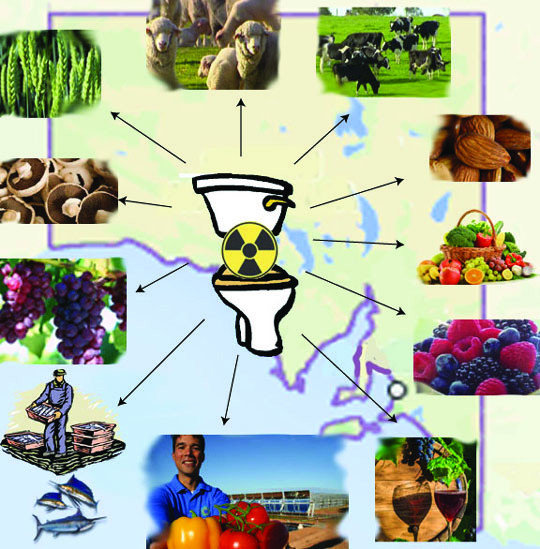
There is no logic behind the proposal to move intermediate-level waste from interim above-ground storage at Lucas Heights to interim above-ground storage at the Kimba site. The proposed double-handling is illogical, it exposes communities to unnecessary risk, and ARPANSA’s Nuclear Safety Committee says it
breaches international best practice
It should further be borne in mind that we in Australia currently enjoy an international
reputation for clean green agricultural products and food. Are we prepared to put that at risk?
Ivan Quail to Senate Committee on National Radioactive Waste Management Amendment (Site Specification, Community Fund and Other Measures) Bill 2020 [Provisions] Submission 12
Intermediate level radioactive waste should not be stored above ground. Low- and intermediate-level radioactive wastes are buried in geological repositories. These repositories must isolate the nuclear waste from the biosphere for as long as 100,000 years. Only solid wastes are stored; liquid wastes are solidified by cementation or bitumen. The strategy adopted by many countries for the disposal of low and intermediate level radioactive wastes requires an engineered repository placed at considerable depth underground.
https://www.sciencedirect.com/topics/chemistry/intermediate-level-radioactive-waste
Long-lived intermediate-level (category S) wastes will be stored above ground in an engineered facility designed to hold them secure for an extended period and to shield their radiation until a geological repository is eventually justified and established, or alternative arrangements made.
Senator Rex Patrick – nuclear waste dump should not go on agricultural land

Azark says: nuclear waste site process unfair and Napandee unsuitable

Azark Project Pty Ltd to Senate Inquiry: National Radioactive Waste Management Amendment (Site Specification, Community Fund and Other Measures ) Bill 2020. Submission No1
Excerpts
This submission is made by Azark Project Pty Ltd who, in conjunction with the Shire of Leonora did apply to be the site to house the storage facility. We were not chosen.
Our submission will deal with, what we believe, was an unfair inquiry by the Department of Industry Innovation and Science who ran the inquiry having already decided that the facility would be above ground. They said as much when they stipulated when calling for applications that “they required no less than 100 hectares of land for the facility”………
The National Radioactive Waste Management Facility project has a Facebook page. Posted on the Facebook site on the 5 March at 16.01 was this statement: “Intermediate level waste will be stored at the NRWMF until a permanent disposal solution is developed. (Attachment 2).
Intermediate level waste disposal will require a different solution- likely a deep geological repository that will take several decades to site and build.” Attachment 3……….
Our submission would like to concentrate on the most important factors in recommending to the senate that this bill not be passed.
There is no greater responsibility that the government has to its people than to keep them safe. The current Corona Virus is a good example. The proposed site at Kimba fails miserably on this score. ILW is deadly to humans if they are exposed to it.
The Kimba proposal by the government admits that it can only be a temporary site for ILW and that it will have to be shifted before that time. This double handling presents yet another danger…………
The second factor the committee should consider is the cost to the taxpayer.Press reports, which have not been denied, put the construction cost of the Kimba facility at $325M. Because this will be borrowed money there is an
additional interest bill of $6.5M per year. That is $65M for ten years and they have a time frame of 30 years……..
There is also the cost of finding a new “deep geological repository” and constructing it within 30 years. It is safe to assume that this will run in to hundreds of millions of dollars given the cost of the current proposal.
At Attachments 4 and 5 are letter from two prominent SA geologists, with over 90 combined years of studying the Kimba region, who both state that the site at Kimba is not suitable and both of them saying what we are saying and that is
Don’t choose Kimba as the site to store ILW. Bury it underground Kimba is in an active earthquake zone
Another major consideration is the stability of the land on which the storage facility is sited……… What is important is that the real responsibility for the safe storage is regulated by ARPANSA and it is that body that will enforce the public safety standards
James Shepherdson – no true community support for Napandee nuclear waste dump, and alternative site ignored
 James Shepherdson to Senate Committee on National Radioactive Waste Management Amendment (Site Specification, Community Fund and Other Measures) Bill 2020 [Provisions] Submission 8 In regards to the federal government process of site selection for a radioactive waste repository, please let it be known to this inquiry that I being a local Kimba resident for thirty two years have observed in the past five years of the events that have taken place a number of obvious examples of what I can only describe as being a very premeditated, deceptive, unbalanced process of manipulation with an agenda to reach an outcome of support for such a facility regardless of the obvious division it has created in my community.
The following points I make are to me evidence of a completely flawed process.
1. Community was given no consultation therefore no right to make a decision prior to a land owner nominating their land.
2. The process continued regardless of the fact Minister Frydenberg conceded there was not broad community support for the initial land nominations.
3. The main criteria for the proposal to move forward was that of broad community support ,however there has never been a clear definition of what constitutes broad community support.
4. The criteria for what described a direct neighbour in the first land nominations was when two properties could share a road between them but in the second round of nominations this was changed to then to deem them to not be direct neighbours therefore the minister being able to declare that all direct neighbours were in support of the
facility when in fact they were not.
5. The traditional owners denied the right to vote.
6. Community supporting members of the Kimba district denied the right to vote just because they happened to be outside the Kimba district council boundary.
7. Given the fact that the traditional owners and residents outside of the Kimba boundary were not given the right to vote the minister always reiterated that all submissions would be taken into account when making his decision ,however by his own admission declared that only submissions from inside the Kimba boundary were taken into
consideration.This deemed 2789 submissions from concerned residents of the Eyre Peninsula and the wider community to be completely irrelevant in his view .
8. A nomination of a much more favorable site in Western Australia in 2017 was completely overlooked .This particular site had already been declared by experts to be suitable for not only the disposal of low level radioactive waste but also the deep geological burial of the intermediate level radioactive waste.
Crina Virgona – Kimba nuclear dump plan – unfair and irresponsible to our children
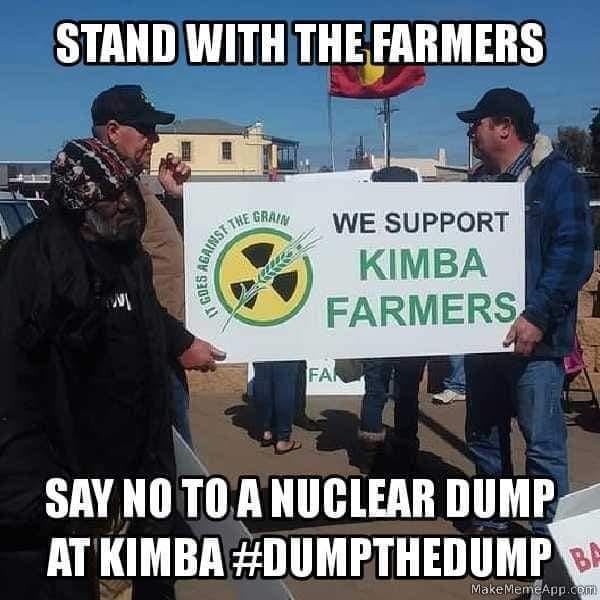
Crina Virgona to Senate Committee on National Radioactive Waste Management Amendment (Site Specification, Community Fund and Other Measures) Bill 2020 [Provisions] Submission 38
I write to you distressed to hear that the issue of the radioactive dump in South Australia is still on the table. The threat to our water supply, our food production and indeed to human life itself in unfathomable. How can you imagine that we can keep radio active material stable and safe for hundreds of years, particularly now in the face of climate change when crisis is the ‘new normal’.
Apart from drought, fire and flood, seismic activity is not as predictable as it was in the past. We can no longer be sure that the radio active material will stay safe. You cannot hand on this legacy to future generations. It is unfair and irresponsible. We have already inflicted enough of our poor decision making onto subsequent generations. Please lets stop now. It has already gone far too far and we are all endangered.
Brian and Michelle Hunt- plan for radioactive waste dump near Kimba a safety threat to us and future generations
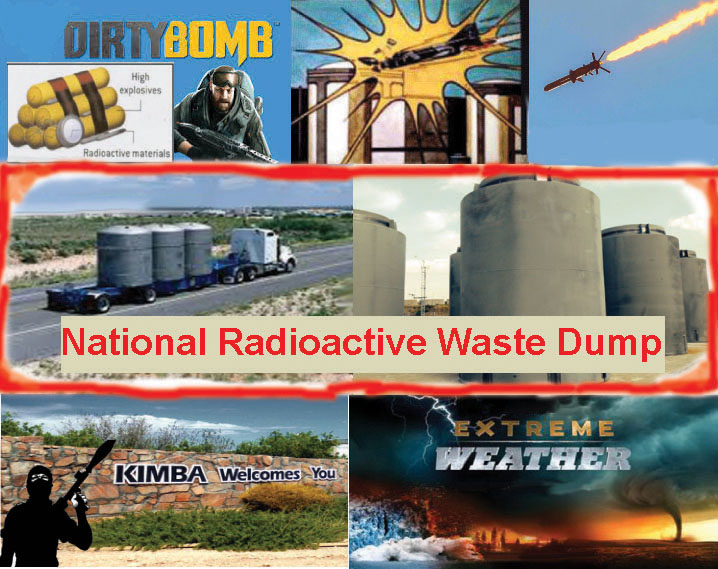
Brian and Michelle Hunt National Radioactive Waste Management Amendment (Site Specification, Community Fund and Other Measures) Bill 2020 [Provisions] Submission 40
I am writing to express our opposition to your proposal of a nuclear waste dump in Kimba. We have always
been opposed, but with what’s happening in the world at the moment it brings home to us how important it is to
feel safe in your own community, and this facility does not make us and our families feel safe for our future
generations.
We feel you’re taking advantage of a town that thinks money is the answer to everything, & for that reason we
don’t have much respect for your constant pressure to have this thing in our town.
Radioactive Waste Management Amendment Bill – a drastic attack on Aboriginal rights, heritage and environment
This inquiry if successful will enable Native Title to be extinguished, whether it is admitted or not.
3 Section 4 (a) seeks to repeal the definition of Aboriginal land,
9 Section 4 (b) seeks to repeal the definition of traditional Aboriginal owners
34 GA (1) (c) seeks to override the archaeological and heritage values of the land, the significance of the
land in the traditions of the Indigenous owners, by overriding existing state and territory legal protections.
34 GB (1) (a) seeks to override the Aboriginal and Torres Strait Islander Heritage Protection Act 1984.
34 GB (b) seeks to override the Environment Protection and Biodiversity Conservation Act.
Stephanie Ingerson to Sente Committee on National Radioactive Waste Management Amendment (Site Specification, Community Fund and Other Measures) Bill 2020 [Provisions] Submission 28
South Australia’s north-west desert lands were laid waste by nuclear tests conducted by the British in the
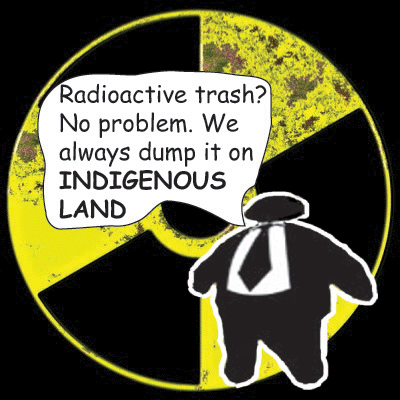
1950s and 1960s at Maralinga on the country of Aboriginal traditional owners. Despite this existing nuclear wasteland, more lands belonging to traditional owners near Kimba on Eyre Peninsula are destined for more nuclear waste. Ninety per cent of the waste will be transported from the Lucas Heights reactor in Sydney, overland and around the coastline of New South Wales, posing a potential risk for humans and the environment given the history of radioactive spills and accidents at the Lucas Heights reactor site. The waste will not just be gloves and gowns. The government does not talk about spent nuclear fuel rods and other hazardous radioactive high level waste, active for thousands of years,that may be destined for a radioactive waste site on Eyre Peninsula.
The Barngarla Aboriginal people have their traditional lands on Eyre Peninsula. They did not give their consent for a radioactive waste site, having been excluded from voting in a restricted ballot in Kimba conducted to secure the land for this purpose. Continue reading
Greg Phillips- Australia’s nuclear management amendment bill – a dishonest, manipulative process.
Greg Phillips to Senate Committee on National Radioactive Waste Management Amendment (Site Specification, Community Fund and Other Measures) Bill 2020 [Provisions] Submission 27
The location of a nuclear dump at Kimba (in the vicinity of valuable farmland, fishing grounds and tourism area) should be rejected. The whole process has been the result of a dishonest, manipulative process. The seat of Grey has been targeted and groomed for many years. The location of a nuclear dump at Kimba (in the vicinity of valuable farmland, fishing grounds and tourism area) should be rejected. The whole process has been the result of a dishonest, manipulative process. The seat of Grey has been targeted and groomed for many years.
The first and major dishonesty relates to Australia’s definition of Intermediate waste. The “intermediate level” waste destined for Kimba would be called “High Level Waste” (HLW) in the USA[1], Canada[2], UK[3], Japan[4], South Africa[5], Taiwan[6], Switzerland[7], South Korea[8]. Even France classified it as High Level Waste when they shipped it to us. The vitrified residue from processing spent nuclear fuel is almost universally called “High Level Waste“. Even Australia once called it High Level Waste[9]. So why do we call it “Intermediate”? Because Australia has a dishonestly slack and misleading definition of “High Level” waste that is purely based on how thermally hot it is ie. “high level radioactive material means material which has a thermal energy output of at least 2 kilowatts per cubic metre.”. The definition doesn’t even mention the radioactivity of the waste! No other country does this. It’s like passing a law that says “manure is only manure if it is hotter than 30 degrees C“. If the “intermediate” waste inner containers were taken out of their massive transport container (the “TN81” container, with 10- inch thick solid steel walls), standing next to it would give a person a fatal radiation dose in seconds. The sole purpose of this definition seems to be to make the importation of High Level
Waste invisible to the public.
The dishonesty of the definition should be enough to stop this process now. It puts Australia at risk because it means that other countries could send their High Level Waste to us and it will be magically redefined as “Intermediate” by our laws. (Note: don’t be tricked by misleading statements from nuclear experts/lobbyists such as “reprocessing removes the bulk of the radioactive material” – the vitrified residues left over from reprocessing are almost as radioactive as the original spent fuel, the “bulky” Uranium and Plutonium removed are relatively low radioactivity[10]. Also, spent fuel from research reactors (whether HEU or LEU types) is still considered HLW[2])
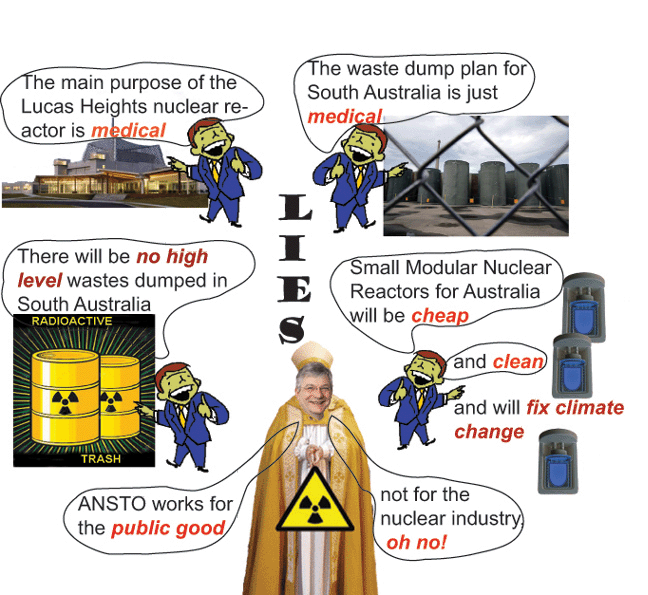
Nuclear medicine (the production of nuclear isotopes) is often used to justify the existence of this dump. But many countries are moving to methods that produce isotopes that don’t produce wastes. Cyclotrons and accelerators can produce isotopes with no reactor waste[11, 12]. The medical isotopes used for the superior imaging of PET scans are produced with a cyclotron. These isotopes decay so quickly that they can be thrown out in normal trash after a few weeks
[13] – no radioactive dump required. ANSTO decided to gamble taxpayer’s money to try and dominate the world medical isotope market with a complex, messy isotope manufacturing technique that produces a lot of problematic waste – waste that the taxpayer (and workers) will have to pay dearly to manage[14]. Canada is moving to a network of Cyclotrons to produce isotopes – it is safer, cleaner and more reliable than relying on a single nuclear reactor (probably cheaper too). Some even predict that the superior imaging of PET will make Technetium-99m/Mo-99 imaging begin to disappear over the next 10 years[15].
The nuclear power/arms/mining pushers see the Kimba dump as a foot in the door for an international dump. It is located near several ports that could be used to directly import nuclear waste. If Australia is going to continue to generate dangerous nuclear waste, it should be stored where there is already high security to protect it ie. Lucas Heights. There is plenty of room for the reactor waste there. Meanwhile Lucas Heights needs to work hard at reducing the waste produced from its production of medical isotopes. Accelerators are the way of the future, but ANSTO has a conflict in interest in that it knows that pushing cyclotrons/accelerators will undermine its reactor/isotope business. ANSTO’s dream of shipping taxpayer funded isotopes to the world (while taxpayers also fund the waste disposal) should be given up. If Australia
concentrated on producing isotopes for its own uses only, then the volume of radioactive wastes ANSTO produces would be reduced dramatically.
Here in South Australia we have been bombarded with lobbyists over the last few years trying to create an International nuclear waste dump in our state. One of the main pushers for a nuclear dump seems to be the Uranium miners (who want to increase their international Uranium sales by giving other countries an easy place for them to abandon their problematic, highly toxic, nuclear waste). It is worth remembering at this point that spent nuclear fuel (and reprocessed spent fuel) is millions of times more radioactive than the Uranium ore we dig up.
Shipping and handling nuclear waste would put our workers and our fisheries, farmers, tourism,
security etc. at risk.
Nuclear lobbyists are often deceptive about the risks of radioactive contamination. They try to make people think that inhaling or ingesting radioactive particles/contamination is the same as the non-contaminating radiation you get from an X-ray (or the increased Cosmic rays when traveling in an airplane). Ingesting or inhaling radioactive contamination is much more dangerous, it is more like inhaling Asbestos. It could sit in your lungs, muscles, bones for years/decades, increasing the risk of cancer. Because illnesses from such contamination take years to develop, the lobbyists dishonestly dismiss any consequences from the Chernobyl and Fukushima catastrophes. The young and the pregnant are most vulnerable to such
contamination. If someone covered a group of people (or land) with Asbestos dust, you wouldn’t say “no harm was done” – unfortunately that is what nuclear lobbyists try to do. No one dies immediately from inhaling Asbestos dust, but we know that the deadly effects can take years/decades to appear. The Cesium-137 that contaminates large areas of Japan will take hundreds of years to decay away, meanwhile the young and pregnant are at risk of disturbing it and breathing this slow-acting poison into their system.
The whole process of selecting a site has been so flawed and dishonest that it should be started again.
References
60 years ago, Aborginal people’s land desecrated by nuclear bombs. Now a new desecration – nuclear wastes?
Even I know off by heart the supercilious tones of the Chief Scientist of the British nuclear tests, Ernest Titterton’s on-screen completely false declaration: ‘No Aboriginal people were harmed.’ The discovery of Edie Milpuddie and family as they camped on the edge of the Marcoo bomb crater was dramatic exposure of that cruel fiction. It is extraordinary to see the actual footage of this moment in the film; and so sobering to hear again the terrible repercussions among her descendants.
‘No Aboriginal people were harmed.’ Add into that mix, English and Australian servicemen and the various pastoral landholders; and from the strong desert winds including across the APY Lands, we will never know the results of the further fallout across the state and nation.
Wind forward another 30 years again and the well being of another almost neighbouring group of Aboriginal people is threatened with nuclear repercussions: this time by the plan for the nation’s nuclear waste ‘stored’ (dumped) on their Country. Again as Traditional Owners, the Barngarla denied a say on their own Country, while a few white ‘latecomers’ were given theirs.
The nuclear fight: then and now, Eureka Street Michele Madigan, 04 June 2020 heeded? https://www.eurekastreet.com.au/article/the-nuclear-fight–then-and-now?utm_medium=email&utm_campaign=Eureka%20Street%20Daily%20-%20Thursday%204%20June%202020&utm_content=Eureka%20Street%20Daily%20-%20Thursday%204%20June%202020+CID_d497ae8df79099faf8643a0a84a8536d&utm_source=Jescom%20Newsletters&utm_term=READ%20MORE On Sunday 24th May, the ABC showed the documentary Maralinga Tjarutja produced and directed by lawyer, academic, filmmaker and Eualeyai/Kamillaroi woman Larissa Berendt. It was wonderful to see the Traditional Owners including the women given a current national voice as survivors of the British nuclear tests on their lands. Mima Smart OAM former long-term chairperson of Yalata Community was co-presenter with the chair of Maralinga Tjarutja, Jeremy Lebois; Mima’s Maralinga art, painted in collaboration with other Yalata minyma tjuta — women artists, becoming an integral background story — sometimes even in animation.
Graham Mantle: substantial bribe and biased propaganda, as the Australian Government foists a nuclear waste dump on a farming community
Graham Mantle, To the Committee of Inquiry: National Radioactive Waste Management Amendment (Site Specification, Community Fund and Other Measures) Bill 2020 [Provisions] Submission 44
The possibility of a National Radioactive Waste Management Facility at Kimba concerns far more than 61.58% of the people of Kimba. (Approximately 600 in favour)
I submit that this facility, together with a substantial bribe for Kimba, is being foisted on South Australia and the Eyre Peninsula in particular because no other state wants it. The fact that it has taken the government five
years to gain a 61.58% majority of the Kimba population of 1057 speaks for itself.
I have seen the kind of persuasive information to which the people of Kimba have been subjected. The ‘information’ fed to them carefully avoided mention of the possibility or probability of adverse perceptions, not only towards Kimba and what is grown there, but towards the entire Eyre Peninsula and even South Australia as a whole. viz “ South Australia – oh yes, the nuclear dump state…”
Farming, though rewarding, is a tough game and, after overcoming all the other issues, you don’t need adverse
perceptions when it comes to selling your produce. Tourism, too, can be a fickle business and perceptions are
vital to attracting visitors to the peninsula.
The Barngarla traditional owners a voice for over 3000 First Nation people who reside on Eyre Peninsula have
been denied a hearing in this deliberation. That is inexcusable in the spirit of reconciliation. They, together with
all who live on the Eyre Peninsula, have a right to be heard.
Finally, I draw your attention to South Australian Legislation:
Nuclear Waste Storage Facility (Prohibition) Act 2000.
This Act binds the Crown in right of the State and, in so far as the legislative power of the State permits, in all
its other capacities.
The objects of this Act are to protect the health, safety and welfare of the people of South Australia and to
protect the environment in which they live by prohibiting the establishment of certain nuclear waste storage
facilities in this State.
I implore you to reject the proposal to put a radioactive waste facility at Kimba.
With respect
Graham Mantle
National Radioactive Waste Management Amendment Bill aims to prevent Bangarla people from legal action against the nuclear dump
Schedule 1 of the Bill is a blatant and indisputable attempt to prevent any judicial review proceedings which would have been initiated by the Barngarla people (and potentially other members of the Kimba Community)
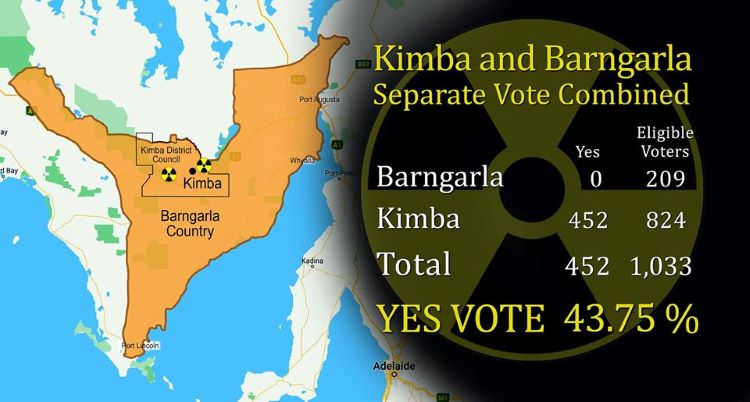
There is clearly no broad community support and such material suggesting there is, was manufactured by gerrymandering the ballot to exclude the Barngarla.
The Barngarla Determination Aboriginal Corporation to Senate Committee on National Radioactive Waste Management Amendment (Site Specification, Community Fund and Other Measures) Bill 2020 [Provisions]
Submission 25 The Barngarla Determination Aboriginal Corporation RNTBC ICN 8603 (BDAC) is the
registered native title body corporate for the Barngarla native title holders.1 As the determined native title holders for the Kimba area, which includes the site of Napandee, the Barngarla people seek to make a submission to the Senate Standing Committees on Economics (the Committee) as part of the Committee’s inquiry…….
………….., once the pandemic is resolved, BDAC consider it important that the Committee should attend on Country and hear from the Barngarla people directly. BDAC would welcome this opportunity and may seek to provide supplementary submissions at this time.
4. The Committee would be aware that members of BDAC were excluded from participating in a community ballot, facilitated by the District Council of Kimba between 3 October 2019 and 7 November 2019, to gauge support for the nominated sites of Napandee and Lyndhurst at Kimba.2 As the First Peoples for the Kimba area, this exclusion was alarming to our community given the permanent impact that the National Radioactive Waste Management Facility (NRWMF) would have on Country.
The Barngarla people also hold many parcels of native title land very close to the NRWMF location, and have the right to live on and use this land. That native title land was, and is in many cases, closer to the proposed site than the town of Kimba to the site. To be excluded from the ballot on the technicality that the land was not rateable,
was terrible for the Barngarla community. The ballot returned a yes vote whilst excluding over 200 Barngarla persons who would likely have voted no. Clearly the entire legitimacy of the site selection process is, at best, highly questionable in these circumstances. It is Barngarla’s position that the site selection process has entirely miscarried. There is clearly no broad community support and such material suggesting there is, was manufactured by gerrymandering the ballot to exclude the Barngarla. We are also aware that community consultation was not consistent with processes used for the Wallerberdina site and, as a result, also excluded members of the farming
community living and working in the Kimba area from the community ballot.
However, we respectfully submit to the Committee that the introduction of this Bill (in particular Schedule 1 of the Bill) presents a significantly more disturbing issue which goes beyond the exclusion of voters, seeking to have a voice on the NRWMF, from a community ballot.
6. We respectfully state that the issues raised in our submission, outline such a significant matter of principle that it will become evident to the Committee that Schedule 1 of the Bill should not be passed. We understand that Schedule 1 of the Bill seeks to directly legislate Napandee, as the specified site for the NRWMF, following
the policy decision (which was mischaracterised as a declaration) of the former Minister for Resources and Northern Australia on 1 February 2020. BDAC make clear that the Bill is in no way supported by the Barngarla people and is of the greatest concern to us, not only as the First Peoples for the Kimba area but as Australians in general, given that it effectively removes our right to seek judicial review .
Summary of Submission Continue reading
Sebastian Tops: National Radioactive Waste Management Amendment Bill uses vague unspecified term “controlled material” FOR SECRET REASONS? “

Sebastian Tops to Senate Committee on National Radioactive Waste Management Amendment (Site Specification, Community Fund and Other Measures) Bill 2020 [Provisions] Submission 22
Argument: This Bill involves possible Mutiny or even Treason. My argument here is that this Bill proposal is most disrespectful in several ways. To me this (amendment) Bill does involve democratic mutiny, Federal but also
State.
The Bill has ignored fundamental recommendations and Verdicts from S.A.’s Citizen’s Jury (2016) entirely. Great disloyalty to Australian lands and citizens is also still optionally hidden inside this Bill, for ‘non-Commonwealth’ entities can also be ‘doing their thing’. That disrespectful proposal possibility presents the idea of treason. If (only) a military land zone is required – please say and do so – but that should follow a different process.
This Bill does state to rely on “The principle of voluntarism” (Explanatory Memo, p.1). This Bill therefore fails because it cannot be found reasonable or legal for only one, or even a few South Australian land owner(s) to decide to sell land for purposes that will impact an entire region’s State future outlook negatively in several ways. Could anyone find it democratically respectful and reasonable for one single landowner’s (temporary life) choice and this Bill, to impact an entire State, here possibly South Australia, to become the proposed nuclear victim, again?
There is no ‘voluntary principle’ apart from the one, or two apparent S.A. landowner(s). There might be an NSW heritage or family history link? It would then involve fraud (false declaration), and or treason, at least against S.A.. These are matters relating directly to ethics which have failed fundamental (Australian) morals.
The Bill here proposes to introduce possibly new payment categories for NAW, in Item 33 par. 34B(1)(b) and (c) (Expl. Memo, p.19) “payable to the Commonwealth”. England is part of the ‘Commonwealth’. Further, only a fee is payable “by non-Commonwealth and non-host State users”. Does this mean England can store their (nuclear active) waste in Australia at no cost? This Bill continues to be unspecific on proposals related directly to nuclear most hazardous topics.
With anything nuclear; any relevant information should have been part of, and timely provided to each of the applicable eligible voter prior a vote on the matter. That officially presented voter information determines what could only possibly be stored in an appropriately ‘selected’ region. Not what is possibly proposed in the Bill here, after the actual vote. Otherwise, again, no proper political processes have been applied in this matter (2015 – 2019).
Neither the AEC, nor the District Council of Kimba seem to be willing or able to inform the public what printed information was provided to each of those limited few local voters, prior considering their vote. It could explain why ballots were
not returned. Likely due to a lack of trust in the applied political processes.
Vague unspecified term uses regarding anything nuclear. Who considers that ethical? The term use of “controlled material” is extremely vague, and can involve “all types of waste” (Expl. Memo, Schedule 3, Other Amendments, point 132, p.25). It has unspecified additional unknown liabilities and outcomes, and involves other unspecified responsibilities. Within the JCV (1997). The term use of “controlled material” amends the Object of Act (Expl. Memo, p.12). Controlled
material remains secretive for dubious reasons, and did admittedly under Schedule 3, point 132 not form part at all of the applied vote processes. Were voters made timely aware of any “controlled material” involving “primarily” from “State and Territory Governments, industry, hospitals and universities” (Expl. Memo, part 6A, p.3) to which even “laws cannot apply to regulate, hinder or prevent the doing of a thing” (Expl. Memo, point 94, p.20)?
This Bill fails to specify a clear set of criteria, full accountabilities, appropriate specifications of various necessary kinds, or responsibilities for all parts of this proposal. The proposed long-distance transport of highly hazardous (nuclear active) waste products produced in another State is entirely unnecessary
The Bill proposes for the EPA to not be able to report on environmental matters regarding the proposals inside the Bill put. What is generally known is the necessity to protect life against any poison’s hazard life duration. NAW is supposed to be safely ‘managed’ to protect vital sources like water, esp. in drought affected regions. The lifetime involvement of the EPA would be an absolute minimum requirement as such for any Australian NAW proposal. By not explicitly stating any poison responsible needs for its still unknown hazard life duration, and all its necessary more costly safety requirements, seems rather unprofessional. This Bill presents its disregard for another’s (State or Territory) land, by meaning to apply intentional disrespect to another by not demanding compliance with fundamental NAW safety requirements.
Any hazardous material is to be maintained closest to its source (for safe containment reducing wider risk exposures), minimize handling, introduce future monitoring and re-packing facilities in NSW etc.. Otherwise, if this Bill was to pass then more fully operational regional hospitals would be needed prior commencement of introducing the spread of any hazardous substances etc.. No new strategically located regional fully operational hospitals are proposed in this Bill.
Democratic Human Rights – Self-Determination (not to ever have to endure another State’s own produced (nuclear active) wastes to at least prevent image impairment and future economic opportunity losses.)……
To claim that “The specification of the site … is supported by a comprehensive consultation process” (Explanatory Memo, p.4), is incorrect, as a similar (also foreign) NAW proposal was considered earlier in the process. That process did receive an official S.A. Citizens Verdict, stating: “Under no circumstances do we pursue the disposal of nuclear waste because the potential brand damage is too great a risk to the state”. “It is a threat to a $17.5billion/year (1) income to the state generated from tourism, international students, agriculture, food, wine, seafood, livestock, and this is just the beginning. This is a risk we are not willing to take”. One can suggest that related to foreign (nuclear active) wastes only but, RCNCJ reasons go much deeper into their debated, wider considered, and broader researched nuclear related findings than this Bill seemingly has.
The RCNCJ expressed the need to prevent a lasting State or Territory ‘image impairment’. Storing another’s (nuclear) wastes would have ramifications to South Australia’s economy and negatively impact future opportunities like trade. That particular finding received 82% support. That economic Verdict finding alone relates directly to this Bill amendment proposal. Like “The jury felt it was it was important for environmental impact studies to include impacts beyond radiation”. The reasons state that overall, no economic benefits are sufficient to lose or damage one’s clean and safe image which South Australia still has. The Gawler Ranges are still brilliant. Several other “No” reasons are expressed within that RCNCJ verdict. Another such example: “The project will have significant social costs. Particularly, through the divisiveness of the issue”. How true is that finding alone, and who did dictatorially decide to allow politicians to totally ignore those Citizens Verdict findings?
The (Two-third or three-quarter) majority requirement has not been achieved………
At least two non-compliant issues are present within this Bill as it fails:
1. The JCV (66.6% majority), respecting dubious vote result (under 55%).
2. The Consultation paragraph of the explanatory memo (K. Pitt), as well the Bill ignore South Australian RCNCJ (2016) Verdict. Misrepresentations regarding NAW, “controlled material”, or “doing a thing” do involve inappropriately controlled voting processes, contrary to a controlled RCNCJ (2016) “No” Verdict(s). Non-compliant issues described are to have immediate political ramifications for this (Amendment) Bill and should be denied any further considerations in its
entirety. I elaborate on (also other) reasons in the Appendix “No Because”.
References………..
Appendix “No Because”
Other additional reasons to stop this (Amendment) Bill entirely:
As this amendment Bill relates directly to (anything) nuclear,
1. it would be logical to be very specific, clear, and state exactly what will be included and excluded.
2. full professional and personal accountabilities are to apply at all times, under any of the applicable Laws (State or Federal), otherwise nuclear should finally admit that (anything) nuclear is actually the least regulated industry………
1 This month

of the week – Australians for War Powers Reform (AWPR)
To see nuclear-related stories in greater depth and intensity
 Antinuclear