NUCLEAR POWER ‒ NO SOLUTION TO CLIMATE CHANGE
 Friends of the Earth Australia Statement August 2019 http://www.nuclear.foe.org.au
- Introduction 2. Nuclear Power Would Inhibit the Development of More Effective Solutions 3. The Nuclear Power Industry is in Crisis 4. Small Modular Reactors 5. Nuclear Weapons Proliferation and Nuclear Winter 6. A Slow Response to an Urgent Problem 7. Climate Change & Nuclear Hazards: ‘You need to solve global warming for nuclear plants to survive.’ 8. Nuclear Racism 9. Nuclear Waste 10. More Information
- Introduction
Support for nuclear power in Australia has nothing to do with energy policy – it is instead an aspect of the ‘culture wars‘ driven by conservative ideologues (examples include current and former politicians Clive Palmer, Tony Abbott, Cory Bernardi, Barnaby Joyce, Mark Latham, Jim Molan, Craig Kelly, Eric Abetz, and David Leyonhjelm; and media shock-jocks such as Alan Jones, Andrew Bolt and Peta Credlin). With few exceptions, those promoting nuclear power in Australia also support coal, they oppose renewables, they attack environmentalists, they deny climate change science, and they have little knowledge of energy issues and options. The Minerals Council of Australia – which has close connections with the Coalition parties – is another prominent supporter of both coal and nuclear power.
In January 2019, the Climate Council, comprising Australia’s leading climate scientists and other policy experts, issued a policy statement concluding that nuclear power plants “are not appropriate for Australia – and probably never will be”. The statement continued: “Nuclear power stations are highly controversial, can’t be built under existing law in any Australian state or territory, are a more expensive source of power than renewable energy, and present significant challenges in terms of the storage and transport of nuclear waste, and use of water”.
Friends of the Earth Australia agrees with the Climate Council. Proposals to introduce nuclear power to Australia are misguided and should be rejected for the reasons discussed below (and others not discussed here, including the risk of catastrophic accidents).
- Nuclear Power Would Inhibit the Development of More Effective Solutions
Renewable power generation is far cheaper than nuclear power. Lazard’s November 2018 report on levelised costs of electricity found that wind power (US$29‒56 per megawatt-hour) and utility-scale solar (US$36‒46 / MWh) are approximately four times cheaper than nuclear power (US$112‒189 / MWh).
A December 2018 report by the CSIRO and the Australian Energy Market Operator concluded that “solar and wind generation technologies are currently the lowest-cost ways to generate electricity for Australia, compared to any other new-build technology.”
Thus the pursuit of nuclear power would inhibit the necessary rapid development of solutions that are cheaper, safer, more environmentally benign, and enjoy far greater public support. A 2015 IPSOS poll found
that support among Australians for solar power (78‒87%) and wind power (72%) is far higher than support for coal (23%) and nuclear (26%).
Renewables and storage technology can provide a far greater contribution to power supply and to climate change abatement compared to an equivalent investment in nuclear power. Peter Farley, a fellow of the Australian Institution of Engineers, wrote in January 2019: “As for nuclear the 2,200 MW Plant Vogtle [in the US] is costing US$25 billion plus financing costs, insurance and long term waste storage. For the full cost of US$30 billion, we could build 7,000 MW of wind, 7,000 MW of tracking solar, 10,000 MW of rooftop solar, 5,000MW of pumped hydro and 5,000 MW of batteries. That is why nuclear is irrelevant in Australia.”
Dr. Ziggy Switkowski ‒ who led the Howard government’s review of nuclear power in 2006 ‒ noted in 2018 that “the window for gigawatt-scale nuclear has closed”, that nuclear power is no longer cheaper than renewables and that costs are continuing to shift in favour of renewables.
Globally, renewable electricity generation has doubled over the past decade and costs have declined sharply. Renewables account for 26.5% of global electricity generation. Conversely, nuclear costs have increased four- fold since 2006 and nuclear power’s share of global electricity generation has fallen from its 1996 peak of 17.6% to its current share of 10%.
As with renewables, energy efficiency and conservation measures are far cheaper and less problematic than nuclear power. A University of Cambridge study concluded that 73% of global energy use could be saved by energy efficiency and conservation measures. Yet Australia’s energy efficiency policies and performance are among the worst in the developed world.
- The Nuclear Power Industry is in Crisis
The nuclear industry is in crisis with lobbyists repeatedly acknowledging nuclear power’s “rapidly accelerating crisis”, a “crisis that threatens the death of nuclear energy in the West” and “the crisis that the nuclear industry is presently facing in developed countries”, while noting that “the industry is on life support in the United States and other developed economies” and engaging each other in heated arguments about what if anything can be salvaged from the “ashes of today’s dying industry”.
It makes no sense for Australia to be introducing nuclear power at a time when the industry is in crisis and when a growing number of countries are phasing out nuclear power (including Germany, Switzerland, Spain, Belgium, Taiwan and South Korea).
The 2006 Switkowski report estimated the cost of electricity from new reactors at A$40–65 / MWh. Current estimates are four times greater at A$165‒278 / MWh. In 2009, Dr. Switkowski said that a 1,000 MW power reactor in Australia would cost A$4‒6 billion. Again, that is about one-quarter of all the real-world experience over the past decade in western Europe and north America, with cost estimates of reactors under construction ranging from A$17‒24 billion (while a reactor project in South Carolina was abandoned after the expenditure of at least A$13.3 billion).
Thanks to legislation banning nuclear power, Australia has avoided the catastrophic cost overruns and crises that have plagued every recent reactor project in western Europe and north America. Cheaper Chinese or Russian nuclear reactors would not be accepted in Australia for a multitude of reasons (cybersecurity, corruption, repression, safety, etc.). South Korea has been suggested as a potential supplier, but South Korea is slowly phasing out nuclear power, it has little experience with its APR1400 reactor design, and South Korea’s ‘nuclear mafia‘ is as corrupt and dangerous as the ‘nuclear village‘ in Japan which was responsible for the Fukushima disaster.
- Small Modular Reactors
The Minerals Council of Australia claims that small modular reactors (SMRs) are “leading the way in cost”. In fact, power from SMRs will almost certainly be more expensive than power from large reactors because of diseconomies of scale. The cost of the small number of SMRs under construction is exorbitant. Both the private sector and governments have been unwilling to invest in SMRs because of their poor prospects. The December 2018 report by the CSIRO and the Australian Energy Market Operator found that even if the cost of power from SMRs halved, it would still be more expensive than wind or solar power with storage costs included (two hours of battery storage or six hours of pumped hydro storage).
The prevailing scepticism is evident in a 2017 Lloyd’s Register report based on the insights of almost 600 professionals and experts from utilities, distributors, operators and equipment manufacturers. They predict that SMRs have a “low likelihood of eventual take-up, and will have a minimal impact when they do arrive”.
No SMRs are operating and about half of the small number under construction have nothing to do with climate change abatement – on the contrary, they are designed to facilitate access to fossil fuel resources in the Arctic, the South China Sea and elsewhere. Worse still, there are disturbing connections between SMRs, nuclear weapons proliferation and militarism more generally.
- Nuclear Weapons Proliferation and Nuclear Winter
“On top of the perennial challenges of global poverty and injustice, the two biggest threats facing human civilisation in the 21st century are climate change and nuclear war. It would be absurd to respond to one by increasing the risks of the other. Yet that is what nuclear power does.” ‒ Australian
Nuclear power programs have provided cover for numerous covert weapons programs and an expansion of nuclear power would exacerbate the problem. After decades of deceit and denial, a growing number of nuclear industry bodies and lobbyists now openly acknowledge and even celebrate the connections between nuclear power and weapons. They argue that troubled nuclear power programs should be further subsidised such that they can continue to underpin and support weapons programs.
For example, US nuclear lobbyist Michael Shellenberger previously denied power–weapons connections but now argues that “having a weapons option is often the most important factor in a state pursuing peaceful nuclear energy”, that “at least 20 nations sought nuclear power at least in part to give themselves the option of creating a nuclear weapon”, and that “in seeking to deny the connection between nuclear power and nuclear weapons, the nuclear community today finds itself in the increasingly untenable position of having to deny these real world connections.”
Former US Vice President Al Gore has neatly summarised the problem: “For eight years in the White House, every weapons-proliferation problem we dealt with was connected to a civilian reactor program. And if we ever got to the point where we wanted to use nuclear reactors to back out a lot of coal … then we’d have to put them in so many places we’d run that proliferation risk right off the reasonability scale.”
Running the proliferation risk off the reasonability scale brings the debate back to climate change. Nuclear warfare − even a limited, regional nuclear war involving a tiny fraction of the global arsenal − has the potential to cause catastrophic climate change. The problem is explained by Alan Robock in The Bulletin of the Atomic Scientists: “[W]e now understand that the atmospheric effects of a nuclear war would last for at least a decade − more than proving the nuclear winter theory of the 1980s correct. By our calculations, a regional nuclear war between India and Pakistan using less than 0.3% of the current global arsenal would produce climate change unprecedented in recorded human history and global ozone depletion equal in size to the current hole in the ozone, only spread out globally.”
Nuclear plants are also vulnerable to security threats such as conventional military attacks (and cyber-attacks such as Israel’s Stuxnet attack on Iran’s enrichment plant), and the theft and smuggling of nuclear materials. Examples of military strikes on nuclear plants include the destruction of research reactors in Iraq by Israel and the US; Iran’s attempts to strike nuclear facilities in Iraq during the 1980−88 war (and vice versa); Iraq’s attempted strikes on Israel’s nuclear facilities; and Israel’s bombing of a suspected nuclear reactor site in Syria in 2007.
6. A Slow Response to an Urgent Problem
Expanding nuclear power is impractical as a short-term response to climate change. An analysis by Australian economist Prof. John Quiggin concludes that it would be “virtually impossible” to get a nuclear power reactor operating in Australia by 2040.
More time would elapse before nuclear power has generated as much as energy as was expended in the construction of the reactor. A University of Sydney report states: “The energy payback time of nuclear energy is around 6.5 years for light water reactors, and 7 years for heavy water reactors, ranging within 5.6–14.1 years, and 6.4–12.4 years, respectively.”
Taking into account planning and approvals, construction, and the energy payback time, it would be a quarter of a century or more before nuclear power could even begin to reduce greenhouse emissions in Australia … and then only assuming that nuclear power displaced fossil fuels.
- Climate Change & Nuclear Hazards: ‘You need to solve global warming for nuclear plants to survive.’
“I’ve heard many nuclear proponents say that nuclear power is part of the solution to global warming. It needs to be reversed: You need to solve global warming for nuclear plants to survive.” ‒ Nuclear engineer David Lochbaum.
Nuclear power plants are vulnerable to threats which are being exacerbated by climate change. These include dwindling and warming water sources, sea-level rise, storm damage, drought, and jelly-fish swarms.
At the lower end of the risk spectrum, there are countless examples of nuclear plants operating at reduced power or being temporarily shut down due to water shortages or increased water temperature during heatwaves (which can adversely affect reactor cooling and/or cause fish deaths and other problems associated with the dumping of waste heat in water sources). In the US, for example, unusually hot temperatures in 2018 forced nuclear plant operators to reduce reactor power output more than 30 times.
At the upper end of the risk spectrum, climate-related threats pose serious risks such as storms cutting off grid power, leaving nuclear plants reliant on generators for reactor cooling.
‘Water wars’ will become increasingly common with climate change − disputes over the allocation of increasingly scarce water resources between power generation, agriculture and other uses. Nuclear power reactors consume massive amounts of cooling water − typically 36.3 to 65.4 million litres per reactor per day. The World Resources Institute noted last year that 47% of the world’s thermal power plant capacity ‒ mostly coal, natural gas and nuclear ‒ are located in highly water-stressed areas.
By contrast, the REN21 Renewables 2015: Global Status Report states: “Although renewable energy systems are also vulnerable to climate change, they have unique qualities that make them suitable both for reinforcing the resilience of the wider energy infrastructure and for ensuring the provision of energy services under changing climatic conditions. System modularity, distributed deployment, and local availability and diversity of fuel sources − central components of energy system resilience − are key characteristics of most renewable energy systems.”
- Nuclear RacismTo give one example (among many), the National Radioactive Waste Management Act dispossesses and disempowers Traditional Owners in every way imaginable:
- The nomination of a site for a radioactive waste dump is valid even if Aboriginal owners were not consulted and did not give consent.
- The Act has sections which nullify State or Territory laws that protect archaeological or heritage values, including those which relate to Indigenous traditions.
The nuclear industry has a shameful history of dispossessing and disempowering Aboriginal people and communities, and polluting their land and water, dating from the British bomb tests in the 1950s. The same attitudes prevail today in relation to the uranium industry and planned nuclear waste dumps and the problems would be magnified if Australia developed nuclear power.
The Act curtails the application of Commonwealth laws including the Aboriginal and Torres Strait Islander Heritage Protection Act 1984 and the Native Title Act 1993 in the important site-selection stage.
- The Native Title Act 1993 is expressly overridden in relation to land acquisition for a radioactive waste dump.
9. Nuclear Waste
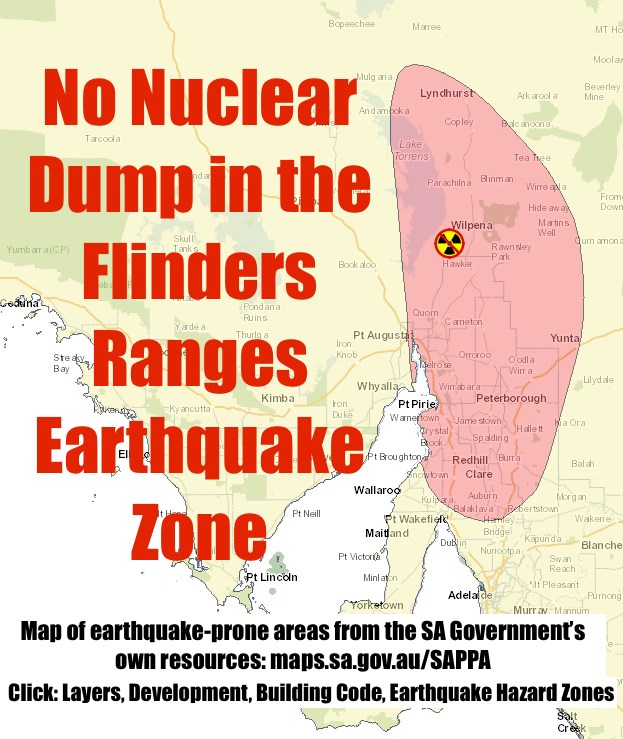
Decades-long efforts to establish a repository and store for Australia’s low-and intermediate-level nuclear waste continue to flounder and are currently subject to legal and Human Rights Commission complaints and challenges, initiated by Traditional Owners of two targeted sites in South Australia. Establishing a repository for high-level nuclear waste from a nuclear power program would be far more challenging as Federal Resources Minister Matt Canavan has noted.
Globally, countries operating nuclear power plants are struggling to manage nuclear waste and no country has a repository for the disposal of high-level nuclear waste. The United States has a deep underground repository for long-lived intermediate-level waste, called the Waste Isolation Pilot Plant (WIPP). However the repository was closed from 2014‒17 following a chemical explosion in an underground waste barrel. Costs associated with the accident are estimated at over A$2.9 billion.
Safety standards fell away sharply within the first decade of operation of the WIPP repository ‒ a sobering reminder of the challenge of safely managing nuclear waste for millennia.
- More Information
- Climate Council, 2019, ‘Nuclear Power Stations are Not Appropriate for Australia – and Probably Never Will Be‘
- WISE Nuclear Monitor, 25 June 2016, ‘Nuclear power: No solution to climate change‘
- Friends of the Earth Australia nuclear power online resources
21 August Senator Matt Canavan to hold closed meeting , then 2 open ones, in region designated for nuclear waste dumping

Queensland Sinister Matt Canavan is having a closed door meeting with the Barndioota Consultative Committee before the Hawker meeting. No doubt the serious nuclear waste dump decisions will be made then
But there’ll be open meetings – ?window dressing – at Hawker 21 August, and at Kimba 22 August.
21 August Wed 3.30 – 430 pm Hawker Sports Centre – Druitt Range Drive, Hawker
22 August Thurs 11 a.m – 12. pm Kimba Gateway Hotel- 40 High St Kimba
Nuclear waste dump: Barngarla group says indigenous ballots won’t fix its worries over vote discrimination
Nuclear waste dump: Barngarla group says indigenous ballots won’t fix its worries over vote discrimination The Advertiser, 14 Aug 19
An Aboriginal organisation at the centre of a legal battle over the site for a nuclear waste dump says a separate consultation process for indigenous people will do little to dampen its discrimination concerns.
The Barngarla Determination Aboriginal Corporation took Kimba Council to court over its plan to host a community vote to gauge support for a waste storage facility near the Eyre Peninsula town.
The organisation argued the poll was discriminatory because it excluded native title holders who did not live in the area.
After losing the Federal Court challenge in July, the Barngarla has lodged an appeal in the Full Court.
Resources Minister Matthew Canavan has since written to Kimba and Flinders Ranges councils saying he will approach indigenous organisations reaffirming his department’s offer to pay for a poll of their members, providing them with a voice.
But the Barngarla board told The Advertiser such a poll was “designed to exclude our people from having a say on equal footing to the rest of the community”.
“It is very simple to solve this problem – all which needs to happen is to allow our people the right to vote with the rest of the Kimba community rather that segregate us,” the board said.
The organisation said Mr Canavan had not provided a template ballot paper and associated material so the ballot could be run on equal terms. The council and Federal Government had also not agreed to consolidate all the results into one process.
The Barngarla board has written to Indigenous Australians Minister Ken Wyatt asking him to intervene.
Three SA sites are being considered for the radioactive waste dump – two near Kimba and one at Wallerberdina Station, near Hawker in the Flinders Ranges. It would hold low and intermediate-level waste, primarily from the production of nuclear medicines.
Polls in the Hawker and Kimba communities were due to happen in August 2018 but were stalled after the Barngarla court appeal was flagged.
The Adnyamathanha Traditional Lands Association (ATLA) has also lodged a complaint with the Human Rights Commission.
Meanwhile, Government staff on Tuesday confirmed at a Flinders Ranges-based consultative committee meeting the minimum size of the nuclear site and its surrounding buffer zone would increase from 100ha to 160ha – as claimed by a source close to the project in The Advertiser last month.
The Government says the extra space will allow for features such as a water treatment plant, power infrastructure and road access, depending on the selected site.
Mr Canavan said the Government had “listened carefully” to communities when shaping ballot boundaries.
“At Kimba it extended to the entire local council area, while at Wallerberdina Station it is the local government area plus an approximate 50km radius,” he said.
“Wherever a boundary is defined there will be a number of groups outside that line, but the process gives those people the ability to fully participate by making a submission that will be taken into account in the decision-making process.”
A spokeswoman for Mr Canavan said details of polls among indigenous organisations would be worked out alongside any groups who wanted to participate.
Maurice Blackburn lawyer Nicki Lees, representing ATLA, said the organisation had made it clear it opposed a nuclear waste dump on its traditional land.
“If the Government is considering further consultation on this project, we would consider this in due course,” she said.
“However, it is important that this is a meaningful process, which hasn’t occurred to date.”
Adnyamathanha woman Regina McKenzie has previously told The Advertiser the long-running debate had disrupted her community.
Kimba Council renews commitment to local community ballot on nuclear waste dump
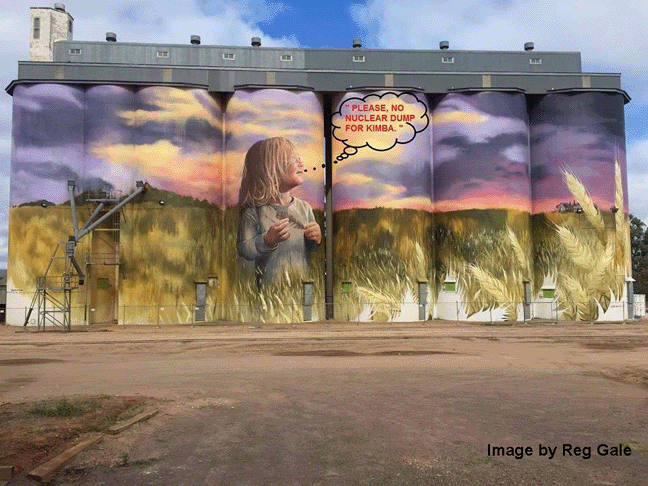
Despite this, Kimba mayor Dean Johnson said the council had received legal advice that the ballot process could now resume.
“There’s no legal impediment to us proceeding with the ballot,” he said.
Mr Johnson said the council had received a “strong judgement” in the federal court, and he encouraged the community to read it themselves.
He said the Resources Minister had requested the council proceed with the ballot, and it was important to give the Kimba community their vote on whether the waste management facility should go ahead in the district
“Our community have been in a holding pattern for a very long time… our main objective is to give our community an opportunity to have their say.”
He said he believed it was the responsibility of the Department of Industry, Innovation and Science to make sure the Barngarla people were properly consulted during the site selection process.
National Radioactive Waste Management Facility Taskforce’s heavy-handed repressive approach to community consultation
 Waste dump consultative committee enforces strict observer protocol, Transcontinental Amy Green 9 Aug 19, Waste dump consultative committee enforces strict observer protocol, Transcontinental Amy Green 9 Aug 19,
Tensions over the federal government’s plans to site a National Radioactive Waste Management Facility have reached boiling point in the wake of upcoming community consultation meetings scheduled for Kimba and Hawker next week. The process has been stalled for more than a year because of a federal court challenge by Barngarla traditional owners,but last month the federal court rejected their bid to stop the council ballot. Kimba and Hawker (Barnidoota) are the two communities who have been shortlisted for the proposed facility, which would house low-level nuclear waste and provide temporary storage for intermediate level waste. The Department of Industry Innovation and Science’s National Radioactive Waste Management Facility Taskforce plan to use the committee meetings as its main platform for ongoing community consultation. The level of community consultation has been widely criticised by anti-waste dump groups such as the Flinders Local Action Group (FLAG). In an open letter to the Barnidoota Consultative Committee, FLAG spokesperson Greg Bannon raised further concerns.
“The Flinders Local Action Group, as you know, represents the point of view from community members who continue to hold deep concerns about siting the National Radioactive Waste Management Facility in our region,” he said. “These concerns do not arise from a lack of information on our part. As we have said previously, when the ‘information’ provided comes from only one source, that being the proposer and promoter of the facility, it cannot be unbiased. “The meetings are supposedly for community consultation, but often fail to fulfil that expectation.” Mr Bannon said the meetings leave little time to answer community questions and criticised the timeliness of meeting minutes. Locals have since complained that a new code of conduct for people wishing to observe the Barnidoota meeting is enforcing restrictions that make it even harder for the community to voice their concerns. The code restricts observers from taking notes or recording any part of the meeting without prior agreement from the department, independent convener and all representative members of the committee. It also states that individual ideas or views of committee members cannot be repeated or shared…… The Barndioota Consultative Committee will be held on August, 13 and the Kimba Consultative Committee on August, 15. https://www.transcontinental.com.au/story/6320383/waste-dump-consultative-committee-enforces-strict-observer-protocol/?fbclid=IwAR1v49mvokOwEIjIHWqYf0cMgK2eR6EZBtOiv_5KcmQGWoYADDmdnD7Zj6g |
|
Spent nuclear fuel from small nuclear reactors would pose a real problem for Australia

|
Small Modular Reactors: A Challenge for Spent Fuel Management? From the IAEA Bulletin, , Small modular reactors (SMRs) have been the talk of scientists and researchers in the nuclear industry for many years — but to what extent will their debut, expected next year, create challenges in spent fuel management? It depends, say experts, on the particular SMR design and a country’s existing spent fuel management practices…… |
|
Australia’s repression of democratic discussion on nuclear waste dump is worse than UK’s
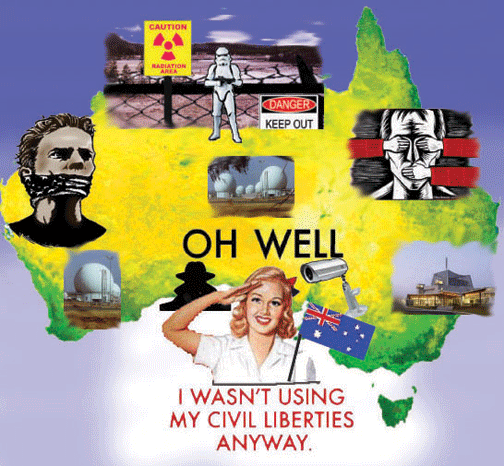
Cumbria Trust 11th Aug 2019 The Guardian has reported that residents in Southern Australia, who face having a nuclear waste storage facility imposed on them, are being forced
to sign an excessively restrictive code of conduct if they wish to attend
community meetings. This prevents them from taking notes, repeating certain
views expressed in the meeting, or trying to take part in the committee
discussions.
This appears to go well beyond the steps required to maintain
an orderly meeting, and serves to suppress democratic accountability. While
the last search process in Cumbria, MRWS, didn’t go to such extreme
lengths, there were some unnecessary restrictions which obstructed local
democracy. Specifically, executive members of the borough councils, and
cabinet members of Cumbria County Council, were told that they could not
give any public indication of whether they were minded to vote for the
process to proceed to the next stage. This ‘predetermination’ rule
allowed senior councillors to completely avoid public scrutiny on the
matter.
https://cumbriatrust.wordpress.com/2019/08/11/australian-troubles-with-community-engagement/
Bangarla people call on Minister for Indigenous Australians Ken Wyatt to intervene in support of their vote on nuclear waste dump
 On the anniversary of recognition Aboriginal Australians, the Barngarla people have written to Minister for Indigenous Australians Ken Wyatt to ask him to personally intervene and allow them to have a vote on the radioactive waste facility proposed for their land. Read their letter here:
Federal nuclear waste management “consultative committees” – secretive – a farce?
 Ruth Tulloch Fight To Stop Nuclear Waste In The Flinders Ranges, 10 Aug 19 These committees were originally set up as a way of “consulting with the community”. They haven’t been allowed to discuss much (if any thing) with the community and any one who wants to go and sit in on a meeting has to ‘ask’ (beg, be vetted) for an invite. These are supposed to be public meetings and as such should be run like a public meeting ie. local council….where any one is entitled to go and sit in at any time. https://www.facebook.com/groups/941313402573199/
Nuclear waste: residents near proposed dump told to sign draconian code of conduct,
 Nuclear waste: residents near proposed dump told to sign draconian code of conduct, https://www.theguardian.com/australia-news/2019/aug/08/nuclear-waste-residents-near-proposed-dump-told-to-sign-draconian-code-of-conduct?CMP=soc_567&fbclid=IwAR3a-X8NHLloKNUaCpkAblZb7yhKDmDkiIkFgP9cVGiv232hfZec0-w_Xfk
Code bans residents from taking notes or recording any part of meetings without prior agreement, Calla Wahlquist @callapilla 8 Aug 2019 Residents in small South Australian communities shortlisted for a proposed nuclear waste storage facility have been told if they want to attend community consultation meetings they have to sign a code of conduct that bans them from taking notes.
The shortlist for the proposed dump has been narrowed down to Lyndhurst or Napandee, in the Kimba shire area on the Eyre Peninsula, and Wallerberdina Station, which is near Barndioota in the southern Flinders Ranges.
If approved, it would be a permanent storage facility for low-level nuclear waste and provide temporary storage for intermediate level waste, including waste temporarily stored near the research reactor at Lucas Heights in Sydney.
The process has been stalled for more than 12 months because of a federal court challenge by Barngarla traditional owners, who hold native title over land adjacent to the two proposed Eyre Peninsula sites.
Barngarla Determination Aboriginal Corporation last month lost a federal court case arguing that a decision not to include native title holders in a local government poll gauging community support for the dump was in breach of the Racial Discrimination Act, but have appealed that decision to the full court.
A majority of Adnyamathanha traditional owners have also said they’re “totally opposed” to the facility being built at Barndioota.
Meetings of two local consultative committees, appointed by the federal industry department’s National Radioactive Waste Management Facility Taskforce (NRWMFT) as its main platform for ongoing community consultation, were put on hold while the court case was underway but have been scheduled to resume next week.
But locals have complained that a new code of conduct for people wishing to observe the Barndioota and Kimba consultative committee meetings is unnecessarily restrictive and makes it harder for the community to obtain up-to-date information and voice their concerns.
The code, seen by Guardian Australia, states that “observers” must be approved and cannot “take any notes, or record any part of the meeting … except with the prior agreement of the department, the independent convenor and all representative members of the committee”.
It also says they cannot “repeat or share the individual ideas or views of [committee] members,” and can’t repeat confidential information or try to interject in committee discussions.
“This agreement does not prevent you from discussing information shared during a BCC meeting unless it has been identified as confidential or sensitive,” it says. “The [convenor] may ask you to leave the meeting if you do not comply with this Code of Conduct.”
Farmer Dean Hooper, who has applied to attend the Barndioota meeting, said that restrictions on repeating confidential information and behaving respectfully were reasonable but other conditions placed on attending were “bullshit”.
Hooper opposes the dump and is a member of the Flinders local action group.
The NRWMFT said that the code of conduct concerned behavioural standards and that information in the meeting was not confidential, unless stated otherwise, and that the minutes of all meetings had been published online.
Committee members have also been restricted from discussing meetings with the media. Susan Andersson, a GP from Hawker who sits on the Bandioota committee, said the contract extension that committee members signed in March was “more restrictive” than the original contract and represented an apparent desire by the department to control public information.
NRWMFT general manager Sam Chard said the facility “will only proceed near a community that broadly supports it and which could provide an ongoing workforce”.
In a statement on Wednesday, she said that ballots of residents and ratepayers, like that attempted by Kimba before the federal court challenge, “remain one method that we intend to use to help inform if that necessary broad community support exists”.
People living outside the local government areas can make a submission.
Senate moved to call on Senator Canavan to explain nuclear waste dump plan – size of dump, and types of wastes
24 July 19, Sarah Hanson Young has a motion in parliament today re the rumours about a larger dump site
Senator Hanson-Young: moved —That the Senate—
- notes that recent reports that the proposed nuclear waste dump site in South Australia will be expanded, covering at least 160 hectares, an increase of 60%, are deeply troubling given the lack of consultation; and
- calls on the Minister representing the Minister for Industry, Science and Technology, Senator Canavan, to provide a full explanation of the current plans for the nuclear waste dump site, and to clarify exactly how large it will be and what level of waste it will hold.
Continuing problem of radioactive waste at Hunters Hill – contamination from old uranium processing site

Key points:
- The area on Sydney’s north shore was the former site of the Radium Hill refinery, which closed in 1915
- Residents have fought for decades to have the Government remove the contaminated soil
- A plan to keep the waste in “cells” on site has been rejected and labelled a “temporary” fix
Several properties on Nelson Parade at Hunters Hill have been built on land contaminated by the former Radium Hill uranium processing plant in the 1900s.
Residents have spent decades urging the government to remove the affected soil, which the NSW Environment Protection Authority found was contaminated with petroleum hydrocarbons, coal tar pitch, arsenic and lead.
The Council has now voted against a recommendation by its own consultants to “encapsulate” the low-level radioactive material in cement “cells” and store it onsite.
Philippa Clark from the Nelson Parade Action Group said residents felt the plan would make their lives worse.
“The cells will make the stigma permanent, our anxiety increased, trapped in unsaleable homes.
“The proposal is silent on all of those impacts.
She said most Hunters Hill residents knew nothing of the latest plan by Property NSW as few residents were formally notified and it was on exhibition over the school holidays.
The existence of the radioactive material, in the soil for over a century, was discovered 53 years ago and remains unmanaged.
The Council and residents want the soil removed altogether but an earlier proposal to send it to a waste facility at Kemp’s Creek in Sydney’s West was abandoned after a backlash from the local community.
There is no other waste facility in the state licenced to handle the material and a national radioactive waste management facility is yet to be established by the Federal Government.
Ms Clarke told Monday night’s council meeting that if the radioactive material was stored onsite at Hunters Hill, there was no guarantee it would be moved later when suitable off-site storage becomes available.
Former Hunters Hill mayor Richard Quinn also urged the Council to reject the proposal.
“Whilst we might wish to see progress at last and endorse this [proposal], the onsite encapsulation component of this report I believe cannot be accepted,” he said.
“It’s contrary to the best practice in sustainable remediation, and it’s not unreasonable for this community to expect anything less than best practice.”
Resident John Akin thought the Council had no choice but to accept the proposal, saying those pushing for outright rejection “overlook the health risk from the waste being left in its current uncontrolled state”.
But Mayor Mark Bennett said Property NSW told the Council during a meeting that the majority of Hunters Hill ratepayers were against the encapsulation option.
“It will be interesting to see what the Government decides to do as a result of this … it’s a decision of the Government at the end of the day.
“My opinion is we should not vote for encapsulation because I think it could be a permanent solution without any guarantees that it’s an interim solution — I can’t support it.”
Last year the NSW Government announced $30 million to fully remediate the land after a parliamentary inquiry a decade ago.
Campaigners vow to continue the fight to stop Canberra dumping nuclear waste in South Australia
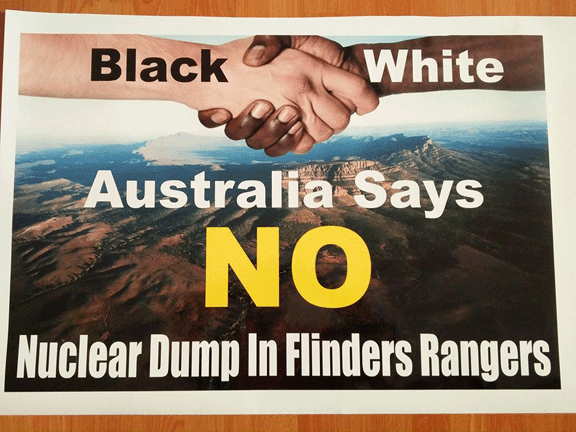
12 July 2019, Civil society groups and members of the communities affected by the federal government’s proposed National Radioactive Waste Management Facility (NRWMF) are deeply disappointed with Justice White’s ruling that the exclusion of Barngarla Traditional Owners from a ballot intended to gauge community support was not a breach of the Racial Discrimination Act.
Ballots were to be held in the Flinders Ranges and Kimba districts in August 2018. Eligibility to participate was severely restricted and while non-resident rate-payers were included, Traditional Owners who live outside the small geographic areas were excluded.
The Barngarla Determination Aboriginal Corporation, Native Title Holders for the Kimba District, sought an injunction in the Supreme Court, asserting that their exclusion breached the Racial Discrimination Act. This effectively put the site selection on hold.
In December 2018, the Adnyamathanha Traditional Lands Association (ATLA) lodged a formal complaint with the Human Rights Commission based on poor treatment and consultation with Traditional Owners throughout the divisive site selection process. This case is ongoing.
Mara Bonacci, Nuclear Free Campaigner for Friends of the Earth Australia said: “Today’s announcement is very disappointing, but not surprising. The federal legislation governing the nuclear waste management process, the National Radioactive Waste Management Act 2012, is undemocratic and systematically disadvantages Aboriginal people. The Act gives the federal government the power to extinguish rights and interests in land targeted for a radioactive waste facility. The Act allows the Minister to proceed with a nuclear waste dump without securing the consent of Traditional Owners. Traditional Owners, local communities, pastoralists, business owners, local councils and State/Territory Governments are all disadvantaged and disempowered by the NRWMA.
“It is important to note that today’s ruling is not a vindication of the federal site selection process, only finding that it is not a breach of the Racial Discrimination Act. The lack of inclusion of Aboriginal people is inconsistent with community expectation, best practise and Australia’s international obligations under the UN Declaration on the Rights of Indigenous Peoples. It is galling that Justice White’s ruling was delivered in NAIDOC week.
“The Federal government process has also denied a voice to many Australians concerned about this issue and about responsible radioactive waste management – this is a national issue and national responsibility, the burden of which should not be placed on regional and remote communities.
“It is appalling that federal resources Minister Matt Canavan is contemplating proceeding with a nuclear waste dump on Barngarla land despite the clear opposition of Traditional Owners. The SA Marshall Government also needs to voice its clear opposition to the imposition of a nuclear waste dump.”
“This Sunday marks the 15th anniversary of a famous day in South Australia’s history. On July 14, 2004, a campaign led by an Aboriginal Women’s Council, the Kupa Piti Kungka Tjuta, finally persuaded the Howard Government to abandon its plan to impose a national nuclear waste dump on SA. It seems nothing was learnt from that experience.
“Despite today’s ruling, community members, civil society groups and many others will continue to fight to protect South Australia from becoming home to Australia’s radioactive waste and for a fair and transparent site selection process based on responsible radioactive radioactive waste management”, Ms Bonacci concluded.
Bangarla Aboriginal people’s Statement on court decision regarding ballot on nuclear waste dump site
The Barngarla People have ancient historical connections to the land around Kimba, and we are the determined Native Title Holders for the broader area. The Barngarla hold significant areas of native title in the area, and we are also property owners for the purpose of the Local Government Act. The Barngarla respects the decision of the Federal Court, as the Court has to interpret complicated legislation. However, more generally we consider it sad that in the 21st Century we are required to take legal action to allow us to have the right to vote on the major decision of the day.

1 This month
Chernobyl: The Lost Tapes – A good documentary on Chernobyl on SBS available On Demand for the next 3 weeks– https://www.sbs.com.au/ondemand/tv-program/chernobyl-the-lost-tapes/2352741955560
15 April – Zoom –Nuclear Power is Not the Solution
Apr 15, 2026 01:00 AM in Canberra, Melbourne, Sydney

Join the International Physicians for the Prevention of Nuclear War (IPPNW) on Tuesday, April 14th for a timely webinar exploring the risks associated with nuclear power and challenging the myth that it offers a simple, safe, carbon-free solution to the climate crisis

21 April Webinar: No Nuclear Weapons in Australia
Start: 2026-04-21 18:00:00 UTC Canberra, Melbourne, Sydney (GMT+10:00)
End: 2026-04-21 19:30:00 UTC Canberra, Melbourne, Sydney (GMT+10:00)
Event Type: Virtual
A virtual link will be communicated before the event.
Host Contact Info: australia@icanw.org

of the week – Australians for War Powers Reform (AWPR)
To see nuclear-related stories in greater depth and intensity
 Antinuclear