Memo to Energy Resources of Australia : You have one job – clean up Kakadu uranium mess
https://www.acf.org.au/memo-to-era-you-have-one-job-clean-up-kakadu 26 Apr 23
Northern Territory and national environment groups have a clear message for Energy Resources Australia at ERA’s annual meeting in Darwin: focus on repair.
ERA is the former uranium mining company that operated the controversial Ranger uranium mine in Kakadu for 40 years, until the cessation of commercial operations in 2021.
The company, majority (86%) owned by Rio Tinto, is now responsible for delivering Australia’s costliest and most complex mine rehabilitation project.
ERA also holds the nearby Jabiluka mineral lease – the site of sustained and successful protest by the Mirarr Traditional Owners and civil society supporters from across Australia and around the world.
Despite Rio’s clear acknowledgement that any possible mining window for Jabiluka is now firmly closed, ERA continues to promote Jabiluka as an asset.
“Rio Tinto has formally accepted there is no credible business case or pathway to advance mining at Jabiluka,” said Environment Centre NT analyst Naish Gawen.
“Rio has stated it will no longer report a Mineral Resource for Jabiluka. It’s time for ERA to do the same.”
Environmentalists inside and outside the meeting will urge the ERA Board to drop the fiction of drilling at Jabiluka and address the fact of required repair at Ranger.
“Repairing the heavily impacted Ranger site is ERA’s legal responsibility,” said ACF’s nuclear policy analyst Dave Sweeney.
“ERA and Rio Tinto will be closely watched and long judged on their performance of this responsibility.”
Greens support Barngarla people’s opposition to Kimba radioactive waste dump set to open after 2030
ABC North and West SA / By Nicholas Ward https://www.abc.net.au/news/2023-04-21/greens-affirm-nuclear-dump-opposition-at-kimba-visit/102252440
Greens senators travelled to Kimba on South Australia’s Eyre Peninsula this week to hear from farmers and First Nations groups opposed to the national radioactive waste management facility proposed at Napandee.
Key points:
- Calls are growing for the federal government to drop court action against a First Nations group opposing a nuclear dump
- The local Native Title chair says the government is “not being truthful” about listening to Aboriginal voices
- Greens senators say intermediate-level waste must stay at Lucas Heights until a permanent storage solution is found
SA senator Barbara Pocock said the federal government’s process to determine the site for permanent low-level and temporary intermediate-level waste storage was flawed.
“It didn’t listen to First Nations people, it hasn’t listened to local farmers in the community, and it’s not an appropriate site for intermediate-level waste coming out of Lucas Heights [in Sydney],” Senator Pocock said.
“It results in the double-handling of highly toxic intermediate-level waste, which will be temporarily stored at Kimba, and future generations are going to have to find a long-term solution.
“Bearing in mind the history of nuclear testing in our state, it’s especially important that we … can find a safe long-term solution, not a temporary solution.”
Calls to listen to Aboriginal voices
Jason Bilney is chair of Barngarla Determination Aboriginal Corporation (BDAC), which is fighting the federal government in court to block the current proposal.
He said the government’s continued legal action showed a lack of commitment to listening to Aboriginal voices.
“They’re breaking First Nations hearts by continuing down this path of the Liberals and outspending us 4: 1 in court to put a nuclear waste dump on our country,” Mr Bilney said.
“What does that say about the Statement from the Heart, let alone constitutional recognition?
“It’s about truth-telling and yet they’re not being truthful about listening to our voice.”
Mr Bilney welcomed the senators’ visit to Kimba and said proponents of the waste dump needed to speak honestly about its impact on Barngarla culture.
“It’s always good to come out on country and actually see for themselves where the site is and meet us on country. It’s a very positive step,” he said.
‘Don’t need a court to tell us’
BDAC holds native title over large areas of the Upper Spencer Gulf and Eyre Peninsula, including around Kimba, but not at the specific location of the proposed radioactive storage site at Napandee.
The Greens’ spokesperson for First Nations, Science and Resources, Senator Dorinda Cox, said that did not delegitimise Aboriginal concerns about its placement.
“The Barngarla people have stories, know the songlines, know the importance of birthing places, know the importance of country and practice of their culture in a very strong and traditional way still,” Senator Cox said.
“I don’t think we need a court to tell us that, and unfortunately that is a process they are pushed into.
“There was no free, prior, informed consent.”
Waste at Kimba ‘not expected before 2030’
The Australian Radioactive Waste Agency (ARWA) is overseeing site preparation works at Napandee, while awaiting final approvals to begin construction of the waste facility.
“Construction of the facility can only commence after all necessary siting, construction, nuclear, and environmental regulatory approvals are received,” an ARWA spokesperson said.
“The facility is not expected to be operational before 2030.”
Western Australian company to build low-level radioactive waste facility – Kimba dump a decade away – now irrelevant?

GREEN LIGHT FOR FIRST NUCLEAR WASTE STORAGE
Tellus, March 16, 2023
Australia’s first purpose-built low-level radioactive waste facility has been granted final approval in Western Australia ……
The Australian has confirmed that the WA government has granted a final approval licence to Australian firm Tellus Holdings to store low-level radioactive waste at a repository in Sandy Ridge, 240km northwest of Kalgoorlie, which could take hundreds of thousands of tonnes of stored waste from around the country.
………….The Sandy Ridge repository will be the country’s first commercial facility to be licensed in Australia to take low-level radiological waste and store it in a stable geological repository, and is one of only a handful of its types in the world.
It is also licensed to take low level radioactive waste from the Lucas Heights reactor in Sydney, as well as from defence facilities.
The commonwealth’s own proposed radioactive waste facility, Kimba in South Australia, is estimated to be at least a decade away from being constructed.
The licence approval, following agreement with traditional owners, will see it remediate contaminated oil and gas infrastructure, end-of-life mines and also deal with Australia’s massive stockpile of low-level radioactive waste from nuclear medicine, including diagnostic, treatment, research and other industries.
The near-surface geological repository will also be licensed to take low-level radioactive waste generated in the processing of critical minerals, which is estimated to eventually generate millions of tonnes of waste every year, as well as radioactive waste from the dismantling of offshore oil and gas rigs, which is estimated to cost more than $40bn.
The site is located in one of the most geologically stable zones in the world with the company claiming it was one of the “safest places” in Australia to store hazardous and low-level radioactive waste.
It is not licensed to take the high-level nuclear waste that would be produced by the need to one day dispose of nuclear reactors from submarines. However, the company said it could contribute its geological expertise and knowledge as the commonwealth begins a search for a geologically safe location for this purpose.
According to the Australian Radioactive Waste Agency, the country’s stockpile of radioactive waste is spread across more than 100 locations around Australia, including science facilities, universities and hospital basements – and is increasing.
Tellus chief executive Nate Smith told The Australian the site would provide a critical link in developing Australia’s first multibillion-dollar hazardous waste industry………………..
Sandy Ridge was granted approval in 2021 to take class V hazardous waste.
However, the McGowan government only granted final approval in January this year for the facility to take low-level radioactive waste as well, following a review by WA’s Radiological Council which advises the minister for health. – https://tellusholdings.com/green-light-for-first-nuclear-waste-storage/?fbclid=IwAR3P1lFgTT4rlThFKGWfB9yd-U8bFu6wrsrRTkBUNk4E7oNfzVW9J3p33Iw
The Australian
By Simon Benson
16 March 2023
Friends of the Earth comments accuse the Australian Government Industry Department of blatant racism in its Kimba nuclear waste dump plan.

Comments on: Guidelines for the content of a Draft EIS National Radioactive Waste Management Facility, SA EPBC 2021/9128 April 2023
RIGHTS OF TRADITIONAL OWNERS
Recommendation #1: The Guidelines must require the proponent (the Australian Government Department of Industry, Science and Resources) to explain how the nuclear dump/store proposal complies with the United Nations Declaration on the Rights of Indigenous Peoples, in particular Article 29.2:
“States shall take effective measures to ensure that no storage or disposal of hazardous materials shall take place in the lands or territories of indigenous peoples without their free, prior and informed consent.”
Of course it is common knowledge that the proposal is a gross violation of Article 29.2 and that the nuclear dump/store is unanimously opposed by Barngarla Traditional Owners. Nevertheless, the proponent must be asked to explain its position and its crude racism.
Recommendation #2: The list of documents in section 3.5.1 of the Guidelines should also include the United Nations Declaration on the Rights of Indigenous Peoples.
Recommendation #3: The Guidelines mention a “process for ongoing consultation with FirstNations people”. The proponent should be required to declare whether or not it reservesthe right to ignore the rights, interests and recommendations of the Barngarla Traditional Owners in future just as it has ignored and overridden unanimous Barngarla opposition to the nuclear dump/store proposal.
Recommendation #4: The proponent should be required to discuss the adequacy of the
National Radioactive Waste Management Act (NRWMA) and in particular to provide
justifications for each of the following provisions of the Act:
- The nomination of a site for a radioactive waste facility is valid even if Aboriginal
Traditional Owners were not consulted and did not give consent. The NRWMA states that
consultation should be conducted with Traditional Owners and consent should be secured ‒
but that the nomination of a site for a radioactive waste facility is valid even in the absence
of consultation or consent. - The NRWMA has sections which nullify State or Territory laws that protect the
archaeological or heritage values of land or objects, including those which relate to
Indigenous traditions. - The Act curtails the application of Commonwealth laws including the Aboriginal and Torres
Strait Islander Heritage Protection Act 1984 and the Native Title Act 1993 in the important
site-selection stage. The Native Title Act 1993 is expressly overridden in relation to land
acquisition for a radioactive waste facility.
Recommendation #5. The proponent should be required to explain why it rejects the SA
Government’s policy that Traditional Owners should have a right of veto of nuclear waste
sites. SA Labor’s Deputy Leader (and now Deputy Premier) Susan Close noted in September
2020 that: “South Australian Labor is calling on the Federal Government to halt its plans to
dump nuclear waste at Kimba. … SA Labor has consistently expressed its concerns about the
site selection process and the lack of consultation with native title holders. … This was a
dreadful process from start to finish, resulting in fractures within the local community over
the dump. The SA ALP has committed to traditional owners having a right of veto over any
nuclear waste sites, yet the federal government has shown no respect to the local
Aboriginal people.”
FEASIBLE ALTERNATIVES
Recommendation #6. The Guidelines should require discussion on the ‘feasible alternative’
of targeting states/territories which do not have legislation prohibiting a nuclear
dump/store such as the one proposed. The current proposal requires the Commonwealth to
override the SA Nuclear Waste Storage (Prohibition) Act 2000.
Recommendation #7. The Guidelines state that the no-action alternative should be
discussed “if relevant”. The term “if relevant” should be removed and the proponent should
be required to discuss the no-action alternative since it is in fact a viable alternative.
Recommendation #8. The Guidelines should explicitly require the proponent to consider the
option of abandoning the plan to store intermediate-level waste (ILW) and Kimba since an
overwhelming majority of ILW is currently store at ANSTO’s Lucas Heights site with no
practical or legal obstacles to ongoing storage. The plan to move ILW to Kimba is absurd: it necessarily entails double-handling; and it entails moving waste from a site with strong
security and an abundance of nuclear experts to a site with weaker security and a dearth of
nuclear experts … for no reason whatsoever let alone a good, compelling reason.
It should be noted here that ARPANSA plans separate assessments of the proponent’s plans
for disposal of lower-level wastes and storage of ILW. Further, in its March 2022 Regulatory
Assessment Report approving ANSTO’s new ILW Storage Facility at Lucas Heights to 2037,
the ARPANSA CEO states that a “clear net benefit must be provided by the licence applicant
to support a licence application”. It is implausible that the proposal to move ILW from Lucas
Heights to Kimba would meet this net-benefit criterion. Thus DCCEEW must be alert to the
misinformation and obfuscation that the proponent may present to justify ILW storage at
Kimba instead of Lucas Heights, and DCCEEW must ensure a full evaluation of alternatives to
ILW storage at Kimba.
Recommendation #9. Further to the above recommendation, the proponent should be
required to consider the option of abandoning plans for ILW storage at ANSTO and instead
working on a consolidated plan for deep underground disposal (or deep borehole disposal)
of both ILW as well as high-level nuclear waste from nuclear submarines.
TRANSPORT OF SPENT FUEL REPROCESSING WASTES
Recommendation #10. The proponent should be required to thoroughly consider
transportation of waste products arising from reprocessing of spent research reactor fuel.
There is no logical reason or justification for this omission
AUKUS, NUCLEAR TECHNOLOGY AND AUSTRALIA’S FUTURE
ARENA ONLINE, JOHN HINKSON, 6 APR 2023 https://arena.org.au/aukus-nuclear-technology-and-australias-future/
The AUKUS agreement attempts developments that will shift Australia into a zone that will threaten the existence of Australia itself.
I am not merely thinking of the militarisation of Australia, although that is definitely one likely outcome. I also have in mind our way of life that, while still set in settler-colonial assumptions that give First Nations people no substantial value in Australian society, is relatively relaxed when compared with the way of life of people in the United States. Australia has not experienced the focus upon security that high-powered militarisation associated with nuclear weapons brings. This is the world our leaders are leading us towards.
I want to take up two lines of inquiry into Aukus in this brief article. Firstly AUKUS brings together three Anglo-settled countries – two examples of settler-colonial domination that date back two centuries and more. plus of course the original Anglo-source nation, the United Kingdom. This may seem like an insignificant reference to an aspect of European colonialism that has shaped the whole world for centuries. However, Anglo colonialism has a particular complexion. Here I am drawing in part on the book by James Belich, Replenishing the Earth, about the history of Anglo colonialism. It is well-known these days in anti-colonialism circles that the Anglo slavery pursued in the Caribbean by England was the worst form of slavery, with cruelty on a scale that makes slavery in the United States seem enlightened. Anglo colonialism is typified by relations of difference that deal with colonised peoples with a vengeance. It is noteworthy that Anglo-settled countries like Australia have not at all come to terms with the cultures that pre-existed them. All invading cultures find this difficult, but Anglo-based cultures, as Belich shows, are a special case. It is no coincidence that Adolf Hitler looked with admiration to the United States for its ‘handling’ of its First Nations ‘problem’—a form of extermination of the Native American population—in how to think about the treatment of Jews and Slavs in Europe. Anglo cultures’ commitment to freedom and democracy has a repellent underbelly of racism and cultural suppression, not to mention genocidal elimination.
Significant cultural reform is always difficult but clearly the Anglo-powers have made the decision, at a time when in many respects their backs are up against the wall, to stand and fight—not for their own territory, but against the emergence of China, which was itself on the humiliating receiving end of Anglo colonialism in the nineteenth century. AUKUS in a strong sense is a thumbing of the West’s nose at all the emerging powers in Asia—on racial grounds. They must toe the line.
This is surely a crisis for an Australia seeking in the first half of the twenty-first century to survive in our region. To survive here Australia has to change its spots profoundly. It needs a form of cultural regeneration, in significant combination with Australian First Peoples, to justify its presence outside of the strategies of colonial power. While cultural change is always slow and complex, it is Australia’s only hope of both flourishing and being accepted in this region. It is also crucial because our allies are, in any case falling apart.
While I think the Voice could be the first step towards a significant and substantial change, only a weak version of the Voice, suitable for photo opportunities and feel-good policy, will survive the reassertions of this new Anglo alliance. Australia combines an especially empty form of recognition of First Nations with the arrogance of a superior colonial presence, coloured only a little by multiculturalism, and all this in a region where it has no basic right to exist.
The AUKUS alliance represents an incapacity to flexibly adjust to an emerging situation in which a new world power has emerged, one that will not go away. It is deeply ironic that the United States has fostered this emergence by its global development strategies, just as it fostered its opponents in Afghanistan at an earlier time.
That China is a new superpower is a reality—not that being a superpower is good for China or for us. Like large bureaucracies, superpowers develop self-oriented agendas related to their size, and are not to be trusted. But linking up with the remnants of the old powers to resist emergence means that Australia has resorted to a last gasp Anglo-cultural alliance rather than enter a serious process of rethinking its social composition and its place in the world.
The second line of comment is about nuclear submarines, drawing on a piece that appears in Arena Quarterly, just publishe
I want to take up two lines of inquiry into Aukus in this brief article. Firstly AUKUS brings together three Anglo-settled countries – two examples of settler-colonial domination that date back two centuries and more. plus of course the original Anglo-source nation, the United Kingdom. This may seem like an insignificant reference to an aspect of European colonialism that has shaped the whole world for centuries. However, Anglo colonialism has a particular complexion. Here I am drawing in part on the book by James Belich, Replenishing the Earth, about the history of Anglo colonialism. It is well-known these days in anti-colonialism circles that the Anglo slavery pursued in the Caribbean by England was the worst form of slavery, with cruelty on a scale that makes slavery in the United States seem enlightened. Anglo colonialism is typified by relations of difference that deal with colonised peoples with a vengeance. It is noteworthy that Anglo-settled countries like Australia have not at all come to terms with the cultures that pre-existed them. All invading cultures find this difficult, but Anglo-based cultures, as Belich shows, are a special case. It is no coincidence that Adolf Hitler looked with admiration to the United States for its ‘handling’ of its First Nations ‘problem’—a form of extermination of the Native American population—in how to think about the treatment of Jews and Slavs in Europe. Anglo cultures’ commitment to freedom and democracy has a repellent underbelly of racism and cultural suppression, not to mention genocidal elimination.
Significant cultural reform is always difficult but clearly the Anglo-powers have made the decision, at a time when in many respects their backs are up against the wall, to stand and fight—not for their own territory, but against the emergence of China, which was itself on the humiliating receiving end of Anglo colonialism in the nineteenth century. AUKUS in a strong sense is a thumbing of the West’s nose at all the emerging powers in Asia—on racial grounds. They must toe the line.
This is surely a crisis for an Australia seeking in the first half of the twenty-first century to survive in our region. To survive here Australia has to change its spots profoundly. It needs a form of cultural regeneration, in significant combination with Australian First Peoples, to justify its presence outside of the strategies of colonial power. While cultural change is always slow and complex, it is Australia’s only hope of both flourishing and being accepted in this region. It is also crucial because our allies are, in any case falling apart.
While I think the Voice could be the first step towards a significant and substantial change, only a weak version of the Voice, suitable for photo opportunities and feel-good policy, will survive the reassertions of this new Anglo alliance. Australia combines an especially empty form of recognition of First Nations with the arrogance of a superior colonial presence, coloured only a little by multiculturalism, and all this in a region where it has no basic right to exist.
The AUKUS alliance represents an incapacity to flexibly adjust to an emerging situation in which a new world power has emerged, one that will not go away. It is deeply ironic that the United States has fostered this emergence by its global development strategies, just as it fostered its opponents in Afghanistan at an earlier time.
That China is a new superpower is a reality—not that being a superpower is good for China or for us. Like large bureaucracies, superpowers develop self-oriented agendas related to their size, and are not to be trusted. But linking up with the remnants of the old powers to resist emergence means that Australia has resorted to a last gasp Anglo-cultural alliance rather than enter a serious process of rethinking its social composition and its place in the world.
The second line of comment is about nuclear submarines, drawing on a piece that appears in Arena Quarterly, just published.
The AUKUS strategy seeks to assert massive power, especially surveillance in the Pacific, surrounding China. Nuclear submarines combined with surveillance are the main focus of this attempt to cripple what actually, as I see it, cannot be stopped, in a way similar to Paul Keating’s argument. AUKUS shifts the whole emphasis away from how we protect our independence to what is needed to contain China. For Australia this seems to mean we have to achieve interoperability with US weaponary and systems, with nuclear submarines a key aspect of this. It means Australia must take a first step into adopting nuclear technology, and its consequences. We should not be assured by those who claim that it will be the last step.
Much has been written about the dangers of nuclear power and weapons over the years, to the point where it seems many in the community are now blasé about it—unless radiation waste is to be placed next door to you. Part of what the nuclear industry and its supporters have done is to launch smaller scale tactical nuclear weapons and also small-scale nuclear power plants because both large-scale nuclear weapons and large-scale power plants have unmanageable consequences and poor public acceptance, either because of non-human-scale destruction or ridiculous costs, which only keep escalating.
No one, with the exception of some military strategists, favours nuclear war. The reasons are obvious. The level of destruction of atomic bombs steps beyond our capacity to comprehend: it steps into another realm, a post-human one. Even the seemingly more mundane questions associated with nuclear waste are on another scale because they cannot be effectively disposed. All around the world nuclear waste is piling up around nuclear power stations as well as ‘storage’ of used nuclear submarines components because the waste is not of this world. There is no solution to the waste question. Nuclear waste is killing us on an increasing scale, as exposed by Kate Brown in her book A Manual for Survival. Contrary to the findings of mainstream Western science, she argues that low-level radiation is a mass killer and a general source of ill health As one Russian scientist she quotes puts it: ‘Chronic radiation is a crime’, and chronic radiation is a process that Australia has just signed up for with its nuclear submarines, adding its contribution to the systemic decline of the Earth’s environment, at least one that is suitable for human habitation.
We need to give some focus to this because it is an embarrassment to the nuclear lobby, which they handle and largely get away with by resorting to silence. But nuclear waste is a contradiction that will not go away. All attempts at solutions have failed in every part of the world. This cannot be emphasised enough.
What sort of contradiction is this?
Like nuclear technology, nuclear waste is usually simply regarded as a special category of danger. But its special effects arise out of a social process that is usually ignored. And this is a disaster because that social process is transforming our world in unprecedented ways.
This new world first burst upon us in 1945, with the practical scientific triumph of the atomic bomb. It was not merely novel. It was a consequence of the practical/conceptual reconstructions in the early twentieth century we associate with Albert Einstein and his associates. It was not merely a new theory. It was a combination of abstract academic theory with practical technology in the real world that gave birth to technoscientific society and culture, most importantly through its systematic approach to the transformation of nature. As such, academic theory entered the world of production, as an alternative or supplement to the transformations performed by the working classes, in a way that has expanded exponentially ever since. For better or worse, our world has become increasingly composed socially of the intellectually-trained.
The novelty of nuclear technology is contained within this social approach. Scientific intellectuals now uncover deep levels of the natural world, levels never before encountered by human societies that turn out to be mysterious and unmanageable. Nuclear is not the only example but it is a key one that destroys whatever it touches.
This is the world we are now entering, and doing so with great enthusiasm. It is not only a question of nuclear war. It is just as much one of the levels of security needed when dealing with what we do not know how to control. Nuclear weapons have been ‘controlled’ by such monstrosities as the Cold War and MAD (Mutually Assured Destruction) strategies that give reason a bad name. And low-level radiation has been controlled by denial of any major effects, while the environment of Planet Earth deteriorates. As Brown remarks, ‘Western researchers are discovering, like Soviet scientists before them, that radioactive decay at low doses changes the way cells behave in subtle and life-changing ways’, laying the basis for ‘chronic radiation syndrome’.
AUKUS is a strategy that pursues these outcomes systematically, our leaders planning to leave submarine waste in the desert, once again to be dealt with by First Nations people, now to be permitted by the WA Labor government. Among other things, the crime of chronic radiation poisoning needs to be sheeted home to the powers that be, and in particular now, the Albanese government.
Australian government always knew that Australia would end up with AUKUS nuclear wastes – they just didn’t let on to the public.

“…………………………………… our ALP federal gov says they will within 12 months make an announcement of a process to dispose of High Level nuclear waste (a feat no other country has achieved) from AUKUS nuclear powered submarines on existing or future defence lands,
this will involve a site study across ‘remote’ areas and likely be by imposition, with compulsory land acquisition and override of State / Territory laws and may be without recognising a right of affected traditional owners to Say No…
Deputy Leader Hon Richard Marles MP has said ‘keeping the waste was always a pre-condition to AUKUS nuclear subs’ – the ALP gov just didn’t let on to the public till after they’d sought to lock in an ‘pathway’ https://cosmosmagazine.com/…/explainer-radioactive…/…
Community trust requires public discussion and transparency.
David Noonan 30 Mar 23
According to the Department of Defence, the process for selecting a site for high-level nuclear waste will include engaging with community and First Nations groups.
Community engagement expert, Professor Sara Bice from the Australian National University, says best practice consultation for something as controversial as nuclear submarines or high-level radioactive waste would ideally begin early, be transparent and involve public discussion about whether the technology is desired in the first place.
“We’re beyond the point where communities can have genuine consultation on this issue. Because the decision has already been made for them. The government has decided that this is a type of weaponry and defence mechanism that is going to occur within Australia. So, things like the nuclear waste sites […] will have to occur in order for AUKUS to proceed.”
The option of a site in outback South Australia has been floated by the Premiers of Victoria and Western Australia.
But Bice says there are implications of proposing a waste site in outback South Australia, given that state already went through a robust process – with a Royal Commission, public engagement and a Citizen Jury – to consider high-level waste in 2015 and 2016. That process concluded with 27 Native Title groups and the majority of the Citizen Jury rejecting the idea.
Re-opening the discussion of nuclear waste in South Australia suggests the expectation you might get a different outcome, she says.
“I think that’s a bit disingenuous, and it undermines the thing that we look for most when we talk about a social licence, which is trust.”
She says when large, controversial decisions are made without public discussion or consultation, it creates fear and conditions ripe for opposition and protest.
Nuclear safety agency silent on disposal of AUKUS radioactive waste
By Brian TooheyMar 21, 2023 https://johnmenadue.com/nuclear-safety-agency-silent-on-disposal-of-aukus-radioactive-waste/
At this stage there is little interest in how to dispose of the high level uranium waste from AUKUS SSNs, let alone put First Nations voices to the fore.
This is unlikely to change while the nation’s most prominent journalists see it as their job to promote the dominant military doctrine and boost the demonisation of China, while rubbishing inconvenient interlopers such as the former prime minister Paul Keating.
I recently asked Australia’s principal nuclear safety organisation, the Australian Radiation Protection and Nuclear Safety Agency (ARPANSA), “What’s required to safely dispose of highly enriched uranium (over 90%) and for how long e.g. in stable underground rock formation?” Not a hard question you might suppose. However, the media officer replied, “ARPANSA is unable to provide a response in this instance”.
I then asked without success, “Why not?” This is a timid answer from an organisation supposed to provide the public and others accurate information on big issues in its field.
My question followed the defence minister Richard Marles’ announcement that Australia will take all the nuclear waste generated by the reactors in its newly acquired nuclear submarines which use highly enriched, weapons grade, uranium. Marles’ statement that the uranium waste would be kept “on” defence land shows he lacks a grip of what’s involved.
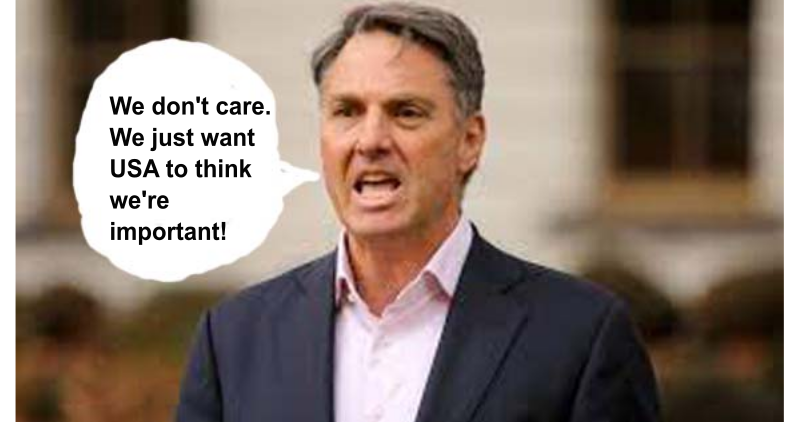
He’s not dealing with low-grade radioactive hospital waste that can be stored on the surface. At a minimum, the reactor waste will have to be kept deep underground, probably vitrified, and guarded for centuries. Marles says nothing needs to be done for 50 years. This will not be the case if Australia initially gets three to five second-hand US submarines whose high level waste will need to be dealt with much sooner.
Despite the US and the UK’s long experience with nuclear weapons, neither has a high-level underground nuclear waste repository. In these circumstances, Australia could easily be pressured into securing the waste created by the US and UK submarines’ nuclear reactors.
At this stage, it seems likely the burial site will be on land important to Australia’s indigenous population. Whatever happens, it is essential there is no repeat of the neglect of the indigenous people who were wilfully exposed to radiation during and after the British nuclear tests in the 1950s and 60s in Australia’s south and central desert areas. The case for getting nuclear submarines is already bad. They should be ruled out entirely if the indigenous population rejects the proposed waste burial sites, which need to be identified urgently, rather than at Marles’ leisurely timetable.
At this stage there is little interest in how to dispose of the high level uranium waste, let alone put indigenous inhabitants to the fore. This is unlikely to change while the nation’s most prominent journalists see it as their job to promote the dominant military doctrine and boost the demonisation of China, while rubbishing inconvenient interlopers such as the former prime minister Paul Keating. It doesn’t help either that they some are largely ignorant of the issues.
Many journalists put great faith in intelligence briefings from right wing ideologues and others about the alleged threat from China. They claim Keating can’t say anything of value because he hasn’t received an intelligence briefing in decades. On the contrary, this is a distinct advantage.
Keating’s detractors need to pay a lot more attention to the role intelligence played in the illegal invasion of Iraq. The recent 20th anniversary of the invasion, led by George Bush, Tony Blair and John Howard, received little attention in Australia. This act of aggression was justified by concocted intelligence. Howard falsely claimed that at the time of the invasion his government “knew” Iraq possessed weapons of mass destruction. Thanks largely to the much-disparaged weapons inspectors, Iraq certainly didn’t have any. Yet Howard falsely said they did and were “capable of causing destruction on a mammoth scale”.
Many Australian journalists now rely on purported intelligence and propaganda for their flimsy claims about Chinese acts of aggression, which barely rank alongside the death and destruction wrought by the US aided by Australia. Chinese journalists also rely excessively on government sources, but have almost no influence in Australia.
The White House, for example, engaged in a blatant act of propaganda when unveiling the plan for Australia to get nuclear submarines. It claimed, “For over 60 years, the UK and the US have operated more than 500 naval nuclear reactors . . . without incident or adverse effect on human health or the quality of the environment.” In fact, two US nuclear submarines, the Thresher and the Scorpion, sunk during that period with the loss of all lives on board. Mainstream Australian journalists have not treated this as a staggering falsehood that should be condemned.
Mainstream journalists also have little grasp of other issues involving submarines. One recently claimed that Keating, who opposes Australia buying nuclear submarines, didn’t understand that conventional submarines have to go close to the surface to recharge their diesels by what’s called a “snorting”, a process, where they risk detection. This journalist seemed to have no awareness that modern conventional submarines greatly reduce this risk with Air Independent Propulsion, which uses hydrogen fuel cells to operate extremely quietly for at least three weeks. Using modern batteries can provide another three weeks, or more, of silent operation before charging the batteries in a safe location. They are also much cheaper than nuclear submarines which are detectable from a range of sources, including heat and the wake they leave on the surface at high speed. By the time Australia’s new nuclear submarines arrive around 2050 there is a high chance that advances in sensor technology and computing power will make them relatively easy to detect and destroy.
Although the public currently likes the idea of getting nuclear submarines, it doesn’t like the cost which Marles puts at $268 billion to $368 billion by 2055. The public may like it even less if they realise that the Virginia Class submarines of which we are still get up to five, have an appalling maintenance record. If we got eight, as originally intended, only two would be operationally available on average. Paying $368 billion to have two operationally available would be a scandalous result. Modern conventional submarines, such as German ones, have an exemplary maintenance record and cost about $15 billion for ten.
Spent Matters: The AUKUS Nuclear Waste Problem
March 19, 2023, Dr Binoy Kampmark https://theaimn.com/spent-matters-the-aukus-nuclear-waste-problem/
When Australia – vassal be thy name – assumed responsibilities for not only throwing money at both US and British shipbuilders, lending up territory and naval facilities for war like a gambling drunk, and essentially asking its officials to commit seppuku for the Imperium, another task was given. While the ditzy and dunderheaded wonders in Canberra would be acquiring submarines with nuclear propulsion technology, there would be that rather problematic issue of what to do with the waste. “Yes,” said the obliging Australians, “we will deal with it.”
The Australian Defence Department has published a fact sheet on the matter, which, as all such fact sheets go, fudges the facts and sports a degree of misplaced optimism. It promises a “sophisticated security and safety architecture” around the nuclear-powered submarine program, “building on our 70-year unblemished track record of operating nuclear facilities and conducting nuclear science activities.”
This record, which is rather more blemished than officials would care to admit, does not extend to the specific issues arising from maintaining a nuclear-powered submarine fleet and the high-level waste that would require shielding and cooling. In the context of such a vessel, this would entail pulling out and disposing of the reactor once the submarine is decommissioned.
Australia’s experience, to date, only extends to the storage of low-level waste and intermediate-level waste arising from nuclear medicine and laboratory research, with the low-level variant being stored at over a hundred sites in the country. That situation has been regarded as unsustainable and politically contentious.
The department admits that the storage and disposal of such waste and spent fuel will require necessary facilities and trained personnel, appropriate transport, interim and permanent storage facilities and “social license earned and sustained with local and regional communities.” But it also notes that the UK and the US “will assist Australia in developing this capability, leveraging Australia’s decades of safely and securely managing radioactive waste domestically”.
That’s mighty good of them to do so, given that both countries have failed to move beyond the problem of temporary storage. In the UK, the issue of disposing waste from decommissioned nuclear submarines remains stuck in community consultation. In the US, no option has emerged after the Obama administration killed off a repository program to store waste underneath Nevada’s Yucca Mountain. The reasons for doing so, sulked Republicans at the time, were political rather than technical.
Where, then, will the facilities to store and dispose of such waste be located? “Defence – working with relevant agencies including the Australian Radioactive Waste Agency – will undertake a review in 2023 to identify locations in the current or future Defence estate that could be suitable to store and dispose of intermediate-level waste and high-level waste, including spent fuel.”
The various state premiers are already suggesting that finding a site will be problematic. Both Victoria and Western Australia are pointing fingers at South Australia as the logical option, while Queensland has declared that “under no circumstances” would it permit nuclear waste to be stored. “I think the waste can go where all the jobs are going,” remarked Victorian Premier Daniel Andrews. “I don’t think that’s unreasonable, is it?”
-ADVERTISEMENT-
Western Australia’s Mark McGowan, in furious agreement, suggested that a site “somewhere remote, somewhere with very good long-term geological structure that doesn’t change or move and somewhere that is defence lands” narrowed down the options. “[T]hat’s why Woomera springs to mind.”
South Australia’s Premier, Peter Malinauskas, insists that the waste should go “where it is in the nation’s interest to put it” and not be a matter of “some domestic political tit-for-tat, or some state-based parochial thing.”
When it comes to storing nuclear waste, parochialism is all but guaranteed. The Australian government is already facing a legal challenge from traditional owners regarding a 2021 decision to locate a nuclear waste site at Kimba in South Australia. The effort to find a site for the National Radioactive Waste Management Facility intended for low and intermediate radioactive waste produced by the Australian Nuclear Science and Technology Organisation at Lucas Heights, New South Wales, took three decades.
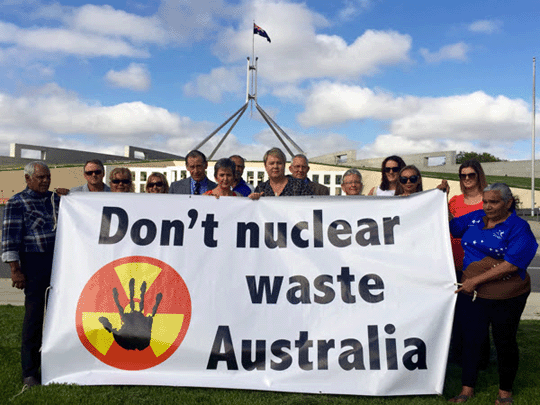
According to members of the First Nations group opposing the decision, the proposed facility risks interfering with a sacred site for women. Dawn Taylor, a Barngarla woman and Kimba resident, told the ABC that, “The Seven Sisters is through that area.” She feared that the waste facility would end up “destroying” the stories associated with the dreaming.
The federal resources minister, Madeleine King, has stated with little conviction that a cultural heritage management plan “informed by the research of the Barngarla people” is in place. “There are strict protocols around the work that is going on right now to make sure there is no disturbance of cultural heritage.”
Local farmers, including the consistently vocal Peter Woolford, are also opposed to the project. “We just can’t understand why you would expose this great agricultural industry we have here in grain production to any potential risk at all by having a nuclear waste dump here.”
The Australian security establishment may well be glorifying in the moment of AUKUS, itself an insensibly parochial gesture of provocation and regional destabilisation, but agitated residents and irate state politicians are promising a good deal of sensible mischief.
Labor Premiers’ dispute over location for AUKUS nuclear wastes, – but planned Kimba waste dump is”now dead in the water”?

Mr Wilkins told ABC Radio Adelaide that the proposed Kimba nuclear waste dump no longer made sense, and that any future site to store submarine reactor spent fuel should also accept waste that would have gone to Kimba.
“The proposed Kimba nuclear waste dump must now be dead in the water,” he said
Nuclear waste divisions intensify between Labor premiers over AUKUS submarine deal
ABC, 18 Mar 23
South Australia’s premier has hit back at suggestions from Labor counterparts that his state should take nuclear waste from the future AUKUS fleet, saying the decision on where the waste goes should be based on the “nation’s interests”…………….
Divisions within Labor ranks over AUKUS — including over its $368 billion cost, and its strategic aims and consequences — have become increasingly apparent since Paul Keating’s blistering attack on what he described as the “worst international decision” by a Labor government since conscription.
While Prime Minister Anthony Albanese yesterday rebuked Mr Keating, Labor premiers have since voiced opposition to accepting nuclear waste from the AUKUS subs in their states.
Victorian Premier Daniel Andrews said yesterday it was not “unreasonable” to suggest that, since South Australia is gaining jobs, it should also accept the spent fuel rods when the submarines reach the end of their service.
“I think the waste can go where all the jobs are going,” he said.
West Australian Premier Mark McGowan voiced similar sentiment, suggesting South Australia take on a nuclear waste facility.
But while Mr Malinauskas said that the possibility of SA taking waste could not be ruled out, he rejected Mr Andrews’s claim that SA had a responsibility to take the waste because it was taking the jobs.
“No, because that implies that somehow that this isn’t a national endeavour,” he said……………………
Conservation Council of SA chief executive Craig Wilkins said discussion of a “short-term political stoush between state premiers” overlooked the major challenges involved in storing nuclear waste.
“We’re talking about waste that needs to be kept safe from humans for tens of thousands of years, basically beyond our civilisation, so this needs to be an incredibly well-considered decision,” he said.
“[There] needs to be a multi-billion-dollar project to house the waste.”
Mr Wilkins told ABC Radio Adelaide that the proposed Kimba nuclear waste dump no longer made sense, and that any future site to store submarine reactor spent fuel should also accept waste that would have gone to Kimba.
“The proposed Kimba nuclear waste dump must now be dead in the water,” he said………………………. https://www.abc.net.au/news/2023-03-17/sa-premier-hits-back-at-nuclear-waste-claims/102109026
Nuclear dump to be built on Defence land
14 March, 2023, Judy Skatssoon
The government has confirmed it will build a high level nuclear dump to deal with waste from its nuclear powered submarine program but says the location is yet to be decided.
Dealing with high level waste on Australian soil is part of the $368 billion AUKUS deal announced on Tuesday, which will see Australia build and operate eight nuclear powered submarines over the next 30 years.
Defence Minister Richard Marles said during a press conference on Tuesday that a purpose-built facility will have to be built to deal with waste generated by the submarines.
He admitted the government is yet to decide where the dump will be located but said it would be ‘quite some time’ before that bridge is crossed.
“There will be a process that we will determine within the next 12 months for how the site will be identified,” Mr Marles said.
“That’s to say we won’t identify the facility in twelve months’ time, but we will set up a process within the next twelve months for how that will be identified. But we’ve got time. We’ve got time to get this right, we’ve got time to identify the facility.”
30-year timeframe for decisions
It would be about 30 years before the first of the nuclear reactors that will power the subs will have to be disposed of, he said.
“So that is the timeframe. We will, in the course of the next year, announce a process by which that site will be identified. We’re not about to identify right now. And there is plenty of time in which to identify.”
He declined to say whether South Australia, where the SSN-AUKUS submarines will be built, or WA, which will eventually be home to the nuclear powered fleet, would be the site of a dump.
However, he indicated it will be on Defence land.
“We are committing to the fact that it will happen on Defence land, be it current Defence land or future Defence land,” the minister said.
He told the ABC the location would need to be remote from populations and geologically stable.
“We’re actually blessed with large parts of the country where that’s possible,” he said.
Spent nuclear reactors
Spent nuclear reactors will produce the highest level of nuclear waste, but this won’t need to be disposed of until after 2050, he said.
The first of those will be from the Virginia Class submarines being procured from the US, which will start operating in the early 2030s, Mr Marles said.
“It’s a significant undertaking to deal with the reactors at the end of their life, and this will require a purpose built facility in order to do that,” he said.
“So that people are clear, we’re talking about the first reactor needing to be dealt with in the 2050s, so this is a long way into the future.
“But we need to be planning for that, and what we’ve made clear today is that within the year we will announce a process by which that place will be identified – so we won’t identify the place in a year, but we’ll announce the process for that and what that facility would look like.”
Mr Marles did not answer questions about how many kilos of highly enriched uranium would need to be disposed of, telling the ABC that information was classified.
Australia was focused on dealing only with it’s own nuclear waste, and not that of its AUKUS partners the US and UK, the minister said.
‘Send it to Woomera’: Premier McGowan cold on nuclear waste being stored in Western Australia
SMH, Hamish Hastie, With Paul Sakkal. March 16, 2023
Western Australia has nominated defence force land in the Woomera prohibited area in South Australia as the best location to store dangerous radioactive waste from Australia’s nuclear submarines.
The premier’s comments add to the growing headache the Albanese government faces over what to do with the spent nuclear reactors from the AUKUS deal submarines once the vessels begin producing them from the mid-2050s.
On Wednesday the leaders of Victoria, Queensland and South Australia all signalled they did not want a nuclear waste facility in their state.
When asked whether he would be happy with a nuclear waste facility set up in WA after a press conference alongside Defence Minister Richard Marles in Perth on Thursday McGowan responded: “no”.
Woomera is a large swath of defence land in the north west of South Australia used as a long-range weapons testing area, including for nuclear weapons, after the second world war.
……………………………. Marles said the government would begin a process to pick a site for the waste within the year and revealed he had “a chat” with McGowan about the issue. But he said it was still early days.
…………… On Wednesday South Australian Premier Peter Malinauskas told ABC Radio the waste should be sorted somewhere safe but that didn’t mean it had to be in South Australia……………………
A spokeswoman for Queensland Premier Annastacia Palaszczuk said under no circumstances would the state become a dumping ground for nuclear waste.
WA has a nuclear waste dumping facility in the Goldfields that stores waste with low-level radioactivity including discarded medical imaging machines.
McGowan said this low-level waste was completely different to the radioactivity from spent nuclear reactors from submarines. https://www.smh.com.au/national/send-it-to-woomera-mcgowan-cold-on-nuclear-waste-being-stored-in-wa-20230316-p5csps.html—
Australia hasn’t figured out low-level nuclear waste storage yet – let alone high-level waste from submarines.
The Conversation, Ian Lowe, Emeritus Professor, School of Science, Griffith University, March 15, 2023
.”……………. nuclear submarines mean nuclear waste. And for decades, Australia has failed to find a suitable place for the long-term storage of our small quantities of low and intermediate level nuclear waste from medical isotopes and the Lucas Heights research reactor.
With this deal, we have committed ourselves to managing highly radioactive reactor waste when these submarines are decommissioned – and guarding it, given the fuel for these submarines is weapons-grade uranium.
Where will it be stored? The government says it will be on defence land, making the most likely site Woomera in South Australia.
What nuclear waste will we have to deal with?
Under this deal, Australia will not manufacture nuclear reactors. The US and later the UK will give Australia “complete, welded power units” which do not require refuelling over the lifetime of the submarine.
In this, we’re following the US model, where each submarine is powered by a reactor with fuel built in. When nuclear subs are decommissioned, the reactor is pulled out as a complete unit and treated as waste.
An official fact sheet about this deal states Australia “has committed to managing all radioactive waste generated through its nuclear-powered submarine program, including spent nuclear fuel, in Australia”.
What does this waste look like? When Virginia-class submarines are decommissioned, you have to pull out the “small” reactor and dispose of it. Small, in this context, is relative. It’s small compared to nuclear power plants. But it weighs over 100 tonnes, and contains around 200 kilograms of highly enriched uranium, which is nuclear weapons-grade material.
So, when our first three subs are at the end of their lives – which, according to defence minister Richard Marles, will be in about 30 years time – we will have 600kg of so-called “spent fuel” and potentially tonnes of irradiated material from the reactor and its protective walls. Because the fuel is weapons-grade material, it will need military-scale security.
Australia has no long-term storage facility
There’s one line in the fact sheet which stands out. The UK and US “will assist Australia in developing this capability, leveraging Australia’s decades of safely and securely managing radioactive waste domestically”.
This statement glosses over the tense history of our efforts to manage our much less dangerous radioactive waste.
For decades, the Australian government has been trying to find a single site for disposal of low-level radioactive waste. …………………………………..
The most recent plans to locate a dump at Kimba, on South Australia’s Eyre Peninsula is still bogged down in the legal system due to opposition by local communities and First Nations groups.
And we’re still dithering about what to do with the intermediate level waste produced by the OPAL research reactor at Lucas Heights in Sydney. At present, spent fuel is sent to France for reprocessing while nuclear waste is now being returned to Australia, where it is held in a temporary store near the reactor.
This waste needs to be permanently isolated from ecosystems and human society, given it will take tens of thousands of years for the radiation to decay to safe levels.
Our allies have not figured out long-term waste storage either
But while Sweden and Finland are building secure storage systems in stable rock layers 500 metres underground, neither the UK nor the US have moved beyond temporary storage.
UK efforts to manage waste from decommissioned nuclear submarines is still at the community consultation stage. At present, high-level waste from sub reactors is removed and taken to Sellafield, a long-established nuclear site near the border with Scotland. But each submarine still holds around one tonne of intermediate level waste, which, according to the UK government, has to be temporarily stored until a long-term underground storage facility is built some time after 2040.
In the US, spent fuel and intermediate waste from nuclear submarines is still in temporary storage. ………. nuclear waste from their military and civilian reactors is just piling up with no long-term solution in sight. Successive administrations have kicked the can down the road, assuring the public a permanent geological disposal site will be developed some time in the future.
This should be concerning. To manage the waste from our proposed nuclear submarines properly, we’ll have to develop systems and sites which do not currently exist in Australia.
In 2016, South Australia’s Royal Commission on nuclear fuel suggested Australia’s geological stability and large areas of unpopulated land would position us well to act as a permanent place to store the world’s nuclear waste.
This hasn’t come to pass in any form. An almost intractable problem is that any proposed site will be on the traditional land of a First Nations group. Every site suggested to date has been opposed by its Traditional Owners.
What if we send the high-level waste overseas for processing and bring it back as less dangerous intermediate waste? It’s possible, given it’s what we already do with waste from the OPAL reactor. But that still leaves us with the same problem: where do you permanently store this waste. That’s one we haven’t solved in the 70 years since Australia first entered the nuclear age with our original HIFAR reactor at Lucas Heights. https://theconversation.com/australia-hasnt-figured-out-low-level-nuclear-waste-storage-yet-let-alone-high-level-waste-from-submarines-201781
Ocean discharge is the worst plan for Fukushima waste water — IPPNW peace and health blog

Japan may soon start dumping radioactively contaminated waste water from the Fukushima Daichi nuclear plant into the Pacific Ocean, despite warnings from neighboring countries, marine scientists, and health experts. As soon as within a month or two, Japan could begin dumping into the Pacific Ocean 1.3 million tons of treated but still radioactively contaminated wastewater […]
Ocean discharge is the worst plan for Fukushima waste water — IPPNW peace and health blog
As soon as within a month or two, Japan could begin dumping into the Pacific Ocean 1.3 million tons of treated but still radioactively contaminated wastewater from the stricken Fukushima Daichi nuclear plant. Construction of the kilometer long undersea discharge tunnel and a complex of pipes feeding it commenced last August.
This cheap and dirty approach of “out of sight out of mind” and “dilution is the solution to pollution” belongs in a past century. It ignores the significant transboundary, transgenerational and human rights issues involved in this planned radioactive dumping, projected to continue over the next 40 years.
Concerns about Japan’s ocean dumping plans have been strongly voiced by China and South Korea, and by numerous Pacific island nations. Multiple UN Special Rapporteurs have severely criticised the plan, which has also been opposed by the United States National Association of Marine Laboratories and many regional and international health and environmental civil society organisations.
Australia bears a particular responsibility in relation to the aftermath of the ongoing Fukushima nuclear disaster, since fuel fabricated with uranium from Australia was in each of the Fukushima reactors which exploded. Yet my letters to the relevant Australian federal ministers on this matter have gone unanswered for seven weeks, and no evidence is publicly available that the Australian government has supported our Pacific neighbours in raising concerns about the planned discharge with its Japanese counterparts.
We are in the UN Decade of Ocean Science for Sustainable Development (2021-30). As Pacific Islands Forum (PIF) Secretary-General Henry Puna reminded us in his piece in The Guardian on 4 January, in 1985 the Forum welcomed the then Japanese prime minister’s statement that “Japan had no intention of dumping radioactive waste in the Pacific Ocean in disregard of the concern expressed by the communities of the region.” The current plan is inconsistent with this commitment.
In a public event organised by the PIF in Suva on 18 January, Puna noted Prime Minister Kishida’s reassurance during Japan’s regular meeting with the Forum in July 2022 of the need to progress this matter consistent with international law and verifiable science. The Secretary-General reiterated his request on behalf of Forum members for postponement of the planned discharge in order to allow adequate consideration of alternative options and to engage in respectful and full evidence-based consultation with Pacific nations in planning the best course of action. His calls have been ignored.
The most authoritative independent scientific assessment of the planned discharge has been conducted by a five-member independent international scientific panel appointed by the PIF. The experts were unanimous in their conclusions and recommendations. Their main conclusions:
- TEPCO’s knowledge of the specific radionuclide contents of all the tanks is seriously deficient. Only roughly one quarter of the more than 1,000 tanks at the site have been sampled at all, and in almost all cases only nine or fewer of 64 total radionuclides are measured in the data shared with PIF. TEPCO’s assumptions of consistent ratios of various radionuclides across different tanks are contradicted by the data, with show many thousand-fold variation.
Sampling and measurements have been unrepresentative, statistically deficient and biased, and have not included the debris and sludges, which Japan has acknowledged are present in at least some of the tanks. Sludges and debris are likely to be most radioactive, particularly in relation to harmful isotopes like plutonium and americium.- More than 70% of the tanks which had gone through ALPS (Advanced Liquid Processing System), designed to remove most of the radioactive contaminants, will require re-treatment. For some isotopes, the levels after treatment are up to 19,900 times higher than the regulatory limits for discharge. There is no evidence confirming that even repeated processing through ALPS can provide consistently effective purification.
- There has been no adequate consideration of the behavior of radioactive elements in the ocean, with transport by ocean currents and organisms, accumulation in biota and sea floor sediments, or the behavior of organically bound tritium in an ocean environment. The seafloor off Japan’s east coast still contains up to 10,000 times the cesium concentration as before the disaster, before any planned discharge.
- Neither TEPCO nor the IAEA acknowledged or addressed the many serious scientific questions raised by the panel. For example, TEPCO reported that tanks sampled in 2019 contained tellurium-127, an isotope with a half-life of only 9 hours. This signifies either that accidental criticality with fission reactions are occurring on an ongoing basis in the molten reactor cores, which would be very significant, or that the measurements are wrong. However no satisfactory answers were provided. Indeed the IAEA cut off contact with the panel.
- Neither TEPCO, the International Atomic Energy Agency (IAEA) nor the Japanese Nuclear Regulatory Authority have properly considered several viable alternative approaches, including storage in purpose-built seismically safe tanks, possibly after initial purification, subsequent use in concrete for structural applications with little or no potential for contact with humans and other organisms, and bioremediation for some important isotopes such as strontium-90. All the proposed alternatives would have orders of magnitude less impact and avoid transboundary impacts.
The argument that the site is running out of room to store water is spurious. Contaminated water will continue to be generated for many decades hence, and there is plenty of nearby space available that will be unfit for other uses for a very long time and is already being used to store large amounts of contaminated soil from around the prefecture. There is in fact no urgency to begin ocean discharge.
The independent expert panel recommended unanimously that the planned ocean dumping should not proceed. Their overwhelming case, based on scientific evidence and the need to minimise transboundary and transgenerational impacts, is that new approaches and alternatives to ocean dumping are needed and are the responsible way forward.
This matter requires urgent attention. Construction of the pipeline through which the ocean discharge is planned to occur is well underway, and the discharge may commence as soon as this month. Given that the discharge is planned to continue over 30-40 years, reconsideration could still be undertaken even after ocean discharge commenced. However it would be far better if the planned discharge were postponed until better alternatives were properly considered and implemented.
Now is the time for the Australian government, scientists and citizens to join with our Pacific neighbours in calling on Japan to stop its irresponsible plan to use the Pacific Ocean as a radioactive waste dump.
‘David and Goliath’: Kimba nuke waste fight heads to Federal Court
Stephanie Richards, 6 March 23, https://indaily.com.au/news/2023/03/06/david-and-goliath-kimba-nuke-waste-fight-heads-to-federal-court/?utm_medium=email&utm_campaign=InDaily%20Lunchtime%20%206%20March%202023&utm_content=InDaily%20Lunchtime%20%206%20March%202023+CID_654499187b614fa7e1f09bd8ceb7100e&utm_source=EDM&utm_term=READ%20MORE
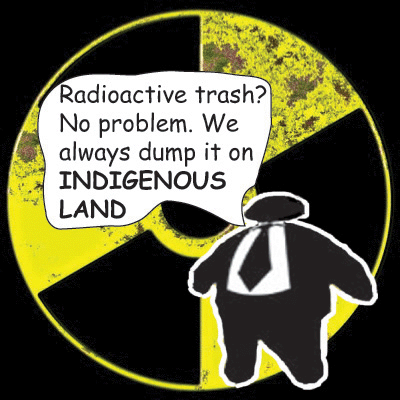
Barngarla Traditional Owners’ fight to stop a nuclear waste facility being built near Kimba on South Australia’s Eyre Peninsula has reached the Federal Court, with the first substantive case hearing in Adelaide today.
They were supporting the Barngarla Determination Aboriginal Corporation, which has applied for judicial review in an attempt to thwart construction of the federal government’s planned radioactive waste storage facility at Napandee near Kimba.
“We’re fighting against injustices that have been happening to the Barngarla people regarding this waste dump in Kimba,” Barngarla Traditional Owner Harry Dare told InDaily outside court.
“We’re actually fighting for a seven sisters and women’s dreaming site and we’re fighting for a vote in our local governance.
“The Australian Government has given back our Native Title, but they haven’t given us a voice in those Native Title areas, so we’re fighting for equality and for all of Australia to be nuclear free.”
The Napandee site was selected by the former Morrison Government, with then Resources Minister Keith Pitt saying the government had secured “majority support” from the local community after more than “six years of consultation”.
But Barngarla Traditional Owners opposed the project and argued they were not included in the consultation.
During today’s hearing, the Federal Court was told of how the decision to locate the dump at Napandee, near Kimba, played out.
After beginning the process to select the site through its administrative powers, the then Coalition Government changed tack and decided to legislate, partly to avoid delays through legal challenges.
However, when the legislation failed in the Senate, the government restarted the administrative process.
Counsel for the Barngarla told Justice Natalie Charlesworth that raised questions over whether Pitt, who ultimately named the Napandee location and who strongly supported the legislative approach, could properly carry out his administrative role.
“That, of itself, would excite a reasonable apprehension that the minister might be unable or unwilling to approach the matter with an open mind,” he said.
“Because, effectively, the decision had already been made.”
The court was also told that the Barngarla disagreed with the former government’s view that the dump had wide community support in Kimba and would also argue the decision on the dump was unreasonable given the lack of proper consultation with the Indigenous owners.
Given Pitt’s correspondence with the Barngarla people and his other statements, the impression that might arise was that consultation would largely amount to “matters around the edges”.
“In terms of identifying culture and the like in the implementation of the site, which had already been selected and to which the minister was committed,” counsel said.
With the case listed for several days, the federal government is expected to argue that much of the material to be relied on by the applicants is subject to parliamentary privilege.
The Barngarla launched their action in 2021 after being denied the right to participate in a community ballot to gauge local support for the Napandee site because many did not live in the Kimba council area.
The community ballot returned about 61 per cent in favour of the dump.
But when the Barngala conducted their own ballot among their community members, 83 voted no and none voted yes.
They argue they were denied the right to participate in a community ballot to gauge local support for the site, because many did not live in the Kimber council area.
Traditional Owner Linda Dare told protestors ahead of this morning’s hearing that the proposed location for the nuclear waste facility was near an important women’s site for the Barngarla people.
“It just seems to be that every time the government wants to put something it’s always around a women’s site,” she said.
“We need to fight as women around Australia to protect our sites.
“We need to say ‘no’ because it’s going to affect the waterways, not just in South Australia but everywhere.”
InDaily reported in September that the federal government was spending three times more than Barngarla Traditional Owners fighting the project in the Federal Court.
Information released to SA Greens Senator Barbara Pocock showed that between December and July, the government had spent $343,457.44 on legal fees.
That compares to the approximate $124,000 spent by the Barngarla Determination Aboriginal Corporation over the same period.
The Native Title group estimates that the total cost incurred by the federal government would run into the millions.
Barngarla Determination Aboriginal Corporation chairperson Jason Bilney told InDaily the judicial review was a “David and Goliath battle”.
“But, we’re dedicated. It took us 21 years to win our Native Title, come out of Native Title six months later and we’re fighting a nuclear waste dump on our country,” he said.
“What does that tell you about truth telling, the Statement From The Heart or the Voice?
“Our Voice isn’t being heard, truth telling isn’t being told and they’re going to break the First Nations’ heart – Barngarla – and put it (the nuclear waste dump) on our country.”
Bilney said Traditional Owners expected the Federal Court would take months to reach a decision, with hearings scheduled each day this week.
“It could take a year, but we would like it to have it sooner than later,” he said.
It comes after the Barngarla Native Title group last month won a separate Supreme Court bid to overturn former Premier Steven Marshall’s decision to allow a mineral exploration company to drill at Lake Torrens in the state’s outback.
At the time, Bilney said the group was buoyed by the win as they continued their legal fight to stop the Napandee nuclear waste facility from going ahead.
South Australian Labor has long called for Barngarla people to have the right to veto the project, with Premier Peter Malinauskas previously saying that the state government had expressed its views to the federal government.
1 This month

of the week – Australians for War Powers Reform (AWPR)
To see nuclear-related stories in greater depth and intensity
 Antinuclear