Australian govt uses out-dated terminology, to disguise reality of High Level Nuclear waste
 Steve Dale, Nuclear Fuel Cycle Watch South Australia, 6 Sept 16 When exactly did Australia start calling what should be “High Level Waste” – “Intermediate Level Waste”? The following extract shows they had the correct definitions in 1985 : “The two categories of high level waste are unreprocessed spent fuel and the fission product/actinide residue generated from spent fuel reprocessing. Spent fuel is routinely stored in water-cooled ponds and HLW solution is stored for limited periods in water cooled tanks. HLW solution is being vitrified and stored in air-cooled vaults in France and India…. No country has yet disposed of either spent fuel or vitrified HLW.” from STORAGE AND DISPOSAL OF RADIOACTIVE WASTES by K.D. Reeve, Australian Atomic Energy Commission, 1985http://www.iaea.org/…/NCLCollec…/_Public/17/000/17000568.pdf
Steve Dale Date Found. Australia has based its definition of High Level Waste on an obsolete and superseded version of the IAEA “Classification of Radioactive Waste” 1994, (Safety Series 111-G-1.1). The latest version of the document defines HLW as “HLW typically has levels of activity concentration in the range of 104-106 TBq/m3”. The definition now is based purely on radioactivity and not thermal output. Time for Australia to get honest and start calling Spent Fuel and vitrified reprocessed waste what it is – High Level Waste. https://www.facebook.com/groups/1021186047913052/
Confusion about the two South Australian nuclear waste dump plans
 Are these 2 proposals really so separate, or is the Federal dump choice of South Australia planned so as to soften up South Australians and Australia at large, to view South Australia as a suitable radioactive trash toilet? South Australian Liberals, and the Federal Liberal and Labor are all staying quiet about the Scarce Nuclear Commission plan – but are they secretly in support of it?
Two nuclear proposals ‘confusing discussion’ about potential waste dumps in South Australia, ABC News 2 Sept 16 By Lauren Waldhuter Two separate proposals for storing nuclear waste in South Australia have caused widespread confusion in communities and the Premier has conceded public consultation was badly timed.
The State Government has launched a state-wide public consultation program on royal commission recommendations to store the world’s high-grade nuclear waste in SA.
But at the same time the Federal Government hasshort-listed Wallerberdina station, near Hawker in the Flinders Ranges, as a preferred site for Australia’s first storage facility for low-to-intermediate level radioactive waste.
Hawker Community Development Board chairperson Janice McInnis said SA’s public consultation was clouding discussion about the federal plan.
“I’ve had phone calls from friends in Adelaide who said, ‘what’s this about a waste dump at Hawker?’, thinking it was the state one and they hadn’t heard about the federal one at all,” she said.
| March 2015 | Nuclear Fuel Cycle Royal Commission established. |
May 2015 |
Landholder nominations to host Australia’s Radioactive Waste Management Facility close. |
| May 2015 |
Royal commission releases four issues papers. Public consultation period begins. |
November 2015 |
Six sites around Australia identified for further assessment, including three in SA. Consultation period begins. |
| February 2016 |
Royal commission releases tentative findings. It suggests SA builds a dump for the world’s high-level nuclear waste. |
April 2016 |
Federal Government announces Wallerberdina station as its preferred site. |
| May 2016 | Final report released and consultation continues. | Present | Consultation continues until next year. |
Premier Jay Weatherill admitted the timing could have been better.
“Certainly we would’ve preferred if the federal process had have waited until our process had been underway,” he said.
“There’s no doubt there’s been confusion between the federal process and the South Australian Government process.
“We’ve detected that as we’ve gone out and spoken to people.
“I think the Commonwealth support the approach that we’ve taken but we’re going to have to find a way to bring those two decision-making processes together.”……..
Two sets of conversations ‘insulting’ Despite disagreeing with both government plans to pursue a nuclear future for SA, environmental groups agree the issue has become too confusing.
The Conservation Council of SA held an expo in Port Augusta on Friday to highlight concerns about both proposals as well as their differences.
“It’s actually insulting to have two sets of governments having two sets of conversations on two different proposals at the same time,” chief executive Craig Wilkins said.
“No wonder the community is confused. “It’s incredibly important that these two plans are kept separate because the impacts are very, very different.” http://www.abc.net.au/news/2016-09-04/nuclear-proposals-confusing-discussion-in-sa/7812646?pfmredir=sm
Unions ready to oppose South Australian Premier Jay Weatherill on nuclear waste dump plans
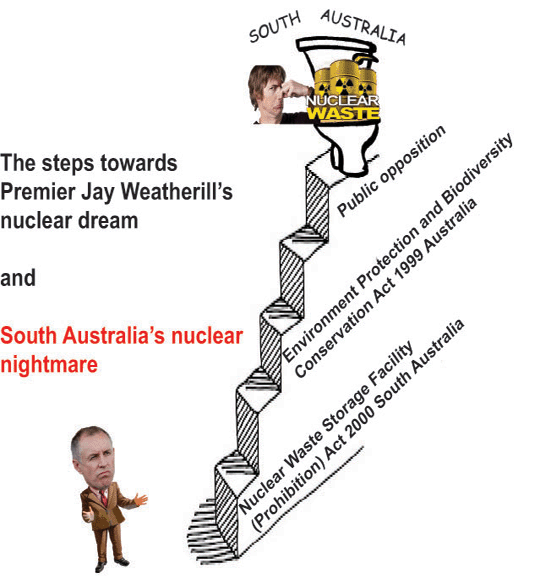 Unions ready to dump on Jay Off the Record: SA’s home of political, business and legal gossip http://www.adelaidenow.com.au/news/opinion/off-the-record-sas-home-of-political-business-and-legal-gossip/news-story/d4d7206f85a8cf5ff5a628158157ef66The Advertiser September 2, 2016 POWERFUL forces within the Labor movement are bracing for an intense union campaign against Premier Jay Weatherill if he goes ahead with plans for a high-level nuclear waste dump.
Off the Record can reveal some are talking about a repeat of the union campaign against Mike Rann, which boiled over in 2010 when he needed a police escort through protesters at Labor’s state conference.
Labor figures have drawn our attention to Maritime Union of Australia state secretary Jamie Newlyn’s public backing of the No Dump Alliance, a broad coalition of environmentalists, indigenous groups and academics.
Newlyn, also SA Unions president, says on the group’s website that the MUA has “a long history of opposing expansion of the nuclear industry including nuclear waste dumps”.
“We fear that the economic assumptions pale in insignificance to the unknown safety and environmental implications of such plans,” says Newlyn.
Wharfies clearly would be required to unload any imported high-level waste, so the union’s support would be critical.
SA Unions vice-president (women) and nurses’ union state secretary Elizabeth Dabars also is backing the anti-dump campaigners, ambiguously declaring her union is pleased “to join the No Dump Alliance to actively participate in community debate on this very important issue for the South Australian community”.
Rann discovered, to his peril, the risks of putting off-side powerful union leaders, such as Australian Workers’ Union state secretary (now president)Wayne Hanson. The AWU, however, is said to be more onside with the dump, because of the potential for jobs and investment.
Perhaps Weatherill will have to worry about his hitherto smooth relations with the union movement being disrupted when he delivers, by the end of the year, the government’s response to the nuclear royal commission.
Surface nuclear waste spurs community concern
Community concern is mounting about plans to store high level radioactive waste above ground for years before building a proposed nuclear waste dump, warns Conservation SA CEO Craig Wilkins.
“From our public consultation, most people think this proposed dump is an ‘out of sight, out of mind’ idea, where we bury the waste deep in the outback and that’s it,” he said. “The reality is very different.
“The Nuclear Fuel Cycle Royal Commission was very candid: The project only stacks up financially if we import and stockpile 50,000 tonnes of nuclear waste above ground for as long as 17 years before we can deposit it in an underground disposal site. Indeed, that ‘interim’ surface site will store tens of thousands of tonnes above ground for the next 100 years.

“So, we acquire the risk and responsibility for this nuclear waste before we know if we can actually build and operate the ultimate repository – let alone obtain community consent for it.
“Before we get there, ships containing that high-level waste enter South Australian waters through problem areas such as the South China Sea, then traverse our prawn and tuna fisheries, aquaculture zones and tourism hotspots every month for 70 years. That is a huge amount of risk.
“The plan would require a purpose-built nuclear port and rail line with nuclear waste being stored at five different locations across the state. While these facts are publicly accessible, they’ve been obscured by the promise of eye-popping windfall profits from this proposal.”
However, community concern has grown as South Australian citizens identify problems with the financial viability, environmental impact and community effects of the proposed nuclear waste dump.
In Port Augusta, a two-day community forum, called Exposure 2016, will run this weekend, from September 2-4, at the city’s Institute Theatre, starting on Friday night with ‘Talking Straight Out’. This exhibition showcases the famous Irati Wanti campaign when senior Aboriginal women from Coober Pedy, the Kupa Piti Kungka Tjuta, defeated Federal Government plans to dump radioactive waste on their land.
The free event will also include sessions on the SA Government’s international nuclear waste dumping plans; current Federal Government plans to dump waste in the Flinders Ranges; traditional owners’ voices and rights; impacts of radiation on people and the environment; impacts on industries including tourism, farming and recreation and the track record of radioactive waste management / mismanagement in South Australia and globally.
For many South Australians, the proposed nuclear waste dump in the State’s outback invokes memories of Maralinga and Emu Fields, the South Australian sites of nine British secret nuclear tests between 1953 and 1963. The tests exposed local Aboriginal communities to radiation that caused cancers, blindness and ongoing genetic damage. British and Australian servicemen were also exposed and radioactivity was detected in SA, NT, NSW and Queensland.
South Australian singer Mike Roberts also communicates concern about the nuclear waste dump in his new song Welcome to the Nuclear State. Listen at http://www.cdbaby.com/cd/mikeroberts23#. For community concerns about the SA nuclear waste dump, visit http://www.nodumpalliance.org.au/.
Nuclear waste plan for South Australia not economically viable? Global nuclear lobby doesn’t care
The global nuclear lobby surely does not care about whether or not the South Australian nuclear waste importing scheme is economically viable.
A commitment by an Australian State to take in nuclear waste could do the trick for them – as Oscar Archer put it – by unblocking the back end of the nuclear fuel cycle. The NFCRC plan also promises the chance of a market in Australia for the mini nuclear reactors.
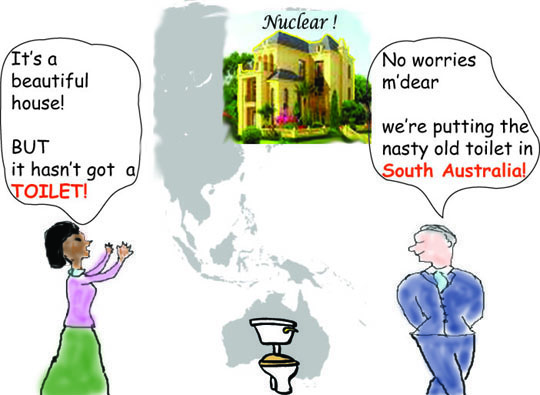
Mixed motives in South Australia’s nuclear waste import plan, Noel Wauchope, Online Opinion, 23 Aug 16, In South Australia the continued nuclear push focusses solely on a nuclear waste importing industry. Yet that might not be economically viable. Behind the scenes, another agenda is being pursued – that of developing new generation nuclear reactors.
First, let’s look at the message. The message from the Nuclear Fuel Cycle Royal Commission (NFCRC) is clearly a plan to make South Australia rich, by importing foreign nuclear wastes……This theme has been repeated ad nauseam by the NFCRC’s publicity, by politicians, and the mainstream media.…..
Meanwhile, the South Australian Parliament is holding a Committee Inquiry into the NFCRC’s recommendations. This Committee asked witnesses about various aspects of the plan. However, an intense focus in questioning Royal Commissioner Kevin Scarce, and Dr Tim Johnson from Jacob Engineering (financial reporter to the NFCRC) was directed at the economic question. It was clear that the politicians were concerned that there’s a possibility of the State spending a significant amount of money on the project, which might then not go ahead. And, indeed, Dr Johnson acknowledged that, financially,” there is a very significant risk”
Whereas other countries are compelled to develop nuclear waste facilities, to deal with their waste production from civil and military reactors,that is not a necessity for Australia, (with the exception of relatively tiny amounts derived from the Lucas Heights research reactor).
So, the only reason for South Australia to develop a massive nuclear waste management business is to make money.
If it’s not profitable, then it shouldn’t be done.
Or so it would seem.
There is another, quieter, message. When you read the Royal Commission’s reports, you find that, while the major aim is for a nuclear waste business, in fact, the door is kept open for other parts of the nuclear fuel chain…….
The clearest explanation of this came early in 2015, just as the NFCRC was starting, in an ABC Radio National talk by Oscar Archer…….
Archer’s plan is significant because it illustrates a very important point about South Australia’s nuclear waste plan – IT SOLVES A GLOBAL NUCLEAR INDUSTRY PROBLEM. Both in ‘already nuclear’ countries, especially America, and in the so far non nuclear counties, such as in South Asia, the nuclear industry is stalled because of its nuclear waste problem. In America, the “new small nuclear”, such as the PRISM, technologies (Power Reactor Innnovative Small Module) cannot even be tested, without a definite waste disposal solution. But, if South Australia provided not only the solution, but also the first setting up of new small reactors, that would give the industry the necessary boost……..
Once Australia has set up a nuclear waste importing industry, the nuclear reactor salesmen of USA, Canada, South Korea, will have an excellent marketing pitch for South Asia, as the nuclear waste problem has been removed from their shores.. And South Asia is exactly the market that the NCRC has in its sights. The NFCRC eliminated most of the EU, Russia, China, North America as customers. This was explained by Dr Tim Jacobs, of Jacobs Engineering, (financial reporters to the NFCRC), at the recent hearing of the South Australian Parliamentary Joint Committee on Findings of the Nuclear Fuel Cycle Royal Commission ………
South Australia’s government is influenced by a strong nuclear lobby push and the Royal Commission advocacy for solving that State’s present financial problems by a futuristic nuclear waste repository bonanza scheme…….
The global nuclear lobby surely does not care about whether or not the South Australian nuclear waste importing scheme is economically viable. Their fairly desperate need is to sell nuclear reactors to those countries that don’t already have them. In particular, the ‘small nuclear” lobby sees an urgency now, with ‘big nuclear’ failing, to get their industry happening.
A commitment by an Australian State to take in nuclear waste could do the trick for them – as Oscar Archer put it – by unblocking the back end of the nuclear fuel cycle. The NFCRC plan also promises the chance of a market in Australia for the mini nuclear reactors. http://www.onlineopinion.com.au/view.asp?article=18465&page=1
Roger Cross: Reasons to Reject a Medium and High Level Radioactive Waste Dump in South Australia
Roger Cross Submission to Joint Committee on Nuclear Royal Commission South Australian Parliament, August 2016 Some Reasons for rejecting the proposal to build a Medium and High Level Radioactive Waste Dump in South Australia. By Roger Cross (Author of Fallout: Hedley Marston and the British Bomb Tests in Australia, co-author of Beyond Belief The British Bomb Tests: Australia’s Veterans Speak Out)
Preamble:
The risks to the future health and security to all Australians, and South Australians in particular are many. A risk-benefit analysis is almost certainly impossible given a time-frame that extends for centuries (probably for the rest of human existence on the Planet). Benefits, in terms of financial gain to the State. and some employment must be secondary to the multitude of risks involved. These risks are worth restating so that the “golden egg” of a large financial windfall do not cloud the realities of such a decision.
Risks:
- Health Risks: The existence or otherwise of a threshold below which exposure to ionising
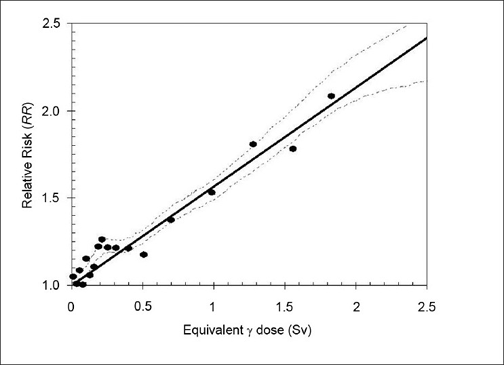
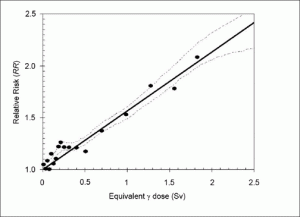 radiation is harmless has been a matter of continuous debate among nuclear scientists for decades. The statistical analysis of John Gofman (l,W, Gofman, 1981. Radiation and Human Health, Sierra Club, San Francisco, 1981, and 1990 RadiationInduced Cancer Fom Low-Dose Exposure: An Independent Analysis. Committee or Nuclear Responsibility Inc., San Francisco) shows there is no safe radioactive dose. Therefore, at any point in the chain of receiving, from overseas, transporting within S.A. and storage even small mishaps leading to only low-level contamination are not risk free. Naturally any large scale mishap would be catastrophic for the State.
- Historical Episode of radioactive contamination in South Australia: It is not feasible to claim that mishaps would not occur, that is, the risks are non-existent The radioactive contamination of Adelaide on the 12 October. 1956 due to an unfortunate change in the wind
 direction at the 11 October Maralinga Bomb Test is a case in point, This mishap caused the population of Adelaide and much of the rest of the State to be contaminated with ionising radiation from one of the Buffalo Bomh explosions (See Cross, R. 2001, Fallout: Hedley Marston and the British Bomb Tests in Australia, Wakefield Press, Adelaide, for information about this event).

- Transportation Risks: While these are impossible to quantify they are not
 negligible.Transportation of medium or high level radioactive waste in particular would require a
high degree of security and infrastructure. The former, in particular would challenge the well-being of South Australians through a system of near military style command and control intrusion into the lives of all South Australians. Such is the consequence of having to secure such a commodity.

- The Uranium back to source Argument: An argument has been mounted that because SA
 exports Uranium, and may one day become a world leading exporter of themineral, we should take back the highly radioactive waste from the user of our Uranium. This argument is entirely false, as in no other exported mineral has it been suggested that we have such an obligation. For example, do coal and iron ore producing States receive back the waste slag and ash. This can be applied to almost any raw material exported. Waste is an inevitable consequence of industrial processing and is the end-users responsibility.
- South Australia’s future World image: The risks are not confined to technical issues but are
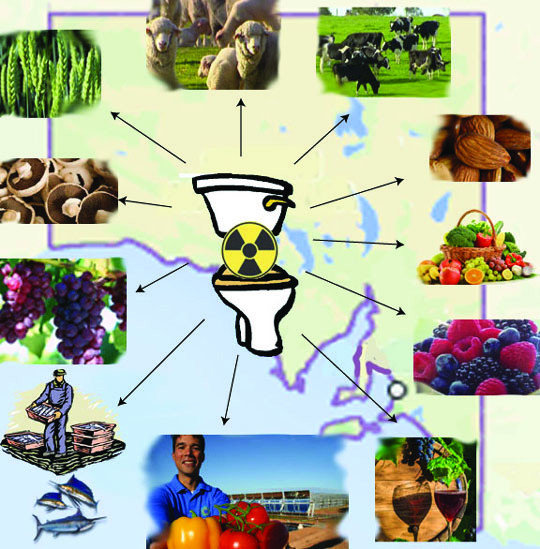
 also present in the image we wish to present to the rest of the world. This will become increasingly important in our push to attract more overseas visitors. Tourism is and can play and ever greater part in our economy as the State is currently seen as fl safe, clean and green place to visit. This advantage we have would naturally disappear in the minds of prospective visitors if we went ahead with the storage of medium and high level radioactive waste from around the World.
Taken from research by the pre-eminent researcher into the health effects of low-dose ionizing radiation, Emeritus Professor John W. Gofman. See for example:- Radiation Induced Cancer from Low-Dose Exposure. An Independent Analysis, 1990, and Synapse article
Disproof of any Safe Dose: The Threshold Question In Chapters 18 through 21 it is proved beyond reasonable doubt that no safe dose or dose rate exists. His analysis of the absence of a threshold below which no harm will be done from a dose of ionizing radiation is based on human evidence. The data analysed rules out the idea of a threshold with regard to radiation-induction human cancer.
The practical implications for these findings are obvious for the establishment of any storage facility of ionising radiation material, and especially the concern here, medium to high level material. There cannot be any doubt that any exposure to radiation as a result of the multiple handling steps that are required even to reach a storage facility would have human health consequences forthose exposed, and may have, even, heritable consequences.
It should be noted that possible exposures do not end with the material reaching the storage facility but continue at that facility virtually in perpetuity. Consider the following:-
“How would a safe level of radiation come about? It could come about in theory jf the biological repair 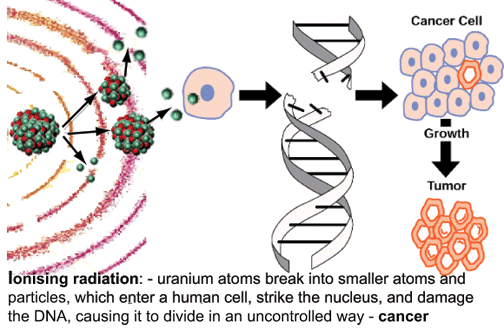 mechanisms – which exist and will repair DNA and chromosomes – work perfectly. Then a low dose of radiation might be totally repaired. The problem, though, is that repair mechanisms don’t work perfectly. There are lesions in DNA and chromosomes that are unrepairable. There are those where the repair mechanisms don’t get to the site and so they go unrepaired. . .. The evidence that the repair mechanism is not perfect is very solid today…. Ionizing radiation is not like a poison out of a bottle where you can dilute it and dilute it. The lowest dose of ionizing radiation is one nuclear track through the cell- you cannot halve it.”
1 Quotation from Gofman on Health Effects of nuclear Radiation, Synapse, Vol 38, No 16, 1994. http://www.parliament.sa.gov.au/Committees/Pages/Committees.aspx?CTId=2&CId=333

South Australian Parliamentary Inquiry asks inconvenient questions about nuclear waste import costs
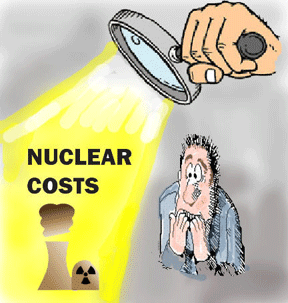 SA parliamentary committee questions economics of importing nuclear waste, Independent Australia, 19 August 2016, The economic benefits of SA’s push for a global nuclear waste dump took a negative turn during the current parliamentary committee inquiry. Noel Wauchope reports.
THE SOUTH Australian Parliament is holdinga Joint Committee on Findings of the Nuclear Fuel Cycle Royal Commission (NFCRC).
The five committee members, with one exception, the Greens Mark Parnell, have pro-nuclear opinions. I thought that it was going to be just a rubber stamp for the NFCRC. Now I am not so sure. The committee gave the NFCRC a grilling on the economics of the plan to develop a nuclear waste import industry in South Australia.
Answers indicated that the NFCRC is keen to have discussions with other countries before the matter is resolved at the political level…….
Trawling through the 173 pages transcript of hearings of this committee, I was surprised at the rigour of the questioning of witnesses by the politicians. They did ask hard questions about the arrangements for contracts from overseas countries, customers sending radioactive wastes to South Australia. They asked questions about who pays and when, and for what aspects of the process.
The most intensive questioning of witnesses was certainly on that subject of economics. After all, the plan is to make a financial bonanza for the state. There is no other reason for it. I sensed that the parliamentary committee was indeed focussed on this one basic question:
If it’s not going to make money, why do it?……
Dr Johnson went on to rather confusing statements about the contractual arrangements, and particularly about at what stage revenue would come to South Australia. I don’t think that the committee was inspired with confidence as Johnson discussed this. It was a very lengthy discussion. A few extracts illustrate the economic problems that were revealed in this discussion:
(Transcript p.24) Dr JOHNSON:
We recognised that, once waste got to South Australia, it was very unlikely to leave South Australia. It was very unlikely that there would be anywhere else you could move it on to, so the liability and the responsibility for that waste would be transferred to South Australia. What was a realistic value of that willingness to pay number? We looked at that in a number of different ways because there is no market for it……
a rare mention of the probability of a serious nuclear accident happening – who knows when? It raised the spectre of the expected nuclear waste bonanza suddenly fizzling out, after South Australia had committed to building the nuclear waste repository …..
Dr Johnson seemed to get a bit rattled:
Dr JOHNSON:
In essence we are spending money up until we start signing the contracts, and at this stage on the 28-year timeline that occurs at year six-ish, but if it’s a 40-year timeline and there are delays, then it may well be that you keep spending money and you don’t get the precommitments until later than year six. : I am not an economist; I am a chemist. Quite clearly, we were not looking at this from an economic perspective. Our remit was to look at it from a financial perspective…….
Kristen Jelk asks:
Who is talking about “Brand South Australia”? ……….If SA is pitching safe products to an international market, and it becomes known that this Australian state has established a dump for nuclear waste, then the damage to brand SA will be immeasurable….It will not matter that the dump is in a desert, nor will it matter if the dump is a distance from prime agricultural land, nor will it matter if experts assure of safety standards. The perception that would prevail is that SA will be a dumping ground for nuclear waste. Perception is everything….
China is our largest trading partner. At present, Australia has clear marketing opportunities in China, and for our other nearer neighbours. In assessing the so called golden coin to be gained for bringing in radioactive trash, South Australia needs to also consider the other side of that coin —the economic opportunities that could be lost, along with the risk of a poor or no return on the waste facility investment. https://independentaustralia.net/environment/environment-display/sa-parliamentary-committee-questions-economics-of-importing-nuclear-waste,9371
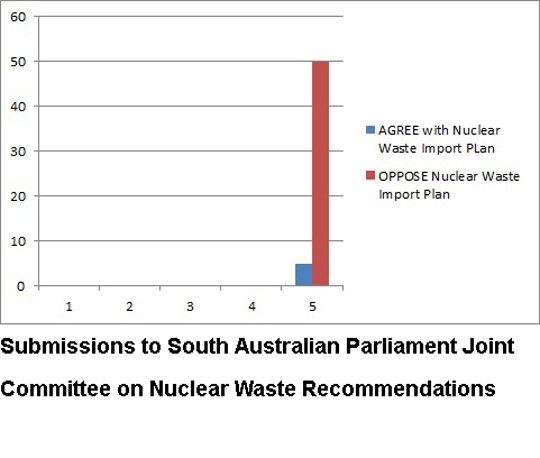
Submissions to South Australia Parliament are overwhelmingly opposed to nuclear waste importing
South Australian Parliament’s Joint Committee on Findings of the Nuclear Fuel Cycle Royal Commission.
This Parliamentary Inquiry is still going on. Transcripts of hearings and submissions can be read at
http://www.parliament.sa.gov.au/Committees/Pages/Committees.aspx?CTId=2&CId=333.
The opinions of those submitting to this Committee are overwhelmingly opposed to the nuclear waste import plan.
However,the Committee itself is hardly neutral:
- Hon Tom Kenyon MP Labor’s “ true believer in SA’s nuclear potential”
- Mrs Annabel Digance MP – Labor party. well, we all know how Labor MPs toe the party line, no matter what the evidence.
- Hon Dennis Hood MLC, of Family First a party that is more interested in matters of personal sexuality, than in wider causes. However, Mr Hood has made his own views clear, in saying ” The stars are aligning for our nuclear future“
- Mr Dan van Holst Pellekaan MP Liberal Local Member for Stuart Dan van Holst. Pellekaan said “all options for the future of the town must be explored and if it can be proven to be done safely, then there would be significant benefits for the community“.
- The Greens’ Mark Parnell will be putting a strong case for opposing the nuclear waste import plan.
Nuclear waste forum in Port Pirie got a negative response from indigenous community
 Speakers in Pirie raise doubts about nuclear dump http://www.portpirierecorder.com.au/story/4087477/negative-vibes-at-nuclear-forum/ Greg Mayfield 10 Aug 2016, Speakers at an indigenous forum in Port Pirie questioned the merits of proposals for a nuclear waste dump in South Australia.
The forum was hosted by Jason Downs, of the Consultation and Response Agency set up after the Nuclear Fuel Cycle Royal Commission. It was aimed at gathering informal views from the Aboriginal community on the findings of the commission.
Gregory Waldon, of Wirrabara, said radioactive contamination on the leg of a fly could be a “problem dose” amid the scenario of handling nuclear waste. He said the issue of “risk” should be reserved for the casino. Only about $230 for each resident of South Australia would flow, he said, from development instead of an original estimate of $3300, once the Commonwealth became involved.
“It is not our waste. We should not be taking any risk,” he said.
Enice Marsh, 73, of Gladstone, is an Adnyamathanha indigenous woman who was once a coal-miner at Leigh Creek. Mrs Marsh said she was on Adnyamathanha land and was the only person from this group here at the gathering. “There are lots of Adnyamathanha people living here in Port Pirie and the area,” she said.
“I really got very little notice about this gathering. It is my duty to come here to represent my country.
“We have two uranium mines on our land – Beverley and Honeymoon. “It doesn’t matter whether it is low, intermediate or high-level waste, we are saying ‘no’ from day one.”
Neville Reid, who works in Port Pirie, said that if he were not logged into the “no nuclear” website, he would not have known about the event. He queried why there were only 10 country people on the Citizens’ Jury looking at the nuclear issue when the dump was “going to be in a country area”.
He warned that steel and concrete doors on repositories would “rot away”, leading to “another site then another site” being used during the long radioactive life of the waste.
Leader for engagement with the agency Mr Downs said a private research company had been engaged to report to the next Citizens’ Jury in October followed by a report to Premier Jay Weathefill who would “make decisions” in November based on feedback.
Quite secretively organised, the plan for a federal nuclear waste dump at Hawker, Flinders Ranges, South Australia
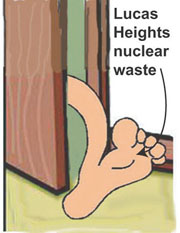 https://www.facebook.com/groups/941313402573199/ This secrecy is outrageous. It would not happen in America. The whole bs about “medical wastes” is one big cover-up for the transport of a tiny amount of intermediate to high level nuclear wastes returning from France. The plan is to continue to take in such returning nuclear wastes, so that Lucas Hieights’ reactor can continue to produce them. After that, how convenient for the global nuclear lobby, if South Australia is already taking in ‘Australian’ high level wastes. What a lovely precedent for the global nuclear waste import plan.
Australia’s Secret Shipment of Radioactive Nuclear Waste Arrives !
This will be the tick the box and no-one is concerned b.s.
Gavin Smith Joy Engelman It is a national project and we should all be given a fair go . It is not in the Council Region but Outback Lands . My blood is near boiling point about this.
Nick Xenophon – only a referendum is adequate to resolve South Australia’s nuclear waste decision
 South Australian Premier Jay Weatherill says a final decision on a nuclear waste dump is still years away. SBS World News, AAP 29 JUL 2016
The state government on Friday launched a three-month community consultation program on the recommendations rising from a Royal Commission into the Nuclear Fuel Cycle…….Mr Weatherill says whatever the outcome of that process, a final decision on the dump is still some way off, and will be proceeded by a series of “gated decisions” to move ahead cautiously…….
But South Australian independent Senator Nick Xenophon said only a referendum of all South Australian voters would be adequate for such a momentous decision.
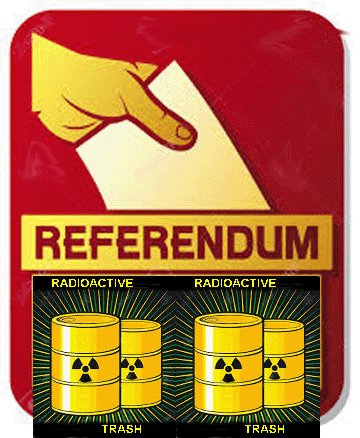
“Because once we have a nuclear dump, that’s it. We will be known as the nuclear dump capital of the world,” he said.
South Australian Greens MP Mark Parnell also criticised the consultation process which he said had ignored the history of failures, cost overruns and risks associated with waste storage.
“The government says it wants South Australians to have the facts, but it has chosen just some of the facts to present,” he said. http://www.sbs.com.au/news/article/2016/07/29/sa-dump-decision-years-away-says-premier
Nuclear Weathervane Weatherill wavers on his anti – referendum stance
 SA nuclear waste dump referendum vote still possible, Premier Jay Weatherill says http://www.abc.net.au/news/2016-07-28/referendum-on-sa-nuclear-waste-dump-still-possible/7668412 By political reporter Nick Harmsen The South Australian Government may not be in a position to make a final decision on whether to pursue an international high-level nuclear waste dump this year, Premier Jay Weatherill has said.
The Premier has previously said the Government’s plans to make a decision clear to parliament in November.
But Mr Weatherill today told a budget estimates committee any decision this year was likely to be just the first step. “I’d like to be in a position to make a decision about whether we’re able to pass the first threshold,” he said.
“And there is an important go/no-go threshold that needs to be considered by the parliament.”
The Government has assembled a series of citizens’ juries to help inform its decision.
Mr Weatherill told the committee he would not rule out holding a referendum on the nuclear issue.
But he said a referendum would not provide the level of nuance required. “In particular, some green groups are calling for a referendum,” he said.
“Of course they’re the same green groups that don’t want a referendum on gay marriage. But leaving aside that little internal inconsistency for the moment, I think I [a referendum] tends to close down debate rather than allow it to be developed.”
South Australian Greens prevented law that would give full rein to taxpayer funded nuclear promotion
 Nuclear waste dump ‘spruiking’ with taxpayers’ money stopped by Greens http://www.abc.net.au/news/2016-04-14/nuclear-waste-dump-‘spruiking’-with-taxpayers’-money-stopped/7325076 14 Apr 2016 An attempt to change the law in South Australia to allow public money to be spent on promoting a nuclear waste dump has been stopped with the Greens claiming a victory.
A law passed in 2000 to stop public funds from being used in any activity associated with a nuclear waste facility.
The State Government had tried to amend the law to allow consultation with the community on the results of the Nuclear Fuel Cycle Royal Commission. Greens MLC Mark Parnell said the proposed change was too wide ranging and the Upper House had stepped in to protect taxpayers.
“The Greens do accept that we do need to have a public debate,” he said.”We’re confident we know what the result will be but nevertheless the Government says they only want to consult, they don’t want to spruik and they don’t want to plan for a nuclear waste dump.”
He said the Government had attempted to “overreach”.”The law now says that the Government can use public money to consult the community but they’re not to use public money for promoting or designing or even buying land for a nuclear waste dump.”
South Australia is targeted for five nuclear dumps and high level waste processing
 SA is targeted for five nuclear dumps and high level waste processing
Brief by David Noonan, Independent Environment Campaigner
The Nuclear Royal Commission recommended SA pursue nuclear waste storage and disposal “as soon as possible” – requiring five waste dumps and a high level nuclear waste encapsulation processing facility.
The Final Report Ch.5 “nuclear waste” and the Findings Report (p.16-20) are reliant on a consultancy “Radioactive waste storage and disposal facilities in SA” by Jacobs MCM, summarised in Appendix J.
SA is targeted for above ground high level nuclear waste storage, without a capacity to dispose of wastes, exposing our society to the risk of profound adverse impacts, potential terrorism and ongoing liabilities.
The State government is in denial on the importance of nuclear waste dump siting by claiming social consent could be granted before we know what’s involved in siting up to five nuclear dumps across SA.
Affected regions and waste transport routes are fundamental pre-requisites to transparency and to an informed public debate on potential consent to take any further steps in this nuclear waste agenda.
First: a dedicated new deep sea Nuclear port is to receive waste ships every 24 to 30 days for decades, to store high level waste on site following each shipment, and to operate for up to 70 years.
The coastal region south of Whyalla and north of Tumby Bay is the likely location for this Nuclear port.
South Australia is targeted for a globally unprecedented scale of high level nuclear waste shipments. Some 400 waste shipments totalling 90 000 tonnes of high level waste and requiring 9 000 transport casks are to be brought into SA in the first 30 year period of proposed Nuclear port operations.
This is in excess of the global total of 80 000 tonnes of high level nuclear waste shipped around the world in the 45 year period from 1971 to 2015, according to the World Nuclear Association report “Transport of Radioactive Materials” (Sept 2015) and the Jacobs MCM consultancy (Feb 2016, p.152).
Second: an above ground nuclear waste Storage facility is to take on approx. 50 000 tonnes high level waste before a Disposal facility could first start to operate in Project Year 28 (Jacobs p.5 Fig.3).
SA is proposed to import high level waste at 3 000 tonnes a year, twice the claimed rate of waste disposal (Jacobs p.114), with storage to increase to 70 000 tonnes. The Store is to operate for up to 100 years.
The Nuclear Commission budgeted to locate the waste Storage facility 5 to 10 km from the Nuclear port.
The Nuclear port and above ground waste Storage facility are to be approved in Project Year 5, ahead of pre-commitment contracts for 15 500 tonnes high level waste in Year 6 and waste imports in Year 11.
South Australia needs to know the proposed region for siting the Nuclear port AND whether the nuclear waste Store is to be adjacent to the port (likely on Eyre Peninsula) or sited in the north of SA.
Third: a Low Level Waste Repository for burial of radioactive wastes derived from all operations including final decommissioning of all nuclear facilities is proposed to be located in north SA. This Repository has a nominal waste burial capacity of 80 000 m3 of radioactive wastes (Jacobs p.144). This is some eight times the total scale of the proposed National Radioactive Waste Repository.
Questions about Senator Sean Edwards’ nuclear waste proposal
 Nuclear Fuel Cycle Watch, Andrew Allison July 21 Rumour has it that once of the anonymous countries that Sean Edwards will not name is South Korea. One might speculate about where the money for Sean Edwards’ very glossy submission to the NFCRC came from? ….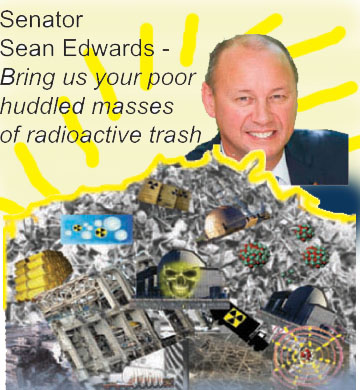
I have many reservations about Sean Edwards’ proposal, but two obvious questions come to mind:
1/ If the deep-underground storage of nuclear waste is a “solved” problem and South Australia can supposedly acquire and implement the technology at low cost (leading to high profits…) then why can’t South Korea do that?
2/ If the generation IV reactors are going to solve the waste storage problem then why can’t an advanced technological country like South Korea do that? https://www.facebook.com/groups/1021186047913052/
1 This month

of the week – Australians for War Powers Reform (AWPR)
To see nuclear-related stories in greater depth and intensity
 Antinuclear