Community struggle against government plans for nuclear waste dump
The Government should scrap these sites, admit they got it wrong, and then apologise to the people this has affected. They should then start a responsible and correct process to decide what to do with the waste- not just pushing it on regional and rural communities with promises of financial gain. They need to find out a way to stop making more nuclear waste and research what we can do or use instead.
We’re under a nuclear cloud but we’re not backing down, Beyond Nuclear March 11,  2016/ By Robyn Rayner. Farmers contend regularly with fire, flood and drought, but fine wool producer Robyn Rayner never expected to be fighting off plans for a radioactive waste dump across the road from her property
How would you feel if you woke up one morning and was told via a media report that you could be living next door to a nuclear waste dump?
On November 13 last year the Federal Government announced a shortlist of six sites, from twenty eight volunteered properties around Australia, for a proposed national radioactive waste dump. A property at Hill End was named. Since then our lives have been turned upside down. My husband Geoff and I, along with our family, own and run Pomanara Merino Stud directly across the road from the proposed site. It is just 1.5km from our family home. We are second-generation woolgrowers and our son James would like to be the third. This may not be important to Government Departments, but it is to us. This nuclear waste will also be around for generations to come, wherever they put it.
We have worked long and hard to achieve the clean, green and sustainable label that we have today. Our region is renown for growing the best superfine wool in the world and we have won many major awards for the sheep we breed. At no time did the landowner who nominated his property consult with neighbours, nor did he take into consideration the environment or the village of Hill End, located nine kilometres away. Hill End is a historic precinct that host 5000 school children a year and over 100 000 other visitors. The nominated property backs onto the Turon River, a major waterway for the food bowl of Australia. Continue reading
Oman Ama community group to Canberra to reject nuclear waste dump plan
 Qld group rejects nuclear dump plan Brisbane [AAP], EchoNet 1 Mar 16 Representatives from a tiny Queensland town have travelled to Canberra to voice concerns about being on a shortlist for nuclear waste dump sites.
Oman Ama, west of Warwick, was in November named as one of six potential dump sites identified by the federal government, which began a four-month consultation period…….
Members of the group Friends of Oman Ama will meet with two of Mr Frydenberg’s advisors on Tuesday, believing their questions about the process have not been adequately answered. ‘There’s some real damage happening – in family, friends, there’s division in the community’, spokesman Mark Russell told AAP.
‘The degree of harm and hurt is only going to be exacerbated as this process goes on.’ Mr Russell said the government was yet to clarify how it would measure “community acceptance”.‘We have no way of identifying where the goalposts are,’ he said.
‘It’s a very murky area, but it’s a key part of the process – because (the minister) is pinning his approach on this to the consultation factor.’
Oman Ama is a potential site because one land holder expressed an interest to an offer of “four times” the retail value of his property, Mr Russell said. He said residents were not concerned about the owner’s decision, but the way in which the government had begun the process based on one landowner’s interest.
Other property owners were worried about the financial impact and had spoken to bank managers, real estate agents and insurance brokers, Mr Russell added.
‘They have been told if you get a radioactive waste management facility in your area, your land values are most likely to depreciate’, he said……http://www.echo.net.au/2016/03/qld-group-rejects-nuclear-dump-plan/
Communities fight Turnbull government nuclear waste dump plan
Aboriginal woman Regina Mackenzie said the proposed Barndioota site in the Flinders Ranges threatened important cultural heritage sites. “There was no consultation whatsoever … we just feel it’s an attack on our belief system,” she said.
Greens nuclear spokesman senator Scott Ludlam said communities were told the dump would not be built if locals largely objected. “There’s strong opposition in all six communities [and] the government needs to abandon this idea,” he said.
 Nuclear waste dump: Sleepless nights, tears and stress as communities fight Turnbull government plan, SMH March 1, 2016 – Nicole Hasham Environment and immigration correspondent When Peter Woolford’s son died in a motorbike accident 12 years ago, the rural community of Kimba united to help the farmer and his wife through their personal cataclysm.
But that was then. Now, old friends in the community no longer speak, and people on the streets of the South Australian town are afraid to talk about the issue that has driven a wedge between neighbours: a proposed nuclear waste dump.
Cortlinye, near Kimba, is one of six sites across Australia the federal government has shortlisted to host the nation’s first permanent nuclear dump for low-level and intermediate waste.
The others are at Sallys Flat near Hill End in NSW, Hale in the Northern Territory, Pinkawillinie and Barndioota in South Australia and Oman Ama in Queensland.
If sites are approved, landowners who volunteered their property would receive up to four times the value of their land, and the community would receive about $10 million for infrastructure or services.
But this fight is “not about money”, said Mr Woolford, who was in Canberra on Tuesday with waste dump opponents from the other five communities to voice their concern. They say Resources Minister Josh Frydenberg refused to meet them, however they met other senior officials. Continue reading
Will the Australian govt impose a Lucas Heights nuclear waste dump on a South Australian community?
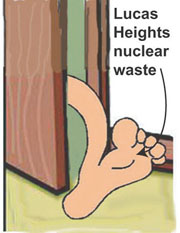 We will soon see how much in a rush the government is with the issue. Will it try to find a site by any means, even if this implies imposing it on a community or will it take its commitment not to do so seriously and maybe take the steps necessary to find a long-lived solution to a long-lived problem?
| By Anica Niepraschk , 29 February 2016 The federal government – once again – is looking for a place to dump its nuclear waste. All attempts over the last twenty years have failed – and so might this one, at least if the government is sticking to the promises it made in its new approach.The process is to be voluntary and no dump is to be located anywhere without community consent. These are the words at least. 28 sites across Australia had been nominated by landowners last year and were reduced to a shortlist of six by the Department for Resources.
The six sites are in Hale (NT), not far from Alice Springs, Hill End in NSW, Oman Ama in Queensland and three sites in South Australia: two in the Kimba region (Cortlinye and Pinkawillinie) and Wallerbidina/ Barndioota, outside Hawker. The South Australian shortlisted sites also get increasingly entangled in a debate as to whether the state might offer itself up as the world’s nuclear waste dump, accepting high-level nuclear waste from power reactors around the world. This was the key prospect outlined in the tentative findings of the Royal Commission into the Nuclear Fuel Cycle, released last week. All six sites are so far highly contested by the local communities, Continue reading |
South Australia a great State not a Waste State – communities visit Federal Parliament

 Flinders Ranges and Kimba residents voicing nuclear concerns to Federal Parliament http://www.transcontinental.com.au/story/3753842/local-voice-on-nuclear-goes-national/?cs=1538 28 Feb 16
FLINDERS Ranges and Kimba representatives will travel to Parliament House in Canberra next week, with delegates from three other sites across Australia targeted for a national radioactive waste dump joining them.
South Australia has three nominated sites – two at Kimba and one just north of Hawker in the Flinders Ranges. The visit comes a week before the closure of public comment on the National Radioactive Waste Management Project on March 11.
Meetings have been requested with the key decision maker federal Resources Minister Josh Frydenberg and other ministers to discuss community concerns ahead of the submission deadline.
Toni Scott and her family neighbour in Kimba a part of a group of locals within affected areas.She has been in regular contact and feels taking their message directly to Canberra will be an important way to step up campaigning efforts to ensure community concerns are recognised and reflected. “We are going to Canberra because our concerns must be heard,” Ms Scott said.
“Communities deserve to be treated better than what this process has delivered thus far and we want to get our message across face to face.”
Regina McKenzie has regularly spoken against the planned proposal near Hawker.“Its important that we get the message through to the government – no means no,” Ms McKenzie said.”We don’t want to live next to a radioactive waste dump. “SA is a great state not a waste state.”
Adelaide Advertiser poll – nearly all supporters of nuclear waste import had vested interests!
 Dennis Matthews, It was heartening to see that in a survey stacked with vested interests (The Advertiser, 23/2/16), of those who had no apparent vested financial or professional interest only two people supported the importation of high-level nuclear waste into South Australia and one of those had imprecise information about Finland.
Stacking inquiries and surveys is a trade mark of the nuclear lobby.
I look forward to the day when we can trust the business community, media and politicians to be honest with the people of South Australia and to stop treating us as like idiots.
Naively, I thought this would have happened after the State Bank fiasco in 1991. Consecutive South Australian Premiers have clearly demonstrated that they have learnt nothing from past indiscretions.
It is now up to ordinary South Australians to keep South Australia free from exploitation by vested interests and incompetent politicians.
Aboriginal landowners shocked at plan for nuclear waste dump close to sacred site
 Traditional owners in the Flinders Ranges say nuclear waste dump threatens cultural heritage ABC NORTH AND WEST MICHAEL DULANEY Traditional owners in the Flinders Ranges say a Federal Government nuclear waste dump could destroy significant cultural heritage and countless sacred sites around a permanent spring. The lush vegetation and birdlife along Hookina Creek, 30 kilometres north of Hawker in South Australia, stands out even among the imposing space and scale of the central Flinders Ranges. Its permanent waters are fed by aquifers that bubble up to feed ‘an oasis’ of reeds and large eucalypts bursting from the dry heat and dust of the pastoral landscape.
It is an area integral to the lives of the Adnyamathanha people for generations and whose presence has left a rich cultural and archaeological record along the creek.
These waters are also just a few kilometres from Wallerberdina, a cattle station near Barndioota partly-owned by former Liberal senator Grant Chapman.
It is also one of six sites nominated to host Australia’s first nuclear waste dump.The Adnyamathanha people, who manage the Yappala Indigenous Protected Area which shares a boundary with Barndioota, said they were “shocked” by the prospect of storing Australia’s low and intermediate level nuclear waste so close to a significant cultural site.
Traditional owner Regina McKenzie said the facility would jeopardise their links to a place important for the present — a place where her children have learnt to swim and the family comes to camp — as well as the past, as seen in the tools, paintings and storylines that mark the area.
“The emotional stress we’re feeling is off the charts,” Ms McKenzie said. “We’re still the custodians here; we’ve always looked at it that way.”
The Adnyamathanha people are also worried about the risk from large floods known to hit the area, and elder Enice Marsh pointed out damage around the creek caused by the last flood a decade ago.
Ms Marsh said she feared the loss of her people’s heritage in the region if rising flood waters mixed with radioactive waste. “If we’re going to have that poison stuff here, even if it’s a low-level situation, it’s just absolute madness to put something like this near somewhere that’s so special,” she said.
“It’s everything; it’s a type of importance that you would never be able to describe. “The connection to this land for Adnyamathanha people is their culture, their customs; it’s their identity.”…….
With a final decision from the Government due by the end of the year, Ms McKenzie said the Adnyamathanha people would continue to oppose the expansion of the nuclear industry into their traditional lands.
“We’re feeling as though we’re being forced to do something we don’t want to do,” she said. http://www.abc.net.au/news/2016-02-24/traditional-owners-flinders-ranges-fears-on-nuclear-waste-dump/7195030
National Radioactive Waste Management Act overrides any local opposition to nuclear waste dump
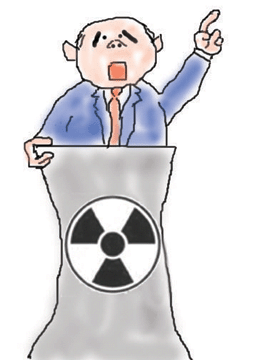 Overriding opposition, Jim Green 21 Feb 16 Bruce Wilson said it would be unlikely that the federal government would override state/territory government opposition to a repository. But that’s exactly what the federal government did the first time round (1998– 2004). And that’s exactly what the federal government did in the NT (2005– 2014). As Wilson acknowledged, the government retains the power to override state/territory governments in order to impose a radioactive waste repository/store. The government should amend the legislation so it no longer has that power.
Wilson said the National Radioactive Waste Management Act is consent-driven ‘world’s best practice’ legislation. In fact, it gives the federal government extraordinary powers to override state/territory governments, councils, communities, Traditional Owners and anyone else.
A government rep said the government gave up on the Muckaty / NT site when it realised that community support was lacking. That’s false. The government knew that a majority of Traditional Owners opposed the proposed repository/store in 2006/07 but only gave up in 2014.
Kimba residents are all too aware of the distress and division that the radioactive waste issue has created in the past six months. Muckaty Traditional Owners endured the same problems for the best part of a decade. “We’ll probably have one of the first good sleeps we’ve had in eight years,” Marlene Bennett said when the government finally stopped its thuggish attempt to impose a radioactive waste repository on an unwilling community.
Julie Bishop, Christopher Pyne, Bill Shorten do their bit for the pro nuclear dance

Opposition Leader Bill Shorten has indicated he is open to the idea as long as there is community support, an economic benefit, and reassurance of environmental protection….
Overall Ms Bishop is optimistic that public opinion is in favour of more engagement with the nuclear fuel cycle………http://www.adelaidenow.com.au/news/south-australia/australia-the-ideal-location-for-nuclear-waste-dump-says-julie-bishop/news-story/c2655249dd4f655d05bf809d6d1795c8
Nuclear waste dump plan for Kimba – govt ignores relevant standards and codes
 Jim Green 21 Feb 16 Some comments on the 18 Feb 2016 government ‘information session’ in Kimba regarding plans for a radioactive waste repository and above-ground ‘interim’ store for long-lived intermediate-level waste.
 1. The government ignores and breaches relevant standards and codes when it suits.
As a Kimba resident noted at the meeting, the National Health and Medical Research Council’s (NH&MRC) ‘Code of Practice for Near-Surface Disposal of Radioactive Waste in Australia (1992)’ states that “the site for the facility should be located in a region which has no known significant natural resources, including potentially valuable mineral deposits, and which has little or no potential for agriculture or outdoor recreational use”.
So the government has breached the NH&MRC Code of Practice by short-listing the Kimba sites.
Following the so-called clean-up of the Maralinga nuclear test site in the late 1990s, nuclear engineer Alan Parkinson wrote: “The Department has claimed that burial is a safe disposal method consistent with “the [NH&MRC] Code.” This was the first time that the Code had been mentioned in relation to the Maralinga project. When three of the five authors said that it was not applicable (the other two were Commonwealth public servants and would not comment), the Department claimed that it did not have to follow the Code but had chosen to do so. It made this statement despite the fact that not a single requirement of that Code was satisfied.”
(Alan Parkinson, “The Maralinga Rehabilitation Project: Final Report”,
http://www.ippnw.org/pdf/mgs/7-2-parkinson.pdf)
So the government ignores relevant standards and codes when it suits, and the government breaches relevant standards and codes when it suits. Why would anyone trust the government to safely operate a radioactive waste facility in the Kimba region in those circumstances?
Alan Parkinson summarises the problem (keep in mind that he is pro-nuclear and a nuclear engineer): “The disposal of radioactive waste in Australia is ill-considered and irresponsible. Whether it is short-lived waste from Commonwealth facilities, long-lived plutonium waste from an atomic bomb test site on Aboriginal land, or reactor waste from Lucas Heights. The government applies double standards to suit its own agenda; there is no consistency, and little evidence of logic.”
(Alan Parkinson, 2002, ‘Double standards with radioactive waste’, Australasian Science, www.foe.org.au/anti-nuclear/issues/oz/britbombs/clean-up)
Nuclear Semioticians (sign experts): how to warn future generations of the wastes danger
they established the field of nuclear semiotics……. an “atomic priesthood”
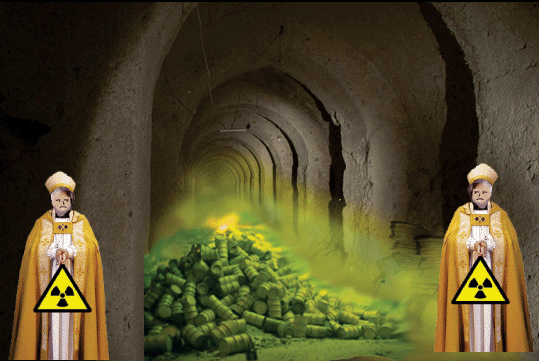
The message walls would have the faces as well as simple messages
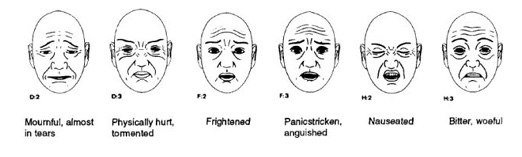
Temple of Doom: How do we warn the future about nuclear waste?, Triple J Hack, by James Purtill, 19 Feb 16 This week the South Australian Royal Commission released “tentative findings” recommending the state take more than 100 tonnes of high-level radioactive waste and store it in the desert for hundreds of thousands of years.
……..If the facility goes ahead, the designers may consider a problem that has baffled linguists and semioticians (sign experts): how to tell the distant future don’t dig up the dump?
Atomic priesthoods and ‘ray cats’
In 1991, the Department of Environment hired linguists, scientists and anthropologists at a cost of about $1 million to answer what is basically a conundrum of labelling. How do you warn far-off civilisations or scattered bands of post-apocalyptic survivors that invisible beams of energy emanating from the earth could kill them, and this was not a trick, there’s no buried treasure?
The report runs to 351 pages and has the (rather dry) title: Expert Judgement on Markers to Deter Inadvertent Human Intrusion into the Wasteland Isolation Pilot Plant.
Here’s some of the problems they identified:
- Languages evolve too fast to communicate with the future: Few English speakers understand Old English, which was spoken about 1000 years ago.
- The meanings of symbols is too ambiguous: For example, the physicist Carl Sagan was invited to join the researchers, couldn’t make it, and wrote to suggest they simply use the skull-and-crossbones symbol to signify danger. But this symbol has only been current for a few hundred years, has meant ‘poison’ for the last 100, and is no longer very threatening. It’s on ‘pirate theme’ drink bottles.
- Even if they understand the warnings, future trespassers might not believe them. Curses associated with the burial sites of the Egyptian Pharaohs did not deter grave robbers.
Nuclear waste dump for South Australia: an unacceptably bad option
The endeavours of our scientists and engineers are needed in dealing with the many facets of climate challenge, including the transition to renewable energy, and they should be focused on this.
 Nuclear waste dump just another bad option — what about renewable energy? http://www.adelaidenow.com.au/news/opinion/nuclear-waste-dump-just-another-bad-option–what-about-renewable-energy/news-story/92f494cdde1dcae41481a45e5ac4f4ac February 18, 2016 John Willoughby The Advertiser SOUTH Australia’s Nuclear Fuel Cycle Royal Commission, in its tentative findings, has recommended avoiding some bad options: no nuclear power generation and no reprocessing or fuel leasing in the foreseeable future.
However, a bad option it found acceptable is allowing a proportion of the world’s most dangerous high-level nuclear waste to be transported to SA for long-term disposal. Continue reading
Proposal for nuclear waste dump splits South Australian Kimba community
Support for proposed nuclear storage facility at Kimba difficult to determine
ABC Rural 18 Feb 16 The South Australian town of Kimba is divided over the benefits or otherwise of a low level nuclear storage facility in the area.
The Federal Government has released a shortlist of six sites nominated to store low-to-intermediate nuclear waste, with three of them located in South Australia.
The three South Australian sites are Cortlinye and Pinkawillinie near Kimba on the Eyre Peninsula, and Barndioota near Hawker, north of Port Augusta.
The prospect of Kimba region being selected has caused deep divisions in the community of Kimba.
The ABC has been told some people are boycotting local businesses in town due to their opposing views  on the issue but the Federal Member for Grey,Rowan Ramsey believes as the debate continues more people are coming around to the idea.
“That’s very concerning, I had not anticipated that people would go to those lengths. All I have ever wanted was a calm rational debate,” Mr Ramsey said…….
Mr Ramsey has been a key player in the debate even offering up his own property as a possible site to host the facility before it was deemed a conflict of interest……
Andrew Baldock and his father Graeme nominated 100 hectares of cropping country at Cortlynie outside Kimba to host the nuclear site……
Melanie Woolford who runs Merinos and prime lambs with her husband, kilometres from the proposed site at Pinkawilinie does not share that view. Ms Woolford is concerned the risk of jeopardising the regions clean, green image does not justify the proposed benefits of having a nuclear waste facility in the region.
“It scares me to think what could happen to our kids or our grandchildren, I think we have a right to say no. “It’s good farming land and I don’t understand why you’d want to put it (a nuclear storage facility) in the middle of farming land,” Ms Woolford said.
“I’ve been here for 13 years and I don’t enjoy coming to Kimba anymore, it’s horrible.” http://www.abc.net.au/news/2016-02-18/nuclear-dump-support-at-kimba-diifficult-to-determine/7181410
Aboriginal Elders accuse authorities of paying lip service only to traditional owners objection to nuclear waste dumping
Aboriginal elders on Tuesday accused authorities of paying lip service to traditional owners’ fears that waste could be dumped in the outback.
 Australian Nuclear Free Alliance co-chair and Kokatha-Mula woman Sue Coleman-Haseldine says the proposal threatens her people’s spiritual health.
“We can’t survive in this world without our culture and the land is the main part of that. We’ve got sacred sites, we’ve got Dreamtime stories out there,” she told AAP on Tuesday.
“We don’t seem to be able to get this through the government’s heads, the people’s heads. All they see is the dollar signs.” 9 News Feb 16
South Australian nuclear waste import plan simply cannot succeed
Given the wildly optimistic price for waste modelled by the mid-scenario, not to mention the 56,000 tonnes of waste left over with no costed solution, and with all the uncertainties in developing the new technologies required, the simple conclusion is that this plan is simply all risk with no reward.
No-one else will line up to take advantage of this “once in a lifetime opportunity”, because the opportunity does not exist. The plan simply cannot succeed.
The impossible dream Free electricity sounds too good to be true. It is. A plan to produce free electricity for South Australia by embracing nuclear waste sounds like a wonderful idea. But it won’t work. THE AUSTRALIA INSTITUTE Dan Gilchrist February 2016
“……NO GOOD OUTCOME The free energy utopia depends on two new, as yet unproven technologies: PRISM reactors, and cheap borehole disposal. The Edwards plan appears to rely on these technologies not only being successfully developed, but remaining entirely in Australian hands. Competition is certainly not addressed in the plan.
1 This month

of the week – Australians for War Powers Reform (AWPR)
To see nuclear-related stories in greater depth and intensity
 Antinuclear