National waste dump is NOT NEEDED for medical nuclear wastes
 Is Australia becoming the world’s nuclear waste dump by stealth? http://www.smh.com.au/comment/is-australia-becoming-the-worlds-nuclear-waste-dump-by-stealth-20151122-gl4v04.html December 2, 2015 -Dr Margaret Beavis
When it comes to justifying new nuclear waste storage, a lot has been said about it being essential for medical diagnostics and cancer treatment. This is misleading. It blurs two distinct components of nuclear medicine – the production of isotopes and the use of isotopes.
Australia’s medical use of isotopes creates very little waste. In contrast, reactor production of isotopes generates considerable amounts, and ANSTO (the Australian national nuclear research and development organisation) is very quietly proposing to dramatically increase production to supply 30 per cent of the world market. This will significantly increase Australia’s nuclear waste problems.
On the “use” side, the vast majority of isotopes used for medical tests are very short-lived. They decay on the medical facilities’ premises until their radioactivity is negligible. They can then be disposed of in the normal waste stream (sewers, landfill etc) according to set standards. There is no need for a new nuclear waste facility for these isotopes. Most cancer radiotherapy uses X-rays, which does not produce any waste at all. A very small proportion of cancer treatments need radioactive materials, which also are too short-lived to require a remote repository, or are legally required to be sent back to the (overseas) supplier once used up. There is a very small amount of legacy radium relating to cancer therapy in the past, however, this has not been used in Australia since 1975.
On the other hand, using a nuclear reactor to manufacture radio isotopes creates a significant amount of intermediate and low-level waste. ANSTO has recently unilaterally decided it will dramatically increase its production of medical isotopes at the Lucas Heights reactor to supply 30 per cent of the world’s needs. This business decision assumes it will not have to pay for the disposal of the waste produced, even though it will need securing for many thousands of years.
This decision ignores the reality of technology that enables isotopes to now be produced using accelerators and cyclotrons; i.e. without using a reactor and without generating large quantities of radioactive waste. This is fast approaching commercial scale and economic viability. ANSTO’s decision contrasts with that of the Canadian nuclear authorities, who have for some years been actively phasing out reactor production, and pouring money into developing non-reactor technologies.
Canada, the world’s single largest producer of medical isotopes, independently reviewed its nuclear industry in 2009 and decided not to build a new reactor. Several reasons stood out: investment in reactor production of medical isotopes would crowd out investment in innovative alternative production technologies both domestically and internationally, Canada did not want to continue being the radioactive waste site for other countries’ nuclear medicine industries, it created supply vulnerabilities, and at no stage was it commercially viable without massive taxpayer subsidies.
The ANSTO decision represents vested interests entrenching a reactor-based model and crowding out development of other options. In many ways it is like the coal industry boosting production to stop wind and solar development. Like coal, the business model relies on not being responsible (financially or socially) for the waste it leaves behind.
We urgently need an open conversation about whether we want to pick up the world’s waste tab when it comes to producing medical isotopes. This is a policy choice that will leave Australia storing waste from isotopes produced for international markets. The market price for these isotopes does not factor in the price of storing this waste, which falls to the taxpayer and the community unlucky enough to be landed with it. It is taking Australia down a path that Canada has rejected.
The bottom line is that storage of nuclear waste from reactors is difficult, requiring long-term isolation and security.
We need transparent, informed and clear discussion of what our choices are. We have an obligation to future generations to minimise the waste we produce. There needs to be a considered and open debate about where existing waste is most safely stored in Australia. And it needs to be absolutely clear to ANSTO that we do not want to be left holding the world’s radioactive waste by default.
The Australian community is far from convinced about taking on more radioactive material on behalf of the international community. ANSTO needs to be much more explicit about what it is planning. As a government-owned entity it has a responsibility to be upfront and consult with the community.
When it comes to such long-term decisions about radioactive materials, sleight of hand is not good enough.
Margaret Beavis is a GP and national president of the Medical Association for Prevention of War.
GREENPEACE FINDS NUCLEAR WASTE HEADED TO AUSTRALIA CLASSIFIED AS DANGEROUS HIGH-LEVEL WASTE BY FRANCE
The French Nuclear Safety Authority (ASN) has revealed to Greenpeace that the waste has been classified as high-level (long-life) waste according to standards set by ANDRA, the French national radioactive waste management agency. High-level waste is ANDRA’s most severe nuclear waste classification.
Areva documents have also confirmed that the waste still contains low quantities of plutonium.
The nuclear waste is due to be unloaded off the BBC Shanghai at Port Kembla in southernSydney in the early hours of Sunday, 6 December. It will then be transported to Lucas Heights by road for interim storage.
Sydney, 2 December 2015 – Nuclear waste returning to Australia this weekend by ship from France has been classified as high-level waste by French authorities, contradicting Australia’s claims over its radioactivity, a Greenpeace report has found.
Greenpeace’s investigation also found the waste still contains quantities of plutonium – highly toxic even in small quantities – despite reprocessing by French state-owned nuclear company, Areva.“The Australian government is downplaying the danger of this shipment, saying it is
intermediate-level waste that isn’t harmful unless mismanaged. But we know it contains plutonium and is classified as high-level waste by the French authorities,” said Emma Gibson, Greenpeace Australia Pacific’s Head of Programs. Continue reading

MP Kevin Humphries “doesn’t fully understand it” but wants nuclear waste dump in far West New South Wales
 “We’ve certainly got the space”: Far west MP pushing for uranium mining, waste storage, ABC News, Declan Gooch and Julie Clift , 1 Dec 15 The far west’s state MP says he wants to gauge community support for legalising uranium mining around Broken Hill as well as the storage of toxic waste in the region.
Kevin Humphries said uranium mining could be a significant employer in Broken Hill, especially as traditional mining activities wind down in the future.
Mr Humphries said the far west should also be considered as a potential site for the storage of waste material, which he said is proven to be safe……”I don’t fully understand it, but is it something that’s going to keep re-emerging?
There was community outrage in the state’s central west last month when the federal government proposed storing nuclear waste near the town of Hill End.
But Mr Humphries pointed to the long-term storage of toxic waste at Lucas Heights in Sydney as evidence that there were no dangers posed to the public……we need to consider all the options for places like Broken Hill and the far west, and I’m pretty keen to keep pushing that in 2016.” http://www.abc.net.au/news/2015-12-01/22we27ve-certainly-got-the-space223a-far-west-mp-pushing-fo/6989660
Yet another delay in radioactive cleanup of Sydney’s Hunter’s Hill
 Residents appalled as radioactive clean-up of Sydney street delayed another four years http://www.smh.com.au/nsw/residents-appalled-as-radioactive-cleanup-of-sydney-street-delayed-another-four-years-20151128-glaf1b.html Kirsty Needham State Politics Editor, The Sun-Herald
|
The clean-up of radioactive waste from a residential street in Hunters Hill has been delayed for another four years, as the cost has almost doubled. |
The Baird government was ordered by the Environment Protection Authority last November to submit a plan to remove toxic waste from six properties on Nelson Parade after a decade of delay and political paralysis.
The clean-up was to begin within 90 days of the plan being approved.
But Government Property NSW’s annual report has revealed the remediation work won’t be undertaken until 2016-17, and won’t be complete until 2018-19.
Remediation costs have blown out from $12.4 million to $22.5 million “mainly as a result of changes in the final waste disposal location”.
Philippa Clarke, of the Nelson Parade Action Group, said a delay until 2018 was “appalling”. Continue reading
Hosting nuclear waste – a liability in the long run, and a dangerous one
 Wasting Australia’s future, Green Left , November 20, 2015 By Jim Green“………Profits from nuclear waste?
It is no secret that the driving force behind the South Australian Nuclear Fuel Cycle Royal Commission is the idea that the state could make billions from storing or disposing of high-level nuclear waste from power reactors around the world.
Accepting nuclear waste might be profitable. Or it might not. Most likely, it would be profitable in the short-term and a liability in the long-term.
Proponents are talking up the billions that might be made by making Australia the world’s nuclear waste dump, but they have said little about costs. Since the volume of waste would presumably be large, the cost of a deep underground repository for high-level nuclear waste would likely be in the tens of billions of dollars. Plans for a high-level waste repository in Japan may be comparable: the estimated cost is ¥3500 billion (A$40.8 billion).
The US wasted $10 billion on the plan for a deep geological repository for nuclear waste at Yucca Mountain in Nevada before abandoning the project. In 2008 the US Department of Energy estimated that the cost of construction and operation of Yucca Mountain over a 150 year period would be US$96 billion (A$135 billion).
The waste would need to be monitored and problems addressed for millennia: it takes about 300,000 years for the radioactivity of spent nuclear fuel to fall to that of the original uranium ore. The annual cost of monitoring waste might be modest; the costs over millennia would be anything but.
Explosion in deep underground repository
The idea that nuclear waste can be safely disposed of in a deep underground repository has been shot to pieces by an explosion in the world’s only deep underground repository for nuclear waste: the Waste Isolation Pilot Plant (WIPP) in the US state of New Mexico. Continue reading
Civil Contractors Federation SA want to save town Leigh Creek by hosting nuclear dump
Call to store nuclear waste at Leigh Creek http://www.9news.com.au/national/2015/11/24/10/29/call-to-store-nuclear-waste-at-leigh-creek A nuclear waste dump should be built at Leigh Creek in the South Australian outback before it becomes a ghost town, the state’s peak civil construction body says.The federal government has short-listed six sites – two on the Eyre Peninsula and another in SA’s mid-north – for Australia’s first permanent nuclear waste dump for low-level and intermediate domestic waste.
The Civil Contractors Federation SA says putting a nuclear waste dump near Leigh Creek would be a “no brainer” and guarantee its survival after Alinta Energy last week shut down the town’s coal mine, shedding about 200 workers.
Chief executive Phil Sutherland says the facility could also be used to store and convert other industrial waste into energy and fuel.
The proposal bypasses the commonwealth in favour of the state government, which is holding a Nuclear Fuel Cycle Royal Commission.
“All the SA government needs to do is simply show some mettle and bite the bullet to give Leigh Creek a purpose before the township transitions into a ghost town,” Mr Sutherland said.
ANSTO, Geoscience, Dept of Science to visit Kimba, South Australian site on shortlist for nuclear trash dump
 Nuclear delegations to visit Kimba after release of toxic dump short list, ABC News 23 Nov 15 Two separate delegations are to visit Kimba on SA’s Eyre Peninsula, the tiny town shortlisted by the Federal Government to be the site of a nuclear waste dump.
Earlier this month the Government released a shortlist of six sites nominated to store low and intermediate level nuclear waste…….One delegation, including Geoscience Australia, the Australian Nuclear Science and Technology Organisation, and the Department of Science, will visit councillors and landowners who have nominated their properties.
Greens MP Mark Parnell will also tour the community which has been divided by the issue.
He said there was no need for a new dump because waste could be stored at existing sites.
“When it comes to nuclear waste we have a responsibility to manage it properly, and safely,” Mr Parnell said.
“The waste has been stored at Lucas Heights for many years and can be safely continue to be stored there. There’s waste that’s in hospital basements that’s got people worried, but they’re still going to have to operate.”
He said local residents had good reason to be alarmed, especially in light of an accident last year at a New Mexico waste facility.
“The operators put organic kitty litter into the drums of nuclear waste rather than inorganic kitty litter. As a result, the chemical reaction burst the drum open and radiation spread throughout the facility,” he said.
“There were 22 workers who were contaminated, and the facility is likely to be closed for four years.” http://www.abc.net.au/news/2015-11-23/nuclear-delegations-to-visit-kimba-after-dump-shortlisting/6962598
3 South Australian sites picked for nuclear trash toilet, but locals resist
The indigenous group Adnyamathanha Camp Law Mob says while the property is governed by a perpetual lease, meaning no native title claim can be lodged over the area, Aboriginal heritage legislation does apply.
“We demand that the Federal Resources Minister Josh Frydenberg publicly declare who he has consulted regarding these nominations, and who has the authority to nominate these sites,” spokeswoman Jillian Marsh said in a statement.
Cortlinye and Pinkawillinie KIMBA is known as “the Gateway to the Gawler Ranges”. But some residents fear the township would become known as “the Gateway to the National Nuclear Waste Facility” should it be selected as the future site to store radioactive waste. Local farmers Toni Scott, Sue Woolford, Helen Harris and their families have vowed to fight any move to build the facility in their district.
“They’re saying this is a voluntary process but how is this voluntary?,” Mrs Scott said.
“We’re not volunteering, we don’t want any money and we don’t want to live next to it.’’
The group vowed to be vocal during the Federal Government’s consultation in Kimba next week
Nuclear waste repository in SA: What do the locals think? The Advertiser, 22 Nov 2015 BRYAN LITTLELY, PAUL STARICK and MEAGAN DILLON PICKING a site for a nuclear dump is as contentious a decision as you will find. Whichever of the six Australia-wide candidates that is chosen to be the nation’s nuclear repository will acquire a degree of notoriety.
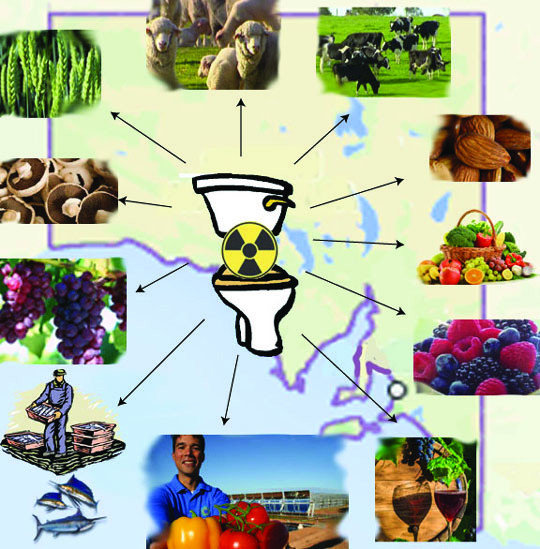
South Australia is home to three potential dump locations. Continue reading
Calare MP John Cobb blames local media for ‘sensationalism’ about nuclear waste dumping
Member for Calare John Cobb’s words to offer hope for Sallys Flat, Western Advocate, 22 Nov 15 Calare MP John Cobb has guaranteed no nuclear waste dump would be built in Sallys Flat if local residents remain “generally opposed” to it.
More than 100 residents turned out at a community meeting last Tuesday to voice their anger about Sallys Flat being shortlisted as one of six sites to potentially host the new permanent waste dump.
Mr Cobb also came under fire at that meeting for saying he was not concerned about the prospect of a nuclear waste dump being established at Sallys Flat and claiming the waste that would be dumped in the region was so benign “you could sleep on it”.
But in a written statement issued on Friday, Mr Cobb blamed the local media for “sensationalising” the issue and failing to tell the people of Sallys Flat there would be no nuclear waste dump in their backyard without their support……. http://www.westernadvocate.com.au/story/3509083/nuclear-reaction/
Ipswich, Queensland, at risk from nuclear waste,
 Ipswich at risk from nuclear waste, Queensland Times Joel Gould | 20th Nov
  2015 THE FIGHT is well and truly on to stop hundreds of trucks a year loaded with radioactive nuclear waste from moving through Ipswich towards a national repository near Inglewood.
A site at Oman Ama is one of six slated by the Federal Government to store nuclear waste which has been slammed as “an environmental disaster waiting to happen” by Cr Paul Tully, who is also the national secretary of the Australian Nuclear Free Zones Secretariat.
Cr Tully said the federal Energy Minister Josh Frydenberg was “putting major cities across southeast Queensland under threat with hundreds of trucks a year carrying dangerous radioactive waste across the region”.
Cr Tully, who called the plan “total lunacy”, said Ipswich did not want such dangerous material transiting through the city.
“It will be a national repository which means that radioactive waste from North Queensland as well as southern states of Australia will come into south Queensland,” he said.
“Anything coming up the Pacific Highway will go through Brisbane, Ipswich and Toowoomba and anything coming from North Queensland would as well.
“So it does hold concerns that hundreds of trucks a year could be coming through our area.”A lot of it would come up through central NSW of course if they do select this site, which is one of six in Australia that has been nominated for further investigation.
“But if a truck, semi-trailer or B-double laden with this material had an accident and caught fire or rolled into a creek or river bed, then that is an issue. Brisbane, Ipswich and Toowoomba residents will be concerned at this act of madness by the federal government.” Continue reading
National Party MP John Cobb happy to host radioactive trash – Merino farmers ARE NOT!
 On Friday, Member for Calare John Cobb said he was very relaxed about the
  proposal to consider Sallys Flat for the dump.
He said he felt the waste was so non-threatening that a person could put it in a bag and sleep on it without feeling any ill-effects.
Merino farmers at Sallys Flat fear nuclear dump next door, Western Advocate, 17 Nov 15 PRIME wool producers around Sallys Flat fear the potential establishment of a nuclear waste dump on a neighbouring property could put their livelihoods at risk.
Geoff and Robyn Rayner produce some of the best superfine fleece in the world at their Pomanara Merino Stud, close to a neighbouring property which has been shortlisted for a permanent radioactive waste dump.
The Rayners’ home is the closest residence to the site ……The Sallys Flat site has been offered to the Federal Government for use by the landowner.
The Rayners have just signed up to become a sustainable operation and said they had to meet stringent criteria. Now, with the prospect of nuclear waste on their doorstep, all that has been put at risk. “The stigma sticks,” Mr Rayner said. Three generations of the family have made their living from the land. Now they wonder if they will have a future. Continue reading
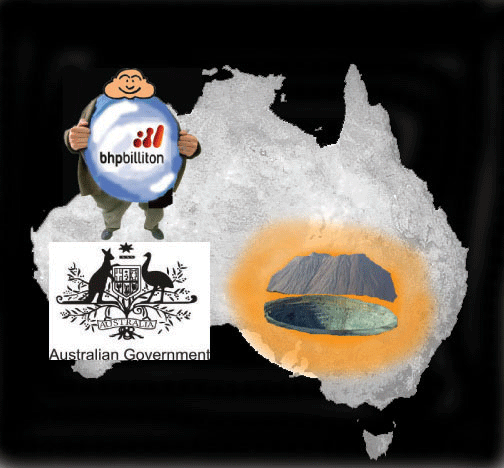
Australia’s really big radioactive waste dump is at Roxby Downs
Dennis Matthews, 19 Nov 15, In the 1980’s we were repeatedly told not to worry about uranium mining at Roxby, that Roxby was a copper mine and that uranium was incidental. Now we are being told that Roxby has the world’s largest deposit of uranium.
Despite strong public opposition, mining at Roxby got the nod from politicians. Soon radioactive water started leaking through the un-sealed base of the tailings dam, and now BHP is building an ever-expanding man-made stockpile of radioactive waste.
Paul Starick (The Advertiser, 13/11/15) downplays the fact that we have a nuclear reactor, stating that Australia has no nuclear power reactor, a distinction that has little to do with the issue. Using the “nuclear medicine” mantra, Starick downplays the main role of a nuclear waste dump, namely to deal with highly radioactive waste from Australia’s nuclear reactor, which will open the door to international waste.
The small amounts of relatively benign low-level waste being safely stored in institutions around Australia is trivial compared to BHP’s massive stockpiles of waste at Roxby and Australia’s nuclear reactor waste.
What are the radioactive risk of nuclear waste dump to a farming community?
Jim Green Friends of the Earth, 18 Nov 15 Responding to these questions: “So what are irradiation cans, ion exchange resins and aluminium ends of fuel rods and what dangers do they present to those living in a farming community? Is anyone able to inform me or direct me to where I can find such information please?”
They are harmless metals (irradiation cans + aluminium ends of fuel rods) and resins/polymers … but hazardous because of contamination with radioactive substances. For the contaminated metals they are likely contaminated with long-lived alpha-emitting radionuclides and would likely be classified as long-lived intermediate-level waste (LLILW) and would therefore be sitting in an above-ground shed at Kimba for an ‘interim’ period likely to last for many decades since absolutely no effort is being made to find a disposal site for LLILW (it is destined for deep underground disposal).
The risks …. pretty much anything you can imagine has happened at one or another radioactive waste repository around the world: fires, leaks, water infiltration and corrosion of waste drums, a chemical explosion, etc.
Fire would be a particular concern at Kimba, all the more so since the most hazardous waste (LLILW) would be stored above ground. Articles about recent fires at U.S. repositories are posted at: http://www.foe.org.au/fire
Water infiltration and corrosion is a difficult dilemma. Continue reading
South Australia’s radioactive threat: it’s not “medical” waste – it’s nuclear waste from used fuel rods
Freydenberg said the facility would ‘only’ house low and intermediate level waste. Perhaps he is unaware of the toxicity of this LLILW. Dr Green again: ‘When the spent fuel is removed from the reactor, it is high-level nuclear waste. After some months it cools down and falls below the heat criterion so is reclassified as LLILW.’
The farmer opponents of the Kimba sites are right to be concerned. The spent fuel reprocessing waste will be hazardous for thousands of years.
 South Australia’s nuclear threat continues http://www.eurekastreet.com.au/article.aspx?aeid=45708#.VkuCE9IrLGh Michele Madigan | 17 November 2015
Last Friday 13 November, the federal government released the shortlisted sites of the proposed national radioactive waste facility. No surprise that three are in South Australia, the ‘expendable state‘: Cortlinye and Pinkawillinie near Kimba on Eyre Peninsula, and Barndioota near Hawker, north of Port Augusta.
I wonder if South Australians aren’t beginning to feel like nuclear particles themselves, bombarded on all sides by the nuclear industry. This announcement from the federal government about its nuclear repository plans comes as the state government continues to consider, through its Royal Commission, whether, when and where South Australia will offer to host the world’s high-level nuclear waste.
The six names on the federal government shortlist (the remaining three being Sallys Flat in NSW, Hale in the Northern Territory and Oman Ama in Queensland) are taken from an original list of 28 properties that were offered by their landowners. It’s disturbing to find that the owner of the Cortilinye site, at least, has been misinformed,believing ‘It’s basically only a medical waste facility.’
In reality, only 10–20 per cent of the radioactive waste is medical in origin. And nuclear medicine is in no way affected by the lack of a national repository.
Resources and energy minister Josh Freydenberg’s Friday announcement included a masterly sentence of understatement: ‘Low level waste is those gloves or those goggles or the paper or the plastic that comes into contact with nuclear medicine, and intermediate waste could be, for example, those steel rods that are used in the reactor to actually create these particular products.’
It’s interesting to notice what’s different and what stays the same from the 1998–2004 ‘dump’ campaign in SA. Continue reading
Indigenous Adnyamathanha Camp Law Mob shocked at selection of South Australian site for radioactive trash dump
Response from the Adnyamathanha Camp Law Mob regarding the Federal Resources Minister’s announcement of 3 sites nominated for a nuclear waste dump in South Australia.
The Adnyamathanha Camp Law Mob are a group of Adnyamathna people who meet regularly to discuss issues relating to our land and culture.
The Camp Law mob share this message on behalf of all Adnyamathanha people and other South Australians who are opposed to any further expansion of the nuclear industry. We have taken part in the SA Nuclear Fuel Cycle Royal Commission, and our views along with many others are clearly stated in our submission that we do not support any expansion of a nuclear industry this includes the imposition of a radioactive waste dump on Adnyamathana country at Barndioota.
We are shocked to hear on Friday 13th November 2015 that one of the 3 nominated sites in South Australia for a national nuclear waste dump is 377 Wallerberdina Road, Barndioota. We understand that ex-Liberal Senator Grant Chapman is the current owner of the nominated site that is a Perpetual Lease property and therefore no native title claim can be lodged over this area. It must still be governed according to the requirements of the Aboriginal Heritage legislation.
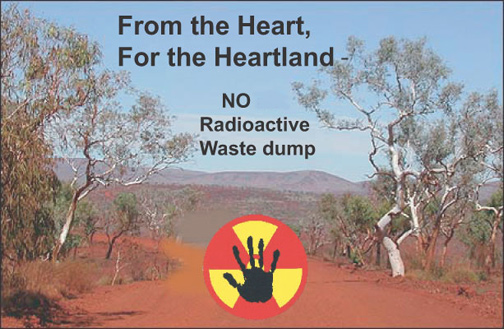
We demand that the Federal Resources Minister Josh Frydenberg publicly declare who he has consulted regarding these nomination, and who has the authority to nominate these sites.
We want to know who are the experts with local knowledge that took part in the advisory panel prior to these sites being nominated as waste sites? Who are the Traditional Owners that took part in this process? What Traditional knowledge from thousands of years of occupation has been incorporated into the decision-making?
Our involvement is this industry is nothing new. We were concerned by the government agreeing to uranium mining activities that have now permanently contaminated our land and our groundwater. We want no further expansion of the nuclear industry and we will continue to fight for our rights as Traditional Owners in respect of the wisdom of our old people that came before us.
That’s what Traditional Owners do. We care for our country. We only wish governments and industries would do the same. Stop playing with our future and care for our country.
1 This month

of the week – Australians for War Powers Reform (AWPR)
To see nuclear-related stories in greater depth and intensity
 Antinuclear