Former Liberal Party presidnt and Senator Grant Chapman offers Grant Chapman land for high level nuclear waste dump
 Proposed Flinders Ranges nuclear site identified as pastoral property belonging to former Liberal senator Grant Chapman, ABC News, By Daniel Keane, 16 Nov 15 A former South Australian senator and Liberal Party president who jointly owns one of several proposed sites for a nuclear dump in the state said he would be willing to allow high-level waste to be stored on the property in the future.
Grant Chapman owns the long-term lease to Wallerberdina, a station near Barndioota in the Flinders Ranges about 40 kilometres north-west of Hawker, which is currently used to graze cattle.
It is one of six sites across the nation, including three in SA, being considered by the Federal Government to store low- and intermediate-level nuclear waste.
News of its potential future use has alarmed some neighbours, who are opposed to a nuclear dump and said they had not been consulted.
Mr Chapman said if approved, a proposed nuclear storage facility would eventually occupy 100 hectares in the northern section of the 25,000-hectare property.
He said he nominated the site several months ago…….Mr Chapman was a strong supporter of storing nuclear waste in Australia during his time as a senator, chairing a Senate committee into the subject.
“If it was shown to be safe for that high level waste to be eventually transformed into a form that was safe to store in that situation then certainly the property would be a potential site for that,” he said…..
Neighbour angered and concerned by location
Artist Regina McKenzie, who lives on neighbouring Yappala Station, which shares a boundary with Wallerberdina, said she and her family were angry and frustrated they had not been consulted.
Ms McKenzie said she had heard rumours Wallerberdina was being considered but was shocked when that was confirmed by the Federal Government.
She said Aboriginal people have suffered greatly as a result of the Maralinga nuclear tests and she feared history would repeat itself.
“The water here that we use, the aquifers that are under the earth, what if they get contaminated by some leakages or something?” she said.
“I don’t care how safe they say it is. If it’s so safe, why don’t they take it back and put it in their own back yards. If it’s so safe, have it in Canberra there where all the pollies sit.”
Ms McKenzie said the area was culturally significant to the Adnyamathanha people.
We don’t want [waste] in the area. We didn’t want them to take it out of the ground in the first place, it’s against our culture, and now they’re sending it back to the country,” she said.
“It’s not right. If they take it, they should keep it. It’s poison. We don’t want the poison back.
“I’m a little bit scared about it. My grandchildren are going to come back here and visit as well.
“I just don’t want anything coming back on our communities.”………http://www.abc.net.au/news/2015-11-16/proposed-nuclear-site-identified-as-wallerberdina-station/6944636?section=sa
Ipswich’s Councillor Paul Tully urges residents to fight nuclear waste dump plan
 Tully speaks out against planned nuclear waste dump http://www.qt.com.au/news/tully-speaks-out-against-planned-nuclear-waste-dum/2841387/, 16 Nov 15 CR PAUL Tully has urged Ipswich residents and the community as a whole to prevent a nuclear waste storage facility less than three hours drive from the city from going ahead.
He said Ipswich had a proud history of preventing similar dumps going ahead within its city borders in the past. He drew the community’s attention to the issue on his Facebook page.
“The Federal Government has picked a potential site – one of six – near Inglewood 250km southwest of Brisbane to store nuclear waste from Lucas Heights in Sydney’s west and from other states of Australia,” he posted.
“This would mean hundreds of truckloads of hazardous waste coming through Brisbane, Ipswich and  Toowoomba via cities and towns in NSW every year.
“Say no to Queensland becoming a nuclear waste dumping ground for the rest of Australia.
The Ipswich community stopped a similar dump at Redbank in 1988 proposed by the state government at the time, which was finally scrapped by the new Goss government in 1989.”
Strong objections to nuclear waste dump sites
 Why is it that THE AUSTRALIAN and most media go on about medical wastes, but don’t mention the REAL problem – Lucas Heights nuclear reactor wastes returning from France?
Nuclear waste dump goes against the grain, THE AUSTRALIAN, REBECCA PUDDY ANDREW BURRELL, 14 Nov 15, Grain farmer Cameron Scott is no green activist, but he promises to fight any move to build the nation’s first nuclear waste dump on his doorstep in South Australia’s wheatbelt.
Mr Scott is a key member of a coalition of neighbours in the town of Kimba, almost 500km northwest of Adelaide, who are strongly opposed to the region hosting a facility to store the nation’s low-level and mediumlevel radioactive waste.
“The first thing that hit me was safety — we’ve got kids, we’ve been here for three generations and we want to look after their future,” Mr Scott said yesterday, as he acknowledged deep tensions in his local community over the issue.
“What will this do for our price of land, who wants to buy land next to a radioactive waste dump and what will happen to the price of our grain?”
Kimba is ground zero in the deeply personal battle over the location of the dump, with two of the six shortlisted sites across Australia — all of which were voluntarily nominated by landholders — located in the district……… Continue reading
Danger in transporting radioactive trash to Queensland
Goondiwindi mayor raises issues over transport of nuclear waste to Queensland, ABC News 13 Nov 15 The Mayor of a southern Queensland region shortlisted to store nuclear waste is concerned about how it will be transported, but is keeping an open mind to the proposal.
Oman Ama, 250 kilometres southwest of Brisbane,is one of six sites earmarked by the Federal Government, including three in South Australia, one in New South Wales and one in the Northern Territory. Goondiwindi Mayor Graeme Scheu said he did not want to jump to conclusions.
“The main question around it would be transportation, where it goes, so, so many questions that we don’t even have an answer for and the facts,” he said……..
The Federal Government is offering sweeteners to the community that agrees to house nuclear waste…..
Transporting waste to Queensland ‘total lunacy’
National secretary of the Australian local government nuclear free zones secretariat, Ipswich councillor Paul Tully, said “total lunacy” had overtaken the Federal Government.
Mr Tully said the federal Energy Minister Josh Frydenberg will put major cities across southeast Queensland under threat with hundreds of trucks a year carrying nuclear waste across the region.”They will be transporting nuclear waste from the Lucas Heights reactor west of Sydney and other parts of Australia to Queensland,” he said.
“We don’t want Queensland to become the dumping ground for dangerous waste from NSW.”
He said similar plans in 1989 for a radioactive waste dump at Redbank in Ipswich had been thwarted after major environmental concerns were raised.
Kirsten Macey from the Queensland Conservation Council said regional communities should not be used as the scapegoat for a “dirty” nuclear industry. She wants the waste left in Sydney.
“We believe that where the regulator is – where they have the capacity to store it and monitor it, that’s where the nuclear waste should be stored,” she said. “That’s at Lucas Heights where the nuclear waste is being generated.”http://www.abc.net.au/news/2015-11-13/mayor-goondiwindi-transport-nuclear-waste-queensland/6937570
Darling Downs, Queensland, residents shocked at proposal to site nuclear waste there
 Darling Downs locals opposed to potential Oman Ama nuclear storage site, 9 News, 13 Nov 15, A property near the Darling Downs town of Oman Ama has been shortlisted by the Federal Government as a potential storage site for low-to-intermediate nuclear waste, but locals have told 9NEWS they are seriously concerned by the plan.
“Initally, horror, shock, how could they?” Liff Parr said. “I would hate to find something like that happening in our area,” Jo Clark said.
Locals had not received any notice of the plans, Andrew Clark-Dickson said. “Up until seven o’clock this morning I knew nothing about it,” he said. “It’s got to be put somewhere, but I really don’t think it should be on top of the Murray-Darling Basin.”
Organic olive farmer Gesine Owen echoed his concerns. My biggest fear is the water contamination,” she said. Ms Owen said she had spent many years investing in infrastructure to attract tourists to the town.“We just don’t see why we should be picked,” she said.
The residents realise one landowner has volunteered to sell their property for the purpose of establishing a nuclear waste site, with the government offering to pay four times market value for the selected site………
The Australian Nuclear Free Alliance said Australian Aboriginal communities “are reeling from this announcement”.
“We are concerned about the lack of consultation with Aboriginal communities, which are already under attack due to unconventional gas mining, coal proposals and the roll-back of Aboriginal heritage protections,” Alliance co-chair Adam Sharah said in a statement. http://www.9news.com.au/national/2015/11/13/19/51/darling-downs-locals-opposed-to-potential-oman-ama-nuclear-storage-site#fg1Io11Df1AmGg61.9
MP Warren Snowdon sceptical about siting nuclear waste dump in Northern Territory
No reason to fear nuclear waste dump says owner of shortlisted farm near Alice Springs, ABC News, By James Oaten, Xavier La Canna and Nathan Coates, 13 Nov 15 “……….MP can’t see significant benefits The federal Member for Lingiari, Warren Snowdon, whose electorate includes the farm, said the Government had done the right thing in starting a consultation process, but was sceptical about the benefits the project could bring. “I don’t think there’s any question that if the community is opposed to this site around Alice Springs, it won’t happen,” Mr Snowdon said.
“I’ve always been a sceptic about the nuclear industry but this is a process that needs to be followed through. “There would be minimal employment opportunities. “I can’t see significant benefit from this.”
Mr Snowdon said he believed it was best to have such a facility closer to where the nuclear waste originated from…..
“It’s always been my view probably better off elsewhere, closer to where the bulk of the radioactive waste is rather than being transported long distances.”
‘Just the starting point’, environmentalist says
Director of the Alice Springs-based Arid Lands Environment Centre, Jimmy Cocking, said he was concerned the proposal may be a precursor to storing more dangerous nuclear waste.
“Low-to-intermediate waste is generally the starting point,” Mr Cocking said.
“So our concern is, if established, it will in the long term not just have low to intermediate waste.
“We are opposed to it being in Hale, we think it should be located at Lucas Heights [in New South Wales] where the expertise is.”http://www.abc.net.au/news/2015-11-13/date-farm-south-of-alice-springs-shortlisted-for-nuclear-waste/6938126
Radioactive trash dump would damage tourism – Sally’s Flat residents say “NO”
Sallys Flat should be removed from nuclear waste shortlist, residents say, ABC News 13 Nov 15 By Joanna Woodburn, Residents have slammed a proposal to store nuclear waste at Sallys Flat, near the historic gold mining village of Hill End in New South Wales’ central west.
The association’s Ross Brown said the historical significance and population of the area made it a poor choice for a nuclear facility…….
Bathurst Climate Action Network head Tracy Carpenter said Bathurst, which is an hour away from Sallys Flat, had been a sister city with Okuma in Japan, one of the towns affected by the Fukushima nuclear disaster. “People cannot occupy [Okuma] since the tsunami and earthquake and the result [of] the nuclear disaster, and now we’re being slated as an area to dump nuclear waste,” she said. “It’s just appalling.”…….
NSW Opposition Leader Luke Foley said he would be surprised if the site was chosen……….”I think people in New South Wales will take an enormous amount of convincing for such a repository to be placed in our state, somewhere around Bathurst.
“We’re not talking about the outback, we’re talking about a pretty well populated area.”…….http://www.abc.net.au/news/2015-11-13/take-sallys-flat-off-nuclear-waste-shortlist-residents-say/6937442
Yami Lester, victim of nuclear testing urges communities to fight nuclear waste dumping
SA Government ‘open’ to nuclear waste dump proposal despite previous opposition: Weatherill, ABC News, 13 Nov 15, “…… Greens MP Mark Parnell said he wanted to see more detail on the proposal, but was suspicious of the agenda from Canberra. He was concerned accepting a site in South Australia could lead to the storage of high level radioactive waste.
“It’s no surprise that the Federal Government has its eyes on South Australia for its nuclear waste dump,” Mr Parnell said. “But what will worry people in this state is whether this is a precursor to a high level radioactive waste dump.”…
 Indigenous man Yami Lester, from Mintabie in the APY Lands, said the state and federal governments should not mine uranium, let alone store it.
Mr Lester was blinded from a radiation fallout in 1953 when the British and Australian governments conducted uranium testing near his community, west of Coober Pedy.
“It was terrible. Some older people died, I went blind and my cousin went blind, skin rash, diarrhoea and all that sickness,” he said.
“We had no treatment at all, the hospital nearest the clinic was 160 kilometres [away] at Ernabella, and we were sitting here, no doctor nothing.
“That’s why I’m scared of the government mining uranium. Better to leave it under the ground. Don’t touch it.”
Mr Lester urged the communities close to the proposed waste sites to fight against the dumps.
He said the state and federal government should learn from past mistakes.
“I don’t agree with [experts] at all. The Australian Government and the South Australian Government, people haven’t learnt from the mistakes that happened overseas, in Germany, Japan they haven’t learned from that,” he said…..http://www.abc.net.au/news/2015-11-13/sa-govt-consider-nuclear-waste-proposal-royal-commission/6937530
NATIONAL NUCLEAR WASTE DUMP IN SA: TROJAN HORSE FOR AN INTERNATIONAL NUCLEAR WASTE DUMP?
 13 Nov 15 The Federal Government has released the shortlist of six sites for the location of a national radioactive waste dump. Three of these sites are in South Australia.
Friends of the Earth Adelaide is cautious about the Federal Governments genuine commitment to a voluntary site nomination and selection process.
“The test will be how the government handles community opposition, how inclusive and transparent the site selection process will be, and how it will handle the issue of existing South Australian legislation banning the establishment of a nuclear waste dump,” said Nectaria Calan of Friends of the Earth Adelaide.
The National Radioactive Waste Management Act 2012, the Act governing the site selection process, over-rides existing state legislation prohibiting the establishment of a nuclear waste dump.
“Will the Federal Government impose a nuclear waste dump on states that have legislated against it, or communities that do not want it?” asked Ms Calan.
“The location of a waste dump cannot simply be decided through individual nominations,” said Ms Calan. “It affects the wider community, particularly those in close proximity to the site. Radioactive contamination knows no property boundaries. The principle of voluntarism extends beyond the individual where an action has wider ramifications,” continued Ms Calan.
“There is yet to be an independent inquiry into all our radioactive waste management options, so the nominations process is premature,” said Ms Calan.
Additionally, here in South Australia the Royal Commission into the Nuclear Fuel Cycle is considering the feasibility of an international nuclear waste dump. “Will a national nuclear waste repository in SA be the trojan horse for an international high level nuclear waste dump down the track?” asked Ms Calan.
“Rather than considering existing nuclear waste in Australia as an intractable problem, the SA government and some proponents of the nuclear industry seem to consider radioactive waste a business opportunity and want to import it, astounding given that so far globally there has been no success in establishing even one facility for the long term storage of high level waste.”
“ The one deep underground repository for intermediate level waste that does exist, the Waste Isolation Pilot Plant (WIPP) in New Mexico, saw an incident in February last year where a waste barrel exploded, leading to an aboveground release of airborne radiation, after only 15 years in operation,” said Ms Calan. “According to the US Department of Energy, twenty-two workers tested positive to low-level radiation exposure.”
Friends of the Earth Adelaide has serious concerns regarding the regulatory framework that may be applied to a nuclear waste dump in South Australia, whether national or international.
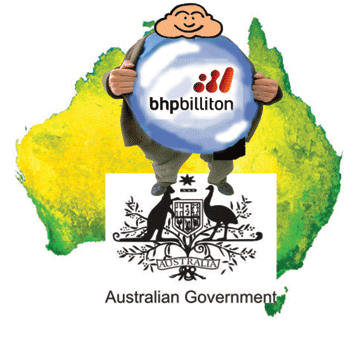 “BHP Billiton, operator of the Olympic dam mine, is exempt from key regulating legislation in SA, including the Freedom of Information Act, and parts of the Radiation Protection and Control Act and the Environmental Protection Act. With such a precedent here in SA for the regulation of the nuclear industry, where is the guarantee that other nuclear projects such as a nuclear waste dump would not also be exempt from laws regulating radiation, environmental protection, and transparency?” asked Ms. Calan.
Scrutiny on the Australian govt’s plan for Lucas Heights nuclear waste
 Community consent must be forthcoming and it must be informed consent. Defining the relevant affected community can be fraught. For example, people living on transport routes clearly have an interest but are rarely given a say. Several states and territories − indeed all four of the short-listed states and territories − have legislation banning the imposition of nuclear waste repositories. The nomination of sites in those jurisdictions suggests the federal government may be willing to ignore or override legislative bans.
An immediate problem is that visits to affected communities by government officials may not be illuminating or helpful. Government officials will insist the waste is safe and communities will wonder why it isn’t buried beneath Parliament House − or at a local landfill − if the waste is as safe as the government insists it is.
the government should go back to the drawing-board and ask whether a remote repository is needed at all. About 95 per cent of the waste is securely stored at two locations: the Australian Nuclear Science and Technology Organisation’s Lucas Heights site in southern Sydney, and Defence Department land near Woomera in SA. There is no obvious reason why that waste should be moved.
Government must learn from past mistakes on nuclear waste Anica Niepraschk & Jim Green, 13 Nov 2015, Climate Spectator www.businessspectator.com.au/article/2015/11/13/policy-politics/government-must-learn-past-mistakes-nuclear-waste
After failed attempts to impose a national nuclear waste repository in South Australia and the Northern Territory, the federal government has embarked on its latest attempt to find a site.
To its credit, the government has learnt from past mistakes. Instead of attempting to impose a repository (to be precise, a repository for low-level waste and an above-ground store for intermediate-level waste), the government called for land-owners to nominate potential sites. The two-month nomination period ended in May. That was followed by a desk-top study to evaluate the sites’ suitability according to a number of social, environmental and economic factors. Twenty-eight sites were put forward and six made the short-list: three in SA and one each in NSW, Queensland and the NT.
The announcement of the short-list will now be followed by a public consultation period, then detailed site characterisation studies to further assess the suitability of the sites. An announcement of a preferred (but not yet selected) site will be made in mid-2016 at the earliest.
A community compensation package of up to $10 million is on offer − a pittance considering the repository would be operational for around 300 years and hazardous for thousands of years beyond that.
Two of the SA sites are near Kimba, 150 km west of Port Augusta. It is agricultural land and there is overwhelming opposition from local farmers. The South Australian debate also feeds into a debate as to whether the state might offer itself up as the world’s nuclear waste dump, accepting high-level nuclear waste from power reactors around the world. Despite extravagant claims about the potential revenue stream from high-level nuclear waste, less than one in six South Australians support the proposal.
A strong coalition of Aboriginal communities and civil society organisations in South Australia has already clearly announced its opposition to hosting a nuclear waste repository and is prepared to follow in the footsteps of the Kupa Piti Kungka Tjuta, senior Aboriginal women who successfully prevented a repository being foisted on their land from 1998−2004. Continue reading
Govt releases 6 sites short-listed for Lucas Heights nuclear wastes returning from France etc
Six sites shortlisted for Australia’s first permanent nuclear waste dump revealed, SMH November 13, 2015 James Massola Political correspondent
The Turnbull government has finally released a shortlist of six sites that are in the running to host Australia’s first permanent nuclear waste dump for low-level and intermediate waste.
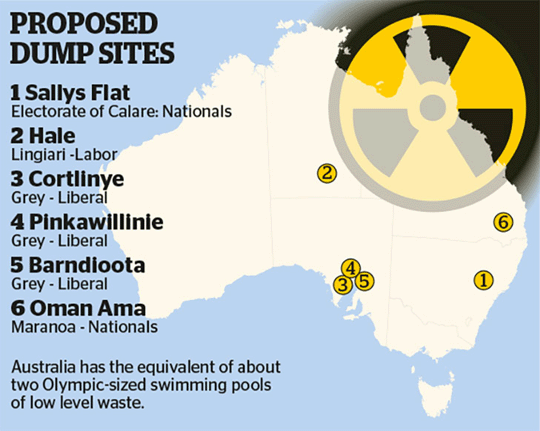
The six sites have been chosen from 28 voluntarily nominated sites around Australia and are at Sallys Flat in NSW, Hale in the Northern Territory, Cortlinye, Pinkawillinie and Barndioota in South Australia and Oman Ama in Queensland.
Following release of the much-anticipated shortlist, locals who live in the six locations will now be consulted over the next four months about what will eventually be a remote, 100-hectare site.
 Resources Minister Josh Frydenberg said Australians should embrace the eventual construction of a permanent facility as it would allow Australian to continue to enjoy the benefits of nuclear medicine, for example………
“This is completely independent from the nuclear fuel cycle royal commission process underway in South Australia.”
Australia has the equivalent of about two Olympic-sized swimming pools of low-level nuclear waste at 100 sites across the country and the facility will store this waste, as well as low and intermediate-level radioactive waste from the Lucas Heights facility in Sydney.
The waste includes laboratory items such as paper, plastic and glassware, material from medical treatment and even radioactive soil………
Mr Frydenberg cautioned that under current legislation, “Australia can’t take another country’s waste” and thus, the possible expansion of the industry was not at this stage possible.
Australian-produced waste that had been sent to France, the US and Britain between 1996 and 2009 is due to be returned to Australia under international agreement, with a load from France currently enroute back to Australia and due to arrive at Port Kembla later this month. http://www.smh.com.au/federal-politics/political-news/six-sites-shortlisted-for-australias-first-permanent-nuclear-waste-dump-revealed-20151112-gkx8mo.html
Australian govt avoiding opposition from Aboriginals, as it selects nuclear waste dump sites
Is the Australian government in a hurry to reassure Sydney residents about the nuclear waste dump, and also scared of the potential powerful opposition by Aboriginal people? Australia is contractually bound to take back these wastes from France.
 Native titles extinguished Significantly, native title has been extinguished on all the shortlisted sites.
Six areas make shortlist for nuclear waste storage, AFR, by Laura Tingle, 13 Nov 15, South Australia appears to be the most likely home for nuclear waste storage after the Turnbull government shortlisted six sites for a facility to store low-level radioactive waste.
Resources Minister Josh Frydenberg unveiled the list of six sites arising from a process in which landowners voluntarily nominated their land. A final decision is expected by the end of next year after long community consultations.
The six shortlisted sites are at locations near Sally’s Flat in NSW; Hale in the Northern Territory; Cortlinye, Pinkawillinie and Barndioota in South Australia; and Oman Ama in Queensland….
The federal low-level waste storage proposal is separate from the [South Australia Nuclear Fuel Chain Royal Commission] scheme originally raised by a nuclear energy inquiry commissioned by the Howard government – and recently canvassed by Prime Minister Malcolm Turnbull – that would see Australian uranium exported and ultimately brought back as high-level waste…….. Continue reading
Why interim storage at Lucas Heights is the least worst solution for returning nuclear wastes.

 Dave Sweeney, Australian Conservation Foundation, 9 Nov 15 Last week Natalie Wasley (BNI) and myself spent a few days talking to a range of stakeholders in Sydney and Sutherland Shire and this note seeks to provide some context for the ENGO response to this development.
The BBC Shanghai left the French port of Cherbourg in mid-October carrying twenty five tonnes of Australian origin intermediate level waste returning here after reprocessing in France.
There has been controversy about the shipment, including safety and capacity concerns raised by Greenpeace about the vessel and a statement from the Indonesia’s Maritime Security Board that it can not pass through Indonesian waters. There is sure to be more domestic and international media attention when it arrives in Port Kembla (Wollongong), expected to be in early December.
After arrival in Kembla it is planned that the waste – which is in solid form inside a special transport container – will be moved by road to the Australian Nuclear Science and Technology Organisation’s Lucas Heights reactor facility in southern Sydney.
Some local residents are/will be calling for this material to not be stored in Sydney – this is an understandable response, but it is not one supported by the wider national nuclear free movement and key civil society partners.
We advocate that extended interim storage at Lucas Heights is the current least worst option as:
- ANSTO is already both the continuing producer of and home to the vast majority of Australia’s higher level radioactive waste
- ANSTO has certain tenure, a secure perimeter and is monitored 24/7 by Australian federal police
- Storing the waste at ANSTO means the waste will be actively managed as operations at the site are licensed for a further three decades – it also keeps waste management on the radar of the facility/people with the highest concentration of nuclear expertise and radiation response capacity in Australia
- Since the government realised in 2012 that the planned national waste dump at Muckaty would not be in place prior to the return of this waste, ANSTO has constructed and commissioned a new purpose built on site storage shed dedicated to housing this waste
- Extended interim storage at ANSTO helps reduce the political pressure to rush to find a ‘remote’ out of sight, out of mind dump site and increases the chances of advancing responsible management
- Storage at ANSTO has been publicly identified as a credible and feasible option by ANSTO, the nuclear industry lobby group, the Australian Nuclear Association and the federal nuclear regulator, the Australian Radiation and Nuclear Safety Agency (ARPANSA)
Importantly, this approach also provides the ability to have a circuit breaker in this long running issue in the form of an evidence based and open review of the best longer term management options.
Nothing about the nuclear industry, especially nuclear waste, is clean or uncomplicated and some in the wider community might be critical of this position.
However we believe that extended interim storage is the least worst approach and that coupled with a sustained ENGO call for a wider public review, is the path that is most likely to usefully advance the debate about future management options.
There is also an unusually high level of common acceptance that storage at Lucas Heights is the best option in the current circumstances – as well as ENGO’s this view is shared by the Sutherland Shire Council, local Greens and environmentalists, ANSTO and the Maritime Union.
Given this, pending a safety inspection upon the ship’s arrival, we do not forsee protest action aimed at disrupting the transfer of this waste from the Port to ANSTO – we want to see that happen with as low risk as possible. There are plans for a peaceful presence to witness the arrival and transfer and convey that while we (reluctantly) accept the need for this transport to occur we will not accept these shipments becoming routine and will actively resist moves to impose a national waste dump on remote communities or develop international waste dumps/storage in Australia.
Clearly this is an important message to convey in the context of the South Australian Nuclear Royal Commission and recent comments by PM Turnbull and other senior Coalition figures.
There is also both a real opportunity and need for a clear social and wider media profile at this time on the need for an open review of the best ways to manage this material and to end/reduce its production.
Nuclear fuel leasing – not economically viable for Australia
 When nuclear reactors shut (as they are doing in USA) – where is the income stream to pay Australia for having all that radioactive trash?
 Proponents are talking up the billions that might be made by swallowing our pride and making Australia the world’s nuclear waste dump. But they have been silent about the costs.
And the waste would need to be monitored and problems addressed for millenia
Wasting Australia’s Future: Why We Shouldn’t Become The World’s Nuclear Waste Dump, New Matilda, By Dr Jim Green on November 9, 2015 There are many good reasons why Australia should not set its sights on becoming a dumping ground for nuclear waste. Dr Jim Green takes up the case.
While sceptical about the prospects for nuclear power in Australia, Prime Minister Malcolm Turnbull has given cautious support to the idea of a nuclear fuel leasing industry in Australia. Such an industry would involve uranium mining, conversion (to uranium hexafluouride), enrichment (increasing the ratio of uranium-235 to uranium-238), fuel fabrication, and disposal of the high-level nuclear waste produced by the use of nuclear fuel in power reactors overseas.
In the Prime Minister’s words: “We have got the uranium, we mine it, why don’t we process it, turn it into the fuel rods, lease it to people overseas, when they are done, we bring them back and we have got stable, very stable geology in remote locations and a stable political environment.”
Regardless of its merits, a nuclear leasing industry is an economic non-starter. That much is clear from the data provided in the latest edition of the International Atomic Energy Agency’s Nuclear Technology Review. Uranium miners could be compelled to participate in an Australian nuclear leasing industry. But try telling that to BHP Billiton. The company bluntly stated in its submission to the 2006 Switkowski Review: “BHP Billiton believes that there is neither a commercial nor a non-proliferation case for it to become involved in front-end processing or for mandating the development of fuel leasing services in Australia.”
And there’s no point appealing to the patriotic fervour of Australia’s uranium miners: they are majority foreign-owned. Continue reading
Australia’s demonstrated incompetence on dealing with radioactive trash
 Wasting Australia’s Future: Why We Shouldn’t Become The World’s Nuclear Waste Dump, New Matilda, By Dr Jim Green on November 9, 201 “…….Is there any reason to believe that Australia would manage a deep underground repository any more responsibly than the US? No.
Is there any reason to believe that things might be worse in Australia? Yes.
The US has a wealth of nuclear expertise at its disposal; Australia has comparatively little.
Moreover, Australia has its own sordid history dealing with long-lived nuclear waste. In the late-1990s, the Australian government carried out a clean-up of the Maralinga nuclear test site. It was done on the cheap and many tonnes of plutonium-contaminated debris remain buried in shallow, unlined pits in totally unsuitable geology.
A number of scientists with inside knowledge of the Maralinga project publicly noted their concerns. Nuclear engineer Alan Parkinson said of the ‘clean up’: “What was done at Maralinga was a cheap and nasty solution that wouldn’t be adopted on white-fellas land.”
US scientist Dale Timmons said the government’s technical report was littered with “gross misinformation”. Geoff Williams, an officer with the Commonwealth nuclear regulator ARPANSA, said the ‘clean up’ was beset by a “host of indiscretions, short-cuts and cover-ups”. Nuclear physicist Prof. Peter Johnston said there were “very large expenditures and significant hazards resulting from the deficient management of the project”.
Barely a decade after the Maralinga ‘clean-up’, a survey revealed that 19 of the 85 contaminated debris pits have been subject to erosion or subsidence.
Australia’s demonstrated incompetence feeds back into the economic debate. Some − perhaps many − countries would surely think twice about entrusting nuclear waste to a country that has already proven that it is not up to the task.https://newmatilda.com/2015/11/09/wasting-australias-future-why-we-shouldnt-become-the-worlds-nuclear-waste-dump/
1 This month

of the week – Australians for War Powers Reform (AWPR)
To see nuclear-related stories in greater depth and intensity
 Antinuclear