Labor consults traditional owners about the Kimba nuclear waste dump Bill, considers supporting the Bill.

Nuclear waste facility in SA may be a step closer, after Labor consults traditional owners
ABC, By political reporter Matthew Doran, 15 June 21, ”………………with the federal opposition preparing to negotiate with the government on legislation that would allow construction to begin.
Key points:
- Labor says the government has agreed to amendments allowing legal challenges against the location
- The federal government has proposed to build the dump at Kimba in South Australia…..
Nuclear waste facility in SA may be a step closer, after Labor consults traditional owners
ABC, By political reporter Matthew Doran, 15 June 21, ”………………with the federal opposition preparing to negotiate with the government on legislation that would allow construction to begin.
Key points:
- Labor says the government has agreed to amendments allowing legal challenges against the location
- The federal government has proposed to build the dump at Kimba in South Australia…..
The federal government has proposed the dump be built near Kimba, on South Australia’s Eyre Peninsula, after a shortlist of locations was whittled down and a community vote was held.
But legislation to give the project the tick of approval stalled in the Senate, with Labor concerned the bill did not allow legal challenges against the choice of location……..
On Tuesday, Labor’s Caucus agreed to let Shadow Resources Minister Madeleine King negotiate on the bill after the Coalition suggested it would present amendments to Parliament allowing for judicial review.
“We said we would not support passage of this legislation unless the traditional owners were comfortable with it,” Ms King said………
Ms King said the opposition would wait to see the details of the amendments before making its final decision.
She was praised by Shadow Indigenous Australians Minister Linda Burney for her consultation with the community.
Representatives of the Barngarla Determination Aboriginal Corporation (BDAC) travelled to Canberra to seek extra assurances from the federal government about the amendments.
“We welcome the engagement Labor to date and the engagement from the crossbench,” a spokesperson said.
We also acknowledge the commitment from Labor to ensure that nothing occurs without our support.
“We are unable to comment further at this stage as we are too busy dealing with this.”……..
The amendments are yet to be introduced to Parliament, and the timeframe for construction is not clear.
Legal challenges have scuttled previous attempts to construct a nuclear waste dump, including at Mukaty Station in the Northern Territory.
Nuclear waste facility in SA may be a step closer, after Labor consults traditional owners
Nuclear waste intended for Kimba, -used to be classified as ”high level” – now called ”intermediate”.
Zac Eagle No nuclear waste dump in South Australia , 16 June 21
teSponst9oreduh · “High Level waste from the existing HIFAR reactor is due to return in 2015 from reprocessing in France”Federal Parliament – 24 January 2005.
This is the stuff they want to dump in SA.When was it reclassified as Intermediate Waste? The link https://www.aph.gov.au/…/BN/2011-2012/RadioActiveWaste
ANSTO’s dodgy classification of nuclear wastes.
When the re-processed material is returned to Australia invariably the processing country refers to that material as high-level waste but ANSTO reclassifies it as intermediate level on the very weak argument of the classifications in Europe being different to Australia…… it seems ludicrous that it should assume its own manner of classification and against the treaty adopted classifications of IAEA and adhered to by other countries.
(b) the intermediate level waste should even when stored on a temporary basis be geologically buried at appropriate depths.
The prescriptive codes of IAEA have been fully adopted by ARPANSA12 as its standards for the classification and treatment and management of nuclear waste in Australia.
It is interesting that a new subsection 3(2) of the Bill gives effect to Australia’s obligations as a party to the Joint Convention for the safe and secure management of what is defined as decontrolled material and in particular Australia’s obligations under Chapters 3 and 4 of the Joint Convention.
The government has always stated that the facility at Kimba would only be used for the permanent disposal of low-level waste and indefinite storage of intermediate level waste with that storage period being up to 100 years.
The government has described the facility at Kimba as being a central one for Australia with the implication that it would dispose of or store as required all the present legend or stockpiled waste in Australia and all waste generated locally in the future.
After accepting Napandee as a nominated site the government engaged AECOM to carry out what is described as a characterisation study of the site at Napandee which concluded with a technical report dated 23 July 2018.
That summary added little to the technical nature of both Kimba sites and dealt principally with community consultations and the results of a recent ballotWhile all three reports were colourful presentations with elaborate artwork and photographs in reality by technical standards they contained little proper information to support and satisfy the selection of Napandee as the site for the waste management facility.
environmental hazards such as seismic and flooding events, can be mitigated via design solutions.
This conclusion again shows that the Napandee selection was both premature as to its choice by the government due to the lack of a full assessment and investigation of the site and completely unsuitable for the facility.
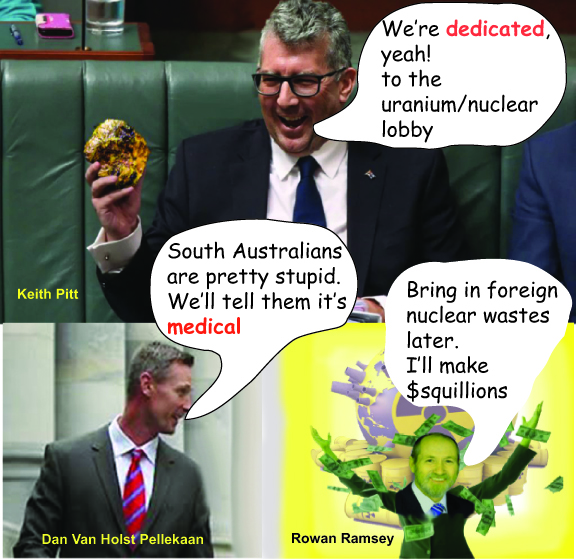
Resources Minister Pitt changes nuclear waste Bill in the effort to gain Labor’s support.

Nuclear waste storage facility legislation changed in bid to gain Labor support, secure Kimba site” – The Advertiser 14th June 2021.
“A nuclear waste storage facility in regional South Australia is one step closer, [really?] with the Federal Government making changes in a fresh bid to get the controversial plan through parliament.
Napandee Farm near Kimba on the Eyre Peninsula was named as the preferred site in February 2020 but draft laws to establish the facility have been stalled in parliament for months .
The federal Opposition won’t back the bill in its current form because naming the site in legislation, rather than declaring it by a ministerial decision, prevents a possible future legal challenge to the location.The federal government is now proposing changes that would reinsert the possibility for a judicial review, in a bid to win Labor’s support and get the laws through the Senate.
Under the changes, a site would no longer be specified but three previously short-listed locations – Lyndhurst in New South Wales, Napandee near Kimba, and Wallerberdina in the Flinders Ranges – would be included in the bill and the minister would then be required to declare the site…….
Opposition leader Anthony Albanese’s frontbench is due to consider the amendments on Monday night and the bill may go before the Senate in the next two weeks.
Indigenous associations, including the Barngarla Determination Aboriginal Corporation, have been opposed to the site because traditional land owners who did not live in the area were excluded from a 2019 ballot to gauge community support for the site.
Kimba Mayor Dean Johnson said the community just wanted a decision.“We just look forward to a resolution so our community can move forward,” Mr Johnson said. He welcomed changes to the draft laws if it would secure Labor’s support, and said the minister should declare the site “as soon as possible”…
Australian Conservation Foundation Nuclear Free Campaigner David Sweeney said Mr Pitt had “finally accepted the reality” the proposal did not have support and needed to be revised.
“The return of legal review is important but it is extraordinary that the Minister ever thought its removal was reasonable,” Mr Sweeney said.“A day in court is a fundamental right and to seek to remove this was deeply flawed – as is the government’s wider plan.”…….
Mr Sweeney said there was no compelling case to move intermediate level waste from ANSTO’s site to Kimba, and it had been opposed by the traditional owners.He added the reintroduction of Wallerberdina, which was ruled out in 2019, showed the government was “making policy on the run”.

Most South Australians “don’t want the country’s nuclear waste dump in our backyard,” Senator Hanson Young said.She also raised concerns the amendments opened the door to the minister selecting the Flinders Ranges site.Greens senator Sarah Hanson Young said it appeared the Federal Government and Labor had done a deal to pass the bill.
“We will use all mechanisms available in the Senate over the next two weeks to stop this bill passing, and I suspect our fellow crossbenchers will do the same,” she said.”
Change in Resource Minister Keith Pitt’s strategy: what’s next for his Kimba nuclear dump project?

On Tuesday 15th June, Resources Minister Keith Pitt is introducing a revision to the the National Radioactive Waste Management Amendment (Site Specification, Community Fund and Other Measures) Bill 2020.
The purpose of the original Bill was to make sure that a site near Kimba, South Australia, would become the dump for nuclear waste from ANSTO’s nuclear reactor in Sydney. AND that there could not be any court action taken against it. That site would be ”set in stone”
Mr Pitt has chickened out a bit, seeing that the Senate was likely to reject that Bill. Hence the change – this new amendment The amendment restores the three shortlisted South Australian sites (Lyndhurst, Napandee, and Wallerberdina) as being open for consideration. (This is despite Wallerberdina (the Flinders Ranges site) having been ruled out of consideration in December 2019 by former Minister Canavan. )
”The Bill No longer specifies a site” – listed in supplementary explanatory memorandum https://www.aph.gov.au/Parliamentary_Business/Bills_Legislation/Bills_Search_Results/Result?bId=r6500&fbclid=IwAR2F-HOZX_TNR1r_kYXbB8sM3R-UwZNZRQ7X1hU34z9MTnLot3aRJcEFKVs
‘‘New section 34A ensures that the payment of the Community Fund is linked to a site declaration, rather than to a site specified in legislation” This would appear to cast some doubt on the ambitions of the Kimba District Council etc?
How does this amendment affect the chances of the Bill being passed in the Senate?
Well, Federal Labor being traditionally wishy washy on nuclear issues, this change might be enough to win the support of Labor, and thefore be passed.
Once the Bill is passed, what then?
Minister Pitt can then exercise his power to formally declare the site at Napandee, Kimba, as the site for the radioactive waste facility.
What then?
Well, various possibilities.
Concerned citizens in the the local Kimba community could seek some government grant to pay for their own independent assessment and review .
The plan still requires, and might not qualify for, a licence from ARPANSA, to ensure that the site meets the requirements, geological etc, for interim storage of nuclear wastes, and more permanent storage of low level radioactive wastes.
The Barngarla people, and perhaps others, will file a legal challenge to the site selection.
An outline of the recent years in the history of South Australia targeted for an international nuclear waste dump.
Brett Burnard Stokes No nuclear waste dump anywhere in South Australia,14 June 21,
Some info on the nuclear waste importing plot. South Australia has been the target of nuclear fanatics for 25 years or more, with several serious attempts to make SA the nuclear waste dump for other states and also for the whole world. The history is long, with Mike Rann making “we won” noises in 2006.
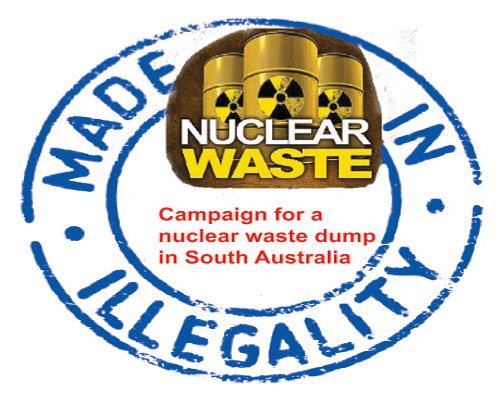
There is a law in South Australia which is still on the books, specifying ten years jail for importing or plotting to import nuclear waste into SA,Nuclear Waste Storage Facility (Prohibition) Act 2000https://www.legislation.sa.gov.au/…/NUCLEAR%20WASTE…
In 2014 there was a state election and Jay Weatherill (Labor) won the election and quickly did a surprise announcement of a royal commission into nuclear “opportunities” for SA.The commission was headed by ex navy ex governor Kevin Scarce.There were dodgy “economic reports” saying we should import the world’s nuclear waste and make a fortune.There were propaganda campaigns and eventually a citizens’ jury in late 2016 which rejected the nuclear waste import plans and upheld the SA law.
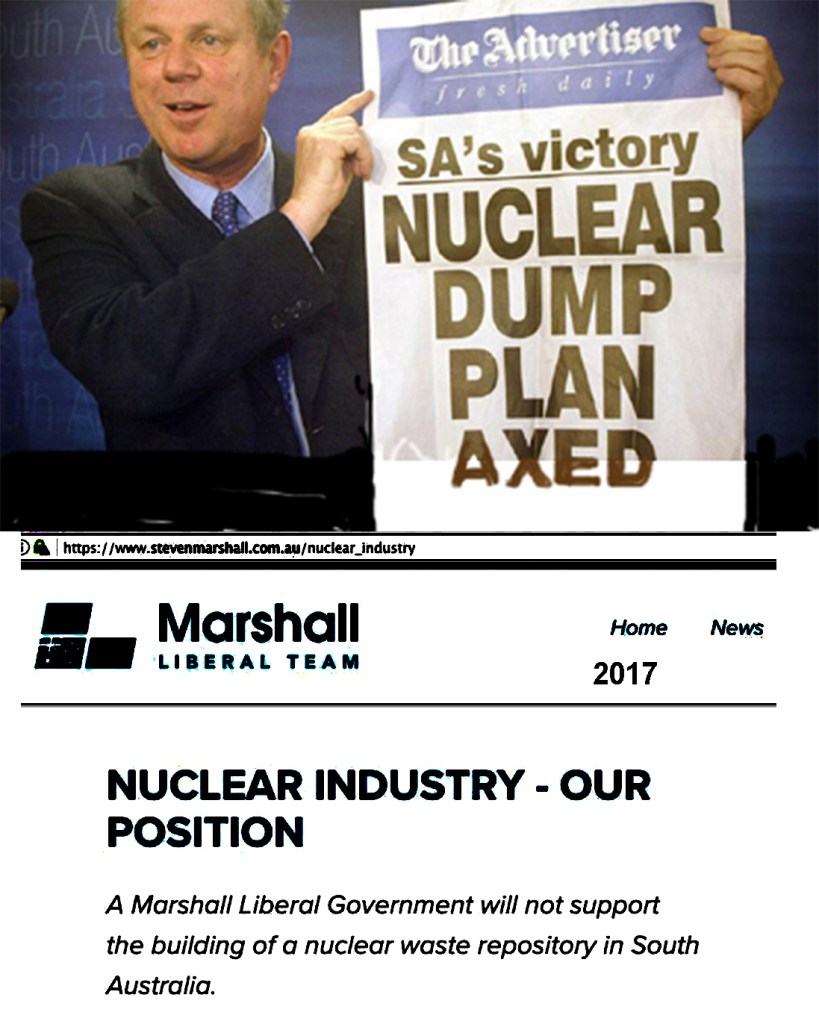
Jay W was upset and mumbled about having a referendum and spent another million dollars on polling before shutting up about nuclear in the lead up to the 2018 state election.
(Liberal) Marshall promised to not support a nuclear waste dump.Marshall won the 2018 election.
Meanwhile the Aussie nuclear mob ANSTO were spending a lot of money and telling a lot of lies in two areas of the state, trying to manufacture community consent for import into SA of nasty nuclear waste from Lucas Heights in suburban Sydney.
The Flinders area soundly rejected the idea (after a lot of community conflict).
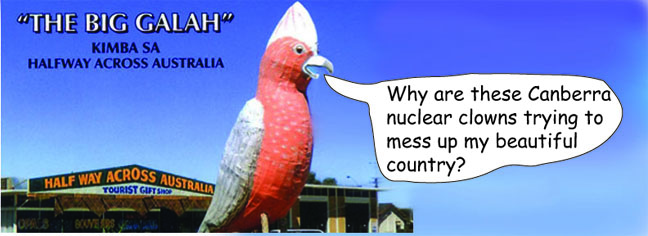
So ANSTO (and the fed gov department DIIS under Matt Canavan at the time) went hard on Kimba.A devious process followed where first nations people were excluded from voting and a few hundred people voted.A bare majority supported the plans and Canavan and co claimed they had community support.
Now we have had a weird year or so of waiting for the libs in federal parliament to put up a bill for voting, about the Kimba dump plans.And we have an office being established in Adelaide and ads for more jobs in the new bureaucracy.
And we still have the SA law specifying jail for plotting these things and for doing the things that are planned.There are several relevant people fighting the good fight — perhaps the best is Dave Sweeney at ACF.
There are many facebook groups.Premier Marshall promised to not support a nuclear waste dump in SANo Radioactive Waste Facility for Kimba DistrictNuclear Waste Information Sharing – WhyallaStop nuclear waste threats in South Australia
Dr Jim Green gives an update on the Australian government’s new strategy to get a nuclear waste dump at Kimba, South Australia.
Dr Jim Green, Friends of the Earth, 12 June 21, After being deadlocked in the Senate for exactly twelve months Resource Minister Pitt is introducing a revised radwaste amendment next Tuesday morning (June 15) that seeks to negate key objections to the federal governments approach to the siting of a national radioactive waste facility near Kimba in regional SA.
The changes mean that the Minister – rather than the Parliament – will choose a site and that choice will then be subject to legal review through Administrative Decisions (Judicial Review) Act 1979 (ADJR) processes.
In some ways this is a positive campaign outcome – the federal agenda has been effectively stalled since Feb 2020 and the Minster has had to abandon his push to remove the right of legal recourse, an important reaffirmation of a (limited) check and balance. However, it does mean that the federal effort and momentum to advance the facility will soon significantly escalate.
The amendment restores the three shortlisted SA sites (Lyndhurst, Napandee, and Wallerberdina) as being open for consideration. This is despite Wallerberdina (the Flinders Ranges site) having been ruled out of consideration in December 2019 by former Minister Canavan.
The last listed supplementary explanatory memorandum on the right hand side of the below link outlines the main changes to the revised amendment.
https://www.aph.gov.au/Parliamentary_Business/Bills_Legislation/Bills_Search_Results/Result?bId=r6500
<https://www.aph.gov.au/Parliamentary_Business/Bills_Legislation/Bills_Search_Results/Result?bId=r6500>
I have not had formal confirmation but it is likely that this revised approach will satisfy federal Labor and that the Bill will be passed. After this it is expected that Minister Pitt will move to formally declare the Napandee site, near Kimba.
Once this happens it is expected the Barngarla lawyers (the Adelaide based firm Norman Waterhouse) will file a challenge to the site selection. This development will require a re-calibration – but not a fundamental change – of our strategy and an increased public face to the campaign for responsible radioactive waste management.
Samantha Chard, General Manager, Australian Radioactive Waste Management Agency – doubletalk about nuclear waste transport.
Kazzi Jai No nuclear waste dump anywhere in South Australia ,11 June 21.

“Ms Chard also noted that aside from the TN81, other intermediate level waste will not look substantially different to the low level waste packages.
It is likely that transportation of intermediate level waste will be discrete to avoid someone potentially doing something they should not; however all trucks need to note if they are transporting a hazardous substance.”
Short post today – but something I have been meaning to address….
…..”to avoid someone potentially doing something they should not”…..WTF is that???? Are they only NOW ADMITTING how SERIOUS the TRANSPORT of this waste is SECURITY WISE???????
Then….”however all trucks need to note if they are transporting a hazardous substance”….Again – WTF – or are they trying to REWRITE THE AUSTRALIAN DANGEROUS TRANSPORT CODE????
“Mickey Mouse Operation” are the words which spring to mind
Predictably transport of intermediate waste will be done under the cover of darkness, just like the whole process has been. https://www.facebook.com/groups/1314655315214929
At Kimba, the National Radioactive Waste Management Faciity (NRWMF) insert themselves into community events
Kazzii Jai, No Nuclear waste dump anywhere, 5 June 21, Photos from the NRWMF page This time, it was a Ladies Morning Tea, with Jenny Baldock and Maree Barford. Jeff Baldock and his wife Jenny put up not ONE nominated piece of land (was knocked back outright ), not TWO (second one was not taken further in the second round of nominations – nominations which SHOULD NOT have occurred – the forever changing goalposts kicked in then!), but THREE pieces of land for this NUCLEAR DUMP!
Now tell me – who else in Australia was THAT DETERMINED to make their land A NUCLEAR WASTELAND….and worse – ON EXPORT AGRICULTURAL LAND – with NO PAST OR CURRENT HISTORY OF NUCLEAR INDUSTRY EVER!!! And guess what – Not even the uranium mining companies would come to the party on this one!!! Telling isn’t it!!!S
Photos are featured on the National Radioactive Waste Management Faciity (NRWMF) page where NRWMF AGAIN are inserting themselves – wanted or not -into community events!
Maree Barford is a paid employee of the NRWMF… PLUS recipient of Community Benefits Fund through her other job of co-managing the Kimba Hotel!
Australia’s nuclear waste policy shambles
In developing this plan, ANSTO had the option of choosing a different process.
They had the option of disposing of the wastes from O.P.A.L. to the USA, providing a cheaper alternative for ANSTO:
Australia’s nuclear waste policy shambles https://independentaustralia.net/politics/politics-display/australias-nuclear-waste-policy-shambles,15146B 2 June 2021 The Government is scrambling to figure out a solution to Australia’s nuclear waste problem with a new bill before the Senate, writes Noel Wauchope.
TO BE FAIR, Australia is not alone in having a shambolic policy on nuclear wastes. Russia, China, India and even France and the UK are secretive about all aspects of the nuclear fuel chain. But the USA, the first and biggest of the nuclear countries, has openly described its struggles with this problem.
I’ve always thought that America summed up its nuclear waste policy best in its Nuclear Waste Confidence Rule — first promulgated in 1984 and upgraded several times since. This rule, charmingly optimistic, stated that a permanent nuclear waste disposal solution would be found (no details, they didn’t know where, didn’t know when). But therefore, the nuclear industry could confidently continue to make radioactive trash.
It’s no surprise that Australia, too, is struggling with its relatively small amount of nuclear waste.
Indeed, as Griffith University Professor Ian Lowe has pointed out, Australia dodged a bullet in not having nuclear power:
“We were just lucky to avoid having nuclear power stations with mountains of accumulated waste, for which there is no effective permanent solution.”
Still, Australia’s one nuclear reactor, run by the Australian Nuclear Science and Technology Organisation (ANSTO) at Lucas Heights, Sydney, is now mired in problems about what to do with its nuclear waste.
The added problem is that by its licence for this storage facility, ANSTO was required to ‘submit a plan, by no later than June 2020, for removal of the waste stored in the facility’. This has resulted in the Federal Government’s rather frenzied efforts over recent years to draw up a plan for a “permanent” nuclear waste facility, culminating in its present bill before the Senate.
The National Radioactive Waste Management Amendment (Site Specification, Community Fund and Other Measures) Bill 2020 (NRWMA) specifies a farming property, Napandee, near Kimba, South Australia as the site for this still “interim” nuclear waste facility. The bill is cunningly devised so that when it’s passed, there can be no judicial review of it, nor of the selected location.
Another impetus for this bill is consideration of the local community at Barden Ridge (formerly called Lucas Heights). When the original High Flux Australian Reactor (HIFAR) nuclear research reactor started operations in 1958, Lucas Heights was then a remote bushland site well outside the suburban area of Sydney. Nuclear development was meshed in secrecy and controlled by influential experts Philip Baxter and Ernest Titterton, without much understanding by the Parliament or the public. It was the time of British atomic weapons tests in Australia and heightened fears about the cold war. Little attention was paid to the subject of radioactive wastes.
As Sydney grew, Lucas Heights became more of a suburb and public awareness of the danger of ionising radiation grew. In 1992, local residents voted to rename the suburb of Lucas Heights and in 1996 it officially became Barden Ridge. It is widely accepted that this was done to increase the real estate value of the area, as it would no longer be instantly associated with the original reactor, the HIFAR nuclear reactor.
The local community supports the present Open Pool Australian Lightwater (O.P.A.L.) nuclear reactor but doesn’t want its radioactive wastes. The Sutherland Shire Council in 2013 said that they liked having the nuclear reactor, but not the radioactive wastes. The presence of nuclear wastes is an issue. Local people and Council were relieved to learn of the Federal Government’s plan to set up a waste facility in another state.
Nevertheless, this nuclear waste bill is contentious. Over 1,700 kilometres away from Barden Ridge, a Kimba community ballot resulted in 452 voters, out of 824 eligible voters, supported hosting the waste facility — hardly an overwhelming endorsement. And the Barngarla Aboriginal Traditional Owners, who were excluded from this ballot, held their own ballot, unanimously opposing the plan.
Local farmers opposing the facility set up their own group to lobby the Government — “No Radioactive Waste on Agricultural Land in Kimba or SA”. There is also significant opposition to the plan from the wider Australian community. Of the 105 submissions listed on the Parliamentary website, the majority were opposed to the NRWMA Bill. (A breakdown of the submissions is here.)
The situation with the NRWMA Bill, passed in the House of Representatives but now before the Senate, is tricky and complicated. To start with, the proposed facility is in no way a permanent disposal. It is an “interim” storage, with the reactor wastes to be in big canisters just as at the Lucas Heights facility. If the Senate votes against it, the Government’s nuclear waste plan is in disarray. Resources Minister Keith Pitt has the power to formally designate the Napandee site, but then the Government might be faced with a legal challenge against this.
The background of the nuclear waste management is that ANSTO contracted with the French company Areva, to send the first (HIFAR) reactor’s spent fuel rods to France for processing and to take back the processed wastes. Later, in 2017, a similar treaty ensured that the O.P.A.L. reactor’s wastes would go to France until 31 December 2030, with Australia accepting the return of radioactive waste arising from that reprocessing, with final return by 31 December 2040. So, a final resting place will be needed for this material.
In developing this plan, ANSTO had the option of choosing a different process.
They had the option of disposing of the wastes from O.P.A.L. to the USA, providing a cheaper alternative for ANSTO:
‘These wastes were [to] be retained in the U.S. without any associated return of equivalent wastes to Australia and the financial cost involved was only for the one-way shipment to the U.S. — significantly less than the now additional cost in reprocessing and in required in-perpetuity management and final disposal of this first decade of O.P.A.L.’
By now, this option looks like ancient history. Too late now? Probably so.
Yet, in a puzzling development, we learn that approximately 2,000 tonnes of radioactive material are to be excavated from the Sydney suburb of Hunters Hill and shipped to Idaho, USA. The radioactive soil is to be sealed in bags, loaded into shipping containers and taken to a secure facility in the Eastern Sydney suburb of Matraville before shipping overseas in scheduled consignments. ANSTO will oversee the process over an18-month-long mission.
Permanent export of radioactive wastes from a Sydney suburb can happen. There is very little information made public on how this latest decision was reached.
In the meantime, while everyone seems focused on the pandemic, the Senate is in no hurry to vote on the NRWMA Bill. Perhaps that is a hot potato best left for after the Federal Election. Labor is opposed to the bill and the votes of the cross-benchers will be critical. One of them, Senator Rex Patrick, is unearthing details of the negotiations between the Kimba District Council and the Federal and South Australian Governments. The South Australian Civil and Administrative Tribunal has ruled that this information should not be kept secret.
Minister Keith Pitt has redoubled efforts to ensure the support of the Kimba community for the waste dump, announcing an extra $2 million to bring a new Community Benefit Program round up to $6 million.
Both the previous Resources Minister, Matt Canavan, and ANSTO’s previous CEO, Adi Paterson, were forceful and enthusiastic promoters of the nuclear industry and the Kimba waste facility plan. In these uncertain times of pandemic, it’s not easy to tell if their replacements can push this project along with the same fervour.
Meanwhile, the Kimba town community, the Barngarla people, the farmers and quite a few others wait in limbo.
Nuclear trash – a tale of two Sydney suburbs

Radioactive trash – a tale of two Sydney suburbs, https://johnmenadue.com/radioactive-trash-a-tale-of-two-sydney-suburbs/ By Noel Wauchope, May 26, 2021
Australia is relatively clear of nuclear reprocessing waste problems. But the Sydney suburbs of Hunters Hill and Barden Ridge have radioactive wastes from uranium processing which have been sitting there for decades. A bill is now before the Senate addressing the issue.
Australia does have radioactive waste problems in the lingering concerns over historic atomic bomb test sites in South Australia., and in both the functioning and the closed uranium mines. But there is only one uranium-processing facility producing radioactive wastes, the Opal nuclear research reactor at Lucas Heights in Sydney.
Now, Federal and State governments are making decisions on the disposal of these wastes. But there is still uncertainty and lack of public information on just how [or whether] these decisions will be carried out. For example, there’s no detail on transport routes, dates etc.
There are significant differences between the situations of the two suburbs. Perhaps the most significant one is that at Barden Ridge, the nearby Opal nuclear research reactor will be continuing to produce nuclear wastes for the foreseeable future, whereas the Hunters Hill wastes are set for final and permanent removal. Hunters Hill residents have been worried about this for over a century. For Barden Ridge, it has been been recognised as a problem for a much shorter time.
2021 looks like being a watershed year for both.
Hunters Hill.
n 1911, radium was a valuable commodity, and was processed was processed at Hunters Hill, Some 2,000 tonnes of uranium ore were transported from Radium Hill in South Australia, to extract the radium. Several tonnes of uranium oxide were left, and also thorium 230, which itself decays to form more radium and is therefore dangerous for thousands of years. The project closed in 1915. From then on, it was a saga of mistakes and failed attempts to clean up this remaining debris. There was a tin smelter there until 1964.
Then the Australian Atomic Energy Commission (AAEC, now ANSTO) decided it was safe for housing. In the following years, residents and others became concerned about the uranium tailings spread over 6 housing blocks, in Nelson’s Parade, with the risk to health. They were met with cover-ups and obfuscation from the government. Health tests were kept secret, radiation hotspots were found, and cancers and deaths were claimed to be linked to this, and legal cases ensued.
Government plans to solve the problem included dumping the wastes at sea. This was resisted by environmentalists. The next plan was to dump it in Western NSW. This was strongly opposed by Aborigines from the area’s Bakandii tribe. When several Nelson Parade residents fell ill in the 1970s, the NSW government purchased several houses and demolished them, but failed to remediate the site.
in 1981 The then NSW Premier, Mr Wran asked South Australia to take 5,000 tonnes of contaminated soil. A NSW Upper House Inquiry in 2008 led to the government attempting to plan for the clean-up of 2,000 tonnes of radioactive waste. The Australian Radiation Protection and Nuclear Safety Agency said radioactive waste from Hunters Hill wasn’t permitted to be stored at ANSTO’s Lucas Heights interim waste storage facility.
In 2012, most of the contaminated earth was reclassified as ”restricted solid waste”. Two Sydney suburbs were mooted as destinations for the wastes – Kemps Creek and Lidcombe. This was resisted by the local residents. Then in 2019, the New South Wales government proposed to store the contaminated soil on site in an ”encapsulated” form. This was vigorously rejected by the Hunters Hill residents.
Now, in 2021, beginning in July, New South Wales Property and Housing Minister Melinda Pavey announced that the radioactive material will beexcavated and and be shipped to Idaho ,USA. The contaminated soil is to be sealed in bags, loaded into shipping containers and taken to a secure facility in the Eastern Sydney suburb of Matraville before shipping them overseas in scheduled consignments. ANSTO would oversee the process with up to 1800 tonnes to be transported to Idaho in an18-month-long mission.
Barden Ridge.
The radioactive waste problem of formerly Lucas Heights has a more recent history, with the original HIFAR nuclear research reactor starting operations in 1958. Lucas Heights was then a remote bushland site well outside the suburban area of Sydney. Nuclear development was meshed in secrecy, and controlled by influential experts Philip Baxter, and Ernest Titterton., without much understanding by the parliament or the public. It was the time of British atomic weapons tests in Australia, and heightened fears about the cold war. Little attention was paid to the subject of radioactive wastes.
In later years, as Sydney grew, Lucas Heights did become more of a suburb. And the Three Mile Island 1979 and Chernobyl 1986 nuclear accidents aroused a general awareness of nuclear risks. Radioactive wastes from Fisherman’s Bend in Victoria was brought to Lucas Heights in 1990. By now, public concern was raised. When Lucas Heights agreed to take the waste from St Mary’s Defence Base NSW (1991) the Sutherland Shire Council won a court case against ANSTO to stop Lucas Heights taking waste from other entities.
In 1992, local residents voted to rename the suburb of Lucas Heights, and in 1996 it officially became Barden Ridge. It is widely accepted that this was done to increase the real estate value of the area, as it would no longer be instantly associated with the HIFAR nuclear reactor.
Barden Ridge has a conservative community, historically voting Liberal, that accepts the reality of ANSTO and the now Opal nuclear reactor, with the jobs that come with it. Still, the presence of nuclear wastes is an issue. The Sutherland Shire Council in 2013 said that they liked having the nuclear reactor, but not the radioactive wastes. Local people and Council were relieved to learn, in 1997, of the federal government’s plan to set up a waste facility in another State. Sutherland Shire Council rejoiced in 2014, when the federal government announced plans for a nuclear waste facility in the Northern Territory.
Which brings us to the Australian Government’s Bill about radioactive waste, now before the Australian Senate, the National Radioactive Waste Management Amendment (Site Specification, Community Fund and Other Measures) Bill 2020. This Bill specifies Napandee, a farm near Kimba, South Australia, as the nation’s nuclear waste dump. Resources Minister Keith Pitt has recently announced more grants to the local community .Yet there is significant local opposition to the plan, from Aborigines and farmers. If this Bill is passed, there can be no judicial review of the decision. So, Barden Ridge residents will get their solution. Or maybe not.
The Hunters Hill solution is an unusual one, and quite a precedent. There could still be some opposition to the planned process. The Barden Ridge one is also fraught with problems, as nuclear waste will continue to be produced by the nearby nuclear reactor. The Senate might not pass this Bill, leaving the Resources Minister with the option of declaring the Napandee site, which would then open the matter up for court action.
It’s again ‘wait and see’ time for two worried communities.
Will Kimba nuclear waste situation become untenable for Kimba District Council?
It is obvious that the South Australian government will have to publicly disclose all documents and information given or received by it which should presumably include all transactions with the federal government in its various guises.
The disclosures will also include the Kimba District Council which will put its councillors in an invidious position in trying to give the Kimba community impartial and independent advice while at the same time trying to justify its past actions with regard to the federal government’s proposals for the nuclear waste management facility at Kimba.
This untenable situation for the Kimba councillors may require them to stand aside while commissioners or administrators are appointed to run the Council
South Australia’s Whyalla Council’s cop-out: just ”don’t want to know nothin” about nuclear waste through their town.

Kazzi Jai No nuclear wastec dump anywhere in South Australia, 24 May 21. Yet AGAIN – sneaky sneaky Feds are hoping for NO RESISTANCE regarding the problems arising from TRANSPORTATION OF NUCLEAR WASTE – NOT YELLOWCAKE, NOT NUCLEAR MEDICINES – ACROSS 1700KMS OF AUSTRALIA….OR IN OUR FRAGILE SEA ECOSYSTEMS!!
Josie Hocking, Whyalla
It seems that our Council don’t consider the transport of intermediate level nuclear waste through our town to be any of their business.
Dear Ms Hocking I write with regard to your question below.This question was submitted to the Ordinary Council Meeting held on Monday 17 May 2021. Below, is Council’s response (as recorded within the Minutes of the Meeting): 10. Public Question Time 10.1 Ms J Hocking – Resident 10.1.1 Transportation of Nuclear Waste.
Question 1. I, and no doubt many others, would like to know if permission is required from the Whyalla Council to allow nuclear waste to be transported through our city or port?
What is the general view of the Mayor and Councillors in this respect? Can the Federal Government override any objections by the Mayor and Councillors?
If the Mayor and Councillors are in favour of allowing this to happen, then I respectfully suggest that the decision should not be theirs alone. A vote should be held among the Whyalla residents to see whether we are willing to take the risks involved in this venture. I have seen nothing about Council’s views on this subject in the Whyalla News or anywhere else.
My personal view is that Council should be taking every opportunity to refuse to allow nuclear waste to be transported though our town, and hopefully other Councils in our neighbourhood might follow your example. Perhaps there could be a meeting between the town Councils to come up with a strategy to protect all of these towns and let them know how populations feel about this dump being imposed on our neighbourhood without proper consultation of everyone involved, and that includes the residents of all towns the nuclear waste is intended to travel through.
Answer1. Council does not have a written public policy which relates to the handling of ‘intermediate level’ nuclear waste, or any matter relating to nuclear energy.
Regarding the road/rail transport of waste through Whyalla and its surrounds, the roads which would be used in the transport of this waste, are managed and controlled by the Department of Infrastructure and Transport, including the Port Augusta Highway which is outside the Whyalla Council boundary. If waste was shipped into, or out of the Whyalla Port, this Port is owned and managed by the GFG Alliance companies, which is also outside of Council’s boundary. On behalf of Council, thank you for taking the time to submit the question under reference.
Regards, Shell Michelle ArmstrongExecutive Co-ordinator – CEO and Mayor https://www.facebook.com/groups/1314655315214929
r
·
Safety issues in nuclear waste dump proposal
Looking back to the 2016 shonky South Australian Nuclear Fuel Cycle Royal Commission, – the same problems apply to the present Federal Government plan . Friends of the Earth Australia examined these- in Arguments against turning SA into the world’s nuclear waste dump.
” The so-called ‘Interim Storage Facility’ is proposed to accumulate 50,000 tonnes of high level nuclear waste before a repository begins accepting waste. There is a significant risk that high level waste will be imported and will have to remain in ‘interim’ storage ad infinitum due to i) the lack of a repository, ii) the lack of a return-to-sender clause in contracts and iii) the inability to send the waste on to a third country.”
” the fundamental lesson from the WIPP fiasco – initially high safety and regulatory standards gave way to complacency, cost-cutting and corner-cutting in the space of just 10–15 years. The Royal Commission correctly notes that high level waste “requires isolation from the environment for many hundreds of thousands of years”. How can we be confident that high safety and regulatory standards in SA would be maintained over centuries and millennia when WIPP shows that the half-life of human complacency, cost-cutting and corner-cutting is measured in years or at most decades?”
”South Australia has a track record of mismanaging radioactive waste (Radium Hill, Maralinga, Port Pirie, Arkaroola, etc.) and no experience managing high-level nuclear waste.
If there were clear recognition of the mismanagement of radioactive waste in SA, coupled with remediation of contaminated sites, we might have some confidence that lessons have been learnt and that radioactive waste would be managed more responsibly in future. But there is no such recognition in the Royal Commission’s report or from state or federal governments, and there are no plans to remediate contaminated sites. ” Arguments against turning SA into the world’s nuclear waste dump https://nuclear.foe.org.au/waste-import-arguments/?fbclid=IwAR1yajKABFYLvMp3gFjM_DuYJFFMu4nnuc3LXxLFEBLpI7Da9-OjSv0IHrk#_ftnref4
South Australian Supreme Court rules that information on the Kimba nuclear waste dump can be made public.
Senator Rex Patrick · SA GOVERNMENT TRANSPARENCY FAILURE, 18 May 21,
Yesterday the South Australian Civil and Administrative Tribunal overturned a decision by SA Energy and Mining Minister Dan van Holst Pellekann to keep information on the National Radioactive Waste Management Facility (NRWMF) from the public. In August last year I made a Freedom of Information request to the Minister asking for access to correspondance between the SA and Federal Government relating to the establishment of a NRWMF facility at Kimba. In November he released four documents to me, with significant redaction on one of them.
When I challenged the redaction the Minister threatened me with legal costs. Yesterday Justice Hughes rejected the Minister’s arguments and found that the document he wished to keep secret was not exempt under FOI.People have a right to know what their Government is saying and doing so that they can properly participate in democracy. This is especially the case when there is a major issue being played out. Minister van Holst Pellekaan needs to rethink who he really owes a duty to. Ministers should serve the people, not their own narrow political interests. https://www.facebook.com/senator.rex.patrick/posts/924739811419769
1 This month
To see nuclear-related stories in greater depth and intensity
– go to https://nuclearinformation.wordpress.com/

of the week – Disrupting War & Militarism in Oceania. Active solidarity. Radical practice.
 Antinuclear