Legislative and regulatory obstacles, highly dangerous wastes – Kimba nuclear dump is still an uncertain project.

no point moving intermediate waste from its temporary storage in Lucas Heights, to temporary storage in Napandee.
3 reasons the announcement to dump radioactive waste in South Australia is extremely premature , The Conversation, Ian Lowe, Emeritus Professor, School of Science, Griffith University Prof. Ian Lowe was for twelve years a member of the Radiation Health and Safety Advisory Council, which advises the regulator ARPANSA. 1 Dec 21,
The site, Napandee, comprises 211 hectares of government-acquired land, with radioactive waste set to be stored for over 100 years in deep trenches.
Radioactive waste is extremely hazardous to people and the environment. It emits radiation, which can pollute water, kill wildlife and cause a number of deadly human health issues such as cancer. Even waste with low potency levels needs to be stored away for centuries, so the community should be assured the repository is well designed and properly managed.
While Pitt is celebrating what he regards as a resolution, there are three reasons this announcement is premature……………
1. Legislative and regulatory hurdles
Twenty years ago, The Olsen government of SA passed legislation to prevent radioactive waste being brought into the state. When the Howard government proposed storing radioactive waste in the state soon after, the subsequent Rann government strengthened that legislation.
This means the new proposal will require the current SA government to repeal or amend the current law. This will be difficult, as Premier Steven Marshall runs a minority government and, with an MP defecting in October, he’s likely to struggle to get the support he needs.
There is also a regulatory hurdle. A proposal such as this needs the approval of the regulator, the Australian Radiation Protection And Nuclear Safety Authority (ARPANSA), which will assess the proposal to determine whether it ensures the safety of people and the natural environment.
ARPANSA took the previous proposal by the Howard government very seriously. The process included public hearings at which the Director of ARPANSA was assisted by two scientists – I was one and the other was a Canadian expert in radioactive waste management.
It became clear in the assessment process that the federal government had made no attempt to calculate the risk of transporting radioactive waste from the various sites where it’s now stored to the more secure centralised facility. It simply asserted that the risk was minimal.
ARPANSA was not impressed by this data-free approach. Faced with opposition by the state government and questions raised by the regulator, the federal government withdrew the proposal.
2. The waste is more dangerous
The second serious hurdle is that “intermediate level” waste from a nuclear reactor temporarily stored at Lucas Heights will be sent there.
The new Napandee facility will mostly store the comparatively benign “low-level waste”. This includes residues from nuclear medicine, scientific research and industrial applications. Once buried in deep trenches, this poses relatively little risk to humans or wildlife.
Intermediate level waste is much nastier and demands much greater levels of security. It contains long-lived radioactive isotopes that need to be isolated and contained for periods of thousands of years – effectively permanent disposal. This is generally seen as requiring engineered underground containment facilities, rather than the near-surface repositories used for low-level waste.
No such facility to safely, and permanently, house this waste has been built in Australia, and the regulator will undoubtedly require assurances it could be safely constructed and managed.
It will also be much more difficult to justify transporting this waste along the roads of three states, given it’s now securely held at Lucas Heights. Transporting nuclear waste comes with risks of accidents or possible theft by terrorists of the dangerous material.
There seems to be no point moving intermediate waste from its temporary storage in Lucas Heights, to temporary storage in Napandee.
3. No consent from Traditional Owners
The third hurdle for the proposal is the opposition of the Barngarla Traditional Owners, who have made clear they do not support the proposal for radioactive waste to be stored on their land.
After the consultation process in SA, a ballot showed 60% of the local residents supported the proposal. But the the Barngarla people say they have not been included in consultations.
In previous decades, our governments have ridden roughshod over the wishes of Traditional Owners and imposed developments they did not want. Today, the Australian public is generally more respectful of the wishes of Traditional Owners.
There will certainly be legal challenges to the government’s scheme. But even if the Barngarla people don’t have the law on their side, they have the moral authority. It will be politically difficult for any government to justify going ahead with a scheme that is totally opposed by the relevant Indigenous group. https://theconversation.com/3-reasons-the-announcement-to-dump-radioactive-waste-in-south-australia-is-extremely-premature-172766?fbclid=IwAR1AHoelrqg9AWWS4sicLvV6t3KIHFbFidE_rot3ncTVJ-Avlitu09Tl6bQ
Liberal MP Rowan Ramsey has misled South Australia, in greatly minimising the amount of Intermediate Level nuclear waste intended for Napandee farm site.

So on the basis of the above figures the amount of ILW contained in the big canister that Rowan mentioned is actually only 0.1 per cent by volume of the ILW intended for Napandee. (In other words the documented volume of ILW intended for Napandee is about 1000 times more than what he stated).
Andrew Williams, Fight to stop sa nuclear waste dump in South Australia, 1 Dec 21, Rowan Ramsey stated that the TN-81 canister in the Interim Waste Store at Lucas Heights is the only Intermediate Level Waste intended for Napandee. This is not correct.
The large canister that he mentioned contains reprocessed used nuclear fuel from the old decommissioned HIFAR reactor, which ARPANSA notes as having radioactivity at the higher end of the ILW range.
That means it must remain safe from people and the environment for 10,000 years according to International guidelines followed by the Australian regulator. Another load of reprocessed used nuclear fuel from the old HIFAR reactor is due back next year and is intended to end up at Napandee, in the same type of TN-81 container.
Of the waste intended for Napandee, this highly hazardous reprocessed nuclear fuel is the most radioactive. However there is a lot more intermediate level waste (ILW) than what is in these two big containers intended for Napandee. All of the reprocessed highly hazardous used nuclear fuel produced by the existing OPAL reactor over its operating life is intended for Napandee in years to come.
However during the production of radioactive isotopes (some of which are used in nuclear medicine) ILW is produced. The Australian Radioactive Waste Management Framework (2018) reports total ILW at 1770 cubic metres, with 95% by volume as federal gov. wastes. It is intended to produce a further 1,960 cubic metres over the next 40 years (all intended for Napandee), most of which will be produced at Lucas Heights. (This is documented and can be checked).
All of this ILW is intended to go to Napandee for up to 100 years of above ground storage. A TN-81 container can hold up to 28 canisters, each containing 150 litres of vitrified reprocessed fuel waste. 28×150 litres = 4,200 litres = 4.2 cubic metres. So on the basis of the above figures the amount of ILW contained in the big canister that Rowan mentioned is actually only 0.1 per cent by volume of the ILW intended for Napandee. (In other words the documented volume of ILW intended for Napandee is about 1000 times more than what he stated).
Kimba temporary nuclear waste dump plan is unnecessary, now that federal government has approved upgraded storage plan at Lucas Heights.
South Australian farm near Kimba to be nation’s first nuclear waste facility, Queensland Country Life 30 Nov 21,
A SOUTH Australian farm will be turned into a national nuclear waste facility, after the federal government officially selected the site in the last parliamentary sitting week of 2021.
The site near the town of Kimba, in the Eyre Peninsula, was always considered the front runner for the facility,…………
Australian Conservation Foundation national nuclear-free campaigner Dave Sweeney said the plan lacked a rationale and a social licence, as the region’s Traditional Owners were excluded from key consultation processes.
Mr Sweeney said the planned facility was unnecessary given federal parliament’s recent support for a $60 million waste storage upgrade to secure the most problematic intermediate level waste at the Australian Nuclear Science and Technology Organisation’s (ANSTO) Lucas Heights nuclear site for the next three to five decades.
“The Kimba plan is effectively redundant on the day Minister Pitt has made his decision,” Mr Sweeney said.
Extended storage of Australia’s most problematic waste at Lucas Heights where most of it is already stored, makes far more economic, environmental and radiological sense than the ill-considered Kimba plan.”
The Kimba nuclear dump is a long way from a done deal: needs formal environmental and regulatory assessment and approval.
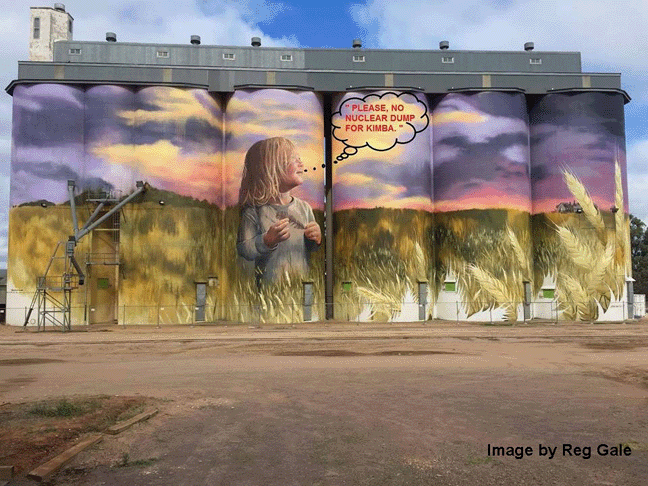
Resources Minister Keith Pitt’s formal declaration of Napandee, near Kimba in regional South Australia, as the location for a co-located radioactive waste disposal and storage facility is likely to see an escalation in community contest and opposition, the Australian Conservation Foundation said today.
ACF’s concerns with the plan include:
- No consent from the region’s Traditional Owners, the Barngarla people. Barngarla were actively excluded from key ‘consultation’ processes, including a highly restricted community ballot.
- The planned facility is unnecessary given federal parliament’s recent support for a $60 million waste storage upgrade to secure the most problematic intermediate level waste (ILW) at the Australian Nuclear Science and Technology Organisation’s (ANSTO) Lucas Heights nuclear site for the next three to five decades.
- Moving intermediate level waste from ANSTO, a site with many institutional assets – security, radiation monitoring and emergency response, local expertise etc – to a site near Kimba with far fewer assets and resources is irresponsible and inconsistent with best industry practice.
Further concerns are outlined in ACF’s 3-page background brief on radioactive waste plans.
“The Kimba plan is effectively redundant on the day Minister Pitt has made his decision,” said ACF’s national nuclear-free campaigner Dave Sweeney.
“Extended storage of Australia’s most problematic waste at Lucas Heights where most of it is already stored, makes far more economic, environmental and radiological sense than the ill-considered Kimba plan.
“Sites that currently store and manage nuclear medicine waste around Australia will still need to do so, irrespective of the status of any national facility, so the Minister’s repeated reference to nuclear waste being spread across 100 sites is disingenuous and inaccurate.
“The planned federal action is contrary to SA state law and does not enjoy bi-partisan political support.
“Fewer than one thousand South Australians have had a say in a plan that has profound inter-generational implications.
“This is particularly concerning given the prospect of project creep as atomic enthusiasts spruik domestic nuclear energy in the context of the proposed acquisition of nuclear-powered submarines.
“Minister Pitt is continuing the same top-down, flawed approach that has failed in the past.
“Minister Pitt’s decision is the start of a new stage in the campaign for responsible waste management.
“This politicised move will be contested in the Courts and on the streets.
“Setting up processes to manufacture consent – including denying a voice to Aboriginal Traditional Owners – speaks volumes about the poverty of the arguments in favour of the waste facility.
“If the Minister was convinced of the project’s merits he would not be cutting corners with Traditional Owners and the wider community or making myth about nuclear medicine.
“Canberra should stop playing politics and instead get serious about responsible radioactive waste management.
“This issue has a long way to run. The plan needs formal environmental and regulatory assessment and approval and is a long way from a done deal.”
ACF’s 3-page background brief on federal radioactive waste plans
Measure twice, cut once: Advancing responsible radioactive waste management in Australia
Kimba nuclear dump: Premier Marshall must enforce South Australia’s legislation
“The SA Nuclear Waste Storage Facility (Prohibition) Act was an initiative of the SA Olsen Liberal government to prevent the imposition of an intermediate-level nuclear fuel waste dump in SA. The state legislation was strengthened by the Rann government in 2002. Premier Marshall should fight Canberra’s push to dump nuclear waste on SA and to override state legislation, as did Premier Olsen and Premier Rann.
The Act mandates a state Parliamentary inquiry in response to any attempt to impose a nuclear waste dump on SA and the Premier should initiate that inquiry immediately.
The Morrison government’s plan to impose a national nuclear waste dump at Kimba still faces multiple hurdles despite today’s announcement from Minister Keith Pitt that the site has been formally declared and land acquired. Those hurdles include a judicial challenge to the declaration, environmental assessment, assessment by the federal nuclear regulator ARPANSA, a state parliamentary inquiry, and upcoming state and federal elections.
The Howard government had proceeded further towards imposing a dump on SA before abandoning the plan in 2004.
Dr. Jim Green, national nuclear campaigner with Friends of the Earth Australia, said: “The Morrison government’s disgraceful efforts to override the unanimous opposition of Barngarla Traditional Owners will be challenged in the courts. Barngarla Traditional Owners are expected to launch a judicial challenge following today’s announcement.
“Traditional Owners were excluded from the government’s sham ‘community ballot’ so they held their own ballot. When the results of the government’s ballot and the Barngarla ballot are combined, support falls to 43%, short of a majority and well short of the 65% that the government indicated was the benchmark to determine ‘broad community support’.
“Premier Steven Marshall’s support for a nuclear waste dump that is unanimously opposed by Barngarla Traditional Owners is unconscionable, crude racism and Friends of the Earth calls on the Premier to support Traditional Owners ‒ and all South Australians ‒ instead of shamefully falling into line behind his undemocratic, racist federal colleagues.
“The SA Nuclear Waste Storage Facility (Prohibition) Act was an initiative of the SA Olsen Liberal government to prevent the imposition of an intermediate-level nuclear fuel waste dump in SA. The state legislation was strengthened by the Rann government in 2002. Premier Marshall should fight Canberra’s push to dump nuclear waste on SA and to override state legislation, as did Premier Olsen and Premier Rann.
“The Act mandates a state Parliamentary inquiry in response to any attempt to impose a nuclear waste dump on SA and the Premier should initiate that inquiry immediately.
“The proposed nuclear dump will be contested at the SA and federal elections. Friends of the Earth welcomes SA Labor’s policy that Traditional Owners should have a right of veto over nuclear projects given the sad and sorry history of nuclear projects in this state. Deputy Leader Susan Close says that SA Labor is “utterly opposed” to the “appalling” process which led to the federal government targeting the Kimba site.
“The government’s claim that most of the waste arises from nuclear medicine is a blatant lie. The claim that 45 permanent jobs will be created is implausible. When the Howard government planned a dump in SA, it said there would be zero jobs.
“Measured by radioactivity, well over 90% of the waste is long-lived intermediate-level reactor waste that the federal government wants to store above ground at Kimba until such time as a deep underground disposal facility is established. No effort is being made to find a location for such a facility so this long-lived waste would remain stored above ground in SA ad infinitum. The only deep underground nuclear waste repository in the world, in the US state of New Mexico, was closed in 2014 following an underground chemical explosion in a nuclear waste barrel.
“Intermediate-level waste should be stored at ANSTO’s Lucas Heights site until a suitable disposal facility is available. The Morrison government’s plan to move intermediate-level waste from secure above-ground storage at Lucas Heights to far less secure storage at Kimba is absurd and indefensible.
“South Australians fought long and hard to prevent the Howard government turning SA into the nation’s nuclear waste dump. We fought and won the campaign to stop the Flinders Ranges being used for a national dump. We fought and won the campaign to stop SA being turned into the world’s high-level nuclear waste dump. And now, we will fight until the Morrison government backs off.”
Minister Keith Pitt confirms that the federal government has bought the land at Kimba for the national nuclear waste dump.

Kimba confirmed as home to nuclear waste facility, The Advertiser, 29 Nov 21,
Small Eyre Peninsula town of Kimba confirmed by Canberra as home to Australia’s new nuclear waste facility.
The small Eyre Peninsula town of Kimba will be home to a $325m nuclear waste facility for Australia, with Resources Minister Keith Pitt confirming the federal government has acquired land to build the complex.
Mr Pitt said the decision to choose Kimba provided “a solution that has eluded consecutive governments for more than 40 years’’. In August, Mr Pitt said the 211ha site at Napandee farm, 24km west of Kimba, was the preferred location for the dump, which will store low-level radioactive waste permanently and some intermediate waste for several decades.
The selection of Kimba has divided the local community. Opponents believe a nuclear waste dump would ruin the area’s clean, green image, although a ballot run by Kimba Council in 2019 found 62 per cent of residents supported the facility. The Barngarla Determination Aboriginal Corporation has previously argued that it was not consulted about the site and has flagged it will ask for a Judicial Review of the decision………
Kimba Consultative Committee draft Minutes reveal what a mess the Federal Radioactive Waste dump project is in.
The most important part the draft minutes is the first item relating to the nature and activity of the radionuclides in the immediate level waste proposed to be stored at Kimba but there was no discussion recorded on this issue.
This should have probably been the main item of business of the meeting considering it is the major aspect of community safety but received scant attention
Peter Remta, 22 Nov 21, I was recently asked to comment on the draft minutes of the Kimba joint community meeting held on 24 October 2021 and attach them for your reference
The draft minutes are available on https://www.industry.gov.au/sites/default/files/2021-11/kimba-consultative-committee-kimba-economic-working-group-meeting-minutes-oct-2021.pdf?fbclid=IwAR3Ej8KsyWH8KtvfRlL5JXc8C3mubLJ5K5tThB1HMZfIfpI2c2M9_QO3Mdg
Suffice to say that the federal government is ill prepared to choose and pursue the Napandee site near Kimba and as I have previously shown it is a grossly unsuitable and highly expensive exercise
It tests common sense to continue with the plans for the facility as it will surely not be approved for the required licences
KIMBA COMMUNITY MEETING COMMENTS
I cringe when I read the draft minutes of the joint meeting at Kimba on 14 October 2021 and the explanations and reasons by the federal government’s personnel as recorded in those minutes relating to the proposed nuclear waste management facility at Kimba.
In most instances they are unconvincing and inconsistent explanations even bordering on the nonsensical considering that this is a most important and serious issue for this country deserving far better attention than has been given to it over the past few years.
From all of this is it is quite obvious that the radioactive waste management facility at Kimba is still in its infancy of planning and prematurely unprepared for its objectives which is hard to understand as the government has been assessing the various locations at Kimba for over five years and has so far spent up to $100 million for that purpose.
It is also a gross indictment on the competence of the government and its various agencies all of which has been aided and abetted by the responsible ministers involved which should be gauged in the light of
the imminent ministerial declaration of Napandee near Kimba as the site for the management facility as mentioned in section 2 of the draft minutes
The most important part the draft minutes is the first item relating to the nature and activity of the radionuclides in the immediate level waste proposed to be stored at Kimba but there was no discussion
recorded on this issue.
This should have probably been the main item of business of the meeting considering it is the major aspect of community safety but received scant attention.
I have pointed out previously that based on the best available scientific and technical information internationally the details and levels of the radionuclide activity in any nuclear waste to be stored (as that at Kimba) is of prime importance since it becomes the determining factor for the selection of an appropriate site for storage and the manner in which the storage is undertaken.
This means that there can be no realistic designs – however conceptual of any storage facility until that information on the radionuclides is fully disclosed and understood and hence the conceptual designs for
Kimba so far put out by the government are nothing more disingenuous and misleading promotional material to try and convince a rather sceptical public.
What is more the details of the radionuclides inventories and activity should have been given to the community at Kimba when the various locations were initially identified as possible sites for the facility
but this has still not been done to this day
Kimba, South Australia, as a nuclear ”sacrifice zone”

Below is an article from the Port Lincoln Times. Like most articles from the region, it appears to be written with breathless delight over the joys of Kimba, South Austraklis getting a ? temporsry nuclear waste dump.
It was the headline that got me.
What do they mean – ”SACRIFICE ZONE’? Does it simply refer to what everyone knows – that the dump will be a financial white elephant, trashing the area’s previous clean green agricultural reputation?
Or does it carry the more sinister meaning, of damage to health and environment, as Rusdsia’s Mayak site, and Fukushima, have been labelled as ”sacrifice zones”?
Grants recognise Kimba’s sacrifice Bianca Iovino, 17 Nov 21,
The Kimba region will benefit from another $2 million in grants, acting as a recognition of the strain the anticipated National Radioactive Waste Management Facility has had on the community.
Kimba Mayor Dean Johnson said the grants rewards community engagement in what’s been a long and difficult conversation about the facility.
“I think there’s a real air of excitement and expectation in the community at the moment, but the truth is not everyone agrees on this, there are people who strongly appose it and that hasn’t changed,” he said.
“But to have another $2 million to spend in our community is really exciting, and I can’t wait to see the projects that get put forward.”
Resources and Water minister Keith Pitt said the program recognises the significant amount of time, effort and disruption caused to the town following an over five years consultation process regarding the facility….. The official location of the site is yet to be confirmed, but a Notice of Intention to Declare has been lodged and and an announcement is imminent. https://www.portlincolntimes.com.au/story/7511178/grants-recognise-kimbas-sacrifice/?cs=1500&fbclid=IwAR3qWas_23kw_rcX6yKFSUePG8zM1WydYsVXgV8CN2Rz-KGaiz0AoJWnG5Q
Australia needs independent Inquiry on nuclear production and wastes. Kimba nuclear dump plan is not supported by facts.
Nuclear waste and nuclear medicine in Australia
Jim Green, Online Opinion, 16 Nov 2021, https://www.onlineopinion.com.au/view.asp?article=21721&page=0
Claims that the Australian government’s proposed national nuclear waste storage and disposal ‘facility‘ near Kimba in South Australia is required to support nuclear medicine are not supported by the facts.
Australia’s radioactive waste arises from the production and use of radioactive materials in scientific research and industrial, agricultural and medical applications. The Australian Nuclear Science and Technology Organisation (ANSTO), operator of the research reactor at Lucas Heights, south of Sydney, is the main source of waste destined for a national nuclear waste facility. (Other waste streams ‒ such as those generated at uranium mines, and wastes from nuclear weapons testing ‒ would not be disposed of at the national facility.)………….
Scare-mongering
Regardless of the outcome of the current push for a national waste facility ‒ and bearing in mind that all previous plans have been abandoned ‒ there will be an ongoing need for hospitals to store clinical waste. After nuclear medicine is used in a patient, the vast majority is stored on site while it decays. Within a few days, it has lost so much radioactivity that it can go to a normal rubbish tip. There will always be multiple waste storage locations even if a national facility is established.
The government’s claim that a national waste facility is urgently required lest nuclear medicine be affected amounts to scare-mongering………….
health professionals noted in a joint statement in 2011: “The production of radioactive isotopes for nuclear medicine comprises a small percentage of the output of research reactors. The majority of the waste that is produced in these facilities occurs regardless of the nuclear medicine isotope production. Linking the need for a centralised radioactive waste storage facility with the production of isotopes for nuclear medicine is misleading.”………..
ANSTO’s Lucas Heights site
ANSTO’s Lucas Heights site cannot be used for disposal of nuclear waste. It is unlikely that the site would meet relevant criteria, and in any case federal legislation prohibits waste disposal there.
But nuclear waste can be (and is) stored at Lucas Heights; indeed much of the waste destined for a national facility is currently stored there.
Claims that storage capacity at Lucas Heights is nearing capacity and that a national waste facility site is urgently needed have been flatly rejected by Dr Carl-Magnus Larsson, CEO of the federal nuclear regulator, the Australian Radiation Protection and Nuclear Safety Agency (ARPANSA). Dr Larsson stated in parliamentary testimony in 2020: “Waste can be safely stored at Lucas Heights for decades to come”.
Similar comments have been made by ANSTO officers, by the federal government department responsible for radioactive waste management, and by the Australian Nuclear Association. ANSTO officers have noted that “ANSTO is capable of handling and storing wastes for long periods of time” and that waste is stored there “safely and securely”.
Long-lived intermediate-level waste
Of particular concern is long-lived intermediate-level waste (ILW) including waste arising from the reprocessing of irradiated nuclear fuel from the OPAL research reactor at Lucas Heights as well as earlier research reactors. The government plans to move this ILW to the Kimba site for above-ground storage while a deep underground disposal site is found. (Lower-level wastes will be permanently disposed of at Kimba if the project proceeds.)
But the process of finding an ILW disposal site has barely begun and will take decades; indeed ARPANSA has flagged a timeline of 100 years or more.
The vast majority of ILW is currently stored at Lucas Heights. Why not leave it at Lucas Heights ‒ described by an ANSTO officer as “the most secure facility we have got in Australia” ‒ until a disposal site is found? The government doesn’t have a good answer to that question ‒ indeed it has no answer at all beyond false claims about storage capacity limitations and scare-mongering about nuclear medicine supply.
Until such time as a disposal site is available, ILW should be stored at Lucas Heights for the following reasons:
* Australia’s nuclear expertise is heavily concentrated at Lucas Heights;
* Storage at Lucas Heights would negate risks associated with transportation over thousands of kilometres;
* Security at Lucas Heights is far more rigorous than is proposed for Kimba (a couple of security guards); and
* Ongoing storage at Lucas Heights avoids unnecessary costs and risks associated with double-handling, i.e. ILW being moved to Kimba only to be moved again to a disposal site.
Conversely, above-ground storage of ILW in regional South Australia increases risk, complexity and cost ‒ for no good reason.
Need for an independent inquiry
The current plan for a waste facility at Kimba should be scrapped. It is unacceptable to be disposing of nuclear waste against the unanimous wishes of Barngarla Traditional Owners, and ILW storage at Kimba makes no sense for the reasons discussed above.
Australia needs a thorough independent inquiry of both nuclear waste disposal and production. We need a long-term disposal plan that avoids double-handling and unnecessary movement of radioactive materials and meets world’s best practice standards.
An inquiry should include an audit of existing waste stockpiles and storage. This could be led by the federal nuclear regulator ARPANSA in consultation with relevant state agencies. This audit would include developing a prioritised program to improve continuing waste storage and handling facilities, and identifying non-recurrent or legacy waste sites and exploring options to retire and decommission these.
An inquiry would also identify and evaluate the full suite of radioactive waste management options. That would include the option of maintaining existing arrangements until suitable disposal options exist for both ILW and lower-level wastes.
Radioisotope production options
We also need to thoroughly investigate medical radioisotope production options with the aim of shifting from heavy reliance on reactor production in favour of cyclotrons (a type of particle accelerator). Among other advantages, cyclotrons produce far less radioactive waste than research reactors…………. https://www.onlineopinion.com.au/view.asp?article=21721&page=0
Unanswered questions and problems in secretive Kimba Consultative Committee about the proposed nuclear waste dump
Kazzi Jai 13 Nov 21, Fight to stop a nuclear waste dump in South Australia, For those who are time poor, here are some “gems” which stand out from the last DRAFT minutes of the KCC October 14th, 2021…..

The “community conversations” are not open to anyone. Apparently they invite an interest group – and then representatives are to be selected to represent that interest group ….
Honestly – we are talking of a small country town council area – population of around 1000 if you include the children too….and they want to be SELECTIVE of who they have at these COMMUNITY CONVERSATIONS???!!!

Next…apparently the bribe money aka Community Benefit Program money which was announced by Minister Pitt in May 2021, successful nominations will be selected this time, not by AusIndustry as in all the other times….but by the Minister himself! Anyone smell an up coming election in the air?Cultural Heritage Assessment Plan…..O..M.G!! Got to love those “tick the box” things! Makes you feel like you are doing something – when you’re not doing ANYTHING AT ALL!! And get this – The “process” outlined will ONLY TAKE PLACE AFTER THE SITE IS ACQUIRED!!!!!!
Gotta love the line regarding a question about possible High Level Nuclear Waste storage …”that was not the case, and reiterated that there is no intention to expand the scope of the facility“….BUT LATER IN THE FOLLOWING PARAGRAPHS says “we cannot speak for the decisions of future governments”!!!!
Do they take people for fools??

Notice that they are AVOIDING the term NATIONAL when referring to the Nuclear Dump? Is this deliberate? Because it will be the NATIONAL DUMP AND THAT IS WHERE ALL THE NUCLEAR WASTE WILL END UP!! WHETHER IT IS LOW, INTERMEDIATE OR HIGH!!Soil Management and Fire Hazard Management….Well, Well, Well…..Got very excited about – where the discussion would go on this one, – but alas, the discussion was curtailed to only within the confines of the proposed dump area! Too bad that OTHER FACTORS OUTSIDE THE PROPOSED DUMP AREA WILL AFFECT IT TOO!!
Another sideline little gem of information…..”Mr Osborn advised members that the CEO is expected to commence in January 2022, in the Adelaide office, and following a handover period, Ms Sam Chard, A/g Head of Division for ARWA, will move to another senior leadership role within the Australian Public Service.”
So does that mean she ISN’T staying as the General Manager of ARWA anymore after being the Acting Head of Division for ARWA?Another interesting comment …”Mr Osborn reminded members that ARWA is a separate entity from the facility, and will be looking at all radioactive waste management matters in Australia.“
….Just keep that one in your back pocket for future reference – In all likelihood the NRWMF may become a casualty of privatization by the Government to “cut loose” anything which presents ” a drain on public taxpayers’ purse strings”!! International Dump here we come!!
Oh….the Information Centre may be in town and may end up being staffed BY VOLUNTEERS!
Where are these HIGH PAYING JOBS??
They seem to be DISAPPEARING right before our eyes!!Then lo and behold…..Sam Chard made an appearance via video conference! Didn’t stay long, but long enough to say that ..”letters of comfort will be provided to ANSTO, meaning they may be able to start pre-conditioning their waste holdings…“
This is a BIT PREMATURE given that the Notice for Declaration by Minister Pitt was STILL OPEN when she made this comment on October 14th, 2021!! The Notice for Declaration only closed on October 22nd 2021!On that HIGH NOTE, I’ll leave it there…… https://www.facebook.com/groups/344452605899556
The Australian Radiation Protection and Nuclear Safety Agency (ARPANSA) must be required to fully inform the Kimba community of the safety and financial risks of the nuclear dump
[importance of] the community at Kimba getting their own full and independent assessment and report on the government’s intentions for Napandee assisted by both government funding and by access to all records and information for that purposeAnother issue forThe Australian Radiation Protection and Nuclear Safety Agency (ARPANSA)
NAPANDEE ASSESSMENT
It is the intention of ANSTO to store intermediate level nuclear waste at the proposed nuclear waste management facility at Napandee near Kimba in South Australia for an indefinite period but suggested to be 30 years

Since it is merely the storage of the intermediate level waste ANSTO is suggesting that it is not necessary to obtain any licences from ARPANSA for that purpose and consequently will not be making any application to ARPANSA in that regard
This is clearly against the concept of the enabling legislation and irrespective of this suggestion ARPANSA as the statutory regulator must insist on ANSTO having an appropriate licences for both the storage of the intermediate waste at Napandee and for the construction of the required facility for the increased storage capacity at Lucas Heights
Should there be any reluctance by ARPANSA in enforcing the licensing compliance by ANSTO then legal action will need to be taken by way of mandamus by interested parties which would be the Kimba community to make certain that the required licences will be sought by ANSTO
In order to ensure that the community position is fully protected ARPANSA should provide adequate funding either directly or by
government grant to the community to enable them to obtain proper and detailed legal advice and to undertake any appropriate actions that may be required or necessary to protect their position
This should be coupled with the community at Kimba getting their own full and independent assessment and report on the government’s intentions for Napandee assisted by both government funding and by access to all records and information for that purpose
This is an essential requirement for enabling the community at Kimba to understand and negotiate with full knowledge of the safety case required for the Napandee facility as the independent assessment will no doubt be critical of the inappropriate and unsuitable site selection and nature of the facility by way of above the ground storage
The special rapporteurs of the United Nations Human Rights Council for the sound management and disposal of hazardous substances including nuclear wastes and for the rights of indigenous peoples are aware of the Kimba community concerns and will monitor the situation and if necessary take appropriate action to ensure protection of their human rights
Kimba agricultural group supports nuclear waste stored at Lucas Heights, rejects dump on farming land.

Waste war over Kimba https://www.whyallanewsonline.com.au/story/7469993/waste-war-over-kimba/?fbclid=IwAR0kw1aDb_t9KiGaLWcEdC7UgEqGYVPGtSUYu6quCNKxi5hDXEGWH2r88KE
An anti-nuclear group are holding onto hope that the federal government will reconsider storing intermediate level waste (ILW) in Kimba, after attending a meeting in the rural town on Thursday.
The No Radioactive Waste on Agricultural Land in Kimba or SA are seeking answers as to why the government are planning to store ILW at Kimba as opposed to Lucas Heights.
It comes following a recent Parlimentary hearing where the Australian Nuclear Science and Technology Organisation (ANTSO) revealed it had the capacity to store ILW at Lucas Heights for “decades to come”.
President Peter Woolford said the group put this to the combined Kimba Consultative Committee (KCC) and Kimba Economic Working Group (KEWG) when they met in Kimba.
They also questioned if the recent nuclear-powered submarines deal made by the federal government would see submarine waste stored at Kimba, and if it was a gateway to a domestic nuclear industry.
“They indicated that no high-level waste would come to Kimba,” he said.
“When you look at what’s going on with ANTSO and the money being spent there for extended storage of intermediate level waste it makes sense to keep the waste there until a permanent dispoal site is found.”
Mr Woolford said storage of nuclear waste from decommissioned submarines would have been an essential part of the federal government’s plans.
“Obviously people are concerned about that because it is an issue…there has to be a waste pathway for all that waste and there isn’t one at the moment,” he said.
With Federal Resources Minister Keith Pitt intending to declare Kimba as the site for the Nuclear Radioactive Waste Management Facility (NRWMF), Mr Woolford believes there’s still time to prevent storage of ILW on agricultural land.
“The reality is the Minister has to declare the site, which could be this week, once they do that the Commonwealth can acquire the land,” he said.
The facility is coming here it’s just the matter of what’s stored in it … I can’t speak for everybody but at the present time it makes perfect sense that ILW stays in ANTSO.”
Minister Pitt has been contacted for comment.
Nuclear waste shipment to come from UK to Lucas Heights

Australia to receive UK nuclear waste shipment amid bitter dispute over national storage facilityTwo-tonne load to be stored at Sydney’s Lucas Heights until national facility built in several years https://www.theguardian.com/australia-news/2021/oct/21/australia-to-receive-uk-nuclear-waste-shipment-amid-bitter-dispute-over-national-storage-facilityTory ShepherdThu 21 Oct 2021 Two tonnes of nuclear waste will be shipped from the United Kingdom to Australia next year as debate continues over a national storage facility.
The shipment of four 500kg canisters inside a forged steel container called a TN-81 is part of a waste swap deal with the UK.
The intermediate-level waste is to be stored temporarily at Sydney’s Lucas Heights facility then sent to the national radioactive waste management facility the federal government plans to build near Kimba in South Australia
However that project is the subject of a bitter dispute, and is years away. It will take several years for all the regulatory approvals to pass, and the government has declined to nominate when it will start construction.
In 1996 Australia sent spent fuel rods from its Hifar reactor – the predecessor to the existing Opal multi-purpose reactor – to the UK to be recycled into fuel for nuclear power plants. The “radiologically equivalent” waste will be sent to Australia under the 2022 waste repatriation project.
The Australian Radiation Protection and Nuclear Safety Agency (Arpansa) reported this week that it is working with the UK’s Office for Nuclear Regulation “for the inspection of radioactive waste containers, set to return to Australia from the Sellafield Reprocessing Plant”.
The waste relates to the processing of spent fuel sent to the UK in earlier years from Australia’s former research reactor,” Arpansa said.
The Australian Nuclear Science and Technology Organisation (Ansto) says it successfully repatriated radioactive waste from France to Australia in 2015 and that the TN-81s had been used successfully in 180 nuclear shipments around the world.
The federal government says Lucas Heights does not have the room or the approvals to store the nation’s nuclear waste, which is spread across more than 100 sites, so it will commission a purpose-built dump. It settled on a site at Napandee, near Kimba in South Australia.
That plan has been deeply divisive.
A ballot run by the Australian Electoral Commission found more than 60% of people in the Kimba council area supported the facility, which would store mostly medical waste that is currently in separate sites all over the country.
But the traditional owners, the Barngarla people, say many were excluded from that ballot because they lived outside the council area. In a separate ballot, Barngarla voters unanimously rejected the proposal.
Chair of The Barngarla Determination Aboriginal Corporation, Jason Bilney, later welcomed amendments to the legislation that leave open the possibility of a judicial review.
Federal resources minister, Keith Pitt, has announced his intention to declare that Napandee will host the site. Before that declaration is made, however, there has been a consultation process for anyone who has a legal right or interest in the proposal.
Submissions to that consultation will close on Friday.
Pitt will consider any comments, and if he goes ahead and declares Napandee as the site, the federal government plans to acquire the land and begin preparations to build the facility – barring legal challenges.
Conservation Council of SA chief executive officer, Craig Wilkins, said the UK shipment highlighted the overall issues with creating a national facility. The facility will mostly store low-level waste but will temporarily store intermediate-level waste such as that coming from the UK.
Wilkins says Lucas Heights should store all waste until a permanent facility can be built.
“If this is genuinely our waste and we have a responsibility to look after it, then we need to do that properly,” he said.
“We need a genuine, long-term national approach to dealing with our waste, rather than this ad hoc temporary fix of shifting some of the waste across to SA to temporarily park it in above-ground sheds while they work out what to do with the waste long term. It makes sense to get the long-term solution first.”
International best practice is to bury the waste in a deep disposal site in the safest place in the country, he said. “That work hasn’t been done yet, and until it’s done the waste should stay … at Lucas Heights.”
The government says waste from more than 100 sites needs to be consolidated in a purpose-built facility and that neither Lucas Heights nor the CSIRO storage site at Woomera were intended for permanent storage.
The industry department argues Lucas Heights “is not large enough” because any free space is needed for an expansion of research activities, and that it is only licensed for temporary storage.
Debate over nuclear storage continues, as does debate over Australia’s planned acquisition of nuclear-powered submarines, and debate over whether Australia needs nuclear power.
Kimba Consultative Committee living in la la land over the prospect of stranded nuclear wastes.
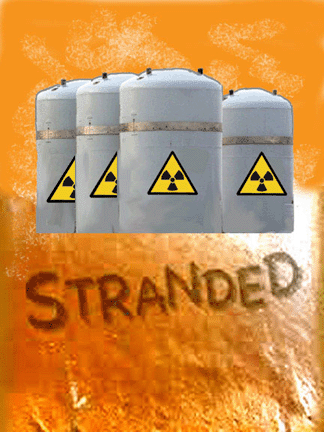
A VIEWING PLATFORM……Soooooo….let me get this right….People from around the world, will come flooding into Kimba (this is paraphrasing Adi Paterson’s claim that it will be a “tourist” attraction), to “view” the dump from a viewing platform!!!
And it gets better – “Members seem to be strongly for the visitor centre in the township and liked Mr Osborn’s idea about the viewing platform. It was also raised that they did not want to see the visitor centre offer coffee or lunch, as it would affect local businesses.”
 |
Kazzi Jai Fight to stop a nuclear waste dump in South Australia, 8 Oct 21,
For those time poor, here is a brief summary of the latest minutes of the Kimba Consultative Committee August 26th 2021
1. Downplaying Judicial Review….What a surprise! Biggest laughable line – “Choosing Napandee is an educated decision based on in-depth community consultation and extensive technical assessment work undertaken over a 4 year period, which started with voluntary land nomination by the owners of land.”!!
2. Cultural Heritage Assessment….to be done AFTER site acquisition because apparently “the work is quite costly and it would be prudent to wait until the site is acquired to spend further public money on this activity.”!!
3. Fluff words – no substance – “ARWA will work with ANSTO, CSIRO, and others to develop this research and implement an Australian appropriate disposal pathway in due course” – with respect to the “temporary” storage of Intermediate Level Nuclear Waste!
NOT ONE RED CENT SPENT YET TO DEAL PROPERLY WITH INTERMEDIATE LEVEL NUCLEAR WASTE – SO NOT GOING TO HOLD ONE’S BREATH ON THIS “PROMISE”….ALWAYS “LOOKING INTO IT” SEEMS TO BE THE FALLBACK ANSWER TO “APPEASE” PEOPLE….FROM WHAT WILL BE IN FACT STRANDED WASTE!!!!! ….Again….why is there no mention of a HOT CELL should the Intermediate Level Nuclear Waste be stored in Kimba? TN-81 casks ONLY have a 40 year lifetime manufacturer’s warranty. Given that it will now NOT be ANSTO’S PROBLEM – THEY ARE ONLY THE CUSTOMERS……WHERE DOES THIS LEAVE THE TN-81 WASTE??
4. Seems there is a REDUCTION in ACTUAL SECURITY already happening BEFORE EVEN DECLARATION OF THE SITE HAS HAPPENED!!…..”There were questions around the police presence in the community with an influx of people for construction, and whether this is something that has been considered. Mr Osborn said that this is something that needs further discussion with South Australian Police and Council. There will be security at the site, however it is yet to be decided if it will be Australian Federal Police (AFP).”
5. “Mr Osborn said that he envisaged a visitor centre in town and the possibility of there being a viewing platform at the facility where people can look over the site to get a birdseye view.”
A VIEWING PLATFORM……Soooooo….let me get this right….People from around the world, will come flooding into Kimba (this is paraphrasing Adi Paterson’s claim that it will be a “tourist” attraction), to “view” the dump from a viewing platform!!!
And it gets better – “Members seem to be strongly for the visitor centre in the township and liked Mr Osborn’s idea about the viewing platform. It was also raised that they did not want to see the visitor centre offer coffee or lunch, as it would affect local businesses.” https://www.facebook.com/groups/344452605899556
Dr Margaret Beavis on why nuclear waste is best kept at Lucas Heights, and on the advantages of cyclotrons.

concerningly, in terms of nuclear medicine, ANSTO has proved an unreliable supplier with multiple outages and supply shortages in the last few years. You will find references to that in our submission. When you’re sourcing from a single nuclear reactor, one break in the chain shuts down the whole process. If technetium were instead sourced from multiple cyclotrons, which could be based in hospitals around Australia at not a huge cost—certainly much less than a nuclear reactor—if one of these cyclotrons broke down, there would be multiple other cyclotrons to supply technetium.
Dr Carl-Magnus Larsson, head of ARPANSA, – the ‘waste could be safely stored at Lucas Heights for decades to come’. He said that there was no urgent need for relocation of this waste and that ARPANSA has not raised any safety concerns regarding storage of waste at the interim waste facility [at Lucas Heights]
PARLIAMENTARY STANDING COMMITTEE ON PUBLIC WORKS Intermediate level solid waste storage facility, Lucas Heights, New South Wales (Public) MONDAY, 13 SEPTEMBER 2021 BEAVIS, Dr Margaret, Vice President, Medical Association for Prevention of War (Australia) [by audio link] RUFF, Dr Tilman, AO, Member, Medical Association for Prevention of War (Australia) [by audio link]
Dr Beavis, Thank you for the opportunity to speak today. MAPW supports the construction of a new facility at Lucas Heights. As noted in ANSTO’s submission, there will be minimal expected impact on the community, and ANSTO has an excellent record of managing this waste on site. This contrasts with the massive distress and community division a succession of nuclear waste storage proposals have caused in regional and remote Australia.
I’ll now address the sort of individual criteria of the committee. The stated purpose and suitability: the facility is needed and the proposal is suitable. You’ve already heard Dr Carl-Magnus Larsson, head of ARPANSA, say that the ‘waste could be safely stored at Lucas Heights for decades to come’. He said that there was no urgent need for relocation of this waste and that ARPANSA has not raised any safety concerns regarding storage of waste at the interim waste facility [inaudible] ANSTO. Addressing the need for the work: clearly intermediate level waste has to be stored safely and securely. It’s radioactive for over 10,000 years. Putting that in perspective, the Egyptian pharaohs were about 5,000 years ago, so it needs to be kept safe for a very long time.
Addressing cost effectiveness: this plan may prove to be very cost effective if, as a result of the extra capacity, there is time for an open and independent inquiry looking at world’s best practice management of nuclear waste. Given current world’s best practice standards, it’s very likely that the plan to move the waste will not proceed.
At some point ANSTO does indeed need to address the proper disposal or long-term management of intermediate waste. Countries, such as Finland, have spent decades researching how best to do this, and Australia could learn a lot from their research and expertise. In terms of the current and prospective value of the work, as noted, this work may provide breathing space enabling the open—and I stress—independent review of the claimed need for a temporary storage facility in South Australia.
The work would have even greater value if waste production was also reviewed and curtailed. If this were done, the proposed new site at Lucas Heights would take much longer to fill and be available for a much greater time frame.
It’s worth remembering that the first principle of managing toxic waste is to reduce production. Currently ANSTO is rapidly expanding production of the nuclear medicine isotope called technetium-99 precursors, which is the most commonly used isotope. This export business continues because it is very heavily subsidised. There’s no cost-benefit analysis and no attempt at full cost recovery. Historically Australian supply has been one per cent of the world supply and, as a doctor, I support nuclear medicine. One per cent of the world’s supply has been what Australia has needed.
ANSTO is in the process of increasing from that one per cent for the last few years and aims to produce 25 to 30 per cent of global supply, with very little acknowledgement of the massively increased quantity of intermediate waste that this will generate.
On top of that, concerningly, in terms of nuclear medicine, ANSTO has proved an unreliable supplier with multiple outages and supply shortages in the last few years. You will find references to that in our submission. When you’re sourcing from a single nuclear reactor, one break in the chain shuts down the whole process. If technetium were instead sourced from multiple cyclotrons, which could be based in hospitals around Australia at not a huge cost—certainly much less than a nuclear reactor—if one of these cyclotrons broke down, there would be multiple other cyclotrons to supply technetium.
Additionally, clean cyclotron production of technetium has recently been approved through all the health hurdles in Canada. It’s being implemented now there. This should rapidly become the future of isotope production. It avoids the high cost and the serious accident and terrorist risk inherent in nuclear reactors. It has no weapons proliferation potential, and it creates very little nuclear waste. You can use pre-existing cyclotrons. There are already cyclotrons in hospitals making other isotopes. Japan, the US, the UK and several European countries are all looking into implementing more reliable, safer, cheaper and much cleaner cyclotron production of technetium-99 https://parlinfo.aph.gov.au/parlInfo/download/committees/commjnt/cfc4f9dc-b73c-4166-b484-eeaddcab5bc0/toc_pdf/Parliamentary%20Standing%20Committee%20on%20Public%20Works_2021_09_13_9111.pdf;fileType=application%2Fpdf?fbclid=IwAR0ZzP4j5ukpfZOgyipP2ak92avAEz19B2wqC_Zz4bcbCDXGB9cRcT2siFo#search=%22Australian%20Nuclear%20Scie
1 This month
To see nuclear-related stories in greater depth and intensity
– go to https://nuclearinformation.wordpress.com/


 Antinuclear