Defence continues its blanket secrecy on weapons exports
Mapping the revolving door between government and the weapons industry
Undue Influence revolving door database progresses
Undue Influence Substack, MICHELLE FAHY, NOV 4, 2023
Australia has approved 322 military or dual-use permits to Israel over the past six years, according to new figures the government provided last week in response to questions on notice from Greens Senator David Shoebridge. The period covered was January 2017 to March 2023.
Defence has previously admitted that it favours secrecy over transparency and accountability regarding its decisions on weapons exports.
As I reported in 2021, Defence elevates the protection of ‘commercially sensitive’ information and ‘opportunities for Australian companies’ above fundamental democratic principles of transparency and accountability.
The recent reports show that Defence Department secrecy around weapons exports has not improved with the change in government.
Australia is obliged under international law to ensure weapons exports are not used to commit human rights violations, but Defence’s ongoing secrecy means the public has no idea what the Department has approved for export in our name.
“Australia has a legal duty under the UN Arms Trade Treaty, which Australia actively promoted when it was a UN Security Council member, to ensure that weapons are not used to commit human rights violations,” says former United Nations legal expert and Australian government minister Melissa Parke, who now leads the International Campaign to Abolish Nuclear Weapons (ICAN). “Under the treaty, there must also be fully transparent public reporting about arms exports.”
Senator Shoebridge, the Greens’ defence spokesperson, said Australia had “one of the most secretive and unaccountable weapons export systems in the world”, given that it doesn’t break down the exact items exported.
Furthermore, Defence’s disclosure of the number of permits it has approved is a statistical veneer of limited value. Consider: one permit can cover multiple shipments or shipments to multiple countries. One permit can also cover multiple quantities, types and models of weapons or other items, whether physical or ‘intangible’ (electronic). In addition, as Defence freely admits, not all permits it approves proceed to export and delivery. Knowing the number of approved permits is therefore meaningless.
The ethical consequences of Defence’s policy of protecting the commercial interests of Australian weapons companies can be readily understood given the current war between Israel and Hamas: Australia is likely to have contributed towards the indiscriminate killing of innocent people in Gaza.
“Australia’s actions in approving arms exports to countries that are known to be committing serious violations of human rights, and its failure to be transparent about this, are inconsistent with its obligations under international law,” says Parke. “Having signed up to … these international laws, the Australian government can’t just cherry pick what aspects it’s going to abide by, especially when it … lectures other countries, such as China and Russia, about the importance of the international rule of law.” https://undueinfluence.substack.com/p/mapping-the-revolving-door-database-progress?utm_source=post-email-title&publication_id=297295&post_id=138509639&utm_campaign=email-post-title&isFreemail=true&r=1ise1&utm_medium=email
Australian leadership in Indo‑Pacific nuclear diplomacy
JOHN TILEMANN, The Interpreter, 3 Nov 23
With growing state capabilities in the region, “guardrails”
are more important than ever. Canberra can help.
Australia should again take a leadership role in nuclear diplomacy, working with regional neighbours, to reduce nuclear threats in the Indo-Pacific through confidence building and preventive diplomacy measures.
This was the call in an open letter to Prime Minister Anthony Albanese published this week by a cross-party and expert group of prominent Australians in the fields of public policy and nuclear security, urging the government to act to stem the rising tide of global nuclear threats – threats mostly generated today in the Indo-Pacific.
The seriousness of the danger has been acknowledged by regional leaders, including Australia’s prime minister. But it has yet to receive the high-level political attention it demands.
Eight of the world’s nine nuclear-armed states have strategic stakes in our region. Tensions among these nuclear players continue to rise, and the price of nuclear mistakes, or worse, intentional use of nuclear weapons, could be existential.
The numbers illustrate the danger…………………………………………………………………………………………………….
Long gone are the days of the relative simplicity of the bipolar world of two opposing blocs with a degree of stability arising from the doctrine of Mutually Assured Destruction. The multi-polar nuclear world of the Indo-Pacific is an even more dangerous place.
And additional nuclear complexity arises from the expectations of states benefiting from “ironclad treaty alliances” that the United States extends to Australia, Japan, South Korea, the Philippines and Thailand.
Both South Korea and Japan have expressed concern about the reliability of US strategic assurances, and both could build nuclear weapons quickly should they take that decision. Australia’s nuclear diplomacy must also address those proliferation pressures…………………………………………….
Global instruments to stop the spread of nuclear weapons and to cap nuclear weapon testing have been very successful – but there are big gaps in these regimes in the Indo-Pacific.
Three of the four countries to reject the Nuclear Non-Proliferation Treaty, designed to prevent the further spread of nuclear weapons, are in this region: India, Pakistan and North Korea. The formal entry into force of the global ban on nuclear weapon testing is blocked by eight countries in two areas of regional tension – the Middle East and the Indo-Pacific.
Widely supported proposals for a global ban on the production of materials used to make nuclear weapons – highly enriched uranium and plutonium – are also resisted by those in our region still growing their nuclear arsenals.
While remaining hugely important, global mechanisms must be supplemented by regional mechanisms. Even basic tools for crisis management such as hotlines are either unevenly maintained or non-existent.
The ASEAN Regional Forum brings together all relevant Indo-Pacific players but has had limited success in moving beyond information exchange to confidence building measures – and preventive diplomacy remains a distant ambition.
The East Asia Summit also engages all key Indo-Pacific strategic nuclear parties, but it has yet to become a mechanism for addressing security challenges, let alone reducing nuclear threats.
Nevertheless, Australia has a solid record of institution building from APEC through to its strong engagement with the ASEAN-led arrangements that have done much to establish the habits of regional dialogue. ……………………………………………………… more https://www.lowyinstitute.org/the-interpreter/australian-leadership-indo-pacific-nuclear-diplomacy
Australia must lobby US for ‘no first use’ of nuclear weapons, says ex-minister Gareth Evans
Former foreign minister says it is ‘sheer dumb luck’ that arms have not been used in the past 78 years and urges leadership on control measures
Daniel Hurst, Guardian, 1 Nov 23
Labor luminary and former foreign minister, Gareth Evans has urged Australia to lobby the US to promise “no first use” of nuclear weapons, warning that global arms control agreements “are now either dead or on life support”.
Evans says that in the wake of sealing the Aukus nuclear-powered submarine deal, the Albanese government should give “some comfort to ALP members and voters that we are really serious about nuclear arms control”.
Evans told Guardian Australia it was “sheer dumb luck” that the world had avoided a nuclear attack in the 78 years since the bombing of Hiroshima and Nagasaki, and “it is utterly wishful thinking to believe that this luck can continue in perpetuity”.
Evans joined arms control experts and former senior diplomats in urging the prime minister, Anthony Albanese, to take “a leadership role in addressing the rising nuclear threats in our region”.
Australia should appoint “a high-level envoy to engage our regional partners on an agenda of nuclear confidence building and preventive diplomacy measures”, according to a letter from the Asia-Pacific Leadership Network for Nuclear Non-Proliferation and Disarmament (APLN).
While the group’s letter to Albanese is not specific about policy measures, Evans offered his own view that Australia’s status as a close US ally “gives us a particularly significant potential role” in pushing to reduce nuclear risks.
“The most immediately useful step we could take would be to support the growing international movement for the universal adoption of No First Use doctrine by the nuclear-armed states,” Evans told Guardian Australia…………………………………….
In a stark warning about the security environment, Evans said the risk of nuclear weapons being used through human error, miscalculation or system error was “greater than ever, not least given new developments in AI and cyber-offence capability”.
“Nearly 13,000 nuclear warheads are still in existence, with a combined destructive capability of close to 100,000 Hiroshima- or Nagasaki-sized bombs, and stockpiles, especially in our own Indo-Pacific region … are now growing again,” he said.
“The taboo against their deliberate use is weakening, with Russia’s president, Vladimir Putin, talking up this prospect in language not heard since the height of the cold war.”
In addition to seeking universal support for “no first use”, Evans said other potential risk-reduction measures include cutting the number of weapons ready for immediate use……………………………………………….
The APLN letter gained support from high-powered experts including John Carlson, the former head of the Australian Safeguards and Non-Proliferation Office, and Ramesh Thakur, a former UN assistant secretary general.
Other signatories included John Tilemann, a former diplomat and international civil servant with the International Atomic Energy Agency, and Gary Quinlan, a former Australian ambassador to the UN.
The leader of the Greens in the Senate, Larissa Waters, backed the letter with the former Australian Democrats leader Natasha Stott Despoja and the former Labor minister for international development Melissa Parke. https://www.theguardian.com/australia-news/2023/nov/01/australia-must-lobby-us-for-no-first-use-of-nuclear-weapons-says-ex-minister-gareth-evans #nuclear #antinuclear #nuclearfree #NoNukes
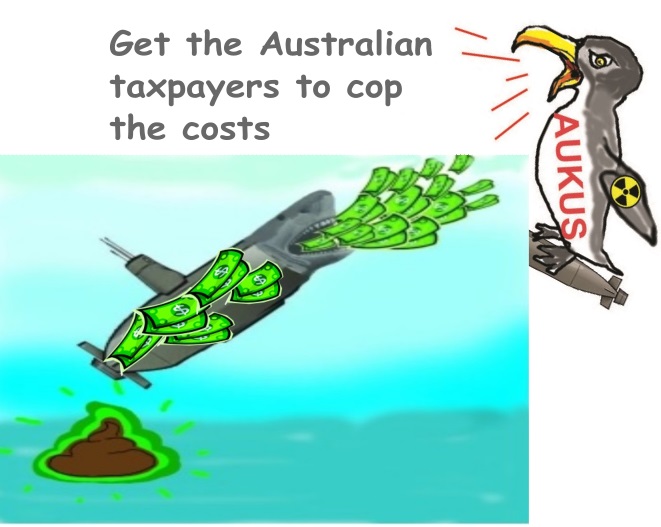
AUKUS nuclear submarine deal triggers accusations over cost and construction
SMH, By Daniel Keane 30 Oct 23
South Australia’s premier remains insistent that the nation’s future nuclear-powered submarines should be constructed in Adelaide, despite a prominent call for the vessels to instead be built by, and purchased from, another AUKUS nation in order to save taxpayers “billions and billions of dollars”.
Key points:
- Alexander Downer has called for all of the nation’s future nuclear subs to be built overseas
- But SA premier Peter Malinauskas says Australia should build them “for national security reasons”
- Mr Downer also said the question of storage of AUKUS nuclear waste needs to be addressed
Former foreign affairs minister Alexander Downer has described the AUKUS project’s $368 billion price tag as “eye-watering”, and said he expects a future federal government to abandon the local construction element of the deal.
“We’re just going to wreck Australia if we keep promising to spend money on any manner of projects and have no idea where the money is going to come from,” Mr Downer told the ABC on Sunday.
“I don’t think the existing federal parliament or the next one is going to make a decision on this, but I think down the years, in the end, the federal government will decide that this is just too expensive, and they will buy the submarines from overseas.
“I’d be almost certain of that.”
Responding to similar comments Mr Downer made in The Weekend Australian, SA premier Peter Malinauskas said it is vital that Australia develops the ability to build the vessels “for national security reasons”, but also because “neither the US nor the UK in the long term have the capacity” to construct Australia’s entire fleet.
“They are struggling to meet their own demand,” Mr Malinauskas said.
Under the current terms of the AUKUS pact, Australia will get three US-made Virginia-class submarines while it builds up to eight nuclear-powered submarines of its own.
Mr Malinauskas accused Mr Downer of “misunderstanding” the intentions and expected outcomes of AUKUS…………………………………………………………..
But Mr Downer has rejected the premier’s comments, and in turn accused Mr Malinauskas of failing to understand the economics of AUKUS.
“I have a challenge to the premier — to explain where all this money is going to come from, and why does the premier think it’s better we spend eye-watering amounts of money on building nuclear submarines in Adelaide rather than investing … in other parts of our economy?” Mr Downer said……………………
“Peter Malinauskas and [SA opposition leader] David Speirs will be well and truly retired by the time this project comes about.
“It’s easy for them to make any manner of promises about times in the future, which will be way beyond their political life span — we can all make promises about the Second Coming.”
Mr Downer also said the question of storage of nuclear waste from the subs had not been satisfactorily addressed.
“There’s some elements of the Labor Party who have reservations, or are opposed to, nuclear-powered submarines and any association with nuclear power, and so I part company with them on that,” he said.
“But you’re going to have to store the waste somewhere. I’m not sure where that will be stored.” https://www.abc.net.au/news/2023-10-29/sa-premier-defends-aukus-after-alexander-downer-questions-cost/103036822
Australian Submarine Agency stated Osborne, South Australia for building nuclear submarines, – but Osborne is totally unsuitable!

25 Oct 23
The latest reliable information is that Osborne, South Australia, is unsuitable for the construction of the new hybrid nuclear power submarines in that it is far too small.
Besides it in its inherent size, being too small without any capacity for expansion, the submarines building
facility will require two concentric buffer zones for which there is simply no room based on the reports in
InDaily.
The first of these buffer zones will be immediately surrounding the Osborne complex and will be a “
shoot to kill“ buffer zone for high security.
The external buffer zone surrounding the first one will be fairly substantial and is to ensure complete
environmental and similar protection
It is therefore daydreaming to put up Osborne for the construction of the hybrid nuclear powered
submarines
From INDAILY 11 October 2023, Radiation monitoring at SA nuclear subs: – “In a written response to InDaily, a spokesperson from the Australian Submarine Agency said they had informed the State Government, Port Adelaide Enfield Council, and the PortnAdelaide residents Environment Protection group of the environmental baseline contamination assessment at Osborne.
“This assessment will determine existing levels of non- radiological contaminants and background radiation on the preferred site for the Submarine Construction Yard and surrounding areas,” the spokesperson said.” –
This is at first instance no more than a good political photoshoot based on ignorance .
It seems that as pointed out by Rex Patrick the government has failed to learn anything from the ill fated and expensive Kimba situation
Having regard to the warnings by ANSTO it also seems that yet again there is no consensus by the various organs of the federal government
Finally it is interesting that Susan Close who is the deputy premier of South Australia and is ostensively regarded environmental scientist has had little to say on this situation which is similar to her stance on Kimba.
Both the federal and state governments should heed the excellent study entitled RESET OF AMERICA’S NUCLEAR WASTE MANAGEMENT Strategy and Policy by Professor Rod Ewing and his assembled experts to properly understand the implications and requirements of the possible start of a nuclear installation such as in this instance.
The work now being undertaken should immediately start a safety case for full community consultations which seems most appropriate since media polls suggest that more than 70% of South Australia’s population is against any nuclear activity
This situation is just another black mark for the International Atomic Energy Agency (IAEA) for not approving the implementation of AUKUS under the nonproliferation treaty
Antipodean Nuclear Free Zones: Testing Times for Antarctica and the South Pacific
October 19, 2023 https://nonproliferation.org/antipodean-nuclear-free-zones-testing-times-for-antarctica-and-the-south-pacific/
Australia and New Zealand have historically promoted strong anti-nuclear policies at both a global, regional, and sub-regional level. They joined with the United States and the other original parties to the 1959 Antarctic Treaty to make Antarctica nuclear free.
Both countries also took France to the International Court of Justice in 1973 in order to bring about a halt to France’s nuclear testing program in the South Pacific, and actively promoted the South Pacific Nuclear Free Zone in the 1985 Treaty of Rarotonga.
However, in 2021 Australia along with the UK and US announced the AUKUS initiative, which in March 2023 was finalized in San Diego. Australia will eventually acquire AUKUS nuclear-powered submarines during the 2030s.
This has placed a spotlight on Australia’s anti-nuclear credentials and its international law commitments and has attracted criticism from within the Asia Pacific, including from New Zealand, Pacific island states, and China. This seminar considers these issues through the lens of international law.
VIDEO – on original
Chapters:
00:00:00 Moderator: Avner Cohen, Professor, Nonproliferation and Terrorism Studies, Middlebury Institute of International Studies
00:01:44 Speaker: Donald R. Rothwell, Professor of International Law, ANU College of Law, Australian National University
00:57:07 Q&A
Australian Red Cross calls on the Australian Government to sign and ratify the Treaty on the Prohibition of Nuclear Weapons.

Black Mist and the Ban
On the 70th anniversary of the first nuclear weapon test on mainland Australia, we support the call for a nuclear weapons ban.
On the 70th anniversary of the first nuclear weapon test on mainland Australia at Emu Field on Anangu Pitjantjatjara Yankunytjatjara (APY) lands, and at a time when people in Australia consider deeply new ways to address realities in the experience of First Nations people, we support the call for Australia to urgently join the Treaty on the Prohibition of Nuclear Weapons.
On 15 October 1953, the first nuclear weapons testing on mainland Australia took place at Emu Field as part of Operation Totem. This was only one in a series of twelve major nuclear weapons tests and the hundreds of smaller-scale trials conducted in Australia from 1952 to 1963. Today, First Nations People continue to suffer long-term and inter-generational effects from these blasts, impacting their health, communities, and homelands.
The devastating legacy of nuclear weapons testing in Australia cannot be undone, it must never be forgotten and we, as Australians, must do everything in our power to right these wrongs. These actions include compensating affected communities, remediating contaminated lands, and recommitting to the fight in ensuring that these weapons are never used again.
The Treaty on the Prohibition of Nuclear Weapons (TPNW), as the first and only treaty to comprehensively ban these bombs, recognises their disproportionate impact on Indigenous communities. The Treaty, which also provides for victims’ assistance and environmental remediation, is the clear path forward to addressing these weapons’ destructive force in Australia.
Australian Red Cross calls on the Australian Government to sign and ratify the TPNW. We endorse the “Black Mist and the Ban” Statement, released by the International Campaign to Abolish Nuclear Weapons and co-drafted by Karina Lester, Yankunytjatjara Anangu woman and second generation survivor of the Emu Field nuclear tests, urging the Government to take swift action towards the complete elimination of nuclear weapons.
Accident on nuclear submarine would leave Australia ‘unavoidably’ responsible, says US report.

9 news By Richard Wood • Senior Journalist Oct 4, 2023
Australia would “unavoidably” become responsible for stopping an accident once it sails American-made nuclear powered submarines under the AUKUS deal, a report warns.
The warning comes in a study prepared for US legislators that looks at the potential impacts of the Royal Australian Navy acquiring the submarines.
Australia will spend up to $368 billion by 2055 to build a new fleet of eight nuclear-propelled submarines in Adelaide to enter service in the 2040s under the costliest defence project in the nation’s history.
But any accident on one of the vessels would have potentially huge ramifications, the Congressional Research Service report said.
Any mishap might “call into question for third-party observers the safety of all US Navy nuclear-powered ships”.
It would likely impact support by the American public for operating US Navy nuclear-powered submarines.
Foreign ports might also be put off from hosting the vessels, thus affecting the US Navy’s deterrent ability against potential adversaries such as China and Russia………………..
The federal government confirmed earlier this year that Australia will take delivery of three US Virginia-class nuclear-powered submarines by the early 2030s.
The report comes after a group of Republicans in the US Senate in July expressed their fears that selling nuclear-powered submarines to Australia through the AUKUS arrangement would leave their own navy short.
They demanded more funding for the US military before they said they would support the sale.
But Australian Defence Minister Richard Marles said he was confident the US Congress would pass the AUKUS deal.

Aukus: UK defence giant BAE Systems wins Australian £3.95bn #nuclear submarine contract
BBC News By Peter Hoskins, Business reporter 2 October 23 #antinuclear #nuclear-free #NoNukes
Britain’s biggest defence firm, BAE Systems, has won a £3.95bn ($4.82bn) contract to build a new generation of submarines as the security pact between the US, UK and Australia moves ahead.
In March, the three countries announced details of the so-called Aukus pact to provide Australia with nuclear-powered attack submarines by the late 2030s.
The pact aims to counter China’s ambitions in the Indo-Pacific region.
Beijing has strongly criticised the three countries over the deal.
……………………..”This multi-billion-pound investment in the Aukus submarine programme will help deliver the long-term hunter-killer submarine capabilities the UK needs to maintain our strategic advantage and secure our leading place in a contested global order,” UK Defence Secretary Grant Shapps said as the Conservative party conference got under way in Manchester.
………………….Other major UK defence contractors are also getting a boost from the Aukus deal.

In March, it was confirmed that Rolls-Royce Submarines would provide all the nuclear reactor plants that will power the SSN-Aukus vessels.
In June, Rolls-Royce said it would almost double the size of its Raynesway facility in Derby as a result of the deal. On Sunday, Babcock International, which maintains and supports the UK’s submarines, said it had signed a five-year deal with the Ministry of Defence to work on the SSN-Aukus design.
The Aukus security alliance – which was first announced in September 2021 – has repeatedly drawn criticism from China.
However, the three Western countries say the deal is aimed at shoring up stability in the Indo-Pacific more https://www.bbc.com/news/business-66979798
BAE lands £4bn contract for Aukus attack submarines

Britain has signed contracts worth GBP4 billion to finance a new phase of
the SSN-Aukus next-generation attack submarine project, according to
government officials. The deals, which involve British companies BAE
Systems PLC, Rolls-Royce Holdings PLC and Babcock International Group PLC,
are part of the Aukus military alliance between the US, Australia and the
UK to counter China in the Asia-Pacific region.
London South East 2nd Oct 2023
Let’s Label #USPropaganda – Call it out. Our crews at Boeing and disrupting General Mick Ryan/
Age Peace 21 Sept 23
Wage Peace friends have been out disrupting the US propaganda machine.
Last week our friends interrupted this public lecture. General Mick Ryan is there at the lectern. He’s an ex-ADF General – now a #USPropagandist – and he’s about to tell people about why we must prepare for war by buying more US weapons.
ALP stalwart Paul Lucas moves in. But even 30 minutes later we were still there telling an alternative story about what is going on!
| –Last week our friends interrupted this public lecture. General Mick Ryan is there at the lectern. He’s an ex-ADF General – now a #USPropagandist – and he’s about to tell people about why we must prepare for war by buying more US weapons. ALP stalwart Paul Lucas moves in. But even 30 minutes later we were still there telling an alternative story about what is going on!Watch on YouTube as we disrupt his latest propaganda engagement. #BewareBoeingsWars Boeing is a weapons companyOur friends also attended Boeing slowly walking up to their suburban location in Brisbane. We prevented the weapons dealers arriving for work. Beware Boeing’s wars we warned. Boeing is a weapons company. With BAE, Thales, and General Dynamics, Boeing is pushing for war while taking the big bucks from Australians. #EarthCareNotWarfare |
Australia’s Navy Pursues Nuclear Submarines and AI-Powered Ghost Sharks

the potential for AI-driven robots to make lethal decisions independently,
https://www.gktoday.in/australias-navy-pursues-nuclear-submarines-and-ai-powered-ghost-sharks 10 Sept 23
Australia’s Navy is adopting two contrasting approaches to advanced submarine technology to address the challenges posed by a rising China. On one hand, Australia is investing in a costly and slow project to acquire up to 13 nuclear-powered attack submarines. On the other hand, Australia is rapidly developing AI-powered unmanned submarines called “Ghost Sharks,” AI-powered subs will be delivered in the near future, offering a cost-effective and swift solution to enhance naval capabilities. The divergent approaches highlight the transformative impact of automation and AI on modern warfare.
How do the cost and delivery timelines of the nuclear submarines and Ghost Sharks differ?
The nuclear submarines are estimated to cost over AUD$28 billion each and will not be delivered until well past the middle of the century. In contrast, Ghost Sharks have a per-unit cost of just over AUD$23 million and will be delivered by mid-2025.
Significance of the Ghost Shark project
The Ghost Shark project illustrates the transformative impact of automation and AI on modern warfare, offering a cost-effective and swift solution to enhance naval capabilities. Such AI-powered unmanned submarines can operate autonomously, descend to greater depths, and be deployed in large numbers without risking human lives. They offer increased flexibility, cost-effectiveness, and the ability to perform maneuvers that might be impossible for crewed submarines.

Link to Geopolitical Challenges?
Australia’s investments in advanced submarine technology are linked to the geopolitical challenges posed by a rising China in the Asia-Pacific region. These developments are part of efforts to maintain military capabilities and respond to regional security concerns.
nfluence of AI
AI technology is influencing the development of various military capabilities, including autonomous weapons, fighter drones, swarming aerial drones, and ground combat vehicles. AI is also playing a role in data analysis and decision support for military commanders.
The AI technology arms race has high stakes in terms of military dominance and geopolitical influence. Winning the race could reshape the global political and economic order, with potential consequences for peace and stability in the Asia-Pacific region.
Challenges of AI
Challenges and concerns include the potential for AI-driven robots to make lethal decisions independently, the need for regulation related to the military application of AI, and the ethical considerations of using AI in warfare, including the targeting of combatants and non-combatants.
Private Sector’s Role

Private companies like Anduril are actively involved in developing AI-powered military technologies. They are contributing to the development of autonomous systems, sensor fusion, computer vision, edge computing, and AI, with applications in various defense domains, including submarines, drones, and counter-drone systems.
Nuclear deterrence is a dangerous fraud
The theory of nuclear deterrence is a feeble excuse for nations to hold onto their weapons of mass destruction and a fraud that must be exposed, writes Dr Sue Wareham. 23 Aug 23 https://independentaustralia.net/politics/politics-display/nuclear-deterrence-is-a-dangerous-fraud,17833
Dr Sue Wareham OAM is President of the Medical Association for Prevention of War (Australia) and a past board member of ICAN (the International Campaign to Abolish Nuclear Weapons) Australia.
HOW IS IT that “homo sapiens” has persisted with an invention that threatens our very survival, strikes fear in the heart of every rational one among us, diverts an unconscionable quantity of our collective time, labour and finances from things that are actually useful, and at the same time could be eliminated?
All we need to do is dismantle the invention and prioritise efforts to ensure that it remains a historic relic. That could all be done. Our failure to do so thus far is such an extraordinary gamble on our future that we must examine the reasons.
The invention is, of course, nuclear weapons. The answer to the opening question is not so straightforward, but given our current all-time high risk of these weapons being used, the question has never been more important. And given Australia’s rapidly growing enmeshment with the only nation that has used these weapons thus far in warfare, we in Australia have a particular interest in it.
The first response to the question that often comes to mind is that of “power”. That’s true, a tiny minority of the world’s leaders – in nine out of the nearly two hundred countries that make up the global community – see the capacity to inflict unimaginable suffering on others as a marker of global prestige and influence in world affairs.
But, as we shall see, translating a capacity for cruelty to military or political advantage is a completely different matter. And, in any event, even such leaders need to explain to their people how having horrific and widely-condemned weapons is actually a good thing. For this, they need a theory that sounds plausible; it doesn’t need to be valid, but it just needs to sound reassuring and humane.
That theory is nuclear deterrence — the theory that having nuclear weapons keeps a nation safe from attack, especially nuclear attack, because others will be too terrified of a possible nuclear response. The more inhumane our weapons appear, the safer we are and the more certain we are to prevail militarily if any armed conflict does occur — or so the theory goes. The Latin origin “terrere”, to terrify or deter by terror, sums up how deterrence is meant to work.
For Australia, the theory is extended nuclear deterrence, a belief that our ally – the U.S. – would launch its own nuclear weapons if needed to “protect” Australia (whatever that means in practice), even risking a nuclear retaliatory strike on its own shores in the process. Like nuclear deterrence itself, extended nuclear deterrence is no more than an unproven theory.
Nuclear deterrence has been so consistently presented as justification for the world’s worst weapons of mass destruction that it is worth unravelling. If it is found to be faulty, then the primary crutch that bolsters nuclear weapons policies is exposed as a dangerous fraud.
The first major problem with nuclear deterrence theory is that it hasn’t worked. Nuclear weapons have proven to be generally useless in preventing military aggression or bringing military victories. As nuclear weapons abolition advocate Ward Wilson argues: ‘It is possible for a weapon to be too big to be useful.’
History recounts multiple occasions in which a nuclear arsenal on one side of a conflict has been irrelevant to the outcome. Examples include the attacks on or by Vietnam, Afghanistan, the UK-held Falklands, Iraq (1991 and 2003), Lebanon, former Soviet republics, multiple confrontations between India and Pakistan (both nuclear-armed), and others. In addition, crises over the deployment of the weapons have triggered periods of extreme danger, such as the 1962 Cuban Missile Crisis.
The war in Ukraine is the latest example of a war involving a nuclear-armed adversary. Whether or not President Putin follows through with his gravely irresponsible threats to use nuclear weapons in this war remains to be seen, but “winning” a nuclear wasteland would be no more than a pyrrhic victory.
Claims that attacks on non-nuclear armed nations, such as Ukraine, would have been prevented if those nations did have “the bomb” are not supported by evidence. In any event, such claims would lead us to the conclusion that the weapons are essential for every nation — including, say, Iran and North Korea. Deterrence cannot work only for “us” and not for “them”.
Have nuclear weapons played a role in preventing a war between two nuclear-armed superpowers? We don’t know, but there is no evidence for such a role. Even if they did, could we rely on this deterrent effect to always work? The answer is a categorical no; such a proposition is not credible.
This leads to the second major problem with nuclear deterrence theory which is that to be reliable, it must work in every conceivable situation for all time. Common features of human behaviour, such as miscommunication, misunderstanding, clouded judgement or plain incompetence in a period of heightened tensions could spell catastrophe.
Irrational or malevolent leaders who care little about human suffering elevate the risks, as do ongoing cyber and computer vulnerabilities. Nuclear deterrence might be fit for a fantasy world where everything goes according to plan, but it is not fit for the real world. The nuclear weapons era has produced over a dozen “near misses” when detonation of a warhead was very narrowly avoided.
Tellingly, even governments for whom the mantra of deterrence is sacrosanct know all this. Repeatedly, official documents in the U.S. and, presumably, in other nuclear-armed nations, refer to measures needed “if deterrence fails”. Events that could be terminal for much of human civilisation are passed off with those few glib words, “if deterrence fails”, to set out what military strategy kicks in next.
Part of the “what next” for the U.S. is its missile defence program, another vast money-guzzling venture that won’t necessarily work but is designed to intercept incoming enemy nuclear missiles, the ones that haven’t been deterred; it just might save “our” side at least. The response of the “other” side, not to be deterred, is obvious — more missiles, thus the race continues.
There is one thing that “if deterrence fails” scenarios steer well clear of, however — what happens to people and the planet when the bombs do hit their target cities? For deterrence advocates, that’s someone else’s problem.
The third major impediment to nuclear deterrence is that pesky constraint on so many nefarious activities — the law. Since the entry into force in January 2021 of the Treaty on the Prohibition of Nuclear Weapons (TPNW), even the possession of these devices, let alone use or threats to use them, have been explicitly prohibited under international law.
While the prohibition is legally binding only for nations that have joined the Treaty (those with the weapons and their supporters, such as Australia, not yet being among them) its purpose goes much deeper. It replaces whatever international prestige might be attached to the weapons with international opprobrium. The treaties prohibiting both landmines and cluster munitions strongly influenced the behaviour of even nations that hadn’t signed them.
Fourthly, and herein lies the crux of all the above problems, nuclear deterrence is a threat to commit morally abhorrent actions. The incinerating of cities condemns millions of people, guilty and innocent alike, young and old, to the same collective unthinkable punishment. To play any role in deterring, a threat must be credible and therefore acceptable to those making it, something they would be prepared to carry through with in some circumstances.
Being the perpetrator of such suffering, or even just aiding and abetting it as extended nuclear deterrence requires, challenges us to consider whether our common humanity means anything at all. If it does, then committing or even threatening acts of savagery on a grand scale against innocent people has no place. It not only destroys the victims but also degrades the perpetrator.
Beyond the fundamental flaws of nuclear deterrence theory – its failure to prevent wars, its unsuitability for an imperfect world, its illegality and its immorality – it brings further risks and harm.
Economically, the cost of nuclear weapons programs is staggering, diverting scarce funds from essential human and environmental needs. In 2022, the nine nuclear-armed nations between them spent $82.9 billion on their nuclear weapons programs, over half of that being spent by the U.S. — all this for devices with the extraordinary purpose of existing so that they are never used.
With such national treasure invested in being able to commit atrocities, an enemy is needed, or a succession of enemies to suit changing circumstances. The enemy must be portrayed as morally inferior to us, less worthy as humans, so that no fate is deemed too terrible for them.
U.S. President Reagan’s “evil empire” speech of 1983 about the Soviet Union exemplified the process of dehumanising the “other”. President George W Bush’s reference in his January 2002 State of the Union address to the “axis of evil” – comprising Iran, Iraq, North Korea and others – did similarly. While more measured in rhetoric, President Biden’s “democracy versus autocracy” speech in February 2021 carried the same message of U.S. moral authority, for which read supremacy, with which it must confront its enemies.
As our “security” is built on a capacity to destroy, or euphemistically, “deter”, the critical task of building a common future with all people is marginalised. Foreign policies become stunted and skewed far too heavily towards inflicting collective punishment on whole populations rather than the slow and painstaking work of diplomacy to manage international relationships. Cooperation on global challenges such as climate dwindles as enmity is reinforced. Deterrence policy, with nuclear weapons at the pinnacle, erodes our capacity to survive together on this small and troubled planet.
Nuclear weapons themselves must be abolished. Given that they have proven to be almost useless in deterring anything or winning anything, this goal is achievable. Exposing the fraud of nuclear deterrence and extended nuclear deterrence theories – in promising security and yet delivering existential risk – is a key part of that process.
So much Labor hope is riding on an empty vessel

Labor’s leaders have put staying in government first. But it’s a bit pointless when they cannot even persuade their own supporters why they are taking the positions they are.
AFR Laura Tingle, Columnist 18 Apr 23
On one side of the discussion there was a disparate collection of people expressing concerns about a profound policy shift which has a multitude of troubling – and unanswered – questions attached to it.
On the other, a cabinet full of ministers who before September 15, 2021, when it was announced by Scott Morrison, had never remotely considered that Australia buying nuclear-powered submarines from the Americans was obviously the strategic……………………………. (Subscribers only) https://www.afr.com/politics/federal/so-much-labor-hope-is-riding-on-an-empty-vessel-20230814-p5dw8a
‘Unbelievable’: Defence spends $8.5m on consultants for AUKUS nuclear regulator
Greens defence spokesperson Senator David Shoebridge said: “It’s genuinely unbelievable that in the middle of a national scandal about outsourcing core government functions to the big four consultants, Defence has gifted an $8.5 million contract to one of them to design a new national nuclear regulator.
“It was always wrong to have Defence in control of its own regulator for the AUKUS nuclear submarines, and now we can see how they have hand-picked a pro-nuclear consultant to design the whole thing.”
SMH, Matthew Knott, August 21, 2023
One of the big four consultancy firms will receive almost $8.5 million in taxpayers’ money over the next year to help design a new agency to monitor safety issues associated with Australia’s acquisition of nuclear-powered submarines under the AUKUS pact.
The Defence Department contract with EY, also known as Ernst & Young, comes amid a growing debate about the federal public service’s reliance on advice from external consultants for tasks that would previously have been performed in-house.
The Albanese government announced in March that it would create a new agency, known as the Australian Nuclear-Powered Submarine Safety Regulator, to “regulate the unique circumstances associated with nuclear safety and radiological protection across the lifecycle of Australia’s nuclear-powered submarine enterprise”.
The regulator, which will sit within the Defence Department, will also monitor infrastructure and facilities associated with the AUKUS pact such as the yet-to-be determined east coast submarine base.
Prime Minister Anthony Albanese stared down concerns from Labor’s Left faction about AUKUS, including about nuclear safety and the risks of nuclear proliferation, at the party’s national conference on the weekend.
Earlier this month the Defence Department revealed that it had awarded a 12-month contract to EY worth $8.4 million to advise on the design of a future nuclear regulatory agency.
Greens defence spokesperson Senator David Shoebridge said: “It’s genuinely unbelievable that in the middle of a national scandal about outsourcing core government functions to the big four consultants, Defence has gifted an $8.5 million contract to one of them to design a new national nuclear regulator.
“It was always wrong to have Defence in control of its own regulator for the AUKUS nuclear submarines, and now we can see how they have hand-picked a pro-nuclear consultant to design the whole thing.”
Shoebridge said he was troubled by EY’s deep connections to nuclear companies including US firm NuScale Power Corporation and China General Nuclear Power Co, as well as its role as the longstanding auditor for Japan’s Tokyo Electric Power Company, which operated the now decommissioned Fukushima power plant.
“This contract needs to be torn up and then this core duty of government, designing a nuclear oversight agency, needs to be done by government, not by a hired gun from the big four,” Shoebridge said………………………………………………………………………………………..
EY declined to respond to questions about the contract.
During a Senate appearance in July EY Oceania chief executive David Larocca distanced the firm from rival PwC, which is under fire for leaking confidential government information to its clients.
Shoebridge said the nuclear safety regulator should sit inside a separate department – such as the Department of Climate Change, Energy, the Environment and Water – rather than Defence to ensure it could provide independent oversight of the AUKUS submarine program.
…………………………… The government has been widely expected to name Port Kembla, in the Illawarra region of NSW, as the east coast base for Australia’s fleet of nuclear-powered submarines, but the idea has attracted a backlash from residents and unions.
The government has said it will store nuclear waste from the AUKUS submarines on defence land. Woomera in remote South Australia is seen as the most likely location. https://www.smh.com.au/politics/federal/unbelievable-defence-spends-8-5m-on-consultants-for-aukus-nuclear-regulator-20230820-p5dxxo.html
1 This month

of the week – Australians for War Powers Reform (AWPR)
To see nuclear-related stories in greater depth and intensity
 Antinuclear