Why Australia should ditch the AUKUS nuclear submarine and-pivot-to-pitstop-power
Dr Elizabeth Buchanan is an expert associate of the ANU National Security College. This is an excerpt from the latest issue of Australian Foreign Affairs.
There is an elephant in the room, even though it is not a concern for current AUKUS leaders and key backers because it won’t need attention for a decade or so.
Nonetheless, the quandary exists, and we should acknowledge it: the SSN-AUKUS probably won’t materialise. Domestic tensions in both the US and UK are simmering away, with Washington already stating it has no plans to ever operate the boat.
Pillar One does have elements worth salvaging. The sale by Washington to Canberra of at least three Virginia-class SSNs from as soon as the early 2030s is reasonable. As is the exchange of expertise through the embedding of personnel and injection of capital into shipyard infrastructure. Increasing SSN visits to Australian ports by our UK and US partners via the Submarine Rotational Force West is also sensible. Indeed, the SRF-W should be put on steroids.
But the design and attempted construction of a future submarine – the SSN-AUKUS – should be scrapped. This would save us time and money, given the high likelihood the SSN-AUKUS won’t eventuate. With the US not intending to operate the SSN-AUKUS and committing to the SSN-X instead, Canberra is left to rely on London. This is precarious to say the least.
Canberra should focus its efforts on interoperability with the US in our maritime backyard. After all, Washington is geographically wedded to the same Pacific arena. It is clear our long-term regional maritime interests align more with Washington than with London.
We should acquire as intended the three Virginia-class subs and get behind the US’s SSN-X. If the UK fulfils the ambitious SSN-AUKUS project, it will likely share similar elements to the SSN-X in any case – not least the weapons and propulsion systems. Theoretically, Australia would provide maintenance and support for the UK’s SSN-AUKUS via SRF-W, as we will for the Virginia-class subs and probably for the SSN-X too.
This more sensible AUKUS pathway takes advantage of Australia’s pit-stop power. Our value proposition to partners is our enhanced ability to maintain and host their SSN capabilities, while also bringing our own capabilities to the table. Come 2030 and through to the 2040s, Australia’s SRF-W is likely to contain no less than five different submarine classes. We could see our trusty but aged Collins-class aside a single visiting British Astute, up to nine Virginias, as well as the SSN-X and, of course, the mystical SSN-AUKUS.
This is surely more submarine capability housed in the Indo-Pacific than the AUKUS partners could poke a stick at, which is good news for Canberra. Keeping the waters of the Indo-Pacific free from coercion and potentially armed conflict is a binding mutual interest for Australia, the US and the UK. This is also true for Australia’s global partners and allies, as maritime security challenges originating in the Indo-Pacific ripple across the globe. Of course, our competitors – and states we don’t see eye to eye with – also want the continued facilitation of maritime trade throughout the world. But the capabilities to marshal and control the world’s seas are strengthening and not necessarily in our favour, with vast military modernisation processes under way in our neighbourhood.
In the wise words of Sean Connery’s naval captain in The Hunt for Red October, “one ping” tells us only part of the picture. The optimal pathway tabled by AUKUS leaders is merely one approach to SSN capability for Australia. There are many options for achieving the right capability. We’ve committed to a pathway that has welcomed extremely limited consultation or public debate. One ping, one approach, offers only part of the picture.
Defence acquisition is an enduring process, involving constant review and revision. But even a capability novice must accept that pursuing a “Frankenstein” approach to delivering an SSN is beyond the pale in terms of risk. This is not a call to walk back on the plan to acquire nuclear-powered submarines.
As the island continent smack bang in the middle of the Indian and Pacific Ocean theatres, Australia cannot bunker down and avoid the fallout of sharpening competition on its doorstep. But nor should Canberra expect to sidestep the competition. As a net beneficiary of the extant rules-based order, secured and administered primarily by our partners, namely Washington, Australia ought to be providing security too.
For our allies and partners, Australia’s geography is unbeatable in an era of Indo-Pacific strategic competition. Our pit-stop power is a potential solution to a glaring problem: the SSN-AUKUS might not ever eventuate. While this would not necessarily be detrimental to Australia, we need an SSN capability. We can arrive at one by putting SRF-W at the centre of AUKUS, making the most of our pit-stop power to support the enhanced operation of partner SSN presence in our backyard, while continuing efforts to acquire and operate our own SSN capability. Any optimal pathway surely needs to be sensible too.
Pacific wants open discussion on AUKUS to ensure region is nuclear free
Eleisha Foon, RNZ Pacific Journalist, @eleishafoon, more https://www.rnz.co.nz/international/pacific-news/508948/pacific-wants-open-discussion-on-aukus-to-ensure-region-is-nuclear-free 12 Feb 24
Keeping the Pacific nuclear-free, in line with the Rarotonga treaty, was a recurring theme from the leaders of Tonga, Cook Islands and Samoa to New Zealand last week.
The New Zealand government’s Pacific mission wrapped up on Saturday with the final leg in Samoa.
Over the course of the trip, defence and security in the region was discussed with the leaders of the three Polynesian nations.
In Apia, Samoan Prime Minister Fiamē Naomi Mataʻafa addressed regional concerns about AUKUS.
New Zealand is considering joining pillar two of the agreement, a non-nuclear option, but critics have said this could be seen as Aoteroa rubber stamping Australia acquiring nucelar-powered submarines.
“We would hope that both administrations will ensure that the provisions under the maritime treaty are taken into consideration with these new arrangements,” Fiamē said.
New Zealand’s previous labour government was more cautious in its approach to joining AUKUS because it said pillar two had not been clearly defined, but the coalition government is looking to take action.
Prime Minister Fiamē said she did not want the Pacific to become a region affected by more nuclear weapons.
She said the impact of nuclear weapons in the Pacific was still ongoing, especially in the North Pacific with the Marshall Islands, and a semblance of it is still in the south with Tahiti.
She said it was crucial to “present that voice in these international arrangements”.
“We don’t want the Pacific to be seen as an area that people will take licence of nuclear arrangements.”
The Treaty of Rarotonga prohibits signatories – which include Australia and New Zealand – from placing nuclear weapons within the South Pacific.
Cook Island’s Prime Minister Mark Brown said Pacific leaders were in agreement over the security matter.
“I think our stance mirrors that of all the Pacific Island countries. We want to keep the Pacific region nuclear weapons free, nuclear free and that hasn’t changed.”
Reflecting on dicussions during the Pacific Islands Forum in 2023, he said: “A review and revisit of the Rarotonga Treaty should take place with our partners such as New Zealand, Australia and others on these matters.”
“It’s timely that we have them now moving forward,” he said.
Last year, Fiji’s Prime Minister Sitiveni Rabuka proposed a Pacific peace zone which was discussed during the forum leaders’ meeting Rarotonga.
This year, Tonga will be hosting the forum and matters of security and defence involving AUKUS are expected to be a key part of the agenda.
Tonga’s Acting Prime Minister Samiu Vaipulu acknowledged New Zealand’s sovereignty and said dialogue was the way forward.
“We do not interfere with what other countries do as it is their sovereignty. A talanoa process is best,” Vaipulu said.
Foreign Minister Winston Peters and Health and Pacific People’s Minister Shane Reti reiterated that they care and have listened to the needs outlined by the Pacific leaders.
They said New Zealand would deliver on funding promises to support improvements in the areas of health, education and security of the region.
Worst places in Australia to be if World War Three hits

For Australia, the question isn’t where to hide in the event of a nuclear war. It’s where not to be — and this is the top of the list.
news.com.au Jamie Seidel Jamie Seidel is a freelance writer | @JamieSeidel 12 Feb 24
For Australia, the question isn’t where to hide in the event of a nuclear war. It’s where not to be. And how to cope afterwards.
………………………………………the bomb is back.
And international analysts fear there’s a growing will to use them…………………………………………………………………………….
The Bulletin of the Atomic Scientists chose to keep their “Doomsday Clock” at 90 seconds to midnight late last month – the closest it has ever been to an apocalypse.
They cited the danger of the Russia-Ukraine war, the slaughter in Gaza, and the worldwide diplomatic, economic and environmental toll associated with 2023 being the hottest year in recorded history.
All it takes is one “incident”. Then the domino effect of “Mutually Assured Destruction” kicks into play.
Those with the largest arsenals – China, Russia and the United States – are still likely to hit strategic targets. At least in the first wave of a nuclear exchange.
Australia in the firing line
……………………………………………………“Once we enter the slippery slope of even limited nuclear exchanges, the end result will be escalation to mutual annihilation — something about which both Vladimir Putin and Xi Jinping may need reminding,” says ANU emeritus strategic studies professor Paul Dibb.
PINE GAP has long been known to top the list. This highly secret US military installation exists to detect and track nuclear missiles. Removing it early in any war would degrade the ability of the US to defend its own soil.
“In the late 1970s, it was made quite clear to me during talks in Moscow that Pine Gap was a priority Soviet nuclear target,” Professor Dibb said in a recent ASPI critique.
“And in 2016, I was warned: ‘In the event of nuclear war between Russia and America, you Australians will find that nuclear missiles fly in every direction.
HAROLD E HOLT Naval Communications Station at Northwest Cape, near Exmouth, Western Australia, is in a similar category. This enormous communications facility has been built to communicate with submarines at depths of up to 30 metres. Eliminating it would sow confusion among US attack and ballistic missile submarine commanders.
From here, the list gets more controversial.
RAAF TINDAL near Katherine in the Northern Territory has recently been adapted to host nuclear-capable US B-52 bombers. Any nuclear-capable delivery system is a likely nuclear target…………………….
HMAS STIRLING, the naval base in Perth’s southern suburbs, is slated to become a regular pitstop call for US and UK nuclear-powered submarines. Eventually, it is hoped to also house Australia’s own. But such submarines are incredibly high-value targets because they combine immense firepower, globe-circling range and virtual invisibility.
OSBORNE NAVAL SHIPYARD in Port Adelaide could potentially join its US and UK cousins on a nuclear warhead list. The nuclear-powered submarines it is expected to begin assembling are among the most lethal ships in the sea. But also the hardest to build, maintain and repair.
“Armed with nuclear submarines, Australia itself will be a target for possible nuclear attacks in the future,” Communist Party mouthpiece Victor Gao threatened shortly after then Prime Minister Malcolm Turnbull dropped the AUKUS nuclear submarine pact bombshell in 2021.
“Do you really want to be a target in a possible nuclear war, or do you want to be free from nuclear menace,” he menaced. [ Ed note – “menaced” – I thought it was a fair question]
MARINE ROTATIONAL FORCE – DARWIN is a rotating force of 2500 US Marine troops, aircrew and sailors based in and around Darwin and at RAAF Base Darwin. While small, it does represent the core upon which a much larger force can be built. And it’s a high-profile US presence far from home shores.
RAAF BASE WILLIAMTOWN, 40km north of Newcastle, NSW, is home base to Australia’s small fleet of F-35 Lightning II stealth fighters. But the one thing these aircraft were explicitly designed to do – be invisible to radar – makes attacking their undefended airfields an obvious shortcut.
GARDEN ISLAND NAVAL BASE, Sydney, is already home to a disproportionately large number of Australia’s otherwise limited number of major surface (and subsurface) combat vessels. And while there are no plans for US or UK nuclear attack submarines to visit, Australia’s own will likely operate from this centralised hub. https://www.news.com.au/national/worst-places-in-australia-to-be-if-world-war-three-hits/news-story/1c0180b0a5f8652b024bfc1fe9444313
When Times Were Better: Victoria’s Ties with Israel’s Defence Industry
But now, of course, there’s a live domestic debate about the war, and … most people are concerned about civilian casualties.”………… Israel’s predatory policies towards Palestinians since 1948 can be dismissed as peripheral and inconsequential to the current bloodbath (?)
Given the federal government’s brusque termination of previous agreements entered into by Victoria with purportedly undesirable entities, the Albanese government has a useful precedent.
Complicity with genocide – actual, potential or as yet unassessed by a court – can hardly be in Canberra’s interest. Over to you, Prime Minister Anthony Albanese.
February 9, 2024 Dr Binoy Kampmark, https://theaimn.com/when-times-were-better-victorias-ties-with-israels-defence-industry/
Times were supposedly better in 2022. That is, if you were a lawmaker in the Australian state of Victoria, a busy Israeli arms manufacturer, or cash counting corporate middleman keen to make a stash along the way between the two. That view is premised on the notion that what happened on October 7, 2023 in Israel was stunningly remarkable, a historical blot dripped and dribbled from nothingness, leaving the Jewish state vengeful and yearning to avenge 1200 deaths and the taking of 240 hostages. All things prior were dandy and uncontroversial.
Last month, word got out that the Victorian government had inked a memorandum of understanding (MoU) with the Israeli Defence Ministry in December 2022. “As Australia’s advanced manufacturing capital, we are always exploring economic and trade opportunities for our state – especially those that create local jobs,” a government spokesperson stated in January. It’s just business.
No one half observant to this should have been surprised, though no evidence of the MoU, in form or substance, exists on Victorian government websites. (It is, however, listed on the Australian government’s Foreign Arrangements Scheme register.) For one thing, Israel’s Ministry of Defense had happily trumpeted it, stating that its International Defense Cooperation Directorate (SIBAT) and the Victorian statement government had “signed an industrial defense cooperation statement” that December. Those present at the signing ceremony were retired General Yair Kulas, who heads SIBAT and Penelope McKay, acting secretary for Victoria’s Department of Jobs, Precincts, and Regions.
That an MoU should grow from this was a logical outcome, a feature of the State’s distinctly free approach to entering into agreements with foreign entities. In April 2021, the previous Morrison government terminated four agreements made by the Victorian government with Iran, Syria and China. The agreements with Iran and Syria, signed in November 2004 and March 1999 respectively, were intended as educational, scientific and training ventures. The two agreements with China came in the form of an MoU and framework agreement with the National Development and Reform Commission of the PRC, both part of Beijing’s Belt and Road Initiative (BRI).
The Israeli arms industry has taken something of a shine to Victoria. One of its most aggressive, enterprising representatives has been Elbit Systems, Israel’s prolific drone manufacturing company. Through Elbit Systems of Australia (ELSA), it established a Centre of Excellence in Human-Machine Teaming and Artificial Intelligence in Port Melbourne after announcing its plans to do so in February 2021.
Continue readingAustralia sends sailors to Guam for US Navy nuclear submarine training
By JUAN KING. STARS AND STRIPES • February 9, 2024
A second, larger contingent of Australian sailors is training alongside U.S. counterparts on Guam as part of an agreement to create a nuclear-powered submarine force for the Australian navy.
Australia sent 37 officers and enlisted personnel to Naval Base Guam to train aboard the submarine tender USS Emory S. Land, according to a Feb. 4 news release from the country’s Department of Defence.
The training program falls under the AUKUS pact, an agreement by Australia, the United Kingdom and United States to build eight nuclear-powered submarines for Australia by the 2030s at a cost of about $240 billion over 30 years.
A rotating force of U.S. and U.K. submarines is expected to establish itself in Australia by 2027 as part of the plan. “The opportunity for our Navy personnel to learn from our AUKUS partners demonstrates meaningful progress along Australia’s pathway to acquiring nuclear-powered submarines,” Defence Minister Richard Marles said in the release………………………….. https://www.stripes.com/branches/navy/2024-02-09/nuclear-sub-training-australia-guam-12948455.html—
Funding the imperium: Australia subsidises U.S. nuclear submarines
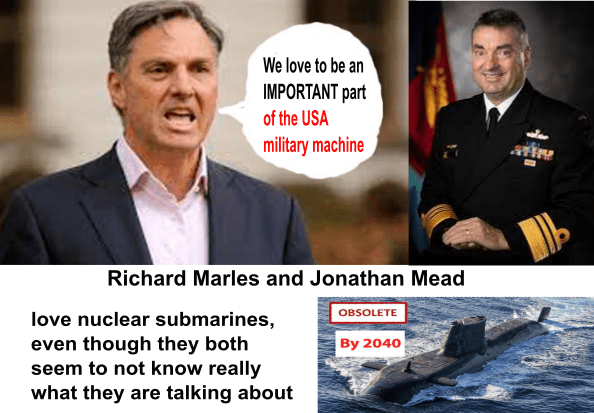
The gem in this whole venture, at least from the perspective of the U.S. military-industrial complex, is the roping in of the Australian taxpayer as the funder of its own nuclear weapons program.
By Binoy Kampmark | 6 January 2024. https://independentaustralia.net/politics/politics-display/funding-the-imperium-australia-subsidises-us-nuclear-submarines,18217
AUKUS, the trilateral pact between the United States, the United Kingdom and Australia, was a steal for all except one of the partners.
Australia, given the illusion of protection even as its aggressive stance (acquiring nuclear-powered submarines, becoming a forward base for the U.S. military) aggravated other countries; the feeling of superiority, even as it was surrendering itself to a foreign power as never before, was the loser in the bargain.
Last month, Australians woke up to the sad reminder that their government’s capitulation to Washington has been so total as to render any further talk about independence an embarrassment. Defence Minister Richard Marles, along with his deputy, Minister for Defence Industry Pat Conroy, preferred a different story.
Canberra had gotten what it wanted: approval by the U.S. Congress through its 2024 National Defense Authorisation Act (NDAA) authorising the transfer of three Virginia class nuclear-powered submarines to the Royal Australian Navy, with one off the production line, and two in-service boats. Australia may also seek congressional approval for two further Virginia class boats.
The measures also authorised Australian contractors to train in U.S. shipyards to aid the development of Australia’s own non-existent nuclear-submarine base, and exemptions from U.S. export control licensing requirements permitting the ‘transfer of controlled goods and technology between Australia, the United Kingdom, and the United States without the need for an export license’.
For the simpleminded Marles, Congress had “provided unprecedented support to Australia in passing the National Defense Authorisation Act which will see the transfer of submarines and streamlined export control provisions, symbolising the strength of our Alliance, and our shared commitment to the AUKUS partnership”.
Either through ignorance or wilful blindness, the Australian Defence Minister chose to avoid elaborating on the less impressive aspects of the authorising statute. The exemption under the U.S. export licensing requirements, for instance, vests Washington with control and authority over Australian goods and technology while controlling the sharing of any U.S. equivalent with Australia. The exemption is nothing less than appropriation, even as it preserves the role of Washington as the drip feeder of nuclear technology.
An individual with more than a passing acquaintance with this is Bill Greenwalt, one of the drafters of the U.S. export control regime.
As he told the ABC last November:
“After years of U.S. State Department prodding, it appears that Australia signed up to the principles and specifics of the failed U.S. export control system.”
In cooperating with the U.S. on this point, Australia would “surrender any sovereign capability it develops to the United States control and bureaucracy”.
The gem in this whole venture, at least from the perspective of the U.S. military-industrial complex, is the roping in of the Australian taxpayer as the funder of its own nuclear weapons program. Whatever its non-proliferation credentials, Canberra finds itself a funder of the U.S. naval arm in an exercise of modernised nuclear proliferation.
Even the Marles-Conroy media release admits that the NDAA helped ‘establish a mechanism for the U.S. to accept funds from Australia to lift the capacity of the submarine industrial base’. Airily, the release goes on to mention that this “investment” (would “gift” not be a better word?) to the U.S. Navy would also ‘complement Australia’s significant investment in our domestic submarine industrial base’.
A few days after the farcical spectacle of surrender by Australian officials, the Congressional Research Service provided another one of its invaluable reports that shed further light on Australia’s contribution to the U.S. nuclear submarine program. Australian media outlets, as is their form on covering AUKUS, remained silent about it. One forum, Michael West Media, showed that its contributors – Rex Patrick and Philip Dorling – were wide awake.
The report is specific to the Navy Columbia (SSBN-826) Class Ballistic Missile Submarine Program, one that involves designing and building 12 new SSBNs to replace the current, aging fleet of 14 Ohio class SSBNs. The cost of the program, in terms of 2024 budget submission estimates for the 2024 financial year, is US$112.7 billion (AU$168.2 billion).
As is customary in these reports, the risks are neatly summarised. They include the usual delays in designing and building the lead boat, thereby threatening readiness for timely deployment; burgeoning costs; the risks posed by funding the Columbia class program to other Navy programs; and ‘potential industrial-base challenges of building both Columbia-class boats and Virginia-class attack submarines (SSNs) at the same time’.
Australian funding becomes important in the last concern. Because of AUKUS, the U.S. Navy “has testified” that it would require, not only an increase in the production rate of the Virginia class to 2.33 boats per year, but ‘a combined Columbia-plus-Virginia procurement rate’ of 1+2.33. Australian mandarins and lawmakers, accomplished in their ignorance, have mentioned little about this addition.
But U.S. lawmakers and military planners are more than aware that this increased procurement rate:
‘…will require investing several billion dollars for capital plant expansion and improvements and workforce development at both the two submarine-construction shipyards (GD/EB [General Dynamics’ Electric Boat in Groton, Connecticut] and HII/NSS [Huntington Ingalls Industries’ Newport News Shipbuilding]) and submarine supplier firms.’
The report acknowledges that funding towards the 1+2.33 goal is being drawn from several allocations over a few financial years, but expressly mentions Australian funding ‘under the AUKUS proposed Pillar 1 pathway’, which entails the transfer component of nuclear-powered submarines to Canberra.
The report helpfully reproduces the 25 October 2023 testimony from the Navy before the Seapower and Projection Forces Subcommittee of the House of Armed Services Committee. Officials are positively salivating at the prospect of nourishing the domestic industrial base through, for instance, ‘joining with an Australian company to mature and scale metallic additive manufacturing across the SIB [Submarine Industrial Base]’.
The testimony goes on to note that:
‘Australia’s investment into the U.S. SIB builds upon ongoing efforts to improve industrial base capability and capacity, create jobs, and utilise new technologies. This contribution is necessary to augment VACL [Virginia class] production from 2.0 to 2.33 submarines per year to support both U.S. Navy and AUKUS requirements.’
The implications from the perspective of the Australian taxpayer are significant.
‘Australian AUKUS funding will support construction of a key delivery component of the U.S. nuclear strike force, keeping that program on track while overall submarine production accelerates.’
The funding also aids the advancement of another country’s nuclear weapons capabilities, a breach, one would have thought, of Australia’s obligations under the Treaty of Non-Proliferation of Nuclear Weapons.
Defence spokesman for the Australian Greens, Senator David Shoebridge, makes that very point to Patrick and Dorling:
“Australia has clear international legal obligations to not support the nuclear weapons industry, yet this is precisely what these billions of dollars of AUKUS funding will do.”
The Senator also asks:
“When will the Albanese Government start telling the whole truth about AUKUS and how Australians will be paying to help build the next class of U.S. ballistic missile submarines?”
For an appropriate answer, Shoebridge would do well to consult the masterful, deathless British series Yes Minister, authored by Antony Jay and Jonathan Lynn.
In one episode, the relevant minister, Jim Hacker, offers this response to a query by the ever-suspicious civil service overlord Sir Humphrey Appleby on when he might receive a draft proposal:
“At the appropriate juncture. In the fullness of time. When the moment is ripe. When the necessary procedures have been completed. Nothing precipitate, of course.”
In one word: never.
Australian Sailors Embed Aboard Submarine Tender for Nuclear Experience
The Sailors and Officers will embed aboard USS Emory S. Land, one of two U.S submarine tenders based in the Pacific territory, for up to five months.
Naval News Staff 04 Feb 2024
A group of 37 Royal Australian Navy officers and sailors have departed for Guam to embed on board USS Emory S. Land, the United States submarine tender.
In December last year, Australia, the United States and United Kingdom announced that Australian sailors would commence duty in Guam from early 2024 as part of preparations for the commencement of Submarine Rotational-Force West where, from as early as 2027, one UK Astute-class submarine and up to four US Virginia-class submarines will have a rotational presence at HMAS Stirling in Western Australia.
The Navy personnel will spend up to five months on board USS Emory S. Land integrating with US sailors and building the unique knowledge, skills and experience in how the US conducts nuclear-powered submarine (SSN) maintenance…………………………………… https://www.navalnews.com/naval-news/2024/02/australian-sailors-embed-aboard-submarine-tender-for-nuclear-experience/
Perth could be an ‘especially important target’ due to AUKUS
January 12, 2024
Curtin University Dean of Global Futures Professor Joe Siracusa says while Australia has always been a nuclear target, Perth has particularly become a target for China and Russia due to AUKUS.“They see the AUKUS development here, not only nuclear-propelled submarines, but they’re going to have nuclear cruise missile type things here,” he told Sky News Australia.
Defence Minister Marles announces Australia has joined in U.S. attacks on Yemen
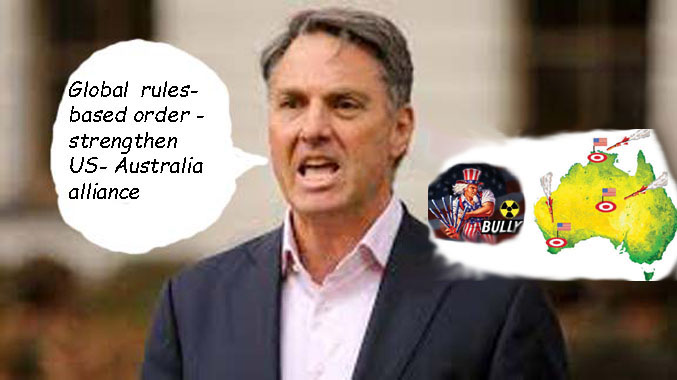
Comment. As Marles yet again spouts the “global rules-based order”, we wonder where is Prime Minister Anthony Albanese, and why was Parliament not consulted?
Deputy Prime Minister Richard Marles confirms Australian personnel contributed to strikes in Yemen.
ABC News, 12 Jan 24
Defence Minister and Deputy Prime Minister Richard Marles says Australian personnel had been present in “operational headquarters” but said he could not elaborate further on the precise nature of their participation.
Key points:
- A US official said strikes against the Iran-backed group were carried out by aircraft, ships and a submarine
- It comes as the United Nations Security Council demands an immediate halt to the shipping disruptions
- The US Central Command said Houthi rebels have launched their 27th attack since November 19
Mr Marles said Australia’s participation was “completely consistent” with the national interest. “Australia must stand up for freedom of navigation,” Mr Marles said, accusing the Houthis of “disruption of the rules-based order.”
The US and Britain have started launching strikes against Houthi targets in Yemen.
Houthi official Abdul Qader al-Mortada said raids were conducted in several Yemeni cities, including the capital Sana’a, in the early hours of Friday.
Two Hodieda residents told Associated Press they heard five strong explosions.
Hodieda lies on the Red Sea and is the largest port city controlled by the Houthis.
Yemen’s Houthi rebels said they will continue targeting Israel-linked ships in the Red Sea despite overnight air strikes by the US and Britain, their spokesman said on Friday.
“We affirm that there is absolutely no justification for this aggression against Yemen, as there was no threat to international navigation in the Red and Arabian Seas, and the targeting was and will continue to affect Israeli ships or those heading to the ports of occupied Palestine,” Yemen’s Houthis spokesperson Mohammed Abdulsalam posted on X, formerly known as Twitter.
On Friday, Iran said it condemns the US-Britain attack on Houthis in Yemen warning that it will fuel “insecurity and instability” in the region, Iranian state media reported.
“We strongly condemn the military attacks carried out this morning by the United States and the United Kingdom on several cities in Yemen,” said Nasser Kannani, spokesperson at Iran’s foreign ministry.
“These attacks are a clear violation of Yemen’s sovereignty and territorial integrity, and a breach of international laws,” he added…………………………………………
US President Joe Biden said Australia, Canada, Bahrain and the Netherlands provided support for the operation………………………………………..
The strikes would mark the first counterattack launched against the Iran-backed group, since it began Red Sea attacks in November last year.
It comes as the United Nations Security Council demanded an immediate halt to the disruption in global commerce on Thursday.
A joint statement by Australia, Bahrain, Canada, Denmark, Germany, Netherlands, New Zealand, Republic of Korea, United Kingdom and the US said the UN resolution, in addition to Houthi ignoring calls to end the shipping attacks, had led to these “precision strikes”……………………………..
Scotland’s first minister Humza Yousaf, whose parents-in-law escaped Gaza in early November, warned the UK “does not have a good record of military intervention in the Middle East”, demanding MPs have a briefing. ………………………………………………………………………………….
The Iran-backed group says it is conducting attacks in support of Palestinian militant group Hamas in its fight against Israel………………………………………………………….
Before the resolution on Thursday, United States deputy ambassador Robert Wood said “freedom of commercial activity on the seas is critically important to commerce and to national security of a number of states”.
Wider fallout on the horizon
Nearly 10 per cent of global oil trade and an estimated $US1 trillion ($1.5 trillion) in goods pass through the Red Sea route annually.
Houthi attacks have forced many shipping companies to use the much longer and more-expensive route around Africa’s Cape of Good Hope………………………………………………………………. more https://www.abc.net.au/news/2024-01-12/britain-joins-strikes-against-houthi-rebels/103312432?fbclid=IwAR0IWBxVsFVdHyF534j_12Il1ojMC-TMJ2zflrOI_J5Xnt9KWqBRBmUCAy8
Nuke policy quietly nuked: Australia to fund US nuclear weapon delivery program

Greens Defence Spokesperson Senator David Shoebridge said, “When will the Albanese government start telling the whole truth about AUKUS and how Australians will be paying to help build the next class of US ballistic missile submarines?”
by Rex Patrick and Philip Dorling | Jan 2, 2024, https://michaelwest.com.au/australia-to-fund-nuclear-missiles-aukus/
A newly released Congressional Research Service report confirms that Australian funds will be used to support the United States Navy’s nuclear ballistic missile submarine program. The Government has sunk Labor’s nuclear disarmament and non-proliferation pledges. Rex Patrick and Philip Dorling explain.
The Columbia class submarines will carry 16 thirteen metre long Trident II D5 missiles. Each of those missiles can carry up to eight (they can carry 12 but, by treaty, the number has been limited to eight) multiple independently targeted re-entry vehicles. Each re-entry vehicle can deliver a thermonuclear warhead to an individual target.
Fully loaded, each submarine will be able deliver thermonuclear weapons to 128 cities or hardened military targets.
When on patrol, the submarines are virtually undetectable, and there are no known, near-term credible threats to the survivability of the SSBN force. The ballistic missile submarines are the most survivable leg of the triad.
The US Navy for more than a decade consistently identified the Columbia Class program as its top priority program.
Enter AUKUS
There has been a lot of focus on how the US will meet its own production requirements for the conventionally armed Virginia class nuclear attack submarines with the AUKUS agreements providing for two existing submarines to be transferred to Australia and at least another new vessel acquired off the production line.
No-one in Australia has paid much attention to the Columbia Program. That’s been an oversight.
The Columbia class ballistic missile submarines will be built at General Dynamics’ Electric Boat in Groton, Connecticut, and Huntington Ingalls Industries’ Newport News Shipbuilding (HII/NNS), in Newport News, Virginia. That’s exactly the same shipyards the Virginia class attack submarines will be built.
And this will all be happening at the same time. The first Columbia submarine is to be delivered in October 2027, the second in April 2030, the third in August 2032, the fourth in September 2032, and the fifth in August 2033. At the same time those same shipyards will be pumping out Virginia Class submarine for the US Navy, and Australia. As the fifth Columbia is being delivered, Australia will get its first second hand Virginia Class submarine.
Both shipyards are currently collectively punching out 1.4 Virginia class boats per annum. By 2028 it is expected that the yards will be collectively be producing 2 per annum. That will meet US Navy requirements, but AUKUS takes the required production rate to 2.33 per annum. When the Columbia submarines are added to the mix, the US submarine industrial base needs to be producing 1+2.33 submarines per annum.
AUKUS funding to be used
In the meantime, Australia has agreed to contribute US$3B (AUD$4.7B) to “the US industrial base to support increased production and maintenance capacity to ensure there is no capability gap for Australia in acquiring Nuclear Powered Submarines.”
The latest Congressional Research Service report on the Columbia class program makes to clear that the Australian commitment is to generic US submarine industrial base funding; covering construction for both the Virginia and Columbia submarine programs.
“Building up the industrial base’s capacity to a 1+2.33 capacity will require investing several billion dollars for capital plant expansion and improvements and workforce development at both the two submarine-construction shipyards and submarine supplier firms.
Some of this funding has been provided in FY2023 and prior years, some of it is requested for FY2024, some of it would be requested in FY2025 and subsequent years, and some of it would be provided, under the AUKUS proposed Pillar 1 pathway, by Australia.”
Parliament in the dark on nuclear funding
To be perfectly clear, Australian AUKUS funding will support construction of a key delivery component of the US nuclear strike force, keeping that program on track while overall submarine production accelerates.
This fact has not been shared with the Australian public or Parliament.
Greens Defence Spokesperson Senator David Shoebridge said, “When will the Albanese government start telling the whole truth about AUKUS and how Australians will be paying to help build the next class of US ballistic missile submarines?”
Of course, the Government hasn’t exactly been upfront about a number of things in the AUKUS program, with Michael West Media being left to reveal (in contrast to statements made by Defence Minister Richard Marles) that Australia will be taking nuclear waste from the US and UK under the program.
Price Waterhouse Cooper’s (PWC’s) $8m nuclear submarine payday revealed
18 DECEMBER 2023, By: Liam Garman, https://www.defenceconnect.com.au/naval/13341-pwc-s-8-million-nuclear-submarine-payday-revealed
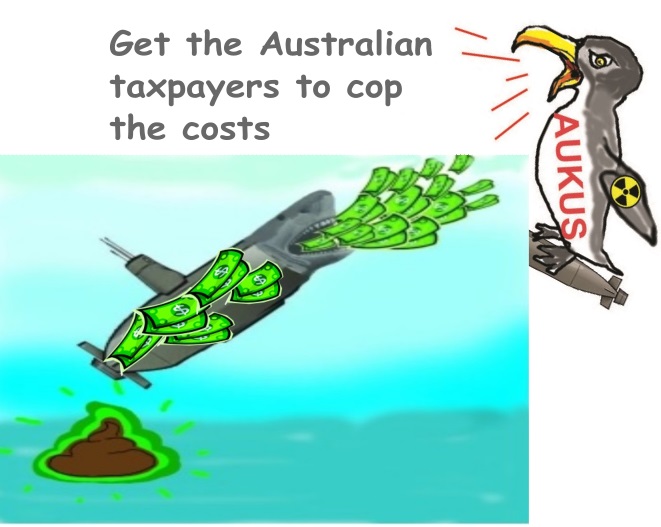
Talking points prepared for Vice Admiral Jonathan Mead, director general of the Australian Submarine Agency, on the Nuclear-Powered Submarine Taskforce’s engagement with the embattled professional services firm have come to light following a freedom of information request from former independent senator Rex Patrick.
Information seen by Defence Connect have detailed two separate contracts between the Nuclear-Powered Submarine Taskforce and the consulting firm via the Defence Support Services Panel.
In total, Defence spent $8,055,928.56 with PwC between 2021 and 2023, with one contract phase costing Defence $560,142.57 for just 12 weeks of consulting work.
The revelation comes as PwC grapples with the fallout of the widely reported tax scandal in early 2023, which saw senior partners at the firm share confidential Commonwealth information with clients to avoid paying tax.
Leaked internal emails from PwC showed that confidential tax information was shared with over 50 of the company’s partners, some of whom then used the information to approach 14 global companies.
The talking points sourced by former South Australian independent senator Rex Patrick were developed for the head of the ASA, Vice Admiral Mead, for budget estimates, who justified the engagements, outlining that “value for money was a core consideration in the Nuclear-Powered Submarine Taskforce’s engagement of PwC”.
The ASA has not engaged with PwC since its creation on 1 July 2023.
Speaking to Defence Connect, an ASA spokesperson explained the taskforce’s engagement with PwC: “The Nuclear-Powered Submarine Taskforce entered into two contracts with PwC, during the 18-month consultation period.
At no time was PwC briefed into any security compartment, nor were they part of any development of the Optimal Pathway during the 18-month consultation period.”
The contracts were awarded to support the development of a domestic nuclear-powered submarine industry and included $5,275,135.90 for the development of Program Management Office (PMO) artefacts, scheduling support, program development and management, and “governance mechanisms”.
The second contract, valued at a total $2,780,792.66, was for the delivery of an enterprise-wide solution on the reporting of workforce demographics, and supported the development and implementation of a workforce support concept development plan.
At its time of writing, the talking points detailed that the Australian Submarine Agency had five ongoing consulting contracts valued at $2.756 million with KPMG and Deloitte.
More to follow.
Over 700 American AUKUS personnel to be based in Western Australia, with radioactive storage facility also planned
by defence correspondent Andrew Greene, https://www.abc.net.au/news/2023-12-18/aukus-americans-western-australia-radioactive-storage-facility/103239924
Defence expects more than 700 American personnel could live in Western Australia to support up to four US nuclear submarines being stationed at HMAS Stirling, where a “low-level radioactive waste management” facility is also being planned.
Key points:
- Western Australia will host the first submarines from 2027
- British personnel are also expected to join rotations but without families
- Radioactive waste will be stored at Defence sites including a new management facility in Perth
The projections are contained in comprehensive briefing notes prepared by the newly created Australian Submarine Agency (ASA) which also detail how a one-off Australian government payment of $US3 billion ($4.45 billion) will be spent by the United States.
Under the optimal pathway announced by AUKUS leaders earlier this year, the Submarine Rotational Force – West (SRF-West) would first begin hosting Royal Navy Astute-class and US Navy Virginia-class submarines at HMAS Stirling from 2027.
A Virginia-class submarine carries a crew of 132 according to the US Navy, while an Astute-class boat deploys with almost 100 Royal Navy submariners on board.
“This workforce will then move to support our enduring nuclear-powered submarine program and will be a key enabler for SRF-West,” the ASA states in documents obtained under Freedom of Information by former Senator and submariner Rex Patrick.
“In addition to these 500-700 Australians at its height, we estimate that over 700 United States Personnel could be living and working in Western Australia to support SRF-West, with some also bringing families,” the ASA predicts.
According to the ASA, SRF-West will be established as early as 2027 and expand in subsequent years to support up to four US and one UK nuclear-powered submarine, with the Australian government investing $8 billion to expand HMAS Stirling outside Perth.
The ASA notes there will also be “a small United Kingdom contingent living in Perth” but most British personnel supporting SRF-West “will be in Australia for shorter rotations, meaning they will not be bringing families with them”.
Planning begins for low-level radioactive waste management
Decisions on where Australia will eventually dispose of its nuclear submarine reactors are not expected for many years, but planning has begun for “low-level radioactive waste management” at HMAS Stirling to support SRF-West.
“Expertise to manage low-level operational waste arising from nuclear-powered submarine operations and sustainment will be an important part of Australia building the necessary stewardship capability to operate and maintain its own submarines.”
More details emerge on Australia’s multi-billion dollar payment
Inside the almost 200 pages of ASA briefing notes are further details of how a $US3 billion ($4.45 billion) Australian contribution to the US submarine industrial base will be spent, including on enhancing facilities and pre-purchasing components and materials.
“Australia’s commitment to invest in the US submarine industrial base recognises the lift the United States is making to supporting Australia’s acquisition of nuclear-powered submarines.”
“Pre-purchasing submarine components and materials, so they are on hand at the start of the maintenance period – saving time” and “outsourcing less complex sustainment and expanding planning efforts for private sector overhauls, to reduce backlog”.
Australia’s AUKUS nuclear submarines could fuel regional arms race despite assurance
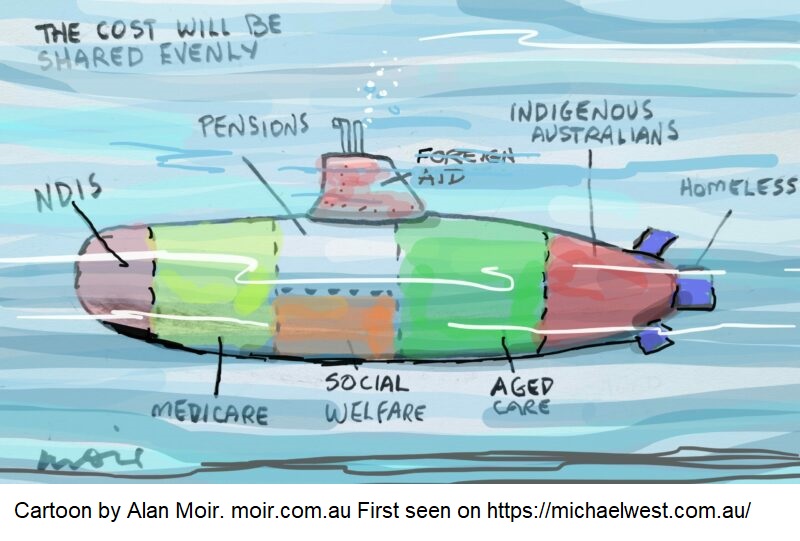
“AUKUS is designed to shore up American power in East Asia, not de-escalate tensions,”
By Su-Lin TanDec 4, 2023, https://johnmenadue.com/australias-aukus-nuclear-submarines-could-fuel-regional-arms-race-despite-assurance/
Defence Industry Minister Pat Conroy says Australia is not worsening the arms race and gives assurance about the submarines’ nuclear reactors. The deal could still spark a defence build-up in Asia-Pacific while Australia lacks the facilities to deal with nuclear waste, analysts say.
Australia may have asserted that its acquisition of nuclear-powered submarines under AUKUS is not aggravating the “arms race”, but the deal and the three-nation alliance could still fuel a defence build-up in the Asia-Pacific and heighten regional tensions, security analysts say.
At the national press club in Canberra on Tuesday, Australian Defence Industry Minister Pat Conroy reiterated the importance of the submarines to the country’s defence while debunking “myths” about the trilateral deal struck with Britain and the United States, which is largely seen as a countermeasure targeting China.
“The arms race is the greatest it’s been since 1945, and that is why I reject assertions … that Australia is somehow fuelling that arms race,” he said, adding that rising tensions in the Asia-Pacific had posed the most challenging strategic environment for Australia since World War II. “We are responding to it in a responsible and mature manner, like Australian governments should.”
Australia will own at least eight submarines over the next three decades through the A$368 billion (US$243 billion) deal. First announced in 2021 and finalised earlier this year, the controversial pact has raised concerns in the region.
Collin Koh, a senior fellow at the S. Rajaratnam School of International Studies in Singapore, said Conroy’s comment was not a surprise as countries including China and others in Asia-Pacific often couched their arms acquisitions in “defensive terms”.
Most countries would do so in the name of national security interests but it did not mean such actions ensured peace or safety, he said.
Even before AUKUS was announced in 2021, China and other regional countries had already embarked on significant military build-up since the 1990s, Koh said.
“Conroy may not be necessarily wrong to say AUKUS responds to this already ongoing condition, yet at the same time, it’s also not wrong to say that AUKUS … may not only be used by Beijing to legitimise its naval build-up, it also could be exploited as a justification for other regional countries’ military build-up programmes,” Koh said.
Australia’s acquisition of the submarines might trigger new problems as other countries could argue that they should also acquire similar capabilities, said Maria Rost Rublee, a nuclear politics expert at Monash University.
These countries are not limited to “dangerous actors”, for instance, in South Korea where the majority of its people have expressed a desire for their country to own nuclear weapons, Rublee added.
“Just having this type of technology in the hands of a country where you have strong popular support for nuclear weapons could be an issue,” she said.
In an analysis earlier this month, Ankit Panda, the Stanton Senior Fellow in the Nuclear Policy Programme at the Carnegie Endowment for International Peace, warned the accumulation of weapons such as missiles could potentially lead to unintended attacks.
“The Indo-Pacific region has entered a new missile age … each nation individually seeking deterrence while as a whole steering the region into ever more dangerous waters,” he said. “A particular risk concerns the prospects of attacks on the nuclear forces of countries like North Korea and China, by US or allied forces in ways that may not be intended.”
By the 2030s, the Indo-Pacific region would be “full of thousands of new missiles that can be expected to be used widely in the context of a major regional war”, Panda said.
Responding to Conroy’s comments, the national convenor of Labor Against War in Australia, Marcus Strom, said: “If your answer to growing regional tension is to add offensive weaponry, you create a logic towards war.
“AUKUS is designed to shore up American power in East Asia, not de-escalate tensions,” he added.
While Conroy has given assurances about the safety of sealed nuclear reactors within the submarines, analysts argued that the lack of facilities in Australia for the eventual disposal of these reactors is worrying.
“The strength of this agreement is that the reactor module comes to us sealed. It comes sealed, designed to be never opened over the life of a submarine. You don’t have to refuel it, you don’t have to insert new fuel rods … [over] the life of the submarine,” Conroy said.
But nuclear waste expert Ian Lowe said in an analysis on The Conversation website earlier this year that Australia has failed for decades to find long-term storage solutions for small quantities of low- and intermediate-level nuclear waste.
Even Australia’s allies and AUKUS partners, the US and the UK, do not have long-term solutions for nuclear waste storage, according to Lowe.
“This should be concerning. To manage the waste from our proposed nuclear submarines properly, we’ll have to develop systems and sites which do not currently exist in Australia,” Lowe said.
Australian states such as Victoria, Queensland and South Australia have said they would not accept a nuclear waste facility within their borders.
While it will be another 30 years before Australia has to worry about dumping the submarine’s nuclear reactors, it is not a long time, Rublee said.
“If they take their nuclear stewardship obligations seriously, they must immediately begin working on the long-term storage of high-level nuclear waste,” she added.
Karina Lester addresses the Second Meeting of States Parties to the TPNW
Karina Lester, second-generation nuclear test survivor and ICAN Ambassador addresses the delegates at the UN Second Meeting of States Parties to the Treaty on the Prohibition of Nuclear Weapons in NYC, November 28th, 2023.
She said “People still suffer to this day. We know our lands are poisoned. We know the fallout contaminated our country and our families, our people who move through those traditional lands…
We want recognition by governments of the day of the harms and what they’ve imposed on our people and on our traditional lands… We want respect and we want to start the conversations on repair. How do we work together to fix the damages that are there?”
She called on states parties to get to work on Articles 6 & 7 and for observers to double their efforts to sign and ratify the #nuclearban. She called on Australia, in particular, to make joining the treaty a top priority.
Sovereignty Surrendered: Subordinating Australia’s Defence Industry
Bureaucratic red tape will be slashed – for the Australian Defence industry and the AUKUS partners.
the broader object here is unmistakably directed, less to Australian capabilities than privileged access and a relinquishing of control to the paymasters in Washington.
“Whenever it cooperates with the US Australia will surrender any sovereign capability it develops to the United States control and bureaucracy.”
November 30, 2023, Dr Binoy Kampmark, https://theaimn.com/sovereignty-surrendered-subordinating-australias-defence-industry/
One could earn a tidy sum the number of times the word “sovereignty” has been uttered or mentioned in public statements and briefings by the Australian Prime Minister, Anthony Albanese.
But such sovereignty has shown itself to be counterfeit. The net of dependency and control is being increasingly tightened around Australia, be it in terms of Washington’s access to rare commodities (nickel, cobalt, lithium), the proposed and ultimately fatuous nuclear-propelled submarine fleet, and the broader militarisation and garrisoning of the country by US military personnel and assets. (The latter includes the stationing of such nuclear-capable assets as B-52 bombers in the Northern Territory.)
The next notch on the belt of US control has been affirmed by new proposals that will effectively make technological access to the Australian defence industry by AUKUS partners (the United States and the United Kingdom) an even easier affair than it already is. But in so doing, the intention is to restrict the supply of military and dual-use good technology from Australia to other foreign entities while privileging the concerns of the US and UK. In short, control is set to be wrested from Australia.
The issue of reforming US export controls, governed by the musty provisions of the US International Trade in Arms Regulations (ITAR), was always going to be a feature of any technology transfer, notably regarding nuclear-propulsion. But even before the minting of AUKUS, Canberra and Washington had pondered the issue of industrial integration and sharing technology via such instruments as the Defense Cooperation Treaty of 2012 and Australia’s addition to the National Technology and Industrial Base in 2017.

This fundamentally failed enterprise risks being complicated further by the latest export reforms, though you would not think so, reading the guff streaming from the Australian Defence Department. A media release from Defence Minister Richard Marles tries to justify the changes by stating that “billions of dollars in investment” will be released. Bureaucratic red tape will be slashed – for the Australian Defence industry and the AUKUS partners. “Under the legislation introduced today, Australia’s existing trade controls will be expanded to regulate the supply of controlled items and provision of services in the Defence and Strategic Goods List, ensuring our cutting-edge military technologies are protected.”
Central to the reforms is the introduction of a national exemption that will cover trade of defence goods and technologies with the US and UK, thereby “establishing a license-free environment for Australian industry, research and science.” But the broader object here is unmistakably directed, less to Australian capabilities than privileged access and a relinquishing of control to the paymasters in Washington. A closer read, and it’s all got to do with those wretched white elephants of the sea: the nuclear-powered submarine.
As the Minister for Defence Industry, Pat Conroy, states, “This legislation is an important step in the Albanese Government’s strategy for acquiring the state-of-the-art nuclear-powered submarines that will be key to protecting Australians and our nation’s interests.” In doing so, Conroy, Marles and company are offering Australia’s defence base to the State Department and the Pentagon.
With a mixture of hard sobriety and alarm, a number of expert voices have voiced concern regarding the implications of these new regulations. One is Bill Greenwalt, a figure much known in the field of US defence procurement, largely as a prominent drafter of its legal framework. He is unequivocal in his criticism of the US approach, and the keen willingness of Australian officials to capitulate. “After years of US State Department prodding, it appears that Australia signed up to the principles and specifics of the failed US export control system,” Greenwalt explained to the Australian Broadcasting Corporation. “Whenever it cooperates with the US it will surrender any sovereign capability it develops to the United States control and bureaucracy.”
The singular feature of these arrangements, Greenwalt continues to elaborate, is that Australia “got nothing except the hope that the US will remove process barriers that will allow the US to essentially steal and control Australian technology faster.”
In an email sent to Breaking Defense, Greenwalt was even more excoriating of the Australian effort. “It appears that the Australians adopted the US export control system lock, stock and barrel, and everything I wrote about in my USSC (US Studies Center) piece in the 8 deadly sins of ITAR section will now apply to Australian innovation. I think they just put themselves back 50 years.”
The paper in question, co-authored with Tom Corben, identifies those deadly sins that risk impairing the success of AUKUS: “an outdated mindset; universality and non-materiality; extraterritoriality; anti-discrimination; transactional process compliance; knowledge taint; non-reciprocity; and unwarranted predictability.”
When such vulgar middle-management speech is decoded, much can be put down to the fact that dealing with Washington and its military-industrial complex can be an imperilling exercise. The US imperium remains fixated, as Greenwalt and Corben write, with “an outdated superpower mindset” discouragingly inhibiting to its allies. What constitutes a “defence article” within such export controls is very much left to the discretion of the executive. The archaic application of extraterritoriality means that recipient countries of US technology must request permission from the State Department if re-exporting to another end-user is required for any designated defence article.
The failure to reform such strictures, and the insistence that Australia make its own specific adjustments, alarms Chennupati Jagadish, president of the Australian Academy of Science. The new regulations may encourage unfettered collaboration between the US and UK, “but I would require an approved permit prior to collaborating with other foreign nationals. Without it, my collaborations could see me jailed.” The bleak conclusion: “it expands Australia’s backyard to include the US and UK, but it raises the fence.” Or, more accurately, it incorporates, with a stern finality, Australia as a pliable satellite in an Anglo-American arrangement whose defence arrangements are controlled by Washington.
1 This month
17 October, Free Public Talk on Nuclear Issues in South Australia
David Noonan will speak on public interest concerns over the new Roxby Downs Indenture Act 2026 on BHP copper-uranium mining and ore processing in SA, and on how AUKUS may face SA with a High-Level nuclear waste agenda.
Dr Jim Green will discuss international developments in the field of nuclear power including ‘small modular reactors’ and Generation 4 ‘advanced’ nuclear reactor concepts.


Help Aunty Sue Protect Her Land and Sacred Sites From Destructive Rocket Testing.
.

Australians deserve the truth
about
AUKUS – https://aukuspublicinquiry.com/

PETITION – To: Prime Minister Anthony Albanese and the Australian Labor Government

of the week – Australians for War Powers Reform (AWPR)
To see nuclear-related stories in greater depth and intensity

