A $200billion nuclear submarine deal could cost the average Australian taxpayer about $13,000. This is effectively the equivalent of every Australian buying a new small car – an astonishing outlay on just a handful of boats. But experts say the deal – despite the extraordinary price tag – could be worth every cent.
Prime Minister Anthony Albanese has just committed Australia to spending $368 billion on somewhere between three and five second-hand US Virginia Class submarines, and a follow on build of eight next generation British AUKUS nuclear submarines. It’s a strategic blunder, writes former submariner Rex Patrick, and it’s not even going to happen the way the PM has suggested.
I just want a Ferrari. All my mates tell me they’re great cars. Never mind that, financially, I’m already struggling to keep up with the house repayments and, over time, the wife and kids are going to have to miss out on some of life’s niceties and even essentials; no orthodontic treatment to straighten my daughter’s teeth, no tutor to assist my son through extension maths and the wife won’t be able to afford to go back to uni to get her masters.
But I’ll look good cruising down Jetty Road at Glenelg in my shiny red machine. Now, just between you and me, the Ferrari’s not so good for going off-road or towing the family caravan, but hey, otherwise it is a great car.
Nuclear capability
Coming back from my Ferrari dream, it’s true that nuclear submarines are good. I know, because I’ve spent time at sea on them.
There’s nothing like taking the submarine down to 200 metres and turning up the power on the reactor to get to 30 knots, and then staying there, knowing you have almost unlimited power. It allows you to deploy great distances, arriving quickly. That’s important for the power projecting nations that sit as permanent members of the United Nations Security Council; China, France, Russia, the UK and the US all have nuclear submarines.
Our first priority is supposed to be defence of Australia, and our Defence Force should be configured for that, first and foremost. Even those who think we must automatically join the US in a war against China need to understand US strategy and what Australia’s role would likely be.
China depends on imports for 72% of its oil consumption, and the overwhelming majority of China’s oil imports must pass through maritime chokepoints over which the United States has significant influence. China’s dependency is complicated by the fact an overwhelming portion of its energy imports come from its west. 43% of its oil is sourced in the Persian Gulf, 25% from the Gulf of Aden and Africa and 9% from the Americas, with the overwhelming majority of that passing through the Malacca Straits. Security of supply would be a significant weak point in any conflict China finds itself involved in with the US.
In time of conflict the United States Navy, perhaps in conjunction with European or other regional coalition partners, could secure the Straits of Hormuz. India, part of the Quad, could assist with operations from the Persian Gulf through to the Andaman Seas.
Indonesia, Malaysia and, particularly, Singapore would exercise control over the Malacca Straits with Indonesia and Australia jointly responsible for shutting down Chinese oil carriage through Sunda and Lombok (and up through Makassar Straits). With these routes controlled, the only remaining option for China would be to re-direct shipping around Southern Australia.
Australian submarines are not needed in the South China Sea. The US will rely on Japan’s 20 submarines, South Korea’s 23, and Vietnam’s six, and Malaysia’s two and Singapore’s six. Our submarines have a role to play in shutting down the Sunda and Lombok Straits, or Chinese ships passing through Australian waters. This is a role that can be carried out by far less expensive conventional submarines.
The pros and cons of going nuclear
Of course, it’s true to say that it’s handy to have a reactor when you are detected by enemy anti-submarine forces. Speed can be a very useful asset.
The flip side is that smaller conventional submarines are better performers in littoral waters where they can silently lie in wait, lay mines or covertly deploy Special Forces.
Unsustainable price
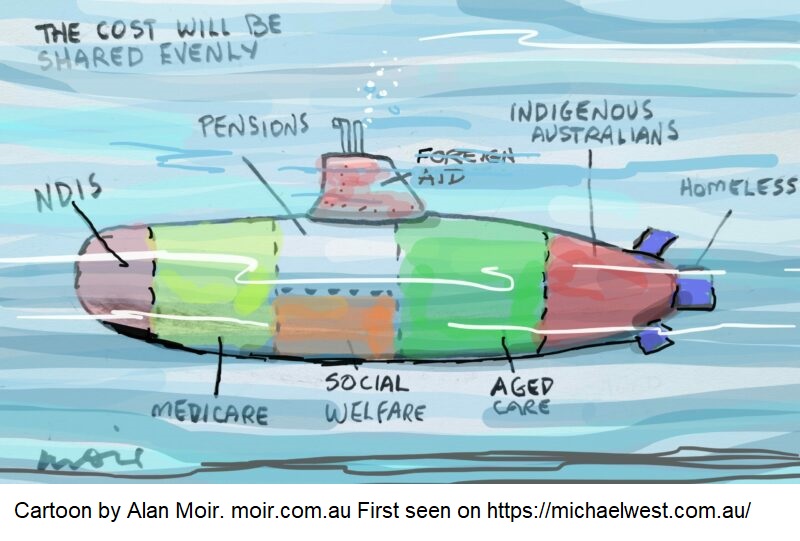
The purported cost of this program is “up to” $368 billion dollars. That’s an incredible amount of money to spend, and particularly on a single capability.
Australia has $970 billion dollars in gross debt. It will rise to a trillion dollars next financial year. Albanese says that out Defence budget will increase to 2.5% of GDP. That’s an extra $10 billion per annum, on top of a structural deficit of $50 billion a year, already rising to $70 billion.
With Stage 3 tax cuts set to kick in next year, and revenue from coal and gas exports likely to decrease, it hard to work out how AUKUS will be paid for, other than by spending cuts.
Nation building spin
The Government has started to offset concerns about the spend and placate the punter by saying that this is a nation building project. But this is just spin.
Yes, shipbuilding creates trade jobs which can be utilised in a range of different industries other than defence. The same is true for the electronic engineers and software engineers that work on submarine combat systems.
But as for where a lot of workforce investment will take place, it will be in nuclear technology. This investment will not translate into benefits for the Australian economy, because there are no plans for us to have a civil nuclear industry. Even if Australia were to take a decision to go there, the US will not grant the nuclear technology release or transfer approval.
Any investment in a nuclear workforce will be a sunk Defence cost.
Dismantling of our sovereign submarine build capability
We will see an Australian flagged submarine in our waters in the early 2030’s. At that time we will start decommissioning Collins Class submarines and the workforce in Adelaide, who carry out full cycle dockings and life of type extension. That activity will stop, and 700 jobs will go.
The Government tells us that we will start building next generation SSN AUKUS submarines in 2040. But they are wrong. Once the Adelaide workforce is disbanded, we won’t rebuild a submarine build workforce. We will just buy an AUKUS submarine from the UK, or perhaps more US Virginia class boats instead.
Opportunity cost
There is a real tension building to our north. We need to have a Defence Force that can deter and, if that fails, fight.
This multi-billion dollar program will come at a great opportunity cost. What significant other capabilities do we miss out on as we fund this program? In that respect there is tragedy in the way we are moving forward.
Will it happen?
We’ve seen our future submarine go from an Australian “Son of Collins” under Rudd, to a Japanese submarine under Abbot, to a French submarine under Turnbull, to a US and UK submarine under Morrison and Albanese. The reality is that as Governments change moving forward, and that includes in the US and UK, the program will change again. And that’s not to mention significant changes that could take place in our geo-strategic circumstances.
In 2040, when we are purportedly going to start building an AUKUS submarine here in Australia, Anthony Albanese will be 77. You and I will be reading the second edition of his political memoirs, picked up from the discount bin at the front of the local bookstore. There’ll be a different program underway.
I’d love a new Ferrari, but I’d have to pay for it, so it just won’t happen. Unconstrained by the need to pay for it themselves, the Prime Minister, supported by a few Admirals, just wants nuclear submarines.
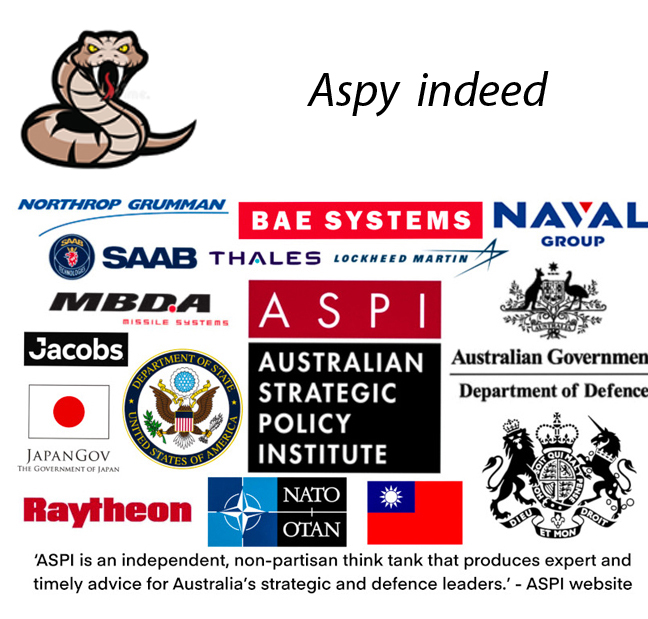
From producing reports and analysis for U.S. policy-makers, to enlisting representatives to write op-eds in corporate media, to providing talking heads for corporate media to interview and give quotes, think tanks play a fundamental role in shaping both U.S. foreign policy and public perception around that foreign policy. Leaders at top think tanks like the Atlantic Council and Hudson Institute have even been called upon to set focus priorities for the House Intelligence Committee. However, one look at the funding sources of the most influential think tanks reveals whose interests they really serve: that of the U.S. military and its defense contractors.
This ecosystem of overlapping networks of government institutions, think tanks, and defense contractors is where U.S. foreign policy is derived, and a revolving door exists among these three sectors. For example, before Biden-appointed head of the Pentagon Lloyd Austin took his current position, he sat on the Board of Directors at Raytheon. Before Austin’s appointment, current defense policy advisor Michèle Flournoy was also in the running for the position. Flournoy sat on the board of Booz Allen Hamilton, another major Pentagon defense contractor. These same defense contractors also work together with think tanks like the Center for Strategic and International Studies to organize conferences attended by national security officials.
On top of all this, since the end of the Cold War, intelligence analysis by the CIA and NSA has increasingly been contracted out to these same defense companies like BAE Systems and Lockheed Martin, among others — a major conflict of interest. In other words, these corporations are in the position to produce intelligence reports which raise the alarm on U.S. “enemy” nations so they can sell more military equipment!
And of course these are the same defense companies that donate hundreds of thousands of dollars each year to think tanks. Given all this, is it any wonder the U.S. government is simultaneously flooding billions of dollars of weaponry into an unwinnable proxy war in Ukraine while escalating a Cold War into a potential military confrontation with China?
The funding to these policy institutes steers the U.S. foreign policy agenda. To give you a scope of how these contributions determine national security priorities, listed below are six of some of the most influential foreign policy think tanks, along with how much in contributions they’ve received from “defense” companies in the last year.
All funding information for these policy institutes was gathered from the most recent annual report that was available online. Also note that this list is compiled from those that make this information publicly available — many think tanks, such as the hawkish American Enterprise Institute, do not release donation sources publicly.
1 – Center for Strategic and International Studies According to their 2020 annual report
$500,000+: Northrop Grumman Corporation
$200,000-$499,999: General Atomics (energy and defense corporation that manufactures Predator drones for the CIA), Lockheed Martin, SAIC (provides information technology services to U.S. military)
$100,000-$199,999: Bechtel, Boeing, Cummins (provides engines and generators for military equipment), General Dynamics, Hitachi (provides defense technology), Hanwha Group (South Korean aerospace and defense company), Huntington Ingalls Industries, Inc. (largest military shipbuilding company in the United States), Mitsubishi Corporation, Nippon Telegraph and Telephone Corporation (provides intelligence and information technology services to U.S. military), Qualcomm, Inc. (semiconductor company that produces microchips for the U.S. military), Raytheon, Samsung (provides security technology to the U.S. military), SK Group (defense technology company)
$65,000-$99,999: Hyundai Motor (produces weapons systems), Oracle
$100,000-$249,000: Huntington Ingalls Industries, Neal Blue (Chairman and CEO of General Atomics), Qualcomm, Inc., Raytheon, Boeing.
$50,000-$99,000: BAE Systems, Booz Allen Hamilton, Intel Corporation (provides aerospace and defense technology), Elbit Systems of America (aerospace and defense company), General Dynamics, Palantir Technologies
Australia’s nuclear submarine program will cost up to $368 billion over the next three decades, with confirmation that the federal government will buy at least three American-manufactured nuclear submarines and contribute “significant additional resources” to US shipyards.
Key points:
The AUKUS class submarines will be operated by both the UK and Australia, using American combat systems.
One submarine will be built every two years from the early 2040s through to the late 2050s
From as early as 2027, four US submarines and one from the UK will start rotating through Western Australia
The Australian government will take three, potentially second-hand Virginia-class submarines early next decade, pending the approval of the US Congress.
There will also be an option to purchase another two under the landmark AUKUS defence and security pact, announced in San Diego this morning.
In the meantime, design and development work will continue on a brand new submarine, known as the SSN-AUKUS, “leveraging” work the British have already been doing to replace their Astute-class submarines.
That submarine — which will form the AUKUS class — would eventually be operated by both the UK and Australia, using American combat systems.
One submarine will be built every two years from the early 2040s through to the late 2050s, with five SSN-AUKUS boats delivered to the Royal Australian Navy by the middle of the 2050s.
Eventually, the fleet would include eight Australian submarines built in Adelaide into the 2060s, but the federal government is leaving open the option of taking some from British shipyards if strategic circumstances change.
Meanwhile, the federal government estimates the cost of the submarine program will be between $268 billion and $368 billion over the next 30 years.
As part of that figure, $8 billion will be spent on upgrading the naval base HMAS Stirling in Western Australia.
From as early as 2027, four US and one UK submarine will start rotating through Western Australia, to be known as the Submarine Rotational Forces West.
No decision has been made on a future east coast base for submarines, although Port Kembla has firmed as the most likely location.
Standing alongside Prime Minister Anthony Albanese and UK Prime Minister Rishi Sunak, US President Joe Biden spoke of the strength of the alliance already………..
US subs to rotate off Australian coast
During the announcement, President Biden flagged that, from this year, Australian navy personnel would embed with both US and UK crew on submarines and at their shipyards………………………
Mr Albanese confirmed that Australian submariners were already undergoing nuclear power training in the US……………
Money for US shipyards
Australia will also contribute $3 billion over the next four years to US and UK production lines, with the bulk of that money heading stateside.
White House officials insisted Australia was preparing to make a “substantial contribution” to US submarine production facilities.
The US government will also request an extra $US4.6 billion from Congress to upgrade the nation’s submarine infrastructure, with a concession that the readiness of American production lines are “not where it should be”.
Included in its overall project budget, Australia will spend $2 billion over the next four years upgrading the Osborne shipyards in South Australia.
The purchase of Virginia-class submarines from the United States was described by American officials as “a potent nuclear powered submarine force in the 2030s, much earlier than many had expected”.
US officials tried to allay concerns about restrictions on sharing its nuclear technology with Australia…………..
The three AUKUS leaders made the announcement at Naval Base Point Loma, in front of the Virginia-class submarine USS Missouri, which arrived in San Diego Harbor late last week.
Opposition Leader Peter Dutton said the Coalition would support the submarine deal “come hell or high water”.
“We were the authors of it. We give full credit to the government for continuing it and arriving at today,” he said.
Marles: Aukus program includes commitment to dispose of spent nuclear reactors
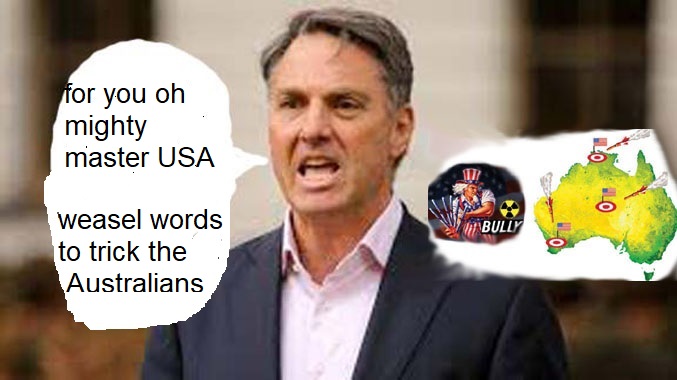
Marles: the sealed nuclear reactor is our friend, because by virtue of having a sealed reactor, we can provide assurance in respect of every piece of nuclear material through the life cycle of the nuclear material.
We are making a commitment that we will dispose of the nuclear reactor. That is a significant commitment to make. This is going to require a facility to be built in order to do a disposal that will be remote from populations. We are announcing that will be on defence land, current or future.
Now, to be clear, the first of the [nuclear material] we will dispose of will not happen until the 2050s, but within the year, we will announce a process by with this facility will be identified.
We are also a proud signatory to the treaty of Rarotonga. That commits us to not operate nuclear weapons from our territory.
Richard Marles says he is confident that the agreement will hold, even if America has a change in political direction……….
Q: Is it possible that we’ll be maintaining and operating three classes of submarines? That is the Virginia, the Collins and the Aukus submarines? And if so, is there any concern? And can I ask the admiral as well, is there any concern in defence about the prospect of operating three different submarines?
Marles:We obviously will be operating two as a result of this announcement. You know, the preference is to operate as few classes as possible.
Vice Admiral Mead: And once we work with the submarines coming to Western Australia and develop our own capabilities on the Virginias, then the move to SNN-AUKUS, which will have incredible commonality with propulsion systems, platforms, weapons, combat systems and sensors…………………. It remains the position of the Albanese government, that there won’t be foreign bases in Australia and this will not be a foreign base. It’s a forward rotation.…………..
Marles: ‘This is as good a value-for-money spend in defence as you will get’..……
Q: Is a high-level nuclear waste dump the price that South Australia will have to pay for the jobs that go to the state?
Marles:
Well, as I indicated earlier there will be a process that we will determine in the next 12 months … how the site will be identified. You’ve made a leap that we won’t make for some time. It will be a while before a site is identified but we will establish a process.
Q: The $9bn the government is spending over the forwards has a neutral impact on the budget, $6bn because of what was allocated to the attack class but $3bn is coming from the integrated investment program. Can you give more detail about … where that money is coming from? And if not today, when?
Marles: I won’t give you the detail today except you’re right to identify the integrated investment program and obviously the strategic review has had a good look at all of that. It will be plain in time of the budget.
Q: Why not now, though? You must have an idea where those cuts are going to be? In the interests of transparency, people want to judge what the opportunity cost of the nuclear submarines are. Unless you’re suggesting it’s cuts first and work it out later? Where are the cuts coming from?
In response to the news Australia will build and purchase nuclear submarines from the USA and the UK at a cost of up to $368bn between now and the mid-2050s, the Australian Conservation Foundation’s nuclear analyst Dave Sweeney said:
“The arrangement announced today will undoubtedly elevate regional tensions and increase risks for Australians and our neighbours.
“This deal introduces new and significant safety risks that Australia has never had to deal with before.
“There are risks of possible future accidents in our ports and waters, especially given nuclear regulator ARPANSA’s assessment that emergency management arrangements in Australia ‘are not fit for purpose for a future with nuclear powered submarines.’
“Pacific nations, Indonesia and others in our region have deep concerns about AUKUS.
“This arrangement further entangles Australia in the USA’s war-fighting plans.
“It raises serious non-proliferation concerns relating to access to highly enriched weapons-grade uranium and sets a disturbing precedent for imitation and escalation.
“Australia would be the only nation without nuclear weapons but with nuclear submarines. It may embolden other nations to go down this path, increasing global nuclear risks.
“There is no clarity about how the government intends to manage the resulting high level nuclear waste for the thousands of years it remains radioactive.
“As many Australians face daily cost of living pressures – and we all face the pressures of the climate crisis – this deal comes with a massive financial cost we will all bear.
“This whole process has lacked rigour or transparency and will cost Australians many billions of dollars that would be much better spent on social and environmental problems.
“ACF calls for the Albanese government to sign the UN Treaty on the Prohibition of Nuclear Weapons to give the Australian public and our region a clear commitment that nuclear subs are not a precursor to nuclear weapons.
“The Prime Minister should rule out Australia facilitating or hosting nuclear weapons – ‘neither confirm, nor deny’ is not an acceptable position. Australia must not facilitate unlawful weapons of mass and indiscriminate destruction.
“The PM should also rule out domestic nuclear power – nuclear subs must not become a Trojan Horse for subsidies for a deeply controversial and contaminating energy source.”
the Australian order will be filled with a new and advanced SSN® model still in development. This is where the British come in. In a sense, Australia will be (a) serving as a test run and (b) will be creating extra economies of scale for the British Navy’s plans to develop and build SSN( R) models to replace its Astute class submarines by the early to mid 2040s.
China may well regard Taiwan as a renegade province. Yet the invasion of Taiwan – as the Australian economist and commentator John Quiggin points out – would pose massive challenges for the forces or Xi Jinping……………………………………………………What Quiggin is getting at here is that a concerted campaign is currently being waged by sections of the Aussie media with the aim of scaring the pants off the Australian public about the imminent threat from China in the Pacific, in the South China Sea and with regard to Taiwan.
The aim of this campaign is to justify a sky-high level of new defence spending by the Australian government. New Zealand is at risk of being carted along by the same momentum into authorising increases in our own defence spending that we don’t need, and can’t afford.
Acting the part
The campaign kicks into high gear today. As the Oscars get handed out in Los Angeles, another pantomime of power will be playing out on the docks just down the coast, in San Diego. Anthony Albanese, Rishi Sunak and Joe Biden will be standing shoulder to shoulder as they announce the first concrete manifestation of the AUKUS pact – a military alliance between Australia, Britain and the Americans that has China as its common target……………………………………
. As Reuters put it:
….[The] AUKUS pact, will have multiple stages with at least one U.S. submarine visiting Australian ports in the coming years and end in the late 2030’s with a new class of submarines being built with British designs and American technology, one of the officials said….after the annual port visits, the United States would forward deploy some submarines in Western Australia by around 2027.
In the early 2030’s, Australia would buy 3 Virginia class submarines and have the option to buy two more. AUKUS is expected to be Australia’s biggest-ever defence project and offers the prospect of jobs in all three countries.
That last bit is very important. Like his predecessors, Albanese will be treating Australia’s defence policy as a cutting edge ingredient of its manufacturing policy.
Australia’s defence policy as a cutting edge ingredient of its manufacturing policy. For Australian politicians, military policy and defence spending is as much about (a) creating jobs for Aussie workers, (b) gaining technology upgrades for Aussie industry and (c) scoring lucrative contracts for Aussie goods and services firms as it is about the actual defence of the nation.
…………………………………………………………………. In a worst case scenario, the Australians could well invite New Zealand to join AUKUS and assign us some “friend of AUKUS” status, as an observer. Our anti-nuclear legislation would complicate such a role. That aside, and given the ocean currents and prevailing winds, New Zealand has every good reason to feel nervous about the prospect of our near-neighbour learning on the job about how to build and maintain the nuclear reactors on its new submarine fleet.
Luckily, most of the new Aussie subs won’t be delivered until the early to mid 2030s. That means these massively expensive new purchases probably wouldn’t arrive in time to deter China from invading Taiwan, given that this is supposed to be imminent.
In the US, the building of Virginia-class subs are shared between two shipyards, one in Groton Connecticut and the other in Newport News, Virginia. Reportedly, the design variant that Australia has in mind will have been a three-headed upgrade project to the Virginia-class that will have been co-designed by Britain and the US, as amended to Australian specifications, with at least some of the subs being built by US-trained Australians who had no prior experience in this sort of construction. On top of these complications, all participants will be coming under pressure to deliver every stage of the project at the lowest cost possible. I mean, what could possibly go wrong with such a design and construction plan? And in this case, I don’t just mean the danger of cost blowouts.
Attack and defence
AUKUS is likely to make New Zealanders feel more unsafe in a number of other ways as well. For starters, AUKUS is not a “defend the homeland” pact. It is a forward projection alliance, to attack enemy targets and stifle the enemy’s ability to defend itself and respond. (Enemy = China.) Before we bow to the pressure coming from our traditional allies to join in with their chest-bumping rivalries with China, it is probably worth looking at the Aussie nuclear submarine deal in more detail.
The Albanese government has said the Aussie subs will not be nuclear-armed. (Not yet, anyway) However, the roughly 40 Tomahawk cruise missiles (the final design will limit the number) that each submarine will carry can all carry nuclear warheads. Only previous treaty commitments with Russia have prevented the cruise missiles carried on Virginia-class subs from being nuclear-armed.
Yet with the scrapping of nuclear proliferation treaties with Russia in the wake of the war in Ukraine, we could well be sailing in a few years time into “neither confirm nor deny” territory with our Australian neighbours. Regardless of their potential for carrying nuclear tipped Tomahawk cruise missiles alongside the usual torpedoes, mines, autonomous undersea drones, etc etc ….Would these nuclear-powered Australian subs be barred from docking at New Zealand ports under the terms of our anti-nuclear legislation? Yes, they would.
Therefore, it would be good to know if our current political leaders share a bi-partisan agreement to preserve our anti-nuclear stance in its current form and thereby ban those Aussie subs from our ports, now and forever more. Even if Labour and National did agree, the reality is that our new and expensive Poseidon anti-submarine surveillance aircraft will still be taking part in exercises which will increasingly have (a) a nuclear component and (b) an anti-submarine (ASW) component, courtesy of our ANZAC buddies. Lest we forget. (The growing ASW role for Virginia-class SSN category subs is mentioned on page 9 of the Congressional Review Service evaluation of the SSN programme. )
From what can be gleaned at this point i.e. prior to the formal announcement, the Australian order will be filled with a new and advanced SSN® model still in development. This is where the British come in. In a sense, Australia will be (a) serving as a test run and (b) will be creating extra economies of scale for the British Navy’s plans to develop and build SSN( R) models to replace its Astute class submarines by the early to mid 2040s.
To repeat: It would be unwise for New Zealand to be stampeded by the “defence” lobbyists both here and offshore into making significant increases to the allocations for Defence in the May Budget. If nothing else, the Aussie subs saga is a useful reminder that the regional tensions in the Pacific and the China bogey are both being driven and monetised by firms within the military-industrial complex, via the pork barrel politicking (lucrative jobs and contracts for our neighbourhood! ) that is so rife among our traditional military allies.
Footnote: While we spend billions on a fleet of new Poseidon anti-submarine aircraft, and the Aussies buy their fleet of mega-expensive nuclear submarines, the future of underwater warfare is seen by some observers to rest with unmanned underwater vehicles (UUVs). Apparently, the Australian military has a programme to develop UUVs called Ghost Shark, cutely named after the US Ghost Bat programme.
But Western leaders while discussing AUKUS have taken pains to avoid calling out China directly, but it’s clearly aimed at countering Beijing’s influence in the Indo-Pacific, and certainly China sees it as directly impacting its own defense priorities – and has accused Australia of severely violating prior commitments to not introduce nuclear weapons or nuclear technology to its military.
In a major expansion and overhaul of its navy, Australia is planning to buy up to five US Virginia class nuclear powered submarines beginning in the next decade, Reuters and others are reporting. US as well as European officials have disclosed the future deal as part of a “landmark defense agreement between Washington, Canberra and London, four U.S. officials said on Wednesday, in a deal that would present a new challenge to China.”
The impending agreement is seen as central to the relatively new AUKUS partnership, and the major sub deal is expected to be announced when President Joe Biden, Australian Prime Minister Anthony Albanese and UK Prime Minister Rishi Sunak meet in San Diego Monday.
When the partnership was first announced and formalized eighteen months ago, President Biden said of it, “We all recognize the imperative of ensuring peace and stability in the Indo-Pacific over the long term,” and that “We need to be able to address both the current strategic environment in the region and how it may evolve.”
The nuclear submarines at center of the expected deal cost $3 billion each and will initially be built in Virginia and Connecticut. But sources say other submarines could be built in the UK and Australia while utilizing US technology and assistance.
The AUKUS partnership has multiple defense components components, chief among them the development of the nuclear submarine capability for Australia. This has been known since the AUKUS agreement was announced in Sept. 2021, but this week marks the first time specifics have been revealed.
Other components include security cooperation in cyberspace, artificial intelligence, quantum technologies and undersea capabilities. While the US, the UK and Australia already take part in common security arrangements, and all three participate in the Five Eyes alliance, an intelligence-sharing arrangement that also includes Canada and New Zealand, the AUKUS security structure provides for the technology cooperation needed to share nuclear submarine technology and other common efforts in a region where China poses growing security concerns.
But Western leaders while discussing AUKUS have taken pains to avoid calling out China directly, but it’s clearly aimed at countering Beijing’s influence in the Indo-Pacific, and certainly China sees it as directly impacting its own defense priorities – and has accused Australia of severely violating prior commitments to not introduce nuclear weapons or nuclear technology to its military.
The US Navy wants a full-service submarine hub in Australia that can oversee all underwater activity in the Asia Pacific, including production and repairs, Defense News reported Thursday.
The report cited comments from Navy Secretary Carlos del Toro, whose vision will be possible under AUKUS, the military pact signed between the US, Britain, and Australia in 2021 as part of an effort to build alliances against China.
AUKUS focuses on technology-sharing and will give Australia access to American and British nuclear-powered submarine technologies. Del Toro said that AUKUS is about “being able to repair our submarines much further out, being able to build them in Australia as well, too, and create that much more presence in the Indo-Pacific where we need it the most.”
President Biden, Australian Prime Minister Anthony Albanese, and British Prime Minister Rishi Sunak are expected to unveil the details of AUKUS submarine deals on Monday during a meeting aboard a submarine in San Diego. Australia is expected first to purchase American Virginia class attack submarines, which will be delivered in the early 2030s.
Australia will then purchase a new British-designed submarine, called the SSN-AUKUS, that’s expected to arrive in the 2040s. The ultimate goal is for Australia to be able to build its own SSN-AUKUS submarines with US or British-provided nuclear propulsion. Over the next few decades, Canberra is expected to spend over $100 billion on the plan.
The submarines Australia will acquire are not expected to be armed with nuclear weapons, but that could always change. Either way, China views the submarine buildup as a provocation since the underwater craft will be used to patrol the waters of the South China Sea. The US also has plans to deploy more troops and aircraft to Australia as part of its buildup, including nuclear-capable B-52 bombers.
Independent Australia, By John Quiggin | 10 March 2023,
As Nine newspapers attempt to spread panic about a Chinese invasion, Professor John Quiggin explains why the logistics of such an event happening are unrealistic.
“…………………………………………….We are being told that within the next few years, a seaborne invasion that would dwarf D-Day is going to take place. The most extreme version of this claim is the ‘Red Alert’ series now being published by the Nine newspapers.
China, it is claimed, plans to invade Taiwan, a country with 290,000 soldiers under arms and reserves of 2.3 million. To achieve the kind of numerical superiority seen on D-Day, China would need to land nearly a million men in the first days of an invasion.
But unlike D-Day, there could be no element of surprise. With modern technology, any attack would be detected before the ships left port. They would have to travel 170 kilometres across open water, within range of air attack and anti-ship missiles for the entire voyage. On arriving, they would have a choice of eight small beaches, all of which have been fortified over many decades. Assuming the troops somehow got ashore, they would deal with terrain that makes the bocage look like an open plain.
And to achieve this, the PLA Navy has less than 50 operational landing craft, many dating from the 1970s. The rest of the invasion is supposed to be undertaken by converted ferries, which would be virtually defenceless even against small-arms fire.
Any attempt at grinding down defences with a preliminary bombing campaign would be doomed to failure. Taiwan’s air and missile forces are dug deep into mountains. And retaliatory strikes would impose huge costs, even assuming that the U.S. did not take part.
A variety of other strategies (decapitation attacks, blockades and so on) have also been canvassed. All were tried by the Russians in Ukraine and all failed.
How do the fearmongers of the ‘Red Alert’ series respond to this widely known analysis? The answer is that they don’t. Instead, they canvass every possible scary scenario they can come up with (germ warfare, cyber-attacks, even a nuclear strike on Pine Gap) in the hope that Australians will be terrified enough to back a big increase in military spending. The striking contradiction is that the conventional weapons they are pushing for would be of no use in countering the threats they are talking about.
Of course, the idea of an invasion of Taiwan isn’t just a fantasy of the Nine newspapers. It suits all the main players to pretend that it’s a realistic possibility. Chinese President Xi Jinping wouldn’t last five minutes as China’s dictator if he renounced the idea of forcible reunification. U.S. Navy figures like Admiral Michael Gilday, who says an attack might come this year, want an increased share of the U.S. defence budget. And, obviously, the Taiwanese Government has no incentive to understate the threats it faces from the Chinese regime.
An enthusiastic Rishi Sunak has told ministers to expect a positive outcome next week when he travels to San Diego to unveil a deal to supply nuclear-powered submarines to Australia as part of the Aukus pact with the US.
Multiple sources said they believed the UK had succeeded in its bid to sell British-designed nuclear submarines to Australia, a deal that will safeguard the long-term future of the shipyard at Barrow-in-Furness.
A senior minister said Sunak had told colleagues he was delighted by the outcome of the negotiations, which have been going on for 18 months and have presented Australia with a choice between a British or a US design, based on the existing Astute or Virginia class submarines.
“The deal has definitely gone our way. The prime minister was buzzing about it when he told ministers, smiling and bouncing on the balls of his feet,” the minister said.
A second source outside government with knowledge of the talks said they had also been told to expect a British design success when the deal is announced on Monday, although any final submarine will also make heavy use of US technology.
Sunak is due to travel to the west coast for a trilateral summit with Joe Biden, the US president, and Anthony Albanese, the Australian prime minister, on Monday, where he also expected to unveil a refresh of Britain’s integrated review of defence and foreign policy in the light of the war in Ukraine.
Supplying Australia with a nuclear-powered submarine was the centrepiece for the Aukus defence pact, announced in September 2021, with the US and UK agreeing to share secret reactor technology in a surprise deal, so Canberra could dump an alternative diesel-powered design from France.
The expectation, one source indicated, was that Australia would work jointly on a design for a next generation submarine with the UK, evolving from the existing Astute submarine design, although it may not be seaworthy until the 2040s because of the complexity of the work.
Further reports last night suggested that the short-term gap could be plugged by Australia buying up to five Virginia-class submarines from the US as part of the three-way deal.
Meanwhile, an alternative plan that the UK could even be willing to sell or lease the two Astute class submarines yet to be completed at Barrow, HMS Agincourt and HMS Agamemnon, is wide of the mark. Naval analysts say the UK’s submarine fleet is already stretched and could not afford a sudden reduction.
Australia will become the seventh country to have a nuclear-powered submarine, relying on an enriched uranium reactor, propulsion technology that will put the country’s diesel-powered navy on a technological par with China.
But it will require Australia, which is not a nuclear power, to be supplied with a reactor, a move that Beijing has argued is a breach of the Nuclear Non Proliferation Treaty. The three Aukus powers say that is not the case, and that any reactors will be supplied “welded, shielded and sealed shut” according to Australian officials overseeing the effort.
The new submarines will not carry nuclear weapons. But James Acton, a nuclear expert with the Carnegie Endowment for International Peace, said it was not yet clear how the nuclear waste generated by the propulsion reactors will be dealt with – and whether that will happen in Australia or the UK or US.
Defence experts said the time it would take to build the new submarines meant that there may be some related short-term developments. The US is keen to be able to base its nuclear submarines in Australia, making it easier to patrol the South Pacific, as it seeks to retain naval parity with China.
A UK government spokesperson said: “When we announced the Aukus partnership in September 2021 we said there would be an 18-month scoping period to determine the optimal path to procuring Australia nuclear-powered submarines. The outcome of the scoping period is due to be announced soon.”
A No 10 spokesperson said they could not pre-empt any future announcements.
Diligently, obediently and with a degree of dangerous imbecility, a number of Australian media outlets are manufacturing a consensus for war with a country that has never been a natural, historical enemy, nor sought to be.
But as Australia remains the satellite of a Sino-suspicious US imperium, its officials and their dutiful advocates in the press seem obligated to pave the way for conflict.
The latest example of this came in articles run in the Sydney Morning Herald and The Age of Melbourne. The premise is already clear from the columnists, Peter Hartcher and Matthew Knott. Australia faces a “Red Alert”, and, to that end, needs a warring fan club. Not since the domino theory bewitched strategists and confused military planners have Australians witnessed this: a series of articles featuring a gang of five with one purpose: to render the Australian public so witless as to reject any peaceful accommodation.
First, the provocative colouring for the article, “How a conflict over Taiwan could swiftly reach our shores.” The Australian continent is shown bathed in a sea of red. Various military bases and facilities are outlined. For good measure, there is a picture of Australian soldiers firing an artillery piece in “military exercises in 2018 at Shoalwater Bay, Queensland.”
Then, the blistering opening lines of terror. “Within 72 hours of a conflict breaking out over Taiwan, Chinese missile bombardments and devastating cyberattacks on Australia would begin. For the first time since World War II, the mainland would be under attack.” The authors already anticipate a good complement of US troops to occupy the Australian north, some 150,000 “seeking refuge from the immediate conflict zone.”
The Red Alert panellists, anointed as “defence experts”, brim with such scenarios. All, as they state in a joint communique, agree on one thing: “Australia has many vulnerabilities. It has long and exposed connections to the rest of the world – sea, air and undersea – yet is incapable of protecting them.”
Leading the gang of five is Peter Jennings, who has had an unshakeable red-under-the-bed fantasy for years. A former deputy secretary for strategy in the Australian Defence Department, and steering the Australian Strategic Policy Institute (ASPI) for a decade (that’s Canberra’s revolving door for you), Jennings is adamant and steely. “As I think of a conflict over Taiwan, what I’m thinking about is something that very quickly grows in scale and location.”
There is no reason at all why such a growth in scale or location should happen, but this is not the purpose of the exercise. The point of the Red Alert fantasy is to neutralise the significance of Australia’s natural boundaries – some of the most formidable on the planet – and dismiss them in any conflict with Beijing. “Distance is no longer equivalent to safety from our strategic perspective,” ponders Jennings.
Jennings inadvertently reveals the case against war, which can only be an encouragement to activists and officials keen to reverse the trend of turning Australia into a US imperial outpost of naval and military bases that would be used in any Taiwan conflict. “If China wants to seriously go after Taiwan in any military sense, the only way they can really contemplate quick success is to pre-emptively attack those assets that might be a threat to them. That means Pine Gap goes.” Pine Gap remains that misnamed joint US-Australian signals facility that has facilitated illegal drone strikes in foreign territories most Australian politicians would fail to find on a map.
……….. Lavina Lee, another Red Alert panellist, is also into the business of softening the Australian public for war,………
Australia’s former chief scientist, Alan Finkel, dolls out his own catastrophic scenario………..
Retired army major-general Mick Ryan makes his contribution by wishing Australia to be readied for war. In a message common to most military officers, the civilians should really do more about giving his brethren more cash. ……………
Lesley Seebeck, former head of the Australian National University’s Cyber Institute, completes the crew of five, …………
A few things are worth noting in this frothy mix of fantabulation and establishment fire breathing. In the quest to gather such a panel, no effort has been made to consult the expertise of a China hand. That lobby, able to provide a more nuanced, less heavy-footed approach, is being shunned, their advice exorcised in any effort to encourage war.
Bizarrely, the panellists offer an increasingly popular non-sequitur that has creeped into the warmonger’s manual: Would Australia’s leaders, in war, pass the Zelensky test? This somehow implies that the Ukraine conflict offers salient lessons over a war over Taiwan, an absurd comparison that muddled strategists are fond of making.
Most of all, Beijing’s own actual intentions over Taiwan are to be avoided. The presumption in ASPI-land is that a war is imminent, and that Beijing would want to go to war over the island as a matter of course. China’s President Xi Jinping’s main advisor on the subject, veteran ideologue Wang Huning, suggests an approach at odds with such thinking.
The Red Alert exercise has drawn necessary and important criticism. Former Australian Prime Minister Paul Keating did not mince his words in a fuming column for Pearls and Irritations. “Today’s Sydney Morning Herald and The Age front page stories on Australia’s supposed war risk with China represents the most egregious and provocative news presentation of any newspaper I have witnessed in over fifty years of active public life.” One might even go further back than that. The war times are coming, and as are those gangs seeking to encourage them. https://theaimn.com/war-over-taiwan-australias-gang-of-five/
Contributors to the “War with China over Taiwan” horror show which began in the Nine newspapers this week assume that a war between China and the United States is likely, and some of them then explicitly say that Australia would be involved. Australia should instead regard the Taiwan issue as one for us to “sit out”.
Mick Ryan, for example, says that “we have made our choice. If the United States goes to war with China over Taiwan, we are going to support them one way or the other”. Lavina Lee speaks of “the outbreak of war and Australia’s inevitable participation”.
They speak so glibly that one wonders whether they have thought at all about what a war between two nuclear powers, the biggest and second biggest economies in the world, would be like. Nor do they seem to have given any thought to what various government Ministers have said is Australia’s prime strategic goal in the Asia-Pacific, and that is to prevent war.
Why all this drama at this time? There are some events coming up which may have an influence; the releases of the Defence Strategic Review and the nuclear submarine study are two of them, and the coming budget is another. They will all involve spending very large sums of money on defence projects, and both the Defence organisation and firms which stand to benefit from Government spending may well welcome some “preparing of the audience”.
Our ally, the United States, may also have an interest. Under various defence arrangements we can expect to see an increasing amount of United States basing and military involvement in Australia. This has not been universally welcomed in the past, and the United States Government, and its defence firms which would be involved in an expansion of the US military presence in Australia as well as in an increase in our own defence spending, could well welcome the dramatisation of the “China threat” the Nine newspapers are providing this week.
How real is the China threat? It’s certainly seen as real by some Americans, who see China as the “peer competitor” they cannot tolerate. According to some accounts China is already clearly ahead of the US in a number of key technologies, which gives added emphasis to the military in US eyes, since the US is clearly superior militarily; despite the recent planned increase of 7% in Chinese military spending the US increase is even bigger, at 8%. The urge to maintain their predominance in the Pacific, and elsewhere, is probably why some very senior American military commanders seem to be anticipating and even looking forward to a war with China before long, with Taiwan as its probable rationale.
Australian Ministers and senior officials, on the other hand, have frequently spoken of the need to find a balance in the Pacific which gives appropriate place and weight to both the United States and China…………………………………………………………….
Taiwan is a very special case. We have no formal obligation to it. We recognised China, acknowledging that it maintained there is only one China, and that Taiwan is part of that. The current situation is complex and complicated: for example despite all the mutual abuse China and Taiwan have a substantial economic relationship; many people from Taiwan live and work in China. Recent polls show that a large proportion of Taiwanese believe that in the end Taiwan will be re-united with China, and are not keen to fight China to prevent that. The current state of affairs has come about as the result of the struggle for predominance in the Asia-Pacific between the US and China, the world’s two largest economies, both nuclear-armed and themselves in a complex and many-sided relationship.
We want the US to continue to play a major role in the Asia-Pacific, but there must be an appropriate place for China as well. As the former Secretary of DFAT, Peter Varghese, wrote in September last year: “If we tether ourselves to the cause of US primacy we leave ourselves exposed to US policies that may make sense for the US but not necessarily for Australia. We risk structuring our defence forces to fight alongside the US rather than primarily for the defence of Australia. We risk buying into a narrative of democracy versus autocracy which, however inspiring, misreads the strategic and historical drivers of China’s actions and has little resonance in our region.”
Australia, with its small and presently ill-equipped armed forces, could contribute almost nothing to a clash between the United States and China that has nothing to do with us. The US is such a large and globally important country that its relationships can in the end be repaired even with countries with which it has been in conflict. That does not apply to us, and if we joined the US in fighting China over Taiwan, not only would we not make any appreciable difference but our relationship with our biggest trading partner would be destroyed for years.
Australia is expected to buy up to five US Virginia class nuclear-powered submarines in the 2030s under the AUKUS defence pact between Washington, Canberra and London, reports say.
US officials, speaking on the condition of anonymity, said after the annual port visits, the US would forward deploy some submarines in Western Australia by around 2027, the Reuters news agency reported today.
Australia would buy three Virginia class submarines in the early 2030s and have the option to buy two more, the sources said.
Australia’s new fleet of nuclear-powered submarines will be based on a modified British design with US parts and upgrades, the report said.
Prime Minister Anthony Albanese will travel to the US next week to unveil the choice of submarine design for the Royal Australian Navy (RAN).
More than 10,000 jobs will be created from Australia’s acquisition of nuclear-powered submarines under the AUKUS defence pact, according to the country’s navy.
The mass media in Australia have been churning out brazen propaganda pieces to manufacture consent for war with China, and what’s interesting is that they’re basically admitting to doing this deliberately.
Australians are uniquely susceptible to propaganda because we have the most concentrated media ownership in the western world, dominated by a powerful duopoly of Nine Entertainment and the Murdoch-owned News Corp. Both of those media megacorporations have recently put out appalling propaganda pieces about the need for Australians to rapidly prepare to go to war with China in defense of Taiwan, and in both of those instances have straightforwardly told their audiences that there’s an urgent need to effect a psychological change in the way all Australians think about this war.
Nine Entertainment’s Sydney Morning Herald and The Age have been busy flooding the media with testimony from a panel of war machine-funded “experts” who say Australia must hasten to get ready to join the United States in a hot war with China in the next three years. Yesterday’s dual front-page propaganda assault featured imagery of Chinese war planes flying straight at the reader, awash in red and emblazoned with the words “RED ALERT” to help everyone understand how evil and communist China is.
“Today’s Sydney Morning Herald and Age front-page stories on Australia’s supposed war risk with China represents the most egregious and provocative news presentation of any newspaper I have witnessed in over 50 years of active public life,” former Australian Prime Minister Paul Keating opined in response to the publications.
“Apart from the outrageous illustrations of jet aircraft being shown leaving a profiled red-coloured map of China, the extent of the bias and news abuse is, I believe, unparalleled in modern Australian journalism,” he added.
In the first installment of their “Red Alert” propaganda series, SMH and The Age share that their empire-funded panelists believe there’s a need to bring about a “psychological shift” in the public’s attitude toward war with China, with one panelist asserting that “the nation’s leaders should trust the public enough to include them in what can be a confronting discussion” about the need to prepare for that war.
In the second “Red Alert” installment, this same message is repeated, saying that “Australia’s vulnerabilities are not only physical, but psychological,” and again repeating the need to get everyone talking and thinking about the possibility of war with China.
“It is a real national taboo to think about the likelihood of a conflict in anything other than the most remotely theoretical perspective,” says Peter Jennings of the war machine-funded propaganda firm Australian Strategic Policy Institute, countering that “we will sleepwalk into disaster unless we openly discuss unpalatable scenarios.”
Saying that the real threat is “complacency rather than alarmism,” think tanker Lavina Lee urges Australia to confront “the possibility that we might go to war and what would happen either way. We should talk about what the world would look like if we win and what it would look like if we lose.”
Over and over again they are telling us that something must be done to change the way Australians think and talk about a war with China, in articles designed to change the way Australians think and talk about war with China. They are doing the exact thing they say must be done, while explaining why it needs to be done. They are brainwashing us with propaganda while explaining why it is necessary to brainwash us with propaganda.
Toward the end of the special, Sky News’ empire-backed “experts” tell their audience that Australia needs to double its military spending, and that those in power need to explain to them why this is so important…………………………………….
Again, they’re saying there’s a desperate need to explain to Australians why they need to make sacrifices to prepare for war with China, while explaining to Australians that they need to make sacrifices to prepare for war with China. They are openly telling us that we need to be propagandized for our own good, while filling our heads with propaganda.
They’re not just filling our minds with war propaganda, they are openly telling us that war propaganda is good for us.
………………………….. This latest propaganda piece says that in the event of a hot war with China, our nation may be struck with intercontinental ballistic missiles, we may find ourselves cut off from the world while the fuel supplies we rely on dry up in a matter of weeks, and we may find our infrastructure rendered useless by massive Chinese cyberattacks.
The empire-funded “experts” acknowledge that this will not be because China is just randomly hostile to Australia, but because we are a US military and intelligence asset who will support the US empire in its war:
But why would China use its limited resources to attack Australia instead of focusing solely on seizing Taiwan? Because of the strategically crucial role Australia is expected to play for the United States in the conflict.
“Our geography means we are a southern base for the Americans for what comes next,” Ryan says. “That’s how they’re seeing us. They want our geography. They want us to build bases for several hundred thousand Americans in due course like in World War II.”
Interestingly, the article contains a rare acknowledgement in the mainstream press that the presence of the American surveillance base Pine Gap makes Australia a legitimate target for ICBMs:
At no time is it ever suggested that the fact that going to war with China could cost Australia its shipping lanes and infrastructure and even get us nuked means we should probably reconsider this grand plan of going to war with China. At no time is it ever suggested that riding Washington’s bloodsoaked coattails into World War Three against our primary trading partner might not be a good idea. At no time is it ever suggested that de-escalation, diplomacy and detente might be a better approach than rapidly increasing militarism and brinkmanship.
And at no time is it ever suggested that we should reconsider our role as a US military/intelligence asset, despite the open admission that this is exactly what is endangering us. We’re not being told to prepare for war with China because China is going to attack us, we’re being told to prepare for war with China because our masters in DC are planning to drag us into one. We’re not being told to prepare for war to defend ourselves, we’re being told to prepare for war because our rulers plan to attack China.
We see this in the way Australia is assembling its war machinery, buying up air-to-ground missiles that cannot possibly be used defensively because their sole purpose is for taking out an enemy nation’s air defenses. We see it in the way Australia is buying up sea mines, which as journalist Peter Cronau has noted is less suitable for protecting our 34,000 km of coastline than for blockading the shipping lanes of an enemy nation you wish to lay siege to. We see it in the fact that China’s military budget remains steady at around one and-a-half percent of its GDP, while the US spends 3.4 percent and Australia is being persuaded to double our share from two to four percent.








 Antinuclear