Irresponsible Politics: Australia’s B-52 Nuclear Weapons Problem, and weasel words from Foreign Minister Penny Wong.

an irritated Wong deferred the issue in its entirety to Washington’s judgment, accepting the principle of “warhead ambiguity”.
This stubbornly irresponsible approach by the Australian government and its public servants means that the Australian public, at no point, can know whether US aircraft or delivery systems will have nuclear weapons, even if they transit through airspace or are based, for however long, on Australian soil. As Australian Greens Senator and Foreign Affairs spokesperson Jordon Steele John described it, “Australians have resisted the nuclearization of our military for decades and now the Albanese government is letting the Americans do it for us.”
February 17, 2023, Dr Binoy Kampmark, https://theaimn.com/irresponsible-politics-australias-b-52-nuclear-weapons-problem/
It is not farfetched to make the point that delivery systems capable of deploying nuclear weapons will lead to them carrying those very same weapons. Whatever the promises made by governments that such delivery systems will not carry such loads, stifling secrecy over such arrangements can only stir doubt.
That is the problem facing the AUKUS alliance which makes Australia a central point of reference for Washington and its broader ambitions in curbing China. The alliance is increasingly being characterised by a nuclear tone. First came the promise to furnish Australia with nuclear powered submarines, absent nuclear weapons. Then came the announcement to deploy six B-52 bombers to the Northern Territory’s Tindal airbase, south of Darwin.
Australia, in being turned into a US garrison state, is very likely going to be a site where nuclear weapons are hosted, though pedants and legal quibblers will dispute what, exactly, constitutes such hosting. Whether this is done so transiently, or whether this will be an ongoing understanding, is impossible to say. Any such arrangement is bound to make a nonsense of the South Pacific Nuclear-free Zone Treaty, otherwise known as the Treaty of Rarotonga, to which Australia is a party
The Albanese government is doing little to clarify the matter, and, in so doing, drawing even more attention to itself. In Senate estimates hearings held on February 15, the Greens pressed for clarification on the issue of nuclear weapons on Australian soil. Senator David Shoebridge asked whether Canberra was complying with the Treaty of Rarotonga, and whether visiting B-52s could carry nuclear weapons.
The latter question was almost a moot point, given that all B-52Hs are nuclear capable. The only issue is the type of nuclear enabled weapon they might carry. The nuclear gravity bomb days of the aircraft are over, but they are more than capable of being armed with nuclear-tipped cruise missiles.
In his response, Department of Defence Secretary Greg Moriarty manufactured a state of compliance with international obligations. The circle could thereby be squared. “I think more generally, it is clear stationing of nuclear weapons in Australia is prohibited by the South pacific nuclear free zone treaty, to which Australia is fully committed.”
The same, however, could not be said about visiting “foreign aircraft to Australian airfields or transit of Australia’s airspace, including in the context of our training and exercise programs, and the Australia and the Australian force posture cooperation with the United States.”
Disconcertingly, Moriarty went on to acknowledge that the practice of carrying nuclear weapons on US aircraft, if it had been going on, was entirely consistent with Australia’s own commitments to both the Treaty of Rarotonga and the Nuclear Non-Proliferation Treaty. “US bomber aircraft have been visiting Australia since the early 1980s and have conducted training in Australia since 2005. Successive Australian governments have understood and respected the longstanding US policy of neither confirming nor denying the presence of nuclear weapons on particular platforms.”
Moriarty went on to acknowledge that, “Australia will continue to fully comply with our international obligations, and the United States understands and fully respects Australia’s international obligations with respect to nuclear weapons.”
Shoebridge, less than content with the secretary’s response, shot back with another question: “So, Mr. Moriarty, do I understand from that answer that defence does not believe that there is a restraint under Australia’s current treaty obligations [permitting] nuclear armed B-52 bombers to be present in Australia, provided it’s not a permanent presence?”
Moriarty never got a chance to respond. Left with an opportunity to correct the outlandishly servile, not to mention opaque nature of US-Australian security relations, Foreign Minister Penny Wong became stroppy. The tradition of Master Washington and Servant Canberra would not be bucked. “I’m the minister, and I’m responding.”
In responding, thereby channelling the self-interested voice of the US imperium, an irritated Wong deferred the issue in its entirety to Washington’s judgment, accepting the principle of “warhead ambiguity”. “It is part of ensuring we maintain that interoperability that goes to us making Australia safe. We have tried to be helpful in indicating our commitment to the South Pacific nuclear free zone treaty. We are fully committed to that. And we’ve given you the answer that the secretary has given you.”
It was, the Senator continued to elaborate, beneath the minister to “engage in any more hypotheticals” – what Shoebridge was wishing to do, she accused, was “drum up concern, and I don’t think it’s responsible.” What, then, was the appropriate response in the world according to Wong? “The responsible way of handling this is to recognise that the US has a ‘neither confirm nor deny position’ which we understand and respect.”
This stubbornly irresponsible approach by the Australian government and its public servants means that the Australian public, at no point, can know whether US aircraft or delivery systems will have nuclear weapons, even if they transit through airspace or are based, for however long, on Australian soil. As Australian Greens Senator and Foreign Affairs spokesperson Jordon Steele John described it, “Australians have resisted the nuclearization of our military for decades and now the Albanese government is letting the Americans do it for us.”
This ingloriously subservient status to Washington has been laid bare yet again, and along with that, the increasingly likely prospect of being targeted in any future conflict that involves the United States. Hardly a responsible state of affairs, and one on the verge of being treasonous.
Murdoch Propaganda Pushes Australia To Double Its Military Budget For War With China – The time to start resisting is now.

And at 45:50 we finally get to the real purpose of this Sky News special: the need to “dramatically increase” the Australian military budget, and the need to manufacture consent for that increase.
I always get people complaining that I focus too much on the US war machine when I live in Australia, but anyone who’s paying attention knows the behavior of the US war machine is as relevant to Australians as it is to Americans. They are beating the drums for a future war of unfathomable horror all to please a dark god known as unipolarism, and it threatens to destroy us all.
The time to start resisting is now.
Caitlin Johnstone, Feb 16 2023,
In the latest escalation in Australia’s increasingly forceful campaign to manufacture consent for war with China, the Murdoch-owned Sky News Australia has aired a jaw-droppingly propagandistic hour-long special which advocates a dramatic increase in the nation’s military spending.
Australians are uniquely vulnerable to propaganda because our nation has the most concentrated media ownership in the western world, the lion’s share of it by Rupert Murdoch, who has well-documented ties to US government agencies going back decades. The propaganda campaign against China has gotten so aggressive here in recent years that I’ve repeatedly had complete strangers start babbling at me about the Chinese threat in casual conversation, completely out of the blue, within minutes of our first meeting each other.
The Sky News special is one of the most brazenly propagandistic things I have ever witnessed in any news media, with its opening minutes featuring footage of bayonet-wielding Chinese troops marching while ominous cinematic Bad Guy music plays loudly over the sound of the marching. In its promotional clip for the special, Sky News Australia tinged all footage pertaining to China in red to show how dangerous and communist they are. These are not decisions that are made with the intention of informing the public, these are decisions that are made with the intention of administering war propaganda.
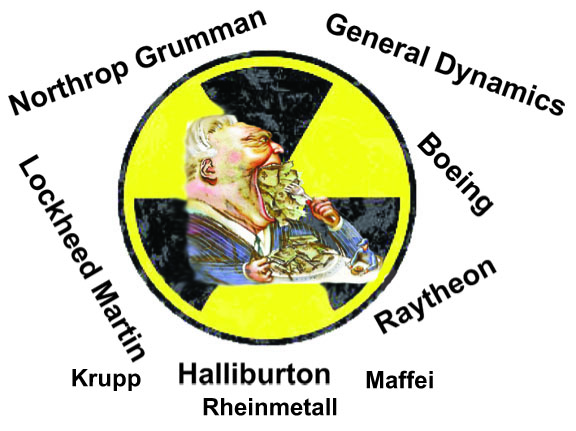
The first expert Sky News brings on to tell viewers about the Chinese menace is Mick Ryan, an Adjunct Fellow at the Center for Strategic and International Studies, which is funded by military-industrial complex entities like Raytheon, Boeing, Lockheed Martin and Northrop Grumman, and is also directly funded by the US government and its client states, including Australia and Taiwan. Sky News of course makes no mention of this immense conflict of interest while manufacturing consent for increased military spending, calling Ryan simply a “former major general.” This is on the same level of journalistic malpractice as running an article by Colonel Sanders on the health benefits of fried chicken but calling him “Harland David Sanders, former fry cook.”
The next expert Sky News presents us with is Australian former major general Jim “The Butcher of Fallujah” Molan, who oh-so-sadly passed away last month. I’ve written about Molan previously specifically because the Australian media love citing him in their propaganda campaign against China, last time when he was pushing the ridiculous claim that China is poised to launch an invasion of Australia.
The other experts Sky News brings in are former CIA Director and US Secretary of Defense Leon Panetta, Taiwan’s Foreign Minister Joseph Wu, Taiwan’s Director of Chinese Affairs Dr Lai Chung, Japan’s ambassador to Australia Yamagami Shingo, Australian Shadow Defense Minister Andrew Hastie, and John Coyne of the Australian Strategic Policy Institute, a virulent propaganda firm which is once again funded by US-aligned governments and military-industrial complex war profiteers.
So it’s about as balanced and impartial a punditry lineup as you’d expect.
At the 8:15 mark of the special, Sky News repeats the unevidenced propaganda claim that former Chinese president Hu Jintao was politically purged during the 20th Communist Party Congress last year.
At 19:15 Jim Molan talks about the need to fight and die with our allies the Americans while patriotic cello music plays in the background.
At 21:30 we are shown images of Australia being bombed alongside the Chinese flag (very subtle, guys).
At 24:25 Sky News accidentally does a version of the “look how close they put their country to our military bases” meme with a graphic display of all the US war machinery that surrounds China. The US would never tolerate being encircled by the Chinese military like that and would immediately wage war if China tried; it’s clear that the US is the aggressor in this conflict and China is reacting defensively.
“The United States plays a major strategic role in the Indo-Pacific,” says Sky News anchor Peter Stefanovic as the screen lights up with graphics showing the military presence surrounding China. “With 375,000 personnel, there’s a vast network of operations that extend from Hawaii all the way to India.”
At 26:30 we are shown a digital representation of China’s satellite systems in space, with the Chinese satellites colored red to help us all appreciate how evil and communist they are.
At 27:45 we are shown illustrations of how much smaller Australia’s military is than China’s or America’s to help us understand how important it is to increase the size of our nation’s war machine, ignoring the fact that Australia’s total population is a tiny fraction of either of those countries.
At 32:45 we are told that the AUKUS pact will “beef up America’s military presence in the north of Australia,” and that “America has long used Australia as a key strategic outpost,” showing images of Pine Gap and other parts of the US war machine which dot this continent. “Now, there’s more to come,” says Stefanovic, with US Secretary of Defense Lloyd Austin describing the surge in US military presence we’re to expect in Australia.
At 34:10 the Australian Strategic Policy Institute guy explains why the US is so keen to use Australia in its planned confrontation with China, saying the continent’s geography puts it in “the Goldilocks location” of being close enough to China to be meaningful but far enough away that its war machinery can’t be easily struck.
At 35:15 Stefanovic warns that “our nation could quite literally be brought to its knees” if a war to the north sees shipping lanes cut off since Australia is so heavily dependent of imports. You would think this is an argument about the importance of maintaining a peaceful relationship with China, but instead it’s used to foment fear of China and argue for the need to be able to defeat it in a war.
And at 45:50 we finally get to the real purpose of this Sky News special: the need to “dramatically increase” the Australian military budget, and the need to manufacture consent for that increase. Australia currently has a military budget of $48.7 billion, a little less than two percent of the nation’s GDP. The late Butcher of Fallujah tells Sky News that “we need to at least double our defense expenditure” to four percent, and the special’s pundits openly discuss the need for Australians to be persuaded to accept this using narrative management…………………….
To be clear, this is not just a call to increase military spending, this is a call to propagandize Australians into consenting to more military spending. It’s not very often that the propaganda comes right out and explains to you why it is propagandizing you.
I always get people complaining that I focus too much on the US war machine when I live in Australia, but anyone who’s paying attention knows the behavior of the US war machine is as relevant to Australians as it is to Americans. They are beating the drums for a future war of unfathomable horror all to please a dark god known as unipolarism, and it threatens to destroy us all.
The time to start resisting is now. https://caitlinjohnstone.substack.com/p/murdoch-propaganda-pushes-australia?r=pf4vw&utm_campaign=post&utm_medium=web&fbclid=IwAR2-MoxPsyKvcurWfgwc2Qd8aFn6YwgGaG4clg0wgUKO7NYQypg76A-zLUY
With weasel words, Australia’s top military brass, and sycophant Richard Marles, justify allowing U.S. nuclear weapons in Australia
US nuclear-armed bomber visits allowed under Australian treaty obligations The Age, Matthew Knott, February 15, 2023
American B-52 bombers armed with nuclear warheads could rotate through Australia without breaching treaty obligations, the nation’s most senior defence public servant has indicated.
The Australian public would never be informed whether such aircraft are carrying nuclear weapons under the so-called US policy of “warhead ambiguity” in which it neither confirms nor denies if particular forms of military equipment are nuclear-armed.
While adamantly refusing to address hypothetical scenarios, Foreign Minister Penny Wong said: “The responsible way of handling this is to recognise that the US has a ‘neither confirm nor deny position’ which we understand and respect.”
It was revealed last year that the United States is preparing to build dedicated facilities for up to six B-52 bombers at Tindal air base, south of Darwin, for use in the Northern Territory dry season.
Nuclear weapons opponents and the Chinese government blasted the plan on the basis it could escalate tensions in the Asia-Pacific and accelerate an arms race in the region………………….
Australia is prohibited from permanently housing nuclear weapons in the country under its treaty obligations. But Moriarty, speaking in general terms, suggested US nuclear-armed bombers could temporarily pass through Australia without breaching international law.
“The stationing of nuclear weapons in Australia is prohibited by the South Pacific Nuclear-free Zone Treaty to which Australia is fully committed,” Moriarty said.
“There is no impediment under this treaty or the Nuclear Non-proliferation Treaty to the visit of foreign aircraft to Australian airfields or transit of Australia’s airspace, including in the context of our training and exercise programs and Australia’s force posture co-operation program with the United States.”
The B-52 is a long-range, heavy bomber that can carry out ocean surveillance and anti-ship operations and “can carry nuclear or precision guided conventional ordnance”, according to the US government……………
Greens defence spokesman David Shoebridge said: “It is highly alarming that Australian military facilities are being made available for the US to launch its nuclear-capable bombers.
“This decision not only makes us a nuclear target – it further erodes our sovereignty.
“The US has made it clear it won’t tell anyone when their B-52’s are nuclear armed or not. This leaves Australia in the dark about our role in the USA’s global nuclear strategy.”
Defence Minister Richard Marles said that while Australia had agreed to an increased tempo of American rotations in northern Australia, there had been no change in policy regarding the presence of nuclear-armed weapons.
“America maintains a policy of ambiguity in terms of the nature of assets that are on their platforms and they do that so as to amplify their extended nuclear deterrence,” he told the ABC.
Asked whether US nuclear-armed bombers should be allowed in Australia, opposition defence spokesman Andrew Hastie said: “Of course, we want to see a greater presence of the American military in the Indo-Pacific.”……………………………………………
When the ABC’s Four Corners revealed the plan to build dedicated facilities for the B-52s in October, Chinese Foreign Ministry spokesman Zhao Lijian said: “Such a move by the US and Australia escalates regional tensions, gravely undermines regional peace and stability, and may trigger an arms race in the region.”
Greens foreign affairs spokesman Jordan Steele-John said: “Nuclear-capable B-52 bombers have no place on Australian bases, on Australian shores or in Australian airspace. They are an offensive weapon that will destabilise our region.” https://www.theage.com.au/politics/federal/us-nuclear-armed-bomber-visits-allowed-under-australian-treaty-obligations-20230215-p5ckrs.html—
Australian government OK with not knowing whether or not visiting US aircraft carry nuclear weapons!
“………………… Appearing before a Senate estimates hearing, Defence secretary Greg Moriarty and senior military figures were also quizzed about a nuclear submarines deal with the United States and Britain.
Mr Moriarty said the AUKUS agreement would also accelerate the acquisition of guided weapons…………….
“There is no impediment under either treaty to the visit of foreign aircraft to Australian airfields or transit of Australia’s airspace, including in the context of our training and exercise programs,” he said.
“Successive Australian governments have understood and respected the long-standing US policy of neither confirming nor denying the presence of nuclear weapons on particular platforms.”……..
Canberra mulls defence overhaul as subs decision nears (msn.com)
The Defence Strategic Review and Australia’s ‘Alliance’ obsession
After that Australian forces, or rather their equipment, was aligned to a newer kind of threat from irregular or insurgent forces in Western Asia, conflicts in which Australia had little or no direct interest but was engaged there to keep the US on-side
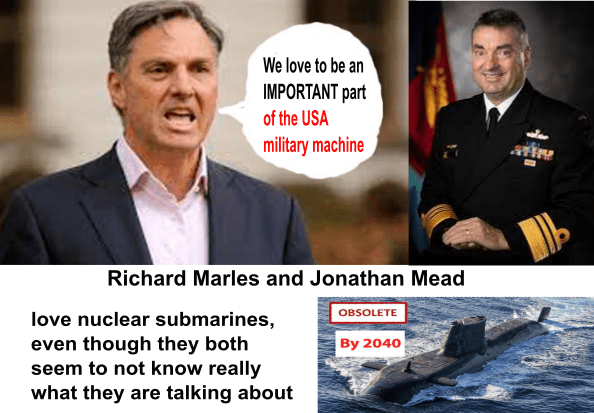
The proposed long term acquisition of nuclear submarines has completely upended our diplomatic and strategic positioning, as revealed (perhaps unintentionally) by Defence Minister Richard Marles when he told a gathering in London this month that the AUKUS goal is to create “a more seamless defence industrial space” between the three countries, affirming that Australia is more tied at the hip to the US than previously admitted – because we would not have national control over the submarines in relation to their location and deployment, thereby severely compromising our national sovereignty.
The submarines would have little purpose for independent defence if ranged against China
Pearls and Irritations. By Andrew Farran, Feb 16, 2023
How might the renown mid-20th century linguist Ludwig Wittgenstein have addressed the current defence strategic review?
As the perceptive mid-20th century Cambridge based English/Austrian linguist Ludwig Wittgenstein explained, the answer you get to a question depends on how the question is formed. The same wisdom could have been conveyed to military planners in the past when they set out to plan force structures for twenty or more years ahead. Wrong question. Wrong answers.
Looking back, think of all the military expenditure over the past twenty years and more that has been wasted as being unusable or irrelevant to purpose. Think of the lost opportunities for sound force development and the money saved that might have been available for under-resourced schools, hospitals and welfare assistance falling short of need.
After World War Two planning remained where it had left off, with established formations around divisions, battalions and platoons, essentially ground forces and an expensive aircraft carrier unsuitable for serious combat. After much debate a viable carrier fleet was seen as unattainable and unaffordable with the loss of the existing fleet air arm. Upgrades on traditional lines were undertaken following the Korean War but thereafter with Vietnam becoming the main preoccupation (misconceived), and keeping faith with the US on military commitments, the conventional wisdom in military circles was that future conflict would involve containing insurgents in Asian jungles and the protection of naval approaches around continental Australia and its resources of a conventional nature.
Nonetheless a parallel objective was the search for a silver bullet that would provide cover for all contingencies whether existing or not. Hence the embrace by government of the F111 fighter/bomber not withstanding the tribulations of its procurement and eventual deployment (the latter being relatively little as it happened). After that Australian forces, or rather their equipment, was aligned to a newer kind of threat from irregular or insurgent forces in Western Asia, conflicts in which Australia had little or no direct interest but was engaged there to keep the US on-side – being our insurance in case of larger dangers closer to home.
…………………………. The real threat to America today is largely internal given rising levels of rioting and disaffection (racial and otherwise). But concern over America’s decline vis a vis China, whether real or not, is now front and centre on force structure issues.
…………….. As before we have looked for a magic pudding that would enhance our profile and please our once great and powerful friends. Hence as was the case with the F111s, and more recently the F-35s we have become fixated with nuclear powered submarines, having decided they are needed for long range deployment.
There is much that is unreal about this move. Firstly long range deployment implies that China is the potential or envisaged enemy requiring Australian engagement at that level. While China might be seen as flexing its muscles lately it has done nothing in this regard that is different from the United States. Both seek to protect and advance their relative status. But for neither side would this be advanced by military conflict.
……………..
wider world has a vested interest in the avoidance of counter-productive warfare and a deep felt need for viable multilateralism.
(See Jeffrey Sachs, “The new geopolitics”.)
………………………… The proposed long term acquisition of nuclear submarines has completely upended our diplomatic and strategic positioning, as revealed (perhaps unintentionally) by Defence Minister Richard Marles when he told a gathering in London this month that the AUKUS goal is to create “a more seamless defence industrial space” between the three countries, affirming that Australia is more tied at the hip to the US than previously admitted. – because we would not have national control over the submarines in relation to their location and deployment, thereby severely compromising our national sovereignty.
That would be a high price to pay even if we were engaged in a major war as was the case in 1942; but it is not and should not be the price we pay on speculation over assumed threats that are anything but imminent. The submarines would have little purpose for independent defence if ranged against China which can deploy a growing number of nuclear powered and armed submarines together with some 50 conventional powered ones (bearing in mind too that North Korea could deploy just as many given that the Korean War remains unresolved).
The Strategic Review currently underway will certainly strengthen our capacity to protect our immediate off-shore regions and coastline with new technologies including drones for enhanced surveillance, medium range missiles and sea mines, and survivable platforms to support them – while appreciating at the same time that in a high conflict situation the Chinese or any other militarily powerful nation could lob missiles on our vulnerable locations with disconcerting accuracy (including cities, Pine Gap and North West Cape). That point could well be the end of us sooner than we would like to think
So why buy into this unless doing so would make a difference when we know it would not. There is a lot more to this issue for the government to consider than when Prime Minister Menzies and his Cabinet decided on Australian forces being deployed in Vietnam or when Prime Minister Howard and his kitchen cabinet decided similarly in the case of Iraq – both gigantic mistakes. https://johnmenadue.com/the-defence-strategic-review-and-australias-alliance-obsession/
7.30 Report: Sarah Ferguson Opens Up New Perspectives on the AUKUS Nuclear Submarine Deal
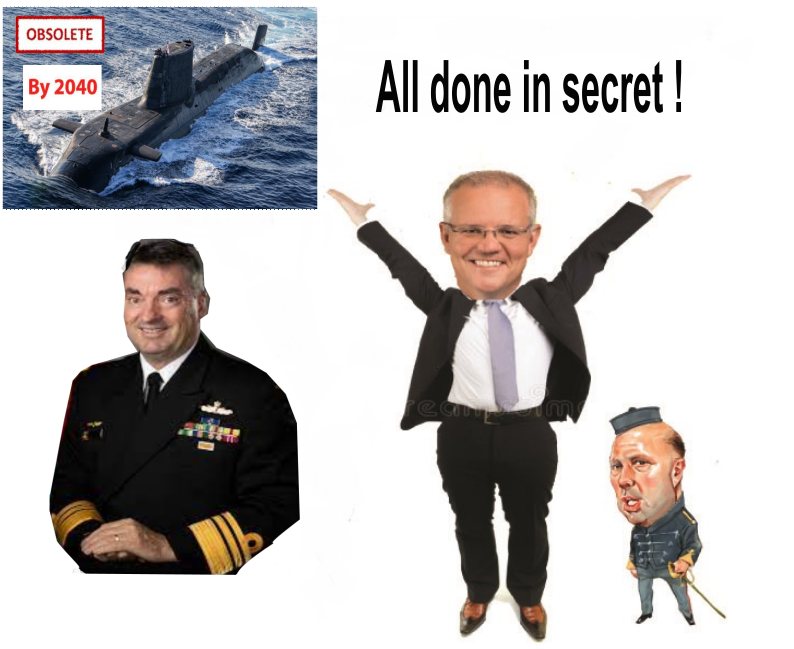
The secrecy associated with the formation of the Submarine Taskforce should be of great concern to Australians of all persuasions as our partners in France had no clues about what was happening behind the scenes as they made preparations to supply the contracted diesel submarines that more fully complied with commitments to the South Pacific Nuclear Free Zone with the support of New Zealand and other island states. No wonder that President Macron had little respect for Scott Morrison. (The video and the news clip of the French President’s remarks are available here.)
February 14, 2023 By Denis Bright
Sincere appreciation must be extended to the Albanese Government for allowing Vice Admiral Jonathan Mead AO to be interviewed in some depth on the 7.30 Report (13 February 2023). Sarah Ferguson was up to speed again in her interviewing skills with a seasoned naval officer who was assigned to active service in the Persian Gulf in 2006 as Captain of HMAS Parramatta.
The Vice Admiral’s understanding of nuclear technology being applied in the selection of the new submarine options was of course beyond reproach through his involvement with the clandestine Nuclear Submarine Taskforce established by the Morrison Government. Our US allies are great salespersons for the Anglo-American military industrial complexes in the post-Brexit era.
At least Britain’s BAE Systems as potential manufacturers of the AUKUS Submarines paid some tax in 2020-21 with a payment of $26.293 million to the ATO on a revenue base of $1.062 billion and a declared taxable income of just $123.484 million. The US military and aerospace giant Lockheed Martin kept its tax bill to $14.891 million on an income take of just over half a billion and a taxable income of $53.056 million (ABC News Taxation List, 2 November 2022).
The concerns of ordinary Australians about the financial and security costs of the AUKUS Submarine deal extend well beyond concerns about the technical capacity of those sealed reactors which are expected to operate for 30 years for the full life of the submarines until the year 2070 approaches.
The secrecy associated with the formation of the Submarine Taskforce should be of great concern to Australians of all persuasions as our partners in France had no clues about what was happening behind the scenes as they made preparations to supply the contracted diesel submarines that more fully complied with commitments to the South Pacific Nuclear Free Zone with the support of New Zealand and other island states. No wonder that President Macron had little respect for Scott Morrison. (The video and the news clip of the French President’s remarks are available here.)
…………………………………………………….. The Naval News video admitted that the Émeraude had transited the South China Sea in stealth mode. This was confirmed by coverage from France 24 (12 February 2021). Perhaps the stealth mode was to test the awareness of Chinese vessels and shore installations. Other military French vessels have done navigation runs through the Taiwan Straits which is always provocative when the current Democratic Party (DPP) holds power in Taipei and is calling for a formal declaration of independence from China to cheers from far-right global opinion.
…………….For China, the Taiwan Straits are definitely disputed waters as most countries in the US Global Alliance supported a One China Policy fifty years ago. This should have ended the US practice of using Taiwan for propaganda purposes throughout the Cold War.
……………………….. Just imagine the outrage in the Murdoch press if Chinese submarines made jaunts into Bass Strait to annoy the naval officers at HMAS Cerberus or to scare students at the Vice Admiral’s old secondary school at St. Bede’s in Mentone if the remnants of the federal LNP tried to establish Tasmania as an Independent Nationalist State with the support of a friendly US Administration.
Annoying China as well as alienating some ASEAN nations and members of the Pacific Island Forum will not assist with the current repair work on trading and investment relations with China.
The proposed AUKUS submarine deal imposes frightful financial burdens on Australia during inflationary times in which costs estimates for the AUKUS submarines extends into the 2040s (The Guardian 14 December 2021). Losses on trade and investment opportunities with China would of course extend these costs with 43 per cent of our exports destined to China at present (Latest data from Trading Economics).
Taiwan can assist to defuse tensions by giving a guarantee that it is not about to make a declaration of independence from the mainland. Relations between Taiwan and the Mainland seem to be improving again as China reverts to commercial diplomacy over displays of military strength. This style of diplomacy at least ensures that the economy of Taiwan is more fully integrated with the Mainland. Over 12,000 Taiwanese students were studying in Chinese academic institutes prior to the COVID-19 epidemic.
Despite all the negative media coverage of China in the Murdoch press, 42 per cent of Taiwan’s exports went to China in 2021-22 and 22 per cent of Chinese imports originated in either China or Hong Kong (CNBC 4 August 2022). Many Taiwan-based companies and services operate in China and Hong Kong.
With President Tsai Lng-wen unable to seek a third term as President in 2024, the popularity of the DPP seems to be on the wane. The opposition KMT gained 50.14 per cent of the vote at the recent local government elections on 26 November 2022 and controls fourteen local government areas to five held by the Democratic Progressive Party (DPP).
The Taiwanese electorate is undoubtedly evaluating the sustainability of nationalist rhetoric favouring a declaration of Taiwanese independence while the Australian government is negotiating those AUKUS submarine deals.
Signs of some thawing in cross-strait relations include a recent visit by the vice-chairman of the KMT to China and the restoration of more frequent fast ferry services between China’s Fujian Province and the adjacent Taiwanese islands of Kinmen and Matsu which are just a few kilometres off-shore.
There is great scope for the 7.30 Report to extend its coverage of the upsurge in regional strategic tensions with China after election cycles in Taiwan which bring the DPP into office. Re-election of the KMT in Taiwan in 2024 may totally defuse the current situation and leave Australians to bear the financial costs of the AUKUS submarine deal.
Opportunities exist to invite guest speakers onto future 7.30 Report programs to consider the impact of nuclear-powered submarines on the South Pacific Nuclear Free Zone which was ratified by all South Pacific nations as well as differing viewpoints on commercial ties with China.
Extending the South Pacific Nuclear Free Zone Treaty to coverage ASEAN Countries, the South China Sea and Taiwan might be a logical extension for consideration.
Toning down provocative visits by unfriendly naval vessels can be part of a Win-Win Deal to avoid future flyovers by Chinese jets.
Even the jellyfish in Moreton Bay are not very welcoming about the prospects of nuclear-powered ships:
According to a leading marine biologist and jellyfish expert Lisa-ann Gershwin, if the fleet is based in Brisbane, which is one of the shortlisted sites of the Australian government, the nuclear-powered submarines may be forced into an emergency reactor shutdown by swarms of jellyfish.
Gershwin added that Brisbane is “close to the absolute worst place” for a nuclear submarine base, due to the conditions in Moreton Bay and the usual jellyfish blooms.
Safety protocols for nuclear powered ships which sometimes carry nuclear weapons into Australian ports have been prepared by all states and territories as the ACT has its Jervis Bay facility which is separated from land-locked Canberra. The Queensland Government has made its precautions public in the publication Nuclear Powered Warship Visits to the Port of Brisbane.
Perhaps more public discussion as presented on the 7.30 Report can give the Australian government more wriggle room before the contracts are signed to initiate the AUKUS submarine deal. Payment of $835 million has already been made by the Albanese Government to France for breach of contract on the previous arrangements as negotiated by Malcolm Turnbull’s Government.
Appeals from our US allies for more military commitment from Australia and more use of the Pine Gap electronic base for offensive operations have landed Australia in compromising situations for decades from interventions in Vietnam to Afghanistan. The nostalgia for a return to the Cold War era with new military bases in the Philippines is an unfortunate regression. The ASEAN region to our north is better off left as a zone of peace and sustainable development.
By the time Australians discuss these issues, there may be a KMT Government in Taipei, and peaceful Win-Win scenarios may make the AUKUS deal redundant. Cheers then to the 7.30 Report’s contribution to strategic sanity. This style of reporting offers guest speakers who are saturated in knowledge of their specialist topics. I can only promote discussion and would be a real novice in head-to-head discussions with the Vice Admiral.
Richard Marles and Jonathan Mead babble on about nuclear submarines, (adding to the confusion).
Australia will have ‘unequivocal’ control over nuclear-powered submarines, insists chief adviser
‘When we take command of our first boat, we will have sovereign capability’, says Vice Admiral Jonathan Mead,
Daniel Hurst Guardian, 14 Feb 23,
The head of Australia’s nuclear-powered submarine taskforce insists Australia will retain full operational control over the submarines, while potentially having US or British engineers on board to provide technical advice.
The comments follow renewed debate in recent weeks over whether the flagship project of the Aukus pact – which relies on support from the US and the UK – will lead to an erosion of Australian sovereignty.
The former prime minister Malcolm Turnbull has been calling on the government to answer whether the submarines could be “operated, sustained and maintained by Australia without the support or supervision of the US navy”, and whether that effectively meant “sovereignty would be shared with the US”.
But the head of the taskforce advising the Australian government on the acquisition of at least eight submarines, Vice Admiral Jonathan Mead, used an interview with ABC TV on Monday evening to assert Australian control.
“When we take command of our first boat, we will have sovereign capability,” he told the 7.30 program.
“We will be commanding and controlling, under the Australian government direction, that nuclear-powered submarine.”…………………………….
Like the defence minister, Richard Marles, Mead expressed confidence that the plan to be announced soon would ensure there was no capability gap between the retirement of Australia’s existing Collins class diesel-electric submarines and the entry into service of nuclear-powered boats. But he did not provide specifics.
Mead also described the purpose of nuclear-powered submarines as being to “put the greatest question of doubt in the enemy’s mind” and “if necessary, respond with massive firepower”.
Marles used a speech to parliament last week to declare that acquiring nuclear-powered submarines would “dramatically enhance” Australia’s sovereignty, rather than undermine it………
Marles said Australia would “always make sovereign, independent decisions on how our capabilities are employed”.
In the wake of that speech, Turnbull tweeted that it was “quite a different thing to have a major platform that cannot be operated without the supervision/support of another country”
Turnbull said on Monday evening: “I think the question which has not been answered is: could the submarines be operated if US technical advice/support were withdrawn? The entire resources of the Australian news media have been unable to pin the government or the navy down on that.”
Paul Keating, the former Labor prime minister has previously raised concerns about increased reliance on US support and suggested Australia’s sovereignty was being “wilfully suborned”. https://www.theguardian.com/australia-news/2023/feb/13/australia-will-have-unequivocal-control-over-nuclear-powered-submarines-insists-chief-advisor
Nuclear zealot Jonathan Mead touts nuclear-powered submarines- Australia to have “full control” – (oh yeah?)
Australian commanders to have complete control over nuclear-powered submarines and reactors
ABC 7.30 / By Sarah Ferguson and James Elton, 13 Feb 23
Australian Navy commanders will have full operational control over their submarines and the powerful nuclear reactors onboard, despite the potential presence of US or UK engineers.
Key points:
- US or UK personnel may go to sea on Australian nuclear submarines
- Australian technicians will understand “every detail” of how the reactors work
- Construction in Adelaide shipyards may begin by end of 2020s
Vice Admiral Jonathan Mead, chief of the AUKUS submarine taskforce, has rejected criticisms that the nuclear propulsion program, based on US technology, would undermine Australian sovereignty.
“When we take command of our first boat, we will have sovereign capability,” he told 7.30‘s Sarah Ferguson in an exclusive interview.
Details of extensive plans to build a fleet of eight boats powered with weapons-grade uranium will be revealed next month.
Vice Admiral Mead was asked what would happen onboard in the event of any dispute over the nuclear reactor, including following an accident, between a US or UK engineer and the boat’s Australian commander.
“We would expect anyone, be it a foreign engineer or an Australian engineer, to provide advice,” he said.
But the commanding officer of that submarine, the Australian, would have “command and control over the reactor, over the submarine – unequivocal”.
Australians will understand ‘every detail’ of welded-shut nuclear reactors
The defining feature of the submarine deal is that the highly enriched uranium reactors that power the boats will be supplied by either the US or UK, and “welded shut”.
The use of weapons-grade fuel means the reactors do not need to be opened for refuelling over the 30-plus-year life of the boat. Reactors that run on low-enriched uranium, like those used by the French and Chinese navies, do require refuelling.
This also means Australia will not need to manufacture nuclear fuel – one of the commitments the country has made to the International Atomic Energy Agency.
Vice Admiral Mead said Australia would, however, be sending people to US “design facilities” so we would understand “every element of detail of that reactor”.
No Australian reactors … for now
Asked if Australia is considering building its own nuclear reactors in the future, Vice Admiral Mead said: “We are not envisioning that at the moment, we haven’t gone into that at the moment.”
The senior Navy official has spoken previously about the need for the AUKUS program to have public support.
Asked what would happen to an Australian nuclear-propelled submarine that was hit by a missile, Vice Admiral Mead said he could not reveal the technical details but that “nuclear-powered submarines are designed for exacting standards”.
He also said that submariners receive only minimal doses of radiation onboard – less than an ordinary person walking the streets of a capital city.
UK or US-designed boat, and when will we see them?
Addressing the scale of the program, Vice Admiral Mead said if Australia wanted to begin construction of new boats in Adelaide “towards the end of this decade” the government would need to quickly finalise the construction of a revamped shipyard.
He also described the extraordinary staffing requirements of the project, requiring nuclear physicists, chemists and engineers, as well as specialist tradesmen.
One of the biggest questions around AUKUS is whether Australia would be left without a functioning submarine force before the new boats are launched, as the ageing Collins fleet approaches retirement.
Vice Admiral Mead said unequivocally there would be no gap, but would not be drawn on the Navy’s specific plans.
The UK defence secretary, Ben Wallace, recently suggested a new submarine design the three countries could share was under consideration.
Asked whether that strategy would further delay the delivery of new submarines, Vice Admiral Mead reaffirmed there would be no gap in Australia’s capability.
China is the motivation
Vice Admiral Mead said rapid changes in the Indo Pacific had sharpened strategic competition.
“We’ve also seen in recent years a significant modernisation in the Chinese military, particularly the Navy,” he said.
Australia’s current fleet of Collins class submarines run on diesel-electric engines that are extremely quiet when running off the battery.
Nuclear submarines have massive range and the stealth advantage of not needing to resurface, but they do have reactor components that can’t be easily switched off to “go quiet”.
The pros and cons of nuclear and conventional submarines have led defence analysts to suggest a new generation of diesel submarines should be considered as well, particularly to operate closer to the Australian coastline – while the nuclear boats could be prioritised for operations further away from the mainland.
But Vice Admiral Mead said the nuclear submarines would be a good option in both theatres.
“Nuclear-powered submarines provide a capability to deploy away from the home shore, or to deploy close to home shore,” he said.
Pressed on whether conventional submarines would be quieter for closer operations, Vice Admiral Mead said under some circumstances nuclear submarines could be “just as quiet”.
“It’s often more to do with the age and the technology of the submarine that we are dealing with,” he said.
Vice Admiral Mead said the purpose of nuclear-powered submarines was to “put the greatest question of doubt in the enemy’s mind” and “if necessary, respond with massive firepower”.
This type of game-changing capability, he said, would change Australia’s “strategic personality”. https://www.abc.net.au/news/2023-02-13/australian-commanders-complete-control-over-nuclear-submarines/101965182
Growing signs Australia’s new nuclear submarine will be British design

Breaking Defense , (Sponsored by Northrop Grumman) By COLIN CLARK and TIM MARTIN February 10, 2023
SYDNEY and BELFAST — With the formal announcement of Australia’s path to obtain nuclear attack submarines expected to happen in Washington next month, speculation about the likely solution AUKUS is beginning to leak out.
The most intriguing hints center on a British boat — but not the Astute-class — based in part on rare public comments by Australian Defense Minister Richard Marles and his British counterpart, UK Defence Secretary Ben Wallace……………………………………
From the first announcement of the AUKUS effort, Australia has said it intends to build boats at home. However, developing the nuclear expertise from a tiny pool of a few dozen individuals to potentially thousands of people will take time, as will development of the highly skilled welders and other technical experts needed to build and maintain nuclear powered boats. Developing a new design and building a new shipyard to produce it seems unrealistic, given the lack of domestic expertise — especially if the goal is to deploy nuclear attack submarines before the conventionally powered Collins-class attack subs are retired.
That has prompted talk of America supplying Australia with refitted Los Angeles-class boats or providing Virginia-class boats that would be crewed by Australians, but both options pose many obstacles. America doesn’t seem able to build nuclear attack boats quickly enough to meet its stated requirement of 66, which prompted two top defense lawmakers in the Senate to caution President Joe Biden against committing the US to supplying Australia with nuclear boats.
Given the concerns about personnel and Marles’ comments, there is reason to think Britain’s next-generation sub, which will require a much smaller crew than do any of the American boats are in play……………….
“Among the ‘straws in the wind’ are the UK’s ambitions to rebuild its own submarine fleet. The Royal Navy would like to see a rise from the planned seven Astute-class attack submarines to perhaps 12 boats in the long term.
In a speech in December 2022, the UK chief of the defence staff, Admiral Sir Tony Radakin, said of AUKUS that ‘if we have the courage to do this properly’ it could help grow the UK’s own submarine numbers in the decades to come, clearly assisted in part by potential economies of scale under AUKUS.”
Jonathan Mead
Back in November 2021, the man who led the day-today work on the AUKUS boats in Australia, Vice Adm. Jonathan Mead, told an Australian Senate committee that his country intended to select a “mature design” for its nuclear submarine. “It is our intention,” Mead said then, “that when we start the build program, the design will be mature and there will be a production run already in existence.” That would appear to make the British offering a candidate…………………
Sidharth Kaushal, a sea power expert at the Royal United Services Institute think tank, told Breaking Defense:
“The point of friction that introduces with the UK [revolves around] the Australians operating with the US Navy primarily in the Indo-Pacific and their preference for things like prompt strike capabilities, including cruise missiles and potentially hypersonic missiles. The [US Navy] Virginia-class payload module can host those weapons but the [Royal Navy’s] Astute-class can torpedo launch cruise missiles but doesn’t necessarily offer prompt strike capabilities.”
All seven Astute-class submarines are due to be in service with the Royal Navy by 2026, each with a life cycle of 25 years. …………….
“There’s much more work to be done when you look at areas of joint production…but for the initial project of delivering a new Australian submarine there’s going to be some compromises,” Kaushal said. “For the US, this works out quite nicely but their big challenge of course remains, that their production lines are struggling to meet US Navy requirements.”
Should the Virginia-class be selected for the Australian requirement, the US would also benefit from new basing facilities for the future submarines, he added.
“It would effectively give the US an additional SSN base separate to Guam, which is of course an inherently vulnerable location and will be more so going forward,” Kaushal explained.
Operationally, how the future Australian submarines operate in the Indo-Pacific looks to be particularly difficult to assess in light of China formidable ASW capabilities, like Type 56 Corvettes and Y-8 maritime patrol aircraft, combined with the often shallow waters of the South China Sea which can make nuclear submarine missions more difficult.
“China is investing in a pretty substantial sensor network in the South China Sea that includes under sea hydrophones, large unmanned underwater vehicles all linked up to artificial islands they have built,” Kaushal said. ………………………………. https://breakingdefense.com/2023/02/growing-signs-australias-new-nuclear-sub-will-be-british-design/
The US is preparing Australia to fight its war against China
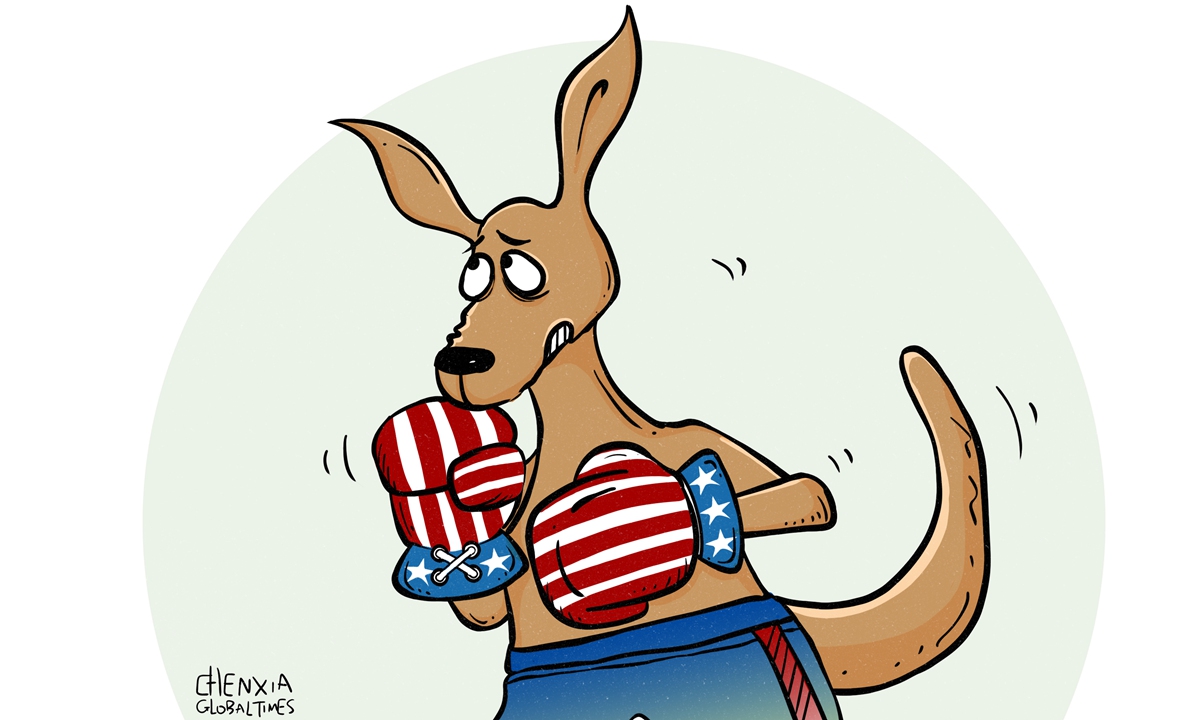
The United States is not preparing to go to war against China. The United States is preparing Australia to go to war against China.
Defence and military weapons manufacturing industries in Australia are now largely owned by US weapons corporations – Lockheed Martin, Raytheon, Boeing, Thales, NorthropGrumman. The deep integration of Australia’s defence industries and economy into the US military-industrial complex greatly influences Australia’s foreign/defence policies.
The Threat. All these preparations are justified by the false premise that China presents a military threat. China has not invaded anywhere. It has never proposed use of force against other countries. It has enshrined in its Constitution the ‘Three No’s – No military alliances; No military bases; No use, or threat to use, military force. China has, however, reserved the right to use force to prevent secession by Taiwan.
Guardian, By John Lander, Feb 1, 2023 Edited transcript of a speech to the Committee for the Republic, Salon, 18 January 2023.
The ANZUS Treaty
A look at the ANZUS Treaty and the way it has been manipulated over time will explain why I have come to this conclusion.
Originally defensive in concept, the ANZUS Treaty was seen by Australia from its very beginning as a means to “achieve the acceptance by the USA of responsibility in SE Asia” (Percy Spender) to shield Australia from perceived antagonistic forces in its region. It has, however, developed into an instrument for the furtherance of US ability to prosecute war globally – previously in Iraq and Afghanistan, currently against Russia and potentially against China.
The ANZUS Treaty, usually referred to in reverential tones as “The Alliance”, has been elevated to an almost religious article of faith, against which any demur is treated as heresy amounting to treachery. Out of anxiety to cement the US into protection of Australia, the Alliance has been invoked as justification for Australia’s participation in almost every American military adventure – or misadventure – since WW II.
Unlike NATO or the Defence Treaty with Japan, the ANZUS treaty actually provides no guarantee of protection, merely assurances to consult on appropriated means of support in the event that Australia should come under attack.
On the other hand, the Alliance has facilitated the steady growth of American presence in Australia, to the point that it pervades every aspect of Australian political, economic, financial, social and cultural life. Australians fret about China “buying up the country”, but American investment is ten times the size.
They are unaware or uncaring that almost every major Australian company across the resources, food, retail, mass media, entertainment, banking and finance sectors has majority American ownership. Right now US corporations eclipse everyone else in their ability to influence our politics through their investment in Australian stocks.

The transfer of Australian assets to American ownership has continued unabated: In the second half of 2021 then Treasurer Josh Frydenberg approved the transfer of $130 billion of Australian assets to foreign private equity funds, benefiting Goldman Sachs who facilitated the transactions, by multimillions of dollars. Josh Frydenberg now is employed by Goldman Sachs:
- Sydney Airport – Macquarie Bank led by a NY investment banker
- AusNet (electricity infrastructure) $18 billion takeover by Brookfield – NY via Canada
- SparkInfrastructure (electricity) $5.2 billion takeover by American interests
- AfterPay financial transaction system $39 billion takeover
- Healthscope, second-biggest private hospitals group (72 Hospitals) taken over by Brookfield and now controlled in the Cayman Islands.
The USA and the UK between them represent nearly half of all foreign investment. China plus Hong Kong represents 4.2%. The 4 big “Aussie” banks are dependent on foreign capital which dictate local banks’ policies and operations.
Defence and military weapons manufacturing industries in Australia are now largely owned by US weapons corporations – Lockheed Martin, Raytheon, Boeing, Thales, NorthropGrumman. The deep integration of Australia’s defence industries and economy into the US military-industrial complex greatly influences Australia’s foreign/defence policies.
That, plus US capture of Australia’s intelligence and policy apparatus through the “Five Eyes” network and ASPI (which has lobbyists from American arms manufacturers on a Board headed by an operative trained by the CIA) means that the US is able to swing Australian policy to support America in almost all its endeavours.
Despite the fact that it contains no guarantee of US protection of Australia, the Treaty and further arrangements under its auspices, such as the 2014 Force Posture Agreement and now AUKUS, have greatly facilitated US war preparation in Australia. This has accelerated exponentially in the past few years. The US now describes Australia as the most important base for the projection of US power in the Indo-Pacific.
Indicators of war preparations
* 2,500 US marines stationed in Darwin practicing for war with the Australian Defence Forces, soon to include the Japanese Defence Forces
* Establishment of a regional HQ for the U.S. Indo-Pacific Command in Darwin
* Lengthening the RAAF aircraft runways in Northern Territory at our expense for servicing US fighters and bombers
* Proposed stationing of 6 nuclear weapons-capable B52 Bombers at RAAF Tindal in NT
* Construction of massive fuel and maintenance facilities in Darwin NT for US aircraft
* Proposed acquisition of eight nuclear-propelled submarines at the cost of $170 billion for hunter-killer operations in the Taiwan Strait
* Construction, at the cost of $10 billion, of a deep water port on Australia’s east coast for US and UK nuclear powered and nuclear missile-carrying submarines
* The long-established satellite communications station known as Pine Gap in central Australia has recently, and is still being, expanded and upgraded. It is key to the command and control of US forces in the Indo-Pacific (and even as far afield as Ukraine)
The Government and right wing anti-China analysts and commentators, whose opinions dominate main stream media, accept the Defence Minister’s contention that this militarisation enhances Australia’s sovereignty by strengthening the range and lethality of Australia’s high-end war-fighting capability to provide a credible deterrent to a potential aggressor.
Many analysts and commentators outside the governing elite, including myself, argue that these arrangements effectively cede Australian sovereignty to America. This is especially because of the provisions of the Force Posture Agreement of 2014, entered into under the auspices of ANZUS.
I understand that a paper has been circulated to the Committee, expounding the details of the FPA, so in summary, it gives unimpeded access, exclusive control and use of agreed facilities and areas to US personnel, aircraft, ships and vehicles and gives Australia absolutely no say at all in how, when where and why they are to be used.
All Australian analysts, whether sympathetic or antipathetic to China, agree on one point. That is, that if the US goes to war against China over the status of Taiwan, or any other issue of contention, Australia will inevitably be involved.
The Threat
All these preparations are justified by the false premise that China presents a military threat. China has not invaded anywhere. It has never proposed use of force against other countries. It has enshrined in its Constitution the ‘Three No’s – No military alliances; No military bases; No use, or threat to use, military force. China has, however, reserved the right to use force to prevent secession by Taiwan.
It has recently rapidly increased its defence capability in response to the fearsome US naval presence and war-fighting exercises just off its coastline. Its defence budget is one third that of the US and the bases that it has constructed in the South China Sea pale into insignificance compared to the hundreds of bases that the US has ranged all around China.
So, if China is not a military threat, why is it designated as the primary systemic threat of the collective West, led by the US? The answer lies in the word “systemic”. China has expressed a determination to revamp the global financial system to make it fairer for developing countries. Kissinger is reputed to have said: “If you control money, you control the world”. The US currently controls world finance and China (with Russia) is out to change that.
The US, which played the leading part in the establishment of the post-World War II institutions, has become a leading revisionist, abandoning the UN for “coalitions of the willing”. The US has declined to join important Conventions like those on the Law of the Sea and on Climate. It has refused to accept the jurisdiction of the International Court of Justice and the International Criminal Court, and has exempted itself from the Genocide Convention. It has played a leading part in the weakening of the World Trade Organisation by imposing trade restrictions on other countries, while not agreeing to new appointments to the WTO’s appellate tribunal, so preventing that body from functioning.
China is the second-largest (or by some calculations, the largest) economy in the world. It is the major trading partner of over 100 countries, mainly in the global south, but including Australia and a number of other Western countries. Hence China has the clout to undermine the “international rules-based order” set up by, and for the benefit of, the West.
China has already established an alternative to the Anglo-American international financial transaction system: – the Cross-border Interbank Payments System CIPS, (in which, ironically a number of Western banks are shareholders). In collaboration with Russia and within the BRICS (Brazil, Russia, India, China & South Africa) China is creating an alternative to the almighty dollar as the preferred currency for trade and for national reserve holdings.
It seems that the US has concluded that, since it can’t constrain China economically, it will have to get it bogged down in a long-drawn-out war to hinder its economic growth and hamper its infrastructure development cooperation with other countries. On 25 March 2021 President Biden vowed to prevent China from overtaking the US as the most powerful country in the world – “not on my watch” he said.
Nevertheless, the latest CSIS computer modelling, like previous modelling by the Rand Corporation, indicates that all involved in a Sino-US war would lose.
Proxy War
All of these analyses overlook one significant point. US determination to pursue the Wolfowitz doctrine of preventing the rise of any power that could challenge US global supremacy (neither Russia, nor Europe, nor China) has not diminished, but has morphed into a strategy of fighting its adversaries by proxy.
This has been clearly demonstrated by the war in Ukraine. A White House press briefing on 25 January 2022, before the Russian intervention, stated that “the US, in concert with its European partners, will weaken Russia to the point where it can exercise no influence on the international stage”.
Political leaders from Biden, through Pelosi and on to Members of Congress have told Ukraine that “your war is our war and we are in it for as long as it takes”. Congressman Adam Schiff put it bluntly that “we support Ukraine… to fight Russia over there, so that we don’t have to fight it over here”.
In the case of China, defined in the NDS as the principal threat to the US, the proxy of choice is clearly Taiwan. The strategy envisages:
• a world-wide media campaign (going on for several years already) to portray China as the aggressor;
• goading China into taking military action to prevent Taiwan’s secession;
• leaving Taiwan to conduct its own defence, with constant resupply of arms and equipment from the US, at great profit to the military/industrial complex;
• sustaining Taiwan sufficiently to keep China ‘bogged down’, thus hampering its economic development and its infrastructure cooperation with other countries;
• avoiding direct military engagement, in order to maintain the full capacity of US forces, while China’s would be significantly depleted; Although Biden has publicly re-affirmed adherence to the ‘One China’ principle, the US has been goading China by;
• stationing the bulk its naval power off the coast of China;
• ‘freedom of navigation’ and combat exercises in the South China Sea and Taiwan Straits;
• visits by senior US officials using US military aircraft;
• creation of a putative ‘Air Defence Identification Zone’ (ADIZ) extending well over mainland territory and then alleging Chinese violation of it;
• secretly providing military training personnel (whilst denying it);
• including Taiwan in the Summit for Democracy (9-10 December 2021), implying it is a separate country;
Many Australian politicians, (although not the present government), joined in goading China, by encouraging Taiwan to consider the possibility of declaring independence, which would trigger military action by China.
If Australia were to make good on its promise to ‘save Taiwan’, it would be devastated:
• The Australian navy would be obliterated, given the disparity between China’s and Australia’s forces;
* command/control centres (and possibly cities) in Australia could be wiped out by Chinese missiles. Australia has no anti-missile defence;
• To preserve its own assets, and to forestall the descent into nuclear conflict, the US would not engage directly in defence of Australia;
• US ‘support’ would be through massive arms sales to replace our losses – just as in Ukraine – at further profit to the US military/industrial complex;
• ASEAN is unlikely to support Australia. It has renewed and up-graded its Comprehensive Strategic Partnership with China. Each member country has infrastructure projects under China’s BRI, which they would not want to jeopardise in a ‘no-win war’;
Support from India is unlikely, despite its membership of the Quad – which is nothing more than a consultative dialogue. India has security commitments to China under the SCO and gets its arms from Russia, which has a “better than treaty” relationship with China.
• Australia relies heavily on China for many daily necessities. In a war, deliveries from China would be severely disrupted.
The increasing size of China’s economic (and, by extension military) strength, to which Australia contributes important resources and from which it derives so much benefit, is portrayed as a threat to Australia’s security. This has Australia trapped in the absurd policy paradox of preparing to go to war against China to protect Australia’s trade with China.
Recent developments in Taiwan, particularly the county and municipal elections, which caused the President, Tsai Ingwen, to resign her leadership of the pro-Independence Party, suggest that Taiwan prefers the status quo and is unwilling to be the proxy of the US in a war with Beijing.
Australia thus becomes the potential proxy.
In the name of the Alliance, American service personnel (active and retired) are now embedded in Australian defence policy making institutions and in command and control positions within the ADF. All of the American military assets installed in Australia under the Alliance and the AUKUS deal, are now “interchangeable” with the ADF, making it possible to use them as putative Australian forces against China, while the US stands aside and maintains the same pretence of “no engagement”, as it is doing in Ukraine.
This is why I said at the beginning that the US is preparing to send Australia to war against China.
Whilst these are the dangers that the ANZUS Alliance poses for Australia if the US instigates a war against China, there are risks for the US also.
1. There would be crippling expense that further exacerbates the US wealth divide and related domestic political breakdown. Supplying the weaponry and everything else required for a proxy war with China would be a bigger drain on the US budget than the Ukraine conflict. The expenditure would flow back to the military industrial complex, constituting a further massive transfer of wealth from the ordinary taxpayer to the plutocrat billionaires. It would blow out the already unsustainable national debt, and either take away from expenditure on essential services and infrastructure, or, if they print money, further blow out inflation. The political and social breakdown that the US is already suffering as a consequence of its real economic decline and widening wealth gap could only intensify to breaking point.
2. The slide into a direct war would probably be inevitable. Planning a proxy war is all very well as an academic exercise, but sticking with those plans when the fighting starts will be very difficult. There are already lunatic politicians and “experts” in the US who think America can win a direct war, so when China starts bombing Australia, and good old Aussie “mates” are dying in massive numbers, the voices of those in the US advocating direct engagement will be amplified. Combined with the already extreme polarisation of US politics in which ONLY war is bipartisan, the risk that extremists will take the US into direct conflict, and a nuclear showdown with China, is very serious.
3. The folding in of Japan into the AUKUS arrangements will increase the risk that Japan would be obliged to assist Australia in any military conflict with China. The US, because of its Defence Treaty with Japan, would then be obliged to join in the fighting, vitiating its plan to avoid direct military engagement.
A point of historical irony:
I’ll wind up with a bit of historical irony, in which I was personally involved:
In the early 70’s, we had been kept completely in the dark about the secret Kissinger visits to China, until the plan for Nixon to visit was announced. Feeling blindsided by a momentous change in US policy towards China, we produced Policy Planning Paper QP11/71 of 21 July 1971.
It recognised.. “political disadvantage resulting from the manner in which the United States conducts its global policies” and argued that this would mean that. “The American alliance, in a changing power balance, will mean less to us than it has in the past.”
It went on:
“If anything, this argument has been strengthened by recent United States actions and America’s failure to consult us on issues of primary importance to Australia. Accordingly, we shall need, now more than ever, to formulate independent policies, based on Australian national interests and those of our near neighbours…”
This is even more true today than it was in the 1970’s. For example, Australia was not consulted in the precipitate US withdrawal from Afghanistan, despite our role as ‘loyal’ supporter of the US in that ill-advised conflict. Our indignant protestations were met with Biden’s statement that “America acts only in its own interests”.
Our present predicament is due largely to the failure of a succession of Australian Governments to take this analysis to heart and act upon it. Prime Minister Fraser, who replaced Whitlam, ironically came to a very similar view towards the end of his life, which he set forth in detail in his book ‘Dangerous Allies’, but too late to do anything about it. He identified the paradox that Australia needs the US for its defence, but it only needs defending because of the US.
A couple of pertinent quotes, first from the late Jim Molan:
“Our forces were not designed to have any significant independent strategic impact. They were purely designed to provide niche components of larger American missions.”
We were, in his view, abdicating our own defence and cultivating complete dependence on the Americans.
And from Chris Hedges:
“Finally, the neo-cons who have led the U.S. into the serial debacles of Afghanistan, Iraq, and now Ukraine, costing the country tens of trillions of dollars and even greater amounts of destroyed reputational capital, will claim their customary immunity from any accountability for their savage failures and cheerily move on to their next calamity. We need to be on the lookout for their next gambit to pillage the treasury and advance their own private interests above those of the nation. It will surely come.”
An (incomplete) list of some of the commentators from whom I have drawn:
John Menadue – former secretary PM&C
Richard Tanter – military analyst, Nautilus Foundation
Brian Toohey – author (political and historical analysis)
Mike Scrafton was a senior Defence executive, and ministerial adviser to the minister for defence
Paul Keating was the prime minister of Australia from 1991 to 1996.
Geoff Raby AO was Australia’s ambassador to China (2007–11); He was awarded the Order of Australia for services to Australia–China relations and to international trade.
Gregory Clark began his diplomatic career with postings to Hong Kong and Moscow. He is emeritus president of Tama University in Tokyo and vice-president of the pioneering Akita International University.
Dr Mike Gilligan worked for 20 years in defence policy and evaluating military proposals for development, including time in the Pentagon on military balances in Asia.
Jocelyn Chey AM is Visiting Professor at the University of Sydney and Adjunct Professor at Western Sydney University and UTS. She formerly held diplomatic posts in China and Hong Kong. She is a Fellow of the Australian Institute of International Affairs.
Joseph Camilleri is Emeritus Professor at La Trobe University in Melbourne, a Fellow of the Australian Academy of Social Sciences, and President of Conversation at the Crossroads
David S G Goodman is the Director, China Studies Centre, University of Sydney.
Geoff Miller was Director-General, Office of National Assessments, deputy secretary, Department of Foreign Affairs, Ambassador to Japan and the Republic of Korea, and High Commissioner to New Zealand.
Cavan Hogue was Ambassador to USSR and Russia. He also worked at ANU and Macquarie universities.
‘We need a plan B’: Unions have ‘deep concerns’ about AUKUS pact.
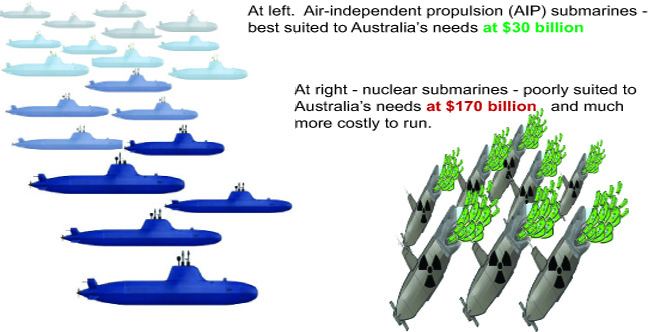
The shipbuilding federation – which represents unions including the AMWU, Electrical Trades Union and the Australian Workers Union – is urging the government to build an additional six conventionally powered submarines in Australia before the arrival of a fleet of nuclear-powered submarines.
The shipbuilding federation – which represents unions including the AMWU, Electrical Trades Union and the Australian Workers Union – is urging the government to build an additional six conventionally powered submarines in Australia before the arrival of a fleet of nuclear-powered submarines.
Matthew Knott, February 7, 2023 https://www.theage.com.au/politics/federal/we-need-a-plan-b-unions-have-deep-concerns-about-aukus-pact-20230206-p5ciaf.html
Labor’s traditional union allies say they harbour deep concerns about Australia’s plan to acquire a fleet of nuclear-powered submarines and fear the AUKUS pact will not deliver the promised bonanza of Australian manufacturing jobs.
The federal government is preparing to announce the details of its nuclear-powered submarine plan in March, with preparation under way for Prime Minister Anthony Albanese to travel to Washington for a possible joint press conference with US President Joe Biden and British Prime Minister Rishi Sunak
During a visit to Washington over the weekend, Defence Minister Richard Marles said AUKUS would create “thousands” of new local jobs and expressed confidence Australia would not be left with a capability gap between the retirement of the current Collins class fleet and the arrival of nuclear-powered vessels.
Despite Marles’ assurances, Australian Shipbuilding Federation of Unions national convener Glenn Thompson said he remained “apprehensive” about a possible capability gap and urged the government to develop a backup plan in case AUKUS falls over.
“It’s one thing to say that this is going to create thousands of jobs, but you actually have to be able to build something well in advance of whatever AUKUS comes up with,” said Thompson, an assistant national secretary of the Australian Manufacturing Workers Union (AMWU).
“It’s of great concern to us about where the workforce is coming from and how are we addressing the issue of Australia’s sovereignty.”
Thompson noted there had been no pledge from the government that AUKUS would create as many local jobs as the 5000 positions promised under the cancelled contract with French company Naval Group.
The shipbuilding federation – which represents unions including the AMWU, Electrical Trades Union and the Australian Workers Union – is urging the government to build an additional six conventionally powered submarines in Australia before the arrival of a fleet of nuclear-powered submarines.
Marles last week stated definitively that the government “has no plans for any conventionally powered interim submarine capability, as we move towards gaining the nuclear-powered submarine capability”. Senior defence figures, including in the Navy, have fiercely resisted the idea of an interim conventional submarine.
“There’s a whole lot of uncertainties,” Thompson said of the AUKUS pact. “I just think from a capability perspective the country needs to have a plan B.”
Thompson said he feared local construction of the nuclear-powered submarines would not begin until the late 2040s or early 2050s, a decade after the Collins-class vessels begin being decommissioned.
“It’s very rare that these defence projects deliver on time,” he said. “By the mid-2040s you could have two-thirds of the existing fleet retired, so there could be a substantial capability gap.”
Marles told The Sydney Morning Herald and The Age last month that AUKUS would be “a genuine three-country collaboration”, raising expectations Australia will acquire a joint next-generation submarine model combining American and British technology.

While not specifying what proportion of the submarines would be built in Australia, Marles said the Osborne Naval Shipyard in Adelaide would play a major role in the project.
“We must develop an industrial capability in Australia,” he said. “That’s the only way this can work, and that’s what will be expected of us by both the UK and the US.”
Marles told parliament on Monday the government was “on track” to make its AUKUS announcement in the very near future.
He said while there had been a “very real potential of a capability gap opening up with our submarines, I am confident that the pathway we announced will provide a solution to this”.
Defence Minister insists nuclear submarine deal will not damage Australia’s sovereignty
By Richard Wood • Senior Journalist 9 News, Feb 9, 2023
Defence Minister Richard Marles is hitting back at claims the AUKUS military alliance will undermine the future of Australia’s military sovereignty.
In a speech to Parliament today, he will seek to ease worries that the defence pact between Australia, Britain and the US poses any risk.
Former prime ministers Paul Keating and Malcolm Turnbull have critcised AUKUS, saying it makes Australia too dependent on the US…………
Marles’ speech to MPs comes ahead of next month’s announcement about the type of nuclear-propelled submarine technology Australia will obtain. https://www.9news.com.au/national/aukus-submarine-pact-will-not-compromise-australian-sovereignty-defence-minister-says/906cf0bc-0c2f-426b-9720-0acaae9ad5c8
The US shooting down a Chinese spy balloon is a risk for Australia’s tired submarine fleet
Michael West Media, by Rex Patrick | Feb 6, 2023 |
For many Australians watching the events over the past week, where the United States Air Force tracked a Chinese balloon overflying US territory and then shot it down, might seem to be of indirect significance to our security. Former senator and submariner, Rex Patrick suggests that it is of direct significance to Australia, increasing the risk we might be drawn into war in South East Asia.
Over the weekend the US Air Force shot down a Chinese balloon. The United States have said that the balloon was carrying out intelligence gathering. The Chinese Government has said it wasn’t. They claim it was just a wandering weather balloon. That’s important for reasons I’ll come back to, but I first need to provide some background – not about balloons, but about another surveillance platform.
What submarines do
Submarines can perform a whole range of different tasks in time of war……………………….
In preparing for war they train, they engage in tactical development and they conduct intelligence gathering. It is the latter which is their most important and challenging tasks………………….
Balloons and ballast tanks
…. Imagine a South Korean, Japanese or Australian submarine operating very close to (or perhaps inside) China’s territorial waters conducting intelligence gathering. China might now be inclined to treat that submarine the same way the United States treated a balloon purported to be conducting intelligence collection.
If detected, even if just outside of their territorial waters, the Chinese will just say they were inside their waters when, or in the minutes before, they were engaged. We’ll say, just as the US has for the balloon, that we weren’t spying and they’ll say we were.
And getting detected in our newest Australian submarine, the 20 year old HMAS Rankin, is far more likely than is the case for South Korea’s newest submarine, the 1 year old ROKS Dosan Ahn Changho, or Japan’s newest submarine, the 1 year old Tōryū.
The stakes are greater for us because Australian governments of various political flavours have left us with ageing Collins Class submarines to carry out this most serious and complex of peace time tasks.
One option would be to eventually withdraw our ageing Collins class submarines from surveillance operations anywhere close to Chinese waters, but that’s unlikely. Our Navy and our government will be anxious to continue to do all they can to assist the United States Navy in the Northern Pacific, in the Sea of Japan and the South China Sea.
Alliances are not just pieces of paper, they are dynamic relationships in which there’s a strong obligation to contribute and share risk.
The China risk
The risks are likely to increase in the years ahead, as China continues to ramp up military tensions in an effort to coerce Taiwan into some form of political subordination to Beijing.
The possibility that China will choose a vessel of a US ally to make an example of cannot be dismissed.
And that risk will be disproportionately carried by our Navy as it operates a submarine force with decreasing relative capability across the next two decades or longer. Thanks to government spending $170bn pursuing a distant nuclear-powered capability, our submariners will be at greater risk in less capable vessels than our so-called ‘great and powerful’ friend.
For a long time, we’ve been able to see Defence procurement failures and kick ourselves on account of cost to the taxpayer. Now, as the balloon goes up in the South China Sea, the lack of capability may well cost us many lives.
It’s not just about a war before the arrival of new submarines in 2040, its all the peace time intelligence operations between now and then. https://michaelwest.com.au/the-us-shooting-down-a-chinese-spy-balloon-is-a-risk-for-australias-tired-submarine-fleet/—
Aukus: Biden urged to fast-track research into submarines using non-weapons grade uranium
US lawmakers are concerned that if Australia’s new nuclear submarines use enriched fuel it could undermine global non-proliferation system
Guardian Daniel Hurst 4 Feb 23
The Biden administration is being urged to fast-track research into submarines that do not use weapons-grade uranium, as four Democratic politicians warn the Aukus deal with Australia makes the task “even more pressing”.
Australia’s deputy prime minister, Richard Marles, arrived in the United States for crucial talks with the defense secretary, Lloyd Austin, on Friday (US time), amid renewed congressional concerns about aspects of the flagship Aukus project.
With March looming as the deadline for key decisions on how Australia acquires at least eight nuclear-powered submarines with help from the US and the UK, all three countries maintain the work remains on track.
But in the latest sign of congressional jitters, four politicians from Joe Biden’s party have sounded the alarm about broader risks to the global nuclear non-proliferation system.
A newly published letter coordinated by Bill Foster, a physicist serving as US representative for an Illinois congressional district, asks the Biden administration to ramp up research into alternatives to using weapons-grade uranium to power submarines.
It adds to concerns already raised by experts that if the Australian submarines are powered by highly enriched uranium (HEU), other countries may seek to follow the precedent – even though they will not be armed with nuclear weapons…………………….
in a letter to the administrator of the NNSA and the navy secretary, the politicians formally requested a detailed report on “the feasibility and performance impact of a Virginia-Class replacement SSN(X) nuclear-powered attack submarine” that is fuelled by a low-enriched uranium (LEU) reactor with a life-of-the-ship core.
They said previous reports indicated it “may be feasible for the navy to use LEU fuel for naval nuclear propulsion, as France and China already do”……………….
“Minimizing the global presence of HEU by reducing its use in military applications would reduce the risks associated with making and transporting HEU and demonstrate significant leadership on nonproliferation,” the letter said…………….
James Acton, a co-director of the Nuclear Policy Program at the Carnegie Endowment for International Peace, has previously argued that Aukus depends on “a glaring and worrying loophole in IAEA safeguards” that could be exploited by others.
This loophole allows non-nuclear weapon countries to remove the fissile material they need for the submarine reactors from the stockpile monitored by the IAEA………………………………………………..
In the National Defense Authorization Act for Fiscal Year 2023, which was signed by Biden in late December, the US Congress requested Austin to order an independent assessment of the “challenges” to implementing Aukus……….. https://www.theguardian.com/australia-news/2023/feb/03/aukus-biden-urged-to-fast-track-research-into-submarines-using-non-weapons-grade-uranium
Push in US Congress to exempt Australia from International Traffic in Arms Regulations, so that it can import nuclear submarines.

Democrat push to grant Australia a waiver to import nuclear subs earlier than expected
SMH, ByFarrah Tomazin, January 21, 2023 —
Washington: A maze of US regulations and export control laws stand between Australia and the multibillion-dollar AUKUS submarine agreement, prompting a key ally of the pact in Congress to propose a blanket exemption to accelerate delivery of the nuclear-powered fleet.
Democratic congressman Joe Courtney, who recently spearheaded a bipartisan defence of the Australia-UK-US pact amid jitters from some of his Washington colleagues, wants Australia to be given a waiver from strict US export controls that could otherwise derail the agreement.
The International Traffic in Arms Regulations is one set of rules which could delay for years the transfer of crucial technologies at a time when Australia is racing to bolster its submarine capacity before the retirement of its Collins-class fleet.
Defence Minister Richard Marles has said the government will announce by March which type of submarine it will acquire, after receiving a recommendation from Jonathan Mead, the head of the Nuclear Powered Submarine Taskforce.
The announcement is expected to provide the first concrete insights into the cost, timing and procurement of the AUKUS deal. The modelling so far has suggested that if the submarines are produced in Australia, as the government has suggested, the earliest possible delivery date would be 2055.
While President Joe Biden supports AUKUS, he needs the backing of a divided Congress to make good on his promise to share American submarine secrets with Australia.
Courtney, who co-chairs the bipartisan “AUKUS caucus” and is regarded as one of Congress’ top navy experts, said a potential solution to the difficulties posed by US law would be to pass an exemption, with the support of the Pentagon, allowing Australia to bypass rules such as the International Traffic in Arms Regulations and related nuclear submarine laws, for the strict purpose of advancing AUKUS……………………………….
Australian officials have for years been pushing their US counterparts to reform their treatment under arms regulations, and the issue was front and centre of the December Australian-US Ministerial consultations between Marles and US Secretary of Defence Lloyd Austin…………
In response to questions from this masthead, a spokesman for the Australian Department of Defence said it was anticipating that export arrangements would need to change “to ensure technology and expertise could be transferred seamlessly and effectively among AUKUS partners, as well as their respective industrial bases, within a suitably designed protective framework”…………
At a seminar last week, Democratic congressman Adam Smith, a ranking member of the House of Representatives armed services committee, also warned that while AUKUS was “a great idea, with a lot of promise” it “could also go bloop” unless some regulatory restrictions were eased.
And Mark Watson, the director of the Australian Strategic Policy Institute’s Washington office, suggested that “an AUKUS express lane is what we need” to avoid delaying or derailing the project due to the maze of red tape and complex US laws surrounding it.
But the regulatory hurdles are not the only difficulty the alliance faces.
One of the concessions Republican congressman Kevin McCarthy made this month to secure the speakership of the House of Representatives was a vote on a framework that caps discretionary spending at fiscal 2022 levels. Some fear that this could result in the US defence budget being cut in real terms, which Courtney warned “could have a very negative effect on AUKUS”.
Helping Australia acquire nuclear submarines will also test America’s submarine manufacturing industry, which has already been strained by the COVID pandemic. https://www.smh.com.au/world/north-america/democrat-push-to-grant-australia-a-waiver-to-import-nuclear-subs-earlier-than-expected-20230120-p5ce4e.html
1 This month

of the week – Australians for War Powers Reform (AWPR)
To see nuclear-related stories in greater depth and intensity
 Antinuclear