Legacy of Maralinga bomb tests -a reminder of need for safety in matters nuclear
 Sixty years on, the Maralinga bomb tests remind us not to put security over safety, The Conversation Liz Tynan, Senior Lecturer and Co-ordinator Research Student Academic Support, James Cook University September 26, 2016 It is September 27, 1956. At a dusty site called One Tree, in the northern reaches of the 3,200-square-kilometre Maralinga atomic weapons test range in outback South Australia, the winds have finally died down and the countdown begins……….
The count reaches its finale – three… two… one… FLASH! – and all present turn their backs. When given the order to turn back again, they see an awesome, rising fireball. Then Maralinga’s first mushroom cloud begins to bloom over the plain – by October the following year, there will have been six more.
RAF and RAAF aircraft prepare to fly through the billowing cloud to gather samples. The cloud rises much higher than predicted and, despite the delay, the winds are still unsuitable for atmospheric nuclear testing. The radioactive cloud heads due east, towards populated areas on Australia’s east coast.
Power struggle
While Australia was preparing to sign the Maralinga agreement, the supply minister, Howard Beale, wrote in a top-secret 1954 cabinet document:
The British carried out two clean-up operations – Operation Hercules in 1964 and Operation Brumby in 1967 – both of which made the contamination problems worse.
Legacy of damage
The damage done to Indigenous people in the vicinity of all three test sites is immeasurable and included displacement, injury and death. Service personnel from several countries, but particularly Britain and Australia, also suffered – not least because of their continuing fight for the slightest recognition of the dangers they faced. Many of the injuries and deaths allegedly caused by the British tests have not been formally linked to the operation, a source of ongoing distress for those involved.
Decades later, we still don’t know the full extent of the effects suffered by service personnel and local communities. Despite years of legal wrangling, those communities’ suffering has never been properly recognised or compensated.
Why did Australia allow it to happen? The answer is that Britain asserted its nuclear colonialism just as an anglophile prime minister took power in Australia, and after the United States made nuclear weapons research collaboration with other nations illegal, barring further joint weapons development with the UK. …..Six decades later, those atomic weapons tests still cast their shadow across Australia’s landscape. They stand as testament to the dangers of government decisions made without close scrutiny, and as a reminder – at a time when leaders are once again preoccupied with international security – not to let it happen again. https://theconversation.com/sixty-years-on-the-maralinga-bomb-tests-remind-us-not-to-put-security-over-safety-62441?fbclid=IwAR3-AXJA_-RZTlr1AW6qxgcFRPuOX5IIi163L75vLWXFyIOcZGKxbet5DDE
Does Australia really need nuclear submarines, and the whole nuclear shebang
|
The strange submarine saga: nuclear-powered poser, The Strategist
14 Sep 2020, |Graeme Dobell Submarines are so vital to Australia that two of our past prime ministers have publicly pointed to the nuclear-powered option.
Shifting from the conventional power of the existing Collins class and the planned Attack class to nuclear propulsion would take the subs saga to a whole new depth. Before reading the nuclear-powered musings of Tony Abbott and Malcolm Turnbull (a rare meeting of minds), turn to the other part of the proposition: subs are vital. A couple of episodes into this five–part series, I got a note from one of the smartest men I know—an economist with a long history in the Canberra policy jungle and an equally deep understanding of East Asia. He is a master at posing the simple Delphic question that forces lots of devilish detail through its paces. And so my master posed this question:
A fine reminder of an enduring truth: the Canberra defence consensus isn’t always what the rest of Oz understands or believes. Whenever military types berate me for the ignorance of journalists about defence, I respond they should be grateful to us: we’re merely showing them how much the rest of the population lives in a different place with a sky of a different colour. On why subs are vital, turn to two politicians responsible for explaining defence to the voters…………..
With France, Australia is building Attack-class submarines that are cousin to the French Barracuda nuclear-powered boats. And that nuclear capability is one element in Australia’s decision to partner with France rather than Germany or Japan, as Turnbull states: ‘It wasn’t the reason for the choice, but accepting the French submarine bid, as opposed to the Japanese or German bids, at least gives us a potential option to move to a nuclear design in the years ahead.’ Reaching for that option would confront many dimensions of Australia’s nuclear taboo. The Labor and Liberal parties would have to agree. The people would have to be persuaded. There’s the small matter of building the nuclear industry. And we’d have to do a lot of talking and explaining to the neighbours—especially Indonesia. All that could only happen in a darkening strategic environment. It’d be ‘a post-Covid world that is poorer, that is more dangerous, and that is more disorderly’. The quotation marks around that poorer, dangerous, disorderly quote are because that’s what Prime Minister Scott Morrison described in launching the 2020 strategic update. Tough times will put more twists into Australia’s strange submarine saga. https://www.aspistrategist.org.au/the-strange-submarine-saga-nuclear-powered-poser/ |
|
Australia entangled in the military-industrial-intelligence-security complex

|
The military-industrial-intelligence-security complex https://johnmenadue.com/alison-broinowski-the-three-slash-complex/ By ALISON BROINOWSKI | On 25 August 2020 In 1961 President Eisenhower warned that a vast and permanent ‘military-industrial complex’ could produce ‘the disastrous rise of misplaced power’. Earlier, US Senators Robert La Follette and J. William Fulbright also foresaw the dangers of militarisation. Now we have a military/industrial/security/intelligence complex, and it is dangerous. Let’s start with ‘security’, which sounds harmless and desirable. Who welcomes insecurity? Our ‘safety and security’, various authorities assure us (never explaining the difference) are their prime concern, particularly after some egregious security failure on their part. Security abroad used to mean the First World remaining in control of opportunities, in its own interests. Security now additionally means controlling people euphemistically called ‘those who would do us harm’. Since 2001, national security has become an exponential, unassailable, growth area. Proliferating Australian laws criminalise knowing, revealing, or even asking anything about it. Despite some academics arguing that it includes food, health, social, economic, and environmental security, ‘hard-headed’ national security is the dominant growth area in universities and government. From there to intelligence. We lavishly fund the ‘community’ of ten security agencies which demand ever more power and resources. Several heads of ASIO, ASIS, ASD, and DFAT have followed each other in revolving door fashion. Some emerge occasionally to warn us of the new, dire, and continuing dangers we face. They can’t give details, of course, before WikiLeaks or the American media do, or until a tip-off to a Five Eyes partner inspires an ‘open source’ report. But they assure us of their best efforts – with a lot more staff – to keep us safe and secure. Their colleague from the American community, Mike Green, former Asia Director of the National Security Agency (the equivalent of ASIO), used to joke that the NSA’s job was to keep people frightened ‘so they’ll go on funding us’. From the community came the intelligence that government misused, or didn’t use, before the Bali bombing and the Lindt Café siege in Sydney. They provided intelligence that government used, or misused, to justify Australian forces’ illegal invasions of Iraq and Syria, to benefit Woodside Petroleum and disadvantage East Timor. Government is currently making an example of David McBride, a military lawyer who said what he saw Australian troops doing in Afghanistan, of Witness K, a former ASIS officer who said what he did in Dili, and of his former solicitor Bernard Collaery, who’s not allowed to say much, but who was raided in 2013 under anti-terrorism laws. The Attorney-General wants charges and court proceedings against them in the ACT to be secret, as in the Kafkaesque case of another, Witness J. The same applies in Britain, a common-law country, where a judge is likely in September to allow the extradition of Julian Assange to the US, whose CIA paid to have him spied on. Rule of law? The Australian government and opposition say nothing. To industry then. Canberra airport has become a hall of mirrors for American, British, and French arms producers. So has the Kerry Stokes-chaired Australian War Memorial, whose expansion is to cost $500 million. Less than a decade after the ‘Australia in the Asian Century’ report, Asian languages and the arts languish, and the National Library closes its Asian collection. Defence expenditure is exempt from the efficiency dividend, and much cannot be accounted for. Yet a government that criticised its predecessors for running up ‘debt and deficit’ tries to please the Americans by exceeding 2 percent of GDP, even for aircraft that are not delivered and are denied the technologies the US allows Israel, and for submarines that will lack crew and be obsolete and over budget before they hit the water. Diversification of suppliers is commendable, and local manufacture too, but value for money? Japan would have undercut the French price and delivery date for the submarines, and might not have dangled the option of nuclear power. By 1967 the US was ‘the greatest purveyor of violence in the world today’, said Martin Luther King. Now the war industry (let’s call it by its name) has proliferated in Australia, as in the US and UK. Its promises of local employment ̶ often more jobs than are delivered ̶ attract votes, particularly in South Australia. The merchants of death are to be joined by Australia as the tenth largest arms exporter. And we won’t ban nuclear weapons. So why bother searching for a vaccine to stop millions dying in the pandemic? Fourth, military. In most democracies, elected civilians debate where the armed forces should go, what they should do, what they need to do it, and when they should return. Some constitutions even require reports on progress, and independent inquiries afterwards. That worked before the undeclared, endless war. Now potential conflicts are planned years in advance, the security state identifies the priorities, the war industry gears up, and inter-operable allied forces that are not already embedded get their American orders on a given date. So the Australian military tail in effect wags the government dog. Moreover, inviting US military bases to proliferate in northern Australia, and expanding our war-games, not only makes Australia a bigger target but inevitably America’s endless wars become Australia’s. The putative enemies China, Russia, and Iran need not be Australia’s enemies. The risk grows of Australia being used as an example by China of what it could do to the US, to its real enemy. If Australia is not to be dragged into war against China or Iran by the US, our Ministers while in quarantine might reflect on the invertebrate performance they gave at the AUSMin talks in July. Bipartisan Sinophobia was recently demonstrated against NSW parliamentarian Shaoquett Moselmane. Australian security would benefit if the opposition didn’t try to outdo the government’s ‘Communist China’ McCarthyism. Trump aimed to drain the Washington swamp by filling top White House positions with ex-military people. Most have departed, but this proto-fascist tendency continues in Australia where the governor-general, governors, politicians, and even academics with military backgrounds are conspicuous. Of these former fighters, only a few have the courage, as retired General Peter Leahy did in 2016, to deplore Australia’s lack of independent military strategy and the way we go to war. If the ADF is called out to enforce the law in Australia, fascism will be next. Dr Alison Broinowski AM is a former diplomat, academic, and author, and is Vice-President of Australians for War Powers Reform. |
|
Military to Weapons Sales – Professor Peter Leahy and the revolving door
Professor Peter Leahy AC Australian Defence Force | Military | Revolving Doors, Michael West Media, 19 Aug, 20
Lieutenant-General Peter Leahy retired from the Australian army in July 2008 having concluded his 37 year military career with six years as Chief of Army. Within a year he was on the boards of Codan and Electro Optic Systems (EOS). More recently, EOS has been exporting its weapon systems to Saudi Arabia and the United Arab Emirates while the Yemen war has raged despite multiple reports of war crimes by these countries and a situation in Yemen which the UN has called the world’s worst humanitarian catastrophe.
Current Positions
Public
Professor and foundation director, National Security Institute, University of Canberra (7.10.08–present^)
^ Website accessed 10.08.20
Corporate
Member, Advisory Board, WarpForge Limited ([??]–present^)
Director, Citadel Group (28.6.14*–present^; including as Chair from 12.11.19)
Director, Electro Optic Systems (4.5.09*–present^)
Director, Codan Limited (19.9.08*–present^)………. https://www.michaelwest.com.au/peter-leahy/
Remembering Hiroshima and Nagasaki – and celebrating the Global Nuclear Ban Treaty
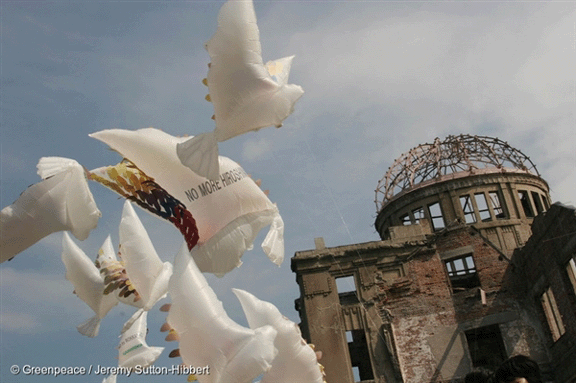
August 6th and August 9th are the days that remind us of the horror of nuclear weapons. The failing and desperate nuclear industry would like us to forget about Hiroshima and Nagasaki. They’d like us to swallow their spin about new small nuclear reactors. (But new small nuclear reactors are just the latest gimmick to support the nuclear weapons industry, and put a friendly mask on it. They really have no other purpose.)
 In this time of pandemic and global heating, Biden’s USA, Putin’s Russia, and other nations, are putting obscene amounts of money into nuclear weapons. The U.N.’s Treaty on the Prohibition of Nuclear Weapons (passed by a vote of 122-1-1 at the United Nations in 2017) is looking ever more rational and necessary. It entered into force on 22 January 2021.
“The pandemic has taught us that all the world’s great needs and threats are linked. By reallocating bloated military spending and reorienting nations to resolve conflict through peaceful negotiation, people and governments throughout the world can more easily tackle the enormous economic and civil injustices that give rise to conflict and fuel the fire of climate change. Each victory in each arena must be used to feed progress elsewhere if humanity is to survive this century.
As we remember the victims of the atomic bombings and hear the stories of the survivors, we realize more than ever: we are all in this together. ” – Michael Christ, Executive Director, International Physicians for the Prevention of Nuclear War
Although Australians started a move to abolish nuclear weapons, The Australian government tried to sabotage the U.N. nuclear ban treaty
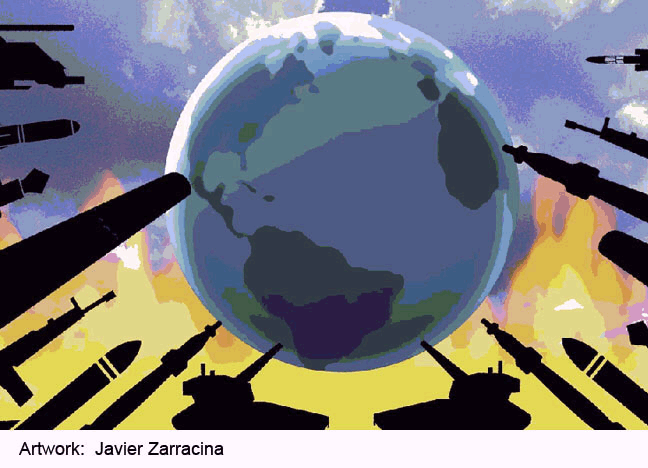 75 years after Hiroshima and Nagasaki, the arms race isn’t over, Independent Australia By Binoy Kampmark | 12 August 2020,“………………The 75th anniversary of the Hiroshima and Nagasaki bombings might have encouraged some reflection on current attitudes to the United Nations Treaty on the Prohibition of Nuclear Weapons. Passed on July 7, 2017, it has become a focal point for advocates of a nuclear weapons-free world and a source of irritation for nuclear weapons states.
Most perversely of all are those powers not in possession of nuclear weapons yet derive some form of security from states who have them, a strategic figment of the military imagination known as the ‘umbrella of extended nuclear deterrence“. For that reason Japan, despite being a global town crier for the banning of nuclear weapons, has refused to add its name to the nuclear weapons ban treaty.
Hiroshima Mayor Kazumi Matsui took the commemorative occasion to encourage the Japanese government to abandon that position:……
Australia, another U.S. annex in the Asia Pacific, similarly refuses to join the club of prohibitionists. When it participated in the UN working group on nuclear disarmament in 2016, Australian diplomats made it clear that they had no interest in seeing any document banning nuclear weapons emerge.
The disruptive involvement of Australian officials in the group was keenly exposed in documents obtained under Freedom of Information by the International Campaign to Abolish Nuclear Weapons (ICAN). ‘So long as the threat of nuclear attack and coercion exists,’ states one document from foreign ministry officials, ‘U.S. extended deterrence will serve Australia’s fundamental national security interests’.
Such a position would have to be renounced were Canberra to sign up to any treaty outlawing nuclear weapons. To avoid that outcome, they were to serve as spoilers, providing ‘a strong alternative viewpoint, notably against those states who wish to push a near-term ban treaty’.
During the course of negotiations, Australian officials also served as the ears and eyes of Washington, a role they have been accustomed to for decades. As the United States had boycotted the meetings, Canberra felt it necessary to remain in “close contact” with Washington ‘about our shared concerns’ on the working group’s disturbing move towards recommending ‘negotiations on a ‘ban treaty”’. Happily, Australia’s spoiling role merely served to strengthen the resolve of the other parties.
Canberra’s current position is that of a jaded cynic in realist’s clothes. The Department of Foreign Affairs and Trade states:
‘Australia does not support the “ban treaty” which we believe would not eliminate a single nuclear weapon.’
It scoffs at efforts that have ignored powers possessing nuclear weapons in negotiations, avoiding ‘the realities of the global security environment’. The document, furthermore, lacks the teeth of the NPT and ‘would be inconsistent with our U.S. alliance obligations’.
As long as the nuclear weapons option remains genuine, credible and desirable, there will always be a prospect for use. Once acquired, their abandonment has only ever proven exceptional (South Africa provides a unique case of this).
As things stand, a good number of countries could go nuclear overnight. It has taken much persuasion, and long discussion, to reassure South Korea and Japan not to do so before the nuclear ambitions of North Korea. The atom, in other words, still retains a deadly magic, tempting to upstarts, arrivistes and possessors. https://independentaustralia.net/article-display/75-years-after-hiroshima-and-nagasaki-the-arms-race-isnt-over,14192
Four more states ratify Treaty on the Prohibition of Nuclear Weapons, and Australians commemorate anniversary of atomic bombing
The Irish Foreign Minister, Simon Coveney, said: “I am proud that Ireland today ratifies the Treaty on the Prohibition of Nuclear Weapons … It honours the memory of the victims of nuclear weapons and the key role played by survivors in providing living testimony and calling on us as successor generations to eliminate nuclear weapons.”
The Minister of Foreign Affairs of Saint Kitts and Nevis, Mark Brantley, said on Sunday “The bombing of Nagasaki was the apogee of human cruelty and inhumanity. As a small nation committed to global peace, Saint Kitts and Nevis can see no useful purpose for nuclear armaments in today’s world. May all nations work towards peace and mutual respect for all mankind.”
In Australia, the Hiroshima and Nagasaki anniversaries were honoured by activities and events on and off line, with the demand for Australia to join the nuclear weapon ban treaty loud, clear and persistent.
The Irish Foreign Minister, Simon Coveney, said: “I am proud that Ireland today ratifies the Treaty on the Prohibition of Nuclear Weapons … It honours the memory of the victims of nuclear weapons and the key role played by survivors in providing living testimony and calling on us as successor generations to eliminate nuclear weapons.”
The Minister of Foreign Affairs of Saint Kitts and Nevis, Mark Brantley, said on Sunday “The bombing of Nagasaki was the apogee of human cruelty and inhumanity. As a small nation committed to global peace, Saint Kitts and Nevis can see no useful purpose for nuclear armaments in today’s world. May all nations work towards peace and mutual respect for all mankind.”
In Australia, the Hiroshima and Nagasaki anniversaries were honoured by activities and events on and off line, with the demand for Australia to join the nuclear weapon ban treaty loud, clear and persistent.
special webinar on Tuesday night titled “Remembering the Atomic Bombs: History, Memory and Politics in Australia, Japan and the Pacific” featuring one of our wonderful board members Dimity Hawkins. Click here for info and registration.
Australia’s ICAN and Conservation Council of Western Australia commemorate Hiroshima Day


On August 5th, people from across Australia gathered, via Zoom, to commemorate the nuclear bombing of Hiroshima, and to hear speakers from ICAN Autralia (International Campaign to Abolish Nucleat Weapons).
Medlissa Clarke spoke of the human effects of this catastrophe, and of the efforts over time, towards disarmament. The biggest leap forward in this has been, in 2017, the U.N. Treaty on the Prohibition of Nuclear Weapons. The Treaty now has over 200 nations signed up, with 40 ratifications – not far from the 50 required to make it international law.
Most Australians want a nuclear weapons free world.But Australia’s policy does endorse nuclear weapons. A future Labor government might change that.
Dimity Hawkins described the misery experienced by the Japanese, the agonising stories of the survivors. Since Hiroshima, the nuclear bombs developed are greatly stronger, and have been tested over many years, on the Marshall Islands, on Maralinga, South Australia, and on other Pacific Islands, in nuclear colonialism that has never properly been cleaned up. Australia is part of that nuclear chain. But now,the survivors are speaking out. Red Cross and Red Crescent, the world’s greatest non government emergency service is strongly behind the Treaty movement, and the indigenous people, particularly Australia’s Aboriginals .
Former Senator Scott Ludlam commemorated the Hibakusha, and the impact of the nuclear weapons industry on indigenous people world-wide. He drew attention to the ?proud statement of U.S. Strategic Command – that their nuclear weapons are to be used in a “safe, secure and lethal way”.
The Treaty was an Australian initiative, brought about by the work of, at first, a few, who by-passed official systems, and went out getting signatures, setting up ICAN, which became an international movement.-, – showing that people can do this, have an effect and an influence. As cities will be the places to bear the catastrophe of nuclear annihilation, many Mayors of many have City Councils have signed up to the Treaty. The Treaty shows that no-one can now claim that nuclear weapons are acceptable, in the same way as biological and chemical warfare are unacceptable.
For information on the continuing CCWA webinar series go to http://www.ccwa.org.au/yellowcake_country_webinar_series
Another Hiroshima is Coming…Unless We Stop It Now
Today, an unprecedented campaign of propaganda is shooing us all off like rabbits. We are not meant to question the daily torrent of anti-Chinese rhetoric, which is rapidly overtaking the torrent of anti-Russia rhetoric. Anything Chinese is bad, anathema, a threat: Wuhan …. Huawei. How confusing it is when “our” most reviled leader says so.
The target is China. Today, more than 400 American military bases almost encircle China with missiles, bombers, warships and nuclear weapons. From Australia north through the Pacific to South-East Asia, Japan and Korea and across Eurasia to Afghanistan and India, the bases form, as one US strategist told me, “the perfect noose”.
In the Sydney Morning Herald, tireless China-basher Peter Hartcher described those who spread Chinese influence in Australia as “rats, flies, mosquitoes and sparrows”. Hartcher, who favourably quotes the American demagogue Steve Bannon, likes to interpret the “dreams” of the current Chinese elite, to which he is apparently privy. These are inspired by yearnings for the “Mandate of Heaven” of 2,000 years ago. Ad nausea.
To combat this “mandate”, the Australian government of Scott Morrison has committed one of the most secure countries on earth, whose major trading partner is China, to hundreds of billions of dollars’ worth of American missiles that can be fired at China.
At a quarter past eight on the morning of August 6, 1945, she and her silhouette were burned into the granite.
I stared at the shadow for an hour or more, then I walked down to the river where the survivors still lived in shanties.
I met a man called Yukio, whose chest was etched with the pattern of the shirt he was wearing when the atomic bomb was dropped.
He described a huge flash over the city, “a bluish light, something like an electrical short”, after which wind blew like a tornado and black rain fell. “I was thrown on the ground and noticed only the stalks of my flowers were left. Everything was still and quiet, and when I got up, there were people naked, not saying anything. Some of them had no skin or hair. I was certain I was dead.”
Nine years later, I returned to look for him and he was dead from leukaemia.
“No radioactivity in Hiroshima ruin” said The New York Times front page on 13 September, 1945, a classic of planted disinformation. “General Farrell,” reported William H. Lawrence, “denied categorically that [the atomic bomb] produced a dangerous, lingering radioactivity.”
Only one reporter, Wilfred Burchett, an Australian, had braved the perilous journey to Hiroshima in the immediate aftermath of the atomic bombing, in defiance of the Allied occupation authorities, which controlled the “press pack”.
“I write this as a warning to the world,” reported Burchett in the London Daily Express of September 5,1945. Sitting in the rubble with his Baby Hermes typewriter, he described hospital wards filled with people with no visible injuries who were dying from what he called “an atomic plague”.
For this, his press accreditation was withdrawn, he was pilloried and smeared. His witness to the truth was never forgiven.
The atomic bombing of Hiroshima and Nagasaki was an act of premeditated mass murder that unleashed a weapon of intrinsic criminality. It was justified by lies that form the bedrock of America’s war propaganda in the 21st century, casting a new enemy, and target – China.
During the 75 years since Hiroshima, the most enduring lie is that the atomic bomb was dropped to end the war in the Pacific and to save lives.
“Even without the atomic bombing attacks,” concluded the United States Strategic Bombing Survey of 1946, “air supremacy over Japan could have exerted sufficient pressure to bring about unconditional surrender and obviate the need for invasion. “Based on a detailed investigation of all the facts, and supported by the testimony of the surviving Japanese leaders involved, it is the Survey’s opinion that … Japan would have surrendered even if the atomic bombs had not been dropped, even if Russia had not entered the war [against Japan] and even if no invasion had been planned or contemplated.”
The National Archives in Washington contains documented Japanese peace overtures as early as 1943. None was pursued. A cable sent on May 5, 1945 by the German ambassador in Tokyo and intercepted by the US made clear the Japanese were desperate to sue for peace, including “capitulation even if the terms were hard”. Nothing was done.
The US Secretary of War, Henry Stimson, told President Truman he was “fearful” that the US Air Force would have Japan so “bombed out” that the new weapon would not be able “to show its strength”. Stimson later admitted that “no effort was made, and none was seriously considered, to achieve surrender merely in order not to have to use the [atomic] bomb”.
Stimson’s foreign policy colleagues — looking ahead to the post-war era they were then shaping “in our image”, as Cold War planner George Kennan famously put it — made clear they were eager “to browbeat the Russians with the [atomic] bomb held rather ostentatiously on our hip”. General Leslie Groves, director of the Manhattan Project that made the atomic bomb, testified: “There was never any illusion on my part that Russia was our enemy, and that the project was conducted on that basis.”
The day after Hiroshima was obliterated, President Harry Truman voiced his satisfaction with the “overwhelming success” of “the experiment”.
The “experiment” continued long after the war was over. Between 1946 and 1958, the United States exploded 67 nuclear bombs in the Marshall Islands in the Pacific: the equivalent of more than one Hiroshima every day for 12 years. Continue reading
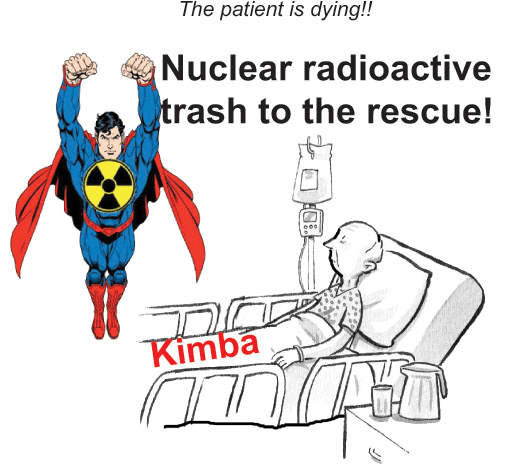
Senate committee to report by August 31 re Kimba Nuclear Waste Dump plan
[Ed. According to some reports – “Woomera has nothing to worry about, Defence say no, so they are safe.”]
Nuclear waste push for Woomera over Kimba ‘fails pub test’, local mayor says , Michelle Etheridge, Regional Reporter, The Advertiser
A push to swap Kimba for Woomera as the site of a new radioactive waste storage site is disrespectful and “fails the pub test” following years of consultation, the local mayor says.
Kimba Mayor Dean Johnson on Monday told a Senate committee that after much debate, the district was “the best informed community in Australia when it comes to radioactive waste and how it’s handled”.
His comments follow Senator Patrick’s suggestion that the contentious storage facility, planned for farming property Napandee, near Kimba, be built at Woomera instead.
“Our community has engaged and invested in the process for a really long time and to throw it in another location now, like Woomera, is just disrespectful on so many levels,” Mr Johnson said.
“It’s a bad idea that fails the pub test and the common sense test.”
Senator Patrick has said Federal Parliament should be given a choice to build the dump in the remote and highly-secure Woomera Protection area, where low and intermediate level waste has been stored for decades. However, Defence has argued building the facility at Woomera would “not align with Australia’s strategic interests”.
Kimba stands to receive a $31 million funding package under the plans.
Mr Johnson said the facility would deliver a new industry for the Eyre Peninsula town, and help the area “not just survive, but thrive”.
The Barngarla Determination Aboriginal Corporation have opposed the legislation on the basis that it removes the organisation’s right to seek a judicial review of the Government’s decision to go ahead with the site.
Its chairman Jason Bilney asked the committee to consider the impacts of a decision to go ahead as planned, despite traditional landowners objecting.
“What does that say to indigenous people – we’ve won our country but we still don’t have a right to say what we need to about our country? It’s very disrespectful to the community and our elders,” he said.
Kimba Council last year ran a poll on whether locals supported the waste plan, but traditional landowners not living in the area were excluded.
Meantime, No Radioactive Waste on Agricultural Land in Kimba or SA president Peter Woolford said the waste site should be built somewhere it posed no risk to agriculture. “The sad thing that’s been forgotten here is the impact on people – people are thinking about whether they’re going to move out because of their mental health,” he said.
“We’re (also) trying to stand up for people outside of Kimba that have been denied a say.”
The Senate committee will report back by August 31.
Australian govt trying to keep its $1.3bn arms purchase a secret, a dangerous precedent
Coalition says making public parts of $1.3bn Thales arms deal audit would penalise weapons company
Australian government claims disclosure would damage chances of multinational Thales to sell Hawkei combat vehicle to other countries, Guardian Christopher Knaus, The Australian government is arguing parts of an audit of a $1.3bn arms purchase must be kept secret because a multinational weapons company Thales would have trouble selling its product if they were disclosed.But the administrative appeals tribunal has heard that such an argument if allowed to stand would have a “devastating effect” on the auditor general’s ability to transparently and publicly criticise other government purchases.
 The tribunal is hearing a case between the Department of Prime Minister and Cabinet and crossbench senator Rex Patrick, who is fighting through freedom of information for full release of a 2018 audit report examining the government’s acquisition of the $1.3bn Hawkei combat vehicle fleet from French-based manufacturer Thales.
After representations from Thales, the attorney general, Christian Porter, made an extraordinary and largely unprecedented intervention to redact sections of the audit on the grounds they unfairly prejudiced Thales’s commercial interests and threatened Australia’s national security and defence.
The Guardian has since revealed the redacted material included a cost-comparison suggesting that Australia could have saved money by purchasing a different vehicle – the joint light tactical vehicle – from the United States……. https://www.theguardian.com/world/2020/jul/23/coalition-says-making-public-parts-of-13bn-thales-arms-deal-audit-would-penalise-weapons-company
Australia should join regional nations in signing and ratifying the Treaty for the Prohibition of Nuclear Weapons (TPNW)
Push to join nuclear weapons banm https://www.afr.com/politics/federal/letters-push-to-join-nuclear-weapons-ban-20200719-p55dhy Daryl Le Cornu, Member of the board of ICAN Australia 22 July 20, It was good to read William Stoltz’s ‘‘How Australia can help the world avoid nuclear war’’ (July 17) about the diplomatic initiative to push for a treaty of no-first-use based on the Chinese model.
His argument that Australia may be the only country that could lobby the US to agree to the principle of no-first-use has merit.
Furthermore, Stoltz argues that it is only through the ‘‘strength of principled examples and ambitious diplomacy that responsible nations can hope to make the legacy of Trinity and the nuclear threat to civilisation a thing of the past’’.
However, there is another potentially more effective ‘‘ambitious diplomacy’’ that Australia could pursue. This would be to join with the majority of the nations in the world and a majority of the people in the world in signing and ratifying the Treaty for the Prohibition of Nuclear Weapons (TPNW) that was created at the United Nations on July 7, 2017.
New Zealand has already done so, as have most of our regional neighbours. The Labor Party at its December 2018 national conference committed a future Labor government to such a diplomatic initiative. Furthermore, the organisation whose 10-year global campaign led to the creation of the TPNW – the International Campaign to Abolish Nuclear Weapons (ICAN) – was born in Australia in 2007 and launched by former Liberal prime minister Malcolm Fraser, who became ICAN’s first patron. With only 10 more ratifications for the TPNW to come intoforce in international law, it is surprising that Stoltz did not devote some time in his article reflecting on the 75th anniversary of the Trinity test to this citizen-initiated global campaign.
Australia and nuclear weapons – theme for August 2020
Sad to say, but Australia, or at least the Australian government, is something of an international pariah on the great issues of climate action, and nuclear disarmament.
In decades past, Australia took a leadership position on nuclear disarmament. Not any more.The rot really set in with the dismissal of Gough Whitlam as Prime Minister. That whole thing remains shrouded in secrecy, but Whitlam wanted Australia’s government to know what was going on at Pine Gap, and opposed having a USA secret spy and military operations base operating in Australia. I believe that it was Whitlam’s stand about Pine Gap that was the underlying reason for his dismissal.
After Whitlam, Australian governments kowtowed to USA, and continue to do so. As with climate action, the Australian government continues to sabotage international disarmament efforts. That’s why we have U.S. military bases as targets in this country, and some Liberal and National MPs itching to buy nuclear weapons from US.
On a positive note, however, Australians can be proud of the initiation of the International Campaign to Abolish Nuclear Weapons, (ICAN) which was started by Australians, and won the Nobel Peace Prize. This led to the United Nations Treaty on the prohibition of nuclear weapons, voted in by 122 nations, now ratified by 40. It is an important start, removing any pretense that such weapons could be considered ethical. There are now 28 Australian councils that call for the federal government to sign and ratify the Treaty on the Prohibition of Nuclear Weapons..
for page Andrew Wilkie https://www.youtube.com/watch?v=gRfhFITToa8
for International https://www.youtube.com/watch?v=0XzrxspyzXo
for international – very good https://www.youtube.com/watch?v=jveGno7ee9I
Hope for a nuclear weapons free world
Hope for a nuclear weapons free world https://www.echo.net.au/2020/07/hope-for-a-nuclear-weapons-free-world/#comment-3006538 Mick & Deborah Stacey, Ballina
The 16 July, 75 years ago, was the date of the first atomic weapons test code named ‘Trinity’, at Alamogordo, New Mexico, USA, (part of the Manhattan Project). This led to the bombings of Hiroshima and Nagasaki on the 6 and 9 August, and over 2000 additional tests worldwide, exposing people and nature to deadly toxic radioactive particles.
Today, there are over 13,890 nuclear weapons worldwide, all far more powerful than the ones used on Japan.
But there is hope, thanks to an Australian initiated campaign ICANW (International Campaign to Abolish Nuclear Weapons), we now have 40 countries, Botswana being the latest, that have ratified the treaty in the United Nations, with 10 more required to make nuclear weapons, illegal under International Law.
Thanks to the dedicated people who work tirelessly to make this happen. We can help by making a donation at ICANW, and encouraging your council to sign up to the ICAN Cities Appeal. There are now 28 Australian councils signed up, Adelaide being the latest.
So if local Councils could take some time out from being developers, just like Ballina Council they could add their support.
There is no future in a world, held to ransom by these horrendous weapons of mass destruction.
People should be appalled by the governments’ announcement to spend $270 billion on so called defence. Love is the answer.
40th ratification of the Treaty on the Prohibition of Nuclear Weapons
Thanks to Botswana, the Treaty on the Prohibition of Nuclear Weapons has now reached 40 states parties. After just 10 more ratifications, it will enter into force. Botswana deposited its instrument of ratification with the UN Secretary-General, António Guterres, on 15 July, the anniversary of the entry into force of the Treaty of Pelindaba, which established the whole of Africa as a nuclear-weapon-free zone.
In case you missed it, our neighbouring Fiji also ratified the ban treaty last week. You can read about the significance of this step and Fiji’s long history of activism against the bomb in the Guardian, thanks to Dr Vanessa Griffen and Talei Luscia Mangioni.
The 40th ratification is a significant milestone, dispelling any doubts over the treaty’s inevitable entry-into-force. The Australian Government simply cannot ignore the ban forever.
In more good news, on Tuesday night the City of Port Adelaide Enfield became the first South Australian council to endorse the ICAN Cities Appeal. There are now 28 Australian councils that call for the federal government to sign and ratify the Treaty on the Prohibition of Nuclear Weapons. Congratulations Port Adelaide and thanks to the SA campaigners that made this happen!
Today is the 75th anniversary of the first nuclear explosion, code-named “Trinity”. This event has significance for all people impacted by nuclear weaponry worldwide, including in Australia. Nuclear explosions don’t stay in the past, the effects of radiation continue through the decades and generations. In just a couple of hours we’ll begin our special Trinity video panel with three incredible women who are fighting against the bomb. Check the details and get the Zoom link here, or watch it later from the ICAN Australia Facebook page.
1 This month

of the week – Australians for War Powers Reform (AWPR)
To see nuclear-related stories in greater depth and intensity
 Antinuclear