AUKUS faces bigger tests than Trump’s ‘America first’ review, US and UK experts warn.

The deal could undermine Australia’s sovereignty. it could lock Australia into following the Americans into a confrontation with China over Taiwan.
“You are in the punch-up, whether you like it or not.”
The deal could undermine Australia’s sovereignty. it could lock Australia into following the Americans into a confrontation with China over Taiwan.
“You are in the punch-up, whether you like it or not.”
ABC News, Four Corners, By Mark Willacy, Ninah Kopel and Lara Sonnenschein, 16 June 5
Key defence figures on both sides of the Atlantic warn the risks to AUKUS run deeper than whether a review finds Australia’s biggest ever defence deal is “America first” enough for Donald Trump.
They’ve told Four Corners of the damage being done to decades-old alliances by Mr Trump’s unpredictability and contempt for the US’s allies, the UK’s increasing focus on Europe, and concerns neither country has the capability to deliver the submarines on time or on budget.
With Australia’s allies holding all the cards, and our Indo-Pacific defence strategy at stake, it’s possible we could be left billions out of pocket, without submarines, and with one of our oldest alliances in tatters.
AUKUS alliance ‘undermined’
Even before the US decided to review the deal, a senior member of the country’s powerful Armed Services Committee was warning Mr Trump’s “idiotic” and “bullying” behaviour towards allies presented risks to the alliance with Australia.
The US president has repeatedly said that he regards Canada as the “51st state”, while his belittling of Ukrainian president Volodymyr Zelenskyy in the Oval Office in February shocked American allies around the world.
Mr Trump has also threatened to take back control of the Panama Canal and has not ruled out military force to wrest Greenland from Denmark.
The House Armed Services Committee’s highest-ranking Democrat, congressman Adam Smith, said Canberra had reason to be concerned about whether “the strong partnership between the US and Australia will remain”.
“I cannot possibly be critical enough of the way the Trump administration has treated our partners and allies since they were elected … it’s really stupid,” he said.
“Their contempt for allies and partners has the potential, not just to undermine the AUKUS agreement, but to undermine the very national security of the United States of America.”
Former US National Security Adviser Jake Sullivan also fears that Mr Trump has undermined America’s standing with its allies and partners.
“I think this is a great source of alarm,” Mr Sullivan, who served in the role under president Joe Biden, told Four Corners. “The direction of travel right now is quite disturbing.”
Mr Sullivan said he understood why allies such as Australia, may be wondering where they stand with the US president.
“I’m not sure that [Mr Trump’s] looking for territory Down Under … not to make light of it,” Mr Sullivan said.
“But I can see why people are asking questions. ‘Hey, what the heck is going on here? This isn’t right.'”
Key voices in the UK, the third alliance partner, are also troubled about the implications for AUKUS.
Former Royal Navy admiral Alan West said, “dear old Trump coming in, that has … stood everyone on their heads really”.
“Things that we absolutely took as a certainty are no longer a certainty,” said Lord West, formerly the official who oversaw the Royal Navy’s operations.
“What he’s been saying about Canada [being the 51st state] is outrageous actually. It’s like stamping on a fluffy bunny really, isn’t it? It’s just terrible.”
America first?
Under the AUKUS agreement the US is supposed to transfer at least three nuclear-powered Virginia-class attack submarines to Australia in the 2030s.
But it’s not building enough Virginia-class submarines for its own fleet, let alone enough to supply Australia.
To meet its targets the US would need to build them at a rate of 2.3 a year. It’s only making 1.2 a year.
Christopher Miller, who served as the acting Defense Secretary in the dying days of the first Trump administration, warns production is “moving too slow”.
“I think probably most of that’s on the United States side, to be perfectly honest with you,” Mr Miller said.
“The problem is we don’t have the workforce, the welders, the skilled machinists that are required.”
Adam Smith conceded slow production had put pressure on the AUKUS deal.
“But I’m hoping that the AUKUS deal will also put pressure the other way. It’ll put pressure to solve that problem,” Mr Smith said.
Earlier this year Australia’s Defence minister handed over $800 million to his US counterpart. It’s the first of six payments designed to help bolster the struggling American submarine industry.
The chief of the Royal Australian Navy, Vice Admiral Mark Hammond, told Four Corners Washington was determined to boost production and to fulfil its obligations under the deal.
“That is the United States Navy’s job to set the conditions to enable that to succeed,” Vice Admiral Hammond said.
“They’re being backed up with strategic investment by the United States and by Australia. So I’ve got every reason to believe they will succeed.”
‘They can walk away’
The Trump administration said its review of AUKUS includes ensuring it is “aligned with the president’s ‘America first’ agenda” and that “the defence industrial base is meeting our needs”.
AUKUS critics, like the former commander of the Royal Australian Navy’s submarine squadron, Peter Briggs, warn that Australia could lose everything it has bet on the nuclear subs.
“This is a good deal for the Americans,” Mr Briggs said. “If they see that the AUKUS program is impacting on their capabilities, they can walk away from it.”
“No penalties, no refunds. That’s it.”
Under the United States’ AUKUS legislation, the president has to certify to Congress that any transfer of Virginia-class submarines to Australia would not degrade America’s undersea capabilities. Otherwise, the transfer will not take place…………………………
American leverage
The man leading the review, Under Secretary of Defense for Policy Elbridge Colby, has been staunchly opposed to transferring any Virginia-class submarines to Australia while they are needed by the US.
Last year, before his elevation to the Pentagon, Mr Colby told the ABC it would weaken American strike power.
“It would be crazy for the United States to give away its single most important asset for a conflict with China over Taiwan,” he said at the time.
That view isn’t shared by other Republicans close to Donald Trump.
“We’re not ‘giving them away’. I mean, we are putting them in the hands of our friends in Australia,” Republican congressman Rob Wittman told Four Corners.
He said having Australia equipped with Virginia-class subs would place an obligation on Canberra to use them to assist the US in the Indo-Pacific.
“To me, that’s a lever. That’s where we can leverage the ability for Australia to do even more in partnership,”
Mr Wittman said.
“That’s a force multiplier for the United States and our friends in that region of the world.”
The prospect of “leverage” concerns some, who warn the deal could undermine Australia’s sovereignty.
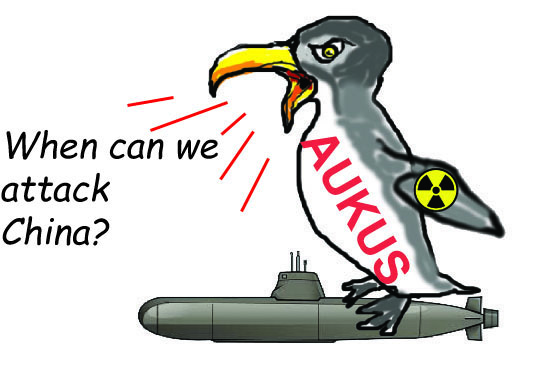
Mr Briggs fears it could lock Australia into following the Americans into a confrontation with China over Taiwan.
“You are in the punch-up, whether you like it or not,” Mr Briggs said………………………………………
Shifting priorities
Mr Trump’s approach to diplomacy and the US’s lagging production are not the only factors threatening to disrupt AUKUS.
Under the plan the UK will design a brand-new nuclear-powered submarine called the SSN-AUKUS. Construction is due to begin by the end of this decade in the UK and Australia.
But the UK is facing more pressing challenges closer to home.
Since the signing of the agreement in 2021, Europe has seen the outbreak of the largest war on the continent since World War II. Senior UK defence experts say that has up-ended the country’s defence priorities.
…………………….The US isn’t alone in struggling with submarine production.
Former First Sea Lord Alan West said the UK currently does not have the workforce or the specialist skills to deliver the SSN-AUKUS on time……………………. Lord Ricketts said Australia should not expect the SSN-AUKUS to arrive on time or budget.
“I think any sensible defence calculation will be that these things will be more expensive and later than is currently expected,” he said……………………………………….. https://www.abc.net.au/news/2025-06-16/aukus-risks-trump-review-defence-four-corners/105412740
Pacific Rim countries say no to U.S.-China war
The question that the people of the Pacific and Pacific Rim countries are asking is: Why do we have to respond to this demand by the U.S.? We are not threatened by China. Where is the dire urgency that demands such a huge distortion of our public spending on the military?
The indications are that the United States is preparing for war against China, but cannot wage such a war from the West Coast of the USA. It needs military bases, port facilities and airfields in the countries on the west side of the Pacific Rim; for example, South Korea, Japan, the Philippines, Guam, Micronesia and Australia. Without these bases, without the backing of the military forces and munitions and manufacturing capabilities of the Pacific Rim countries, the United States cannot launch and sustain a war against China.
By Bevan Ramsden | 16 June 2025, https://independentaustralia.net/politics/politics-display/pacific-rim-countries-say-no-to-us-china-war,19837
As the U.S. pushes Pacific Rim allies to ramp up military spending for a possible war with China, a new campaign asks: at what cost and for whose benefit? Bevan Ramsden writes.
THE PACIFIC and Pacific Rim countries have a geographical commonality. They are encircled by, or have a border with, the vast, blue, peaceful Pacific Ocean. They also share a political commonality. The people and countries of this region are under pressure to lift their military spending at the expense of addressing their social needs.
The pressure comes from the United States, whose Defence Secretary, Peter Hegseth, at the recent Singapore Defence Summit, declared that the U.S. expects its allies in this region to increase their defence spending to 5% of their GDP. His justification was a “possibly imminent threat” posed by China. He emphasised how the U.S. is “reorienting towards deterring aggression by China” and made it clear that the Donald Trump Administration’s defence strategy revolves around stifling the rise of China.
Responding to this expectation would involve the doubling of South Korean expenditure on military defence, from 2.6% of its GDP to 5%.
It would mean Japan’s military defence spending would have to triple from 1.8 % of its GDP to 5%.
In Australia, such an increase would represent a two-and-a-half times increase from 2% to 5% of its GDP.
These examples show that the 5% target represents a massive increase in military spending, which can only be made by reducing funding for urgent infrastructure, social needs such as health and education and loss of resources to address the real threat to their living environments, the climate crisis.
The question that the people of the Pacific and Pacific Rim countries are asking is: Why do we have to respond to this demand by the U.S.? We are not threatened by China. Where is the dire urgency that demands such a huge distortion of our public spending on the military?
Another commonality among the countries of the Pacific Rim, particularly those on the western and southern rim of the Pacific, is U.S. troops and U.S. military installations stationed on their territory. In the case of South Korea, these are substantial, close to 30,000 and put that country’s military virtually under the control of the U.S.
Japan has 57,000 U.S. troops, including 20,000 on Okinawa, where the U.S. Kadena Air Base is its largest outside of the USA. Clearly, this level of foreign military occupation exerts substantial pressure on Japan’s foreign policy.
The Philippines has four U.S. bases with troops rotating through its territory and training with its defence forces, and is setting up logistic centres for equipment and munitions.
The people of Guam, a territory under direct U.S. control, are subject to 7,000 U.S. troops, with almost a third of the land controlled by the U.S. military. The Joint Region Marianas is a U.S. military command combining the Andersen Air Force Base and the Naval Base Guam.
Andersen Air Force Base hosts B-52 bombers and fighter jets. Naval Base Guam is the home port for four nuclear-powered fast attack submarines and two submarine tenders. American military commanders have referred to the island as their “permanent aircraft carrier”.
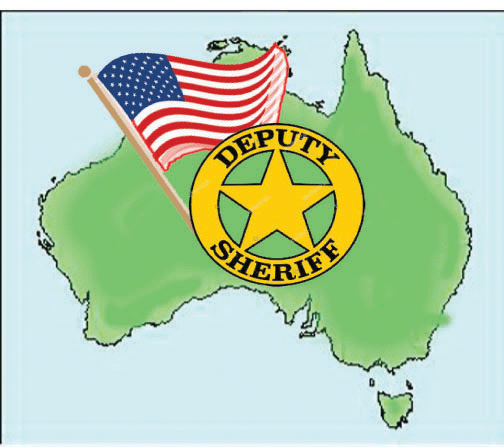
Australian governments, in their subservience to the U.S., have signed the Force Posture Agreement, giving the U.S. military unimpeded access to Australia’s ports and airfields and enabling the establishment of a Northern Territory base for its B-52 bombers, some of which are nuclear-capable. The Agreement is giving the U.S. fuel and munitions storage areas to support war operations and an $8 billion port facility for servicing their nuclear submarines and storage of their nuclear waste.
The people of Pacific Rim countries, including Australia, need to ask: Why does the U.S. have these extensive military facilities in our countries and why are they demanding such huge military expenditures from us?
The answer, unfortunately, is not for the benefit of the people of this region but for its own foreign policy objectives, which include maintaining its dominance in the region by “containing” China and preventing the rise of its influence.
The indications are that the United States is preparing for war against China, but cannot wage such a war from the West Coast of the USA. It needs military bases, port facilities and airfields in the countries on the west side of the Pacific Rim; for example, South Korea, Japan, the Philippines, Guam, Micronesia and Australia. Without these bases, without the backing of the military forces and munitions and manufacturing capabilities of the Pacific Rim countries, the United States cannot launch and sustain a war against China.
So the United States needs us but we don’t need such a war.
It would only bring devastation to our lives and our economies, and if it turned nuclear, who would survive?
The Pacific Peace Network, with representatives from the Pacific Rim countries and together with World Beyond War, has produced a solidary campaign which is being launched on 21 June 2025.
This is a campaign in which the people of each country on the Pacific Rim, including Australia, can say no to such a war and no to an increase in military spending for it, through a common petition which is a call on their governments.
The common petition can be accessed here at the World Beyond War website.
This call on governments reads:
For sustainable peace and the survival of our peoples and environment, we ask you:
- refuse to join military preparations for a U.S.-China war;
- declare you will not fight in a U.S.-China war;
- declare neutrality should such a war break out; and
- do not allow your territory or waters to be used in such a war, including the collection and relay of military intelligence, sales of weapons and hosting combatant troops and facilities.
Later this year, the petitions will be presented to their respective governments by peace activists in each country.
AUKUS: A Very Antipodean Stupidity
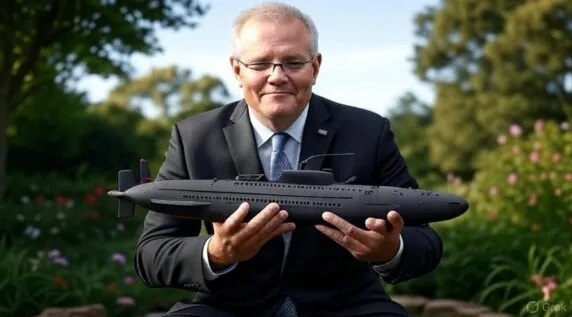
14 June 2025 Dr Binoy Kampmark, https://theaimn.net/aukus-a-very-antipodean-stupidity/
Call it abandonment, anxiety, or just latent stupidity. The messy goo of feelings and fuzzy notions behind Australia’s most injudicious strategic decision is yielding its nasty harvest. Conceived by paranoid armchair strategists, flabby think tankers and profligate spenders happy to expend other people’s money, the tripartite agreement between Australia, the United Kingdom and the United States is rapidly unravelling.
Even during the Biden administration, whose bumbling watch this agreement was hatched under, there were doubts. The ogrish price tag (US$239 billion or A$368 billion) that would be billed to the Australian taxpayer; the absurd time schedules (delivery of nuclear-powered submarines by the 2030s and 2040s); the contingencies and qualifications (Congressional concerns about transferring Virginia Class (SSN-774) submarines to the Royal Australian Navy), all pointed to the fact that Canberra had fallen for a lemon, childishly refusing to taste its stinging bitterness.
The central point of the tediously named Pillar One of the AUKUS agreement (there is no pillar, one or otherwise), which involves the transfer of US Virginia class boats to the RAN – was always its viability. While President Joe Biden was gradually losing his faculties in the White House, the Congressional Research Service was pertinently noting the obstacles that would face any transfer. The CRS report released on May 22, 2023 was the sort of thing that should have alarmed Australian defence planners, instead of turning them into paid up ostriches dreaming of consultancies. For one thing, it made it clear that Congress was always going to be the one to convince in the matter. “One issue for Congress is whether to approve, reject, or modify DOD’s AUKUS-related legislative package for the FY2024 NDAA [National Defense Authorization Act] sent to Congress on May 2, 2023.” That package included the authorisation for the transfer of “up to two Virginia-class SSNs to the government of Australia in the form of sale, with the costs of the transfer to be covered by the government of Australia.”
There were also weighty doubts about the “net impact on collective allied deterrence and war fighting capabilities of transferring three to five Virginia-class boats to Australia while pursuing the construction of three to five replacement SSNs for the US Navy.” This is a point that has never gone away. To give, even to an ally, and a perceived advantage yet diminish, however small and fictional, the supposed power of the US submarine fleet, is never going to take place if the annual production of 1.2 Virginia boats remains as it is. Mississippi Senator Roger Wicker was always of the view that “the AUKUS plan would transfer US Virginia-class submarines to a partner nation even before we have met our own Navy’s requirements.”
The fact that the Trump administration is now conducting a review of AUKUS can be seen as a mere formality – for those who think formalities smooth matters. The Australian Defence Minister Richard Marles certainly hopes so, calling it “a completely natural step for an incoming government to take.” That Yankee stronghold of renown in Canberra, the Australian Strategic Policy Institute, apes the line with simian consistency: “It’s normal, after a change of government, for a new administration to review existing commitments in the light of new policy priorities: in this case, ‘America First’.”
But nothing about the Trump government is a formality, or any review’s outcome a foregone conclusion. The presence of Undersecretary of Defense Policy Eldridge Colby should be disconcerting to the AUKUS band leaders and comparisons to Britain’s own review of the pact by Sir Stephen Lovegrove should be seen as fantastically distant. “AUKUS,” in Colby’s assessment, “is only going to lead to more submarines collectively in 10, 15, 20 years, which is way beyond the window of maximum danger, which is really this decade.” Putting to one side the warmongering stirring in the latter part of the statement, Colby is certainly not wrong about the time that will elapse before any delivery takes place.
Down under, the strategists are scurrying and fretting, a sight that is proving enormously entertaining. But the political classes have only themselves to blame for this pigsty of a conundrum. As former Australian Prime Minister Malcolm Turnbull notes with snappy precision, the AUKUS agreement is perfectly positioned for the US to not follow through. It can still stick to the letter of the agreement without having to ever transfer a single submarine to Australia, all the time raking in Australian largesse. “This is because it has always been part of the deal, and part of the US legislation, that the transfer of submarines to Australia is highly conditional.”
The legislation in question notes that the President will submit to the relevant congressional committees and leadership a certification no later than 270 days prior to the transfer of vessels that the move “will not degrade the United States underseas capabilities”; is consistent with the country’s foreign policy and national security interests and furthers the AUKUS partnership. That furtherance, however, involves the US ensuring “sufficient submarine production and maintenance investments” that will meet undersea capabilities; Australia supplying “appropriate funds and support for the additional capacity required to meet the requirements” under the provisions; and Canberra’s “capability to host and fully operate the vessels authorized to be transferred.”
The latest development in this overpriced show shows it up as a series of fictions: for Australia, the boyish hankering for nuclear powered submarines in the first place; for the United States, the fact that it needs more nuclear armed boats in order to look more ridiculous in having an arsenal it can never use. It was the military industrial complex in full song, nourished by expensive games, dubious scenarios and drab excuses for war.
With Donald Trump in the White House, the Make America Great Again philosophy mushes the terminology of sweet friends and mortal foes, turning it into the mortar of self-interest. Washington’s interests come first, and Australia’s own idiotically misplaced interests are barely visible in the White House situation room. Then again, never ask Australian strategic thinkers about their interests, ever the hostage of governing fears and treasured prejudices.
Rudd talking the AUKUS talk in Washington, but is the US walking?

by Rex Patrick | May 23, 2025, https://michaelwest.com.au/rudd-talking-the-aukus-talk-in-washington-but-is-the-us-walking/
A new FOI reveals Kevin Rudd has been talking the AUKUS talk, with success. Yet no amount of talk will help the US walk the AUKUS walk. Rex Patrick on the project status.
A Freedom of Information request looking into what Ambassador Kevin Rudd and his Washington staffers had been doing on AUKUS since he took up his post in March 2023 shows that he was pretty busy.
When he arrived at his Embassy post, the US Congress had already passed the Australia-United States Submarine Officer Pipeline Act. That was the first US legislative action to support AUKUS, allowing Australian submarine officers to train with the US Navy, to gain expertise in nuclear-powered submarines and to set them up to serve on their subs.
But there was a lot more work to be done. The FOI shows that AUKUS was a priority that Rudd took on with his characteristic eagerness and focus. Between March and July 2023, he met with President Biden and over 40 members of Congress of both political persuasions, with a focus on those who were members of the Armed Services Committee or Foreign Relations/Affairs Committees.
In amongst tens of private or close-knit lunches, dinners and meetings, he also spoke at a House Foreign Affairs Committee roundtable on 18 April, had drinks with twelve Republican Members of Congress on 5 July and hosted an ‘AUKUS and US-AUS International Cooperation’ dinner at the Australian Embassy with seven Senators on July 11.
By then, the Embassy was declaring victory in cables back to Australia regarding AUKUS support in Congress.
Transfer legislation passes
Further Embassy work saw a swath of other laws change in support of AUKUS, including laws in the 2024 National Defense Authorization Act allowing for the conditional transfer in the 2030s of three Virginia-class submarines to the Royal Australian Navy.
The conditional elements of the law are that the transfer cannot take place if it would cause a degradation of US undersea capabilities or is inconsistent with US foreign policy and national security interests. Furthermore, the law requires the President to certify the US is making sufficient submarine production and maintenance investments to meet the combination of US and Australian requirements.
And therein lies the problem.
The US Congressional Research Service (CRS) estimates that, before a transfer of submarines can occur, the US Submarine Industrial Base needs to be producing one Columbia-class nuclear missile submarine and 2.3 Virginia-class attack submarines per annum.
Currently, the Columbia submarine program, the US Navy’s highest priority program, is running between 12 and 16 months behind schedule.
Virginia-class submarines are being built at a rate of 1.2 boats per annum, way below what’s required. At the same time, the number of commissioned US submarines either in depot maintenance or idle (awaiting depot maintenance) has increased from 11 boats (21% of the attack submarine force) to 16 boats (33% of the attack submarine force).
And that is why the Albanese Government has committed $4.7B to uplift the capabilities of the US Submarine Industrial Base. The US is also injecting billions, with a plan to get to a build rate of two Virginia-class submarines by 2028.
The big picture
The problem is that, when one stands back and looks at past US performance, even with the money being spent, hitting a build rate of 2.3 Virginia-class submarines a year is fanciful.
The Government Accountability Office (GAO) testified to the House of Representatives Armed Services Seapower and Projection Forces subcommittee on March 11 this year, stating,
The Navy has no more ships today than when it released its first 30-year shipbuilding plan in 2003.
This stagnation has occurred despite regular demands and plans for a substantial increase to the Navy’s fleet size and a near doubling of its shipbuilding budget (inflation-adjusted) over the past 2 decades.”
GAO described the situation in more detail stating that; in the 2000s attack submarines took six years to build and cost around $US3B, they now take nine years to build and cost around $US4.5B (only a third of the increase can be attributed to shipbuilding inflation); destroyers used to take five years and cost $US1.9B to build and now take nine years and cost $US2.5B (the lead ship of the new Constellation class frigate program has an estimated 3 years delay, with construction stalled; aircraft carriers used to take eight years to build and now take eleven years.
Over the period 2019 to 2040 it is estimated that the US Navy will have lost 234 ship service years due to shipbuilding delays and between 2027 and 2030 the US fleet will be smaller by 20 ships, mostly attack submarines.
Both the CRS and GAO have advised Congress that it’s not just a money problem; there are systemic issues right across the board.
The CRS testified that it has taken a long time to get into this situation and that it will take a long time to “right the ship”.
Talking cross-purposes
This brings us back to an exchange in the Australian Senate between the man in charge of AUKUS, Vice Admiral Mead, and Greens Senator David Shoebridge in June last year.
Shoebridge was asking what happens if the US can’t deliver; will we get our $4.7B back? Mead was answering that the US was fully committed. Shoebridge was in effect asking, ‘what happens if the US can’t walk the AUKUS walk’. Mead was answering, ‘they’re talking the AUKUS talk’.
Politics over engineering?
Over the years we’ve seen Australian politicians make promises about, and commit public money to, Defence projects that have subsequently gone off the rails and cost the country dearly in terms of money spent, unavailability of military capability and the undermining of national security.
It doesn’t matter what politicians in Australia or the US say; it matters what the experienced project managers and engineers say. In addition, our Defence is, at best, very short of experienced project managers; rather, they have flag-ranked officers who’ve never run projects but need somewhere to go after successfully commanding a ship or unit.
The warning signs for AUKUS are apparent right now. Australia is an island state that needs submarines and, based on the actual states of US shipyards,
“the current trajectory of AUKUS is a likely loss of our submarine force altogether.“
The Government recently announced that the Collins Life of Type Extension will be scaled back, and is refusing to develop a Plan B. Plan B is no submarines, after spending $4B not buying French submarines and pouring almost $5B into the US Submarine Industrial Base.
In any normal organisation which has accountability to shareholders, someone would have been fired by now. But no-one ever gets fired in upper echelons of the Defence force
Nothing to See Here: Australia’s Hidden Arms Trade With Israel
May 19, 2025, Stefan Moore, Consortium News,
Despite the risks of colluding in Israel’s war crimes, Australia’s leaders remain wedded to the business of selling weapons and weapons parts to Israel, writes Stefan Moore.
Australian politicians will go to extraordinary lengths to obfuscate, excuse and lie about their country’s arms trade with Israel but recent investigations by human rights groups, independent media and the Australian Greens reveal that Australia is in breach of every international law prohibiting the sale of arms to countries committing war crimes.
Among the most egregious examples is Australia’s contribution to Israel’s Lockheed-Martin F-35 Joint Strike Fighter — the most technologically advanced and lethal fighter jet in the world. Each plane can carry a payload of up to 10 massive bombs — four internally and six mounted on the wings – each capable of obliterating apartment buildings, schools and hospitals and atomising the bodies of hundreds of Palestinians. Every day in Gaza, survivors of these attacks comb through the rubble for the remains of their loved ones.
Australia plays a critical role in the global supply chain of parts for Israel’s F-35 fighter jets. As reported by Declassified Australia, the “update actuators” that open the bomb bay doors are supplied by Rosebank Engineering in Melbourne. The “weapons adaptors” that release the bombs are supplied by Ferra Engineering in Brisbane.
Australia’s insistence that it does not sell weapons to Israel is both false and nonsensical. When questioned about the sale of F-35 parts by Greens Sen. David Shoebridge in Parliament, Deputy Defence Secretary Hugh Jeffrey claimed that the mechanisms used to open the F-35 bomb bay doors are not weapons because weapons are “whole systems” and not parts like a bomb door opener which he ridiculously compared to a pencil that can either be used to write or as a weapon.
Despite the deputy defence secretary’s claim that Australia’s sale of F-35 parts does not violate international law, it is clearly prohibited by the United Nations Arms Trade Treaty (to which Australia is a signatory) that stipulates in Article 6(3) “arms transfers should be prohibited if the state knows that the weapons will be used for genocide, crimes against humanity, or war crimes.” Specifically, the Treaty restricts the export of weapons “parts and components.”
For Australian politicians, any discussion of Australia’s arms trade with Israel hits a raw nerve. When Foreign Affairs Minister Penny Wong was asked about the F-35 parts sales by Sen. Shoebridge in parliament, instead of answering the question truthfully (that either she didn’t know or that she was aware that Australia is part of the F-35 supply chain) she aggressively attacked Shoebridge for spreading “misinformation and disinformation” that was being spread on social media.
But Australia’s sale of weapons parts to Israel is not restricted to the F-35……………………………………………………………………………………………………………………………………https://consortiumnews.com/2025/05/19/nothing-to-see-here-australias-hidden-arms-trade-with-israel/?eType=EmailBlastContent&eId=a5119662-8aaa-4113-b7c5-e057e49d1f20
Treaty the planet’s best chance to get rid of its worst weapons
By Dave Sweeney | 19 May 2025, https://independentaustralia.net/politics/politics-display/treaty-the-planets-best-chance-to-get-rid-of-its-worst-weapons,19758
From Jakarta to the Vatican, Prime Minister Albanese’s journey underscores a global call to ban the world’s most destructive weapons, writes Dave Sweeney.
ON HIS FIRST overseas trip since his sweeping election victory, Prime Minister Anthony Albanese made for two very different destinations.
The first stop was steamy Jakarta, the capital of Indonesia, the world’s most populous island nation and home to the world’s largest Muslim population with around 240 million or 13 per cent of the globe’s believers.
After Indonesia, the PM switched time zones and belief systems and headed to the Vatican, the world’s smallest sovereign state in terms of area and population, and the (sacred) heartland of the Catholic faith.
These two places are very different worlds, with very different worldviews, but both have an active desire to protect our shared world from its most avoidable existential threat: nuclear war.
Prime Minister Albanese also holds this view.
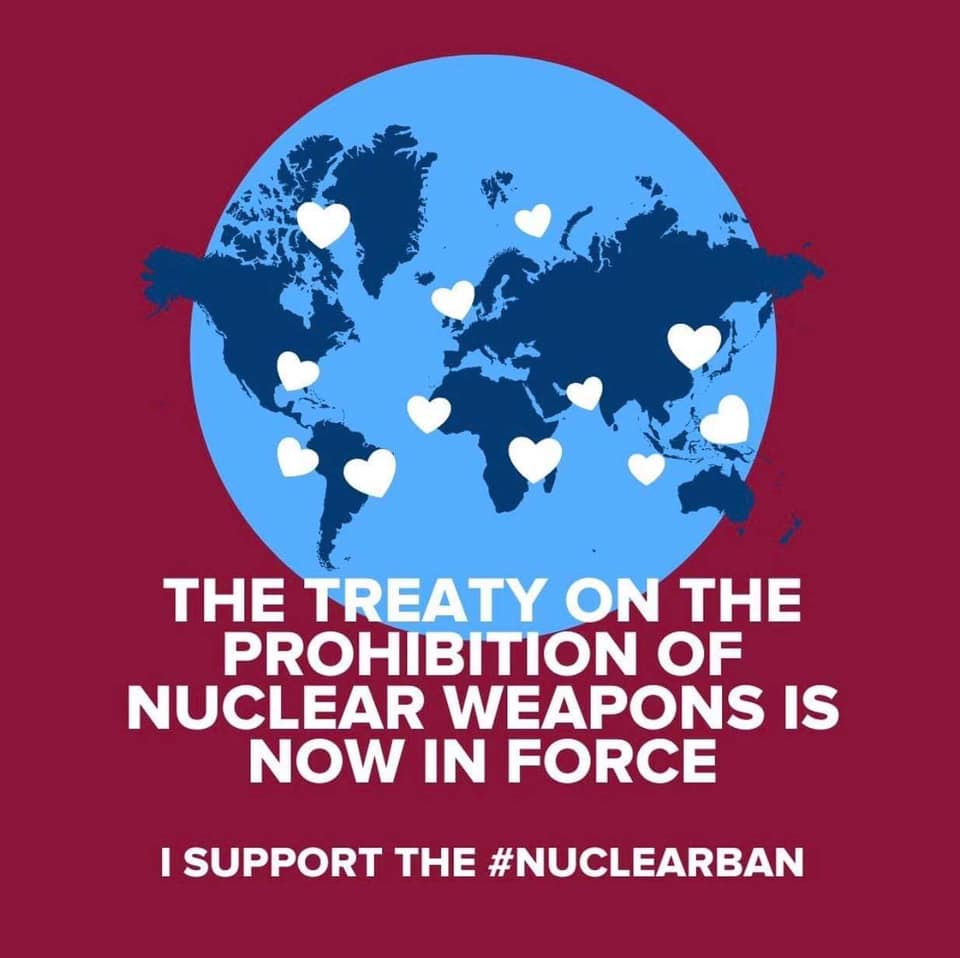
In December 2018, he championed Federal Labor’s support for the newly adopted UN Treaty on the Prohibition of Nuclear Weapons (TPNW), stating:
“Nuclear weapons are the most destructive, inhumane and indiscriminate weapons ever created. Today we have an opportunity to take a step towards their elimination.”
The TPNW, adopted by the UN in 2017 with more than 120 nations voting in favour, grew from an Australian initiative by the International Campaign to Abolish Nuclear Weapons (ICAN).
ICAN was launched in Melbourne in 2007 and was awarded the 2017 Nobel Peace Prize in recognition of the group’s work ‘to draw attention to the catastrophic humanitarian consequences of any use of nuclear weapons’ and its ‘groundbreaking efforts to achieve a treaty-based prohibition of such weapons’.
The TPNW entered into force in January 2021, an act which has finally and formally seen nuclear weapons be declared unlawful under international humanitarian law.
Supporters of the TPNW have described the Treaty as our planet’s best way to get rid of its worst weapons.
The fragile and fractured global situation starkly highlights the urgency of this task.
Two nuclear weapon states, Israel and Russia, are actively involved in hot wars.
Two more, India and Pakistan, are engaged in risky posturing that could dramatically escalate, while two others, China and the United States, are shaping up for a trade war with hints of worse to come.
Against this grim background, the TPNW is a star that provides some light and hope and a navigation point to help chart a safer and saner course for our shared future.
Nations are embracing this path with half of the world’s countries having signed, ratified or acceded to the Treaty, including Indonesia and the Vatican/Holy See.
When it ratified the TPNW last September, Indonesia – a leading player in the global Non-Aligned Movement – made clear that ‘the possession and use of nuclear weapons cannot be justified for any reason’
Speaking at the time, then Foreign Minister Retno Marsudi posed the fundamental question and delivered the humane answer:
Should fear of nuclear weapons be our guarantee for peace? Indonesia’s answer will forever be no.
Indonesia reaffirms its commitment to a nuclear weapon-free world.
The late Pope Francis was a strong supporter of the TPNW and gave expression to the principle of “blessed are the peacemakers” with the Vatican’s championing and early adoption of the Treaty. The Pope described the very existence of nuclear weapons as “an affront to heaven”. In his final Easter Sunday sermon, shortly before he died, he made a powerful call for peace and weapons abolition.
These calls for nuclear abolition and for ways of addressing conflict that do not risk all that ever was, is or could be on our shared planet are finding a resonance and echo in many other nations.
Labor’s National Platform is clear:
Labor acknowledges the growing danger that nuclear weapons pose to us all and the urgent need for progress on nuclear disarmament.
Labor will act with urgency and determination to rid the world of biological, chemical and nuclear weapons.
Commits itself to redoubling efforts towards a world without nuclear weapons…
Labor in government will sign and ratify the Ban Treaty…
In this year that marks 80 years since the unveiling of the age of Armageddon with the first atom bomb test in New Mexico and the first atom bombings of the Japanese cities of Hiroshima and Nagasaki, it is time to turn a political platform into a prescription for a habitable world.
It is time for Australia to follow the example of Indonesia, the Vatican and many other nations and to show that the pen is mightier than the sword by signing the TPNW.
As they say, Prime Minister, when in Rome…
US military expected to export ‘high-risk’ explosives to Australian ports amid arms expansion
“Australia and the Indo-Pacific region is a theatre to the American military planners,”
ABC News, by Oliver Chaseling, Fri 9 May 25, https://www.abc.net.au/news/2025-05-09/us-defence-department-to-increase-arms-shipments-to-australia/105259122
In short:
The US Department of Defence has sought tenders for the handling of US military cargo in Australian ports.
In its tender solicitation, the shipping manifest of an existing contract has been expanded to include indefinite quantities of explosive cargo.
What’s next?
Further announcements on US-Australian military cooperation in coming months was flagged at a recent Defence industry summit in Darwin.
Subcontractors in at least four Australian ports are expected to soon handle United States military cargo containing gases and radioactive material, as part of an expanded contract with the US government, the ABC can reveal.
The US Department of Defense is currently seeking tenders for port services in the Northern Territory, Queensland and Victoria, where it expects “indefinite quantities” of explosives, aircraft, classified and general cargo to be unloaded from ships and onto trucks.
The tender solicitation issued by a US transportation battalion based in Yokohama, Japan, covers the handling of cargo shipped to and from Australia……………………………………………………………………………….
The new contract will also expand arms shipments to the Point Wilson port, between Geelong and Melbourne, which in 2023 was flagged for “large-scale importation of guided weapons and explosive ordnance” according to the Australian Department of Defence……………………………………………………..
Shipments mark ‘maturing’ US military logistics network
Defence industry consultant Darian Macey said the contract “broadens the [US] strategic footprint” in Australia, by adding more dangerous cargo and expanding arms shipments to Victoria’s Point Wilson port.
“While the contract itself doesn’t specify end use, the inclusion of high-risk cargo types and expanded port access is consistent with broader trends we’re seeing under AUKUS and allied posture initiatives,” he said.
Mr Macey said the contract signalled “a maturing [US] posture in the region” that could support rapid deployments throughout the Indo-Pacific.
“Australia and the Indo-Pacific region is a theatre to the American military planners,” he said.
“Having those assets in theatre means that they can respond more rapidly, than if they had to bring those assets across from their home country.”
The Australian Department of Defence’s Brigadier Mick Say told the recent Northern Australia Defence Summit that the pre-positioning of US military equipment in Australia had been “enabled” by the 2014 US Force Posture Agreement.
He flagged a potential expansion in US Force Posture efforts after high-level ministerial talks between Canberra and Washington later this year.
“That will lead to a number of other announcements, once agreed to by governments, in regards to the next steps of the Force Posture activities within Australia,” he said.
Greens fear AUKUS overreach as State Development Coordination and Facilitation Bill 2025 passes SA parliament
A new $4m planning office will be granted unprecedented powers, sparking calls to temper the power of the four bureaucrats set to wield them.
Sweeping new powers will be invested in a $4m office to fast track “significant” SA projects including housing and AUKUS – raising fears they could avoid tougher planning checks.
The State Government is planning to appoint four staff to the office, including an AUKUS expert, with unprecedented powers to “case manage” projects.
Premier Peter Malinauskas has flagged this would allow faster approvals in designated “go zones” for projects like the AUKUS nuclear-powered submarines, housing and renewable energy projects.
The move flared concerns about existing heritage, environment, coastal protection and pastoral land act processes being downgraded after the State Development Coordination and Facilitation Bill 2025 passed this week.
Mr Malinauskas previously said the law meant the State Government could designate “state development areas” as “go-zones”.
Regulatory work in these zones would be completed before developers moved in “allowing for quicker approvals within them once an application is made”.
This was meant to save time in passing “urgent and significant projects”.
A government spokesperson assured provisions meant the new office must perform any assessment independently and it could not be directed “by any Minister to either approve or reject any application.”
The office could not deal with nuclear waste projects.
And the Adelaide Parklands was protected by the Adelaide Parklands Act and the new bill states it “may never be designated as a state development area”.
But SA Greens party co-leader Robert Simms was still concerned.
He feared the inclusion of an AUKUS expert meant approvals for the project would bypass usual safety guards.
“SA parliament has just given the Malinauskas Government the biggest blank cheque in South Australian history,” he said.
“This bill gives an unelected office the power to override South Australian laws to enable controversial projects, including AUKUS, yet it passed the Upper House in the blink of an eye.”
“This bill isn’t about facilitating housing developments, it’s about giving the state government the power to ride roughshod over the community. It’s a power grab of epic proportions that should have been given much more scrutiny.”
It was confirmed in the senate the office would cost $4m a year to operate.
Australia’s arms escalation is in the interest of no one but death
Independent Australia, By Bronwyn Kelly | 2 May 2025,
Instead of arguing about whether Australia needs more submarines, we would be better off working towards a world where no one needs them. Bronwyn Kelly reports.
THOSE WHO HAVE HAD the patience to listen to the full day of speeches and questions at the recent Sovereignty and Security forum held at the National Press Club have been given a unique insight.
The event, organised by former Prime Minister Malcolm Turnbull, shed light on what happens when members of an elite defence establishment attempt to set Australia’s strategic direction. They jockey for money for an industry of death.
Usually, they jockey quietly, but this particular forum allowed several to display how much of their thinking is motivated by money and is therefore fixated on militarism – as though peace and disarmament were not a prospect to be contemplated at all in Canberra.
Turnbull kicked off the day’s discussion by asserting that Trump’s America is now a country whose values are “aligned to a might is right world” and that, as such, it no longer shares Australia’s values. He made little, if any, reference to what Australia’s national values might be. Presumably, we were simply meant to infer that Australia should no longer aspire to emulate America, at least in its “might is right” approach to economic and military strategy.
As the day moved on, no one demurred from this description of America. They took it largely as a fact and mostly as one that would be long-lived rather than short-lived. There was general agreement that America has changed with the rise of Trump and that this has implications for our choices in defence, diplomacy, trade and international relations. Accordingly, they set about the laudable exercise of discussing how Australia should “recalibrate”.
But it was those with a vested and sometimes even nakedly pecuniary interest in defence industries that proved themselves to be among the most unwilling in the room to recalibrate. Instead they used the day wherever they could to argue for massive expansion of defence industries and weapons exports and also for increasing what they called a “deterrent” capability – shorthand for building a defence force and armaments at such a large scale that any adversary, no matter how much bigger their military capability might be than Australia’s, would calculate that an attack on Australia would not be worth the cost. At least that’s the theory.
Someone should tell them that deterrence doesn’t actually work when there is a large and insurmountable imbalance of power as there is in the case of Australia vis-a-vis China, Russia and the US. It’s a lot of money for nothing in our case, and our adoption of deterrence as an overriding posture in the most recent National Defence Strategy simply makes matters worse by forcing others to distrust us more and arm themselves. But that’s another article. Suffice to say here that those championing more investment in defence seemed unable to contemplate anything other than arms escalation.
Perhaps the most disheartening feature of the discussion, however, was that at no time did those advocating for arms escalation ask whether expansion of defence and defence industries was in Australia’s interest or show how it would be. They bypassed the questions of what is in our interest and what Australians might value and be prepared to defend militarily, and instead jumped straight to the issue of how much more funding they needed for the defence industry. The clamour for a greater share of GDP to be spent on defence activities swamped voices such as those of former foreign minister Gareth Evans and former chief of defence Chris Barrie — both of whom attempted to argue that the whole debate should be reframed so that we decide what is in our interest first, before we design a strategy to protect it in defence and foreign policy………………………………………………………………………….
At the very least Australia’s alliance with the U.S., especially if it continues to take a military form, is very likely to defeat other attempts to engage more positively with the rest of the world and particularly with Asia. The need for greater engagement with Asia was something that most speakers agreed on at the forum – and yet the prevailing impression was that most could not bring themselves to think of abandoning the alliance, even as an option.
This reluctance begs the question of how far the prevailing regime in America diverges from our “values” before we say it’s behaving in a manner that is so contrary to our interests that we must detach ourselves from it? How many more regime changes, brutal incursions and even genocides fostered by the U.S. will it take? How much more destabilisation of other economies? How much lower should America sink into autocratic behaviours, threats to allies and obliteration of human rights within its own territory, before we detach ourselves? How much more ugly must America become?
…………………….Given that Australians don’t want their economy and well-being disrupted by war, they’d be far more likely to want to concentrate on strategies that reduce or prevent the need for military expenditures. This is not what those attached to defence industries want to hear, but if they are asking Australians to sacrifice all their well-being and place themselves unnecessarily at dire risk of attack, they should be prepared for justifiable pushback.
The next time Mr Turnbull hosts a forum for these elites, everyone will be better off if he frames the occasion so that they stop arguing about whether we need submarines and start working towards a world where no one needs them. Arms escalation is in the interest of no one but the merchants of death. So if elites are invited again to ponder a “recalibration”, a plan for eventual disarmament should be acknowledged as a necessary permanent feature of a viable defence strategy. Nothing else is in our interest.
Dr Bronwyn Kelly is the Founder of Australian Community Futures Planning (ACFP). She specialises in long-term integrated planning for Australia’s society, environment, economy and democracy, and in systems of governance for nation-states.
Confirmed: Australian weapons sold to Israel
With the federal government covering for them, a Canberra-based company has supplied lethal weapons to a country accused of war crimes and genocide
Michelle Fahy, Undue Influence. Apr 30, 2025
This article was first published with Declassified Australia on 26.4.25
The Australian counter-drone weapons system seen at a weapons demonstration in Israel recently is actually just one of a few that were sold by Canberra-based company Electro Optic Systems (EOS) and sent through its wholly-owned US subsidiary to Israel, Declassified Australia can reveal.
It was the ABC who broke the news of the EOS weapons system being provided for the demonstration trial. In response, Prime Minister Anthony Albanese continued to insist, as he has since the war in Gaza began, that Australia does not sell weapons to Israel.
However the weapon displayed wasn’t just provided on loan for the demonstration – the weapon has been sold to the Israelis. Declassified Australia can reveal that EOS, by its own admission, sold more than one of its R400 weapons systems to the Israelis prior to the demonstration.
An EOS company presentation, titled ‘2024 Full Year Results’, describes a “potential new customer” for the R400 weapon in the “Middle East”. The presentation, prepared for EOS shareholders and lodged with the Australian Stock Exchange, is dated 25 February 2025.
EOS describes this potential new customer for its R400 being a “preliminary” stage opportunity, meaning a bid is being prepared or has been submitted (page 16).
The overall opportunity is valued at <$100 million with the company stating (page 36) that more than one weapons system has been sold:
“Sample products sold, demo held, discussions underway.” (Emphasis added.)……………………………………………………………………………………………………………………………………………………………….
Words are not enough
The Australian government and the Defence Department have continued their obfuscation of Australia’s weapons trade with Israel, as Declassified Australia has been reporting repeatedly.
ABC television has reported how the government continues to insist no weapons or ammunition had been supplied “directly to Israel” since its latest genocidal war on Gaza began. The addition of the word “directly” is a notable change to the government’s wording since this EOS news emerged.
In response to the ABC report, Prime Minister Albanese said: “We do not sell arms to Israel… We looked into this matter and the company has confirmed with the Department of Defence that the particular system was not exported from Australia. Australia does not export arms to Israel.”
Declassified Australia has previously reported on the Albanese Government’s repeated and misleading use of the phrase ‘to Israel’.
Arms companies are known for exporting their weaponry, or parts and components thereof, via third party countries in an attempt to cover their tracks.
A defence industry source told the ABC the Australian-made components of the EOS R400 remote weapons system were assembled at the company’s wholly-owned US subsidiary in Alabama USA, before being shipped to Israel without an Australian export approval.
Military exports, including ammunition, munitions, parts and components, do not need to travel ‘directly’ to Israel to be prohibited under the Arms Trade Treaty.
Governments are required to find out where their weapons will, or may, end up and then make responsible decisions that comply with the treaty. A government must consider and assess the potential ‘end users’ of its military exports.
A UN expert panel has issued repeated demands that States and companies cease all arms transfers to Israel or risk complicity in international crimes, possibly including genocide. It stated:
An end to transfers must include indirect transfers through intermediary countries that could ultimately be used by Israeli forces, particularly in the ongoing attacks on Gaza… [Emphasis added]
Greens’ defence spokesperson, Senator David Shoebridge, has said, “What we might be seeing here is the impact of what’s called AUKUS Pillar 2, the removal of any controls for the passage of weapons between Australia and the United States, and then Australia permitting the United States to send Australian weapons anywhere”.
Not the first time
EOS has a history of supplying its remote weapons systems to military regimes accused of extensive war crimes.
During the catastrophic Yemen war which started in 2014, despite significant evidence of war crimes, EOS sold its weapons systems to both Saudi Arabia and the United Arab Emirates. EOS enjoyed the full support of the Turnbull coalition government and its defence industry minister Christopher Pyne.
In early 2019, ABC TV reported, Saudi Arabia awarded EOS a contract to supply the Kingdom with 500 of its R400 Remote Weapons Systems.
EOS has also benefited from the government-to-industry revolving door. Former chief of army, Peter Leahy, was on the EOS board from 2009 until late 2022, encompassing the period of the Yemen war. He served as the company’s chair from mid-2021 until his departure.
The two longest-serving current members of the EOS board are former chief of air force, Geoff Brown (joined 2016) and former Labor senator for the ACT, Kate Lundy (joined 2018).
The release of a Human Rights Watch (HRW) report in 2023 raised serious concerns about EOS and its Saudi Arabian arms deals.
HRW’s report revealed that hundreds, possibly thousands, of unarmed migrants and asylum-seekers had been killed at the Yemen-Saudi border in the 15 months between March 2022 and June 2023, allegedly by Saudi officers.
Human Rights Watch says it identified on Google Earth what looks like “a Mine-Resistant Ambush Protected (MRAP) vehicle” near a Saudi border guard posts north of the Yemeni refugee trail in January 2023.
The vehicle has what appears to be “a heavy machine gun mounted in a turret on its roof”. This description matches the military equipment that Australia sold to Saudi Arabia a few years earlier.
Declassified Australia put a number of questions to EOS, the Department of Defence, and the offices of the Prime Minister, the Defence Minister, and the Foreign Minister. None responded to our questions on this matter. https://undueinfluence.substack.com/p/confirmed-australian-weapons-sold?utm_source=post-email-title&publication_id=297295&post_id=162393240&utm_campaign=email-post-title&isFreemail=true&r=1ise1&triedRedirect=true&utm_medium=email
Labor, Liberal and National Parties all caught up in American militarism, and enriching American weapons companies

Terry McBride 14 April 2025.
A Memorandum of Understanding has been signed between the WA Government and General Dynamics Mission Systems Inc
The partnership is designed to fast-track local businesses into the Virginia-class supply chain
Part of the Made in WA plan to build more things locally, create more local jobs and diversify the economy
2025 Decnet reports Australia is launching an ambitious plan to establish a domestic Australian Weapons Manufacturing Complex (AWMC) capable of producing up to 4,000 Guided Multiple Launch Rocket System (GMLRS) missiles annually by 2029. This initiative – a partnership with Lockheed Martin as part of the Future Made in Australia. The australian gov gives a 23.5B handout to the worlds most profitable business.
What the US MIC does is spread a number of military manufacturing factories across a country to make each state dependant on them. It becomes to politically hot for politicians after they are built. The MIC knows this as they have done it in the US for decades. It also makes war inevitable because this equipment is for use. its not made to sit on a shelf. The MIC is the biggest and most profitable business in the world and leaving equipment sitting does not make money.
This is so the Americans have enough missiles for war with china and others at australian taxpayer expense.
23 april 2025 Dutton announces defence policy to spend another 21B on top of the 58B this year, on top of 32M a day for AUKUS(or 11.5B per year) plus the 1B for a missil factory in sydney, plus the above, plus other US military bases we are paying for. About 75B a year for war so far. Is this why you pay tax. Where are they getting the money? Loans from the US with interest.
If the people woke up to the fact that our 3 mains parties are completely fascist groups and actively working towards war.
Stop voting Labor, Liberal and National number 1 on the ballot. If you want a better future of your children and not war, DO something different. Simple.
Dont underestimate Labor, Liberal and Nationals commitment to put your children on the front line for american business interest
Avalon Air Show: Arms deals, weapons of destruction and family fun
F-35s, the weapons that have caused such destruction in Gaza, will be in the air at Avalon. For civilian populations on the receiving end, they are objects of terror and loathing, but the Air Show’s website begs to differ: ‘The F-35A Lightning II isn’t just advanced — it’s packed with record-breaking fun facts!’
By Dave Sweeney | 27 March 2025 https://independentaustralia.net/politics/politics-display/avalon-air-show-arms-deals-weapons-of-destruction-and-family-fun,19567
A Melbourne air show is being promoted as a family event, hiding the dark truth behind its glorification of death and mass destruction, writes Dave Sweeney.
IN THE MISTS of legend, Avalon was a place of mysticism and magic linked with the once and future King Arthur and carrying the scent of sorcery and whispers of the Holy Grail.
This week, the sorcery is back with a showcase of the dark arts of industrial warfare and the Holy Grail of unfettered armaments profits on full display at Melbourne’s “other airport”.
Located around 60 kilometres from Melbourne down the Geelong road, Avalon Airport is home to some Jetstar operations, but it has a long-standing military connection since the strip was first used by federal agencies 70 years ago for the development of the RAAF’s Canberra bomber.
These days, alternate years see the windswept paddocks between the nearby open range zoo and the closed range prison complex host a family feel good celebration of technology that makes many families in other parts of the world feel bad or cease feeling altogether.
The Australian International Air Show and Exhibition is a place for family fun, and with the exciting new food vendors and free carnival rides for children young and old, you are set for ‘a day out with the family that’s not to be missed!’
The Air Show has two parts – one Circus, where weekend crowds can ‘get right up close to feel the rumble and smell the jet fuel’ and one Bread, a closed-door, dollar-driven weapons and technology trade show and networking opportunity.
In a set play from the global textbook of normalising deeply distressing and dangerous practices, the event seeks to braid together war fighting and arms trading with civil aeronautical seminars and emergency response displays.
But the principal public face is a high-octane aerial spectacle and parade of power without glory and context.
Australian manufacturing plays a growing role in the global arms trade, including an essential role in keeping the Israeli Defence Forces F-35 fighters in the air.
According to Amnesty International, Australian-manufactured parts and components, including those produced by sole-source providers, are being used in F-35 fighter jets, raising serious concerns about Australia’s potential involvement in the atrocities in Gaza.
Earlier this year, over 230 global civil society organisations urged governments producing F-35 fighter jets to immediately halt all arms transfers to Israel.
F-35s, the weapons that have caused such destruction in Gaza, will be in the air at Avalon. For civilian populations on the receiving end, they are objects of terror and loathing, but the Air Show’s website begs to differ: ‘The F-35A Lightning II isn’t just advanced — it’s packed with record-breaking fun facts!’
This family fun promotion is worlds away from many other peoples’ experience of the sky as a hostile space that threatens rapid, remote and remorseless destruction and death.
For most of us, the closest we get to this all too common global reality is TV news footage of wailing sirens and survivors amid the rubble.
The reality of what these machines actually do is not likely to be publicly canvassed at the Air Show but will no doubt be a marketing point – as demonstrated in the field – in the exhibition sheds and over networking drinks.
Event sponsors and supporters include federal and state governments, the Australian Strategic Policy Institute and Defence, along with a who’s-who of arms corporations and nuclear weapons heavyweights.
BAE, GE Aerospace and Raytheon will join Lockheed Martin, Northrop Grumman and more in giving away show bags and swapping badged pens, sweets, lanyards and notebooks in an effort to ‘elevate your brand to thousands of attendees’.
The guest list has tentacles around the world, as evidenced by Amentum, an innocuous sounding outfit with fingerprints over Pine Gap, military and civil radioactive waste management in the U.S. and UK and a growing interest in future radioactive waste plans in the Northern Territory.
But none of this is reflected in an event website full of happy family pics, tips on where to park and footage of enraptured kids gazing skywards.
There will be public service announcements reminding folks to slip, slop, slap and stay hydrated and no doubt car conversations on the way home featuring excited chatter about the noise, the power and the cool merch.
But what is likely to be missing – and not by accident – is any serious conversation about Australia’s role and responsibilities and whether our nation prioritises building a human and humane peace or getting a piece of the armaments action and conflict cash in an increasingly uncertain world.
Australia Ramps Up Missile Arsenal Over Chinese Navy Concerns

Just the bare $74 billion
Canberra plans to strengthen the nation’s maritime defenses by equipping forces with anti-ship missiles and advanced targeting radars.
The Australian military is looking to deploy new long-range missiles amid concerns about the growing presence of Chinese warships off the country’s vast coastline.
In the latest move to defend Australia’s maritime security, the government plans to arm forces with anti-ship missiles and advanced targeting radars.
Canberra will allocate up to 74 billion Australian dollars (47 billion U.S. dollars) over the next decade for targeting technology, long-range strike capabilities, missile defense, and the manufacturing of missiles and explosives, according to official speeches and defense planning documents.
Two new types of advanced anti-ship missiles, to be fired from mobile launchers, are currently under evaluation, with a decision expected by 2026.
Future versions of one of the contenders, Lockheed Martin’s Precision Strike Missile, are expected to have a range of up to 1,000 km and could be launched from High Mobility Artillery Rocket System (HIMARS) launchers. Australia has ordered 42 HIMARS launchers from the United States, with the launchers expected to be in service by 2026-27, according to the defense department.
Mick Ryan, a retired Australian army major general, said the new missiles for the Australian army would provide a powerful strike capability and serve as a deterrent to potential adversaries………………………………………………………………………………………………………………
Australian security officials expect more frequent and stronger visits by Chinese warships to the country’s coast…………………………….. https://www.theepochtimes.com/china/australia-ramps-up-missile-arsenal-over-chinese-navy-concerns-5825315?utm_source=Aobreakingnoe&utm_medium=Aoemail&utm_campaign=Aobreaking-2025-03-17&utm_content=NL_Ao&src_src=Aobreakingnoe&src_cmp=Aobreaking-2025-03-17&cta_utm_source=Aobreakingnoecta&est=LOrwYxBGZjROUs118QpMBtE0bgLYS8gg4SGZaQDgSPefhBQmyAxNjk%2BPa9v%2FDaL7DpE6eW86a08A
It’s time to ditch Virginia subs for AUKUS and go to Plan B
In this op-ed, Henry Sokolski argues Australia should switch its focus from buying Virginia-class submarines and instead put that money towards Pillar 2 technologies.
Breaking Defense Henry Sokolski March 06, 2025
Earlier this month, the Australian government made its first payment of $500 million toward eventually obtaining US nuclear-powered submarines under the 2021 AUKUS agreement. Because the submarine deal is unlikely to overcome budgetary, organizational, and personnel hurdles, that payment should be Australia’s last.
Rather than sacrificing much of its defense program to buy nuclear submarines, Canberra should instead adopt an AUKUS Plan B that would field new defense technologies such as uncrewed systems and hypersonic weapons that would enhance Australia’s security faster, and for far less.
Most experts believe funding AUKUS’s nuclear submarine plans will be challenging. Australia’s defense budget this year is almost $35 billion USD, and is planned to rise to almost $63 billion annually by the end of this decade when Australia would begin buying US nuclear submarines. At more than $3 billion per boat, each Virginia sub will eat up five to ten percent of the Australia defense budget that year, assuming Australia can double its defense spending in five years. Already, a former top officer has warned that the submarine pact will “cannibalize” other priorities and require deferring future surface warships or eliminating some ground units.
Another potential stumbling block is what’s needed to manage a nuclear propulsion program. More than 8,000 people work for the US Naval Nuclear Propulsion program. Today only about 680 people work at the Australian Submarine Agency. If Australia wants a sovereign submarine force that isn’t dependent on Washington’s oversight, it will need thousands of additional skilled civilian workers.
Military personnel is also a challenge. The Royal Australian Navy (RAN) includes about 16,000 sailors today. Each Virginia-class submarine has a crew of about 130 people, and about 400 sailors per ship to account for training, shore duty, and maintenance. With retention already difficult for the Australian Defence Force, the RAN may be hard-pressed to find and keep the thousand-plus highly-qualified personnel it needs to crew the nuclear sub fleet……………………………..
https://breakingdefense.com/2025/03/its-time-to-ditch-virginia-subs-for-aukus-and-go-to-plan-b/
Surface tension: could the promised Aukus nuclear submarines simply never be handed over to Australia?
Guardian, Ben Dohert, 7 Mar 25.
The multi-billion dollar deal was heralded as ensuring the security of the Indo-Pacific. But with America an increasingly unreliable ally, doubts are rising above the waves.
Maybe Australia’s boats just never turn up.
To fanfare and flags, the Aukus deal was presented as a sure bet, papering over an uncertainty that such an ambitious deal could ever be delivered.
It was assured, three publics across two oceans were told – signed, sealed and to-be-delivered: Australia would buy from its great ally, the US, its own conventionally armed nuclear-powered attack submarines before it began building its own.
But there is an emerging disquiet on the promise of Aukus pillar one: it may be the promised US-built nuclear-powered submarines simply never arrive under Australian sovereign control.
Instead, those nuclear submarines, stationed in Australia, could bear US flags, carry US weapons, commanded and crewed by American officers and sailors.
Australia, unswerving ally, reduced instead to a forward operating garrison – in the words of the chair of US Congress’s house foreign affairs committee, nothing more than “a central base of operations from which to project power”.
Reliable ally no longer
Officially at least, Aukus remains on course, centrepiece of a storied security alliance.
Pillar one of the Australia-UK-US agreement involves, first, Australia buying between three and five Virginia-Class nuclear-powered submarines from the US – the first of these in 2032.
Then, by the “late 2030s”, according to Australia’s submarine industry strategy, the UK will deliver the first specifically designed and built Aukus submarine. The first Australian-built version will be in the water “in the early 2040s”. Aukus is forecast to cost up to $368bn to the mid-2050s.
But in both Washington and Canberra, there is growing concern over the very first step: America’s capacity to build the boats it has promised Australia, and – even if it had the wherewithal to build the subs – whether it would relinquish them into Australian control.
The gnawing anxiety over Aukus sits within a broader context of a rewritten rulebook for relations between America and its allies. Amid the Sturm und Drang of the first weeks of Trump’s second administration, there is growing concern that the reliable ally is no longer that…………………….
‘The cheque did clear’
On 8 February, Australia paid $US500m ($AUD790m) to the US, the first instalment in a total of $US3bn pledged in order to support America’s shipbuilding industry. Aukus was, Australia’s defence minister Richard Marles said, “a powerful symbol of our two countries working together in the Indo-Pacific”.

“It represents a very significant increase of the American footprint on the Australian continent … it represents an increase in Australian capability, through the acquisition of a nuclear‑powered submarine capability … it also represents an increase in Australian defence spending”.
………….. just three days after Australia’s cheque cleared, the Congressional Research Service quietly issued a paper saying while the nuclear-powered attack submarines (known as SSNs) intended for Australia might be built, the US could decide to never hand them over.
It said the post-pandemic shipbuilding rate in the US was so anaemic that it could not service the needs of the US Navy alone, let alone build submarines for another country’s navy…………………………………………………………………………………………………..
‘Almost inevitable’
Clinton Fernandes, professor of international and political Studies at the University of New South Wales and a former Australian Army intelligence analyst, says the Aukus deal only makes sense when the “real” goal of the agreement is sorted from the “declared”.
“The real rather than declared goal is to demonstrate Australia’s relevance to US global supremacy,” he tells the Guardian.
“The ‘declared goal’ is that we’re going to become a nuclear navy. The ‘real goal’ is we are going to assist the United States and demonstrate our relevance to it as it tries to preserve an American-dominated east Asia.”
Fernandes, author of Sub-Imperial Power, says Australia will join South Korea and Japan as the US’s “sentinel states in order to hold Chinese naval assets at risk in its own semi-enclosed seas”.
“That’s the real goal. We are demonstrating our relevance to American global dominance. The government is understandably uneasy about telling the public this, but in fact, it has been Australia’s goal all along to preserve a great power that is friendly to us in our region.”
Fernandes says the Aukus pillar one agreement “was always an article of faith” based on a premise that the US could produce enough submarines for itself, as well as for Australia.
“And the Congressional Research Service study argues that … they will not have enough capacity to build boats for both themselves and us.”
He argues the rotation of US nuclear-powered submarines through Australian bases – particularly HMAS Stirling in Perth – needs to be understood as unrelated to Aukus and to Australia developing its own nuclear-powered submarine capability.
“Submarine Rotational Force-West (SRF-W) is presented by the spin doctors as an ‘optimal pathway’ for Aukus. In fact, it is the forward operational deployment of the United States Navy, completely independent of Aukus. It has no connection to Aukus.”
The retired rear admiral and past president of the Submarine Institute of Australia, Peter Briggs, argues the US refusing to sell Virginia-class submarines to Australia was “almost inevitable”, because the US’s boat-building program was slipping too far behind.
“It’s a flawed plan, and it’s heading in the wrong direction,” he tells the Guardian.
Before any boat can be sold to Australia, the US commander-in-chief – the president of the day – must certify that America relinquishing a submarine will not diminish the US Navy’s undersea capability.
“The chance of meeting that condition is vanishingly small,” Briggs says.
It now takes the US more than five years to build a single submarine (it was between three and 3.5 years before the pandemic devastated the workforce). By 2031, when the US is set to sell its first submarine to Australia, it could be facing a shortfall of up to 40% of the expected fleet size, Briggs says.
Australia, he argues, will be left with no submarines to cover the retirement from service of the current Collins-class fleet, weakened by an unwise reliance on the US.
The nuclear-powered submarines Australia wants to buy and then build “are both too big, too expensive to own and we can’t afford enough of them to make a difference”.
He argues Australia must be clear-eyed about the systemic challenges facing Aukus and should look elsewhere. He nominates going back to France to contemplate ordering Suffren-class boats – a design currently in production, smaller and requiring fewer crew, “a better fit for Australia’s requirements”……. https://www.theguardian.com/world/2025/mar/07/surface-tension-could-the-promised-aukus-nuclear-submarines-simply-never-be-handed-over-to-australia
1 This month

of the week – Australians for War Powers Reform (AWPR)
To see nuclear-related stories in greater depth and intensity
 Antinuclear