The lingering horror of the nuclear bomb tests at Maralinga
 The lesser known history of the Maralinga nuclear tests — and what it’s like to stand at ground zero https://www.abc.net.au/news/2020-03-24/maralinga-nuclear-tests-ground-zero-lesser-known-history/11882608, ABC Radio National By Mike Ladd for The History Listen I thought I knew all the details about Maralinga, and the nuclear bomb tests that took place there six decades ago.But when I set out to visit ground zero, I realised there were parts of this Cold War history I didn’t know — like Project Sunshine, which involved exhuming the bodies of babies. The lesser known history of the Maralinga nuclear tests — and what it’s like to stand at ground zero https://www.abc.net.au/news/2020-03-24/maralinga-nuclear-tests-ground-zero-lesser-known-history/11882608, ABC Radio National By Mike Ladd for The History Listen I thought I knew all the details about Maralinga, and the nuclear bomb tests that took place there six decades ago.But when I set out to visit ground zero, I realised there were parts of this Cold War history I didn’t know — like Project Sunshine, which involved exhuming the bodies of babies.
Maralinga is 54 kilometres north-west of Ooldea, in South Australia’s remote Great Victoria Desert. Between 1956 and 1963 the British detonated seven atomic bombs at the site; one was twice the size of the bomb dropped on Hiroshima. There were also the so-called “minor trials” where officials deliberately set fire to or blew up plutonium with TNT — just to see what would happen. One location called “Kuli” is still off-limits today, because it’s been impossible to clean up. I went out to the old bomb sites with a group of Maralinga Tjarutja people, who refer to the land around ground zero as “Mamu Pulka”, Pitjantjatjara for “Big Evil”. “My dad passed away with leukaemia. We don’t know if it was from here, but a lot of the time he worked around here,” says Jeremy Lebois, chairperson of the Maralinga Tjarutja council. Thirty per cent of the British and Australian servicemen exposed to the blasts also died of cancer — though the McClelland royal commission of 1984 was unable to conclude that each case was specifically caused by the tests. It’s not until you stand at ground zero that you fully realise the hideous power of these bombs. Even after more than 60 years, the vegetation is cleared in a perfect circle with a one kilometre radius. “The ground underneath is still sterile, so when the plants get down a certain distance, they die,” explains Robin Matthews, who guided me around the site. The steel and concrete towers used to explode the bombs were instantly vaporised. The red desert sand was melted into green glass that still litters the site. Years ago it would have been dangerous to visit the area, but now the radiation is only three times normal — no more than what you get flying in a plane. The Line of FireAustralia was not the first choice for the British, but they were knocked back by both the US and Canada. Robert Menzies, Australia’s prime minister at the time, said yes to the tests without even taking the decision to cabinet first. David Lowe, chair of contemporary history at Deakin University, thinks Australia was hoping to become a nuclear power itself by sharing British technology, or at least to station British nuclear weapons on Australian soil. “In that period many leaders in the Western world genuinely thought there was a real risk of a third world war, which would be nuclear,” he says. The bombs were tested on the Montebello Islands, at Emu Field and at Maralinga. At Woomera in the South Australian desert, they tested the missiles that could carry them. The Blue Streak rocket was developed and test-fired right across the middle of Australia, from Woomera all the way to the Indian Ocean, just south of Broome. This is known as “The Line of Fire” The Line of Fire from Woomera to Broome is, funnily enough, the same distance from London to Moscow,” Mr Matthews says. Just as the Maralinga Tjarutja people were pushed off their land for the bomb tests, the Yulparitja people were removed from their country in the landing zone south of Broome. Not all the Blue Streak rockets reached the sea. Some crashed into the West Australian desert. The McClelland royal commission showed that the British were cavalier about the weather conditions during the bomb tests and that fallout was carried much further than the 100-mile radius agreed to, reaching Townsville, Brisbane, Sydney and Adelaide. “The cavalier attitude towards Australia’s Indigenous populations was appalling and you’d have to say to some extent that extended towards both British and Australian service people,” Professor Lowe says. There are also questions over whether people at the test sites were deliberately exposed to radiation. “You can’t help but wonder the extent to which there was a deliberate interest in the medical results of radioactive materials entering the body,” Professor Lowe says. “Some of this stuff is still restricted; you can’t get your hands on all materials concerning the testing and it’s quite likely both [British and Australian] governments will try very hard to ensure that never happens.” Project SunshineWe do know that there was a concerted effort to examine the bones of deceased infants to test for levels of Strontium 90 (Sr-90), an isotope that is one of the by-products of nuclear bombs. These tests were part of Project Sunshine, a series of studies initiated in the US in 1953 by the Atomic Energy Commission. They sought to measure how Sr-90 had dispersed around the world by measuring its concentration in the bones of the dead. Young bones were chosen because they were particularly susceptible to accumulating the Sr-90 isotope. Around 1,500 exhumations took place, in both Britain and Australia — often without the knowledge or permission of the parents of the dead. Again, it was hard to prove conclusively that spikes in the levels of Strontium 90 during the test period caused bone cancers around the world. The Maralinga tests occurred during a period that Professor Lowe describes as “atomic utopian thinking”. “Remember at that time Australians were uncovering pretty significant discoveries of uranium and they hoped that this would unleash a vast new capacity for development through the power of the atom,” he says. Some of the schemes were absurdly optimistic. Project Ploughshare grew out of a US program which proposed using atomic explosions for industrial purposes such as canal-building. In 1969 Australia and the US signed a joint feasibility study to create an instant port at Cape Keraudren in the Kimberley using nuclear explosions. The plan was dropped, but it was for economic not environmental or social reasons. The dream (or was it a nightmare?) of sharing nuclear weapons technology with the British was never realised. All Australia got out of the deal was help building the Lucas Heights reactor. The British did two ineffectual clean-ups of Maralinga in the 1960s. The proper clean-up between 1995 and 2000 cost more than $100 million, of which Australia paid $75 million. It has left an artificial mesa in the desert containing 400,000 cubic metres of plutonium contaminated soil. The Maralinga Tjarutja people received only $13 million in compensation for loss of their land, which was finally returned to them in 1984. As we were leaving the radiation zone, the Maralinga Tjarutja people spotted some kangaroos in the distance. Over the years some of the wildlife has started to return. Mr Lebois takes it as a good sign. “Hopefully, hopefully everything will come back,” he says. |
|
Australian defence officials and politicians, like Christopher Pyne, rotate quickly between government and weapons industry jobs
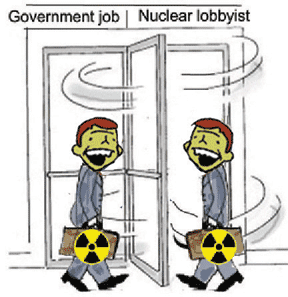 Brothers-in-Arms: the high-rotation revolving door between the Australian government and arms merchants. Michael West Media by Michelle Fahy | Mar 11, 2020 | A disturbing number of Australia’s military personnel, senior defence and intelligence officials and politicians leave their public service jobs and walk through the ‘revolving door’ into roles with weapons-making and security-related corporations. Nowhere is government and industry more fused than in defence. Michelle Fahy reports. Brothers-in-Arms: the high-rotation revolving door between the Australian government and arms merchants. Michael West Media by Michelle Fahy | Mar 11, 2020 | A disturbing number of Australia’s military personnel, senior defence and intelligence officials and politicians leave their public service jobs and walk through the ‘revolving door’ into roles with weapons-making and security-related corporations. Nowhere is government and industry more fused than in defence. Michelle Fahy reports.
The majority of transitions between politics and the Australian defence sector pass unremarked, with only an occasional high profile name making media headlines. It is a career pathway which has been normalised. This despite the sensitive nature of defence and the astronomical size of the nation’s defence spending. A recent example is the 21 February 2020 appointment to the Thales Australia board of one of the nation’s most senior intelligence chiefs, former ASIO boss Duncan Lewis, which barely rated a mention. Nine newspapers were an exception in noting the appointment, but there were no hard questions asked and no analysis by Nine as to the implications of this swift move into the private sector by such a powerful well-connected person: a move into an industry over which Lewis until recently had had oversight. Upon his appointment to the Thales board, Lewis had only been out of ASIO for five months, having spent five years as its Director-General. ASIO was his final public sector role in a long career that also spanned the military, the departments of the prime minister and cabinet and defence, as well as diplomatic roles. Thales is the world’s 10th largest weapons-making corporation; a French multinational that also encompasses cybersecurity and space projects. It also owns 35 per cent of Naval Group, the lead contractor of the $80 billion Future Submarines project. Thales Australia is a multi-billion-dollar contractor to the Australian government. When respected senior leaders such as Lewis leave public service for the weapons industry, they take with them extensive contacts, deep institutional knowledge, and rare and privileged access to the highest levels of government. Their presence in the private sector serves to affirm and entrench the influence of the weapons industry on government decision-making. The public interest risks becoming conflated with corporate interests. In addition to these issues, the well-trodden path from public service into such industry appointments raises the troubling possibility that some senior decision-makers on defence and national security matters, with an eye on possible future board appointments or consulting roles (whether consciously or not), might favour a certain proposal over another, or become hesitant to make decisions that could displease corporate interests. How would the public they serve ever know?
|
|

Australian govt rejects a report that recommends nuclear submarines
French submarine program ‘dangerously off track’ warns report urging Australia to consider nuclear alternative, ABC News, By defence correspondent Andrew Greene 11 Mar, 20 Australia’s $80 billion Future Submarine Program is “dangerously off track” according to a new report that urges the Government to ditch the controversial project and consider a nuclear option.
Key points:
- The report indicates there are fears the current project is at a high risk of failing
- The Defence Minister denies those fears and maintains the project remains on track
- Under a proposed “Plan B” scenario, the company that designed the Collins class submarines would prepare an updated design
Businessman Gary Johnston, who commissioned and funded the study, fears the current plan to build 12 attack class submarines designed by French company Naval Group is at “high risk” of failing.
His report, prepared by Insight Economics, suggests Australia should instead immediately begin work on a “Plan B” — an evolved version of the current Collins class fleet — before eventually acquiring nuclear-powered boats.
Earlier this year, a report from the auditor-general confirmed the Future Submarine Program was running nine months late and Defence was unable to show whether the $396 million spent so far had been “fully effective”.
“The Government’s own advisory body, including three American admirals, even recommended the Government should consider walking away from the project,” Mr Johnston said.
Under the proposed “Plan B”, Swedish company Saab Kockums, which designed the navy’s Collins class submarines, would be asked to prepare an updated design for the future submarine fleet.
In 2022-23, both Naval Group and Saab will present their competing preliminary design studies for building the first batch of three submarines in Adelaide — based on a fixed price, capability, delivery and local content.
Mr Johnston, along with former naval officers in the Submarines for Australia organisation, argue that over the long term the Government should begin preparing to acquire nuclear submarines……
Government rejects report, issues warning
The Submarines for Australia report will be formally launched by ANU Emeritus Professor Hugh White at the National Press Club today, but it is already drawing fire from the Morrison Government.
“I totally reject the premise that this project is ‘dangerously off track’, as stated in the new Submarines for Australia report”, Defence Minister Linda Reynolds said.
“The delivery of the attack class submarine remains on track, with construction set to commence in 2023.”
Senator Reynolds said the technical feasibility of delivering an evolved Collins class submarine was reviewed in 2013-14, but a review found it would be equivalent to a whole new design, involving similar costs and risks, without a commensurate gain in capability.
“This assessment by Submarines for Australia will only increase cost, delay the delivery, and put at risk our submarine capability.”
The Defence Minister also flatly rejected any suggestion of a nuclear-powered submarine in the future.
“As has been the policy of successive Australian Governments, a nuclear-powered submarine is not being considered as an option for the attack class submarine,” Senator Reynolds said.
https://www.abc.net.au/news/2020-03-11/australia-urged-to-embrace-nuclear-submarines/12043444
Legislation banning nuclear power in Australia should be retained
| Jim Green, Online Opinion, 27 Feb 2020, https://onlineopinion.com.au/view.asp?article=20758&page=0
Nuclear power in Australia is prohibited under the Environmental Protection and Biodiversity Conservation (EPBC) Act 1999. A review of the EPBC Act is underway and there is a strong push from the nuclear industry to remove the bans. However, federal and state laws banning nuclear power have served Australia well and should be retained.
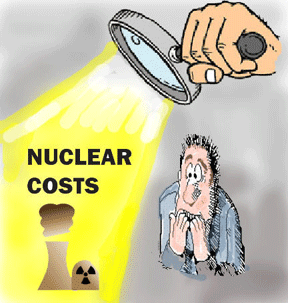
There are many other examples of shocking nuclear costs and cost overruns, including: * The cost of the two reactors under construction in the US state of Georgia has doubled and now stands at A$20.4‒22.6 billion per reactor. * The cost of the only reactor under construction in France has nearly quadrupled and now stands at A$20.0 billion. It is 10 years behind schedule. * The cost of the only reactor under construction in Finland has nearly quadrupled and now stands at A$17.7 billion. It is 10 years behind schedule. * The cost of the four reactors under construction in the United Arab Emirates has increased from A$7.5 billion per reactor to A$10‒12 billion per reactor. * In the UK, the estimated cost of the only two reactors under construction is A$25.9 billion per reactor. A decade ago, the estimated cost was almost seven times lower. The UK National Audit Office estimates that taxpayer subsidies for the project will amount to A$58 billion, despite earlier government promises that no taxpayer subsidies would be made available. Nuclear power has clearly priced itself out of the market and will certainly decline over the coming decades. Indeed the nuclear industry is in crisis ‒ as industry insiders and lobbyists freely acknowledge. Westinghouse ‒ the most experienced reactor builder in the world ‒ filed for bankruptcy in 2017 as a result of catastrophic cost overruns on reactor projects. A growing number of countries are phasing out nuclear power, including Germany, Switzerland, Spain, Belgium, Taiwan and South Korea. Rising power bills: Laws banning nuclear power should be retained because nuclear power could not possibly pass any reasonable economic test. Nuclear power clearly fails the two economic tests set by Prime Minister Scott Morrison. Firstly, nuclear power could not possibly be introduced or maintained without huge taxpayer subsidies. Secondly, nuclear power would undoubtedly result in higher electricity prices.
Former US Vice President Al Gore summarised the proliferation problem: “For eight years in Too slow: Expanding nuclear power is impractical as a short-term response to climate change. An analysis by Australian economist Prof. John Quiggin concludes that it would be “virtually impossible” to get a nuclear power reactor operating in Australia before 2040. More time would elapse before nuclear power has generated as much as energy as was expended in the construction of the reactor: a University of Sydney report concluded that the energy payback time for nuclear reactors is 6.5‒7 years. Taking into account planning and approvals, construction, and the energy payback time, it would be a quarter of a century or more before nuclear power could even begin to reduce greenhouse emissions in Australia (and then only assuming that nuclear power displaced fossil fuels).
Water consumption of different energy sources (litres / kWh): * Nuclear 2.5 * Coal 1.9 * Combined Cycle Gas 0.95 * Solar PV 0.11 * Wind 0.004 Climate change and nuclear hazards: Nuclear power plants are vulnerable to threats which are being exacerbated by climate change. These include dwindling and warming water sources, sea-level rise, storm damage, drought, and jelly-fish swarms. Nuclear engineer David Lochbaum states. “I’ve heard many nuclear proponents say that nuclear power is part of the solution to global warming. It needs to be reversed: You need to solve global warming for nuclear plants to survive.”
By contrast, the REN21 Renewables 2015: Global Status Report states that renewable energy systems “have unique qualities that make them suitable both for reinforcing the resilience of the wider energy infrastructure and for ensuring the provision of energy services under changing climatic conditions.”
To give one example (among many), the National Radioactive Waste Management Act dispossesses and disempowers Traditional Owners in many respects: the nomination of a site for a radioactive waste dump is valid even if Aboriginal owners were not consulted and did not give consent; the Act has sections which nullify State or Territory laws that protect archaeological or heritage values, including those which relate to Indigenous traditions; the Act curtails the application of Commonwealth laws including the Aboriginal and Torres Strait Islander Heritage Protection Act 1984 and the Native Title Act 1993 in the important site-selection stage; and the Native Title Act 1993 is expressly overridden in relation to land acquisition for a radioactive waste dump. No social license: Laws banning nuclear power should be retained because there is no social license to introduce nuclear power to Australia. Opinion polls find that Australians are overwhelmingly opposed to a nuclear power reactor being built in their local vicinity (10‒28% support, 55‒73% opposition); and opinion polls find that support for renewable energy sources far exceeds support for nuclear power (for example a 2015 IPSOS poll found 72‒87% support for solar and wind power but just 26% support for nuclear power). As the Clean Energy Council noted in its submission to the 2019 federal nuclear inquiry, it would require “a minor miracle” to win community support for nuclear power in Australia. The pursuit of nuclear power would also require bipartisan political consensus at state and federal levels for several decades. Good luck with that. Currently, there is a bipartisan consensus at the federal level to retain the legal ban. The noisy, ultra-conservative rump of the Coalition is lobbying for nuclear power but their push has been rejected by, amongst others, the federal Liberal Party leadership, the Queensland Liberal-National Party, the SA Liberal government, the Tasmanian Liberal government, the NSW Liberal Premier and environment minister, and even ultra-conservatives such as Nationals Senator Matt Canavan.
Australia can do better than fuel higher carbon emissions and unnecessary radioactive risk. We need to embrace the fastest growing global energy sector and become a driver of clean energy thinking and technology and a world leader in renewable energy technology. We can grow the jobs of the future here today. This will provide a just transition for energy sector workers, their families and communities and the certainty to ensure vibrant regional economies and secure sustainable and skilled jobs into the future. Renewable energy is affordable, low risk, clean and popular. Nuclear is not. Our shared energy future is renewable, not radioactive. More Information * Don’t Nuke the Climate Australia, www.dont-nuke-the-climate.org.au * Climate Council, 2019, ‘Nuclear Power Stations are Not Appropriate for Australia – and Probably Never Will Be’, https://www.climatecouncil.org.au/nuclear-power-stations-are-not-appropriate-for-australia-and-probably-never-will-be/ * WISE Nuclear Monitor, 25 June 2016, ‘Nuclear power: No solution to climate change’, https://www.wiseinternational.org/nuclear-monitor/806/nuclear-power-no-solution-climate-change Dr. Jim Green is the national nuclear campaigner with Friends of the Earth Australia. |




What was #ScottyFromMarketing planning, with U.S. military, at PineGap?
PRIME MINISTER’S PINE GAP VISIT RAISES EYEBROWS NT NEWS, 21 Feb 20,
The Prime Minister has made a visit to the secretive Pine Gap military intelligence base raising eyebrows about the potential involvement of the facility in ongoing tensions between the United States and Iran….. (subscribers only)
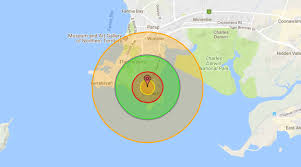
NukeMap – what if Australian cities were hit by a nuclear bomb
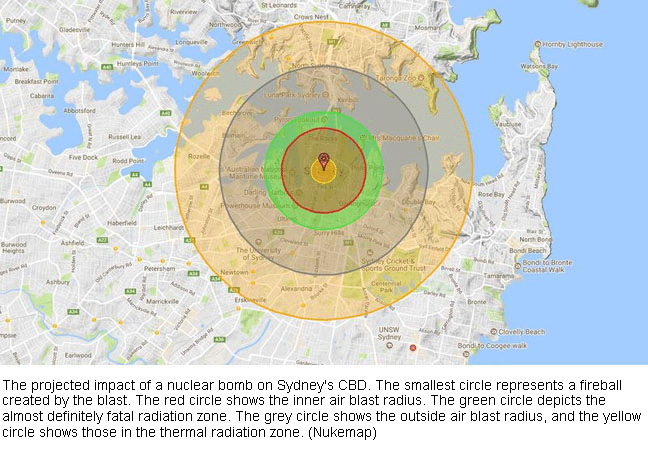
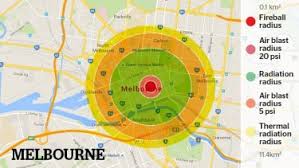
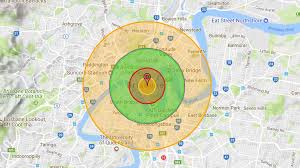
What Happens If Australia Is Hit By A Nuclear Bomb? lifehacker, Jackson Ryan | Feb 16, 2020, “….NUKEMAP provides a few different readouts for each map with colour coded rings :
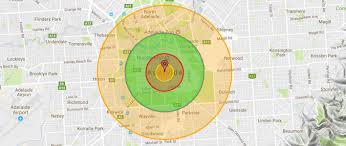
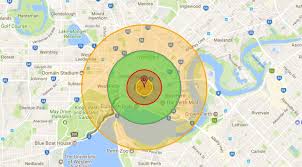
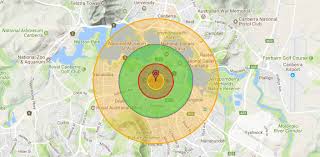
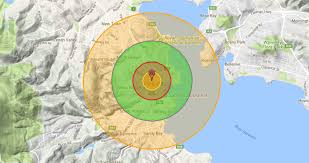
- The yellow ring is the size of the nuclear fireball
- The red ring denotes the air blast zone where 20 psi of pressure is felt – enough to damage concrete buildings
- The green ring denotes the radiation diameter – within this ring, you would receive a 500 rem radiation dose. That’s enough to kill 65-90% of all exposed within 30 days.
- The grey ring denotes the air blast zone where 5 psi of pressure is felt
- The orange ring is the thermal radiation zone – if you are within this ring you receive third degree burns that extend through the layers of the skin.
The most recent bomb tested by North Korea was reportedly around 50 kilotons. So if we used that as a base, what would the damage from a 50 kiloton nuclear bomb do to:
Sydney
Melbourne
The size of the nuclear fireball would destroy Melbourne’s CBD and the resulting pressure from the explosion would flatten the land around it. Most of the iconic landmarks in Melbourne’s inner city would be gone.
Brisbane
Adelaide
Adelaide’s CBD would be mostly non-existent, with the fireball engulfing a large portion and the overpressure extending from North to South Terrace. Rundle Mall would be hit hard and you wouldn’t expect Adelaide Oval to remain standing, either. The thermal radiation would extend out as far as the parade in Norwood and almost entirely cover North Adelaide.
Perth
Owing to its place right next to the Swan River, Perth City may not see the same level of immediate fatalities but the destruction would be extensive. The thermal radiation ring would extend from the centre of the CBD out to the Perth Zoo and as far as Lake Monger. The famous Perth Mint would sadly be caught in the 5psi overpressure zone, a space where most buildings collapse.
Canberra
Parliament House as a target, would be completely decimated by the fireball and the 20psi overpressure would flatten everything as far as National Circuit. The National Library, the National Museum and the National Gallery would also likely crumble under the pressure of the air blast. The Australian War Memorial and the Royal Australian Mint would fall just outside the thermal radiation zone.
Hobart
A direct hit on Hobart’s CBD would see a lot of the blast rip across the River Derwent. The fireball would circle most of the city, while the overpressure blast would extend up Elizabeth Street and out to the Salamanca Market. The Royal Tasmanian Botanical Gardens would receive a huge amount of thermal radiation, which would reach across the Tasman Highway bridge and into Rosny.
Darwin
The size of an atomic bomb blast of this size would take out a lot of Darwin’s waterfront, but the thermal radiation wouldn’t extend all the way across Charles Darwin National Park but, provided it hit the CBD, the overpressure air blast would do incredible damage all the way through the city and across to the Gardens…..
Australia’s Mawson research station monitors radionuclides in the atmosphere
|
Nuclear watchdog sniffs wind at Mawson, Mirage News, 14 Feb 20 An ordinary-looking shipping container at Australia’s Mawson research station plays an important role in the global network that polices a ban on nuclear testing.Inside is a high-volume air sampler, one of 80 world-wide, running every day since 2013 to ‘sniff’ the wind for traces of radioactive debris.
The air sampler at Mawson is part of the international monitoring system for the Comprehensive Nuclear-Test-Ban Treaty (CTBT), which aims to ensure that no nuclear explosion goes undetected. The Australian Radiation Protection and Nuclear Safety Agency (ARPANSA) is responsible for a total of 21 monitoring stations within Australia and its territories. Three are in Antarctica – Mawson research station monitors radionuclides in the atmosphere and seismic vibrations in the earth’s crust, and an infrasound facility near Davis research station uses acoustic pressure sensors to detect very low-frequency sound waves in the atmosphere. A radionuclide is an atom with an unstable nucleus that loses its excess energy by emitting radiation in the form of particles or electromagnetic waves. All chemical elements can exist as radionuclides. They occur naturally or can be produced artificially by nuclear reactors, particle accelerators, or nuclear explosions. ……. https://www.miragenews.com/nuclear-watchdog-sniffs-wind-at-mawson/ |
|
225 $billion for Australia’s submarine plan – a fleet of B-21 bombers would be better
|
Scrap submarines project before it’s too late says former public service boss, Michael West media, by Jon Stanford | Feb 3, 2020 Australia’s $225 billion SEA 1000 submarine project is so high risk, it would be better for Department of Defence to scrap it and start again, writes former public service chief, Jon Stanford, in the final instalment of his Second Rate Leadership series. In addition to some very serious problems with progress with the SEA 1000 program, there are some more fundamental questions to be addressed in the longer term. The first of these is whether the Attack class will embody the technologies required to be successful in its operations in the mid-2030s and beyond. In other words, will it be fit for purpose? An associated question is around the submarine’s cost effectiveness. The escalating cost of this acquisition means that the opportunity cost is also going up. With the submarines being designed mainly for joint operations with the US Navy, there are also significant risks in the future around whether a continuing US presence can be assumed.
In regard to the first question, it is very difficult to be able to judge whether the submarines will be fit for purpose if we do not know what that purpose is. Based on comments and submissions to Parliamentary inquiries from former Australian submariners we can be fairly confident that our submarines’ main area of operations (AO) is in the South China Sea, 3,500 nautical miles from base. But once there, we are not told what they do. In Australia at least, the missions the submarines undertake are classified….. ……..In addition, at a whole of life cost of $225 billion, this deterrent, such as it is, has a very high opportunity cost. Two former RAAF Chiefs have recently proposed that the ADF needs to acquire a long-range bomber force. Even if the new American B-21 bomber delivers only half the capability currently being spruiked, the early acquisition of two squadrons – 48 aircraft off the shelf – at a cost of around $50 billion looks an attractive power projection proposition. By comparison, the ability to put one conventional submarine on station “up threat” at any time at an acquisition cost of $80 billion, with associated doubts around its effectiveness and survivability, must be of questionable value………. |
|
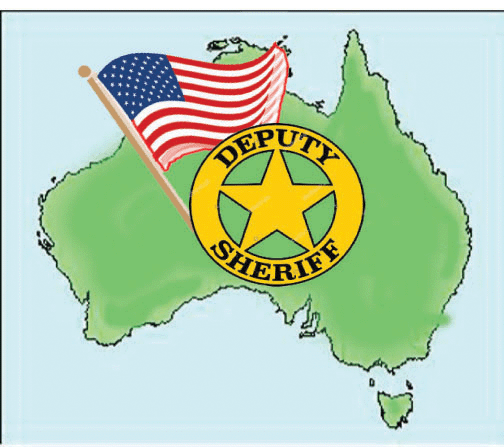
Australia’s dangerous subservience to the war-obsessed USA
|
JOHN MENADUE: Tugging our forelock again and again to our dangerous ally. An update, Michael West.com by John Menadue — 30 December 2019 The US has coming calling again. Not an Admiral this time but the Pentecostalist Secretary of State, Mike Pompeo. He is whistling us up as a faithful dog to join with the US in tackling the problems which Donald Trump created with Iran and presumably to soften us up to host missiles to protect the US marines and port facilities in Darwin. And Pine Gap. John Menadue reports.
We are being softened up again step by step to support the US military and industrial complex that promotes perpetual war. The US is the greatest threat to peace in the world. It is an aggressor across the globe. It is the most violent country both at home and abroad. And people know it. The Pew Research Centre found in 2018 that 45% of people surveyed around the world saw “US power and influence as a major threat”. Retired US Defence, Secretary James (Jim) Mattis, complained that President Trump should show more respect for allies. But the US shows most respect for allies that do what they are told or supinely comply, like Australia. Our PM even gets an invitation to dinner with Trump. Scott Morrison could not contain his eagerness. Our media join in the vicarious thrill of it all. Apart from brief isolationist periods, the US has been almost perpetually at war; wars that we have been foolishly drawn into. The US has subverted and overthrown numerous governments over two centuries. It has a military and business complex, a “hidden state”, that depends on war for influence and enrichment. It believes in its “manifest destiny” which brings with it an assumed moral superiority which it denies to others. The problems did not start with Trump. They are long-standing and deep rooted. Unfortunately, many of our political, bureaucratic, business and media “elites” have been so long on an American drip feed that they find it hard to think of a world without an American focus. We had a similar and dependent view of the UK in the past. That ended in tears in Singapore. Conservatives rail about Chinese influence but they and we are immersed and dominated by all things American, including the Murdoch media. Our media do regard Australia as the 51st American state. Just look at the saturation coverage of the Democrat primaries with the presidential election still 10 months away! Easy and lazy news. I’ts harder and nowhere near as interesting to cover much more important news in Indonesia and Malaysia. In an earlier article (Is war in the American DNA?), I drew attention to the risks we run in being “joined at the hip” to a country that is almost always at war. The facts are clear. The US has never had a decade without war. Since its founding in 1776, the US has been at war 93% of the time. These wars have extended from its own hemisphere, to the Pacific, to Europe and most recently to the Middle East. The US has launched 201 out of 248 armed conflicts since the end of WWII. In recent decades most of these wars have been unsuccessful. The US maintains 700 military bases or sites around the world including in Australia. In our own region it has massive deployment of hardware and troops in Japan, the ROK and Guam. …. Despite all the evidence of wars and meddling in other countries’ affairs, the American Imperium continues without serious check or query in America or Australia. …… The second reason why the American Imperium continues largely unchecked is the power of what President Eisenhower once called the “military and industrial complex” in the US. In 2019, I would add the intelligence community and politicians to that complex who depend heavily on funding from powerful arms manufacturers across the country and the military and civilian personnel in over 4,000 military facilities across the US. Democrats and Republicans both court these wealthy arms suppliers and their employees. The intelligence community, universities and think-tanks also have a vested interest in the American Imperium. This complex which co-opts institutions and individuals in Australia, is often called “the hidden state”. It has enormous influence. No US president nor for that matter any Australian prime minister would likely challenge it. Australia has locked itself into this complex. Our military and defence leaders are heavily dependent on the US Departments of Defence and State, the CIA and the FBI for advice. But it goes beyond advice. The “five eyes” led by the CIA applied pressure to us on 5G as part of a broader campaign to attack almost all things Chinese.We willingly respond and join the US in disasters like Iraq and the Middle East. While the UN General Assembly votes with large majorities to curb nuclear proliferation, we remain locked in to the position of the US and other nuclear powers…… The US military and industrial complex and its associates have a vested interest in America being at war and our defence establishment, Department of Defence, ADF, Australian Strategic Policy Institute and the “Intelligence” community are locked-in American loyalists…… Like many democracies, including our own, money and vested interests are corrupting public life. “Democracy” in the US has been replaced by “Donocracy”, with practically no restrictions on funding of elections and political activity for decades. Vested interests are largely unchecked. House of Representatives electorates are gerrymandered and poor and minority group voters are often excluded from the rolls. The powerful Jewish lobby, supported by fundamentalist Christians, has run US policy off the rails on Israel and the Middle East. The US has slipped to number 21 as a “flawed democracy” in the Economist’s Intelligence 2016 Democracy Index. (NZ was ranked 4 and Australia 10). It noted that “public confidence in government has slumped to historic lows in the US.” That was before Trump! Many democracies are in trouble. US democracy is in more trouble than most. There is a pervasive sickness…….
But it is not just the destructive role of News Corp in US, UK and Australia. Our media, including the ABC and even SBS, is so derivative. Our media seems to regard Australia as an island parked off New York. We are saturated with news, views, entertainment and sit-coms from the US. It is so pervasive and extensive, we don’t recognize it for its very nature…… A further reason for the continuing US hegemony in Australian attitudes is the galaxy of Australian opinion leaders who have benefitted from American largesse and support – in the media, politics, bureaucracy, business, trade unions, universities and think-tanks. Thousands of influential Australians have been co-opted by US money and support in “dialogues”, study centres and think tanks. The US has nourished agents of influence in Australia for decades. China is a raw beginner in the use of soft power. How long will Australian denial of US policies continue? When will some of us stand up? When will our humiliation end?……. https://www.michaelwest.com.au/john-menadue-us-alliance-more-likely-to-get-us-into-trouble-than-out/ |
|
|

Dave Sweeney – on wining Nobel Prize, and on treaty on the Prohibition of Nuclear Weapons.
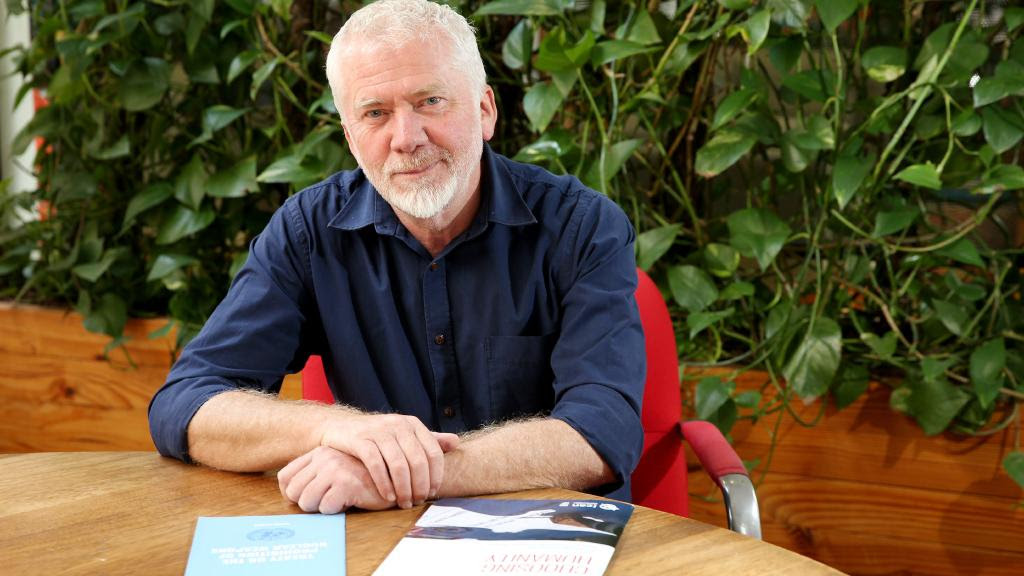
Dave Sweeney talks Nobel Prize and working against nuclear weapons https://www.weeklytimesnow.com.au/country-living/dave-sweeney-talks-nobel-prize-and-working-against-nuclear-weapons/news-story/02bae8fda0306529842b5e19bad835c2
A Nobel Prize winner who grew up on a farm has dedicated his life to one of humanity’s most important causes.
DAVE Sweeney’s story starts out like so many rural kids.
Growing up on a grazing property, east of Melbourne, he wanted to be a farmer, but his Dad wanted his son to achieve more skills.
So Dave dutifully got a degree, and a range of jobs, including as a teacher.
But then he went one better and got a Nobel Peace Prize.
 It was two years ago that Dave was one of the founding members of ICAN, the International Campaign to Abolish Nuclear Weapons, who travelled to Norway to receive the globally significant gong, which puts him in the same company as Mother Therese and Nelson Mandela.
“I didn’t actually go on the stage with the King of Norway,” the 57-year-old says.
“But I was in Norway for five days, for the formal reception, with the king and trumpets blowing, and a big party afterwards.”
It speaks volumes about Dave that he and his colleagues don’t run around promoting the fact they are Australia’s only Nobel Peace Prize winners.
Instead, he continues to knuckle down and get on with the job that won the prize in the first place.
“I don’t really talk about it much, only when people ask or I’m doing a presentation,” says Dave, who still speaks with a farmer’s easygoing attitude.
“I don’t have a T-shirt saying ‘Nobel winner’ or a screen saver.
“Winning hasn’t changed my daily life, but there’s been a sense of ‘the stuff this guy has been banging on about forever is actually important’ and ‘these people have done a significant thing’. It’s validation and it opens new doors to keep the momentum going.”
Working between his homes in Melbourne and South Gippsland’s Phillip Island, Dave is currently lobbying councils — including, most recently, Benalla — to get on board and pressure the Australian Government to ratify the Treaty on the Prohibition of Nuclear Weapons.
He says the ICAN Cities appeal is an initiative that is seeking to build a wider recognition of and support for the UN treaty. At its most basic, a council passes a version of a model resolution and writes to the prime minister and foreign minister urging them to support it.
“Other councils get more engaged — some have asked ICAN speakers to attend council and community events, profiled the issue and initiative on the websites and newsletters, flown an ICAN/Nobel flag from the town hall, hosted displays about ICAN and the issue in their libraries, commissioned murals and public artworks,” he said.
“There is much that can and could be done and it really depends on the people and place.
“An important part of the local government initiative, and of ICAN’s wider work, is that it is non-partisan. We don’t seek to score points – we want to make one: that there are no winners in a nuclear war.”
Since 1996 Dave has been the nuclear-free campaigner at the Australian Conservation Foundation, working to stop uranium mining and promote the responsible handling of radioactive waste.
His role also includes working to stop nuclear weapons. That’s how, in 2006, he was one of the voluntary founding members who met over a cup of tea and beer to nut out a strategy, which the following year led to the creation of ICAN.
Today, ICAN has spread to more than 500 groups in more than 100 countries, with its headquarters in Geneva.
According to the Nobel committee, ICAN was awarded the world’s most significant prize for “its work to draw attention to the catastrophic humanitarian consequences of any use of nuclear weapons and for its groundbreaking efforts to achieve a treaty-based prohibition of such weapons”.
“Often the deck feels stacked against us, that we can’t get a break and it’s not always fair. But this was awarded to a group of people who are not powerful or rich,” Dave says.
“It’s humbling and important recognition.”
He says just this year the Federal Government announced an inquiry into the nuclear energy industry, while in both NSW and Victoria there are pushes to examine the sector.
Dave says these are all under the guise of stopping climate change, even though science and industry are unanimous that renewables are the cheapest, fastest and easiest way to supply all our power needs.
“When you use a uranium fuel rod in a nuclear reactor you get a guaranteed three years of low- carbon electricity, and when you take the fuel rod out you get a guaranteed 100,000 years of toxic waste, which is poisonous to human life and the environment,” he says.
“There is a very poor risk-to- reward ratio.”
Yet despite setbacks, there are also breakthroughs.
He says just last week the Federal Environment Minister and the Northern Territory Government agreed with mining companies to transition out of uranium mining in Kakadu.
Dave says following Japan’s Fukushima disaster, the market for nuclear energy had dropped.
“In 2000, 22 per cent of global electricity came from nuclear energy, now it’s 11 per cent.
“Nuclear power is enormously expensive and slow. It would take 20 years to build a reactor in Australia and cost at least $20 billion.”
Dave says being raised in a rural farming family gave him a strong sense of the importance of social justice and caring.
“Mum and Dad were always decent, community-minded people. Mum would cut the sandwiches for the local emergency services and Dad would visit the sick,” he says.
“Even if I’d preferred to stay at home, it was always emphasised to me to put in.
“It’s a privilege to live in this country and so you give back, even if it’s something modest.”
He studied politics and literature, became a teacher, and later became an adviser at Oxfam, before former Prime Minister John Howard’s decision to mine uranium in Kakadu steered him into nuclear campaigning at ACF.
Given Dave has been campaigning on these globally-critical issues for more than two decades, what advice does he have for the younger generation, especially with the documented rise of eco-anxiety?
“I say to young people these problems aren’t of their making, so don’t feel guilt, otherwise you can’t get out of bed in the morning. But they do feel some responsibility and agency,” he says.
“Light a candle, say a prayer, put a sign saying ‘nuclear-free zone’ on your local school, do an act of kindness or a directed act of anger, write a letter to your council, the Prime Minister and the Foreign Minister saying we should ratify the Treaty.
“Yes, individual actions are small, but when you add the next action and the next and the next they really make a difference. Each action matters.”
Nuclear weapons and Australia’s hypocrisy about them
from congratulating ICAN for the first Australian-born Nobel Peace Prize. While a childish move, this only served to highlight the government’s discomfort with the treaty and its clear challenge to Australia’s position on nuclear weapons. As the signatures and ratifications continue to stack up and the treaty nears entry-into-force, this challenge persists.Financial institutions are divesting from nuclear weapon producers, citing the treaty as their reason for doing so even though it has yet to enter into force. These include ABP, the largest Dutch pension fund, and Norway’s trillion-dollar sovereign wealth fund. Cities and towns are declaring their support for the treaty, including Paris, Berlin, Geneva, Washington DC, Toronto, Sydney and Melbourne.
This year’s Nobel Peace Laureate, Ethiopian Prime Minister Abiy Ahmed Ali, has been rewarded for formalising a peace agreement between Ethiopia and Eritrea. For ICAN, the Nobel Peace Prize served a directive upon all nations to sit up and pay attention to the fresh 10-page nuclear weapon ban treaty. We know that we’re up against powerful nations, a lucrative industry and deeply entrenched modes of thinking. The real prize will be the total elimination of nuclear weapons, and we have the tools to get there. It’s up to all people, civil society and governments to turn the tide of history. Our collective security depends on it.
- Gem Romuld is the Australian director of the International Campaign to Abolish Nuclear Weapons and a recipient of the 2017 Nobel Peace Prize. https://www.canberratimes.com.au/story/6442739/nuclear-hypocrisy-cant-continue/?cs=14246
Navy chief looks to nuclear submarines for Australia

Vice Admiral Mike Noonan has opened an international maritime conference in Sydney, where he says defence is keeping a close eye on emerging technologies.
By Andrew Greene on AM 9 Oct 19, Australia’s navy chief says it’s possible the country’s future submarine fleet could eventually switch to nuclear power.
Vice Admiral Mike Noonan has opened an international maritime conference in Sydney, where he says defence is keeping a close eye on emerging technologies.
Nuclear submarines for Australia? Dangerous, would require costly taxpayer insurance
|
Nuclear subs idea worth floating It has been debated in some quarters for years that Australia should operate and maintain nuclear-propelled attack submarines. ……. This prospect raises two significant policy issues for Australia. The first is whether the commonwealth can operate and maintain nuclear submarines in a sovereign environment that has no civilian nuclear power industry to supply the nuclear-trained staffs, as well as build and maintain the infrastructure that is necessary. The second is whether Australia is prepared to establish an indemnification and regulatory environment that would be critical to safely and effectively operate and maintain nuclear vessels for 50 years. ……. A unique aspect of such submarines is the enormous amount of energy stored in their reactor cores. Built, operated, and maintained properly, this energy is released in a controlled manner over a long period. A sudden, uncontrolled release of this energy could be catastrophic, not only to the submarine, but to people and property nearby. Given that private insurance typically does not cover nuclear risks, an effective scheme to indemnify possible victims of a nuclear accident could be critical. Without such an indemnity scheme, companies might be unwilling to provide components and services to maintain and operate propulsion plants. As Australian policymakers and the public debate the nuclear submarine option for the Royal Australian Navy, it could be valuable for them to broaden their understanding of what it would take to establish: • A sovereign and robust industrial capability to operate and maintain submarines equipped with mobile nuclear power propulsion plants; • A rigorous regulatory scheme to ensure mobile power reactors are safely built, tested, operated, maintained and deactivated; • An indemnity scheme to cover third-party liabilities in the event of a “nuclear” incident; • Training and development paths for regulators, engineers, operators and maintainers; and • Facilities necessary to service nuclear-powered submarines……. https://www.theaustralian.com.au/commentary/nuclear-subs-idea-worth-floating/news-story/61c003a41e9303ca7883561983da90ac |
|
Australia sells weapons to Saudi-led coalition, is complicit in human rights abuses
Australia’s arms deals ignoring ‘gross violations of human rights’, ex-defence official says https://www.theguardian.com/australia-news/2019/sep/08/australias-arms-deals-ignoring-gross-violations-of-human-rights-ex-defence-official-says?utm_term=Autofeed&CMP=soc_568&utm_medium=Social&utm_source=Twitter#Echobox=1567888161
Defence department says it provides export permits only if satisfied that the weapons will not be used in breach of international law Ben Doherty, 8 Sept 19, A former secretary of the Australian defence department says the country cannot justify selling weapons to militaries involved in the five-year war in Yemen, which now stand “accused of gross violations of human rights and likely war crimes by the UN”.
And the Australian co-author of the just-released United Nations report into human rights atrocities in Yemen has said governments that sell weapons to belligerent countries are responsible for prolonging the conflict and contributing to immense humanitarian suffering.
The report found that the conflict had been plagued by human rights abuses, including hospitals being bombed, civilians being deliberately targeted by shelling and sniper fire, civilian populations being deliberately starved, medical supplies being blocked, rape, murder, enforced disappearances, torture, and children being forced to fight.
Australia is one of several countries that sell weapons to those that are part of the Saudi-led Coalition in conflict with the Iran-backed Houthi rebels in Yemen. The Australian government says it imposes strict controls on exports to ensure they are not used in the Yemeni conflict.
But the former secretary of the department of defence Paul Barratt told Guardian Australia that regardless of whether Australian-made weapons were crossing the border into Yemen, “the fact remains that Australia now has a national policy which seeks and facilitates weapons sales with countries that stand accused of gross violations of human rights and likely war crimes”.
“When did this particular trade in arms become official Australian policy? Even if we are successfully legally tiptoeing around the Arms Trade Treaty, such deals surely cannot be acceptable on moral or ethical grounds,” Barratt said. “As a country that routinely asks other countries to abide by the rules-based international order, it would seem hypocritical, at best, that Australia is now willing to … make a profit from, weapons sales to nations that are openly flouting this international order.”
The report said hospitals had been bombed, civilians attacked and starvation used as a tactic of war, and alleged that there had been a “collective failure” from the international community to intervene in the five-year war to reduce the suffering of civilians; rather, support from international actors had prolonged the conflict. The public report detailed a list of the key military, political participants in the conflict. A confidential list of those most likely to be complicit in war crimes has been sent to the UN.
Parke said Yemeni civilians had “borne the brunt” of a brutal conflict that was being exacerbated by international indifference, and material support from some governments.
Australia is complicit in the new nuclear arms race
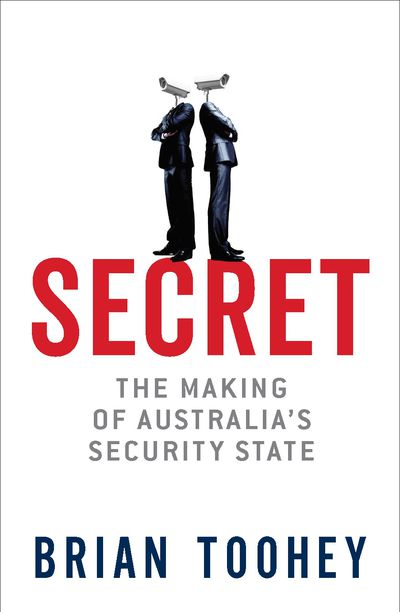
New nuclear arms race brings higher risk of global catastrophe, The New Daily,
Veteran defence and security analyst Brian Toohey has warned that talk of war between the West, and China and Russia, along with brinkmanship with North Korea and Iran, has escalated the conditions that can lead to catastrophic accidents and mistakes.
Adding to the potential for disastrous nuclear consequences, Mr Toohey’s latest book – to be published this week – reveals that “many missile control systems can now be hit by a wide range of previously unknown cyber-warfare tools available to terrorists, hoaxers and governments”.
Mr Toohey’s book, Secret – The Making of Australia’s Security State, outlines a terrifying situation where nuclear weapons continue to exist in massive numbers………
Australia is complicit
Mr Toohey said Australia continued to rely on the US “nuclear umbrella” and was directly complicit in the US nuclear program through the Pine Gap and North West Cape intelligence and communications bases linked to US submarines tasked to detect and destroy Russian and Chinese nuclear-armed submarines.
Coalition governments in Australia had declined to push for nuclear disarmament, with former prime minister Malcolm Turnbull refusing to support a 2017 United Nations resolution to establish a legally binding treaty prohibiting the development or possession of nuclear weapons.
The Turnbull government refused to congratulate ICAN after it was awarded the Nobel Peace Prize in December 2017.
Mr Turnbull later declared that Australia and the US were “joined at the hip”.
The Canberra Commission on the Elimination of Nuclear Weapons concluded in 1996 that “the proposition that nuclear weapons can be retained in perpetuity and never used – accidentally or by decision – defies credibility”.
The only complete defence was the elimination of nuclear weapons with a strong international verification regime to convince the existing nuclear powers to disarm.
Calls for Australia to join the race
Current calls for Australia to consider a nuclear arms capability for its submarines to deter an invasion from China re-emerged from strategic think tanks and academics.
“It is doubtful if China’s relatively small nuclear forces could survive a US attack. The US has a total of 6550 warheads –1350 deployed on long-range missiles and bombers – compared to China’s total of 280,” Mr Toohey writes.
“Ever since George W Bush unilaterally abandoned the Anti-Ballistic Missile Treaty, the US has deployed conventional missiles on ships and land that can destroy nuclear-armed ballistic missiles.”
“Its attack submarines can track and sink China’s four ballistic-missile submarines. This means China must expand its nuclear forces to ensure that enough retaliatory missiles would survive to deter a first strike”.
Quentin Dempster is a Walkley Award-winning journalist, author and broadcaster. He is a veteran of the ABC newsroom. He was awarded an Order of Australia in 1992 for services to journalism nuclear-arms-race/
1 This month
17 October, Free Public Talk on Nuclear Issues in South Australia
David Noonan will speak on public interest concerns over the new Roxby Downs Indenture Act 2026 on BHP copper-uranium mining and ore processing in SA, and on how AUKUS may face SA with a High-Level nuclear waste agenda.
Dr Jim Green will discuss international developments in the field of nuclear power including ‘small modular reactors’ and Generation 4 ‘advanced’ nuclear reactor concepts.


Help Aunty Sue Protect Her Land and Sacred Sites From Destructive Rocket Testing.
.

Australians deserve the truth
about
AUKUS – https://aukuspublicinquiry.com/

PETITION – To: Prime Minister Anthony Albanese and the Australian Labor Government

of the week – Australians for War Powers Reform (AWPR)
To see nuclear-related stories in greater depth and intensity

