Australia is complicit in USA’s militarisation of space
AUSMIN confirms Australia’s subservience to US military, The Guardian, Denis Doherty, 20 Nov 12,”…..In the AUSMIN talks Australia has agreed to establish a space surveillance station which has the aim of detecting space debris. It will be established at the US North West Cape facility in WA. Efforts to stop space debris hitting commercial satellites are welcome. However, the station will also have the capability to gather intelligence to target other satellites and will be configured to provide an interface for anti-satellite warfare.
In its headlong drive to control the planet, the US is also working to control space – and Australia is complicit in this.
Space should be used for the benefit of all humanity and Australia should promote the UN resolution on the prevention of an arms race in outer space (PAROS)….. http://www.cpa.org.au/guardian/2012/1574/06-ausmin-confirms.html
Liberal Party leaders keen for Australia to buy US nuclear submarines
 Coalition leaders float nuclear navy Financial Review CHRISTOPHER JOYE, 10 Nov 12
Top Coalition leaders want to open the debate over the purchase of nuclear submarines to replace the navy’s diesel fleet, a huge step up in Australia’s military capability in response to China’s plan to become a major maritime power in the Pacific Ocean.
Senior Coalition frontbenchers told The Weekend Financial Review that acquiring or leasing  Virginia-class nuclear submarines equipped with conventional weapons, such as cruise missiles, would be supported by the Obama Administration.
Purchasing the submarines is not yet Coalition policy but some shadow ministers have discussed the idea with United States officials….. In discussions with defence experts US Ambassador Jeffrey Bleich reiterated American willingness to provide Australia with nuclear-powered submarines, which could receive technical support at US naval bases in Hawaii and Guam. In the longer term, this could lead to a joint Australian-US submarine base in the west or north of Australia. Continue reading
Australia’s pathetically weak role in the international Comprehensive Nuclear-Test-Ban Treaty (CTBT )
 Australia’s Foreign Minister Bob Carr makes much of weak treaties like this one. I would trust Bob Carr about as far as I could throw him. Carr is an enthusiastic member of Australia’s pro nuclear elite. He is adept at publicising seemingly effective nuclear disarmament moves – but when you look at them properly moves like this much vaunted strengthening of the Comprehensive Nuclear-Test-Ban Treaty (CTBT ) – are really hypocritical sops to those of us who are anxious about nuclear weapons – Christina Macpherson
AUSTRALIA-NZ PACT FALLS SHORT OF ABOLISHING NUKES IDN-InDepthNews – October 21, 2012 By Neena Bhandari SYDNEY – Australia and New Zealand have entered into a scientific and technical cooperation agreement to strengthen detection of nuclear explosions under the framework of the international Comprehensive Nuclear-Test-Ban Treaty (CTBT ) and work together to promote a permanent and effective ban on nuclear weapon tests….. The move would see Australian Radiation Protection and Nuclear Safety Agency and Geoscience Australia working more closely with New Zealand’s Environmental Science and Research (ESR) to enhance their capabilities to detect nuclear explosions……
‘Move quickly to a Nuclear Weapons Convention’
But Chairman of the Mayors for Peace Foundation and former expert advisor to the Hiroshima Peace Culture Foundation , Steve Leeper, feels countries like Australia that have signed and ratified the CTBT should be doing far more than talking about a new framework.
“It makes it look like the two countries are doing something about nuclear weapons when what they are really doing is refusing to support the nuclear weapons convention. Continue reading
Cancer in Australia’s soldier witnesses of Monte Bello atomic bomb tests
 AUDIO: Atom bomb veterans mark anniversary (PM)
Atom bomb veterans remember life-changing blast ABC News Radio 4 Oct 12, PM By Brendan  Trembath Sixty years since Britain tested its first atom bomb in Australia, those who witnessed the blast – many who now have cancer – have reunited to talk about how it changed their lives. The veterans are still seeking an apology from the Federal Government and appropriate health care for them and their children.
Official records say those serving on the HMAS Murchison on October 3, 1952, were 70 miles away when Britain successfully detonated an atomic bomb on the Monte Bello islands, off the coast of the Pilbara in Western Australia.
But to this day, many who were there say they were much closer.
Michael Rowe was on board the ship and remembers the moment the bomb went off.
“We were told to face east, which we did, and then we were told we could turn around and face west and we saw the first British atom bomb go off,” he said…… “We were clothed to protect ourselves in a pair of shorts and sandals. That’s all,” he said.
Mr Rowe is also among those who say they were much closer to ground zero than what is officially recorded and he has photos which he says proves it. “There’s been big arguments over the years about how far away the Murchison was from the actual bomb site, but I had a little tiny camera that I had hidden down inside my shorts and I took a photograph of that bomb going off, a very clear photograph of the bomb going off,” he said.
“All the records show that we were 70 miles away and there was no way in the world you could’ve taken this photograph from 70 miles.”
Mr Rowe says he and others onboard the ship think they were about 12 to 15 nautical miles east of the blast site. I’ve had a great life. Done lots of things, been lots of places but I always seem to have something wrong with me and it was only on September 19 that I was diagnosed with multiple cancers, terminal cancers. He is one of the 23 known surviving national servicemen from HMAS Murchison.
But like many who were there that day, Mr Rowe now has cancer. “I’ve had a great life. Done lots of things, been lots of places but I always seem to have something wrong with me and it was only on September 19 that I was diagnosed with multiple cancers, terminal cancers,” he said.
Fellow crew member Ken Palmer was not well enough to attend the lunch but his wife Robyn came in his place.
“He has secondaries from thyroid cancer as a result of the blast. They were exposed to the radiation, but he’s doing well, yes, he’s doing well,” she said….. http://www.abc.net.au/news/2012-10-03/atom-bomb-veterans-remember-blast-that-changed-lives/4294276
Australia to work with New Zealand to strengthen nuclear test monitoring
 Australia-New Zealand agreement to strengthen nuclear test monitoring. Global Times 29 Sept 12, Government scientists from New Zealand and Australia Friday announced a new agreement to work together to strengthen detection of nuclear explosions under the framework of the international Comprehensive Nuclear-Test-Ban Treaty (CTBT). Continue reading
Australia would back USA and Israel attacking Iran, just like it backed attack on Iraq
Gillard’s statements on Iran were a declaration of Australian support for war.
Gillard asserted that Iran “refuses to take the urgent steps necessary to build confidence that its nuclear program is exclusively peaceful.”
In fact, Iran is a signatory to the Nuclear Non-Proliferation Treaty. Inspections of Iranian nuclear facilities have repeatedly uncovered no evidence of the development of nuclear weapons—any more than UN inspectors found “weapons of mass destruction” in Iraq.
Australian PM demands UN rubberstamp war on Syria and Iran World Socialist Website By James Cogan 28 September 2012 Australian Prime Minister Julia Gillard delivered a speech to the United Nations General Assembly on Wednesday, demanding that the UN endorse imperialist intervention into Syria and rubberstamp a US bombardment of Iran… Continue reading
Australia getting dangerously locked in to USA military operations in the Pacific
 An Australian General, Major General Richard Burr, has become a deputy commander of United States Army Pacific. He will be responsible for planning and advising on the further expansion of American armed forces throughout the Western Pacific.
Australia hostage to the politics of the US in the Asian Century, The Drum, MALCOLM FRASER, 27 Sept 12,
This week Malcolm Fraser delivered a speech on Australia-US relations in the Asian Century. In this edited extract, the former prime minister says our Government has made us hostage to the politics of the United States. Australia has, under this Labor Government and with apparent consent of the Coalition, become the southern bastion of America’s re-arming in the Western Pacific and Southeast Asia. This is an extraordinary consequence of Australian Government ineptitude and of military planning, which might recognise America’s interest, but pays little account of our own.
It makes us complicit in any military activity that the Americans might undertake. Continue reading
Australia in danger, as part of USA’s military machine
Is it time to downgrade US defence? Business Spectator, Jackson Hewett , 26 Sep 2012 Malcolm Fraser says it is time we end our “dangerous and foolish” complicity with US military policy in the Asian region and renegotiate the ANZUS treaty.
He calls Defence Minister Stephen Smith’s assertion that joint US Australian military operations are not bases as “political spin of the worst kind”, something that Professor Richard Tanter, the Director of the Nautilus Institute for security studies agrees with.
Fraser says that the 2500 marines on permanent rotation in the Northern Territory, proposed US surveillance bases in the Cocos Islands and expanded roles of Pine Gap linked to US bomber command in Hawaii, send a clear message that Australia is becoming the “the southern bastion of America’s re-arming in the Western Pacific and Southeast Asia” – something that “spells danger for the entire region”. If citizens fully understood the level of US control over
military operations here, there would be “rage across Australia”.
Fraser is calling for a complete review of the ANZUS treaty and says that we have failed to work within the treaty’s stated aim of “consultation” on defence, and instead we have become “supplicants” who uncritically take part in American wars.
It is time, Fraser says, to show “the guts, the grit and the gumption” to communicate to the region that we are independent of America. Under current American policy, Fraser believes, our unwavering alliance with the US puts us in more danger than not….. http://www.businessspectator.com.au/bs.nsf/Article/us-alliance-america-australia-china-foreign-policy-pd20120926-YH2Q9?OpenDocument&src=sph%20&src=rot
Australia’s unrecognised radiation victims of Montebello atomic bomb tests
Pat Coverley, now 83, saw most of his shipmates die young, “of various cancers suspected to be linked to radiation”
The [Royal Commission] findings delivered a scathing indictment of the manner with which these tests were conducted
Despite the findings, Drewe says the British and Australian governments have ever since fobbed off allegations that servicemen were exposed to high levels of radiation, making it almost impossible to mount a successful compensation claim.
One man’s island SMH, September 22, 2012 “……..Drewe’s arrival by dinghy to the still-contaminated island
(visit limit: one hour) was the eerie culmination of a lifelong obsession with the Montebello Islands. “It amazes me how few
Australians know about these nuclear tests Britain arrogantly conducted in our backyard,” he declares. Continue reading
USA nuclear-related bases in Australia still targets for attack
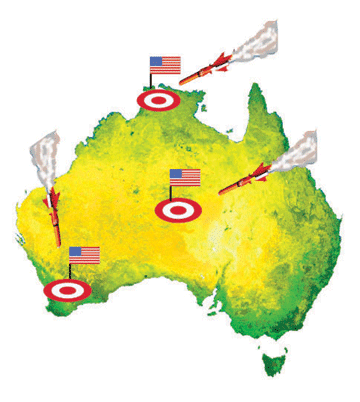
”I am sure that all important targets are included in Russian combat plans,” Colonel Valery Yarynich, a visitor to Australia, said at a rally in Hyde Park on the eve of today’s anniversary of the Hiroshima atom-bombing.
Questioned about the top-secret facilities at Pine Gap near Alice Springs, and WA’s North West Cape communications station, he said: ”Nobody knows, only the high command. It’s secret. Like American plans, too. And targeting can be changed in a matter of minutes.”…….
”I think the world was saved largely due to the fact that missiles of those days were imperfect. They required many hours to prepare to launch. This circumstance helped Kennedy and Krushchev to reach agreement. Today the Russian rocket and the American minuteman demand only a couple of minutes.”
In the 1980s, Soviet strategists became worried the high accuracy of new US missiles might allow a disabling first strike. Colonel Yarynich was involved in setting up the terrifying ”Perimitr” (perimeter) dead-hand system which set off a retaliatory strike automatically from sensor data. It is now disabled. Like many Cold War warriors, the colonel is now involved in efforts to reduce the risk of nuclear war.
He hopes negotiations on nuclear force reductions and de-alerting of remaining forces will pick up between Washington and Moscow after the US election in November and set an example for other nuclear powers. ”We must act,” he said. ”It is necessary and it is possible to remove the finger from the trigger.” http://www.smh.com.au/opinion/political-news/australian-bases-still-in-russian-sights–soldier-20120805-23nxr.html#ixzz22nWt1Gdc
In Cold War, Russia targeted Australia’s USA military bases, not our cities
the US-Australian naval communications station at North West Cape in Western Australia would be a high-priority nuclear target
risks of nuclear attacks on the Pine Gap signals intelligence satellite ground station in central Australia and the missile launch detection facility at Nurrungar
Secret’s out: Soviets did not target cities http://www.smh.com.au/opinion/political-news/secrets-out-soviets-did-not-target-cities-20120805-23ny1.html#ixzz22nPnXqyD August 6, 2012 Philip Dorling THE US-Australian joint defence installations were almost certainly Russian nuclear targets during the Cold War. However, Australia’s cities might well have survived unscathed if superpower tensions had erupted into a global conflagration, according to a top secret intelligence assessment released by the National Archives of Australia.
More than three decades after it was written, the Australian government has finally declassified its most secret study of the
potential impact on Australia of a nuclear war between the US and the former Soviet Union. Continue reading
Australian company SILEX: its laser uranium technology could promote nuclear weapons spread
SILEX is an acronym for Separation of Isotopes by Laser Excitation. The company, a spin-off from the Australian government’s nuclear science and research establishment at Lucas Heights, ANSTO
the worry with SILEX laser technology ”is that it is particularly suited for nuclear proliferation
Uranium on the laser’s edge, Canberra Times, August 6, 2012, Michael Richardson Enrichment systems produce nuclear bomb-grade matter as well as fuel for civilian reactors. The United States is on the verge of approving a licence later this month for the world’s first plant to enrich uranium on a commercial scale for civilian nuclear power reactors
using laser technology developed by an Australian company.
The Australian firm, Silex Systems, says that its secret laser system is cheaper than existing methods of turning natural uranium into fuel for reactors that generate electricity. The plant could be in operation in the US by 2016. Continue reading
A multibillion-dollar nuclear aircraft carrier strike group for Australia?
“full Australian participation in US theatre missile defence”.
US bid for multibillion-dollar nuclear aircraft carrier strike group in Perth, SMH, Nick O’Malley August 1, 2012
- US base in Perth would cost billions
- Strike group includes aircraft carrier, 9 squadrons, 2 submarines
- Read the full report
A report for the US military contains a recommendation to expand America’s defence presence in Australia by massively expanding a base in Perth for a US aircraft carrier and supporting fleet. Continue reading
Secret negotiations as Australia is drawn into USA’s war machine
none of these negotiations have been shared with the Australian public
Nuclear drumbeat grows as US eyes Australia, Crikey, by Harley Dennett , 3 Aug 12, Australian policymakers could not be getting a clearer picture of what our US ally expects of us. Nuclear weapons and joint military bases aimed at containing our largest trading partner will, sooner or later, be put in our backyard — and we’ll be expected to pay for the privilege.
The Center for Strategic and International Studies report making headlines over a proposal to establish a US base in Perth to host nuclear-powered aircraft carriers and manned and unmanned ISR (intelligence, surveillance and reconnaissance) drones is but the first report commissioned by this Congress. The second — as revealed by Crikey in May — will focus on positioning nuclear force in the Pacific.
Defence Minister Stephen Smith’s denials overnight were revealed as word trickery by the comments of the US Deputy Assistant Secretary of Defense for Plans Robert Scher in Congressional hearings early this morning, who pointed out that “no US bases” really means they expect Australia and other allies to share the costs of hosting large numbers of American troops at these so-called “shared facilities”: Continue reading
Australian govt rejects USA naval nuclear base, (FOR THE MOMENT ANYWAY)
Smith rejects proposal for US carrier base ABC Radio AM By Naomi Woodley August 02, 2012 Defence Minister Stephen Smith has flatly rejected a proposal to expand a naval base in Perth to accommodate US nuclear-powered aircraft carrier groups.
The idea for a $7 billion US carrier base on Australia’s Indian Ocean seaboard is one of many canvassed in a report commissioned by the US Defence Department from the Centre for Strategic and International Studies think tank.
Mr Smith says while increased US access to the HMAS Stirling base is on the cards in the long term, American aircraft carriers will not be based in Australia. “The report is an independent report to the United States government. It’s not a United States government document,” he said.
“We don’t have United States military bases in Australia and we are not proposing to. What we have talked about in terms of either increased aerial access or naval access is precisely that – greater access to our facilities.” The West Australian Premier and Opposition Leader have also ruled out the aircraft carrier base idea………….
http://www.abc.net.au/news/2012-08-02/smith-rejects-us-base-proposal/4171086
1 This month
17 October, Free Public Talk on Nuclear Issues in South Australia
David Noonan will speak on public interest concerns over the new Roxby Downs Indenture Act 2026 on BHP copper-uranium mining and ore processing in SA, and on how AUKUS may face SA with a High-Level nuclear waste agenda.
Dr Jim Green will discuss international developments in the field of nuclear power including ‘small modular reactors’ and Generation 4 ‘advanced’ nuclear reactor concepts.


Help Aunty Sue Protect Her Land and Sacred Sites From Destructive Rocket Testing.
.

Australians deserve the truth
about
AUKUS – https://aukuspublicinquiry.com/

PETITION – To: Prime Minister Anthony Albanese and the Australian Labor Government

of the week – Australians for War Powers Reform (AWPR)
To see nuclear-related stories in greater depth and intensity

