TODAY. The Anglophone nations ganging up to dominate the rest of the world, mindlessly obeying the USA

What is it with this sychophantic obedience and grovelling to the USA? Does it come from memories of World War 2, or more likely, memories of how Hollywood portrayed World War 2? Many a Hollywood film, over the decades, told the glorious story of how America won the war, and saved the rest of us. In reality, that just was not true at all, for Britain, but partially true for Australia.
Then there was The Bomb – hastily dropped on Japanese civilians – despite Japan about to surrender anyway. But that wasn’t to save us, to end the war. It was done to intimidate the Russians.
Anyway, 79 years later, the danger is not the evil foreigners who don’t speak English. The danger is above all, the existence of nuclear weaponry itself. And this danger is now being landed especially on the Anglophone nations.

In the UK , only 3 weeks after Keir Starmer and the Labour Party took over, Labour amended the Eisenhower-era 1958 Mutual Defence Agreement (MDA) that is crucial to Britain’s Trident nuclear missile system. Officials deleted a long-standing sunset clause that required it be renewed every ten years. All references to an “expiry date” have been removed “to make the entirety of the MDA enduring, securing continuing cooperation with the US”
This change, quietly made, with no discussion in Parliament, let alone any public information, ensures that Britain will continue to host American nuclear weapons technology , and as always, slavishly follow the USA into its next military adventure, whatever that may be.
The UK’s most dangerous sites would include Lakenheath , the UK’s largest American air force base , and the Clyde Trident nuclear base. What enticing targets for America’s enemies in time of war!
If the USA is using Britain (and Europe) to position these dangerous nuclear targets, its moves into the whole continent Australia are even more breath-takingly bold. There’s always been the secret 5 Eye base at Pine Gap – but now – increasing military bases in Northern and Western Australia, and the nuclear submarine sage unfolds -with its potential to turn Australia into a USA/UK nuclear military waste dump.

What these Anglophone peoples don’t seem to “get” – is that nuclear military technology – if it ever was for “defence” has now become the biggest threat to our safety.
Australian nuclear news headlines Sept 5 – 9

Headlines as they come in
- Submission- G.H. Toll -re new agreement on Naval Nuclear Propulsion- Australia should pursue an independent non aligned foreign policy.
- Submission- Joseph Philippa-re new agreement on Naval Nuclear Propulsion- Much to lose and nothing to gain.
- South Australia is aiming for 100% renewable energy by 2027. It’s already internationally ‘remarkable’
- For Australia to meet emissions reduction targets, we don’t need nuclear energy.
- Basing US Nuclear Subs at Stirling on Garden Island makes Western Australia a nuclear target, while risking “catastrophic conditions” in a N-Sub reactor accident.
- Yah would’nt know it was happening. USA military might and toxic nuclear waste quietly infiltrating Australia?
- (CURRENTLY UNAVAILABLE – The Public Interest and Indigenous Rights in South Australia must not be compromised by an untenable Defence imposition of AUKUS military High-Level nuclear waste & nuclear weapons usable fissile material on the Woomera Area.)
- Mining bash to dish up nuclear as PM pushes future plan
- Submission- Amelia King -re new agreement on Naval Nuclear Propulsion- a shoddy deal for submarines that might not even exist
- Submission- Andrew Gaines -re new agreement on Naval Nuclear Propulsion- could take us to war against China
- Submission- Susan Benham-re new agreement on Naval Nuclear Propulsion- financial and security concerns.
- Another Hunter Valley earthquake sounds alarms on Coalition’s nuclear scheme
- Ted O’Brien’s not so excellent nuclear adventure
- The massive new projects propelling South Australia towards 100 per cent net renewables.
- Give Me Missiles: Gina Rinehart and the Pathologies of Mining
- From the archives: Racist statements by mining magnate Lang Hancock, and claims that he had Aboriginal children
- Submission- Friends of the Earth -re new agreement on Naval Nuclear Propulsion.
- Cash splash for nuclear towns under Coalition plan. Climate review backs solar, wind, hydrogen, not nuclear
- How much water does nuclear really need?
- Steve Thomas admits Collie residents unlikely to have “veto” in Coalition’s nuclear plans.
Submission- Friends of the Earth -re new agreement on Naval Nuclear Propulsion
underlying premises are false or misleading
most importantly, a wasteful expenditure of public money that will make Australia less safe
It is a logical contortion to suggest that nuclear powered naval submarines are “a peaceful activity”.
Besides spent nuclear fuel from Australian AUKUS submarines, there is a danger that Australia could be pressured into storing and disposing of spent nuclear fuel from UK and US submarines.
a giant millstone bequeathed to the people of Australia.
Submission to the Joint Standing Committee on Treaties re “Agreement … for Cooperation
related to Naval Nuclear Propulsion” Submission no. 5 https://www.aph.gov.au/Parliamentary_Business/Committees/Joint/Treaties/NuclearPropulsion/Submissions
Philip White, For Friends of the Earth Adelaide 4 Sept 24 [Original contains many nots, references, sources)
This Agreement should be rejected for reasons including those outlined below.
- Because the underlying premises are false or misleading.
(a) Australia’s defence and security
The premises stated in the preamble include:
Recognizing that their common defense and security will be advanced by the exchange
of information, including Naval Nuclear Propulsion Information, and the transfer of
Material and Equipment for conventionally armed, nuclear-powered submarines, in
accordance with this Agreement; and
Believing that such exchanges and transfers can be undertaken without unreasonable
risk to each Party’s common defense and security.
These premises are false. In fact, Australia’s security will not be advanced and there is an
unreasonable risk to Australia’s defence and security, as can be seen from the quotes below from
eminent military analysts.
Hugh White (emeritus professor of strategic studies at the Australian National University, former
deputy-secretary of the Department of Defence) states as follows:
The new plan – to buy a nuclear-powered submarine instead – is worse [than the old
plan]. It will make the replacement of the Royal Australian Navy’s fleet of Collins-class
boats riskier, costlier and slower. It means an even bigger slump in our submarine
capability over the next few dangerous decades. And it deepens our commitment to the
United States’ military confrontation of China, which has little chance of success and
carries terrifying risks.1
He concludes that it “tied Australia to a deal that undermines our sovereign capabilities,
overspends on hardware we can barely be confident of operating, and drags us closer to the front
line of a war we may have no interest in fighting.”2
Major General Michael G Smith (retired) says:
In my view this decision to procure nuclear-powered submarines will prove to be as
useless, but even more costly, than was our flawed Singapore strategy before World War
II.3
Sam Roggeveen (director of the Lowy Institute’s International Security Program) is quoted as
saying:
It (AUKUS) is a project of vaulting ambition that is out of step with Australian tradition
as a middle military power, wildly at odds with our international status and, most
importantly, a wasteful expenditure of public money that will make Australia less safe.4
(b) Nuclear non-proliferation
The preamble also includes the following premises:
Reaffirming their respective obligations under the Treaty on the Non-Proliferation of
Nuclear Weapons, done at London, Moscow, and Washington 1 July 1968, and entered
into force 5 March 1970; …
Further recognizing that Australia has announced its intention to negotiate and conclude
an Article 14 arrangement with the International Atomic Energy Agency (“IAEA”)
pursuant to the Australia-IAEA Comprehensive Safeguards Agreement, related to
cooperation under this Agreement.
The premises thus stated fail to acknowledge that the ‘Article 14’ arrangement in question is a
self-contradictory attempt to close a dangerous loophole in the Treaty on the Non-Proliferation of
Nuclear Weapons (NPT). The NPT only requires the application of safeguards to ‘peaceful’
nuclear activities. That leaves unstated the question of what to do about ‘non-peaceful’ nuclear
activities, other than nuclear weapons which are banned for non-nuclear-weapon states
‘Article 14’ of the Australia- IAEA comprehensive safeguards agreement (INFCIRC/217, 13
December 1974) states:
Australia shall inform the Agency of the activity, making it clear:
That the use of the nuclear material in a non-proscribed military activity will not be in
conflict with an undertaking Australia may have given and in respect of which Agency
safeguards apply, that the nuclear material will be used only in a peaceful nuclear activity.
It is a logical contortion to suggest that nuclear powered naval submarines are “a peaceful
activity”.
In a 6 October 2021 letter to President Biden, seven leading US non-proliferation experts explain
the problem as follows:
The IAEA is charged by the Treaty on the Nonproliferation of Nuclear Weapons with
verifying that nuclear material in non-weapon states is not diverted to nuclear weapons.
The IAEA is constrained, however, by Section 14 of its standard safeguard agreement,
“Non-Application of Safeguards to Nuclear Material to be Used in [Non-Explosive]
Non-Peaceful Activities,” which would allow a country to exempt HEU fuel from
normal inspections for decades. This well-known loophole has not yet been tested.5
These nuclear non-proliferation experts go on to articulate the following concern:
We … are concerned that the AUKUS deal to supply Australia with nuclear-powered
attack submarines fueled with weapon-grade uranium could have serious negative
impacts on the global nuclear nonproliferation regime and thereby on US national
security.6
They are concerned that countries including Iran, Brazil and South Korea could use the agreement
between Australia, the UK and the US as a precedent to support their own interest in acquiring
nuclear submarines. The experts express their concern for US national security, but the negative
impacts also apply to the national security of Australia.
- Radioactive waste
If Australia goes ahead with its plan to acquire nuclear powered submarines, the resulting spent
nuclear fuel and other radioactive waste will continue to be dangerous for tens of thousands of
years. It will have to be managed, stored and disposed of, but the countries from which we would
purchase these submarines inspire no confidence that this can be safely achieved. In over 60 years
of operating nuclear submarines, the US and UK have been unable to dispose of their own spent
nuclear fuel.
Besides spent nuclear fuel from Australian AUKUS submarines, there is a danger that Australia
could be pressured into storing and disposing of spent nuclear fuel from UK and US submarines.
Under the Agreement, the status of spent fuel from second hand Virginia class submarines to be
purchased from the US is vague, but it is likely that Australia would be expected to accept US
spent fuel: i.e. to dispose of both the spent fuel produced while the submarines were owned and
operated by the US, as well as that produced while they were owned and operated by Australia.
The situation regarding other UK and US submarines is also unclear.
Minister for Defence RichardMarles has stated that Australia would not accept radioactive waste from overseas, but this has not been explicitly ruled out in the Australian Naval Nuclear Power Safety Bill 2023 currently before Parliament. The words of an under-pressure defence minister in 2024 are unlikely to count for much decades hence if Australian legislation and the Agreement between Australia, the UK and
the US do not prohibit the acceptance of foreign spent nuclear fuel.
It is important to acknowledge Australia’s poor history regarding radioactive waste disposal
facilities. As former Senator Rex Patrick points out, “Australia has been searching for a site for a
National Radioactive Waste Management Facility (NRWMF) site since the 1970s; and after 50
years, it still hasn’t found a spot on which to safely establish such a repository.”8 Several attempts
have been made, but they have been opposed by the Traditional Custodians, as well as the wider
public. The United Nations Declaration on the Rights of Indigenous Peoples states:
States shall take effective measures to ensure that no storage or disposal of hazardous
materials shall take place in the lands or territories of indigenous peoples without their
free, prior and informed consent.9
This principle has not been followed in the search for a National Radioactive Waste Management
Facility. Now the Commonwealth Government is seeking to commit Australia to storing and
disposing of highly radioactive long-lived spent nuclear fuel from nuclear submarines. In the event
that Australia does acquire nuclear submarines, any future disposal site selection process should
adhere to this principle. However, it should not be taken for granted that Australia will be able to
find willing communities to host a site, especially considering that several State and Territory
governments have laws or policies opposing the disposal of nuclear waste in their jurisdictions. The Commonwealth should respect such prohibitions. It should not take the view that it can jus tride roughshod over them.
- Health and Safety
Much as the United States Navy claims that its nuclear-powered submarines are safe,11 the fact is
that the longer they operate the more highly radioactive material accumulates in their reactors.
Unlike civilian nuclear power plants, which have some of their spent fuel removed during regular
outages, US and UK designed submarines, which use highly enriched uranium and do not require
refuelling, keep accumulating radioactive material for the life of the submarine. Therefore, even
though submarine reactors have a lower power output than standard civilian reactors, after they
have been operating for a while they accumulate a substantial inventory of spent fuel.
It is not possible to guarantee that some of that radioactive material will not be released into the
environment, but, under the terms of the Agreement, liability is foisted onto Australia. Article IV.E
states as follows:
Australia shall indemnify, subject to paragraph F of this Article, the United States and
the United Kingdom against any liability, loss, costs, damage or injury (including
third-party claims) arising out of, related to, or resulting from Nuclear Risks connected
with the design, manufacture, assembly, transfer, or utilization of any Material or
Equipment, including Naval Nuclear Propulsion Plants and component parts and spare
parts thereof, transferred or to be transferred pursuant to this Article.
So even if the fault lies with the US or the UK, the liability, which could be huge, lies with
Australia. No government should accept such a risk.
Emergency planning is necessary to respond to potential accidents. In the case of port visits by
foreign nuclear vessels, organisations including the Australian Radiation Protection and Nuclear
Safety Agency (ARPANSA), the Department of Defence, and State and Territory authorities each
play a role in planning and responding to accidents involving the release of radioactive material. According to the Department of Defence,
1.4 The Australian Government requires contingency arrangements to be in place at all
Australian ports visited by NPWs and also requires that there be the capability to
undertake radiation monitoring of the port environment. These arrangements are
formulated to cover two potential release mechanisms, which are failure or malfunction
of radioactive waste control systems within the vessel and an accident involving the
reactor plant.13
One scenario that is not considered is the case of a nuclear vessel being attacked by a hostile
foreign power. As we witness the attacks on the Zaporizhzhia Nuclear Power Plant in Ukraine, we are forced to realise that attacks on nuclear facilities are not confined to the realm of fantasy.
Inevitably a hostile power (be it China, or Russia, or some other country in future) would perceive
Australian nuclear powered submarines operated in alliance with the United States and the United
Kingdom as a threat. We cannot rule out the possibility that such a hostile power might one day
decide to attack an Australian nuclear powered submarine, or a US or UK nuclear vessel while it is
in an Australian port or in waters near the Australian coast.
Even if the probability of a nuclear accident is low, the potential consequences could be
catastrophic. The fact that there are grave risks is essentially acknowledged in the high
“permissible radiation dose[s]” envisaged under the existing emergency response plans.
14,15 There are already risks involved in accepting visits by foreign nuclear ships. However, there have been no nuclear vessel visits to Adelaide, where Friends of the Earth Adelaide is based, so there has
been no need to develop emergency plans for this contingency. We would like to keep it that way.
For that reason, we do not want Osborne to be declared a “designated zone” for nuclear submarine
construction. The claimed benefits (which are mostly illusory) are not worth the risk.
- Waste of money and human resources
The projected cost of AUKUS is extraordinary.
The costs of the submarine component of AUKUS are estimated at $368bn through to
the 2040s; and the total cost also includes $3bn to be transferred to the USA to help with
its current domestic submarine production difficulties (Creighton 2023).16
We live in a time of multiple crises: for example, a failing health system, lack of housing, energy
system transformation, and degradation of the environment. All of these crises are security issues.
The security of ordinary Australians is compromised when they can’t get a hospital bed, or find a
home to live in, or pay their electricity bill, or enjoy the fruits of a sustainable environment. All
these security crises could be greatly ameliorated by the wise use of $368 billion. On the other
hand, nuclear-powered submarines won’t even make us safer from attack (refer discussion above),
let alone solve any of the real security issues faced by Australians on a daily basis.
Politicians like to claim that the submarine project will create jobs.
A government press release in March 2023 claimed that the jobs in South Australia
arising from the AUKUS deal would be fairly evenly divided between 4,000 workers employed to design and build the infrastructure at Osborne (Port Adelaide) and a further
4,000 to 5,500 to build the actual submarines. The AMWU sees around 5,000 workers
being needed to build, maintain and repair the submarines when the build is scheduled to
start in the 2040s. Spread over more than a quarter of a century, this is not hugely
impressive.
Furthermore, as John Quiggin (2023) pointed out, at current estimates, this works out at
roughly $18 million per job.17
Spending this money on health, housing, renewable energy and the environment would create
many more jobs at the same time as addressing the real sources of insecurity for Australians now
and in the foreseeable future. Furthermore, it is not just a matter of the money, but also the
diversion of skills that unwise spending leads to.
For Port Adelaide/Osborne, the lesson is that it would be wise to treat all claims
regarding job growth and related local economic development with a large pinch of salt.
South Australia, like the rest of the country, is facing a massive skills shortage. A 2023
report from Jobs and Skills Australia (JSA 2023) argued that Australia would need more
than two million workers in the building and engineering trades by 2050 and more than
32,000 more electricians by 2030. A development focussed entirely on producing
nuclear submarines to reinforce a growing Cold War is going to suck skilled workers
from other vital sectors.18
- Conclusion
The proposal for Australia to acquire nuclear powered submarines from the US and the UK, was
conceived in secret and presented as a fait accompli to the Australian public by then Prime
Minister Morrison. After taking a few hours to collect its thoughts, judging that so close to an
election it couldn’t afford to be seen to be weak on Defence, as a matter of political expediency the
then Albanese Opposition accepted the deal, even though it made no sense from a security
perspective and represented a massive opportunity cost for every Australian for decades. If
Australia proceeds with the deal, it will be Scott Morrison’s greatest legacy: a giant millstone
bequeathed to the people of Australia.
Despite the fact that the deal has received criticism from both the right and the left, there is no sign
that either Labor or the Liberal/National Coalition are interested in winding it back. But maybe
these submarines have an escape hatch written into the clauses of the Memorandum of
Understanding and the Agreement itself. Clause 6 of the Memorandum of Understanding states:
The Governments affirm that cooperation under the Agreement is to be carried out in
such a manner as to not adversely affect the ability of the United States and the United
Kingdom to meet their respective military requirements and to not degrade their
respective naval nuclear propulsion programs.
The grounds for making this judgement are not specified, but based on the current rate of
submarine construction in the US and the UK, it would not be difficult for those countries to make
the case that delivery of submarines to Australia would “degrade their respective naval nuclear
propulsion programs”.19 Article XIII of the Agreement gives them the right to terminate the
Agreement with one year’s written notice, so there is their escape hatch.
We strongly believe that the Agreement should not be entered into in the first place. The proposal
for Australia to acquire nuclear powered submarines should be rejected on security, safety, nuclear
non-proliferation, environmental and economic grounds. Given that both sides of politics have
committed themselves to these submarines, it would take some political courage to reverse course.
If the government does not have enough political courage to make the right decision now, then it
should encourage the US and UK governments to do the arithmetic and quickly come to the
conclusion that they can’t build submarines fast enough to supply Australia without degrading
their own nuclear propulsion programs. The quicker everyone acknowledges this and exercises
their right to terminate the Agreement, the less money will be wasted.
Cash splash for nuclear towns under Coalition plan

Don’t believe the hype!
The Age, By Paul Sakkal and Mike Foley, September 5, 2024 —
Regional communities will be showered with gifts for hosting nuclear reactors under Opposition Leader Peter Dutton’s energy policy, as the Coalition pledges a government-backed managed investment fund propped up by profits from its proposed power plants.
Opposition energy spokesman Ted O’Brien detailed the plans in a speech planned for this week’s Gippsland New Energy Conference, announcing the Coalition’s Community Partnership funds that invest dividends earned by the nuclear plants into the local economy.
Climate and Energy Minister Chris Bowen was invited to speak at the conference while O’Brien’s office claimed he was blocked from speaking despite the Coalition proposing a nuclear facility in the region, displaying what O’Brien called Australia’s “immature” energy debate that excludes nuclear energy advocates. Conference organisers were contacted for comment.
The Coalition’s signature energy policy would build seven taxpayer-funded, government-owned nuclear plants on the sites of existing coal generators. The proposed sites are in Lithgow and the Hunter Valley in NSW, Loy Yang in Victoria’s Latrobe Valley, Tarong and Callide in Queensland, Collie in Western Australia and Port Augusta in South Australia.
In his draft speech given to this masthead, O’Brien claimed the plants would supply the “cheapest electricity in the nation” for firms in industrial zones, which would attract a wave of investment to build facilities, grow the workforce and drive regional population growth.
“We want to ensure that communities like Latrobe can power Australian manufacturing for the remainder of this century and beyond,” O’Brien said in the speech.
“The key here is workers can move over in their same occupations, continuing to apply their skills, doing what they’ve always done. It means their social networks remain, their kids can still go to the same school.”
The Coalition has pledged to build the first two nuclear plants by 2037, with all seven completed by 2050. The sites have been selected to tap into existing transmission line infrastructure once the existing coal plants reach the end of their life.
However, experts have rejected claims that nuclear energy would be cheap, arguing renewables already produce less expensive electricity than fossil fuels and that CSIRO findings show it would cost more than $16 billion to build a single nuclear reactor.
The CSIRO said electricity will come from a grid drawing 90 per cent of its power from renewables, it would cost between $89 and $128 per megawatt hour by 2030. A large scale nuclear reactor would supply power for $136 to $226 per megawatt hour by 2040, according to the CSIRO.
The Coalition disputes the findings, saying the CSIRO did not consider the long life of nuclear plants, but has not released its own costings. This document will be key to understanding how the Coalition intends to return a profit on taxpayers’ investment in nuclear plants.
Bowen told the Gippsland conference on Wednesday the Coalition’s nuclear plan would cripple investment in renewable energy currently flowing to regional communities.
“They want to stop investment, stop jobs, and stop benefits in favour of waiting for a nuclear fantasy that may never come true,” he said.
The Coalition’s claims of a regional industrial boom under the nuclear plan resembles the goals of its previous regional investment policies…………………….more https://www.theage.com.au/politics/federal/cash-splash-for-nuclear-towns-under-coalition-plan-20240902-p5k72h.html
#NoWar2024 Conference To Address USA’s Military Base Empire

2 20 -22 September #NoWar2024 Conference: Resisting the USA’s Military Empire
A global hybrid conference from September 20-22 will bring together activists from dozens of countries worldwide to examine the impacts of the USA’s network of foreign military bases, which provoke war, pollute communities, and steal land from Indigenous peoples.
WHEN: Friday, September 20 – Sunday, September 22, 2024, in honor of the International Day of Peace (September 21)
WHERE: Online on Zoom and live in 4 locations: Sydney, Australia; Wanfried, Germany; Bogotá, Colombia; and Washington, DC, USA
This September 20-22, in honor of the International Day of Peace, World BEYOND War is organizing its annual global #NoWar2024 Conference focused on the theme of the U.S. military base empire — its impacts and the solutions.
The United States of America, unlike any other nation, maintains a massive network of foreign military bases around the world, over 900 bases in 90 countries. These bases perpetuate war-making, pollute waterways, and cost U.S. taxpayers an estimated $80 billion a year.
The permanent stationing of more than 220,000 U.S. troops, weapons arsenals, and thousands of aircraft, tanks, and ships in every corner of the globe makes the logistics for U.S. aggression, and that of its allies, quicker and more efficient. Bases also facilitate the proliferation of nuclear weapons, with the United States keeping nuclear bombs in five NATO member countries, and nuclear-capable planes, ships, and missile launchers in many others.
Furthermore, the U.S.’s network of foreign military bases perpetuates empire — an ongoing form of colonialism that robs Indigenous people of their lands. From Guam to Puerto Rico to Okinawa to dozens of other locations across the world, the military has taken valuable land from local populations, often pushing out Indigenous people in the process, without their consent and without reparations.
Each base has its own story of injustice and destruction, impacting the local economy, community, and environment. The U.S. military has a notorious legacy of sexual violence, including kidnapping, rape, and murders of women and girls. Yet U.S. troops abroad are often afforded impunity for their crimes due to Status of Forces Agreements (SOFAs) with the so-called “host” country.
Status of Forces Agreements (SOFAs) also often exempt U.S. foreign military bases from adhering to local environmental regulations. The construction of bases has caused irreparable ecological damage, such as the destruction of coral reefs and the environment for endangered species in Henoko, Okinawa. Furthermore, it is well documented at hundreds of sites around the world that military bases leach toxic so-called “forever chemicals” into local water supplies, which has had devastating health consequences for nearby communities.
Over 40 speakers from around the world will address the social, ecological, economic, and geopolitical impacts of U.S. military bases in their regions, plus the powerful stories of nonviolent resistance to prevent, close, and convert bases to peacetime uses.
The #NoWar2024 Conference is being organized by World BEYOND War and has been sponsored or endorsed by over 60 organizations. More information at https://worldbeyondwar.org/nowar2024/. A conference promotional video is available on Twitter (X),
Facebook, Instagram, LinkedIn, YouTube, and Tiktok.
A quick update on Submissions to Parliament about the new AUKUS agreement

The remaining 16 Submissions are clear and straight-out in their condemnation of the agreement.
So far, – at 6 pm Tuesday 3rd September – 18 Submissions have been published
For several days, there were only 2 Submissions up. One, (by Robert Heron) – gives some weak criticism of the agreement. The other gives fulsome support to the agreement – it’s by Crispin Rovere – poker player, AI enthusiast, science fiction writer – who claims to be an “internationally recognised nuclear expert” – recognised by whom, I wonder?)
The remaining 16 Submissions are clear and straight-out in their condemnation of the agreement. On the whole, they give sound arguments for their opposition. I will be publishing them over the next days.
One wonders whether Australia’s always conformist and now cowardly Labor politicians will take any notice of these strong opinions. Liberal/National politicians can be relied on to kow-tow to their corporate backers and to the USA. Thank goodness Australia’s system gives intelligent iIndependents and Greens a chance to have a say.
Here are some of the core statements among those 16 Submissions:
I wish to express my complete opposition to the Aukus agreement. Australia should pursue an independent non aligned foreign policy.
It is sheer lunacy that we have put ourselves in a position which only profits the US and UK.
It is not in the best interests of the Australian people on a number of grounds
This Agreement should be rejected – the underlying premises are false or misleading.
The National Interest Analysis is negligent
Proceeding down the path of AUKUS will not make us safer. This Agreement should
not go forward.
Firstly, AUKUS is a horrifying idea in the sense that it is taking money away from the
Australia institutions that well and truly need it.
The acquisition of a fleet of nuclear-powered submarines (some of them second-hand) costing up to
A$368 billion is the largest defence project since World War Two and the worst foreign policy
mistake.
Not only does the AUKUS spending not produce social good it is harmful and causes risks to
Australian society.
Much to lose and nothing to gain.
Dutton’s nuclear vision is distorted by ignorance (or worse)
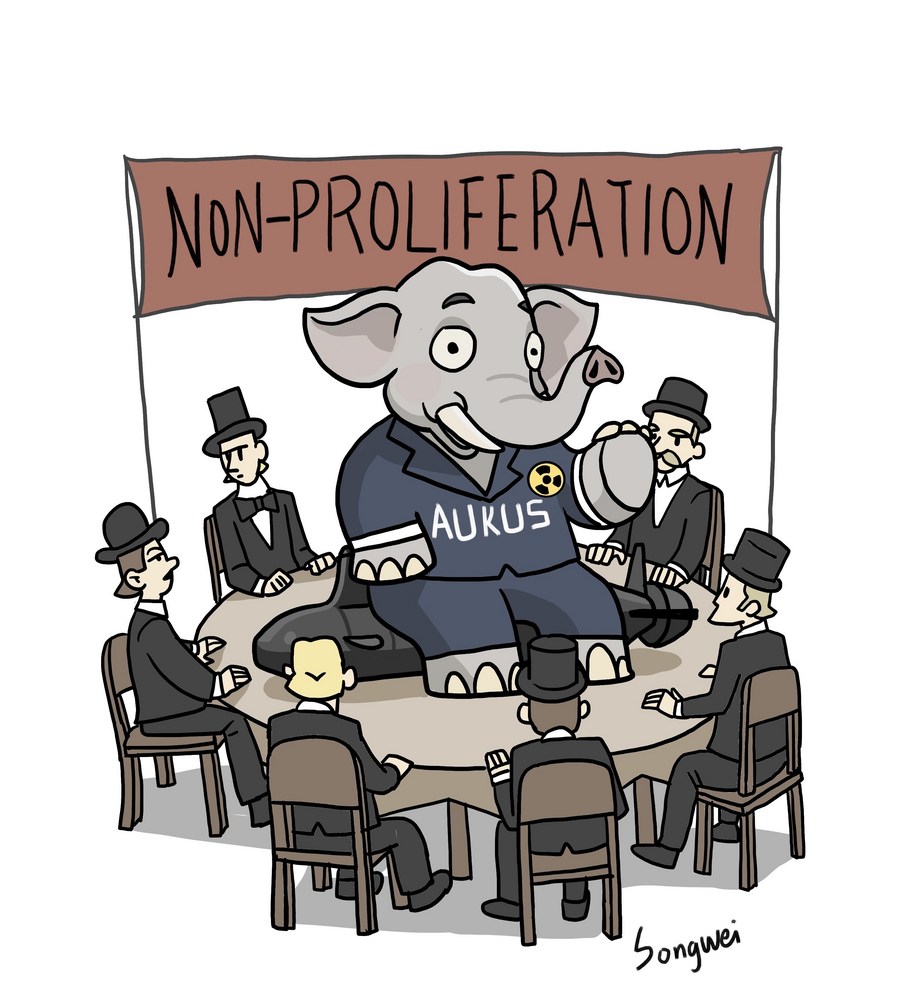
The elephant in the room is the fantasy that we will somehow graduate to having a self-sustaining nuclear industry. Firstly, this would be in breach of the Nuclear Non-Proliferation Treaty, which, AUKUS notwithstanding, would bring down on our heads the disapproval of the civilised world. The difficulties I have described above, with the fuel rods presumably purchased from a weapons state, most likely the US, would be compounded by the need for the International Atomic Energy Agency to ensure that any processing of the fuel in Australia meets non-proliferation standards.
By Jim Coombs, Sep 2, 2024, https://johnmenadue.com/duttons-nuclear-vision-is-distorted-by-ignorance-or-worse/
Peter Dutton’s nuclear plan may well have minimal carbon emissions, but the distant time of arrival, and ignoring the well known drawbacks makes it a dud.
On the face of it, it is all whizzbang white heat of technology (albeit of 60 years ago) and no carbon emissions (never mind the other ones). The problem lies with the nature of the beast.
The energy produced is heat, resulting from nuclear fission (the splitting of atoms, from a critical mass of highly radioactive material, e.g., uranium 235). The process needs to be controlled or it goes off like Hiroshima, so it is a technical fear of some delicacy, given the cost of failure, as can be seen from Chernobyl and Fukushima.
The fuel is usually in the form of rods containing the fissile material, and, over time, it is transmuted into “waste” which contains residual fuel and what are quaintly called the “daughter products of fission”. The spent fuel is reprocessed to extract further and remaining fissionable material and the “daughters’, which are extremely radioactive and dangerous with radioactive half-lives of some thousands of years and which, up to now, have not been found a final resting place that can guarantee their safety for future generations for those thousands of years.
The most celebrated aggregation of these products is at Sellafield in the UK where they have sat awaiting adequate disposal for decades. Dutton blithely says the spent fuel rods will be stored on the power station site, which is mostly not the case elsewhere. For how long, how many and where they might be sent, once processed, for future generations to be safe, is ignored.
The nations he says happily depend on nuclear power, such as France or Japan, either fuel their stations with fissile material from their nuclear weapons programs, as in the case of France, (the cost is, thus, a defence secret), or they are trying to reduce their dependence, to reduce the cost of ensuring safe operation (Japan and Germany).
The cost overruns of nuclear power stations under construction in the UK and elsewhere are notorious. The light-bulb idea of small modular stations has yet to be demonstrated in practice, though the concept has been around for decades. They too have the problems of what to do with the waste as described above which remain unsolved .
The elephant in the room is the fantasy that we will somehow graduate to having a self-sustaining nuclear industry. Firstly, this would be in breach of the Nuclear Non-Proliferation Treaty, which, AUKUS notwithstanding, would bring down on our heads the disapproval of the civilised world. The difficulties I have described above, with the fuel rods presumably purchased from a weapons state, most likely the US, would be compounded by the need for the International Atomic Energy Agency to ensure that any processing of the fuel in Australia meets non-proliferation standards.
The idea that we could produce the fuel rods from our own supply of uranium would entail our establishing a uranium enrichment facility. All that we now know about the cost of doing this, in the face of international obloquy, is that it is a defence secret, which has never been undertaken commercially. Indeed President Richard Nixon famously offered GE and Westinghouse free access to the technology and they both declined to take it on as a business.
Consider then, what is involved in uranium enrichment. Uranium comes in two isotopes. U235 (the fissile one) and U238. To achieve fission, the concentration of U235 needs to be higher than is found in nature, so increasing the proportion of U235 is what needs to be done. That is, increasing the amount of the lighter isotope, and this can only be done by physical means, separating on the basis of three parts by weight out of 238. The only medium for achieving this separation is, in the case of uranium, uranium hexafluoride, an extremely corrosive gas, making the process entirely contained and corrosion resistant the only way to go ahead.
What is the mechanism working in this severely constrained process? A long series of gas centrifuges of the highest quality stainless steel requiring a constant supply of energy to keep the spinning process going. A task at the very edges of technical feasibility. Desperate stuff, or as Dr Johnson said of women preaching, surprising that it is done at all. Cost estimate? A deep dark secret.
Lastly, Dutton’s pro-AUKUS stance goes along with his wilful blindness to the nuclear safety issue. Way back, Billy McMahon denied entry of nuclear-powered submarines to all Australian harbours, because of the mere possibility of an escape of waste or other nuclear materials into populated environments. In the UK and US, berthing of nuclear powered vessels takes place largely at purpose-designed port facilities away from population centres. AUKUS plans to berth near Adelaide, and port cities in NSW. Imagine the effect of a minor “excursion” on real estate prices near Adelaide or even Port Kembla. “It’s clean, it’s green,” Peter cries, with no evidence whatsoever of the cost of keeping it all safe.
Barmy, or dishonest ?
7 September Webinar: Don’t Nuke The Climate: Who is really behind the Nuclear Push? Disarming Disinformation.
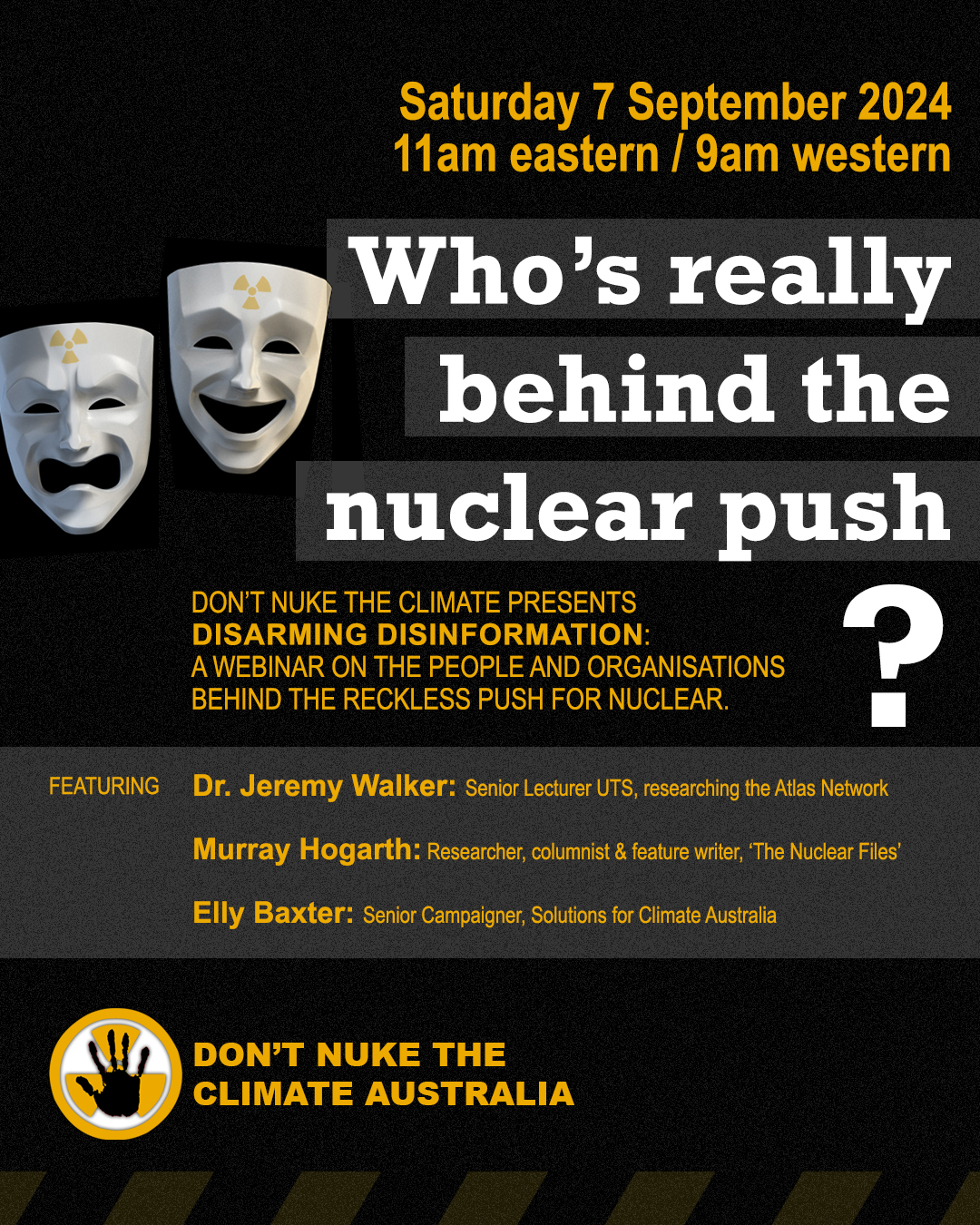
7 September ONLINE SESSION. Don’t Nuke The Climate: Who is really behind the Nuclear Push? Disarming Disinformation.
Who are the people and organisations behind the reckless push for nuclear power?
Join us Saturday September 7 from 11am- 12pm eastern time, 10.30am SA/NT, 9am WA.
At 11am eastern time on September 7, Don’t Nuke the Climate is hosting a session on disarming disinformation in this current nuclear push. We have some fantastic speakers with deep background on the corporate, think tank and political networks behind the pro-nuclear campaign, which just happens to be extremely helpful to coal and gas interests.
Dr. Jeremy Walker: Senior Lecturer UTS, researching the Atlas Network
Murray Hogarth: Researcher, columnist & feature writer, ‘The Nuclear Files’
Elly Baxter: Senior Campaigner, Solutions for Climate Australia
‘Heavily male dominated’: Nuclear workforce has to be ‘more balanced’

Sky News Australia, https://www.msn.com/en-au/news/other/heavily-male-dominated-nuclear-workforce-has-to-be-more-balanced/ar-AA1pKlf2 31 Aug 24
Women in Nuclear Australia President Jasmin Diab says a lot of countries are reinvesting in nuclear energy.
“But in doing that, they’d realise that the workforce has to be more balanced,” she told Sky News Australia.
“The nuclear industry for a really long time has been heavily male-dominated, and a report released late last year by the nuclear energy agency highlighted that we need to do more to attract girls and women into nuclear careers.”

COMMENT. Well, there are numerous reasons why women don’t get into the nuclear workforce.
That includes the gender bias that still exists in schools – where boys get ahead in science classes because both they are pushier, and because playing around with technical stuff is encouraged as natural for boys from infancy onward – but not for girls.
But a bigger reason might be that girls have the intelligence to reject working in a secretive, dirty, dangerous industry intrinsically linked to war.
Barnaby’s Bush Summit bombshell: Why ScoMo wouldn’t back nuclear
Barnaby Joyce revealed Scott Morrison rejected a push from within the Coalition to introduce nuclear power in Australia because polling showed it was unpopular.
Daily Telegraph, John Rolfe and James O’Doherty, 30 Aug 24
Former Prime Minister Scott Morrison rejected a push from within his Coalition government to introduce nuclear power in Australia because polling showed it was unpopular, the Bush Summit has heard.
Speaking in a panel on energy policy at the Summit in Orange, Barnaby Joyce revealed that when he was Deputy Prime Minister he went to Mr Morrison, the then PM, and made the case for overturning the prohibition on nuclear and building reactors.
He claimed Mr Morrison said there wasn’t enough community backing.
“He (Mr Morrison) said that the polling didn’t support that,” Mr Joyce recalled. “And so it didn’t go ahead.”
He added: “We’ve continued fighting, and … now the Opposition is taking it on. That’s what happens in politics. You just fight, fight, fight, and then you finally get there, and we’re there.”
Later, in an interview for DTTV, Mr Joyce went further: “I’ve always been a supporter of nuclear power. So Scott Morrison didn’t pursue nuclear power because he thought it was politically untenable.
“In politics, it’s not a case of following. It’s a case of leading. And that’s what we intend to do.”
Mr Morrison told The Telegraph it was “seriously considered and discussed.
“It was determined and agreed that there was insufficient runway before the election to prosecute the case for a civil nuclear energy capability … especially given there would not be bipartisan support for the change, which had been our standing policy position on nuclear power for many years, that is, to proceed it would need to be bipartisan.
“That said, nuclear power was included in our government’s Technology Road Map.”
Mr Joyce also told the Summit that the push for renewable energy is the “most divisive thing” he has seen in his time in politics in a fiery debate with Matt Kean.
‘WHAT IS THIS, THE WIZARD OF OZ?’
“It has split communities down the middle. It has made good friends (go) for each other’s throats,” Mr Joyce said during his face-off with the former NSW treasurer and energy Minister Mr Kean – now Climate Change Authority chairman.
“We are going to be mugged by reality on this one … if we keep going down this path, the lights are going to go out,” Mr Joyce said, adding red tape would slow down building new energy such as nuclear power.
“You were the deputy Prime Minister of the country Barnaby … you could do something about it,” Mr Kean said.
Mr Kean added he wasn’t “opposed” to nuclear.
“I’m supportive of the facts, I’m not opposed to nuclear per se, but … nuclear is three to five times more expensive than firmed renewables,” Mr Kean said, prompting a barrage of rejections from the New England MP.
“What is this? The Wizard of Oz,” Mr Joyce said.
Mr Kean said the government Mr Joyce was part of didn’t build any baseload power.
Earlier, Mr Joyce met with pro-nuclear protesters outside the summit and promised he would “fight this till the end.”
The anti-wind farm campaigners were brandishing signs saying “we do not consent” and “minimum 6km setback from our homes”.
“They’re ruining the environment and wrecking regional Australia,” one protester said of wind farms………………………………………………………………………….. https://www.dailytelegraph.com.au/bush-summit/barnabys-bush-summit-bombshell-why-scomo-wouldnt-back-nuclear/news-story/f16eae0098c75cb049d0d1a03eddf4be
That time when Canada cancelled its nuclear submarine order
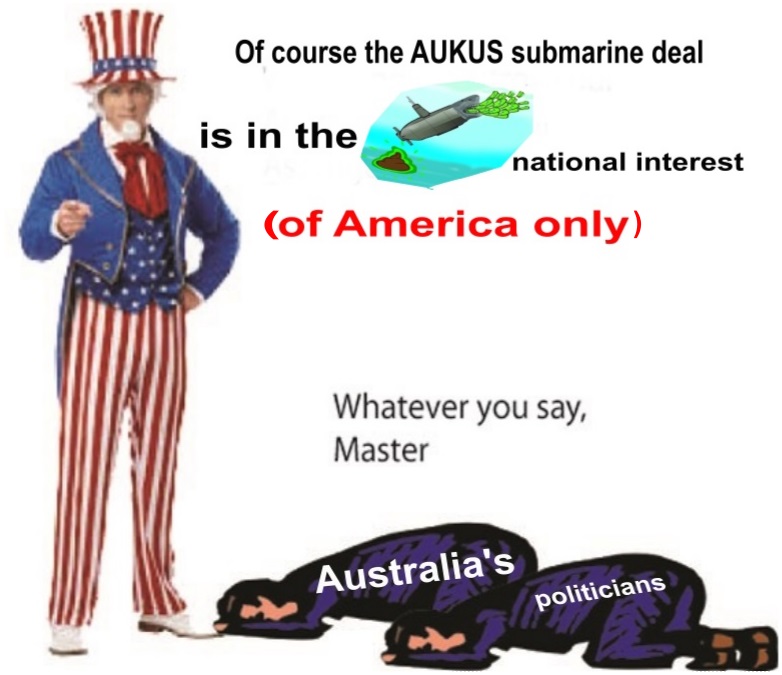
The decision to cut the Australian community out altogether — except where we will be called upon to service the US military as it builds its base in WA — puts us in the relationship of a vassal state, existing only to do the bidding of our powerful friend.
By Julie Macken and Michael Walker, Aug 30, 2024, https://johnmenadue.com/that-time-when-canada-cancelled-its-nuclear-submarine-order/
Back in 1987, when no one knew that the Cold War was just about to end, the Canadian Government signed up to build 10 nuclear-powered submarines. That submarine program lasted for all of two years before being cancelled in 1989. No nuclear Canadian sub ever even began construction, let alone getting put in the water.
There is a very real sense of déjà vu when we look at the Canadian experience and the current Australian experience of AUKUS. The good news is that it is not too late to learn the lessons the Canadians learnt for us.
One of the reasons for the Canadian cancellation was the $8 billion price tag, or about $19 billion in today’s money. Two billion dollars per submarine now sounds like a bargain compared to the astronomical $45 billion per submarine under AUKUS. Canada decided it had other priorities where that money could be put to better use.
But before the contract was cancelled in Canada, the ministries involved in its construction became embroiled in conflict, the Government itself was in a cost-of-living-crisis with immediate, real-world needs pressing and the hasty and secretive choice of vessel design came under withering criticism from the Treasury department for poor procurement with the cost expected to blow out to $30 billion ($70 billion today). And finally, media support eroded, with 71% of the population opposed to the project.
Déjà vu much?
On 12 June, the US Congressional Research Document service produced a research and advice document called the Navy Virginia-Class Submarine Program and AUKUS Submarine (Pillar 1) Project: Background and Issues for Congress.
The document points out the AUKUS deal was a three-step process. The first was to establish a US-UK rotational submarine force in Western Australia. The second was that the US would sell us three or five Virginia nuclear powered submarines and the third would be that the UK assists us in building our own AUKUS class nuclear submarines.
But the Congressional report outlines when comparing the “potential benefits, costs, and risks” of the three stage plan, it might just be better for the US to operate more of its own boats out of WA. That is, “procuring up to eight additional Virginia-class SSNs that would be retained in US Navy service and operated out of Australia along with the US and UK SSNs”.
That’s right, why bother with the whole step two and three when the US is best served by simply operating its nuclear-powered attack submarines out of WA?
This is an extraordinary development and one that demands more attention than has been given previously because a number of issues flow from this kind of thinking.
First, this potentially frees up $400 billion that could be put to far better use on a national housing construction program or high-speed rail network running the entire east coast of Australia or other large and much-needed nation-building projects. But not so fast.
The US Congressional Research Document suggests that “those funds (the $400 billion) could be invested in other military capabilities”, such as long-range missiles and bombers, “so as to create an Australian capacity for performing non-SSN military missions for both Australia and the United States”.
The decision to cut the Australian community out altogether — except where we will be called upon to service the US military as it builds its base in WA — puts us in the relationship of a vassal state, existing only to do the bidding of our powerful friend.
The fact that the document only referenced the “potential benefits, costs, and risks” from the US perspective, without any attempt to imagine how Australia may view becoming a life support for a US submarine base, makes the nature of our relationship pretty clear.
Australia’s Government may not consider it necessary to have done its due diligence on AUKUS but the Americans are happy to do that for us and, you guessed it, even though they quietly have doubts about the SSN project, they’ve already thought of plenty of other ways to spend our money on their own defence objectives. Spending it on the well-being and prosperity of our own people didn’t even rate a mention.
Recent Events Prove Western Nations Are Highly Vulnerable To Cyber Calamity
Alt-Market.US, August 27, 2024

COMMENT. The original of this article contains a conspiratorial view of Covid-19 and its causes.
I can’t really agree to that opinion on Covid.
BUT – the dangers of cyber calamity seem all too real to me, and this article sets it out well
As most people are aware, this month there was a sweeping internet outage across the US which led to a failure in roughly 8.5 million Microsoft Windows devices. Disruptions included banks, airline networks, emergency call centers, online retailers and numerous corporate networks. The outage is estimated to have caused at least $5.4 billion in profit losses and it only lasted about a day.
The alleged cause of the breakdown was Crowdstrike, a cyber-security company that uses large scale data updates to Microsoft Windows networks to counter cyber threats. Instead, the company uploaded bugged code and caused a cascading outage. Mac and Linux machines were not affected.
The scale of the shutdown was immense – Over 25% of Fortune 500 companies were frozen. Travel essentially stopped. Business transactions for many companies ceased. Some banks including Bank of America, Capital One, Chase, TD Bank and Wells Fargo could not function and customers could not access their accounts.
The event reminded me of the panic surrounding the Y2K scare 25 years ago. Of course, that was all nonsense; US systems were definitely not digitized to an extent great enough to cause a disaster should there be an internet crash or a software crash. But today things are very different. Nearly every sector of the American (and European) economy and many utilities are directly dependent on a functioning internet.
The fear that prevailed during Y2K was unrealistic in 1999. Now, it makes perfect sense.
………………First and foremost, there is the potential for random error like the Crowdstrike incident. Then there’s the potential for a foreign attack on US and European digital infrastructure. Then, there’s the potential for a false flag event BLAMED on random error or a foreign government in order to foment war or economic collapse.
……………………..In June of 2021 there was an internet outage that led to large swaths of the web going completely dark, including a number of mainstream news sites, Amazon, eBay, Twitch, Reddit, etc. A host of government websites also went down. All this happened when content delivery network (CDN) company Fastly experienced a “bug.” Although Amazon had its website back online within 20 minutes, the brief outage cost the company over $5.5 million in sales.
A content delivery network is a geographically distributed network of proxy servers and their data centers. They make up what is known as the “backbone” of the internet. Only a handful of these company’s support a vast majority of internet activity. All it would take is for a few to go down, and the internet goes down, taking our economy with it.
The recent Crowdstrike situation is perhaps the worst web disruption of all time, and that was just a bug in a software update. Imagine if someone wanted to deliberately damage internet functions for an extended period of time? The results would be catastrophic.
With supply chains completely dependent on “just-in-time” freight deliveries and those deliveries dependent on efficient digital communications and payments between retailers and manufacturers, a web-down scenario for more than a few days would cause an immediate loss of consumer goods. Stores would empty within hours should the public realize that new shipments might not arrive for a long time.
Keep in mind, I’m not even accounting for payment processing between customers and retailers. If that shuts down, then ALL sales shut down. Then, whatever food you have left in your pantry or in storage is what you will have to live on until the problem is fixed. If it is ever fixed…
Network attacks are difficult to independently trace, which means anyone can initiate them and anyone can be blamed afterwards. With the increasing tensions between western and eastern nations the chances of an attack are high. And corrupt government officials could also trigger an internet crisis and blame it on foreign enemies – Either to convince the public to go to war, or to convince the public to accept greater authoritarianism.
…………….Figuring out who triggered the breakdown would be nearly impossible. We could suspect, but proving who did it is another matter. In the meantime, western officials controlled by globalist interests could lock down internet traffic and eliminate alterna
What are the most practical solutions to this? As always we can store necessities to protect our families and friends. To protect data, I recommend shutting OFF Windows Updates to prevent something like a Crowdstrike error from affecting your devices. You can also set up a Linux-based device with all your important data storage secured.
You can purchase an exterior hard drive and clone your computer data, then throw it in a closet or a waterproof case. Then there is the option of building a completely offline device (a computer that has never and will never connect to the internet).tive media platforms they don’t like, giving the public access to corporate news sources only.
These options protect you and your valuable files, but there’s not much that can be done to prevent a national scale cyber attack and the damage that one could cause. Organizing for inevitable chaos and violence is all you can do.
With a cyber-event there is the distinct danger of communications disruptions – No cell phones, no email, no social media, nothing. So, having knowledge in ham radio and radio communications is a must. I’m a general class ham and I’m still finding there’s more to learn, but a basic knowledge of radios, frequency bands and repeaters will help you to at least listen in on chatter and get important information outside of controlled news networks.
The people who used to claim it’s “doom mongering” to examine the threat of cyber attacks have been proven utterly wrong this past month. We just witnessed one of the worst internet implosions of all time and more are on the way. Prepare accordingly and remember that technological dependency is a double-edged sword. Use your tech wisely and don’t let it run your life. https://alt-market.us/recent-events-prove-western-nations-are-highly-vulnerable-to-cyber-calamity/
The AUKUS submarine deal has been exposed as a monumental folly – is it time to abandon ship?
The good news, perhaps, is that it is difficult to imagine the nuclear-powered submarines will ever arrive. The bad news is we will still have to pay the Americans and the British to prop up their overburdened and underperforming shipyards in the meantime. With friends like these, who needs to make new enemies?
Mark Beeson, Adjunct professor, University of Technology Sydney, August 27, 2024 https://theconversation.com/the-aukus-submarine-deal-has-been-exposed-as-a-monumental-folly-is-it-time-to-abandon-ship-236873?utm_source=twitter&utm_medium=bylinetwitterbutton
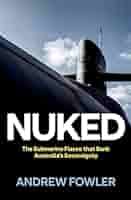
Nautical metaphors are irresistible, I’m afraid, when talking about Australia’s seemingly endless submarine saga. But as investigative journalist Andrew Fowler makes clear in Nuked: The Submarine Fiasco that Sank Australia’s Sovereignty, his excellent and excoriating analysis of the genesis of the AUKUS pact, there isn’t much room for levity otherwise.
Anyone who doubts the accuracy of former Labor luminaries Paul Keating and Gareth Evans, who have argued that AUKUS is, as Keating put it, “the worst deal in all history”, really ought to read this book.
Review: Nuked: The Submarine Fiasco that Sank Australia’s Sovereignty – Andrew Fowler (Melbourne University Publishing)
The plan for Australia to acquire eight nuclear-powered submarines, built locally in partnership with the United Stated and the United Kingdom, is projected to cost up to A$368 billion. But it is not just the cost of the AUKUS project that is astounding.
While many people should hang their heads in shame, the principal architect of this monumental folly is Scott Morrison, whose reputation will be deservedly further diminished by the revelations contained in Fowler’s carefully researched volume. One question the book does not address in detail is the abysmal quality of political leadership in this country, especially, though not exclusively, on the conservative side of politics.
Whatever the reasons for this, the end result was that the huge shift in Australia’s foreign policy alignment was hatched by a Christian fundamentalist former tourism marketing manager with no training in strategic or foreign affairs but a great gift for secrecy and deception.
The shift in question was the decision to abandon an agreement to buy much cheaper, arguably far more suitable and deliverable submarines from France, with the aim of “welding Australia’s military to the United States”. In retrospect, it is hard to believe how badly the French were misled, or how shortsighted the rationale for the switch actually was.
In Fowler’s view, buying the French submarines would have been a “remarkable achievement”. It would have given Australia “greater independence and a more influential position in the world”.
Properly explaining Australian policymakers’ fear of strategic and foreign policy independence would take another book. But what clearly emerges from Fowler’s account is how irresponsible and self-serving Australia’s approach to national security became under Morrison. The fate of the Australian people, not to mention the endlessly invoked “national interest”, was of less concern than short-term political advantage.
“The fact that the increasing US military presence in the Indo-Pacific could draw Australia into a conflict,” writes Fowler, “seemed of little consequence in Morrison’s desire to wedge Labour on national security.”
Of course, being painted as “weak” on security, and the US alliance in particular, was the stuff of nightmares for the Australian Labor Party. It still is. Consequently, the ALP’s leadership has gone to extraordinary lengths to try and convince voters, and its own increasingly sceptical rank and file, that not only are they equally committed to national security, but that the AUKUS agreement is the best way of achieving it.
High costs, significant risks
Given AUKUS was the brainchild of a discredited conservative prime minster who, Fowler suggests, “believed he was on a divine mission”, one might have hoped the Albanese government could have at least conducted a perfunctory cost–benefit analysis. AUKUS is the largest single military acquisition the nation has ever undertaken, after all. Recent defence acquisitions have become known for massive cost blowouts and failures to operate or arrive in the advertised manner.
But the Labor Party has not only walked into Morrison’s trap; it has willingly, even enthusiastically, “embraced a decision taken after a deeply flawed process”. Even more consequentially, as Fowler points out, “with the major parties in lockstep on AUKUS, the most complex and expensive spend in Australian military history would never be publicly investigated”.
At the very least, this is an astounding failure of good governance and accountability. Perhaps even more remarkably, it also demonstrates a singular lack of political judgement, driven by short-term political concerns rather than long-term strategic interests.
“Labor lost the one chance it had to identify itself as independent and courageous and put the interests of the country ahead of its understandable desire to win government,” argues Fowler. “The consequences of the fear that drove the ALP leadership to embrace AUKUS with barely a second thought will haunt them for years to come.”
Serves them right. When there is little discernible difference between the major political parties on issues of profound national importance, voters – especially the younger variety – may understandably despair about their futures.
Even if we put aside the fragile, unpredictable and polarised nature of US politics, it is not too controversial to suggest that the US alliance has some potential frailties and significant costs. Not the least of these is fighting in wars that have no obvious strategic relevance to Australia.
AUKUS will further complicate Australia’s relationship with China, our major trading partner. But it carries other significant risks. This not just because, as Opposition Leader Peter Dutton says, it is “inconceivable” that we would not fight alongside the US in any conflict with China over Taiwan.
If the naval base at Garden Island, just down the road from me off the coast of Fremantle, is not already a nuclear target, it assuredly will be once US and UK nuclear-powered submarines routinely operate from there. Whether my neighbours realise they risk being vaporised as part of our commitment to the alliance and a “great nation building project” is a mystery that has not been explored.
Local politicians, universities and defence representatives certainly recognise the short-term benefits that may flow from new investment. But this means there is likely to be next to no informed debate about, much less opposition to, the AUKUS pact, no matter what the ultimate costs may be for a nation that can’t even provide adequate housing for its own people. Indeed, the lack of debate, not to say outrage, about the sheer cost of the AUKUS project is perhaps the most remarkable feature of the sorry submarine saga.
And that is before we get to the growing doubts about the reliability, deliverability or strategic relevance of nuclear-powered submarines. Perhaps people find technical discussions stupefyingly dull or incomprehensible. Perhaps they don’t realise that if we spend all that money on submarines, not only will our sovereignty and capacity to act independently be significantly eroded, as Keating and Malcolm Turnbull have claimed, but we won’t be able to spend the money on more immediate and tangible threats – repairing our rapidly degrading natural environment, for example.
I am not convinced Australia needs to buy any submarines. This will no doubt strike those in Canberra’s strategic bubble as heretical, ill-informed and irresponsible. But it is noteworthy that our overall security did not seem to suffer while the ageing Collins class submarines were unavailable for four years.
Even those with widely respected expertise in such matters, such as Hugh White, have cast doubt on the feasibility of AUKUS. White has written that “long delays and cost overruns are certain. Outright failure is a real possibility.”
Drunken sailors
Fowler has produced quite the page-turner for a book on strategic policy. His account provokes occasional gasps of disbelief, especially about the conduct of the Morrison government and its coterie of carefully chosen, like-minded advisors, many of them from defence companies likely to benefit from government spending.
Many former Morrison ministers – as well as Morrison himself – have exited through the revolving door between government and business to take up lucrative positions in the defence industry. Who would have thought?
Nuked is worth a close reading to see how Fowler arrives at his damning conclusion:
the level of incompetence in the government of Australia was breathtaking, as were the repercussions. The United States would be calling all the shots on what kind of submarines would be sold to Australia, how old they would be, how many there would be, when they would be delivered, and even if they would be sold at all.
It was to be expected that Washington would act in its own best interests. What is extraordinary is the possibility that Morrison truly believed that what was best for the United States was best for Australia. Just as extraordinary is the fact that the Labor Party, perhaps fearful of history embraced the deal that made Australia so vulnerable, undermining its independence and sovereignty.
Another nautical metaphor about spending like drunken sailors comes to mind. It wouldn’t be quite so galling if the nation’s political leaders weren’t using our money or were motivated by something other than short-term political advantage or the fear of being wedged.
The good news, perhaps, is that it is difficult to imagine the nuclear-powered submarines will ever arrive. The bad news is we will still have to pay the Americans and the British to prop up their overburdened and underperforming shipyards in the meantime. With friends like these, who needs to make new enemies?
It beggars belief that a country with unparalleled geographical advantages and no obvious enemies thinks it is a good idea to spend $368 billion on offensive military capabilities, which may or may not work or be delivered. Nuked explains how this situation came about. But we may need to ask psychologists why our political leaders have turned us into what the diplomat Alan Renouf famously called a “frightened country” and allowed such follies to flourish.
Defence Minister Richard Marles opened $600k second office in Geelong, a short walk from his existing space

COMMENT. Defence Minister Richard Marles grows more grandiose by the day.
ABC News, by political reporter Courtney Gould 29 Aug 24
In short:
Defence Minister Richard Marles requested permission to establish a second office in his hometown of Geelong.
He is the only minister within the Albanese government to have a standalone ministerial office, besides his electorate office. It came at a cost to the taxpayer of more than $600,000.
What’s next?
A spokesperson said the spend was within the rules and guidelines set by the Finance Department.
A brand new headquarters for Defence Minister Richard Marles was established just 240 metres from his existing office at a cost to the taxpayer of over $600,000.
The costly office build, located on Geelong’s waterfront, was revealed in a freedom of information request by the ABC.
The offices are within walking distance of each other in the Geelong city centre.
Mr Marles made his request for the additional office space 13 days after Labor won the federal election in 2022. He is the sole minister to have had a standalone ministerial office approved.
“As the newly elected deputy prime minister, I am advised that I am entitled to additional office space,” he wrote in a letter dated June 3, 2022.
The original plan was to establish a new standalone office for his duties as the deputy prime minister and keep his existing Geelong headquarters open to constituents……………………………
The Department of Finance shelled out $658,053 to fit out and furnish the new office and paid $6,297 for repairs, removing and installing new signage, and new office furniture for the refurbished building.
An additional cost to fit out his now ministerial office to meet “security requirements” was paid by the Department of Defence. Defence Media did not respond to requests for comment about the cost of the upgrades
Marles the only minister to have standalone office
Under current arrangements, a minister can be provided with an additional office space to go about their ministerial responsibilities.
It is “usually” located within the Commonwealth Parliament Office (CPO), an option 19 ministers have elected to take………………….https://www.abc.net.au/news/2024-08-29/richard-marles-second-office-geelong/104280748
Advocates for nuclear power should heed the lessons from Kursk
By Richard Broinowski, Aug 29, 2024, https://johnmenadue.com/advocates-for-nuclear-power-should-heed-the-lessons-from-kursk/
On 22 August, Rafael Grossi, director-general of the International Atomic Energy Agency, warned of the deadly effect a military attack on Russia’s nuclear power complex at Kursk would have on civilian communities in Russia, Ukraine and potentially across Europe. He had previously warned of the consequences of such attacks on Ukraine’s nuclear reactors at Zaporizhzhia.
The Kursk nuclear complex is approximately 30 kilometres from a fluid military situation between invading Ukrainian forces and Russian defenders. The complex has six Russian designed RBMK reactors, the same type as at Chernobyl. Two are shut down, two are in construction mode, and two are hot. None have protective domes. The easiest and most effective military action would be destruction of the complex’s power supply, which as with flooded generators at Fukushima, would halt cooling pumps, overheat the reactors, cause a melt-down of fuel rods, and the uncontrolled venting of radioactive materials into the atmosphere.
People have short memories, and tend to forget the dimensions of previous nuclear disasters and near disasters, particularly at Windscale, Three Mile Island, Chernobyl and Fukushima. Chernobyl was arguably the worst, followed closely by Fukushima. At Chernobyl, reactor number four exploded, not due to military action, but an experiment by Russian engineers to see how long turbines would spin and supply power to cooling pumps if the reactor’s main electric supply failed. In the reactor, the collision of incandescent nuclear fuel with cooling water created an explosion which blew apart the reactor vessel and spread radioactive dust including xenon gas, short-lived Iodine 131 (eight days) and Caesium 137 (30 years) across much of Ukraine and Belarus, as well as parts of Russia, and Scandinavia. The nearest town of Pripyat was evacuated and a no-go zone of 30 kilometre radius, later expanded to 4,300 square kilometres, was declared.
Subsequent reports by the UN Scientific Committee on the Effects of Atomic Radiation found that immediate deaths caused by radiation from Chernobyl could be calculated, most certainly deaths from thyroid cancer, but not of long-term stochastic deaths. The precise number is unknown and there are wildly different estimates, including among the medical profession. Because of fears about radiation damage to foetuses, over one million abortions were performed across Europe in the year following the disaster.
And now, two warring countries dice with death over Zaporizhzhya, Europe’s largest nuclear power complex and one of the 10 largest in the world. Most recent attacks occurred between 2022 and 2024. Fighting in 2022 led up to Russia wresting management of the complex. While it was going on, a large calibre bullet pierced the outer wall of reactor number four and an artillery shell hit a transformer in reactor number six.
In April 2024, the IAEA reported the plant was attacked by a swarm of drones, three of them torching surveillance and communication equipment. There were three direct hits on containment structures. On 11 August, fire broke out in one of two cooling towers. Zelensky blames Putin for the attacks, Putin blames Zelensky. Putin is probably right. Why would Russia attack the complex it now managed? Both tend to downplay the disastrous consequences an attack on the reactors or their electricity and cooling systems would have on civilian populations across Europe. They would be similar if not worse than the results of the Chernobyl fiasco.
Although badgered by journalists following his 22 August address, Grossi refused to attribute blame for the attacks at Zaporizhzhia and who might initiate them at Kursk. He said the IAEA was not a political organisation, and blame would be up to the UN Security Council. He would not get into speculation. When pressed, however, he said if his investigations led to clear evidence of the perpetrators, he would call them out. Meanwhile, he was about to go to Kursk and examine the situation in conjunction with the managers and engineers of the nuclear complex there. He then planned to separately see both Putin and Zelensky.
What the whole situation should bring home to Australian politicians and their backers in the nuclear industry, who so blithely recommend the construction of a dozen-odd nuclear reactor complexes here, is the widespread lethal damage a kinetic attack on any one of them would cause in this country. We already see that US military and surveillance installations would become natural targets for China if ever war breaks out over Taiwan. Nuclear reactors would pose a much wider damage to the civilian population.
1 This month.

Australians deserve the truth
about
AUKUS – https://aukuspublicinquiry.com/

30 July – WEBINAR (Free) – Is Nuclear Power the Solution to Climate Change? https://my.acaw.org.au/event/acaw-is-nuclear-power-the-solution-to-climate-change
18:30 – 19:45 ACST
19:00 – 20:15 AEST

PETITION – To: Prime Minister Anthony Albanese and the Australian Labor Government

of the week – Australians for War Powers Reform (AWPR)
To see nuclear-related stories in greater depth and intensity
 Antinuclear