Australia’s Frightening New “Hate Speech” Laws Are Clearly Aimed At Pro-Palestine Groups
Caitlin Johnstone, Jan 21, 2026, https://www.caitlinjohnst.one/p/australias-frightening-new-hate-speech?utm_source=post-email-title&publication_id=82124&post_id=185285586&utm_campaign=email-post-title&isFreemail=true&r=1ise1&triedRedirect=true&utm_medium=email
Australia’s Labor government has successfully passed a “hate speech” bill that’s plainly aimed, at least in part, at suppressing pro-Palestine organizations as “hate groups”.
Free speech advocates are sounding the alarm about the new laws, saying their extremely vague wording, lack of procedural fairness and low thresholds for implementation mean groups can now be banned if they make people feel unsafe or upset without ever actually posing any physical harm to anyone.
For me the most illuminating insight into what these laws are actually designed to do came up in an ABC interview with Attorney-General Michelle Rowland on Tuesday. Over and over again throughout the interview Rowland was asked by ABC’s David Speers to clarify whether the new laws could see activist groups banned for criticizing Israel and opposing its genocidal atrocities in a way that causes Jewish Australians to feel upset feelings, and she refused to rule out the possibility every single time.
“Let’s just go to what it means in practice: would a group be banned if it accuses Israel of genocide or apartheid, and as a result, Jewish Australians do feel intimidated?” Speers asked.
Rowland didn’t say no, instead saying “there are a number of other factors that would need to be satisfied there” and saying that agencies like the AFP and ASIO would need to make assessments of the situation.
“Okay, just coming back to the practical example though, if a group is suggesting that Israel is guilty of genocide, what other measures or factors would need to be met before they can be banned?” Speers asked.
“Under the provisions that are now before the parliament, there would also need to be able to demonstrate that there are for example, some aspects of state laws that deal with racial vilification that have been met as well,” Rowland responded, again leaving the possibility wide open.
(It should here be noted that Greens justice spokesperson David Shoebridge has pointed out that “state laws that deal with racial vilification” can include “tests like ‘ridicule’ and ‘contempt’,” meaning people could wind up spending years in prison for associating with groups that were essentially banned for upsetting someone’s feelings.)
“Just to be clear, if a group is saying Israel is engaged in genocide, or they’re saying that Israel should no longer exist, that is not enough for that group to be banned?” asked Speers.
“Well, again, that would depend on the other evidence that is gathered, David, so I would be reluctant to be naming and ruling in and ruling out specific kinds of conduct that you are describing here,” Rowland replied.
All this waffling can safely interpreted as a yes. Rowland is saying yes. Speers pushed this question three different times from three different angles because it’s the most immediate and obvious concern about these new laws, and instead of reassuring the public that they can’t be used to target pro-Palestine groups and aren’t intended for that purpose, the nation’s Attorney General confirmed that it was indeed possible.
So that’s it then. Under the new laws we can expect to see the Israel lobby crying about Jewish Australians feeling threatened and unsafe by every pro-Palestine group under the sun, and then from there all it takes is the thumbs-up from ASIO to put the group on the banned list and cage anyone who continues associating with it for up to 15 years.
The bill that ended up making it through Parliament is actually a narrowed down version of an even scarier bill that was scrapped by Labor due to lack of support which went after individuals as well as groups. The earlier version contained “racial vilification” components which could have been used to target any individual who voices criticisms of Israel or Zionism — so it doesn’t look like I’ll be doing any prison time for my writing any time soon. The new version moved its crosshairs to groups with the obvious intent to disrupt pro-Palestine organizing in Australia.
And we’re already seeing the Israel lobby pushing to resurrect the laws targeting individuals. A new ABC article titled “Jewish leaders call for vilification offence to be revisited as Coalition splits over watered-down hate laws” cites Zionist Federation of Australia president Jeremy Leibler and Executive Council of Australian Jewry co-chief executive Peter Wertheim arguing that the new laws don’t go far enough.
So we can expect the Australian Israel lobby to both (A) push to get pro-Palestine groups classified as “hate groups” under the new laws and (B) keep pushing to make it illegal for individuals to criticize Israel in the form of new “racial vilification” laws. They’ll keep trying over and over again, from government to government to government, until they get their way.
This comes after Australia/Israel & Jewish Affairs Council Executive Manager Joel Burnie publicly stated that he wants to ban pro-Palestine protests and criticism of Israel throughout the nation, and as prosecutors drag an Australian woman to court for an antisemitic hate crime because she accidentally butt-dialed a Jewish nutritionist and left a blank voicemail.
So things are already ugly, and they’re getting worse.
It’s so creepy knowing I share a country with people who want to destroy my right to normal political speech. It would never occur to me to try to kill Zionists’ right to free speech, but they very openly want to kill mine. They want to permanently silence me and anyone like me. I find that profoundly disturbing.
Israel supporters are horrible people. And I hope my saying that hurts their feelings.
Revealed: Australian taxpayers subsidising the IDF, illegal settlements in Israel
by Stephanie Tran | Jan 21, 2026, https://michaelwest.com.au/revealed-australian-taxpayers-subsidising-the-idf-illegal-settlements-in-israel/
Australian taxpayers are subsidising the Israel Defense Forces and illegal settlements in the West Bank via Australian charities. Stephanie Tran reports.
Australian taxpayers are subsidising donations to Israel’s military and to organisations operating illegal Israeli settlements in the occupied Palestinian Territories through a network of registered charities with deductible gift recipient (DGR) status, an MWM investigation has found.
Under Australia’s tax system, donations to DGR-endorsed charities reduce a donor’s taxable income, meaning the public indirectly contributes to the charity’s activities. Documents reviewed by MWM indicate that several Australian charities have raised and transferred funds to Israeli military units and to settlement-linked projects in occupied Palestinian territory.
One People for Israel raises money for IDF. Chai Foundation raises money for One People for Israel.
Financing genocide
The UN Special Rapporteur on the Situation of Human Rights in the Palestinian Territories, Francesca Albanese, has
” described the situation in Gaza as “the shame of our time”.
The death toll ranges from 71,500 to estimates of 680,000. Yesterday, a baby girl became the ninth child to die from cold weather in Gaza during ‘the ceasefire’ as Israeli aid restrictions continue. In December, Israel banned 37 International NGOs.
Concerns about tax-deductible charities supporting Israel’s military and illegal settlement expansion have been raised internationally. In a 2025 report, Albanese described faith-based charities as “key financial enablers of illegal projects” in occupied Palestinian territory, often benefiting from tax concessions abroad despite strict regulatory frameworks.
The report found that the Jewish National Fund and more than 20 affiliated entities fund settlement expansion and military-linked projects, while online platforms such as Israel Gives have enabled tax-deductible crowdfunding in more than 30 countries for Israeli military units and settlers since October 2023.
According to the report, Christian Zionist organisations in the United States, the Netherlands and elsewhere sent more than $US12.25m in 2023 to projects supporting settlements, including some linked to extremist settler groups.
The Jewish National Fund, Israel Gives and Christians for Israel all have subsidiaries in Australia that have been awarded DGR status. ACNC registered charities Chai Charitable Foundation and United Israel Appeal have also raised funds to support the IDF.
The Chai Charitable Foundation
The Chai Charitable Foundation reported more than $19 million in revenue in 2024, with the vast majority of its funding directed overseas. Registered with the ACNC in 2017, Chai says its purpose is
“to alleviate poverty, distress and suffering in Australia and internationally.“
In its 2024 financial report, the charity disclosed $15.39 million in grants and donations for use outside Australia, compared with $1.62 million domestically.
While the charity says it supports low-income families and “civilian victims of terror” in Israel, it has also hosted fundraising campaigns linked to organisations that openly provide equipment to the Israel Defense Forces (IDF).
One such campaign supports One People for Israel, founded in 2023 by Ari Briggs, an Australian-born man who emigrated to Israel. The organisation says it works directly with senior IDF logistics officials to deliver helmets, protective vests and other military equipment to Israeli soldiers. A letter dated October 14, 2023, from the IDF acknowledges (image above) that Briggs was supplying equipment to military units.
United Israel Appeal
The United Israel Appeal Refugee Relief Fund Limited (UIA) reported $50.9 million in revenue in 2024.
Established in 1992 and based in Melbourne, UIA raises funds almost exclusively for overseas use, though it does not publicly break down how much of its income is spent outside Australia.
The charity describes itself as part of Keren Hayesod, a global fundraising network that operates in more than 40 countries and acts as a “works to further the national priorities of the State of Israel”.
“UIA funds programs that assist people to serve in the IDF.”
Through its support of the Jewish Agency for Israel, UIA helps fund the “Lone Immigrant Soldier” program, which provides grants, counselling, employment guidance and housing assistance to immigrants who move to Israel and serve in the IDF without family support.
Around 1,300 lone soldiers complete their army service each year, according UIA.
UIA also funds education and training initiatives such as the Net@ program, which provides advanced technology training to young people. Promotional material for the program states that graduates are “strong candidates for elite IDF units”.
Charities response
MWM contacted each of the charities identified in this investigation, seeking comment on whether they have provided funds, equipment or other support to the Israel Defense Forces or illegal settlements in the occupied West Bank since October 2023
United Israel Appeal CEO, Yair Miller stated that “United Israel Appeal is fully compliant with Australian law”.
The Chai Charitable Foundation provided the following statement:
“The Chai Charitable Foundation does not provide equipment, funds or other support to the IDF or any of its units. The Chai Charitable Foundation does not support any activities that are affiliated with entities on DFATs list of sanctioned entities, including those based in the West Bank. Regular checks are made to ensure that funds are not made available to entities on DFAT’s sanctions list.”
“The Chai Charitable Foundation employs an overseas Compliance Officer who oversees the onboarding, vetting and monitoring of our overseas partners. This includes ensuring that the purposes being advanced align with our mission and status as a registered charity in Australia. We are committed to the external conduct standards issued by the ACNC and the DGR conditions regulated by the ATO.”
The other charities contacted for this story did not respond to requests for comment by deadline.
How DGR status works
In Australia, charities endorsed with DGR status can receive tax-deductible donations, an incentive intended to support activities that advance the public good.
The ACNC oversees charity registration, while the Australian Taxation Office administers DGR endorsement.
MWM has obtained legal advice in respect of charity registrations. To remain registered, charities must continue to pursue a recognised charitable purpose and provide a public benefit.
The ACNC Act allows registration to be revoked if a charity has a “disqualifying purpose”, including where it engages in, or supports,
“serious criminal activity such as terrorism,”
or where it operates for a non-charitable purpose. Charities can also lose registration if they fail to comply with the External Conduct Standards, which apply to overseas activities.
For charities operating internationally, the External Conduct Standards require that funds and resources be applied consistently with the charity’s stated purpose, that reasonable controls and risk-management processes are in place to prevent misuse, and that charities take reasonable steps to comply with Australian law while operating overseas.
This includes compliance with relevant provisions of the Criminal Code, such as those relating to terrorism financing.
Evidence suggesting charitable funds or resources are being used to support foreign military units or settlement-linked activities could justify regulatory scrutiny by the ACNC, particularly where such activities appear to fall outside a charity’s stated purposes or raise risks under Australian criminal law.
Canada’s crackdown on JNFRegulatory action against charities funding Israeli settlements is not without precedent. In Canada, multiple charities including Jewish National Fund Canada, have had their charitable status revoked after a tax office audit found “the organisation used donations to help fund infrastructure for the Israeli military, a foreign army, which contravenes Canada’s Tax Code”.
JNF Canada was ordered to wind up its operations in Canada and disperse its remaining assets valued at $31 million. The revocation of JNF Canada’s charity status followed decades of grassroots campaigning and activism.
ACNC response
MWM put detailed questions to the ACNC about its oversight of charities funding the Israeli military and illegal settlements, including whether it considers such funding compatible with charitable purposes and whether any compliance reviews have been opened since October 2023.
The ACNC said it cannot enforce international law unless it has been incorporated into Australian domestic legislation. While the United Nations considers Israeli settlements in occupied territory to be illegal under international law, the regulator said this position “has not, at this stage, been incorporated into domestic Australian law”.
The regulator said it does not categorise concerns using identifiers such as “funding the IDF or settlement-related activities”, but stated that “between 7 October 2023 and 31 December 2025 it received 896 concerns relating to 88 charities in connection with the Israel/Gaza conflict.”
The full ACNC response to questions is below.
What obligations do ACNC registered charities with deductible gift recipient (DGR) status have to ensure their activities and overseas funding comply with Australian law, including sanctions law and counter-terrorism financing requirements, as well as Australia’s international legal obligations? How does the ACNC assess whether a charity’s overseas activities are consistent with the requirement to pursue a charitable purpose and to operate for the public benefit, particularly where funds may support foreign military units or activities in occupied territory?
The ACNC registers and regulates charities. The ATO is responsible for DGR endorsement. In most cases, organisations must be registered charities to qualify for DGR endorsement – some limited exceptions apply (government entities, ancillary funds or entities specifically listed in tax law).
Once registered with the ACNC, charities have ongoing obligations to the ACNC that they must meet to remain registered. These obligations include notifying the ACNC of changes, keeping records, reporting annually and complying with the ACNC Governance Standards (unless they are a Basic Religious Charity) and External Conduct Standards.
Australian registered charities that operate outside of Australia must comply with the External Conduct Standards (ECS) set out in Division 50 of the ACNC Act. ECS 1 covers the way a charity manages its activities overseas and how it is required to control its finances and other resources including ensuring resources are applied in accordance with charitable purposes and that reasonable risk management processes are in place to protect against misuse. ECS 1 also requires registered charities to comply with Australian laws while operating overseas, including to take reasonable steps to ensure they are not breaching international sanctions (this only applies where international law has been incorporated into Australian domestic legislation).
Speaking generally, the ACNC has a range of tools to monitor charity compliance with obligations in addition to compliance and enforcement powers.
Since 2020, the ACNC has had a program to review around 2% of all DGR endorsed charities annually (approx. 500 charities per year), focusing on entitlement to charity registration and correct charity subtypes. The selection of charities reviewed as part of this program is based on an assessment of emerging concerns or patterns of risk identified in our work.
Between 2020-2025 the ACNC conducted compliance reviews that sought to identify areas where governance could be improved amongst particular cohorts of charities where emerging risks and/or areas of regulatory focus had been identified by the ACNC and communicated to the sector. Summaries of matters that the ACNC has considered in these proactive reviews are published on the ACNC’s website here: Compliance reviews.
In addition, the ACNC has the power to compel individual charities or cohorts of charities to complete self-audits of their compliance with specific governance obligations. Programs of self-audits allow the ACNC to better understand emerging issues, areas of operating or governance risk in the sector.
The ACNC publishes information about the regulatory areas we focus our attention on.
Does the ACNC consider funding directed to Israeli settlements in the occupied West Bank, which is illegal under international law, to be compatible with charitable purposes under Australian law?
The United Nations’ view that settling civilian populations in an occupied territory is contrary to international law has not, at this stage, been incorporated into domestic Australian law. The ACNC cannot enforce international law unless that law has been incorporated into Australian domestic legislation.
Has the ACNC received complaints or opened compliance reviews or investigations into any Australian charities alleged to be funding the IDF or settlement-related activities since October 2023?
The ACNC does not categorise concerns with identifiers such as ‘funding the IDF or settlement-related activities’.
However, between 7 October 2023 to 31 December 2025, the ACNC received 896 concerns relating to 88 charities in relation to the Israel/Gaza conflict.
What enforcement or regulatory action is available to the ACNC if a registered charity is found to be supporting activities that may contravene international humanitarian law or undermine Australia’s stated foreign policy position on settlements?
The ACNC can only enforce Australian law.
Is the ACNC working with other government agencies, including the Department of Foreign Affairs and Trade or AUSTRAC, to monitor or address risks associated with overseas charitable funding in conflict zones?
The ACNC works collaboratively with other Australian Government agencies to ensure the best placed agency takes a lead. We support a whole-of-government approach to addressing fraud, and work with other government agencies when it is appropriate to do so.
When our intelligence work uncovers broader illegal activity – for example, detecting suspicious conduct that could be related to terrorism financing, money laundering or serious fraud – we refer these matters to the appropriate authorities
Make Nuclear Weapons the Target

Five years of the Treaty on the Prohibition of Nuclear Weapons., https://www.redcross.org.au/stories/ihl/five-years-of-the-treaty/
Nuclear weapons pose an existential threat to humanity and to the planet itself. Their catastrophic humanitarian consequences are undeniable: immediate mass casualties, long-term radiation effects, and unthinkable environmental devastation. Yet, despite these risks, thousands of nuclear weapons still exist today.
On 22 January 2021, the Treaty on the Prohibition of Nuclear Weapons (TPNW) entered into force, transforming the legal landscape by outlawing the use, threat, development, possession, and deployment of nuclear weapons.
There are currently 95 signatories and 74 States parties to the TPNW. These numbers represent a strong global majority and demonstrate a growing momentum towards banning nuclear weapons altogether.
Today, on the fifth anniversary of the TPNW, Australian Red Cross reiterates its call for all remaining States, including Australia, to sign and ratify the TPNW and join the global movement to eliminate the threat of nuclear weapons once and for all.
Position of Australian Red Cross
Read the Australian Red Cross Position Statement.
Australian Red Cross has a clear and simple stance: nuclear weapons must never be used again, and they must be eliminated completely.
In addition to the obvious humanitarian imperative of eliminating nuclear weapons, Australian Red Cross is driven by our unique humanitarian mandate to promote international humanitarian law (IHL), also known as the laws of war. This body of law is designed to limit unnecessary human suffering during times of armed conflict.
The use of nuclear weapons is inherently incompatible with the core principles of IHL, which include humanity, distinction, and proportionality.
In general, IHL prohibits the use of weapons that are indiscriminate, meaning they cannot distinguish between military targets and civilians or civilian objects. Weapons that cause unnecessary suffering or superfluous injury are also banned, as are those that cause widespread, long-term, and severe damage to the natural environment.
It is impossible to imagine any scenario of nuclear weapon use that could comply with these principles.
Why elimination is urgent
- Nuclear weapons pose an unacceptable human cost: A single nuclear detonation would cause indiscriminate destruction, overwhelming health systems and leaving survivors with lifelong suffering.
- Devastating environmental impact: Fallout and radiation contamination could cause extreme environmental damage, including the destruction of habitats, and the irreparable pollution of water, soil, and air. This could lead to famine and displacement on a global scale.
- A clear legal responsibility: Under IHL, States must not use weapons that cause superfluous injury or unnecessary suffering. Nuclear weapons clearly fall into this category.
A stark reminder from history
The atomic bombs dropped on Hiroshima and Nagasaki in 1945 caused unprecedented and unimaginable devastation, killing hundreds of thousands and leaving survivors to suffer life-long health impacts. Yet, the bombs that were used in 1945 were relatively small by today’s standards. Modern nuclear weapons are many times more powerful, capable of obliterating entire cities in an instant and triggering cascading humanitarian and environmental consequences across borders. This reality reinforces the urgent need to eliminate these weapons before they are ever used again.
What can you do?
- Raise awareness: Share information about the humanitarian consequences of nuclear weapons.
- Support the TPNW: Encourage your government to join and implement the treaty.
- Engage in dialogue: Promote conversations about disarmament and the role of IHL in protecting humanity.
The elimination of nuclear weapons is not just a legal obligation. It is a moral imperative.
Find out how to take action to support the elimination of nuclear weapons by downloading our discussion cards and toolkit. You can also read our Position Statement for more information.
Australia should reconsider alliance with ‘fiercely unpredictable’ US, former foreign ministers say.
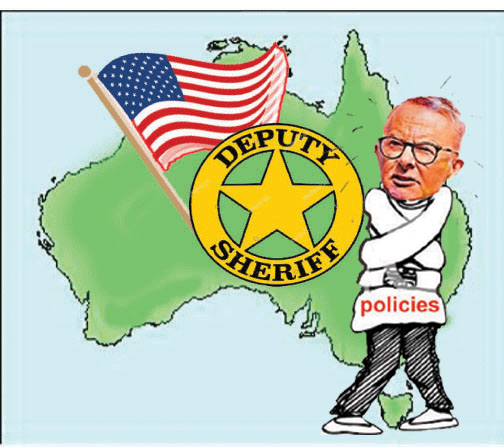
“It’s a wake-up call that can no longer be ignored by the Australian government. It’s now more than time for the Aukus submarine project to be abandoned, and our defence capability to be built in our own interests, not those of a now totally unreliable United States,” Evans said.
Bob Carr says Trump foreign policy presents a ‘colossal challenge’ for Australia and Gareth Evans says the Aukus pact should be reconsidered
Krishani Dhanji and Josh Butler, 13 Jan 26. https://www.theguardian.com/australia-news/2026/jan/12/australia-should-reconsider-alliance-with-fiercely-unpredictable-us-former-foreign-ministers-say?utm_term=69655116eea0abf467c940c50cdab5ac&utm_campaign=MorningMailAUS&utm_source=esp&utm_medium=Email&CMP=morningmailau_email&fbclid=IwY2xjawPdK6FleHRuA2FlbQIxMQBicmlkETFuaUFSaWxJY2FSTlo1T1dLc3J0YwZhcHBfaWQQMjIyMDM5MTc4ODIwMDg5MgABHhrkHcOHn4omPARW4aqaQsheqn-uOz_TJt4rvJlgWOMc7GskLPNWvpqaqFFc_aem_AL6w_5wPn02F0Z9Dqghefg
The Albanese government should urgently reconsider Australia’s alliance with the US, two former Labor foreign ministers have said, as they voiced alarm over Donald Trump’s military intervention in Venezuela and renewed push to claim Greenland.
Speaking to Guardian Australia in the days after the US seizure of Venezuela’s president, Nicolás Maduro, former Labor foreign minister Bob Carr said Trump’s US had become a “fiercely unpredictable” ally, raising a “colossal challenge” for Australia.
Another former Labor foreign minister, Gareth Evans, said he was concerned the US had “zero respect” for international law or the interests of its allies. Evans said the Aukus pact should be reconsidered.
“It’s a wake-up call that can no longer be ignored by the Australian government. It’s now more than time for the Aukus submarine project to be abandoned, and our defence capability to be built in our own interests, not those of a now totally unreliable United States,” Evans said.
After launching airstrikes and a raid in Venezuela that led to the seizure of Maduro earlier this month, Donald Trump has threatened to take over Greenland and has said the US would take action on Greenland “whether they like it or not”.
Australia has not criticised the Trump administration’s actions or rhetoric on Venezuela or Greenland. After the US operation to capture Maduro and moves to capture Venezuelan oil, Albanese said his government was “monitoring developments”, calling for an adherence to international law and a “peaceful, democratic transition” of political power.
Carr, the foreign minister from 2012 to 2013, said it was wise for the government to “keep our head down and watch closely”, adding it was unclear what Trump’s “burst of unilateralism” meant for the world.
“Our US ally is fiercely unpredictable and dedicated ruthlessly to American national interests, without any pretence of being committed to universal values or a global, rules-based order,” he said.
“That is a colossal challenge for Australia and the national security establishment.
“This is an utterly different America than the one that generated our rhetoric about shared values, rules-based order and seeing the world through that lens.”
Carr has used recent posts on social media to suggest “our alliance with the mad politics of the US might have run its course”, adding “goodbye US-led alliance structures”.
Evans, foreign minister between 1988 and 1996, claimed Trump’s recent actions “put beyond doubt that his America has zero respect for international law, morality, and the interests of its allies and partners”.
“The crazy irony of the whole project [Aukus] has always been that it commits Australia to spending eye-watering amounts to build a capability supposed to defend us from military threats which are in fact most likely to arise simply because we have that capability – and are using it to support the US in some conflict not in our interests to engage, without any guarantee of support in return should we ever need it,” Evans said.
Both Carr and Evans have long criticised the Aukus pact, but Evans said recent developments required an urgent rethink about the military agreement.
Penny Wong’s former adviser, Allan Behm, last week wrote that Trump’s short-term tactical success had “come at the expense of the complete destruction of the rules of international behaviour”.
“Australia … has a strong and consistent reputation as an instigator of and contributor to the diplomatic engineering needed when things go pear-shaped, regionally or globally,” he wrote in Guardian Australia. “This is what we need to saddle up for again.”
Trump endorsed the military agreement between the US, Australia and the United Kingdom when he met with Albanese in Washington in October. Aukus was put under review by the Pentagon after the Trump administration was sworn in. Australia has pledged more than $4.5bn towards building US shipbuilding capacity.
The US government separately withdrew from 66 international organisations and treaties in January, including UN commissions on peace keeping and international law.
Zionist Billionaires Openly Acknowledge Manipulating The US Government.
Caitlin Johnstone, Jan 19, 2026, https://www.caitlinjohnst.one/p/zionist-billionaires-openly-acknowledge?utm_source=post-email-title&publication_id=82124&post_id=185023681&utm_campaign=email-post-title&isFreemail=true&r=1ise1&triedRedirect=true&utm_medium=email
Speaking together at the Israeli-American Council Summit on Saturday, billionaire Zionist megadonors Miriam Adelson and Haim Saban strongly implied that they are engaged in some extremely shady activities to manipulate the US government in advancement of Israeli interests.
There’s a guy I follow on Twitter named Chris Menahan who’s always posting clips from Zionist events which might otherwise go unnoticed, frequently turning up jarring admissions from pro-Israel operatives who tend to loosen their lips a bit when addressing an audience of like-minded individuals. I recently cited a clip he spotted featuring former Obama speechwriter Sarah Hurwitz decrying the way social media has allowed the public to view evidence of Israeli atrocities in Gaza.
Menahan has spotlighted some very revealing moments from Adelson and Saban, both of whom are dual US-Israeli citizens, and both of whom have provided funding to the Israeli-American Council (IAC). In 2014, The Nation’s MJ Rosenberg wrote that Saban and Miriam Adelson’s late husband Sheldon were using influence operations like the IAC to become “the Koch brothers on Israel.”
Here’s a transcript of a very revealing interaction between Adelson and event host Shawn Evenhaim:
Evenhaim: Miri, you and Sheldon created a lot of relationships over the years with politicians, at the state level, and especially at the federal level. I want you to share with everyone why is it so important and how you do it, and again, writing cheques is a part of it, but there is more than writing just cheques so, how do you do it?
Adelson: Shawn, can you allow me not to answer?
Evenhaim (shrugs): You choose!
Adelson: I want to be truthful and there are so many things that I don’t want to talk about.
Evenhaim: Yeah, I mean we don’t want specifics but that’s okay.
Miriam Adelson is here admitting that in addition to the hundreds of millions of dollars that she and Sheldon are known to have poured into the political campaigns of Donald Trump and other Republican politicians, they have also been manipulating US politics behind the scenes in ways that she would prefer to keep secret from the public. Presumably because it would cause a significant scandal if the public ever found out.
Trump, for the record, has repeatedly admitted that he provided political favors to Israel at the urging of the Adelsons during his first term, saying he moved the US embassy in Israel from Tel Aviv to Jerusalem and legitimized the Israeli annexation of the Golan Heights in order to please them.
And please them he did. He must have, because Miriam Adelson donated another $100 million to Trump’s 2024 campaign to help him become president again. And now he’s spent the first year of his administration bombing Iran and Yemen, working to take control of Gaza, and aggressively stomping out criticism of Israel in the United States.
Back in 2020, before all these blatant admissions, musician Roger Waters was smeared as an antisemite by the Anti-Defamation League and other Zionist groups for saying that Sheldon Adelson was using his wealth to exert influence over US politics.
Saban was even more guarded about his political operations than Adelson in his response to the same question from Evenhaim:
“I want to be cautious how I’m saying… (Pause) It’s a system that we did not create. It’s a system that’s in place. It’s a legal system and we just play within the system. And that’s it! I mean it’s really quite simple. If you support a politician, you, under normal circumstances, should have access to be able to share opinions and try to help them see your point of view. That’s what access grants you, and the contribution and the financial support grants you the access, sooooo… I mean…. (shrugs) those that give more have more access and those that give less have less access. It’s a simple math. Trust me.”
Haim Saban, whose campaign donations focus on the other side of the aisle with Democratic Party funding, has famously said “I’m a one-issue guy, and my issue is Israel.” In 2022 AIPAC’s superpac cited Saban’s financial clout to argue that deviating from support for Israel would cost the Democrats critical funding, saying “Our activist donors, who include one of the largest donors to the Democratic Party, are focused on ensuring that we have a U.S. Congress that, like President Biden, supports a vibrant and robust relationship with our democratic ally, Israel.”
As with Adelson, we can surmise that Saban said he wanted to be “cautious” how he described his influence operations because it would cause a major scandal if the American people understood what he’s been up to.
Some people will look at these clips and claim it’s antisemitic to even share them. Others will look at them and cite them as evidence that the world is ruled by Jews. For me they’re just evidence that the world is ruled by wealthy sociopaths, and that western democracy is an illusion.
I mean, you really couldn’t ask for a better illustration of the sham of American democracy than this. Two billionaires from supposedly opposite political parties publicly admitting that they use their obscene wealth to manipulate US politics to advance the military and geopolitical agendas of a foreign state on the other side of the planet.
And as Saban said, it’s all legal. Corruption is legal in the United States of America. Plutocrats are allowed to leverage their fortunes to manipulate the US government using campaign funding and lobbying for the advancement of their personal, financial, and ideological agendas. If you have a few million dollars to spare you can use them to make criminal charges go away, to roll back environmental regulations or worker protections which hurt the profit margins of your business, or even to get military explosives shipped to a foreign government for use in an ongoing genocide.
And it’s all being done with complete disregard for the will of the electorate. The American people have no control over what their government does under the current political system. They vote for one oligarchic puppet, then they vote for the oligarchic puppet in the other party when that doesn’t work out, going back and forth without realizing that at no point are they changing the actual power structure under which they live.
That power structure is called plutocracy. That’s only real political system the United States has.
Sussan Ley tries to rewrite history
19 January 2026 AIMN Editorial, Palestine Action Group, https://theaimn.net/sussan-ley-tries-to-rewrite-history/
Today has witnessed a new low in the sickening attempt by some politicians to exploit the horrific massacre at Bondi in order to attack the mass protest movement in which hundreds of thousands of people have marched against the genocide in Gaza.
Opposition leader Sussan Ley, in particular, made a speech filled with obscene misinformation and outright lies. The complete abandonment of any commitment to the truth is a deeply worrying lurch toward the kind of politics Donald Trump has unleashed in the US.
Any suggestion that the Bondi massacre can be blamed on the millions of Australians who have opposed Israel’s genocide in Gaza is baseless, preposterous, hate-filled and hypocritical. There is no evidence of any link whatsoever. ISIS does not support the Palestinian cause, and all available evidence points to the killers being radicalised several years before 2023 or the Harbour Bridge March for Humanity.
The Palestine solidarity movement has always stood firmly and explicitly against antisemitism, and has since the very beginning been organised alongside Jewish people, who have marched in their thousands against the Israeli regime. In Sydney, almost every protest we have held for the past two years has been co-sponsored by Jews Against the Occupation ‘48, and featured Jewish speakers and MCs.
Antisemitism did not march on our streets, bridges and landmarks, nor did it camp in our university quadrangles, and not a shred of real evidence has ever been produced for such claims. On the incredibly rare occasions when genuine antisemites have tried to participate in our movement, they have been unanimously denounced and excluded. The same certainly cannot be said of the Liberal Party, or the Murdoch and other press outlets pushing these claims, who have often supported far right movements led by actual neo-Nazis.
Sussan Ley despicably ties the mass anti-genocide movement to firebombings of places of worship – attacks which the NSW Police and AFP have detailed were carried out by criminal elements, perhaps coordinated by someone in Iran. In other words, nothing to do with the protest movement!
Like others making such blatantly dishonest claims, Sussan Ley has supported the worst possible act of racist violence: genocide. Ley gives the impression she would like it to be a criminal offence to oppose the crimes of the state of Israel. She also seeks to weaponise one form of racism, antisemitism, to whip up another: Islamophobia. This is despicable politics and must be rejected by all who want to uphold universal principles of anti-racism, let alone a basic commitment to factual and rational debate.
Outside the Canberra bubble dominated by politicians, lobbyists and media executives, the fact that Israel has committed a genocide in Gaza is now an incontrovertible fact, confirmed by all human rights organisations and experts. Well over 100,000 Palestinians are estimated to have been massacred and starved to death since October 2023. This is why millions have marched, not because they hate Jews, but because they are against possibly the biggest racist atrocity of the 21st century, carried out by the state of Israel. And this is why they will continue to march, as Israel’s occupation and genocide of Gaza continues.
Betrayed: How Liberals Supported Islamic Revolution in Iran in 1979 and Turned Against the Progressive Shah.

COMMENT. This is a terrific article, much needed, and the original is richly illustrated.
It does set the record straight on the Shah, who basically ran a pretty decent system, and liberated women.
One thing to mention. The USA helped with manipulation to put the Shah into power, but later decided he wasn’t compliant enough. When he wanted to get nuclear power, that was the last straw, and the USA helped manipulate him out again
The Left’s Lethal Miscalculation Still Goes On!
SL Kanthan, Jan 19, 2026, https://slkanthan.substack.com/p/betrayed-how-liberals-supported-islamic?utm_source=post-email-title&publication_id=844398&post_id=184864947&utm_campaign=email-post-title&isFreemail=true&r=1ise1&triedRedirect=true&utm_medium=email
History repeats itself and rhymes in uncanny ways. And there are profound contradictions in political ideologies. The partnership of liberals and right-wing fundamentalist Islam is one of those phenomenon that would leave any objective thinker immensely confused.
Let’s look at the Islamic Revolution in Iran in 1979, where liberals and communists joined forces with religious leader Khomeini to overthrow the progressive but authoritarian Shah, under whom Iran made astonishing progress in terms of economy, modernization and social justice. Of course, immediately after coming to power, Ayatollah Khomeini crushed the Marxists and anyone remotely considered liberal.
Fast forward to 2026, Western liberals are generally very pro-Iran, and many of them are staunchly supporting the current theocratic government that is putting down the nationwide protests with brute force. Khamenei has admitted that “thousands” of protesters have been killed, but he blames the victims for sedition.
The photos and videos of body bags of dead Iranian protesters left to rot on the ground have not changed the opinion of liberal social media influencers.
Western liberals now are driven by the same motive as the Iranian liberals in the 1970s — that is, anti-imperialism and anti-Americanism. Anti-Zionism is also a major factor now.
However, such blind ideology leads to a situation where the cure is much worse than the disease. Let’s dive in.
Shah, the Progressive Leader
The Shah of Iran – Mohammad Reza Pahlavi – would be considered a leftist role model these days!
He did things that would make Mao Zedong cheer — for example, the Shah ended feudalism, took lands away from the landlord, and distributed the land to 1.5 million farmers. That helped about 9 million Iranians, a third of the population.
The Shah of Iran emancipated girls and women and did admirable things. Consider these:
- By 1979, 33% of the university students in Iran were women. That’s an astonishing number in the Middle East.
- There were 22 female ministers in the Iranian parliament.
- Iranian women were doctors, judges, professors and so on.
- How did the Shah achieve it? It was not easy. Here’s how he did it:
- The Shah made education free and compulsory for all Iranian girls (and boys) — up to the age of 14. Also, poor children were provided a free meal in schools.
- Reza Pahlavi built thousands of schools all over Iran, especially in rural areas.
- He abolished child marriage and raised the age to 18.
- He gave Iranian women the right to vote in 1963 — eight years ahead of Switzerland!
- Reza Pahlavi cracked down on Sharia law that limited women’s potential. His father, the first Shah, had already banned chador, the Iranian version of burqa.
- He gave Iranian women equal rights in marriage, divorce and custody. The Islamic laws were quite misogynistic.
In 1962, the Shah of Iran came to the US with his wife and met with President JFK.
The two really clicked, and the Shah was impressed by Kennedy’s Peace Corps. So, the Shah went back home and created a Literacy Corps and Health Corps to have young well-educated Iranians volunteer as teachers and doctors in rural Iran. It was also a bit like Mao’s “barefoot doctors,” but more modern and sophisticated.
Modernization of Iran Under Pahlavi Dynasty — “White Revolution”
Under the Shah and his father (the first king of the Pahlavi Dynasty), Iran made astonishing progress.
- Iran’s GDP grew a stunning 700-fold between 1925 and 1975! The per-capita income grew 200 times!
- Between 1960 and 1976, the real GDP — adjusted for inflation — grew an astonishing 5-fold.
- Between 1948 and 1978, the constant PPP GDP-per-capita grew from $250 to nearly $10,000.
Iran used to be a poor and an illiterate country divided by ethnic and religious identities. In 1925, a quarter of the population was nomadic. Infrastructure was terrible, manufacturing was negligible (except for artisans like those making Persian rugs) and there was no real military.
Under the two visionary Shahs (1925-1941 and 1941-1978), Iran underwent massive modernization. Initially, the private sector did not have enough money or the rich Iranians were not interested in factories, since they could make easy money from imports. Thus, Reza Pahlavi’s government encouraged public-private partnerships, co-invested in numerous factories, raised tariffs on imports, and made Iran self-sufficient in many areas.
Father and the son Shahs electrified villages and built massive infrastructure to connect various parts of Iran — like the Trans-Iranian railway, which is still an engineering marvel in some regions. The Shah helped create joint ventures for auto manufacturing and Iranian cars (like “Paykan”) for the first time. Iran Air was flying (often non-stop) to global hot spots like New York, London, Paris, and Tokyo!
- Under the Shah, a vast majority (60%) of the oil revenue was spent on improving Iran’s transportation, infrastructure and industrialization.
- Iran had no military before the Pahlavi Dynasty. However, by the 1970s, Iran had the most powerful military in the Middle East.
Iran under the Shah also had smart and pragmatic foreign policy. The Shah was greatly liked by the US and the West. Yes, it was geopolitics of the Cold War, but Iranians benefited from the US-Iran relations.
In 1962, the Shah of Iran visited the US and had an amazing ticker-tape parade on Broadway Street in Manhattan, New York City.
“CIA Puppet and SAVAK”
Two of the criticisms about the Shah are that “he was installed by the CIA after the 1953 coup” and that his secret intelligence group SAVAK was brutal and cruel. Let’s explore:
- The CIA coup in 1953 did NOT install the Shah, who came to power in 1941. Yes, his father went into exile when the Brits and the Russians invaded Iran; and he was placed on the throne at the age of 21.
- Fast forward to 1953, Iranian Prime Minister Mossadegh — who had become too powerful — had nationalized the oil sector two years earlier. Powerful Western oil interests and deep state (MI6/CIA) colluded to get rid of Mossadegh. The Shah had fled the country for only 3-4 days.
- This is just a matter of survival in politics and geopolitics. It was a partnership of shared values, although the US definitely and obviously was the more powerful one in the relationship. The Shah eventually became so independent that the US/West secretly supported Khomeini. Recently declassified US diplomatic cables show that the Carter administration had extensive contacts with Khomeini, and basically told the Iranian military to stand down.
- As for SAVAK, it was created in 1957 by the Shah with the help of the British and American intelligence to prevent further coups or the rise of extremists like communists and religious terrorist groups. Remember that the USSR was meddling a lot in the Iranian affairs. And SAVAK did operate outside the law, engaged in spying, arrests, torture etc.
- But guess what happened after the Islamic Revolution? SAVAK was not dismantled, but simply renamed as SAVAMA! In fact, the deputy chief of SAVAK – General Hossein Fardoust – became the head of SAVAMA. All the infrastructure, files, intelligence, torture methods, along with most intel agents continued under Khomeini.
So What Underpinned the 1979 Revolution?
If the Shah was so great, as I have argued, why did was he overthrown in the 1979 revolution?
Well, a whole slew of incompatible radicals and disgruntled groups got together in a strange alliance. The common excuse is that the Shah was authoritarian. However, if the Shah had been as tyrannical as the current government, he would have survived. But let’s take a look at the opposition:
- Islamic clergy — The mullahs were the #1 instigator, since they had lost a lot of their power and wealth in a secular society. Their hatred for the Shah and his father was intense. Some of the Shiite extremist groups like Fadayan-e Islam even assassinated Iranian Prime Ministers (four, to be precise!)
Socialists and Communists — The leftists were a small group in Iran since the 1920s. But when the USSR and the British joined to attack and defeat Iran in 1941, communism spread quickly. A communist political party known as Tudeh was founded in 1941. (Ironically, it was crushed by Khomeini! More on that later). The Soviet Union secretly funded the communists; and openly spread anti-Shah propaganda through newspapers and radio stations (operated out of Azerbaijan). Tudeh had a vast following, especially in trade unions; and quite a few military officers secretly belonged to the party. The communists kept demanding higher wages, even though the Shah passed laws for industrial workers to get 20% of corporate profits. These extremists wanted a communist Iran, and nothing else would satisfy them.
College Students — Khomeini really hated them! These spoiled kids were the clueless and idealistic group, which dreamed of democracy and freedom from imperialism, although they were very Westernized. Not much different from the current liberals, who live in the US but spend all day demonizing the US.
All these people had underestimated the religious fundamentalists. Some naively thought a religious person would never lie! And they all thought the religious poor were too harmless or incompetent to take over the leadership. In the desperation to beat the Shah, none of these groups used their brain. They missed all the red flags and projected their fantasy into Khomeini, who despised them.
How Ayatollah Khomeini Back-stabbed Communists, Liberals & Women
Consider the timeline:
Jan 16: The Shah of Iran leaves Iran, unwilling to push the country into a civil war.
Feb 1: Khomeini comes to Iran after exile. He had spent the last few weeks in France
Feb 11: Khomeini becomes the new leader of Iran.
March 7: Mandatory hijab law gets passed.
March 8: Liberal women stage a massive protest, but their new “friend” turned out to be far more totalitarian than the Shah.
What did Khomeini do to women?
- He systematically reversed much of the Shah’s contribution to women’s liberation.
- Khomeini introduced Sharia laws, made hijab mandatory, segregated public places (men v. women), reduced marriage for girls from 18 to 9 (!), banned women from being judges and other key roles, banned women from sports stadiums, banned women from singing or dancing and so on.
- Remember how the Shah raised marriage of girls to 18? The “Supreme Leader” of Iran reduced the age to 9. Nine!
Khomeini and his followers were brutal in enforcement. Women who did not wear a hijab or “dress modestly” were beaten, stoned, and sometimes attacked with acid that would disfigure their face. The Iranian parliament passed a law that women without hijab could face 72 lashes.
The obsession with hijab still goes on, although in the last 3-4 years, the government has relaxed a bit in Tehran. In 2016, Iran’s top chess player – Dorsa Derakhshani – left Iran because she was banned from the national team for not wearing a hijab or wearing “tight jeans.” There have also been many cases of men throwing acid on women’s faces for not dressing properly — like Marziyeh Ebrahimi in the photo below [on original]
Khamenei’s morality police have harassed, beaten up and arrested countless women for not dressing properly. Young Iranians are arrested for singing or dancing on Instagram or other social media. Last year, a woman (Parastoo Ahmadi) was arrested for live streaming her singing. It was a beautiful and classy performance but women cannot sing in public under Islamic laws! See below: [on original]
How did Khomeini attack the students?
Khomeini shut down the universities for nearly three years, starting from 1980! He fired or arrested all the leftist professors and student leaders. Some were even executed. All the leftist newspapers on campuses were shut down — by brute violence. The entire college curriculum was rewritten to be Islamic. Courses in music and other topics were banned. Soon, Western movies were banned and movie theaters were closed. Alcohol was banned, needless to say.
How did Khomeini attack the communists?
Tudeh, the communist party, had survived 38 years under Shah, even though he was harsh on them, since they were more pro-Soviet than pro-Iran. However, the party did not even last five years under the Islamic Republic. In 1984, the leader of the communist party – Noureddin Kianouri – was tortured and forced into confession, broadcast on TV.
Another Marxist-Leninist group was the OIPFG, a violent underground guerrilla organization that worked against the Shah and supported the Islamic revolution. These clowns were also ruthlessly crushed by Khomeini.
Khomeini eliminated all opposition groups, including the National Front, which was founded by Mossadegh, the man who nationalized the Iranian oil industry in 1951 and is still idolized by Western liberals.
The regimes of Khomeini and Khamenei have continued to be unrepentantly repressive for 47 years.
In 1988, for example, up to 30,000 political prisoners — all of whom once helped overthrow the Shah — were executed over a period of three months. These belonged to the MEK, Tudeh and Fedayeen, who were all deemed to be guilty of “crimes against Allah.”
End of the Shah
The Shah left Iran on Jan 16, 1978, partly because he was already sick with cancer, and partly because he didn’t want to plunge the nation into a bitter civil war. The US didn’t even the decency to let him at first. So, he went to Morocco, Panama, the Bahamas etc. Eventually, he was admitted into a hospital at Cornell in late 1978. A few months later, he died in exile in Egypt.
Hostile and Irrational Foreign Policy of the Islamic Republic
There is a golden mean between being a total puppet of the USA and being an uncompromising enemy of the USA. However, the rabid religious in Iran lack such a nuanced approach that arises out of geopolitical maturity.
In 1979, the Shah went to the US for cancer treatment. Rather than focusing on governance of the new nation, the Islamists wanted to kill the Shah, and demanded the US to send him back to Iran. When the US refused this barbaric demand, Khomeini’s radical students stormed the US embassy in Tehran and took 52 American civilians hostage for 444 days. During this time, the Americans were tortured and humiliated in shocking ways.
This needless and uncivilized action by Khomeini set the US and Iran on a collision path. Obviously, the country that has suffered more in this conflict is Iran.
Furthermore, the delusional Ayatollahs wanted to spread their “revolution” and expand their sphere of influence. Thus, they armed and funded Hezbollah in Lebanon, Hamas in Gaza, Houthis in Yemen, Shiite militias in Iraq etc. Then, the Iranian government cries about US interference or attempts to do a regime change in Iran.
Conclusion
History is written by winners… and sometimes by losers. In Iran’s case, the US didn’t want to admit that it made a mistake, so Mohammad Reza Pahlavi Shah was demonized. “We let the bad guy fall, so don’t feel too bad.”
And Western liberals have a strange affinity for right-wing Islamic fundamentalism. Perhaps it comes out of guilt about imperialism, colonialism, Zionism, and endless wars in the Middle East. Not to mention political correctness, which disrupts critical thinking.
90 million Iranians are suffering because of the religious hardliners, for whom compromise is a dirty word. Even after the death of thousands of protesters over the last decade, the government has not agreed to change one policy. The people don’t have many basic political, economic, social or personal freedoms.
One of the Shah’s son hopes to be return to Iran and restore the old glory along with democracy. It really depends on the US/EU since the Iranian people themselves cannot fight back or change the status quo.
Anyways, hope you found this article useful and interesting. There are no simple truths in geopolitics, but it’s good to have different perspectives .
How Did Australia Get Here?
19 January 2026 Michael Taylor AIM Extra, https://theaimn.net/how-did-australia-get-here/
For the first time in Australian political history, Pauline Hanson’s One Nation Party is polling higher than the Liberal–National Coalition.
Let that sink in.
A party that thrives on fear, resentment, and division – a party built on racism, dog-whistling, and grievance politics – is now outperforming the mainstream conservative alternative. This is not a curiosity. It is a warning.
And it forces a confronting question: how did Australia get here?
The uncomfortable answer is that this moment has been years in the making.
One Nation’s rise is not primarily a story about Pauline Hanson. It is a story about political failure – particularly the failure of the major parties to speak honestly to Australians about economic insecurity, social change, and the forces reshaping their lives.
When people feel unheard, they don’t always become thoughtful. Often, they become angry.
The LNP Opposition has offered little more than cultural skirmishes and imported American talking points. Instead of articulating a serious, coherent alternative vision for the country, it has drifted between silence and performative outrage. Leadership has been replaced by mimicry. Policy has been replaced by posture.
Into that vacuum steps One Nation – loud, simple, and shameless.
The party offers certainty in an uncertain world. It points fingers. It names enemies. It promises easy answers to complex problems. And for some voters, that is enough.
Australia has also absorbed something corrosive in recent years: the tone and tactics of Trump-style politics, without the institutional guardrails or civic culture to blunt their impact. Conspiracy thinking, contempt for expertise, hostility to minorities, and the fetishisation of “strength” over decency have all found a home here.
One Nation didn’t invent this climate – it exploits it.
Media ecosystems that reward outrage over accuracy have played their part. When anger is monetised, when fear drives clicks, and when minorities are framed as threats rather than neighbours, extremist parties don’t need to persuade – they simply wait.
What makes this moment especially troubling is that One Nation is not shy about what it stands for. Its history of racist rhetoric, its hostility to First Nations Australians, its flirtation with authoritarian leaders, and its open admiration for Donald Trump are not hidden. They are features, not bugs.
That a growing number of Australians are willing to look past – or even embrace – those traits should alarm anyone who cares about social cohesion.
This does not mean Australia has suddenly become a hateful country. But it does suggest that we have become more tolerant of cruelty, more cynical about politics, and more willing to excuse prejudice when it is wrapped in the language of “common sense” or “telling it like it is.”
The greatest danger is not that One Nation will ever form government. It won’t.
The danger is that its ideas seep into the mainstream – softened, laundered, and normalised by larger parties chasing votes instead of values. History shows that democracies don’t fail overnight. They erode gradually, as the unacceptable becomes familiar and the outrageous becomes routine.
If a party built on division can now outpoll a major party, then the real question is no longer about Pauline Hanson.
It’s about us.
What kind of country do we want to be – and what are we prepared to tolerate in the meantime?
The War On Free Speech In Australia Is Getting Cartoonishly Absurd.
Caitlin Johnstone, Jan 17, 2026, https://www.caitlinjohnst.one/p/the-war-on-free-speech-in-australia?utm_source=post-email-title&publication_id=82124&post_id=184831756&utm_campaign=email-post-title&isFreemail=true&r=1ise1&triedRedirect=true&utm_medium=email
A mentally disabled Australian woman is being prosecuted for antisemitic hate crimes after accidentally pocket-dialing a Jewish nutritionist, resulting in a blank voicemail which caused the nutritionist “immediate fear and nervousness” because she thought some of the background noises in the recording sounded a bit like gunshots.
We’re being told we need more of this. There’s “hate speech” legislation presently in the works to make this worse. Australia’s controversial Combatting Antisemitism, Hate and Extremism Bill appears to be explicitly crafted to dramatically increase the scale, frequency and consequences of the exact sort of dynamics we’re seeing in this case, and to eradicate opposition to Israel throughout the nation.
This is how overextended Australia’s freakout over “antisemitism” already is. You can literally just be sitting there not saying or doing anything and still find yourself getting arrested and prosecuted for an antisemitic hate crime. They have the authority to do this presently, under the laws that already exist. The argument for this bill is that our present horrifyingly tyrannical and abusive system is insufficiently authoritarian and tyrannical, and that prosecutors need more power to police speech far more forcefully.
Australians are being asked to trust a system that would take a woman with an intellectual disability to prosecution in a court of law over an accidental butt-dial to a person of Jewish faith with the authority to send people to prison for years over their political speech. And this is happening after we just spent years watching Australian authorities roll out authoritarian measures to stomp out criticism of Israel and quash protests against an active genocide.
This is madness, and it needs to be brought to a screeching halt. Immediately. This entire country has lost its damn mind.
The Bondi attack isn’t the reason, it’s the excuse. All these laws being rolled out to stomp out criticism of Israel in Australia were sought for years before the shooting occurred.
Immediately after the attack last month I tweeted, “Not a lot of info about the Bondi shooting yet but it’s safe to assume it will be used as an excuse to target pro-Palestine activists and further outlaw criticism of Israel in Australia, as has been happening to a greater and greater extent in this country for the last two years.”
They could have proved me wrong, but instead they’ve spent this entire time proving me one hundred percent correct. The frenzied efforts to crush anti-genocide protests and silence speech that is critical of Israel and Zionism in these subsequent weeks has plainly established this.
There is no connection between pro-Palestine demonstrations and the Bondi attack. None. It had nothing to do with Palestinians, and it had nothing to do with anti-genocide demonstrations. It’s a completely made-up claim that Israel’s supporters have been circulating in Australian consciousness through sheer repetition. They’re just pretending to believe it’s true in order to promote the information interests of a genocidal apartheid state.
Israel’s supporters need to use propaganda, deception, censorship and oppression to promote their agendas, because it’s all they have. They don’t have truth. They don’t have arguments. They don’t have morality. All they have is brute force. They are shoving support for Israel and its atrocities down our throats whether we like it or not, and if we refuse what we’re being force-fed they will punish us. That’s the only tool in their toolbox.
This needs to be ferociously opposed. The more Israel and its supporters work to assault our right to oppose their abuses, the more aggressively we need to oppose them. We are no longer fighting against war and genocide in the middle east, we are fighting against an assault on our own civil rights. It’s personal now. They’re coming for us directly.
The non-corporate nuclear news this week

Some bits of good news –Ocean treaty “a landmark victory” for the high seas.
Australia is getting a new national park. Montana Program Makes Youth Offenders Talk with Their Victims and Recidivism Plummets.
TOP STORIES
Trump’s foreign policy: “I don’t need international law because I’m not looking to hurt people”
Caitlin Johnstone: You Know They’re Lying About Iran.
The New German Warfare State.
Who is to blame for blocking a new ‘golden era’ for nuclear power?
Democratic Leaders Silent on the Impeachment of Donald Trump.
This Nuclear Renaissance Has a Waste Management Problem. Nuclear power’s hidden $1 trillion problem – https://www.youtube.com/watch?v=QKIaRg3SdTw
The Coalition of the Willing has achieved nothing.
Climate. Results are in for one of the clearest measures of global heating in 2025– It should be raising alarm bells.
Noel’s notes. The new world of journalism. Raw, Rude, and Angry – in the new world of journalism.
AUSTRALIA. The War On Free Speech In Australia Is Getting Cartoonishly Absurd. Aftermath of the Bondi massacre. Political Futures: Stronger Progressive United Front to Broaden the Hate Speech Legislation.
The biggest Propaganda Campaign in Australian History? The West Report .
Australia’s Response to US Intervention in Venezuela.
Clearas a bell. Australia’s Geopolitical Tightrope.
NUCLEAR RELATED ITEMS.
| ART and CULTURE. Dazed and confused in North America. |
ATROCITIES.
100 days into ceasefire Gaza still deliberately deprived of water as aid groups forced to scavenge under illegal blockade . Here’s who really weaponizes children in the Russia-Ukraine conflict.
ECONOMICS.
- How New Venezuela President Will Save Us from Trump’s Crazy. Oil Companies Are Key Partners in Trump’s Imperial Plans for Latin America.
- Ontario Power Generation seeks rate increase for electricity from nuclear plants- ALSO AT https://nuclear-news.net/2026/01/16/1-b-1-ontario-power-generation-seeks-rate-increase-for-electricity-from-nuclear-plants/ Ontario utility wants to double the asking price of nuclear, while US wants reactors on the moon.
- Donald Trump calls for emergency energy auction to make tech giants pay for AI power.
- TerraPower and Meta partner on Natrium nuclear plants.
| EMPLOYMENT. Fears raised that specialist Vulcan MoD work could shift to Sellafield |
| ENERGY. Wind is certainly not the only renewable power source in Scotland. |
| ETHICS and RELIGION. The Flotillas to Gaza Are the World’s Conscience. |
| EVENTS. 31 January. London Challenging the War Machine – https://secure.declassifieduk.org/page/180663/event/1 |
| INDIGENOUS. Navajo lands at risk |
| LEGAL. Militant Zionist Group Ceasing Operations In New York FollowingSettlement with Attorney General. Challenge to Latest Sellafield Discharges to the Rivers Calder, Ehen and the Irish Sea. |
| MEDIA. Billionaire’s Mouthpiece Searches for Reasons to Avoid Taxing Billionaires.Whitewashing U.S. barbarism by smearing Russia and China. Genocide isn’t a mistake- Which is why the media can’t tell you the truth about Gaza. “Another Monroe Doctrine”: Journalists Warn U.S. Strikes on Venezuela Signal a New Era of Intervention. The plastisphere: a world choked by plastic. |
POLITICS.
- Trump names son-in-law, Rubio, Blair to Gaza ‘Board of Peace’. Founders of Deadly Gaza Humanitarian Foundation (GHF), ‘Shaping’ New US-Backed Administration for Gaza: Report.
- Reza Pahlavi vows to recognise Israel, end nuclear programme if he led Iran.
- Spectral Threats: China, Russia and Trump’s Greenland Rationale.
- Senate Republicans edging toward War Powers Resolution to curb Trump’s crazed Venezuelan war. Senate rejects Trump’s military threats against Venezuela with war powers vote.
- Sanctions, Strategy and Spin: Venezuela Lobbying Soars Under Trump.
- ‘Uninvestable’:Oil execs rebuff Trump’s demands for $100bn investment in Venezuela.
- Zelensky makes another move to avoid election.
- Do the Democrats Have the Guts to Outflank Trump on Defense Industry Looting?
- Spending big on nuclear.
- Sizewell C injects nearly £1bn of tax-payers’ money into East of England as construction hits two-year milestone.
- ‘Wall of money’ to invest in Scottish nuclear power if Labour win election.
POLITICS INTERNATIONAL and DIPLOMACY. President Trump Urges Iran Protests To Continue, Says ‘Help Is on Its Way’.
Is the U.S. preparing to install another Shah to run Iran as a U.S. puppet?
You Can’t Cheer For Regime Change In Iran Without Also Cheering For The US Empire.
Netanyahu Is Visiting Trump For The FIFTH Time This Year, And Other Notes.
“Condemning US imperialism for its illegal invasion and violation of sovereignty.”- ALSO AT https://nuclear-news.net/2026/01/13/2-b1-condemning-us-imperialism-for-its-illegal-invasion-and-violation-of-sovereignty/
Russia says it awaits US response on ‘important’ issue of expiring nuclear treaty.
Somaliland: Longtime Zionist Colonisation Target.
It’s time to stop talking about the “denuclearization of the Korean Peninsula” and instead focus on halting U.S. militarism in the region.
| SAFETY. Chubu Electric to Face On-Site Probe over N-Plant Data Fraud. Bill Gates-backed‘Cowboy Chernobyl’ nuclear reactor races toward approval in Wyoming. |
| SECRETS and LIES .Chubu Electric’s data fraud ‘undermines’ Japan’s nuclear energy policy .Revealed: The CIA-Backed Think Tanks Fueling The Iran Protests. From Musk to TikTok: How AI Fakes Fueled a Disinformation Frenzy Around Maduro. Candid Imperialism: Trump, Racketeering and Venezuelan Oil. HOW ONTARIO KEEPS THE TRUE COST OF NUCLEAR POWER OFF YOUR HYDRO BILL. The Nobel Peace Prize, Re-Gifted (Peace Through Strength™ Edition). |
WAR and CONFLICT.
- US Surging Military Assets To the Middle East To Prepare for War With Iran After Trump Postpones Attack
- On the Eve of Destruction: Has His Majesty’s Madness for War Led His Loyal Supporters Astray?
- Cuba Vows to Defend Itself Against Trump to ‘The Last Drop of blood.
- Venezuela today.- Greenland tomorrow?
- Biden knew Ukraine would lose proxy war with Russia….provoked it anyway.
WEAPONS and WEAPONS SALES.
- British Ministry of Defense developing ballistic missile for Ukraine to make “deep strikes into Russia”.
- Report: Military Tells Trump It Needs More Time to Prepare for War With Iran.
- ‘Vomiting blood’: Witness claims US used powerful mystery weapon during Maduro raid.
- New owners of Canadian Nuclear Laboratories have extensive nuclear weapons connections.
- Lost Opportunities toHalt Rising Military Spending.
- Faslane nuclear base tugboats may be built in China.
On the Eve of Destruction: Has His Majesty’s Madness for War Led His Loyal Supporters Astray?

The Australian Connection: The Mirror of Suppression
As we look at the suppression of speech in Australia, the parallels are chilling. The “Public Assembly Restriction Declarations” (PARD) in Sydney, ostensibly to “ensure safety” after the Bondi tragedy, are being used to silence those protesting the US attack on Venezuela.
In Canberra, the “Combatting Antisemitism, Hate and Extremism Bill” is a masterclass in Orwellian doublespeak. Ostensibly targeting hate, its sweeping powers could just as easily silence critics of US wars or Israeli apartheid. And with a loophole for religious scripture, it may even protect the very extremists it claims to combat.
15 January 2026 David Tyler, https://theaimn.net/on-the-eve-of-destruction-has-his-majestys-madness-for-war-led-his-loyal-supporters-astray/
The Persian Gulf is no longer a tinderbox; it is an inferno. Just this morning, President Trump of the USA and Venezuela, as he now styles himself, has effectively issued a declaration of intent, telling Iranian protesters that “help is on its way.” Is that a threat or a promise? Survivors remember US help last time. But as B-2 bombers warm their engines and squadrons of Israeli Adir, as they call their versions of F35s, stealth fighter jets, sit fuelled on the tarmac, we must pull back the curtain on the “spontaneous” uprising that serves as the pretext for this looming catastrophe.
The Hand of the Provocateur
The economic misery of Iran’s people is raw and real; the rial has lost around four-fifths of its value since the June 2025 war; inflation is crippling. But the timing of this chaos cannot be ignored. Tehran is right to point to the meddling of foreigners. When former CIA Director, Mike Pompeo, tweeted a “New Year” greeting to “every Mossad agent walking beside” the protesters, the mask wasn’t just slipping; it was discarded.
History repeats as farce: just as the CIA orchestrated the 1953 coup in Tehran by paying mobs to riot, today’s agents provocateurs are reportedly steering protesters toward IRGC outposts and banks. Iranian state media has showcased confessions from alleged Mossad agents, while reports of 40,000 Starlink terminals smuggled into the country by the CIA and Mossad lend credence to Tehran’s narrative; even as the protests’ roots in economic despair remain undeniable.
The CIA may have wasted its time with the Starlink. Iran has successfully disrupted 80% of Starlink service using military-grade GPS jamming; the first regime to effectively cripple what was thought to be “unjammable” satellite internet
Iran accuses the CIA of creating a level of “state-directed” “massacre” that provides the moral high ground for a “Humanitarian Strike.” The irony could not be any darker. The US mission is to save lives. Even if their agents have to shoot every protester themselves to create the pretext for a US-Israeli attack.
Iran’s Foreign Minister, Abbas Araghchi claims Trump’s warning of military intervention motivated “terrorists” to target protesters and security forces to encourage foreign intervention. Translation: he’s alleging provocateurs are shooting people deliberately to justify Trump’s promised intervention.
“Protesters are speculating” – CNN reports: “protesters are speculating whether the violence is being fuelled by the Iranian regime itself, or by foreign powers.” In the digital blackout, any atrocity can be committed and blamed on anybody. Qatari state broadcaster, Al Jazeera, is giving serious airtime to Tehran’s claim that terrorist groups are shooting people.
When Al Jazeera gives prominent airtime to Iran’s “armed terrorist groups shot people” narrative, that’s not neutral journalism – it’s Doha signaling to Tehran that they’re sympathetic to their version while trying to keep communication channels open
Classic Gulf realpolitik: publicly neutral, privately picking sides based on gas pipelines and base leases.
The Napoleonic Blunder: Two Fronts, Zero Carriers
But US forces may struggle. In his hubris, the President has committed the ultimate strategic error: the creation of a war on two opposing fronts. On January 3, US Special Forces captured Nicolás Maduro in Caracas, and the USS Gerald R. Ford; the Navy’s most advanced carrier, is now anchored in the Caribbean, not the Persian Gulf. This has left a catastrophic “Carrier Gap” in the Middle East. For the first time in years, there is no US aircraft carrier in the 5th Fleet’s area of responsibility.
To launch a war against a sophisticated adversary like Iran, while the Navy is playing colonial administrator in the Caribbean, is more than a mistake; it is a Napoleonic blunder of historic proportions. Or it’s Thiel and Miller’s idea of a military 4D Chess gambit.
The “Grey Figures” and the Fascist Blueprint

The common refrain that Trump “appoints the worst” is only half-true. As Robert Reich has pointed out, the real danger lies in the “grey figures” who are terrifyingly competent. Figures such as Peter Thiel, whose Palantir systems are now the “eyes” of the US military, and Stephen Miller, the architect of the administration’s most ruthless nationalist policies, are not bumbling sycophants. They are “highly capable fascists” who view the destruction of the Iranian regime as a necessary “disruption” to the global order.
Thiel’s Palantir isn’t just watching the war; it’s scripting it. The company’s AI platforms, honed in Ukraine and Gaza, are now the “eyes” of the US military, turning battlefield data into kill chains. The same AI that monitored Iran’s nuclear porgram, identified strike targets in June 2025. It now processes protest data, social media and Starlink traffic. It predicts “threats using predictive policing algorithms. This is “creative destruction” as geopolitical doctrine, with Thiel and Miller as its high priests.
Their criterion for service is not just sycophancy, but a shared disdain for the “old world” of diplomacy. They have led the President’s loyal supporters astray by rebranding a traditional regime-change war as a “populist rescue,” while simultaneously building the digital surveillance infrastructure to ensure that “liberty” abroad looks a lot like “control” at home.
Just to recap. When 12,000 Iranians die in two nights with the internet dark, and Palantir’s AI is processing every data point – who decided they were threats? An algorithm trained on Israeli battlefield data? A predictive model that flags “rioters” the same way it flagged Gaza civilians as “militants”?
Thiel’s company doesn’t just see the war – it authors it. And it’s making billions doing so.
The Retaliation Forecast: A Doomsday Scenario
If the “Iron Strike” protocols are triggered this week, the response will be a regional fireball:
Targeting the “Fixed” Assets: Without carriers, the US must fly from land bases like Al Udeid (Qatar) and NSA Bahrain. These are static targets. Iran’s parliamentary speaker, Ghalibaf, has already warned that these bases will be “totally obliterated” by ballistic missile swarms the moment the first US bomb falls.
The Strait Chokehold: Expect the mining of the Strait of Hormuz, which will send oil prices, already spiked by the Venezuela crisis, into territory that could collapse the global economy.
The “Shadow Fleet” Conflict: The recent US seizure of the Marinera (the renamed Bella 1) shows that the “Shadow War” has already turned kinetic.
With no carriers in the Gulf and US bases in Qatar and Bahrain sitting ducks for Iranian missiles, the “Humanitarian Strike” could quickly become a humanitarian catastrophe. The two-front trap is set; and the empire may have walked right into it.
The Periphery as a Laboratory: The “Donroe Doctrine”
Joseph Schumpeter spoke of “Creative Destruction” as the essential fact of capitalism, the incessant revolutionizing of the economic structure from within by destroying the old one.
In 2026, the Trump administration has applied this to geopolitics.
Under what independent commentators are calling the “Donroe Doctrine,” the administration is treating the global periphery – Venezuela in the West and Iran in the East – as obsolete structures to be liquidated.
The Venezuelan Template: The January 3rd abduction of Maduro wasn’t just about drugs; it was about the “destruction” of a non-compliant energy node to make way for a US-managed resource monopoly.
The Iranian Bait: Al-Jazeera’s recent reporting highlights that while Iran’s Foreign Minister Araghchi pleads for dialogue, the “Grey Figures” in Washington; the Thiels and Millers, are busy ensuring the “creative” part of the destruction. By baiting the regime into the January 8th massacre via agents provocateurs, they have created the “moral” vacuum necessary to install a new, techno-dependent order.
The Symbiosis: Sycophants vs. The “Highly Capable”
Trump is very useful to his key staffers; they need the distraction of his madness. The real power dynamic is not found in the sycophancy of a Pete Hegseth, but in the calculated brilliance of the ideologues.
The Architect: Stephen Miller has successfully pivoted from domestic nativism to a “Brute Strength” foreign policy. He isn’t just a sycophant; he is a practitioner of realpolitik who views the two-front war (Venezuela/Iran) as a necessary “stress test” for American hegemony.
The Engineer: Peter Thiel’s involvement represents the ultimate Schumpeterian shift. Through Palantir’s integration into the “Iron Strike” protocols, the war is being fought as an algorithmic liquidation. This is the symbiosis: Trump provides the populist gale, while the “Grey Figures” provide the silicon-grade precision to ensure the “destruction” is permanent.
The Australian Connection: The Mirror of Suppression
As we look at the suppression of speech in Australia, the parallels are chilling. The “Public Assembly Restriction Declarations” (PARD) in Sydney, ostensibly to “ensure safety” after the Bondi tragedy, are being used to silence those protesting the US attack on Venezuela.
In Canberra, the “Combatting Antisemitism, Hate and Extremism Bill” is a masterclass in Orwellian doublespeak. Ostensibly targeting hate, its sweeping powers could just as easily silence critics of US wars or Israeli apartheid. And with a loophole for religious scripture, it may even protect the very extremists it claims to combat.
The Schumpeterian Irony: In the drive to “creatively destroy” foreign adversaries, the administration and its allies are destroying the very liberal-democratic structures they claim to defend.
Strategic Assessment: The Two-Front Trap
Despite the “capable fascists” at the helm, the Napoleonic blunder remains. With the USS Gerald R. Ford anchored in the Caribbean, the US is vulnerable. Iran knows this. Their “Arc of Fire” retaliation plan doesn’t target carriers; it targets the static, land-based infrastructure of the “Grey Figures’” digital war.
Next Update: I am currently tracking the flow of “emergency” data-sharing agreements between Canberra and Washington. It appears the suppression of the Sydney protests is being used as a training set for the very “Human Geography” mapping Thiel is deploying in Tehran.
In the next instalment, we’ll examine how the “Donroe Doctrine” is reshaping the global order, and why the “help” that is “on its way” may be the very thing that finishes us.
Political Futures: Stronger Progressive United Front to Broaden the Hate Speech Legislation
Oxfam Australia, 14 January 2026 Denis Bright, https://theaimn.net/political-futures-stronger-progressive-united-front-to-broaden-the-hate-speech-legislation/
The far-right of Australian politics and the LNP, with the support of the Murdoch Press, have had a field day during the summer break to foster a commitment against hate speech. The tragic events at Bondi have been fully exploited for political advantage without reference to the underlying mental health state of advocates of antisemitism.
The Albanese Government is responding productively by incorporating a ban on hate speech with new gun control legislation. The forthcoming legislative actions are still in a speculative phase and are likely to be amended in parliamentary processes (ABC News, 13 January 2026):
In short:
A draft of Labor’s new hate speech bill, seen by the ABC, creates a new federal offence making it illegal to publicly promote or incite racial hatred where the conduct would cause a reasonable person to feel intimidated, harassed or fear violence.
But it includes a narrow defence where the speech, writing or other form of public gesture is solely quoting religious texts for teaching or discussion.
What’s next?
Parliament has been recalled to sit for two days next week to debate the wide–ranging bill, which also includes changes to gun laws proposed in the wake of the Bondi attack.
A draft of the Combating Antisemitism, Hate and Extremism Bill, seen by ABC News creates a new federal offence making it illegal to publicly promote or incite racial hatred where the conduct would cause a reasonable person to feel intimidated, harassed or fear violence.
The legislation includes a narrow defence where the speech, writing or other form of public gesture was solely quoting religious texts for the purpose of religious teaching or discussion.
Prime Minister Anthony Albanese on Tuesday used the Old Testament of the Bible to explain the carve out, saying the laws would set a “principles-based test” for conduct and speech that incited racial hatred toward another person or group.
“I encourage you to read the Old Testament and see what’s there and see if you outlaw that, what would occur,” he said.
“So, we need to be careful – we consulted with faith groups, not just with the Jewish community.
“We want to make sure there’s the broadest possible support for this legislation but we also want to make sure that there aren’t unintended consequences of the legislation.”
Our Prime Minister’s concerns about some of the edicts from the Old Testament are highly relevant.
The Old Testament justified the historical invasion of the seven nations of Canaan by the Kingdom of Israel in ancient times.
For cities outside the immediate Promised Land, Israel was commanded to offer terms of peace first. Only if the city refused were they to engage in military action (Deuteronomy 20:10-15). This is straight out of President Trump’s ultimatums to countries like Mexico and Venezuela in this latter-day exceptional era.
Later prophets like Isaiah and Hosea criticized “militarism” when it shifted from trusting in God to trusting in “chariots and horses” (Isaiah 31:1).
With the approach of Sydney’s Gay and Lesbian Mardi Gras, quotes from the Old Testament might fall into the category of hate speech as shown by these quotes from the Holiness Code of Leviticus:
- Leviticus 18:22: “You shall not lie with a male as with a woman; it is an abomination.”
- Leviticus 20:13: This verse repeats the prohibition but adds a legal penalty: “If a man lies with a male as with a woman, both of them have committed an abomination; they shall surely be put to death.”
The cultural exceptionalism promoted in the Old Testament can be used to justify contemporary political excesses including multi-trillion-dollar spending on militarism and tolerance of the growing wealth divide in developed middle powers which fosters support for far-right political agendas as a diversionary response to social tensions.
Progressive Australian politics has taken a battering in the summer break. Before the break, Australian conservative politics was in disarray as the National Party abandoned commitment to zero carbon emission targets and Barnaby Joyce defected to One Nation from his New England electorate.
The hate legislation and its additional gun control protocols are an opportunity to set the balance right again.
When Australian conservatives are on another far, far-right tidal wave, Labor must fight back in defence of the relevance of a majority centre-left government. Good political communication can tame political tidal waves. Commitment to the exceptional values of the US Global Alliance reversed the initial swing to Labor at the 1961 Australian elections as voters looked to the skies for the arrival of those F-111 fighter bombers from General Dynamics that arrived over a decade later.
In the midst of the strategic storm at the 1966 national election, fifteen federal electorates defied the national trend after days of saturation media coverage of President Johnson’s (LBJ) visit.
In the normally conservative federal electorate of Dawson based on the Mackay Reion in Queensland, local member and economist Dr Rex Patterson secured a 13.4 percent swing to Labor after preferences to consolidate a 11.4 percent swing to Labor in the Dawson byelection earlier in 1966.
Dr. Rex Patterson was totally committed to needs-based policies to promote regional and northern development to overcome fifteen years of LNP control of the seat, which was formed in 1949.
At the minor Moranbah polling booth in Dawson on the boundary with the Capricornia electorate, One Nation tied with the LNP to gain 25 percent of the primary vote. This was converted to a landslide result of 63.1 percent of the vote to the LNP after preferences from far-right parties.
This rise of the far-right in regional Australia and disadvantaged outer metro electorates is embedded in social and economic tensions. Shrill populist rhetoric with the support of most mainstream commercial media networks diverts attention away from real solutions to these tensions as noted by the structural analysis of Greece’s former finance minister, Yanis Varoufakis:
It is for the Albanese Government to restore the political balance with a United Front with progressive independents and Green senators to broaden the proposed hate legislation into bans on all forms of discriminatory speech (Gay News 28 August 2024):
The commitment of the Albanese Government to improved living standards might rally support again for the 2028 elections requires a renewed effort in regional electorates like Dawson, Capricornia, Flynn, Hinker and Wide Bay and in those disadvantaged federal electorates in Outer Metro areas which were retained by the LNP in 2025.
Ironically, Labor’s best booth in Dawson was in the Hamilton Island Polling booth with local enrolment of younger resort workers:
In researching this article, I came across the achievements of Dr Rex Patterson in winning and retaining the federal seat of Dawson between 1996 and 1975. I was not aware of the extent to which the Dawson electorate defied the national mood in 1966.
The near impossible can be achieved with the right style of political communication as achieved when a regional electorate defied the vast resources of Queensland’s National Party during the Joh era by a commitment to solutions and needs-based agendas for change and consensus-building in challenging times.
Aftermath of the Bondi massacre
14 January 2026 AIMN Editorial By Antony Loewenstein, https://theaimn.net/aftermath-of-the-bondi-massacre/
Welcome to 2026.
The year has started with a US invasion and kidnapping in Venezuela, ongoing Israeli killings in Gaza, surging violence in the West Bank, huge protests in Iran against its repressive regime, ongoing carnage in Sudan and seemingly never-ending attempts to silence Palestinian voices who dare to criticise Israel.
It’s hard not to feel despair at the state of the world and those forces pushing us towards greater division and violence.
After the horrific anti-Semitic terror attack at Bondi Beach in December, Australia witnessed within hours a highly distasteful and co-ordinated attempt to politicise the massacre by many in the mainstream media and pro-Israel lobby.
Apparently it was the fault of the pro-Palestine marches since 7 October 2023 and criticism of the Jewish state’s actions in Gaza and beyond. There was no evidence for this, more a pre-determined vibe that joined dots that didn’t exist.
It was all deeply cynical and must be rejected by sane people everywhere. Anti-Semitism is an ancient disease and will be fought vigorously. Talking about Israeli war crimes and genocide in Palestine is NOT anti-semitic (as much as many want to claim that it is).
(For a reasoned and compelling examination of anti-Semitism, what it is and what it certainly is not, I recently read this fantastic
book on the subject, On Anti-Semitism: A Word in History by historian Mark Mazower).
Now is the time for sober and reasoned conversations about Palestine, free speech and the egregious attempts to shrink the public space for honest debate.
What needs to be repeated ad nauseam: Israeli criminality, live-streamed to our phones for 2+ years, plus the Zionist lobby’s insistence on curtailing free speech is leading to way more anti-Semitism in the wider community. That’s the conversation that’s rarely had.
It’s a period where most in the mainstream media have shown themselves to be utterly unwilling, unable or ignorant of the threat of the far-right, the growing collusionbetween Israel and global fascism and Big Tech oligarchy.
Corporate media won’t save us.
Independent media and voices have never been more important………………………..
Since the Bondi terror attack, I’ve spoken out extensively about the weaponisation of Jewish trauma in the service of draconian and racist policies + ideas.
I recently launched The Antony Loewenstein Podcast, a weekly show with comments and interviews on issues of the day. It’s available on YouTube, Spotify and Apple. I’m also now on TikTok.
Raw, Rude, and Angry – in the new world of journalism

13 January 2026 Noel Wauchope, https://theaimn.net/raw-rude-and-angry-in-the-new-world-of-journalism/
Amongst the many types of new independent journalism, my favourite is Raw, Rude and Angry, a type that would never have got into conventional “mainstream” media, which keeps up the facade of respectability (even while often condoning immoral lies and pretensions). Now there are lots and lots of raw, rude, and angry articles, and “social media” messages. I certainly don’t like them all, even when I sometimes empathise with the feelings expressed.
Where I do like raw, rude and angry, is where I can see that there is a genuine, valid, feeling of outrage, and especially where there are facts discussed, and information and sources given, too. Where it is clear that the writer has done their homework. Now these types of articles are few and far between, but their authors become popular, as their message resonates with readers, who are fed up with mainstream media’s often bland and uncaring coverage of the atrocities going on in the world. And because they are an accurate commentary on what is happening.
Enter Caitlin Johnstone, who is the absolute star of this genre, if it is now a genre. Caitlin is an Australian, who describes herself as a “bogan socialist.” I won’t go here into just what “bogan” means – it is a sort of derogatory term, implying unsophistication – and yet – there’s a hint of natural wisdom, unspoilt by the mask of etiquette. In Caitlin’s work, where profanities pop up, there’s an uncanny atmosphere of a background of thorough research having been done, by a highly educated person.
I think that is why Caitlin has become a controversial figure, much criticised, and seen as very “left-wing.” I don’t know about you, but to me, the accusation of “left-wing” has very little meaning nowadays – and seems to be applied to anyone who has a compassionate, humanitarian outlook.
So, Caitlin Johnstone’s work is having an impact, one way or the other. Her up-to-date commentary on international politics, Gaza, Venezuela, Zionism, Iran – includes information on international law, history, and current events, and is sprinkled with her powerful and compassionate opinions. Her January 12th article, The Imperial Crosshairs Move To Cuba, outlines Trump’s policies for Latin America, and Other Notes:
“Now he’s advancing every CIA/neocon agenda known to man in the middle east and Latin America with the goal of global domination as life in the US gets worse and worse.”
Other Notes discuss Palestine, Iran, and our right to dissent:
“Fuck Israel, free Palestine. Say it loud and say it often, because you won’t have the right to say it much longer.”
Of course, people are offended at her language. But I suspect that they are more offended by the difficult truths that she is explaining in a complicated subject like the protest movement in Iran.
Caitlin Johnstone doesn’t pull any punches. For example, she makes the clearest and most trenchant criticism of Zionism – Israel And Its Supporters Deliberately Foment Hate And Division In Our Society:
“Yelling “Muslims bad!” does not magically erase Israel’s abuses or address the grievances of its critics”
I haven’t found many journalists who can manage this conjuring trick of being across current affairs while writing in an incisive, outrageous, style. Rare in alternative media, they’re of course rare in mainstream media. Meghan Mangrum of the Chattanooga Times Free Press showed the emotional views about the killing of George Flloyd – “Mistreated. Unappreciated. Hated. Scared.” I can’t, at present, find any writer who compares with Caitlin Johnstone.
It has usually been a general principle that journalists, especially reporters, should aim for just reporting facts, and avoid giving their opinions. In reality, that’s never been easy – the mere inclusion or exclusion of certain facts, or statements, can imply opinion. And there has been scholarly discussion on the merits or otherwise of emotion, in journalism, and even a case for how anger can help you produce better journalism.
Well, that was then, and this is now. I think that we have entered a new era of international politics with changes happening at disturbing speed. People are confused about what is going on and what to think about it, what judgment to make. The current upheaval in Iran is the most obvious example at the moment.
Writers like Caitlin Johnstone, whether one agrees with them or not, do clarify a point of view, and one that is different from the conformity imposed by the corporate media. They hold power to account in a way that is easier to understand, compared with the scholarly approach of some longform critics of Western governments. So, I think that raw, rude, angry writings have a valuable role in today’s journalism.
Australia’s Geopolitical Tightrope
2 January 2026 Michael Taylor, https://theaimn.net/australias-geopolitical-tightrope/
Australia’s Geopolitical Tightrope: A U.S. Invasion of Greenland and the Impossible Neutrality
In the realm of international relations, few scenarios test the bonds of alliance as profoundly as a conflict between friends. Imagine a world where the United States, a global superpower and longstanding ally to Australia, launches an invasion of Greenland – a vast, resource-rich Arctic territory under Danish sovereignty. A military escalation would force Australia into an unenviable position. With European allies, the United Kingdom, and Canada pledging to defend Greenland against such an aggression, Australia’s web of alliances could unravel, making neutrality not just difficult, but practically impossible.
The Spark: Why Greenland?
Greenland, the world’s largest island, has long been a point of strategic interest due to its immense natural resources, including rare earth minerals, oil, and gas reserves, as well as its critical location in the Arctic for military and geopolitical purposes. A U.S. invasion might stem from escalating tensions over resource or, as President Trump has repeatedly asserted, the urgent need for greater U.S. control to protect national security – citing the island’s vital role in deterring Russian and Chinese influence in the Arctic, safeguarding key shipping routes, and supporting defense operations through facilities like the Pituffik Space Base.
The U.S. has historical ties to Greenland, dating back to World War II when American forces established bases there under agreements with Denmark. However, an outright invasion would represent a dramatic shift, potentially justified by Washington as a preemptive security measure amid global instability.
Denmark, as Greenland’s sovereign power and a NATO member, would likely invoke Article 5 of the North Atlantic Treaty, calling on allies to respond. Enter Australia’s European allies – nations like France, Germany, and the Nordic countries – who, in this narrative, have vowed unwavering support for Greenland’s defense. The United Kingdom, bound by its post-Brexit alliances and historical ties to both Europe and the Commonwealth, joins the chorus. Canada, sharing Arctic borders and a deep commitment to indigenous rights and environmental protection (Greenland’s population is predominantly Inuit), echoes this pledge, viewing any incursion as a threat to regional stability.
Australia’s Tangled Alliances
At the heart of this crisis lies Australia, a nation whose foreign policy has long balanced Pacific interests with transatlantic partnerships. The United States is Australia’s closest security ally, formalised through the ANZUS Treaty (1951), which commits both nations to mutual defense. This bond has been battle-tested in conflicts from Korea to Afghanistan and underpins Australia’s intelligence-sharing via the Five Eyes network. An American invasion of Greenland would place Canberra in direct opposition to this core alliance if it sided with the defenders.
Conversely, Australia’s ties to Europe, the UK, and Canada are robust and multifaceted. The UK-Australia-U.S. (AUKUS) pact enhances defense cooperation, but it doesn’t override broader commitments. Canada and Australia share Commonwealth roots, economic partnerships, and similar stances on issues like climate change – critical in an Arctic context. European allies provide Australia with trade diversification, cultural exchanges, and support in multilateral forums like the United Nations. Vows from these nations to defend Greenland would pull Australia toward intervention, perhaps through logistical support, sanctions, or even limited military involvement.
The impossibility of neutrality stems from these overlapping obligations. In modern warfare, “neutrality” is rarely absolute; economic interdependence means that even abstaining could be seen as tacit support for one side. For instance, continuing arms sales or intelligence sharing with the U.S. might alienate European partners, while imposing sanctions on America could provoke retaliation, such as tariffs on Australian exports or reduced military cooperation. Domestically, public opinion in Australia – shaped by media coverage of environmental devastation in Greenland or humanitarian concerns – could demand action, further complicating any neutral stance.
Historical Precedents and Strategic Calculations
This dilemma echoes historical precedents where alliances clashed. During the Suez Crisis of 1956, Australia navigated tensions between its British ally and the U.S., which opposed the Anglo-French-Israeli invasion of Egypt. More recently, debates over the Iraq War (2003) highlighted fractures in transatlantic relations, with Australia aligning closely with the U.S. despite European skepticism.
In weighing options, Australian policymakers would consider several factors:
• Security Implications: Siding against the U.S. risks weakening ANZUS, exposing Australia to threats in the Indo-Pacific, where China’s influence looms large. Conversely, opposing Europe and Canada could isolate Australia in global climate talks, crucial for a nation vulnerable to rising sea levels.
• Economic Ramifications: The U.S. is Australia’s second-largest trading partner, with billions in annual exchanges. Europe, collectively, rivals this volume. A rift could disrupt supply chains, from critical minerals to agricultural exports.
• Moral and Legal Dimensions: International law, including the UN Charter’s prohibition on aggression, would weigh heavily. Greenland’s semi-autonomous status and indigenous rights add ethical layers, resonating with Australia’s own reconciliation efforts with First Nations peoples.
• Military Feasibility: Australia’s defense forces, while capable, are geared toward regional operations. Contributing to a distant Arctic conflict would strain resources, likely limited to naval patrols or cyber support.
Paths Forward: Choices in a No-Win Scenario
Faced with this bind, Australia might pursue diplomatic avenues first, advocating for UN mediation or emergency summits to de-escalate. If conflict erupts, options include:
1. Alignment with the U.S.: Prioritizing ANZUS, Australia could offer rhetorical support or non-combat aid, framing it as loyalty to a key partner while urging restraint.
2. Support for Defenders: Joining Europe, the UK, and Canada in sanctions or defensive operations, emphasising rule-of-law principles and multilateralism.
3. Hedged Involvement: A middle path – public condemnation of the invasion without severing U.S. ties – though this risks alienating all sides.
Ultimately, such a crisis would test the resilience of global alliances, potentially reshaping them. For Australia, the decision could define its role as a middle power: a bridge between East and West, or a pawn in great-power rivalries.
As this remains a speculative exercise, it underscores the fragility of international order. In an era of climate volatility and resource scarcity, even improbable scenarios like a U.S.-Greenland conflict remind us that alliances, once forged in unity, can fracture under pressure. Australia, with its unique position, would need wisdom, not just strategy, to navigate the storm.
1 This month
Chernobyl: The Lost Tapes – A good documentary on Chernobyl on SBS available On Demand for the next 3 weeks– https://www.sbs.com.au/ondemand/tv-program/chernobyl-the-lost-tapes/2352741955560
15 April – Zoom –Nuclear Power is Not the Solution
Apr 15, 2026 01:00 AM in Canberra, Melbourne, Sydney

Join the International Physicians for the Prevention of Nuclear War (IPPNW) on Tuesday, April 14th for a timely webinar exploring the risks associated with nuclear power and challenging the myth that it offers a simple, safe, carbon-free solution to the climate crisis

21 April Webinar: No Nuclear Weapons in Australia
Start: 2026-04-21 18:00:00 UTC Canberra, Melbourne, Sydney (GMT+10:00)
End: 2026-04-21 19:30:00 UTC Canberra, Melbourne, Sydney (GMT+10:00)
Event Type: Virtual
A virtual link will be communicated before the event.
Host Contact Info: australia@icanw.org

of the week – Australians for War Powers Reform (AWPR)
To see nuclear-related stories in greater depth and intensity
 Antinuclear