TODAY. Time to get real about anti-semitism – the renewed danger

If there’s one group of people to weep for now – it’s the Palestinians, and their terrible sufferings at the hands of Israel.
Another group to weep for is the good, intelligent, Jews.
Who is a Jew, anyway? Judaism is a strong vibrant culture, which includes several strands of religious belief, and even secularism. It’s definitely not an ethnicicity – Jews being found all over the world in shapes and sizes and colours, and nationalities, and not having any distinctive gene.
There’s a strong strand of Jewish culture that is universalist and humanistic – we see its expression today in Jewish Voice for Peace. And these are the Jews to weep for, as they try to bring sanity and humanity into what is going on today.
And what about anti-semitism? What is anti-semitism, anyway? Well, really Semites are peoples of the Middle East, including Jews, Arabs and other historic groups.
But the term is used now to mean prejudice against Jews. And this has a very long history, culminating in the Nazi holocaust.
And now we come to Zionism – the belief Judaism is a nationality as well as a religion, and that Jews have the right to their own State in their ancestral homeland. And that’s Zionist-controlled Israel – and like those other theocracies – Iran and Saudi Arabia – it’s a religious and intolerant State.
What is less well known is that way back in 1933, and later – Zionists collaborated with the Nazis. Rather than defend against the oppressor, they co-operated with them, -(much of this is revealed in newly-released transcripts in the Israel State Archive)
The very real danger now, is that people worldwide are so fed up with the cruelty of Netanyahu’s barbaric regime, that they are starting to blame the innocent Jews in their own neighbourhood.
It would seem that the Israeli government doesn’t care at all about this.
A Detectable Subservience – Australia’s ill-fated nuclear submarine deal?

All of this leaves one wondering about just what due diligence was done before Morrison, and the 24-hour copycat decision-maker Albanese, committed us to the folly of paying $A368 billion to purchase a subservient position embedded within the US war machine by means of a soon-to-be fully detectable and therefore likely to be destroyed fleet of nuclear-powered submarines.
June 6, 2024 by: The AIM Network, By Michael Willis, https://theaimn.com/a-detectable-subservience/
The first operational outcome of the Pillar 2 AUKUS arrangement between the US, UK and Australia has just been announced.
The three countries will share data from their submarine-hunting PA-8 Poseidon aircraft, manufactured by the troubled Boeing Corporation.
This was announced on May 29 in an “exclusive interview” given to US online website Breaking Defense by Michael Horowitz, whose office serves as the Pentagon’s day-to-day lead on AUKUS issues.
(In a deliciously ironic slip, the website referred to the United Kingdom as the “Untied Kingdom”, true of the political cohesion of both the UK and the US at this time.)
All three AUKUS nations:
“… operate the Boeing-made maritime surveillance aircraft; the US operates 120, Australia 12, and the United Kingdom nine. A key part of the P-8 is its collection of sonobuoys, which are dropped into the water to hunt down submarines. (“Sonobuoys” is the preferred US-spelling of the English language “sonar buoys”.)
According to Horowitz, the Pentagon’s Deputy Assistant Secretary of Defense for Force Development and Emerging Capabilities, a new “trilateral algorithm” will allow them to share information from P-8 sonar buoys between each other.
According to Breaking Defense, the trilateral algorithm requires a high level of trust between the three countries.
“Even among Five Eyes partners,” it says, “sonobuoy information is highly sensitive, as sharing that data not only makes clear what each country has the ability to gather and where those buoys are deployed, but because it clearly reveals what and where each country is tracking.”
Pillar 2 arrangements build on those of Pillar 1 which are solely concerned with Australia’s acquisition of the hugely expensive nuclear-powered submarines.
At a cost averaged out at $A33 million a day over 35 years, we are promised a fleet of 8 submarines with the apparent advantages of extended range and endurance, higher speed, increased payload capacity, and reduced refuelling needs.
But given our own use of sonar buoys and knowing that our own all-but-at-war with “enemy”, China, has the same or superior detection technologies, it is the claim that SSNs (nuclear-powered submarines) have greater stealth and reduced detectability that is the major sales pitch justifying our $368 billion spend.
SSNs are claimed to have reduced noise and to be able to operate at greater depths, thus making them harder to detect.
Reduced noise will affect passive sonar buoys which listen for sounds generated by submarines. These sounds can include engine noise, propeller cavitation, or other mechanical noises.
Greater depth will affect active sonar buoys, those that send out a sound wave which then bounces off the submarine, allowing the buoy to detect the “ping” that travels back to the buoy. That ping is weaker the greater distance it has to travel.
Former Senator and submariner Rex Patrick was critical of the AUKUS decision for Australia to begin its SSN acquisition with the purchase of three second-hand Virginia Class SSNs from the US.
“The first highly noticeable issue with the Virginia class is a problem that has surfaced with the submarine’s acoustic coating that’s designed to reduce the ‘target strength’ of the submarine (how much sound energy from an enemy active sonar bounces off the submarine, back to the enemy),” he said.
“The coating is prone to peeling off at high-speed leaving loose cladding that slaps against the hull, making dangerous noise, and causes turbulent water flow, which also causes dangerous hull resonance (where the hull sings at its resonant frequency, like a tuning fork) and extra propulsion noise. I know a bit about this as a former underwater acoustics specialist.”
Magnetic Anomaly Detection (MAD) is another method of detection. MAD detects disturbances in the Earth’s magnetic field caused by the metal hull of a submarine. MAD sensors are typically deployed on aircraft and can detect submarines at relatively close ranges. The signals weaken with distance.
However, the Chinese are developing the ability to detect extremely low frequency (ELF) electromagnetic signal produced by speeding subs.
Researchers from the Chinese Academy of Sciences’ Fujian Institute of Research on the Structure of Matter found an ultra-sensitive magnetic detector could pick up traces of the most advanced submarine from long distances away.
The researchers calculated that the extremely low frequency (ELF) signal produced by a submarine’s bubbles could be stronger than the sensitivities of advanced magnetic anomaly detectors by three to six orders of magnitude.
The bubbles are an inevitable consequence of the submarine’s cruising speed, which causes the water flowing around the hull to move faster as its kinetic energy increases and its potential energy – expressed as pressure – decreases. When the pressure decreases sufficiently, small bubbles form on the surface of the hull as some of the water vaporises. This process causes turbulence and can produce an electromagnetic signature, in a phenomenon known as the magnetohydrodynamic (MHD) effect.
Though faint, ELF signals can travel great distances, thanks to their ability to penetrate the water and reach the ionosphere, where they are reflected back to the Earth’s surface.
Detection by ELF turns the advantage of an SSNs higher speed into its opposite, namely the disadvantage of higher detectability.
This ability of science to increase the detection of SSNs led even the pro-US Australian Strategic Policy Institute (ASPI) to publish a warning that “the oceans of tomorrow may become ‘transparent’. The submarine era could follow the battleship era and fade into history.”
It titled its article on a study of submarine detection by Australian scientists and academics “Advances in detection technology could render AUKUS submarines useless by 2050.”
According to the authors:
“The results should ring alarm bells for the AUKUS program to equip Australia with nuclear-powered submarines. Our assessment suggests that there will only be a brief window of time between the deployment of the first SSN AUKUS boats and the onset of transparent oceans.”
However, it is the expanding frontier of quantum computing that may be the ultimate nail in the AUKUS submarines coffin.
Quantum computing is the sexy new kid on the block – witness the Australian government’s investment of almost a billion dollars in a bid to build the world’s first commercially useful quantum computer in Brisbane. It’s bound to make the shareholders of US company PsiQuantum very happy, including notorious corporate investors such as Black Rock.
In July 2016, the Australia government awarded a contract to local company Q-CTRL to develop a quantum navigation system can use the motions of a single atom to precisely determine the course and position of a submarine and maintain accuracy to a remarkable degree. This overcomes two disadvantages of navigation by GPS: GPS is vulnerable to jamming by an adversary, and its signals cannot penetrate sea water to any appreciable depth.
That’s the good news story.
The bad news is that China has already funded its multi-billion-dollar National Quantum Laboratories to develop quantum-based technology applications for “immediate use to the Chinese armed forces”, possibly including targeting stealthy submarines.
According to Zhu Jin in The Conversation:
“New quantum sensing systems offer more sensitive detection and measurement of the physical environment. Existing stealth systems, including the latest generation of warplanes and ultra-quiet nuclear submarines, may no longer be so hard to spot.”
Using devices that measure and analyse the gravitational pull exercised by the mass of a submarine on the movement of sub-atomic particles in a sensor would overcome the disadvantages of sonar buoys and magnetometers, rendering any otherwise undetectable object with mass detectable.
The other area in which China is more advanced than its competitors is the use of quantum computing for encryption and decryption of communications.
In a 2022 paper on Quantum Computing and Cryptography, the authors that:
“China has set the pace for creating secure quantum communications that cannot be intercepted or manipulated. Further advances in Chinese quantum communication networks, especially networks designed for military use, will put the Navy at increased risk when deployed to the Indo-Pacific. If Chinese communications are virtually unbreakable and U.S. Navy communications can be exploited by Chinese quantum code-breaking technology, it will quickly lose its ability to safely operate among PLAN forces.”
All of this leaves one wondering about just what due diligence was done before Morrison, and the 24-hour copycat decision-maker Albanese, committed us to the folly of paying $A368 billion to purchase a subservient position embedded within the US war machine by means of a soon-to-be fully detectable and therefore likely to be destroyed fleet of nuclear-powered submarines.
Michael Williss is a member of the Australian Anti-AUKUS Coalition (AAAC) and the Independent and Peaceful Australia Network (IPAN).
TODAY. Nuclear weapons? I am so tired of the silly little boys inside the “important” men who risk all our lives.

I can’t see any difference. It’s all the same preoccupation – “Mine Is Bigger Than Yours”. We wouldn’t think of letting small boys with undeveloped frontal lobes take silly risks with our lives.
But, when those mentally and morally undeveloped brains are now inside important-looking big men in suits, it is not really apparent – how silly they actually are.
It is well and truly time to “take the toys from the boys”.
What prompted me today, was the proud claim from UK Labour leader Sir Keir Starmer.
He claimed “his party has left behind Jeremy Corbyn’s opposition to the Trident nuclear weapons system. If elected, Sir Keir said he would increase defence spending and update the UK’s nuclear arsenal………….. and push for the UK to assume a “leading” role in Nato.”
So UK Labour has expelled that wimp previous Labour leader, Jeremy Corbyn. I mean – Jeremy Corbyn-
supported the Treaty for the Prohibition of Nuclear Weapons,
criticised Israel for its treatment of Palestinians,
was a strong advocate for environmentalism,
campaigned for animal rights,
campaigner against apartheid in South Africa………….

Obviously a sissy little wimp. With a properly developed frontal lobe
Obviously a sissy little wimp. With a properly developed frontal lobe
But wait a minute. If we can’t have the “weaker sex” really in charge of anything (they’re not to be trusted) – then maybe it’s time to give these wimpy-frontal-lobe men a go.
Before it’s too late.
Eraring deal signals death of baseload power in Australia, and Dutton’s nuclear fantasy
Giles Parkinson, Jun 4, 2024, https://reneweconomy.com.au/eraring-deal-signals-death-of-baseload-power-in-australia-and-duttons-nuclear-fantasy/
Australia’s biggest coal generator will operate with the same capacity factor as the average solar farm as a result of the deal to delay the Eraring closure. It confirms baseload power has no future in Australia, so what does Peter Dutton think he is going to do with a big nuclear plant?
The one thing that you can say about the federal Coalition energy policy over the last two decades is that it has been consistent, at least in so far as the technology that they don’t want to support: Let’s call it “Anything but renewables.”
Two decades ago John Howard scrapped the then mandatory renewable energy target after being convinced by the fossil fuel lobby of the potential horrors of doubling wind and solar output from just one per cent to two per cent.
Nearly a decade later Tony Abbott scrapped the carbon price, and then tried to do the same with the current renewable energy target, and the institutions that supported it. He was thwarted by an unlikely combination of Al Gore and Clive Palmer, but succeeded all the same in creating a two year investment drought.
Now the Peter Dutton led Coalition is having another crack, albeit from Opposition, demanding that the rollout of large scale renewables – wind, solar and storage – be brought to a crashing halt, and promising to rip up contracts with the commonwealth if they are returned to power.
So absolute is their hatred and fear of renewables that it is just a little surprising that they haven’t yet figured out the alternative for the country’s ageing fleet of increasingly unreliable and highly polluting coal fired power stations.
The Coalition started with a fixation on new coal fired power stations – remember HELE – laughingly called high efficiency, low emissions, but in reality exactly the opposite?
That didn’t last long because they realised that no one would actually want to build one, although if you search into the bowels of X, you might just find a cosplay former Coalition minister still singing the fossil fuel’s tunes.
Then it was the turn of nuclear small modular reactors (SMRs), before it dawned on them that the sort of machines the travelling salespeople had been talking to them about with such enthusiasm don’t actually exist – and probably won’t for a while and will likely be terribly costly when they do.
Clean Energy Council boss Kane Thornton on Tuesday described the push for nuclear – six times more costly than renewables and storage and two decades until it could possibly be produced for the first time in Australia – as a “mad-hatters’ tea party”. That is the almost unanimous view in the energy industry, but the FUD – fear uncertainty and doubt being spread by the Coalition and right wing media creates a different picture in the public arena.
The nuclear boosters thought they had a victory last month when they assumed the delay in closing the country’s biggest coal generator Eraring was vindication of their insistence that wind and solar won’t work, and that the only way to replace centralised fossil fuel generation is with another centralised baseload fuel source.
But the extraordinary – and many say unnecessary – deal struck by the NSW government and the Eraring owner is anything but.
Yes, the 2.88 GW official closure is pushed back by two years – not because wind, solar and storage can’t do the job, but because it hasn’t been built quickly enough, and that’s the fault of both Eraring owner Origin and the state government.
The delay is not due to reliability concerns because there is no obligation on Eraring to be producing power at the time that the market operator says it will need it most – the “tail risk” events that might occur in the middle of summer, for instance, when an intense heatwave creates a surge of demand and renders other generation useless.
The extension is really just about the risk and fear of high prices – exacerbated by the delays in new projects – and the fact that these might occur in the lead up to the next election in early 2027.
One thing that the government can observe is that the energy industry exercises no self control about bidding practices, which is why an automatic price cap had to be imposed last month when a bunch of coal generators were out of action. There is no doubt that, given the same opportunity, they will repeat the dose.
But here’s what the Eraring deal really tells us, and it’s a big problem for Opposition leader Peter Dutton’s nuclear fantasies: It’s a signal – indeed confirmation – that the concept of “baseload” power – interpreted by most as “always one” generation and the fundamental back drop to energy markets for half a century – is now dead in the water.
The deal with the government only requires Origin to operate Eraring at just one quarter of its rated capacity, about the same capacity factor as your average solar farm, and less than most wind farms.
The deal requires it to provide little more than one third of its recent average annual output – just 6 terawatt hours. Last year it produced 16 TWh. That’s partly because the plants are getting old – but it’s also because there is simply no room in the grid for an ‘always on’ big baseload generator any more.
This has been admitted by the owners of Eraring, Origin Energy, for some time. It was clear more than a decade ago that this was going to happen, and Origin admitted as much in 2018. “The idea of base-load power stations is well and truly gone,” said Greg Jarvis, the head of markets said then.
It is expected that Origin will cycle two or three of its Eraring units over summer, and perhaps just one over winter. One thing that is for sure, it won’t be running at baseload, and so won’t likely be in the market for so-called “baseload” swaps. Which means, according to some analysts, it might just pick the moments when prices are higher.
Running a big baseload plant at low capacity factors, is clearly not economic, at least at face value. So if Origin can’t pick high priced moments for Eraring, it has at least the security of having the NSW taxpayer on the hook to underwrite its looses – up to a hefty $225 million a year – and pay for any major equipment upgrades.
The other private operators of coal generators in Australia agree that baseload is dead as a concept. AGL says there is simply not the demand to operate coal fired power stations as “baseload,” and EnergyAustralia is pushing for contracts that will allow its last remaining coal generator, Mt Piper, to switch off completely in certain seasons.
There is speculation that its Yallourn generator in Victoria will end up doing the same thing, notwithstanding the current but hidden contract to keep it open until 2028.
The CSIRO, of course, took this into account when estimating its generously low costs for large-scale nuclear in the recently released final version of the GenCost report.
The Coalition and its supporters howled their disapproval. Energy spokesman Ted O’Brien wants the CSIRO to calculate capacity factors of 92 per cent, without ever explaining how this can possibly fit into a grid where rooftop solar in many states already accounts for all, or nearly all, daytime demand.
It’s not the only problem with large scale, of course. There are questions about the need for more standby capacity for such large machines (1.4 GW) and there is the question about critical system services which in many other countries nuclear is given a grid pass on because it requires them to produce less power, which they don’t like doing.
The nuclear lobby has also been absolutely insistent that the CSIRO include integration and transmission costs for wind and solar, which the CSIRO has done. Curiously, they haven’t said a peep about the considerable integration, storage and transmission costs for nuclear, which are not included in the CSIRO report.
There was a big range of reactions to the Eraring decision – from frustration and anger from those who think it is not needed and not justified, to quiet resignation and a roll of the eyes from many in the energy market, and as some sort of validation for the renewable naysers and nuclear junketeers.
One of the most inventive responses came from the Centre for Independent Studies, which decided that fossil fuel subsidies, like the $450 million offered to Eraring to keep less than half its output going for another two years, are really subsidies to the renewable energy industry, because – they argue – it is in response to its failures.
Full marks for creativity, but none for reality. The nuclear boosters have decided, like Donald Trump, that the best way to disguise a dud deal is to make ever more outrageous claims.
It underpins the carefully choreographed claims that nuclear is cheap (it’s not), that everyone is doing it (they are not), that nuclear can be built in Australia faster than anywhere else in the world (it can’t), and that is the only technology that can keep the lights on (clearly not true)..
Denial has morphed from climate change to technology. But it doesn’t stack up. If the lowest cost “baseload” can’t find room in the market, then there’s not much hope for the most expensive “baseload.” And climate science tells us there is no time to wait.
Scott Morrison joins growing list of politicians profiting from AUKUS News / Defence

There’s no hotter business opportunity in Canberra than AUKUS — and the ex-PM is the latest former government insider to jump on board.
Crikey, ANTON NILSSON, JAN 30, 2024
Former prime minister Scott Morrison’s announcement that he’s set to join DYNE Maritime, a venture capital firm focused on emerging military technologies, makes him the latest politician to take business opportunities related to AUKUS.
Of all the former MPs and senators who have become involved in private AUKUS business, Morrison might be the one with the closest connection to the subject matter: he was responsible for creating the defence pact alongside US President Joe Biden and former UK prime minister Boris Johnson. But others on Crikey’s list have had very close access to AUKUS decision-makers as well.
Morrison
The former Liberal leader who is retiring from Parliament has confirmed he’s set to join DYNE Maritime, a $157 million fund launched in October with the aim of investing in dual use technologies — inventions that have military and civilian applications……………………………………. (Subscribers only) https://www.crikey.com.au/2024/01/30/scott-morrison-joins-growing-list-politicians-profiting-aukus/
Australia, Defence and the anti-Midas touch with submarines
by Rex Patrick | Jun 2, 2024
It was revealed at Senate Estimates this week that there’s a corrosion problem with HMAS Sheean, one of our Collins Class submarines. Former senator and submariner Rex Patrick scrapes off the rust to reveal a much more alarming problem.
……………………………sadly for the taxpayer, almost everything our submarine procuring politicians and officials do ultimately turns into costly ruin – it’s a case of the Sadim Touch (the opposite of the Midas Touch).
…………………………To summarise, Defence wasted $4 billion dollars to not buy French Attack Class submarines, is now paying $770 million a year to keep, at best, 3 submarines in the water, and plans to embark on a $6 billion LOTE program to extend the life of the Collins Class until the AUKUS submarines start arriving (assuming they do).
……………….., by the time the AUKUS submarine program starts blowing out its already bankrupting $368 billion budget, the Collins shemozzle will look incredibly cheap by comparison. https://michaelwest.com.au/from-collins-class-to-french-to-aukus-submarines/
This week’s counteracting the nuclear spin

Some bits of good news: European cities embrace nature-based solutions, What went right this week: in the UK green energy records hit . China’s Falling Emissions Signal Peak Carbon May Already Be Here – Carbon Brief notes first decline since the end of the pandemic.- Renewables meet nearly all of nation’s additional power needs
TOP STORIES. Small Modular Reactors: Still too expensive, too slow and too risky. US Endgame in Ukraine — War Without End, Amen.Biden Lets Ukraine Strike Russia With US Weapons While Ukraine Attacks Russian Nuclear Defenses.Presidents Who Gamble With Nuclear Armageddon.
Climate. Humanity’s survival is still within our grasp – just. But only if we take these radical steps. ‘Unliveable’: Delhi’s residents struggle to cope in record-breaking heat. Heatwaves increase risk of early births and poorer health in babies, study finds. “Truly the stuff of nightmares”: unprecedented low in Antarctic sea ice recorded.
Noel’s notes. “Don’t let the people see what is happening” – the forgotten lesson from the Vietnam war. Turning Point .The bomb and the cold war. Episode 4: The Wall – outlines the nuclear weapons race. Jobs jobs jobs in the nuclear industry – but is it true? What is criminal in Ukraine, is God’s righteousness in Gaza
Nuclear. The USA’s intrepid nuclear saleswoman, Jennifer Graholm, touts big nuclear reactors as a great success, speaking of the greatest U.S. financial nuclear boondoggle – the Vogtle nuclear reactors. Does anybody believe this?
*************************************************
AUSTRALIA.
- Summary of Australian federal and state/territory nuclear/uranium laws and prohibitions.
- Nuclear Shaping Up To Be The Big Issue Next Election– https://www.youtube.com/watch?v=SMT_IVoKtIg Every day between now and the election’: Albanese ignites nuclear fight with Dutton.
- Nuclear will cost Queensland jobs.
- CSIRO stands by nuclear power costings that contradict Coalition claims.
- Inside the nuclear influence machine.
- Ex Prime Minister Scott Morrison on the revolving door- government nuclear AUKUS deal, to Dyne, company advising on AUKUS.
- Nuclear plan a ‘distraction‘ as coal town transitions. “We haven’t been consulted:” Coal town on transition to renewables is not interested in nuclear.
- Australia, Defence and the anti-Midas touch with submarines.
NUCLEAR ISSUES.
| ATROCITIES. Gaza: After ICJ order to halt attacks on Rafah, Israel launches over 60 air raids on the city in 48 hours., | CULTURE. The US Empire Isn’t A Government That Runs Nonstop Wars, It’s A Nonstop War That Runs A Government. | EDUCATION. Ukrainian Grad Students Complete Nuclear Internship Program in the United States. | EMPLOYMENT. Dounreay nuclear site workers strike in pay dispute. |
| ENERGY. The (currently terrible) mood in renewables… is largely irrelevant. ‘Offshore wind farms could have averted Fukushima disaster’. A global review of Battery Storage: the fastest growing clean energy technology today. | EVENTS.10 June WEBINAR: Using JFK’s wisdom to make peace today – with Jeffrey Sachs16 June .WEBINAR. Gaza and Ukraine to WWIII: The NATO Problem. 16 June – WEBINAR -“NATO IN THE ARCTIC” |
| LEGAL. To continue the Gaza genocide, Israel and the US must destroy the laws of war. Tribunal judge accused of covering up complaints – about bullying at Sellafield nuclear plant and other sites. | MEDIA. SOS – An Antidote to Crackpot Neo-Nuclearism. https://www.youtube.com/watch?v=FDF1bLN9K8c Searchlight Journalist Receives 2024 MOLLY Award for Story on Trucheña Whose Plutonium Count Was New Mexico’s Highest. | PLUTONIUM. Plutonium found in Indiana Street air filters near Rocky Flats; Boulder Commissioners reconsider trail project. |
| POLITICS. White House to support new nuclear power plants in the U.S. US Energy Secretary calls for more nuclear power while celebrating $35 billion Georgia reactors. Trump and Elon Musk discussing advisory role in next administration. The UK Is Ramping Up Its Nuclear Energy Ambitions. Call for next UK government to make ‘big decisions’ on nuclear power projects | POLITICS INTERNATIONAL and DIPLOMACY. Rare spat shows China and North Korea still at odds on nuclear weapons. China and Russia Issue Nuclear Warnings. Russian think tank proposes ‘demonstrative’ nuclear blast to deter Western support for Ukraine.The ghost of Concorde stalks the Franco-British nuclear renaissance. |
| SAFETY. 2 aging central Japan nuclear reactors get 20-yr service extensions. Drone sightings reported over British nuclear facilities. | SPACE. EXPLORATION, WEAPONS.US-NATO attack 3 Russian space early warning facilities. Space junk is raining from the sky. Who’s responsible when it hits the Earth?. Elon’s Gone to Mars-https://www.youtube.com/watch?v=xi0mVvE9nYQ |
| TECHNOLOGY. Small modular nuclear reactors get a reality check in new report. | URANIUM. Iran’s Near Bomb-Grade Uranium Stock Grows Ahead of Election | WASTES. Pledge sought that laid-up Rosyth subs won’t go to Australia. A robot will soon try to remove melted nuclear fuel from destroyed Fukushima reactor. Fukushima nuclear debris removal to begin as early as August. |
| WAR and CONFLICT. US strike on Russian targets would be ‘start of world war’ – Medvedev. Putin warns West about consequences of long-range strikes on Russia. U.S. concerned about Ukraine strikes on Russian nuclear radar stations. Italy opposes Ukraine using long-range weapons to strike Russia. Israel Continues Gaza Attacks Despite UN Court Order To ‘Immediately Halt’ Rafah Offensive. Operation al-Aqsa Flood’ Day 237: As Israel’s invasion of Rafah and northern Gaza continues, Smotrich calls for ‘war’ on West Bank | WEAPONS and WEAPONS SALES. CNN Analysis Reveals US-Made Munitions Used in Rafah Massacre. Top Biden aides signal openness to letting Ukraine strike Russia with US weapons. US doubtful it could help Korea on nuclear-powered subs. |
Every day between now and the election’: Albanese ignites nuclear fight with Dutton
SMH, By James Massola, June 2, 2024
…………………….. the prime minister highlighted recent CSIRO research that found nuclear power is up to eight times more expensive than large-scale wind or solar power.
“They also found building a single nuclear power plant would cost at least $8.5 billion and take 15 years. At the next election, we will offer voters a choice between renewable energy and nuclear power,” he said.
“We will raise this every day between now and the election. [Dutton] needs to stop hiding his plans and release the locations of these planned nuclear reactors. We will join communities in campaigning against them.”………………………………..
The prime minister said Dutton had promised to look communities that could host nuclear power plants in the eye and engage with them but “he hasn’t been anywhere near [them]”.
“He has not been within 40 kilometres of a coal-fired power station. And he’s saying they’ll have six or more sites. He’s been nowhere near any of them in Gippsland, the Hunter, Flynn, Maranoa, O’Connor, seats like this,” Albanese said.
Back in 2007, when he was infrastructure spokesman in the Kevin Rudd-led opposition, Albanese helped lead Labor’s attack against John Howard’s plans to build nuclear power plants across the country – and he has not forgotten those lessons.
…………………Dutton had initially flagged the nuclear policy would be outlined before last month’s federal budget, but that timeline has since slipped.
This masthead then revealed the Coalition planned to unveil either six or seven sites had been selected to host nuclear power plants in the current parliamentary sitting fortnight but following that report, the opposition pressed pause on the announcement once more.
The Coalition’s policy announcement has now been pencilled in for the week after next, once parliament has risen at the end of next week, and is expected to take place outside of Canberra.
Possible sites for nuclear reactors include the Latrobe Valley in Victoria, the Hunter Valley in NSW, Collie in Western Australia, Port Augusta in South Australia, and even potentially a plant in Nationals leader David Littleproud’s electorate of Maranoa in south-west Queensland. All of these locations are on the site of, or near, current or former coal-fired power plants.
Coalition sources, who asked not to be named so they could detail internal discussions about the policy, said the six or seven MPs who would potentially host nuclear power plants in their seats had been notified.
…………………. Labor strategists believe that once the potential sites are named – all of which are expected to be in Coalition seats – that will sharpen the political debate and force voters to consider the implications of having a power plant in their own seat.
A Dutton-led government, if elected, would face a fight with state Labor premiers including Victoria’s Jacinta Allan, NSW’s Chris Minns and Western Australia’s Roger Cook, who have all hosed down suggestions their states could host nuclear power plants.
Queensland Opposition Leader David Crisafulli, who is widely expected to lead the LNP to victory in a state election in October, has indicated he would not back nuclear power unless it had bipartisan support at a federal level.
Albanese said the Labor government opposed the construction of nuclear power plants in Australia for four main reasons.
“Nuclear reactors are simply wrong for Australia, the International Energy Agency said that this week, they support nuclear reactors but for Australia, given the comparative costs and time frames, it makes no sense given that we have access to the best renewables on Earth, along with hydro, batteries and gas to firm them,” he said.
“Second is nuclear is too slow [to build] to keep the lights on, the CSIRO speak about 15 years at least for it to happen. So you’re talking about 2040 just small modular nuclear reactors and years later, if they want to go down the large-scale route and Australia doesn’t have that time.”
“Third, relates to cost, nuclear will push up power bills – independent analysis from CSIRO, AEMO [the Australian Energy Market Operator], says nuclear is the most expensive form of energy to build. And the fourth is communities don’t want nuclear. That includes state LNP leaders that have said that, local councils, state and indeed even [federal] coalition MPs like Darren Chester and Dan Tehan.”
Back in March, 12 Coalition MPs told this masthead they backed lifting the moratorium on nuclear power in Australia but would not commit to hosting a nuclear power plant in their own electorate.
And Nationals MP Darren Chester, who holds the Victorian seat of Gippsland, which is widely considered a probable pick for a nuclear site, said he would not accept a site unless his community was handed a significant economic package.
https://www.smh.com.au/politics/federal/every-day-between-now-and-the-election-albanese-ignites-nuclear-fight-with-dutton-20240601-p5jigh.html
If regional communities don’t want a windfarm, why would they accept a nuclear power station?
Guardian, Gabrielle Chan, 4 June 24
The Coalition’s energy policy is leveraged on regional discontent about renewables. But many farmers don’t want nuclear in their back yard either.
Here’s the thing about the Coalition’s latest nuclear policy. It tries to use one of the most contentious issues in rural areas, which is the rollout of renewables and the electricity transmission lines to carry energy around the country, to push an even more controversial energy transition.
Because nuclear power stations would also be built in the regions. And if you’re worried about renewables, hands up who wants a nuclear reactor next door?
My generation grew up with the US-Russian cold war and the Doomsday Clock.
While the conversation and the technology of nuclear energy has moved on, the cost, complexity and construction time has not, as the CSIRO found in a report released last month………………………
If there is one thing that I have learned from calling a country town home, it is that people are very attached to their place and how it is identified.
Not everyone opposes renewables but there is a significant portion of people who don’t want them in their own back yard. Others are quietly making their fortunes, having struck the formula for drought-proofing their businesses for decades to come. If the Big Dry strikes, you will probably find them on a beach somewhere.
That is because annual payments to host turbines start from $40,000 each though I know of agreements that are much higher, especially when communities collectively bargain. The New South Wales government pays landowners $200,000 to host transmission lines in annual instalments over 20 years, with Victoria paying the same over 25 years.
Those payments have crept up because of ongoing regional protests. That action has been amplified by poor community consultation from some energy companies highlighted in the Australian Energy Infrastructure Commissioner Andrew Dyer’s report. He found the rollout had created “material distrust” of developers in some communities.
Discontent is also being amplified for political purposes, including by David Littleproud, Barnaby Joyce and Matt Canavan, who spoke at a rally against renewables at parliament house.
The politics is clear. For starters, the long lead time kicks the nuclear energy can down the road to 2040. The Liberals cannot walk naked into the next election without at least a fig leaf for a net zero policy. The Nationals, on the other hand, don’t give a toss about net zero. They just want to extract the funding from the Liberals in compensation for hosting any technology that delivers on the net zero promise. Nuclear can be that fig leaf.
It is also true the Nats and the country Liberals will have to wear any pushback on where nuclear facilities are placed. They won’t be able to campaign against their own policy like some do on renewables.
Peter Dutton has not, as yet, specifically named any potential sites for a nuclear power station but he has pointed to current coal production facilities that are due to close. His announcement is imminent, perhaps even after the party room meeting on Tuesday.
Possible sites include the Hunter Valley in NSW; Anglesea and Latrobe Valley in Victoria; Port Augusta in South Australia; Collie in Western Australia; and perhaps Tarong in central Queensland – within Littleproud’s Maranoa electorate.
Since then the game has begun to get Coalition MPs to commit to host or rule out a reactor in their own back yard.
This is a bit silly really, because apart from the ACT, which renewable-supporting metropolitan MPs could commit to hosting a wind turbine or a solar farm in their city seats?
Littleproud and Joyce have both indicated their approval to host a reactor. But a dozen others would not commit when asked by Nine newspapers.
Keith Pitt told Nine he supported lifting the moratorium on nuclear power but, alas, there were technical restrictions, including earthquakes in his electorate. But if Pitt is worried about his area, other MPs might be scurrying to the Geoscience Australia map of faultlines for their own get-out-of-jail-free card.
Pitt’s seat of Hinkler looks like a shoo-in compared to the faultlines under Darren Chester’s Gippsland electorate, which covers the Latrobe Valley in Victoria, or the Liberal MP Rick Wilson’s seat of O’Connor, which covers Collie in WA…………………………………………..
Once you combine the feelings of the existing populations with younger populations, does that add up to support for nuclear over renewables in these changing back yards? I wouldn’t bet on it. https://www.theguardian.com/australia-news/article/2024/jun/04/liberal-coalition-nuclear-power-plant-policy-renewable-energy
TODAY. “Don’t let the people see what is happening” – the forgotten lesson from the Vietnam war.

Dear oh dear!. The USA had learned this lesson – too much TV coverage of US troops suffering and dying, and worse, what was being done to the Vietnamese, with abuses like napalm and the My Lai massacre in 1968. The American public was shocked – riots in cities and university campuses across the nation. What a mistake! – this coverage – regretfully, – the USA had to withdraw their troops in 1973, and lose this lovely war.
But the lesson was well learned. Next time – The Iraq war coverage was a marvel of distant fireworks exhibitions. Lovely coverage of pretty explosions across Iraq. Not a human casualty in sight.
The USA authorities were in control of the “home “media coverage in the Iraq war, and then the Afghanistan one. And indeed, now the Ukraine war is a model of “correct” coverage.
The USA is doing an effective job on Ukraine. In the Ukraine case, we are constantly reassured that of course Ukraine can beat Russia. There are TV visuals and radio podcasts constant reminders of brutality and atrocities by Russians, the brave sufferings of Ukrainians, and of their brave leader Zelensky, versus the tyrant Putin. And of course, lots of Russian soldiers are getting killed, which must be a good thing, mustn’t it?
All that is no doubt true. But we don’t see any atrocities by Ukrainians. We don’t see the sufferings of ethnic and Russian-language Ukrainians over the 10 years of struggle in the Donbass region. We don’t see any questioning of Zelensky’s wisdom in refusing to negotiate with Russia, any questioning of the massive slaughter of Ukrainian troops.
As is the tradition in wartime, in the Ukraine case, the Western media is very successfully brainwashing us . Any questioning of this narrative is immediately dismissed as “disinformation”. A good case in point is the Russian news outlet Rt.com. Yes. of course, much of Rt’s information is indeed propaganda. But some of it is indeed true – facts that are ignored or hidden by the Western media.
So – the Ukraine war drags on – and we all cheer for Zelensky.
The Gaza situation is something different.

It is a technology thing. In Vietnam, it was TV coverage. Even in Ukraine, there are carefully controlled images from Western journalists “embedded” in the Ukraine army. But now – there’s the mobile phone. And suddenly there is real life footage of the genocidal atrocity going on in Gaza.

It is laughable that emissaries like Antony Blinken can run around the world bleating about Israel’s “right to defend itself”, and Joe Biden can make pious statements about how Israel should behave nicely.
Sorry, warmongers, but people now see what Israel, backed by the USA, is doing to Palestinians – and for Gaza, people are not buying Western propaganda.
Nuclear Shaping Up To Be The Big Issue Next Election
https://10play.com.au/theproject/articles/nuclear-shaping-up-to-be-the-big-issue-next-election/tpa240602vcgxm 2 June 24 We’ve just passed the two-year anniversary of Anthony Albanese being elected as the Prime Minister of Australia, and now rumours are swirling around when the PM will call the next election.
And there’s one issue that shapes up to be a cornerstone election issue when we go to the polls.
The battle lines have been drawn and nuclear power plants are at the centre of them.
The Prime Minister has set the agenda for the remainder of his term, saying the government will campaign on the issue until the day Australia heads to the polls.
It’s been almost two years since the opposition leader first flagged his nuclear policy proposal, but the devil is in the details, and that’s precisely what the PM says is missing.
It comes as rumours swirl around whether Anthony Albanese will call an early election when he still has more than a year left to do so.
And while the PM has repeatedly said he intends to serve a full term… There are a few reasons he may decide not to.
The impact of foreign forces could also play a role in his decision.
So will Albo stick to his guns and hold out until next year, and will the next campaign go totally nuclear.
“We haven’t been consulted:” Coal town on transition to renewables is not interested in nuclear
ReNewEconomy, Aaron Bunch, Jun 2, 2024
A Western Australian coal town lined up as a potential site for a nuclear power station by the federal Coalition says the plan is a distraction as it works to ditch fossil fuels and transition to renewables and storage.
The federal coalition has floated plans to add nuclear energy to the power grid should it win government by building reactors at sites currently home to either coal or gas-fired power stations.
The sites have not yet been announced but the list is widely reported to include Collie, 200km south of Perth and home to about 7500 people, where a state government-supported pivot away from the coal industry is underway. It is the site for two of the country’s biggest battery storage projects.
Shire President Ian Miffling said the state $662 million Just Transition plan had created a “buzz” in the town and the federal coalition’s nuclear power plan hadn’t received much attention.
“Collie hasn’t been consulted at all and we don’t know any of the details of the policy and what they propose, so we’ve not given it too much credence at this stage,” he told AAP…………………
Mr Miffling said locals were focused on bolstering their skills for jobs in new industries, like the recently approved green steel mill and Synergy’s $1.6 billion battery to store renewable energy once coal is retired as an energy supply in 2030.
“The potential for nuclear, which would be a long way down the track, is a bit of a distraction and it really doesn’t need us to spend too much time talking about it at this point,” he said………………..
Local state Labor MP Jodie Hanns said federal opposition leader Peter Dutton and the coalition were out of touch with what was happening on the ground in Collie and floating plans for a reactor in the town was “arrogant and disrespectful”……………………….
“No one I’ve spoken to is in support of a nuclear reactor being put in Collie … my house will be up for sale if this becomes a reality.”
AMWU state secretary Steve McCartney said Collie workers had been discussing for years what they wanted for the town after coal mining ended, “and I can guarantee you one of the things wasn’t a nuclear power station”…………… https://reneweconomy.com.au/we-havent-been-consulted-coal-town-on-transition-to-renewables-is-not-interested-in-nuclear
Summary of Australian federal and state/territory nuclear/uranium laws and prohibitions.

Current prohibitions on nuclear activities in Australia: a quick guide
From Jim Green, 30 May 2024
https://www.aph.gov.au/About_Parliament/Parliamentary_departments/Parliamentary_Library/pubs/rp/rp2324/Quick_Guides/NuclearActivitiesProhibitions
PDF Version [564KB]
Dr Emily Gibson
Science, Technology, Environment and Resources; Law and Bills Digest Sections
This quick guide provides an overview of current prohibitions on nuclear activities under Commonwealth, state and territory laws. It considers the primary legislation most relevant to current policy debates about domestic nuclear energy only and consequently does not consider recent changes to Commonwealth law to facilitate Australia’s acquisition of conventionally-armed, nuclear-powered submarines under the AUKUS partnership.[1] It also does not include consideration of Australia’s international obligations in respect of nuclear activities, including the safeguarding of nuclear materials and the non-proliferation of nuclear weapons.
If a domestic nuclear energy industry were to progress, it is expected that a comprehensive framework for the safety, security and safeguarding of the related nuclear material would need to be legislated to accommodate such an industry.[2] Consideration of these issues is beyond the scope of this paper.
What are nuclear activities?
A nuclear activity is any process or step in the utilisation of material capable of undergoing nuclear fission; that is, any activities in the nuclear fuel cycle.[3] Nuclear activities therefore include:
- mining of nuclear or radioactive materials such as uranium and thorium milling, refining, treatment, processing, reprocessing, fabrication or enrichment of nuclear material
- the production of nuclear energy
- the construction, operation or decommissioning of a mine, plant, facility, structure, apparatus or equipment used in the above activities
- the use, storage, handling, transportation, possession, acquisition, abandonment or disposal of nuclear materials, apparatus or equipment.
Prohibitions on nuclear activities
Commonwealth
Nuclear activities are regulated under the Australian Radiation Protection and Nuclear Safety Act 1998 (ARPANS Act) and the Environment Protection and Biodiversity Conservation Act 1999 (EPBC Act).
Australian Radiation Protection and Nuclear Safety Act 1998
The ARPANS Act establishes a licensing framework for controlled persons (including a Commonwealth entity or a Commonwealth contractor) in relation to controlled facilities (a nuclear installation, a prescribed radiation facility, or a prescribed legacy site).[4] A nuclear installation includes a nuclear reactor for research or the production of radioactive materials for industrial or medical use, and a radioactive waste storage or disposal facility with an activity that is greater than the activity level prescribed by the Australian Radiation Protection and Nuclear Safety Regulations 2018.[5]
The ARPANS Act allows the CEO of the Australian Radiation Protection and Nuclear Safety Agency (ARPANSA) to issue licences for controlled facilities.[6] In issuing a facility licence, the CEO ‘must take into account the matters (if any) specified in the regulations, and must also take into account international best practice in relation to radiation protection and nuclear safety’.[7]
However, subsection 10(2) of the Act expressly prohibits the CEO from granting a licence for the construction or operation of any of the following nuclear installations: a nuclear fuel fabrication plant; a nuclear power plant; an enrichment plant; or a reprocessing facility.[8] This prohibition does not appear to apply to a radioactive waste storage or disposal facility.
Environment Protection and Biodiversity Conservation Act 1999
The EPBC Act establishes 9 matters of national environmental significance (MNES) and provides for the assessment and approval of these actions if the action has, will have, or is likely to have a significant impact on the MNES.[9] ‘Nuclear actions’ are one of the MNES.[10] Where a nuclear action is determined to be a controlled action (that is, one likely to have a significant impact and requiring assessment and approval under the Act), the assessment considers the impact of a nuclear action on the environment generally (including people and communities).[11]
The Act establishes offences for the taking of nuclear actions in those circumstances.[14]
Similarly, the Act provides that a relevant entity (as set out below) must not take an action (including a nuclear action) unless a requisite approval has been obtained under Part 9 of the Act or a relevant exception applies:
- a person must not take a relevant action on Commonwealth land that has, will have or is likely to have a significant impact on the environment[15]
- a person must not take a relevant action outside Commonwealth land if the action has, will have or is likely to have a significant impact on the environment on Commonwealth land[16]
- the Commonwealth or a Commonwealth agency must not take inside or outside the Australian jurisdiction an action that has, will have or is likely to have a significant impact on the environment inside or outside the Australian jurisdiction.[17]
The Act establishes offences and civil penalty provisions for the taking of an action in those circumstances.[18]
Subsection 140A(1) prohibits the Minister for the Environment from granting an approval for a nuclear action relating to specified nuclear installations. These installations are a nuclear fuel fabrication plant, a nuclear power plant, an enrichment plant, and a reprocessing facility.
Potential reform of the nuclear action trigger
The second independent review of the EPBC Act, completed in October 2020 by Professor Graeme Samuel (Samuel Review), recommended that the nuclear actions MNES be retained.[19] The review recommended that ‘the EPBC Act and the regulatory arrangements of [ARPANSA] should be aligned, to support the implementation of best-practice international approaches based on risk of harm to the environment, including the community’.[20]
In 2022, the Government’s Nature Positive Plan adopted this approach and stated, ‘[a] uniform national approach to regulation of radiation will be delivered through the new National Environmental Standards’.
In February 2024, a policy draft of the National Environmental Standard for Matters of National Environmental Significance indicates that ‘nuclear actions’ will be renamed ‘radiological exposure actions’ and states:
Relevant decisions must:
Not be inconsistent with the ARPANSA national codesfor protection from radiological exposure actions including in relation to:
- human health and environmental risks and outcomes; and. radiological impacts on biological diversity,
- the conservation of species and the natural health of ecosystems.[22]
States and territories
States and territories generally regulate nuclear and radiation activities through either the health or the environmental protection portfolios. The relevant legislation provides for the protection of health and safety of people, and the protection of property and the environment, from the harmful effects of radiation by establishing licensing regimes to regulate the possession, use, and transportation of radiation sources and substances.[23] Mining of radioactive materials is regulated through the resources portfolio.
In addition, as outlined below, the states and territories have legislation prohibiting certain nuclear activities or the construction and operation of certain nuclear facilities. Importantly, where permitted, nuclear activities (including mining) would also be subject to assessment and approvals under a range of other legislation, including planning and environmental impact assessment, native title and cultural heritage, and radiation licensing laws at the state or territory and Commonwealth level.
New South Wales
Exploration for uranium has been permitted under the Mining Act 1992 since 2012.[24] However, the mining of uranium is prohibited by the Uranium Mining and Nuclear Facilities (Prohibitions) Act 1986 (NSW Prohibitions Act).[25]
The NSW Prohibitions Act also prohibits the construction and operation of certain nuclear facilities, including uranium enrichment facilities, fabrication and reprocessing plants, nuclear power plants, and storage and waste disposal facilities (other than for the storage and disposal of waste from research or medical purposes, or the relevant radiological licensing Act).[26]
Northern Territory
The Atomic Energy Act 1953 (Cth) provides that the Commonwealth owns all uranium found in the territories.[27] Uranium exploration and mining in the Northern Territory (NT) is regulated under both NT mining laws (the Mineral Titles Act 2010 and the Mining Management Act 2001) and the Atomic Energy Act.[28] The Ranger Uranium Mine operated until 2021 and is now undergoing rehabilitation.[29]
The Nuclear Waste Transport, Storage and Disposal (Prohibition) Act 2004 (NT) prohibits the construction and operation of nuclear waste storage facilities, as well as the transportation of nuclear waste for storage at a nuclear waste storage facility in the NT.[30] Nuclear waste is defined as including waste material from nuclear plants or the conditioning or reprocessing of spent nuclear fuel.[31]
This Act also:
- prohibits public funds from being expended, granted or advanced to any person for, or for encouraging or financing any activity associated with the development, construction or operation of a nuclear waste storage facility
- would require the NT Parliament to hold an inquiry into the likely impact of a nuclear waste storage facility proposed by the Commonwealth on the cultural, environmental and socio‑economic wellbeing of the territory.[32]
Queensland
Exploration for and mining of uranium are permitted under the Mineral Resources Act 1989. However, it has been government policy to not grant mining leases for uranium since 2015.[33] The government policy ban extends to the treatment or processing of uranium within the state.[34]
The Nuclear Facilities Prohibition Act 2007, in similar terms to the NSW Prohibitions Act, prohibits the construction and operation of nuclear reactors and other nuclear facilities in the nuclear fuel cycle.[35]
Unlike other state and territory prohibition legislation, the Nuclear Facilities Prohibition Act would require the responsible Queensland Minister to hold a plebiscite to gain the views of the Queensland population if the Minister was satisfied that the Commonwealth Government has taken, or is likely to take, steps to amend a Commonwealth law or exercise a power under a Commonwealth law to facilitate the construction of a prohibited nuclear facility, or if the Commonwealth Government adopts a policy position of supporting or allowing the construction of a prohibited nuclear facility in Queensland.[36]
South Australia
The exploration and mining of radioactive material (including uranium) is permitted in South Australia (SA), subject to approvals under the Mining Act 1971 and the Radiation Protection and Control Act 2021 (RP&C Act).[37] For example, uranium is mined at Olympic Dam, Four Mile and Honeymoon. However, conversion and enrichment activities are prohibited by the RP&C Act.[38]
The Nuclear Waste Storage Facility (Prohibition) Act 2000 prohibits the construction or operation of a nuclear waste storage facility, and the import to SA or transport within SA of nuclear waste for delivery to a nuclear waste storage facility.[39]
The Nuclear Waste Storage Facility (Prohibition) Act prohibits the SA Government from expending public funds to encourage or finance the construction or operation of nuclear waste storage facilities.[40] The Act would also require the SA Parliament to hold an inquiry into the proposed construction or operation of a nuclear waste storage facility in SA authorised under a Commonwealth law.[41]
Tasmania
The exploration and mining of atomic substances (which includes uranium and thorium) is permitted under the Mineral Resources Development Act 1995 (Tas), subject to approval.
Victoria
The Nuclear Activities (Prohibitions) Act 1983 prohibits a range of activities associated with the nuclear fuel cycle, including the exploration and mining of uranium and thorium, and the construction or operation of facilities for the conversion or enrichment of any nuclear material, nuclear reactors and facilities for the storage and disposal of nuclear waste from those prohibited activities.[42]
Western Australia
Exploration for and mining of uranium is permitted under the Mining Act 1978. A state policy ban on mining approvals was overturned in November 2008;[43] however, this was reinstated in June 2017, with a ‘no uranium’ condition on future mining leases.[44] The ban does not apply to 4 projects that had already been approved by the previous government.
The Nuclear Activities Regulation Act 1978 aims to protect the health and safety of people and the environment from possible harmful effects of nuclear activities, including by regulating the mining and processing of uranium and the equipment used in those processes. The Nuclear Waste Storage and Transportation (Prohibition) Act 1999 also prohibits the storage, disposal or transportation in Western Australia of certain nuclear waste (including waste from a nuclear plant or nuclear weapons).[45]
Can the Commonwealth override a state ban on nuclear activities?
The Commonwealth Parliament only has the power to make laws in relation to matters specified in the Constitution of Australia, including in sections 51, 52 and 122. Assuming the Commonwealth has a sufficient head of power to legislate, section 109 of the Constitution specifically provides for circumstances in which there might be an inconsistency between Commonwealth and state laws:
When a law of a State is inconsistent with a law of the Commonwealth, the latter shall prevail, and the former shall, to the extent of the inconsistency, be invalid.
Therefore, even though some states have enacted prohibitions on certain nuclear activities within their jurisdictions, the Commonwealth Parliament could enact specific legislation in relation to nuclear activities so that such activities can take place within those jurisdictions. One such example is the National Radioactive Waste Management Act 2012 (Cth), which provides for the establishment of a national radioactive waste management facility at a site to be declared by the responsible Commonwealth Minister. Section 12 of that Act provides that state and territory laws have no effect in regulating, hindering, or preventing such a facility
Further information
- ‘Who we regulate’, ARPANSA
- ‘State & territory regulators’, ARPANSA
- ‘Uranium and thorium’, in Geoscience Australia, Australia’s Energy Commodity Resources, 2023 Edition, (Canberra: Geoscience Australia, 2023).
Nuclear plan a ‘distraction’ as coal town transitions
Canberra Times, By Aaron Bunch, June 1 2024
A Western Australian coal town lined up as a potential site for a nuclear power station says the plan is a distraction as it works to ditch fossil fuels.
The federal coalition has floated plans to add nuclear energy to the power grid should it win government by building reactors at sites currently home to either coal or gas-fired power stations.
The sites have not yet been announced but the list is believed to include Collie, 200km south of Perth and home to about 7500 people, where a state government-supported pivot away from the coal industry is underway.
Shire President Ian Miffling said the $662 million Just Transition plan had created a “buzz” in the town and the federal coalition’s nuclear power plan hadn’t received much attention.
“Collie hasn’t been consulted at all and we don’t know any of the details of the policy and what they propose, so we’ve not given it too much credence at this stage,” he told AAP.
“(But) you don’t have to be Einstein to know that Collie would have to be on the radar, considering that we’ve got coal-fired power stations with the hub of the transmission network and it’s probably where all the all the connections would be made.”
Mr Miffling said locals were focused on bolstering their skills for jobs in new industries, like the recently approved green steel mill and Synergy’s $1.6 billion battery to store renewable energy once coal is retired as an energy supply in 2030.
“The potential for nuclear, which would be a long way down the track, is a bit of a distraction and it really doesn’t need us to spend too much time talking about it at this point,” he said…………………………………………………
Local state Labor MP Jodie Hanns said federal opposition leader Peter Dutton and the coalition were out of touch with what was happening on the ground in Collie and floating plans for a reactor in the town was “arrogant and disrespectful”.
“The federal Liberals are not interested in a conversation about Collie, their only interest is in the politics,” she said.
“And the losers in this (are) my community and the people that live and work here.”
She said the transition, which started in 2018, had created certainty for the community as it forged its future after more than 100 years of coal mining.
“My husband works at the power station and he is a transitioning worker. What’s happening in conversations around my dining table at home is happening in in other households around Collie,” she said.
“No one I’ve spoken to is in support of a nuclear reactor being put in Collie … my house will be up for sale if this becomes a reality.”
AMWU state secretary Steve McCartney said Collie workers had been discussing for years what they wanted for the town after coal mining ended, “and I can guarantee you one of the things wasn’t a nuclear power station”……………………………..
WA Liberals energy spokesman Steve Thomas on Sunday said Mr Dutton’s plan wouldn’t work in the west because the state’s power system was too small to accommodate a large, cost-effective nuclear power plant……………….. https://www.canberratimes.com.au/story/8648571/nuclear-plan-a-distraction-as-coal-town-transitions/
Scott Morrison on the revolving door- government nuclear AUKUS deal, to Dyne, company advising on AUKUS
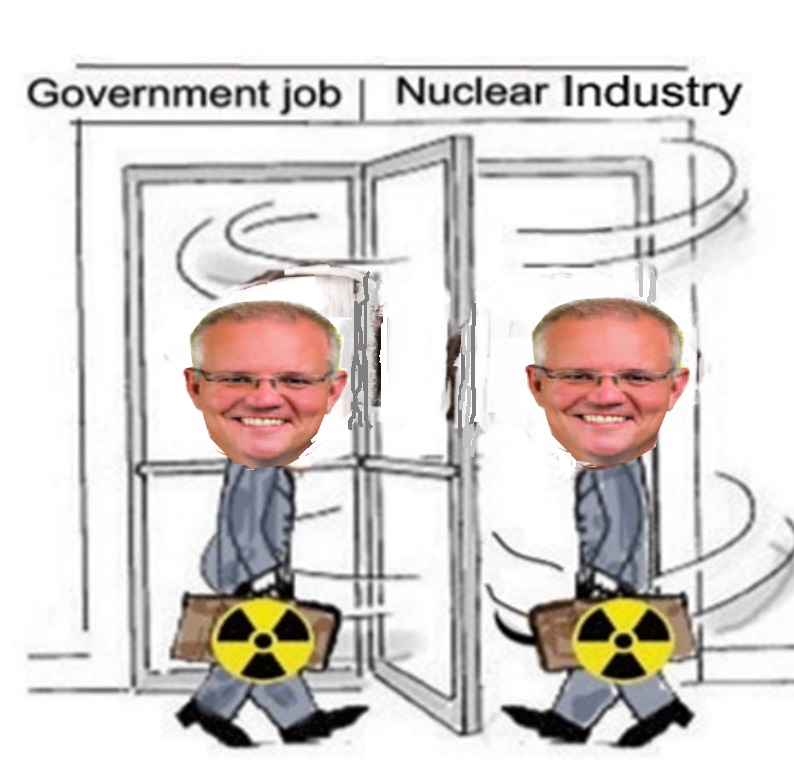
As a strategic advisor to DYNE, Morrison hopes to advance investment in dual-use technologies — inventions that have military and civilian applications. That innovation is being helped by the second pillar of AUKUS, the one that has to do with tearing down military-industrial trade barriers between the US, UK and Australia.
Facing post-Parliament poverty, multitasking Morrison looks to seafloor for riches
What to do when your taxpayer-funded salary drops from $549k, to $225k, to nothing? Multitask, of course.
Crikey, ANTON NILSSON, MAY 30, 2024
Scott Morrison has yet another new job — and like some of his other post-Parliament gigs, it’s tangentially linked to the AUKUS submarine pact he helped set up as prime minister.
The Age reports Morrison is listed as a strategic advisor at a newly created venture called the Seafloor Minerals Fund, alongside ex-US secretary of state Mike Pompeo. Both men are also behind venture capital firm DYNE, set up to support the strategic goals of AUKUS, and which also has interests in deep sea mining, according to the story.
Crikey figured it was time to have another look at Morrison’s post-politics career.
In need of cash …………………………………………..
Multitasking
So what has Morrison done to set himself up for success? His LinkedIn lists three jobs: author, non-executive vice chairman of American Global Strategies, and board member at “various companies”. The voters who brought you Scott Morrison want stronger anti-corruption protectionsRead More
As an author, he’s already published his first work: the religious memoir Plans For Your Good. The book was aimed at the $1.175 billion US Christian book market, but in Australia, it’s reportedly sold very few copies so far.
At American Global Strategies, Morrison is working with two former Donald Trump staffers to “help clients navigate a highly dynamic geopolitical landscape that presents risks and opportunities”, in the ex-PM’s own words.
As a strategic advisor to DYNE, Morrison hopes to advance investment in dual-use technologies — inventions that have military and civilian applications. That innovation is being helped by the second pillar of AUKUS, the one that has to do with tearing down military-industrial trade barriers between the US, UK and Australia. The new gig, with the Seafloor Minerals Fund, will set Morrison and Pompeo up for taking advantage of the estimated trillions of dollars in rare metals estimated to be on the seafloor. According to The Age, Australians can expect a fierce future debate about the merits and risks of mining the seabed for minerals, as China seeks to do the same. https://www.crikey.com.au/2024/05/30/scott-morrison-seafloor-minerals-fund/?utm_medium=Social&utm_source=Twitter#Echobox=1717042244
1 This month
7 April – WEBINAR – Australia and the Doomsday Clock – Preventing nuclear war through NoFirstUse and other policies
Online | Tuesday April 7, 4:00-5:30pm, Australian Eastern Time / 8:00-9:30am Central Europe Time
– Access the registration link
15 April – Zoom –Nuclear Power is Not the Solution
Apr 15, 2026 01:00 AM in Canberra, Melbourne, Sydney

Join the International Physicians for the Prevention of Nuclear War (IPPNW) on Tuesday, April 14th for a timely webinar exploring the risks associated with nuclear power and challenging the myth that it offers a simple, safe, carbon-free solution to the climate crisis

of the week – Australians for War Powers Reform (AWPR)
To see nuclear-related stories in greater depth and intensity
 Antinuclear