Clear as a bell

The question put to the Prime Minister; whether Richardson will have the same powers as the royal commissioner, misses the point. Richardson does not need the same powers. He needs different ones. He needs access to classified intelligence briefings, internal agency communications, and operational protocols that a public Royal Commission cannot examine without compromising national security or prejudicing the trial.
| By David Tyler on 9 January 2026, https://theaimn.net/clear-as-a-bell/ |
Bondi deserves answers. A Royal Commission, right now, will struggle to deliver them. The nation is being sold catharsis; what is on offer is legally hobbled – a rarefied type of theatre that cannot go where the public most wants it to go.
There is a reflex in Australian politics that turns grief into a ladder-climbing contest. We are world champions at it. A calamity shatters lives. Families are inconsolable. Cameras roll. A chorus forms. And before the ambulances have finished their last run, someone on air is demanding the biggest, most theatrical instrument in the civic toolkit: a Royal Commission. After Bondi, that chorus has swelled into something close to compulsory. Families, community leaders, health professionals, MPs and commentators have all called for a federal Royal Commission, framed as the only “serious” response.
It’s our modern-day Malleus Maleficarum. This mirrors the 15th-century Malleus Maleficarum – the infamous “Hammer of Witches” – a witch-hunting playbook by Heinrich Kramer that turned folk panic into systematic purge. Written around 1486, it codified hysteria as policy: classify deviance as heresy, mandate torture for confessions, and execution as the only cure. Our modern model? Calamity spawns moral panic; the “inquiry” becomes the hammer smashing dissent, delay or difference.
A blast from the past
Kramer’s manual thrived on spectacle – public trials, devil pacts, women’s “weakness” fuelling mass executions (but not in England) – much like today’s commissions that amplify grief into political theatre before facts settle. In both, urgency trumps evidence; the ladder-climbers win by promising exorcism.
Time-wasters HQ and the live crime scene
You can see how this plays in Canberra. A reporter fronts the Prime Minister and asks whether “his man”, Dennis Richardson; retired spook, now hunched over Manila folders while staffers colour-code Post-it notes – will be given the same powers as the royal commissioner.
The daft question treats coercive powers like a staff entitlements issue, not a matter of statute and jurisdiction. It also sidesteps the central, inconvenient fact: Bondi is not just a national trauma; it is a live criminal matter.
Lawyer Michael Bradley puts it simply in Crikey: one alleged shooter is alive, in custody and facing charges; that makes Bondi, first and foremost, a crime scene. While that prosecution is afoot, the justice system’s first priority is the accused’s right to a fair trial – an obligation that exists not to protect the accused from scrutiny, but to protect the public from injustice and to preserve the integrity of verdicts. Sub judice rules are built precisely to prevent material with a real and definite tendency to prejudice a trial from being sprayed across the public square.
A Royal Commission inquiry; even one led by someone as formidable as Virginia Bell, the former High Court judge now appointed, does not sit outside those rules. It sits squarely within them. The terms of reference granted to Bell are careful, constrained and cognisant of the legal reality: while criminal proceedings remain on foot, what can be examined, what witnesses can be compelled to say, and what findings can be published are all subject to the overriding requirement not to interfere with the trial.
Virginia Bell is not the problem. She is a jurist of the highest calibre. Her terms of reference ; drivers of violent extremism, systemic failures in mental health, gaps in intelligence sharing, the adequacy of threat assessment frameworks, are comprehensive in ambition. But ambition is not the same as reach. Her commission can summon documents, hold hearings, hear from families and experts. What it cannot do, while the accused awaits trial, is probe the specific circumstances, decisions and chains of causation that led to fifteen people being murdered at Bondi, Sunday, 14 December 2025.
The commission may hear about systemic failures in surveillance services. It may document coordination breakdowns between state and federal agencies. It may map the ideological landscape of online and in community radicalisation. But it cannot ask: why did this person, with this history, acquire that weapon? Why was this red flag ignored? What did this officer know, and when?
Those are questions for the criminal trial. And until that trial concludes, a process that may take years, those questions remain legally out of bounds.
This is not pedantry. It is constitutional bedrock. The separation between investigation and prosecution, between inquiry and trial, exists to safeguard the administration of justice. A Royal Commission that wandered into the specifics of a pending criminal case would risk tainting the jury pool, compromising witness testimony, and handing the defence grounds for appeal or even a mistrial.
The public interest in accountability does not override the public interest in a fair trial. Both matter. And right now, one must yield to the other.
The theatre of inquiry: catharsis without closure
So what, then, is the Royal Commission for? If it cannot answer the questions the public most urgently wants answered, what function does it serve? The answer, increasingly, is symbolic. Royal Commissions have become our civic grief ritual. They signal that something momentous has occurred, that the state is Doing Something, that the dead will not be forgotten.
They offer a stage for testimony, a forum for families, a mechanism for catharsis. These are not trivial functions. Grief demands witness. Trauma demands acknowledgment. But they are not the same as accountability. And they are certainly not the same as answers.
Michael Bradley is blunt about this in his Crikey analysis. A Royal Commission into Bondi, launched now, will be “an elaborate and expensive exercise in delay”. It will take a year. It will produce an interim report that skirts the live criminal matter, and a final report that arrives long after the initial trauma and public attention has moved on. Its recommendations will be debated, some accepted, others shelved. Governments will thank the commissioner, express solemn commitment to reform, and then do what governments always do: implement the easy bits, defer the hard ones, and declare victory.
This is the pattern. We have seen it before. One of the most shocking is the Royal Commission into Aboriginal Deaths in Custody (1987-1991): 339 recommendations on care, justice reform, and reconciliation. Implementation: partial at best; data collection improved, coronial processes tightened, but Indigenous incarceration rates soared 300% since: with the number of Aboriginal people dying in custody is reaching appalling, record figures (26 in 2024-25 alone).
The aged care royal commission delivered a damning report; the government’s response was a fraction of what was recommended. The banking royal commission uncovered systemic corruption; prosecutions were few, structural reform limited. The disability royal commission has been hearing harrowing testimony for years; whether it produces genuine change remains to be seen.
Royal Commissions are better at diagnosis than cure. They are superb at mapping failure. They are far less effective at compelling repair.
Dennis Richardson and the consolation prize
Enter Dennis Richardson. The Prime Minister’s pick. The interim investigator. The placeholder while the Royal Commission gears up and the criminal trial grinds on. Richardson is reviewing national security coordination, intelligence sharing, and threat assessment protocols. His task is narrower, more technical, less theatrical. He will not hold public hearings. He will not take testimony from grieving families. He will not generate headlines. But he might, if given the resources and the mandate, deliver something useful: a clear-eyed account of what went wrong in the machinery of state surveillance and response.
The question put to the Prime Minister; whether Richardson will have the same powers as the royal commissioner, misses the point. Richardson does not need the same powers. He needs different ones. He needs access to classified intelligence briefings, internal agency communications, and operational protocols that a public Royal Commission cannot examine without compromising national security or prejudicing the trial.
His work is not meant to satisfy the public’s hunger for spectacle. It is meant to identify, quietly and methodically, the points of failure that allowed a known threat to become a mass casualty event.
Whether Richardson will be allowed to do that work; whether his findings will be acted upon, or filed away as politically inconvenient, is another question entirely. History suggests caution. Reviews commissioned in the shadow of tragedy tend to be weapons of delay, not engines of reform. They allow governments to say “we’re looking into it” while doing very little. But Richardson, at least, has the advantage of operating outside the glare of a public hearing. He can ask uncomfortable questions without a media gallery taking notes. He can follow the evidence without worrying about headlines. If there is a chance of learning something concrete from Bondi, it may lie more with Richardson’s quiet review than with Bell’s necessarily constrained commission.
What the public is owed – and what it can have
The families of the victims deserve answers. The community deserves to know what failed. The nation deserves accountability. None of that is in dispute. But a Royal Commission launched now, while criminal proceedings are live, cannot deliver those things. It can offer process, yes. It can offer visibility, acknowledgment, a national platform for grief. It can produce a report, eventually, that maps systemic failures and makes recommendations. But it cannot; legally, constitutionally, practically, go to the heart of what happened in Bondi Junction and why. That work belongs to the criminal justice system.
And it could take years.
This is not an argument against accountability. It is an argument for realism. The appetite for a Royal Commission after Bondi is understandable. The political pressure is immense. But the law does not bend to political pressure, and for good reason. The accused has the right to a fair trial. Witnesses have the right not to be compelled to give evidence that could prejudice that trial. The criminal process has priority. This is not a technicality. It is a cornerstone of the rule of law.
What the public is being offered, then, is not what it thinks it is getting. It is being sold a Royal Commission as the gold standard of inquiry, the big gun, the serious response. What it is actually getting is a carefully circumscribed process that will spend months skating around the core questions, deferring the hard answers until after the trial, and producing a report that will be debated, diluted and half-implemented. That is not cynicism. That is the historical record.
The alternative no one is offering
There is another way. It is less theatrical, less politically satisfying, and almost certainly more effective. It involves letting the criminal justice system do its work; properly resourced, properly scrutinised, properly held to account. It involves giving Dennis Richardson the mandate and the access to conduct a serious, classified review of intelligence and coordination failures, and then acting on his findings. It involves empowering existing oversight bodies; the Inspector-General of Intelligence and Security, the Commonwealth Ombudsman, parliamentary committees, to do their jobs without interference. It involves, in short, using the accountability mechanisms we already have, rather than reaching for the shiny new one that makes for better television.
This approach has no champions. It generates no headlines. It does not satisfy the public hunger for a Big Moment. It is not what families are calling for, because families – rightly – want something that feels commensurate with their loss. But it is the approach most likely to produce actual change. Royal Commissions delay, defer and dilute. They turn urgent questions into multi-year research projects. They produce doorstop reports that governments cherry-pick. They are a mechanism for managing political heat, not for delivering accountability.
If the goal is to learn from Bondi, to fix what broke, to prevent the next tragedy, then the focus should be on the hard, long, unglamorous work of institutional repair. Strengthening intelligence sharing protocols. Closing gaps in mental health and law enforcement coordination. Ensuring that red flags are acted upon, not just filed. Resourcing frontline services properly. None of that requires a Royal Commission. It requires political will, funding, and a commitment to follow through. Those are the very things Royal Commissions tend to defer.
Conclusion: grief, law and the limits of theatre
Virginia Bell will conduct her inquiry with rigour and integrity. Her final report will be thorough, considered and damning in its account of systemic failure. It will make headlines. It will be tabled in Parliament. The families will read it. The media will dissect it. And then it will join the long shelf of Royal Commission reports that documented failure, recommended reform, and achieved far less than they promised.
This is not Bell’s fault. It is the nature of the instrument. A Royal Commission is not a magic wand. It is a legal process, bounded by the same constraints as any other. It cannot override sub judice protections. It cannot compel witnesses to incriminate themselves. It cannot force governments to act. It can investigate, document and recommend. That is all. And while the accused awaits trial, it cannot even do that much.
The nation is being sold catharsis. What is on offer is a legally hobbled, year-long process that will arrive at conclusions long after the moment of grief has passed. The families deserve better. The victims deserve better. And if the goal is genuine accountability, not the theatre of it, but the substance, then we need to stop pretending that a Royal Commission is the answer. The courtroom is where the answers will be found. The trial is where accountability begins. Everything else is noise.
A Royal Commission is not a memorial. It is not closure. It is not justice. It is a process. And right now, it is the wrong one. The lobbyists have got their way. The PM has conceded to their pressure. But it’s very hard to see the healing; impossible to spot that social cohesion, he is so overly fond of invoking. That at least, from the outset, is as clear as a bell.
This article was originally published on URBAN WRONSKI WRITES
Australia’s Response to US Intervention in Venezuela
8 January 2026 AIMN Editorial By Denis Hay
Description
Australia’s response to US intervention in Venezuela raises serious questions about sovereignty, international law, and political courage.
Introduction
The Australia response to US intervention in Venezuela was cautious, restrained, and carefully worded. While the United States openly spoke about taking control of another country’s political future, Australia chose not to condemn the action. For many Australians, this raises an uncomfortable question.
This matters because US intervention in Venezuela sets a precedent for how powerful allies bypass international law while expecting silence from partners like Australia. If Australia claims to support a rule-based international order, why does it fall silent when a powerful ally breaches it?
Context box:
Under the UN Charter, sovereign equality and non-intervention are core principles. These rules are meant to apply to all nations, large or small.
This is not an abstract legal debate. It goes to the heart of whether international law still matters, and whether Australia has an independent foreign policy voice or merely echoes its most powerful partner.
The Problem
US intervention in Venezuela and the assertion of control
The trigger was a public statement by Donald Trump, who said the United States would run Venezuela until a safe and proper transition could occur. The problem begins with how the US intervention in Venezuela was framed, justified, and left largely unchallenged by allied governments. This was not diplomatic language. It was an assertion of authority over a sovereign state.
At the time, Venezuela had a sitting president, Nicolás Maduro. His legitimacy was contested, but under international law, governance disputes do not allow external powers to impose control. There was no UN Security Council mandate, no international trusteeship, and no lawful basis for administering another country.
Australia’s reluctance to name the breach
Australia responded by urging restraint and dialogue, while avoiding any direct criticism of the United States. Statements from the Australian Department of Foreign Affairs and Trade focused on stability rather than legality.
This creates a clear problem. When breaches go unnamed, norms weaken. Silence becomes precedent.
The Impact
Erosion of international law credibility
The US attack on Venezuela international law debate is not about defending any one government. It is about defending rules that prevent powerful nations from deciding the fate of weaker ones. When allies ignore these rules, enforcement becomes selective.
The consequences of US intervention in Venezuela extend beyond Latin America, weakening global respect for sovereignty and law.
Australia regularly invokes international law when condemning adversaries. When it does not apply the same standards to friends, credibility suffers.
Who benefits from silence
Silence benefits powerful states that wish to act without constraint. It also benefits political leaders who want alliance comfort without accountability. Ordinary Venezuelans do not benefit, and neither do Australians, who rely on international law to protect smaller nations.
The Solution
Reclaiming Australia’s foreign policy sovereignty
Australia’s foreign policy sovereignty does not require hostility toward allies. It requires consistency. Australia can support diplomacy while also saying clearly that external control and regime change violate international law.
A genuinely independent foreign policy would acknowledge that alliances do not override legal obligations.
Using Australia’s monetary sovereignty for peace
Australia has full monetary sovereignty. It is never financially constrained from investing in diplomacy, humanitarian aid, and multilateral institutions. Instead of reflexively aligning with military power, Australia could invest public funds in conflict prevention, mediation, and UN-led solutions that respect self-determination………………………………………………… https://theaimn.net/australias-response-to-us-intervention-in-venezuela/
When demanding a Royal Commission isn’t enough
9 January 2026 Michael Taylor , https://theaimn.net/when-demanding-a-royal-commission-isnt-enough/
For weeks Josh Frydenberg – and senior figures in the opposition – demanded a Royal Commission into the Bondi shootings. Their criticism of Prime Minister Albanese was relentless: he was accused of dithering, of failing to act decisively, of putting politics ahead of public safety and accountability.
The message was unambiguous. A Royal Commission was urgently needed, and the Prime Minister’s failure to immediately call one was presented as a serious dereliction of duty.
Then Albanese did exactly what he was accused of refusing to do. He called a Royal Commission.
What followed was not relief, nor support, nor even cautious endorsement. Instead, Frydenberg launched into a fresh round of criticism – this time over the Prime Minister’s choice of commissioner. The demand for action had been met, yet the outrage only intensified.
At this point, it is reasonable to ask: what, precisely, was Frydenberg seeking?
Royal Commissions are among the most serious instruments available in Australia’s democratic system. They are designed to establish facts, test evidence, and make recommendations independent of political pressure. When politicians demand them, they are effectively asking the government to hand over control of an issue to an arm’s-length process that cannot be directed once established.
In this case, Frydenberg’s behaviour suggests the Royal Commission itself was never the point. The point was the political leverage gained by accusing the government of inaction. Once that leverage evaporated – once the Prime Minister called the inquiry – the focus shifted immediately to delegitimising the process itself.
Frydenberg’s criticism of the appointed commissioner rests on the implication that the individual lacks credibility, independence, or suitability. But this raises an obvious question: if Frydenberg believes the commissioner is unfit, why was there no articulated standard beforehand? Why was the demand not for a Royal Commission led by a person meeting clearly defined, bipartisan criteria?
The answer appears uncomfortable but unavoidable. Any commissioner appointed by this government was always going to be unacceptable, regardless of credentials. The outrage is not conditional; it is structural.
This is where the episode drifts from political disagreement into something more corrosive. By first demanding a Royal Commission and then attacking its leadership the moment it is established, Frydenberg sends a contradictory message to the public: trust this process – unless the wrong people are running it.
That is not a healthy position for a major political actor to take, particularly in the aftermath of a tragedy. It risks turning an institution designed to uncover truth into a partisan battlefield before it has even begun its work.
The absurdity lies in the sequencing. The opposition, in unison with Frydenberg, argued that failing to call a Royal Commission was irresponsible. Now they imply that calling one – without their preferred appointee – is equally irresponsible. Under this logic, there is no scenario in which the government could have acted correctly.
It is worth pausing on what this means in practice. If every decision is wrong by definition, then criticism is no longer about improving outcomes or safeguarding integrity. It becomes performative – a reflex rather than a reasoned response.
This pattern is not new, but it is becoming more pronounced. Demands are made loudly and publicly, framed as matters of urgent national importance. When those demands are met, they are immediately reframed as failures, missteps, or evidence of ulterior motives. The standard is not excellence, but impossibility.
In the context of a Royal Commission into a violent public tragedy, that approach carries real risks. It encourages cynicism about the process before evidence is heard, witnesses are examined, or findings are made. It invites the public to see the inquiry not as a search for answers, but as another front in a political war.
None of this requires blind faith in the government or its appointments. Scrutiny is legitimate. Questioning decisions is part of democratic accountability. But there is a difference between scrutiny and pre-emptive sabotage.
If Frydenberg truly believes in the value of a Royal Commission, he should allow the process to function and judge it on its conduct and findings. If he does not, then he should be honest about that position rather than using the language of accountability as a political bludgeon.
Australians deserve better than a debate in which every outcome is framed as failure simply because it was delivered by the wrong side of politics. Royal Commissions are not toys to be thrown aside once they stop being useful.
If Frydenberg – and the opposition – demanded one in good faith, now is the moment to prove it.
The new world of journalism

My first effort. This is my first foray into the new jungle. I have been examining different types of journalism, and noting which sorts get an interested response. I plan to evaluate the different types – for their interest and effectiveness.
12 January 2026 Noel Wauchope https://theaimn.net/the-new-world-of-journalism/
Journalism is in a mess, and it is changing so fast. Meanwhile the world is changing even faster, and we need good journalism more than ever.
The old world of journalism is dead. Long live the new!
I liked the old world of journalism. And it still exists – a bit. In that old world, facts were valued, rather than opinions. Of course opinions were still there, not always apparent, and sometimes more effective in selective reporting of the facts, with some facts carefully omitted. Still, the facts were meant to be paramount. I loved an ancient TV series, Dragnet, in which Sergeant Joe Friday expressed it perfectly “Just wanna get the facts, ma’am – just the facts.”
Still, the old journalism did undergo editorial scrutiny, do fact-checking, and even had grammar and spelling checked. And it does still exist today, when the Internet has nearly killed print journalism, and its funding from advertisers.
But – it’s limited. The new digital media has overwhelmed it. You get not just young teenagers gossiping, but also heads of state announcing things, via TikTok or Twitter, X or Facebook, Instagram, and many other platforms. And the message is above all – new, fast, short and visually arresting. No, I haven’t done the research, nor produced a PhD paper about this, but my observation is that longform journalism is read by the much older generations.
Still, forms other than text are doing well, and information and opinion are broadcast by podcast and YouTube journalists, so providing perhaps a more accessible form of longer journalism, though the fact-checking may be dodgy.
So, in place of the staid, somewhat reliable old journalism, what do we have? We still have the struggling print, radio and TV “mainstream media”, where journalists “mind their p’s and q’s”, because they don’t have the job security that used to be taken for granted. Of course, there are “safe” specialities like sport, cooking and gardening, but current affairs, politics, environment, climate and much else – these are dangerous territories for the mainstream journalist.
Self-censorship is rife.
Then there’s “alternative media” where brave souls have branched out with new journals, funding this work sometimes by community organisations, libraries, universities, or just by themselves, and trying to get funding from readers. I really don’t know how successful they are, financially. But for some writers, myself included, these new journals provide the opportunity for self-expression. For the public, they do provide a much-needed broader range of subject and opinion, than is available in the rather constipated traditional mainstream media.
So – where to – for the good journalism? And what is the good journalism? Well, back to good old Sergeant Joe Friday. For a start, we need to know that the writer’s facts are correct. Then there are those seemingly vague things, like authenticity and integrity. It’s a tortuous path to try and work this out. In Australia, the teaching of English does include awareness of logic, and of conflict of interest. These are aspects pretty much impossible to ascertain in the prevailing snappy digital media, but can be gauged in longer journalism.
Over many years, I’ve been studying articles from many sources – to find out what is effective, what is genuinely interesting and believable. I think that it’s time that those of us who appreciate integrity in writing should shout about it.
Just for a first shout – I’ll pick out a couple of shouts already made. Here I find examples of journalists who courageously identify mainstream media’s biased journalism. In FAIR (FAIRNESS & ACCURACY IN REPORTING) an experienced journalist, Ari Paul, takes on the enthusiastic coverage by The Wall Street Journal, the Washington Post, the New York Times, The Times, The Chicago Tribune of “Trump’s Doctrine in Venezuela.” Paul concludes:
“By kidnapping a foreign head of state, the Trump administration is saying that international law doesn’t apply to the United States. That’s a sentiment most American editorialists are all too ready to applaud – despite the danger it poses for Americans, and for the world.”
Elizabeth Smith, writing for the NTI – The Nuclear Threat Initiative – asks:
“What does it take to reveal truth in the face of censorship?”
She applies that principle in the media coverage of the 1945 atomic bombing, described in a new PBS documentary, “Bombshell.” She concludes:
”Bombshell lays bare the power of narratives – and counter narratives. It shows, with infuriating and heartbreaking precision, how misinformation about the bombings influenced public opinion.”
There are a lot of independent writers out there – some, like Ari Paul and Elizabeth Smith are highly qualified and experienced journalists, who go into their subject in some depth, and are not scared to rock the prevailing boat of safe complacency that increasingly pervades the self-censoring mainstream media. Others are less masterful in their use of language, and less qualified, but still get their message across in a compelling way.
The Unbroken Thread: China’s Civilisational-State vs. The West’s Contractual Empire – A Study in Divergent Destinies

10 January 2026 Andrew Klein, PhD, https://theaimn.net/the-unbroken-thread-chinas-civilisational-state-vs-the-wests-contractual-empire-a-study-in-divergent-destinies/
Abstract
This article contrasts the developmental trajectories of China and the United States (representing the modern West) by examining their foundational civilisational codes, historical experiences, and political philosophies. It argues that while the U.S. follows the extractive, individual-centric model of a classic maritime empire (extending the Roman pattern), China operates as a continuous civilisational-state, its policies shaped by a deep memory of collapse and humiliation and a Confucian-Legalist emphasis on collective resilience. The analysis critiques the Western failure to comprehend China through the reductive lens of “Communism,” ignoring the profound impact of the “Century of Humiliation” and China’s subsequent focus on sovereignty, infrastructure, and social stability as prerequisites for development. The paper concludes that China’s model, focused on long-term societal flourishing over short-term extraction, presents a fundamentally different, and perhaps more durable, imperial paradigm.
Introduction: The Mandate of History vs. The Mandate of Capital
The rise of China is often analysed through the prism of Western political theory, leading to a fundamental category error. To compare China and the United States is not to compare two nation-states of similar ontological origin. It is to compare a civilisational-state – whose political structures are an outgrowth of millennia of unified cultural consciousness and bureaucratic governance – with a contractual empire – a relatively recent construct built on Enlightenment ideals, but ultimately sustained by global financial and military hegemony (Jacques, 2009). Their paths diverge at the root of their historical memory and their core objectives.
China’s Catalysing Trauma: Modern China’s psyche is indelibly shaped by the “Century of Humiliation” (c. 1839-1949), beginning with the Opium Wars – a stark example of Western imperial extraction enforced by gunboats (Lovell, 2011). This was compounded by the collapse of the Qing dynasty, civil war, and the horrific suffering during the Second World War. The foundational drive of the People’s Republic, therefore, was not merely ideological victory but the restoration of sovereignty, stability, and dignity (Mitter, 2013). Every policy is filtered through the question: “Will this prevent a return to fragmentation and foreign domination?”
America’s Founding Myth: The U.S. narrative is one of triumphant exceptionalism. Born from anti-colonial revolution, it expanded across a continent it saw as empty (ignoring Native nations) and engaged with the world primarily from a position of growing strength. Its traumas (Civil War, 9/11) are seen as interruptions to a forward progress, not as defining, humiliating collapses. This fosters an optimistic, forward-looking, and often abistorical mindset (Williams, 2009).
2. Political Philosophy: Meritocratic Collectivism vs. Individualist Democracy
China’s System: The “Exam Hall” State. China’s governance synthesises Confucian meritocracy and Legalist institutionalism. The modern manifestation is a rigorous, multi-decade screening process for political advancement, emphasising administrative competence, economic performance, and crisis management (Bell, 2015). The objective is governance for long-term civilisational survival. The Communist Party frames itself as the contemporary upholder of the “Mandate of Heaven,” responsible for collective welfare. Political legitimacy is derived from delivery of stability and prosperity.
The West’s System: The “Arena” State. Western liberal democracy, particularly in its U.S. form, is a contest of ideas, personalities, and interest groups. Legitimacy is derived from the procedural act of election. While capable of brilliance, this system incentivises short-term focus (electoral cycles), polarisation, and the influence of capital over long-term planning (Fukuyama, 2014). Expertise is often subordinated to popularity.
3. The Social Contract: Infrastructure & Security vs. Liberty & Opportunity
China’s Deliverables: Post-1978 reforms shifted focus to development, but within the framework of the party-state. The state prioritises and invests heavily in tangible foundations: universal literacy, poverty alleviation, high-speed rail networks, urban housing, and food security (World Bank, 2022). The social contract is explicit: public support in exchange for continuous improvement in material living standards and national prestige.
The West’s Deliverables: The Western social contract, historically, promised upward mobility and individual liberty protected by rights. However, the late-stage extractive economic model has led to the decline of public goods: crumbling infrastructure, unaffordable higher education, for-profit healthcare, and eroded social safety nets (Piketty, 2013). The contract feels broken, leading to societal discord.
4. Global Engagement: Symbiotic Mercantilism vs. Extractive Hegemony
China’s Method: Development as Diplomacy. China’s Belt and Road Initiative (BRI) is the archetype of its approach: offering infrastructure financing and construction to developing nations, facilitating trade integration on its terms. It is a form of state-led, long-term strategic mercantilism aimed at creating interdependent networks (Rolland, 2017). Its “soft power” is not primarily cultural, but commercial and infrastructural.
The West’s Method: The post-WWII U.S.-led order, while providing public goods, has been characterised by asymmetric extraction: structural adjustment programs, financial dominance, and military interventions to secure resources and political alignment (Harvey, 2003). It maintains a core-periphery relationship with much of the world.
Conclusion: The Durability of Patterns
The West’s mistake is viewing China through the simple dichotomy of “Communist vs. Democratic.” This ignores the 4,000-year-old continuum of the Chinese statecraft that values unity, hierarchical order, and scholarly bureaucracy. China is not “learning from Communism”; it is learning from the Tang Dynasty, the Song economic revolutions, and the catastrophic lessons of the 19th and 20th centuries.
China’s course is different because its definition of empire is different. It seeks a Sinic-centric world system of stable, trading partners, not necessarily ideological clones. Its focus is internal development and peripheral stability, not universal ideological conversion. Its potential weakness lies in demographic shifts and the challenge of innovation under political constraints. The West’s weakness is its accelerating internal decay and inability to reform its extractive, short-termist model.
Two imperial models are now in full view. One, the West, is a flickering, brilliant flame from Rome, burning its fuel recklessly. The other, China, is a slowly rekindled hearth fire, banked for the long night, its heat directed inward to warm its own house first. History is not ending; it is presenting its bill, and the civilisations that prepared their ledger will write the next chapter.
References…………………………..
Royal Commission Must Rise Above Politics: Global Flotilla’s Juliet Lamont

“The scope should include anti-Palestinian racism and hate speech, which we have witnessed since the start of the Gaza genocide. There must be no double standard in this inquiry,
protesting the Gaza genocide is a moral duty.
9 January 2026 AIMN Editorial, https://theaimn.net/royal-commission-must-rise-above-politics-global-flotillas-juliet-lamont/
Intrepid sailor Juliet Lamont, 54, who is leading the Australian delegation of the next Global Sumud Flotilla, today responded to the announcement of the Royal Commission into the Bondi Mass Shooting. Lamont called for it to be “kept independent of all fear politics.”
Film maker Lamont noted that “The causes, circumstances and institutional failures surrounding the Bondi attack will be examined through the courts and a coronial inquest, which are the established, evidence-based mechanisms for determining facts and protecting public safety.”
Lamont reflects concerns that “The Royal Commission risks shifting focus from concrete security and policing accountabilities to ideology, culture and politics with serious implications for lawful protest and political expression.”
“The scope should include anti-Palestinian racism and hate speech, which we have witnessed since the start of the Gaza genocide. There must be no double standard in this inquiry,” added Ms Lamont.
She adds that protesting the Gaza genocide is a moral duty. The so-called “ceasefire” has not stopped the killing of more than 400 Palestinians, including children. Civilians in Palestine are living in a bombed-out wasteland without functioning utilities, fresh water or adequate food. Israel has now blocked desperately needed doctors and health care workers (as part of its ban on 37 aid organisations).
Despite losing a boat and experiencing abuse at the hands of Israeli authorities while incarcerated for over 5 days, Juliet Lamont will travel to Sicily next week to help organise what is expected to be the largest flotilla to date. She will be joined by her daughters on this mission.
Are nazis in Chris Minns hate speech sights … or just Palestinian peace protestors?
Any real discussion on antisemitism in the wake of the Bondi Massacre needs to target all communities, not just those the groups lobbying the NSW government wish to silence.
by Sam AltMediaWatch | Jan 2, 2026, https://michaelwest.com.au/are-nazis-in-chris-minns-sights-or-palestinian-peace-protestors/
The Minns Government response to Bondi has focussed on anti-Israel protestors and hate speech but has so far ignored Nazis. Sam from AltMediaWatch investigates the Ukrainian neo-Nazi movement.
The New South Wales Government is pushing forward with its plan to crackdown on the right to protest and to ban the display of hate symbols in response to the horrific Bondi terror attack.
Premier Chris Minns has said he plans to ban the phrase “globalise the intifada” after he linked pro-Palestinian protests to the 15 people killed at Bondi Beach.
The move is clearly a political one, to appease Israeli lobbying groups who’ve tried to silence outrage over Israel’s genocide in Gaza and protests that have had success in pressuring the Australian government into recognising the State of Palestine.
Any real discussion on antisemitism in the wake of the Bondi Massacre needs to target all communities, not just those the groups lobbying the NSW government wish to silence.
One such example is the Ukrainian community groups, who the Minns government have openly supported in response to Russia’s genocide in Ukraine, but the reality is that there is a significant issue of antisemitism within these Ukrainian community groups and one that the Minns government has directly facilitated.
Da Vinci Wolves fundraiser. On the 12th of February, MP Stephen Kamper, a member of Minns government hosted a fundraiser with the Ukrainian Council of NSW screening the Ukrainian documentary about Dmytro ‘Da Vinci’ Kotsiubailo, who was awarded the Hero of Ukraine medal in 2021 and killed in 2023 while fighting Russia in the battle of Bakhmut.
The event raised $6,505 with proceeds going to the 1st Separate Mechanised Battalion (Da Vinci Wolves), the Brigade which Kotsiubailo commanded up until his death.
The problem is that the Brigade is now commanded by neo-Nazi Serhii Filimonov, who previously served in the controversial Azov Battallion until it was merged with the Ukrainian Armed Forces in an attempt to purge the more extremists like Filiminov from its ranks.
Filimonov sports multiple neo-Nazi tattoos including the popular Valknut rune, and the Totenkopf, the insignia of Hitler’s 3rd SS Panzer Division.
He was a leader in violent Dynamo Ultras, an antisemitic group of football hooligans known as the ‘White Boys Club’. The groups emblem includes an image of Prince Sviatoslav a favourite among antisemites for destroying the Khazar empire, which they believe are ‘fake Jews’ trying to infiltrate and destroy Europe and the West.
3rd Assault Brigade fundraiser
On the February 24, the Australian Federation for Ukrainian Organisations, the peak Ukrainian body, held a rally to commemorate the 3rd anniversary of Russia’s illegal invasion of Ukraine.
NSW Premier Chris Minns spoke at the event along with Senator Dave Sharma and several other state and federal politicians.
The rally at St. Mary’s Cathedral featured a short ‘thank you’ video to Australians from members of the Ukrainian Armed Forces including members of the 3rd Assault Brigade, which received an online fundraising campaign a month earlier hosted by the Defend Ukraine Appeal.
The 3rd Assault is the successor to the controversial Azov Battalion, and just like Azov it is linked heavily with neo-Nazis. Led by the former commander of the Azov Battalion, neo-Nazi Andriy Biletsky who in 2010 was quoted as saying he believed Ukraine’s mission was to:
“lead the white races of the world in a final crusade
… against Semite-led Untermenschen [subhumans]”.
A term used extensively by the Nazis to dehumanise Jews and other groups they considered inferior.
The ‘thank you’ video featured members of a medical unit in the Brigade’s 2nd Mechanised Infantry Battalion, led by well-known neo-Nazi Denys Sokur also formerly of the Azov Battalion. Sokur has an ‘88’ tattoo on his leg (a common abbreviation for ‘Heil Hitler”), and a Sonnenrad or black sun tattoo on his elbow
The Sonnenrad originated from Nazi Germany, it was featured on the marble floor of Wewelsburg castle run by Heinrich Himmler, the head of the SS.
The symbol is popular amongst neo-Nazis,
“it was worn by the Australian neo-Nazi“
who murdered 51 people at a Christchurch mosque in 2019 and was also on the cover of the manifesto he wrote, which has been translated into Ukrainian and published by neo-Nazis in the Azov movement.
Another prominent neo-Nazi from the 3rd Assault Brigade caused controversy last year after visiting Auschwitz concentration camp in a shirt from a neo-Nazi black metal band with the inscription ‘Where we are, there is no place for anyone else’,
“a quote attributed to Adolf Hitler.“
CYM Youth and St. Andrew’s Ukrainian Catholic Church
On March 9, the Sydney branch of the Ukrainian Youth Association (CYM) held a memorial for Nazi collaborator and war criminal Roman Shukhevych, also known by the pseudonym Taras Chuprynka.
CYM Sydney, which is part of the 22 organisations that make up the Australian Federation of Ukrainian Organisations (AFUO) holds regular memorials in honour of Shukhevych, who is the Youth group’s patron.
Shukhevych was the commander of the Nachtigall Battalion, a subunit in Nazi Germany’s special forces that participated in the murder of Jews in Lviv during the German Holocaust.
Holocaust survivor and former Chairman of Yad Vashem, The World Holocaust Remembrance Center, Joseph Lapid noted of Shukhevych and his Battalion:
“In a terrible pogrom the Nightingale Battalion of the Ukrainian legion participated in the murder of 4,000 Jews from Lviv between June 30-July 3, 1941. The Ukrainian commander of the battalion at that time was Roman Shukhevych, a Ukrainian nationalist.
“The units he commanded, supposedly fighting for Ukrainian independence, committed large scale murder during the war. He was a war criminal.”
After the Nachtigall Battalion was dissolved, Shukhevych became deputy commander of the Auxiliary Police, which was sent to Belarus where it fought against Soviet partisans and is believed to have participated in the murder of more Jews.
During the memorial, members of CYM Sydney also displayed a flag for the 14th Waffen Grenadier Division of the SS (1st Galician), a mostly Ukrainian division which was part of the military wing of the Nazi Party and led by the head of the SS, Heinrich Himmler. The flag was gifted to the Youth Group in 2007 by members of the UPA who served in the 14th Waffen Grenadier Division and immigrated to Australia after WW2.
These memorials were held at St. Andrew’s Ukrainian Catholic Church in Lidcombe; The Sydney Ukrainian community has a commemorative plaque dedicated to members of the 14th Waffen SS who “gave their lives for the freedom of Ukraine”.
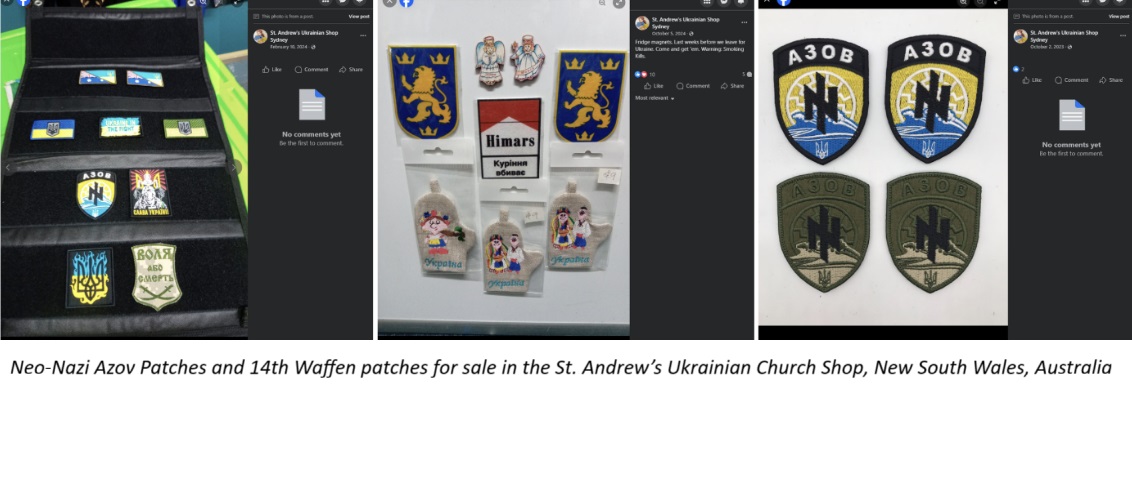
The Ukrainian church store frequently sells patches for both the 14th Waffen SS and the neo-Nazi Azov Battalion featuring the Sonnenrad symbol, the shop’s patron even participated in a parade in Ukraine in patches of the SS Battalion.
The NSW Department of Health under the Minns government promotes both the Sydney Ukrainian Youth Group and the Ukrainian Catholic Church in Lidcombe as support organisations for “Communities Impacted by the Invasion of Ukraine” on their Transcultural Mental Health Centre Website despite the groups open support for Nazi Battalions and commanders.
Minns response for Israel lobby, not antisemitism
The News South Wales premier’s response to the Bondi Massacre has so far focused only on the interests of Israeli lobbying groups. It highlights and blames only those who have voiced their opposition to Israel’s genocide and doesn’t address antisemitism evenly across Australian society.
When it comes to hate there is no difference between displaying ISIS flags at protests or the Azov flag which features the same neo-Nazi symbol worn by the Australian terrorist who he killed 51 people attending Mosques in Christchurch in 2019.
While we have seen strong condemnations from the government on the former display of hate, we are yet to see any on the later despite Ukrainian community members displaying the Azov flag at many of their protests, including at the Opera House just a few weeks prior to widely condemned pro-Palestine rally from October 9th 2023.
Hate affects us all, not just those communities with lobbying groups equipped to pressure the government into prioritising their own interests above all Australians and any approach that selectively highlights antisemitism and ignores displays of hate across society is doomed to fail.
Revealed: Australia’s secret Anti-Protest Force for US Department of War

“public order management operations. “
the Government is boosting its capability to deal with anticipated political protest activities against a much expanded US military and intelligence presence in Australia.
“AUKUS costs in total secrecy.”
by Rex Patrick | Jan 5, 2026 , https://michaelwest.com.au/australias-anti-protest-force-for-us-department-of-war/
As public concerns over the AUKUS alliance rise – with expanding US bases in Australia and Donald Trump’s belligerent conduct, FOI documents reveal the Government is secretly expanding its ‘US Department of War Protest’ Force. Rex Patrick reports.
Most people won’t be aware that the Australian Federal Police (AFP) has established a new command.
Headed by Commissioner Krissy Barrett, our national police force is made up of five regional commands (Northern, Eastern, Central, Southern and Western) and a number of functional commanders dealing variously with crime, fraud and corruption, cyber operations, counter-terrorism and special investigations, and protective security. No surprises there – the AFP structure is well established and pretty much what you would expect.
But now there’s a new AFP “AUKUS Command”, established with little fanfare and headed by AFP Assistant Commissioner Sandra Booth.
AFP Assistant Commissioner for AUKUS Sandra Booth at a US naval station. Image: AFP
AUKUS Command’s roles are centred on security for the AUKUS nuclear submarine project and interestingly include ‘Public Order Management’, but its mandate is much broader than protecting nuclear submarines.
MWM’s Freedom of Information (FOI) request to the AFP, amongst other things, sought access to documents that show the terms of reference, functions and responsibilities of AUKUS Command and Documents held by AUKUS Command that relate to potential political opposition and/or protest activity relating to the AUKUS nuclear-powered submarine project.
The AFP’s FOI response came in late and was covered with large swaths of black ink redacting most of the information, but enough has been revealed to show that the Government is boosting its capability to deal with anticipated political protest activities against a much expanded US military and intelligence presence in Australia.
AUKUS Protection
AUKUS Command starts with a “permanent AFP horizontal security overlay” set up at HMAS Stirling (near Perth) to “support the Australian nuclear submarine program under the AUKUS initiative”
The set-up in some part replicates the US Department of Energy’s Nuclear Protective Forces and the UK’s Ministry of Defence Special Escort Group.
The AFP AUKUS Command will initially conduct AUKUS protective security work, including waterborne and remotely piloted aircraft escorting of US Navy, Royal Navy and (eventually, maybe) Royal Australian Navy submarines in and out of waters around the base.
Submarines berthing at HMAS Stirling have to do a lengthy and protest-vulnerable surfaced transit through Gage Roads to get to/from the deep water north-west of Rottnest Island.
The AUKUS Command has established a rapid response capability and is prepared for
“public order management operations. “
Officers in the AUKUS Command are trained in rapid appraisal, coxswaining, jet ski operation, remote piloting of aircraft and countering remotely piloted aircraft, protestor negotiation techniques, protestor removal techniques and “public order management munitions delivery”.
Initially, at least, the Command will comprise four teams, a ready reaction team and a canine unit.
Nuclear protestors not tolerated
Although anti-nuclear protests focused on visiting US Navy nuclear powered submarines have so far been small in scale, the AFP has likely been alerted to the possibilities of larger scale water-borne protest by the “Rising Tide” environmental actions at Australia’s largest coal export terminal at Newcastle.
Protest groups involved in those activities have already been subject to close scrutiny by the AFP and New South Wales Police.
In any case, it’s clear that the Australian Government and the AFP are determined to demonstrate to the United States and the United Kingdom that there will be no tolerating protest activity that might impede or delay the movement of American and British submarines stationed at HMAS Stirling as part of the AUKUS Submarine Rotational Force – West.
But wait, there’s more, much more
But it turns out that protecting nuclear submarines is only part of the AUKUS Command’s responsibilities.
The first giveaway as to the much broader purpose of the Command is the fact that a July 25, 2025, Memorandum of Understanding signed by Assistant Commissioner Booth was between the AFP and, not the Australian Submarine Agency, but the Department of Defence.
The previously secret AFP documents released under FOI show that the AFP AUKUS Command will have strategic responsibility for delivery of protective security services to “specified Defence bases) under the Defence MOU, with a significant focus on building and supporting a future-ready Protective Security Officer workforce.
Pine Gap
The documents do not reveal which Defence bases, but the FOI request did capture emails between Assistant Commissioner Booth and other AFP officers dealing with a protest that took place last year at Joint Defence Facility Pine Gap, the top-secret signals intelligence facility near Alice Springs that’s operated by the US National Security Agency, the US National Reconnaissance Office and the Australian Signals Directorate.
Major upgrades are taking place at a number of other Australian Defence Force facilities to accommodate an expanded US military presence in Northern and Western Australia.
Significant works have also been underway at Australian intelligence facilities, including a major perimeter security upgrade and installation of new satellite dishes at the ASD’s Shoal Bay Receiving Station, nineteen kilometres north-east of Darwin.
As the US defence and intelligence footprint expands, it’s likely that the AUKUS Command’s security and “public order management” responsibilities will be quite wide-ranging.
More protests coming, and costs
As public concerns rise over nuclear issues, it’s very likely the arrival of the US submarine rotational force at HMAS Stirling, the increasing disposition of US forces around Australia and the abandoning by the US of a ‘rules-based order’ will lead to more protests.
The Mid-Year Fiscal and Economic Outlook (MYEFO) handed down in December showed an allocation to the AFP AUKUS Command of $73.8 million in this financial year and $125.2 million in the next.
The expenditure publication was unusual, given that the Government thinks it is entirely appropriate to wrap
“AUKUS costs in total secrecy.”
Indeed, even in this release, cost information in the MOU was redacted.
A lack of transparency
It is accepted that some things around nuclear submarines are properly confidential. But the Australian Government has been wrapping a thick secrecy blanket over everything to do with AUKUS; absolutely everything.
As an FOI related transparency fight goes on in background, including in the Federal Court where this writer is trying to get access to documents that advise the government on how to select a high-level radioactive waste site, the Government has (in contrast to the US and UK) refused to allow for an inquiry into this bankrupting Defence capability.
Instead of bringing the Australian public along with them, instead of generating social licence for the project, instead of being up front about the integration of the Australian Defence Force into the US Armed Forces at a time when Australians are struggling with confidence in the US, opaqueness is the order of the day for the Government.
And now, for good measure, there’s a whole new AFP command to keep a lid on the secrets and to crack down on public protests.
This week in non-corporate nuclear news

Some bits of good news – Attenborough Showcases Wildlife Thriving in the Capital Coming soon: a national park at ‘the end of the world’ A renewables conundrum was cracked.
TOP STORIES. “President of the World”is not a joke – it’s a warning.
US 21st Century regime change ops: Failure, Failure, Failure, Failure, Failure… To Be Determined.
Japan’s ‘most dangerous’ nuclear power plant admits to manipulating earthquake safety data.
The French Resistance at Bure: the campaign to oppose a nuclear waste dump.
New Imperial War: The U.S. Assault on Venezuela Exposes a Desperate Empire.
Climate. Trump Abandonment of Global Treaties, Including Landmark Climate Deal, ‘Threatens All Life on Earth’
. ‘These disasters are not ‘natural”: Heatwaves, wildfires, droughts, and storms cost more than $120bn in 2025. Microplastics are making it harder for oceans to absorb greenhouse gases, study warns.
AUSTRALIA.
- When demanding a Royal Commission isn’t enough. Royal Commission Must Rise Above Politics: Global Flotilla’s Juliet Lamont. Labor’s Bondi Backflip: When Fear Trumps Justice.
- Revealed: Australia’s secret Anti-Protest Force for US Department of War.
- Are nazis in Chris Minns hate speech sights … or just Palestinian peace protestors?
- The Media’s Role in Manufacturing Consent in US-Venezuela Relations. The Venezuela Playbook: How Australian Media Sold Us Another War.
NUCLEAR-RELATED ITEMS
| ATROCITIES. Genocide in Gaza, Apartheid in the Palestinian West Bank: UN Report. ‘Year of bloodshed’: West Bank authorities record nearly 24,000 army, settler attacks on Palestinians in 2025 |
| CLIMATE. It is not the Earth’s future at stake in the climate crisis – it is ours. |
| ECONOMICS. Top 15 US Billionaires Gained Nearly $1 Trillion in Wealth in Trump’s First Year. The cost of America’s nuclear revival – ALSO AT https://nuclear-news.net/2026/01/09/1-b1-the-cost-of-americas-nuclear-revival/ Meta Is Making a Big Bet on Nuclear With Oklo1 . Microsoft wants to resurrect Three Mile Island – It will never happen. Following U.S. coup in Venezuela, the CIA’s former station chief is advertising support for corporate exploitation of the country’s oil |
| EDUCATION. Academic Freedom on Life Support: Trump’s War on Knowledge Exposed |
| EMPLOYMENT. Fears raised that specialist Vulcan MoD work could shift to Sellafield |
| ETHICS and RELIGION. Impunity: Venezuela, Palestine, and the End of International Law. Pope Leo again condemns “zeal for war,” deepening rift with Trump. |
| LEGAL. Former SNC-Lavalin CEO stripped of his licence, fined $75K over corruption breaches. Report: Nuclear Power Isn’t Viable In Hawaiʻi |
| MEDIA. Editorial Boards Cheer Trump Doctrine in Venezuela.Bombshell: A Story of Truth in the Face of Censorship. |
| OPPOSITION to NUCLEAR . Three things ICAN is looking forward to in 2026. |
| SAFETY. Watchdog halts nuclear plant safety review after seismic data found to be fabricated. Japanese nuclear power station rocked by 6.2 magnitude earthquake. New UK roads police team for major construction work |
| SECRETS and LIES. CIA Played Instrumental Role in Maduro Kidnapping. |
| SPACE. EXPLORATION, WEAPONS. Caught between Trump and Musk’s rockets, a Mexican village despairs. |
| URANIUM. US DOE Awards $2.7B for Uranium Enrichment in Nuclear Power Push. |
| WAR and CONFLICT.‘We’ll Hit Them Very Hard’: Trump Threatens Iran Again as Iran Protest Death Toll Rises. Analysts Warn Venezuela Invasion Could Empower Trump to Take Actions Elsewhere. Fears of Wider War Over Venezuela Oil as US Seizes Russian-Flagged Tanker. Venezuelan leader Maduro lands in New York after capture by US troops – live. J effrey Sachs: U.S. Attacks Venezuela & Kidnaps President Maduro – https://www.youtube.com/watch?v=LhZuTOuwKGA |
| WEAPONS and WEAPONS SALES. Plunging Toward Armageddon: U.S. and Russia on the Brink of a New Nuclear Arms Race. Babcock to provide dock for new Dreadnought nuclear subs: will they be carrying nuclear weapons? After more than 20 years without sailing, a Russian nuclear giant returned to the sea, and the most disturbing detail is not its size. |
Labor’s Bondi Backflip: When Fear Trumps Justice
7 January 2026 David Tyler, Australian Independent Media
Anthony Albanese didn’t choose a Royal Commission into the Bondi massacre, but he was bullied into it. The real scandal isn’t his surrender, but the cynical machinery that left him no other option. When political extortion replaces policy, nobody wins.
The Hostage Prime Minister: How Albanese Was Cornered
Anthony Albanese is said to be on the cusp of a belated acceptance of a Royal Commission into the Bondi massacre, “senior sources” tell the Sydney Morning Herald, as the political costs of his refusal become too big to bear. Similarly, the ABC reports that he’s “not ruling it out.”
This isn’t a back-flip, it’s a capitulation. The PM, who sensibly resisted the demand as redundant, divisive, and politically-driven, is now forced to yield by a Coalition campaign so relentless it beggars belief. This isn’t about truth-seeking; it’s about hostage-taking and cynical opportunism, made possible by Advance backing, where the ransom is Labor’s credibility and the cost is the weaponisation of grief.
The trap was sprung from the moment key figures persuaded Sydney’s Jewish community leaders to exclude the PM from memorial services to the Bondi shootings. Did Albo have to suffer this public snub? No. A bolder, less conflict-avoidance craving type of leader might have stood his ground and insisted on his right to be there to grieve publicly as the nation’s leading public figure. Paul Keating would have seen off the ploy. It remains a calculated and unprecedented slight, from which Albo may not recover.
Our PM was effectively denied the role of national mourner after the Bondi massacre, with organisers excluding him from key memorial services; a move described as an “extraordinary personal censure”
The Coalition, scenting blood after an orchestrated booing at Bondi’s memorial and an open letter from over twenty former Labor MPs, including Mike Kelly and Michael Danby, is turning dissent, discord and grief into a media blitzkrieg. Business elites, judges, and commentators pile on, framing resistance as indifference to Jewish safety. (As if a Royal Commission ever confers protection.)
The message is clear: Comply, or be branded weak on terror. Albanese, boxed in, is folding; not out of conviction, but because the alternative could be political suicide. Already, Sydney shock jocks, Ben Fordham and Ray Hadley, charge the PM with having helped cause the tragedy. He “ignored the warnings.” His government’s focus on Gaza meant it was “distracting from domestic hate.”
The Sydney Morning Herald reports that government insiders confirm Albanese now doubts Dennis Richardson’s rapid review suffices; but the review was never the issue. The issue was who controlled the narrative. The Coalition, having spent years demonising Muslims, migrants, and “African gangs,” suddenly discovered a conscience on anti-Semitism. The hypocritical opportunism isn’t just thick; it’s Trumpian.
The Royal Commission Racket: Justice as a Political Weapon
Royal Commissions in Australia are less about truth than theatre, as Albanese knows all too well. From the Trade Union Royal Commission ($46 million, zero convictions) to the Aboriginal Deaths in Custody inquiry (339 recommendations, Indigenous incarceration doubled), the pattern is clear: damning headlines, negligible reform. These inquiries are designed to paralyse governments, not fix problems.
The Coalition’s demand for a Bondi Royal Commission fits this play book perfectly.
It’s not about answers; it’s about amplifying division, tying Labor in knots over Israel-Palestine, and ensuring the issue dominates headlines until the next election. As historian Judith Brett notes, inquiries are the opposition’s nuclear option when arguments fail. Opposition leader Sussan Ley, whose predecessors won elections on stopping the boats, babies overboard, and other migrant scapegoating, now postures as the guardian of social cohesion.
The audacity would be laughable if the stakes weren’t so grim.
Sussan Ley’s Selective Outrage
Sussan Ley’s claim that “antisemitism has no place” in Australia would carry more weight if her party hadn’t spent decades monetising bigotry and moral panic……………………………………………………………………………………………………………….. https://theaimn.net/labors-bondi-backflip-when-fear-trumps-justice/
Trump’s Annexation Threats: Australia’s Alliance Dilemma
7 January 2026 AIMN Editorial, By Alasdair Black, https://theaimn.net/trumps-annexation-threats-australias-alliance-dilemma/
How can we, Australia, remain allied to the US if they threaten annexation of an ally’s territory?
This throws into question our AUKUS pact with the UK and US, and sets America on the path to being an unreliable – if not dangerous and possibly even hostile – ally.
This is getting all too bizarre.
What of our official status as an “Enhanced Opportunities Partner of NATO”? While we are not a member of NATO, because it is a geographically confined alliance, we have always worked in partnership with them because of our historical connection to the UK and having been involved in European conflicts in both WWI and WWII, and the conflict following the collapse of the former Yugoslavia.
Are we just going to shrug off the violation of a NATO partner’s territory, abandon the support of self-determination, sovereignty, and support of an international rules-based order?
Will the potential collapse of NATO be without repercussions to AUKUS or our relationship with an aggressively military expansionist America?
Do we even want to maintain a relationship with such a dangerous, unreliable partner and ally?
We are in an epoch- or era-changing moment.
Trump is a declining, demented geriatric, raging against the dying of his light, with megalomaniacal and sociopathic tendencies.
This current crisis is possibly the biggest global crisis since Hitler marched into Poland in 1939.
Are we going to choose the moral high ground, or are we going to be on the wrong side of history?
Are we going to, by default, end up being on the side of a Hitlerian maniac, who could quite possibly be setting the foundations of WWIII?
Trump right now is being more of a threat to Europe than Putin, if that’s even possible.
The Trump shit show has just jumped the shark.
America needs to muzzle and chain up its distempered dog.
America, is it time to metaphorically take “Old Yeller” out behind the barn and put him out of his misery.
Are there any adults left in the room in the American Congress, in the American establishment, in the American military-intelligence apparatus?
Where we stand at the moment, in my opinion, is at one minute to midnight on the Doomsday clock.
America, along with their demented President, has dangerously lost the plot.
Trump is turning into a global threat!
The Media’s Role in Manufacturing Consent in US-Venezuela Relations
This matters because Australia is rehearsing for bigger targets. The propaganda model deployed against Venezuela, demonisation, economic warfare disguised as humanitarian concern, manufactured democratic pretexts for intervention, is being retrofitted for China. The patterns are identical; only the scale differs.
Venezuela is the laboratory. The techniques perfected there, demonisation, selective omission, ideological framing, strategic amnesia, are being scaled up for larger targets: China, Russia, Iran, any country that challenges United States dominance.
THE INVISIBLE BLOCKADE: How Media Made Economic Warfare Disappear
The Vanishing Act
In February 2019, millions watched in horror as Venezuelan security forces appeared to torch trucks carrying humanitarian aid on the Colombian border. CNN’s cameras were on hand to capture the flames. For The New York Times, it was proof of Maduro’s “cruelty.” Politicians from Marco Rubio to Nancy Pelosi cited the incident as proof that intervention was needed. Video analysis later contradicted that narrative.
The story just was not true. But the lie was given a long run. Weeks later, the New York Times quietly admitted the fire was started by an opposition protester’s Molotov cocktail; a single paragraph buried deep in a longer piece. The original story, complete with inflammatory images, had already done its work: manufacturing consent for economic strangulation that would kill tens of thousands.
Mainstream reporting of Venezuela is the story of how consent gets manufactured in 2025. Forget naff Soviet style propaganda. Instead, train your eyes on a bee dance of selective coverage, ideological framing and strategic amnesia.
Venezuela wins a golden globe for best propaganda show of the 21st century: convincing most of us that United States economic warfare does not exist.
The Crime That Dare Not Speak Its Name
Ask any Aussie what is happening in Venezuela. Chances are you will get a rehearsed answer: socialist dictatorship, economic collapse, humanitarian crisis. Raise the role of United States sanctions and you will often get silence.
In Caracas, you could not miss it. From 2017 to 2020, Washington imposed more than 350 unilateral coercive measures against Venezuela. The Trump administration bragged about a “maximum pressure” campaign, as if it were running a fracking operation and not ruining the lives of millions of innocent bystanders. Treasury Secretary Steven Mnuchin said the United States was targeting Venezuela’s oil sector “to prevent further diverting of Venezuela’s assets by Maduro.”
The message to Caracas was clear: “We are going to starve your people until they revolt and overthrow the government.” Trump’s crew echoes a Latin dictatorship with its junta of elite billionaires, corporate and military figures such as John Kelly and James Mattis. Trumpism is populist braggadocio and bluff.
The same men must know that they have blood on their hands. A 2019 study by economists Mark Weisbrot and Jeffrey Sachs at the Center for Economic and Policy Research estimated that United States sanctions caused around 40,000 deaths between 2017 and 2018 alone. The authors described the measures as collective punishment. Former United Nations Special Rapporteur Idriss Jazairy called such sanctions “crimes against humanity.”
United Nations expert Alfred de Zayas, who visited Venezuela, called the sanctions “economic warfare” and recommended that the International Criminal Court investigate United States officials for possible crimes against humanity. He likened modern sanctions to medieval sieges.
You did not read much of that in the Sydney Morning Herald, did you?
The Propaganda Model in Action
Noam Chomsky and Edward Herman’s Manufacturing Consent outlines filters through which media coverage passes: ownership, advertising, sourcing, flak and ideology. Venezuela’s coverage demonstrates every single one.
Ownership filter: corporate media outlets have material interests in maintaining the neoliberal economic order Venezuela challenged. When Hugo Chávez increased royalties, nationalised key assets and used oil revenues for social programs rather than shareholder profits, he made powerful enemies. Coverage shifted from sceptical to openly hostile.
Sourcing filter: a 2018 FAIR study of United States media coverage found that stories on Venezuela mostly quoted United States officials and opposition figures. Government representatives were largely invisible. International observers who validated aspects of Venezuelan elections rarely appeared. Economists like Weisbrot who questioned the sanctions narrative were pushed to marginal outlets.
Instead, audiences were fed Marco Rubio, Elliott Abrams of Iran Contra fame and Juan Guaidó, a hack who declared himself Venezuela’s president with United States backing.
The flak machine: journalists who deviated from the script faced immediate pushback. When Abby Martin or Max Blumenthal reported from Venezuela and challenged mainstream narratives, they were smeared as “Maduro apologists” or “useful idiots.” The example kept most other reporters in line.
Ideological filter: the anti socialist smear was mandatory. Every story about Venezuelan food shortages led with “socialist mismanagement.” There was little mention that Saudi Arabia, a United States ally, was simultaneously creating mass starvation in Yemen through a blockade that killed hundreds of thousands.
The framing is not about humanitarian concern. It is about ideology.
The Guaidó Gambit
Nothing demonstrates consent manufacturing quite like the Juan Guaidó affair.
On 23 January 2019, this political unknown swore himself in as “interim president” on a Caracas street. Within minutes, the United States, Canada and major Latin American governments recognised him. Corporate media followed at breakneck speed, describing him as Venezuela’s interim president, without quotation marks.
Unfortunately for the narrative, the facts were less convenient. Guaidó’s party had boycotted the previous presidential election. His constitutional claim was dubious. His “interim presidency” had no control of government, no command of the armed forces, no democratic mandate. He was a US-backed figure on standby for regime change.
For two years, Guaidó staged photo opportunities while much of the media treated his fantasy regime as real. He appointed “ambassadors” to empty buildings. He fronted a “humanitarian aid” push that former senior United States officials later admitted was a regime change ploy. He even backed a failed mercenary invasion, a Bay of Pigs style debacle, that landed with a resounding thud in May 2020.
Then something amazing. Guaidó disappears off-stage. No post mortems examined how spectacularly the media was gulled. No accountability for presenting a ludicrously inept United States puppet as a democratic leader. Just sudden, collective amnesia.
By 2023, even much of the opposition had jilted Guaidó. The sanctions stayed, nevertheless, grinding millions into poverty. And seven million into exile.
The Australian Complicity
Australia has been a keen player in US myth. The Morrison government, which itself blurred fact and fiction, recognised Guaidó and joined the Lima Group, a United States orchestrated coalition promoting regime change. At the United Nations, Australia reliably lined up with Washington against Caracas.
And our media? Lockstep, lickspittle compliance.
The ABC, our “independent” public broadcaster, mostly echoed US narratives. SBS, with its multicultural mission, rarely interviewed Venezuelans who support their government, although millions do, despite everything. Murdoch outlets adored a military tattoo and beat the skins off their intervention drum kit.
When Venezuela held presidential elections in July 2024, The Australian and its claque called them fraudulent, even before votes were counted. Opposition claims of victory were reported as fact. Government claims were “disputed.” The opposition refused to present precinct level evidence to Venezuela’s electoral council, but that got scant coverage.
The ABC, our “independent” public broadcaster, mostly echoed US narratives. SBS, with its multicultural mission, rarely interviewed Venezuelans who support their government, although millions do, despite everything. Murdoch outlets adored a military tattoo and beat the skins off their intervention drum kit.
When Venezuela held presidential elections in July 2024, The Australian and its claque called them fraudulent, even before votes were counted. Opposition claims of victory were reported as fact. Government claims were “disputed.” The opposition refused to present precinct level evidence to Venezuela’s electoral council, but that got scant coverage.
International observers, including the Carter Center, raised concerns about pre-election conditions but did not declare the vote fraudulent. Nuance vanishes in translation.
This matters because Australia is rehearsing for bigger targets. The propaganda model deployed against Venezuela, demonisation, economic warfare disguised as humanitarian concern, manufactured democratic pretexts for intervention, is being retrofitted for China. The patterns are identical; only the scale differs.
The Invisible Blockade
The most extraordinary achievement of this propaganda campaign is rendering economic warfare invisible.
United States sanctions do not just prohibit American companies from trading with Venezuela. They impose secondary sanctions on any company worldwide that does business with Venezuela’s oil sector, central bank or state enterprises. This blocks Venezuela from:
- Importing medicine and medical equipment
- Accessing international financial systems for humanitarian purchases
- Selling oil to finance imports
- Receiving spare parts for refineries and infrastructure
- Engaging in normal international commerce
When a Venezuelan child dies because hospitals cannot get dialysis equipment, that is not “socialist failure.” That is economic strangulation by the world’s dominant power. US officials admit that sanctions should cause enough suffering to trigger political change.
Yet media coverage presents Venezuela’s crisis as self inflicted, the inevitable result of Chavista economic policies and corruption. Sanctions are mentioned, if at all, as afterthoughts; minor irritants rather than a central driver of collapse.
This inversion of cause and effect is propaganda at its most sophisticated. It does not require outright lying, just selective emphasis. Mention sanctions late. Lead with empty supermarket shelves. Quote opposition politicians blaming socialism. Ignore United Nations experts describing collective punishment. Repeat.
The result is that we support sanctions without understanding that we are supporting collective punishment of civilians for political ends.
The Double Standard
Ideological filtering is highlighted by comparing coverage of Venezuela and Saudi Arabia.
Saudi Arabia is an absolute monarchy. There are no competitive national elections. Women gained the right to drive only in 2017. Political dissidents are imprisoned, tortured or murdered. Journalist Jamal Khashoggi was dismembered with a bone saw. The Saudi led coalition has inflicted a catastrophic war on Yemen that has killed hundreds of thousands through violence and starvation.
Yet Saudi Arabia remains a close United States ally. Australian media do not call for sanctions. The ABC does not run rolling segments on Saudi humanitarian disasters. Crown Prince Mohammed bin Salman is often treated as a moderniser, not a dictator.
Venezuela, by contrast, holds regular elections; flawed and contested, certainly, but elections nonetheless. International observers have repeatedly validated Venezuelan electoral processes as technically sound, even while questioning campaign conditions. Venezuela has not invaded neighbours or created famines abroad.
But Venezuela challenged neoliberal orthodoxy and United States dominance over its oil. That is the unforgivable heresy.
Or take Honduras, where a United States backed government emerged from a coup, presides over extreme violence and corruption, and fuels migration through poverty. United States aid continues. Media attention is minimal. No sanctions. No serious calls for intervention.
Humanitarian concern is theatre. The metric that matters is compliance with United States interests.
What Gets Memory Holed
Propaganda does not just create false narratives. It makes inconvenient facts disappear. A short list of what Australian coverage of Venezuela tends to omit:
The achievements: between 1999 and 2012, poverty fell from 50 per cent to 25 per cent. Extreme poverty dropped from 20 per cent to 7 per cent. Infant mortality declined markedly. Malnutrition fell sharply. University enrolment went up. Literacy programs reached millions. Venezuela had one of Latin America’s lower levels of income inequality.
Those gains are now being reversed; primarily due to sanctions, oil price collapse and economic warfare, not the social programs that created them.
The coup attempts: Venezuela has endured repeated United States linked coup efforts. A 2002 coup briefly overthrew Chávez before mass mobilisation restored him. Opposition violence in 2014 and 2017 killed dozens. The 2020 mercenary incursion involved former United States special forces personnel. These are not conspiracy theories; United States officials have openly discussed regime change plans.
The oil price context: Venezuela’s economy relies on oil. When prices collapsed from more than 100 United States dollars a barrel in 2014 to under 30 dollars in 2016, the economy tanked, as any petrostate would. Norway, with stronger institutions, would struggle with that volatility. Yet media present Venezuela’s crisis as purely ideological.
The sanctions timeline: the economic crisis accelerated dramatically after comprehensive sanctions in 2017. Obama era sanctions were limited. Trump era sanctions moved into full economic warfare. The timing is hard to ignore unless you are corporate media.
The alternative: Venezuela has offered to negotiate, to hold elections with international supervision, to accept mediation. The United States repeatedly insists on Maduro’s resignation as a precondition. When Mexico and Uruguay proposed dialogue in 2019, the US and the Lima Group rejected it. The goal was never democracy; it was regime change.
The Propaganda Ecosystem
Modern consent manufacturing is more sophisticated than George Orwell imagined. It does not require central coordination or formal censorship. It emerges from institutional incentives, ideological assumptions and career pressures.
Journalists covering Venezuela face structural pressures:
- Editors favour stories that fit existing narratives
- Contradicting United States government claims invites flak from powerful sources
- Career advancement comes from staying in institutional good graces
- Departing from mainstream consensus risks being labelled “biased”
- Stories that challenge dominant frames are buried or spiked
The result is self censorship that does not require overt control. Journalists internalise the pressures and avoid stories that might cause trouble. Editors spike pieces that challenge core assumptions. The spectrum of acceptable opinion narrows to a sliver.
Social media accelerates this dynamic. Nuanced analysis of sanctions demands sustained attention and complex thinking. “Dictator starves his people” fits neatly into a post. The dopamine driven attention economy marginalises the kind of deep reading needed to understand economic warfare.
Add “fact checkers” funded by the same foundations prosecuting the information war, and dissent becomes “misinformation” in a self-reinforcing knowledge ecosystem.
Why This Matters for Australia
You might think Venezuela is distant and irrelevant to Australian concerns. You would be wrong on both counts.
First, Australia is practising. The propaganda model deployed against Venezuela, demonising leadership, emphasising enemy crimes while ignoring allied atrocities, masking economic warfare as humanitarian concern, is being prepared for larger targets.
Coverage of China already shows the same patterns. Replace “Maduro” with “Xi” and “socialism” with “authoritarianism” and you have the same playbook. The difference is that Venezuela cannot fight back. China can. The stakes are far higher.
Second, Australia is complicit. Our government joined the regime change coalition. Our media helped manufacture consent for economic warfare against civilians. Our citizens were persuaded to support policies that have killed thousands of Venezuelans, often without realising those policies exist.
That moral corrosion matters. If we can be convinced to support collective punishment in Venezuela, what will we not support? Where does it end?
Third, this reveals our media’s subordination to United States interests. The speed with which Australian outlets adopted Washington’s framing, the uniformity of coverage, the lack of critical distance, all suggest a serious sovereignty problem. Not sovereignty over resources or territory, but over the information ecosystem that shapes public understanding.
When Australian media cannot or will not challenge United States propaganda, we are not really independent. We are a province of empire, feeding our citizens pre digested narratives manufactured offshore.
The Resistance to Knowing
Perhaps the most depressing aspect of propaganda is how resistant people become to counter evidence. Present Australians with facts about sanctions causing Venezuelan deaths and watch the mental gymnastics.
“Maduro could end the sanctions by stepping down.” So collective punishment of civilians is acceptable if the goal is regime change?
“The economy was already failing.” True, and then sanctions made it catastrophically worse. That is the point.
“Venezuelans are fleeing.” Largely due to economic collapse driven in part by sanctions. Also, why is there no matching call for regime change in Honduras, which generates far more refugees per capita?
“It is about democracy.” Then why do we support Saudi Arabia, Egypt and dozens of other autocracies?
The resistance is not about evidence; it is about identity. Accepting that United States and Australian policy deliberately starves civilians requires confronting uncomfortable truths about our democracies, our media and ourselves. It is easier to cling to stories about dictators and failed socialism.
This is how propaganda succeeds. Not mainly by convincing people of lies, but by making the truth psychologically unbearable.
The Path Forward
So what is to be done?
For journalists: break the pack. The Guaidó debacle showed that challenging official narratives does not just serve truth; it protects professional credibility. Reporters who questioned the regime change fantasy now look prescient. Those who amplified it look like stenographers.
Demand evidence for government claims. Apply consistent standards across countries. Interview diverse sources, including people who challenge Western narratives. Remember that the job is to afflict the comfortable, not manufacture consent for economic warfare.
For media consumers: develop propaganda literacy. When every outlet says the same thing using the same framing, that is not validation; it is synchronisation. Seek alternative sources. Read United Nations reports. Follow independent journalists who have actually visited Venezuela, not desk bound opinion writers recycling State Department talking points.
Ask the questions media outlets avoid. Who benefits from this narrative? What is being omitted? Are we applying consistent standards? What would coverage look like if ideological positions were reversed?
For citizens: demand accountability. Australia joined a regime change coalition that killed thousands through economic warfare. That happened in our name. Our government recognised a “president” who never won the presidency. Our media cheered it on. None of this has been reckoned with.
Write to politicians. Challenge media outlets. Support independent journalism. Refuse the memory hole. Because Venezuela is practice. The same model will be deployed against larger targets, with potentially catastrophic consequences.
Conclusion: The Test We Are Failing
Venezuela represents a test of democratic societies’ capacity for independent thought in the face of sophisticated propaganda. We are failing spectacularly.
A superpower has spent years waging economic warfare against a smaller country that dared to challenge neoliberal orthodoxy. That warfare has killed tens of thousands of civilians, displaced millions more and caused immense suffering. It violates international law and basic morality.
Financial software
Yet most Australians do not even know it is happening. They have been told that Venezuela’s crisis is self inflicted, the inevitable result of socialist economics. They have been trained to support collective punishment without recognising it as such.
That is the triumph of manufactured consent. Not crude lies, but sophisticated narrative construction that makes economic warfare invisible, transforms victims into villains and converts citizens into unwitting accomplices.
Herman and Chomsky wrote Manufacturing Consent in 1988, documenting how media serve power. Decades later, the model is more sophisticated, more effective and more dangerous. The digital information ecosystem has not liberated us. It has created new mechanisms for propaganda.
Venezuela is the laboratory. The techniques perfected there, demonisation, selective omission, ideological framing, strategic amnesia, are being scaled up for larger targets: China, Russia, Iran, any country that challenges United States dominance.
The question is whether we will recognise the pattern before it is too late. Will we demand independent journalism and honest accounting of our governments’ actions? Or will we continue sleepwalking into support for economic warfare, regime change and potentially catastrophic conflicts, never quite realising we have been played?
The invisible blockade around Venezuela is not just physical. It is cognitive. And the most dangerous walls are the ones we cannot see.
This article was originally published on URBAN WRONSKI WRITES
“President of the World” is not a joke – it’s a warning

7 January 2026 Michael Taylor, https://theaimn.net/president-of-the-world-is-not-a-joke-its-a-warning/
Apparently, a Republican has referred to Donald Trump as the “president of the world.” The remark has circulated widely enough to be waved away as hyperbole, trolling, or the sort of rhetorical excess we’ve all learned to mentally file under American political theatre.
That would be a mistake.
Because while the phrase sounds ridiculous – comic-book villain ridiculous – it is also deeply revealing. Not about Trump, who has never been subtle about his view of power, but about how far the language of American politics has drifted from reality, restraint, and even irony.
Calling someone “president of the world” is not just exaggeration. It is an admission. It tells us how power is imagined, how authority is framed, and how limits are quietly discarded.
For most of modern history, even the most dominant empires understood the value of pretense. Rome spoke of provinces, not ownership of the earth. Britain talked of stewardship and civilisation. The United States, at its best, at least gestured toward alliances, multilateralism, and a rules-based order – even when it bent or broke those rules.
What’s new is not American power. It’s the abandonment of embarrassment.
The phrase “president of the world” collapses all the old euphemisms. It dispenses with alliances, sovereignty, and consent. It skips straight to hierarchy. There is a ruler, and there are the ruled. The only remaining question is who gets to pretend otherwise.
Supporters may insist this is just bravado, the rhetorical equivalent of chanting at a rally. But language matters – especially repeated language, and especially when it aligns so neatly with behaviour.
Trump does not speak like the leader of one nation among many. He speaks like an owner. Other countries are not partners; they are assets, dependents, or irritants. Agreements are not commitments; they are deals to be renegotiated or torn up. International law is not a constraint; it is an obstacle.
Seen in that light, “president of the world” is not a joke. It is a job description aspirationally spoken aloud.
What makes this frightening is not that Trump believes it – he has always treated the globe as an extension of his will – but that others are now comfortable saying it without irony. Once, such a phrase would have embarrassed even loyalists. Now it’s floated casually, as though the only thing unusual about global dominance is failing to name it properly.
There is also something revealingly insecure about the claim.
Strong systems don’t need to announce supremacy. They rely on legitimacy, consent, and institutions that outlast individuals. Declaring someone “president of the world” is less a statement of confidence than a confession of longing – for order, for dominance, for a single figure who cuts through complexity with force of will.
It is the language of people tired of democracy’s messiness, who would rather have a boss than a process.
And let’s be clear: no one who believes in democracy, sovereignty, or international law should be comfortable with the idea – even metaphorically. The world is not a corporation. Nations are not subsidiaries. And the office of “global president” does not exist – except in the imaginations of those who resent limits.
The truly unsettling part is how unchallenged this rhetoric has become. There is no widespread recoil, no sharp intake of breath. Just a shrug, a laugh, and a quick pivot to the next outrage. We have normalised language that would once have sounded like satire – or a warning from a dystopian novel.
History suggests that when people start naming emperors before crowning them, the ceremony is already under way.
So yes, calling Trump “president of the world” is absurd. But absurdity does not make it harmless. Sometimes it makes it honest.
And honesty, in this case, is the most alarming part.
Venal Reactions: US Allies Validate Maduro’s Abduction.

Australian Prime Minister Anthony Albanese did little to improve upon the weak formula in his shabby statement, similarly skipping over the violations of the UN Charter and Maduro’s abduction. “We urge all parties to support dialogue and diplomacy in order to secure regional stability and prevent escalation.” A bland acknowledgement of “the need to respect democratic principles, human rights and fundamental freedoms” is made, along with the risible reference to supporting “international law and a peaceful, democratic transition in Venezuela that reflects the will of the Venezuelan people.”
5 January 2026 Dr Binoy Kampmark, https://theaimn.net/venal-reactions-us-allies-validate-maduros-abduction/
On the surface, abducting a Head of State is a piratical act eschewed by States. A Head of State enjoys absolute immunity from foreign criminal jurisdiction, known as ratione personae, at least till the term of office concludes. The International Court of Justice was clear enough about this principle in the 2002 Arrest Warrant Case, holding that high ranked government officials such as a foreign minister are granted immunity under customary international law to enable the effective performance of their functions “on behalf of their respective States.”
That said, international law has been modified on this score by the jurisdiction of theInternational Criminal Court, whose founding Rome Statute stipulates that the official standing of a serving Head of State is no exemption from criminal responsibility. The effectiveness of this principle lies in the cooperation of State parties, something distinctly unforthcoming regarding certain serving leaders. (Israeli Prime Minister Benjamin Netanyahu springs to mind.)
US domestic law puts all of this to side with the highwayman logic of the Ker-Frisbie doctrine. Decided in Ker v Illinois in 1886, the decision overlooks the way, lawful or otherwise, a defendant is apprehended, even if outside the jurisdiction. Once American soil is reached, judicial proceedings can commence without challenge. The US Department of Justice has further attempted to puncture ancient notions of diplomatic immunity by recategorizing (how else?) the standing of a leader – in this case Venezuela’s Nicolás Maduro – as nothing more than a narco-terrorist. Maduro was seized, explains US Secretary of State Marco Rubio, as part of a law enforcement operation.
In addition to being a violation of the leadership immunity principle, the January 3 kidnapping of Maduro and his wife by US forces was an audacious breach of the sovereignty guarantee under Article 2 of the United Nations Charter. Operation Absolute Resolve involved 150 aircraft, strikes on military infrastructure including surface-to-air missile and communication systems, and various depots. The security fantasists from the White House to the State Department treated Venezuela as not merely a dangerous narco-state but one hosting undesirable foreign elements, but it has never posed a military threat to the US homeland.
In the face of such unalloyed aggression – a crime against peace, if you will – the response from Washington’s allies has been feeble and worse. This is made all the more grotesque for their claims to purity when it comes to defending Western civilisation against the perceived ogres and bogeymen of international relations: Russia and China.
From the United Kingdom, Prime Minister Keir Starmer could not have been clearer about his contempt for the processes of international law. “The UK has long supported a transition of power in Venezuela,” he declared in his January 3 statement. “We regarded Maduro as an illegitimate President and we shed no tears about the end of his regime.” Having given a coating of legitimacy to the banditry of the Trump administration, he could still claim to “support” international law. His government would “discuss the evolving situation with US counterparts in the days ahead as we seek a safe and peaceful transition to a legitimate government that reflects the will of the Venezuelan people.” Certainly, judging from this, the will of President Donald Trump.
An official statement from the European Union released by its high representative, Kaja Kallas, was even more mealy-mouthed: “The EU has repeatedly stated that Nicolás Maduro lacks the legitimacy of a democratically elected president and has advocated for a Venezuelan-led peaceful transition to democracy in the country, respectful of its sovereignty.”
The tactic here involves soiling the subject before paying some false respect for such concepts as democracy and sovereignty. We can do without Maduro, and won’t miss him, but make some modest effort to respect some cardinal virtues when disposing of him. All those involved should show “restraint […] to avoid escalation and to ensure a peaceful resolution of the crisis.”
The arrogance of this position is underlined by the concession to diplomacy’s importance and the role of dialogue, when there has been no dialogue or diplomacy to speak of. “We are in close contact with the United States, as well as regional and international partners to support and facilitate dialogue with all parties involved, leading to a negotiated, democratic, inclusive and peaceful resolution to the crisis, led by Venezuelans.”
From the Canadian Minister for Foreign Affairs, Anita Anand, there was not a whisper of Maduro’s abduction, or the US breach of the UN Charter. The phantom conveniently called the Venezuelan People stood as an alibi for lawbreaking, for they had a “desire to live in a peaceful and democratic society.” And there was the familiar call “on all parties to exercise restraint and uphold international law,” marvellous piffle in the face of illegal abductions.
Australian Prime Minister Anthony Albanese did little to improve upon the weak formula in his shabby statement, similarly skipping over the violations of the UN Charter and Maduro’s abduction. “We urge all parties to support dialogue and diplomacy in order to secure regional stability and prevent escalation.” A bland acknowledgement of “the need to respect democratic principles, human rights and fundamental freedoms” is made, along with the risible reference to supporting “international law and a peaceful, democratic transition in Venezuela that reflects the will of the Venezuelan people.”
Who, then, are these idealised people? Presumably these Venezuelans are the vetted ones, sanitised with the seal of approval, untainted by silly notions of revolution and the poverty reduction measures initially implemented by the government of Hugo Chávez. But if EU officials and other states friendly to Washington thought that a Venezuelan appropriately representative of the People’s Will might be the opposition figure and travesty of a Nobel laureate, María Corina Machado, Trump had other ideas. To date the Maduro loyalist Vice President Delcy Rodríguez, has caught his fickle eye. “I think,” he said with blunt machismo, “it would be very tough for [Machado] to be the leader. She doesn’t have the support within or the respect within the country. She’s a very nice woman, but she doesn’t have the respect.” The Venezuelan people’s choice will be, putting democracy and dialogue to one side, the same as Trump’s.
1 This month
Chernobyl: The Lost Tapes – A good documentary on Chernobyl on SBS available On Demand for the next 3 weeks– https://www.sbs.com.au/ondemand/tv-program/chernobyl-the-lost-tapes/2352741955560
15 April – Zoom –Nuclear Power is Not the Solution
Apr 15, 2026 01:00 AM in Canberra, Melbourne, Sydney

Join the International Physicians for the Prevention of Nuclear War (IPPNW) on Tuesday, April 14th for a timely webinar exploring the risks associated with nuclear power and challenging the myth that it offers a simple, safe, carbon-free solution to the climate crisis

21 April Webinar: No Nuclear Weapons in Australia
Start: 2026-04-21 18:00:00 UTC Canberra, Melbourne, Sydney (GMT+10:00)
End: 2026-04-21 19:30:00 UTC Canberra, Melbourne, Sydney (GMT+10:00)
Event Type: Virtual
A virtual link will be communicated before the event.
Host Contact Info: australia@icanw.org

of the week – Australians for War Powers Reform (AWPR)
To see nuclear-related stories in greater depth and intensity
 Antinuclear