Are US, Israel Heading for Divorce?
It’s unclear how much longer Netanyahu can hold on to power in Israel in the face of a torrent of bad news for Israel about declining international support for — and dire economic consequences derived from — its ongoing military operation in Gaza
Scott Ritter, Washington, Apr 1, 2024, Energy Intelligence Group, https://www.energyintel.com/0000018e-9900-d183-abef-9f430f020000
The crisis in Gaza that has been ongoing since Hamas’ Oct. 7 attack on Israel has resulted in a sea change in political opinion on the question of Israeli security prerogatives and Palestinian statehood. While international opinion has decisively shifted to the Palestinian cause, Israel has until recently been ably backstopped by the US, which has wielded its veto at the UN Security Council to shield Israel from any binding consequences. But shifting global priorities, coupled with turbulent domestic political realities, have caused the US stance on Israel to shift, creating the possibility of Israel, for the first time, standing alone in the crosshairs of global condemnation.
On Mar. 25, the 10 non-permanent members of the UN Security Council tabled a draft resolution demanding a ceasefire in Gaza during Ramadan, the immediate release of hostages and humanitarian access. The resolution was the latest in a succession of similar calls from the Security Council seeking an end to the violence that has wracked Gaza and the region since Oct. 7.
Prior to the Mar. 25 draft resolution being tabled, all previous efforts to bring an end to violence in Gaza had failed, with the draft texts either vetoed by the US or, on one occasion, Russia and China. But the latest call for a ceasefire passed muster, receiving 14 “yes” votes, zero “no” votes, and one abstention — from the US.
The Security Council resolution has no enforcement clause, making it little more than a formal notice of disapproval by the UN of Israeli actions. The administration of President Joe Biden made it clear that it continued to blame Hamas over Israel when it comes to the root cause of the current crisis, and that the US supported the overall Israeli objective of destroying Hamas both militarily and politically. Circumstances at home and abroad, however, raise questions about the sustainability of this policy position.
Changing Times
The Israeli government headed by Benjamin Netanyahu is the most conservative in its history, the byproduct of a desperate politician (Netanyahu) seeking to bury his personal legal problems under the weight of governing what has, for several election cycles, become an increasingly ungovernable state. To accomplish this, Netanyahu made common cause with Israel’s extreme right-wing political element, crafting a coalition that not only rejected the notion of a peaceful resolution of the Palestinian question but also embraced the idea of a greater Israel that would do away with the idea of a Palestinian state in general.
Israel was able to capitalize on the general apathy of the global collective to the plight of the Palestinian people, allowing the dream of a viable Palestinian state to be supplanted by a road map toward regional economic connectivity and prosperity defined by the normalization of relations between Israel and the Arab world. This generated schemes such as the India-Middle East Economic Corridor (Imec), an ambitious sea-rail collaboration designed to link India with Europe via the Gulf Arab states, Jordan and Israel.
The Hamas attack of Oct. 7 and Israel’s heavy-handed response changed all that. Imec is dead in the water, alongside any notion of normalized relations with Arab countries until the question of Palestinian statehood is resolved. The resilience of Hamas militarily and politically has compelled Israel to undertake military action that has resulted in the deaths in Gaza of over 30,000 civilians (some 19,000 of whom are children). This has prompted allegations of genocide presented to the International Court of Justice. Cities across the world are full of protesters condemning Israel and praising the cause of a free and independent Palestine. More and more US cities are hosting such actions.
The tidal wave of public sentiment has moved the needle of government policy in many nations. The US State Department has put the White House on notice that the US is in danger of losing the support of the Global South at a time when US policy objectives are centered on slowing the pace of multipolarity and preserving the rules-based international order that serves as the centerpiece of US foreign and national security policy. The US abstention at the Security Council reflected a new reality, where the US must weigh its own foreign policy objectives against the established principle of unquestioned support for Israel.
Local Politics
The US and Israel could attempt to ride out the storm of international protest, waiting for a world that had long been indifferent to the plight of the Palestinian people to lose interest again and shift its attention to a new crisis — in a world fully capable of generating one at a moment’s notice.
But as Tip O’Neill, a former Speaker of the US House of Representatives, once quipped, “all politics is local,” and the Gaza crisis is no exception. The UN abstention was an attempt at damage control which, under normal circumstances, might have allayed the concerns of people more interested in words over action. But 2024 is a US presidential election year, with incumbent Joe Biden set to face former President Donald Trump in a race that is expected to be every bit as heated — or more — than the tumultuous 2020 election.
The 2020 election, like the 2016 one before it, was won on the margins, in so-called “battleground states” where the difference between winning and losing came down to a few thousand votes derived from distinct demographics. One such demographic is the Muslim-American community, which is overwhelmingly sympathetic to the Palestinian cause.
The UN abstention was an effort to dampen the negative feelings of this community. But void of any meaningful follow-on action by the Biden administration to enforce the will of the Security Council, this won’t be enough to secure this demographic come election time. As a result, the US political theater is witnessing previously unimaginable scenes, such as the ardently pro-Israeli Senate Majority Leader Chuck Schumer calling for the removal of Netanyahu or Biden threatening to withhold military aid, something previously unimaginable in US politics, should Israel not yield to the demand for a ceasefire.
It’s unclear how much longer Netanyahu can hold on to power in Israel in the face of a torrent of bad news for Israel about declining international support for — and dire economic consequences derived from — its ongoing military operation in Gaza. Netanyahu, who failed in his bid to cloak himself with judicial immunity, faces not just political defeat but also personal ruin should he be removed from office.
Netanyahu’s political viability is linked to his ability to sustain the current conflict in the hope that he can pull a miraculous victory over Hamas out of the hat. Netanyahu, however, is running into a brick wall of US political opposition where the presidential political imperative is starting to trump loyalty to Israel. No Israeli prime minister has survived without US political support. And no US presidential candidate has prevailed in an election where the cause of Israel was forsaken. The question now is who will blink first, Netanyahu or Biden — the answer to which remains very much up in the air.
Killing Humanitarians: Israel’s War on Aid Workers in Gaza
April 3, 2024, by: Dr Binoy Kampmark, https://theaimn.com/killing-humanitarians-israels-war-on-aid-workers-in-gaza/
Eulogies should rarely be taken at face value. Plaster saints take the place of complex individuals; faults transmute into golden virtues. But there was little in the way of fault regarding Lalzawmi “Zomi” Frankcom’s messianic purpose, whose tireless work for the charity, World Central Kitchen (WCK) in northern Gaza had not gone unnoticed. Sadly, the Australian national, along with six other members of WCK, were noticed by the Israeli Defense Forces (IDF) around midnight of April 1 and 2 and targeted in a strike that killed all of them.
Other members of the slain crew included Polish citizen Damian Sobol, three British nationals whose names are yet to be released, a US-Canadian dual citizen, and the driver and translator Saif Abu Taha.
The charity workers had been unloading food supplies from Cyprus that had been sent via sea in a designated “deconflicted” area. All three vehicles, two armoured and one “soft skin”, sported the WCK logo. Even more galling for the charity was the fact that coordinating efforts between WCK and the IDF had taken place as it left the Deir al-Balah warehouse, where the individuals had been responsible for uploading over 100 tonnes of humanitarian food aid.
On April 2, Haaretz reported that three missiles had been fired in rapid succession at the convoy by a Hermes 450 UAV on direction of a unit guarding the aid transport route. The troops in question claimed to have spotted what they thought was an armed figure riding a truck that had entered one of the aid storage areas with three WCK vehicles. The armed figure, presumed to be a Hamas militant, never left the warehouse in the company of the vehicles.
In a public relations war Israel is increasingly losing, various statements of variable quality and sincerity could only confirm that fact. IDF spokesman Rear Adm. Daniel Hagari stated that he had spoken to WCK founder Chef José Andrés “and expressed the deepest condolences of the Israel Defense Forces to the families and the entire World Central Kitchen family.”
Hagari went on to add the IDF’s expression of “sincere sorrow to our allied nations who have been doing and continue to do so much to assist those in need.” This was a bit rich given the programmatic efforts of the IDF and Israeli officials to stifle and strangulate the provision of aid into the Gaza Strip, from the logistical side of keeping land crossings closed and delaying access to existing ones, to aggressive efforts to defund the United Nations Relief and Works Agency (UNRWA).
As for the operation itself, Hagari announced that “the highest levels” of military officialdom had been “reviewing the incident” to comprehend the circumstances that led to the deaths. “We will get to the bottom of this and we will share our findings transparently.” Again exalting the prowess of his organisation in investigating such matters, he promised that the army’s General Staff Fact-Finding Assessment Mechanism – yet another independent body designed to give the impression of thoroughness and impartiality – would look into this “serious incident” to “reduce the risk of such an event from occurring again.”
Israeli Prime Minister Benjamin Netanyahu gave a better barometric reading of the mood, and it was certainly not one of grieving or feeling aggrieved. The killings had merely been “a tragic instance of our forces unintentionally harming innocent people in the Gaza Strip. It happens in war.” Israel would “investigate it” and had been “in contact with the governments and we will do everything we can so that it doesn’t happen again.”
This is mightily optimistic given the butcher’s toll of 173 aid workers from UNRWA alone, with 196 humanitarians said to have died as of March 20, 2024 since October 7 last year. Aid workers have been killed in IDF strikes despite the regular provision of coordinates on their locations. Be it through reckless indifference, conscious intent, or a lack of competence, the morgues continue to be filled with humanitarian workers.
A bristling CEO of WCK, Erin Gore, proved blunter about the implications of the strike. “This is not only an attack against WCK, this is an attack on humanitarian organisations showing up in the most dire of situations where food is being used as a weapon of war.”
Project HOPE’s Executive Vice President, Chris Skopec, drew attention to the obvious, yet repeatedly neglected fact in the Gaza conflict that aid workers are protected by international humanitarian law. Gaza had become “one of the most dangerous places in the world to be a humanitarian worker. This is unacceptable and demands accountability through the International Criminal Court.”
Responsibility for the killings is unlikely to translate into accountability, let alone any public outing of the individuals involved. This is not to say that such exercises are impossible, even with Israel not being a member of the International Criminal Court. The pageantry of guilt can still be pursued.
When Malaysian Airlines MH17 was downed over Ukraine in July 2014 by a Buk missile, killing all 298 on board, international efforts of terrier-like ferocity were initiated against those responsible for the deadly feat. The MH17 Joint Investigation Team (JIT), comprising the Netherlands, Australia, Malaysia, Belgium and Ukraine, identified the missile as having come from the 53rd Anti-Aircraft Missile Brigade of the Russian armed forces from Kursk. Four suspects were identified. Of the four, one was acquitted, with the district Court of The Hague handing down three life sentences in November 2022 along with an order to pay over €16 million in compensation to the victims. The individuals remain at large, and the Kremlin largely unmoved, but the point was made.
In this case, any hope for seeking an external accounting for the event is likely to be kept in-house. Excuses of error and misidentification are already filling press releases and conferences. Doing so will enable the IDF to continue its program of quashing the Palestinian cause while pursuing an undisclosed war against those it considers, publicly or otherwise, to be its ameliorating collaborators. With an announcement by various humanitarian groups, including WCK, Anera and Project Hope, that their operations will be suspended following the killings, starvation, as a policy in Gaza, can receive its official blessing.
TODAY. Ethics, intelligence, literature, and nuclear reprocessing

What on Earth has literature got to do with nuclear power? Well, nothing, really, I suppose.
And yet…….
An article today, about nuclear reprocessing, brought to mind the dilemma for Shakespeare’s Macbeth as he continues on the path to his doom.

Macbeth decides to go on, though he knows it is hopeless:
“I am in blood
Stepp’d in so far that, should I wade no more,
Returning were as tedious as go o’er“
He decides to just keep doing the same thing, rather than to stop, and think about alternatives:
” Strange things I have in head, that will to hand; Which must be acted ere they may be scann’d.”
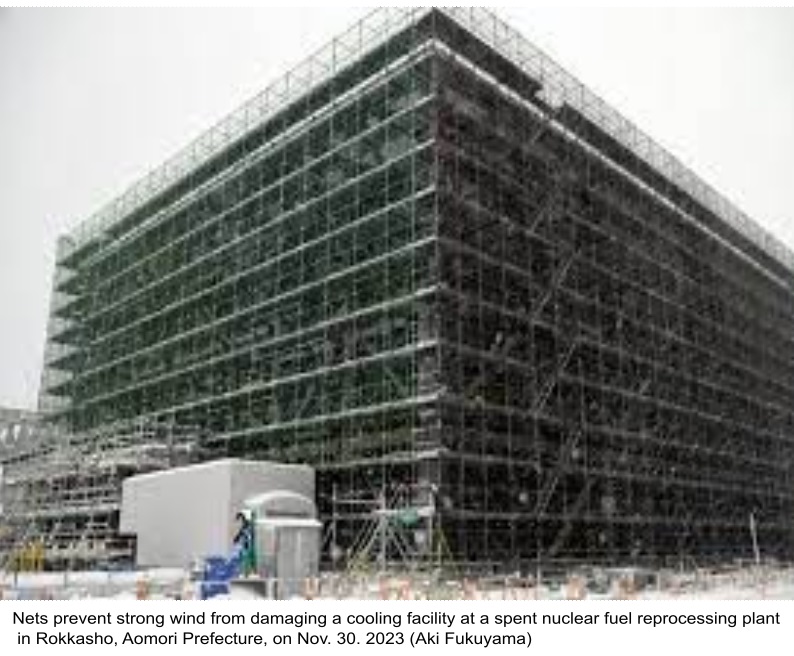
“They have invested too much money in the program to give up on it halfway“
That’s the reason why the Japanese government will continue with this $97 billion massive white elephant of the Rokkasho nuclear reprocessing plant.
Even if the reprocessing plant is completed, it can treat only 800 tons of spent nuclear fuel annually at full capacity, compared with 19,250 tons of spent fuel stored nationwide.
Calls have grown over the years to abandon the nuclear fuel cycle project. – The Asahi Shimbun.
What has intelligence got to do with it? Well, meaning common sense, (rather than spying) – it would be intelligent to stop this futile project, and take some different actions, such as stopping making this toxic trash.
Finally – what has ethics got to do with this?
Well, everything. The Japanese government won’t face up to the truth. Neither will world leaders. It’s all too hard – leave it to our great-grandchildren to deal with the radioactive trash, and all the environmental, social, and weapons-and war-dangers of this noxious industry.
‘Poison portal’: US and UK could send nuclear waste to Australia under Aukus, inquiry told

Labor describes claims as ‘fear-mongering’ and says government would not accept waste from other nations.
Tory Shepherd, Tue 2 Apr 2024, https://www.theguardian.com/world/2024/apr/02/poison-portal-us-and-uk-could-send-nuclear-waste-to-australia-under-aukus-inquiry-told
Australia could become a “poison portal” for international radioactive waste under the Aukus deal, a parliamentary inquiry into nuclear safety legislation has heard.
New laws to establish a safety framework for Australia’s planned nuclear-powered submarines could also allow the US and UK to send waste here, while both of those countries are struggling to deal with their own waste, as no long-term, high-level waste facilities have been created.
The government introduced the Australian naval nuclear power safety bill in November last year. If passed, it will establish a nuclear safety watchdog, allow for naval nuclear propulsion facilities to be created, including for storing or disposing of radioactive waste from Aukus submarines. A second bill to enable the regulator to issue licenses was introduced at the same time.
Both have been referred to a Senate inquiry, which is due to report on 26 April.
Dave Sweeney, the Australian Conservation Foundation’s nuclear free campaigner, said the issue of waste disposal was “highly disturbing” and that the Aukus partners could see Australia as a “a little bit of a radioactive terra nullius”.
“Especially when it’s viewed in the context of the contested and still unresolved issue of domestic intermediate-level waste management, the clear failure of our Aukus partners to manage their own naval waste, the potential for this bill to be a poison portal to international waste and the failure of defence to effectively address existing waste streams, most noticeably PFAS,” he said.
The defence minister, Richard Marles, has previously accused the Greens of “fearmongering” when they raised similar concerns, saying the government would not accept waste from the other nations.
However, the legislation allows for the creation of facilities for “managing, storing or disposing of radioactive waste from an Aukus submarine”, and defines an Aukus submarine as either an Australian or a UK/US submarine, and “includes such a submarine that is not complete (for example, because it is being constructed or disposed of)”.
The Greens defence spokesperson, David Shoebridge, said HMS Dreadnought, one of the UK’s first nuclear submarines, had been “rusting away” since being decommissioned in 1980.
“You can go on Google Maps and look at them rusting away in real time, can’t you?” Shoebridge asked Australian Radiation Protection and Nuclear Safety Agency (Arpansa) chief regulatory officer, James Scott.
“Yes. There is no disposal pathway yet,” Scott said, adding he was “aware of the UK plans to establish a deep geological repository somewhere in the 2050s to 2060s”.
“There’s no exact date,” he said.
“The UK is pursuing a disposal pathway, and Australia will need to do the same. We are fully aware of this; we are engaging with our own radioactive waste agency, ARWA, on this, and it’s something that needs to be dealt with now, not later.”
The Dreadnought’s nuclear fuel has been removed to be stored safely. This has happened with some but not all of the submarines, but there is still no permanent disposal facility. The US also removes nuclear fuel for temporary storage.
The $97 billion mess – spent nuclear fuel reprocessing in Japan

The reprocessing plant was initially scheduled for completion in 1997.
Including expenditures for the future decommissioning of the plant, the total budget has reached 14.7 trillion yen. (close to $97 billion)
Even if the reprocessing plant is completed, it can treat only 800 tons of spent nuclear fuel annually at full capacity, compared with 19,250 tons of spent fuel stored nationwide.
“They have invested too much money in the program to give up on it halfway,“
Another delay feared at nuclear fuel reprocessing plant in Aomori
By AKI FUKUYAMA/ Staff Writer, April 1, 2024, https://www.asahi.com/ajw/articles/15183716
Long-flustered nuclear fuel cycle officials fear there could be another delay in the project.
In a surprise to hardly anyone, the “hopeful outlook” for completion in June of a spent fuel reprocessing plant, a key component in Japan’s nuclear fuel cycle project, was pushed back in late January.
The facility is supposed to extract plutonium and uranium from used nuclear fuel. The recycled fuel can then be used to create mixed-oxide (MOX) fuel, which can run certain nuclear reactors.
But the incompletion of the plant has left Japan with 19,000 tons of spent nuclear fuel with nowhere to go.
The nuclear waste stockpile will only grow, as the administration of Prime Minister Fumio Kishida is turning to nuclear energy to cut Japan’s greenhouse gas emissions and reduce the country’s dependence on increasingly expensive fossil fuels.
Under the plan, 25 to 28 reactors will be running by 2030, more than double the current figure. Tokyo Electric Power Co. is seeking to restart reactors at its Kashiwazaki-Kariwa nuclear power plant in Niigata Prefecture this year.
31 YEARS AND COUNTING
A sign reading “village of energy” stands near Japan Nuclear Fuel Ltd.’s nuclear fuel reprocessing plant in Rokkasho, Aomori Prefecture.

The site, which is 159 times the size of Tokyo Dome, is lined with white buildings with no windows.
Construction started 31 years ago. It was still being built in late November last year, when it was shown to reporters.
The reprocessing plant is located on the Shimokita Peninsula at the northern tip of the main Honshu island.
Crops in the area are often damaged by cold humid winds during summer, so Rokkasho village accepted the plant in 1985 for local revitalization in place of agriculture.
Employees of privately-run Japan Nuclear Fuel, which is affiliated with nine major power companies, and other industry-related personnel account for more than 10 percent of Rokkasho’s population.
After repeated readjustments to the schedule, Naohiro Masuda, president of Japan Nuclear Fuel, said in December 2022 that the plant’s completion should come as early as possible during the first half of fiscal 2024, which is April to September 2024. More specifically, he pointed to “around June 2024.”
But at a news conference on Jan. 31 this year, Masuda said it is “inappropriate to keep saying the plant will be completed in June.”
The reprocessing plant was initially scheduled for completion in 1997.
Many insiders at the plant say it will be “quite difficult” to complete the work within the first half of fiscal 2024.
If officially decided, it will be the 27th postponement of the completion.
PROLONGED SCREENING, ACCIDENTS
One of the reasons for the delay of the completion is prolonged screenings by the Nuclear Regulation Authority.
Flaws were identified one after another in the company’s documents submitted to the nuclear watchdog, and around 400 Japan Nuclear Fuel employees are working on the papers within a gymnasium at the plant site.
Mechanical problems have also hampered progress. In 2022, for example, a system to cool high-level radioactive liquid waste broke down.
Masuda visited industry minister Ken Saito on Jan. 19 to report on the situation at the plant.
Saito told Masuda about the construction, “I expect you to forge ahead at full tilt.”
Masuda stressed his company “is fully devoted to finishing construction as soon as possible,” but said safety “screening is taking so much time because we have myriad devices.”
The cost to build the reprocessing plant, including new safety measures, has ballooned to 3.1 trillion yen ($20.57 billion), compared with the initial estimate of 760 billion yen.
Including expenditures for the future decommissioning of the plant, the total budget has reached 14.7 trillion yen. (close to $97 billion)
Even if the reprocessing plant is completed, it can treat only 800 tons of spent nuclear fuel annually at full capacity, compared with 19,250 tons of spent fuel stored nationwide.
Kyushu Electric Power Co. said in January that it would tentatively suspend pluthermal power generation at the No. 3 reactor of its Genkai nuclear power plant in Saga Prefecture. The reactor uses MOX fuel.
Kyushu Electric commissioned a French company to handle used fuel, but it recently ran out of stocks of MOX fuel.
Kyushu Electric has a stockpile of plutonium in Britain, but it cannot take advantage of it because a local MOX production plant shut down.
HUGE INVESTMENT
Calls have grown over the years to abandon the nuclear fuel cycle project.
Many insiders of leading power companies doubt whether the reprocessing plant “will really be completed” at some point.
But the government has maintained the nuclear fuel cycle policy, despite the huge amounts of time and funds poured into it.
“The policy is retained just because it is driven by the state,” a utility executive said.
Hajime Matsukubo, secretary-general of nonprofit organization Citizens’ Nuclear Information Center, said the government’s huge investment explains why the fuel cycle program has yet to be abandoned.
“They have invested too much money in the program to give up on it halfway,” Matsukubo said.
Xi Jinping’s Thoughts on China’s Nuclear Weapons

Xi noted the increased readiness those new silos might provide was necessary to prepare to respond to foreign military intervention. That sounds more defensive than aggressive. ……………….. China’s long-standing commitment not to use nuclear weapons first at any time or under any circumstances.
UCS is concerned about the future direction of Chinese nuclear weapons policy. We agree with Gen. Cotton that “the PRC’s long-term nuclear strategy and requirements remain unclear.” We urge influential US voices, including the media, to refrain from encouraging the public, and especially US decision-makers, to jump to conclusions the available evidence does not support. We also urge the Biden administration, and the US Congress, to wait until they have a clearer understanding of Chinese nuclear thinking before making precipitous decisions about the future of the US nuclear arsenal.
April 1, 2024, Gregory Kulacki, China Project Manager, This blog was co-authored with UCS China analyst Robert Rust. https://blog.ucsusa.org/gregory-kulacki/xi-jinpings-thoughts-on-chinas-nuclear-weapons/
Last month UCS published a critique of a New York Times article that claimed Chinese military strategists, “are looking to nuclear weapons as not only a defensive shield, but as a potential sword — to intimidate and subjugate adversaries.” We examined the evidence and found it did not support that claim.
However, there was one piece of evidence in the article we could not examine; a speech by Chinese leader Xi Jinping to China’s Second Artillery in December of 2012. It operates China’s conventional and nuclear missiles and was renamed the People’s Liberation Army Rocket Force in 2016. We’ve since obtained a copy of that speech and found it doesn’t support the New York Times claim either. There is no language in Xi’s speech that suggests he thinks about the purpose of China’s nuclear arsenal differently than his predecessors.
We posted the original Chinese text with an English translation. It is classified as an “internal publication” that should be “handled with care.” It was printed and distributed to all Chinese military officers at the regimental level and above by the General Political Department of the People’s Liberation Army (PLA) in February 2014.
Why is this speech worth reading?
UCS first learned about the speech ten years ago when a Chinese colleague drew our attention to language in a commentary on the speech by generals Wei Fenghe and Zhang Haiyang, the commander and party secretary of the Second Artillery at the time. Our colleague noticed it contained new language describing the alert level of Chinese missiles. He thought the two officers might be trying to influence Xi’s thinking. UCS took note of that the new language in our 2016 report on a possible change in China’s nuclear posture.
That report concluded China may shift some of its nuclear forces to what is called a “launch on warning” or “launch under attack” alert status that would give Chinese leaders the option to launch those nuclear missiles quickly before they could be destroyed by an incoming attack. Traditionally, China kept its nuclear missile force off-alert, and the Second Artillery trained to launch a retaliatory nuclear strike only after being struck first. Currently, China is believed to keep most of its nuclear warheads in storage, separated from the missiles that carry them, to prevent an accidental or unauthorized launch.
Although China may still be moving to a launch on warning posture, the full text of Xi’s December 2012 speech, and the phrase it contains related to alert levels, reveals Xi did not discuss nuclear strategy or announce an intention to put Chinese nuclear forces on alert. He addresses more general concerns about the combat readiness, ideological orientation, and human qualities of Chinese military officers. Every Chinese head of state since 1842, when the United Kingdom defeated Imperial China in the Opium War, shared the same concerns. Xi did not say anything new, specific, or surprising. There is no language in his speech that justifies the suggestion he communicated aggressive new nuclear ambitions that day.
What did Xi say?
Continue readingUK Court Gives Biden Chance to Dodge Assange Appeal by “Assuring” His Rights

The WikiLeaks publisher could be extradited if the US gives “satisfactory assurances” of rights and no death penalty.
By Marjorie Cohn , TRUTHOUT 29 Mar 24, https://truthout.org/articles/uk-gives-biden-opportunity-to-dodge-assange-appeal-by-assuring-his-rights/
WikiLeaks publisher Julian Assange is closer than ever to being extradited to the United States for trial on 17 counts under the Espionage Act and one count of conspiracy to commit computer intrusion over WikiLeaks’s 2010-2011 revelation of evidence of U.S. war crimes in Iraq, Afghanistan and Guantánamo Bay. He faces 175 years in prison.
“This is a signal to all of you that if you expose the interests that are driving war they will come after you, they will put you in prison and they will try to kill you,” said Stella Assange, Julian’s wife, of his prosecution.
On March 26, the United Kingdom Divisional Court denied Assange the opportunity to make most of his appellate arguments. But the two-judge panel of Justice Jeremy Johnson and Dame Victoria Sharp left open the possibility that Assange could appeal on three grounds. They found that Assange “has a real prospect of success” on the following issues: If extradited to the U.S., he will be denied the right to freedom of expression, will suffer discrimination because he’s not a U.S. citizen and could be sentenced to death.
Rather than simply allowing Assange to argue the three issues on appeal, however, the panel gave the Biden administration an out. If the U.S. provides the court with “satisfactory assurances” that Assange won’t be denied any of these rights, his extradition to the U.S. can proceed without an appeals hearing.
Stella Assange called the decision “astounding,” adding, “The court’s recognized that Julian has been exposed to flagrant denial of his freedom of expression rights, that he is being discriminated against on the basis of his nationality and that he remains exposed to the death penalty.”
At an earlier stage in this case, the U.S. gave the U.K. High Court “assurances” that Assange would be treated humanely if extradited. That caused the court to reverse the magistrate judge’s denial of extradition (which was based on the likelihood of suicide if Assange is held in harsh conditions of confinement in the U.S.). The High Court accepted those assurances at face value in spite of the U.S.’s history of reneging on similar assurances.
The current ruling, however, requires U.S. assurances to be “satisfactory” and the defense will have an opportunity to challenge them at a hearing.
“Mr. Assange will not, therefore, be extradited immediately,” the panel wrote, implying that if they had denied his appeal outright, the U.K. authorities would put him on a plane to the U.S. forthwith. They gave the U.S. three weeks to come forward with satisfactory assurances.
If the U.S. fails to provide any assurances, Assange will be granted a hearing on the three grounds. If the U.S. does give assurances, a hearing to decide whether they are satisfactory will occur on May 20.
“The Biden administration should not offer assurances. They should drop this shameful case that should never have been brought,” Stella Assange said.
These are the grounds the High Court will review if the U.S. fails to provide “satisfactory assurances”:
1. Extradition Would Violate Freedom of Expression Guaranteed by Article 10 of European Convention on Human Rights
Assange would argue at trial that his actions were protected by the First Amendment to the U.S. Constitution. “He contends that if he is given First Amendment rights, the prosecution will be stopped. The First Amendment is therefore of central importance to his defence,” the panel concluded.
The First Amendment provides “strong protection” to freedom of expression, similar to that provided by Article 10 of the European Convention on Human Rights, the panel noted. Article 10 (1) of the convention says, “Everyone has the right to freedom of expression. This right shall include freedom to hold opinions and to receive and impart information and ideas without interference by public authority and regardless of frontiers.”
Gordon Kromberg, assistant U.S. attorney in the Eastern District of Virginia, where Assange’s trial would be held, said the prosecution might argue at trial that “foreign nationals are not entitled to protections under the First Amendment,” the panel noted. In 2017, then-CIA Director Mike Pompeo said that Assange “has no First Amendment freedoms” because “he is not a U.S. citizen.”
In addition, the U.S. Supreme Court ruled in the 2020 case of Agency for International Development v. Alliance for Open Society International that “it is long settled as a matter of American constitutional law that foreign citizens outside United States territory do not possess rights under the US Constitution.”
The panel wrote that if Assange “is not permitted to rely on the First Amendment, then it is arguable that his extradition would be incompatible with article 10 of the Convention.”
But even if the U.S. Department of Justice prosecutors give “satisfactory assurances” that Assange’s First Amendment rights would be protected, that is no guarantee. Prosecutors are part of the executive branch, which cannot bind the judicial branch due to the constitutional doctrine of separation of powers.
“The ruling reveals that the High Court does not understand the American system of government,” Stephen Rohde, who practiced First Amendment law for almost 50 years and writes extensively about the Assange case, told Truthout. “It only has before it the executive branch of the U.S. government. Whatever ‘satisfactory assurances’ the Department of Justice may give the High Court, they are not binding on the judicial branch.”
Moreover, Rohde said, “The High Court is obligated to uphold Assange’s rights to ‘freedom of expression’ under Article 10 of the European Convention on Human Rights, which protects Assange even if the U.S. courts refuse to do so. The only way to do that is to deny extradition.”
2. The U.K. Extradition Act Forbids Discrimination Based on Nationality
Julian Assange is an Australian citizen who would be tried in the U.S. if the Biden administration’s pursuit of extradition is successful.
Section 81(b) of the U.K. Extradition Act says that extradition is barred for an individual who “might be prejudiced at his trial or punished, detained or restricted in his personal liberty by reason of his … nationality.”
Due to the centrality of the First Amendment to Assange’s defense, the panel noted, “If he is not permitted to rely on the First Amendment because of his status as a foreign national, he will thereby be prejudiced (potentially very greatly prejudiced) by reason of his nationality.”
3. Extradition Is Barred by Inadequate Death Penalty Protection Required by the Extradition Act
Section 94 of the U.K. Extradition Act says, “The Secretary of State must not order a person’s extradition … if he could be, will be or has been sentenced to death for the offence” in the receiving state. That limitation does not apply if a written “assurance” that is “adequate” says “that a sentence of death- (a) will not be imposed, or (b) will not be carried out (if imposed).”
None of the charges that Assange is currently facing carry the death penalty. But if extradited to the U.S., he could be charged with aiding and abetting treason or espionage, both of which are capital offenses.
Ben Watson KC, secretary of state for the Home Department, admitted that:
a.) The facts alleged against [Assange] could sustain a charge of aiding or abetting treason, or espionage.
b.) If [Assange] is extradited, there is nothing to prevent a charge of aiding or abetting treason, or a charge of espionage, from being added to the indictment.
c.) The death penalty is available on conviction for aiding or abetting treason, or espionage.
d.) There are no arrangements in place to prevent the imposition of the death penalty.
e.) The existing assurance does not explicitly prevent the imposition of the death.
The panel noted that when former President Donald Trump was asked about WikiLeaks publishing the leaked documents, he said, “I think it was disgraceful…. I think there should be like a death penalty or something.” If Trump is reelected, he may seek to ensure that his Justice Department adds capital charges to the indictment.
In concluding that Assange could raise this issue on appeal subject to “satisfactory assurances,” the panel cited “the potential, on the facts, for capital charges to be laid; the calls for the imposition of the death penalty by leading politicians and other public figures; the fact that the Treaty does not preclude extradition for death penalty charges, and the fact that the existing assurance does not explicitly cover the death penalty.”
Appeal Grounds Denied by Panel
Remaining grounds for appeal that Assange requested were denied by the panel. They include prosecution for a political offense, prosecution based on political opinion; violation of right to a fair trial; violation of right to life; and violation of right to be free from torture and inhuman or degrading treatment or punishment. In addition, since no publisher has ever been prosecuted under the Espionage Act for publishing government secrets, Assange could not have known it was a crime.
The panel also ruled that Assange could not introduce new evidence adduced after the magistrate judge’s ruling. This includes a Yahoo News report detailing the CIA’s plan to kidnap and kill Assange when he was living under a grant of asylum in the Ecuadorian Embassy in London.
If the U.S. offers “satisfactory assurances” and extradition is ordered, Assange could appeal to the European Court of Human Rights and raise these additional issues as well.
Meanwhile, there is a possibility that instead of filing “assurances,” the Biden administration will opt to avoid the political pitfalls of Assange’s extradition to the U.S. and offer a plea bargain to end the case.
Marjorie Cohn is professor emerita at Thomas Jefferson School of Law, former president of the National Lawyers Guild, and a member of the national advisory boards of Assange Defense and Veterans For Peace, and the bureau of the International Association of Democratic Lawyers. She is founding dean of the People’s Academy of International Law and the U.S. representative to the continental advisory council of the Association of American Jurists. Her books include Drones and Targeted Killing: Legal, Moral and Geopolitical Issues.
Senior Western Australia Liberal calls for Australia to become nuclear weapons power

Brisbane Times, Hamish Hastie, March 11, 2024
A two-time WA Liberal candidate and party office bearer says Australia should have nuclear weapons.
Jim Seth made the argument at a Liberal Party state council meeting this month, saying nuclear weapons had made North Korea untouchable and suggested Australia should follow suit.
At the party’s March 2 meeting, details of which were leaked to WAtoday, Seth asked the question-and-answer panel:
“North Korea, a small country, has got nuclear fire, right? Nobody can do a mimicry [sic] on them, no neighbour can touch them, why we as first world country not nuclear react?”
Seth, who was a WA Liberals candidate for Bassendean in 2017 and for Morley in 2021 and is now the marketing committee chair and state executive member, furthered his point in a follow-up question about the Australian Navy’s capabilities to counter drone attacks…………………..
Seth claimed $90 million was being paid every day to Canberra public servants to create federal policies and suggested this money could be better spent on making Australia a nuclear power.
“We could have spent that money into making Australia a nuclear power, so nobody can come and do mimicry [sic] on us,” he said………………………….
WAtoday contacted Seth to clarify whether he was talking about nuclear energy or weapons, and he said “as a patriotic Australian” he believed Australia should have nuclear weapons.
He did not respond to follow-up requests for comment.
Australia has since 1970 been a signatory to the United Nations Nuclear Non-Proliferation Treaty, which binds the country to an agreement not to acquire nuclear weapons.
According to the Department of Foreign Trade and Affairs Australia has been one of the treaty’s strongest supporters and was a key player in ensuring the treaty was extended indefinitely in 1995.
Seth’s comments alarmed Nuclear Free WA co-convener Mia Pepper who said nuclear weapons would make Australia a target, not safer.
“Nuclear weapons have no strategic utility and would not enhance Australia’s defence or security,” she said.
“In a time of growing conflict and uncertainty, Australia should be proliferating peace and diplomacy, not fuelling nuclear tensions and threat.”………………… https://www.brisbanetimes.com.au/politics/western-australia/senior-wa-liberal-calls-for-australia-to-become-nuclear-weapons-power-20240308-p5fazr.html?ref=rss&utm_medium=rss&utm_source=rss_feed
The UK and US could send nuclear waste to Australia under our AUKUS deal
https://www.crikey.com.au/2024/04/02/misbehaving-mps-pay-aukus-nuclear-waste/
The UK and US could send nuclear waste to Australia under our AUKUS deal, the Australian Conservation Foundation’s Dave Sweeney told a parliamentary inquiry.
It’s exploring Labor’s draft Australian Naval Nuclear Power Safety Bill, as Guardian Australia reports, which proposed facilities that could store or dispose of radioactive waste from AUKUS submarines — defined as either an Australian or a UK/US one, the Defence Department’s domestic nuclear policy branch assistant director general Kim Moy confirmed.
Basically, we’d be in prime position to become a poison portal, Sweeney claimed, though Defence Minister Richard Marles has before vowed it won’t happen. In any case, one expert told the inquiry we need a plan to store the nuclear waste from the subs for as long as 100,000 years — and so far, no-one in AUKUS has quite worked it out.
‘Like a radioactive cloud’: elegance and horror combine in powerful Yhonnie Scarce exhibition
Australia’s forgotten nuclear history and its dehumanisation of Aboriginal people come together in First Nations glass artist’s fiercely intellectual work.
Guardian, by Rosamund Brennan, 2 Apr 24
Yhonnie Scarce grew up in the grim aftermath of nuclear weapons testing in South Australia in the 50s and 60s, not far from her birthplace of Woomera. From the tender age of ten, she heard stories from elders about a cataclysmic roar, the sky turning red and a poisonous black mist hovering over the desert, like an apparition.
Born in 1973, the Kothakha and Nukunu glass artist has spent much of her career researching the British government’s testing of nuclear weapons in Maralinga and Emu Field, which she says “lit a fire in my heart that hasn’t been extinguished”.
The blasts wreaked havoc on generations of Aboriginal people, as well as military personnel and non-Aboriginal civilians – sending radioactive clouds thousands of kilometres, causing burns, blindness, birth defects and premature death.
When the toxic plumes reached Ceduna, where Scarce’s family lived, radioactive slag rained down from the sky, singeing their skin. Their concerns about the burns were rebuffed by doctors, who spuriously claimed there was a measles outbreak. But today, according to Scarce, cancer is prevalent in the town.
“I call this a mass genocide,” Scarce says. “I don’t know if we’ll ever find out how many Aboriginal people died over that 10-year period. But I can imagine it’s thousands.”………………………………………………………………………………………………..
The series is revelatory of Scarce’s practice: at once fiercely intellectual, deeply felt and elegant in its materiality. As a glass-blower, Scarce quite literally breathes life into her work, animating its delicate, molten surface, giving form to invisible pain and loss.
Glass holds special significance for Scarce: crafted from silica, or sand, it emerges from the very essence of the landscape. As Australia’s only professional Indigenous glass-blower, she veered away from working with traditional forms like decorative vases or bowls, instead drawing from what she calls the “bush supermarket”: depicting yams, plums and bush bananas to convey the history of her people.
Conceived by Wardandi and Badimaya curator Clothilde Bullen, the career-spanning exhibition at AGWA also features works which examine the dehumanisation and exploitation of Aboriginal people through displacement, indentured labour and institutionalised racism. One such work is In The Dead House, which features glass bush bananas laid out on a mortuary trolley, their bodies split wide open.
……………………………………………………………………………………………… In a seemingly fated moment, when those monstrous atomic bombs exploded at Maralinga almost 70 years ago, the red desert sand melted into thousands of green shards of glass that still litter the site today. Across Scarce’s 20-year career, it’s as if she’s been slowly collecting the disaster’s shattered remains and, piece by piece, crystallising a dark, hidden chapter of Australia’s history. Like a radioactive cloud, her astonishing body of work engulfs you in its sheer power and potency.
https://www.theguardian.com/artanddesign/2024/apr/02/yhonnie-scarce-light-of-day-art-gallery-western-australia
- Yhonnie Scarce: Light of Day is showing at the Art Gallery of Western Australia until 19 May 2024
UK govt lawyers conclude Israel in breach of humanitarian law – media

A view of damaged buildings at Maghazi refugee camp after Israeli attack in Deir al-Balah, Gaza on March 29, 2024.
Sun, 31 Mar 2024, https://www.sott.net/article/490269-UK-govt-lawyers-conclude-Israel-in-breach-of-humanitarian-law-media
British authorities, however, have apparently opted to keep the findings out of the public domain.
Lawyers for the UK government have established Israel has been breaking humanitarian law amid its ongoing conflict in Gaza with the Palestinian militant group Hamas, a senior Tory is claiming, according to leaked audio revealed by the Observer newspaper on Saturday.
Chair of the Foreign Affairs Select Committee, Alicia Kearns, made the remarks earlier this month during a Conservative Party fundraising event. “The Foreign Office has received official legal advice that Israel has broken international humanitarian law but the government has not announced it,” Kearns, a former official with the Foreign Office and Ministry of Defence, who has been pressing the government on the matter, said during the event.
The legal experts’ assessment effectively makes the UK complicit in the Israeli military’s violations, and defense cooperation should have been severed by London immediately after they produced their evaluation of the situation in Gaza.
“They have not said it, they haven’t stopped arms exports. They have done a few very small sanctions on Israeli settlers and everyone internationally agrees that settlers are illegal, that they shouldn’t be doing what they’re doing, and the ways in which they have continued and the money that’s been put in,” Kearns stated.
During the event, Kearns insisted that she, like the UK Foreign Secretary James Cameron, strongly believes in Israel’s right to “self defense,” noting however that there were legal boundaries for exercising it.
“The right to self defense has a limit in law. It is not limitless,” she explained, warning that Israel’s approach to handling the escalation may end up putting its own – and Britain’s – long-term security at risk.
The authenticity of the recordings obtained by the Observer appears beyond question, given that Kearns has been rather vocal about her position on the matter. On Saturday, she produced similar remarks as well, once again urging the government to make public its legal assessment of the Israeli actions.
“I remain convinced the government has completed its updated assessment on whether Israel is demonstrating a commitment to international humanitarian law, and that it has concluded that Israel is not demonstrating this commitment, which is the legal determination it has to make,” she stated, arguing that “transparency” was absolutely needed to “uphold the international rules-based order.”
Israel launched the operation in Gaza following an incursion by Hamas militants into the southern part of the country last October. During the attack, over 1,200 people were killed and scores of hostages were taken into Gaza. The Israeli campaign inflicted heavy damage on the Palestinian enclave, causing widespread destruction and leaving at least 32,000 people dead, according to the Palestinian Health Ministry.
Comment: Suppressing findings which are inconvenient is nothing new for Western governments so it’s no real surprise that the findings have not been made public. Whether anything changes now that the findings are public remains to be seen (don’t hold your breath).
Is Nuclear Fusion Really The Ultimate Solution to AI’s Crazy Power Use?

By Alex Kimani – Mar 29, 2024, https://oilprice.com/Energy/Energy-General/Is-Nuclear-Fusion-Really-The-Ultimate-Solution-to-AIs-Crazy-Power-Use.html
- A Boston Consulting Group analysis has predicted that data center electricity consumption will triple by 2030.
- Past trends in technology advances suggest that AI cons are very likely to outweigh the pros as far as power demand is concerned.
- OpenAI’s Altman: nuclear fusion is the ultimate solution to the AI energy puzzle
Two weeks ago, we reported how Artificial Intelligence (AI), cryptocurrency mining and clean energy manufacturing are powering the Fourth Industrial Revolution, or simply 4R, and driving disruptive trends including the rise of data and connectivity, analytics, human-machine interaction, and improvements in robotics. Unfortunately, these secular megatrends are pushing the U.S. power grid to its limits.

According to Sreedhar Sistu, vice president of artificial intelligence at Schneider Electric (OTCPK:SBGSF), excluding China, AI represents 4.3 GW of global power demand, and could grow almost five-fold by 2028. Another analysis has predicted that demand from AI will grow exponentially, increasing at least 10x between 2023 and 2026.

AI tasks typically demand more powerful hardware than traditional computing tasks. Meanwhile, bitcoin mining shows no signs of slowing down, with mining rates hitting 565 exahashes per second (EH/s) currently, a five-fold increase from three years ago.
Bitcoin mining consumes 148.63 TWh of electricity per year and emits 82.90 Mt CO2 per year, comparable to the power consumption of Malaysia. And, data center demand is not helping matters at all. Data center storage capacity is expected to grow from 10.1 zettabytes (ZB) in 2023 to 21.0 ZB in 2027, good for a 18.5% CAGR.

A Boston Consulting Group analysis has predicted that data center electricity consumption will triple by 2030, enough electricity to power 40 million U.S. homes.
The situation is already getting out of hand: U.S. power demand has started rising for the first time ever in 15 years. “We as a country are running out of energy,” Michael Khoo, climate disinformation program director at Friends of the Earth and co-author of a report on AI and climate, has told CNN.
To be fair, AI has been touted as one of the key technologies that will help tackle climate change. The revolutionary technology is already being used to track pollution, predict weather, monitor melting ice and map deforestation. A recent report commissioned by Google and published by the Boston Consulting Group claimed AI could help mitigate up to 10% of planet-heating pollution.
Unfortunately, past trends in technology advances suggest that AI cons are very likely to outweigh the pros as far as power demand is concerned.
“Efficiency gains have never reduced the energy consumption of cryptocurrency mining. When we make certain goods and services more efficient, we see increases in demand,” Alex de Vries, a data scientist and researcher at Vrije Universiteit Amsterdam, has pointed out.
At this point, nearly everybody agrees that we are incapable of developing renewable energy plants fast enough to meet this skyrocketing power demand. So, what other recourse do we have, short of saying let’s just build more natural gas and fossil fuel power plants?
Enter nuclear fusion, long regarded by scientists as the Holy Grail of clean and almost limitless energy. Sam Altman, head of ChatGPT creator OpenAI, says nuclear fusion is the ultimate solution to the AI energy puzzle, “There’s no way to get there without a breakthrough, we need fusion,” Altman said in a January interview. Altman reiterated this view a few weeks ago when podcaster and computer scientist Lex Fridman asked him about the AI energy conundrum.
Blue Sky Thinking

Unfortunately, Altman’s proposal is likely another case of overly optimistic blue-sky thinking, and we might not be any closer to building a commercial nuclear fusion reactor than we are to harvesting energy from blackholes.
For decades, nuclear fusion has been considered the “Holy Grail” of clean energy. If we were able to harness its power it would mean endless clean and sustainable energy. It’s what powers stars, and the theory is that it could be successfully applied to nuclear reactors–without the risk of a catastrophic meltdown disaster.
Scientists have been working on a viable nuclear fusion reactor since the 1950s–ever hopeful that a breakthrough is just around the corner. Unfortunately, the running joke has become that a practical nuclear fusion power plant could be decades or even centuries away, with milestone after milestone having fallen time and again
To be fair again, there’s been some promising glimpses into the possibilities here. Last year, a nuclear fusion reactor in California produced 3.15 megajoules of energy using only 2.05 megajoules of energy input, a rare instance where a fusion experiment produced more energy than it consumed. The vast majority of fusion experiments are energy negative, taking in more energy than they generate thus making them useless as a form of electricity generation. Despite growing hopes that fusion could soon play a part in climate change mitigation by providing vast amounts of clean power for energy-hungry technologies like AI, the world is “still a way off commercial fusion and it cannot help us with the climate crisis now”, Aneeqa Khan, research fellow in nuclear fusion at Manchester University, told the Guardian just after the initial December breakthrough.
You don’t have to look very far to get a healthy dose of reality check.
For decades, 35 countries have collaborated on the largest and most ambitious scientific experiments ever conceived: the International Thermonuclear Experimental Reactor (ITER), the biggest-ever fusion power machine. ITER plans to generate plasma at temperatures 10x higher than that of the sun’s core, and generate net energy for seconds at a time. As is usually the case with many nuclear power projects, ITER is already facing massive cost overruns that puts its future viability in question. W
When the ITER project formally commenced operations in 2006, its international partners agreed to fund an estimated €5 billion (then $6.3 billion) for a 10-year plan that would have seen the reactor come online in 2016. Charles Seife, director of the Arthur L. Carter Institute of Journalism at New York University, has sued ITER for lack of transparency on cost and incessant delays. According to him, the project’s latest official cost estimate now stands at more than €20 billion ($22 billion), with the project nowhere near achieving its key objectives. To make matters worse, none of ITER’s key players, including the U.S. Department of Energy, has been able to provide concrete answers of whether the team can overcome the technical challenges or estimates of the additional delays, much less the extra expenses.
Seife notes that whereas the Notre Dame took a century to complete, it eventually was used for its intended purpose less than a generation after construction began. However, he concludes by saying that the same can hardly be said about ITER, which looks less and less like a cathedral–and more like a mausoleum.
Einstein’s vision for peace

By Lawrence S. Wittner https://beyondnuclearinternational.org/2024/03/31/einsteins-vision-for-peace/
Aghast at the use of nuclear weapons, he threw himself into efforts to prevent worldwide nuclear annihilation
Although the popular new Netflix film, Einstein and the Bomb, purports to tell the story of the great physicist’s relationship to nuclear weapons, it ignores his vital role in rallying the world against nuclear catastrophe.
Aghast at the use of nuclear weapons in August 1945 to obliterate the cities of Hiroshima and Nagasaki, Einstein threw himself into efforts to prevent worldwide nuclear annihilation. In September, responding to a letter from Robert Hutchins, Chancellor of the University of Chicago, about nuclear weapons, Einstein contended that, “as long as nations demand unrestricted sovereignty, we shall undoubtedly be faced with still bigger wars, fought with bigger and technologically more advanced weapons.” Thus, “the most important task of intellectuals is to make this clear to the general public and to emphasize over and over again the need to establish a well-organized world government.”
Four days later, he made the same point to an interviewer, insisting that “the only salvation for civilization and the human race lies in the creation of a world government, with security of nations founded upon law.”
Determined to prevent nuclear war, Einstein repeatedly hammered away at the need to replace international anarchy with a federation of nations operating under international law. In October 1945, together with other prominent Americans (among them Senator J. William Fulbright, Supreme Court Justice Owen Roberts, and novelist Thomas Mann), Einstein called for a “Federal Constitution of the World.”
That November, he returned to this theme in an interview published in the Atlantic Monthly. “The release of atomic energy has not created a new problem,” he said. “It has merely made more urgent the necessity of solving an existing one. . . . As long as there are sovereign nations possessing great power, war is inevitable.” And war, sooner or later, would become nuclear war.
Given Einstein’s fame and his well-publicized efforts to avert a nuclear holocaust, in May 1946 he became chair of the newly-formed Emergency Committee of Atomic Scientists, a fundraising and policymaking arm for the atomic scientists’ movement. In the Committee’s first fund appeal, Einstein warned that “the unleashed power of the atom has changed everything save our modes of thinking, and thus we drift toward unparalleled catastrophe.”
Even so, despite the fact that Einstein, like most members of the early atomic scientists’ movement, saw world government as the best recipe for survival in the nuclear age, there seemed good reason to consider shorter-range objectives. After all, the Cold War was emerging and nations were beginning to formulate nuclear policies. An early Atomic Scientists of Chicago statement, prepared by Eugene Rabinowitch, editor of the Bulletin of the Atomic Scientists, underscored practical considerations.
“Since world government is unlikely to be achieved within the short time available before the atomic armaments race will lead to an acute danger of armed conflict,” it noted, “the establishment of international controls must be considered as a problem of immediate urgency.” Consequently, the movement increasingly worked in support of specific nuclear arms control and disarmament measures.
In the context of the heightening Cold War, however, taking even limited steps forward proved impossible. The Russian government sharply rejected the Baruch Plan for international control of atomic energy and, instead, developed its own atomic arsenal. In turn, U.S. President Harry Truman, in February 1950, announced his decision to develop a hydrogen bomb―a weapon a thousand times as powerful as its predecessor.
Naturally, the atomic scientists were deeply disturbed by this lurch toward disaster. Appearing on television, Einstein called once more for the creation of a “supra-national” government as the only “way out of the impasse.” Until then, he declared, “annihilation beckons.”
Despite the dashing of his hopes for postwar action to end the nuclear menace, Einstein lent his support over the following years to peace, nuclear disarmament, and world government projects.
The most important of these ventures occurred in 1955, when Bertrand Russell, like Einstein, a proponent of world federation, conceived the idea of issuing a public statement by a small group of the world’s most eminent scientists about the existential peril nuclear weapons brought to modern war. Asked by Russell for his support, Einstein was delighted to sign the statement and did so in one of his last actions before his death that April.
In July, Russell presented the statement to a large meeting in London, packed with representatives of the mass communications media. In the shadow of the Bomb, it read, “we have to learn to think in a new way. . . . Shall we . . . choose death because we cannot forget our quarrels? We appeal as human beings to human beings: Remember your humanity, and forget the rest.”
This Russell-Einstein Manifesto, as it became known, helped trigger a remarkable worldwide uprising against nuclear weapons in the late 1950s and early 1960s, culminating in the world’s first significant nuclear arms control measures. Furthermore, in later years, it inspired legions of activists and world leaders. Among them was the Soviet Union’s Mikhail Gorbachev, whose “new thinking,” modeled on the Manifesto, brought a dramatic end to the Cold War and fostered substantial nuclear disarmament.
The Manifesto thus provided an appropriate conclusion to Einstein’s unremitting campaign to save the world from nuclear destruction.
Lawrence S. Wittner is Professor of History Emeritus at SUNY/Albany and the author of Confronting the Bomb (Stanford University Press).
Australian government seeks top quality PR team to persuade Aborigines that a nuclear waste dump is a good thing.

The federal government is seeking to employ a highly skilled PR team to manage likely outrage over possible sites for a nuclear waste dump.
In new documents, released quietly on the federal tender site, the Albanese government has called for urgent expressions of interest in public relations services as it continues “high outrage” plans to build a secure nuclear waste storage facility.
A major government approach to market uncovered by The Canberra Times reveals a nuclear-specific crisis management team is now being sought to bid for a two-year contract to help manage public discussion of nuclear waste in Australia.
It comes six months after the government abandoned plans for a low-level nuclear waste facility in remote South Australia amid community division including opposition from the area’s traditional owners, the Barngarla people.
It also comes as Australia, like AUKUS partners the United States and the United Kingdom, continues to be without a long-term solution for radioactive waste disposal.
The approach to market, posted on March 26, reveals the Department of Industry, Science and Resources seeking “nuclear-specific” public relations and professional communications services to work with staff from the Australian Radioactive Waste Agency (ARWA) to support the public’s “comprehensive understanding of the nation’s radioactive waste inventory, origins and need for safe management.”
“This is a highly specialised high-outrage area and there are times of uplift where urgent assistance is required and additional industry-relevant specialist support is needed, including upskilling staff to undertake these activities in a high outrage environment,” the document reads.
“The contract procurement is being undertaken at this time as these skills are especially relevant during the early stages of a new radioactive waste management approach being identified (i.e the first three-five years for a 100-year radioactive waste management project).”
Last August, the federal government scrapped plans to build the nation’s first radioactive waste storage facility on farmland near Kimba in South Australia.
There was high criticism of the way the site at Napandee, a 211-hectare property at the top of the Eyre Peninsula, was announced in 2021 and then argued as needed.
The Barngarla people had earlier won a Federal Court case, successfully arguing that they were not properly consulted by the Morrison government over the site’s selection. However, some other Kimba residents were disappointed that the nuclear waste facility plans were dumped.
The Albanese government said, in scrapping the Kimba plans, that it respected the court’s decision to set aside the 2021 site declaration.
The new approach to market refers to a need to engage with “impacted communities” and hold “stringent preparation for technical and challenging questions from the public to ensure ARWA can answer questions and address concerns transparently.”
“Services will include nuclear-specific stakeholder engagement, often in person, with impacted communities, nuclear industry stakeholders and the broader public – to support a comprehensive understanding of the nation’s radioactive waste inventory, origins and need for safe management,” the documents read.
The new approach to market asks that the successful suppliers be able to obtain baseline security clearance and demonstrate experience and understanding of the nuclear and radioactive industry.
According to the documents, the contract for services, which potential suppliers have to bid for over the next two weeks, would be from July 1, 2024 to June 30, 2026, with a possibility of extension. It is advised that the contract would not be fixed price irrespective of the hours spent by personnel. “Intensive” short notice work is required combined with some intrastate and interstate travel.
It warns there may be “urgent uplift from government announcements or other factors.”
The documents describe activities for the successful supplier, including engagement with the public and capability to “advise on emerging best practice for high outrage management and crisis communication and upskill APS (Australian Public Service) staff to deliver.”
They also ask that the successful supplier assist in preparing “factually correct nuclear technology and radioactive waste engagement materials ahead of in-person stakeholder engagement and upskilling APS staff.”
The Canberra Times sought comment from Resources Minister Madeleine King over the approach to market.
“Federal Resources Minister Madeleine King has instructed her department to develop policy options for managing Commonwealth radioactive waste into the future and this work is ongoing,” a spokesperson for Ms King said in a statement.
“The government has been firm in the need for the Commonwealth to safely manage its own radioactive waste.”
The Nuclear Explosion That Makes US Aid to Israel Illegal

President Carter noted in his White House dairy at the time, “We have a growing belief among our scientists that the Israelis did indeed conduct a nuclear test explosion in the ocean near the southern end of Africa.”
Under US law, Israel must be banned from receiving its annual package of billions of dollars and arsenal of bombs.
Americans are being deliberately lied to by their own government as to Israel’s vast and deadly nuclear stockpile, largely built with nuclear materials stolen from the United States.
At the same time that US administrations were failing to enforce the ban on nuclear weapons testing by Israel, they also deliberately engaged in a campaign of censorship, lies, and disinformation to hide the truth from the American public
Israel’s nuclear program has been in violation of international law for decades, rendering it ineligible for American assistance.
JAMES BAMFORD, 1 April 24 https://www.thenation.com/article/world/israel-nuclear-weapons/
The researchers were startled as they looked up and saw the coal-black sky suddenly turn into a brilliant, multicolored aurora. As geophysicists with Tokyo’s Earthquake Research Institute, they were wintering over at an isolated ice station near Antarctica’s Queen Maud Land, a place where the temperature has dropped to as low as minus-50 degrees Fahrenheit. At about the same time, half the earth away in Puerto Rico, the giant 1,000-foot Arecibo radio telescope picked up an unusual disturbance. An odd and powerful electromagnetic ripple appeared on the lower surface of the ionosphere. And 1,200 miles to the north on the Atlantic coast of Florida, in a secret US government lab, long thin styluses like a spider’s legs began swinging back and forth tracing two hump-shaped images on a rolling sheet of graph paper.
The computer’s action was triggered by a signal from a satellite in the frigid blackness of deep space, 67,000 miles above Earth. Shaped like a giant, 26-sided Christmas tree ornament and hanging weightlessly in the empty void, VELA 6911 was one of a series of satellites designed to act as America’s sentinels in space, watching for signs of nuclear detonations on any part of the planet. And in the early morning of September 22, 1979, at 00:52:43 UTC, VELA 6911’s sensitive instruments recorded what appeared to be a very bright flash, followed quickly by a second. They were the classic indicators of a powerful nuclear explosion. Somewhere down below, as close as someone can come to terra incognita, a rogue country had set off a nuclear bomb. A rogue country that was hoping not to get caught. It was the first and only time in history that a clandestine nuclear blast has taken place. And based on its analysis, US intelligence agencies concluded that the rogue country was Israel.
Now, 45 years later, that explosion could play a significant role in bringing an end to Israel’s genocidal assault on Gaza by using American lawfare to halt Israeli warfare—finally enforcing US laws that would cut off all aid, including the billions and billions of dollars and the tons and tons of weapons Israel now receives. For decades, these laws, enacted by Congress to halt harmful and destructive actions by rogue actors, have been deliberately ignored with regard to Israel. Clearly, they must now be enforced.
Just this week, Francesca Albanese, the UN special rapporteur on human rights in the occupied Palestinian territories, issued a report titled, “Anatomy of a Genocide.” It declared that “there are reasonable grounds to believe that the threshold indicating the commission of the crime of genocide against Palestinians as a group in Gaza has been met.” A few days earlier, the Office of the UN High Commissioner for Human Rights had warned that “any transfer of weapons or ammunition to Israel” could violate international humanitarian law. This week, a Gallup poll indicated that most Americans disapprove of Israel’s war in Gaza as well as of sending them military aid to fight it.
Hours after the sky lit up from the blast, confirmation that it was a nuclear explosion came from another US government facility, this one on remote Ascension Island. A bleak and rugged volcanic speck in the middle of the South Atlantic Ocean, it lies near the equator between Africa and South America and is one of the most secret places on the planet. No one is allowed on the island without the approval of the US and British governments. In addition to a massive British eavesdropping base that targets countries on both continents, the island is also home to an American facility that monitors all undersea activity throughout the Atlantic. And because, at a certain depth, hydroacoustic signals travel through the water at about 5,000 feet per second, the sound of the massive blast was detected about 110 minutes after it took place.
In the netherworld of US intelligence, the rogue atomic explosion was shocking. The Jimmy Carter White House was quickly notified, and, following a series of highly classified meetings, spy agencies became unanimous in their view. “The Intelligence Community has high confidence, after intense technical scrutiny of satellite data, that a low yield atmospheric nuclear explosion occurred in the early morning hours of September 22,” said a Secret/Sensitive Department of State document.
Attention, as a result, turned immediately to Israel. Its nuclear facility in the desert at Dimona had long since ceased to be a secret, and the question wasn’t whether Israel could construct a nuclear weapon but how many it had already built. However, while constructing them secretly inside a building is one thing, secretly testing them out in the open without getting caught is much more difficult. Addressing the issue of “A Secret Test by Israel,” another CIA document outlined a number of reasons the state might have wanted to carry out a hidden nuclear test. Among them was “developing the fission trigger [an atom bomb] for a thermonuclear weapon [an hydrogen bomb]…. A low-yield nuclear test conducted clandestinely at sea could have enabled them to make basic measurements of the device’s performance.”
The report concluded, “Indeed, of all the countries which might have been responsible for the 22 September event, Israel would probably have been the only one for which a clandestine approach would have been virtually its only option.” And President Carter noted in his White House dairy at the time, “We have a growing belief among our scientists that the Israelis did indeed conduct a nuclear test explosion in the ocean near the southern end of Africa.”
The VELA satellite system was designed in particular to watch for rogue tests by nuclear pariah states like Israel, one of the very few countries that had refused to sign both the 1970 Nuclear Non-Proliferation Treaty and the 1975 Biological Weapons Convention, in spite of the fact that it had an illegal hidden arsenal of nuclear weapons and a secret biological weapons program. The problem for Israel—and a key reason for the secrecy involving the tests—was the Glenn Amendment to the US Arms Export Control Act. Passed by Congress in 1977, the amendment aimed particularly at the nuclear pariah states. It mandated an end to arms assistance, and an automatic application of extensive US sanctions, if the president determined that any state (other than the nuclear states authorized by the Nuclear Non-Proliferation Treaty) detonated a nuclear explosive after 1977. The nuclear test was also a clear violation of the 1963 Limited Test Ban Treaty, to which Israel was a party.
Under US law, Israel must be banned from receiving its annual package of billions of dollars and arsenal of bombs. In a 2016 Haaretz column, Victor Gilinsky, a physicist and former commissioner of the US Nuclear Regulatory Commission, laid out the penalties: “The sanctions for detonating a nuclear explosion are tough: termination of assistance under the Foreign Assistance Act, termination of sales of defense equipment and military financing, prohibition of loans from US banks, and more. In other words, if the U.S. government were to conclude Israel detonated a nuclear explosion after 1977, the law, unless waived, would effectively end all US aid to Israel.” Newell Highsmith, who spent three decades with the State Department and was responsible for legal issues related to nonproliferation, agrees. “Glenn Amendment sanctions for detonation or receipt of a nuclear explosive device have been viewed as a ‘death sentence’ because of the breadth of sanctions and because there is no presidential waiver,” he wrote last year for the Carnegie Endowment for International Peace.
In addition to the violation of the Glenn Amendment, Israel is also in violation of the Symington Amendment, which has similar penalties for any country that delivers nuclear materials and technology to another country. Israel had a long history of friendship and cooperation with apartheid South Africa, and in addition to supplying millions of dollars worth of weapons to help violently suppress the country’s Black majority population, it also provided nuclear weapons materials and offered to sell the racist regime nuclear warheads to keep it in power. In return, Israel received uranium from South Africa to develop its weapons.
For decades, US presidents and members of Congress have willfully turned a blind eye to Israel’s extensive violations of American laws. Earlier this month, Maryland Democratic Senator Chris Van Hollen and seven other senators, including Bernie Sanders of Vermont and Jeff Merkley of Oregon, sent a strong letter to President Joe Biden. It urged him to enforce section 6201 of the Foreign Assistance Act by requiring Israel to stop restricting humanitarian aid access to Gaza or forfeit military aid from the US. The law prohibits the sale and transfer of military weapons to any nation that restricts the delivery of US aid, precisely what Israel is doing in its deliberate war of starvation against Palestinian civilians in Gaza. “We need the president and the Biden administration to push harder and to use all the levers of US policy to ensure people don’t die of starvation,” Van Hollen told The Guardian.
At the same time that US administrations were failing to enforce the ban on nuclear weapons testing by Israel, they also deliberately engaged in a campaign of censorship, lies, and disinformation to hide the truth from the American public. The Clinton White House even promulgated a regulation that threatens past and present government employees with harsh actions, including firing, if they publicly acknowledge that Israel has nuclear weapons. “All US government employees are forced to pretend they know nothing about Israeli nuclear weapons,” former NRC commissioner Gilinsky wrote in the Bulletin of the Atomic Scientists. “Since everyone knows it’s not true, the pretense hobbles America’s policy on restraining the spread of nuclear weapons in the Middle East.”
Because of this official gag order, Americans are deliberately kept in the dark regarding the dangerousness of Israel’s illegal stockpile of nuclear weapons—weapons that have never been subject to international inspection and are therefore of questionable safety. And then there is the problem of that secret cache of nuclear weapons being controlled by a number of top Israeli officials whose extreme positions would sanction their use. Last November, Israeli Minister Amichai Eliyahu said one of Israel’s options in the war is to drop a nuclear bomb on Gaza. “That’s one way,” he said. Another Israeli official, Revital “Tally” Gotliv, urged her government to use “everything in its arsenal,” including “doomsday” weapons, against Hamas. “Who would have imagined that, just as we have been worrying about Pakistani weapons falling into the hands of Islamic fanatics, we would come to the point where we have to fear Israel’s nuclear weapons falling into the hands of Israeli fanatics?” said Gilinsky.
With hundreds of drone attacks in the region and missiles flying back and forth, there is also the danger of one of them deliberately or accidentally hitting Israel’s Dimona nuclear weapons plant and setting off a nuclear catastrophe. Last October, according to Israeli reports, “Incoming rocket sirens are sounding in the Southern Negev region, close to the southern city of Dimona.” Adding to the danger is more than half a century’s worth of volatile nuclear waste, numbering hundreds of tons, in shallow trenches at the nuclear weapons complex—material that, unless carefully disposed of, could turn Dimona into another Chernobyl.
Americans are being deliberately lied to by their own government as to Israel’s vast and deadly nuclear stockpile, largely built with nuclear materials stolen from the United States. For those on Capitol Hill and in the White House, the incentive for keeping Israel’s secret—and thus allowing it to avoid US laws—is money and power. Millions in campaign donations from wealthy pro-Israel supporters and PACs, and power from lobbies like AIPAC. In 1979, rather than take any actions against Israel, President Carter, like those in the White House before and after him, did nothing. Carter has acknowledged this in years since, writing that the “reluctance to criticize any policies of the Israeli government is because of the extraordinary lobbying efforts” of AIPAC.
The strength of AIPAC is something CNN’s Wolf Blitzer knows a great deal about. Before his gig with cable news, he was a top propagandist for AIPAC. There is, he noted, “a widely held attitude among Israeli officials that Israel can get away with the most outrageous things. There is a notion among many Israelis that their American counterparts are not too bright, that they can be ‘handled.’”
Vermont Senator Bernie Sanders apparently agrees, having repeatedly warned that Israel is violating both international and US laws. “To pretend that Israel is not violating international law or interfering with US humanitarian aid is absurd on its face,” he said this week. “The State Department’s position makes a mockery of US law and assurances provided to Congress.” Nevertheless, he concluded that “relatively few Democrats are prepared to pull the trigger and say, ‘You know what, hey, Mr. Netanyahu. You continue that and you’re not getting another nickel in American aid.’ Why’s that so? I guess it has a lot to do with AIPAC.”
Sanders then pointed his finger at the White House. “And it’s a lot to do with the president,” he said. Indeed, Joe Biden, during his time in the Senate, was the number-one recipient in Congress of pro-Israel millions—which apparently put him at the top of Israel’s list of “not-too-bright American politicians” that can be “handled” with bags of cash. While vice president in 2011, Biden gave an address to a group of fundraisers and supporters of the Yeshiva Beth Yehuda school in Detroit. “I’ve raised more money from AIPAC than some of you have,” he said to applause. “You think I’m kidding, don’t you,” he added. “I’m not.”
For the White House and Congress, it’s time to rip off the gag, stop being “handled,” reject the cash, and enforce the law with Israel—including the Glenn and Symington amendments. If its leaders want to secretly explode nuclear weapons, sell nuclear materials to racist countries, violate treaties, commit war crimes, and engage in ethnic genocide, America’s billions, bombs, and backing should not be making it possible.
1 This month.

Australians deserve the truth
about
AUKUS – https://aukuspublicinquiry.com/

30 July – WEBINAR (Free) – Is Nuclear Power the Solution to Climate Change? https://my.acaw.org.au/event/acaw-is-nuclear-power-the-solution-to-climate-change
18:30 – 19:45 ACST
19:00 – 20:15 AEST

PETITION – To: Prime Minister Anthony Albanese and the Australian Labor Government

of the week – Australians for War Powers Reform (AWPR)
To see nuclear-related stories in greater depth and intensity
 Antinuclear