National Party threatens to tear up wind and solar contracts as nuclear misinformation swings polls

The campaign against renewables and for nuclear has been based around misinformation, both on the cost and plans of renewables and transmission, and on the cost of nuclear power plants, which have stalled around the world because of soaring costs, huge delays, and because no small modular reactor has yet been licensed in the western world.
That campaign has been amplified by right wing “think tanks” and ginger groups, and the Murdoch media, and largely reported uncritically in other mainstream media. It appears to be having some traction.
Giles Parkinson, Apr 23, 2024, https://reneweconomy.com.au/nationals-threaten-to-tear-up-wind-and-solar-contracts-as-nuclear-misinformation-swings-polls/
National leader David Littleproud has threatened to tear up contracts for wind and solar farm developments, in the latest broadside against large scale renewable energy from the federal Coalition.
The remarks – reported by the Newcastle Herald and later verified by Renew Economy via a transcript – were made in a press conference last week in Newcastle, when Littleproud was campaigning against offshore wind projects and outlining the Coalition’s hope that it could build a nuclear power plant in the upper Hunter Valley.
The Coalition has vowed to stop the roll out of large scale renewables, and keep coal fired power plants open in the hope that they can build nuclear power plants – recognised around the world as the most expensive power technology on the planet – some time in the late 2030s and 2040s.
No one in the energy industry, nor large energy consumers for that matter, are the slightest bit interested in nuclear because of its huge costs and time it takes to build, and because it would set back Australia’s short term emissions reductions.
But the comments about contracts are the most sinister to date, and reflect the determination of a party leader who just a few years ago described renewables and storage as a “good thing”, including the huge wind and solar projects that are being built in his own electorate, to destroy the renewables industry.
The Newcastle Herald asked Littleproud if an incoming Coalition government would consider “tearing up contracts” for renewable infrastructure contracts that had already been signed.
“Well exactly,” Littleproud said. “We will look at where the existing government took contracts and at what stage they are at.
“There are some projects on land that we will have to accept, but we are not going to just let these things happen. If that means we have to pay out part of the contracts, and we will definitely look at that. You’re not going to sit here and say today that we’re stopping it and then not following through.”
The federal government this week announced the biggest ever auction of wind and solar in Australia, seeking six gigawatts of new capacity that will be underwritten by contracts written by the commonwealth.
This will see at least 2.2 GW of new wind and solar sourced in NSW, at least 300 MW in South Australia, already the country’s leader with a 75 per cent share of wind and solar in its grid, and multiple gigawatts spread over other states.
However, the Coalition’s nuclear plans are already facing delays, having pulled back from a previous commitment to deliver the nuclear policy before the May 14 federal budget. It now only promises to release the policy before the next election, with Littleproud telling Sky News on Monday that the party “would not be bullied” into an early release.
One of the many problems with its nuclear strategy will be finding sites for the proposed power plants. The Coalition has targeted the upper Hunter as one site, but AGL, the owner of the site that houses the now closed Liddell and the still operating Bayswater coal generators, has said it is not interested because it is focused on renewables and storage.
Littlepround, however, said there are other sites in the area that could be used, although the Newcastle Herald said he declined to nominate those sites. Inevitably, they would require new infrastructure.
The campaign against renewables and for nuclear has been based around misinformation, both on the cost and plans of renewables and transmission, and on the cost of nuclear power plants, which have stalled around the world because of soaring costs, huge delays, and because no small modular reactor has yet been licensed in the western world.
That campaign has been amplified by right wing “think tanks” and ginger groups, and the Murdoch media, and largely reported uncritically in other mainstream media. It appears to be having some traction.
According to an Essential Media poll published in The Guardian on Tuesday, 40 per cent of respondents ranked renewables as the most expensive form of electricity, 36 per cent said nuclear, and 24 per cent said fossil fuels.
The poll also found a majority (52%) of voters supported developing nuclear power for the generation of electricity, up two points since October 2023, and 31% opposed it, down two points.
The most recent GenCost report prepared by the CSIRO and the Australian Energy Market Operator, like other international studies, says that nuclear power costs nearly three times more than renewables, even counting the cost of storage and transmissions.
However, the Coalition – with the support of right wind media and agitators – have led relentless campaigns against the CSIRO and AEMO, even though their nuclear costs were based on the only SMR technology that has gotten close to construction, before being pulled because it was too expensive.
The push to stop renewables comes despite reports from both AEMO and the Australian Energy Regulator that highlight how the growth in renewables has lowered wholesale power prices, despite extreme weather events and the impact of the unexpected outage of Victoria’s biggest coal generator.
The only state where wholesale electricity prices actually rose were in Queensland, which has the heaviest dependency on coal, although the state has just passed laws that lock in its 75 per cent emissions reduction target and its 80 per cent renewables target by 2030.
South Australia has already reached a 75 per cent wind and solar generation share in its grid, and aims to reach “net” 100 per cent by the end of 2027. It enjoyed the biggest fall in wholesale spot prices in the last quarter, which state minister Tom Koutsantonis said should be passed on to consumers.
“SA’s prices fell the most of any state, and the black coal dependent states of Queensland and NSW had the highest prices,” Koutsantonis said.
“These proven falls in wholesale prices are encouraging signs that we are on the right track. South Australia’s high proportion of renewables – which exceeded 75 per cent of generation in 2023 – is key to South Australian prices being far lower than the black-coal states of NSW and Queensland.
“Retail prices must fall because wholesale costs to retailers are going down.”
Biden signs $95bn aid bill to be sent ‘right away’ – for wars in Ukraine, Israel, and provocations in Taiwan

SOTT – Signs of the Times, BBC, Wed, 24 Apr 2024
US President Joe Biden has signed a $95bn (£76bn) package of aid for Ukraine, Israel and Taiwan.
“It’s going to make America safer, it’s going to make the world safer,” he said after signing the bill into law.
The president said the US would “right away” send fresh weapons and equipment to Ukraine to help Kyiv fend off Russian advances.
Comment: The West has depleted much of its weapon stocks, so much of the money is to go to US weapons manufacturers to actually make the weapons, first.
He spoke a day after the US Senate approved the aid package following months of congressional gridlock.
Ukraine has recently stepped up its calls for Western assistance as Russia makes steady gains in its invasion.
Included in the package is $61bn in military aid for Ukraine. It passed the Senate in a bipartisan vote of 79-18.
Tuesday evening’s approval came after the measurepassed the US House of Representativeson Saturday.
Democratic Senate Majority Leader Chuck Schumer said: “After more than six months of hard work and many twists and turns in the road, America sends a message to the entire world: we will not turn our back on you.”
Comment: They will, however, turn their backs on their own citizens.
Reacting to the vote, Ukrainian President Volodymyr Zelensky said it “reinforces America’s role as a beacon of democracy and leader of the free world”.
The Senate passed a similar aid package in February, but a group of conservatives who oppose new Ukraine support had prevented it from coming to a vote in the House of Representatives.
Last week, Democrats and Republicans in the lower chamber joined together to bypass this opposition.
They ultimately agreed to a package bill that included the foreign aid as well as legislation to confiscate Russian assets held by Western banks; new sanctions on Russia, Iran and China; and a provision that will force the Chinese company ByteDance to sell the popular social media service TikTok.
Comment: The theft of Russian assets will backfire, both with Russia’s retaliation, and global investors who will be reluctant to operate in the US; as will the sanctions; and the control of TikTok only further serves as proof of America as a surveillance state
In the House on Saturday, a majority of Republicans in the chamber voted against the foreign aid package.
The bill also faced resistance among a handful of Senate Republicans who opposed any new aid to Ukraine.
Fifteen voted with two Democrats – as well as independent Senator Bernie Sanders who objected to providing new offensive weapons to Israel – against the bill.
“Pouring more money into Ukraine’s coffers will only prolong the conflict and lead to more loss of life,” Republican Senator Tommy Tuberville said in remarks on Tuesday.
“No-one at the White House, the Pentagon, or the state department can articulate what victory looks like in this fight.”
The aid package is expected to provide a significant boost to Ukraine’s forces, which have suffered from a shortage of ammunition and air defence systems in recent months.
On Tuesday, Ukraine’s second city, Kharkiv, faced the latest in a series of recent drone and missile strikes, with authorities saying two people in a residential neighbourhood were injured.
The commander of Ukraine’s National Guard, Oleksandr Pivnenko, said he was expecting an attempt by Russian forces to advance on the city, which is near the Russian border.
Between February 2022 and January 2024, the US gave Ukraine more than $40bn in military aid, according to German research organisation, the Kiel Institute.
Comment: The EU has allocated 50 Billion euros of taxpayers money.
Aid for Israel and Taiwan
The foreign aid package passed on Tuesday also allocates $17bn to Israel, as well as $9bn for civilians suffering in conflict zones around the world, including Palestinians in Gaza.
Comment: So $17 billion to wage genocide, less than a few billion for those suffering from it?
Israeli Foreign Minister Israel Katz reacted to the vote by thanking congressional leaders for their “unwavering commitment to Israel’s security”.
“Israel and the United States stand together in the fight against terrorism, defending democracy and our shared values,” he said.
The US already provides Israel with $3.8bn in military aid each year.
Over in Asia, a Chinese government spokeswoman called the military aid for Taiwan a “serious violation of the one-China principle” that would “send the wrong signal to the pro-independence separatist forces” in Taiwan.
“We urge the US to take practical actions to fulfil its commitment not to support Taiwan independence by not arming Taiwan in any way,” she said.
Taiwan’s incoming President William Lai said the aid package would “strengthen deterrence against authoritarianism”.
Taiwan is a self-governing island and considers itself distinct from China, but Beijing views it as a breakaway province and hopes to bring it back under its own control.
TikTok ban
The national security package also includes a provision that could lead to a nationwide ban on TikTok………………….. more https://www.sott.net/article/490878-Biden-signs-95bn-aid-bill-to-be-sent-right-away-for-wars-in-Ukraine-Israel-and-provocations-in-Taiwan
UN report demolishes Israeli propaganda campaign against UNRWA
Israel has waged a multi-year campaign against the UN aid group for Palestinian refugees in hopes of eradicating the right of return
The Cradle, News Desk, APR 22, 2024
Israel has failed to provide any evidence of its claims that employees of the UN Relief and Works Agency (UNRWA) are members of “terrorist organizations,” according to an independent review led by former French foreign minister Catherine Colonna.
In January, Israel claimed without evidence that some UNRWA staff – until then the primary conduit of humanitarian aid into the besieged and bombed Gaza Strip – were members of Hamas and Palestinian Islamic Jihad (PIJ) and had participated in the Hamas-led attack on Israeli military bases and settlements on 7 October, known as Operation Al-Aqsa Flood.
The Israeli allegations promptly caused the US and other western nations to cut funding to UNRWA. This came amid reports from rights groups that Israel was using starvation as a weapon against the 2.3 million Palestinians in Gaza.
The Guardian reported on 22 April that the “Colonna report,” which was commissioned by the UN in the wake of Israeli allegations, found that UNRWA had regularly supplied Israel with lists of its employees for vetting, and that “the Israeli government has not informed UNRWA of any concerns relating to any UNRWA staff based on these staff lists since 2011.”
The Guardian added that most donor nations have resumed their funding in recent weeks. However, UK ministers had said they would wait for the Colonna report to decide whether to resume funding. The US Congress has since banned any future financial support of UNRWA.
The Colonna review was drafted with the help of three Nordic research institutes and will be published later on Monday.
It confirms that Israel has yet to provide any evidence of its claims………………………………………………..
more https://thecradle.co/articles/un-report-demolishes-israeli-propaganda-campaign-against-unrwa
Nuclear: In Flamanville, the EPR farce continues
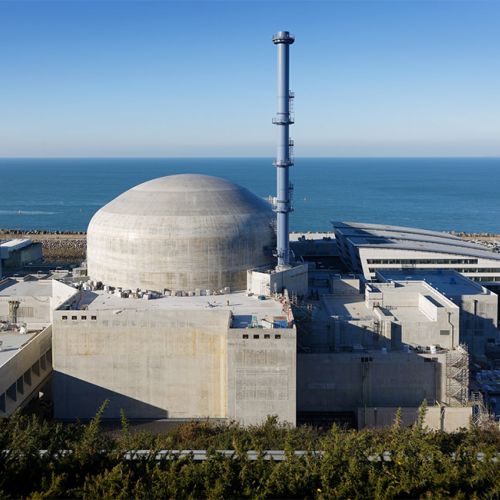
During a meeting of the local information commission on April 12, the Nuclear Safety Authority (ASN) assured that it could give the green light to the start-up of the reactor by the beginning of May. However, not all technical problems are resolved. And now a new one – of vibrations – appeared at the end of last year on the primary circuit. Revelations.
Blast, Thierry Gadault , 22 Apr 24
A few kilometers from the Flamanville nuclear power plant, Les Pieux (Manche) is typical of the many nuclear communities that we cross along the Rhône and Loire valleys: stone facades scrubbed with a toothbrush, paved sidewalks shiny as a new penny, innumerable municipal facilities that a town of some 3,500 inhabitants could never hope to afford, even in its wildest dreams, if it were not for the millions poured every year by EDF into the Department………………………..
Dialogue of the deaf in the basement
Behind the town hall, an old mansion which dominates the village, is the Pieux proximity center. In the basement of the building, which houses part of the municipal services, an auditorium with around fifty seats hosts the meetings of the Local Information Commission (CLI), a consultative body bringing together EDF, the Nuclear Safety Authority (ASN), local elected officials, the State and association representatives.
April 12, 2024, there was a crowd for the extraordinary meeting of the CLI. The menu was potentially copious: it was a question of taking stock of the EPR, before the ASN gave the green light to EDF to install the nuclear fuel in the vessel. While the independent authority was in full public consultation (it ended on April 17), an essential prerequisite for its decision-making, the associations had obtained this appointment in the form of a last-chance meeting, to try to derail the process.
But neither the ASN representative, Gaëtan Lafforge, the head of the Caen division, nor that of EDF, Alain Morvan, the director of the Flamanville EPR project, had the intention of revealing the reality of the numerous problems which still affect the reactor. And it was a dialogue of the deaf that the participants engaged in.
On the ASN and EDF side, the speech can easily be summarized: officially, everything is in order and the objective is now to gradually bring the reactor to operate at full power, at the end of the year. The authority also specified that the green light will be given by the beginning of May. Alain Morvan, with slides reduced to the strict minimum, simply outlined the process of starting up the new reactor.
On April 12, questioned on this subject by Yannick Rousselet, nuclear safety consultant at Greenpeace, the ASN representative had the greatest difficulty in answering the question clearly. “I can’t tell you that there won’t be anything left, there could be possible deviations during the tests,” stammered Gaëtan Lafforge. This then led to a short lunar exchange with the anti-nuclear activist, which triggered laughter from the audience.
On the anti-nuclear activist side, the troops left after two hours with their questions. In particular, lo and behold, a new vibration problem on the primary circuit detected last year.
The information was given to Blast by Julien Collet, the deputy director general of ASN, during the authority’s annual press conference organized at the end of last January. The DGA then told us that EDF was in the process of investigating this umpteenth glitch on the EPR.
On April 12, questioned on this subject by Yannick Rousselet, nuclear safety consultant at Greenpeace, the ASN representative had the greatest difficulty in answering the question clearly. “I can’t tell you that there won’t be anything left, there could be possible deviations during the tests,” stammered Gaëtan Lafforge. This then led to a short lunar exchange with the anti-nuclear activist, which triggered laughter from the audience.
Strangely, Alain Morvan, who could have provided technical details, remained silent. And no one thought to give him the floor. Especially since the president of the CLI, perhaps impatient to go to lunch, hastened to close the session. Questioned by Blast after the meeting, the director of the EPR project, cornered by a member of EDF communications, refused to answer us.
Hardly any more luck with the Parisian communications department, a few moments later. “The vibrational issues have been dealt with and technical solutions put in place,” she simply responded in the usual wooden language. In short, move around, there is nothing to see.
Yes, but here it is: questioned by a journalist from Presse de la Manche, the local daily which covered the event, EDF gave another answer : “There is no new vibration subject,” said the electrician. to our colleague. Um… we should know: has the subject been covered or does it not exist?
It’s not me, it’s him !
To try to see things clearly, Blast turned to the Institute of Radiation Protection and Nuclear Safety (IRSN), the public research establishment which provides technical advice to the ASN.
Perhaps concerned about its future – following the merger with the ASN imposed by the government and ratified by the National Assembly and the Senate – the establishment informed us through its press manager that the subject was not his responsibility. And to send us back to the ASN…
Unfortunately, ASN did not answer our questions. As Martine Aubry, the mayor of Lille and former candidate defeated in the 2011 socialist primary, said about François Hollande, “when it’s vague, there’s a wolf…”
The lid saga
This new problem… sorry “subject” vibration is therefore added to the numerous unresolved technical files that EDF has decided to leave as is, with the agreement of the ASN, to provide a response only after the commissioning of the reactor – it is unusual, we will agree. Starting obviously with the lid of the tank, weakened by a manufacturing defect (positive carbon segregation also present in the bottom of the tank). When the authority finally authorized the use of the tank and its lid in 2018, when it was no longer possible to exclude the risk of rupture but only to prevent it (which does not have the same meaning), she had asked EDF to change the cover no later than December 2024.
……………………………………..Questioned by activists to know why the company was not waiting for this new cover, Alain Morvan got confused in his explanations. He first suggested that it was not finished, and that it would therefore not be installed before the summer of 2025, before contradicting himself to finally assure that it would be delivered to the nuclear power plant at the end of the year…
In fact, the public group has nothing to do with it: in 2023, Framatome obtained from the ASN to postpone the replacement of the cover by one year, without giving any justification for such a postponement. According to the order issued by the authority last year, it must now be replaced during the first full inspection of the installation, after its start-up.
While it was possible to change this part in complete safety for the health of workers, if the new one had been installed before start-up, this postponement changes everything. The current cover will be irradiated and it will in fact become nuclear waste. In other words, an object that cannot be handled like that.
Apart from the fact that this unnecessarily exposes workers to taking doses during operations to replace it, this poses another problem. This question has not been resolved to date by EDF: that of the storage of this contaminated part, when it is removed. ASN asked the EDF group to construct a building for this purpose which would allow it to be stored safely on the power plant site. Which still doesn’t seem to be done…
Radioactivity, haphazardly
Emblematic, the tank cover file is not the only one which demonstrates EDF’s lack of consideration for nuclear employees, whether they are in-house agents or subcontracting employees. A second major project, also planned after the start-up of the reactor, will expose those involved to radioactive risks. Here again, this intervention could have been carried out in complete safety before the installation was started: the modification of the cooling system of the reactor auxiliary networks (RRI) and rescued raw water (SEC). Essential elements, particularly during reactor shutdown…………………………………………………………………………………………………………………….
Later, again
Still in the same logic, EDF has postponed the modification of the tank internals until later, more precisely the lower plenum which directs the distribution of the hydraulic flow in the tank. Since the incident that occurred on one of the two EPRs at Taishan in China, in 2021, we have had some feedback: it has been established that this equipment generates poor distribution of hydraulic flow which causes greater fluctuations. greater than expected in the neutron flux, which could lead to difficulties in controlling the nuclear reaction. Although ASN asked EDF to modify the lower plenum, the studies are still in progress………………………………………………………….
In China, to avoid major problems while waiting for the modification of the lower plenum, the power of the reactors (officially 1,750 MW) would have been limited to 1,500 MW. Will this also be the case for the Flamanville EPR? Questioned during the CLI meeting on April 12 by Yannick Rousselet, neither ASN nor EDF deigned to respond.
Let’s cross our fingers, hoping that there will be no runaway nuclear reaction in the Flamanville EPR tank. Especially since Libération revealed in July 2022, two systems of probes and sensors essential for operating the reactor, installed either in the tank or outside, are malfunctioning.
The EPR, political totem
“It would have been smarter to do all this work before the reactor was started,” exasperates Gilles Reynaud, the president of Ma Zone Contrôlée , which brings together nuclear subcontracting employees. But EDF wants to put the EPR into production to say: “that’s it, it works.” Doing all this work afterwards, I don’t find it very respectful for the workers and the population. »
No matter the cost
“We are starting at all costs for purely political reasons,” judge Yannick Rousselet, interviewed by Blast at the end of the CLI on April 12. As President Macron announced the relaunch of nuclear power with the construction of new EPRs, they want to send the message that we are out of the rut. » For Rousselet, this is a very short-term vision: “Even if this reactor shuts down in a few months for a long period, no one cares. We must be able to say: “That’s it, the Flamanville EPR is loaded. He started.” This is what is most dangerous. We don’t try to solve the problems first. »
The secrets of an engineer
And then, potentially, there is another problem in the medium term. Recently, an engineer, Thierry C, contacted Blast to tell us about his short experience in nuclear power.
………………………………. “When I took the file, I quickly realized that most of the valves that had to be installed could not meet the temperature and pressure conditions planned during these requalification tests,” he explains to Blast. Of the approximately 650 pipes equipped with valves, there were approximately 450 that had to be cut to remove the equipment and replace it with a temporary device to block the pipes. » A not really reassuring observation. “I spoke about it to my superiors who asked me to keep quiet and not talk to EDF about it. »
The documents and plans consulted by Blast seem to confirm these remarks. Which poses a problem: the requalification tests must be carried out with the valves to be validated. However, this analysis work was carried out in 2008-2009, when the EPR construction site, which had just started, was still in the civil engineering stage. Thierry C. left the group shortly after carrying out this study. What has happened since then? Has the error made by Alstom on the technical characteristics of the valves been corrected? Impossible to know: neither EDF, nor ASN, nor IRSN wanted to answer us.
Overall, given these unresolved problems and the lack of transparency from EDF and ASN regarding the technical setbacks of the installation, within the Flamanville CLI but also vis-à-vis the press, the long nightmare of the EPR construction site may not be over. This bad dream led to its bill exploding – which reached some 19.1 billion euros . A farce that could end up boring and no longer make anyone laugh. https://www.blast-info.fr/articles/2024/nucleaire-a-flamanville-la-farce-de-lepr-se-poursuit-G9PeKawaRwmShmxp6sJL3g
TODAY. Saint Rafael Grossi on the road to Damascus.

On the road to Damascus is where you get an epiphany. Well, Saint Paul did, anyway. He was on his way to Damascus to do punishing stuff to Christians, when he had a divine revelation and was transformed into an apostle, all aglow with Christian love.
Well, I don’t know that Rafael Grossi had any such revelation, in going to Damascus. But it seems clear that he decided that the proliferation of nuclear weapons is really nothing to worry about, certainly not when compared with the mission of the International Atomic Energy Agency, which is to promote the nuclear industry.
We always knew that countries that get nuclear weapons first get a “civil” nuclear industry. Except for the USA, which started the whole thing off the other way around, with the atrocity of the bombs for Hiroshima and Nagasaki. They then launched enthusiastically into the hypocrisy of the “peaceful nuke.
Britain’s leader Rishi Sunak, and France’s Emmanuel Macron have both publicly made it clear that “commercial” nuclear power is essential for their nuclear weapons industry. (So it doesn’t matter if commercial nuclear is a financial catastrophe.) The USA and Russia don’t seem to care, as long as they can sell all kinds of nuclear technology to anybody, really.
The new “advanced” small nuclear reactors make the problem worse, as they use enriched uranium, and reprocessing technologies that provide a great cover for making weapons grade fuel .
Rafael Grossi is well known for his earnest and pious statements about nuclear safety. Indeed, didn’t we all think that this is his job, to ensure the safety and non-weapons-proliferation of the world’s reactors?
But when did Rafael’s epiphany happen? When did he realise that safety and non-weapons proliferation did not matter now?
Rafael doesn’t seem to understand that all nuclear facilities become a target for terrorism, and a target in war-time. He has said a few cautionary words about the Zaporizhzhia Nuclear Power Station in Ukraine, but he’s quite OK with Ukraine setting up new nuclear power stations.
Rafael has expressed worthy worries about Saudi Arabia and nuclear weapons, but nevertheless “expressed his delight and admiration for Saudi Arabia’s nuclear capabilities” – and promoted them .
Syria is a place, and with a leader, prone to military disruptions, and , like Saudi Arabia, to human rights abuses, but that doesn’t seem to worry Grossi, over there to arrange for a Syrian nuclear industry.
An epiphany? Or did Rafael know all the time that his job is to be a nuclear salesman ?
Blatant hypocrisy
Dutton’s plan to save Australia with nuclear comes undone when you look between the brushstrokes
Graham Readfearn, https://www.theguardian.com/environment/2024/apr/24/duttons-plan-to-save-australia-with-nuclear-comes-undone-when-you-look-between-the-brushstrokes
The dystopian picture of renewables painted by the opposition leader is full of inconsistencies, partial truths and misinformation
The Coalition leader, Peter Dutton, has been trying to paint a picture of what life in Australia will be like if it tries to power itself mostly with renewable energy and without his technology of choice: nuclear.
Towering turbines offshore will hurt whales, dolphins and the fishing industry, factories will be forced to stop working because there’s not enough electricity and the landscape will be scoured by enough new transmission cables to stretch around the entire Australian coastline.
At the same time – so his story goes – only his option to go nuclear will save Australia from falling behind the rest of the world.
But Dutton’s dystopian image, with more brushstrokes added in an interview on the ABC’s flagship Insiders program, is a picture of inconsistencies, partial truths and misinformation.
Let’s have a look between the brushstrokes.
Is it a credible plan?
The Coalition has said it wants to put nuclear reactors at the sites of coal-fired power plants, but hasn’t said where, how big the reactors will be, when it wants them built or given an estimate on cost.
The Coalition has previously said it would give more details on its plan in time for its response to the Albanese government’s budget next month, but Dutton is now saying it will come “in due course”.
Despite this, Dutton claimed in his interview with the ABC’s David Speers that: “I believe that we’re the only party with a credible pathway to net zero by 2050.”
OK then.
28,000 kilometres?
Dutton claimed the government’s plans relied on “28,000km of poles and wires being erected” to connect renewables to the grid – a distance he said was “equal to the whole coastline of Australia”.
That’s a catchy soundbite, but where does this number come from?
According to the Australian Energy Market Operator’s most recent plan for the development of Australia’s east-coast electricity market, the most likely scenarios to decarbonise the electricity grid would require about 10,000km of additional transmission lines to be built between now and 2050.
What about the extra 18,000km? That figure comes in an estimate of what would be needed if Australia chose to become a major exporter of clean hydrogen as well as decarbonising the grid.
So about two-thirds of Dutton’s 28,000km is not so much related to decarbonising the electricity grid, but rather to an export industry that may or may not happen, to an as-yet-unknown extent.
Turning off power?
Dutton claimed: “At the moment, we’re telling businesses who have huge order books to turn down their activity in an afternoon shift because the lights go out on that grid. Now, no other developed country is saying that.”
Dutton is suggesting that businesses are being routinely forced to reduce their demand for power. This is simply not true.
Dr Dylan McConnell, an energy systems analyst at UNSW, says it’s very rare for businesses to be told by the market operator they are going to have their power interrupted.
Such “load shedding” has happened only five times in the last 15 years, he said, typically occurs in extreme conditions such as storms or coal plants going offline, and only a subset of consumers are affected.
There are two main formal voluntary schemes in place across the National Electricity Market (everywhere except NT and WA) where major electricity consumers can offer to reduce their demand for electricity at certain times, but businesses are compensated for being part of those schemes. Nobody is telling any of these businesses that they have to do anything.
Neither is it true that no other country is engaging in some sort of process where demand for electricity can be managed.
Is Australia really the only developed country engaged in what’s known as demand response? No.
The International Energy Agency lists the UK, US, France, Japan and South Korea as having large markets already in place to help their electricity systems balance the supply of electricity with demand.
McConnell said: “Demand response is becoming a common and important part of modern electricity systems. This includes countries like France and the US, which have both nuclear and demand response programs.”
G20 and nuclear
Dutton said Australia was the only G20 nation “not signed up to nuclear or currently using it”.
According to information from the World Nuclear Association, Australia is one of five G20 nations with no operating nuclear power plants, alongside Indonesia, Italy, Saudi Arabia, Germany and Turkey.
But aside from Italy, Germany and Australia, the rest do have some plans to develop nuclear power in the future. Dutton’s phrase “currently using it” allows him to capture countries like Italy that import electricity from nuclear nations.
But what’s also important to note is that among the G20 countries (actually 19 countries) nuclear is mostly playing a marginal role. Nuclear provides more than 5% of its electricity in only seven of those 19 countries.
Social licence?
Projects would need a “social licence” to go ahead, Dutton said, but there was opposition in western New South Wales where “productive” land was being sold for renewables projects.
This is a variation of a previous Dutton speech, where he lamented a supposed “carpeting of Australia’s prime agricultural land with solar and windfarms”.
The renewable energy industry’s Clean Energy Council has countered claims like this, saying even if all the country’s coal plants were replaced with solar farms, the amount of space needed would be about 0.027% of agricultural land.
The Coalition leader has been to the Hunter coast more than once where offshore windfarms are being planned, telling reporters they were a “travesty” and that they would put whales, dolphins and the fishing and tourism industries “at risk”. He told Speers the turbines would rise “260 metres out of the water”.
Dutton told the ABC that Australia should be mindful of the environmental consequences of windfarms – which is, of course, true – but his past statements have sounded more like cheerleading for voices opposed to the plans than an attempt to understand the scale and legitimacy of the concerns, some of which are being stoked by misinformation.
Dutton can’t know what impact offshore windfarms will have on fishing or tourism, but is willing in any case to use labels like “travesty”.
Nationals’ nuclear climate policy puts Australia’s Paris deal in doubt
The Age, James Massola and Mike Foley, April 25, 2024
The Coalition cannot commit to Australia’s 2030 emissions reduction targets, with senior Nationals MPs conceding a plan to adopt nuclear power would mean a future Coalition government would not comply with the Paris Agreement.
Days after Opposition Leader Peter Dutton delayed his announcement of up to six sites for future nuclear power plants – the announcement is now expected after the budget – Nationals leader David Littleproud told this masthead the path to net zero emissions by 2050 would not be linear under a future Coalition government.
The Nationals’ stated aim of slowing down the rollout of large-scale renewable energy projects, combined with the 15-year timeline for building a nuclear plant, means the Coalition would struggle if returned to power to meet Labor’s current target of 43 per cent emissions reduction by 2030.
But a Coalition government would inherit Australia’s legally binding 2030 target under the Paris Agreement, which requires nations to contribute to an international effort to keep global warming under 2 degrees.
Walking away from the Paris Agreement would infuriate Liberal moderates and MPs in metropolitan seats, where climate action is more popular; embolden the teals and other independents; and risk reigniting the climate wars fought between Nationals and Liberals in the former Morrison government.
Littleproud said “there is not a linear pathway to net zero, and trying to achieve one will have a detrimental impact on the economy. We have to have a broad-based solution rather than an all renewables approach.”
He would not commit to Australia’s climate target, set by the Albanese government, to cut emissions by 43 per cent by 2030.
“We want to wait and see what the modelling we come up with for 2030 [in the party’s new nuclear policy] says, but we won’t rush into anything …”
Experts including former chief scientist Alan Finkel and former Australian Energy Infrastructure Commissioner Professor Andrew Dyer have said it would take a minimum of 15 years for a nuclear plant to be built in Australia
Grattan Institute deputy energy director Alison Reeve said it would be impossible for Australia to reach its 2030 Paris target if there were a slowdown in the renewables rollout – including a pause to accommodate nuclear plant…………………………………………………………..
The Grattan Institute’s Alison Reeve said Australia would not hit the 2030 target under the Coalition’s nuclear push because most of the decarbonisation needed hangs off the government’s renewable goals.
“If you don’t reach that, you just don’t meet the 2030 target,” she said.
The bulk of reductions are to come from reducing coal-fired power and achieving the target to boost renewables to 82 per cent of the grid by 2030.
Reeve said cutting emissions from the energy sector by replacing fossil fuel electricity with renewables was a fundamental underpinning of Australia’s climate policy and any slowdown in wind and solar farms would make it harder for other sectors to clean up their act………. https://www.theage.com.au/politics/federal/nationals-nuclear-climate-policy-puts-australia-s-paris-deal-in-doubt-20240424-p5fm8p.html
New civil nuclear programmes crossing over into military nuclear programmes

New Nuclear Dual-Use Risk: Beating Swords into Ploughshares? By Dr. Paul Dorfman, https://nct-cbnw.com/new-nuclear-dual-use-risk-beating-swords-into-ploughshares/ 24 Apr 24.
Dr. Paul Dorfman discusses whether new civil nuclear programs could cross over into military nuclear programs, and what this means for global non-proliferation efforts.
According to key global finance advisory and asset management firm Lazard, new nuclear power systems perform poorly compared to renewables’ storage, energy efficiency, cost, roll-out speed, and management. So why invest in new nuclear?
Prof. Andy Stirling and Dr. Phil Johnstone, from the University of Sussex Science Policy Research Unit (SPRU), argue that the answer lies in the clear and present link between civil and military nuclear infrastructure. This is because civil nuclear energy maintains the skills and supply chains also needed for military nuclear programs, without which the costs of nuclear military capabilities could become politically unsupportable.
As they point out, the U.K. Government’s ‘Civil Nuclear: Roadmap to 2050’ report includes sets of statements on civil and military nuclear ambitions in order to “identify opportunities to align the two across government”, strengthening existing interconnections between civil and military industries’ research and development, and thereby minimizing costs for both the weapons and power sectors.
More recently, in March 2024, U.K. Prime Minister Rishi Sunak explicitly linked military nuclear weapons production capability with civil nuclear power generation development. French President Emmanuel Macron has gone further, saying that “without civil nuclear power, no military nuclear power, without military nuclear, no civil nuclear”. And the fact is that 90% of all new nuclear construction projects worldwide involve corporations controlled by states with nuclear weapons
New Nuclear, New Proliferation Risk
The increasingly tense geopolitical environment makes nuclear a controversial issue, with nation states concerned that neighbors might use notionally civilian nuclear programs for military ends. In this sense, there are unique challenges and perceived opportunities when it comes to new civil nuclear ambitions.
Choice of offensive or defensive doctrine affects the way other states evaluate their respective security and, in turn, influences the probability of cross-over between civil and military nuclear capacity. Indeed, current movements in military doctrines share the common denominator of adopting more offensive postures.
Meanwhile, according to the U.K. Royal Society, all forms of nuclear production pose weapons development risks, as “there is no proliferation proof nuclear fuel cycle – the dual use risk of nuclear materials and technology and in civil and military applications cannot be eliminated.”
Unhelpfully, Small Modular Nuclear Reactors (SMRs), which are the best new hope for fissile fuel, could make the weapons proliferation problem even worse as any potential SMR roll-out to either developed or developing countries is likely to increase nuclear proliferation and security risks. This is especially so if any of those states prove politically unstable or have relatively limited resources to support a robust nuclear security and regulatory infrastructure.
Nuclear Cross-over in an Increasingly Unstable World
Unless uranium enrichment and reprocessing technologies are effectively regulated against the diversion of civil materials for military purposes, the reality is that new nuclear plants can provide the cover to develop and make nuclear weapons. Whether that capability is turned into actual weapons depends largely on political inclination.
Saudi officials have made it clear on more than one occasion that there’s another reason for their interest in civil nuclear energy technology which was not captured by the royal decree on the Saudi nuclear program – the relationship of the civil program to nuclear weapons. More recently, Saudi Arabia is pushing for the right to produce nuclear fuel, a move that poses further significant proliferation risk. The International Atomic Energy Agency (IAEA) has voiced concerns about Saudi intentions and safeguards.

Unfortunately, the IAEA’s support for Saudi’s civil nuclear clashes with their position on the Kingdom’s military ambition. This is not the first time that the UN nuclear regulator has been caught in this uncomfortably dualist situation.
More worryingly, the Director General of the IAEA, Rafael Grossi, has just met with Syrian President Bashar al-Assad in Damascus to “agree on a new engagement between Syria and IAEA with a view to providing confidence in the peaceful uses of nuclear energy for the benefit of its people”. Given the deeply problematic military and human rights history of al-Assad’s regime, the IAEA’s actions seem profoundly concerning, and bring the IAEA’s role in the global nuclear arena into sharp focus.
Thinking this through, an important question springs to mind. Due to the apparent potential for civil-military nuclear cross-over, could the IAEA’s mission – to work for “the safe, secure and peaceful application of nuclear science and technology” – inevitably result in weapons proliferation by default?
Irrational Paradoxes
Back in Eastern Europe, although Ukraine runs a substantive civil nuclear power program, it’s no longer a nuclear weapons state. Ukraine, once briefly the third-largest nuclear power in the world, made the decision to give up nuclear weapons on the basis that the U.S., U.K., and Russia would guarantee Ukraine’s security via the Budapest Memorandum.
In this sense, both Putin’s invasion of an independent state and subsequent nuclear weapons threats highlight the very real practical distinction between unilateral and multilateral nuclear weapons disarmament in an increasingly unstable world.
And then there’s Zaporizhzhia, where a civil nuclear power plant has become a target of war at the very same time that Russia’s role as a major player in the global civil nuclear power sector continues to expand via Moscow-backed international nuclear new-build projects and technology, uranium supply and enrichment, and spent nuclear fuel management.
Direction of Travel
While it appears reasonably clear that civil and military nuclear can enmesh, one must ask whether one inevitably leads to the other. While the usual concern is that civil nuclear infrastructure leads to military development, according to former Australian Prime Minister Scott Morrison, Australia is bucking the trend: “Let me be clear: Australia is not seeking to establish […] a civil nuclear capability […] a civil nuclear energy industry is not a requirement for us to go through the submarine program.”
In other words, despite the new nuclear submarine AUKUS deal, the current Australian government has no plans to develop new civil nuclear infrastructure.
So, does that start to negate the civil-military nexus hypothesis? Well, it’s not that nuclear military interests are the sole drivers of support for civil nuclear power, but for some states dual-use technology may comprise a significant complementary factor.
In the end, it’s the direction of travel that counts. While all key energy institutes and research organizations agree that renewables will do the heavy-lifting for the net-zero energy transition, it’s worth considering the implications of U.S. Energy Secretary Jennifer Granholm’s speech to Australia’s Energy Forum: “No country has ever been held hostage for access to the sun. No country has ever been held hostage for access to the wind. They have not ever been weaponized, nor will they be.”
Dr. Paul Dorfman is the Chair of the Nuclear Consulting Group, a Visiting Fellow at the Science Policy Research Unit (SPRU) of the University of Sussex, U.K., a Member of the Irish Government’s Radiation Protection Advisory Committee, and a Former Advisor to the U.K. Ministry of Defence Nuclear Submarine Dismantling Project.
U.S. Senate Passes $95 Billion Foreign Military Aid Bill
The bill passed in a vote of 79-18
by Dave DeCamp April 23, 2024, AntiWar.com
On Tuesday night, the Senate passed a $95 billion spending bill that includes military aid for Ukraine, Israel, and Taiwan in a vote of 79-18. The bill has already passed through the House and now heads to President Biden’s desk for his signature.
Earlier in the day, the Senate rejected an effort by some senators to add amendments to the legislation in a vote of 48-50. The legislation, which also includes a provision that could ban TikTok, was passed through the House as four separate bills but was combined into one in the Senate.
The legislation includes $61 billion for the proxy war in Ukraine, much of which will go to US weapons makers to replenish US stockpiles. It includes over $9 billion in economic aid in the form of repayable loans, but Ukraine is not actually expected to pay it back. Another provision will authorize the US to sell off frozen Russian assets, which could be used to pay the loans. CNN previously reported that the Biden administration will also be able to cancel the debt.
The bill also includes $26 billion to support Israel. About $9 billion will go toward humanitarian aid in Gaza and other places, while the remaining $17 billion will go toward military aid to support the slaughter of Palestinians in Gaza and replenish Israeli air defenses. The aid is on top of the $3.8 billion in military assistance that Israel receives from the US each year.
Another $8 billion will go toward military aid for Taiwan and other spending in the Indo-Pacific region to prepare for a future war with China. It includes $1.9 billion to replenish weapons sent to Taiwan and regional countries and $2 billion in Foreign Military Financing, a State Department program that gives foreign governments money to purchase US weapons. Over $3.3 billion will go toward submarine infrastructure in the region.
The massive spending on foreign military aid was put forward by House Speaker Mike Johnson (R-LA), who previously killed a deal that would have included similar foreign aid spending and billions for border security and changes to migrant policies………….. more https://news.antiwar.com/2024/04/23/senate-passes-95-billion-foreign-military-aid-bill/
TODAY. Oh it’s a great time to be an American – with shares in “Defense” companies!

The USA Congress knows this. These worthy persons understand that their job is to enrich weapons companies and the people “wise” enough to have shares in them. After all, “defense” is the USA’s fastest growing and most successful industry. And of course, that’s the job of a patriotic American government – to promote American business.
Some think that the proper role of government is not solely protection of people from attack, but also to provide for the general well-being of the people. But that second purpose is not a goal of American government. And I would argue that even the first purpose is not a real goal – as the practices of diplomacy, negotiation, discussion and respect for other countries would be the best methods – rather than bullying and sabre-waving.
Anyway, the U.S. Senate just passed a $95Billion Bill for weapons for Ukraine, Israel and Taiwan. Law-makers of both stripes are keen to promote weapons. Probably the Congress will approve this.
The U.S. Congress has the power to pull back, to prevent wars. But once they’ve given the White House the money for weapons – then the President (advised by warmongers like Jake Sullivan and Antony Blinken) can go ahead and wage war – Congress will then have no say.

Once the Congress approves an appropriation the President as commander-in chief can use the money any way he likes. If the aim of warmongers is eventual war against Iran, providing money for weapons will be Congress’s role in following this aim. Think tanks and media enthusiastically go along with this.
There seems to be no awareness that USA’s endless strikes on distant countries – Iraq , Syria, backing Israel against Palestine, Iran – are arousing fierce anger among millions of people. In Ukraine whole generations of men are being wiped out.
Weapons get used. Then you make and sell more weapons. That means continuing, endless wars. That’s the business. It’s great when there’s no, or relatively few, American soldiers killed. Terrific – only “the others” are dying.
It’s great for business. Lockheed Martin’s shares are up. Investing advice enthuses “Where there’s war, there’s money to be made, and rising geopolitical tension in the Middle East, and the two-year-long war in Ukraine are leaving investors to shield their portfolios with defense stocks………….no better time than being in the business of defense contracting than right now“
But one day – the shit will hit the fan! Shock horror – it might even happen in the lifetime of those making $millions from weapons sales.
TODAY. The failed social species – Homo-not-sapiens-at-all

‘We’re supposed to be “social animals”, but I wonder about that.
Especially the “advanced” world, the predominantly white people, and particularly the anglophone world are directing their attention, their energy, and above all their MONEY. into ways to kill each other. More importantly perhaps, to kill “less white” people – Arabs and Chinese.
In Pakistan, melting of glaciers and extreme rain is causing heavy loss of life.
Today I read that millions of people in China are threatened by record-breaking floods – tens of thousands evacuated.
European villages are suffering unprecedented extreme heat stress, with rising numbers of heat deaths, as well as having experiencing months of drought and wildfires
One might think that the most important task for a social species would be to help these victims of global heating, and indeed to put a stop to, or at least slow down global heating.
But perhaps, the not-very-bright leaders of the advanced countries do not understand that we are all in fact one species, that for example, Palestinians are not a separate species of untermenschen. That even Russians and Chinese are people, too.
And that we’re all in the same perilous boat -and the job is to deal with climate change – not to enrich weapons manufacturers.
‘A little awkward’: Coalition faces internal tension over nuclear plans
Sky News host Chris Kenny says the Coalition is in an “awkward” situation with their behind the scenes negotiations around nuclear energy.
It is reported that a rift has formed with the Coalition regarding Opposition leader Peter Dutton’s nuclear energy plans.
“Inside the Coalition, there is argument about where the nuclear power stations might be sited in this country,” Mr Kenny said.
“Apparently some MPs saying they don’t want them in their backyard.
“Sounds like there is tension.”
Bankers upgrade Lockheed stock after Iran strikes at Israel

defense contractors are actively shaping U.S. foreign policy through lobbying and campaign contributions, among other tactics.
The American company has played an outsized role in Tel Aviv’s bombing and invasion of Gaza since Oct. 7
NICK CLEVELAND-STOUT, APR 17, 2024 https://responsiblestatecraft.org/lockheed-martin-israel-war/
Over the weekend, Iran launched over 300 missiles at Nevatim Air Base, a base in southern Israel that houses U.S.-made F-35 fighter jets. Israeli Prime Minister Benjamin Netanyahu, who oversaw a strike on an Iranian consulate in Syria just a few weeks ago, has already promised to retaliate. Observers viewed these brewing tensions with concern, ringing the alarm bells of the breakout of a wider war.
Not JP Morgan analyst Seth Seifman. On Monday morning, Seifman upgraded JPMorgan’s outlook from “hold” to “buy” for Lockheed Martin, the manufacturer of Israel’s F-35s, and set a higher price target for the stock.
Seifman says the change was pre-planned, but noted that these developments could be good for business. “What we can say is that it’s a dangerous world and while that is not a sufficient condition for defense stocks to outperform,” he said, “it is a potential source of support, especially when they are under-owned.” JP Morgan owns $355 million worth of Lockheed Martin stock, about a third of which was bought in the last quarter of 2023.
UK investment bank Liberum Capital was similarly bullish on defense stocks, so long as a wider war does not break out. “In our base case scenario of Israel retaliating but in a limited way that keeps the conflict from escalating further, this could lead to a 5-10% correction in the stock market together with further strength in the U.S. dollar,” Liberium told investors. “The obvious short-term winners will be oil & gas stocks as well as defense contractors.”
As finance journalist Jacob Wolisnky put it in a recent preview of defense stock picks, “Where there’s war, there’s money to be made.” At least one member of Congress agrees. Yesterday, Rep. Kevin Hern (R-Okla.) disclosed that he bought Lockheed Martin stock on March 29.
Lockheed Martin has played a large role in Israel’s bombing and invasion of Gaza, manufacturing Hellfire missiles, providing transport planes, and supplying F-16 and F-35 fighter jets. A missile that hit journalists on November 9 of last year in Gaza City was reportedly manufactured by Lockheed Martin. “Their core business model has no respect for human rights,” said Jilianne Lyon, who leads shareholder advocacy campaigns at Investor Advocates for Social Justice.
While privately acknowledging conflict is good for business, the defense industry and its financiers publicly claim they are simply doing America’s bidding. As Lockheed Martin CEO James Taiclet once said, “It’s only up to us to step to what we’ve been asked to do and we’re just trying to do that in a more effective way, and that’s our role.” After all, it was the U.S. government — not Lockheed Martin — that came to Israel’s defense and intercepted the majority of Iran’s missiles.
But this “we just do what we’re told” defense doesn’t quite work given that defense contractors are actively shaping U.S. foreign policy through lobbying and campaign contributions, among other tactics. Aaron Acosta, program director at Investor Advocates for Social Justice, told Responsible Statecraft that defense contractors “are often the ones creating demand by lobbying the U.S. government and pushing for sales of these weapons.”
In 2023, Lockheed Martin spent over $14 million lobbying Congress. The three companies that lobbied the House’s version of the annual defense policy bill the most were RTX (formerly known as Raytheon), Lockheed Martin, and General Dynamics. During the 2022 election cycle, Lockheed Martin contributed nearly $4 million to political candidates. So far, 2024 promises similar results. In its 2023 annual report, Lockheed Martin wrote that, “Changes in the U.S. Government’s priorities, or delays or reductions in spending could have a material adverse effect on our business.”
Sure, 84% of voters might be concerned about the U.S. being drawn into conflict in the Middle East. But as far as defense companies and their shareholders are concerned, business is booming.
Under UN Charter, Iran’s Attack Was a Legal Response to Israel’s Illegal Attack

Iran’s attack on Israel was lawful self-defense carried out in compliance with international humanitarian law.
On April 13, Iran’s aircraft struck two air bases in the Negev desert, where the April 1 attack on Iran’s consulate had been launched. “Iran retaliated against those targets in Israel directly related to the Israeli attack on Iran,”
By Marjorie Cohn , TRUTHOUT, April 18, 2024
On April 1, Israel mounted an unprovoked military attack on a building that was part of the Iranian Embassy complex in Damascus, Syria, killing seven of Iran’s senior military advisers and five additional people. The victims included Gen. Mohamad Reza Zahedi, head of Iran’s covert military operations in Lebanon and Syria, and two other senior generals.
Although Israel’s attack violated the United Nations Charter, the UN Security Council refused to condemn it because the United States, the U.K. and France exercised their vetoes on April 4.
Iran considered this attack on its consulate “an act of war,” Trita Parsi wrote at Foreign Policy.
On April 11, the Permanent Mission of the Islamic Republic of Iran to the United Nations stated: “Had the UN Security Council condemned the Zionist regime’s reprehensible act of aggression on our diplomatic premises in Damascus and subsequently brought to justice its perpetrators, the imperative for Iran to punish this rogue regime might have been obviated.”
Then, on April 13, in response to Israel’s attack, Iran fired more than 300 drones and missiles at the Israeli air base from which the April 1 attacks had emanated. Only two of them landed inside Israel and no one was killed; a Bedouin girl was injured. The U.S., U.K., France, Jordan and Israel intercepted the remaining Iranian missiles and drones. A senior U.S. military official said “there’s no significant damage within Israel itself.”
The Iranian mission to the UN wrote in an April 13 letter to the UN secretary-general that Iran’s action was conducted “in the exercise of Iran’s inherent right to self-defense” under Article 51 of the UN Charter “and in response to the Israeli recurring military aggressions, particularly its armed attack” on April 1 “against Iranian diplomatic premises, in the defiance of Article 2(4) of the Charter of the United Nations.”
The April 1 attack was not the first time Israel had attacked key Iranian personnel………………………………………………………………………….
Iran made clear that it seeks to avoid further escalation that could spark a widespread regional war. An April 13 social media post from Iran’s permanent mission to the UN stated, “The matter can be deemed concluded. However, should the Israeli regime make another mistake, Iran’s response will be considerably more severe. It is a conflict between Iran and the rogue Israeli regime, from which the U.S. MUST STAY AWAY!”
At a Security Council meeting on April 14, Iran’s UN Ambassador Saeid Iravani defended the lawfulness of the missile and drone attack on Israel. He noted the hypocrisy of the U.S. and its allies that claim Israel is acting in self-defense as it conducts its genocide of the Palestinian people:………………………………………..
Israel’s Attack on Iranian Consulate Violated the UN Charter and Vienna Conventions
Iran’s April 13 attack on Israel was a lawful exercise of self-defense in response to Israel’s unlawful April 1 attack on the Iranian consulate. The Israeli attack was an illegal act of aggression.
Article 2 (4) of the UN Charter states, “All Members shall refrain in their international relations from the threat or use of force against the territorial integrity or political independence of any state, or in any other manner inconsistent with the Purposes of the United Nations.”
An act of aggression is inconsistent with the purposes of the UN. Article 39 of the Charter says, “The Security Council shall determine the existence of any threat to the peace, breach of the peace, or act of aggression.”
An “‘act of aggression’ means the use of armed force by a State against the sovereignty, territorial integrity or political independence of another State, or in any other manner inconsistent with the Charter of the United Nations,” under the Rome Statute for the International Criminal Court. Aggression includes “the invasion or attack by the armed forces of a State of the territory of another State.”
Moreover, “Consular premises shall be inviolable,” according to Article 31 of the 1963 Vienna Convention on Consular Relations. Article 1 defines consular premises as “the buildings or parts of buildings and the land ancillary thereto, irrespective of ownership, used exclusively for the purposes of the consular post.”
The 1961 Vienna Convention on Diplomatic Relations likewise provides in Article 22.1 that, “The premises of the mission shall be inviolable. The agents of the receiving State may not enter them, except with the consent of the head of the mission.”
During Israel’s bombing of Iran’s consulate in Syria, it targeted and killed very senior Iranian officials. The attack constituted an act of aggression, which triggered Iran’s right to self-defense.
Iran’s April 13 Attack on Israel Constituted Lawful Self-Defense
Article 51 states, “Nothing in the present Charter shall impair the inherent right of individual or collective self-defense if an armed attack occurs against a Member of the United Nations, until the Security Council has taken the measures necessary to maintain international peace and security.”
An armed attack includes not just an attack against the territory of a state, including its airspace and territorial sea, but also attacks directed against its armed forces or embassies abroad.
On April 13, Iran’s aircraft struck two air bases in the Negev desert, where the April 1 attack on Iran’s consulate had been launched. “Iran retaliated against those targets in Israel directly related to the Israeli attack on Iran,” former U.S. weapons inspector Scott Ritter wrote.
Nevertheless, the Security Council has failed to adopt a resolution condemning Israel’s attack on Iran’s consulate, as Iran pointed out in its April 13 letter to the UN secretary-general.
At an April 14 meeting of the Security Council, the Israeli representative declared that Iran is the number one global sponsor of terrorism and the world’s worst human rights violator. It is Israel, however, that has killed nearly 34,000 Palestinians — two-thirds of them women and children — during its campaign of genocide in Gaza that has now entered its seventh month.
Iran’s self-defense action was the natural outcome of Israel’s violations of international law — both on Syrian territory and elsewhere — the representative from the Syrian Arab Republic said at the April 14 council meeting. Israel is trying to cover up its genocide and military failures in Gaza, the Syrian representative added.
Iran’s Attack Satisfied the Principles of Proportionality, Distinction and Precautions……………………………………………………………….
Netanyahu Is Gunning for War With Iran
Israeli Prime Minister Benjamin Netanyahu would like nothing better than to start a war with Iran. Netanyahu considers Iran an “existential threat” to Israel. He persuaded former President Donald Trump to pull out of the Iran nuclear deal, which was working to prevent Iran from developing nuclear weapons.
As the world waits for Israel’s response to the Iranian attack, President Joe Biden said the U.S. would not assist Israel in an offensive military action against Iran but it would give Israel defensive support if Iran attacks Israel. “But the distinction between offensive or defensive support becomes meaningless the second a war breaks out,” wrote Trita Parsi.
Today, the U.S. and U.K. imposed additional punishing sanctions on Iran. Unilateral coercive measures, levied without the imprimatur of the Security Council, are illegal and generally harm only the general population…………………………………………………………………………………………… more https://truthout.org/articles/under-un-charter-irans-attack-was-a-legal-response-to-israels-illegal-attack/
5 Reasons Why What Congress Just Did Does Not Help Ukraine

Crimea was Russian or Soviet from 1783 to 1991. No election should ever be held with armed troops anywhere within sight. And it’s no simple matter to say that Crimea should hold a new referendum, since people have left and entered. But nobody seriously doubts that any fair election in 2014 or at any time since would have resulted in a majority choosing Russia. The Donbas needed some degree of independence before Minsk II and still does.
It needs it free of militarized borders and chest-thumping empires. Some consideration should be given to whether the people who live there “win” or “lose” — that is, how their lives look going forward. For them and for the world, peace is preferable to war, and peace is prevented by endless weapons and endless opposition to negotiations.
By David Swanson, World BEYOND War, April 21, 2024, https://worldbeyondwar.org/5-reasons-why-what-congress-just-did-does-not-help-ukraine/
You may have heard that the U.S. Congress is finally doing the decent, moral, liberal, democratic, Democratic thing and aiding Ukraine.
You may believe, as pretty much everyone I ask tells me, that there was only one other choice available, namely “letting Putin win.”
You may agree with me that the Russian government and its leader — like every government I’ve ever heard of — have done horrendous things, that invading a country militarily is one of the worst things that can ever be done (with the possible exceptions of invading Libya or Yemen or Syria or Iraq or Afghanistan or anywhere in Latin America, but still), and that rewarding a military invasion is a terrible precedent that could encourage more military invasions (with the possible exception of keeping those bases in Iraq or Syria, or selling more weapons to Saudi Arabia, or marketing that empty beachfront property in Gaza — and who the heck is Niger to tell U.S. troops to leave Niger? I mean come ON! — but still). I’m with you. Between (A) send more unimaginably huge piles of money that materializes out of nowhere and (B) allow a military invasion to succeed, I’m for A.
But please consider five slight complications to this simple tale.
- What the U.S. Congress just did is send huge piles of money that comes out of urgent non-optional crises like climate, eco-collapse, disease, poverty, and homelessness, mostly to U.S. weapons dealers, damaging — yes damaging — the U.S. economy, in order to send mountains of weapons to the war in Ukraine, the war in Gaza, and a yet-to-be-ginned-up war in Asia. No matter how much you support the war in Ukraine, unless you also support providing enough weapons to murder every last person in Gaza and the West Bank, and in addition support building up toward a catastrophic war with China, you ought to at least have mixed emotions here.
2. Countless experts around the globe believe that the war in Ukraine has placed the world closer than ever before to nuclear apocalypse. I picture two cockroaches endowed with the power of speech meeting each other as they crawl over the ruins of the de-personed Earth. One says “Well, at least they stood up to Putin,” and the other simultaneously, “Well, at least they stood up to NATO.” Upon which the war that eliminates all cockroaches is begun. But where, while we still breathe, are our priorities? Is smashing every aspiration of the criminal Russian government (which I’m all in favor of) in order to uphold a rules-based order in which you can freely fuel a sadistic genocide in Palestine (which I’m not so much in favor of) a higher priority than preserving life? And if so, why are you not over there killing Russians yourself, instead of over here cheering for Congress buying more weapons?
3. ’ll leave the option of Russia “winning” to point #4 below. But what is the other option exactly, the one that has been so correctly and nobly chosen? It’s clearly not Russia losing. Nobody even pretends it is. It’s clearly just continuing the endless slaughter with no desirable outcome for either side anywhere on the horizon. Yet more Ukrainians can go on dying, and Russians can go on dying in larger numbers, but that can’t continue until everyone’s dead, not without nuclear escalation — possibly following a French escalation that U.S. media outlets might begin by opposing. So what is it that you think you’ve chosen? Choosing “Not Putin Winning” is great, like choosing “The Candidate Who Isn’t Trump.” Who could disagree? But what if there were an option superior to “Putin winning” and also superior to endless war that risks apocalypse?
4. It helps to face for a moment the complex story of Ukraine, to come to grips with some facts that are as well established as is the illegal, immoral, murderous Russian invasion of 2022, such as that U.S. and foreign officials (including the current CIA director) warned for decades that NATO expansion would create this war — and some (such as the authors of a RAND Corporation report) advocated for just the provocative steps that were taken in order to create this war, that the U.S. supported a coup in Ukraine in 2014 that overthrew a government pursuing neutrality, that the coup government threated the rights of Russian speakers, that the people of Crimea heavily favored returning to Russia, that Ukraine waged a war on its eastern provinces for 8 years, that Ukraine and its Western partners never intended to and never did honor the Minsk II agreements which could have meant lasting peace, that Russia and Ukraine were ready to agree to peace 1 month into the Russian invasion at talks in Turkey where they agreed on Russian withdrawal and a Ukrainian commitment not to join NATO or allow NATO bases in Ukraine — until the U.S. and UK said No, as they have continued to say in the face of horrific suffering, not to mention in the face of nearly identical peace proposals from African leaders, Latin American presidents, the Pope, the Chinese government, and scholars and activists across the globe. This history does not erase, but does complicate, the tale of angelic Ukrainian innocence against evil Russian outlaws.
Crimea was Russian or Soviet from 1783 to 1991. No election should ever be held with armed troops anywhere within sight. And it’s no simple matter to say that Crimea should hold a new referendum, since people have left and entered. But nobody seriously doubts that any fair election in 2014 or at any time since would have resulted in a majority choosing Russia. The Donbas needed some degree of independence before Minsk II and still does. It needs it free of militarized borders and chest-thumping empires. Some consideration should be given to whether the people who live there “win” or “lose” — that is, how their lives look going forward. For them and for the world, peace is preferable to war, and peace is prevented by endless weapons and endless opposition to negotiations.
5. Prior to this recent “aid” package, 62% of U.S. federal discretionary spending was going into militarism. Now it’s more. The other 38% and shrinking has to cover environment, education, health, housing, transportation, agriculture, and everything else. Normalizing endless massive warmaking, just because it’s non-U.S. troops dying, is a path to disaster. To begin considering a different course, here are a few eye-opening reads:
Primer on Foreign PolicyAction for Ukraine and the WorldThe
EU Can Only Survive as a Peace Project and Not as a NATO SubsidiaryWBW Advisory Board Member
Matt Hoh Addresses United NationsAre We Stumbling Into World War III in Ukraine?
Attacking Pope, Militarists Target Ukrainian
Peace Formula of President ZelenskyyPutin’s Draft Treaty Between Russia and Ukraine Did Exist
Letter on Ukraine from Latin America to the World
Message from Ukraine to Europe After Two Years of War in Ukraine, It’s Time for PeaceA World BEYOND War
1 This month


Help Aunty Sue Protect Her Land and Sacred Sites From Destructive Rocket Testing.
.

Australians deserve the truth
about
AUKUS – https://aukuspublicinquiry.com/

PETITION – To: Prime Minister Anthony Albanese and the Australian Labor Government

of the week – Australians for War Powers Reform (AWPR)
To see nuclear-related stories in greater depth and intensity

