Patrick Lawrence: ‘Automated Murder’: Israel’s ‘AI’ in Gaza

In the Lavender case, the data it produced were accepted and treated as if they had been generated by a human being without any actual human oversight or independent verification.

A second AI system, sadistically named “Where’s Daddy?”—and how sick is this?—was then used to track Hamas suspects to their homes. The IDF intentionally targeted suspected militants while they were with their families, using unguided missiles or “dumb” bombs. This strategy had the advantage of enabling Israel to preserve its more expensive precision-guided weapons, or “smart” bombs.
“intelligent” weapons proven effective in Gaza were major attractions when Israel marketed them last month at the Singapore Airshow, East Asia’s biggest arms bazaar.
dehumanized, grotesquely technologized future
By Patrick Lawrence and Cara Marianna / Original to ScheerPost, April 9, 2024
ZURICH—“Technological change, while it helps humanity meet the challenges nature imposes upon us, leads to a paradigm shift: It leaves us less capable, not more, of using our intellectual capacities. It diminishes our minds in the long run. We strive to improve ourselves while risking a regression to the Stone Age if our ever more complex, ever more fragile technological infrastructure collapses.”
That is Hans Köchler, an eminent Viennese scholar and president of the International Progress Organization, a globally active think tank, addressing an audience here last Thursday evening, April 4. The date is significant: The day before Köchler spoke, +972 Magazine and Local Call, independent publications in Israel–Palestine, reported that as the Israel Defense Forces press their savage invasion of the Gaza Strip, they deploy an artificial intelligence program called Lavender that so far has marked some 37,000 Palestinians as kill targets. In the early weeks of the Israeli siege, according to the Israeli sources +972 cites, “the army gave sweeping approval for officers to adopt Lavender’s kill lists, with no requirement to thoroughly check why the machine made those choices or to examine the raw intelligence data on which they were based.”
Chilling it was to hear Köchler speak a couple of news cycles after +972 published these revelations, which are based on confidential interviews with six Israeli intelligence officers who have been directly involved in the use of AI to target Palestinians for assassination. “To use technologies to solve all our problems reduces our ability to make decisions,” Köchler asserted. “We’re no longer able to think through problems. They remove us from real life.”
Köchler titled his talk “The Trivialization of Public Space,” and his topic, broadly stated, was the impact of technologies such as digital communications and AI on our brains, our conduct, and altogether our humanity. It was sobering, to put the point mildly, to recognize that Israel’s siege of Gaza, bottomlessly depraved in itself, is an in-our-faces display of the dehumanizing effects these technologies have on all who depend on them.
Let us look on in horror, and let us see our future in it.
We see in the IDF, to make this point another way, a rupture in morality, human intelligence, and responsibility when human oversight is mediated by the algorithms that run AI systems. There is a break between causality and result, action and consequence. And this is exactly what advanced technologies have in store for the rest of humanity. Artificial intelligence, as Köchler put it, is not intelligence: “It is ‘simulated intelligence’ because it has no consciousness of itself.” It isn’t capable, he meant to say, of moral decision-making or ethical accountability.
In the Lavender case, the data it produced were accepted and treated as if they had been generated by a human being without any actual human oversight or independent verification. A second AI system, sadistically named “Where’s Daddy?”—and how sick is this?—was then used to track Hamas suspects to their homes. The IDF intentionally targeted suspected militants while they were with their families, using unguided missiles or “dumb” bombs. This strategy had the advantage of enabling Israel to preserve its more expensive precision-guided weapons, or “smart” bombs.
As one of +972’s sources told the magazine:
We were not interested in killing [Hamas] operatives only when they were in a military building or engaged in a military activity… . On the contrary, the IDF bombed them in homes without hesitation, as a first option. It’s much easier to bomb a family’s home. The system is built to look for them in these situations.
Once Lavender identified a potential suspect, IDF operatives had about 20 seconds to verify that the target was a male before making the decision to strike. There was no other human analysis of the “raw intelligence data.” The information generated by Lavender was treated as if it was “an order,” sources told +972—an official order to kill. Given the strategy of targeting suspects in their homes, the IDF assigned acceptable kill ratios for its bombing campaigns: 20 to 30 civilians for each junior-level Hamas operative. For Hamas leaders with the rank of battalion or brigade commander, +972’s sources said, “the army on several occasions authorized the killing of more than 100 civilians in the assassination of a single commander.”
In other words, Israeli policy, guided and assisted by AI technology, made it inevitable that thousands of civilians, many of them women and children, would be killed.
There appears to be no record of any other military deploying AI programs such as Lavender and Where’s Daddy? But it is sheer naïveté to assume this diabolic use of advanced technologies will not spread elsewhere. Israel is already the world’s leading exporter of surveillance and digital forensic tools. Anadolu, Turkey’s state-run news agency, reported as far back as February that Israel is using Gaza as a weapons-testing site so that it can market these tools as battle-tested. Antony Lowenstein, an author Anadolu quotes, calls this the marketing of “automated murder.”
And here we find ourselves: Haaretz, the Israeli daily, reported on April 5 that “intelligent” weapons proven effective in Gaza were major attractions when Israel marketed them last month at the Singapore Airshow, East Asia’s biggest arms bazaar. …………………………………………………………………………………………………………………………………………………….
the Biden regime is culpable in inflicting these multiple wounds on humanity in one other dimension we must not miss. With its incessant attempts to suspend us in a virtual reality of its making, distant from what it is doing in our names, it leads us into the dehumanized, grotesquely technologized future Köchler describes just as surely as the Israelis do as they murder human beings wholesale with AI weapons and kill innocent children with remotely controlled sniper drones. https://scheerpost.com/2024/04/09/patrick-lawrence-automated-murder-israels-ai-in-gaza/
TODAY. Australia is EVER so grateful to the global nuclear lobby!
First of all, we Australians LOVE spending money! Not on health, education, preserving our unique biodiversity, certainly not on shelter for our growing homeless.
With our relatively small population, we are still delighted to cough up nearly $400billion to buy a second-hand American nuclear submarine and to buy all the USA and UK nuclear submarine wastes that these dear friends vouchsafe to dump on us.
And, it was interesting to read today, that the UK has spurned paying $millions to Rolls Royce as the maker for its proposed fleet of small modular nuclear reactors.
No problem to the nuclear lobby. Rolls Royce now plans to flog them off to Australia instead – Opposition leader Peter Dutton has pledged, if elected, to deliver Rolls Royce small modular reactors into the grid by the mid-2030s.
Any old or useless stuff that the nuclear industry has to get rid of – no probs – Australia will buy it!
‘Simply mind-boggling’: world record temperature jump in Antarctic raises fears of catastrophe
“Essentially, it is a vicious circle of warming oceans and melting of sea ice, though the root cause is humanity and its continuing burning of fossil fuels and its production of greenhouse gases,”
An unprecedented leap of 38.5C in the coldest place on Earth is a harbinger of a disaster for humans and the local ecosystem
Robin McKie Science editor, Sun 7 Apr 2024 , https://www.theguardian.com/environment/2024/apr/06/simply-mind-boggling-world-record-temperature-jump-in-antarctic-raises-fears-of-catastrophe
On 18 March, 2022, scientists at the Concordia research station on the east Antarctic plateau documented a remarkable event. They recorded the largest jump in temperature ever measured at a meteorological centre on Earth. According to their instruments, the region that day experienced a rise of 38.5C above its seasonal average: a world record.
This startling leap – in the coldest place on the planet – left polar researchers struggling for words to describe it. “It is simply mind-boggling,” said Prof Michael Meredith, science leader at the British Antarctic Survey. “In sub-zero temperatures such a massive leap is tolerable but if we had a 40C rise in the UK now that would take temperatures for a spring day to over 50C – and that would be deadly for the population.”
This amazement was shared by glaciologist Prof Martin Siegert, of the University of Exeter. “No one in our community thought that anything like this could ever happen. It is extraordinary and a real concern,” he told the Observer. “We are now having to wrestle with something that is completely unprecedented.”
Poleward winds, which previously made few inroads into the atmosphere above Antarctica, are now carrying more and more warm, moist air from lower latitudes – including Australia – deep into the continent, say scientists, and these have been blamed for the dramatic polar “heatwave” that hit Concordia. Exactly why these currents are now able to plunge so deep into the continent’s air space is not yet clear, however.
Nor has this huge temperature hike turned out to be an isolated event, scientists have discovered. For the past two years they have been inundated with rising numbers of reports of disturbing meteorological anomalies on the continent. Glaciers bordering the west Antarctic ice-sheet are losing mass to the ocean at an increasing rate, while levels of sea ice, which float on the oceans around the continent, have plunged dramatically, having remained stable for more than a century.https://interactive.guim.co.uk/uploader/embed/2024/04/archive-zip/giv-13425WC79HMmcEe8y/
These events have raised fears that the Antarctic, once thought to be too cold to experience the early impacts of global warming, is now succumbing dramatically and rapidly to the swelling levels of greenhouse gases that humans continue to pump into the atmosphere.
These dangers were highlighted by a team of scientists, led by Will Hobbs of the University of Tasmania, in a paper that was published last week in the Journal of Climate. After examining recent changes in sea ice coverage in Antarctica, the group concluded there had been an “abrupt critical transition” in the continent’s climate that could have repercussions for both local Antarctic ecosystems and the global climate system.
“The extreme lows in Antarctic sea ice have led researchers to suggest that a regime shift is under way in the Southern Ocean, and we found multiple lines of evidence that support such a shift to a new sea ice state,” said Hobbs.https://interactive.guim.co.uk/uploader/embed/2024/04/archive-2-zip/giv-13425x5sm3FJkGC7J/
The dramatic nature of this transformation was emphasised by Meredith. “Antarctic sea ice coverage actually increased slightly in the late 20th and early 21st century. However, in the middle of the last decade it fell off a cliff. It is a harbinger of the new ground with the Antarctic climate system, and that could be very troubling for the region and for the rest of the planet.”
The continent is now catching up with the Arctic, where the impacts of global warming have, until now, been the most intense experienced across the planet, added Siegert. “The Arctic is currently warming at four times the rate experienced by the rest of the planet. But the Antarctic has started to catch up, so that it is already warming twice as quickly as the planet overall.”
A key reason for the Arctic and Antarctic to be taking disproportionate hits from global warming is because the Earth’s oceans – warmed by fossil-fuel burning – are losing their sea ice at their polar extremities. The dark waters that used to lie below the ice are being exposed and solar radiation is no longer reflected back into space. Instead, it is being absorbed by the sea, further heating the oceans there.
“Essentially, it is a vicious circle of warming oceans and melting of sea ice, though the root cause is humanity and its continuing burning of fossil fuels and its production of greenhouse gases,” said Meredith. “This whole business has to be laid at our door.”
As to the consequences of this meteorological metamorphosis, these could be devastating, researchers warn. If all the ice on Antarctica were to melt, this would raise sea levels around the globe by more than 60 metres. Islands and coastal zones where much of the world’s population now have homes would be inundated.
Such an apocalypse is unlikely to occur for some time, however. Antarctica’s ice sheet covers 14m square kilometres (about 5.4m square miles), roughly the area of the United States and Mexico combined, and contains about 30m cubic kilometres (7.2m cubic miles) of ice – about 60% of the world’s fresh water. This vast covering hides a mountain range that is nearly as high as the Alps, so it will take a very long time for that to melt completely, say scientists.
Nevertheless, there is now a real danger that some significant sea level rises will occur in the next few decades as the ice sheets and glaciers of west Antarctica continue to shrink. These are being eroded at their bases by warming ocean water and could disintegrate in a few decades. If they disappear entirely, that would raise sea levels by 5m – sufficient to cause damage to coastal populations around the world. How quickly that will happen is difficult to assess. The Intergovernmental Panel on Climate Change has said that sea levels are likely to rise between 0.3m to 1.1m by the end of the century. Many experts now fear this is a dangerous underestimate. In the past, climate change deniers accused scientists of exaggerating the threat of global warming. However, the evidence that is now emerging from Antarctica and other parts of the world makes it very clear that scientists did not exaggerate. Indeed, they very probably underrated by a considerable degree the threat that now faces humanity.
“The picture is further confused in Antarctica because, historically, we have had problems getting data,” added Meredith. “We have never had the information about weather and ecosystem, compared with the data we get from the rest of the world, because the continent is so remote and so hostile. Our records are comparatively short and that means that the climate models we have created, although very capable, are based on sparse data. They cannot capture all of the physics, chemistry and biology. They can make predictions that are coherent but they cannot capture the sort of extremes that we’re now beginning to observe.”
The woes facing Antarctica are not merely of human concern, however. “We are already seeing serious ecological impacts that threaten to spread through the food chain,” said Prof Kate Hendry, a chemical oceanographer based at the British Antarctic Survey.
A critical example is provided by the algae which grow under and around sea ice in west Antarctica. This is starting to disappear, with very serious implications, added Hendry. Algae is eaten by krill, the tiny marine crustaceans that are one of the most abundant animals on Earth and which provide food for predators that include fish, penguins, seals and whales. “If krill starts to disappear in the wake of algae, then all sorts of disruption to the food chain will occur,” said Hendry.
The threat posed by the disappearance of krill goes deeper, however. They play a key role in limiting global warming. Algae absorb carbon dioxide. Krill then eat them and excrete it, the faeces sinking to the seabed and staying there. Decreased levels of algae and krill would then mean less carbon from the atmosphere would be deposited on the ocean floor and would instead remain near the sea surface, where it would return to the atmosphere.
“They act like a conveyor belt that takes carbon out of the atmosphere and carries it down to the deep ocean floor where it can be locked away. So if we start messing with that system, there could be all sorts of other knock-on effects for our attempts to cope with the impact of global warming,” added Hendry. “It is a scary scenario. Nevertheless that, unfortunately, is what we are now facing.”
Another victim of the sudden, catastrophic warming that has gripped the continent is its most famous resident: the emperor penguin. Last year the species, which is found only in Antarctica, suffered a catastrophic breeding failure because the platforms of sea ice on which they are born started to break up long before the young penguins could grow waterproof feathers.
“We have never seen emperor penguins fail to breed, at this scale, in a single season,” said Peter Fretwell, of the British Antarctic Survey. “The loss of sea ice in this region during the Antarctic summer made it very unlikely that displaced chicks would survive.”
Researchers say that the discovery of the loss of emperor penguins suggests that more than 90% of colonies will be wiped out by the end of the century, if global warming trends continue at their current disastrous rate. “The chicks cannot live on sea ice until they have fledged,” said Meredith. “After that, they can look after themselves. But the sea ice is breaking up before they reach that stage and mass drowning events are now happening. Colonies of penguins are being wiped out. And that’s a tragedy. This is an iconic species, one that is emblematic of Antarctica and the new vulnerability of its ecosystems.”
The crisis facing the continent has widespread implications. More than 40 nations are signatories of the Antarctic Treaty’s environmental protocol, which is supposed to shield it from a host of different threats, with habitat degradation being one of the most important. The fact that the continent is now undergoing alarming shifts in its ice covering, eco-systems and climate is a clear sign that this protection is no longer being provided.
“The cause of this ecological and meteorological change lies outside the continent,” added Siegert. “It is being caused because the rest of the world is continuing to emit vast amounts carbon dioxide.
“Nevertheless, there is a good case for arguing that if countries are knowingly polluting the atmosphere with greenhouse gases, and Antarctica is being affected as a consequence, then the treaty protocol is being breached by its signatories and their behaviour could be challenged on legal and political grounds. It should certainly make for some challenging meetings at the UN in the coming years.”
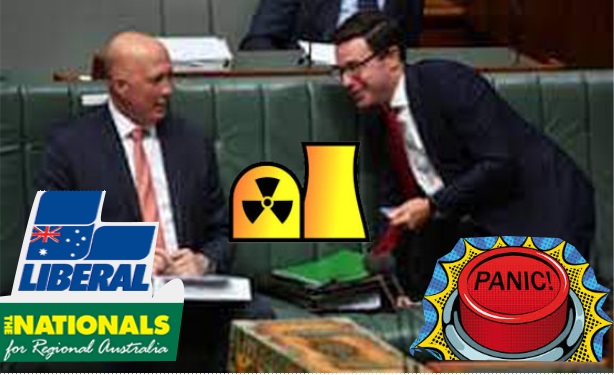
Coalition “in a panic” about response to confused and unpopular nuclear power plan
The Australian noted the Australian Workers Union’s support for nuclear power but didn’t mention the opposition of the Australian Council of Trade Unions, Australian Education Union, Australian Manufacturing Workers Union, Australian Nursing and Midwifery Federation, Australian Services Union, Communication Workers Union, Electrical Trades Union, Independent Education Union (Vic – Tas), Maritime Union of Australia, National Union of Workers, Tasmanian Unions, Unions ACT, Unions WA, Unions SA, Unions NT, United Voice, United Firefighters Union, and the Victorian Trades Hall Council.
Jim Green, Apr 8, 2024, https://reneweconomy.com.au/coalition-in-a-panic-about-response-to-confused-and-unpopular-nuclear-power-plan/
The Coalition’s nuclear power policy is being released in instalments in the Australian newspaper ahead of its formal release sometime before the May budget.
Under a plan taken to the Coalition shadow cabinet in March, seven coal regions have been identified as potential locations for nuclear power plants, the Australian reports.
Presumably those regions are Collie in WA, the Latrobe Valley in Victoria, the Hunter Valley and Lithgow in NSW, and three regions in Queensland — the Darling Downs, Gladstone and Central Queensland.
The Australian reports that a shadow cabinet subcommittee will produce ‘economic impact statements’ to promote the potential economic benefits in the seven regions.
The Coalition will try to win local support by using taxpayer funds to reduce power bills for people living near the proposed nuclear plants. Workers will be offered higher-paid jobs, presumably at taxpayers’ expense. And taxpayers will be on the hook for workforce training, regulation, waste disposal and much more.
The plan “will involve the creation of new precincts for advanced manufacturing centred on cheap energy from small nuclear reactors”, the Australian reports. Cheap nuclear power will attract heavy industry, adding to the high-paid jobs bonanza.
A “community engagement process” would be rolled out once the coal sites had been identified, opposition leader Peter Dutton says.
But just like everything else associated with the Coalition’s nuclear policy, the plan to win over communities in coal regions has hit a snag.
The Murdoch press reported on April 7 that focus group research carried out in the Hunter Valley in NSW and the Latrobe Valley in Victoria found that voters are “hostile” to plans for reactors in their own areas.
An unnamed Coalition MP said of the Liberal and National Party rooms: “My read is they’re in a panic about it. They don’t know what to do.” A Coalition frontbencher said Dutton is “obsessed with this nuclear thing — obsessed with it.”
Rolls-Royce reactors

“There is every reason to be optimistic about bringing small modular net-zero emission nuclear into the power mix in the 2030s,” Dutton told the Australian.
Indeed he has “pledged” that if the Coalition were returned to government at the next election, the first nuclear reactors would be up and running by the mid-2030s. That’s a big pledge since there is zero chance of reactors operating in Australia by the mid-2030s.
Dutton recently met privately with executives from Rolls-Royce to discuss “the pursuit of low-cost small modular reactor technology for Australia”, the Australian reports.
Rolls-Royce claims it could build a reactor in Australia in just four years (once licensing and a myriad of other issues were sorted). Let’s compare that speculation with real world experience:
Continue readingWhat are the risks at Zaporizhzhia nuclear power plant after drone attack?

By Guy Faulconbridge and Francois Murphy, April 8, 2024, https://www.reuters.com/world/europe/nuclear-power-plant-eye-ukraine-war-2024-04-08/
MOSCOW/VIENNA, – Russia said Ukraine struck the Zaporizhzhia nuclear power station controlled by Russian forces three times on Sunday and demanded the West respond, though Kyiv said it had nothing to do with the attacks.
The International Atomic Energy Agency (IAEA) has long warned of the risks of a disaster at Zaporizhzhia, Europe’s largest nuclear plant, and urged an end to fighting in the area.
The plant is just 500 km (300 miles) from the site of the world’s worst nuclear accident, the 1986 Chornobyl disaster.
What nuclear material is at the Zaporizhzhia plant, what are the risks and why are Russia and Ukraine fighting over it?
WHAT IS IT AND WHAT WAS ITS CAPACITY?
The Zaporizhzhia nuclear power plant has six Soviet-designed VVER-1000 V-320 water-cooled and water-moderated reactors containing Uranium 235. They were all built in the 1980s, though the sixth only came online in the mid-1990s after the collapse of the Soviet Union.
All but one of the reactors are in cold shutdown. Reactor unit 4 is in “hot shutdown”, mainly for heating purposes.
IAEA Director General Rafael Grossi says that fighting a war around a nuclear plant has put nuclear safety and security in “constant jeopardy”.
WHAT HAPPENED ON APRIL 7?
Russia’s state nuclear corporation, Rosatom, said Ukraine attacked the plant three times on Sunday with drones, first injuring three near a canteen, then attacking a cargo area and then the dome above reactor No. 6.
IAEA experts at the site went to the three locations of the attacks and confirmed there had been an attack.
“Russian troops engaged what appeared to be an approaching drone,” the IAEA said. “This was followed by an explosion near the reactor building.”
“While the team so far has not observed any structural damage to systems, structures, and components important to nuclear safety or security of the plant, they reported observing minor superficial scorching to the top of the reactor dome roof of Unit 6 and scoring of a concrete slab supporting the primary make-up water storage tanks,” the IAEA said.
The IAEA did not say directly who was to blame for the attacks.
A Ukrainian intelligence official said Kyiv had nothing to do with any strikes on the station and suggested they were the work of Russians themselves.
WHAT ARE THE RISKS?
Russian forces took control of the plant in early March 2022, weeks after invading Ukraine. Special Russian military units guard the facility and a unit of Russia’s state nuclear company, Rosatom, runs the plant.
Nuclear reactors’ containment structures like Zaporizhzhia’s are made of steel-lined reinforced concrete designed to withstand the impact of a small plane crash so there is little immediate risk from a minor attack on those structures.
A 1989 study by the U.S. Department of Energy found that the model of containment structure used in Zaporizhzia “exhibits vulnerabilities to the effects of an aircraft crash” and a fighter jet crashing downwards into the dome, where the structure is thinner, could penetrate it, causing concrete chunks and aircraft engine parts to fall inside.
External power lines essential to cooling nuclear fuel in the reactors are a softer potential target. Cooling fuel even in reactors in cold shutdown is necessary to prevent a nuclear meltdown.
Since the war began the plant has lost all external power eight times, most recently in December last year, forcing it to rely on emergency diesel generators for power. Water is also needed to cool fuel.
Pressurised water is used to transfer heat away from the reactors even when they are shut down, and pumped water is also used to cool down removed spent nuclear fuel from the reactors.
Without enough water, or power to pump the water, the fuel could melt down and the zirconium cladding could release hydrogen, which can explode.
WHAT ABOUT THE SPENT FUEL?

Besides the reactors, there is also a dry spent fuel storage facility at the site for used nuclear fuel assemblies, and spent fuel pools at each reactor site that are used to cool down the used nuclear fuel.
Without water supply to the pools, the water evaporates and the temperatures increase, risking a fire that could release a number of radioactive isotopes.
An emission of hydrogen from a spent fuel pool caused an explosion at reactor 4 in Japan’s Fukushima nuclear disaster in 2011.
WHAT HAPPENS IN A MELTDOWN?
A meltdown of the fuel could trigger a fire or explosion that could release a plume of radionuclides into the air which could then spread over a large area.
The Chornobyl accident spread Iodine-131, Caesium-134, Strontium-90 and Caesium-137 across parts of northern Ukraine, Belarus, Russia, northern and central Europe.
Nearly 8.4 million people in Belarus, Russia and Ukraine were exposed to radiation, according to the United Nations. Around 50 deaths are directly attributed to the disaster itself.
But 600,000 “liquidators”, involved in fire-fighting and clean-up operations, were exposed to high doses of radiation. Hundreds of thousands were resettled.
There is mounting evidence that the health impact of the Chornobyl disaster was much more serious than initially presented at the time and in the years following the accident.
Incidence of thyroid cancer in children across swathes of Belarus, Russia and Ukraine increased after the accident. There was a much higher incidence of endocrine disorders, anaemia and respiratory diseases among children in contaminated areas.
Brutal, chaotic war – norms, conventions and laws of conduct are being erased

Alastair Crooke, April 8, 2024, https://strategic-culture.su/news/2024/04/08/brutal-chaotic-war-norms-conventions-and-laws-of-conduct-are-being-erased/—
We stand on the cusp of what might be termed Chaotic War. Not the formula often used by Israel to intimidate adversaries; this is different.
Israeli reporter Eddie Cohen said, in the wake of the attack on the Iranian Consulate: “We are very clear that we want to start a war with Iran and Hezbollah. Do you still not understand?”
“Israel wants to drag Iran into a full-scale war in order to be able to strike at Iran’s nuclear facilities”, though these facilities are beyond American and Israeli reach, buried beneath mountains.
Cohen, and of course, Israel’s military leadership, will know that; but Israel nonetheless is locking itself into a logic that can only lead to defeat. Iran’s nuclear facilities are safe from Israeli assault. The destruction of civilian Iranian infrastructure, which is out in the open, may kill many, but will not, per se, collapse the Iranian state.
Trita Parsi places Israel’s objective in attacking the Iranian Consulate in Damascus in a different context:
“An important aspect of Israel’s conduct – and Biden’s acquiescence to it – is that Israel is engaged in a deliberate and systematic effort to destroy existing laws and norms around warfare.
Even during wartime, embassies are off-limits [yet] Israel just bombed an Iranian diplomatic compound in Damascus.
Bombing hospitals is a war crime, [yet] Israel has bombed EVERY hospital in Gaza. It has even assassinated doctors and patients inside hospitals.
The ICJ obligated Israel to allow the delivery of humanitarian aid to Gaza. Israel actively prevents aid from coming in.
Starvation of civilians as a method of warfare is prohibited under international humanitarian law. Israel has deliberately created a famine in Gaza.
Indiscriminate bombings are illegal under international humanitarian law. Biden himself admits that Israel is bombing Gaza indiscriminately”.
The list goes on and on … However, Israel’s breach of Vienna Convention immunity accorded to diplomatic premises – plus the stature of those killed – is highly significant. It is a major signal: Israel wants war – but with U.S. support, of course.
Israel’s aim, firstly, is to destroy the norms, conventions and laws of warfare; to create geo-political anarchy in which anything goes, and by which, with the White House frustrated, yet acquiescing to each norm of conduct obtrusively trodden underfoot, allows Netanyahu to grip the U.S. bridle and lead the White House horse to water – towards his regional End of Times ‘Great Victory’; a necessarily brutal war – beyond existing red lines and devoid of limits.
As symbolically significant as the Damascus attack is that the U.S., France and Britain – after a brief ‘hat tip’ to the Vienna Convention – refused to condemn the levelling of the Iranian Consulate, thus placing the shadow of doubt over the Vienna Convention’s immunity for diplomatic premises.
Implicitly, this refusal to condemn will be widely understood as a soft condoning of Israel’s first tentative step towards war with Hizbullah and Iran.
This Israeli chaotic ‘Biblical’ nihilism, however, bears no relationship in purely rational terms to Netanyahu’s aspiration for a ‘Great Victory’. The reality is that Israel has lost its deterrence. It won’t return; the deep anger across the Islamic world generated by Israel through its massacres in Gaza during the last six months precludes it.
Yet, there is a second, adjunct reason why Israel is set on deliberately flouting humanitarian law and norms: Israeli journalist, Yuval Abraham reports in +972 Magazine in great depth how Israel has developed a AI machine (called ‘Lavender’) to generate kill lists in Gaza – with almost no human verification; only a “rubber stamp” check of about “20 seconds” to make sure the AI target is male (as no females are known to belong to the Resistance’s military).
The blatant extra-legality behind the Gaza ‘kill list’ methodology, as reported by Abraham’s various sources, can only be immunised and sheltered through normalising them as but one amongst a general pattern of illegalities – and in effect, claiming sovereign exceptionalism:
“[T]he Israeli army systematically attacks the targeted individual whilst in their homes — usually at night whilst the whole family is present — rather than during the course of military activity … Additional automated systems, including one, [callously] called “Where’s Daddy?” were used – specifically to track targets when they had entered their family’s residences… However, when a home was struck, usually at night, the individual target was sometimes not inside at all”.
“The result is that thousands of Palestinians — most of them women and children or people who were not involved in the fighting — were wiped out by Israeli airstrikes, especially during the first weeks of the war, because of the AI program’s decisions”.
“”We were not interested in killing [Hamas] operatives when they were in a military building … or engaged in a military activity,” A., an intelligence officer, told +972 and Local Call. “On the contrary, the IDF bombed them in homes without hesitation – as a first option. It’s much easier to bomb a family’s home. The system is built to look for them in these situations”.
In addition … when it came to targeting alleged junior militants marked by Lavender, the army preferred to only use unguided missiles, commonly known as “dumb” bombs (in contrast to “smart” precision bombs) which can destroy entire buildings on top of their occupants and cause significant casualties. “You don’t want to waste expensive bombs on unimportant people — it’s very expensive for the country and there’s a shortage [of those bombs]”.
“… The army also decided during the first weeks of the war that, for every junior Hamas operative that Lavender marked, it was permissible to kill up to 15 or 20 civilians … in the event that the target was a senior Hamas official with the rank of battalion or brigade commander – the army on several occasions authorized the killing of more than 100 civilians in the assassination of a single commander”.
“Lavender — which was developed to create human targets in the current war — has marked some 37,000 Palestinians as suspected “Hamas militants”, most of them junior, for assassination (the IDF Spokesperson denied the existence of such a kill list in a statement to +972 and Local Call)”.
So, there it is – no wonder Israel might seek to camouflage the details within a normalised general array of transgressions against humanitarian law: “They wanted to allow us to attack [the junior operatives] automatically. That’s the Holy Grail. Once you go automatic, target generation goes crazy”.
it is not difficult to speculate what the ICJ might determine …
Does anyone imagine that this flawed Lavender AI machine would not be asked to churn out its kill lists, were Israel to decide to surge into Lebanon? (Another reason for normalising the procedures first in Gaza).
The key point made in the +972 Magazine report (with multiple sourcing) is that the IDF were not focussed on pin-point elimination of Hamas’ Qassam Brigades (as claimed):
“It was very surprising for me that we were asked to bomb a house to kill a ground soldier, whose importance in the fighting was so low”, said one source about the use of AI to mark alleged low-ranking militants:
“I nicknamed those targets ‘garbage targets.’ Still, I found them more ethical than the targets that we bombed just for ‘deterrence’ — high-rises that are evacuated and toppled just to cause destruction”.
This report makes clear nonsense of Israel’s claims to have dismantled 19 out of 24 Hamas Battalions: One source, critical of Lavender’s inaccuracy, points out the obvious flaw: “It’s a vague boundary”; How to tell a Hamas fighter from any other Gazan civilian male?
“At its peak, the system managed to generate 37,000 people as potential human targets”, said B. “But the numbers changed all the time, because it depends on where you set the bar of what a Hamas operative is. There were times when a Hamas operative was defined more broadly, and then the machine started bringing us all kinds of civil defence personnel, police officers, on whom it would be a shame to waste bombs”.
Just last week, War Cabinet member and Minister Ron Dermer, was delegated to travel to Washington to plead that the IDF success in dismantling 19 Hamas battalions justified an incursion into Rafah to dismantle the 4 to 5 battalions that Israel claims still remain in Rafah.
What is clear is that AI was a key Israeli tool to its Gaza ‘Victory’. Israel was going to sell a ‘smoke and mirrors story’ based on ‘Lavender’.
By contrast, Palestinians, who are aware of their quantitative inferiority, have a very different outlook: they switched to a new way of thinking that gives the simple act of resisting a civilisational meaning – a path to metaphysical victory (and quite possibly a kind of military victory), if not in their lifetimes, then for the Palestinian People, thereafter. This constitutes the asymmetrical nature of the conflict that Israel has never managed to understand.
Israel wants to be feared, believing this will restore its deterrence. Amira Hass writes that regardless of any revulsion for this government and its members: “The vast majority [of Israelis] still believe that war is the solution”. And Mairav Zonszein writing in Foreign Policy, notes that “The Problem Isn’t Just Netanyahu, It’s Israeli Society”:
“The focus on Netanyahu is a convenient distraction from the fact that the war in Gaza is not Netanyahu’s war, it is Israel’s war—and the problem isn’t only Netanyahu; it’s the Israeli electorate … A large majority—88 percent—of Jewish Israelis polled in January believe the astounding number of Palestinian deaths, which had surpassed 25,000 at the time, is justified. A large majority of the Jewish public also thinks that the [IDF] is using adequate or even too little force in Gaza … Putting all the blame on the prime minister misses the point. It disregards the fact that Israelis have long advanced, enabled, or come to terms with their country’s system of military occupation and dehumanization of Palestinians”.
Yet neither Israel, nor the U.S., has a comprehensive strategy for this mooted war. Israel’s approach is all tactical – claiming to have degraded Hamas; turning Gaza into a humanitarian hellscape and setting the scene for the “decisive plan” devised by Bezalel Smotrich for the Palestinians. Amira Hass again:
“Either agree to an inferior status, emigrate and be uprooted ostensibly voluntarily, or face defeat and death in a war. This is the plan now being carried out in Gaza and the West Bank – with most Israelis serving as active and enthusiastic accomplices, or passively acquiescing in its realisation”.
The U.S. ‘vision’ is also tactical (and far removed from reality) – Imagining the transformation of Gaza into a ‘Vichy collaborator’ statelet; imagining that political pressure by the French in Lebanon will force Hizbullah’s retreat from its ancestral lands in south Lebanon; and imagining that the Biden White House is able to achieve politically through pressure what Israel cannot do militarily.
The paradox is that, with Israel and the U.S. being dependent on an ‘image’ that has been confused with reality, this too works to Iran’s and the Resistance Front’s advantage. (As the old adage goes, ‘do not disturb an adversary who is making mistakes’).
Dutton proposes higher nuclear energy bills
David Llewellyn-Smith, Monday, 8 April 2024,
https://www.macrobusiness.com.au/2024/04/dutton-proposes-higher-nuclear-energy-bills/
From your alternative PM:
Cheaper power prices would be offered for residents and businesses in coal communities to switch from retiring coal-fired generators to nuclear power if the Coalition wins government.
Peter Dutton has pledged that if elected, the Coalition could deliver the first small modular reactors into the grid by the mid-2030s, with British manufacturer Rolls-Royce understood to be able to deliver them at an estimated $3.5bn to $5bn each.
Economic impact statements will also be conducted on at least seven communities identified by a shadow cabinet subcommittee established by the Opposition Leader to develop the Coalition’s energy security policy.
To be clear, RR has not yet completed its own design project for SMRs or produced a working prototype.
But, if we want to take this punt on our energy grid, then Dutton’s YIMBY subsidy will obviously be recouped via higher nuclear energy bills for the majority.
Nuclear is already more expensive than anything else, and you can add your YIMBY surcharge to that: [Excellent chart – on original ]
This is policy gimmickry, and not even very good on those terms.
All we need to do is reserve 10% of gas exports and convert coal plants to gas peakers and batteries.
The current gas price cap needs to be lowered to $7Gj as well. The local price was still trading above export net-back last week:
US, Philippines, Japan, and Australia Conduct First Joint Military Exercise in South China Sea
China launched patrols in the South China Sea in response
by Dave DeCamp April 7, 2024
https://news.antiwar.com/2024/04/07/us-philippines-japan-and-australia-conduct-first-joint-military-exercise-in-south-china-sea/
The US, Japan, the Philippines, and Australia conducted joint military exercises in the South China Sea on Sunday in a provocative show of force aimed at China.
According to Japan’s Kyodo News, the drills marked the first “full-scale exercise” between the four nations. The US has been looking to increase military cooperation between its treaty allies in the region as part of its military build-up to prepare for a future war with China.
The four countries released a joint statement that made clear the drills were meant to push back on China’s claims to the South China Sea. “We stand with all nations in safeguarding the international order based on the rule of law that is the foundation for a peaceful and stable Indo-Pacific region,” the statement said.
According to The South China Morning Post, the drills included two Philippine vessels, one American ship, one Australian ship, and a Japanese ship and focused on anti-submarine warfare training, tactical exercises, and photo exercises.
China launched patrols in the South China Sea on the same day in what appeared to be a response to the drill. “The Southern Theatre Command of the People’s Liberation Army will conduct a joint air and sea combat patrol in the South China Sea on April 7,” the Chinese military’s Southern Theater Command said.
The joint drills come as tensions are soaring between China and the Philippines over disputed rocks and reefs in the South China Sea. Chinese and Philippine vessels frequently have tense encounters in the waters, which often end in collision. In the most recent incident, a Chinese vessel fired a water cannon at a Philippine supply boat, injuring several crew members.
The incidents in the South China Sea could potentially spark a major war as the US has repeatedly affirmed that the US-Philippine Mutual Defense Treaty applies to attacks on Philippine vessels in the disputed waters.
President Biden is hosting Philippine President Ferdinand Marcos Jr. and Japanese Prime Minister Fumio Kishida in Washington this Thursday for the first-ever trilateral summit between the three nations. They’re expected to announce the launch of regular joint patrols in the South China Sea.
Peter Dutton to press ahead with nuclear despite opposition in regional Australia

Locals who live in areas earmarked for nuclear reactors have delivered a blow to Peter Dutton’s energy plan.
James Campbell National political editor, April 7, 2024, The Sunday Telegraph
https://www.adelaidenow.com.au/news/nsw/peter-dutton-to-press-ahead-with-nuclear-despite-opposition-in-regional-australia/news-story/53a7108e83484542ee99870d5002fba9
Peter Dutton will press on with his plans for nuclear power, despite recent Coalition research finding widespread opposition to the proposals in regional areas earmarked for reactors.
Coalition sources said focus group research carried out in the Hunter Valley in NSW and the Latrobe Valley in Victoria in recent weeks found hostility to the proposed polices.
It found that while voters were aware of the general arguments for nuclear power, they were hostile to plans for reactors in their own areas.
A Coalition source familiar with the research said the findings had come as a shock.
“They had convinced themselves that people would be queuing up for these things,” the source said.
Another said it was clear “more work needs to be done” on winning the argument.
But Mr Dutton is still set to release his plan for net-zero energy before the May budget.
The Weekend Australian reported the Coalition’s plan would offer heavily discounted power bills to communities with nuclear power plants.
It also reported the plan is to install small nuclear reactors at as many as seven sites, which will be operating by the mid-2030s.
“The ability to produce zero-emissions baseload with 24/7 electricity to firm up renewables is within our grasp,” he told the paper.
However a Coalition MP who strongly supports nuclear power said there was increasing concern in both the Liberal and National Party rooms that it was already too late to win the public argument about nuclear power in the time left before the next election.
“We haven’t even seen the policy yet,” the MP said. “My read is they’re in panic about it. They don’t know what to do.”
The Sunday Telegraph spoke to a number of Coalition MPs, including frontbenchers, who expressed concerns about the saleability of nuclear power from opposition.
But they all agreed Mr Dutton is not for turning on ¬nuclear power.
According to one frontbencher who supports the plan “the best case scenario” from pushing nuclear power would be a “nil-all draw” with the Government.
“Let’s not kid ourselves that this is some kind of vote-catching policy,” the frontbencher said.
But he said there was no chance Mr Dutton would walk away from it.
“He’s obsessed with this nuclear thing – obsessed with it,” the frontbencher said.
“Peter is very determined to go down this path,” another said.
On Wednesday, Mr Dutton told reporters: “I think we need to have a proper, mature discussion about how we migrate to a new energy system where we can have renewables that are firmed up by zero emissions, latest generation nuclear technology”.
He added: “In terms of regions, we’ve been very definite in our advice that we’re looking at about half a dozen sites, on brownfield sites, those where you’ve got a coal-fired generator coming to an end of life”.
U.S. Nuclear regulator delinquent on climate

Fort Calhoun nuclear station – flooded 2019
“New reactors remain a mirage. But if they ever become operational, the climate extremes we are already seeing will be far worse. It is irresponsible for the NRC to claim that this is not a relevant safety concern for the agency.”
US government agency reprimands NRC for ignoring climate crisis impacts on reactor safety
https://beyondnuclearinternational.org/2024/04/07/nuclear-regulator-delinquent-on-climate/
The findings and recommendations of a new U.S. Government Accountability Office (GAO) report confirm what Beyond Nuclear has been litigating with the U.S. Nuclear Regulatory Commission (NRC): the agency cannot continue to ignore the safety impacts on nuclear power plants from the worsening climate crisis.
The GAO report is entitled NUCLEAR POWER PLANTS: NRC Should Take Actions to Fully Consider the Potential Effects of Climate Change. It criticizes the NRC for failing to conduct assessments for commercial U.S. nuclear power plants by projecting climate risks and incorporating adequate safety margins into both old and new designs.
These risks include a worsening of natural hazards and encompass heat and cold, drought, wildfires, flooding, hurricanes, and sea-level rise, according to the GAO, all of which could seriously jeopardize the safe operation of the nation’s current fleet that is going through extreme license renewals — and any future new — nuclear reactors if not properly safeguarded.
“The NRC is proceeding with the extension of operating licenses for several vulnerable nuclear power plants without any climate change risk analysis,” said Paul Gunter, a policy analyst and spokesperson for Beyond Nuclear. “Worse, the NRC staff claim that preparing for the effects of the climate crisis is outside its scope.”
And yet, as Gunter points out, one of the candidates for license extension out to 2053 and 2054 is the two-unit Turkey Point nuclear power plant on the south Florida coast where sea-level rise is projected. Another is the three-unit Oconee nuclear power plant in South Carolina, also seeking a second 20-year extension that could see it operating for another 30 years.
“Oconee sits precariously downstream and 300 feet below the top of the water level in Lake Jocassee behind a rock-filled earthen dam that holds back more than one million acre-feet of water,” Gunter said. “We are already witnessing recurring extreme precipitation, including prolonged atmospheric rivers attributed to climate change. And yet, the NRC staff have argued that ‘The effects of climate change on Oconee Station SSCs [systems, structures and components] are outside the scope of the NRC staff’s license renewal environmental review’. This is not only disingenuous, but dangerous,” Gunter added.
Beyond Nuclear is preparing to file another legal intervention in the NRC’s Oconee license renewal proceeding on April 29, 2024.
Jeff Mitman, a retired NRC senior risk analyst and expert witness supporting Beyond Nuclear litigations points to a damning revelation in the GAO report, perhaps an NRC obfuscation to shield a vulnerable industry from costly safety retrofits caused by worsening climate change. GAO interviewed NRC staff who acknowledge that the agency is shying away from using site-specific climate change hazards data in its licensing analysis, they claim, because of the challenges presented by uncertainty. To that point, the GAO states:
“However, NRC regulations do not preclude NRC from using climate projections data, and new sources of reliable projected climate data are available to NRC. In 2023, the White House Office of Science and Technology Policy issued guidance to federal agencies on selecting and using climate data to assess risks and their potential impacts. This guide provides information on climate models and projections to help federal agencies understand exposure to current and future climate-related hazards and their potential impacts.
“Without incorporating the best available information into its licensing and oversight processes, it is unclear whether the safety margins for nuclear power plants established during the licensing period—in most cases over 40 years ago—are adequate to address the risks that climate change poses to plants.”
The GAO also points out that even closed and decommissioning nuclear power plants are vulnerable due to climate change-induced weather extremes. The report cites the closed Indian Point nuclear power plant in New York, where fire hazards are very high along with flooding risks, and Palisades in Michigan, also at risk of flooding and now looking to reopen. The hazards are represented by the highly radioactive waste inventories still on site.
Any planned new reactors, including the still-on-paper small modular reactor designs that would not materialize for likely another 20 years, must factor projected climate impacts into safety measures and environmental impact statements, Beyond Nuclear urged.
“New reactors remain a mirage,” Gunter said. “But if they ever become operational, the climate extremes we are already seeing will be far worse. It is irresponsible for the NRC to claim that this is not a relevant safety concern for the agency.”
Given the many examples of risk that the GAO uncovered through extensive interviews, the report concludes that the NRC is not doing enough to “fully consider potential climate change effects” projected three decades and farther into the future. As the GAO frames it, “NRC primarily uses historical data in its licensing and oversight processes rather than climate projections data.”
“It’s like the NRC is driving its nuclear power ambitions through the fog of uncertainty with its high beams on, blinded to what’s ahead,” said Gunter. “The GAO is rightly concerned that the NRC cannot serve public safety by viewing climate data only through its rear view mirror. There are simply too many unpredictable hazards now faced by an inherently dangerous industry,” he said.
U.S. Senators Tom Carper (D-Del) and Joe Manchin (D-W.Va), both devout supporters of nuclear power expansion, commissioned the GAO to look into the resilience of U.S. nuclear power stations to climate change.
The GAO responded with its expert findings on how climate change is expected to affect nuclear power plant operations and what actions the NRC has taken to address the risks that nuclear power faces from climate change. The GAO report provides three reasonable recommendations regarding what they found to be inadequate or missing in the NRC’s oversight and licensing process:
1) NRC should assess whether its licensing and oversight processes adequately address the potential for increased risks to nuclear power plants from climate change.
2) NRC should direct its staff to develop, finalize, and implement a plan to address any gaps identified in its assessment of existing processes.
3) NRC should direct its staff to develop and finalize guidance on incorporating climate projections data including what sources of climate projections data to use and when and how to use climate projections data.
Paul Gunter is the Director of Reactor Oversight at Beyond Nuclear.
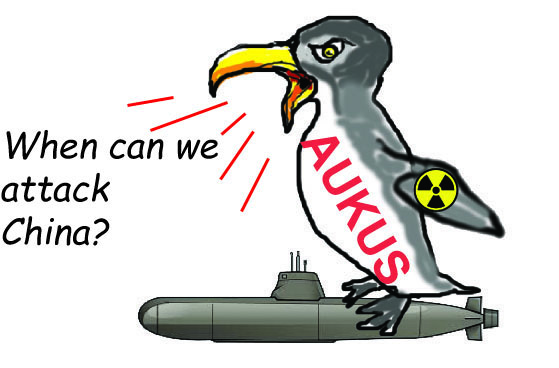
Aukusing for War: The Real Target Is China
Dr Binoy Kampmark, April 7 2024 https://theaimn.com/aukusing-for-war-the-real-target-is-china/
A remarkably perverse reality is in the offing regarding AUKUS. In terms of submarines, it will lag, possibly even sink, leaving the US and, to a lesser extent the UK, operating their fleets as Australians foot the bill and provide the refreshment
Not only is Australia effectively promising to finance and service that particular capacity, it will also do so in the service of a potentially catastrophic conflict which will see its automatic commitment. A truly high price to pay for an abdication of sovereignty for the fiction of regional stability.
The occasional burst of candour from US diplomats provides a striking, air clearing difference to their Australian and British counterparts. Official statements about the AUKUS security pact between Washington, London and Canberra, rarely mention the target in so many words, except on the gossiping fringes. Commentators and think tankers are essentially given free rein to speculate, masticating over such streaky and light terms as “new strategic environment”, “great power competition”, “rules-based order”.
On the occasion of his April 3 visit to Washington’s Center for a New American Security (CNAS), US Deputy Secretary of State Kurt Campbell was refreshingly frank. His presence as an emissary of US power in the Pacific has been notable since the AUKUS announcement in September 2021.
In March last year, Campbell, as Deputy Assistant to the US President and Coordinator for the Indo-Pacific National Security Council, was unfurling the US flag before various Pacific states, adamant that US policy was being reoriented from one of neglect to one of greater attentiveness. The Solomon Islands, given its newly minted security pact with Beijing, was of special concern. “We realise that we have to overcome in certain areas some amounts of distrust and uncertainty about follow through,” he explained to reporters in Wellington, New Zealand. “We’re seeking to gain that trust and confidence as we go forward.”
In Honiara, Campbell conceded that the US had not done “enough before” and had to be “big enough to admit that we need to do more, and we need to do better.” This entailed, in no small part, cornering the Solomon Islands Premier Manasseh Sogavare into affirming that Beijing would not be permitted to establish a military facility capable of supporting “power projection capabilities.”
In his discussion with the CNAS Chief Executive Officer, Richard Fontaine, Campbell did the usual runup, doffing the cap to the stock principles. Banal generalities were discussed, for instance, as to whether the US should be the sole show in projecting power or seek support from like-minded sorts. “I would argue that as the United States and other nations confront a challenging security environment, that the best way to maintain peace and security is to work constructively and deeply with allies and partners.” A less than stealthy rebuke was reserved for those who think “that the best that the United States can do is to act alone and to husband its resources and think about unilateral, individual steps it might take.”
The latter view has always been scorned by those calling themselves multilateralists, a cloaking term for waging war arm-in-arm with satellite states and vassals while ascribing to it peace keeping purposes in the name of stability. Campbell is unsurprising in arguing “that working closely with other nations, not just diplomatically, but in defensive avenues [emphasis added], has the consequence of strengthening peace and stability more generally.” The virtue with the unilateralists is the possibility that war should be resorted to sparingly. If one is taking up arms alone, a sense of caution can moderate the bloodlust.
Campbell revealingly envisages “a number of areas of conflict and in a number of scenarios that countries acting together” in the Indo-Pacific, including Japan, Australia, South Korea and India. “I think that balance, the additional capacity will help strengthen deterrence more general [sic].” The candid admission on the role played by the AUKUS submarines follows, with the boats having “the potential to have submarines from a number of countries operating in close coordination that could deliver conventional ordinance from long distances. Those have enormous implications in a variety of scenarios, including in cross-strait circumstances.” And so, we have the prospect of submarines associated with the AUKUS compact being engaged in a potential war with China over Taiwan.
When asked on what to do about the slow production rate of submarines on the part of the US Navy necessary to keep AUKUS afloat, Campbell acknowledged the constraints – the Covid pandemic, supply chain issues, the number of submarines in dry dock requiring or requiring servicing. But like Don Quixote taking the reins of Rosinante to charge the windmills, he is undeterred in his optimism, insisting that “the urgent security demands in Europe and the Indo-Pacific require much more rapid ability to deliver both ordinance and other capabilities.”
To do so, the military industrial complex needs to be broadened (good news for the defence industry, terrible for the peacemakers). “I think probably there is going to be a need over time for a larger number of vendors, both in the United States in Australia and Great Britain, involved in both AUKUS and other endeavours.”
There was also little by way of peace talk in Campbell’s confidence about the April 11 trilateral Washington summit between the US, Japan and the Philippines, following a bilateral summit to be held between President Joe Biden and Japan’s Prime Minister Fumio Kishida. When terms such as “modernize” and “update” are bandied about in the context of an alliance, notably with an eye towards a rival power’s ambitions, the warring instincts must surely be stirred. In the language of true encirclement, Campbell envisages a cooperative framework that will “help link the Indo-Pacific more effectively to Europe” while underscoring “our commitment to the region as a whole.”
A remarkably perverse reality is in the offing regarding AUKUS. In terms of submarines, it will lag, possibly even sink, leaving the US and, to a lesser extent the UK, operating their fleets as Australians foot the bill and provide the refreshments. Campbell may well mention Australia and the UK in the context of nuclear-powered submarines, but it remains clear where his focus is: the US program “which I would regard as the jewel in the crown of our defense industrial capacity.” Not only is Australia effectively promising to finance and service that particular capacity, it will also do so in the service of a potentially catastrophic conflict which will see its automatic commitment. A truly high price to pay for an abdication of sovereignty for the fiction of regional stability.
The high-stakes power play that will shape our future
April 5, 2024, The Australian, Simon Benson; Political editor
The climate wars may be over but an equally divisive battle is arising out of the nation’s new political consensus. Both sides of politics are locked into a net-zero emissions target by 2050, Labor by choice, the Coalition by the force of political reality. But Peter Dutton’s introduction of the nuclear option creates a stark contest between the main parties on how to get there.
The competing pathways to net zero offer profoundly different outcomes for the nation’s future. They go beyond climate change and raise the fundamental question: what sort of Australia will emerge once a point of no return in the rollout is reached?
…………………………………. a new ideological contest into the debate, reigniting a clash of ideas not only over the future of energy but for the communities that have generational ties to its production.
There are two essential issues at stake.
While the question of energy security has become the axis around which Albanese’s radical transformation of the economy pivots, the economic future of the nation’s coal communities has become the new political frontline between Labor and the Coalition.
In this sense, Australia is not unique. The US is grappling with its own socio-economic dilemma……….
Last week, as the Prime Minister was preparing to fly to the Hunter Valley coalfields to announce a $1bn solar panel scheme to generate jobs as coal exits the community, Dutton was meeting privately with executives from Rolls-Royce for a deep dive into the feasibility of small modular reactors in an Australian context.
This juxtaposition symbolises the chasm of policy approaches to the challenge of decarbonising the economy. Both sides are embarking on equally ambitious road maps. While Albanese has rubbished the idea of an Australian civil nuclear energy program, Dutton is convinced it can work.
In an interview with Inquirer on Wednesday, he pledged that if the Coalition were returned to government at the next election, the first nuclear reactors would be up and running by the mid-2030s.
It is understood Rolls-Royce is confident its small modular reactor technology could be ready for an Australian market in this time-frame with a price tag of $5bn for a 470-megawatt plant. Each plant would take four years to build and have a life-span of 60 years.
Rolls-Royce signed a contract with the Albanese government in February to build the nuclear reactors for the second tranche of AUKUS submarines.
According to this timeline, nuclear power generation could begin being rolled out at about the same time as the first nuclear-powered submarines are delivered. The feasibility of this timeline will be strongly contested.
Social licence is essential to the Coalition’s ambitions…………………..
Under a plan taken to Dutton’s shadow cabinet two weeks ago, seven coal communities were identified as potential locations for coal-to-nuclear transition on or near the sites of exiting coal-fired power stations, with the promise of cheaper electricity for those communities, higher paying jobs and upgraded infrastructure……………………………………
Not all of Dutton’s colleagues are convinced there is enough time in the political cycle to start building the political case for nuclear power……………………..
Both sides are highly alert to the acute political consequences of an ill-managed transition.
What looms is an election battle over energy security set against vastly contrasting ideologies…………………………………………………
The Albanese government’s Net Zero Economy Authority bill passed by the parliament before Easter set out the agency’s purpose as one clearly designed around the transition to renewables. It was unambiguous in its assessment of the cost and scope of Labor’s plan. The bill was equally clear about what is at stake with the exiting of coal-fired power stations across the country and the consequences if steps aren’t taken to protect these communities.
It defines coal-fired power stations and associated thermal coalmines as being located in six regions around Australia: Collie in Western Australia, the Latrobe Valley in Victoria, the Hunter Valley and Lithgow in NSW and three regions in Queensland – the Darling Downs, Gladstone and Central Queensland.
The political expression of this reality is the number of regional seats that will be affected. Some sooner than others. Neither side can claim a monopoly on ownership of these constituencies.
In NSW, Labor is at risk in the Hunter Valley in the seats of Hunter, Shortland and Paterson, while Calare west of Sydney, held by the Nationals until Andrew Gee resigned to sit on the crossbench, covers the coal community of Lithgow.
In Queensland, the LNP has Flynn stretching west from Gladstone to consider with legacy coal community economics also stretching into Capricornia, which takes in Rockhampton up to southern Mackay. Both seats have been in Labor hands before. Nationals leader David Littleproud’s massive Queensland seat of Maranoa is another that takes in coal communities through Queensland’s southern and central west.
In Victoria, coal communities stretch across the Nationals’ seat of Gippsland, which now takes in the industrial region of the Latrobe Valley………………………………………………………………………………..
The day of nuclear Armageddon: Newly declassified documents reveal in macabre minute-by-minute detail what the end of the world would like. And why those vaporised instantly by an atomic bomb will be the lucky ones…

Eventually it reaches the troposphere, higher than commercial flights. Radioactive particles then spew across everything below as fallout, raining back down on the Earth.
A nuclear bomb produces ‘a witch’s brew of radioactive products, which are also entrained in the cloud’, the astrophysicist Carl Sagan warned decades ago.
More than a million people are dead or dying and fewer than two minutes have passed since detonation. Now the inferno begins.
ANNIE JACOBSEN, 7 April 2024, https://www.dailymail.co.uk/news/article-13279197/The-day-nuclear-Armageddon-Newly-declassified-documents-reveal-macabre-minute-minute-end-world-like-vaporised-instantly-atomic-bomb-lucky-ones.html
This story, of what the moments after a nuclear missile launch could look like, is based on facts sourced from exclusive interviews with presidential advisers, cabinet members, nuclear weapons engineers, scientists, soldiers, airmen, special operators, Secret Service, emergency management experts, intelligence analysts, civil servants and others who have worked on these macabre scenarios over decades.
As the plans for General Nuclear War are among the most classified secrets held by the US government, the scenario postulated here takes the reader up to the razor’s edge of what can legally be known. Declassified documents, obfuscated for decades, fill in the details with terrifying clarity.
Because the Pentagon is a top target for a strike by America’s nuclear-armed enemies, in the scenario that follows, Washington DC gets hit first with a one megaton thermo-nuclear bomb. ‘A “Bolt out of the Blue” attack against DC is what everyone in DC fears most,’ says Andrew Weber, former assistant secretary of defence for nuclear, chemical and biological defence programmes. ‘Bolt out of the Blue’ is how US Nuclear Command and Control refers to an ‘unwarned large [nuclear] attack’.
This strike on DC initiates the beginning of an Armageddon-like nuclear war that will almost certainly follow. ‘There is no such thing as a small nuclear war,’ is an oft repeated phrase in Washington.
A nuclear strike on the Pentagon is just the beginning of a scenario the finality of which will be the end of civilisation as we know it.
This is the reality of the world in which we live. The nuclear war scenario proposed in this book could happen tomorrow. Or later today. ‘The world could end in the next couple of hours,’ warns General Robert Kehler, the former commander of the United States Strategic Command.
A one megaton thermonuclear weapon detonation begins with a flash of light and heat so tremendous it is impossible for the human mind to comprehend.
One hundred and eighty million degrees Fahrenheit is four or five times hotter than the temperature at the centre the Sun.
In the first fraction of a milli-second after the bomb strikes the Pentagon outside Washington DC, there is light. Soft X-ray light with a very short wavelength. The light superheats the surrounding air to millions of degrees, creating a massive fireball that expands at millions of miles per hour.
Within a few seconds the fireball has increased to a diameter of a little more than a mile, its heat so intense that concrete explodes, metal melts or evaporates, stone shatters and people instantaneously convert into combusting carbon.
The five-storey, five-sided structure of the Pentagon, and everything inside its 6.5 million sq ft of office space, explodes into superheated dust, all the walls shattering with the near-simultaneous arrival of a shockwave. All 27,000 employees perish instantly.
Not a single thing in the fireball remains. Nothing. Ground zero is zeroed.
Travelling at the speed of light, the radiating heat from the fireball ignites everything flammable several miles in every direction.
Curtains, paper, books, wood fences, clothing and dry leaves explode into flames and become kindling for a great firestorm that begins to consume a 100 or more square mile area that, prior to this flash of light, was the beating heart of American governance and home to six million people.
Several hundred feet north-west of the Pentagon, all 639 acres of Arlington national cemetery –including the 400,000 sets of bones and gravestones honouring the war dead, the 3,800 buried African-American freed people, the visitors paying respects on this late winter afternoon, the groundskeepers mowing lawns, the arborists tending trees, the tour guides touring, the white-gloved members of the Old Guard keeping watch over the Tomb of the Unknowns – they are all instantly transformed into charred human figurines. Into soot.
Those incinerated are spared the horror that begins to be inflicted on the one to two million people gravely injured but not yet dead.
Continue readingUkrainian artillery cuts last backup power line to Zaporozhye Nuclear Power Plant

Steven Starr, April 6, 2024
The fuel rods within the reactor core and in the spent fuel pools will continue to emit a large amount of heat (from the continuous decay of fission products within the fuel) even after the reactors are in a “cold shutdown”. Thus, electric power is required to run the cooling systems in the spent fuel ponds and the pumps that push cooling water through the reactors. If no offsite electricity is available, diesel generators are required to generate electricity to operate the pumps to cool the reactor and the cooling systems that cool the spent fuel pools.
A prolonged failure of the cooling systems (from loss of electric power) to continuously remove heat from the spent fuels will eventually cause the water in the pools to boil off and expose the spent fuel rods to steam and/or air. Exposure of the fuel rods to steam and/or air will cause them to overheat to the point of rupture or ignition, leading to the massive release of radioactivity. (The Soviet-designed reactors have their spent fuel pools inside the primary containment, unlike US reactors that locate spent fuel pools outside primary containment).
The fuel inside the steel reactor containment vessels must also be cooled (by pumping cooling water through the containment vessel). Failure of the cooling pumps to circulate water through the core will lead to the water in the containment vessel to superheat and eventually lead to the damage of the fuel rods, which would release large amounts of highly radioactive fission products.
Offsite power to the Zaporozhye Nuclear Power Plant (ZNPP) has historically been provided by the Zaporozhye Thermal Power Station, which is located several kilometers away from the ZNPP. I think the damage to backup power line from Ukrainian artillery fire refers to the destruction of the power lines and power transformers that connect the Thermal Power Station to ZNPP.
1 This month


Help Aunty Sue Protect Her Land and Sacred Sites From Destructive Rocket Testing.
.

Australians deserve the truth
about
AUKUS – https://aukuspublicinquiry.com/

PETITION – To: Prime Minister Anthony Albanese and the Australian Labor Government

of the week – Australians for War Powers Reform (AWPR)
To see nuclear-related stories in greater depth and intensity

