The Coalition is hoodwinking Australia about nuclear energy

Opposition Leader Peter Dutton is expected to make rescinding the nuclear power prohibition a 2025 election policy. One expert wonders whether he can do basic sums.
EMMA ELSWORTHY, JAN 12, 2024 https://www.crikey.com.au/2024/01/12/nuclear-energy-coalition-policy-dutton-2025-election/
It’s now more expensive than renewables, Australia has a decades-long ban on it, and its key international example touted by the Coalition was scrapped, but that hasn’t stopped growing cries from conservatives about nuclear power entering the energy mix on the nation’s path to net zero by 2050.
Opposition Leader Peter Dutton is reportedly preparing to make nuclear a key part of his energy policy for the next federal election, telling the Institute of Public Affairs: “The only feasible and proven technology, which can firm up renewables and help us achieve the goals of clean, cost effective and consistent power is next generation nuclear technologies.”
Dutton has tasked the opposition’s climate change and energy spokesperson Ted O’Brien with an internal investigation into a domestic nuclear energy industry in Australia. An enthused O’Brien has since returned from a tour of the US and Canada’s nuclear reactors last year, including the site of the BWRX-300 build in Ontario and Pittsburgh’s Generation IV nuclear battery, called the eVinci.
O’Brien is interested in small nuclear reactors, or SMRs — structures that would be manufactured in a factory, shipped out and assembled on-site in a dreamlike bid to drive down the cost and time delays of larger reactors.
“Environmental advocates, industry, private equity, centre-left and centre-right think-tanks, members of Congress — all told us that near 100% renewables was neither practical nor affordable, and that we needed nuclear in our energy mix,” O’Brien wrote in The Australian last year.
Several conservative figures have called for nuclear power to enter the energy conversation, including former Liberal treasurer Peter Costello, Nationals senator Matt Canavan, Nationals leader David Littleproud, and Liberal Democratic MP David Limbrick. Meanwhile, Climate and Energy Minister Chris Bowen has flat-out called the idea “dumb”.
In November, however, conservative SMR dreams were dashed here and abroad when a US developer binned a project widely touted as kicking off the new nuclear era. NuScale Power said it had failed to attract enough utility customers for the controversial power source to proceed — but it had also nearly doubled in cost (from US$8 billion to US$14 billion), suffered a five-year time delay, and revealed its power generation capacity had been slashed by a third.
Even so, Australian National University Honorary Associate Professor Tony Irwin told Crikey there was “still time” for nuclear to contribute to Australia’s pursuit of net zero, requiring “politicians with a long-term vision” to recognise what some COP28 nations called “the key role of nuclear energy in limiting temperature rise”.
Griffith University Emeritus Professor of Science, Technology and Society Ian Lowe called this bullshit.
“Nobody who can read joined-up writing and do take-away sums thinks nuclear power has any role in slowing Australia’s release of greenhouse gases,” the environmental scientist told Crikey.
A CSIRO report released last month found likewise, concluding nuclear power did not offer an “economically competitive solution”, and that SMRs would be “too late to make a significant contribution to achieving net zero emissions” because of both legal and commercial viability hurdles.
Lowe also noted the 2006 Uranium Mining, Processing and Nuclear Energy Review (UMPNER) report had found nuclear energy would need very generous public subsidies to compete with renewables, which have backslid in price enormously in the 18 years since the review’s release.
The UMPNER was chaired by then head of the Australian Nuclear Science and Technology Organisation (ANTSO) Dr Ziggy Switkowski — a spokesperson for the government organisation told Crikey it’s following the nuclear debate though officially “agnostic” on nuclear energy.
Lowe also noted that the Coalition’s bleating about the nation rescinding the nuclear ban and embracing the controversial power source from the opposition has interesting timing considering the nine years it spent in government.
“Of course, they did nothing to promote that technology in their decade in office and are now predictably evasive about where a nuclear power station would be located and how it would be funded,” Lowe said.
Labor MP Josh Wilson went harder, telling Crikey that Dutton’s growing support for nuclear energy in the face of cheaper and cleaner renewables showed the opposition leader is unfit to lead the country.
“By giving in to the climate deniers and nuclear cheerleaders in his own show, Dutton shows his preparedness to consign the Australian community to an expensive, disaster-prone, and dangerous future for the sake of protecting his own position,” Wilson said.
Futile and Dangerous: Bombing Yemen in the Name of Shipping
There was even less of a debate about the legality or wisdom of the Yemen strikes in Australia. Scandalously, and with a good deal of cowardice, the government preferred a deafening silence for hours in the aftermath of the operation. The only source confirming that personnel of the Australian Defence Forces were involved came from Biden, the commander-in-chief of another country. There had been no airing of the possibility of such involvement. Australian Prime Minister Anthony Albanese had, in not sending a warship from the Royal Australian Navy to join Operation Prosperity Guardian, previously insisted that diplomacy might be a better course of action. Evidently, that man is up for turning at a moment’s notice.
Another feature of the strikes is the absence of a Security Council resolution from the United Nations, technically the sole body in the international system able to authorise the use of force under the UN Charter. A White House statement on January 11 attributes authority to the strikes much the same way the administration of George W. Bush did in justifying the warrantless, and illegal invasion of Iraq in March 2003. (Ditto those on his same, limited bandwidth, Tony Blair of the UK and John Howard of Australia.)
January 13, 2024, by: Dr Binoy Kampmark, https://theaimn.com/futile-and-dangerous-bombing-yemen-in-the-name-of-shipping/#
What a show. As US Secretary of State Antony Blinken was promoting a message of calm restraint and firm control in limiting the toxic fallout of Israel’s horrific campaign in Gaza, a decision was made by his government, the United Kingdom and a few other reticent collaborators to strike targets in Yemen, including the capital Sana’a. These were done, purportedly, as retribution for attacks on international commercial shipping in the Red Sea by the Iran-backed Houthi rebels.
The wording in a White House media release mentions the operation’s purpose and the relevant participants. “In response to continued illegal, dangerous, and destabilizing Houthi attacks against vessels, including commercial shipping, transiting the Red Sea, the armed forces of the United States and the United Kingdom, with support from the Netherlands, Canada, Bahrain, and Australia, conducted joint strikes in accordance with the inherent right of individual and collective self-defense.”
US Air Forces Central Command further revealed that the “multinational action targeted radar systems, defense systems, and storage and launch sites for one way attack unmanned aerial systems, cruise missiles, and ballistic missiles.”
The rationale by the Houthis is that they are targeting shipping with a direct or ancillary Israeli connection, hoping to niggle them over the barbarities taking place in Gaza. As the Israeli Defence Forces are getting away with, quite literally, bloody murder, the task has fallen to other forces to draw attention to that fact. Houthi spokesperson Mohammed Abdusalam’s post was adamant that “there was no threat to international navigation in the Red and Arabian Seas, and the targeting was and will continue to affect Israeli ships or those heading to the ports of occupied Palestine.”
But that narrative has been less attractive to the supposedly law-minded types in Washington and London, always mindful that commerce trumps all. Preference has been given to such shibboleths as freedom of navigation, the interests of international shipping, all code for the protection of large shipping interests. No mention is made of the justification advanced by the Houthi rebels and the Palestinian plight, a topic currently featuring before the International Court of Justice in the Hague.
Another feature of the strikes is the absence of a Security Council resolution from the United Nations, technically the sole body in the international system able to authorise the use of force under the UN Charter. A White House statement on January 11 attributes authority to the strikes much the same way the administration of George W. Bush did in justifying the warrantless, and illegal invasion of Iraq in March 2003. (Ditto those on his same, limited bandwidth, Tony Blair of the UK and John Howard of Australia.) On that occasion, the disappointment and frustrations of weapons inspectors and rebukes from the UN about the conduct of Saddam Hussein, became vulnerable to hideous manipulation by the warring parties.
On this occasion, a “broad consensus as expressed by 44 countries around the world on December 19, 2023” and “the statement by the UN Security Council on December 1, 2023, condemning Houthi attacks against merchant and commercial vessels transiting the Red Sea” is meant to add ballast. Lip service is paid to the self-defence provisions of the UN Charter.
In a separate statement, Biden justified the attack on Houthi positions as necessary punishment for “unprecedented Houthi attacks against international maritime vessels in the Red Sea – including the use of anti-ship ballistic missiles for the first time in history.” He also made much of the US-led Operation Prosperity Guardian, “a coalition of more than 20 nations committed to defending international shipping and deterring Houthi attacks in the Red Sea.” No mention of the Israeli dimension here, at all.
In addition to the pregnant questions on the legality of such strikes in international law, the attacks, at least as far as US execution was concerned, was far from satisfactory to some members of Congress. Michigan Democratic Rep. Rashita Tlaib was irked that US lawmakers had not been consulted. “The American people are tired of endless war.” Californian Rep. Barbara Lee warned that, “Violence only begets more violence. We need a ceasefire now to prevent deadly, costly, catastrophic escalation of violence in the region.”
A number of Republicans also registered their approval of the stance taken by another Californian Democrat, Rep. Ro Khanna, who expressed with certitude the view that Biden had “to come to Congress before launching a strike against the Houthis in Yemen and involving us in another middle eastern conflict.” Republican Senator Mike Lee of Utah was in full agreement, as was West Virginia Republican Rep. Thomas Massie. “Only Congress has the power to declare war,” Massie affirmed.
Unfortunately for these devotees of Article I of the US Constitution, which vests Congress approval powers for making war, the War Powers Act, passed by Congress in November 1973, merely requires the president to inform Congress within 48 hours of military action, and the termination of such action within 60 days of commencement in the absence of a formal declaration of war by Congress or authorisation of military conflict. These days, clipping the wings of the executive when it comes to engaging in conflict is nigh impossible.
There was even less of a debate about the legality or wisdom of the Yemen strikes in Australia. Scandalously, and with a good deal of cowardice, the government preferred a deafening silence for hours in the aftermath of the operation. The only source confirming that personnel of the Australian Defence Forces were involved came from Biden, the commander-in-chief of another country. There had been no airing of the possibility of such involvement. Australian Prime Minister Anthony Albanese had, in not sending a warship from the Royal Australian Navy to join Operation Prosperity Guardian, previously insisted that diplomacy might be a better course of action. Evidently, that man is up for turning at a moment’s notice.
In a brief statement made at 4.38 pm on of January 12 (there was no press conference in sight, no opportunity to inquire), Albanese declared with poor conviction that, “Australia alongside other countries has supported the United States and the United Kingdom to conduct strikes to deal with this threat to global rules and commercial shipping.” He had waited for the best part of a day to confirm it to the citizenry of his country. He had done so without consulting Parliament.
Striking the Houthis would seem, on virtually all counts, to be a signal failure. Benjamin H. Friedman of Defense Priorities sees error piled upon error: “The strikes on the Houthis will not work. They are very unlikely to stop Houthi attacks on shipping. The strikes’ probable failure will invite escalation to more violent means that may also fail.” The result: policymakers will be left “looking feckless and thus tempted to up the ante to more pointless war to solve a problem better left to diplomatic means.” Best forget any assuring notions of taking the sting out of the expanding hostilities. All roads to a widening war continue to lead to Israel.
An international law expert explains why South Africa’s case at the ICJ is so important

A ruling by the International Court of Justice in favor of South Africa, which has accused Israel of genocide, could mean saving thousands of lives in Gaza. The alternative, however, could be devastating and further embolden Israeli violence.
BY YUMNA PATEL https://mondoweiss.net/2024/01/an-international-law-expert-explains-why-south-africas-case-at-the-icj-is-so-important/?fbclid=IwAR0_La2MT5GTGkKo2X56cAEa15B-SPBIOwKnMKznqzCczU0XVSIz_BlNrBE
South Africa and Israel will be appearing before the International Court of Justice, on Thursday, January 11, where the court will begin hearing arguments on whether Israel is committing the crime of Genocide.
The highly anticipated public hearings, which will last for two days, are based on an 84-page appeal submitted by South Africa in December to the ICJ, the top judicial body of the United Nations. In the appeal, South Africa argues that Israel’s military campaign in Gaza is “genocidal in character” and that through both action and intent to commit genocide, Israel has violated the 1948 Genocide Convention.
Both Israel and South Africa are parties to the convention, which came into being on the heels of World War II and the Holocaust. All signatories of the treaty are obligated not to commit genocide, to ensure that it is prevented, and to seek that the crime be prosecuted.
South Africa’s appeal to the ICJ, however, is not just about charging Israel with the crime of genocide – a lengthy process that could take the court months or years. It’s also seeking a more immediate solution by requesting the court institute provisional measures to immediately halt Israel’s military campaign in Gaza.
Essentially, South Africa wants two things: to stop the mass killing of Palestinians in Gaza now and for Israel to be charged with the crime of genocide in the long term. A condensed breakdown and explanation of the 84-page brief can be found here.
Expectedly, Israel has outright denied any accusations of genocide, lambasting the South African appeal as antisemtic “blood libel”. The U.S. has also rebuked South Africa’s appeal, called it “meritless” and “completely without any basis in fact.”
Nevertheless, Israel is pressing forward, sending a carefully crafted legal team to The Hague in the Netherlands to defend Israel’s position that it is not committing genocide in Gaza.
The much-talked about public proceedings, which will take place over the course of two days on Thursday and Friday, January 11th and 12th, are being welcomed by both Palestinians, as well as a number of countries around the world, who have thus far failed to bring about a ceasefire, primarily due to the U.S. veto of UN resolutions calling for a halt to the violence.
Despite the international buzz and anticipation, many in Palestine and around the world remain skeptical as to how much weight an ICJ ruling against Israel could hold due to a long history of Israeli impunity on the global stage and Israel’s well-documented disregard for international law and human rights norms.
Still, many Palestinian international law experts and human rights groups say the ICJ proceedings are significant and could hold serious consequences not only for Israel and Palestine but for the world.
Among them is Dr. Munir Nuseibah, a Palestinian professor of International law at Al-Quds University and the Director of the Al-Quds Human Rights Clinic. Mondoweiss spoke to Dr. Nuseibah about the significance of this case, why people should pay attention to it, and what implications it holds.
Why does this case matter?
The case filed by South Africa is important for a number of reasons. First, Dr. Nuseibah notes, the fact that it was filed at the ICJ in and of itself is significant, being that the court is the highest judicial body that settles disputes between states.
“This is quite significant because it’s… based on an agreement, or treaty that is binding to both South Africa and Israel,” he said, referring to the 1948 Genocide Convention.
“This is important in the history of the Palestinian cause, since we haven’t had an opportunity to get a binding international decision on any of the important questions that we have been dealing with, including for example, the issue of the Palestinian refugees, the [Israeli] occupation, etc,” Dr. Nuseibah continued.
The last time the ICJ made a decision in relation to Palestine was a 2004 advisory opinion that found Israel’s separation wall, which at that stage was still early on in its construction, violated international law and should be torn down.
However, because that decision was a non-binding advisory opinion, Israel was not obligated to stop construction or take down the wall. Instead, Israel continued constructing the wall, which today spans across hundreds of kilometers, cutting off Palestinians from their land and swallowing up swaths of Palestinian territory.
This case, Dr. Nuseibah says, would be different, as the resulting decision from this week’s proceedings would be binding, and if the court rules in favor of South Africa, it would mean that under international law, Israel would be obligated to end its military campaign in Gaza in the short term, and in the long term, potentially provide material reparations to the victims of its genocide.
The case is also significant as a symbolic measure as well. That, in the face of an ongoing genocide, which has been well documented by Palestinians and international human rights organizations alike, the world must intervene to stop it.
“If there is no serious intervention, and if the United Nations, the world, and what we call the international community is going to continue to be silenced and made inactive, and in a certain way deactivated and demobilized, this horror will continue,” Dr. Nusaibah said, not just in Palestine but around the world.
“To not only be accused of genocide, but to be charged by the court, and to be seen as a country guilty of genocide is very important,” he said. “In my opinion, everything that happens in the International Court of Justice now, is likely to influence thousands of lives in the future.
So whatever these judges will decide will actually be a question of life and death for many, many Palestinians.”
What will South Africa be arguing on Thursday?
The crux of South Africa’s argument is that Israel is committing genocide in Gaza and that it is violating its obligations under the 1948 Convention on the Prevention and Punishment of Genocide, which defines the crime as “acts intended to bring about the destruction of a substantial part of the Palestinian national, racial and ethnic group.”
South Africa’s argument hinges on proving that Israel is not only committing acts of genocide in Gaza but that there is a clear intent on Israel’s part to commit genocide – the latter being a significant focus of the 84-page brief, which listed off an array of quotes from Israeli politicians, officials, and public figures using genocidal language when speaking about Israel’s campaign in Gaza.
“[South Africa’s] first argument will involve the speeches and quotes basically from Israeli officials who have been using genocidal language from the very first day actually, from October 7th,” Dr. Nuseibah said.
“In criminal law it’s not enough to do something, but you have to intend to do something. And one of the signs of intent, are the things you say. So these quotes from Israeli officials will be used to show that Israel has been calling for genocide,” he continued.
And, of course, South Africa will be providing evidence of what it says are clear genocidal acts carried out by Israel in Gaza, such as “bombing civilians, heavily targeting homes, targeting hospitals, targeting cultural centers, targeting universities, schools, etc,” Dr. Nuseibah detailed.
“So all of these targets that the Israeli army has destroyed over the past months, and of course the civilian casualties, the human beings who have been murdered or injured or made disabled, [Israel] using hunger as a weapon, etc. – all of that will be a very important part of the facts South Africa will present,” he said, adding that the denial of fuel and electricity, the siege on 2 million civilians, and the forcible displacement of Palestinians in Gaza is also “an important element of genocide and especially in this case.”
What will Israel’s legal defense look like?
While there are 84 pages to give us an insight into South Africa’s case, it’s not as apparent what exactly Israel’s defense will consist of.
If the past few months have been any indication, however, during which Israel has denied any wrongdoing in Gaza, justified it as self-defense, and has actually accused Hamas of genocide for its October 7th attack – some assumptions can be made as to how Israel will approach it’s defense.
First, Israel’s primary strategy, Dr. Nuseibah says, will be to “deny, deny, deny.”
“Israel will deny everything that South Africa claims,” Dr. Nuseibah said. “It will deny that it has starved people, or that it is trying to starve people. It will deny that it is not allowing humanitarian aid into Gaza, by showing examples where it actually did allow some trucks to enter,” he continued, noting that what little humanitarian aid has been allowed into Gaza has been critically insufficient to address the needs of the more than 2 million people trapped in the strip.
“It [Israel] will talk about any attempts they made in any of their operations to ‘reduce civilian casualties’, whether by warning civilians in certain places,” Dr. Nuseibah said, referring to Israel’s practice of dropping leaflets to notify civilians that their area is going to be attacked, or by providing QR codes and maps of “safe zones” and “combat zones” in Gaza – all practices that have been widely criticized both as insufficient to save civilian lives, and as a PR move by Israel to save face in front of the international community.
At the time of publication, 96 days after Israel began its bombardment on Gaza, more than 23,000 Palestinians have been killed, the vast majority of them civilians.
“So, Israel’s strategy will be to deny everything, because there is nothing else they can do or say,” Dr. Nuseibah said. “It is a longtime strategy and practice of Israel that we are used to. Israel always denies its crimes. Even until today, Israel denies the Nakba, that is the official position of Israel, to deny it.”
While Israel has focused much of its propaganda campaign on accusing Hamas, and supporters of the Palestinian cause in general, of carrying out or advocating for the genocide of Israelis and Jewish people, Dr. Nuseibah said he doubts that will be a feature of Israel’s arguments at the ICJ.
“I doubt that they will do this or bring this up, because if they do, then they would have to present evidence. They would have to allow an open investigation into what happened on October 7th,” Dr. Nuseibah said, noting that Israel has historically prevented access to independent investigators seeking to probe potential crimes committed in the occupied Palestinian territory.
How will this impact Palestinian lives right now?
While the deliberations on whether Israel is guilty of genocide in Gaza or not could take years, South Africa’s case is expected to yield a much more immediate and time-sensitive result.
As part of its appeal to the court, South Africa is seeking an emergency interim decision by the court, or “provisional measures,” to order the Israeli military to cease its campaign in Gaza immediately, stop the displacement of Palestinians, and allow for the entry of adequate humanitarian aid into Gaza. The court could make that decision in as little as a few days or weeks.
These provisional measures, Dr. Nuseibah says, are some of the most critical elements to the case and have the biggest potential to change the course of the unfolding genocide in Gaza.
“This is very time sensitive. Every day that we lose, we are losing more lives. We are losing more casualties. There are more homes that are demolished. There are more days that children are not going to school,” he continued.”There is a lot of loss every single day of civilian life, and there is no human being in Gaza who is not heavily influenced by what is happening.”
“All of the provisional requests that South Africa has made are there to save lives immediately. And I do expect that the court will take these measures. History has shown that the ICJ has given these provisional measures in similar situations, even with less casualties and less risk,” Dr. Nuseibah said.
“So I do expect that the court will decide provisional measures, which would mean a ceasefire, which is the most important thing right now, as well as stopping the displacement, allowing for the entry of aid, and stopping the continuous demolition of Gaza.”
Israel has ignored international law before, what will be different this time?
Continue readingNuclear Continues To Lag Far Behind Renewables In China Deployments

China can’t scale its nuclear program at all. It peaked in 2018 with 7 reactors with a capacity of 8.2 GW. For the five years since then then it’s been averaging 2.3 GW of new nuclear capacity, and last year only added 1.2 GW between a new GW scale reactor and a 200 MW small modular nuclear reactor.
Michael Barnard 13 Jan 24, https://cleantechnica.com/2024/01/12/nuclear-continues-to-lag-far-behind-renewables-in-china-deployments/
Since 2014 I’ve been tracking the natural experiment in China regarding the ability to scale nuclear generation vs renewables. My hypothesis was that the modularity and manufacturability of wind and solar especially meant that it would be much easier for them to scale up to massive sizes.
That hypothesis was strongly confirmed when I first published the results in 2019, and again in 2021 and 2022 when I updated them. In what is becoming a dog bites man annual article, here are the 2023 results. Once again, China’s nuclear program barely added any capacity, only 1.2 GW, while wind and solar between them added about 278 GW. Even with the capacity factor difference, the nuclear additions only mean about 7 TWh of new low carbon generation per year, while wind and solar between them will contributed about 427 TWh annually, over 60 times as much low carbon electricity.
As a note, there were no new hydroelectric dams commissioned in China, so that continued acceleration of deployment is solely due to wind and solar. That’s going to change when the absurdly massive Tibetan Yarlung Tsangpo river dam is commissioned, likely in the mid 2030s. That dam will generate three times the energy annually as the Three Gorges Dam, making it by far the biggest dam in the world by every measure.
A few points. First, what’s a natural experiment? It’s something which is occurring outside of a laboratory or research setting in the real world that coincidentally controls for a bunch of variables so that you can make a useful comparison. An often referenced example was of a specific region where half was without electricity for a few months. Researchers posited that the blackout region would have seen more pregnancies starting in that period, and sure enough, that’s what they found.
So why is China a natural experiment for scalability of wind and solar? Well, it controls for a bunch of variables. Both programs were national strategic energy programs run top down. I started the comparison in 2010 because the nuclear program had been running for about 15 years by then and the renewables program for five years, so both were mature enough to have worked out the growing pains.
One of the things that western nuclear proponents claim is that governments have over-regulated nuclear compared to wind and solar, and China’s regulatory regime for nuclear is clearly not the USA’s or the UK’s. They claim that fears of radiation have created massive and unfair headwinds, and China has a very different balancing act on public health and public health perceptions than the west. They claim that environmentalists have stopped nuclear development in the west, and while there are vastly more protests in China than most westerners realize, governmental strategic programs are much less susceptible to public hostility. And finally, western nuclear proponents complain that NIMBYs block nuclear expansion, and public sentiment and NIMBYism is much less powerful in China with its Confucian, much more top down governance system.
China’s central government has a 30 year track record of building massive infrastructure programs, so it’s not like it is missing any skills there. China has a nuclear weapons program, so the alignment of commercial nuclear generation with military strategic aims is in hand too. China has a strong willingness to finance strategic infrastructure with long-running state debt, so there are no headwinds there either.
Yet China can’t scale its nuclear program at all. It peaked in 2018 with 7 reactors with a capacity of 8.2 GW. For the five years since then then it’s been averaging 2.3 GW of new nuclear capacity, and last year only added 1.2 GW between a new GW scale reactor and a 200 MW small modular nuclear reactor.
So what’s going on? As I noted late in 2023, nuclear energy and free market capitalism aren’t compatible, but China isn’t capitalist, according to a lot of westerners. But it very definitely is a market and export capitalist economy, albeit with more state intervention and ownership, and the nuclear program is suffering as a result. That lone small modular reactor is a clear signal of that.
‘The Evidence of Genocide Is Not Only Chilling, It Is Also Overwhelming and Incontrovertible’. Quotes from International Court of Justice
by SCHEERPOST staff, https://scheerpost.com/2024/01/12/the-evidence-of-genocide-is-not-only-chilling-it-is-also-overwhelming-and-incontrovertible/
The World Court will hear the case on Jan. 11 and 12 at The Hague.
Notable quotes from Jan. 11 hearing
From South African attorney Tembeka Ngcukaitobi:
“There is an extraordinary feature in this case: that Israel’s political leaders, military commanders, and persons holding official positions have systematically and in explicit terms declared their genocidal intent… And these statements are then repeated by soldiers on the ground in Gaza as they engage in the destruction of Palestinians and the physical infrastructure of Gaza.”
“What state would admit to a genocidal intent? Yet the distinctive feature of this case has not been the silence as such but the reiteration and repetition of genocidal speech throughout every sphere of state in Israel.”
“We remind the court of the identity and authority of the genocidal inciters: the prime minister, the president the minister of defense, the minister of national security, the minister of energy and infrastructure, members of the Knesset, senior army officials, and foot soldiers… The evidence of genocidal intent is not only chilling, it is also overwhelming and incontrovertible.”
“Israel has subjected Gaza to what has been described as one of the heaviest conventional bombing campaigns in the history of modern warfare. Palestinians in Gaza are being killed by Israeli weaponry and bombs from air, land and sea. They are also at immediate risk of death by starvation, dehydration and disease as a result of the ongoing siege by Israel, the destruction of Palestinian towns, the insufficient aid being allowed through to the Palestinian population, and the impossibility of distributing this limited aid while bombs fall. This conduct renders essentials to life unobtainable.“
“…the level of Israel’s killing is so extensive that nowhere is safe in Gaza. … Palestinians in Gaza are subjected to relentless bombing wherever they go. They are killed in their homes, in places where they seek shelter, in hospitals, in schools, in mosques, in churches, and as they try to find food and water for their families. They have been killed if they failed to evacuate. In the places to which they have fled, and even while they attempted to flee along, Israeli declared safe routes.”
“Israel has killed an unparalleled and unprecedented number of civilians with the full knowledge of how many civilian lives each bomb will take.“
TODAY. New heights of folly as UK government releases its Civil Nuclear Roadmap.

When Rishi Sunak rose to the political throne in Britain, I thought: ”Well, of the stupid Tories, at least he’s probably less stupid than the rest of them”
Well, now I wonder. With an election due by early 2025, surely Sunak and co. are not planning upon political suicide?
So I can only conclude that Sunak is as thick as a brick.
He’s launched the Civil Nuclear Roadmap for UK to increase nuclear generation by up to four times to 24GW by 2050. The Prime Minister said: “Nuclear is the perfect antidote to the energy challenges facing Britain – it’s green, cheaper in the long term and will ensure the UK’s energy security for the long-term.” “This is the right long-term decision and is the next step in our commitment to nuclear power”
The UK intends to build up to eight new reactors, and will invest up to £300 million into producing the HALEU fuel required for new high-tech reactors, and which currently is only commercially produced in Russia.
And there’ll be a fleet of “small modular reactors” to be .built across Britain.
Sounds great, don’t it?
BUT:
Large nuclear reactors. The cost of Hinkley Point C has spiralled to £33bn, a 30 per cent increase from 2015 when it forecast the cost at £25-£26bn. Sizewell C has not yet received a final investment decision.
Six reactors on three sites have been shut down since 2021 and will be need expensive dismantlement
Most of the UK’s 9 functioning nuclear reactors are nearing the end of their operating lives, although 2 of them Heysham 1 and Hartlepool are to be extended.
Small Nuclear Reactors. Regulation and planning rules will be loosened . A developer-led approach will replace previous rules. Rather than ministers specifying sites, developers will be asked to identify locations for small nuclear reactors .
Nuclear plants will be ruled out in line with “population density” and “proximity to military activities” . But apart from those considerations, “All other criteria willbe discretionary, including size, flood risk, proximity to civil airports, the natural beauty, ecological importance or cultural heritage of the site. ”
Divorced from reality? Does Rishi Sunak not know what happened to the USA’s one and only small nuclear reactor project – the rapid decline and fall of the NuScale enterprise?
The mainstream media faithfully touts Rishi Sunak’s nuclear plans. But investors and the general public are not that gullible.
I think it more likely that the Nuclear Roadmap will prove the antidote to a Tory government for 2025
Defence Minister Marles announces Australia has joined in U.S. attacks on Yemen
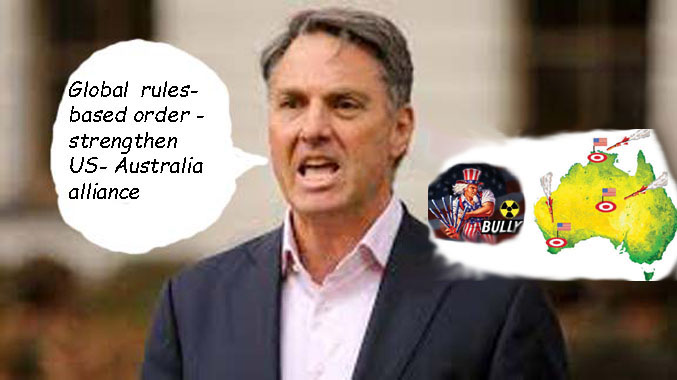
Comment. As Marles yet again spouts the “global rules-based order”, we wonder where is Prime Minister Anthony Albanese, and why was Parliament not consulted?
Deputy Prime Minister Richard Marles confirms Australian personnel contributed to strikes in Yemen.
ABC News, 12 Jan 24
Defence Minister and Deputy Prime Minister Richard Marles says Australian personnel had been present in “operational headquarters” but said he could not elaborate further on the precise nature of their participation.
Key points:
- A US official said strikes against the Iran-backed group were carried out by aircraft, ships and a submarine
- It comes as the United Nations Security Council demands an immediate halt to the shipping disruptions
- The US Central Command said Houthi rebels have launched their 27th attack since November 19
Mr Marles said Australia’s participation was “completely consistent” with the national interest. “Australia must stand up for freedom of navigation,” Mr Marles said, accusing the Houthis of “disruption of the rules-based order.”
The US and Britain have started launching strikes against Houthi targets in Yemen.
Houthi official Abdul Qader al-Mortada said raids were conducted in several Yemeni cities, including the capital Sana’a, in the early hours of Friday.
Two Hodieda residents told Associated Press they heard five strong explosions.
Hodieda lies on the Red Sea and is the largest port city controlled by the Houthis.
Yemen’s Houthi rebels said they will continue targeting Israel-linked ships in the Red Sea despite overnight air strikes by the US and Britain, their spokesman said on Friday.
“We affirm that there is absolutely no justification for this aggression against Yemen, as there was no threat to international navigation in the Red and Arabian Seas, and the targeting was and will continue to affect Israeli ships or those heading to the ports of occupied Palestine,” Yemen’s Houthis spokesperson Mohammed Abdulsalam posted on X, formerly known as Twitter.
On Friday, Iran said it condemns the US-Britain attack on Houthis in Yemen warning that it will fuel “insecurity and instability” in the region, Iranian state media reported.
“We strongly condemn the military attacks carried out this morning by the United States and the United Kingdom on several cities in Yemen,” said Nasser Kannani, spokesperson at Iran’s foreign ministry.
“These attacks are a clear violation of Yemen’s sovereignty and territorial integrity, and a breach of international laws,” he added…………………………………………
US President Joe Biden said Australia, Canada, Bahrain and the Netherlands provided support for the operation………………………………………..
The strikes would mark the first counterattack launched against the Iran-backed group, since it began Red Sea attacks in November last year.
It comes as the United Nations Security Council demanded an immediate halt to the disruption in global commerce on Thursday.
A joint statement by Australia, Bahrain, Canada, Denmark, Germany, Netherlands, New Zealand, Republic of Korea, United Kingdom and the US said the UN resolution, in addition to Houthi ignoring calls to end the shipping attacks, had led to these “precision strikes”……………………………..
Scotland’s first minister Humza Yousaf, whose parents-in-law escaped Gaza in early November, warned the UK “does not have a good record of military intervention in the Middle East”, demanding MPs have a briefing. ………………………………………………………………………………….
The Iran-backed group says it is conducting attacks in support of Palestinian militant group Hamas in its fight against Israel………………………………………………………….
Before the resolution on Thursday, United States deputy ambassador Robert Wood said “freedom of commercial activity on the seas is critically important to commerce and to national security of a number of states”.
Wider fallout on the horizon
Nearly 10 per cent of global oil trade and an estimated $US1 trillion ($1.5 trillion) in goods pass through the Red Sea route annually.
Houthi attacks have forced many shipping companies to use the much longer and more-expensive route around Africa’s Cape of Good Hope………………………………………………………………. more https://www.abc.net.au/news/2024-01-12/britain-joins-strikes-against-houthi-rebels/103312432?fbclid=IwAR0IWBxVsFVdHyF534j_12Il1ojMC-TMJ2zflrOI_J5Xnt9KWqBRBmUCAy8
Nuclear technology: the shady beginnings and the uncertain future
ABC RN, Broadcast Mon 8 Jan 2024, https://www.abc.net.au/listen/programs/bigideas/nuclear-technology-history-and-future/102960302?fbclid=IwAR2QQafugR_2Vy3Est_CdP4MVvA6gu7g-nypcNFKhe5ixGEX8VCdTgrJpEM
The history and development of the nuclear industry is shrouded in secrecy and contradictions. And its future is throwing up more questions than answers.
A scientist, a historian and a poet consider the economic, scientific and social realities of nuclear technology.
They discuss how the lessons from the past might shape an uncertain future, and the possible consequences of playing God.
Nuclear Fallout was presented at the Brisbane Writers Festival. May 10, 2023
Original broadcast on July 6, 2023.
Speakers
Associate Professor Elizabeth Tynan
Coordinator of the professional development program at the James Cook University Graduate Research School
Author of The Secret of Emu Field: Britain’s Forgotten Atomic Tests in Australia, NewSouth Publishing, May 2022
Poet and writer; Author of The Exclusion Zone, UQP 2023
Ian Lowe
Environmental scientist, Emeritus professor at Griffith University,
Ashley Hay (host)
Novelist and essayist, former editor of Griffith Review, editorial consultant for the Climate Justice Observatory
The Case for Genocide
A ruling by the court could be years away. But South Africa is asking for provisional measures that would demand Israel cease its military assault – in essence a permanent ceasefire. This decision could come within two or three weeks.
The International Court of Justice may be all that stands between the Palestinians in Gaza and genocide.
By Chris Hedges /ScheerPost, https://scheerpost.com/2024/01/12/chris-hedges-the-case-for-genocide/
The exhaustive 84-page brief submitted by South Africa to the International Court of Justice (ICJ) charging Israel with genocide is hard to refute. Israel’s campaign of indiscriminate killing, wholesale destruction of infrastructure, including housing, hospitals and water treatment plants, along with its use of starvation as a weapon, accompanied by genocidal rhetoric from its political and military leaders who speak of destroying Gaza and ethnically cleansing the 2.3 million Palestinians, makes a strong case against Israel for genocide.
Israel’s smearing of South Africa as “the legal arm” of Hamas exemplifies the bankruptcy of its defense, a smear replicated by those who claim that demonstrations held to call for a ceasefire and protect Palestinian human rights are “anti-Semitic.” Israel, its genocide live streamed to the world, has no substantial counter argument.
But that does not mean the judges on the court will rule in South Africa’s favor. The pressure the U.S. will bring – Secretary of State Antony Blinken has called the South African charges “meritless” – on the judges, drawn from the member states of the U.N., will be intense.

A ruling of genocide is a stain that Israel – which weaponizes the Holocaust to justify its brutalization of the Palestinians – would find hard to remove. It would undercut Israel’s insistence that Jews are eternal victims. It would shatter the justification for Israel’s indiscriminate killing of unarmed Palestinians and construction of the world’s largest open air prison in Gaza, along with the occupation of the West Bank and East Jerusalem. It would sweep away the immunity to criticism enjoyed by the Israel lobby and its Zionist supporters in the U.S., who have successfully equated criticisms of the “Jewish State” and support for Palestinian rights with anti-Semitism.
Over 23,700 Palestinians, including over 10,000 children, have been killed in Gaza since Oct. 7, when Hamas and other resistance fighters breached the security barriers around Gaza. Some 1,200 people were killed – there is strong evidence that some of the victims were killed by Israeli tank crews and helicopter pilots that intentionally targeted the some 200 hostages along with their captors. Thousands more Palestinians are missing, presumed buried under the rubble. Israeli attacks have left over 60,000 Palestinians wounded and maimed, the majority of them women and children. Thousands more Palestinian civilians, including children, have been arrested, blindfolded, numbered, beaten, forced to strip to their underwear, loaded onto trucks and transported to unknown locations.
A ruling by the court could be years away. But South Africa is asking for provisional measures that would demand Israel cease its military assault – in essence a permanent ceasefire. This decision could come within two or three weeks. It is a decision that is not based on the final ruling by the court, but on the merits of the case brought by South Africa. The court would not, by demanding Israel end its hostilities in Gaza, define the Israeli campaign in Gaza as genocide. It would confirm that there is the possibility of genocide, what the South African lawyers call acts that are “genocidal in character.”
The case will not be determined by the documentation of specific crimes, even those defined as war crimes. It will be determined by genocidal intent – the intent to eradicate in whole or in part, a national, ethnic, racial or religious group – as defined in the Genocide Convention.
These acts collectively include the targeting of refugee camps and other densely packed civilian areas with 2,000-pound bombs, the blocking of humanitarian aid, the destruction of the health care system and its effects on children and pregnant women – the U.N. estimates there are around 50,000 pregnant women in Gaza, and that more than 160 babies are delivered every day – as well as repeated genocidal statements by leading Israeli politicians and generals.
Prime Minister Benjamin Netanyahu equated Gaza with Amalek, a nation hostile to the Israelites in the Bible, and cited the Biblical injunction to kill every Amalek man, woman, child or animal. Defence Minister Yoav Gallant called Palestinians “human animals.” Israeli President Isaac Herzog stated, as the South African lawyers told the court, that everybody in Gaza is responsible for what happened on Oct. 7 because they voted for Hamas, although half the population in Gaza are children who are too young to vote. But even if the entire population of Gaza did vote for Hamas this does not make them a legitimate military target. They are still, under the rules of war, civilians, and entitled to protection. They are also entitled under international law to resist their occupation via armed struggle.
The South African lawyers, who compared Israel’s crimes with those carried out by the apartheid regime in South Africa, showed the court a video of Israeli soldiers celebrating and calling for the death of Palestinians – they sang as they danced “There are no uninvolved civilians” – as evidence that genocidal intent descends from the top to the bottom of the Israeli war machine and political system. They provided the court with photos of mass graves where bodies were buried “often unidentified.” No one – including newborns – was spared, the South African lawyer Adila Hassim, Senior Counsel, explained to the court.
The South African lawyers told the court the “first genocidal act is mass killing of Palestinians in Gaza.” The second genocidal act, they stated, is the serious bodily or mental harm inflicted on Palestinians in Gaza in violation of Article 2B of the Genocide Convention. Tembeka Ngcukaitobi, another lawyer and legal scholar representing South Africa, argued that “Israel’s political leaders, military commanders and persons holding official positions have systematically and in explicit terms declared their genocidal intent.”
Lior Haiat, spokesperson for the Israeli Ministry of Foreign Affairs, called Thursday’s three hour hearing one of the “greatest shows of hypocrisy in history, compounded by a series of false and baseless claims.” He accused South Africa of seeking to allow Hamas to return to Israel to “commit war crimes.”
Israeli jurists, in their response on Friday, called the South African charges “unfounded, “absurd” and amounting to “libel.” Israel’s legal team said it had – despite U.N. reports of widespread starvation and infectious diseases from a breakdown in sanitation and shortage of clean water – not impeded humanitarian assistance. Israel defended attacks on hospitals, calling them “Hamas command centers.” It told the court it was acting in self-defense. “The inevitable fatalities and human suffering of any conflict is not of itself a pattern of conduct that plausibly shows genocidal intent,” said Christopher Staker, a barrister for Israel.
Israeli leaders accuse Hamas with carrying out genocide, although legally if you are the victims of genocide you are not permitted to commit genocide. Hamas is also not a state. It is not, therefore, a party to the Genocide Convention. The Hague, for this reason, has no jurisdiction over the organization. Israel also claims the Palestinians are warned to evacuate areas that will come under attack and provided with “safe areas,” although as the South African lawyers documented, “safe areas” are routinely bombed by Israel with numerous civilian casualties.
Israel and the Biden administration intend to prevent any temporary injunction by the court, not because the court can force Israel to halt its military assaults, but because of the optics, which are already disastrous. The ICJ’s ruling depends on the Security Council for enforcement – which given the veto power by the U.S., renders any ruling against Israel moot. The second objective of the Biden administration is to make sure Israel is not found guilty of committing genocide. It will be unrelenting in this campaign, heavily pressuring the governments that have jurists on the court not to find Israel guilty. Russia and China, who have jurists in The Hague, are battling their own charges of genocide and may decide it is not in their interests to find Israel guilty.
The Biden administration is playing a very cynical game. It insists it is trying to halt what, by its own admission, is Israel’s indiscriminate bombing of Palestinians, while bypassing Congress to speed up the supply of weapons to Israel, including “dumb” bombs. It insists it wants the fighting in Gaza to end while it vetoes ceasefire resolutions at the U.N. It insists it upholds the rule of law while it subverts the legal mechanism that can halt the genocide.
Cynicism pervades every word Biden and Blinken utter. This cynicism extends to us. Our revulsion for Donald Trump, the Biden White House believes, will impel us to keep Biden in office. On any other issue this might be the case. But it cannot be the case with genocide.
Genocide is not a political problem. It is a moral one. We cannot, no matter what the cost, support those who commit or are accomplices to genocide. Genocide is the crime of all crimes. It is the purest expression of evil. We must stand unequivocally with Palestinians and the jurists from South Africa. We must demand justice. We must hold Biden accountable for the genocide in Gaza.
Could Israel’s War in Gaza Spiral Into a Regional War?
Since the early days of this war, the conflict has not been contained to Gaza. Is a regional conflict with Iran, Hezbollah, and other actors on the horizon?
SCHEERPOST, By Maximillian Alvarez and Chris Hedges / The Real News Network 12 Jan 24
Over three months into Israel’s genocidal assault on Gaza, there is little hope the carnage will stop anytime soon—and with each passing day, the danger of Israel’s war on Gaza spiraling into a larger regional conflict increases. The devastation in Gaza is unlike anything seen in the 21st century, but Israel’s military strikes—like last week’s assassination of Saleh al-Arouri, a top leader of Hamas, in Lebanon—have not been limited to Palestine alone.
At the same time, armed resistance groups in Iraq and Syria have launched hundreds of attacks on US bases, confrontation between Israel and Hezbollah has created a simmering northern front along the Lebanese border, and Yemen’s blockade of the Red Sea has created an international crisis for shipping and trade.
Should any of these fronts open into a new facet of this war, it could lead to the unraveling of the entire region, with a very real possibility of a showdown between Israel and the US against Iran. TRNN Editor-in-Chief Maximillian Alvarez speaks with former war correspondent Chris Hedges on the slippery slope to a regional war.
TRANSCRIPT……………………………………………………………………………………………………………..
Chris Hedges: At this particular moment, I don’t think we’re that close. And that’s because Iran, in particular, but also Hezbollah, do not want a conflict with Israel…………………………… the longer the conflict goes on in Gaza, the more things can spiral out of control.
………………………………. But it could happen, and if it does, it will be absolutely catastrophic. Because a war with Iran, throughout the region, will not be interpreted as simply a war with Iran, it’ll be interpreted as a war against Shiism and 60% of Iraq is Shia, Bahrain, 3 million Shias in Saudi Arabia. So it will be interpreted by Shia, the Shiites, as a religious war and will immediately extend beyond the borders of Iran itself.
The big question in Gaza, we know what the Israeli goal is, whether they can achieve it or not, is an unknown. They want to push the 2.2, 2.3 million Palestinians out. They want them ethnically cleansed……………………………………………… really, the goal of Israel is to offer the Palestinians a choice between death by bombs, bullets, infectious diseases or exposure, or leaving Gaza.
Now, the problem that Israel has run into, although Anthony Blinken tried to run interference, is that none of the countries, especially Egypt which borders Gaza to the south, is willing to accept the Palestinians. …………………………………………………… And now we know, and this has been public, by the Netanyahu government, they are reaching out to countries in Africa and South America to take the Palestinians and offering them, reportedly, financial inducements to do so.
…………………. Netanyahu and his government is counting on that restraint to prevent a wider conflict. I read The New York Times this morning, it was kind of a remarkable front page story about all of the provocations that were being carried out by Iran. In fact, it’s the complete opposite, the provocations are carried out by Israel. And the nation that has exercised, up until this point, considerable restraint is Iran.
………………………………………………. Well, in the case of Iran and Hezbollah, it’s the fact that they don’t want to go into an open conflict with Israel because that will also probably, in the case of Iran, include a direct conflict with the United States. Netanyahu has long wanted to attack Iran, in particular the nuclear sites in Iran, and he has periodically made pushes to get the United States involved.
…………………. the push by Netanyahu is to get the United States to take out the aerial defense systems and then allow Israeli jets to bomb in particular nuclear sites. But if they bomb those sites, we’re talking about thousands and thousands of deaths, Iranian deaths.
…………………………………………………….. the longer Israel carries out these kinds of strikes, the more those provocations take place, the closer we come… despite a reluctance on the part of Iran and Hezbollah, the closer we come to a regional conflict.
……………………………………………………………… I think in the end, it’s really totally dependent on how far Israel goes. And if they do not show restraint, then I could see it beginning with Hezbollah. And once Hezbollah is actively engaged, especially if Israel does make a ground incursion into Lebanon, then you bring Iran a few steps closer to being involved in a conflict. And at that point, it becomes a regional conflict and very, very dangerous.
…………………………………………………… , the Congress is bought and paid for by the Israel lobby. Biden is one of the largest recipients of Israel lobby aid. Both parties are completely wedded to Israel. Our intelligence services are integrated with the Israeli. Israel is the 10th largest arms exporter in the world. So it’s totally, it’s training our police forces. So I think, especially because it’s Israel, it doesn’t really matter what the public and all these demonstrations, which have been very heartening to people like myself, it doesn’t matter. Especially, it’s worse because it’s Israel. So if somehow there began to be a conflict between Iran and Israel, I have little doubt that we would intervene. And at that point, we’re at war with Iran………. https://scheerpost.com/2024/01/12/could-israels-war-in-gaza-spiral-into-a-regional-war/
Aw gee! Did ya know that Australia is partnering USA in making multiple strikes on Yemen?

Yeah. It’s happened already. And many thanks to the American media (CNN) for letting me know. Not that it was discussed in the Australian Parliament or anything like that. But don’t worry. Our Defence Minister Richard Marles has it all in hand. I believe that he’s going to make an announcement to the Australian public soon. So no need to worry. The Labor government has everything in had, just as the Liberal government under John Howard did, in 2003, when we joined USA to bomb Iraq, without consulting Parliament.
Not a peep out of our Prime Minister yet. I wonder if the Australian media will bother to cover it?
Israel Is Terrified the World Court Will Decide It’s Committing Genocide
Public hearings on South Africa’s request for provisional measures will take place on January 11 and 12 at the ICJ which is located in the Peace Palace in The Hague, Netherlands. The hearings will be livestreamed from 4:00-6:00 a.m. Eastern/1:00-3:00 a.m. Pacific on the Court’s website and on UN Web TV. The court could order provisional measures within a week after the hearings.
Other States Parties to the Genocide Convention Can Join South Africa’s Case
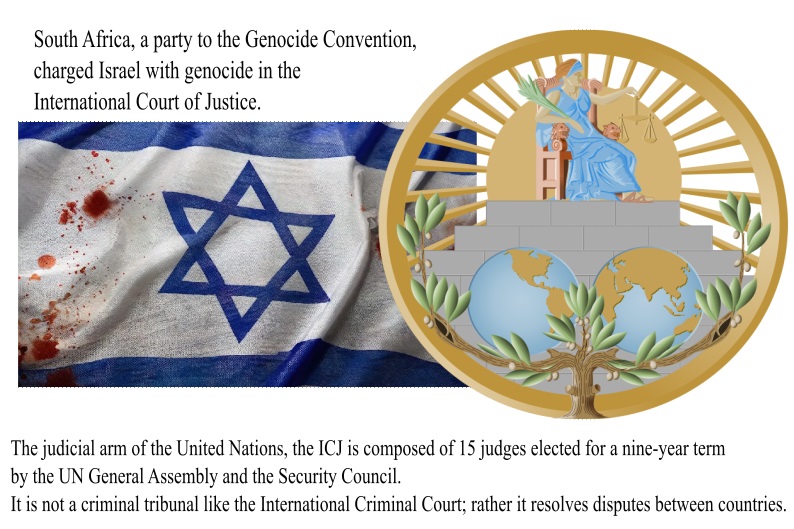
South Africa, a party to the Genocide Convention, charged Israel with genocide in the International Court of Justice.
By Marjorie Cohn / Truthout, January 8, 2024, https://scheerpost.com/2024/01/08/israel-is-terrified-the-world-court-will-decide-its-committing-genocide/
For nearly three months, Israel has enjoyed virtual impunity for its atrocious crimes against the Palestinian people. That changed on December 29 when South Africa, a state party to the Genocide Convention, filed an 84-page application in the International Court of Justice (ICJ, or World Court) alleging that Israel is committing genocide in Gaza.
South Africa’s well-documented application alleges that “acts and omissions by Israel … are genocidal in character, as they are committed with the requisite specific intent … to destroy Palestinians in Gaza as a part of the broader Palestinian national, racial and ethnical group” and that “the conduct of Israel — through its State organs, State agents, and other persons and entities acting on its instructions or under its direction, control or influence — in relation to Palestinians in Gaza, is in violation of its obligations under the Genocide Convention.”
Israel is mounting a full-court press to prevent an ICJ finding that it’s committing genocide in Gaza. On January 4, the Israeli Foreign Ministry instructed its embassies to pressure politicians and diplomats in their host countries to make statements opposing South Africa’s case at the ICJ.
In its application, South Africa cited eight allegations to support its contention that Israel is perpetrating genocide in Gaza. They include:
(1) Killing Palestinians in Gaza, including a large proportion of women and children (approximately 70 percent) of the more than 21,110 fatalities and some appear to have been subjected to summary execution;
(2) Causing serious mental and bodily harm to Palestinians in Gaza, including maiming, psychological trauma, and inhuman and degrading treatment;
(3) Causing the forced evacuation and displacement of about 85 percent of Palestinians in Gaza — including children, the elderly and infirm, and the sick and wounded. Israel is also causing the massive destruction of Palestinian homes, villages, towns, refugee camps and entire areas, which precludes the return of a significant proportion of the Palestinian people to their homes;
(4) Causing widespread hunger, starvation and dehydration to the besieged Palestinians in Gaza by impeding sufficient humanitarian assistance, cutting off sufficient food, water, fuel and electricity, and destroying bakeries, mills, agricultural lands and other means of production and sustenance;
(5) Failing to provide and restricting the provision of adequate clothing, shelter, hygiene and sanitation to Palestinians in Gaza, including 1.9 million internally displaced persons. This has compelled them to live in dangerous situations of squalor, in conjunction with routine targeting and destruction of places of shelter and killing and wounding of persons who are sheltering, including women, children, the elderly and the disabled;
(6) Failing to provide for or ensure the provision of medical care to Palestinians in Gaza, including those medical needs created by other genocidal acts that are causing serious bodily harm. This is occurring by direct attacks on Palestinian hospitals, ambulances and other healthcare facilities, the killing of Palestinian doctors, medics and nurses (including the most qualified medics in Gaza) and the destruction and disabling of Gaza’s medical system;
(7) Destroying Palestinian life in Gaza, by destroying its infrastructure, schools, universities, courts, public buildings, public records, libraries, stores, churches, mosques, roads, utilities and other facilities necessary to sustain the lives of Palestinians as a group. Israel is killing whole families, erasing entire oral histories and killing prominent and distinguished members of society;
(8) Imposing measures intended to prevent Palestinian births in Gaza, including through reproductive violence inflicted on Palestinian women, newborns, infants and children.
South Africa cited myriad statements by Israeli officials that constitute direct evidence of an intent to commit genocide:
“Gaza won’t return to what it was before. We will eliminate everything,” Israel’s Defense Minister Yoav Gallant said. “If it doesn’t take one day, it will take a week. It will take weeks or even months, we will reach all places.”
Avi Dichter, Israel’s Minister of Agriculture, declared, “We are now actually rolling out the Gaza Nakba,” a reference to the 1948 ethnic cleansing of Palestinians to create the state of Israel.
“Now we all have one common goal — erasing the Gaza Strip from the face of the earth,” Nissim Vaturi, the Deputy Speaker of the Knesset and Member of the Foreign Affairs and Security Committee proclaimed.
Israel’s Strategy to Defeat South Africa’s Case at the ICJ
Continue readingWhere your $trillions go, to risk all life

Peace and Planet News, by Anthony Donovan | Winter 2023 Edition
We’ve seen an amazing level of bipartisan support!” For what initiative do we hear this rare statement echoed about Congress today?
The 15th Annual Nuclear Deterrence Summit, held once again at the Hyatt Regency in Arlington, Va., Feb. 13–15. For three days the rooms are filled with a multitude of companies and government agencies from around the country connected to the Department of Energy, Department of Defense, and National Nuclear Security Administration that make up our nuclear weapons industry, and its terribly secretive renewed Mutually Assured Destruction (MAD) race.
What is termed the “Enterprise” is in full-out sales and confidence-building mode. It is here the relationships for securing contracts through the next 5 to 35 years are solidified.
One aged reporter who once covered the industry in the 1980s confides his shock after a dizzying day of presentations: “How did you know these gatherings were going on? I just found out last week! Can’t believe this, I mean, this is a new unbridled arms race! These people in there are totally convinced this is the only way to go.” Looking at only two of us with our sign, he asks, “Why aren’t more people in the streets? Where is the movement pushing back?”………………………………………………………………….
Attendees were a bit puzzled that I wasn’t with a company connected to the summit, but I continued to share my purpose, seeing that we desperately need their dedication and skillset to begin turning toward the critical needs before us today: sustainability, good jobs supporting our environment, food, water, air, housing, healthcare, education, infrastructure … you know the issue. Some were relieved that I was all for science and space exploration, but first, for the precious earth!
…………………………………………………… Most exhibitors were too young to remember that the vast majority of citizens had voted with their feet to end this madness, and that there was no transparency or democratic process in the decision to use our treasure to fund it all.
Inevitably the confounding old Cold War rhetoric arose, painting China and Russia as vile enemies that we can not trust to honor any agreements. ……………………..
Naturally, I’d let them know we had a most worthy instrument, The Treaty on the Prohibition of Nuclear Weapons, now international law, to help guide this needed transformation, despite its being dismissed by our mainstream media. Only a few had heard of it, and of those, few knew particulars.
Laser beamed on their one aspect of the industry, several with competitors present vying for the same contract, many met in the dozens of closed-door side rooms for private company presentations/briefings. There were open “networking breakfasts” lunches and evening cocktail parties and several daily general gatherings in the large Hyatt Ballroom focused on the latest in pit production, delivery platforms, command-and-control infrastructure and communications, warhead modernization, STRATCOM reports, reports from the heads of all our labs, Los Alamos, Oak Ridge, Sandia, etc. Presentations on increasing efficiency in product and organization, best practices, and cited pathways to “success.” After all, we are leading and “winning.” Exactly what we think we are winning made no sense to anyone on the nuclear abolition team.
There were exhibitors displaying highly specialized metal nose cones and delivery vehicle parts. Designers of fabrics that claim to protect from radioactivity, cybersecurity “experts,” nuclear waste management specialists, triad infrastructure architects, specialists in improving uranium refining, nuclear physicists and engineers specializing in all materials and their “enhanced delivery” of precision warhead targeting and interception by “safety” umbrellas, inter-agency communication specialists, and those through it all maintaining secure communications. My presence seemed harmless enough to this security. I think of all our very brave colleagues who’ve risked life to enter the kill zones of these most highly sealed-off omnicidal compounds to render witness of the crime against humanity.
Amazon, a “Gold Sponsor” of the summit, had an exhibit: “We have established good relations with the CIA, but we need to get better integrated with the NNSA. This is new to us. That’s why we’re here.”
In this very clearly white male-oriented world, there was also a presentation on the essential hiring of more “diversity” for the future. One enticing statement read they “offer specialized worth to employees by valuing their entire career life cycle–creating stable careers…” Ah, such security………..
The revolving door is astoundingly evident here, and the boundaries of government, military, with private companies is quite indistinguishable. Those with Navy, Air Force, and other triad experience are now running these private companies or working as their specialized “experts in technical and professional innovation. support and security.” One “private” company proudly advertising that 70% of “our expertise” hold all the necessary security clearances within the government!
…………………………….. Former General Lloyd Austin, who retired to become Raytheon’s CEO, was easily confirmed by our Congress to become our current Secretary of Defense under President Biden. In his hearings, General/CEO Austin guaranteed to our representatives that the Triad would get his full support to obtain all that it needed. What seems illegal goes unchallenged.
Along with the DOE, National Security Administration, and Budget Office, the regular old nuclear weapon corps were very present: General Dynamics, Huntington Ingalls, Bechtel, Flour, Honeywell, Aerospace, SAIC, etc., and a number of universities……………………………………………………………………………………………………..
Within 25 minutes we were surrounded by hotel security and managers asking us to leave the premises immediately. They then claimed even the sidewalks outside the hotel were private and we could not remain there………………………………………………………..
Ask your representative to sign H. Res. 77, sponsored by Rep. James McGovern, supporting the goals of the Treaty on the Prohibition of Nuclear Weapons! Ask your senator to call for the same in the Senate. Thank all the nations ratifying the TPNW. Ask your representative to observe the Ban Treaty’s Meeting of States this November in New York City at the United Nations. They are welcome to learn, and think deeper.
Knowing the horror of war was pushing ahead and with it an increasing, completely unnecessary risk of nuclear annihilation, there was ever-present sense of unity with the citizens of the world who are pleading and advocating another way. There were many thumbs up and waves from passing vehicles. Thinking of those who have young children/grandchildren, including a good number I got to speak with on this Summit floor, we felt there was nowhere else to be on this day celebrating the love in our hearts and in our lives, round the world, Valentine’s Day. https://peaceandplanetnews.org/where-your-trillions-go/
Energy Transition Minister Agnes Pannier-Runacher enthuses over “the rebirth of France’s nuclear industry”

EDF will construct the new plants with tens of billions in public financing

“EDF will construct the new plants with tens of billions in public financing ” – what could possibly go wrong?
France sees potential for 14 new nuclear reactors. 8 Jan 24, https://www.power-technology.com/news/france-may-build-14-new-nuclear-reactors/
France may need to build more than 14 new nuclear power plants, more than the six currently planned, if the nation is to meet its energy transition goal of reducing fossil fuel dependence from 60% to 40% by 2035.
Energy Transition Minister Agnes Pannier-Runacher stressed that nuclear will play an increasingly vital role in France’s energy mix. Speaking to La Tribune Dimanche just a few weeks before parliament reveals a bill relating to energy sovereignty, Pannier-Runacher said: “We need nuclear power beyond the first six EPRs [European Pressurised Reactors] since the existing (nuclear) park will not be eternal.”
This new energy strategy will be debated in parliament from late January and must be codified into law.
In 2022, French nuclear power output fell to a 30-year low after operational issues forced many reactors offline. This placed additional upward pressure on European energy prices, which were already being driven up reduced gas flows from Russia. However, French President Emmanuel Macron emphasised the importance of nuclear, stating: “What our country needs, and the conditions are there, is the rebirth of France’s nuclear industry.”
Over the course of 2023, availability improved, falling in line with state-controlled energy provider EDF’s target of 300–330 terawatt-hours. EDF will construct the new plants with tens of billions in public financing and chief executive Luc Rémont said his company aims to build roughly one 1.6GW reactor a year.
President Macron also reinforced his country’s commitment to nuclear at the recent COP28 climate summit in Dubai, where he led a group of 20 world leaders signing a pledge to “triple nuclear energy capacity from 2020 by 2050”. Shortly after signing, Macron pronounced that “nuclear energy is back”.
France currently has 56 operable reactors that produce around 70% of the nation’s electricity. Comparatively, Germany, another European superpower, does not produce any of its electricity from nuclear power, while in the UK the figure is 15%.
The ‘Ghost Budget’: How America Pays for Endless War

The post-9/11 war funding pattern was completely different. For the first time since the American Revolutionary War, war costs were covered almost entirely by debt. There were no wartime tax increases or cuts in spending. Quite the reverse
a “culture of endless money” inside the Pentagon.
the ability to keep borrowing and spending with minimal oversight allowed the United States to keep fighting indefinitely.
Prior to 2001, U.S. wars were financed through a mixture of higher taxes and budget cuts, and funded mostly through the regular defense budget. The post-9/11 war funding pattern was completely different.
By Linda Bilmes / Just Security https://scheerpost.com/2024/01/08/the-ghost-budget-how-america-pays-for-endless-war/
The post-9/11 wars in Iraq and Afghanistan were enabled by a historically unprecedented combination of budgetary procedures and financing methods. Unlike all previous U.S. wars, the post-9/11 wars were funded without higher taxes or non-war budget cuts, and through a separate budget. This set of circumstances – one that I have termed the “Ghost Budget” – enabled successive administrations to prosecute the wars with limited congressional oversight and minimal transparency and public debate. I adopted the name “Ghost Budget” because the term “ghost” appeared frequently in post-9/11 government reports in reference to funds allocated to people, places, or projects that turned out to be phantoms.
The Ghost Budget was the result of an interplay between changes in the U.S. budgetary process, a more assertive military establishment, and the conditions in global capital markets. It has had far-reaching implications for the conduct and course of the post-9/11 wars and for defense policy today.
Funding the Post-9/11 Wars
The “Ghost Budget” was the biggest budgetary anomaly in U.S. history. Prior to 9/11, U.S. wars were financed through a mixture of higher taxes and budget cuts, and funded mostly through the regular defense budget. One third of the costs of World War I and half the costs of World War II were met through higher taxes. During World War II, President Franklin D. Roosevelt described paying taxes as a “patriotic duty” as he raised taxes on business, imposed a “wealth tax,” raised inheritance taxes, and expanded the number of income taxpayers to roughly 80 percent of the workforce by 1945. Wars in Korea and Vietnam largely followed a similar pattern, with President Harry Truman pledging to make the country “pay as you go” for the Korean War. War funding was also a central issue in the Vietnam War, which ended when Congress refused to appropriate money for the South Vietnamese military.
The post-9/11 war funding pattern was completely different. For the first time since the American Revolutionary War, war costs were covered almost entirely by debt. There were no wartime tax increases or cuts in spending. Quite the reverse: far from demanding sacrifices, President George W. Bush slashed federal taxes in 2001 and again in 2003, just as the United States invaded Iraq. President Donald Trump reduced taxes further in 2017. Overall, federal taxes declined from 18.8 percent of GDP in 2001 to 16.2 percent by the start of 2020. In the same period, outstanding federal debt held by the public rose from $3.5 trillion to $20 trillion. War spending contributed at least $2.2 trillion to this increase.
Not only was the financing strategy unprecedented, but the budgetary mechanism used to approve the vast post-9/11 wartime spending also diverged radically from the past. In all previous conflicts, the United States paid for wars as part of its regular defense appropriations (the defense “base budget”), after the initial period (1-2 years) of supplemental “emergency” funding bills. By contrast, for the entire decade from FY 2001 to FY 2011, Congress paid for the conflicts in Iraq and Afghanistan as “emergencies,” devoid of serious legislative or executive oversight.
By statute, emergency spending is defined as “unanticipated…sudden…urgent…unforeseen…and temporary” and is typically reserved for one-off crises such as floods and hurricanes. Such emergency spending measures are exempt from regular procedural rules in Congress because the intent is to disburse money quickly in situations where delay would be harmful.
Congress continued to enact “emergency supplemental” funding even as the war effort expanded. The United States sent 130,000 military personnel into Iraq in 2003 (alongside troops from more than 30 countries). By 2009, there were 187,200 U.S. “boots on the ground” in Iraq and Afghanistan, supported by a similar number of military contractors, with nearly 500 U.S. military bases set up across Iraq, but the conflict was still being paid for as an “emergency.” In FY 2012, President Obama renamed the “Global War on Terror” as “Overseas Contingency Operations” (OCO) but the war continued to be funded using money that – although not designated as “emergency” – was explicitly exempted from regular spending limits on other government spending programs.
How We Got Here
There were three primary drivers of the Ghost Budget: unusual economic conditions, congressional budget dysfunction, and military assertiveness.
Economic Conditions: Unlike earlier wars, the post 9/11 conflicts took place in an era of free-flowing international capital markets. That provided the U.S. Treasury with access to a deep and global pool of capital, making it easy to borrow large amounts without negatively affecting the cost. It was also a period of historically low interest rates. Real interest rates (nominal rate minus inflation) on 10-year Treasury bonds fell from 3.4% at the start of 2001 to negative (-0.4%) by early 2021 — a 40-year low. Consequently, the Treasury was able to borrow trillions of dollars to pay for the wars, and simultaneously finance the tax cuts of 2001 and 2003 without having any material effect on the amount of debt service being repaid through the annual budget. By FY 2017, total public debt had more than tripled, but debt service payments as a percentage of annual budget outlays had decreased to 6.6 percent, compared to 8.5 percent of federal budget outlays in FY 2002. In terms of cash outlays, this meant that the United States paid only slightly more in interest payments in FY 2017 than it had in FY 2002 ($268 billion versus $232 billion in 2018 dollars). Borrowing seemed virtually painless.
Budget Dysfunction: For several decades, the federal budget process has become increasingly dysfunctional. This breakdown may be traced to the post-Watergate budget reforms enacted in 1974, which shifted power away from the President and to the Congress. Most budget experts from both parties agree that the reforms made the budget process weaker, less predictable, less capable of reconciling competing demands, and more prone to fiscal crises. Prior to 1974, the federal government had never ceased operations for lack of funding. Since then, it has “shut down” 22 times, completely or partially. There have been only four years in which Congress passed its annual appropriations bills on time, and a series of near-defaults and other fiscal crises. In the absence of reliable budgets, Congress has enacted hundreds of short-term stopgap “continuing resolutions” to pay the bills. In this context, it was convenient for all the stakeholders to fund the wars as an “emergency” outside the regular process. The President was able to exclude war funding from his annual defense budget request to Congress, thus presenting an artificially low number for the federal budget deficit. This helped the Bush administration sustain the pretense that the wars would be short, while pursuing its political agenda of cutting taxes. Meanwhile, Congress was freed from the need to find politically painful spending cuts elsewhere to pay for the war, and the Pentagon was able to prosecute the wars without worrying about whether Congress would pass the defense appropriations bills on time.
Military Assertiveness: In 2001, the Pentagon was actively seeking to increase its budget after a decade of post-cold war budget cuts. The Afghanistan and Iraq conflict not only reversed the downward trend in military spending, but opened the floodgates to a spending bonanza due to the nature of emergency and OCO appropriations. Unlike the regular defense base budget, the wartime supplemental money was easier to secure, had few restrictions on how it could be spent, and avoided the lengthy internal Planning, Programming, Budgeting & Execution Process (PPBE) budget justification process. Consequently, the Defense Department was able to shift war funding into other categories to obtain items on its long-time “wish list” that were only tangentially (or not at all) related to the wars in Iraq or Afghanistan. Former Defense Secretary Robert Gates termed this a “culture of endless money” inside the Pentagon.
By 2009, war spending accounted for almost one quarter of the total military budget; the Pentagon budget had grown to its highest level since the Second World War, and military spending had rebounded from 2.9% of GDP in FY 2001 to above 4% of GDP, where it remained through FY 2019. The OCO budget had evolved into a second defense budget that was largely untethered from the wars, and protected the military from congressional budget volatility.
Implications for Perpetual War
The Ghost Budget provided the ability to keep borrowing and spending in an almost unconstrained manner for more than two decades. The absence of new taxes insulated the public from the mounting cost of the wars and broke the expectation that wars would inevitably involve higher taxes. The OCO budget extended far beyond the immediate operational needs of the wars in Afghanistan and Iraq, perpetuating military actions throughout the region. As Immanuel Kant predicted in Perpetual Peace (1795), the ability to keep borrowing and spending with minimal oversight allowed the United States to keep fighting indefinitely.
Implications for Perpetual War
The Ghost Budget provided the ability to keep borrowing and spending in an almost unconstrained manner for more than two decades. The absence of new taxes insulated the public from the mounting cost of the wars and broke the expectation that wars would inevitably involve higher taxes. The OCO budget extended far beyond the immediate operational needs of the wars in Afghanistan and Iraq, perpetuating military actions throughout the region. As Immanuel Kant predicted in Perpetual Peace (1795), the ability to keep borrowing and spending with minimal oversight allowed the United States to keep fighting indefinitely.
The legacy of the Ghost Budget is that money is no longer a serious deterrent to war. To date, 99% of US assistance to Ukraine has been funded by supplemental emergency funds – which means that this spending is in addition to the $840 billion regular defense budget. The Biden administration has asked Congress to approve another $106 billion in emergency funding for the Middle East, Ukraine, and other regions. Regardless of the merits of any particular endeavor, the use of Ghost Budgets makes it far easier to prolong the fighting at any cost.
1 This month
Chernobyl: The Lost Tapes – A good documentary on Chernobyl on SBS available On Demand for the next 3 weeks– https://www.sbs.com.au/ondemand/tv-program/chernobyl-the-lost-tapes/2352741955560
15 April – Zoom –Nuclear Power is Not the Solution
Apr 15, 2026 01:00 AM in Canberra, Melbourne, Sydney

Join the International Physicians for the Prevention of Nuclear War (IPPNW) on Tuesday, April 14th for a timely webinar exploring the risks associated with nuclear power and challenging the myth that it offers a simple, safe, carbon-free solution to the climate crisis

21 April Webinar: No Nuclear Weapons in Australia
Start: 2026-04-21 18:00:00 UTC Canberra, Melbourne, Sydney (GMT+10:00)
End: 2026-04-21 19:30:00 UTC Canberra, Melbourne, Sydney (GMT+10:00)
Event Type: Virtual
A virtual link will be communicated before the event.
Host Contact Info: australia@icanw.org

of the week – Australians for War Powers Reform (AWPR)
To see nuclear-related stories in greater depth and intensity
 Antinuclear